8-37. (35 min.) Compute Costs per Equivalent Unit—Weighted-Average Method:
Pacific Ink.
Physical
Units
Equivalent Units
Materials
Eq. units
Conversion Costs
Eq. units
Flow of units:
Units to be accounted for:
Beginning WIP inventory ………………..
48,000
Units started this perioda
84,000
Total units to account for ……………..
132,000
Units accounted for:
Completed and transferred out (given)
102,000
102,000
102,000
Units in ending inventory ………………..
30,000
Materials (30,000 x 80%) …………….
24,000
Conversion costs (30,000 x 40%) …
12,000
Total units accounted for ……………..
132,000
126,000
114,000
a 84,000 units started this period = 132,000 units to account for – 48,000 units in
beginning work-in-process inventory.
Total
Direct
Materials
Conversion
Costs
Flow of costs:
Costs to be accounted for:
Costs in beginning WIP inventory ……….
Current period costs …………………………
Total costs to be accounted for ……….
$6,116,400
$3,467,880
Cost per equivalent unit
Materials ($2,648,520 ÷ 126,000 units) .
Conversion costs ($3,467,880 ÷ 114,000)
414 Fundamentals of Cost Accounting
8-38. (20 min.) Assign Costs to Goods Transferred Out and Ending Inventory—
Weighted-Average Method: Pacific Ink.
Total
Direct
Materials
Conversion
Costs
Flow of costs:
Costs to be accounted for:
Costs in beginning WIP inventory ………
$ 744,960
$ 304,920
$ 440,040
Current period costs …………………………
5,371,440
2,343,600
3,027,840
Total costs to be accounted for ……….
$6,116,400
$2,648,520
$3,467,880
Cost per equivalent unit
Materials ($2,648,520 ÷ 126,000 units) .
$ 21.02
Conversion costs ($3,467,880 ÷ 114,000)
$ 30.42
Costs accounted for:
Cost of ending WIP inventory …………….
Costs transferred out total $5,246,880 and costs in ending inventory total $869,520.
a $2,144,040 = 102,000 EU x $21.02 per EU.
b $3,102,840 = 102,000 EU x $30.42 per EU.
8-39. (35 min.) Compute Costs per Equivalent Unit—FIFO Method: Pacific Ink.
Physical
Units
Equivalent Units
Materials
Eq. units
Conversion
Costs Eq.
units
Flow of units:
Units to be accounted for:
Beginning WIP inventory ………………………
48,000
Units started this perioda
84,000
Total units to account for ……………………
132,000
Units accounted for:
Completed and transferred out
102,000
From beginning WIP inventory
Materials (48,000 x (1 – 30%)) ……
33,600
Conversion (48,000 x (1 – 30%)) ..
33,600
Started and completed …………………….
54,000
54,000
Units in ending inventory ………………………
30,000
Materials (30,000 x 80%) …………………..
Conversion costs (30,000 x 40%) ……….
12,000
Total units accounted for ……………………
Total
Direct
Materials
Conversion
Costs
Flow of costs:
Costs to be accounted for:
Costs in beginning WIP inventory ……….
$ 744,960
$ 304,920
$ 440,040
Current period costs …………………………
5,371,440
2,343,600
3,027,840
Total costs to be accounted for ……….
$6,116,400
$2,648,520
$3,467,880
Cost per equivalent unit
Materials ($2,343,600 ÷ 111,600 units) .
Conversion costs ($3,027,840 ÷ 99,600)
416 Fundamentals of Cost Accounting
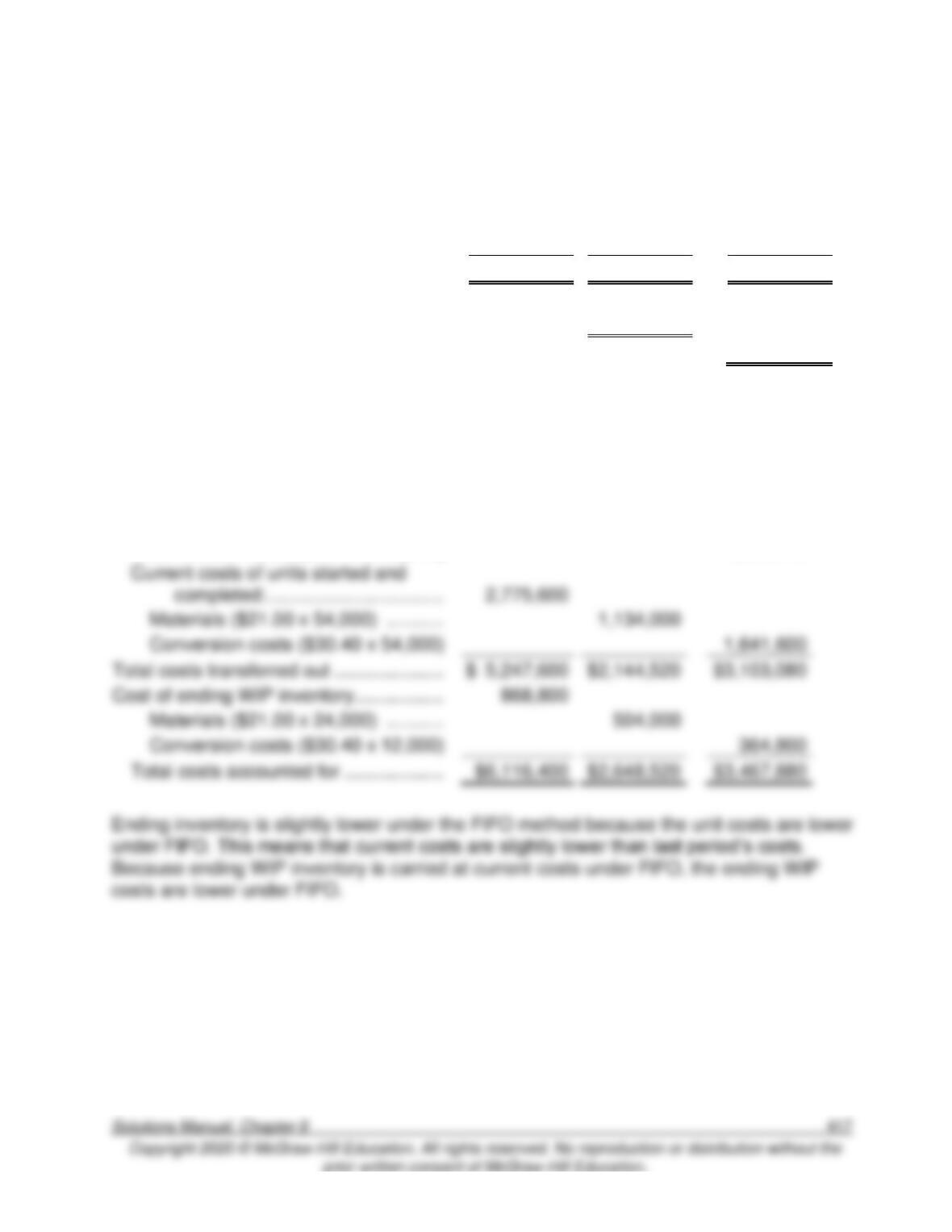
8-40. (20 min.) Assign Costs to Goods Transferred Out and Ending Inventory—
FIFO Method: Pacific Ink.
Physical
Units
Equivalent Units
Materials
Eq. units
Conversion
Costs Eq. units
Flow of units:
Units to be accounted for:
Beginning WIP inventory …………………..
48,000
Units started this perioda
84,000
Total units to account for ……………….
132,000
Units accounted for:
Completed and transferred out
102,000
To complete beginning WIP inventory
Materials (48,000 x (1 – 30%)) ..
Conversion (48,000 x (1 – 30%))
Started and completed …………………
Units in ending inventory …………………..
30,000
Materials (30,000 x 80%) ……………….
Conversion costs (30,000 x 40%) ……
Total units accounted for ……………….
8-40. (continued)
Total
Direct
Materials
Conversion
Costs
Flow of costs:
Costs to be accounted for:
Costs in beginning WIP inventory …….
$ 744,960
$ 304,920
$ 440,040
Current period costs ………………………
5,371,440
2,343,600
3,027,840
Total costs to be accounted for …….
$6,116,400
$2,648,520
$3,467,880
Cost per equivalent unit
Materials ($2,343,600 ÷ 111,600 units)
$ 21.00
Conversion costs ($3,027,840 ÷ 99,600)
$ 30.40
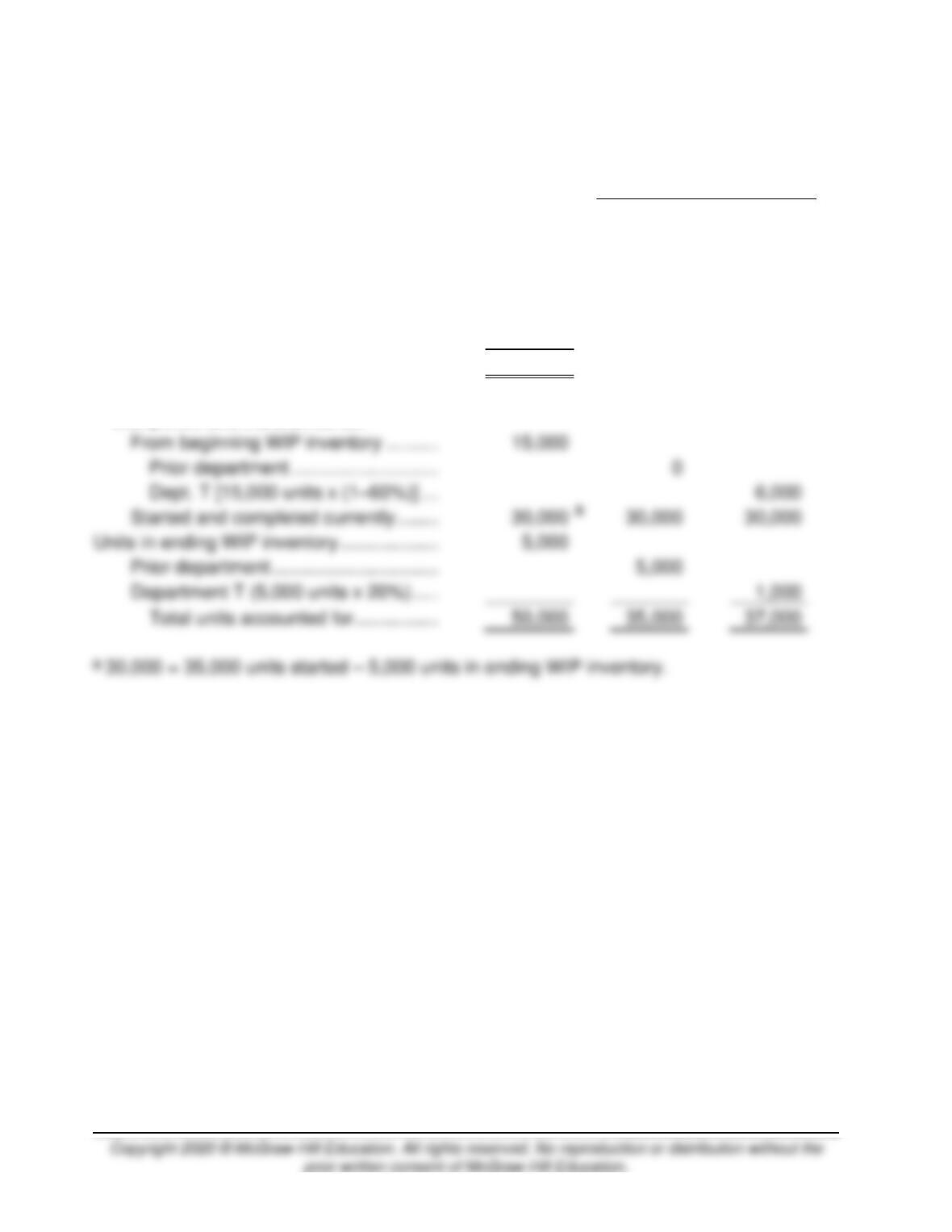
Costs accounted for:
Costs assigned to units transferred out:
Costs from beginning WIP inventory
$ 744,960
$ 304,920
$ 440,040
Current costs added to complete
beginning WIP inventory ………..
1,727,040
Materials ($21.00 x 33,600) ………..
705,600
Conversion costs ($30.40 x 33,600)
1,021,440
Materials ($21.00 x 54,000) ………..
1,134,000
Conversion costs ($30.40 x 54,000)
Total costs transferred out …………………
Cost of ending WIP inventory ……………..
Materials ($21.00 x 24,000) ………..
Conversion costs ($30.40 x 12,000)
Total costs accounted for ……………….
418 Fundamentals of Cost Accounting
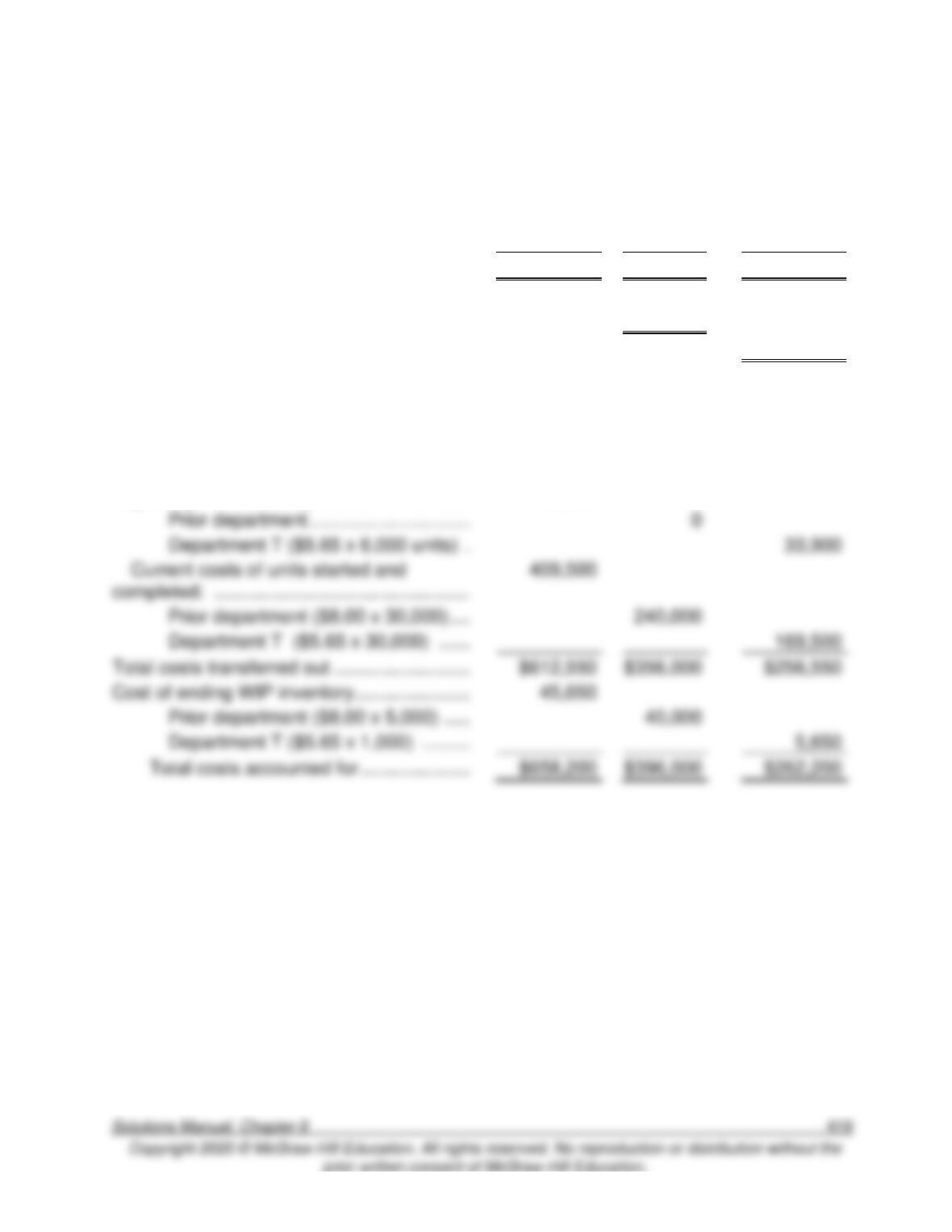
8-41. (50 min.) Prepare a Production Cost Report—FIFO method: Lansing, Inc.
Physical Units
Equivalent Units
Prior
Department
Department
No. T
Flow of units:
Units to be accounted for:
Beginning WIP inventory …………………..
15,000
Units started this period…………………….
35,000
Total units to account for ……………….
50,000
Units accounted for:
Completed and transferred out
From beginning WIP inventory ……….
Started and completed currently ……..
30,000
Units in ending WIP inventory ……………….
Department T (5,000 units x 20%) …..
8-41. (continued)
Total
Prior
Department
Department
No. T
Flow of costs:
Costs to be accounted for:
Costs in beginning WIP inventory ……….
$169,150
$116,000
$ 53,150
Current period costs …………………………
489,050
280,000
209,050
Total costs to be accounted for ……….
$658,200
$396,000
$262,200
Cost per equivalent unit
Prior department ($280,000 ÷ 35,000 units)
$ 8.00
Department. T ($209,050 ÷ 37,000 units)
$ 5.65
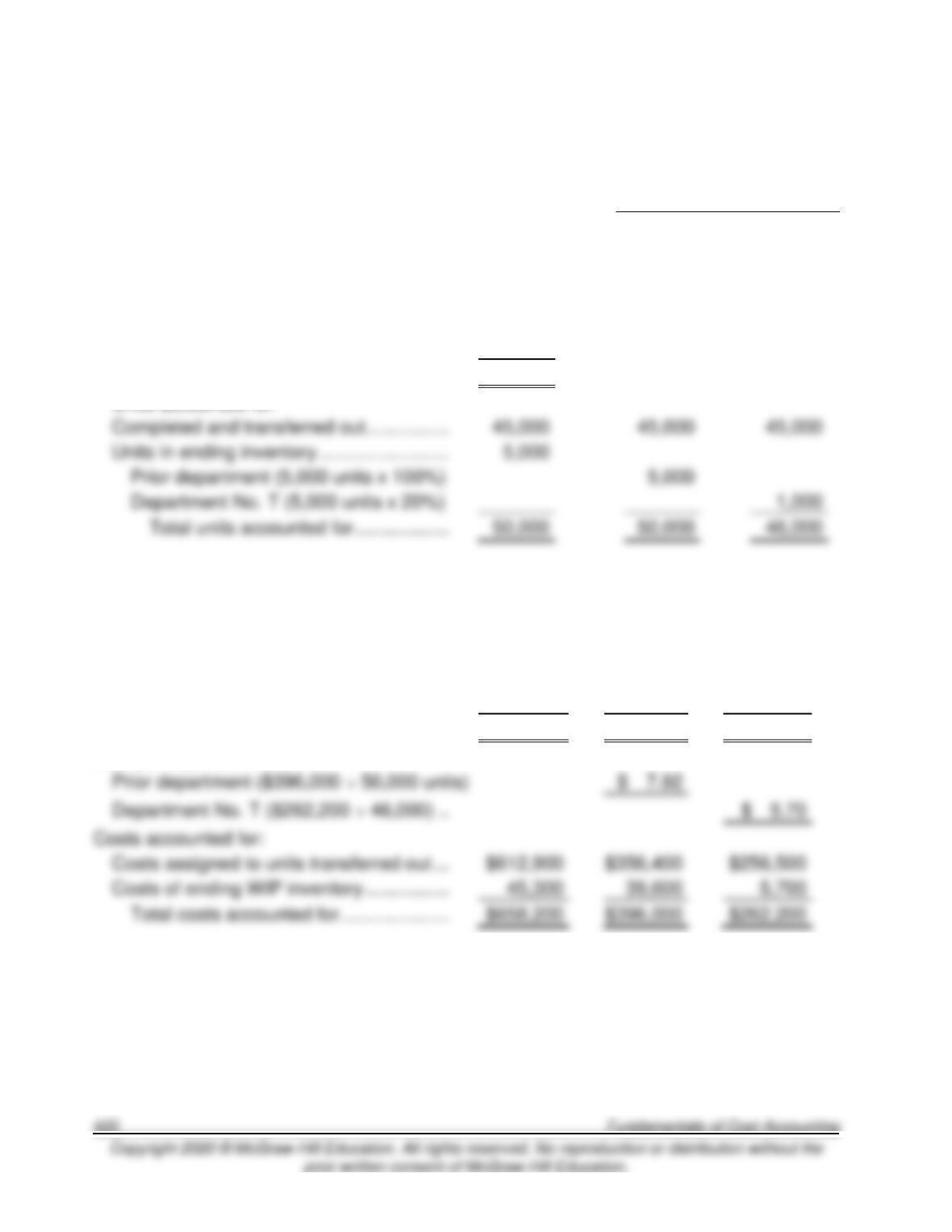
Costs accounted for:
Costs assigned to units transferred out:
Costs from beginning WIP inventory ….
$169,150
$116,000
$53,150
Current costs added to complete
beginning WIP inventory ………………………..
33,900
Prior department ………………………….
Department T ($5.65 x 6,000 units) .
Current costs of units started and
Prior department ($8.00 x 30,000) ….
Total costs transferred out ……………………..
$612,550
$356,000
Cost of ending WIP inventory ………………….
Prior department ($8.00 x 5,000) …..
40,000
Department T ($5.65 x 1,000) ………
Total costs accounted for …………………
$658,200
$396,000
$262,200
8-42. (50 min.) Prepare a Production Cost Report—Weighted-Average Method:
Lansing Inc.
a.
Physical
Units
Equivalent Units
Prior
Department
Department
No. T
Flow of units:
Units to be accounted for:
Beginning WIP inventory …………………….
15,000
Units started this period………………………
35,000
Total units to account for …………………
50,000
Completed and transferred out …………….
45,000
45,000
Total units accounted for ………………
50,000
46,000
Total
Prior
Department
Department
No. T
Flow of costs:
Costs to be accounted for:
Costs in beginning WIP inventory ………..
$169,150
$116,000
$ 53,150
Current period costs …………………………..
489,050
280,000
209,050
Total costs to be accounted for …………
$658,200
$396,000
$262,200
Cost per equivalent unit
Prior department ($396,000 ÷ 50,000 units)
Department No. T ($262,200 ÷ 46,000) ..
Costs accounted for:
$356,400
$256,500
Costs of ending WIP inventory …………….
Total costs accounted for …………………
$658,200
$396,000
$262,200
b. The ending inventory is lower under the weighted-average method than under the
FIFO method. Under weighted-average, the ending inventory is $45,300. This is $350
less than FIFO, which is $45,650. The difference is due to the differences in costs per
equivalent unit between FIFO and weighted-average.
8-42. (continued)
c. The decision depends on the decisions that will be made using the data. If the most
current cost information is desired, FIFO might be the better method. If there are
random fluctuations that the company wants to smooth, weighted average might be
best. In this case, the difference is so small it is unlikely to make a difference.
However, if prices fluctuate more, the differences might become more significant.
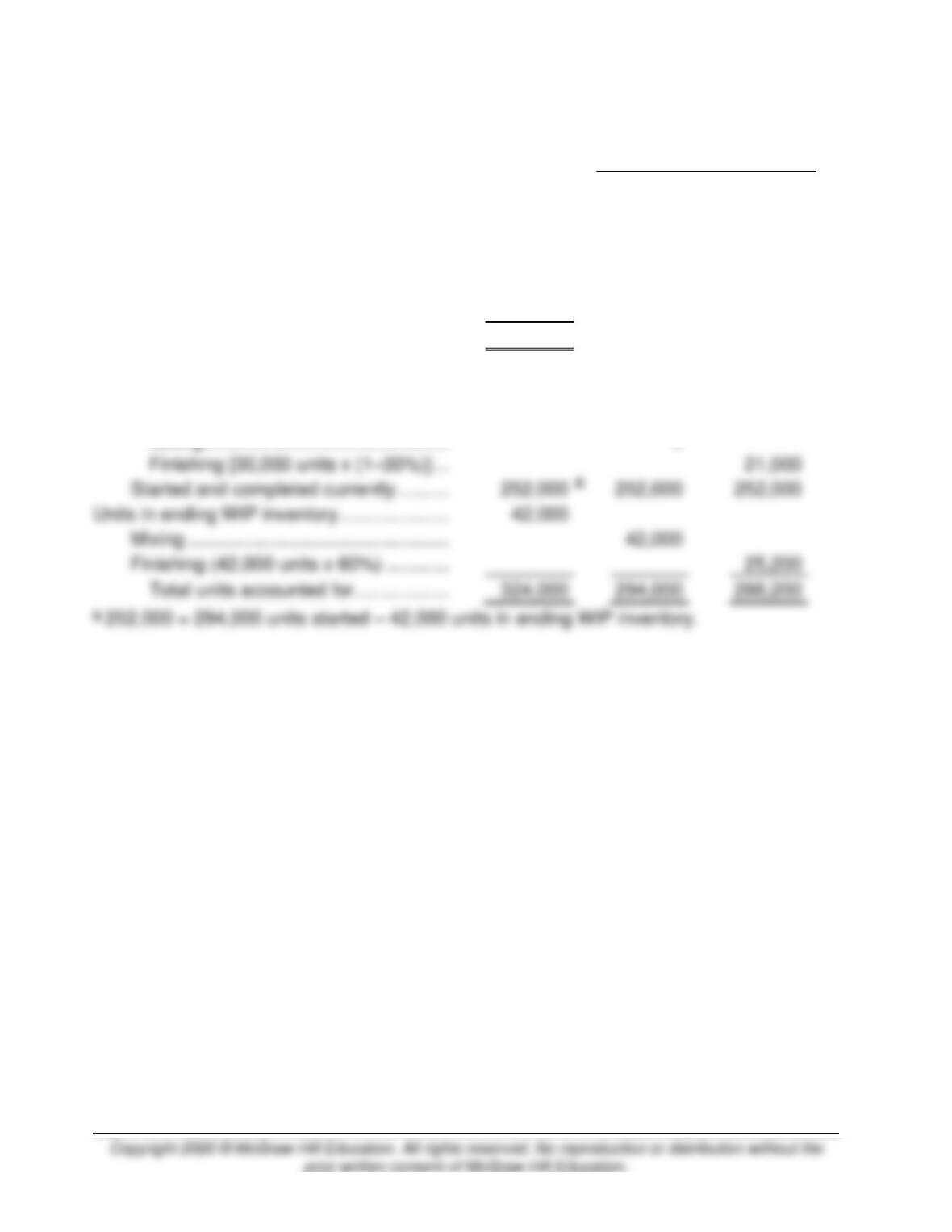
8-43. (50 min.) Prepare a Production Cost Report—Weighted-Average Method:
Yarmouth Company.
Physical
Units
Equivalent Units
Mixing
Department
Finishing
Department
Flow of units:
Units to be accounted for:
Beginning WIP inventory …………………….
30,000
Units started this period ………………………
294,000
Total units to account for ………………….
324,000
Units accounted for:
Completed and transferred out …………….
282,000
282,000
Units in ending inventory …………………….
Mixing (42,000 units x 100%) ……………
Total units accounted for ………………
324,000
Total
Direct
Materials
Conversion
Costs
Flow of costs:
Costs to be accounted for:
Costs in beginning WIP inventory …………
$723,636
$657,600
$ 66,036
Current period costs …………………………..
7,565,964
5,174,400
2,391,564
Total costs to be accounted for …………
$8,289,600
$5,832,000
$2,457,600
Cost per equivalent unit
Mixing ($5,832,000 ÷ 324,000 units) …….
Finishing ($2,457,600 ÷ 307,200) …………
Costs accounted for:
Costs assigned to units transferred out …
$2,256,000
Costs of ending WIP inventory …………….
Total costs accounted for …………………
$8,289,600
$5,832,000
$2,457,600
422 Fundamentals of Cost Accounting
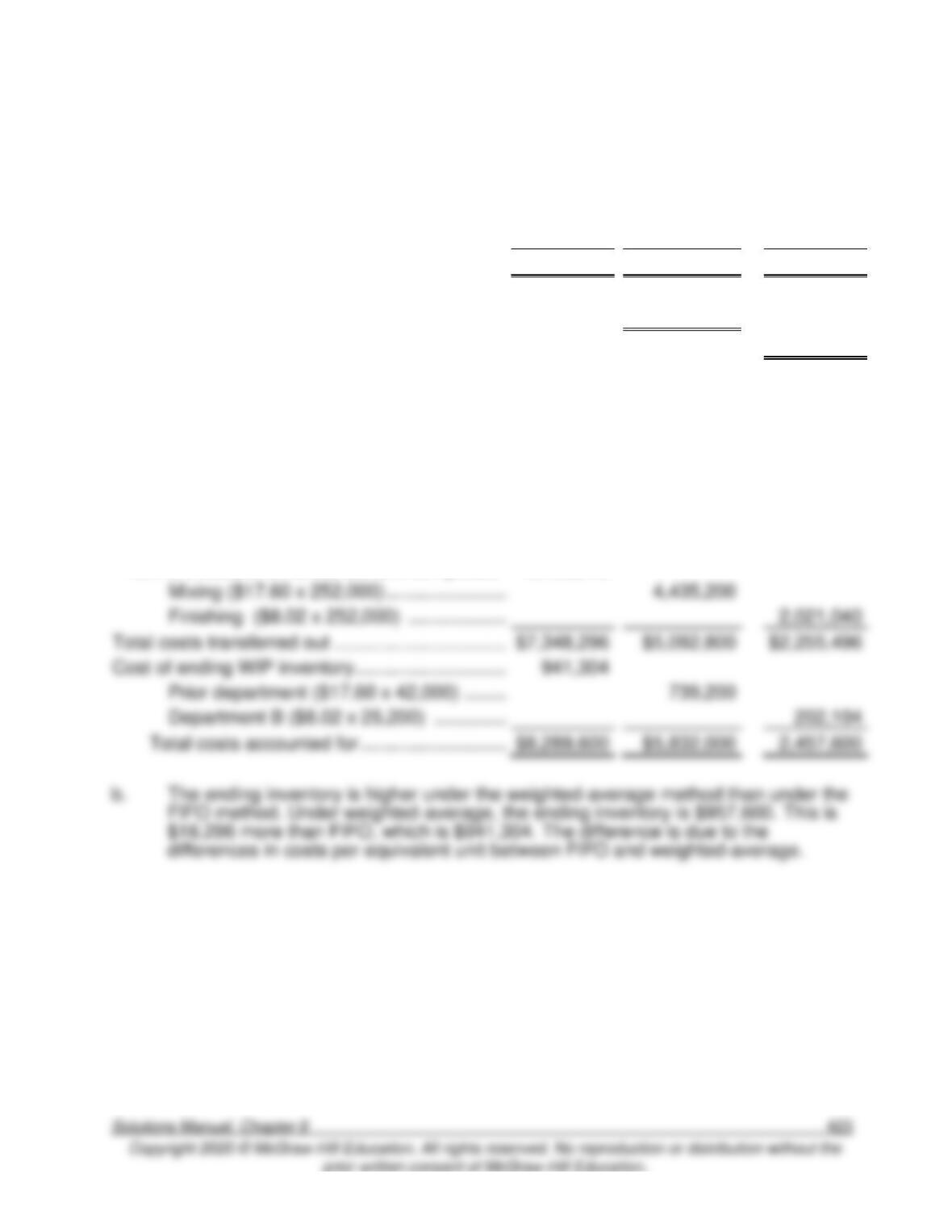
8-44. (50 min.) Production Cost Report—FIFO method: Yarmouth Company.
a.
Physical Units
Equivalent Units
Mixing
Department
Finishing
Department
Flow of units:
Units to be accounted for:
Beginning WIP inventory …………………….
30,000
Units started this period………………………
294,000
Total units to account for …………………
324,000
Units accounted for:
Completed and transferred out
From beginning WIP inventory …………
30,000
Started and completed currently ……….
252,000
Units in ending WIP inventory …………………
Finishing (42,000 units x 60%) …………
324,000
298,200
8-44. (continued)
Total
Mixing
Department
Finishing
Department
Flow of costs:
Costs to be accounted for:
Costs in beginning WIP inventory ……………….
$723,636
$657,600
$ 66,036
Current period costs …………………………………
7,565,964
5,174,400
2,391,564
Total costs to be accounted for ……………….
$8,289,600
$5,832,000
$2,457,600
Cost per equivalent unit
Mixing ($5,174,400 ÷ 294,000 units) ………….
$ 17.60
Finishing ($2,391,564 ÷ 298,200 units) ………
$ 8.02
Costs accounted for:
Costs assigned to units transferred out:
Costs from beginning WIP inventory ………..
$723,636
$657,600
$ 66,036
Current costs added to complete beginning
WIP inventory ……………………………………………..
168,420
Mixing ………………………………………………
0
Finishing ($8.02 x 21,000 units) ………….
168,420
Current costs of units started and completed:
6,456,240
Mixing ($17.60 x 252,000) …………………..
Finishing ($8.02 x 252,000) ……………….
2,021,040
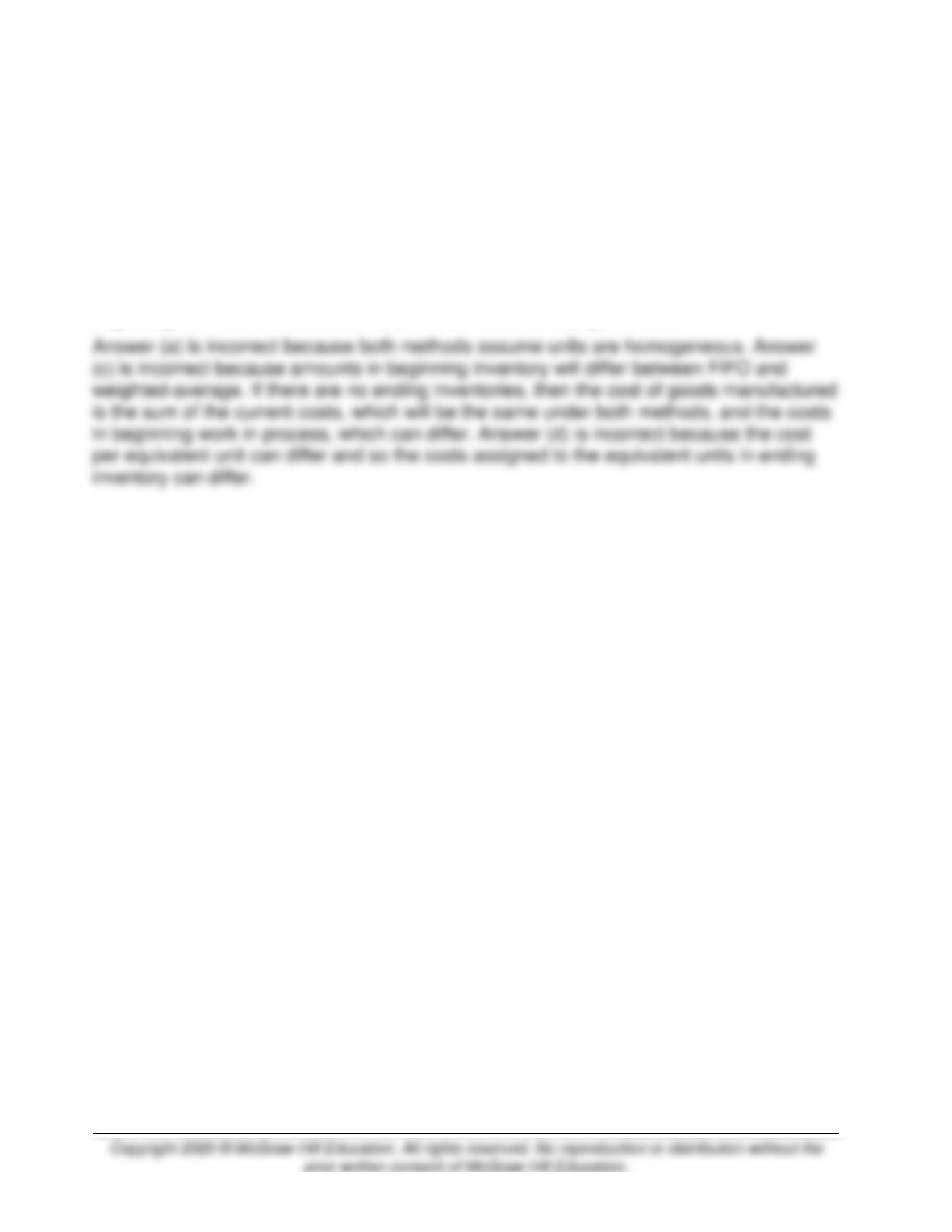
Cost of ending WIP inventory ………………………..
941,304
Prior department ($17.60 x 42,000) ……..
Department B ($8.02 x 25,200) …………..
Total costs accounted for ……………………….
$8,289,600
$5,832,000
424 Fundamentals of Cost Accounting
8-44. (continued)
c. The decision depends on the decisions that will be made using the data. If the
most current cost information is desired, FIFO might be the better method. If there
are random fluctuations that the company wants to smooth, weighted average
might be best.
8-45. (10 min.) Cost Per Equivalent Unit: Weighted-Average Method.
The correct answer is (b). The difference between the weighted-average and FIFO
methods of process costing is how they handle beginning WIP. When there is no
beginning WIP there is no difference between the two costing methods.
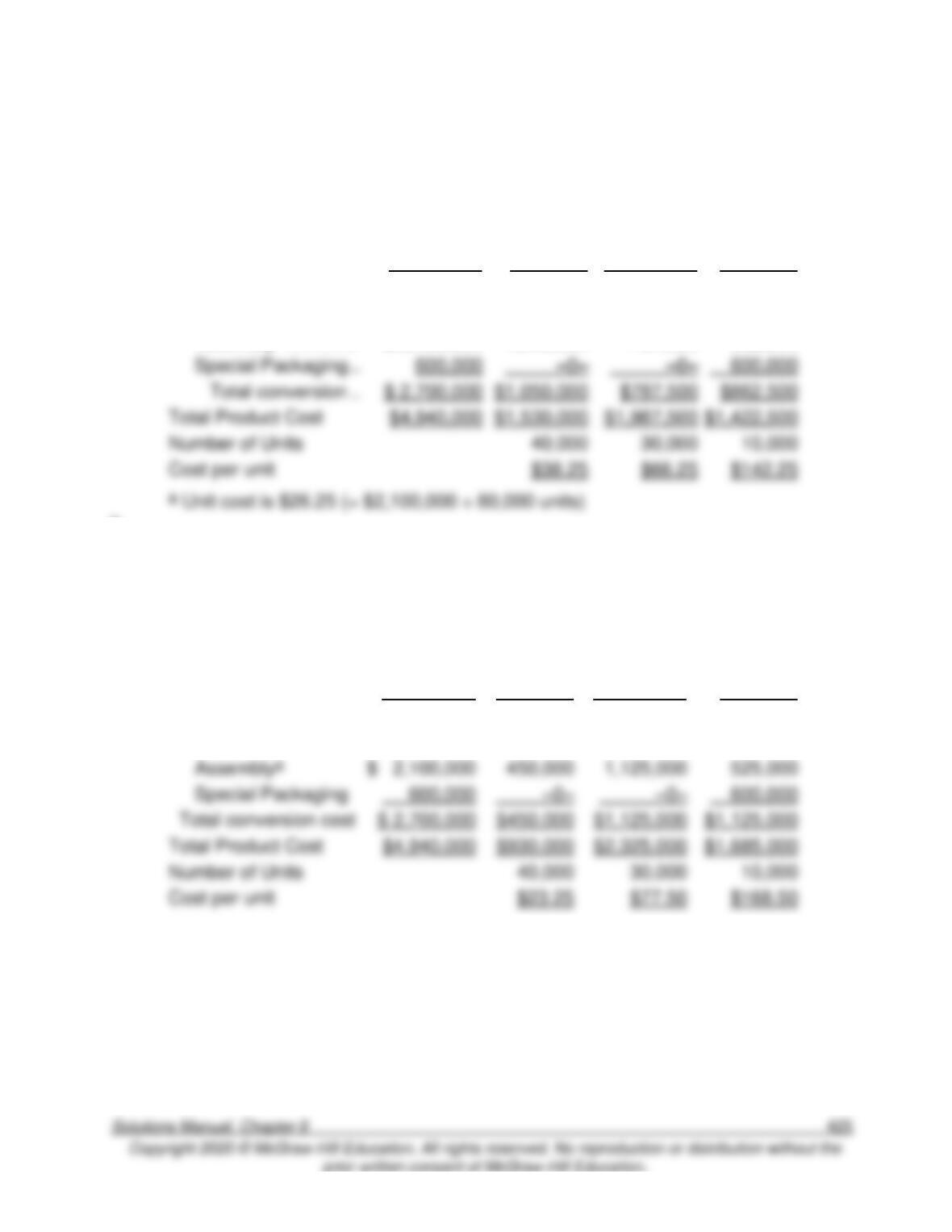
8-46. (50 min.) Operations Costing―Ethical Issues: Brokia Electronics.
a.
Total
Basic
(40,000
units)
Photo
(30,000
units)
UrLife
(10,000
units)
Materials ………………….
$2,240,000
$480,000
$1,200,000
$560,000
Conversion
Assemblya …………..
$ 2,100,000
1,050,000
787,500
262,500
–0–
Total conversion ..
Total Product Cost
Number of Units
Cost per unit
$142.25
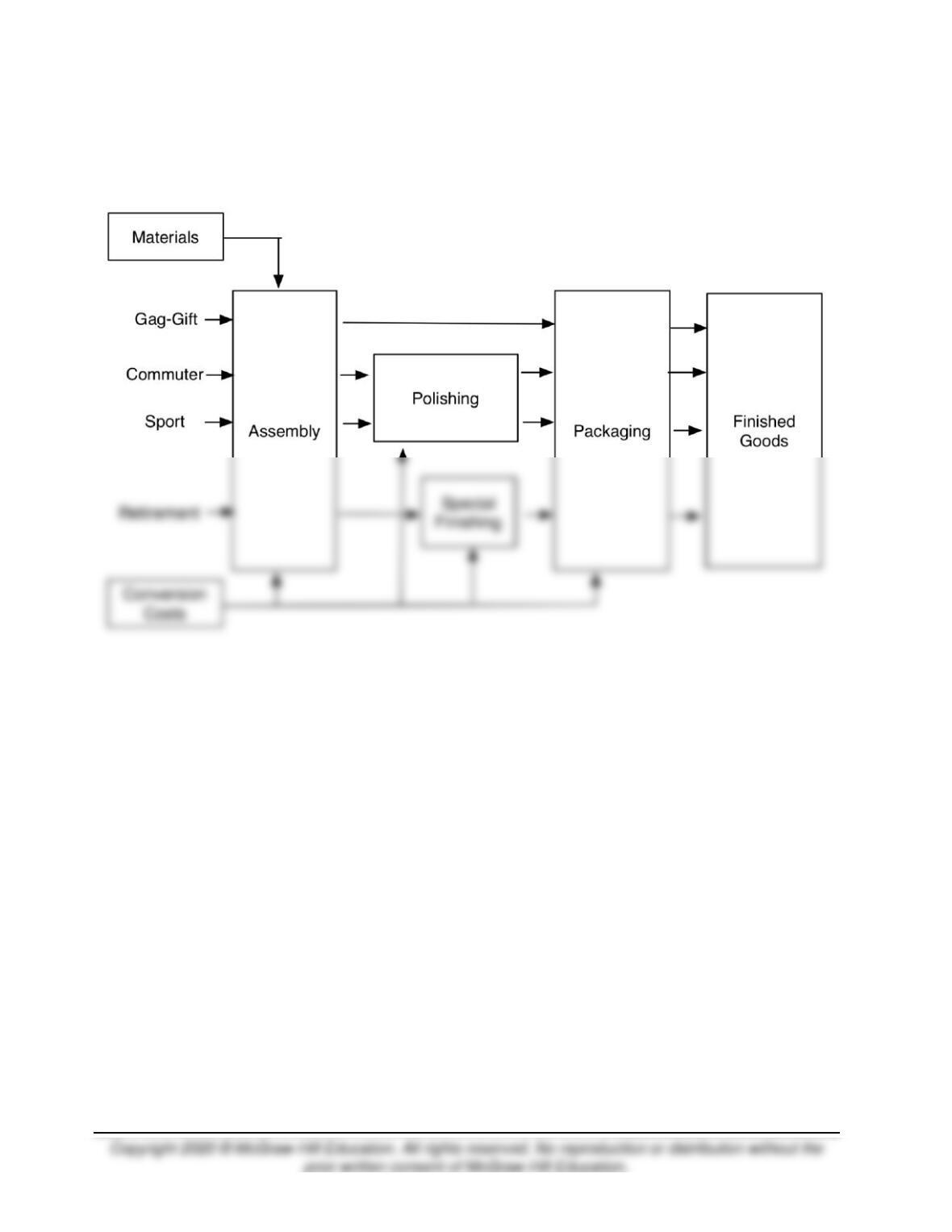
b.
(1)
Total
Basic
(40,000
units)
Photo
(30,000
units)
UrLife
(10,000
units)
Materials
$2,240,000
$480,000
$1,200,000
$560,000
Conversion
Assemblya
–0–
Total Product Cost
$2,325,000
Number of Units
Cost per unit
a Unit cost is 93.75% of material dollars (= $2,100,000 ÷ $2,240,000 material
dollars)
(2) If there is a reason that conversion costs are related to material dollars (for example,
because of the difficulty of working with different materials), this change might be
justified. If it is done simply to shift cost to the cost-plus customer, this is not ethical.
426 Fundamentals of Cost Accounting
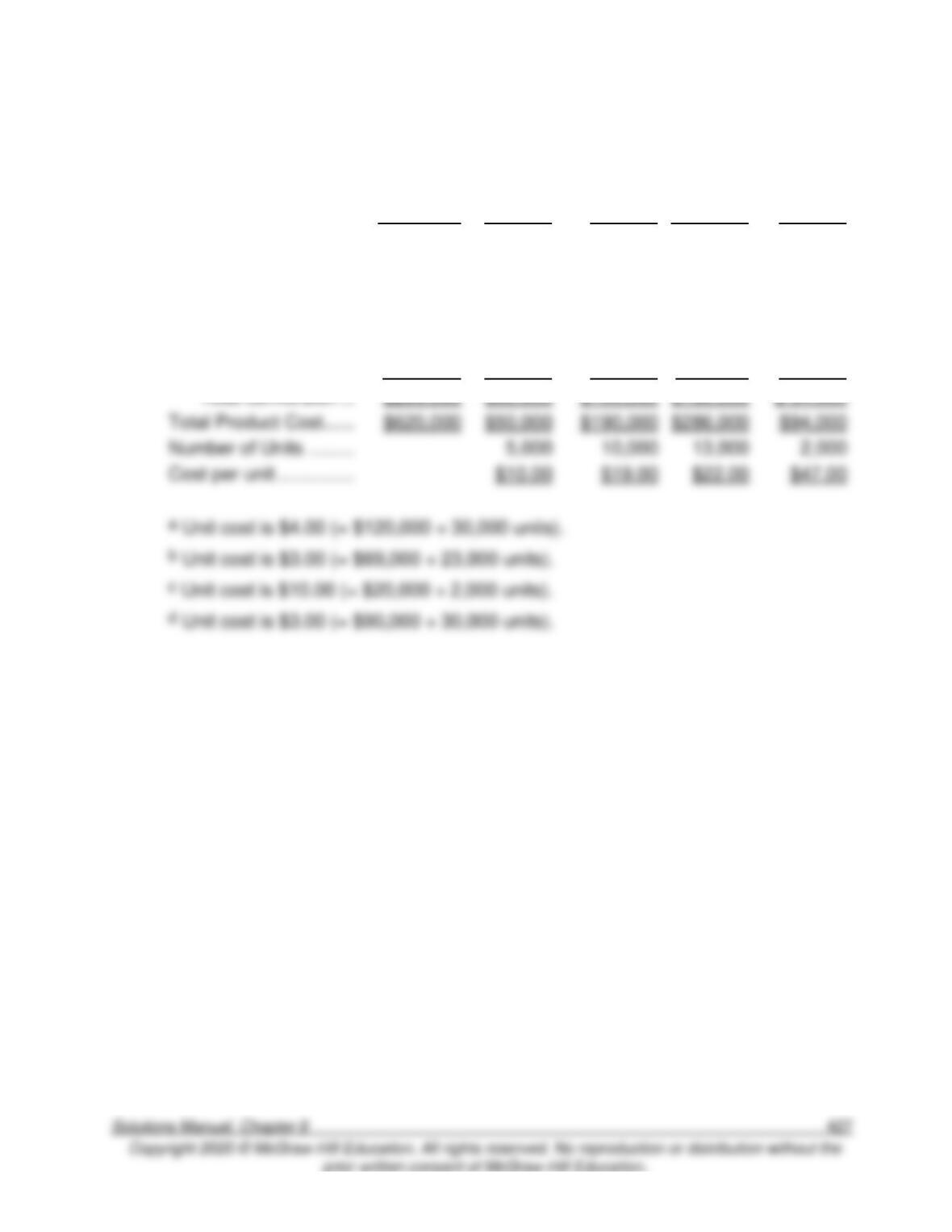
8-47. (50 min.) Operations Costing: Ferdon Watches.
a.
8-47. (continued)
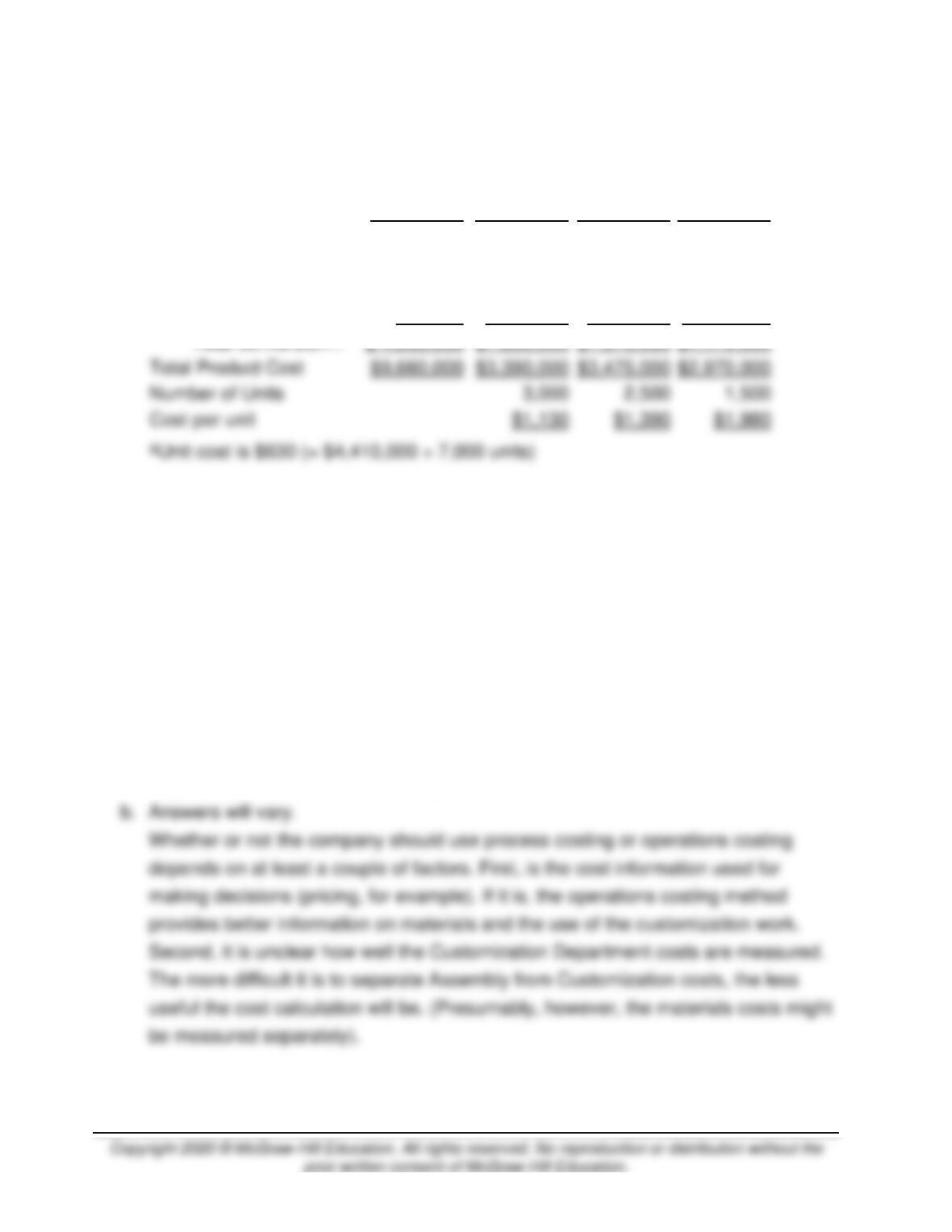
b.
Total
Gag-Gift
(5,000
units)
Commuter
(10,000
units)
Sport
(13,000
units)
Retirement
(2,000
units)
Materials …………………
$ 321,000
$15,000
$90,000
$156,000
$60,000
Conversion
Assemblya …………..
$120,000
$20,000
$40,000
$52,000
$ 8,000
Polishingb ……………
69,000
–0–
30,000
39,000
–0–
Special Finishingc ….
20,000
–0–
–0–
–0–
20,000
Packagingd …………..
90,000
15,000
30,000
39,000
6,000
$299,000
$35,000
$130,000
Total Product Cost ……
$620,000
$50,000
$286,000
$94,000
Number of Units ………
10,000
13,000
Cost per unit ……………
428 Fundamentals of Cost Accounting
8-48. (20 min.) Operations Costing: Coastal Cycles.
Total
E20
(3,000
units)
E35
(2,500
units)
E60
(1,500
units)
Materials ………………….
$4,900,000
$1,500,000
$1,900,000
$1,500,000
Conversion
Assemblya ……………
$ 4,410,000
1,890,000
1,575,000
945,000
Customization ………
525,000
–0–
–0–
525,000
Total conversion …
$1,890,000
$1,575,000
$1,470,000
Total Product Cost
$9,660,000
$3,390,000
$2,970,000
Cost per unit
8-49. (20 min.) Operations Costing and Process Costing: Coastal Cycles.
a. $1,405
There are never any work-in-process inventories. Therefore, there is no difference
between the weighted-average and FIFO methods. It also means that the
equivalent units are equal to the physical units for the period.
Therefore, there were 7,000 (= 3,000 + 2,500 +1,500) units produced. The cost of
materials per unit was $700 (= $4,900,000 ÷ 7,000). The conversion cost per unit
was $705 (= $4,935,000 ÷ 7,000). Therefore, the cost per unit of a completed
bicycle was $1,405 (= $700 + $705).
8-50. (20 min.) Job Costing and Process Costing: Coastal Cycles.
Note: This is a job costing problem, but the purpose is to illustrate that the two
approaches differ by how costs are accumulated, but not in the basic idea: that
costs incurred are allocated to products in a systematic way. If students have not
been introduced to job costing (unlikely if they are learning process costing), this
might not be an appropriate assignment.
a. First, we can compute the predetermined rate in the two departments:
Predetermined rate
=
(Conversion Cost
÷
Direct materials cost)
Customization: 35%
=
÷
$1,500,000)
E20
E35
E60
Total
Direct materials
$1,500,000
$1,900,000
$1,500,000
$4,900,000
Conversion cost
Assy (@90%)
1,350,000
1,710,000
1,350,000
4,410,000
Cust. (@35%)
0
0
525,000
525,000
Total cost
$2,850,000
$3,610,000
$3,375,000
$9,835,000
Number of units
3,000
2,500
1,500
Unit cost
$950
$1,444
$2,250
b. Answers will vary.
Whether or not the company should use job costing or operations costing
depends on at least a couple of factors. First, is the cost information used for
making decisions (pricing, for example). In this case, it seems as if it is used by

Solutions to Problems
8-51. (45 min.) Compute Equivalent Units: Multiple Choice.
a. The answer is (2).
Materials
Conversion
Costs
Units transferred out …………………….
790,000
a
790,000
a
EU in ending inventory:
Materials 100% × 80,000 units …..
80,000
EU
Conversion costs 30% × 80,000
units ………………………………………….
24,000
EU
EU produced this period ……………….
870,000
EU
814,000
EU
=
units started + beg. inventory – ending inventory
=
=
b. The answer is (3).
Prior
Department
Costs
Materials
Conversion
Costs
Units transferred out …………………….
330,000
a
330,000
a
330,000
a
EU in ending inventory:
Prior department costs ……………..
40,000
EU
Materialsb ……………………………….
–0–
EU
Conversion costs 65% × 40,000
units ………………………………………….
26,000
EU
EU produced this period ……………….
370,000
EU
330,000
EU
356,000
EU
a320,000 started + 50,000 in beg. inv. – 40,000 in ending inv. = 330,000 transferred out.
bMaterials are added at the end of the process.
EU
Started and completedb ……………………………….
EU
EU in ending inventory 70% × 40,000 units …….
EU
EU done this period …………………………………….
EU
432 Fundamentals of Cost Accounting
8-51. (continued)
d. The answer is (1).
Materials
Conversion
Costs
To complete beginning inventory:
Materials: 0%a × 40,000 units ……………..
0
Conversion costs: 30%b × 40,000 units ..
12,000
EU
Started and completed during the period….
140,000
c
EU
140,000
EU
Units still in ending inventory:
Materials: 100% × 32,000 units……………
EU
Conversion costs: 50% × 32,000 units ….
16,000
EU
Work done in current period …………………..