8-66. (continued)
Cost of units transferred to finished goods:
Product
Unit
Material
Cost
Unit
Department
A Cost
Unit
Department
B Cost
Unit Cost
X-10 ……….
$150
+
$ 300
+
$ –0–
=
$ 450
b.
Work-in-Process Ending Inventory Balances are (note the number of units is equal to the
difference between the units started and units completed):
Department A:
Material cost
Number
of Units
Unit
Cost
Total Cost
X-10 ……………………
100
$150
$ 15,000
X-20 ……………………
40
450
18,000
X-40 ……………………
20
1,200
Total material cost ……
$ 57,000
40
12,000
Total ………………………
$ 69,000
Department B:
Material cost
Number
of Units
Unit
Cost
Total Cost
X-20 ……………………
35
$450
15,750
X-40 ……………………
15
1,200
18,000
Total material cost ……
$ 33,750
50
300
15,000
30
100
8-67. (50 min.) Operations Costing—Work-in-Process Inventory: Miller Outdoor
Equipment.
The solution to this problem is to apply process costing methods for the conversion
costs and then add the cost of materials for each product. Because there is no
beginning work-in-process inventory, FIFO and weighted-average process costing
gives the same results.
a.
The material costs per unit are:
Product
Material
Cost
Number of
Units
Unit Material
Cost
Rookie …….
÷
Novice …….
÷
Hiker ……….
÷
Expert ……..
÷
Stitching Department:
Physical
Units
Conversion Costs
Equivalent Units
Flow of units:
Units to be accounted for:
Beginning WIP inventory ……………..
–0–
Units started this perioda
1,520
Total units to account for ………….
1,520
Completed and transferred outb
1,380
Units in ending inventoryc
140
Conversion costs (140 × 40%) ….
Total units accounted for ………….
1,520
a 1,520 units = 600 Rookie + 480 Novice + 290 Hiker + 150 Expert.
b 1,380 units = 540 Rookie + 450 Novice + 270 Hiker + 120 Expert.
c 140 units = 1,520 units started – 1,380 units transferred out.
8-67. (continued)
Total
Conversion
Costs
Flow of costs:
Costs to be accounted for:
Costs in beginning WIP inventory …
Current period costs …………………..
60,312
Total costs to be accounted for …
Cost per equivalent unit
Conversion costs ($60,312 ÷ 1,436)
Customizing Department:
Physical
Units
Conversion Costs
Equivalent Units
Flow of units:
Units to be accounted for:
Beginning WIP inventory …………….
–0–
Units started this perioda
840
Total units to account for ………….
840
Units accounted for:
Completed and transferred outb
790
Conversion costs (50 x 20%) ……
Total units accounted for ………….
Total
Conversion
Costs
Flow of costs:
Costs to be accounted for:
Costs in beginning WIP inventory …
$ –0–
$ –0–
Current period costs …………………..
28,800
28,800
Total costs to be accounted for …
$ 28,800
$ 28,800
Cost per equivalent unit
Conversion costs ($28,800 ÷ 800) ..
$ 36
8-67. (continued)
Cost of units transferred to finished goods:
Product
Unit
Material
Cost
Stitching
Department
Unit Cost
Customizing
Department
Unit Cost
Unit Cost
Rookie …….
$30
+
$ 42
+
$ –0–
=
$ 72
Novice …….
36
+
42
+
36
=
114
Hiker ………
45
+
42
+
36
=
123
Expert …….
75
+
42
+
36
=
153
b.
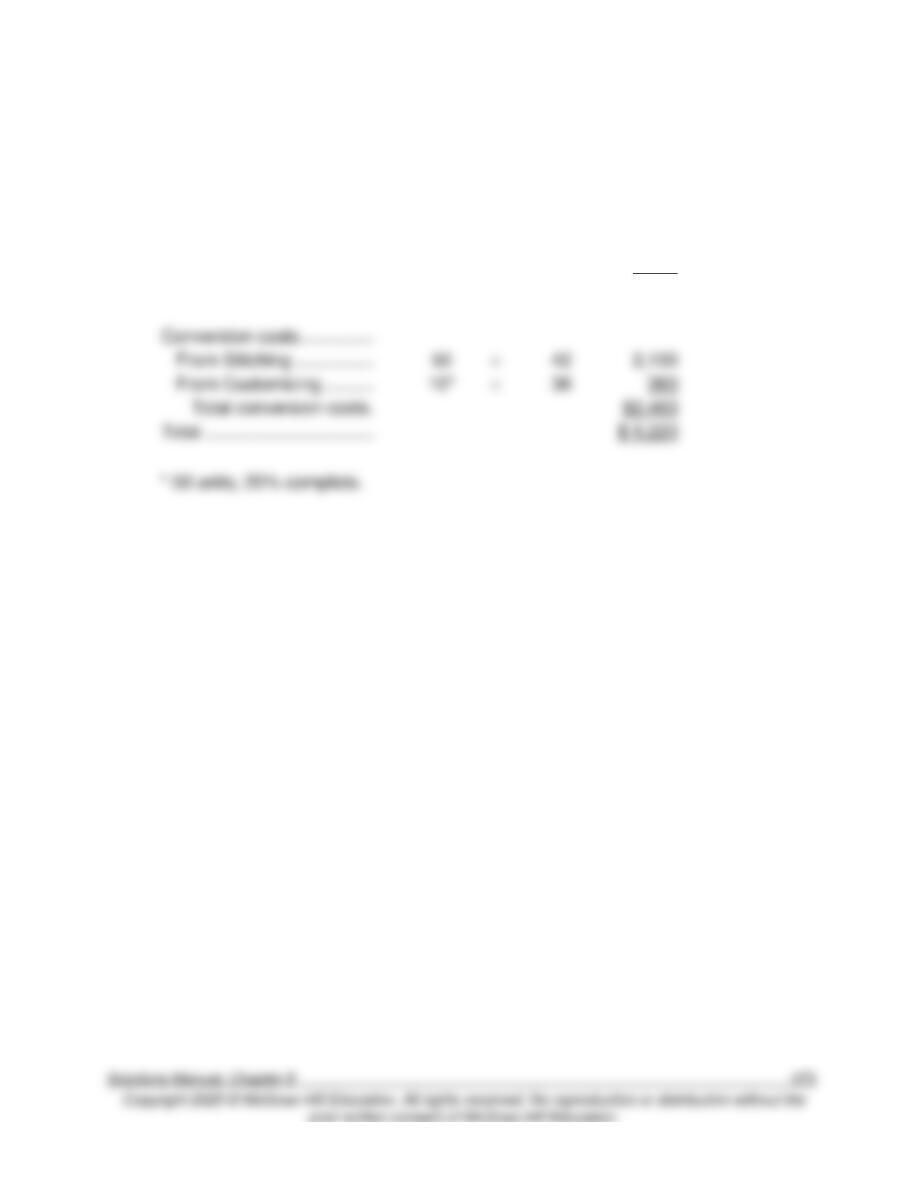
Work-in-Process Ending Inventory Balances are (note the number of units is equal to the
difference between the units started and units completed):
Stitching Department:
Material cost
Number
$ 1,800
Total material cost……
Conversion costs …….
Unit
8-67. (continued)
Customizing Department:
Material cost
Number
of Units
Unit
Cost
Total Cost
Novice ……………………….
10
$36
360
Hiker ………………………….
20
45
900
Expert ………………………..
20
75
1,500
Total material cost ………….
$ 2,760
Conversion costs ……………
50
42
36

8-68. (50 min.) Process Costing and Ethics – Increasing Production to Boost
Profits: Pacific Siding, Inc.
a. The CEO and CFO expect to produce profits by reducing the unit cost of each sold.
This will occur because of the fixed overhead costs. (Recall “most of the overhead
costs are fixed.”) Because each unit transferred out in March will have a lower unit
costs, reported costs of goods sold will be lower. Therefore, profit will be higher.
8-68. (continued)
b. See the revised data entry section and production cost report below:
Data Entry Section
Unit Information
Percent Complete
Units
(board
Direct
Direct
feet)
materials
labor
Overhead
Units in beginning WIP inventory (all completed this period)
250,000
n/a
n/a
n/a
Units started and completed during the period
140,000
100%
100%
100%
Units started and partially completed during the period
225,000
80%
85%
90%
Direct
Direct
Cost Information
materials
labor
Overhead
Costs in beginning WIP inventory
Costs incurred during the period
$102,000
8-68. (continued)
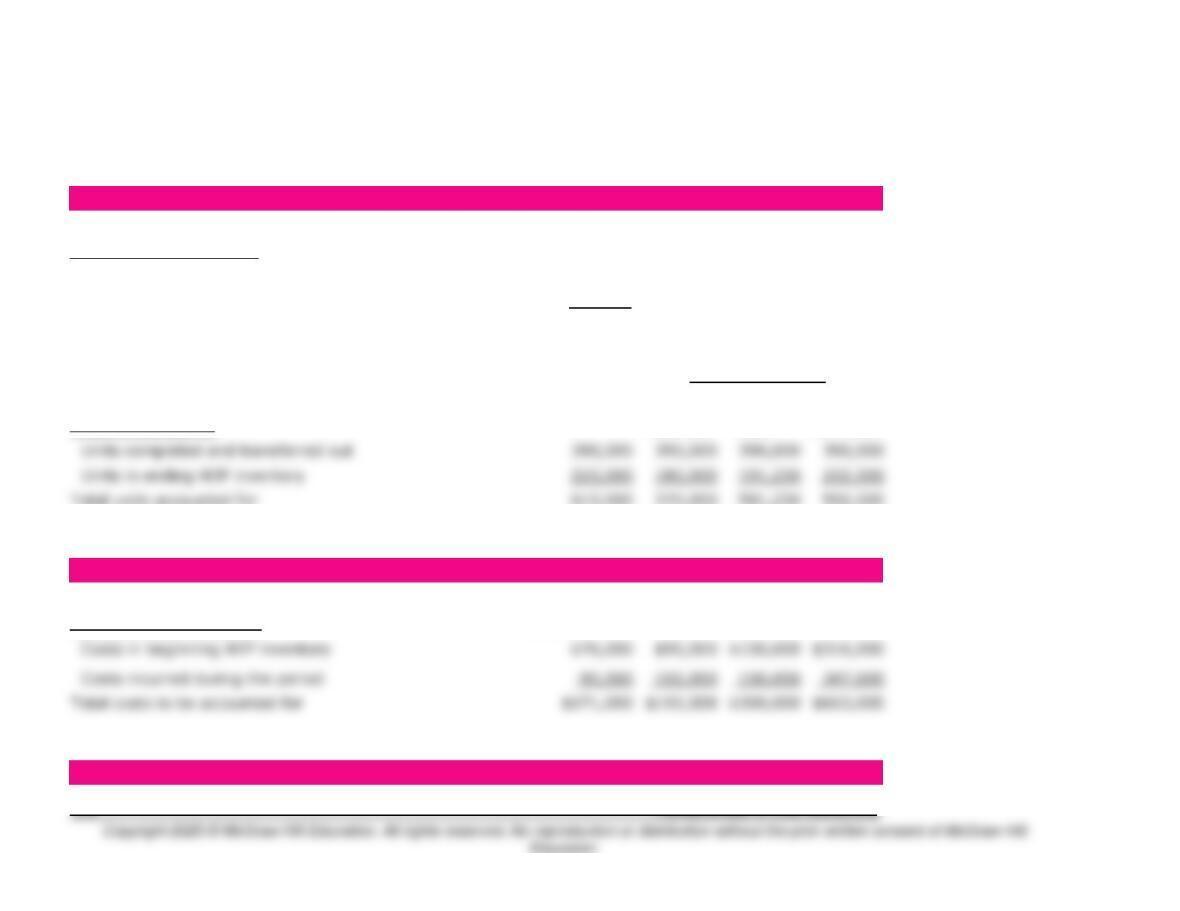
Revised Production Cost Report
Month Ending March 31
Step 1: Summary of Physical Units and Equivalent Unit Calculations
Physical
Units to be accounted for
Units
Units in beginning WIP inventory
250,000
Units started during the period
365,000
Total units to be accounted for
615,000
Equivalent Units
Direct
Direct
Units accounted for
materials
labor
Overhead
Units completed and transferred out
390,000
390,000
390,000
390,000
Total units accounted for
615,000
570,000
581,250
592,500
Step 2: Summary of Costs to be Accounted for
Direct
Direct
Costs to be accounted for
materials
labor
Overhead
Total
Costs in beginning WIP inventory
$150,000
$316,000
Costs incurred during the period
Total costs to be accounted for
$192,000
$300,000
$663,000
Step 3: Calculation of Cost per Equivalent Unit
8-68. (continued)
Direct
Direct
materials
labor
Overhead
Total
Total costs to be accounted for (a)
$171,000
$192,000
$300,000
Total equivalent units accounted for
570,000
581,250
592,500
Cost per equivalent unit (a) / (b)
$0.3000
$0.3303
$0.5063
$1.1366
Step 4: Assign Costs to Units Transferred Out and Units in Ending WIP Inventory
Direct
Direct
materials
labor
Overhead
Total
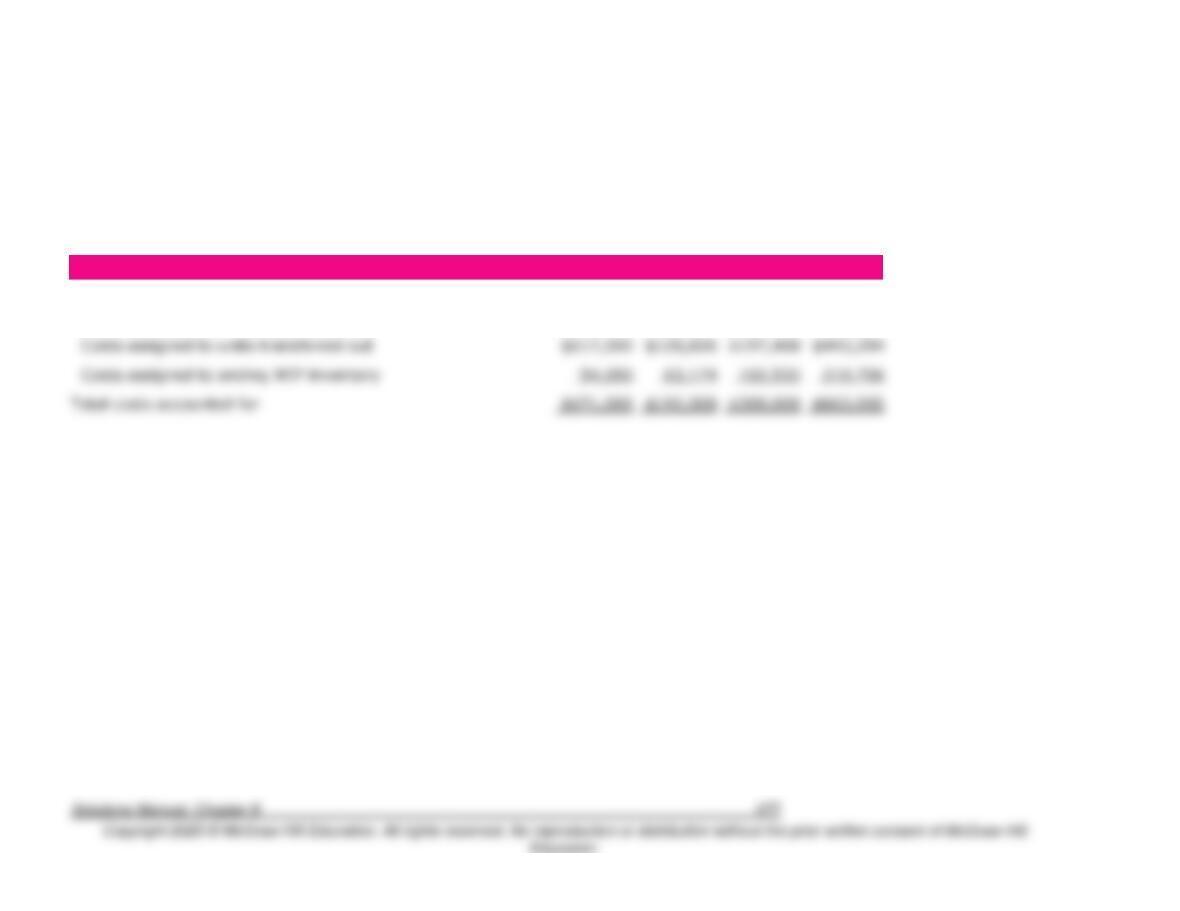
Costs assigned to units transferred out
$117,000
$128,826
$197,468
$443,294
Costs assigned to ending WIP inventory
102,532
219,706
Total costs accounted for
$171,000
$192,000
$300,000
$663,000
8-68. (continued)
c. The costs assigned to units transferred out has decreased from $541,621 to $443,294,
or $98,327. Because all the units transferred out will be sold before the end of March,
profits will be $98,327 higher than originally planned.
8-69. (70 min.) Show Cost Flows—FIFO Method: Vermont Co.
Work in Process
Beginning Balance
716,000
Transferred out:
Current work:
materials (given)
300,400
716,000a
From beginning inventory
From current work
conversion (given)
1,287,000
240,320a
materials
833,976b
conversion costs
Ending Balance
513,104
Additional computations:
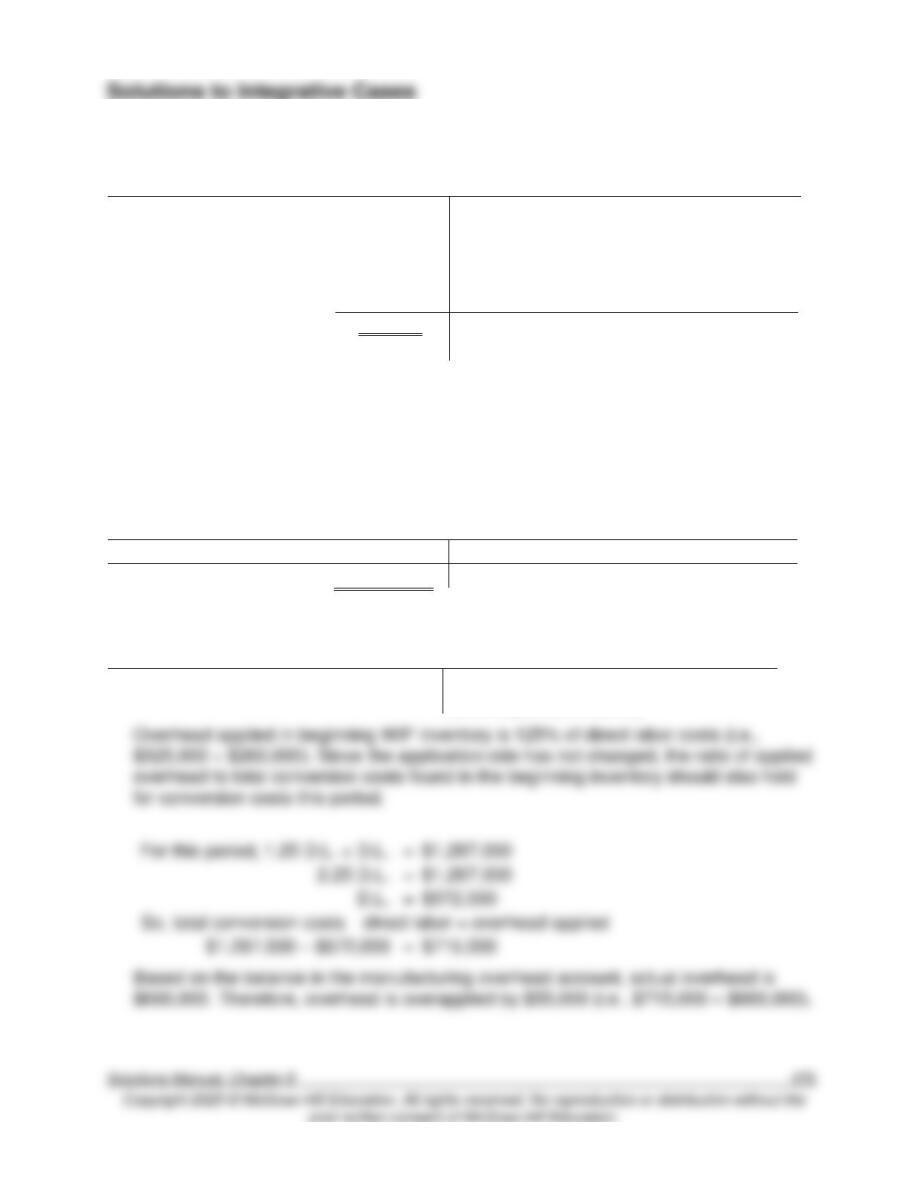
a $240,320 = 40,000 EU transferred × ($300,400 ÷ 50,000 EU for materials)
(40,000 EU = 50,000 – 10,000 in ending inventory)
b $833,976 = 40,500 EU transferred out × ($1,287,000 ÷ 62,500 EU for conversion costs;
40,500 EU = 62,500 – 22,000 in ending inventory)
Finished Goods
Transferred in
1,790,296
a
1,432,237
To Cost of Goods Sold
(80%)
Balance
358,059
aFrom total credits in Work in Process.
Cost of Goods Sold
From Finished Goods
1,432,237
Overapplied overhead
(See explanation below)
55,000
For this period, 1.25 D.L. + D.L.
=
$572,000
$715,000

8-69. (continued)
The journal entry to assign the overapplied overhead to cost of goods sold is:
Overapplied overhead …………………………
55,000
Cost of goods sold ……………………
55,000
8-70. (45 min.) Job Costing, Process Costing, Choosing a Costing Method:
Bouwens Corporation.
This problem is computationally straightforward, but requires the student to think about
the use of the costs from the costing system and how to best reflect the production
costs for a single product for two customer types.
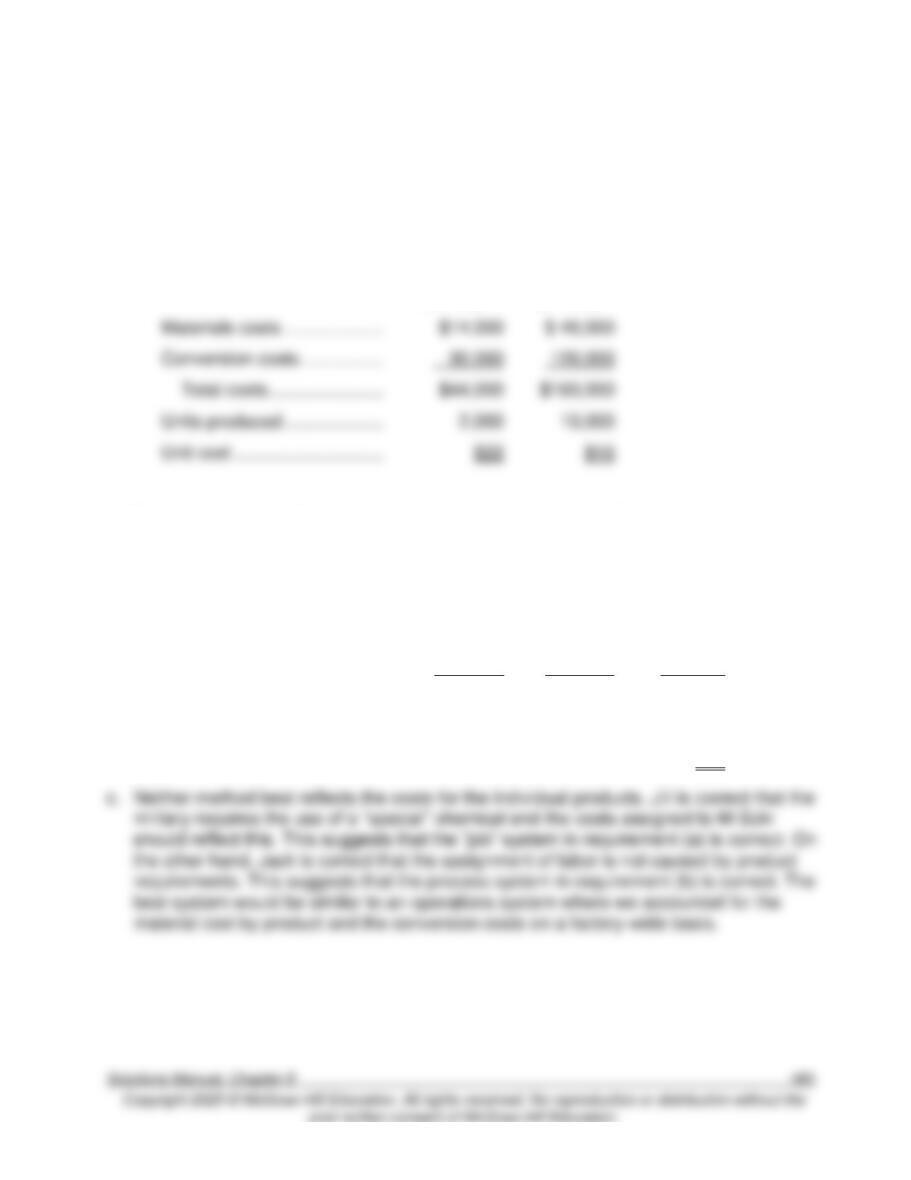
a. The “job” costs for each product are the unit costs in each building:
M-Solv
(B–155)
C-Solv
(B–159)
Materials costs ………………..
$14,000
$ 40,000
Conversion costs ……………..
30,000
120,000
Total costs …………………..
$44,000
$160,000
Units produced ………………..
2,000
10,000
Unit cost …………………………
$16
b. The “process” costs for each product are the unit costs for both buildings divided by
total production:
M-Solv
(B–155)
C-Solv
(B–159)
Total
Materials costs ………………..
$14,000
$ 40,000
$ 54,000
Conversion costs ……………..
30,000
120,000
150,000
Total costs …………………..
$44,000
$160,000
$204,000
Units produced ………………..
2,000
10,000
12,000
Unit cost …………………………
$17
8-70. (continued)
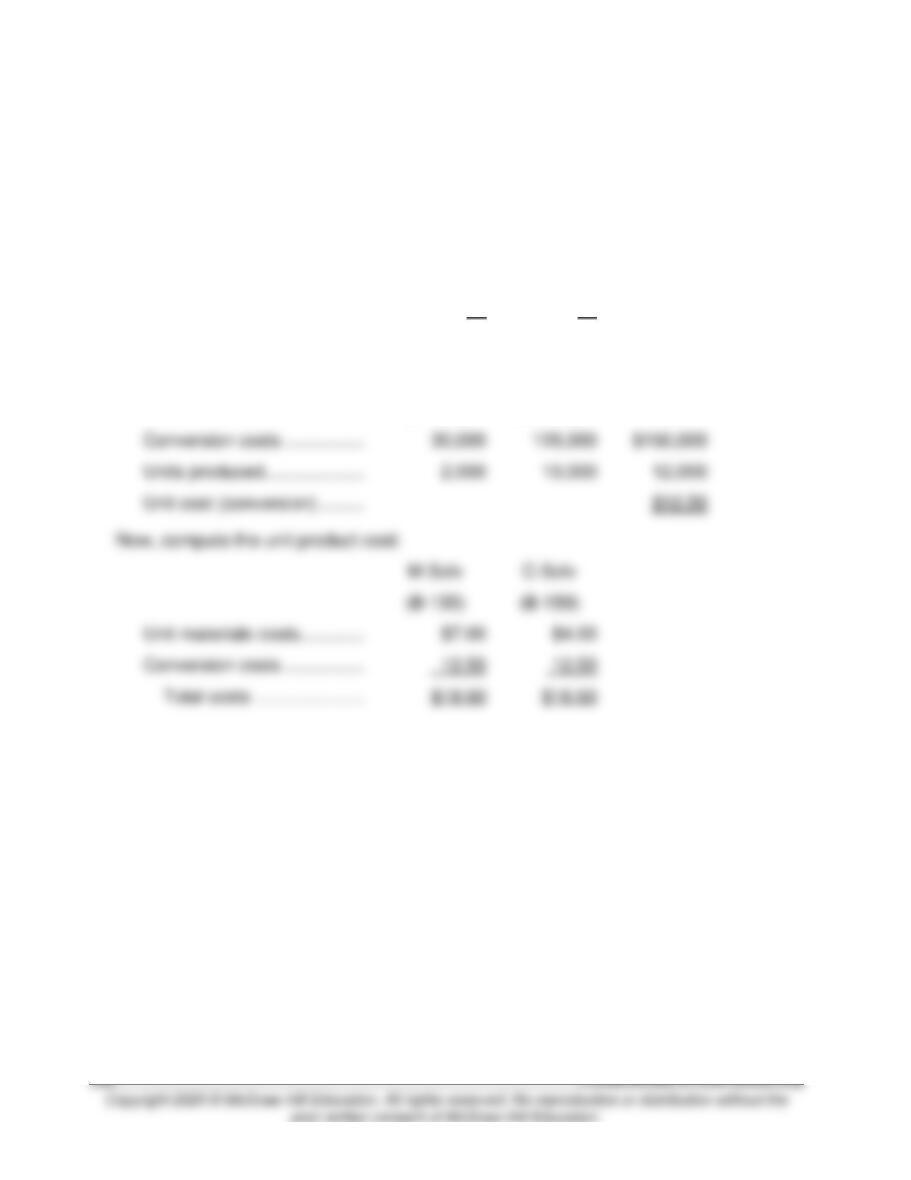
d. Compute the unit costs for materials and conversion costs separately.
M-Solv
(B–155)
C-Solv
(B–159)
Materials costs ………………..
$14,000
$ 40,000
Units produced ………………..
2,000
10,000
Unit cost (materials) …………
$7
$4
Then compute conversion costs for the factory:
M-Solv
(B–155)
C-Solv
(B–159)
Total
Conversion costs …………….
120,000
Units produced ………………..
2,000
10,000
12,000
Unit cost (conversion) ………
M-Solv
(B–155)
C-Solv
(B–159)
Unit materials costs………….
$7.00
Conversion costs …………….