
CHAPTER 8
Pricing
ASSIGNMENT CLASSIFICATION TABLE
Learning Objectives
Questions
Brief
Exercises
Do It!
Exercises
A
Problems
1. Compute a target cost when
the market determines a
product price.
1, 2
1
1
1, 2, 3
2. Compute a target selling price
using cost-plus pricing.
3, 4, 5,
6, 7, 8
2, 3,
4, 5
2
3, 4, 5,
6, 7
1A, 2A
3. Use time-and-material pricing
to determine the cost of
services provided.
9, 10
6
3
8, 9, 10
3A
4. Determine a transfer price
using the negotiated, cost-
based, and market-based
approaches.
11, 12, 13,
14, 15,
16, 17
7, 8, 9
4
11, 12, 13,
14, 15,
16, 17
4A, 5A, 6A
*5. Determine prices using
absorption-cost pricing
and variable-cost pricing.
18, 19
10, 11
18, 19, 20
7A, 8A
*6. Explain issues involved in
transferring goods between
divisions in different countries.
20
*Note: All asterisked Questions, Exercises, and Problems relate to material contained in the appendix to the
chapter.

ASSIGNMENT CHARACTERISTICS TABLE
Problem
Number
Description
Difficulty
Level
Time
Allotted (min.)
1A
Use cost-plus pricing to determine various amounts.
Simple
20–30
2A
Use cost-plus pricing to determine various amounts.
Simple
20–30
3A
Use time-and-material pricing to determine bill.
Simple
20–30
4A
Determine minimum transfer price with no excess capacity
and with excess capacity.
Moderate
20–30
5A
Determine minimum transfer price with no excess capacity.
Moderate
20–30
6A
Determine minimum transfer price under different situations.
Moderate
20–30
*7A*
Compute the target price using absorption-cost pricing and
variable-cost pricing.
Moderate
30–40
*8A*
Compute various amounts using absorption-cost pricing and
variable-cost pricing.
Complex
40–50
BLOOM’ S TAXONOMY TABLE
Correlation Chart between Bloom’s Taxonomy, Learning Objectives and End–of-Chapter Exercises and Problems
Learning Objective
Knowledge
Comprehension
Application
Analysis
Synthesis
Evaluation
*1. Compute a target cost when the
market determines a product
price.
Q8-1
Q8-2
BE8-1
DI8-1
E8-1
E8-2
E8-3
*2. Compute a target selling price
using cost-plus pricing.
Q8-3
Q8-5
Q8-6
Q8-4
Q8-7
Q8-8
BE8-2
BE8-3
BE8-4
BE8-5
DI8-2
E8-3
E8-4
E8-5
E8-6
E8-7
P8–1A
P8–2A
*3. Use time-and-material pricing
to determine the cost of
services provided.
Q8–10
Q8-9
BE8-6
DI8-3
E8-8
E8-9
E8–10
P8–3A
*4. Determine a transfer price using
the negotiated, cost-based, and
market-based approaches.
Q8–13
Q8–15
Q8–16
Q8–11
Q8–12
Q8–14
Q8–17
BE8-7 E8–16
BE8-8 E8–17
BE8-9 P8–4A
DI8-4 P8–5A
E8–11 P8–6A
E8–13
E8–14
E8–15
E8–12
*5. Determine prices using
absorption-cost pricing
and variable-cost pricing.
Q8–18
Q8–19 E8–20
BE8-10 P8–7A
BE8-11 P8–8A
E8–18
E8–19
*6. Explain issues involved in
transferring goods between
divisions in different countries.
Q8–20
Broadening Your Perspective
BYP8-4
BYP8-5
BYP8-6
BYP8-2
BYP8-3
BYP8-7
BYP8-1
ANSWERS TO QUESTIONS
1. The first type of pricing environment is where the company is a price taker; that is, the company
does not set the price, but instead the price is set by a competitive market. In the second type of
situation, the company sets the price. This happens most often when the product is specially made
for a customer or there are few or no other producers capable of manufacturing a similar item.
2. A company focuses on target cost when it cannot influence the market price. The target cost is
determined by subtracting the desired profit per unit from the market-determined selling price.
3. The basic formula to determine the target selling price in cost-plus pricing is:
Target selling price
=
Cost
+
(Markup percentage X Cost)
4. The basic formula to determine the target selling price in cost-plus pricing is:
Target selling price
=
Cost
+
(Markup percentage X Cost)
$23.40
=
$18
+
(30% X $18)
5. The basic formula to compute the markup percentage is:
Markup percentage
=
Desired ROI per unit
Total unit cost
6. Some of the factors that affect a company’s desired ROI are competitive and market conditions,
political and legal issues, and other relevant risk factors.
7. Total cost base per unit, excluding selling and administrative expenses ……………………. $60
Selling and administrative expenses per unit ………………………………………………………… 15
Total unit cost ………………………………………………………………………………………………….. $75
The markup percentage is computed as follows:
$6
=
8%
$75
8. Variable cost per unit ………………………………………………………………………………………… $16
Fixed cost per unit ……………………………………………………………………………………………. 9
Desired ROI per unit …………………………………………………………………………………………. 6
Target selling price …………………………………………………………………………………………… $31
The markup percentage is:
$6
= 24%
$25
9. Time-and-material pricing is most often used in service industries. It involves two pricing rates,
one for the labor used on a job, while the other involves the materials used. Each typically has a
profit rate factored into it.
10. The material loading charge is a fee added to each bill to cover the costs of purchasing, receiving,
handling, and storing materials, plus any desired profit margin on the materials themselves. The
material loading charge is expressed as a percentage of the total estimated costs of parts and
materials for the year.

Questions Chapter 8 (Continued)
*11. A transfer price is the price used to record the transfer of goods or services between two divisions
in the same company. Setting a fair transfer price is important because an improper price will
benefit one division while hurting the other.
*12. The objective of an appropriate transfer price is to maximize the return to the whole company
and not cause divisional performance to decline.
*13. The three approaches for determining transfer prices are:
(1) Negotiated transfer prices
(2) Cost-based transfer prices
(3) Market-based transfer prices
*14. When a cost-based transfer price is used, the exchange of goods between divisions is recorded
by using the costs incurred by the selling division. This may either be the variable costs or
the variable costs with an additional markup to cover fixed costs. The primary advantage of this
approach is that it is relatively simple to use. The disadvantage is that it understates the selling
division’s contribution to the company’s total contribution margin. Finally, it reduces the selling
division’s incentive to control cost.
*15. The general formula for determining the minimum transfer price that the selling division should
be willing to accept is:
Minimum transfer price
=
Variable cost
+
Opportunity cost
*16. When determining the minimum transfer price, the opportunity cost is the contribution margin
that would be received if the goods were sold externally.
*17. A company is likely to use a negotiated transfer price rather than a market-based price when the
selling division has excess capacity, and is therefore eager to expand production, or when a
market price does not exist (e.g., for a special order).
*18. The absorption-cost approach defines the cost base as manufacturing cost. Therefore, it excludes
variable and fixed selling and administrative costs.
*19. The markup percentage using variable-cost pricing would be:
$3 + $9
= 75%
$16
*20. A company with divisions in different countries will set the transfer price so that more profit is
allocated to the division located in the country with the lower tax rate. This is improper. The
proper (and legal) treatment is to base the transfer price on the market value of the goods
transferred.
SOLUTIONS TO BRIEF EXERCISES
BRIEF EXERCISE 8-1
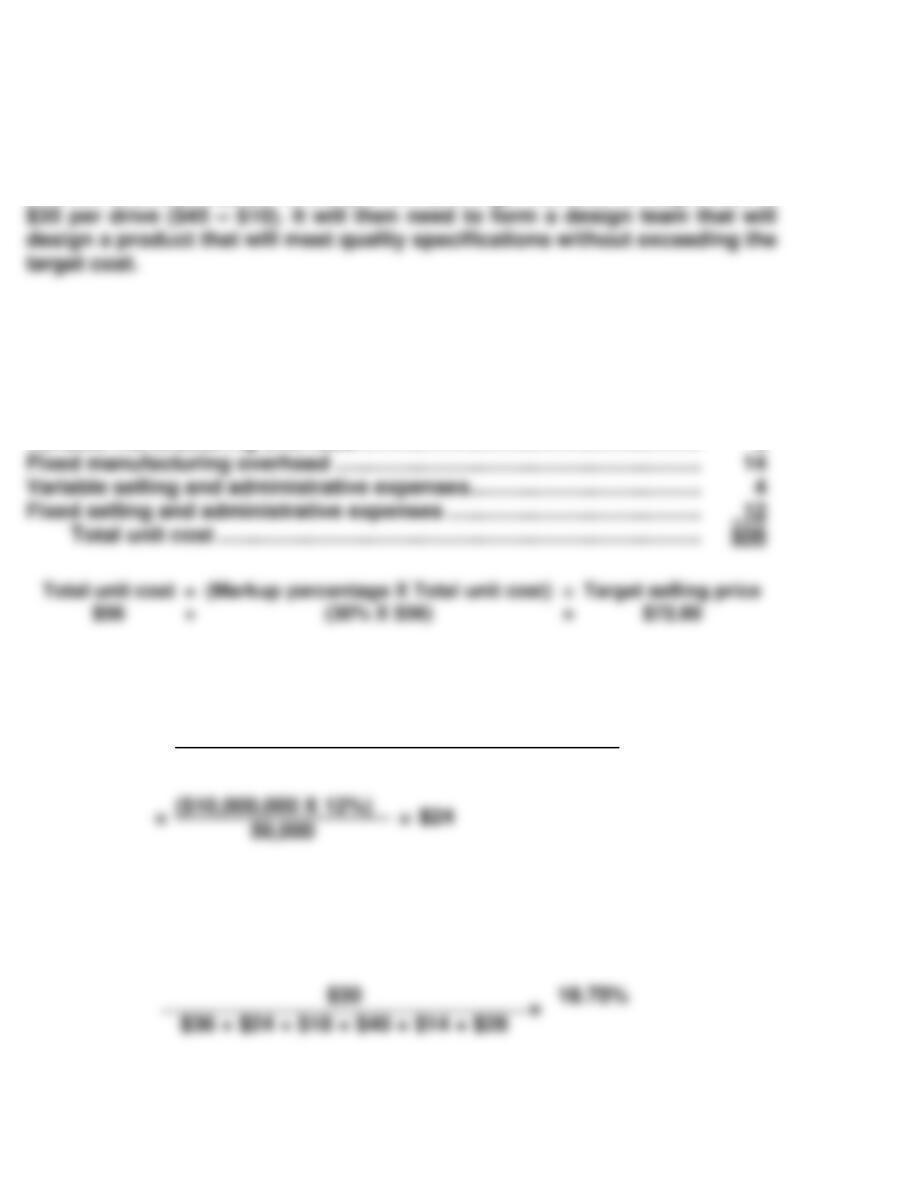
In order to obtain a profit of $10 per drive, Ortega must set its target cost at
BRIEF EXERCISE 8-2
Direct materials …………………………………………………………………………… $12
Direct labor …………………………………………………………………………………. 8
Variable manufacturing overhead …………………………………………………. 6
BRIEF EXERCISE 8-3
ROI per unit
=
(Total investment X Desired ROI percentage)
Number of units
=
=
BRIEF EXERCISE 8-4
The markup percentage would be:
BRIEF EXERCISE 8-5
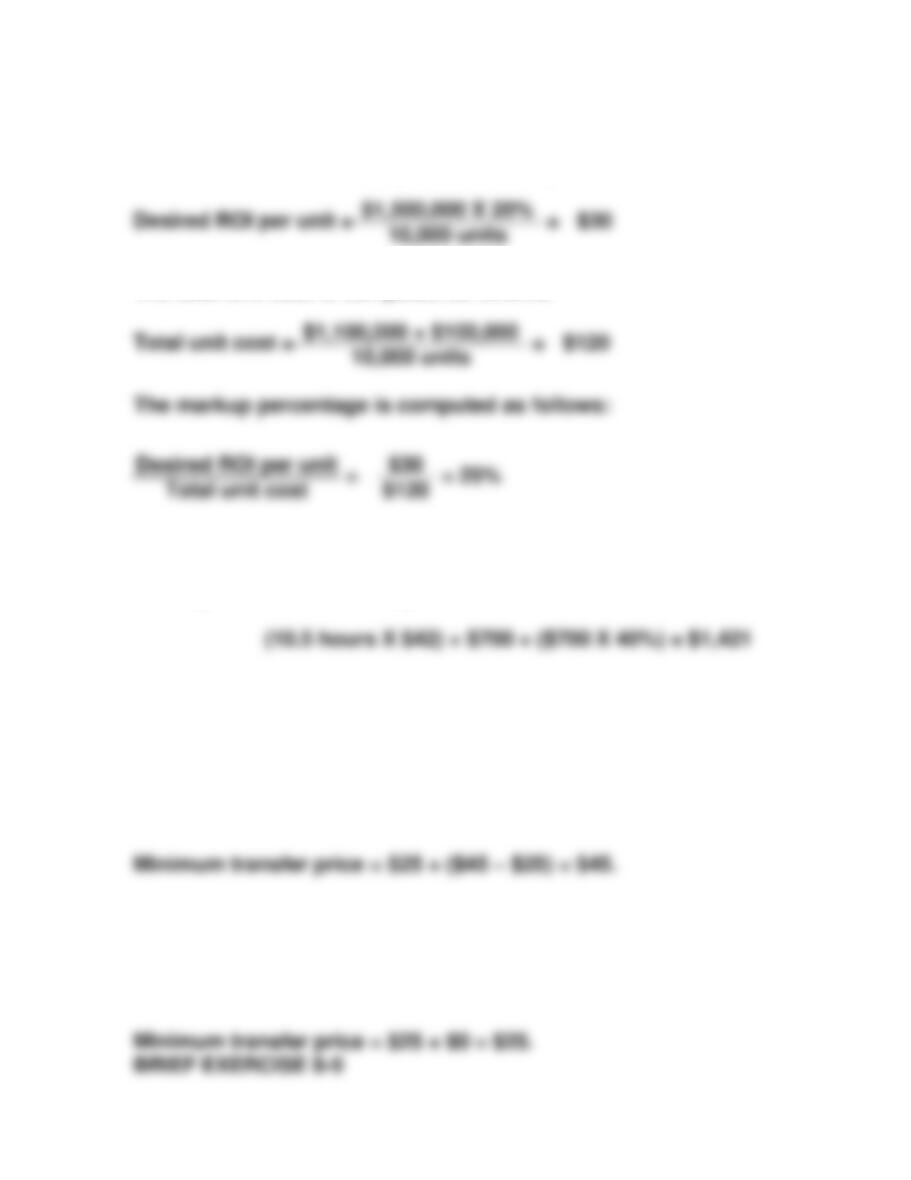
The markup percentage is equal to Desired ROI per unit divided by total
unit cost. The desired ROI per unit is computed as follows:
The total unit cost is computed as follows:
BRIEF EXERCISE 8-6
Rooney’s total bill would equal:
BRIEF EXERCISE 8-7
The minimum transfer price is equal to the division’s variable cost plus its
opportunity cost. The opportunity cost is equal to its contribution margin
on goods sold to external parties. Thus, the minimum transfer price in this
case is:
BRIEF EXERCISE 8-8
If the division has excess capacity, then its opportunity cost is zero. In this
case, the minimum transfer price is:
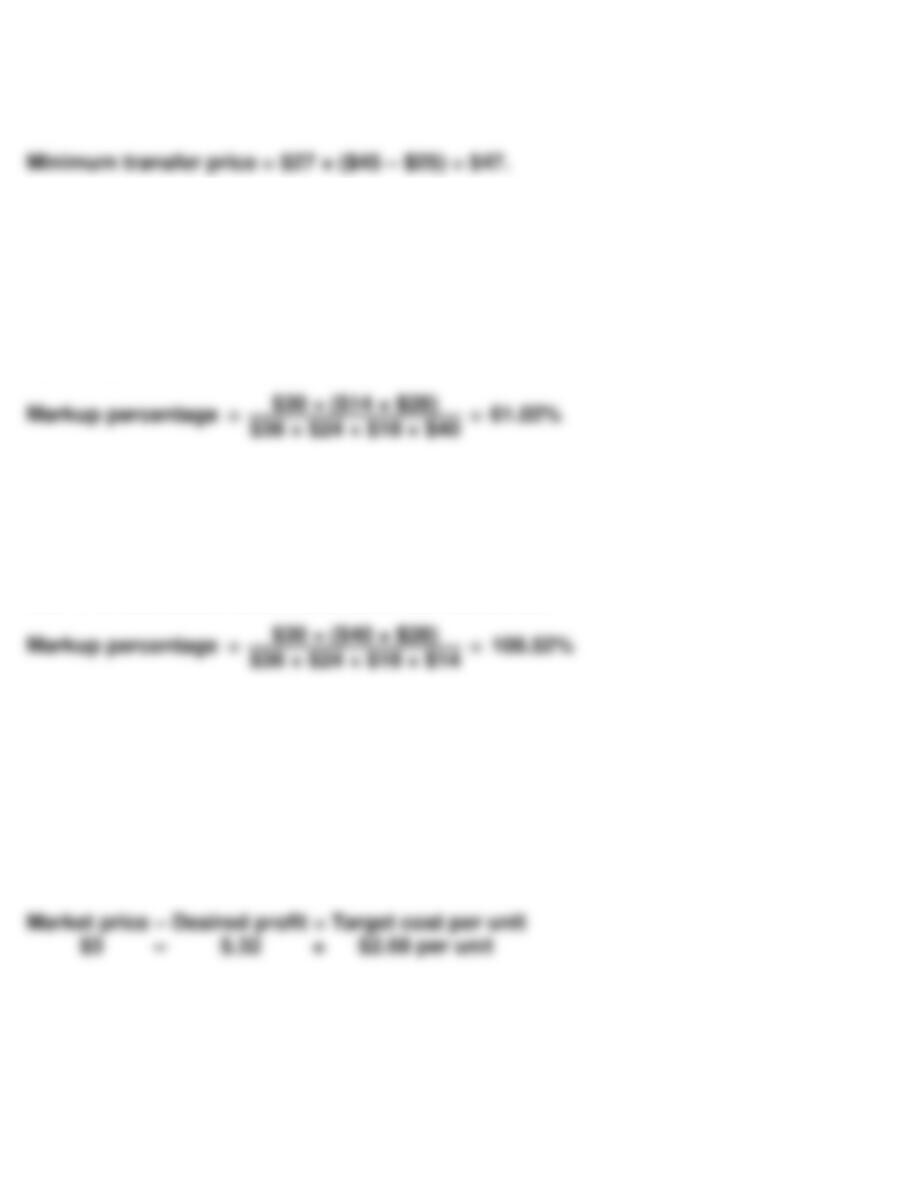
The minimum transfer price is equal to the division’s variable cost plus its
opportunity cost. In this case the minimum transfer price is:
*BRIEF EXERCISE 8-10
The markup percentage using the absorption-cost approach is calculated
by including only manufacturing costs in the cost base. Therefore, all costs
related to selling and administration are excluded from the cost base and
added back in the numerator.
*BRIEF EXERCISE 8-11
The markup percentage using variable-cost pricing is calculated by including
only variable costs in the cost base. Therefore, all fixed costs are excluded
from the cost base and added back in the numerator.
SOLUTIONS TO DO IT! EXERCISES
DO IT! 8-1
The desired profit for this new product line is $320,000 ($2,000,000 X 16%)
Each filter must result in $.32 of profit ($320,000/1,000,000 units)
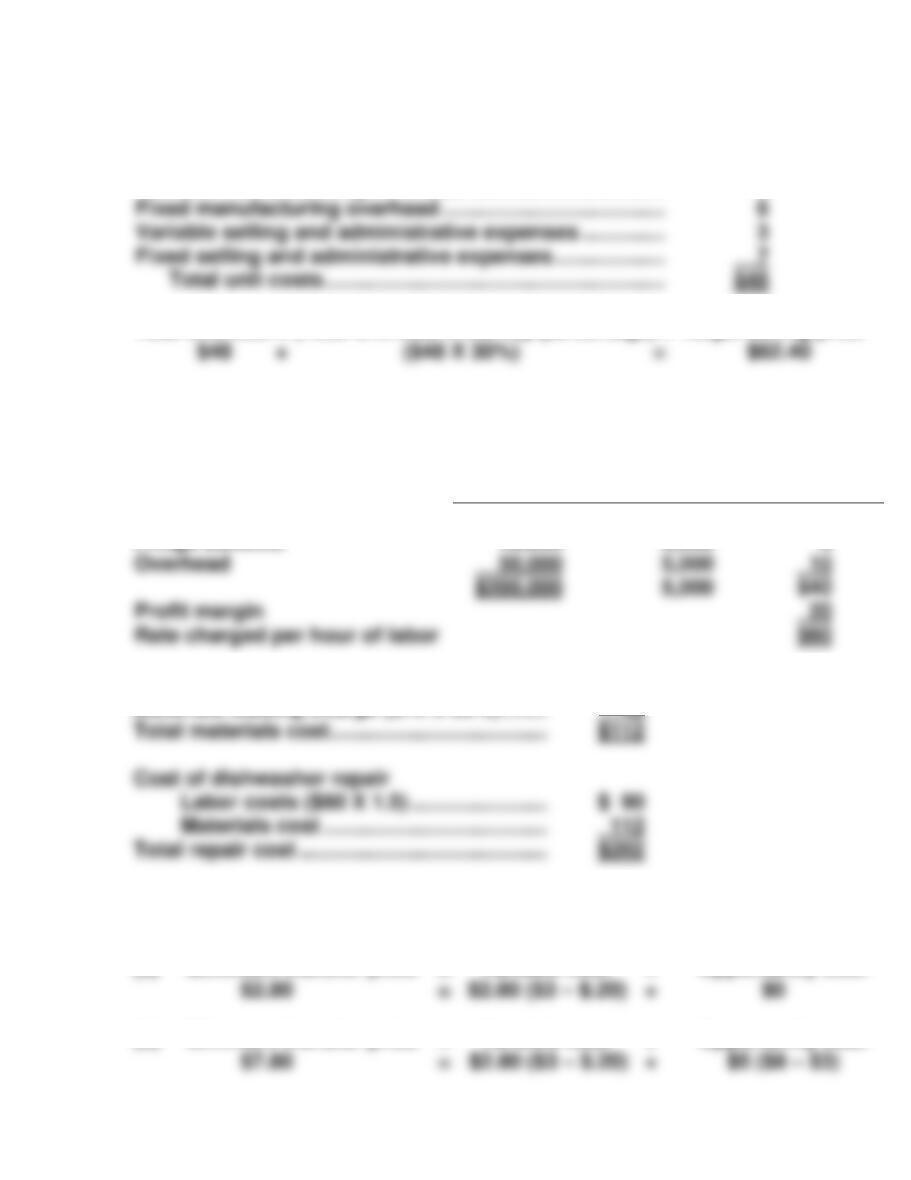
DO IT! 8-2
Direct materials ………………………………………………………
$18
Direct labor …………………………………………………………….
9
Variable manufacturing overhead …………………………...
5
Fixed manufacturing overhead ………………………………..
6
Variable selling and administrative expenses …………..
3
Fixed selling and administrative expenses ……………….
$48
Total unit cost + (Total unit cost X Markup percentage) = Target selling price
DO IT! 8-3
Total Cost /
Total Hours =
Per Hour
Charge
Repair-technicians’ wages
$110,000
5,000
$22
Fringe benefits
40,000
5,000
8
5,000
$200,000
5,000
$40
Profit margin
$60
Materials cost ………………………………………. $ 70
Materials loading charge ($70 X 60%) …….. 42
DO IT! 8-4
(a) Minimum transfer price = Variable cost + Opportunity cost
(b) Minimum transfer price = Variable cost + Opportunity cost
SOLUTIONS TO EXERCISES
EXERCISE 8-1
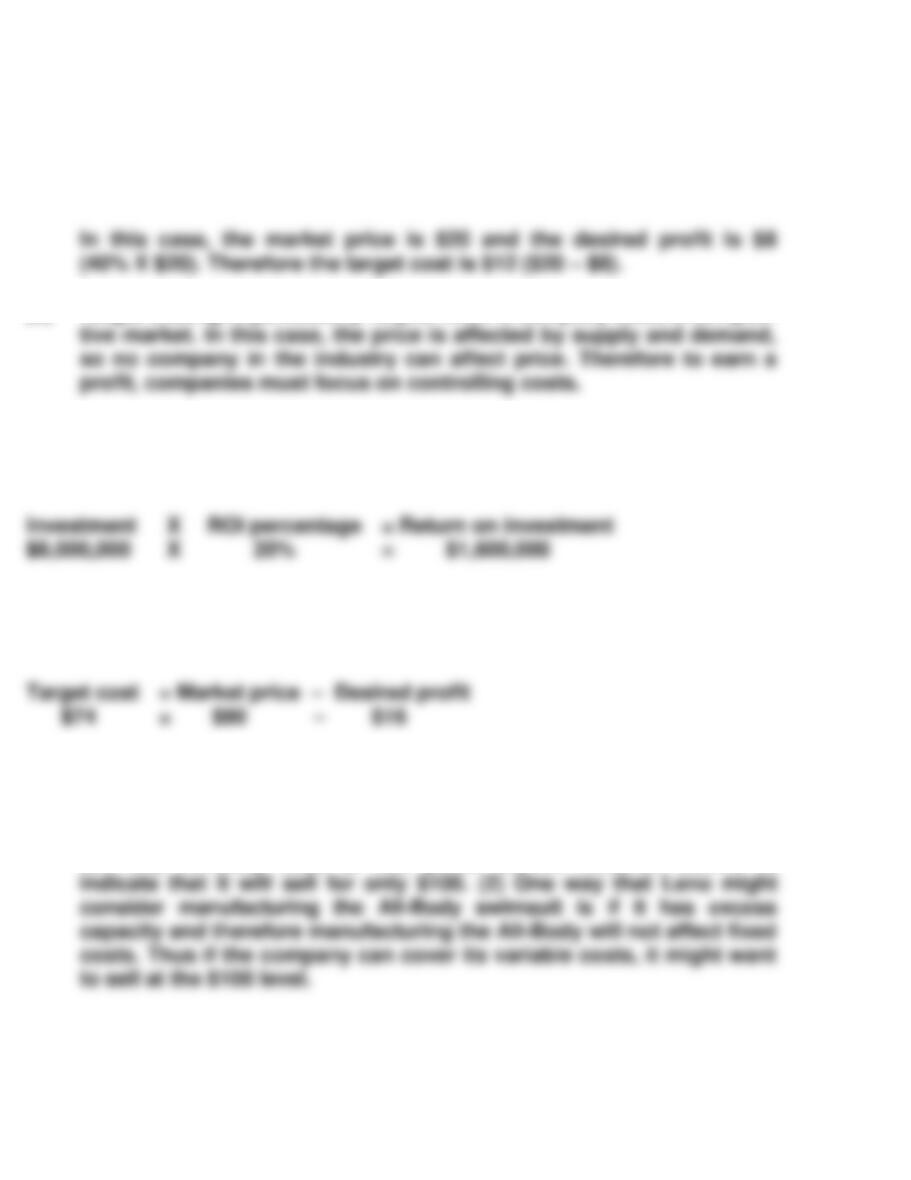
(a) The target cost formula is: Target cost = Market price – Desired profit.
(b) Target costing is particularly helpful when a company faces a competi–
EXERCISE 8-2
The following formula may be used to determine return on investment
Return on investment per unit is then $16 ($1,600,000 ÷ 100,000)
The target cost is therefore $74 computed as follows:
EXERCISE 8-3
(a) (1) In this case the selling price would be $125 ($100 + [$100 X 25%]).
The problem with the $125 is that it is unlikely that Leno will be able to
sell any All-Body suits at that price. Market research seems to
(b) In this case, the amount would be the selling price of $100.
EXERCISE 8-3 (Continued)
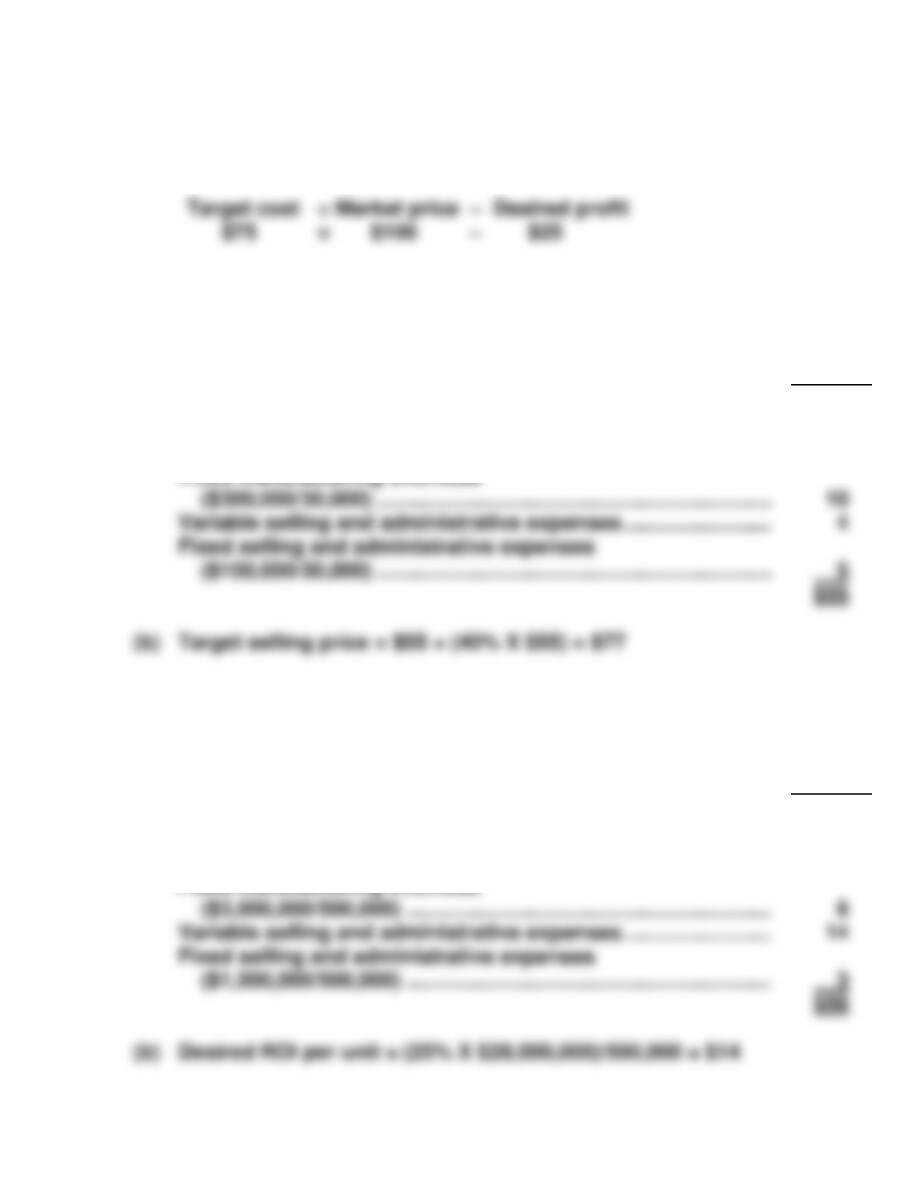
(c) The highest acceptable cost would be the target cost. The target cost
is $75 as shown below:
EXERCISE 8-4
(a) Total cost per unit:
Per Unit
Direct materials ……………………………………………………….……….
Direct labor ………………………………………………………………………
Variable manufacturing overhead ……………………………………..
$17
8
11
EXERCISE 8-5
(a) Total cost per unit:
Per Unit
Direct materials ……………………………………………………….……….
Direct labor ………………………………………………………………………
Variable manufacturing overhead ……………………………………..
$ 7
11
15
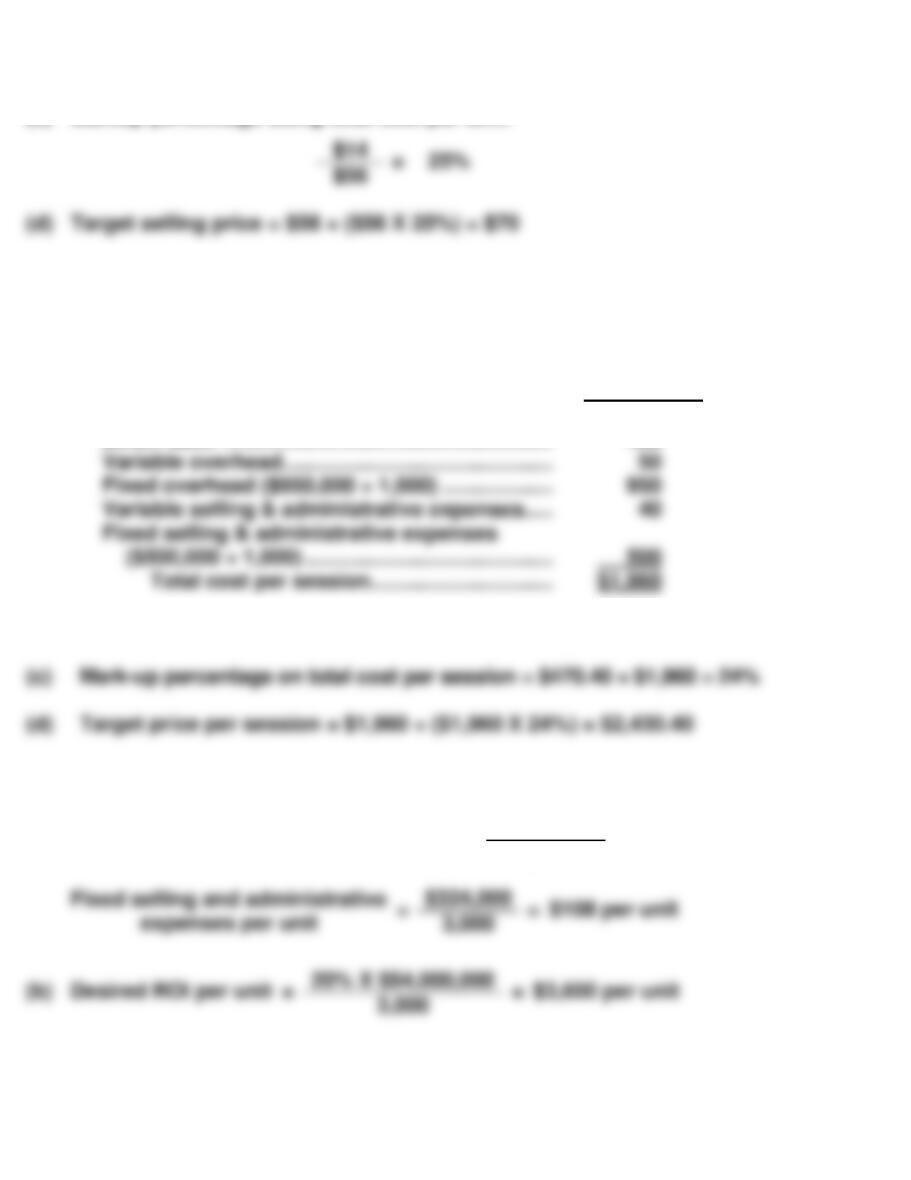
EXERCISE 8-5 (Continued)
(c) Markup percentage using total cost per unit:
EXERCISE 8-6
(a)
Total cost per session:
Per Session
Direct materials ………………………………………….
$ 20
Direct labor ………………………………………………..
400
Variable overhead ……………………………………….
Fixed overhead ($950,000 ÷ 1,000) ……………….
Variable selling & administrative expenses…..
Fixed selling & administrative expenses
($500,000 ÷ 1,000) ……………………………………
500
Total cost per session ………………………….
(b) Desired ROI per session = (20% X $2,352,000) ÷ 1,000 = $470.40
EXERCISE 8-7
(a)
Fixed manufacturing overhead per unit
=
$1,500,000
=
$500 per unit
3,000
(b)
Desired ROI per unit
=
20% X $54,000,000
=
=
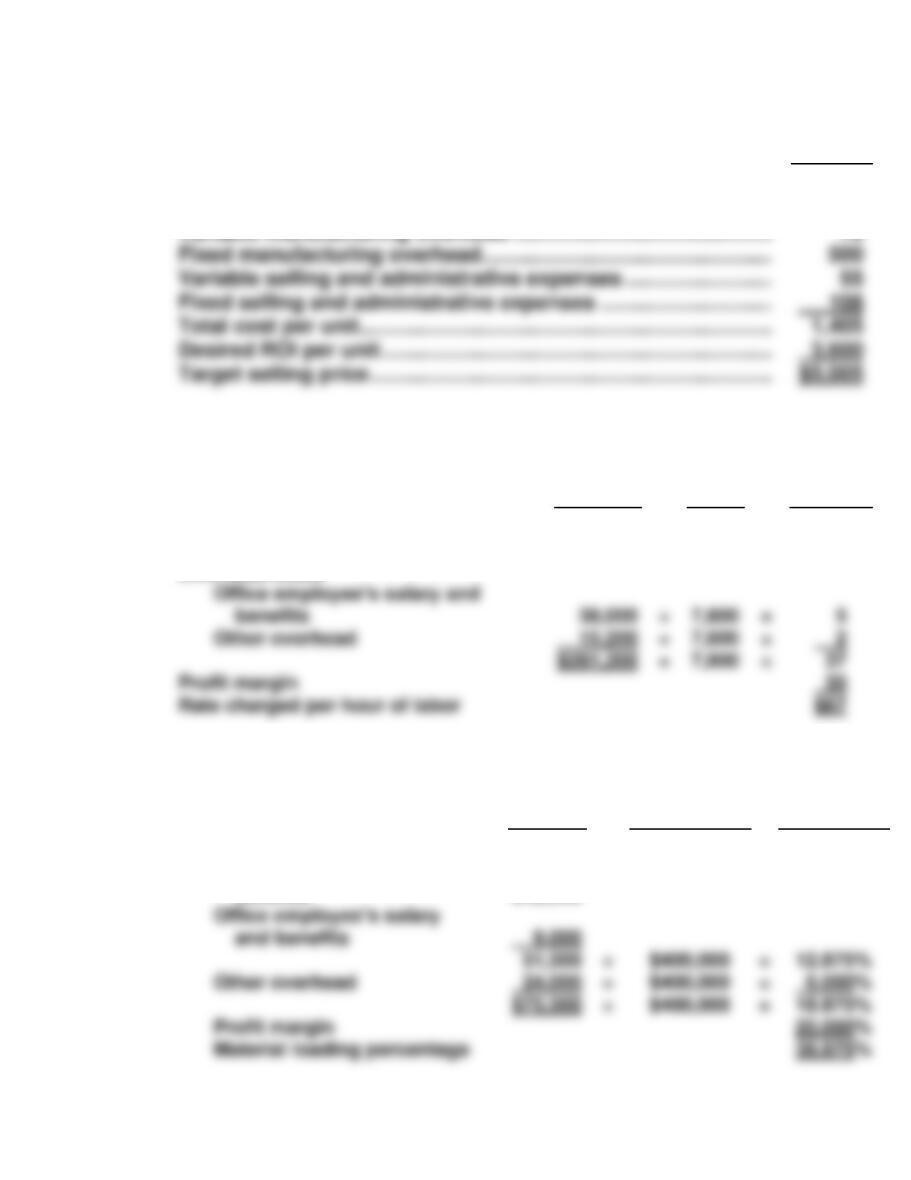
EXERCISE 8-7 (Continued)
(c)
Per Unit
Direct materials ……………………………………………………….……….
Direct labor ………………………………………………………………………
Variable manufacturing overhead ……………………………………..
$ 380
290
72
EXERCISE 8-8
(a)
Total
Cost
÷
Total
Hours
=
Per Hour
Charge
Hourly labor rate for repairs
Technician’s wages and benefits
Overhead costs
$228,000
÷
7,600
=
$30
(b)
Material
Loading
Charges
÷
Total
Invoice Cost,
Parts and
Materials
=
Material
Loading
Percentage
Overhead costs
Parts manager’s salary and
benefits
$42,500
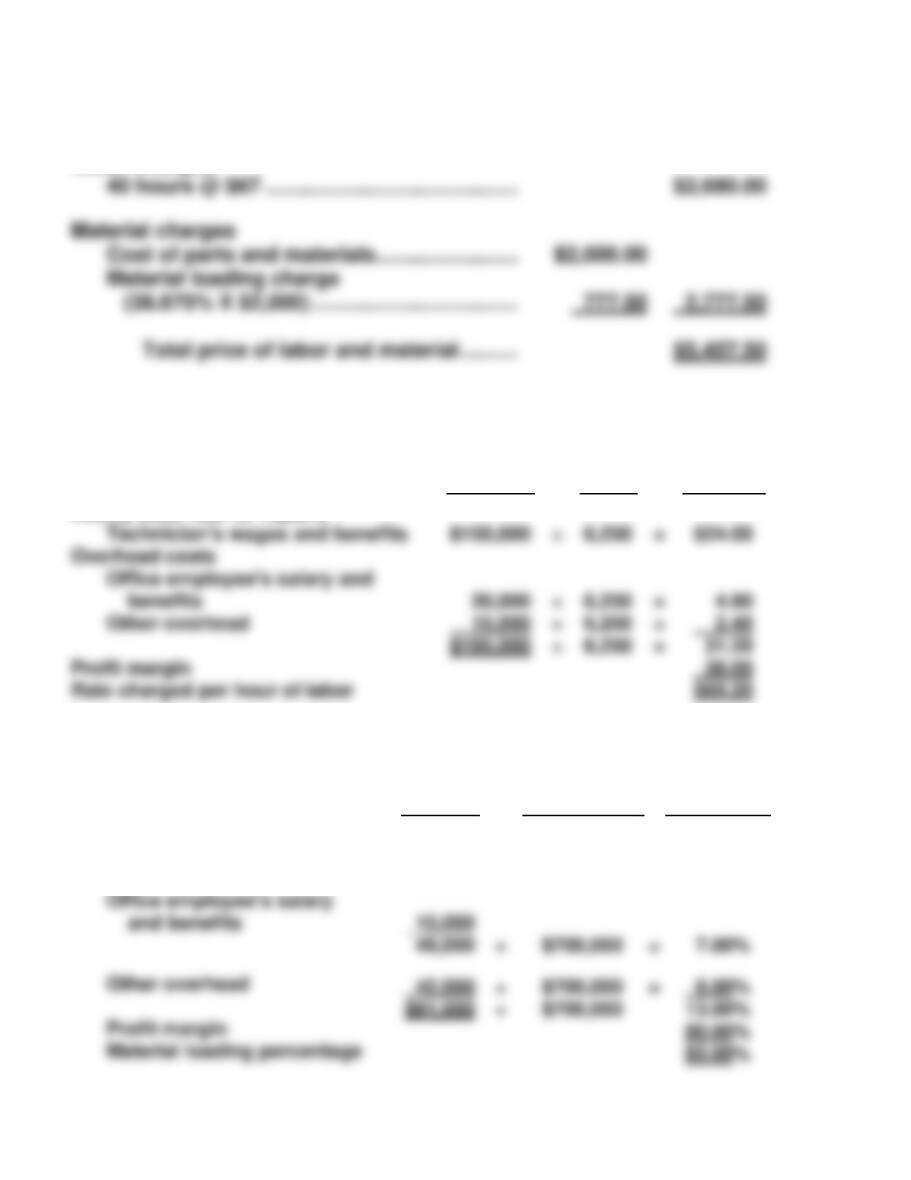
EXERCISE 8-8 (Continued)
(c) Job: Pace Corporation—Rebuild spot welder
Labor charges
EXERCISE 8-9
(a)
Total
Cost
÷
Total
Hours
=
Per Hour
Charge
$195,000
Hourly labor rate for repairs
(b)
Material
Loading
Charges
÷
Total
Invoice Cost,
Parts and
Materials
=
Material
Loading
Percentage
Overhead costs
Parts manager’s salary and
benefits
$34,000
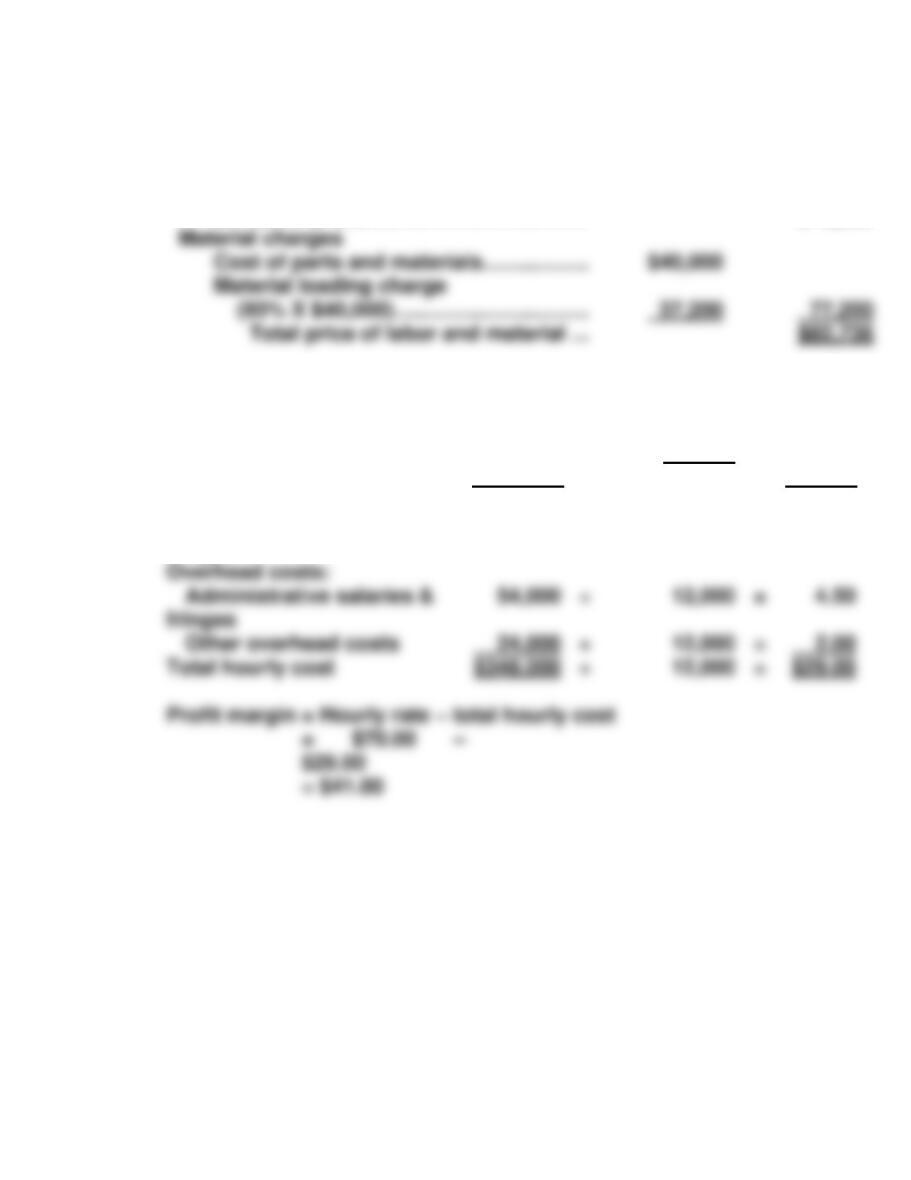
EXERCISE 8-9 (Continued)
(c) Job: Buil Builders
Labor charges
80 hours @ $69.20 ………………………….. $ 5,536
EXERCISE 8-10
(a)
Total
Cost
÷
Total Hours
=
Hourly
Charge
Hourly labor rate:
Restorers’ wages and
fringes
$270,000
÷
12,000
=
$22.50
Overhead costs:
fringes
Other overhead costs
2.00
Total hourly cost
÷
=
Profit margin = Hourly rate – total hourly cost
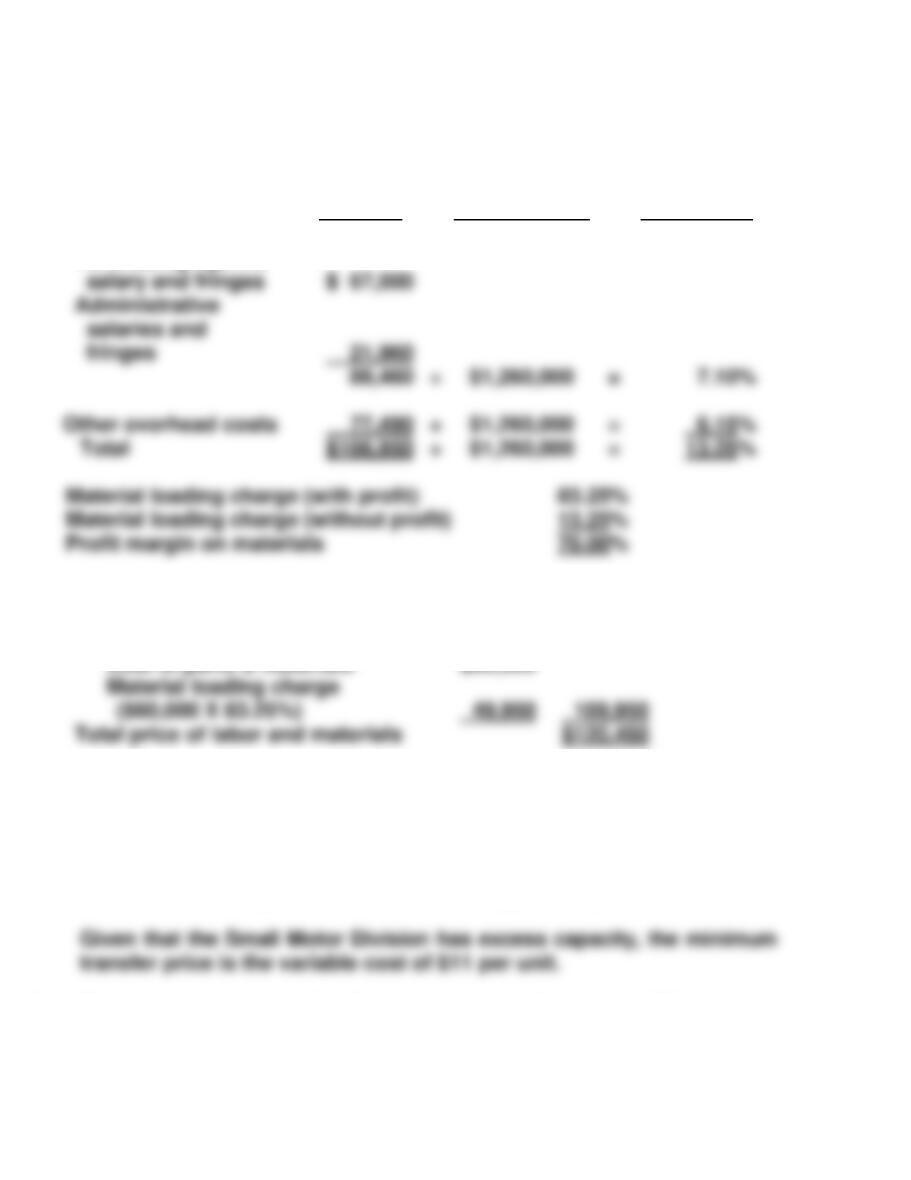
EXERCISE 8-10 (Continued)
(b)
Material
Loading
Charges
÷
Total Invoice
Cost, Parts &
Materials
=
Material
Loading
Percentage
Overhead costs:
Purchasing agent’s
(c)
Labor charges:
150 hours @ $70
$ 10,500
Material charges:
Cost of parts & materials
Material loading charge
($60,000 X 83.25%)
Total price of labor and materials
EXERCISE 8-11
(a) The minimum transfer price is:
Minimum transfer price = Variable cost + opportunity cost
(b) Given no excess capacity, the minimum transfer price is $35, which is
its variable cost plus the lost contribution margin.
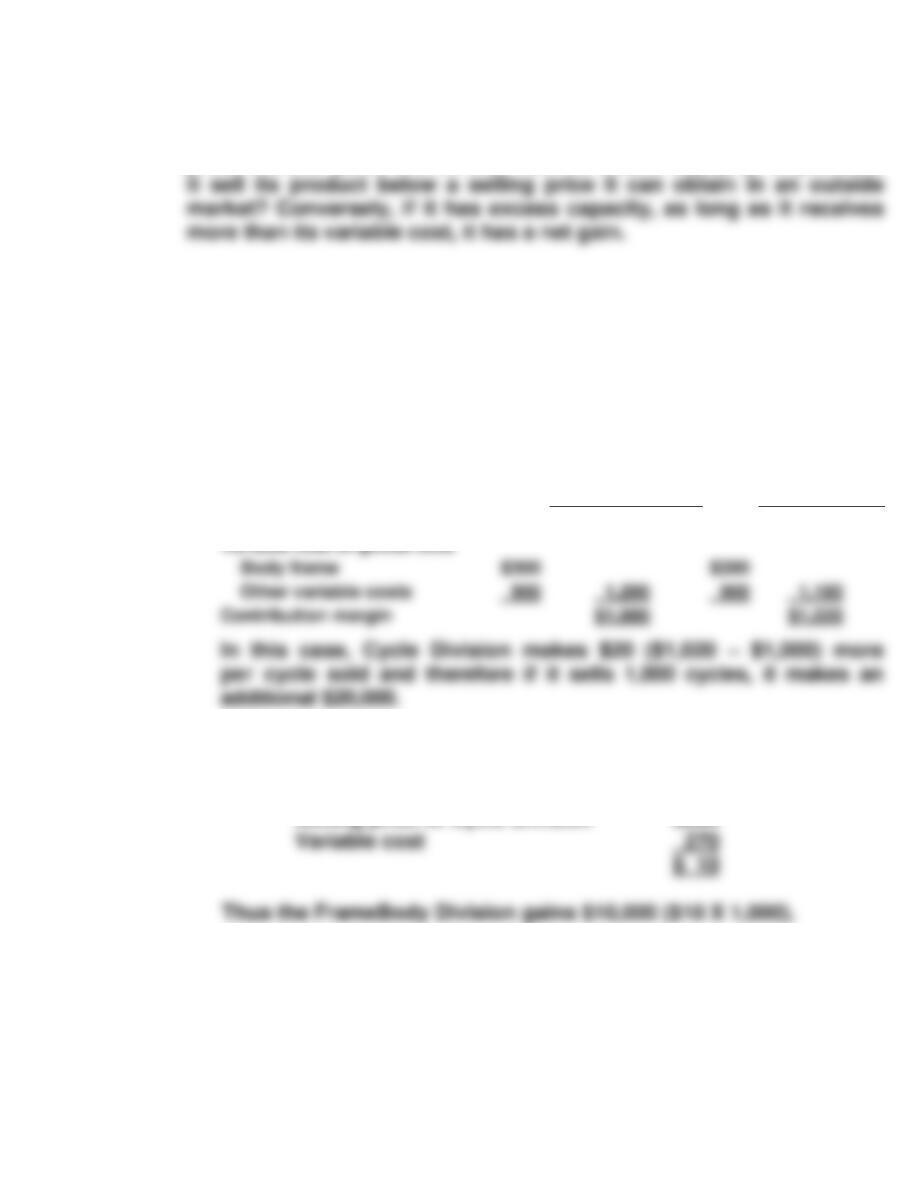
salary and fringes
salaries and
fringes
÷
=
Other overhead costs
÷
=
Total
÷
=
EXERCISE 8-11 (Continued)
(c) The level of capacity plays a significant role in determining the appro-
priate transfer price. If a division has no excess capacity, why should
EXERCISE 8-12
(a) As indicated, FrameBody has excess capacity and therefore should be
willing to accept any price that equals or exceeds its variable cost.
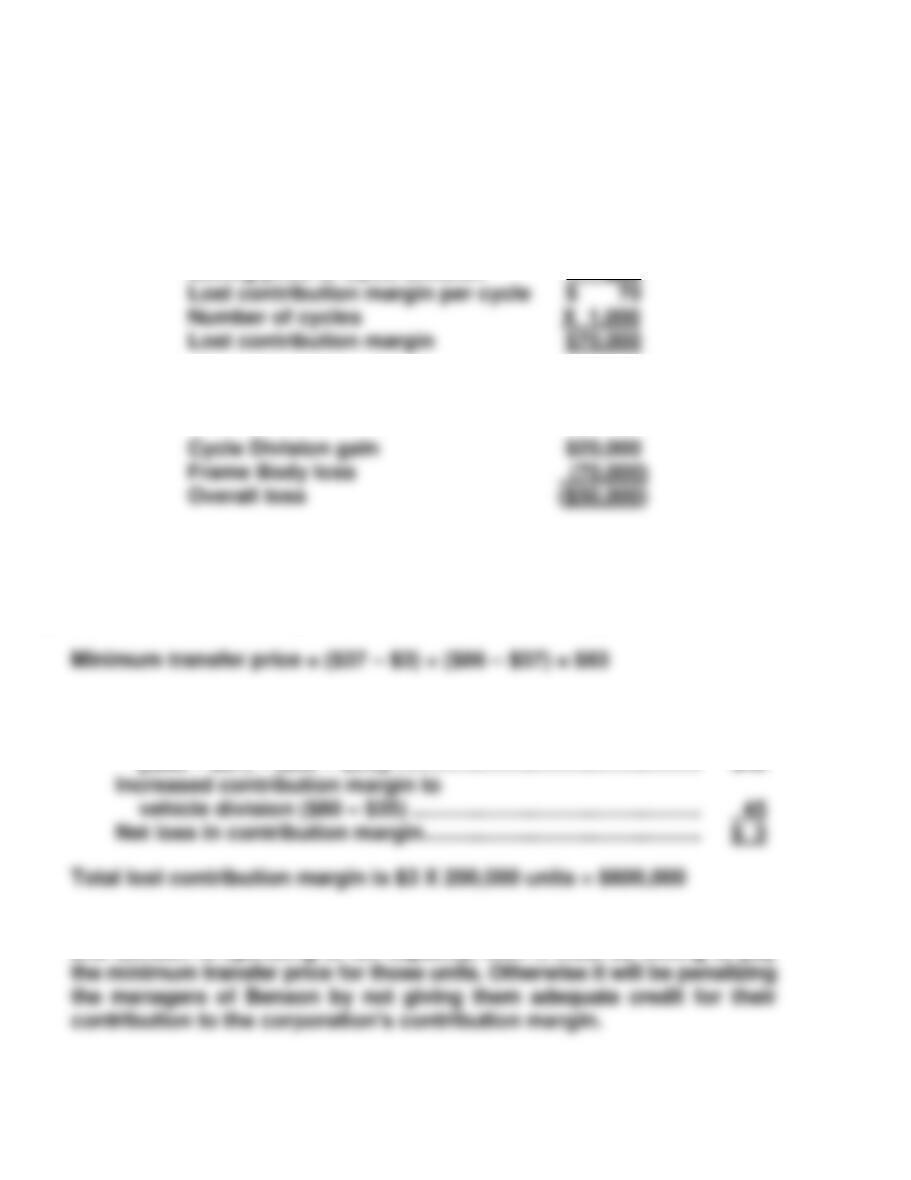
1. The effect on Cycle Division is as follows:
Present Situation
Purchase from
FrameBody
Selling price
$2,200
$2,200
2. The effect on FrameBody is that it makes $10 on each frame sold
as shown below:
Selling price to Cycle Division $280
3. As a result, the overall income for Ayala increases $30,000 ($20,000
from Cycle Division and $10,000 from FrameBody).
EXERCISE 8-12 (Continued)
(b) 1. The answer would not change from (a)(1). Cycle Division would
gain $20,000 if it purchased the frames from FrameBody.
2. However, FrameBody would incur a loss of $70,000 as computed
below:
Selling price to outside buyer $ 350
Selling price to Cycle Division 280
3. The effect on the overall income to Ayala is a net loss of $50,000 as
shown below:
EXERCISE 8-13
(a) The minimum transfer price that Benson should accept is:
(b) The lost contribution margin per unit to the company is:
Contribution margin lost by Benson
[($86 – $37) – ($35 – $34)] ……………………………………………. $48
(c) If management insists that it wants Benson to provide the stereo units,
and Benson is operating at full capacity, then it must be willing to pay
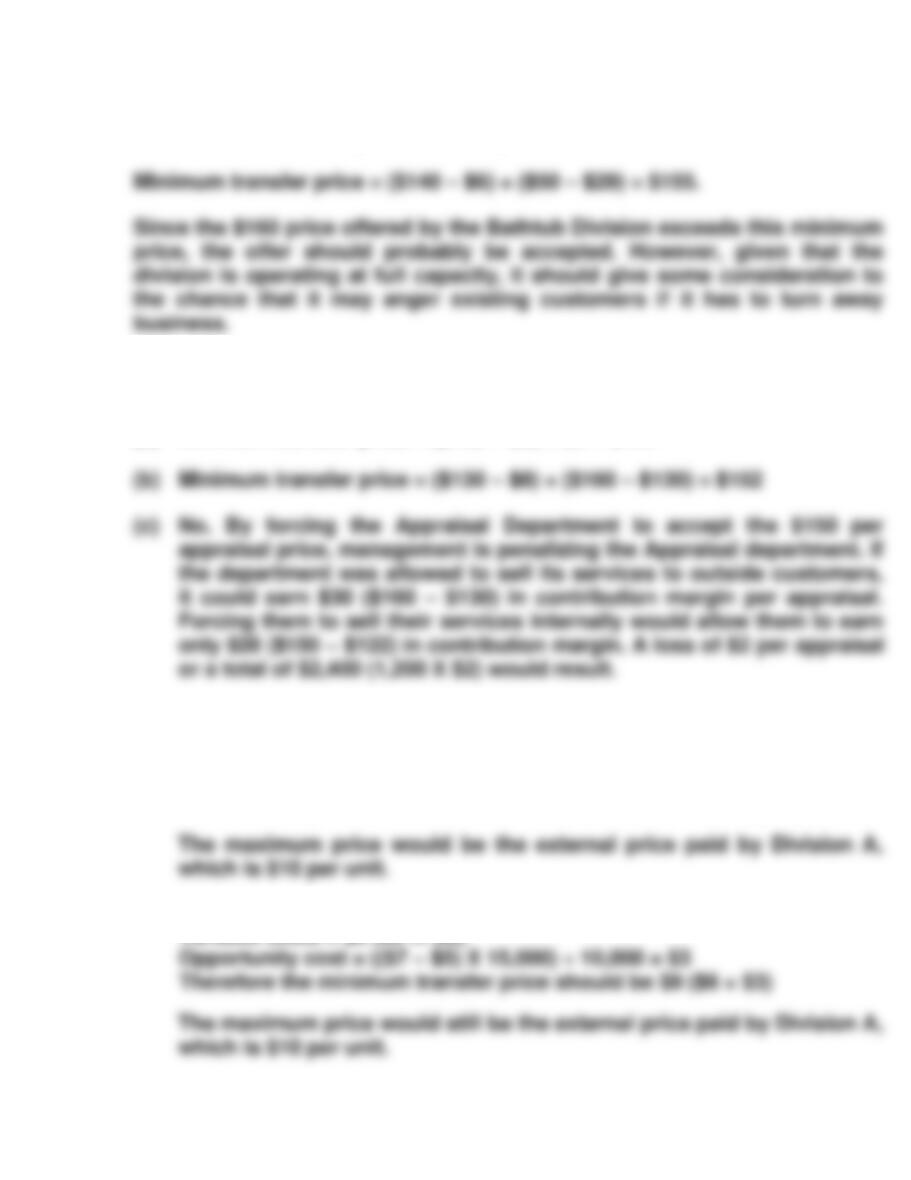
EXERCISE 8-14
The minimum transfer price on this special order would be:
EXERCISE 8-15
(a) Minimum transfer price = ($130 – $8) + $0 = $122
EXERCISE 8-16
(a) The minimum transfer price for Division B would be variable costs,
which are $6 per unit ($7, variable cost – $1, variable selling expense).
(b) Minimum transfer price = variable costs + opportunity cost
Variable costs = $6 (as in (a))
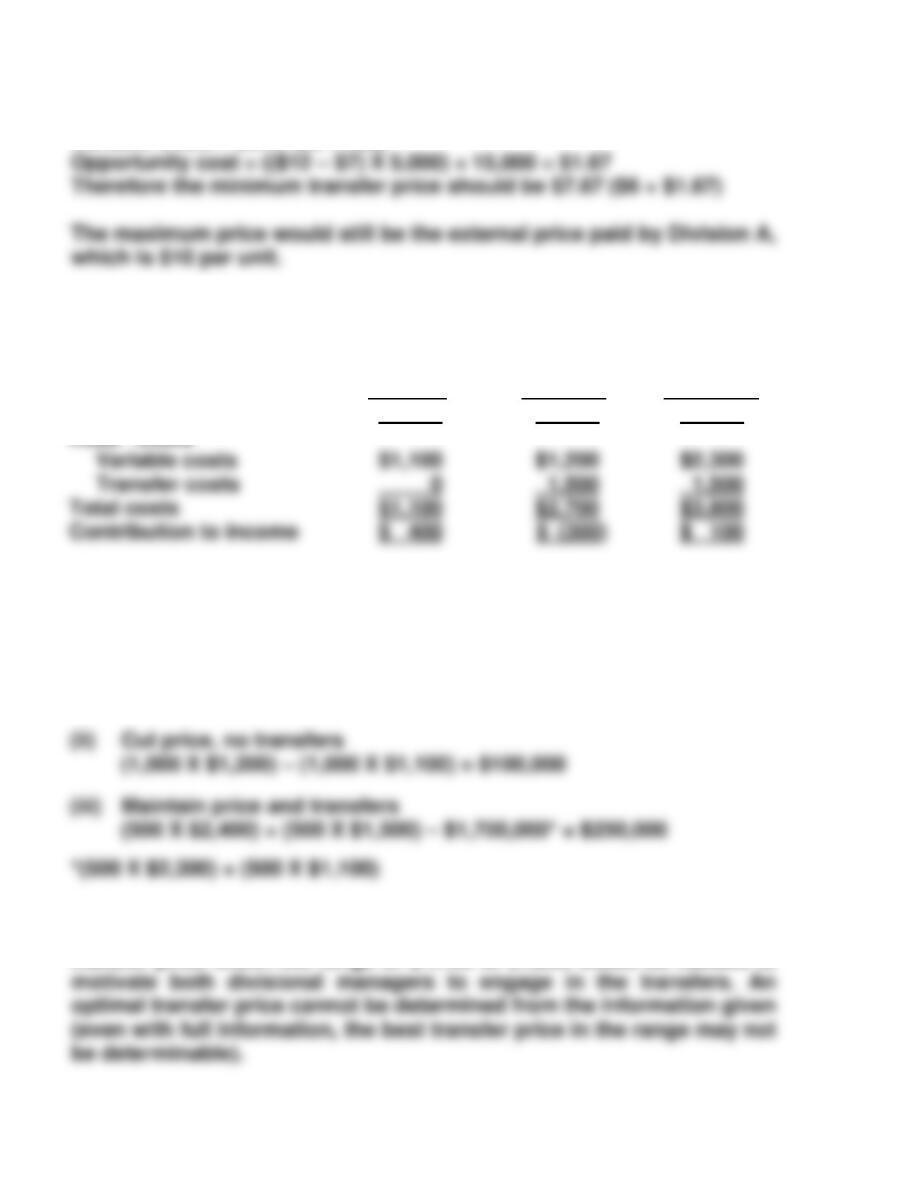
EXERCISE 8-16 (Continued)
(c) Minimum transfer price = variable costs + opportunity cost
Variable costs = $6.00 (as in (a))
EXERCISE 8-17
(a) Division Division Total
A B Company
Sales $1,500 $2,400 $3,900
Less: Costs
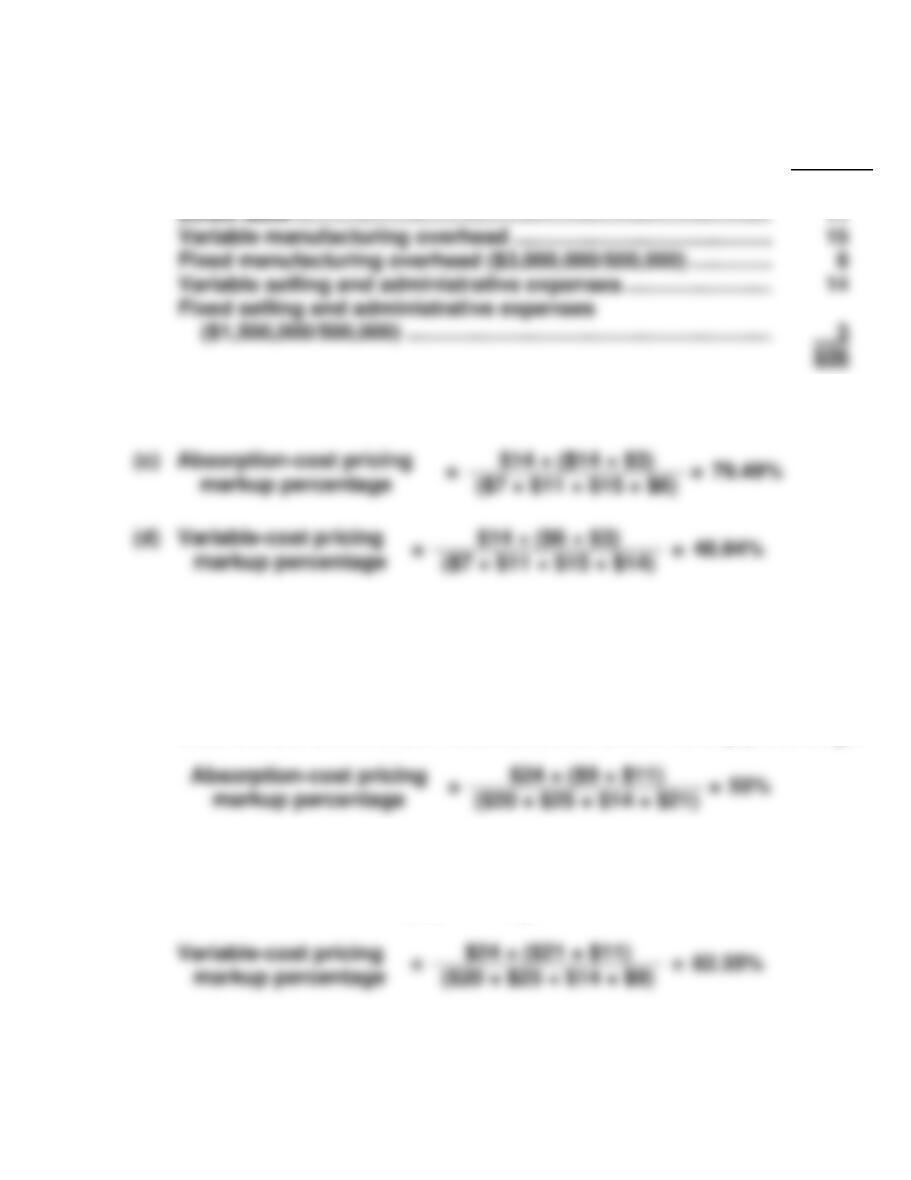
(b) The opportunity cost is the market price. Transfers should be made at
market prices less any avoidable costs. In the current situation, it
would appear that no transfers would be made.
(c) (i) Maintain price, no transfers
(500 X $1,500) – (500 X $1,100) = $200,000
The firm is better off by maintaining the current market price for
Division A’s product and transferring 500 units to Division B. A
transfer price within the range of $1,100 to $1,200 would be needed to
*EXERCISE 8-18
(a) Cost per unit:
Per Unit
Direct materials ……………………………………………………….……….
$ 7
(b) Desired ROI per unit = (25% X $28,000,000)/500,000 = $14
*EXERCISE 8-19
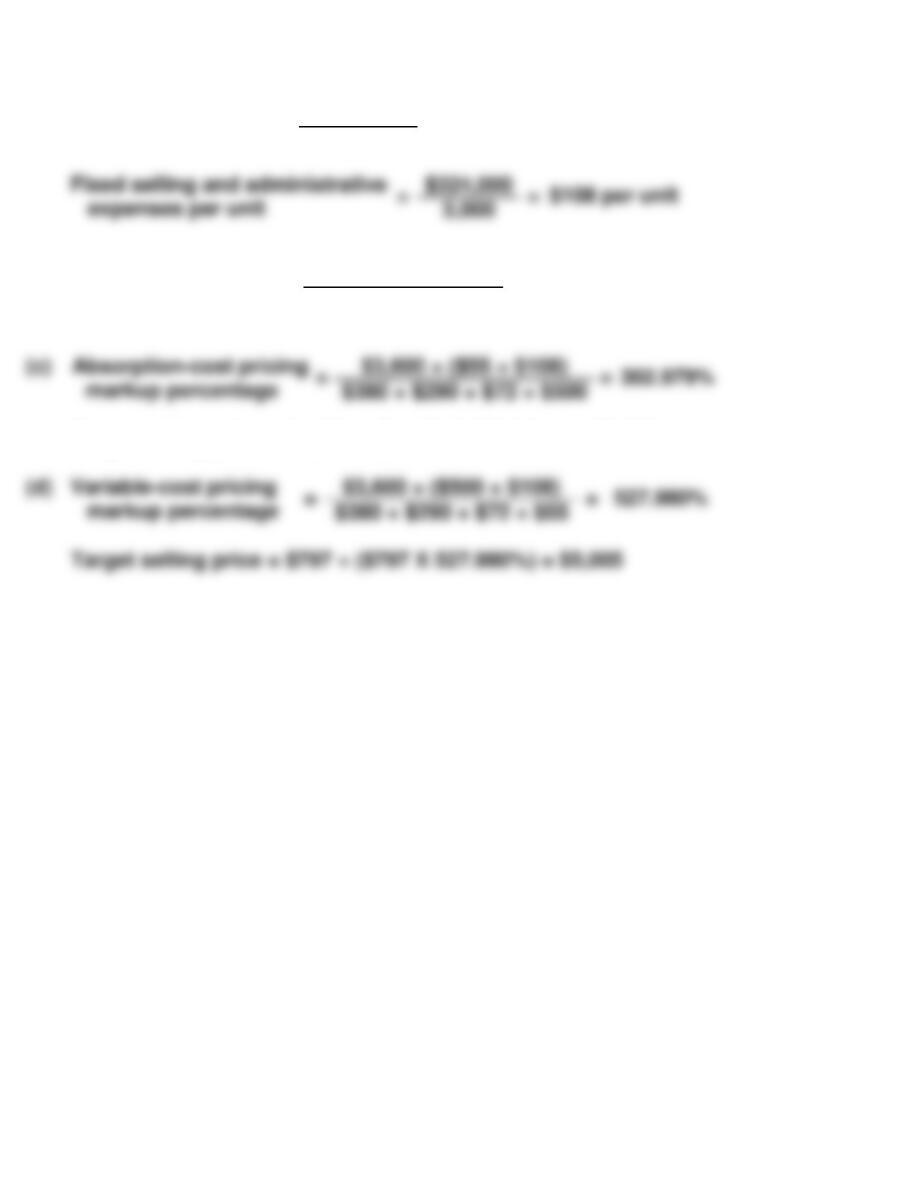
(a) The cost base of absorption-cost pricing includes only manufacturing
costs. All selling and administrative costs are excluded from the cost
base and are added back in the numerator of the markup percentage.
(b) The cost base of variable-cost pricing includes only variable costs. All
fixed costs are excluded from the cost base and are added back in the
numerator of the markup percentage.
*EXERCISE 8-20
(a)
Fixed manufacturing
overhead per unit
=
$1,500,000
=
$500 per unit
3,000
(b)
Desired ROI per unit
=
20% X $54,000,000
=
$3,600 per unit
3,000
$380 + $290 + $72 + $500
Target selling price = $1,242 + ($1,242 X 302.979%) = $5,005
expenses per unit
=
$324,000
=
$108 per unit
SOLUTIONS TO PROBLEMS
PROBLEM 8-1A
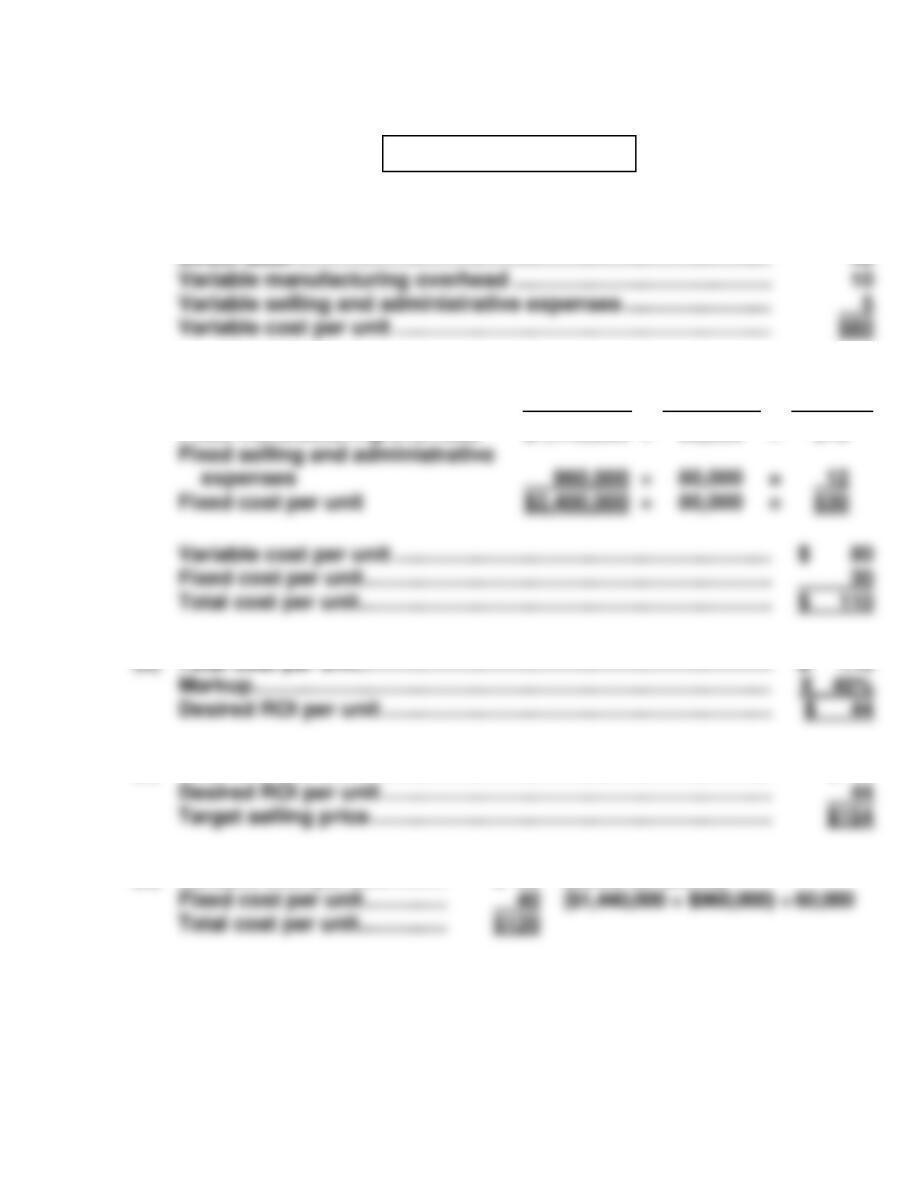
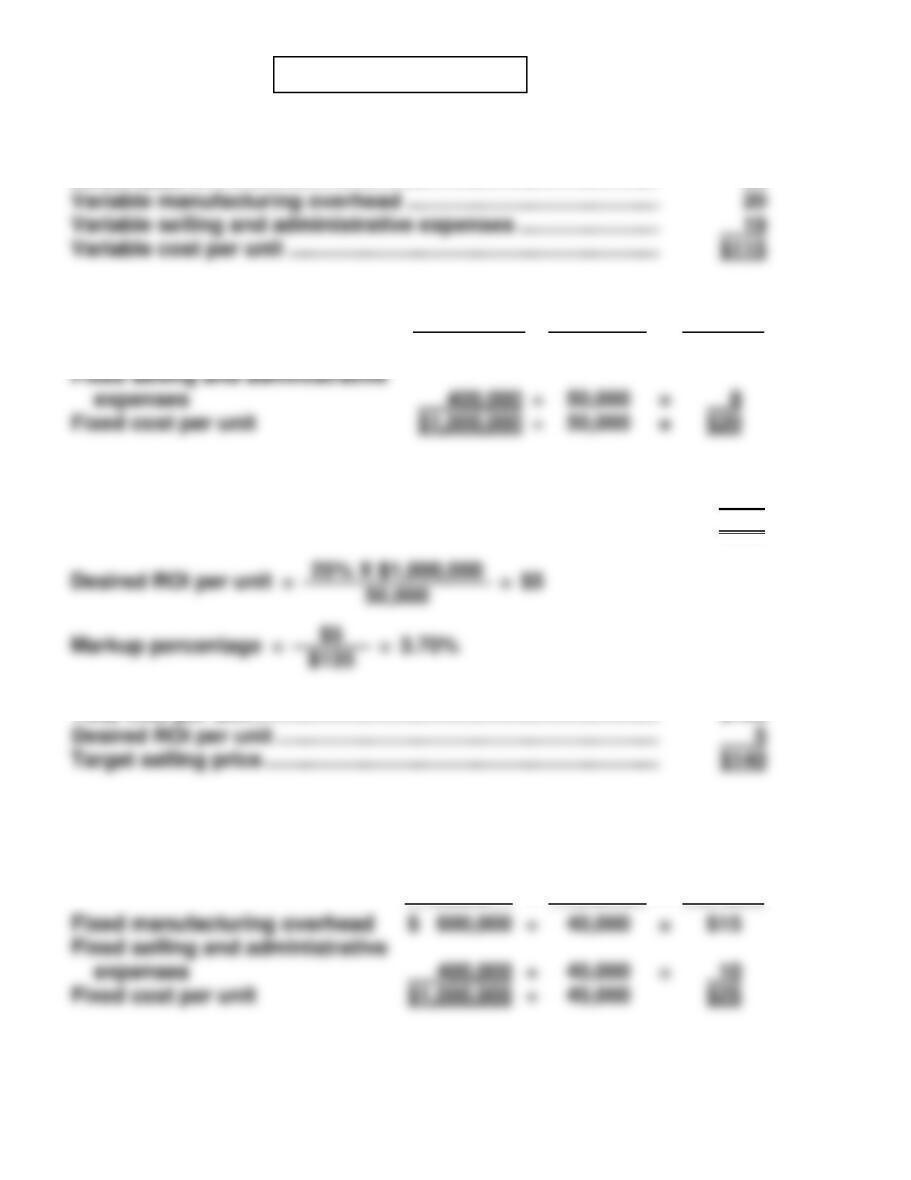
(a) Direct materials ……………………………………………………………….. $25
Total
Costs
÷
Budgeted
Volume
=
Cost
Per Unit
expenses
960,000
÷
=
Fixed manufacturing overhead
$1,440,000
÷
80,000
=
$18
(c) Total cost per unit ……………………………………………………………. $110
(d) Variable cost per unit ……… $ 80 (same as above)
PROBLEM 8-2A
(a) Direct materials ………………………………………………………………. $ 50
Direct labor …………………………..………………………………………… 26
Total
Costs
÷
Budgeted
Volume
=
Cost
Per Unit
expenses
÷
=
=
Fixed manufacturing overhead
$ 600,000
÷
50,000
=
$12
Variable cost per unit ……………………………………………………… $115
Fixed cost per unit ………………………………………………………….. 20
Total cost per unit …………………………………………………………… $135
Total cost per unit …………………………………………………………… $135
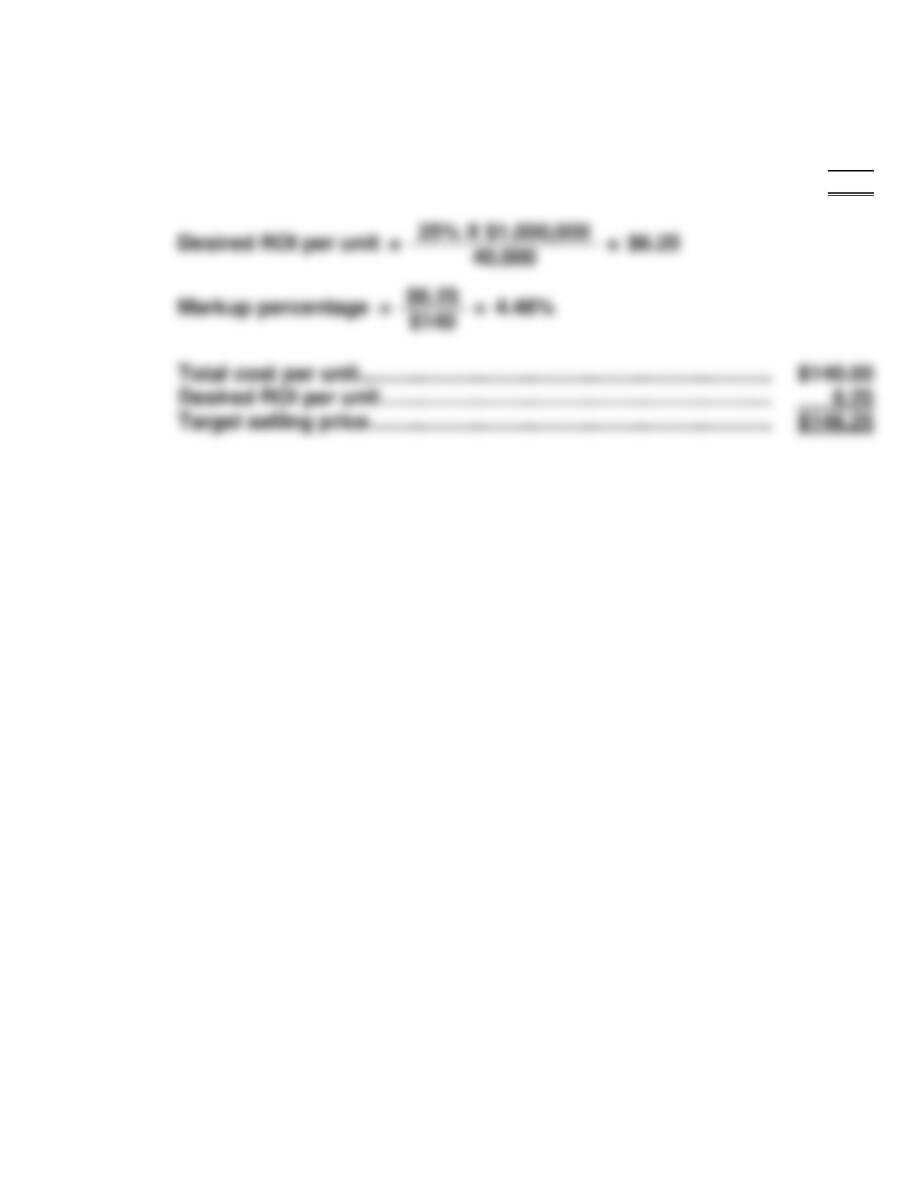
(b) Variable cost per unit ……………………………………… $115 (same as (a))
Total
Costs
÷
Budgeted
Volume
=
Cost
Per Unit
expenses
400,000
÷
=
PROBLEM 8-2A (Continued)
Variable cost per unit ………………………………………………………. $115
Fixed cost per unit …………………………………………………………… 25
Total cost per unit ……………………………………………………………. $140
PROBLEM 8-3A
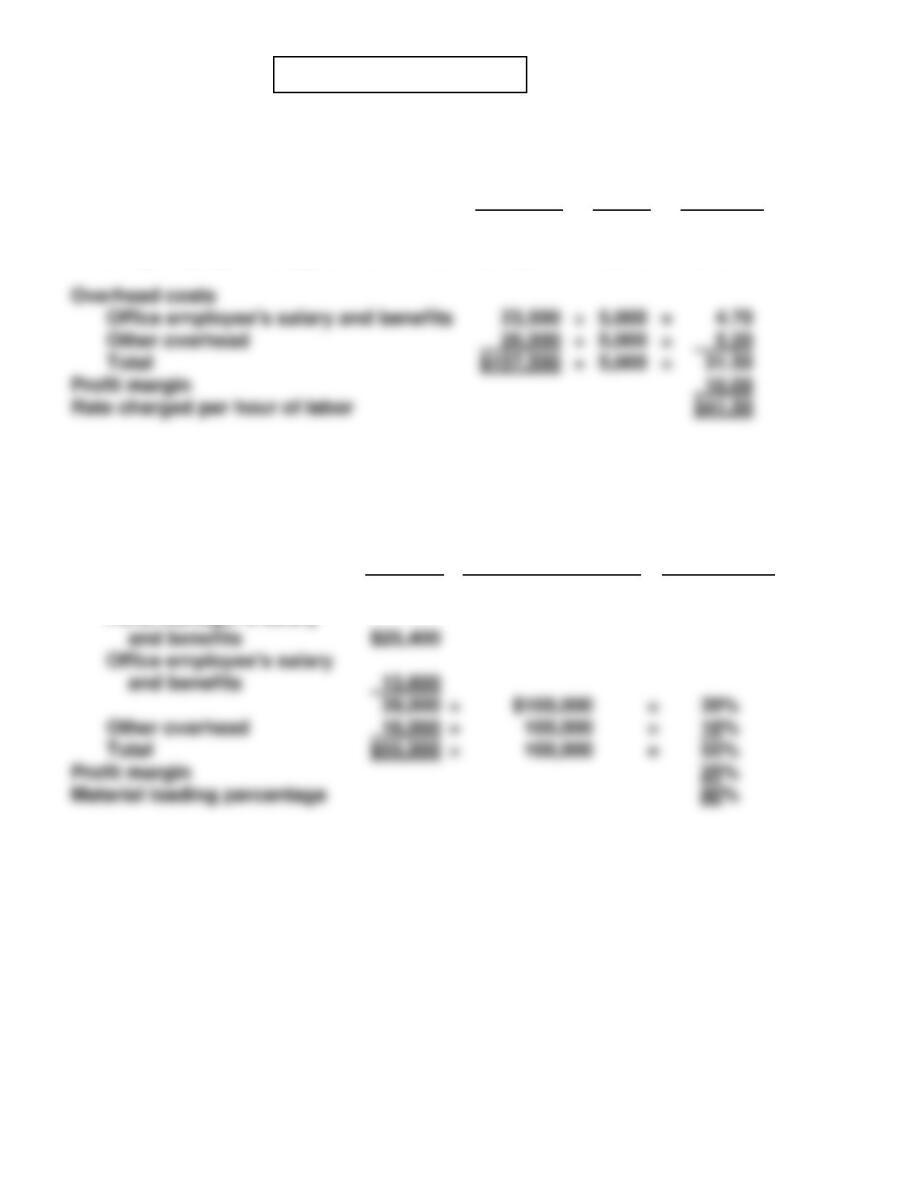
(a) Computation of time charge rate
Total
Cost
÷
Total
Hours
=
Per Hour
Charge
Hourly labor rate for repairs
Shop employees’ wages and benefits
$108,000
÷
5,000
=
$21.60
(b) Computation of material loading charge
Material
Loading
Charges
÷
Total Invoice Cost,
Parts and Materials
=
Material
Loading
Percentage
Total
Overhead costs
Parts manager’s salary
PROBLEM 8-3A (Continued)
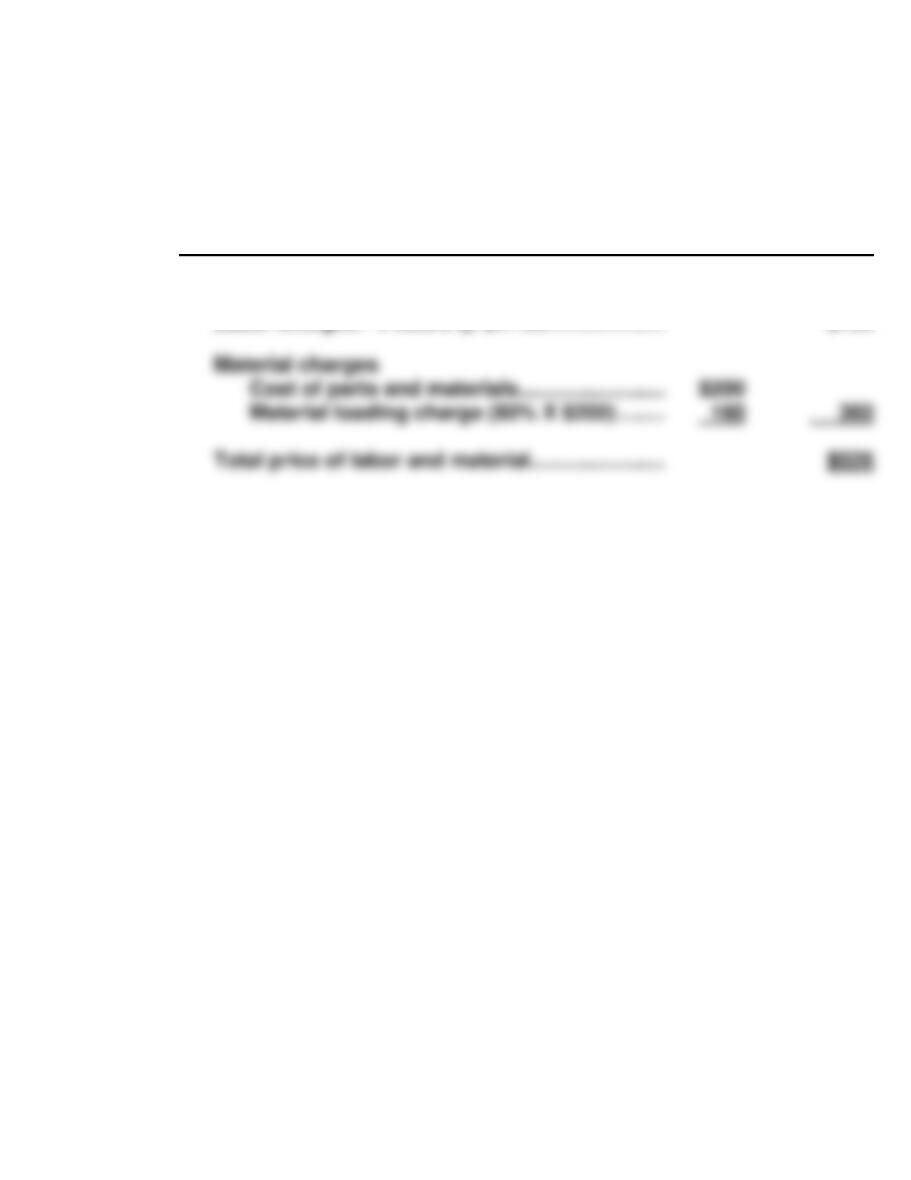
(c) Price quotation for time and material
SUTTON’S ELECTRONIC REPAIR SHOP
Time and Material Price Quotation
January 5, 2017
Job: Fix big screen TV set
Labor charges: 4 hours @ $41.50 ……………….. $166
PROBLEM 8-4A
(a) Assuming no available capacity, the printing operation’s variable cost
is $0.004 per page and its opportunity cost is $0.006 ($0.01 – $0.004)
(b) Assuming that the printing operation has available capacity, the print–
ing operation’s variable cost is $0.004 and its opportunity cost is $0.
The minimum transfer price would be $0.004 ($0.004 + $0). Therefore,
(c) The advantages of having all of the company’s printing done intern–
ally include: (1) ensuring that the company’s quality expectations are
met, (2) ensuring that all projects are completed on a timely basis, and
(d) The printing operation would lose:
PROBLEM 8-5A
(a) The minimum transfer price is based on the variable cost of units
transferred internally, plus the opportunity cost of units sold externally.
The variable cost of internal sales would be $10 ($14.50 – $4.50). The
(b) If the Chip Division rejects the offer, each division will suffer a loss of
contribution margin, as well as the company as a whole. The amount
of this loss is calculated as:
Lost contribution margin by Board Division:
Cost of buying externally, per chip $22
Lost contribution margin by Chip Division:
Unit contribution margin on internal sales
($21 – $10) $11
Unit contribution margin on external sales
PROBLEM 8-6A
(a) Assuming no available capacity, and that the number of new units
produced would be equal to the number of standard units forgone,
variable cost of the special pager would be $80 ($50 + $30) and the
(b) Assuming no available capacity, and that in order to produce the
12,000 special pagers, 16,000 standard pagers would be forgone, the
(c) Assuming that the CD Division has available capacity, variable cost
would be $80 ($50 + $30) and the opportunity cost would be zero.
*PROBLEM 8-7A
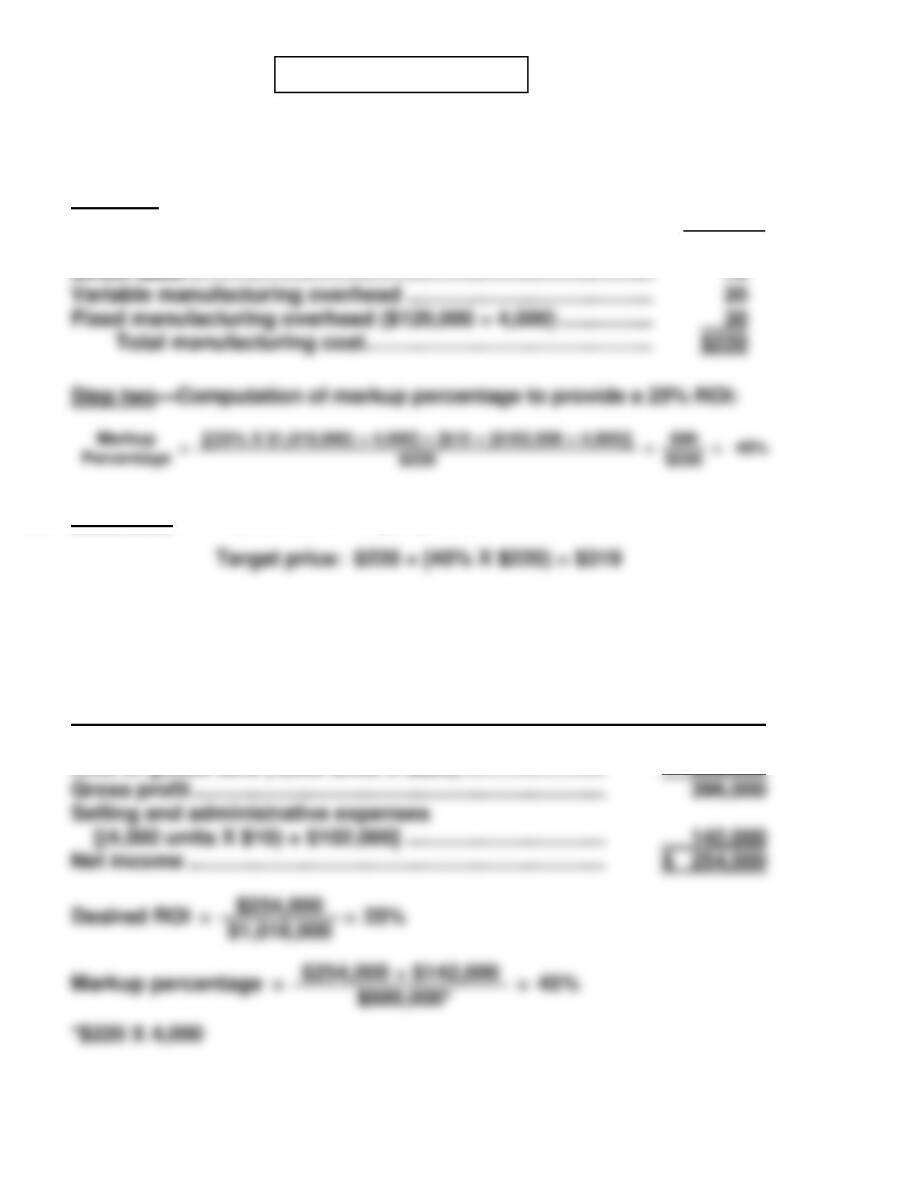
(a) Absorption-cost pricing:
Computation of unit manufacturing cost and target selling price
Direct materials ………………………………………………………………. $ 20
Direct labor …………………………………………………………………….. 40
Variable manufacturing overhead ……………………………………. 10
(b) Variable-cost pricing:
Computation of total variable cost and target selling price
Direct materials ………………………………………………………………. $ 20
Direct labor …………………………………………………………………….. 40
Variable manufacturing overhead ……………………………………. 10
*PROBLEM 8-8A
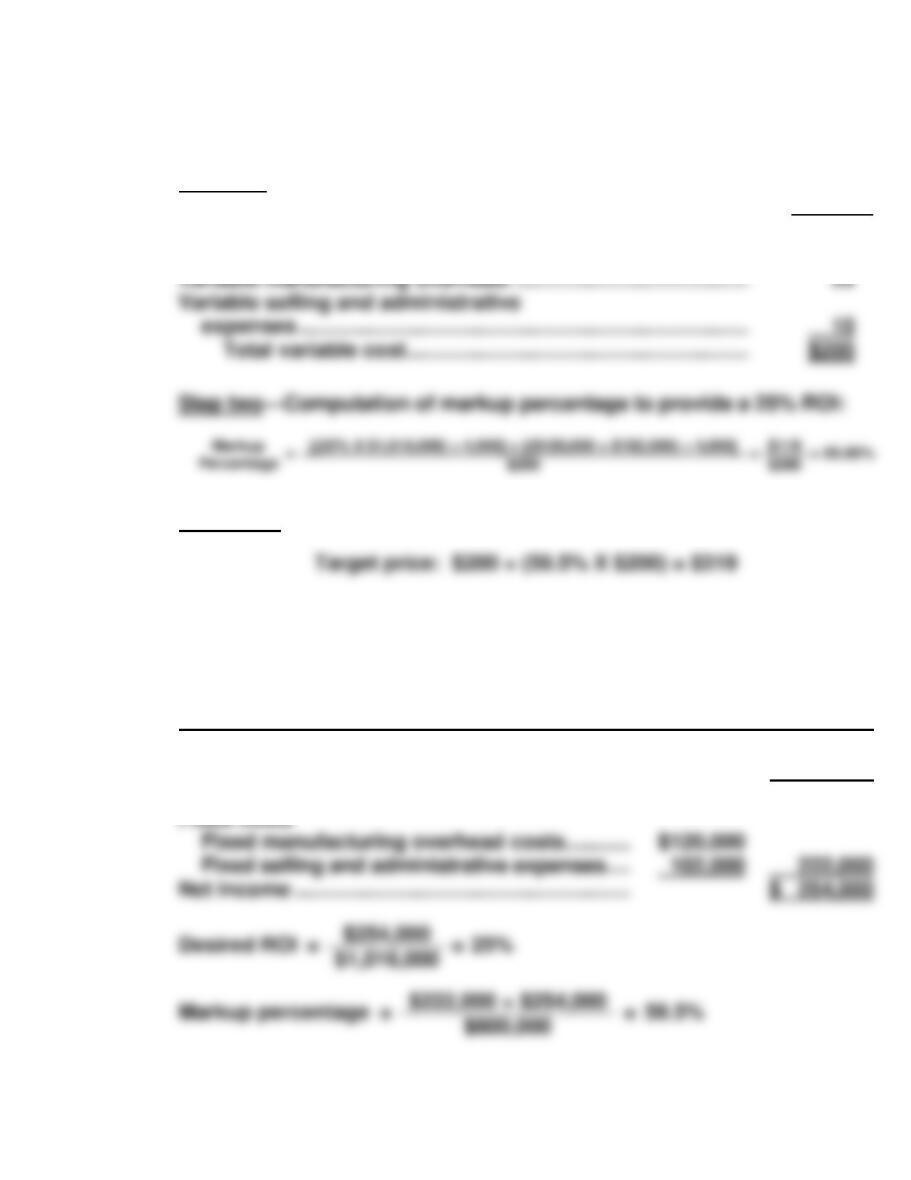
Absorption-cost pricing
(a) Step one—Computation of unit manufacturing cost:
Per Unit
Direct materials ………………………………………………………………
$100
(b) Step three—Computation of target price:
Proof of 25% ROI under absorption-cost pricing:
ANDERSON WINDOWS INC.
Budgeted Absorption-Cost Income Statement
(Tinted Window)
Revenues (4,000 units X $319) …………………………………. $1,276,000
Cost of goods sold (4,000 units X $220) ……………………. 880,000
*PROBLEM 8-8A (Continued)
Variable-cost pricing
(c) Step one—Computation of unit variable cost:
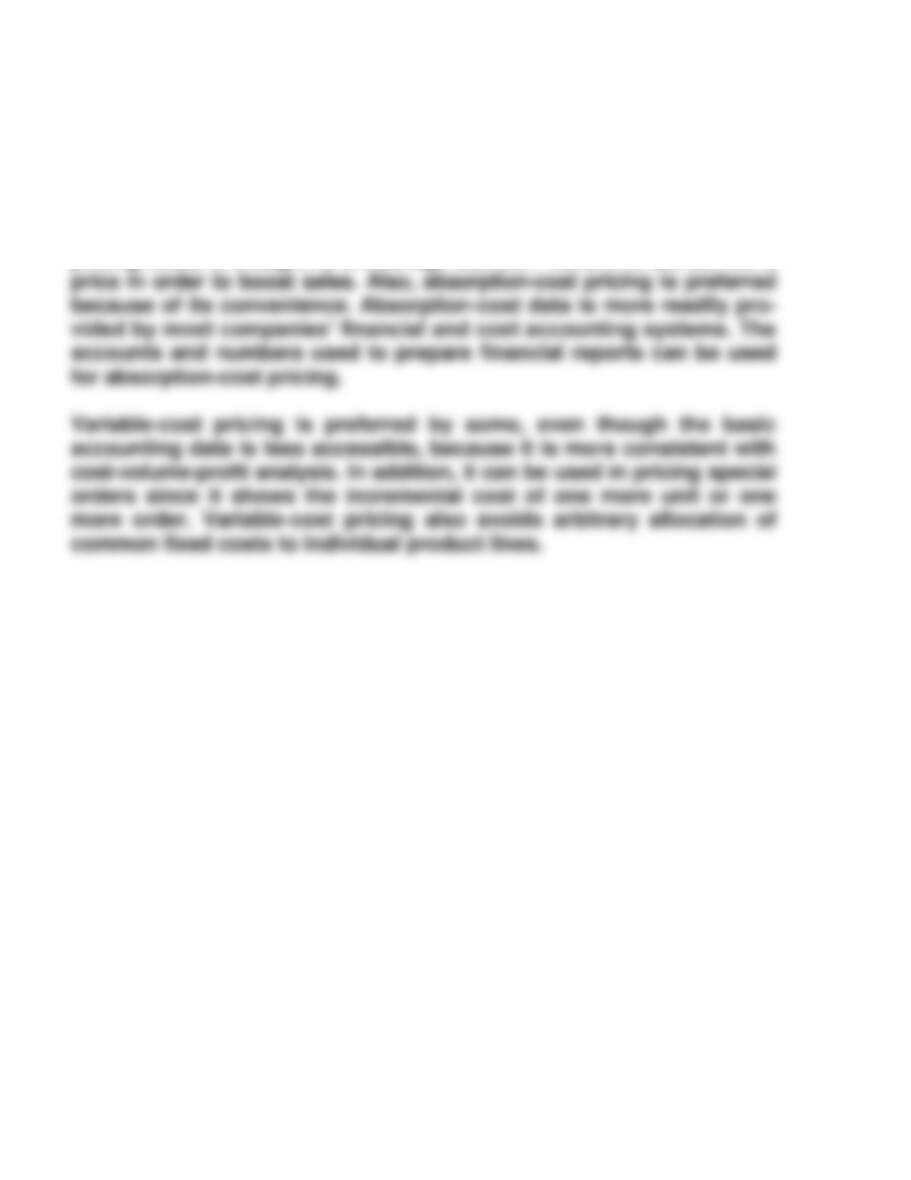
Per Unit
Direct materials ……………………………………………………….……
Direct labor …………………………………………………………………..
$100
70
(d) Step three—Computation of target price:
Proof of 25% ROI under variable-cost pricing:
ANDERSON WINDOWS INC.
Budgeted Variable-Cost Income Statement
(Tinted Window)
Revenue (4,000 units X $319) ………………………. $1,276,000
Variable costs (4,000 units X $200) ……………… 800,000
Contribution margin …………………………………… 476,000
*PROBLEM 8-8A (Continued)
(e) Both absorption-cost pricing and variable-cost pricing are used because
they have differing merits.
Absorption-cost pricing, especially when it includes full or all costs, is
preferred by some because in the long-run all costs plus a normal profit
margin must be covered. Using only variable costs, as the variable-cost
pricing does, is thought to encourage decision makers to set too low a
CD8 CURRENT DESIGNS
Total Cost
Total Hours
Per Hour
Charge
Repair-technician’s wages
$30,000
2,000
$15
Fringe benefits
10,000
2,000
5
Overhead
10,000
2,000
5
$50,000
2,000
25
Profit margin
20
Rate charged per hour of labor
$45
BYP 8-1 DECISION-MAKING ACROSS THE ORGANIZATION
(a) Purchasing goods from within the company offers a number of
advantages. (1) It cuts out the “middle man,” thus keeping all profits in
the company. (2) It allows the company to have more control over the
(b) Frequently the buying division will be required to buy from within the
company as long as the selling division can provide goods of compara–
ble quality and price. A selling division should not normally be forced
(c) The Wheel division would find this desirable. It would be able to get
higher quality bearings at a cost savings of $3 per set. The Bearing
division would find this very undesirable. Instead of making a profit of
(d) One possible solution is to continue on with the current situation. As
pointed out in (c), the current situation is clearly better than forcing the
Bearing division to sell its high quality bearings to a division that
BYP 8-2 MANAGERIAL ANALYSIS
(a) Dave must consider a number of issues in arriving at a price. First, he
should gather information regarding what price people would be willing
to pay for his type of service. This information could be gathered by a
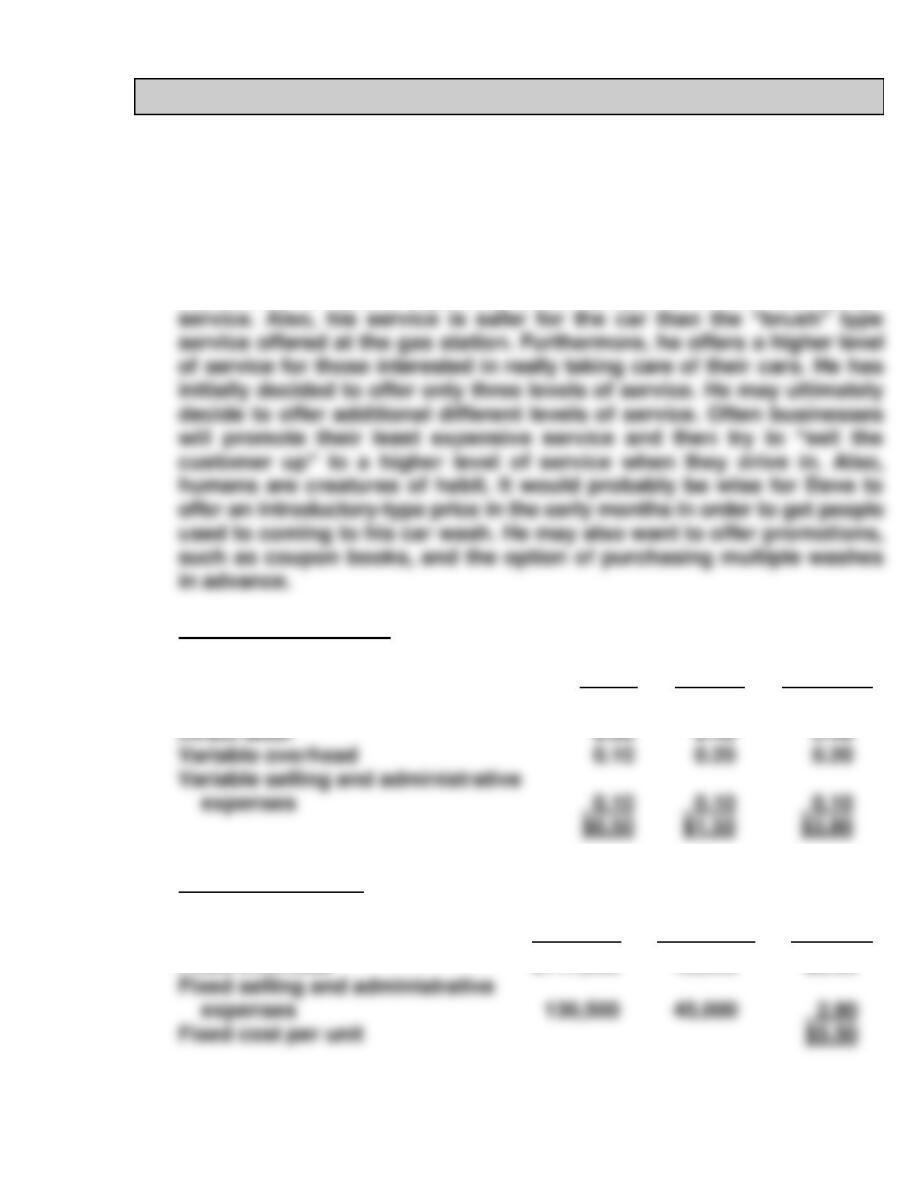
marketing agency. He must consider the strengths and weaknesses of
his product. First, he is closer to housing, thus more convenient. Two,
his service is easier, especially when compared to the “self–spray”
(b) Variable cost per unit
Basic
Wash
Deluxe
Wash
Premium
Wash
expenses
0.10
Direct materials
$0.30
$0.80
$1.10
Fixed cost per unit
Total
Costs
÷
Budgeted
Volume
=
Cost
Per Unit
Fixed cost per unit
$5.50
Fixed overhead
$117,000
45,000
$2.60
BYP 8-2 (Continued)
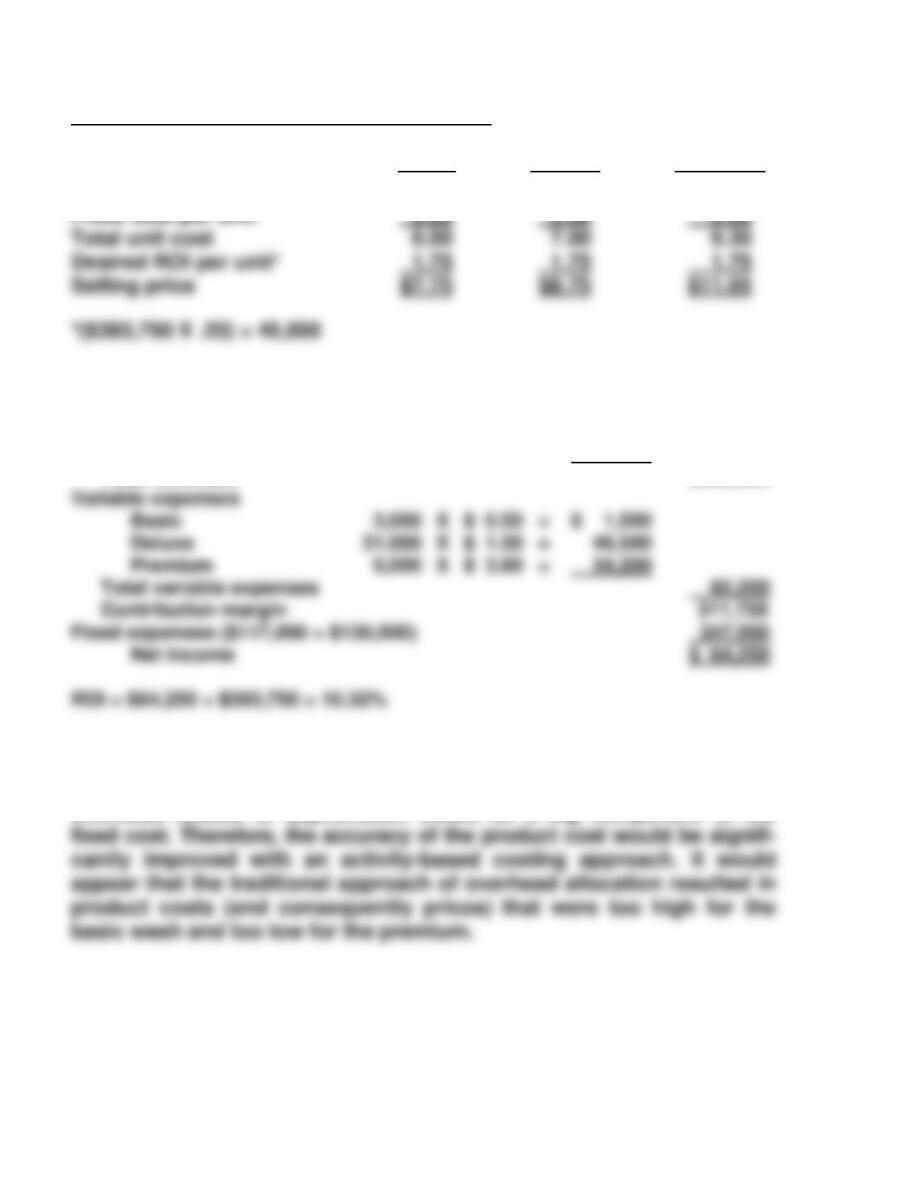
Computation of selling price (45,000 units)
Basic
Deluxe
Premium
Variable cost per unit
$0.50
$1.50
$ 3.80
(c)
Revenues
Basic
Deluxe
Premium
Total revenues
3,000
31,000
9,000
X
X
X
$ 7.75
$ 8.75
$11.05
=
=
=
$ 23,250
271,250
99,450
$393,950
(d) Clearly, the basic wash does not use much of the more complex
capabilities of the equipment. The equipment is expensive and the
overhead related to depreciation would be a big component of the
BYP 8-3 REAL-WORLD FOCUS
(a) Pricing in the pharmaceutical industry is complicated by a number of
factors:
1. When a new drug is developed, it is patented. This protects the
company from competition for a period of time and allows the
company to charge a higher price.
4. Many prescription drugs are paid for by health insurance policies.
This complicates matters since it makes the user of the drug
insensitive to price, but makes the ultimate payer (the insurance
(b) Normally, if a difference exists in the price of a product across markets,
that difference will be eliminated as people take advantage of the
difference by shipping the goods. Eventually, the difference should be
equal to the cost of transporting and selling from one market to
another. However, in the pharmaceutical industry, barriers exist which
BYP 8-3 (Continued)
(c) In arriving at a price for a drug, the company would need to take into
account market factors as well as its costs. Ultimately, the price will be
arrived at through a combination of cost-plus pricing, market considera–
tions, and consideration of the other factors discussed in (a). When
BYP 8-4 REAL-WORLD FOCUS
(a) Answers will vary.
(b) One concern is the security of providing credit card information over
the Internet. While most security issues related to payment have been
(c) In the same way that sometimes consumers will choose a brick-and-
mortar retailer even though its prices are higher, the same is true of
the Web. For brick-and-mortar stores, the reasons for this often have
to do with location. It would appear that this would not be an issue
(d) These shopping “robot” sites have tremendous implications for retailers.
These sites make it incredibly easy for a customer to price shop. No
BYP 8-5 COMMUNICATION ACTIVITY
To: Jane Fleming
From: Student
Re: Proposal to start business with links to businesses of relatives
The student’s memo should address the following points:
1. In a traditional transfer pricing problem, the transactions are between
divisions within the same company. In the case of related divisions, the
challenge is to find a transfer price that is fair to all parties and results
BYP 8-6 ETHICS CASE
(a) The stakeholders in this case are:
• The two airlines
• The flying public in the affected cities
• Federal transportation regulators
(b) Most small airlines can keep their costs down (and therefore have a
lower break-even point) because they fly used aircraft, they pay their
(c) Jumbo services many different locations. If it loses money for a while
on one location, it can make it up on other locations. Econo doesn’t
have this luxury. This same phenomenon has been observed with
large discount stores that move into a community and initially offer
low prices until the local competition goes out of business.
(d) If it feels that Jumbo’s actions are anti-competitive, it can take Jumbo
to court. The problem is that anti-competitive behavior is difficult to
BYP 8-7 CONSIDERING YOUR COSTS AND BENEFITS
(a) A low-priced product is a product with a low initial purchase price. The
authors contrast this to a low-cost product by explaining that the initial
(b) Clarus Technologies often charges significantly higher prices for its
equipment when compared to competitive products. In order for the
company to compete, one option would be for the company to lower
(c) The five categories of costs used by the authors to evaluate the
Tornado and examples of each type of cost are:
a. Usual costs: Personnel and fuel savings.
b. Hidden costs: Insurance rates, regulatory costs, hazardous waste
disposal fees.
(d) Full-cost accounting, as developed by the EPA, looks at all costs incurred
using a product over its life-cycle. It focuses on including environmental
costs and benefits, as well as other “social costs of doing business” that