8
Process Costing
Solutions to Review Questions
8-1.
8-2.
Using the basic cost flow equation, rearrange the terms to solve for the unknown
8-3.
With FIFO costing, the units in the beginning inventory are transferred out first. These
beginning inventory units carry with them the costs incurred in a previous period plus the
8-4.
The five steps are:
1) Measure the physical flow of resources.
8-5.
Under FIFO costing, the equivalent units represent only the work done in the current
8-6.
8-7.
Prior department costs behave the same as direct materials, which are typically added at
the start of production. They are treated separately because they represent the
8-8.
8-9.
Solutions to Critical Analysis and Discussion Questions
8-10.
To assign costs to specific barrels of liquid cleaning products or similarly mass–produced
8-11.
This is a fairly common problem. LIFO is usually beneficial for tax purposes when prices
are rising and inventory levels are steady or rising. However, maintaining internal records
8-12.
The results will be the same using either costing system. The important point is that job
8-13.
Answers will differ. Factors to consider include: (a) the relative size of beginning work–in–
8-14.
We could treat direct labor costs and manufacturing overhead as a single resource
8-15.
It is not necessary that both departments use the same cost-flow assumption. Department
8-16.
With prior period costs, a department manager often does not control the decision to
8-17.
It is unlikely, but not impossible, for process costing to work well in a service firm. Process
Solutions to Exercises
8-18. (20 min.) Compute Equivalent Units—Weighted-Average Method: Conlon
Chemicals.
a.
Materials
b.
Conversion Costs
– 157,500 units transferred out.
8-19. (20 min.) Compute Equivalent Units—FIFO method: Conlon Chemicals.
Compute Equivalent Units—FIFO
a.
Materials
b.
Conversion Costs
To complete beginning inventory:
Materials: 50%a x 30,000 units…………………..
15,000
EU
Conversion costs: 70%b x 30,000 units ……….
EU
Started and completed during the period ………..
EU
EU
Materials: 10% x 52,500d units…………………..
EU
EU
Alternative Method:
Conversion Costs:
157,500 units
Equivalent
units of work
=
Units
transferred
+
EU
ending
–
EU
beginning
8-20. (15 min.) Compute Equivalent Units—Weighted-Average Method: Pierce &
Company.
a.
Materials
b.
Conversion
Costs
Units transferred out ………………………………………..
210,000
210,000
Equivalent units in ending inventory:
140,000
Total equivalent units for all work done to date ……
8-21. (20 min.) Compute Equivalent Units—FIFO method: Pierce & Company.
a.
Materials
b.
Conversion
Costs
To complete beginning inventory:
Materials: 0%b x 98,000a units …………………………
0
EU
Conversion costs: 60%c x 98,000 units ……………..
58,800
EU
Started and completed during the period ………………
Units still in ending inventory:
EU
63,000
EU
EU
a 98,000 units in beginning inventory
Alternative Method
Materials:
Conversion Costs:
Equivalent
units of work
=
Units
transferred
+
EU
ending
–
EU
beginning
8-22. (30 min.) Compute Equivalent Units: Magic Company.
a. Weighted-average method:
Materials
Conversion
Costs
Units transferred out ……………………………………………….
480,000
480,000
Materials
Conversion
Costs
To complete beginning inventory:
Materials: 0%a x 72,000 units ……………………
0
EU
Conversion costs: 40%b x 72,000 units ……….
28,800
EU
Started and completed during the periodc ………
EU
EU
Materials: 100% x 72,000 units ………………….
EU
EU
480,000
EU
EU
8-23. (10 min.) Equivalent Units: Weighted-Average Process Costing.
(e). None of these answers are correct.
8-24. (30 min.) Compute Equivalent Units—Ethical Issues: Aaron Company.
a. Weighted-average method:
Materials
Conversion
Costs
Units transferred out ………………………………………..
630,000
630,000
Conversion costs: 40% x 120,000 units …………..
b. First-in, First-out (FIFO) method:
a.
Materials
b.
Conversion
Costs
To complete beginning inventory:
Materials: 0%a x 150,000 units …………………..
0
EU
Started and completed during the periodc ……….
EU
EU
Materials: 0% x 120,000 units…………………….
EU
480,000
c.
8-25. (10 min.) Equivalent Units and Cost of Production.
If the percentage completion is overstated, (a) the total equivalent units for the period will
be overstated, because the work-in-process ending inventory will be assumed to have
8-26. (20 min.) Compute Cost per Equivalent Unit—Weighted-Average Method:
Moline Facility.
Physical
Units
Materials
Eq. Units
Flow of units:
Units to be accounted for:
Beginning WIP inventory …………………………..
54,000
Units started this period…………………………….
Total units to account for ……………………….
Completed and transferred out
Materials (153,000 x 100%) ……………………
Units in ending inventory:
Materials (45,000 x 100%) ……………………..
Total units accounted for …………………….
Flow of costs:
Costs to be accounted for:
Costs in beginning WIP inventory …………………………..
Current period costs ……………………………………………..
Total costs to be accounted for …………………………...
Materials ($623,700 ÷ 198,000 units) ……………………..
8-27. (20 min.) Compute Cost per Equivalent Unit—FIFO method: Moline Facility.
Physical
Units
Materials Eq.
Units
Flow of units:
Units to be accounted for:
Beginning WIP inventory ………………………………….
54,000
Units started this period ……………………………………
144,000
Total units to account for ……………………………….
198,000
Completed and transferred out
From beginning WIP inventory (54,000 x 100%)
99,000
Units in ending inventory:
Materials (45,000 x 100%) …………………………….
Total units accounted for …………………………...
198,000
Direct
Materials
Flow of costs:
Costs to be accounted for:
Total costs to be accounted for (current period costs only) ………..
$475,200
Cost per equivalent unit
Materials ($475,200 ÷ 144,000 units) ……………………………………….
8-28. (20 min.) Compute Equivalent Units—FIFO method: Campo Company.
Physical
Units
Conversion
Eq. Units
Flow of units:
Units to be accounted for:
Beginning WIP inventory ……………………………………….
90,000
Units started this period…………………………………………
Total units to account for ……………………………………
Units accounted for:
Completed and transferred out
From beginning WIP inventory [90,000 x (1 – 70%)]
90,000
Units in ending inventory:
Conversion (150,000 x 40%) ………………………………
Total units accounted for …………………………………
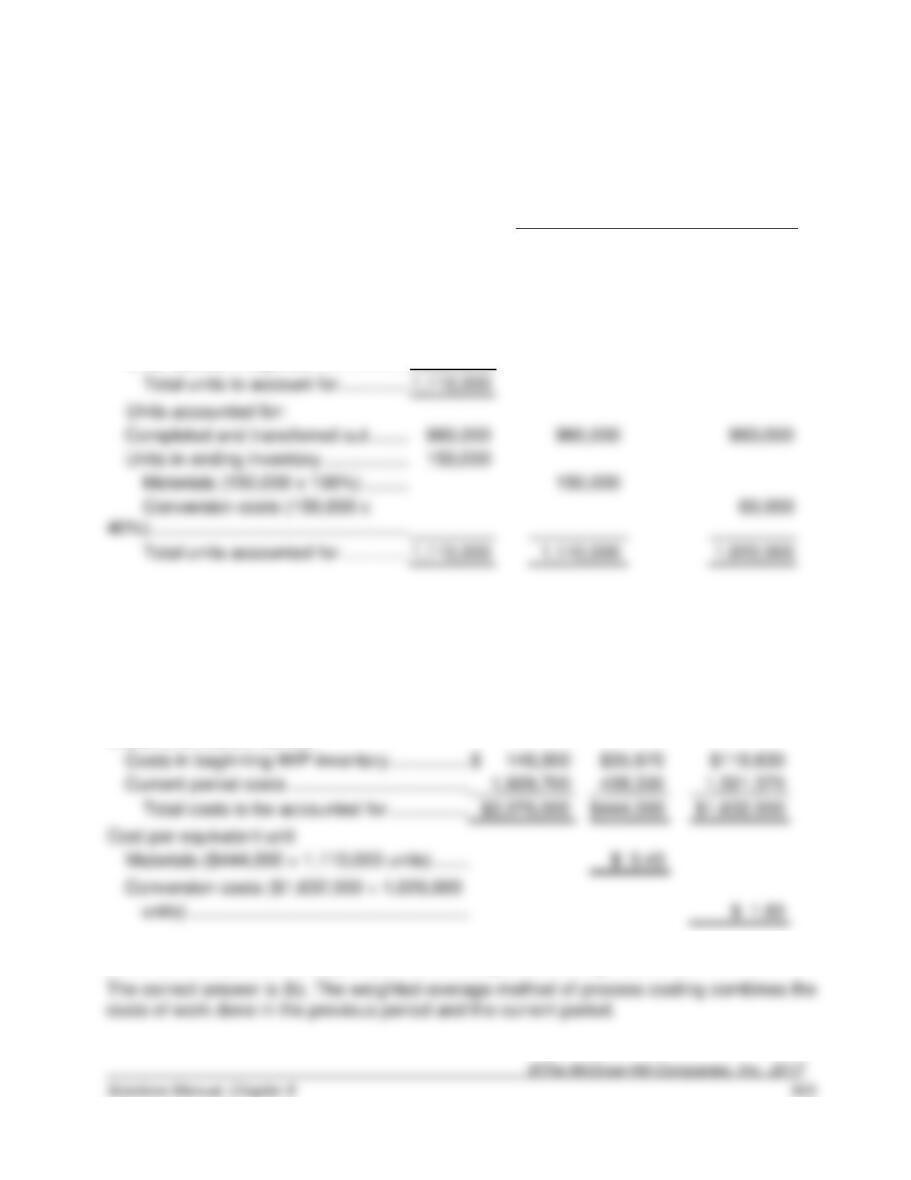
8-29. (20 min.) Compute Equivalent Units and Cost per Equivalent Unit—
Weighted-Average method: Campo Company.
a.
Physical
Units
Equivalent Units
Materials
Eq. units
Conversion
Costs Eq. units
Flow of units:
Units to be accounted for:
Beginning WIP inventory …………………………..
90,000
Units started this period …………………………….
1,020,000
Total units to account for ………………………..
Completed and transferred out …………………..
Units in ending inventory …………………………..
Materials (150,000 x 100%) ……………………
Conversion costs (150,000 x
40%) ………………………………………………………….
Total units accounted for ………………………..
b.
Total
Direct
Materials
Conversion
Costs
Flow of costs:
Costs to be accounted for:
$35,670
$2,076,000
$444,000
Cost per equivalent unit
units) ………………………………………………………..
8-30. (10 min.) Cost Per Equivalent Unit: Weighted-Average Method.
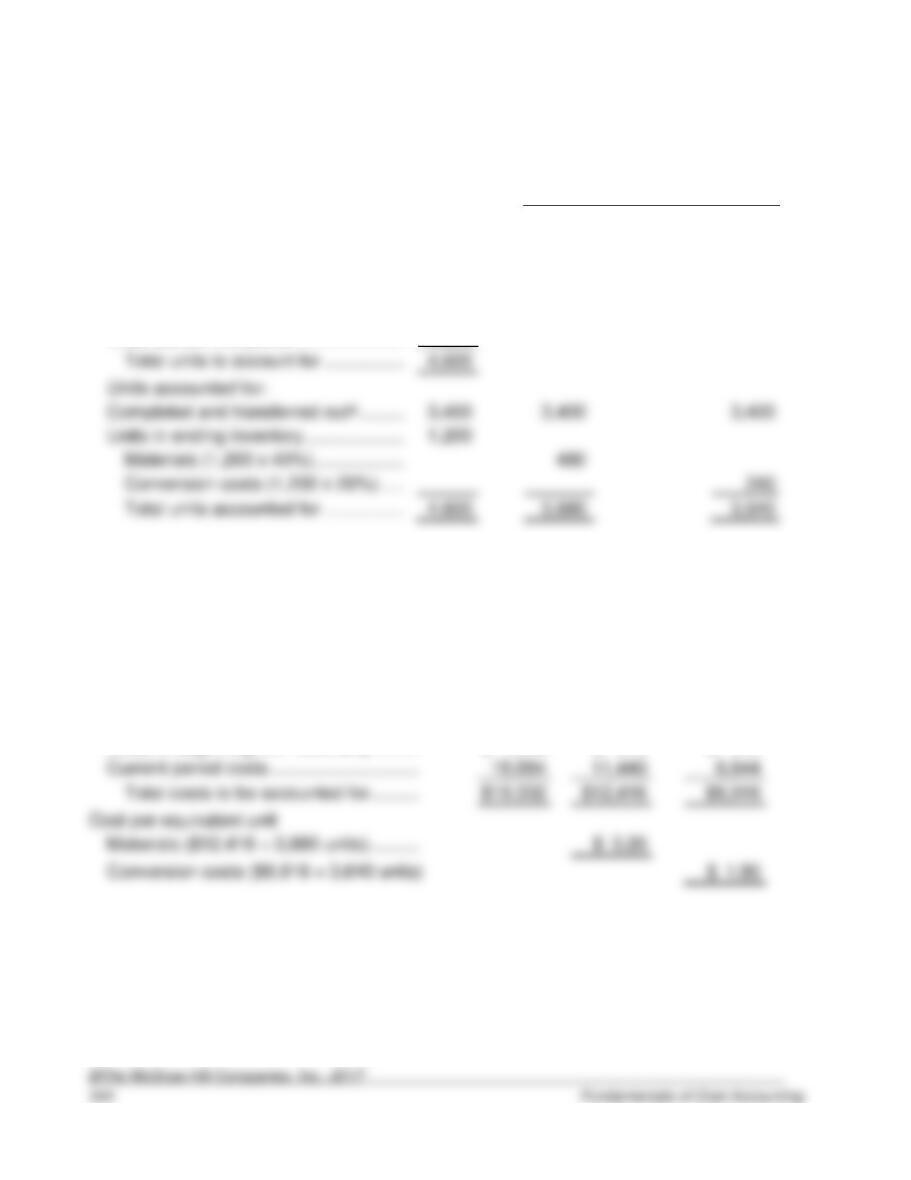
8-31. (35 min.) Compute Costs per Equivalent Unit—Weighted-Average Method:
Matsui Lubricants.
Physical
Units
Equivalent Units
Materials
Eq. units
Conversion
Costs Eq. units
Flow of units:
Units to be accounted for:
Beginning WIP inventory …………………………..
600
Units started this period…………………………….
4,000
Total units to account for ……………………….
4,600
3,400
3,400
Units in ending inventory …………………………..
1,200
Materials (1,200 x 40%) …………………………
Conversion costs (1,200 x 20%) ……………..
Total units accounted for ……………………….
4,600
3,880
a 3,400 units transferred out = 4,600 units to account for – 1,200 units in ending WIP
inventory.
Total
Direct
Materials
Conversion
Costs
Flow of costs:
Costs to be accounted for:
Costs in beginning WIP inventory ………
$ 1,248
$ 976
$ 272
$12,416
Cost per equivalent unit
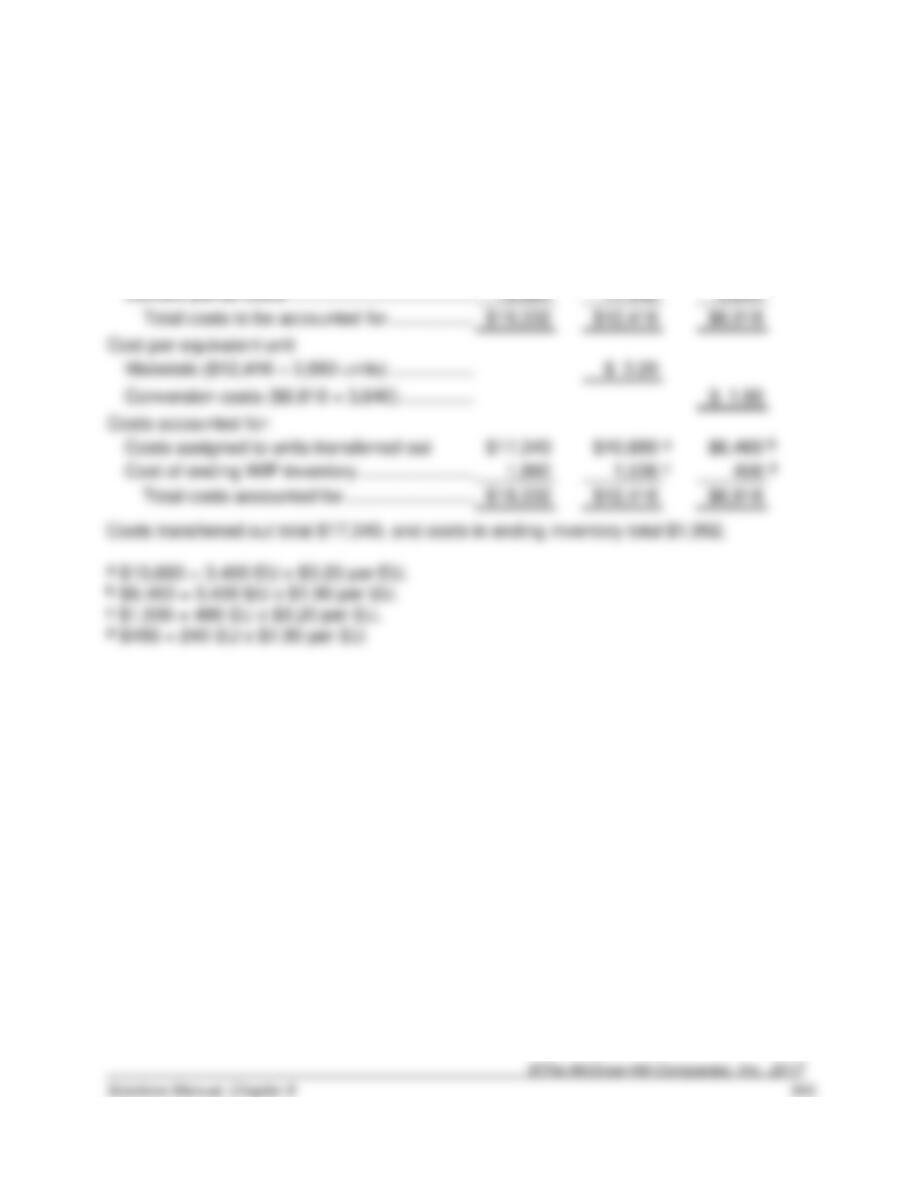
8-32. (20 min.) Assign Costs to Goods Transferred Out and Ending Inventory—
Weighted-Average Method: Matsui Lubricants.
Total
Direct
Materials
Conversion
Costs
Flow of costs:
Costs to be accounted for:
Costs in beginning WIP inventory ……………….
$ 1,248
$ 976
$ 272
Current period costs …………………………………
18,084
11,440
Total costs to be accounted for ……………….
$19,332
$12,416
Cost per equivalent unit
Materials ($12,416 ÷ 3,880 units) ……………….
$ 3.20
Conversion costs ($6,916 ÷ 3,640) ……………..
$ 1.90
Costs accounted for:
$17,340
$10,880
Cost of ending WIP inventory …………………….
$19,332
$12,416
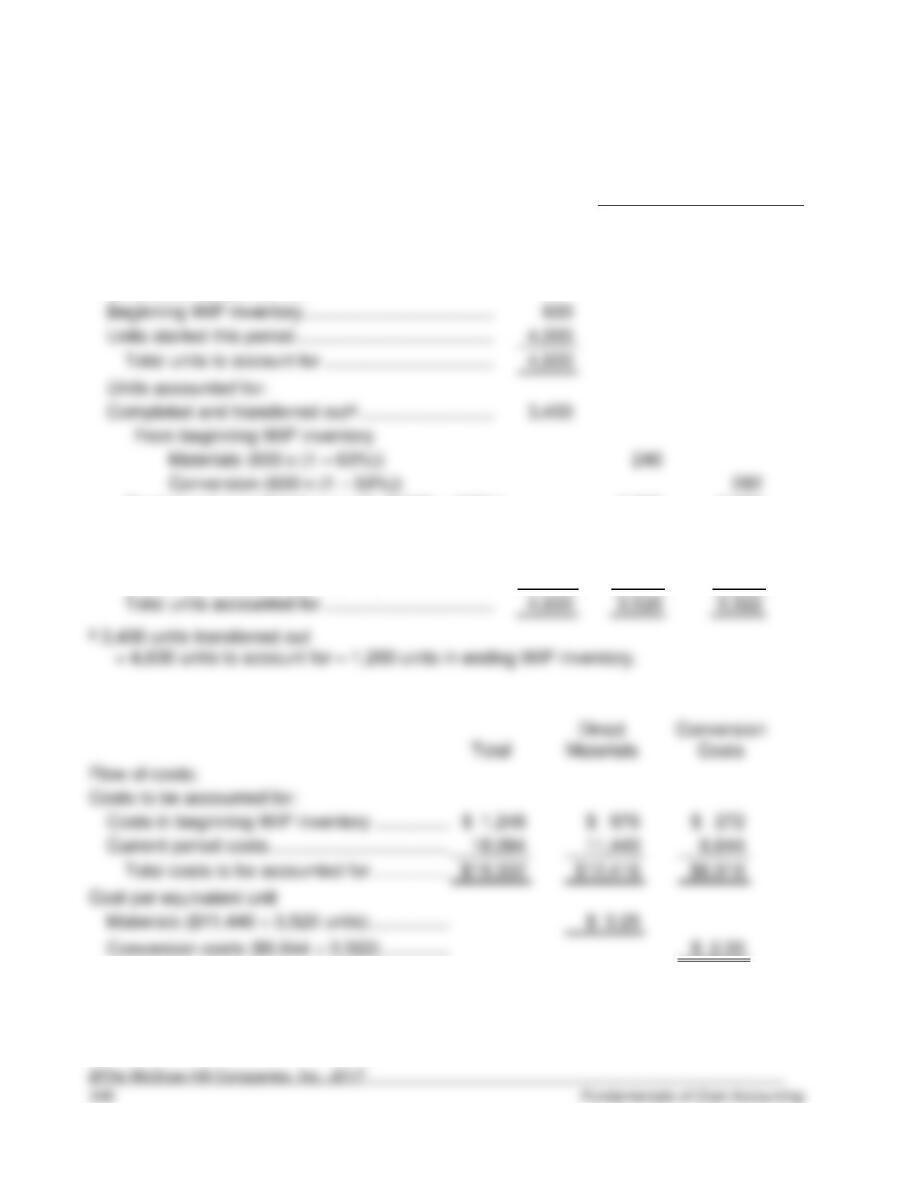
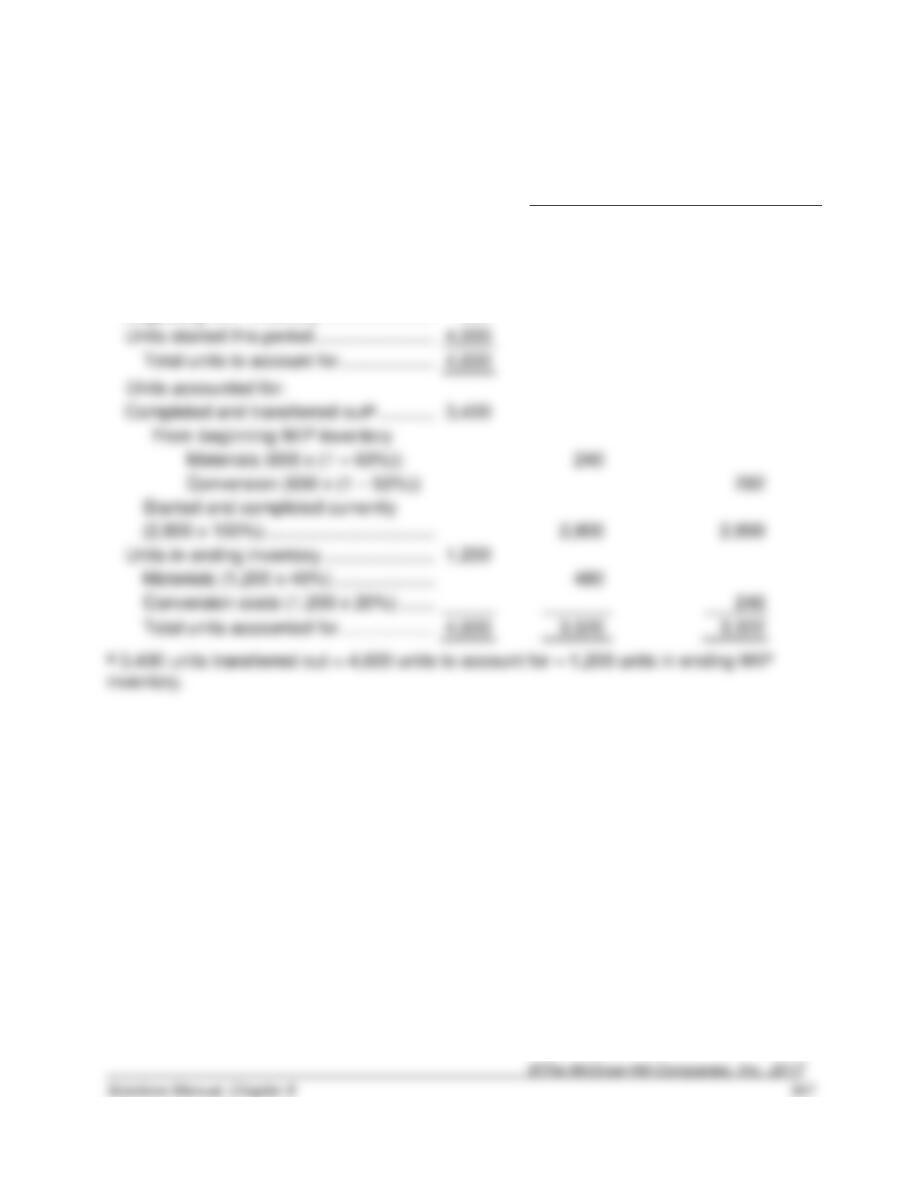
8-33. (35 min.) Compute Costs per Equivalent Unit—FIFO Method: Matsui
Lubricants.
Physical
Units
Equivalent Units
Materials
Eq. units
Conversion
Costs Eq. units
Flow of units:
Units to be accounted for:
Beginning WIP inventory ………………………………..
Units started this period………………………………….
Total units to account for …………………………….
From beginning WIP inventory
Materials (600 x (1 – 60%))
Conversion (600 x (1 – 53%))
282
Started and completed currently (2,800 x 100%)
2,800
2,800
Units in ending inventory ………………………………..
1,200
Materials (1,200 x 40%) ………………………………
480
Conversion costs (1,200 x 20%) …………………..
240
Total units accounted for …………………………….
4,600
Costs
Flow of costs:
Costs to be accounted for:
Cost per equivalent unit
8-34. (20 min.) Assign Costs to Goods Transferred Out and Ending Inventory—
FIFO Method: Matsui Lubricants.
Physical
Units
Equivalent Units
Materials
Eq. units
Conversion Costs
Eq. units
Flow of units:
Units to be accounted for:
Beginning WIP inventory …………………………..
600
Units started this period …………………………….
Total units to account for ………………………..
From beginning WIP inventory
Materials (600 x (1 – 60%))
Conversion (600 x (1 – 53%))
(2,800 x 100%) ……………………………………..
Units in ending inventory …………………………..
Materials (1,200 x 40%) …………………………
Conversion costs (1,200 x 20%) ……………..
Total units accounted for ………………………..
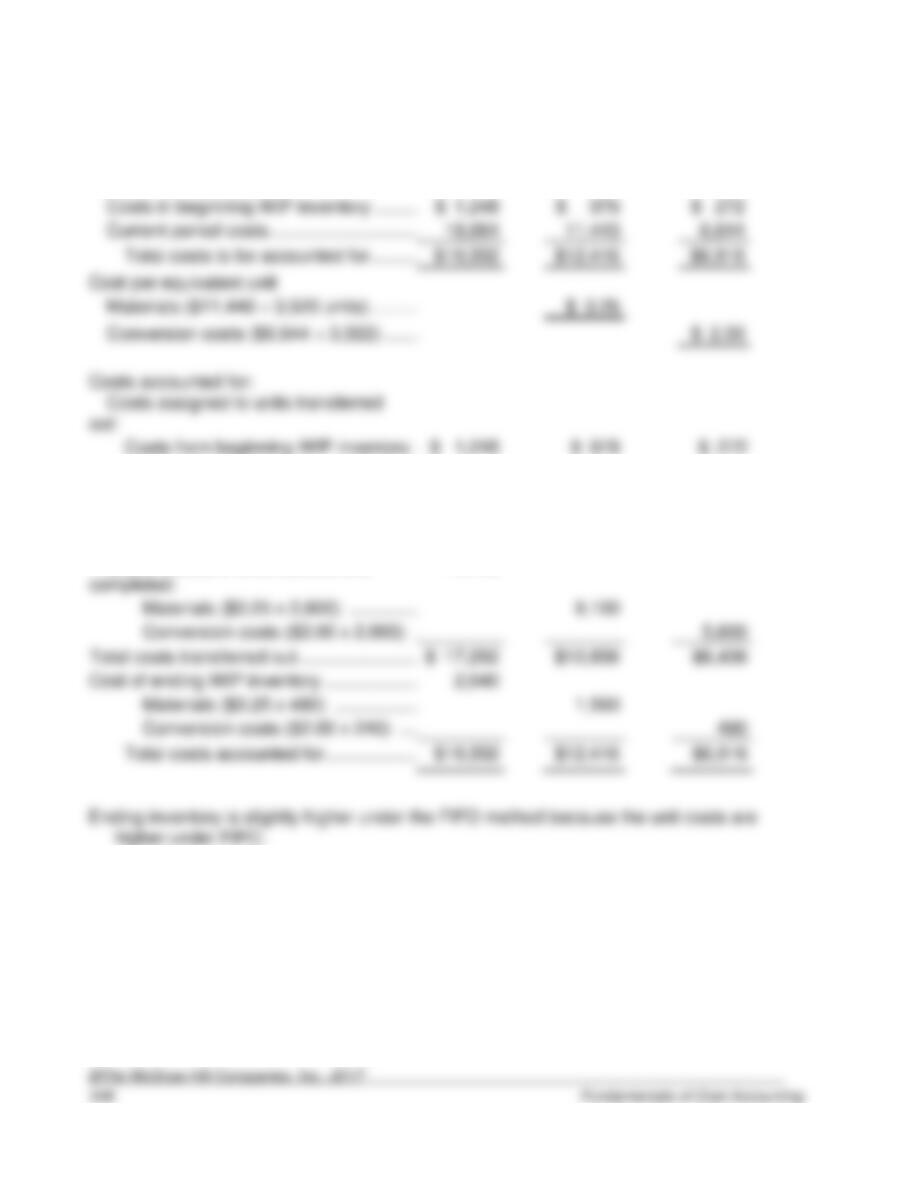
8-34. (continued)
Total
Direct
Materials
Conversion
Costs
Flow of costs:
Costs to be accounted for:
18,084
6,644
Total costs to be accounted for ……………….
Cost per equivalent unit
out:
Current costs added to complete
beginning WIP inventory ………………………………
1,344
Materials ($3.25 x 240) …………………..
780
Conversion costs ($2.00 x 282) ……….
564
completed:
Total costs transferred out …………………………...
Cost of ending WIP inventory ……………………….
2,040
Current costs of units started and
14,700
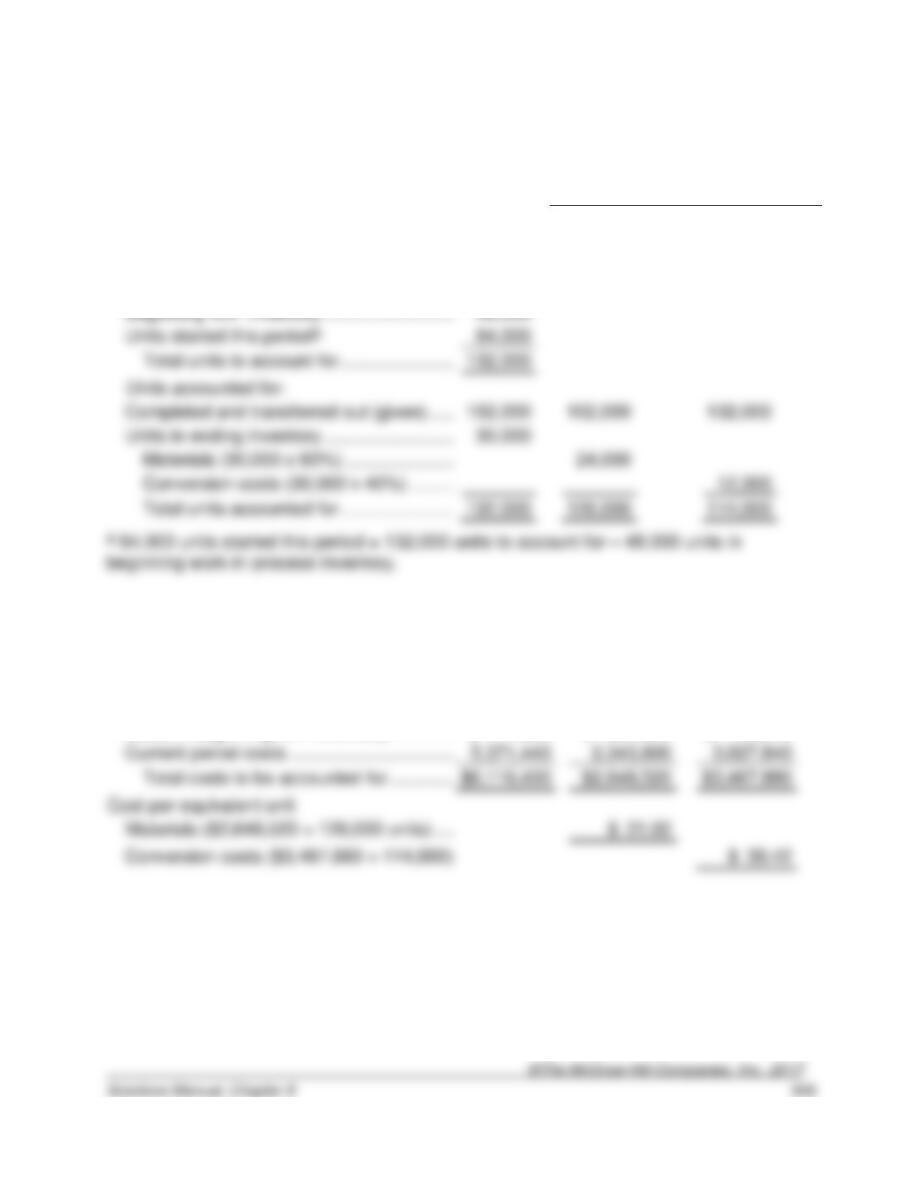
8-35. (35 min.) Compute Costs per Equivalent Unit—Weighted-Average Method:
Pacific Ink.
Physical
Units
Equivalent Units
Materials
Eq. units
Conversion Costs
Eq. units
Flow of units:
Units to be accounted for:
Total units to account for ………………………..
Completed and transferred out (given) ………..
Units in ending inventory …………………………..
Conversion costs (30,000 x 40%) ……………
12,000
Total units accounted for ………………………..
Total
Direct
Materials
Conversion
Costs
Flow of costs:
Costs to be accounted for:
Costs in beginning WIP inventory ……………….
$ 744,960
$ 304,920
$ 440,040
Current period costs …………………………………
2,343,600
Cost per equivalent unit
Materials ($2,648,520 ÷ 126,000 units) ……….
Conversion costs ($3,467,880 ÷ 114,000) ……
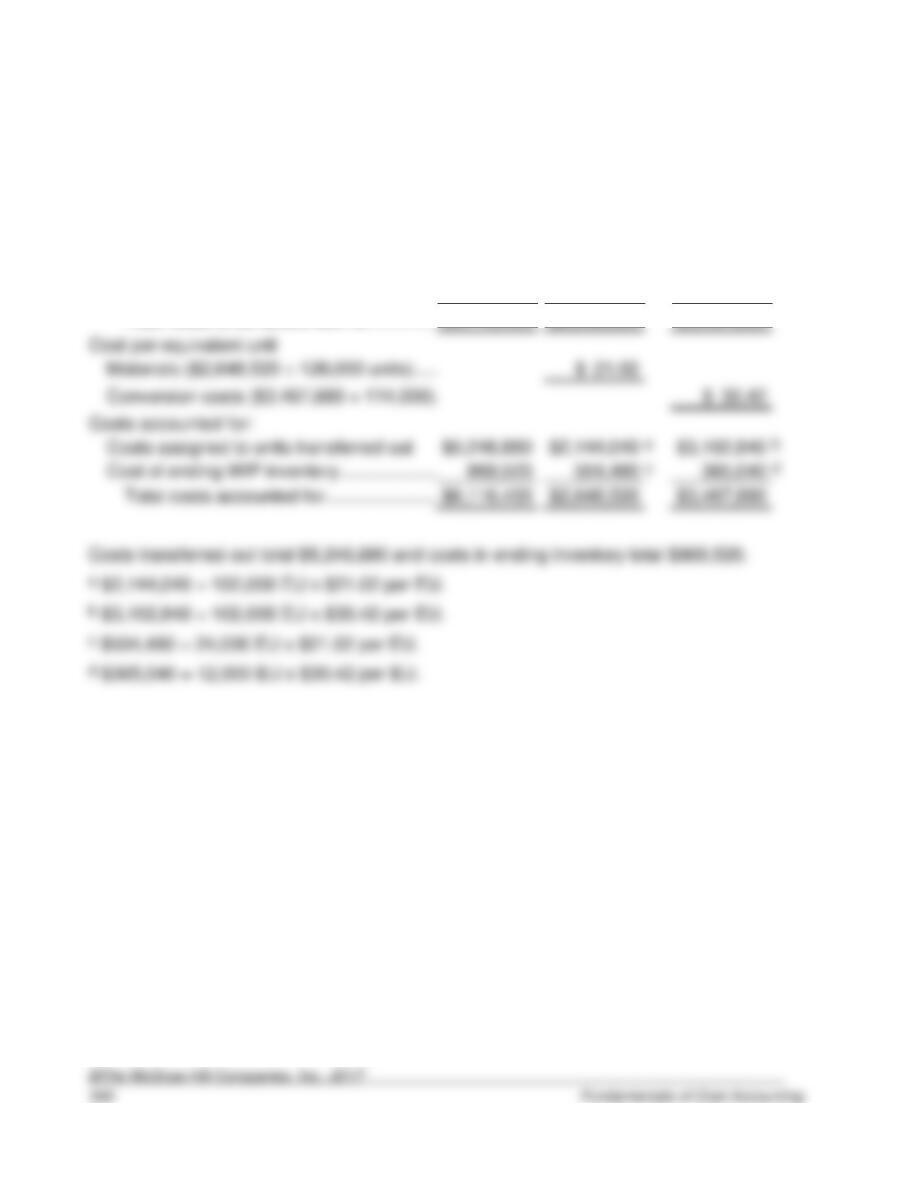
8-36. (20 min.) Assign Costs to Goods Transferred Out and Ending Inventory—
Weighted-Average Method: Pacific Ink.
Total
Direct
Materials
Conversion
Costs
Flow of costs:
Costs to be accounted for:
Costs in beginning WIP inventory ………………
$ 744,960
$ 304,920
$ 440,040
Current period costs …………………………………
5,371,440
2,343,600
3,027,840
Total costs to be accounted for ……………….
$6,116,400
$2,648,520
$3,467,880
Cost per equivalent unit
Materials ($2,648,520 ÷ 126,000 units) ……….
Conversion costs ($3,467,880 ÷ 114,000)……
Costs accounted for:
Cost of ending WIP inventory …………………….
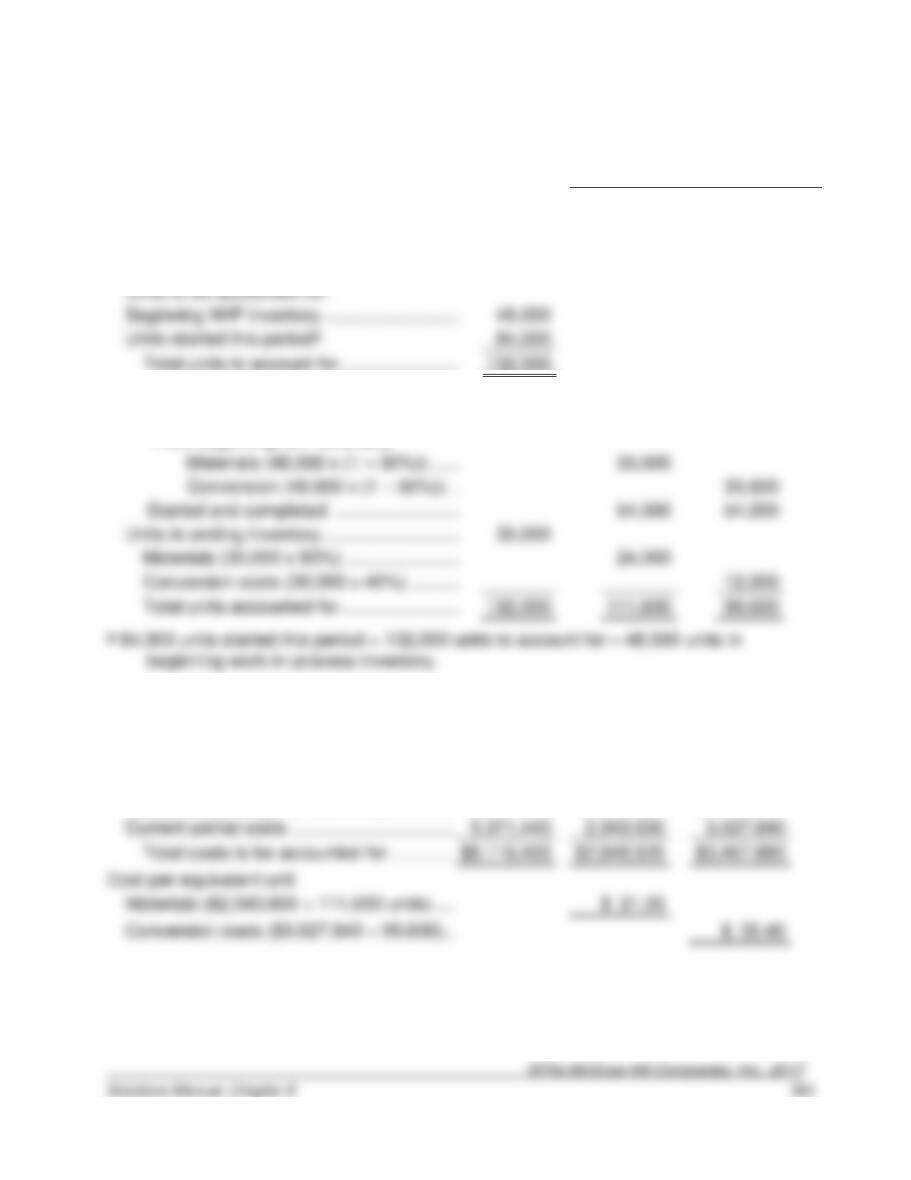
8-37. (35 min.) Compute Costs per Equivalent Unit—FIFO Method: Pacific Ink.
Physical
Units
Equivalent Units
Materials
Eq. units
Conversion
Costs Eq.
units
Flow of units:
Units to be accounted for:
Units accounted for:
Completed and transferred out
102,000
From beginning WIP inventory
Materials (48,000 x (1 – 30%)) ……
Conversion (48,000 x (1 – 30%)) ..
Started and completed …………………….
Materials (30,000 x 80%) …………………..
Total
Direct
Materials
Conversion
Costs
Flow of costs:
Costs to be accounted for:
Costs in beginning WIP inventory ……………….
$ 744,960
$ 304,920
$ 440,040
5,371,440
2,343,600
3,027,840
Cost per equivalent unit
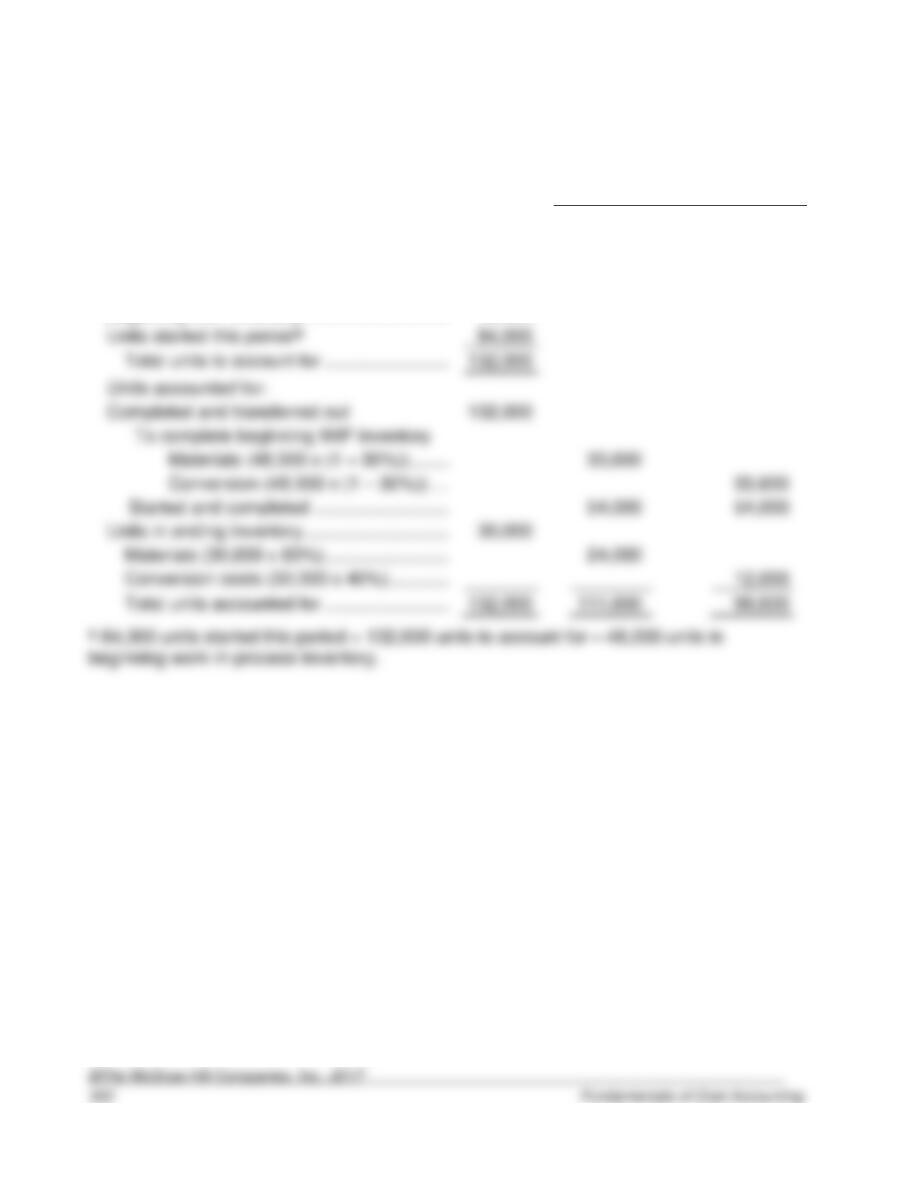
8-38. (20 min.) Assign Costs to Goods Transferred Out and Ending Inventory—
FIFO Method: Pacific Ink.
Physical
Units
Equivalent Units
Materials
Eq. units
Conversion
Costs Eq. units
Flow of units:
Units to be accounted for:
Beginning WIP inventory …………………………..
48,000
Total units to account for ……………………….
Completed and transferred out
To complete beginning WIP inventory
Materials (48,000 x (1 – 30%)) ………..
Conversion (48,000 x (1 – 30%)) …….
Started and completed …………………………
Units in ending inventory …………………………..
30,000
Materials (30,000 x 80%) ……………………….
Conversion costs (30,000 x 40%) ……………
Total units accounted for ……………………….
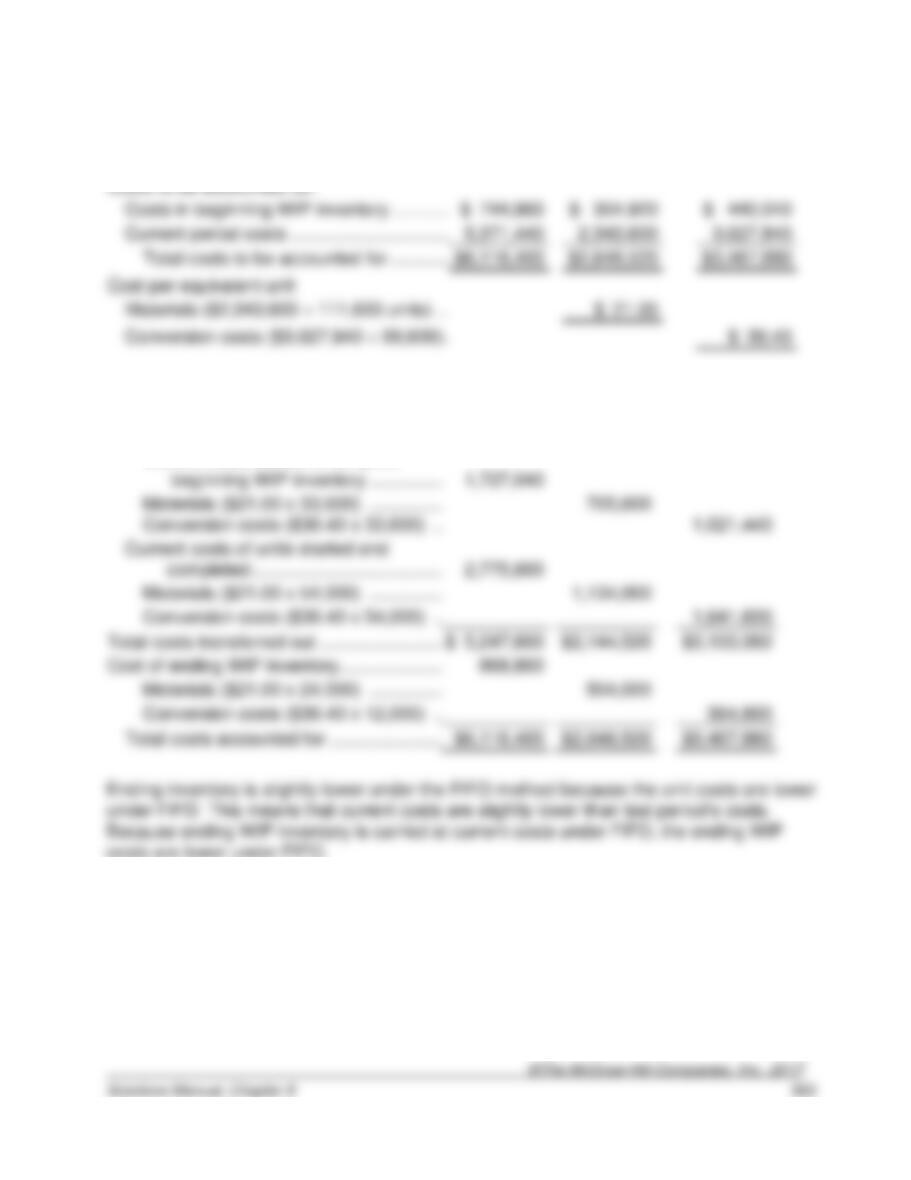
8-38. (continued)
Total
Direct
Materials
Conversion
Costs
Flow of costs:
Costs to be accounted for:
Current period costs …………………………………
Materials ($2,343,600 ÷ 111,600 units) ……….
Conversion costs ($3,027,840 ÷ 99,600) ……..
Costs accounted for:
Costs assigned to units transferred out:
Costs from beginning WIP inventory ………..
$ 744,960
$ 304,920
$ 440,040
beginning WIP inventory …………………..
Materials ($21.00 x 33,600) …………………..
completed: ……………………………………….
Materials ($21.00 x 54,000) …………………..
Total costs transferred out …………………………...
Materials ($21.00 x 24,000) …………………..
Conversion costs ($30.40 x 12,000) ……….
Total costs accounted for ………………………….
Current costs added to complete
costs are lower under FIFO.
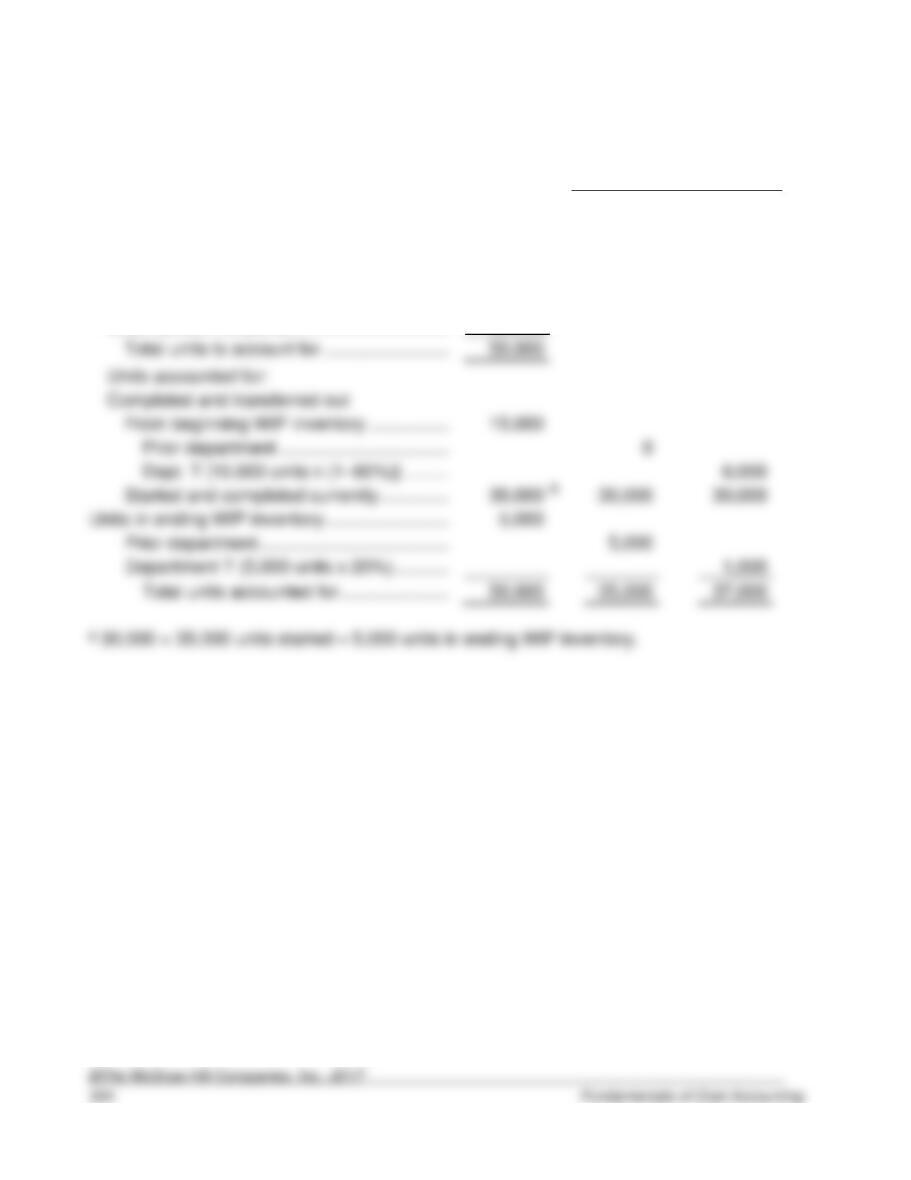
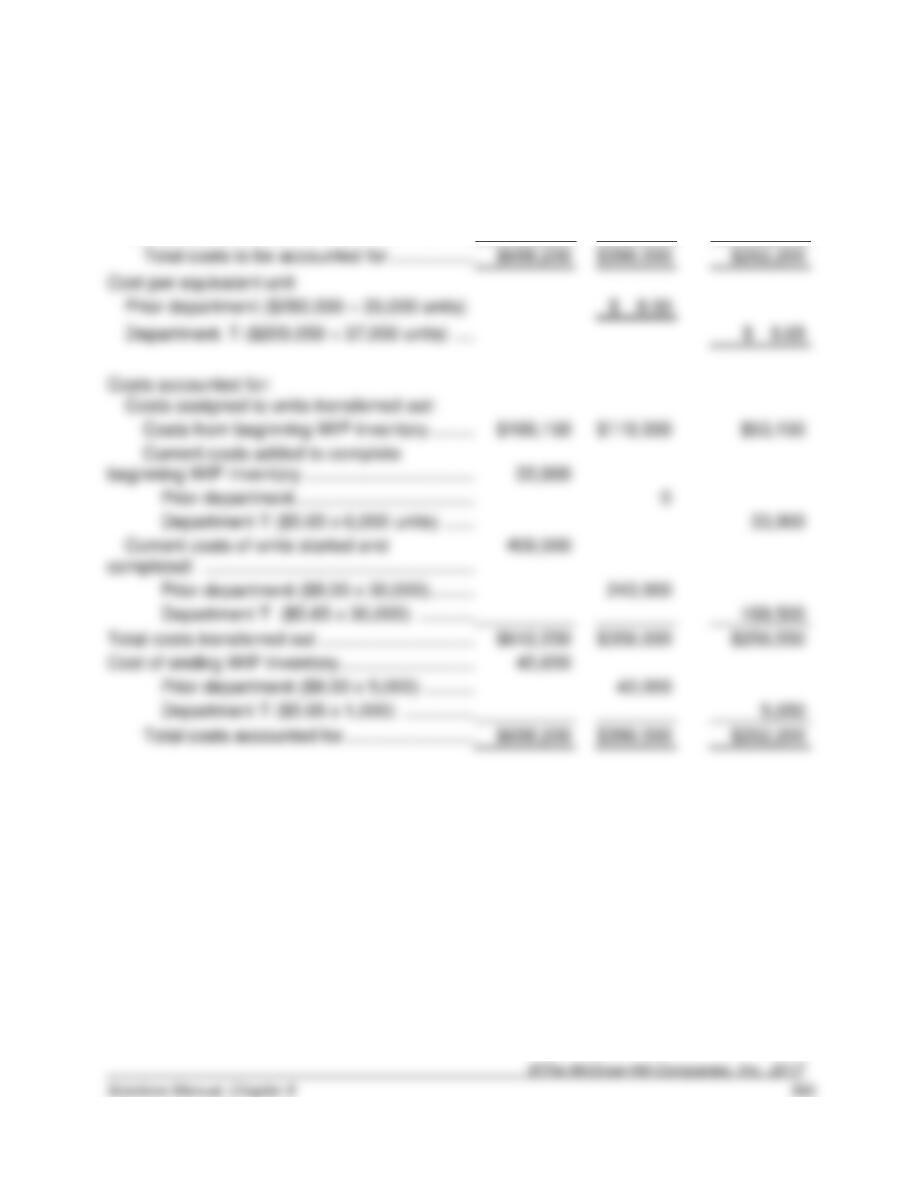
8-39. (50 min.) Prepare a Production Cost Report—FIFO method: Lansing, Inc.
Physical Units
Equivalent Units
Prior
Department
Department
No. T
Flow of units:
Units to be accounted for:
Beginning WIP inventory …………………………..
15,000
Units started this period…………………………….
35,000
Completed and transferred out
Units in ending WIP inventory ……………………….
8-39. (continued)
Total
Prior
Department
Department
No. T
Flow of costs:
Costs to be accounted for:
Costs in beginning WIP inventory ……………….
$169,150
$116,000
$ 53,150
Current period costs …………………………………
489,050
280,000
209,050
Total costs to be accounted for ……………….
$396,000
$262,200
Cost per equivalent unit
Prior department ($280,000 ÷ 35,000 units) ..
Department. T ($209,050 ÷ 37,000 units) ……
Costs assigned to units transferred out:
$116,000
beginning WIP inventory ………………………………
Prior department ………………………………..
Department T ($5.65 x 6,000 units) ……..
completed: ………………………………………………..
Total costs transferred out …………………………...
$356,000
Cost of ending WIP inventory ………………………..
Prior department ($8.00 x 5,000) …………
40,000
Total costs accounted for ……………………….
$658,200
$396,000
$262,200
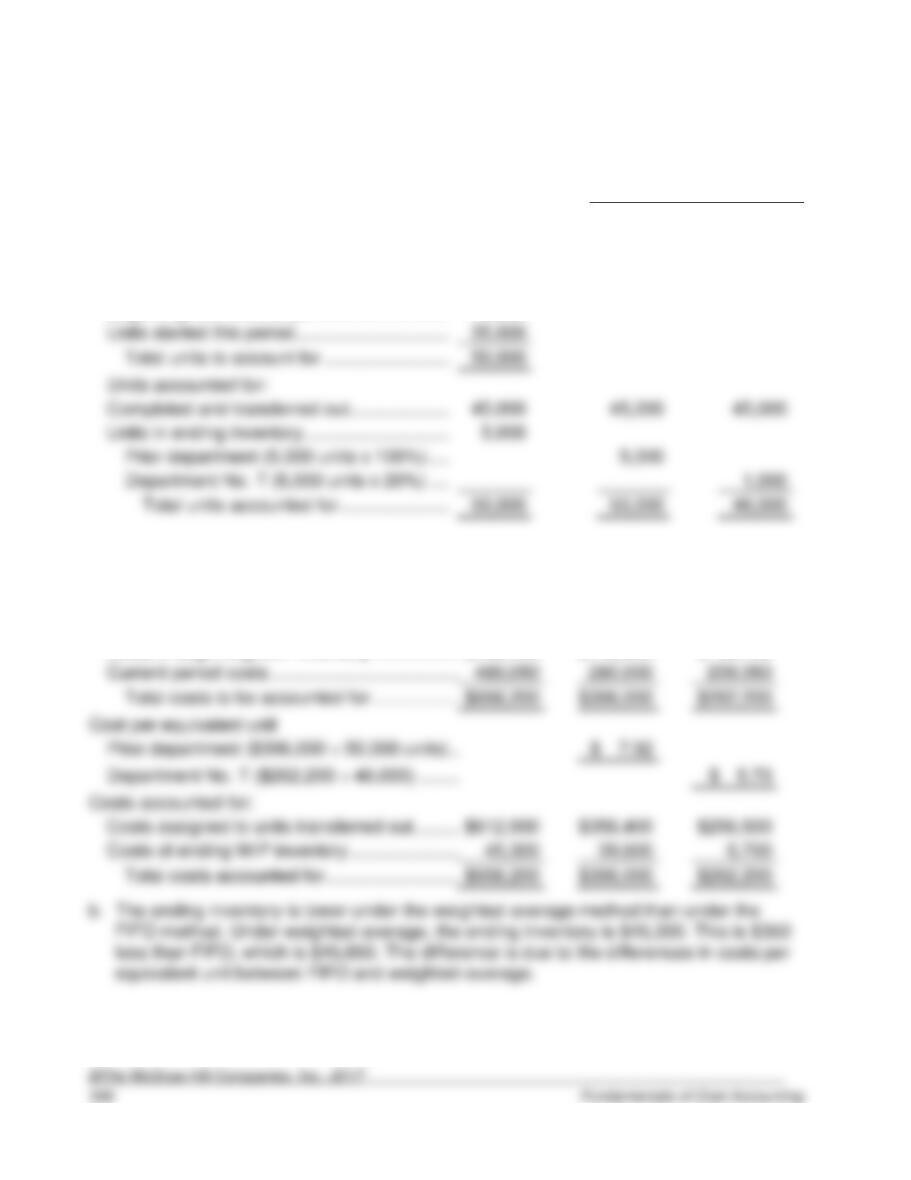
8-40. (50 min.) Prepare a Production Cost Report—Weighted-Average Method:
Lansing Inc.
a.
Physical
Units
Equivalent Units
Prior
Department
Department
No. T
Flow of units:
Units to be accounted for:
Beginning WIP inventory …………………………..
15,000
Units started this period…………………………….
35,000
Completed and transferred out …………………..
45,000
45,000
Total
Prior
Department
Department
No. T
Flow of costs:
Costs to be accounted for:
Costs in beginning WIP inventory ………………
$169,150
$116,000
$ 53,150
Current period costs …………………………………
$396,000
$262,200
Cost per equivalent unit
Prior department ($396,000 ÷ 50,000 units) …
Department No. T ($262,200 ÷ 46,000) ………
Costs accounted for:
$356,400
$256,500
Costs of ending WIP inventory …………………..
45,300
$396,000
$262,200
8-40. (continued)
c. The decision depends on the decisions that will be made using the data. If the most
8-41. (50 min.) Prepare a Production Cost Report—Weighted-Average Method:
Yarmouth Company.
Physical
Units
Equivalent Units
Mixing
Department
Finishing
Department
Flow of units:
Units to be accounted for:
Beginning WIP inventory …………………………..
30,000
Units started this period …………………………….
Total units to account for ………………………..
Units accounted for:
Completed and transferred out …………………..
Units in ending inventory …………………………..
Mixing (42,000 units x 100%) ………………….
Total units accounted for …………………….
Total
Direct
Materials
Conversion
Costs
Flow of costs:
Costs to be accounted for:
Costs in beginning WIP inventory ……………….
$723,636
$657,600
$ 66,036
Current period costs …………………………………
7,565,964
5,174,400
2,391,564
Total costs to be accounted for ……………….
$8,289,600
$5,832,000
$2,457,600
Cost per equivalent unit
Mixing ($5,832,000 ÷ 324,000 units) …………..
Finishing ($2,457,600 ÷ 307,200) ……………….
Costs accounted for:
Costs assigned to units transferred out ……….
$2,256,000
Costs of ending WIP inventory …………………..
Total costs accounted for ……………………….
$8,289,600
$5,832,000
$2,457,600
8-42. (50 min.) Production Cost Report—FIFO method: Yarmouth Company.
a.
Physical Units
Equivalent Units
Mixing
Department
Finishing
Department
Flow of units:
Units to be accounted for:
Beginning WIP inventory …………………………..
30,000
Units started this period…………………………….
Completed and transferred out
Units in ending WIP inventory ……………………….
298,200
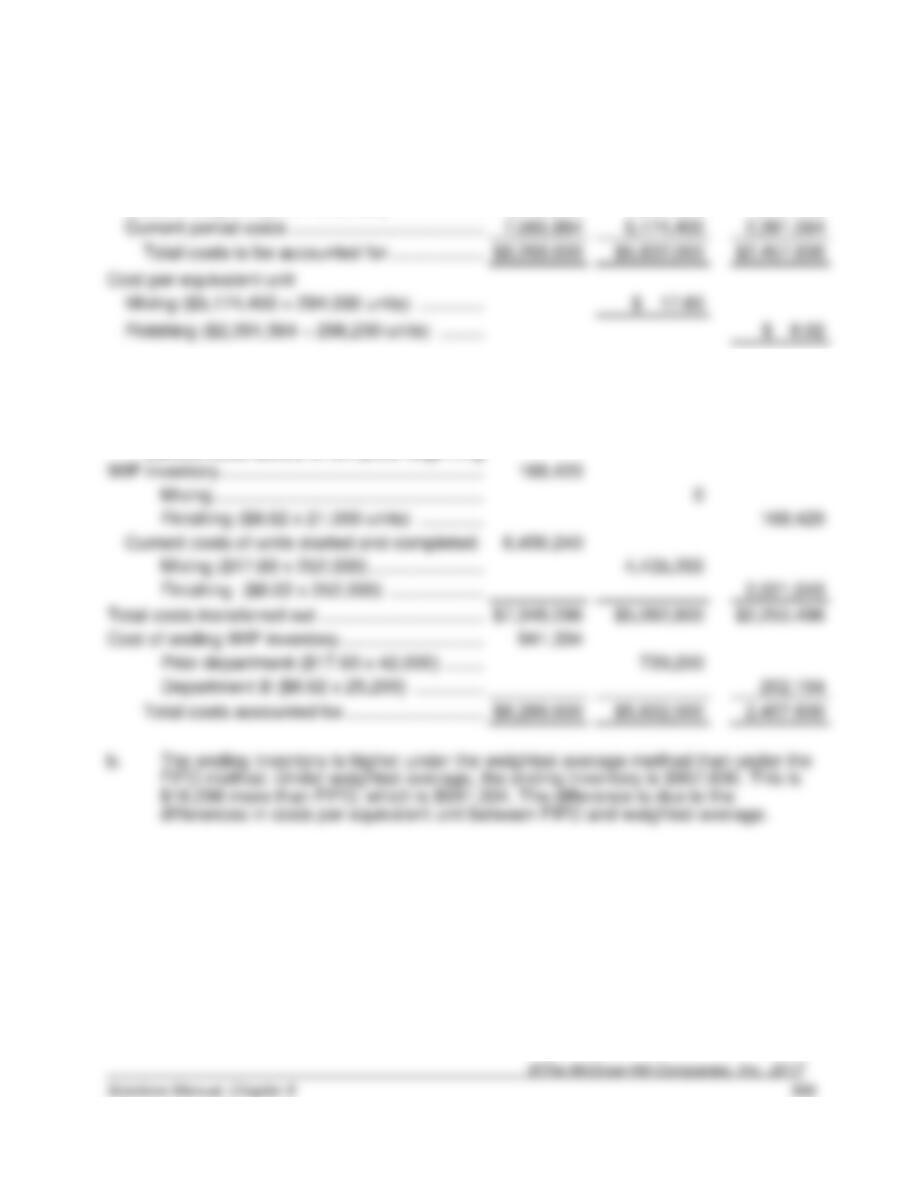
8-42. (continued)
Total
Mixing
Department
Finishing
Department
Flow of costs:
Costs to be accounted for:
Costs in beginning WIP inventory ……………….
$723,636
$657,600
$ 66,036
Total costs to be accounted for ……………….
Cost per equivalent unit
Costs accounted for:
Costs assigned to units transferred out:
Costs from beginning WIP inventory ………..
$723,636
$657,600
$ 66,036
WIP inventory …………………………..…………………
168,420
Mixing ………………………………………………
Current costs of units started and completed:
Mixing ($17.60 x 252,000) …………………..
4,435,200
Cost of ending WIP inventory ………………………..
Prior department ($17.60 x 42,000) ……..
Department B ($8.02 x 25,200) …………..
Total costs accounted for ……………………….
Current costs added to complete beginning
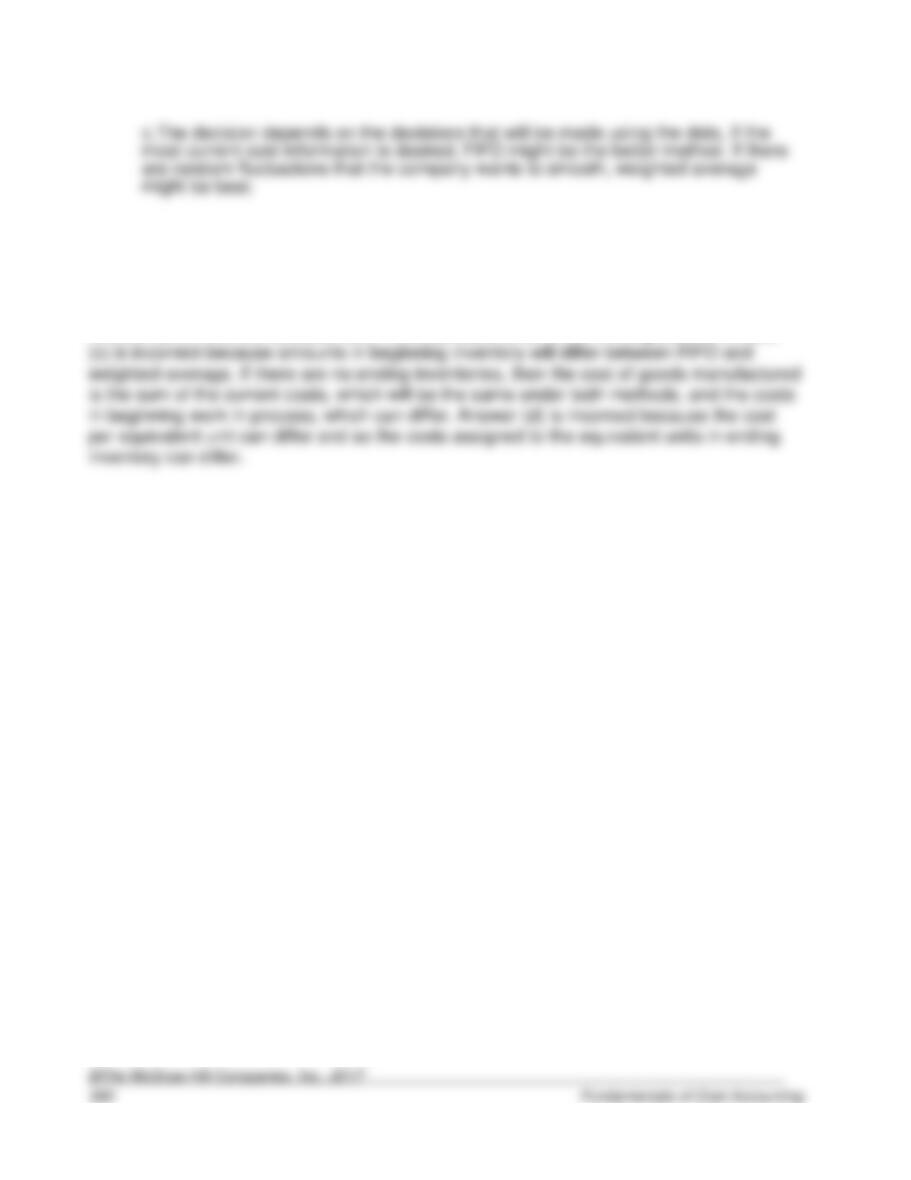
8-42. (continued)
8-43. (10 min.) Cost Per Equivalent Unit: Weighted-Average Method.
The correct answer is (b). The difference between the weighted-average and FIFO
methods of process costing is how they handle beginning WIP. When there is no
beginning WIP there is no difference between the two costing methods.
Answer (a) is incorrect because both methods assume units are homogeneous. Answer
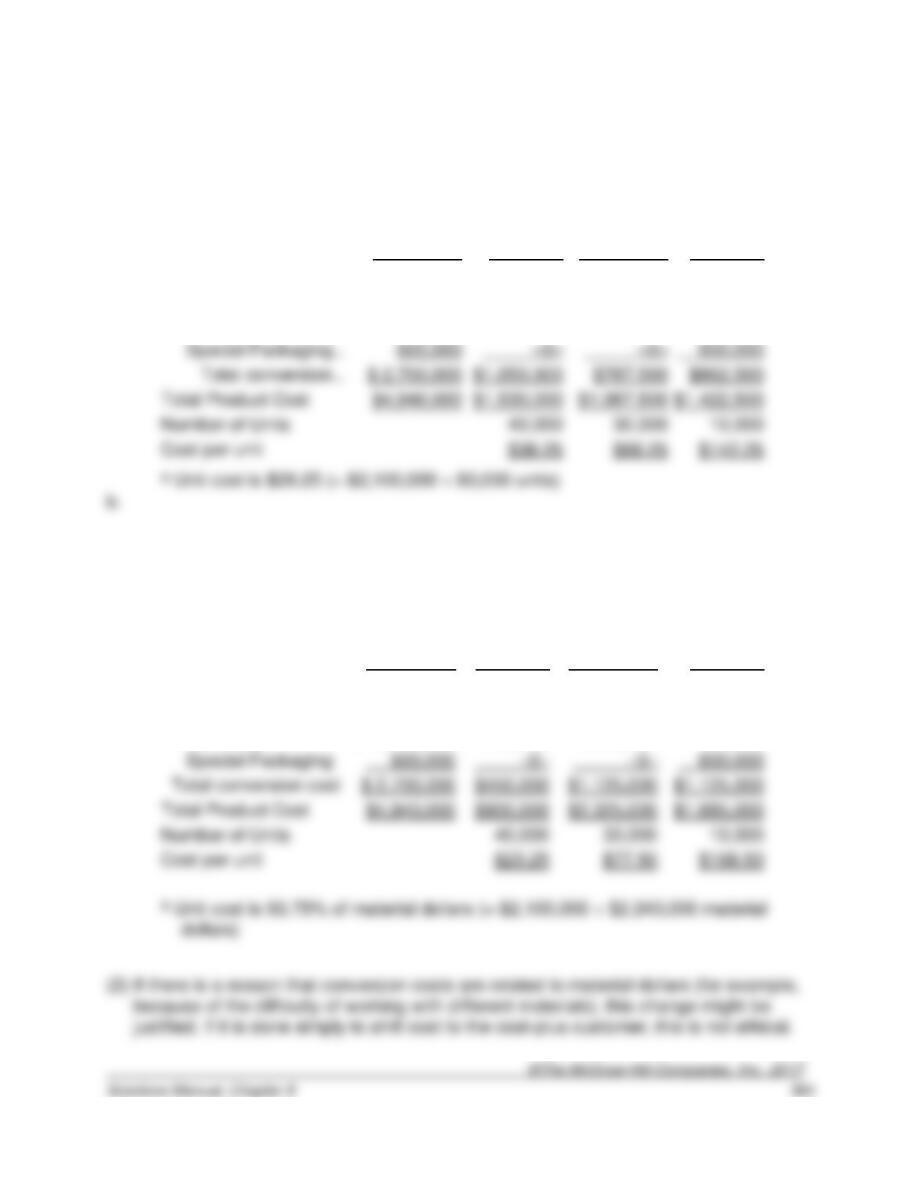
8-44. (50 min.) Operations Costing―Ethical Issues: Brokia Electronics.
a.
Total
Basic
(40,000
units)
Photo
(30,000
units)
UrLife
(10,000
units)
Materials ………………….
$2,240,000
$480,000
$1,200,000
$560,000
Conversion
Assemblya …………..
$ 2,100,000
1,050,000
787,500
262,500
600,000
–0–
Total conversion ..
Total Product Cost
Number of Units
10,000
Cost per unit
$142.25
(1)
Total
Basic
(40,000
units)
Photo
(30,000
units)
UrLife
(10,000
units)
Materials
$2,240,000
$480,000
$1,200,000
$560,000
Conversion
Assemblya
$ 2,100,000
450,000
1,125,000
525,000
–0–
Total Product Cost
Number of Units
40,000
Cost per unit
$23.25
$168.50
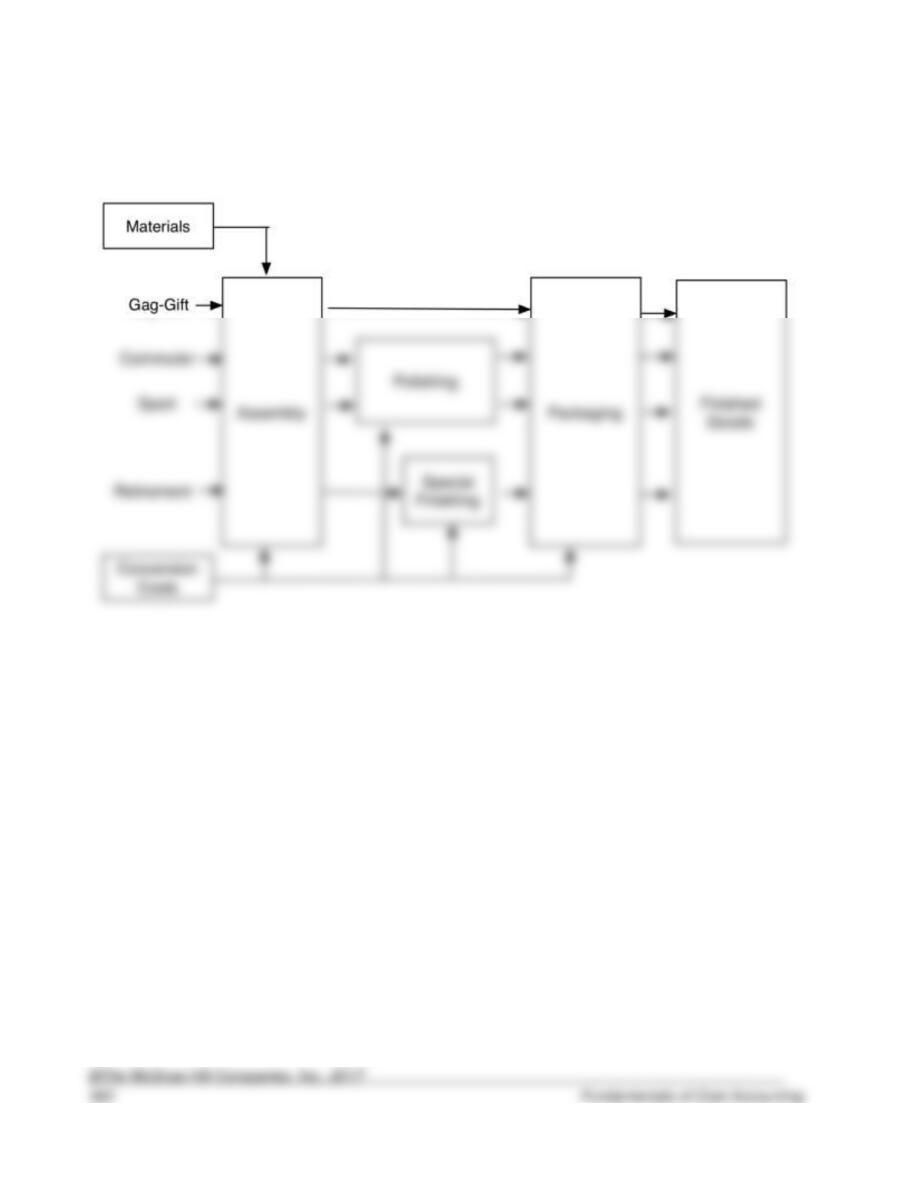
8-45. (50 min.) Operation Costing: Ferdon Watches.
a.
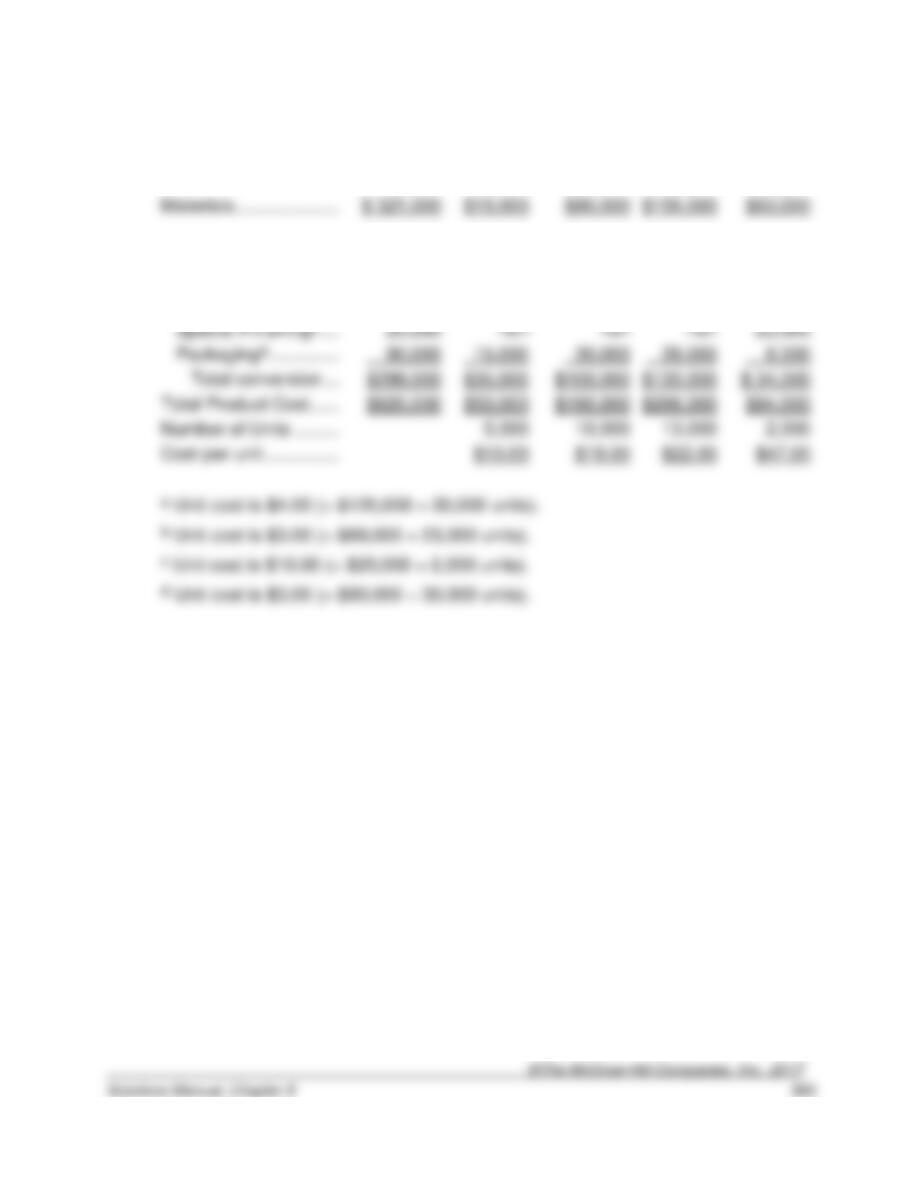
8-45. (continued)
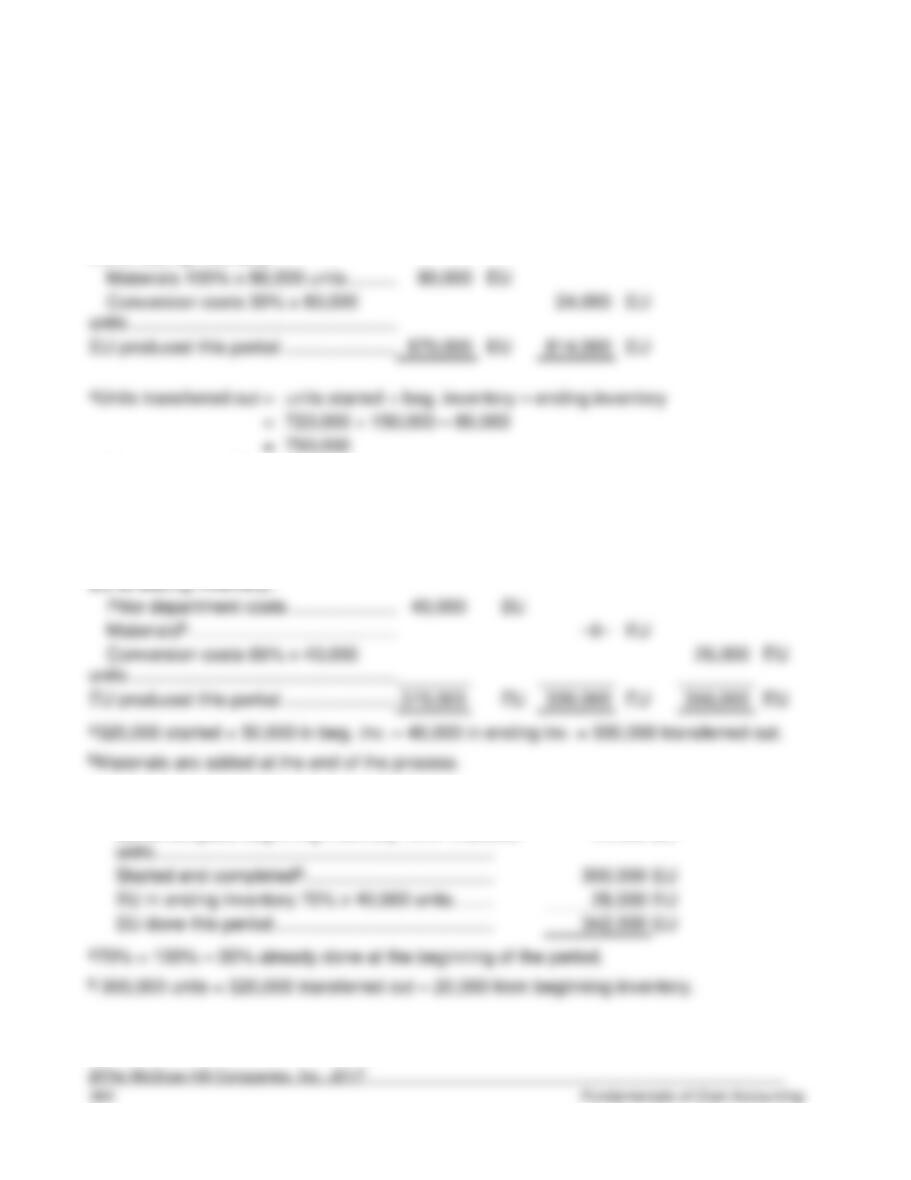
b.
Total
Gag-Gift
(5,000
units)
Commuter
(10,000
units)
Sport
(13,000
units)
Retirement
(2,000
units)
Materials …………………
Conversion
Assemblya …………..
$120,000
$20,000
$40,000
$52,000
$ 8,000
Polishingb ……………
69,000
–0–
30,000
39,000
–0–
Special Finishingc ….
20,000
–0–
20,000
$299,000
$35,000
Total Product Cost ……
$620,000
Number of Units ………
10,000
13,000
Cost per unit ……………
Solutions to Problems
8-46. (45 min.) Compute Equivalent Units: Multiple Choice.
a. The answer is (4).
Materials
Conversion
Costs
Units transferred out …………………………..……….
790,000
a
790,000
a
EU in ending inventory:
Conversion costs 30% x 80,000
units ………………………………………………………….
EU
EU produced this period ………………………………
870,000
814,000
=
units started + beg. inventory – ending inventory
=
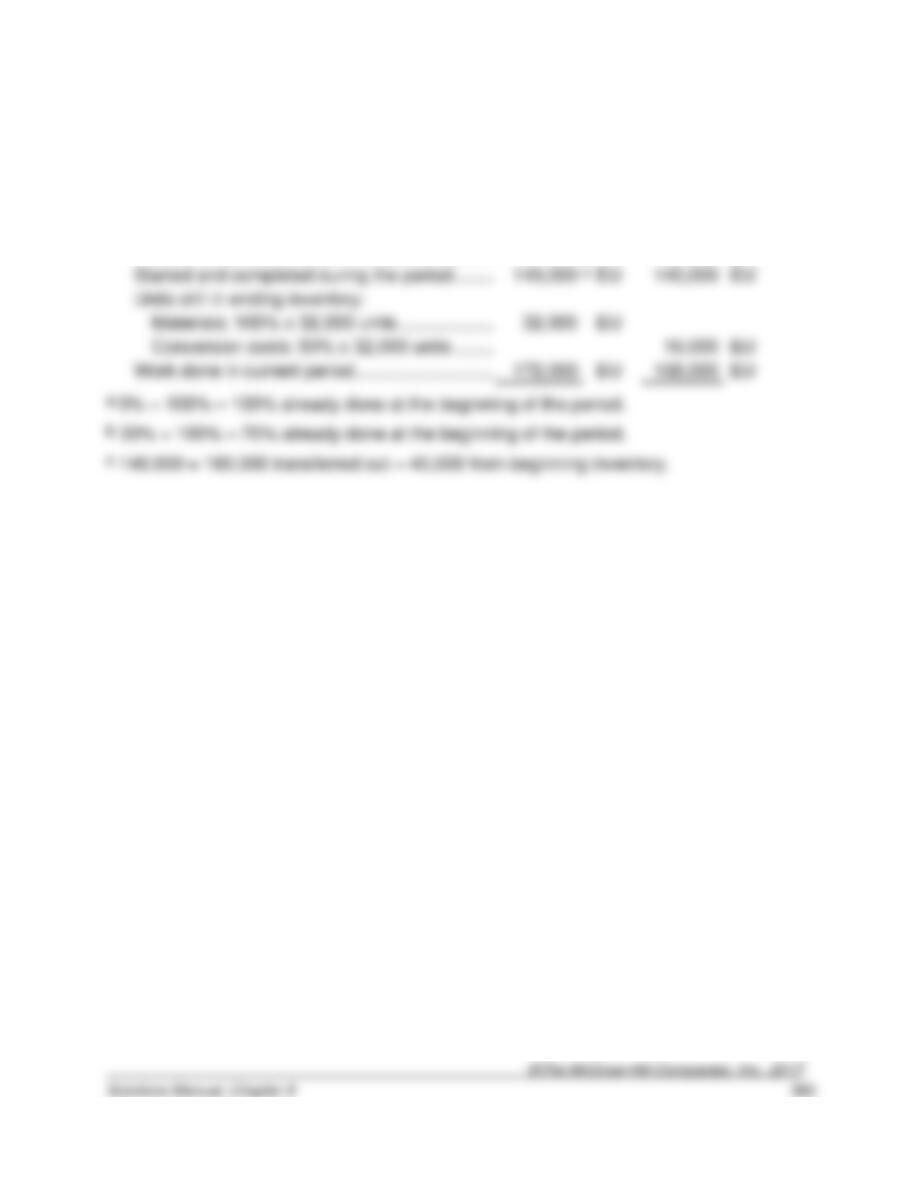
b. The answer is (3).
Prior
Department
Costs
Materials
Conversion
Costs
Units transferred out …………………………..……….
330,000
a
330,000
a
330,000
a
Prior department costs ……………………………..
Conversion costs 65% x 40,000
units ………………………………………………………….
EU
c. The answer is (4).
units …………………………………………………………..
EU done this period ……………………………………..
EU to complete beginning inventory 70%a x 20,000
14,000
EU
8-46. (continued)
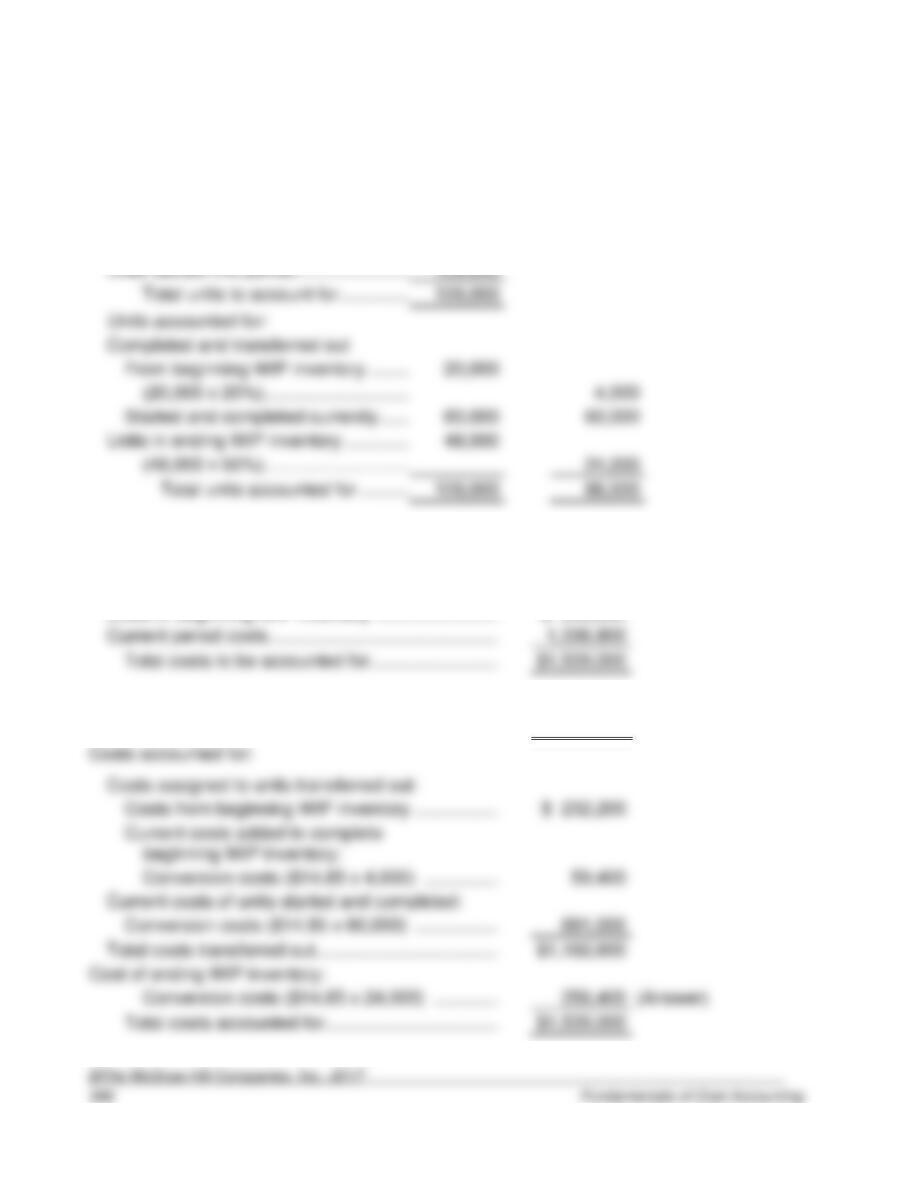
d. The answer is (1).
Materials
Conversion
Costs
To complete beginning inventory:
Materials: 0%a x 40,000 units ……………………
0
Conversion costs: 30%b x 40,000 units ……….
12,000
EU
Started and completed during the period ………..
EU
EU
Materials: 100% x 32,000 units ………………….
EU
Conversion costs: 50% x 32,000 units ………..
16,000
EU
8-47. (30 min) FIFO Method: Glasgow Corporation.
a.
Physical
Units
Equivalent Units
Conversion
Costs
Flow of units
Units to be accounted for:
Beginning WIP inventory …………………………..
20,000
Conversion Costs
Flow of costs:
Costs to be accounted for:
Costs in beginning WIP inventory ……………………….
$ 232,200
Current period costs ………………………………………….
Total costs to be accounted for ………………………..
Cost per equivalent unit ($1,306,800 ÷ 88,000) ……….
$ 14.85
Costs accounted for:
Costs assigned to units transferred out:
Costs from beginning WIP inventory ………………..
beginning WIP inventory:
Conversion costs ($14.85 x 4,000) ………………
Current costs of units started and completed:
Conversion costs ($14.85 x 60,000) ………………..
Total costs transferred out………………………………….
Cost of ending WIP inventory:
Conversion costs ($14.85 x 24,000) …………….
(Answer)
8-47. (continued)
b.
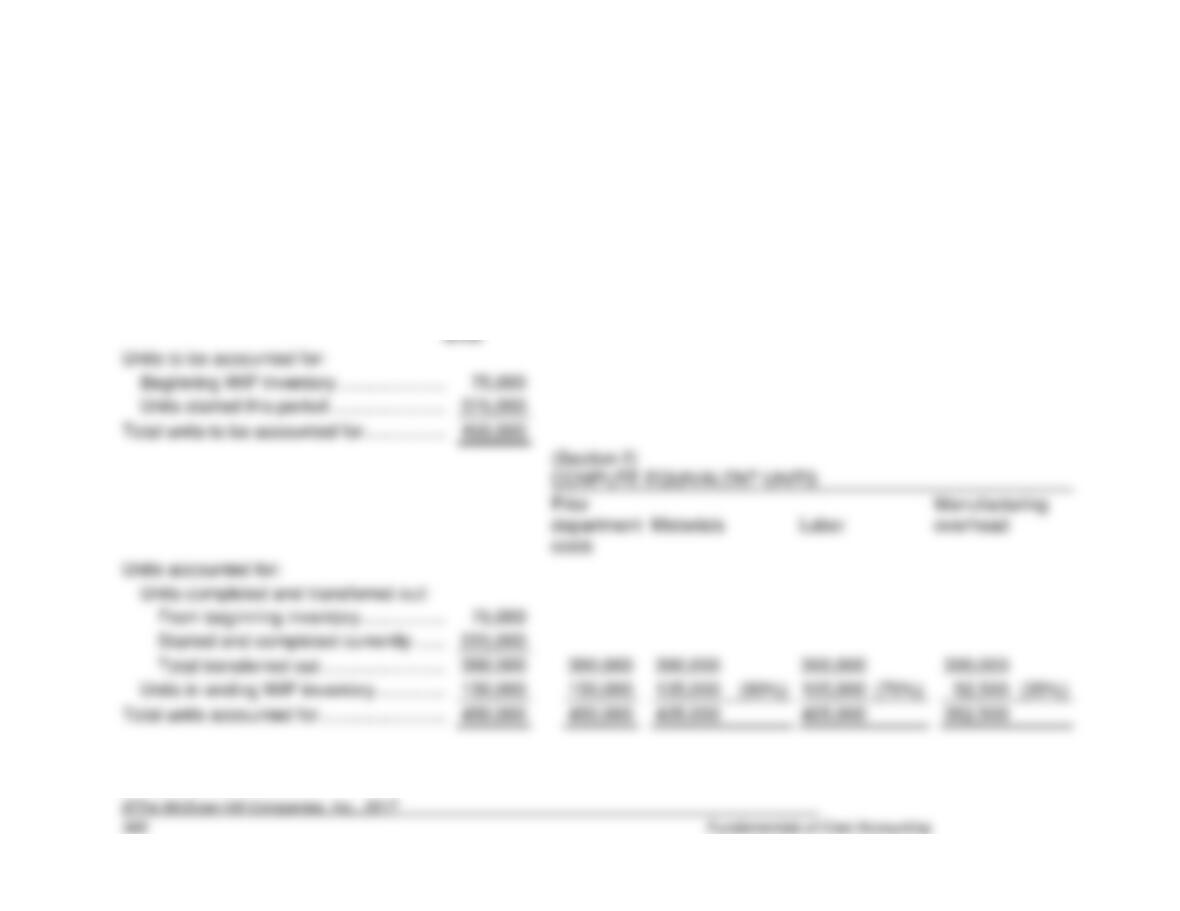
8-48.
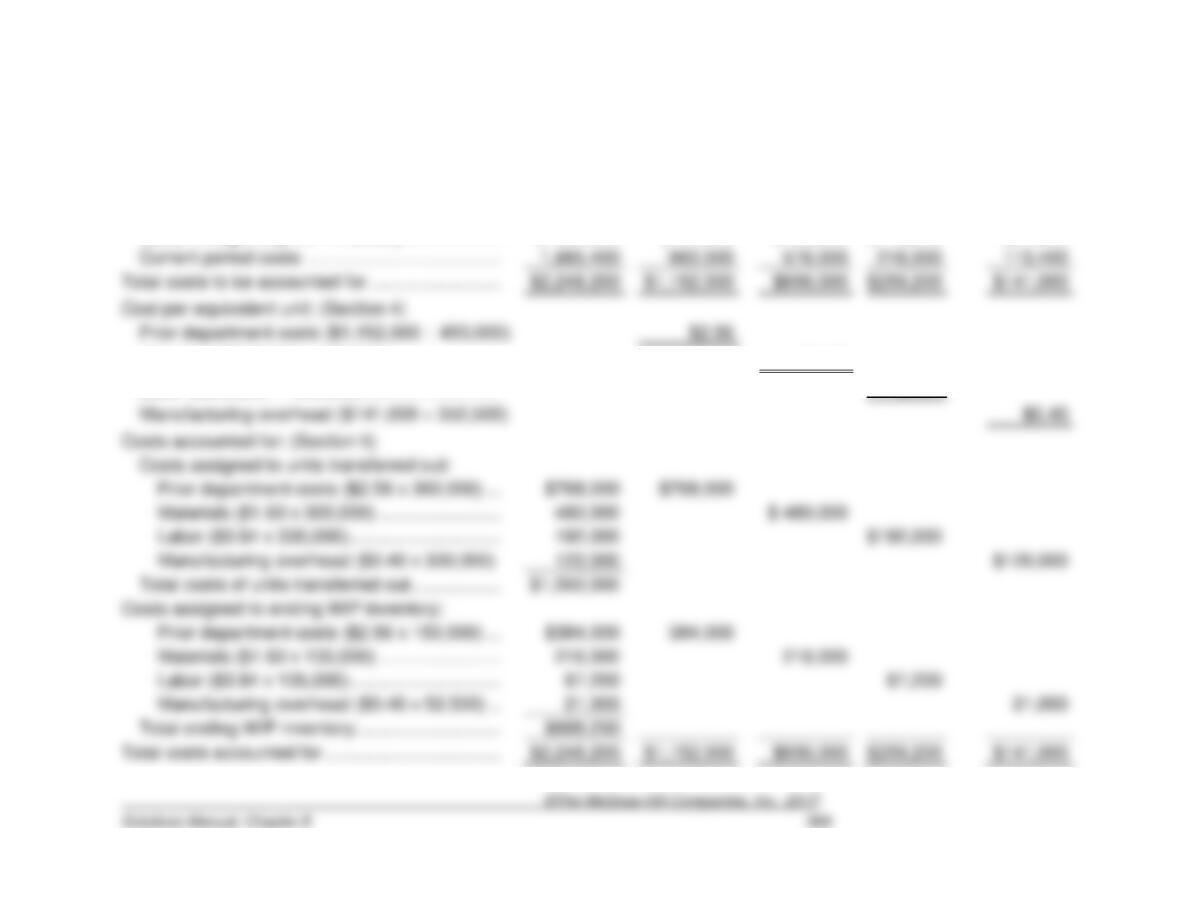
(50 min.) Prepare a Production Cost Report—Weighted Average Method: Kansas Supplies.
a.
Kansas Supplies
Assembling Department
Production Cost Report—Weighted-Average
Flow of Production Units
(Section 1)
units
Beginning WIP inventory …………………………..
Units started this period …………………………….
Total units to be accounted for ………………………
COMPUTE EQUIVALENT UNITS
department
costs
Materials
Labor
overhead
Units accounted for:
Total units accounted for ………………………………
Physical
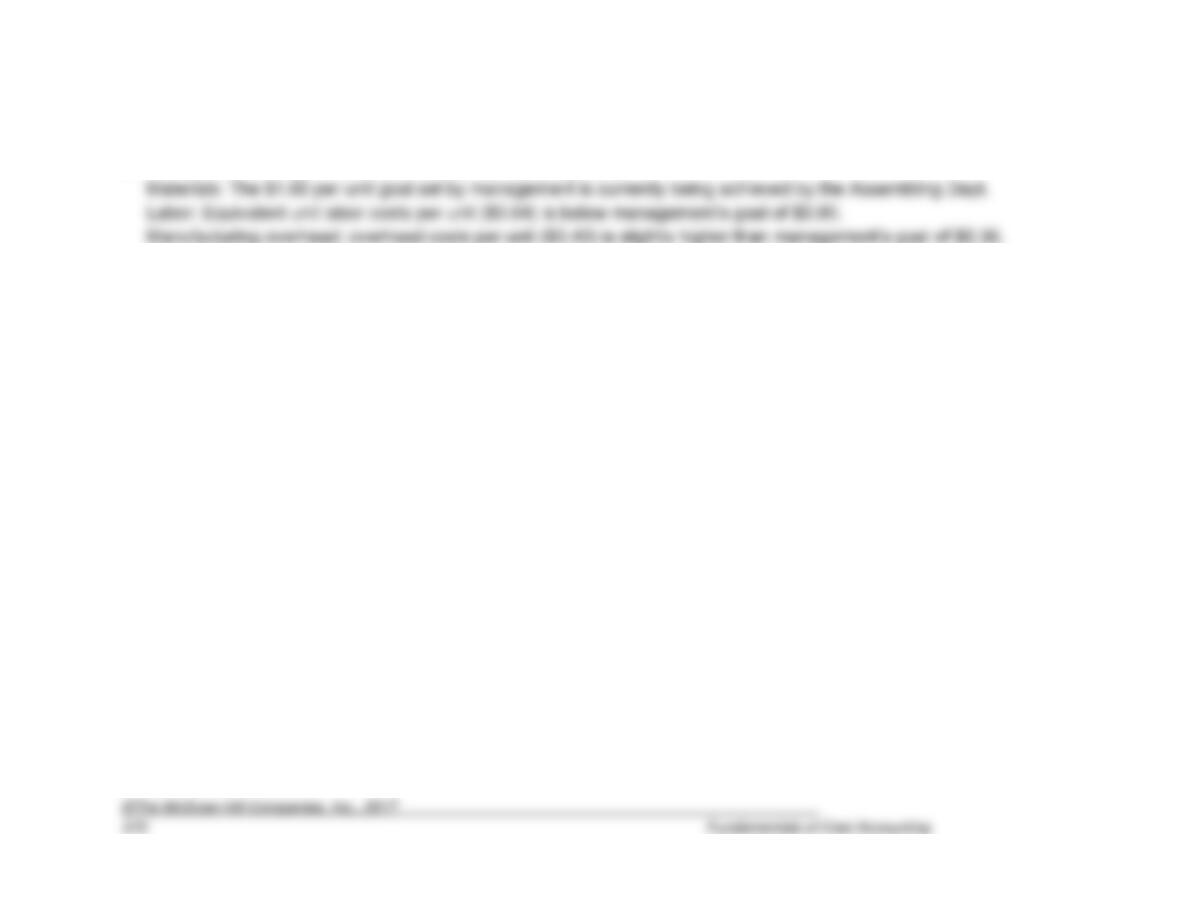
8-48. (continued)
Total costs
Prior
department
costs
Materials
Labor
Manufacturing
overhead
Costs to be accounted for: (Section 3)
Costs in beginning WIP inventory ……………….
$ 382,800
$192,000
$120,000
$ 43,200
$27,600
Current period costs …………………………………
960,000
Prior department costs ($1,152,000 450,000)
Materials ($696,000 435,000) ………………….
$1.60
Labor ($259,200 405,000) ………………………
$0.64
Manufacturing overhead ($141,000 352,500)
Costs accounted for: (Section 5)
Costs assigned to units transferred out:
480,000
120,000
Total costs of units transferred out ………………
384,000
216,000
Total ending WIP inventory ………………………..
8-48. (continued)
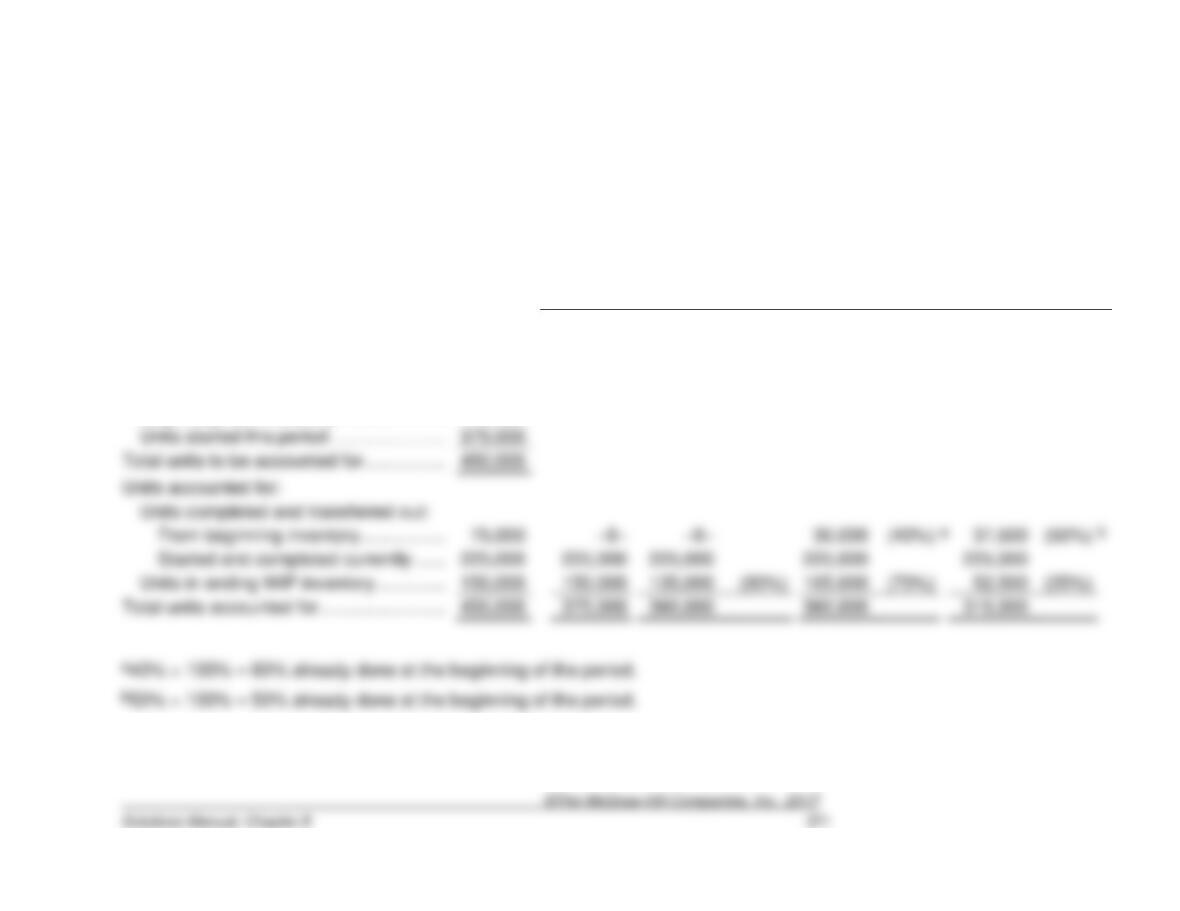
b. The report to management should include the following items:
8-49.
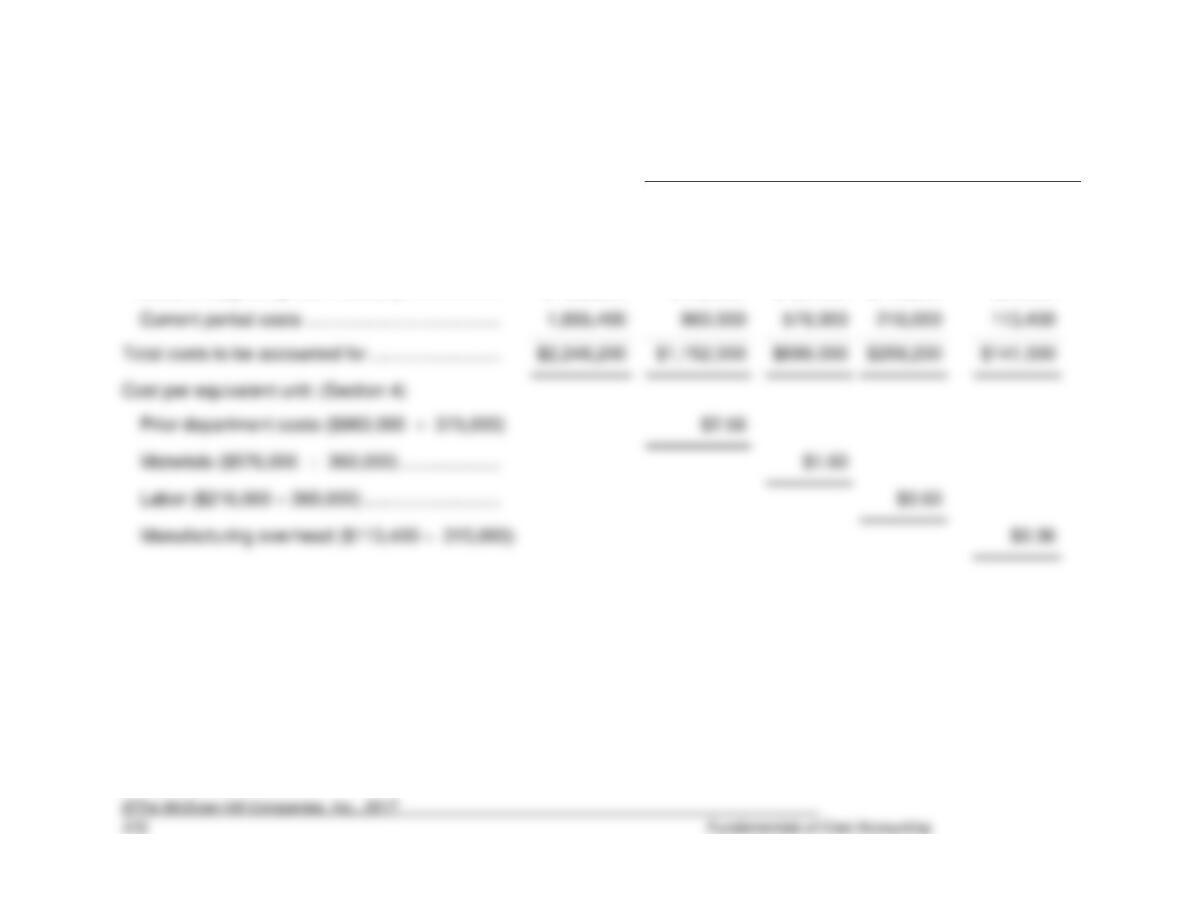
(50 min.) Prepare a Production Cost Report—FIFO Method: Kansas Supplies.
a.
Kansas Supplies
Assembling Department
Production Cost Report—FIFO
Flow of Production Units
(Section 1)
(Section 2)
COMPUTE EQUIVALENT UNITS
Physical
units
Prior
department
costs
Materials
Labor
Manufacturing
overhead
Units to be accounted for:
Beginning WIP inventory …………………………..
75,000
Total units to be accounted for ………………………
Units accounted for:
225,000
(90%)
Total units accounted for ………………………………
8-49. (continued)
Costs
DETAILS
Total Costs
Prior
department
costs
Materials
Labor
Manufacturing
overhead
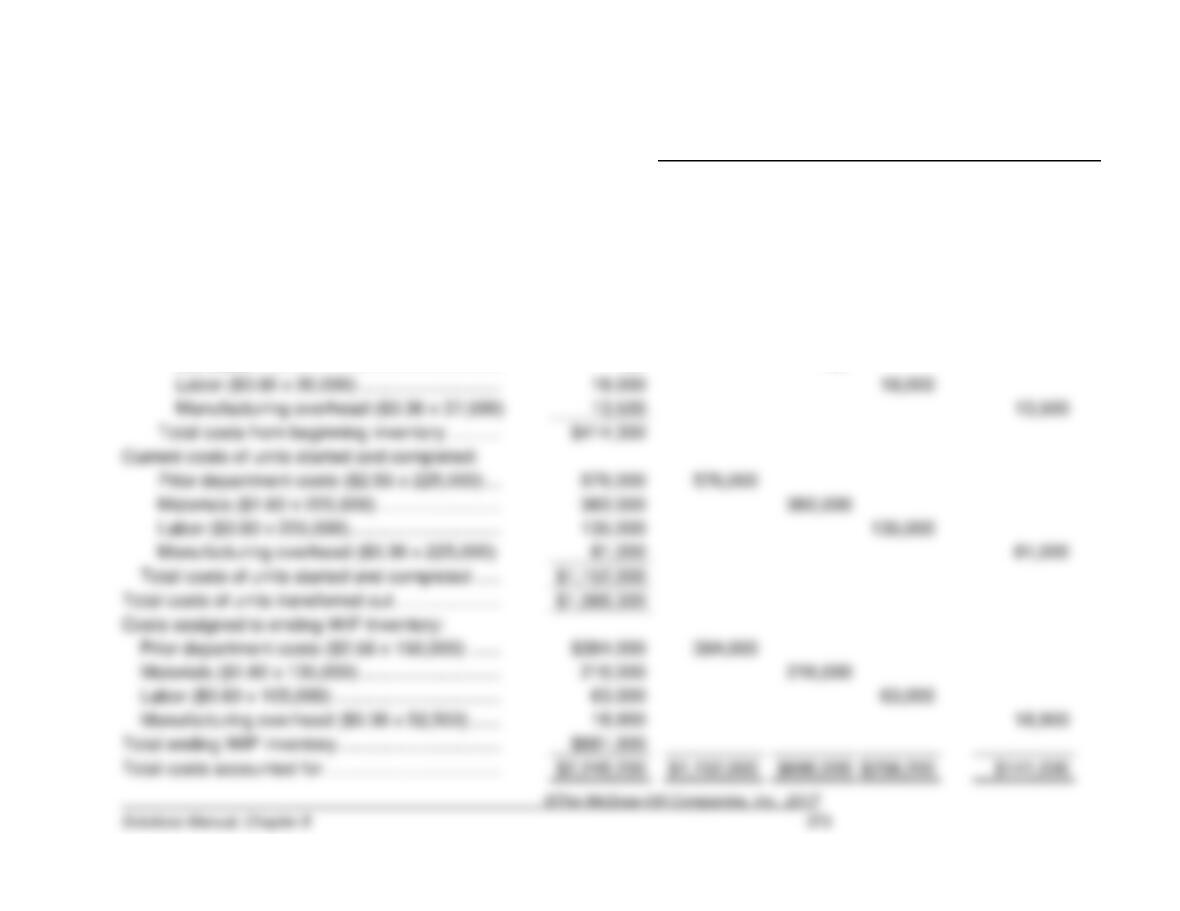
Costs to be accounted for: (Section 3)
Costs in beginning WIP inventory ……………….
$ 382,800
$192,000
$120,000
$ 43,200
$27,600
Current period costs …………………………………
Total costs to be accounted for ……………………..
Cost per equivalent unit: (Section 4)
Prior department costs ($960,000 375,000)
Materials ($576,000 360,000) ………………..
Labor ($216,000 360,000) ………………………
Manufacturing overhead ($113,400 315,000)
8-49. (continued)
Details
Total Costs
Prior
department
costs
Materials
Labor
Manufacturing
overhead
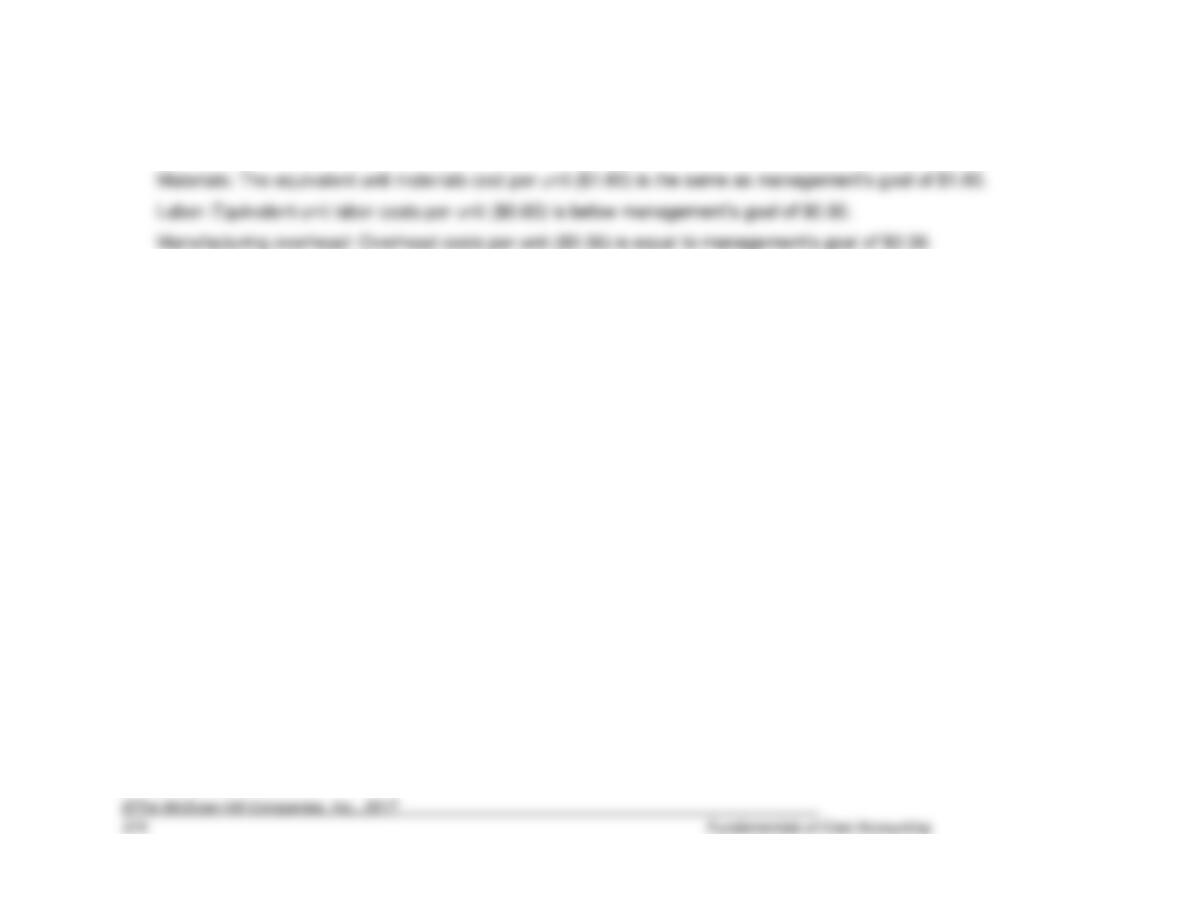
Costs accounted for: (Section 5)
Costs assigned to units transferred out:
Costs from beginning WIP inventory ………..
$ 382,800
$192,000
$120,000
$ 43,200
$27,600
Current costs added to complete beginning WIP inventory:
Prior department costs ……………………….
–0–
–0–
Materials …………………………………………..
–0–
–0–
Labor ($0.60 x 30,000) ……………………….
Manufacturing overhead ($0.36 x 37,500)
Total costs from beginning inventory ……….
Current costs of units started and completed:
Prior department costs ($2.56 x 225,000) …
Materials ($1.60 x 225,000) ……………………
Labor ($0.60 x 225,000) …………………………
Manufacturing overhead ($0.36 x 225,000)
Total costs of units started and completed …..
Total costs of units transferred out …………………
Costs assigned to ending WIP inventory:
Prior department costs ($2.56 x 150,000) ……
Materials ($1.60 x 135,000) ……………………….
Manufacturing overhead ($0.36 x 52,500) ……
Total ending WIP inventory …………………………..
Total costs accounted for ……………………………..
8-49. (continued)
b. The report to management should include the following items:
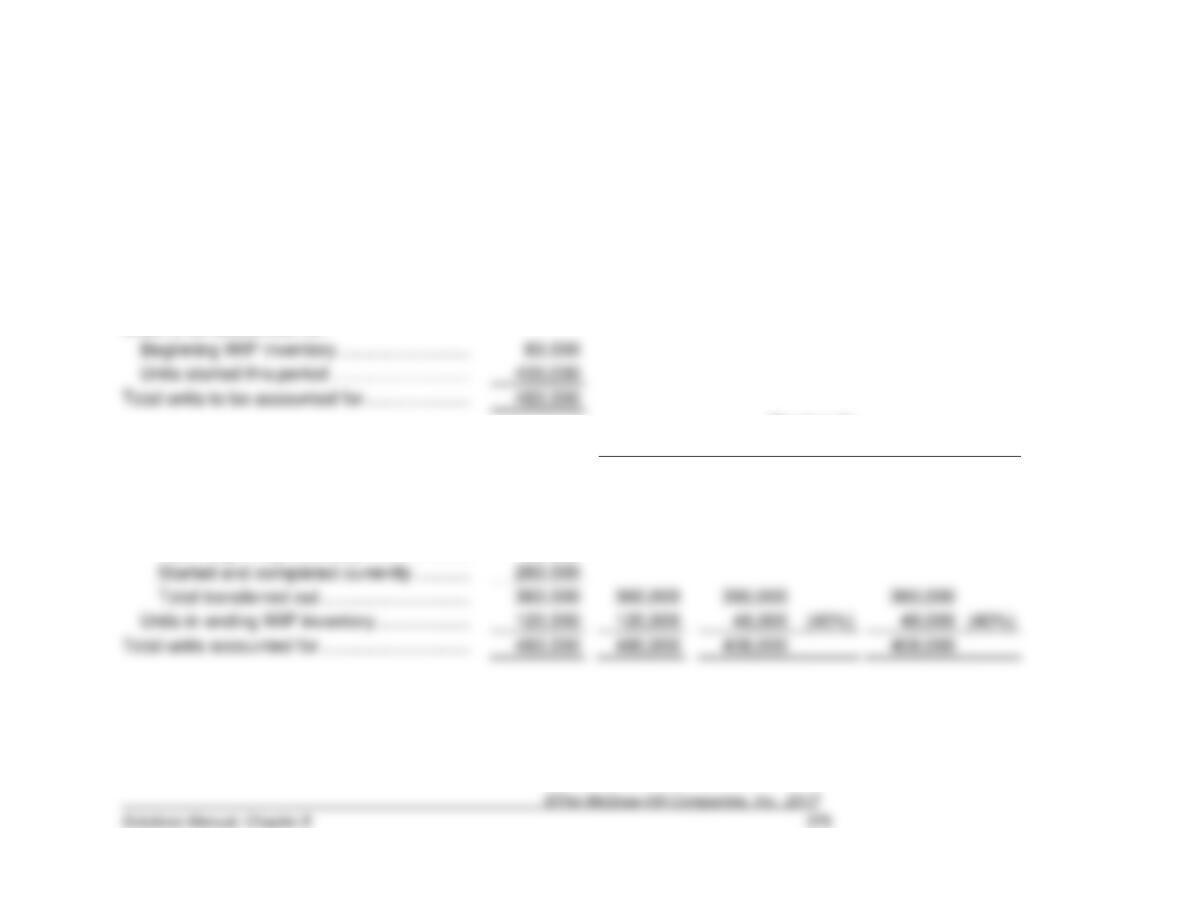
8-50. (60 min.) Prepare a Production Cost Report and Adjust Inventory Balances—Weighted-Average Method:
Fremont Corporation.
a.
Fremont Corporation
Production Cost Report—Weighted-Average
Flow of Production Units
(Section 1)
Physical units
Units to be accounted for:
Beginning WIP inventory …………………………..
Total units to be accounted for ………………………
(Section 2)
COMPUTE EQUIVALENT UNITS
Materials
Labor
Overhead
Units accounted for:
Units completed and transferred out:
From beginning inventory……………………….
80,000
Started and completed currently ……………..
Total units accounted for ………………………………
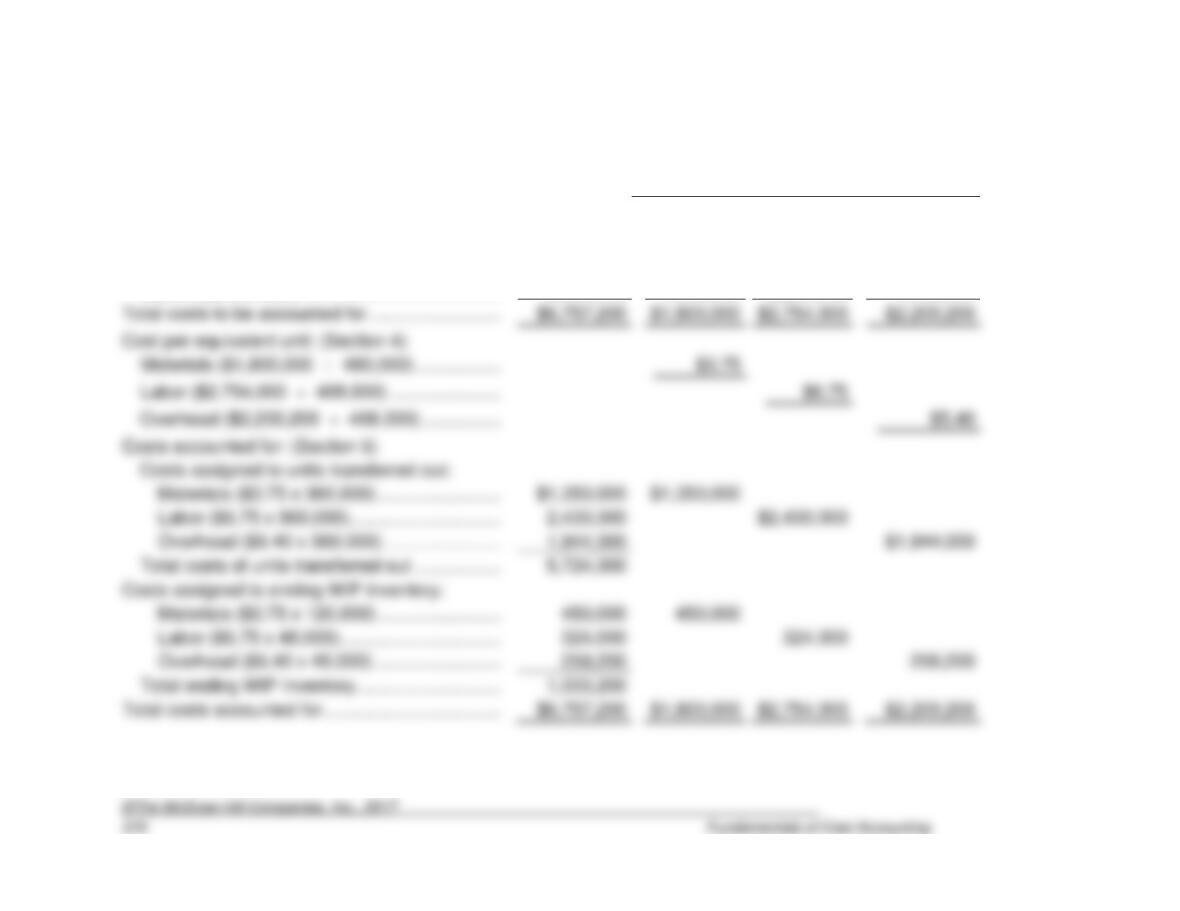
8-50. (continued)
Costs
Details
Total costs
Materials
Labor
Overhead
Costs to be accounted for: (Section 3)
Costs in beginning WIP inventory ……………….
$ 1,222,800
$ 240,000
$ 546,000
$ 436,800
Current period costs …………………………………
5,534,400
1,560,000
2,208,000
1,766,400
Total costs to be accounted for ……………………..
Cost per equivalent unit: (Section 4)
Materials ($1,800,000 480,000) ……………..
Labor ($2,754,000 408,000) ………………….
Overhead ($2,203,200 408,000) …………….
Costs accounted for: (Section 5)
Costs assigned to units transferred out:
Total costs of units transferred out ……………..
Costs assigned to ending WIP inventory:
Total ending WIP inventory………………………..
Total costs accounted for ……………………………..
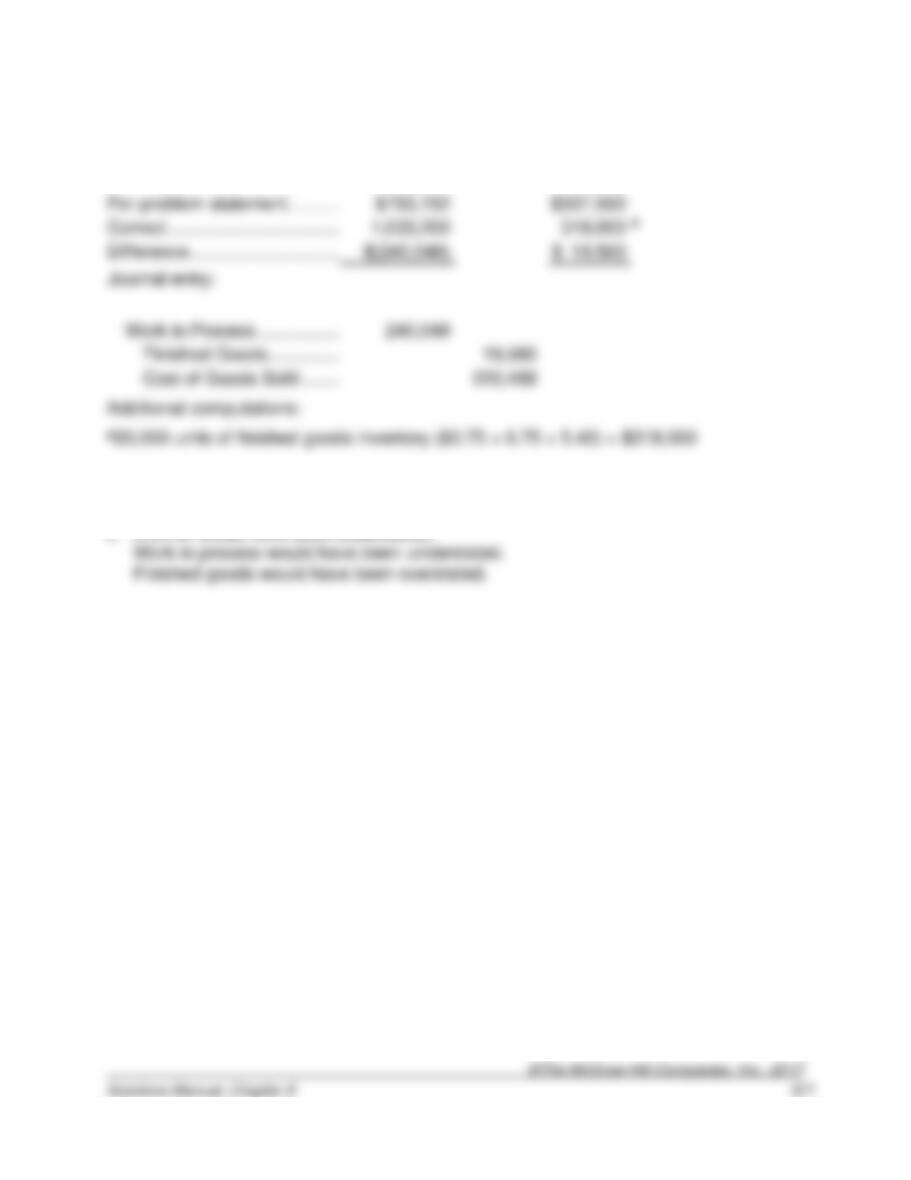
8-50. (continued)
b. Adjustment required:
Work in
Process
Finished
Goods
c. Income would have been understated.
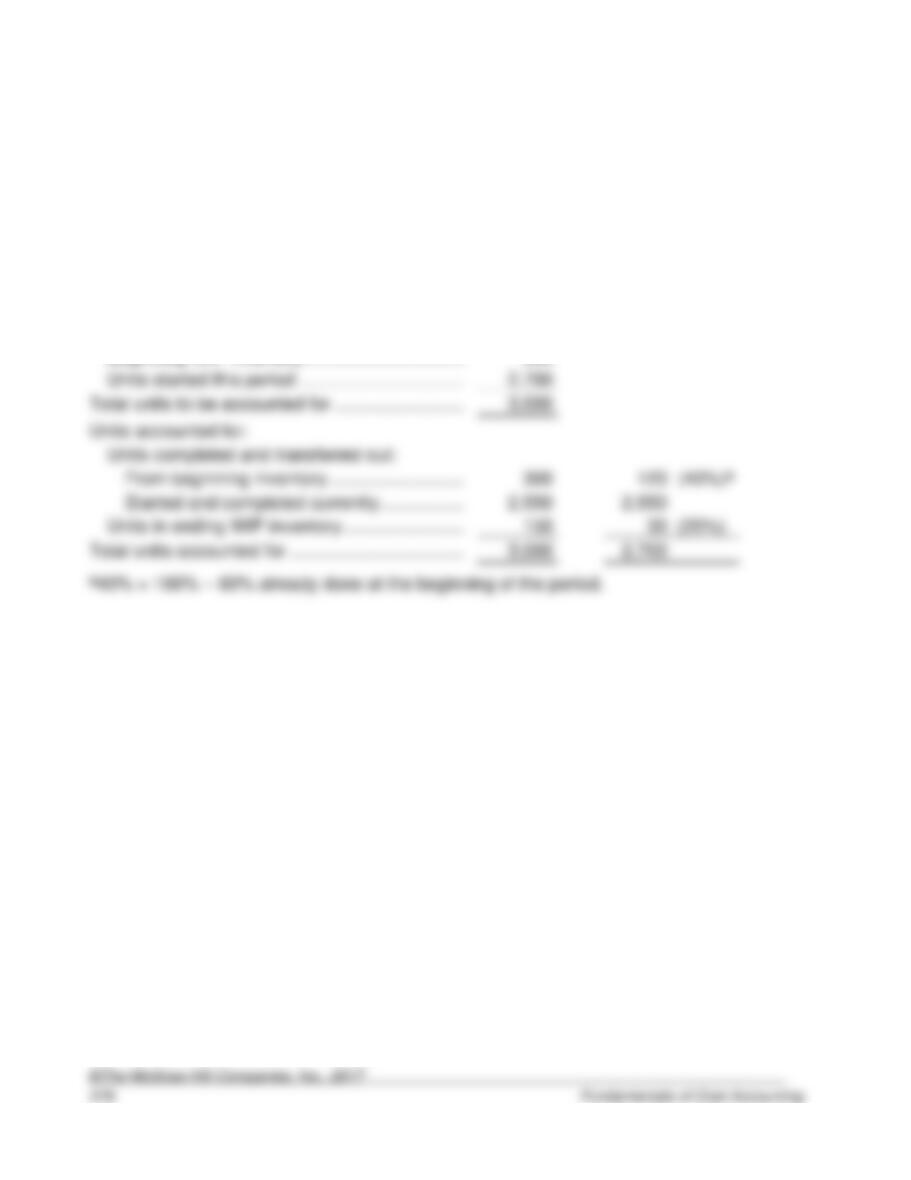
8-51. (40 min.) Prepare a Production Cost Report and Show Cost Flows Through
Accounts—FIFO Method: Recyclers, Inc.
Recyclers, Inc.
Production Cost Report—FIFO
a.
Flow of Production Units
(Section 2)
Compute Equivalent
Units
(Section 1)
Physical units
Conversion
costs
Units to be accounted for:
Beginning WIP inventory …………………………..
300
Total units to be accounted for ……………………..
Units accounted for:
Units completed and transferred out:
Units in ending WIP inventory ……………………
150
Total units accounted for ……………………………..
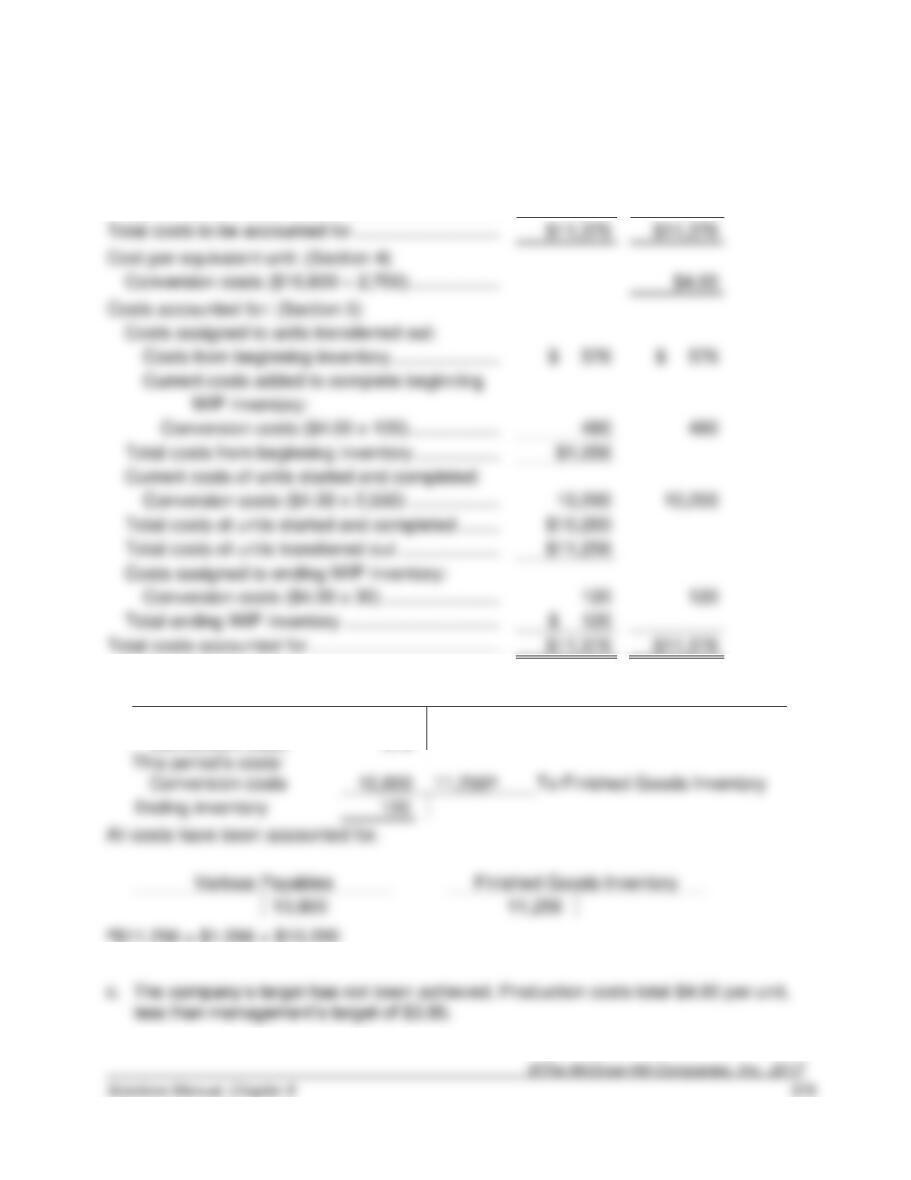
8-51. (continued)
Costs
Total costs
Conversion
costs
Costs to be accounted for: (Section 3)
Costs in beginning WIP inventory ………………….
$ 576
$ 576
Current period costs ……………………………………
10,800
10,800
Total costs to be accounted for ………………………..
Cost per equivalent unit: (Section 4)
Conversion costs ($10,800 2,700) ………………
Costs accounted for: (Section 5)
Costs assigned to units transferred out:
Costs from beginning inventory ………………….
$ 576
$ 576
WIP inventory:
Conversion costs ($4.00 x 120) ………………
Total costs from beginning inventory ……………..
$1,056
Current costs of units started and completed:
Conversion costs ($4.00 x 2,550) ………………
Total costs of units started and completed ……..
Total costs of units transferred out ………………..
Costs assigned to ending WIP inventory:
Conversion costs ($4.00 x 30) …………………..
Total ending WIP inventory ………………………….
$ 120
Total costs accounted for ………………………………..
b.
Work in Process
Beginning inventory:
Conversion costs
576
This period’s costs:
Conversion costs
To Finished Goods Inventory
Ending inventory
10,800
8-52. (40 min.) Prepare a Production Cost Report and Show Cost Flows Through
Accounts—Weighted-Average Method: Recyclers, Inc.
Recyclers, Inc.
Production Cost Report—Weighted Average
a.
Flow of Production Units
(Section 2)
Compute Equivalent
Units
(Section 1)
Physical units
Conversion
costs
Units to be accounted for:
Total units to be accounted for ……………………..
Units accounted for:
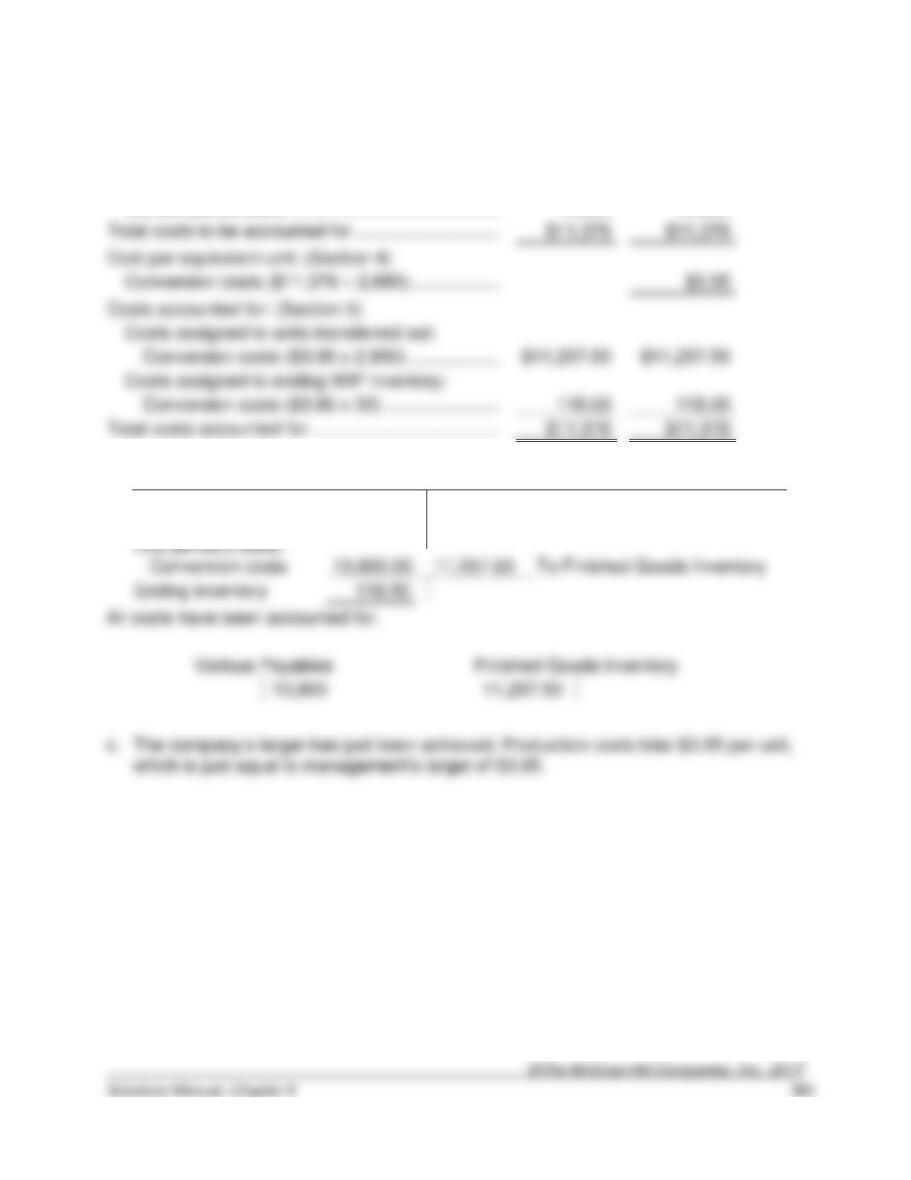
8-52. (continued)
Costs
Total costs
Conversion
costs
Costs to be accounted for: (Section 3)
Costs in beginning WIP inventory ………………….
$ 576
$ 576
Current period costs ……………………………………
10,800
10,800
Total costs to be accounted for ………………………..
$11,376
Cost per equivalent unit: (Section 4)
Conversion costs ($11,376 2,880) ………………
Costs accounted for: (Section 5)
Costs assigned to units transferred out:
Conversion costs ($3.95 x 2,850) ………………
Costs assigned to ending WIP inventory:
Conversion costs ($3.95 x 30) …………………..
Total costs accounted for ………………………………..
b.
Work in Process
Beginning inventory:
Conversion costs
576.00
Conversion costs
11,257.50
To Finished Goods Inventory
Ending inventory
10,800
11,257.50
8-53. (60 min.) FIFO Process Costing: Pantanal, Inc.
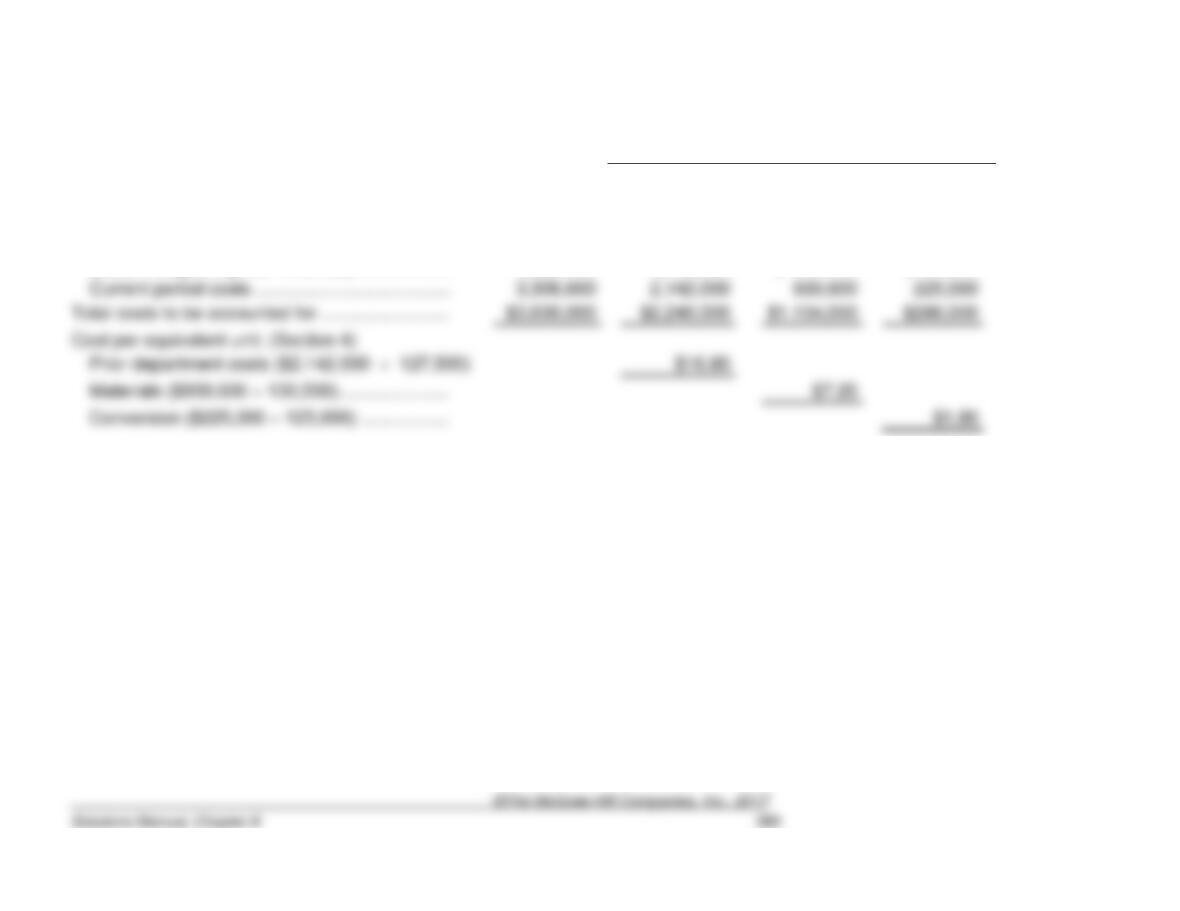
Pantanal, Inc.
Assembling Department
Production Cost Report—FIFO
Flow of Production Units
(Section 1)
(Section 2)
COMPUTE EQUIVALENT UNITS
Physical units
Prior
department
costs
Materials
Conversion
Units to be accounted for:
Beginning WIP inventory …………………………..
12,500
Units started this period …………………………….
Units completed and transferred out:
Started and completed currently ……………..
Units in ending WIP inventory …………………….
20,000
Total units accounted for ………………………………
130,500
8-53. (continued)
Costs
DETAILS
Total Costs
Prior
department
costs
Materials
Conversion
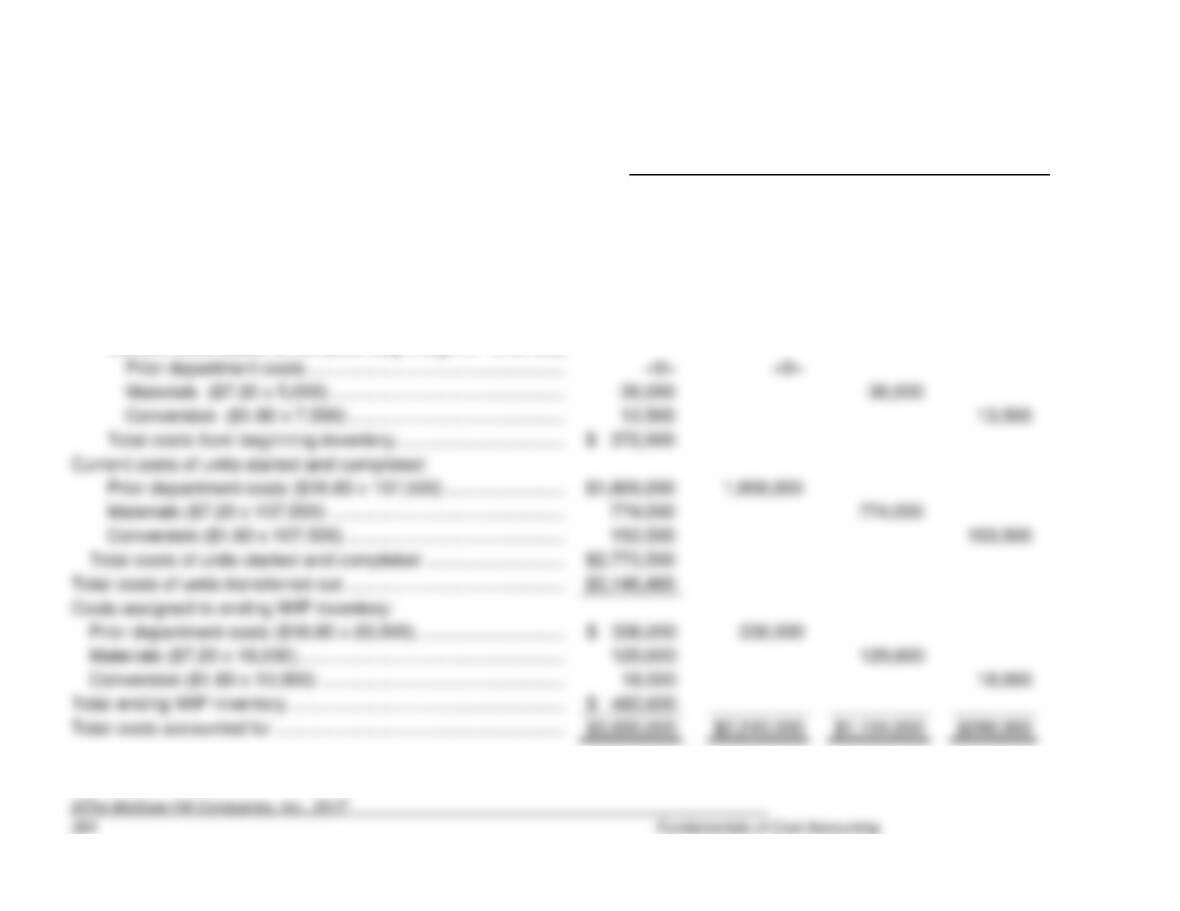
Costs to be accounted for: (Section 3)
Costs in beginning WIP inventory ……………….
$323,400
$ 98,000
$ 164,400
$ 61,000
Total costs to be accounted for ……………………..
Cost per equivalent unit: (Section 4)
Prior department costs ($2,142,000 127,500)
Materials ($939,600 130,500) ………………….
8-53. (continued)
Details
Total Costs
Prior
department
costs
Materials
Conversion
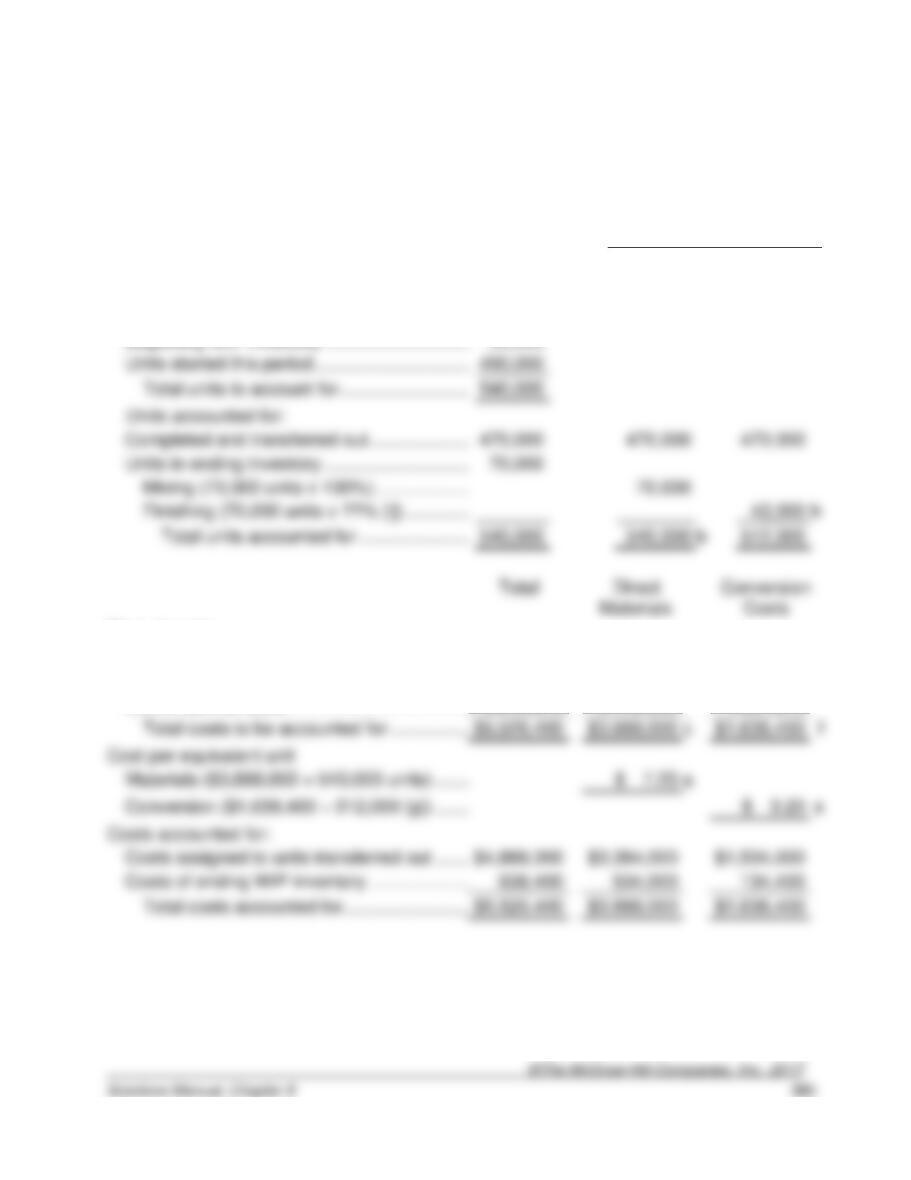
Costs accounted for: (Section 5)
Costs assigned to units transferred out:
Costs from beginning WIP inventory …………………………….
$ 323,400
$ 98,000
$ 164,400
$ 61,000
Current costs added to complete beginning WIP inventory:
Prior department costs ……………………………………………
Materials ($7.20 x 5,000) ………………………………………..
Conversion ($1.80 x 7,500) …………………………………….
Total costs from beginning inventory …………………………….
$ 372,900
Current costs of units started and completed:
Prior department costs ($16.80 x 107,500) ……………………
1,806,000
Materials ($7.20 x 107,500) ………………………………………..
Conversion ($1.80 x 107,500) ……………………………………..
Total costs of units started and completed ……………………….
Costs assigned to ending WIP inventory:
Prior department costs ($16.80 x 20,000) …………………………
$ 336,000
Materials ($7.20 x 18,000) ……………………………………………..
Conversion ($1.80 x 10,000) ………………………………………….
$ 483,600
Total costs accounted for ………………………………………………….
$286,000
8-54. (50 min.) Prepare a Production Cost Report—Weighted-Average Method:
Saline Solutions.
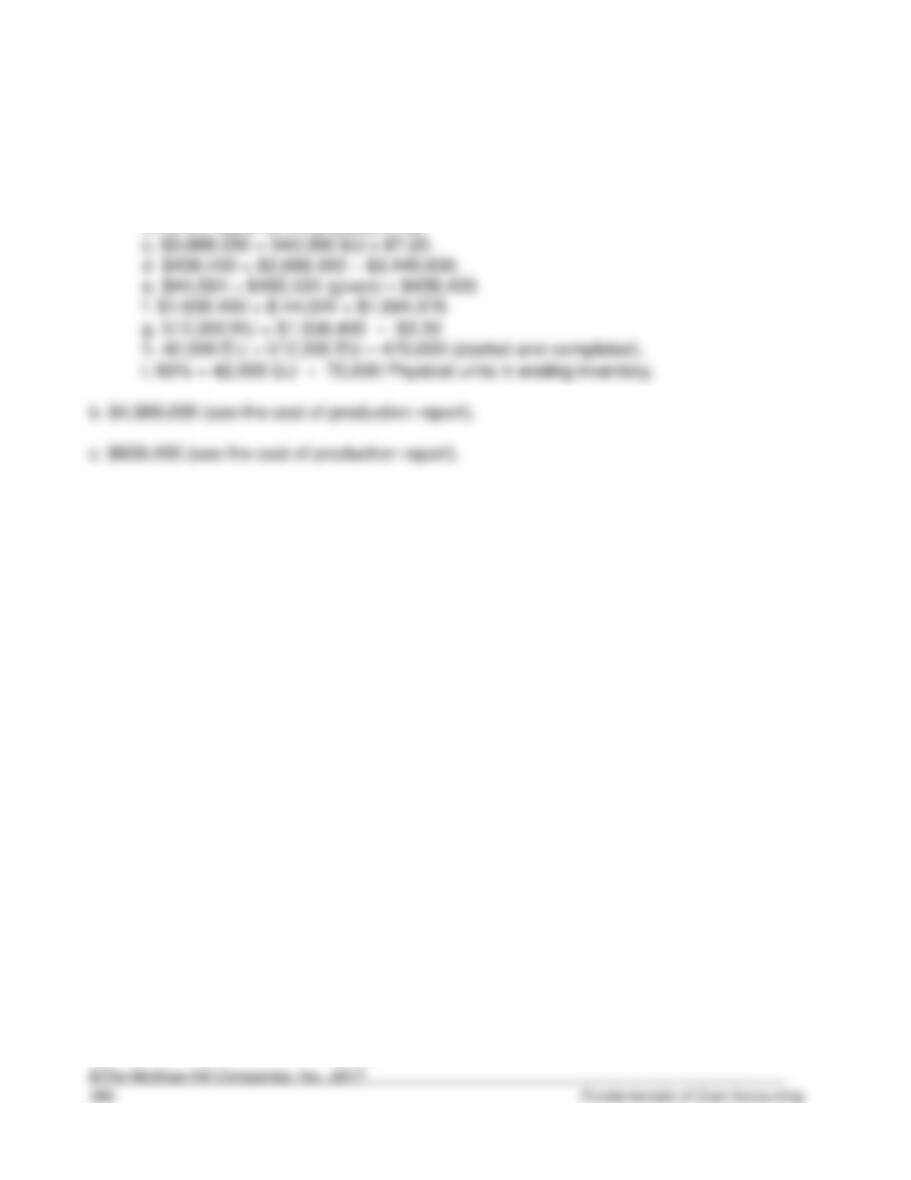
a. 60 percent complete. The key to this problem is to set up the production cost report to
the extent you can and then fill in the missing information.
Physical
Units
Equivalent Units
Materials
Conversion
Flow of units:
Units to be accounted for:
Beginning WIP inventory …………………………..
50,000
Total units to account for ………………………..
Units accounted for:
Completed and transferred out …………………..
Units in ending inventory …………………………..
70,000
Mixing (70,000 units x 100%) ………………….
Finishing (70,000 units x ??% [i]) …………….
h
Total units accounted for …………………….
b
Flow of costs:
Costs to be accounted for:
Costs in beginning WIP inventory ……………….
$482,424
$438,400
d
$ 44,024
e
Current period costs …………………………………
5,043,976
3,449,600
1,594,376
Total costs to be accounted for ……………….
c
$1,638,400
f
Cost per equivalent unit
Materials ($3,888,000 ÷ 540,000 units) ……….
a
Conversion ($1,638,400 ÷ 512,000 [g]) ……….
a
Costs accounted for:
Costs assigned to units transferred out ……….
$1,504,000
Costs of ending WIP inventory …………………..
Total costs accounted for ……………………….
$3,888,000
8-54. (continued)
Notes:
a. Given.
b. Because the units are fully complete with respect to materials, the equivalent
units are equal to the physical units.
8-55. (30 min.) Determine Degree of Completion—FIFO method: Saline Solutions.
a. The ending work in process is at least 60% complete with respect to conversion costs.
This is a problem that requires relatively few computations, but a thorough understanding
of process costing. There are various ways to work through to an answer; the following is
one.
8-56. (40 min.) Solving For Unknowns—FIFO Method.
a.
Units started and completed equals the units transferred out (units completed this
period) less the units started in a previous period (beginning inventory):
8-56. (continued)
c.
Equivalent units
=
Beginning inventory
x (1 – percentage of completion of beginning inventory)
+ 100% of units started and completed
+ ending inventory times its percentage of completion
=
5,600
equivalent units
5,600
=
1,000 (1 – X) + 4,500 + (3,000 x 30%)
5,600
=
1,000 – 1,000X + 5,400
=
=
1,000X
=
TO + EB – TI
=
(4,500 + 1,000) + 900 – 5,600
=
800 units
1,000X
=
$87,000 ÷ 10,000
d. The cost per equivalent unit is obtained by dividing the ending inventory costs by the
equivalent units in ending inventory:
which, for the problem are:
42,000 + 60,000 + 10,000
=
Equivalent units worked this period are the sum of the equivalent units to:
8-57. (50 min.) Solving For Unknowns—Weighted-Average Method.
a. Units transferred out equals beginning inventory plus current work minus ending
inventory. In equation form:
b. The inventory equation yields:
8-57. (continued)
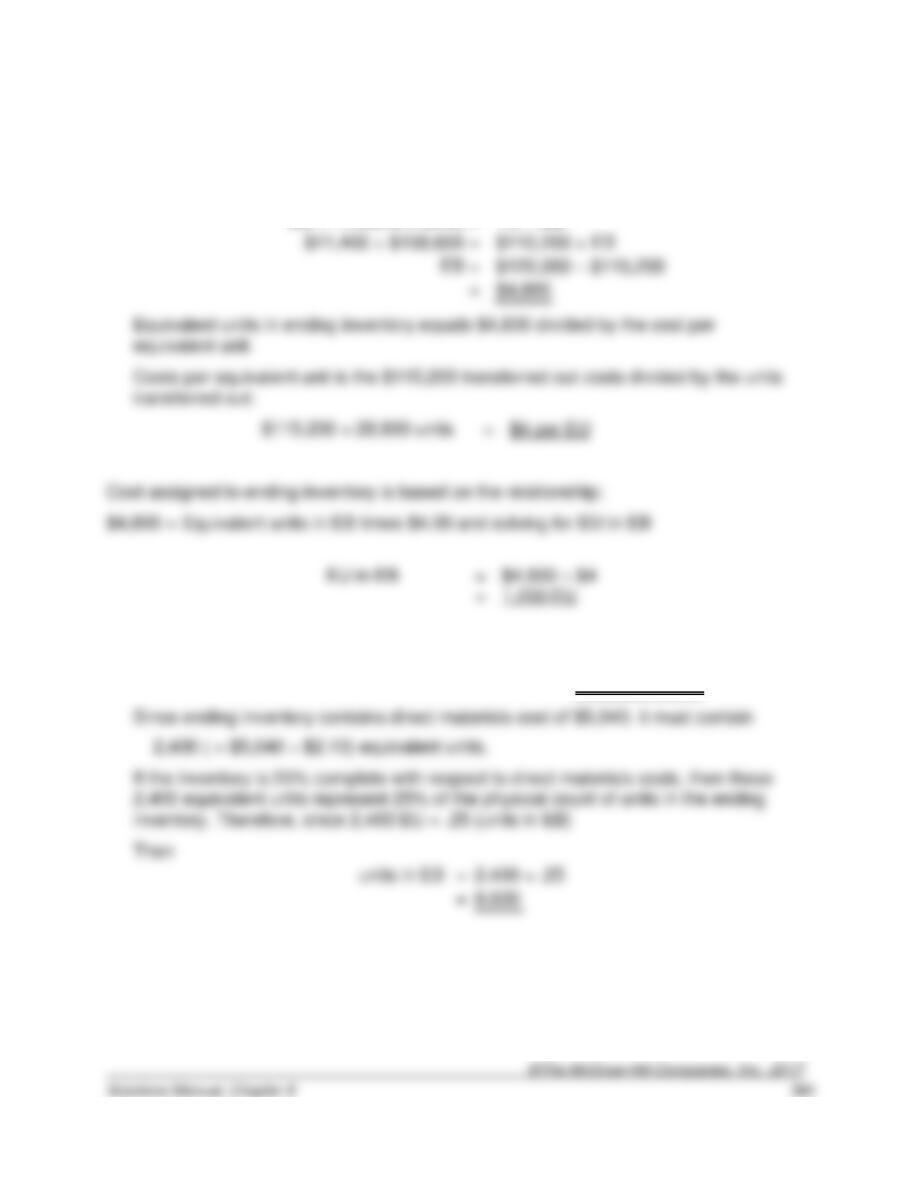
c. First, we compute the cost of ending inventory:
BB + TI (current work)
=
TO + EB
=
$115,200 + EB
=
$120,000 – $115,200
=
$4,800
d. The materials cost per equivalent unit is:
$26,880 ÷ 12,800 units transferred out
=
$2.10 per EU
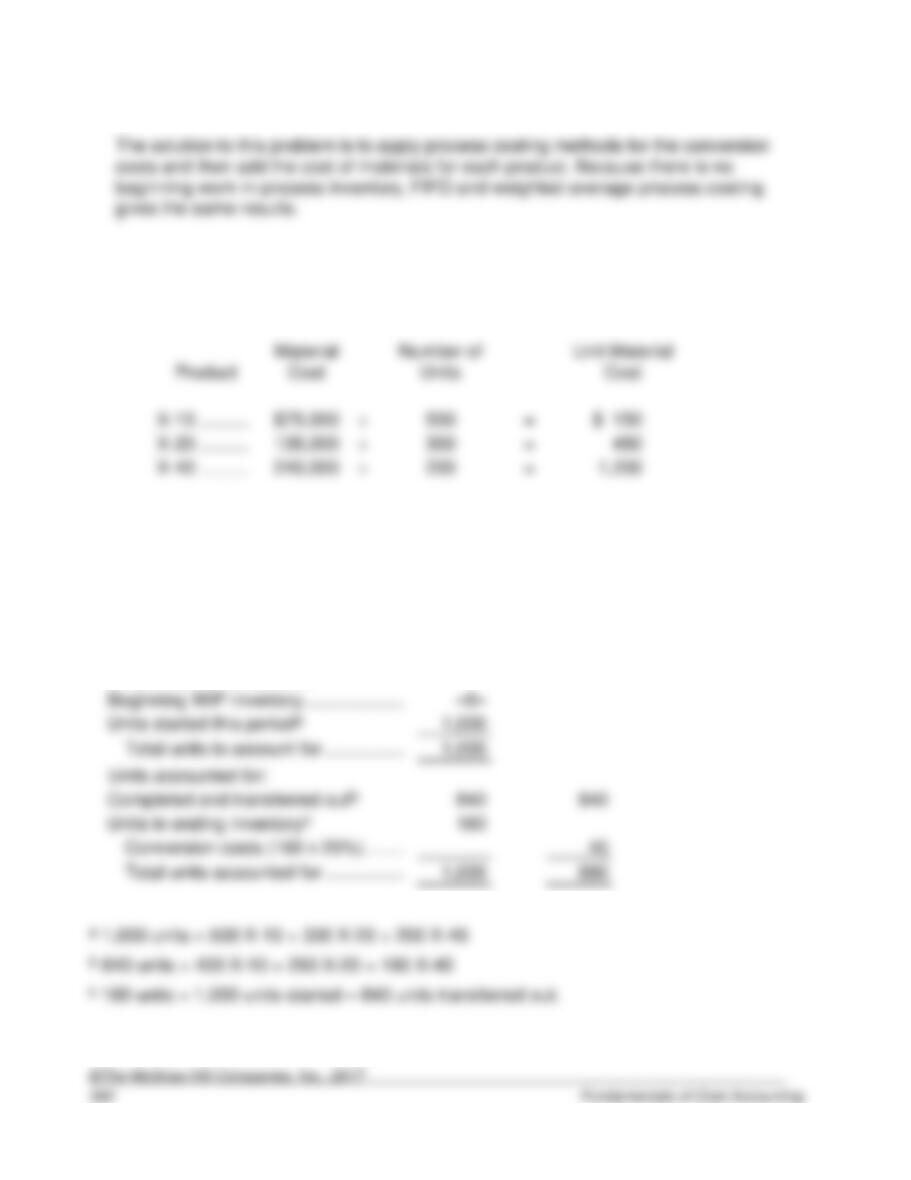
units in EB
2,400 ÷ .25
9,600
÷
÷
÷
8-58. (50 min.) Operation Costing—Work-in-Process Inventory: Washington, Inc.
a.
The material costs per unit are:
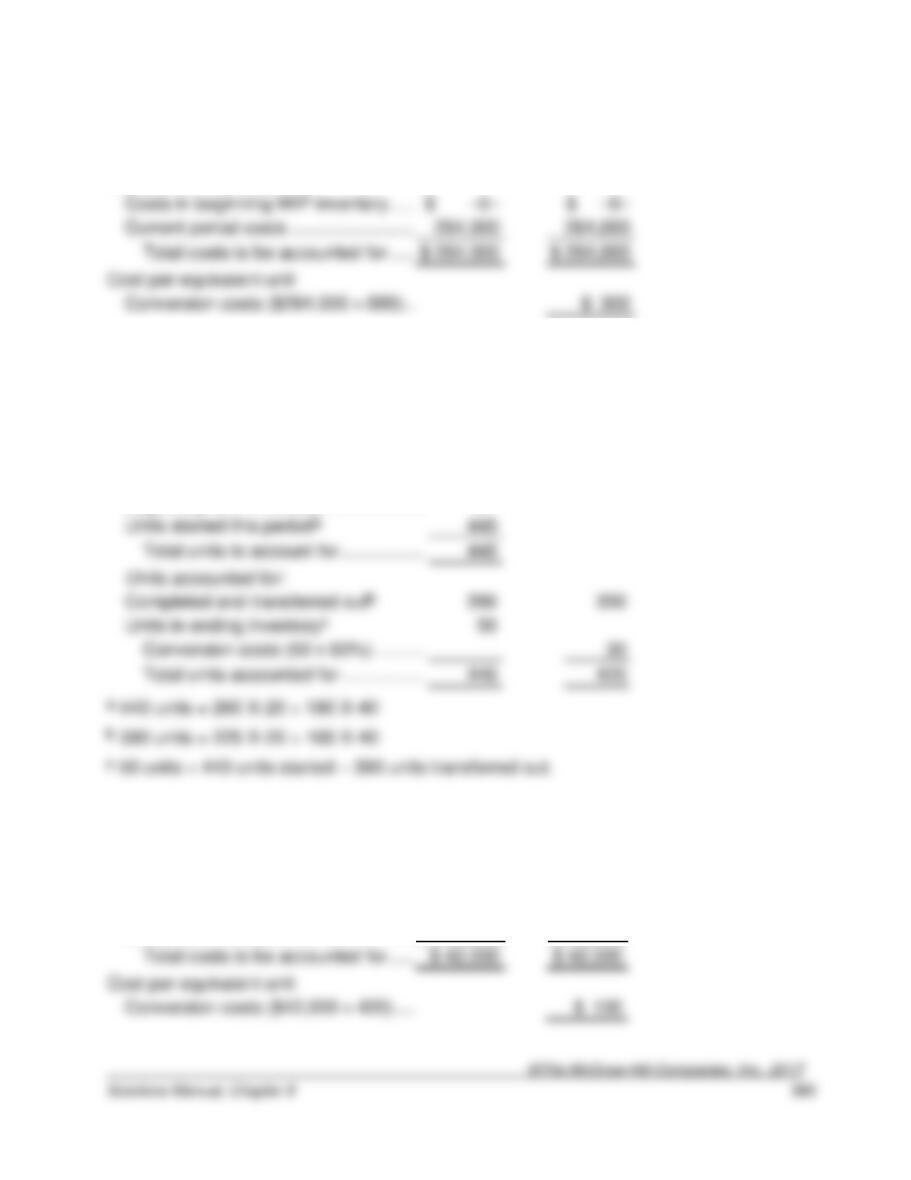
The conversion costs per equivalent unit are:
Department A:
Physical
Units
Conversion Costs
Equivalent Units
Flow of units:
Units to be accounted for:
Beginning WIP inventory …………………………..
1,000
Total units to account for ……………………….
1,000
Units accounted for:
Conversion costs (160 x 25%) ………………..
Total units accounted for ……………………….
1,000
8-58. (continued)
Total
Conversion
Costs
Flow of costs:
Costs to be accounted for:
Costs in beginning WIP inventory ……………….
$ –0–
Current period costs …………………………………
Total costs to be accounted for ……………….
$ 264,000
Cost per equivalent unit
Conversion costs ($264,000 ÷ 880) …………….
Department B:
Physical
Units
Conversion Costs
Equivalent Units
Flow of units:
Units to be accounted for:
Beginning WIP inventory …………………………..
–0–
Total units to account for ………………………..
Conversion costs (50 x 60%) ………………….
Total units accounted for ………………………..
Total
Conversion
Costs
Flow of costs:
Costs to be accounted for:
Costs in beginning WIP inventory ……………….
$ –0–
$ –0–
Current period costs …………………………………
42,000
42,000
Total costs to be accounted for ……………….
Cost per equivalent unit
Conversion costs ($42,000 ÷ 420) ………………
8-58. (continued)
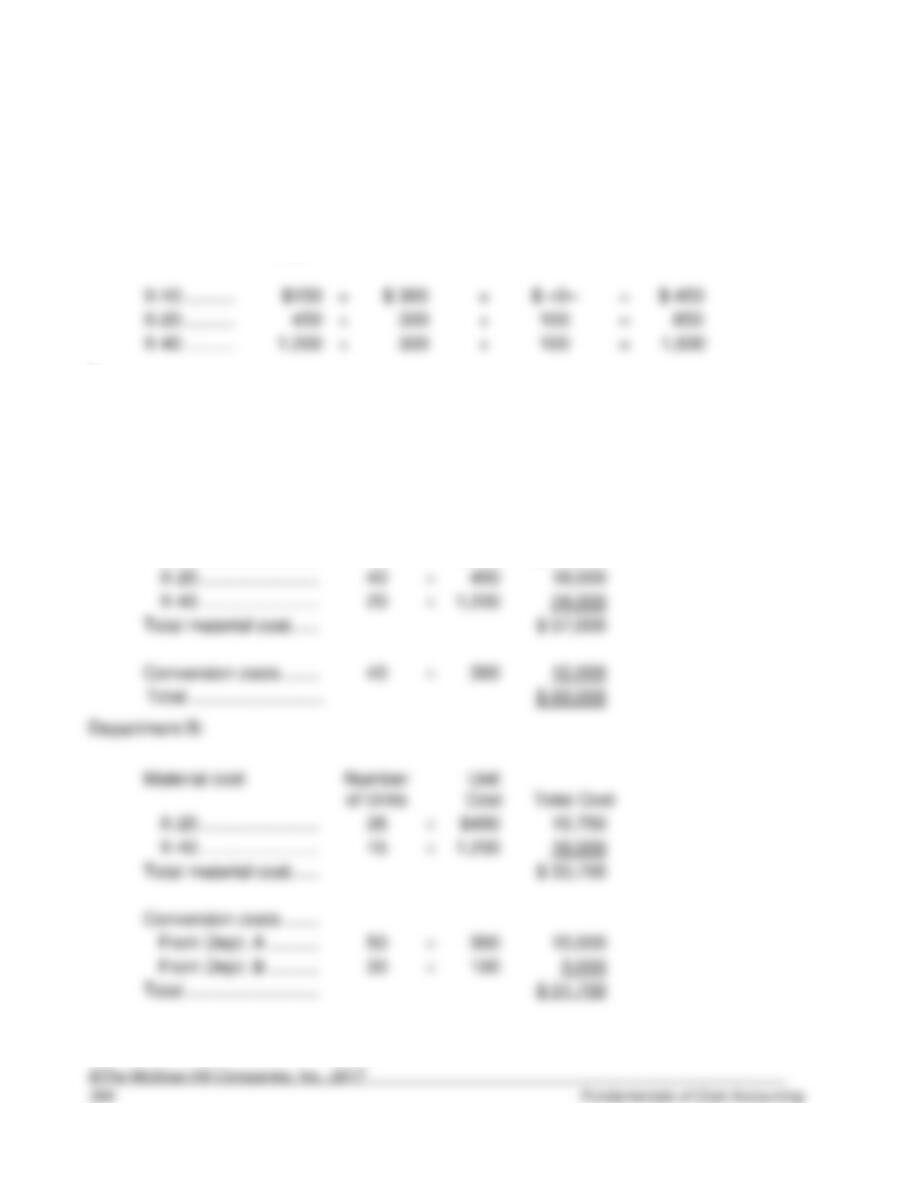
Cost of units transferred to finished goods:
Product
Unit
Material
Cost
Unit
Department
A Cost
Unit
Department
B Cost
Unit Cost
b.
Work-in-Process Ending Inventory Balances are (note the number of units is equal to the
difference between the units started and units completed):
Department A:
Material cost
Number
of Units
Unit
Cost
Total Cost
X-10 ……………………
100
$150
$ 15,000
Material cost
Number
of Units
Cost
Total Cost
300
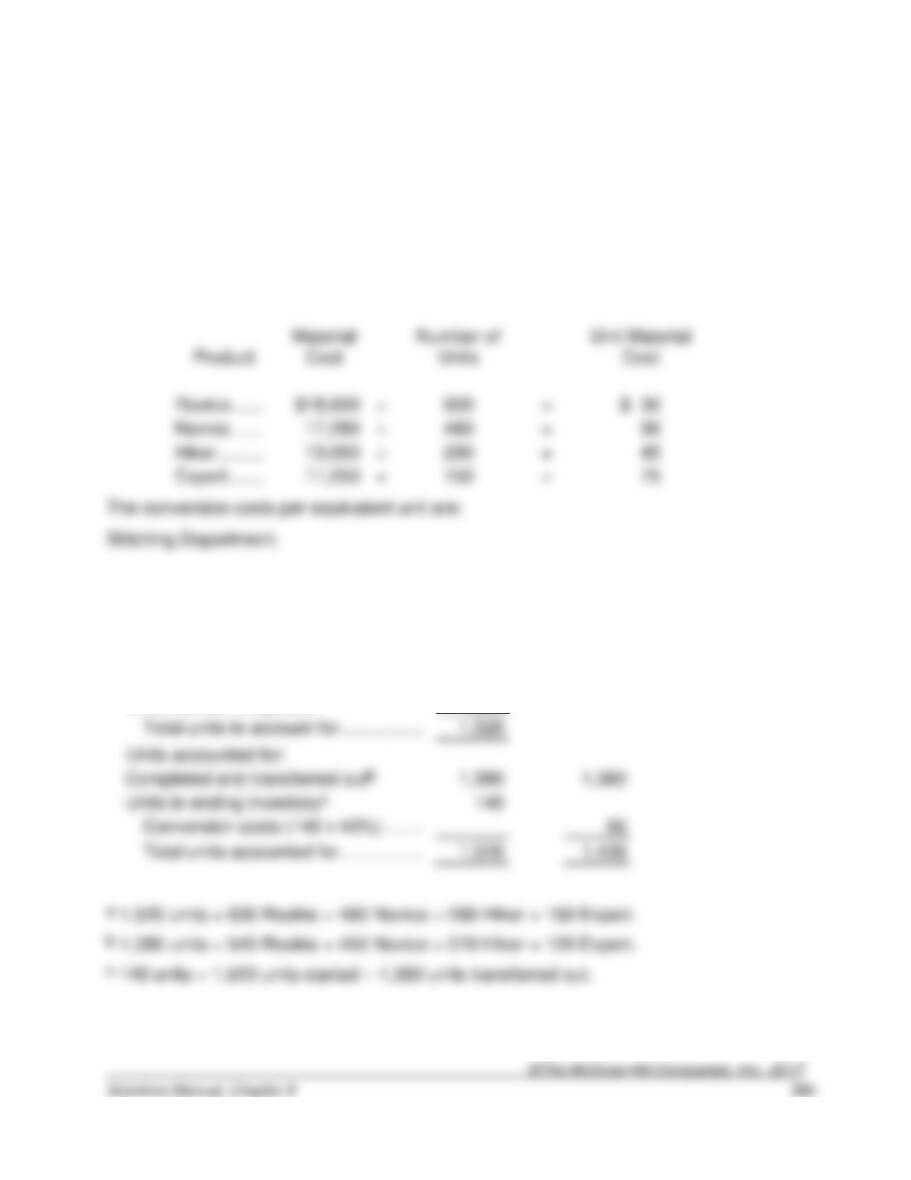
Rookie ……
÷
17,280
÷
Hiker ………
13,050
÷
Expert …….
11,250
÷
8-59. (50 min.) Operation Costing—Work-in-Process Inventory: Miller Outdoor
Equipment.
The solution to this problem is to apply process costing methods for the conversion
costs and then add the cost of materials for each product. Because there is no
beginning work-in-process inventory, FIFO and weighted-average process costing
gives the same results.
a.
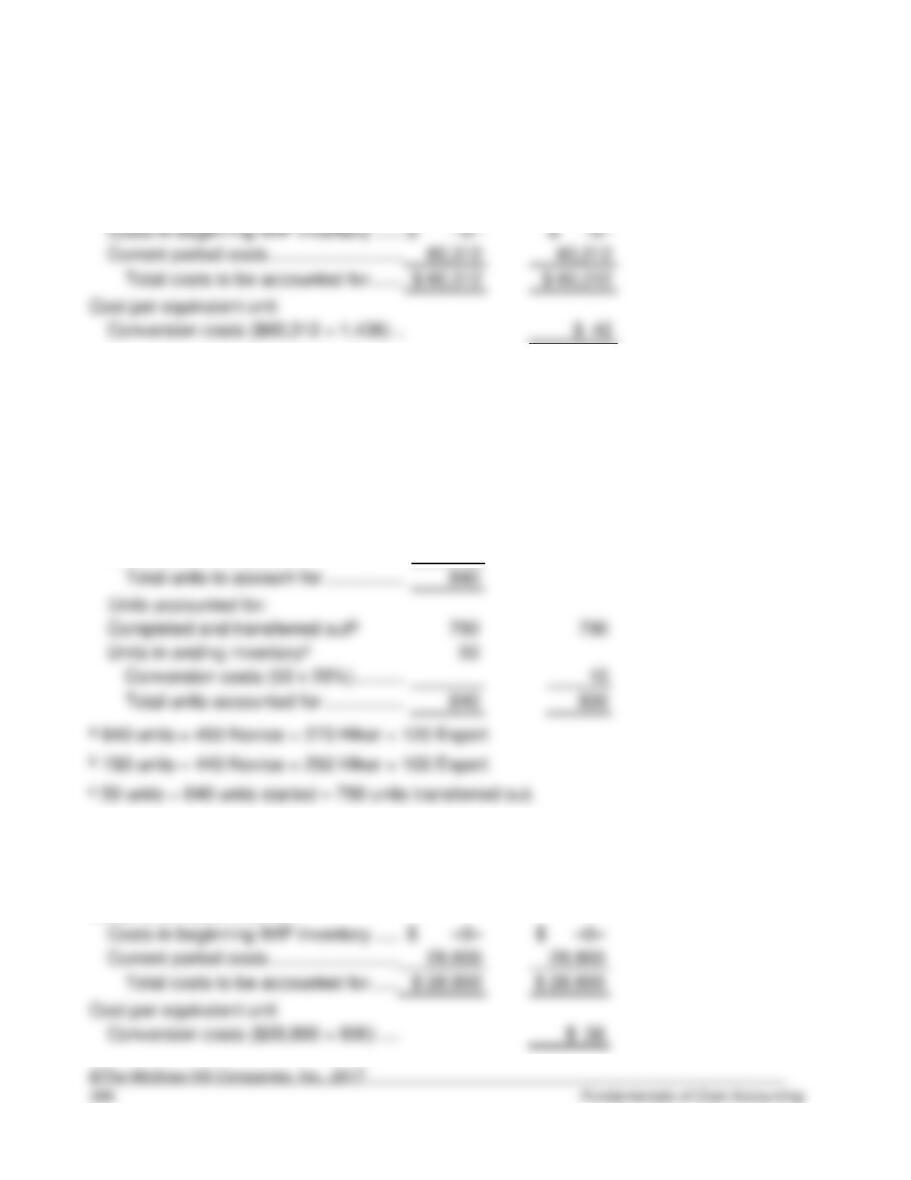
The material costs per unit are:
Physical
Units
Conversion Costs
Equivalent Units
Flow of units:
Units to be accounted for:
Beginning WIP inventory …………………………..
–0–
Units started this perioda
1,520
Total units to account for ………………………..
Completed and transferred outb
1,380
Units in ending inventoryc
Conversion costs (140 x 40%) ………………..
Total units accounted for ………………………..
1,520
8-59. (continued)
Total
Conversion
Costs
Flow of costs:
Costs to be accounted for:
60,312
Cost per equivalent unit
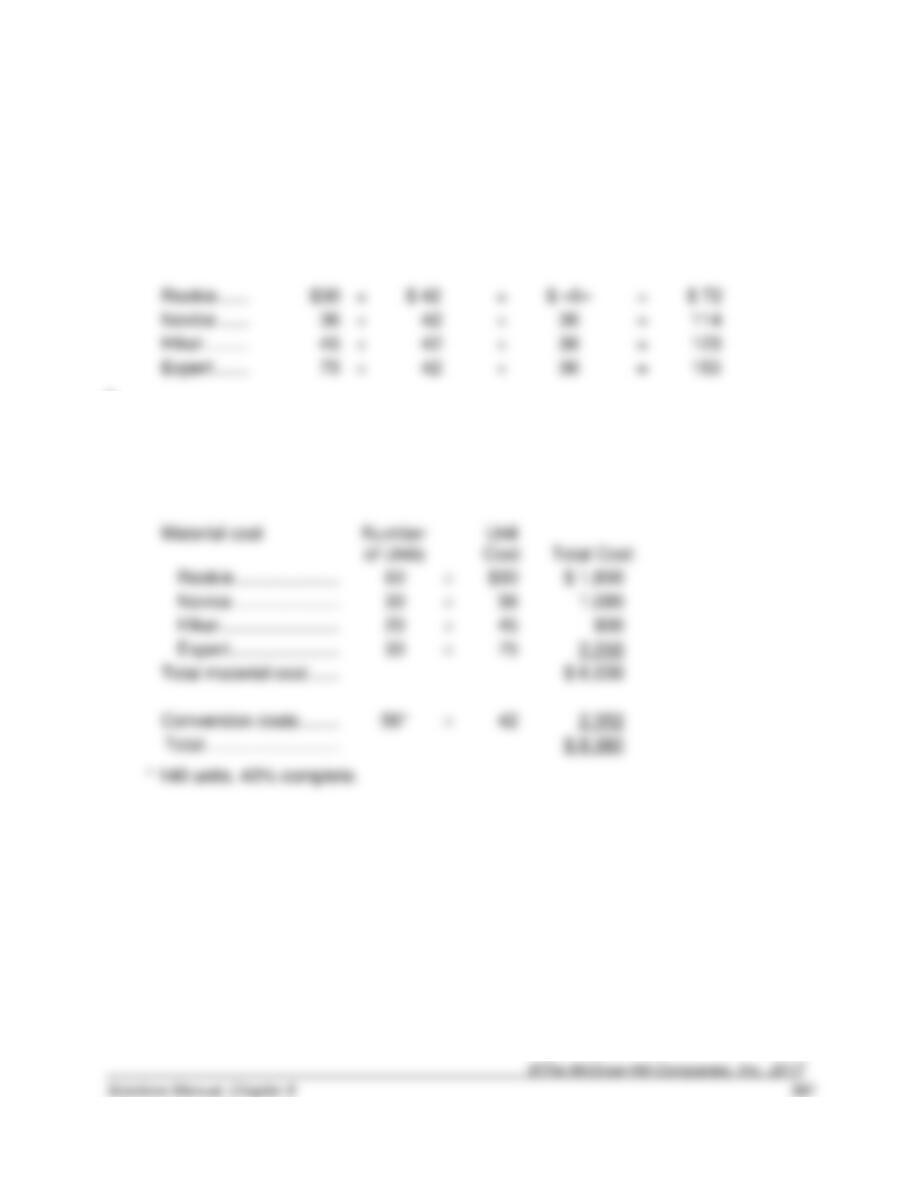
Customizing Department:
Physical
Units
Conversion Costs
Equivalent Units
Flow of units:
Units to be accounted for:
Beginning WIP inventory …………………………..
–0–
Units started this perioda
840
Total units to account for ……………………….
840
Completed and transferred outb
790
Conversion costs (50 x 20%) ………………….
Total units accounted for ……………………….
Total
Conversion
Costs
Flow of costs:
Costs to be accounted for:
$ –0–
Cost per equivalent unit
8-59. (continued)
Cost of units transferred to finished goods:
Product
Unit
Material
Cost
Stitching
Department
Unit Cost
Customizing
Department
Unit Cost
Unit Cost
Material cost
Number
Cost
$ 1,800
b.
Work-in-Process Ending Inventory Balances are (note the number of units is equal to the
difference between the units started and units completed):
Stitching Department:
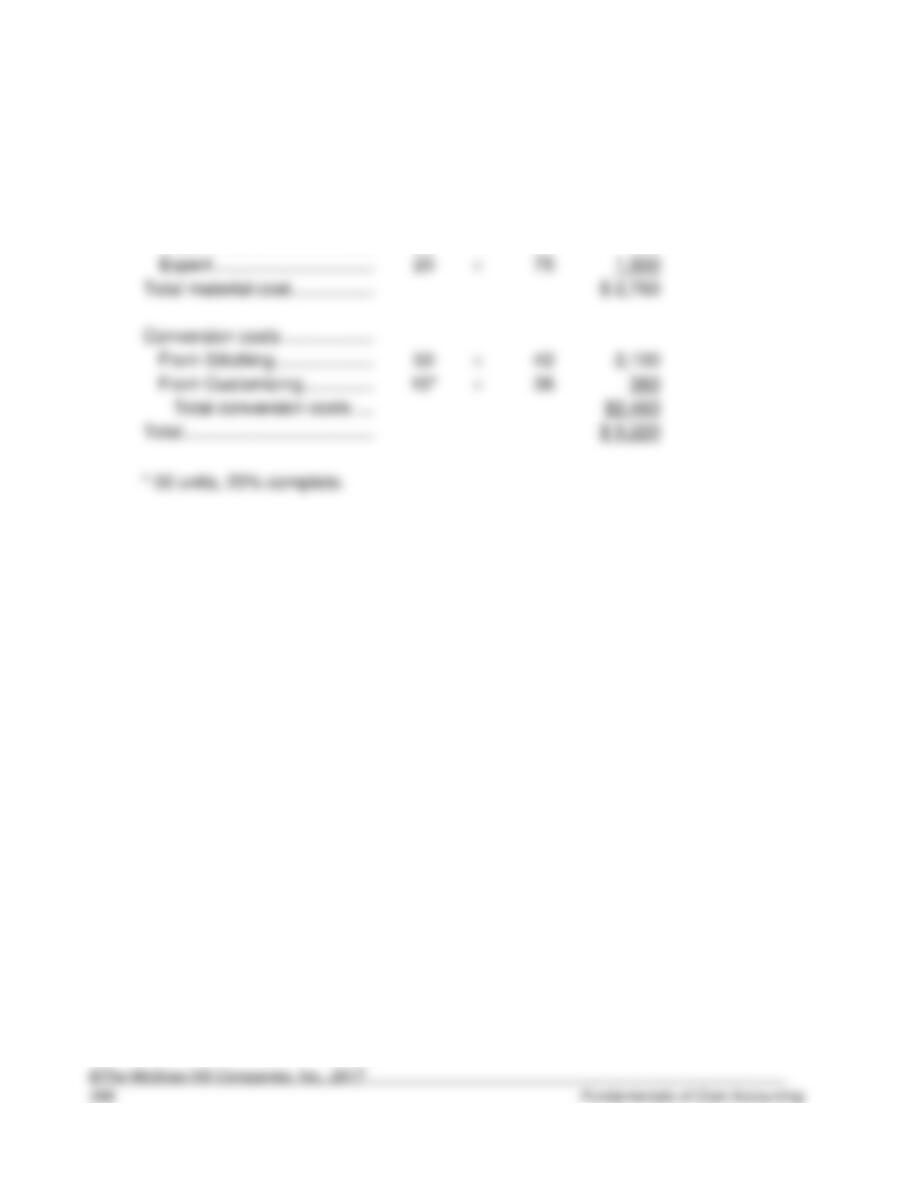
8-59. (continued)
Customizing Department:
Material cost
Number
of Units
Unit
Cost
Total Cost
Novice …………………………..
10
$36
360
Hiker …………………………….
20
45
900
Expert …………………………..
20
50
36
8-60. (50 min.) Process Costing and Ethics – Increasing Production to Boost
Profits: Pacific Siding, Inc.
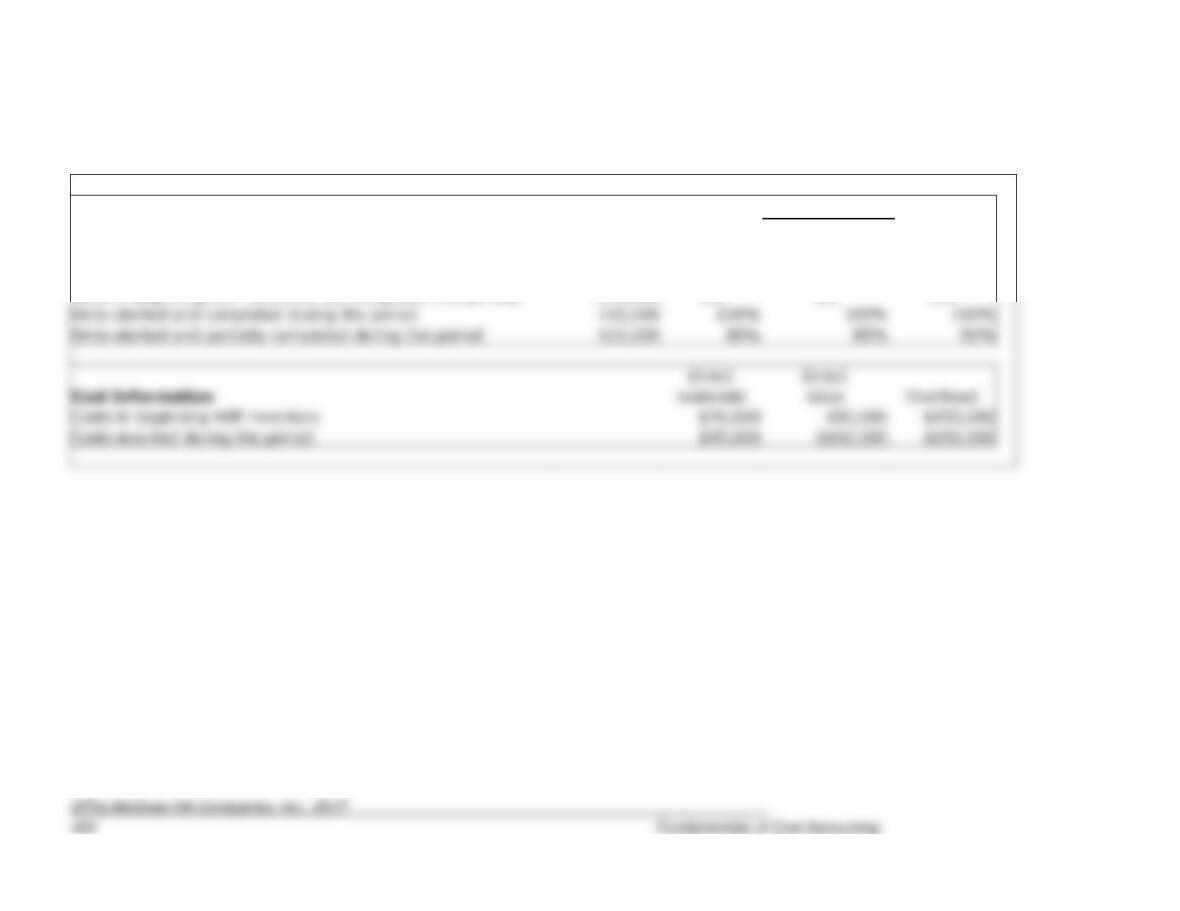
8-60. (continued)
b. See the revised data entry section and production cost report below:
Data Entry Section
Unit Information
Percent Complete
Units
(board
Direct
Direct
feet)
materials
labor
Overhead
Units in beginning WIP inventory (all completed this period)
250,000
n/a
n/a
n/a
Units started and completed during the period
140,000
Units started and partially completed during the period
225,000
Direct
Direct
Cost Information
materials
labor
Overhead
Costs in beginning WIP inventory
Costs incurred during the period
$102,000
8-60. (continued)
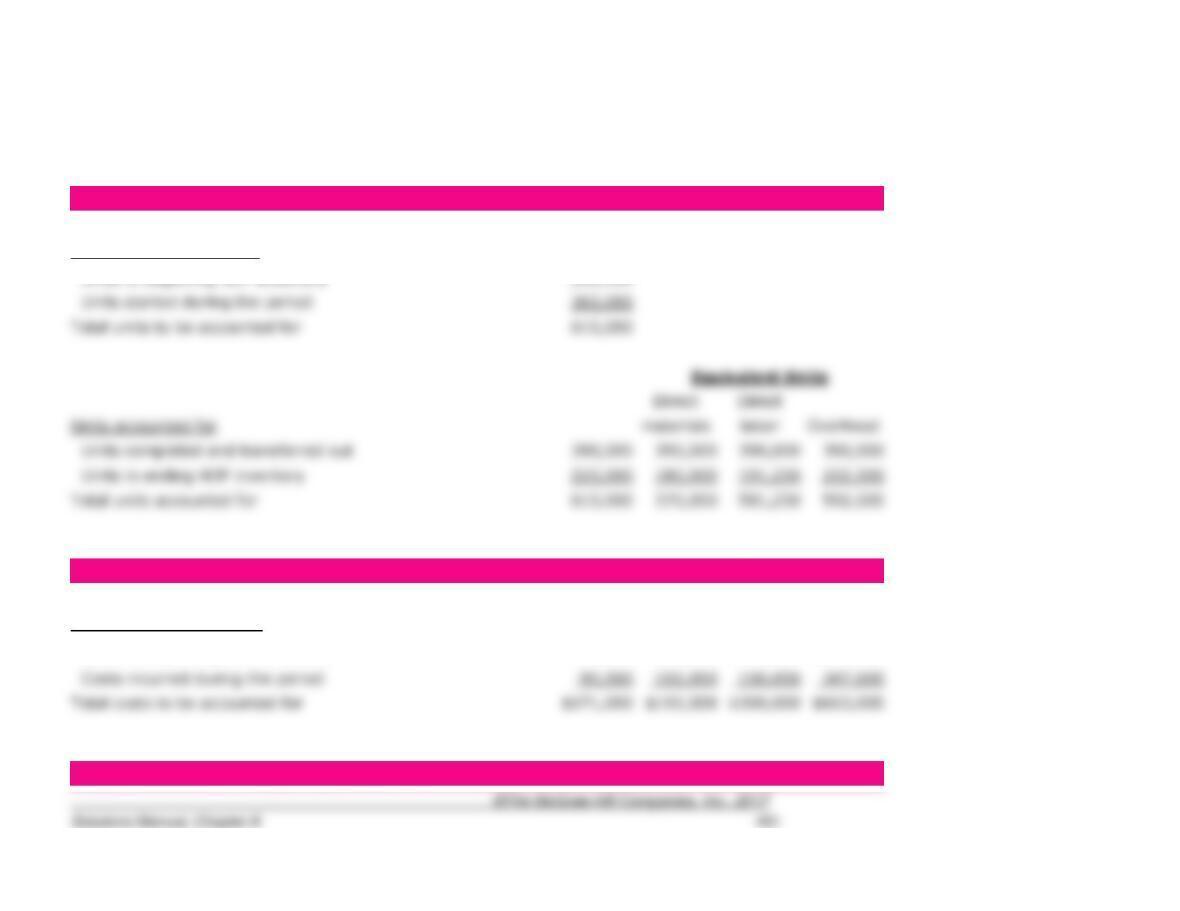
Revised Production Cost Report
Month Ending March 31
Step 1: Summary of Physical Units and Equivalent Unit Calculations
Physical
Units to be accounted for
Units
Units in beginning WIP inventory
250,000
Units started during the period
365,000
Total units to be accounted for
615,000
Direct
Direct
Units accounted for
materials
labor
Overhead
Units completed and transferred out
390,000
Total units accounted for
615,000
Step 2: Summary of Costs to be Accounted for
Direct
Direct
Costs to be accounted for
materials
labor
Overhead
Total
Costs in beginning WIP inventory
$76,000
$90,000
$150,000
$316,000
Costs incurred during the period
102,000
150,000
347,000
Total costs to be accounted for
$192,000
$300,000
$663,000
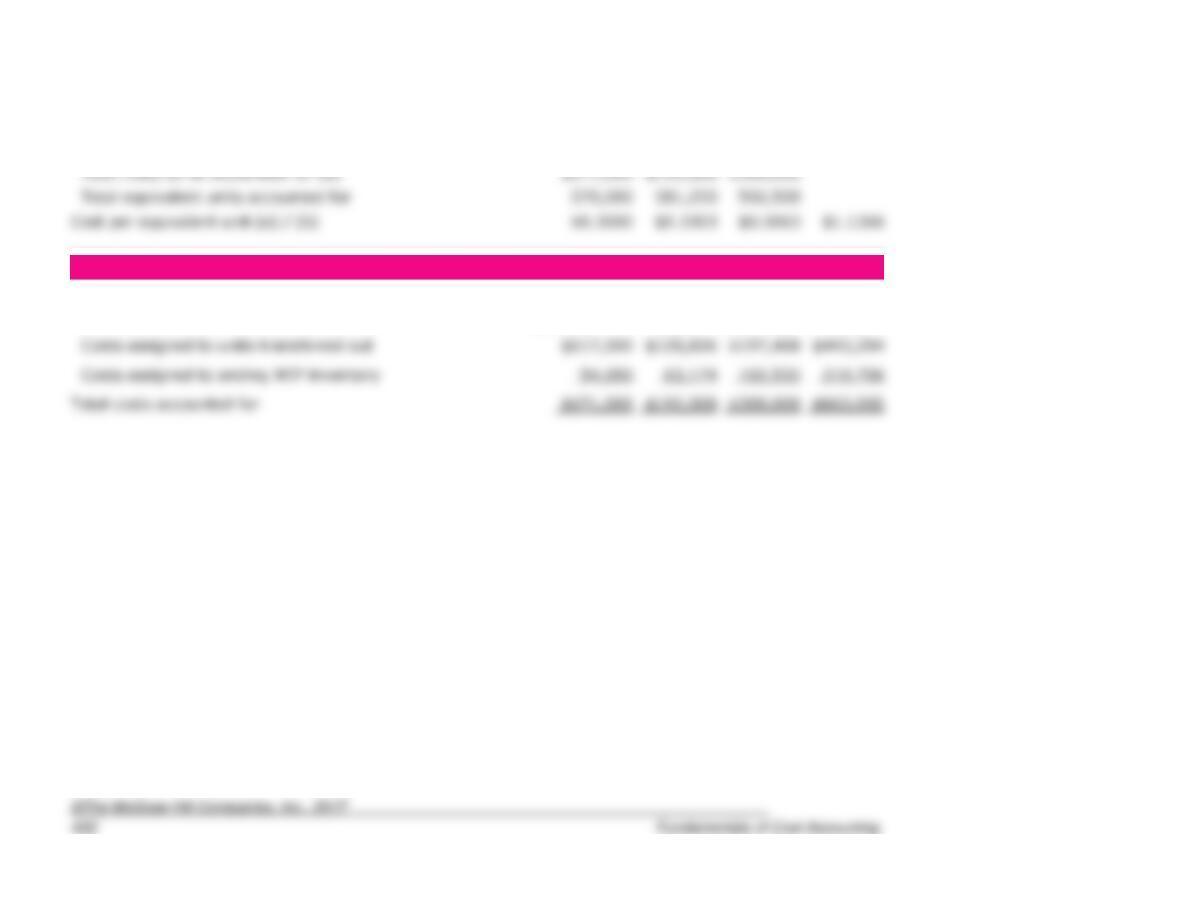
Step 3: Calculation of Cost per Equivalent Unit
8-60. (continued)
Direct
Direct
materials
labor
Overhead
Total
$192,000
Cost per equivalent unit (a) / (b)
Step 4: Assign Costs to Units Transferred Out and Units in Ending WIP Inventory
Direct
Direct
materials
labor
Overhead
Total
$128,826
$443,294
Total costs accounted for
$192,000
$663,000
8-60. (continued)
Solutions to Integrative Cases
8-61. (70 min.) Show Cost Flows—FIFO Method: Vermont Co.
Work in Process
Beginning Balance
716,000
Transferred out:
materials (given)
300,400
From current work
conversion (given)
materials
conversion costs
Ending Balance
513,104
Additional computations:
a $240,320 = 40,000 EU transferred x ($300,400 ÷ 50,000 EU for materials)
Finished Goods
a
1,432,237
To Cost of Goods Sold
Cost of Goods Sold
(See explanation below)
$572,000
$715,000
8-61. (continued)
The journal entry to assign the overapplied overhead to cost of goods sold is:
8-62. (45 min.) Job Costing, Process Costing, Choosing a Costing Method:
Bouwens Corporation.
This problem is computationally straight-forward, but requires the student to think
about the use of the costs from the costing system and how to best reflect the
production costs for a single product for two customer types.
a. The “job” costs for each product are the unit costs in each building:
M-Solv
(B–155)
C-Solv
(B–159)
Materials costs ………………..
$14,000
$ 40,000
Conversion costs …………….
120,000
$44,000
Units produced ………………..
b. The “process” costs for each product are the unit costs for both buildings divided by
total production:
M-Solv
(B–155)
C-Solv
(B–159)
Total
Materials costs ………………..
$14,000
$ 40,000
$ 54,000
Conversion costs …………….
120,000
$44,000
Units produced ………………..
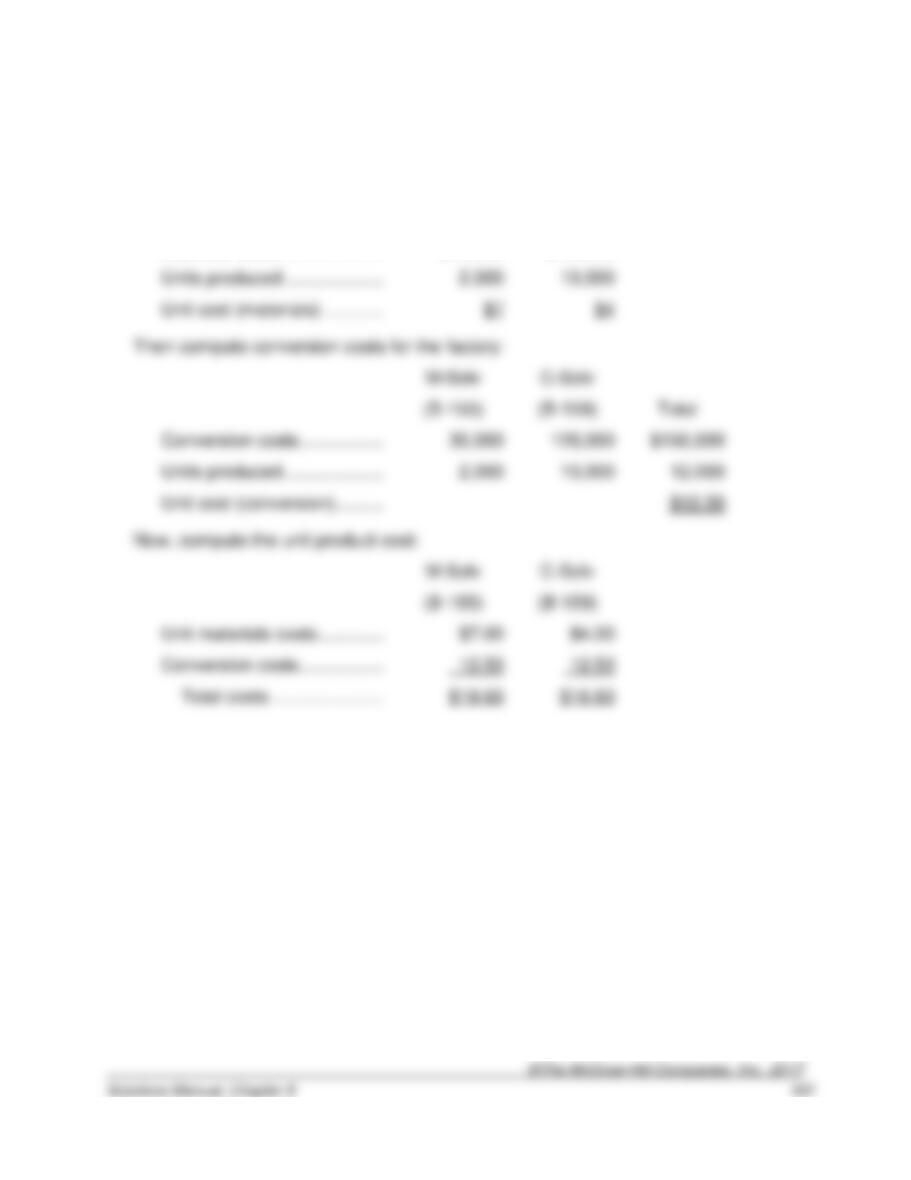
8-62. (continued)
d. Compute the unit costs for materials and conversion costs separately.
M-Solv
(B–155)
C-Solv
(B–159)
Materials costs ………………..
$14,000
$ 40,000
Units produced ………………..
M-Solv
(B–155)
C-Solv
(B–159)
Conversion costs ……………..
120,000
Units produced ………………..
M-Solv
(B–155)
C-Solv
(B–159)
Unit materials costs ………….
Conversion costs ……………..