1. Tactical decisions are short run in nature; they involve choosing among alternatives with an
immediate or limited end in view. Strategic decisions involve selecting strategies that yield a
long-term competitive advantage.
2. A manager can identify alternatives by using his or her own knowledge and experience and by
obtaining input from others who are familiar with the problem.
5. The salary of the supervisor of an assembly line with excess capacity is an example of an
irrelevant future cost for an accept-or-reject decision.
6. Yes. Suppose, for example, that sufficient materials are on hand for producing a part for 2 years.
After 2 years, the part will be replaced by a newly engineered part. If there is no alternative use
for the materials, then the cost of the materials is a sunk cost and not relevant in a make-or-buy
decision.
7. If a firm is operating below capacity, then a price that is above variable costs will increase profits.
9. Contribution margin is the amount available to cover fixed expenses and provide for profit.
Segment margin is the amount available to cover common fixed expenses and provide for
profit. Contribution margin is the difference between revenues and variable expenses.
Segment margin is contribution margin less direct fixed expenses.
10. A complementary effect is the loss of revenue on a secondary product when the primary product
is dropped. Thus, complementary effects may make it more expensive to drop a product.
11. No. Joint costs are irrelevant in a sell or process further decision. They occur regardless of
whether the product is sold at the split-off point or processed further.
8
DISCUSSION QUESTIONS
TACTICAL DECISION MAKING
AND RELEVANT ANALYSIS
CHAPTER 8 Tactical Decision Making and Relevant Analysis
8-1. e
8-5. b
8-6. e
8-7. e
8-10. d
8-11. c
8-12. c
MULTIPLE-CHOICE QUESTIONS
CHAPTER 8 Tactical Decision Making and Relevant Analysis
BE 8-16
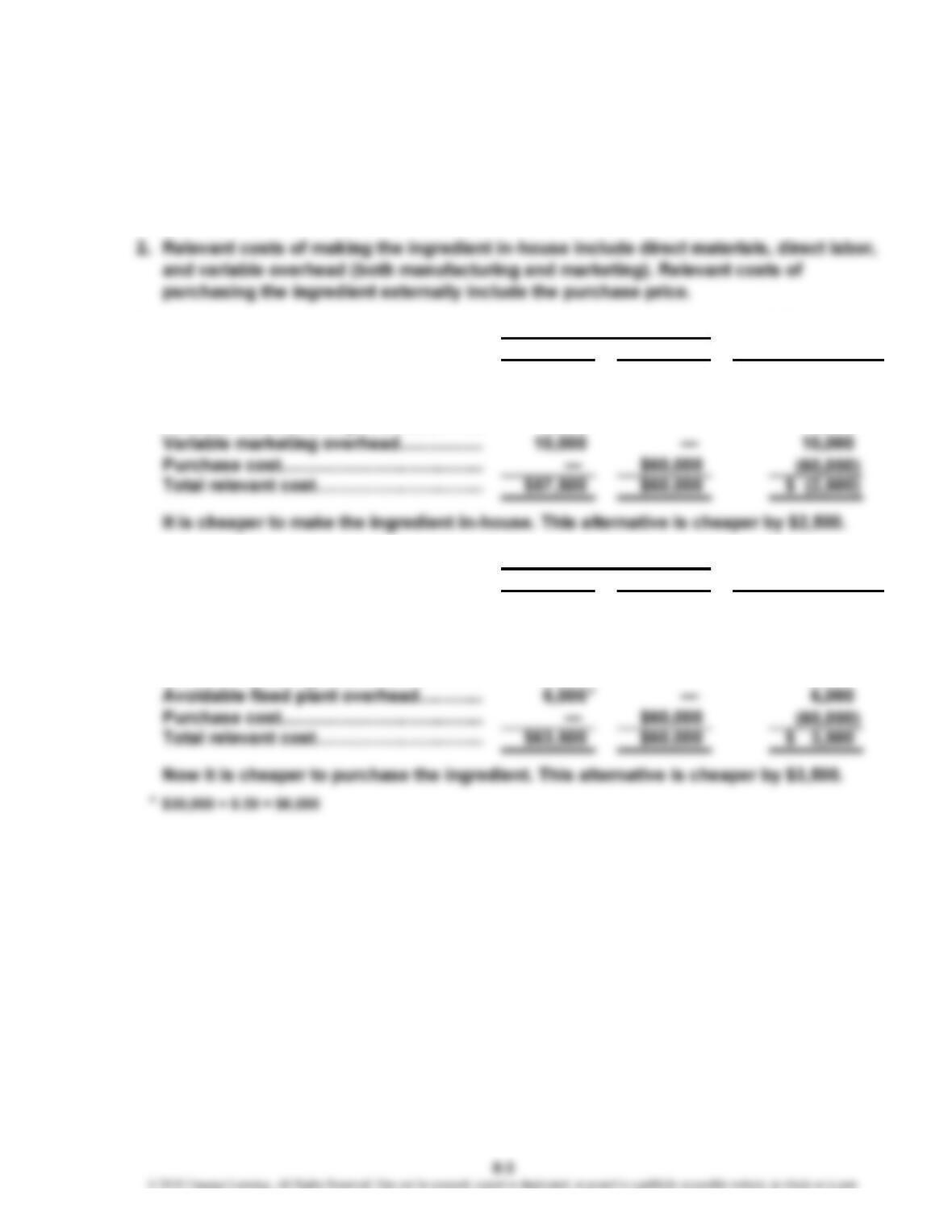
1. There are two alternatives: make the ingredient in-house or purchase it externally.
3.
Make Buy
Direct materials…………………………… $25,000 — $ 25,000
Direct labor………………………………… 15,000 — 15,000
V
ariable manufacturing overhead……
…
7,500 — 7,500
V
…
…
…
4.
Make Buy
Direct materials…………………………… $25,000 — $ 25,000
Direct labor………………………………… 15,000 — 15,000
V
ariable manufacturing overhead……
…
7,500 — 7,500
V
ariable marketing overhead…………
…
10,000 — 10,000
…
BRIEF EXERCISES: SET A
Cost to Make
Alternatives Differential
Cost to Make
Alternatives Differential
CHAPTER 8 Tactical Decision Making and Relevant Analysis
BE 8-17
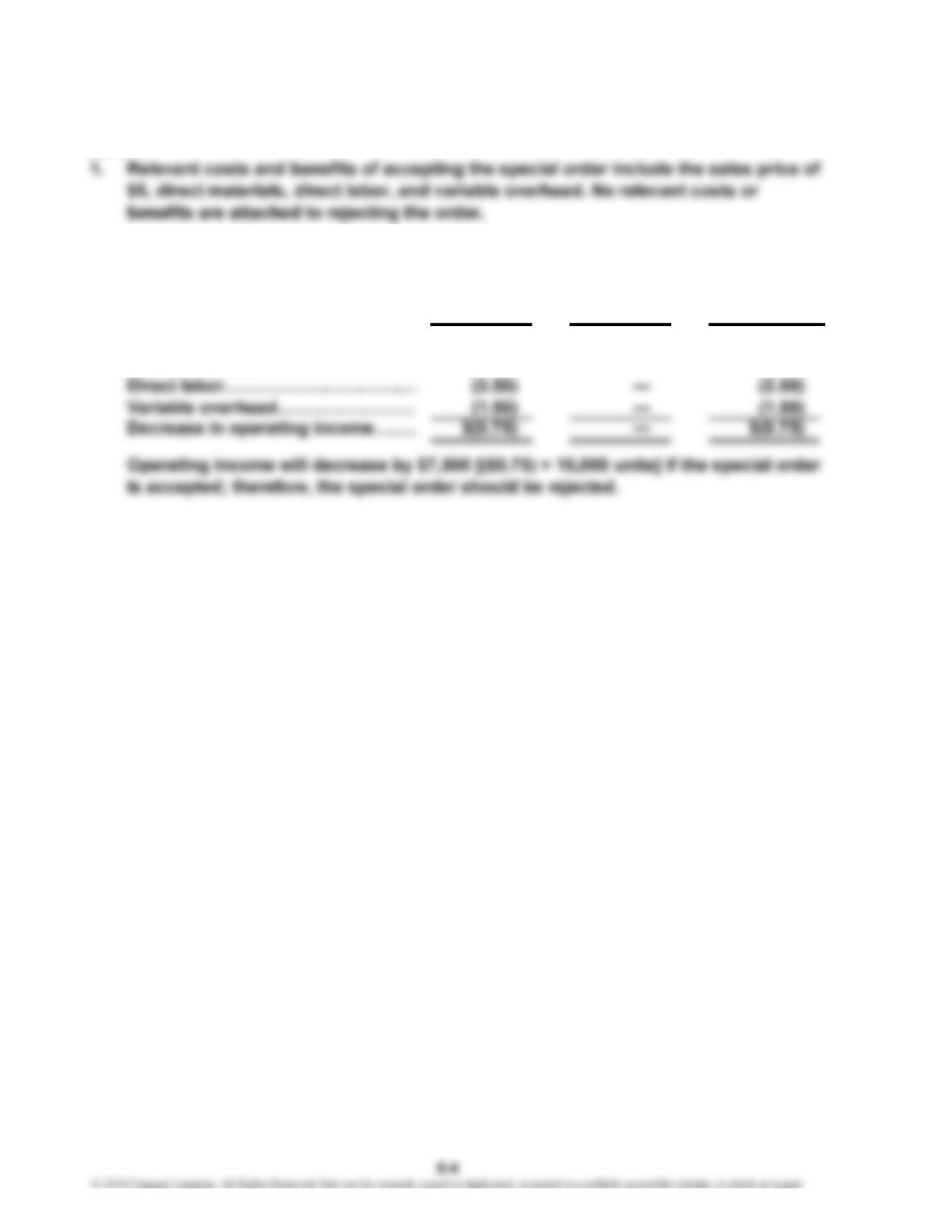
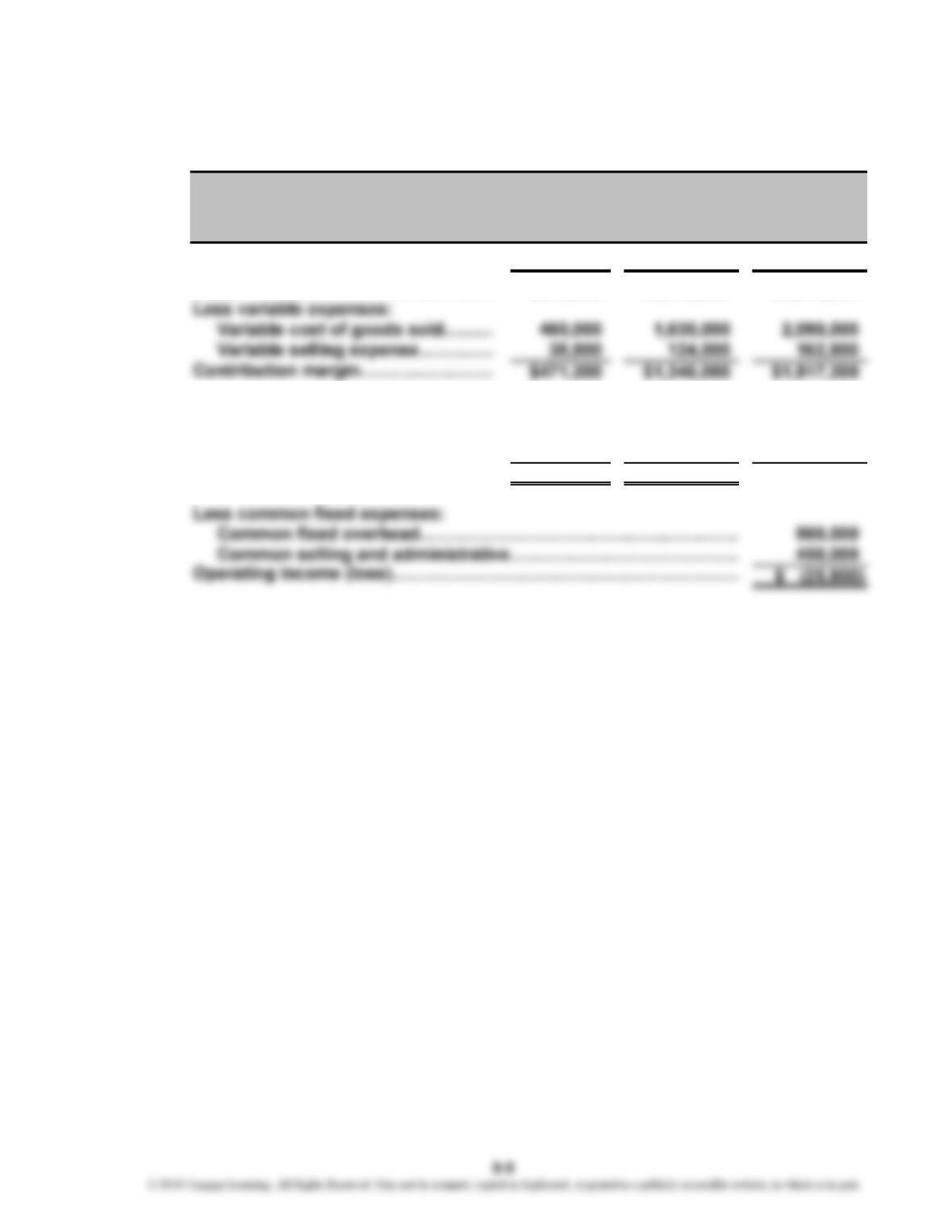
2. If the problem is analyzed on a unit basis:
Accept Reject
Price……………………………………
…
$ 5.00 — $ 5.00
Direct materials………………………
…
(1.75) — (1.75)
Differential
Benefit to
Accept
CHAPTER 8 Tactical Decision Making and Relevant Analysis
BE 8-18
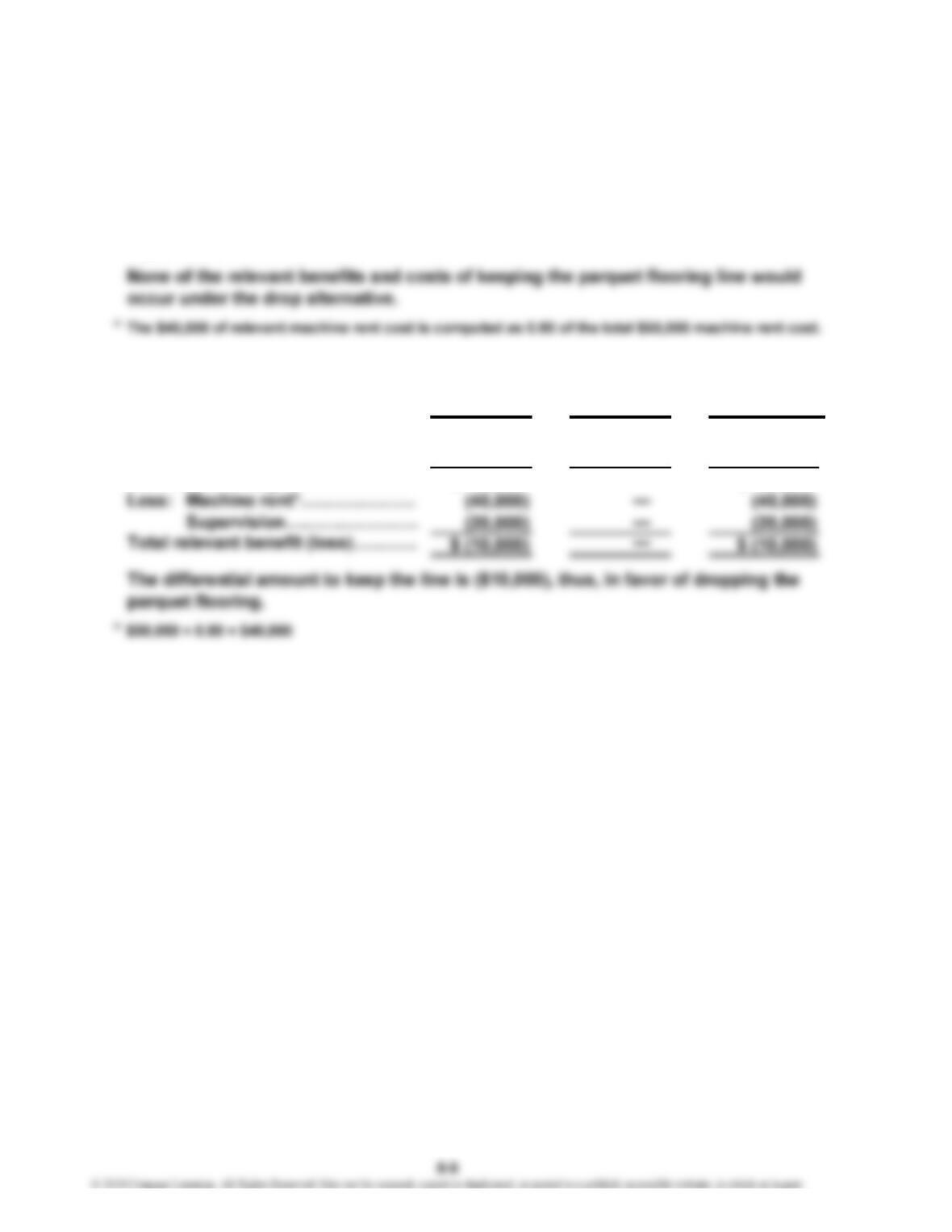
Poinsettias Fruit Trees Total
Sales……………………………………
…
$970,000 $3,100,000 $4,070,000
Less direct fixed expenses:
Direct fixed overhead……………
…
160,000 200,000 360,000
Direct selling and administrative
…
146,000 87,000 233,000
Segment margin………………………
…
$165,200 $1,059,000 $1,224,200
For the Coming Year
Gorman Nurseries Inc.
Segmented Income Statement
…
CHAPTER 8 Tactical Decision Making and Relevant Analysis
BE 8-19
1. The two alternatives are to keep the parquet flooring line or to drop it.
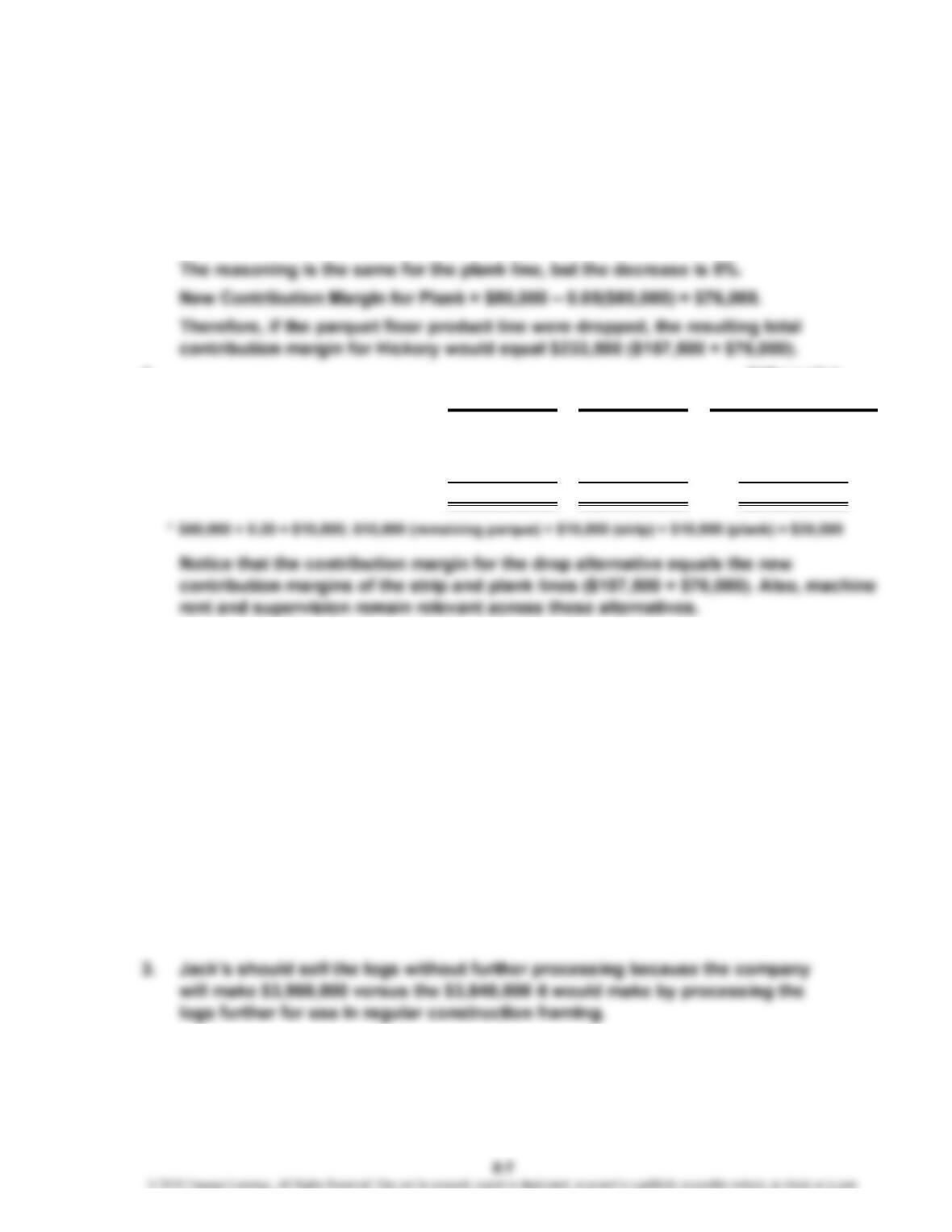
2. The relevant benefits and costs of keeping the parquet flooring line include sales
of $300,000, variable costs of $250,000, machine rent cost of $40,000*, and
supervision cost of $20,000.
3.
Keep Drop
Sales…………………………………… $300,000 —$300,000
Less: Variable expenses…………… 250,000 — 250,000
Contribution margin………………… $ 50,000 —$ 50,000
Differential
Amount to
Accept
CHAPTER 8 Tactical Decision Making and Relevant Analysis
BE 8-20
1. Previous contribution margin of the strip line was $175,000. A 10% decrease in
sales implies a 10% percent decrease in total variable costs, so the contribution
margin decreases by 10%.
New Contribution Margin for Strip = $175,000 – 0.10($175,000) = $157,500.
2.
Keep Drop
Contribution margin…………
…
$305,000 $233,500 $ 71,500
Less: Machine rent……………
…
(75,000) (35,000) (40,000)
Supervision……………
…
(45,000) (25,000) (20,000)
Total………………………………
…
$185,000 $173,500 $ 11,500
As shown in BE 8-19, the decision to drop the parquet flooring line makes Hickory
better off by $10,000 (avoided relevant costs were greater than the lost contribution
margin) when only the parquet line is considered. However, as shown in this
exercise (BE 8-20), dropping parquet would have an $11,500 net detrimental effect
on the other two lines in that Hickory would lose contribution margin of $71,500
but only avoid relevant costs of $60,000. Therefore, Hickory is better off by
$11,500 if it KEEPS the parquet line.
BE 8-21
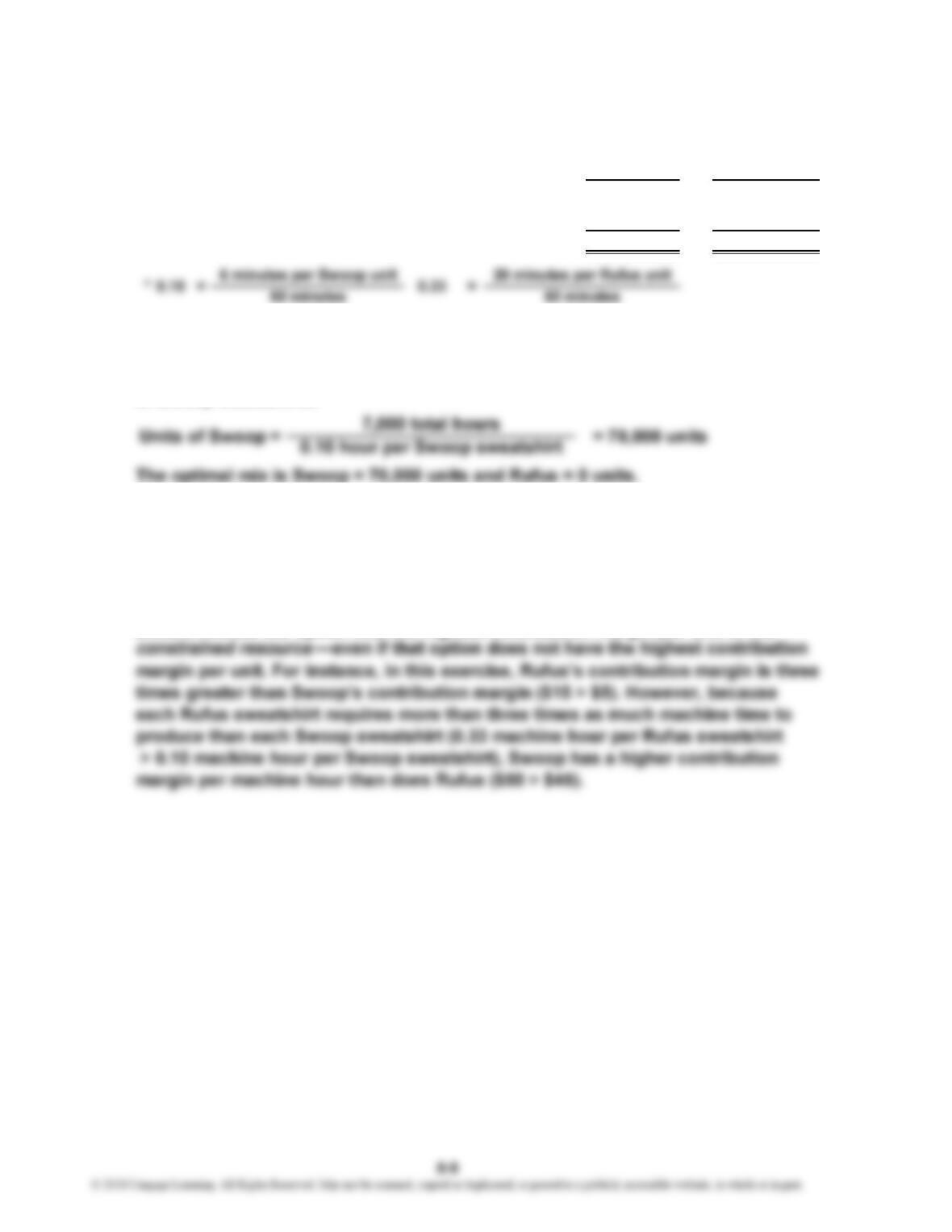
1. Revenue from Logs = (8,000 × $495) = $3,960,000
2. Revenue from Further Processing = $0.75 × (8,000 × 800) = $4,800,000
Further Processing Cost = $0.15 × (8,000 × 800) = $960,000
Income from Further Processing = $4,800,000 – $960,000 = $3,840,000
Differential
Amount to Keep
*
CHAPTER 8 Tactical Decision Making and Relevant Analysis
BE 8-22
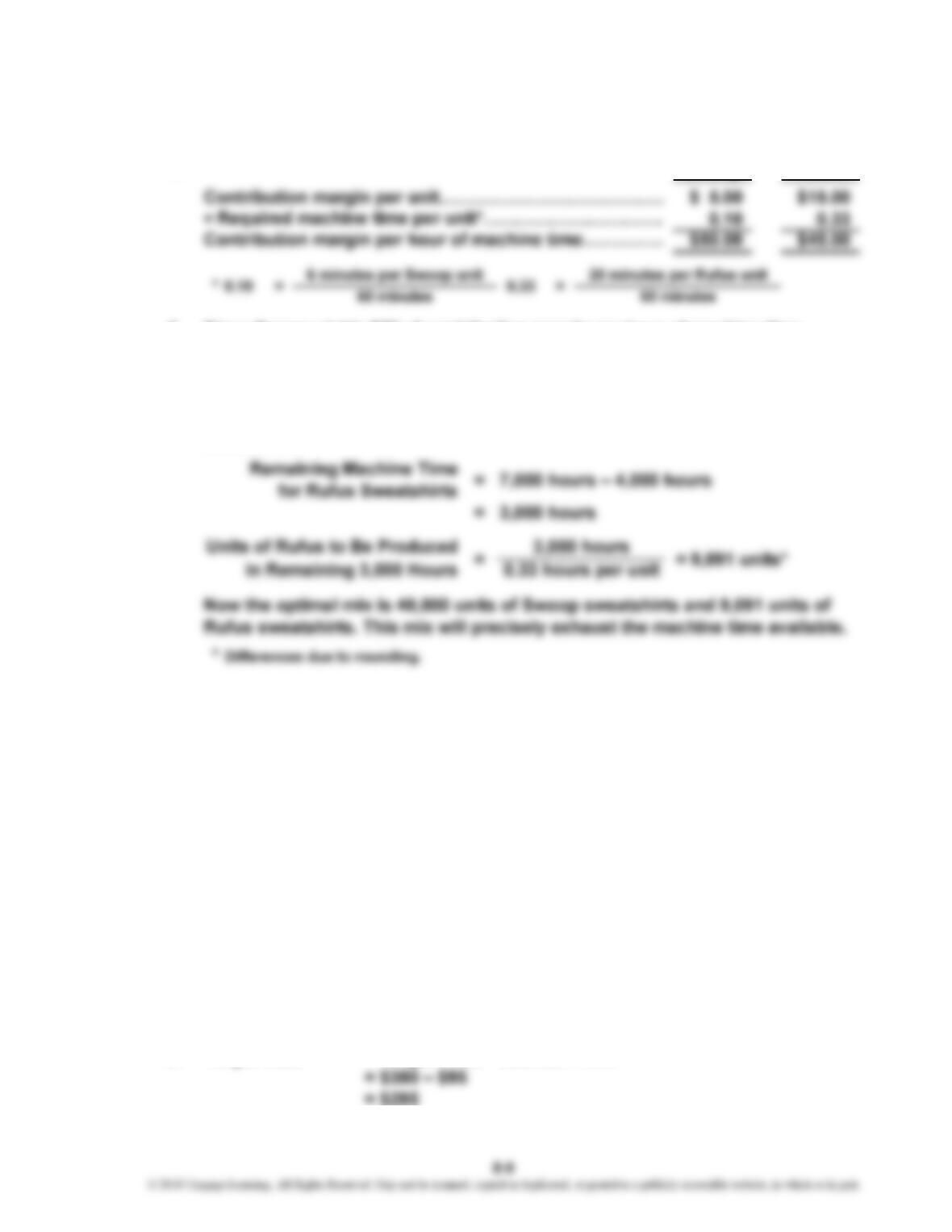
1. Swoop Rufus
Contribution margin per unit……………………………
…
$ 5.00 $15.00
÷ Required machine time per unit*……………………… 0.10 0.33
Contribution margin per hour of machine time………
…
$50.00 $45.00
2. Since the Swoop sweatshirt yields $50 of contribution margin per hour of machine
time (which is higher than the $45 contribution margin per hour of machine time
for Rufus), all machine time (i.e., 7,000 hours) should be devoted to the production
of Swoop sweatshirts.
3. Total Contribution Margin of Optimal Mix = 70,000 units Swoop × $5
= $350,000
Note: Brief Exercise 8-22 (as well as Example 8.7) clearly illustrates
a fundamentally important point involving relevant decision making with a
constrained resource. The point is that when making this relevant decision, one
should choose the option with the highest contribution margin per unit of the
CHAPTER 8 Tactical Decision Making and Relevant Analysis
BE 8-23
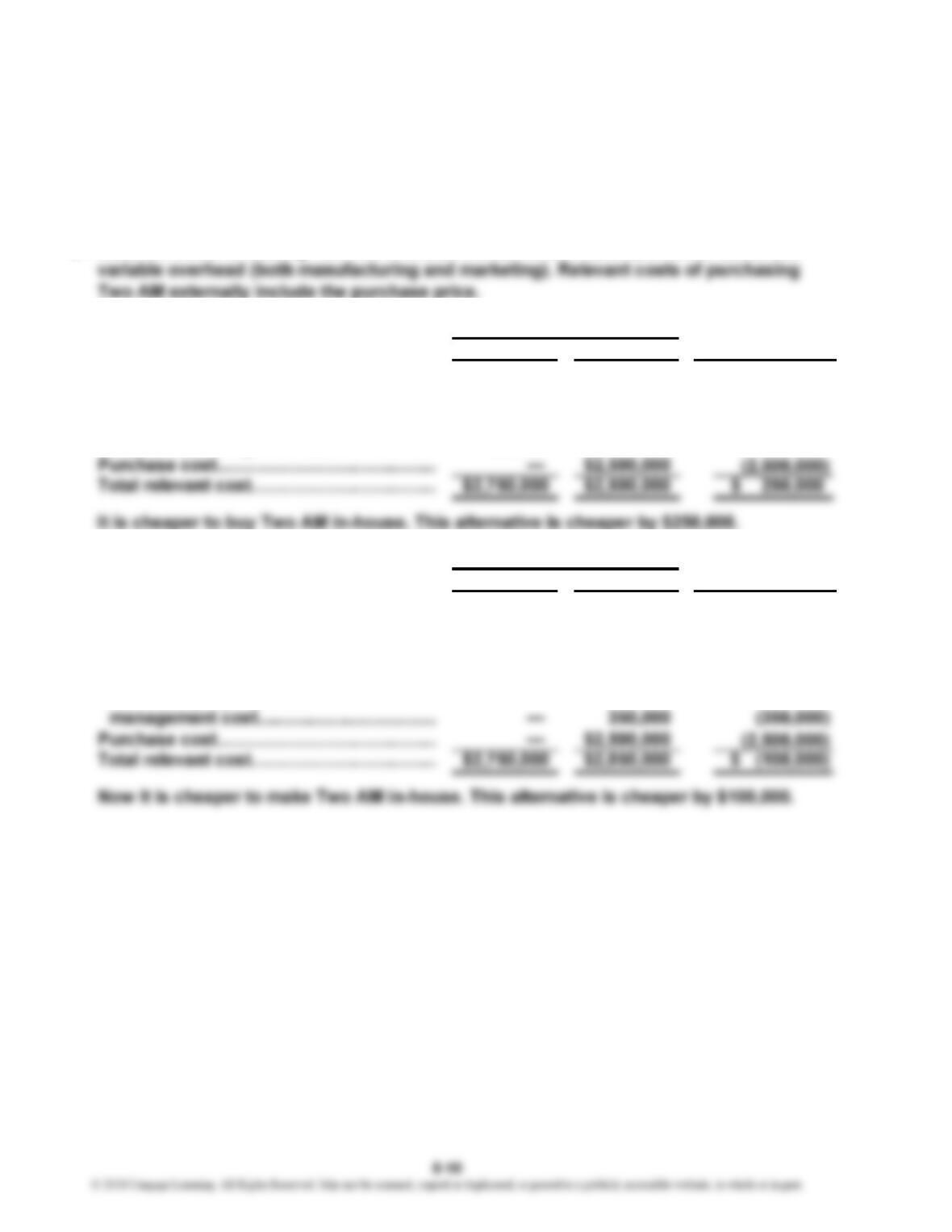
1. Swoop Rufus
2. Since Swoop yields $50 of contribution margin per hour of machine time,
the first priority is to produce all of the Swoop sweatshirts that the market
will take (i.e., demands). Machine time required for maximum amount of
Swoop = 40,000 maximum units × 0.10 hour of machine time required per
Swoop sweatshirt = 4,000 hours needed to manufacture 40,000 Swoop
sweatshirts.
3. Total Contribution Margin of Optimal Mix = (40,000 units Swoop × $5) +
(9,091 units Rufus × $15)
= $336,365
BE 8-24
Price = Cost + (Markup Percentage × Cost)
= $170,000 + 0.15($170,000)
= $170,000 + $25,500
=
BE 8-25
1. Desired Profit = 0.25 × Target Price
= 0.25 × $380
= $95
2. Target Cost = Target Price – Desired Profit
$195,500
CHAPTER 8 Tactical Decision Making and Relevant Analysis
BE 8-26
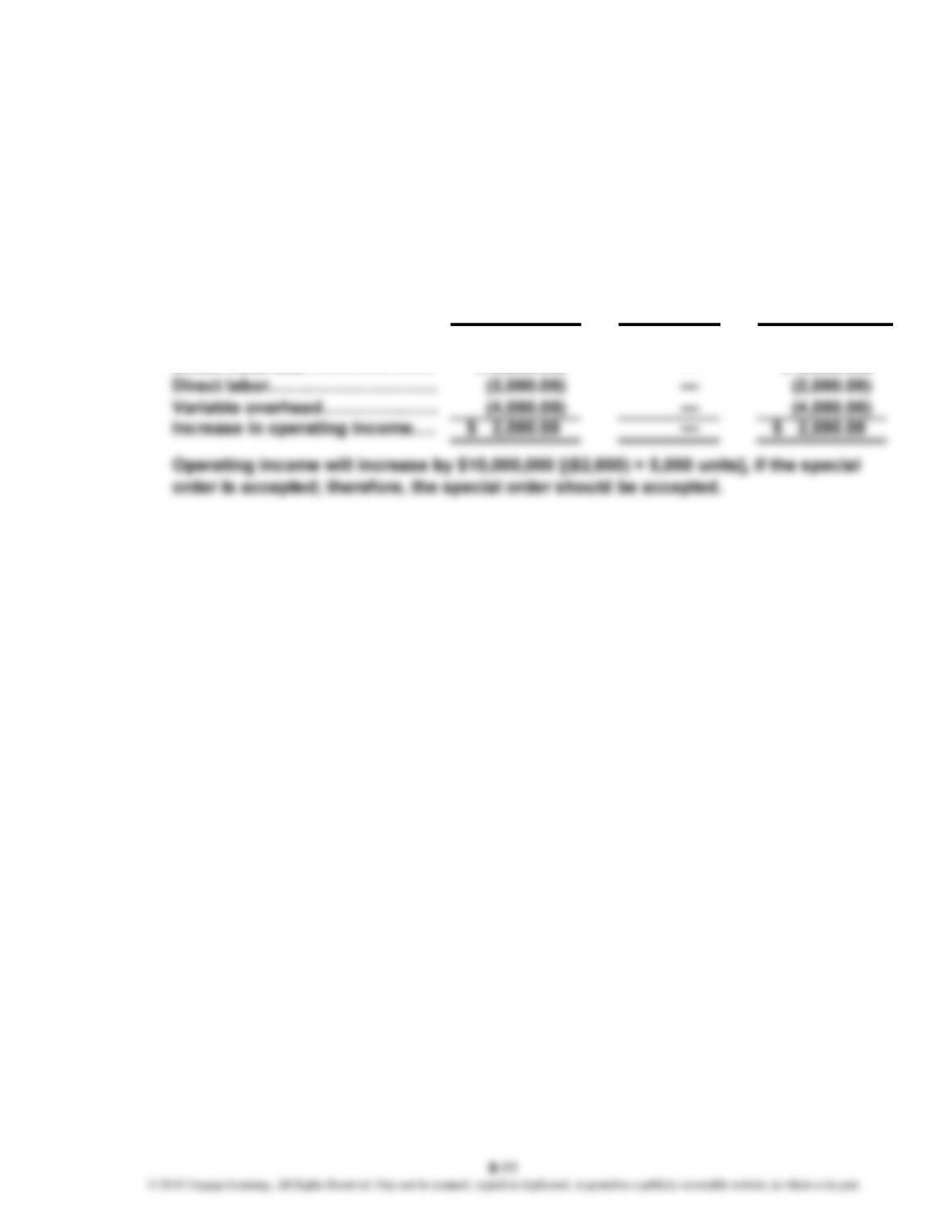
1. There are two alternatives: make Two AM in-house or purchase it externally.
2. Relevant costs of making Two AM in-house include direct materials, direct labor, and
3.
Make Buy
Direct materials……………………………… $2,000,000 — $ 2,000,000
Direct labor…………………………………
…
350,000 — 350,000
V
ariable manufacturing overhead………
…
150,000 — 150,000
V
ariable marketing overhead……………
…
250,000 — 250,000
…
…
4.
Make Buy
Direct materials……………………………… $2,000,000 — $ 2,000,000
Direct labor…………………………………
…
350,000 — 350,000
V
ariable manufacturing overhead………
…
150,000 — 150,000
V
ariable marketing overhead……………
…
250,000 — 250,000
Intellectual property theft
…
…
Cost to Make
BRIEF EXERCISES: SET B
Alternatives Differential
Cost to Make
Alternatives Differential
CHAPTER 8 Tactical Decision Making and Relevant Analysis
BE 8-27
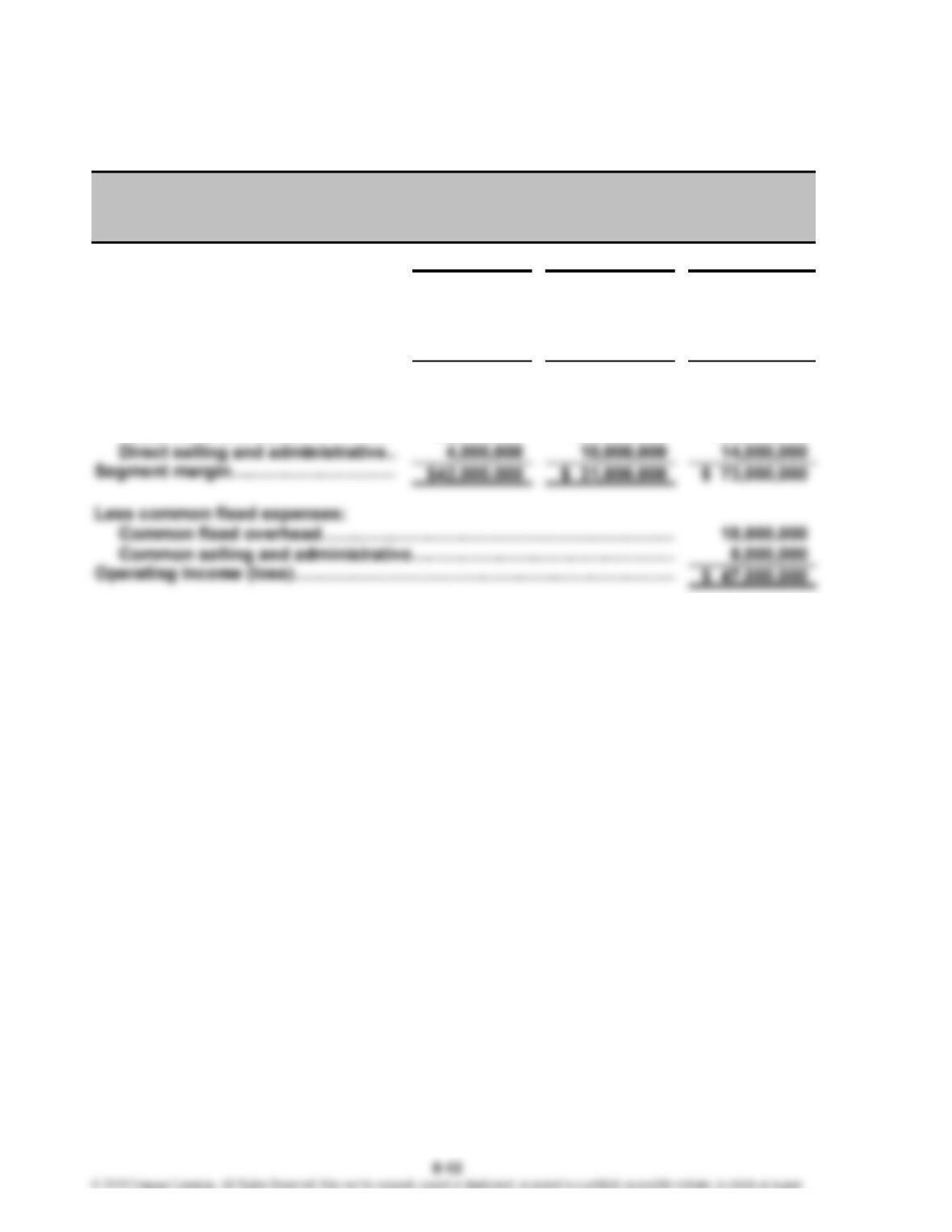
1. Relevant costs and benefits of accepting the special order include the sales price of
$18,000, direct materials, direct labor, and variable overhead. No relevant costs or
benefits are attached to rejecting the order.
2. If the problem is analyzed on a unit basis:
Accept Reject
Price………………………………
…
$ 18,000.00 — $ 18,000.00
Differential
Benefit to
Accept
CHAPTER 8 Tactical Decision Making and Relevant Analysis
BE 8-28
Bladers Ballers Total
Sales……………………………………
…
$80,000,000 $180,000,000 $260,000,000
Less variable expenses:
V
ariable cost of goods sold……
…
10,000,000 30,000,000 40,000,000
V
ariable selling expense…………
…
4,000,000 9,000,000 13,000,000
Contribution margin…………………
…
$66,000,000 $141,000,000 $207,000,000
Less direct fixed expenses:
Direct fixed overhead……………
…
20,000,000 100,000,000 120,000,000
Kraft Bowlen
Segmented Income Statement
For the Coming Year
CHAPTER 8 Tactical Decision Making and Relevant Analysis
BE 8-29
1. The two alternatives are to keep the Boat Maintenance line or to drop it.
2. The relevant benefits and costs of keeping the Boat Maintenance line include sales
of $5,000,000, variable costs of $4,900,000, garage/warehouse cost of $210,000*, and
supervision cost of $75,000**.
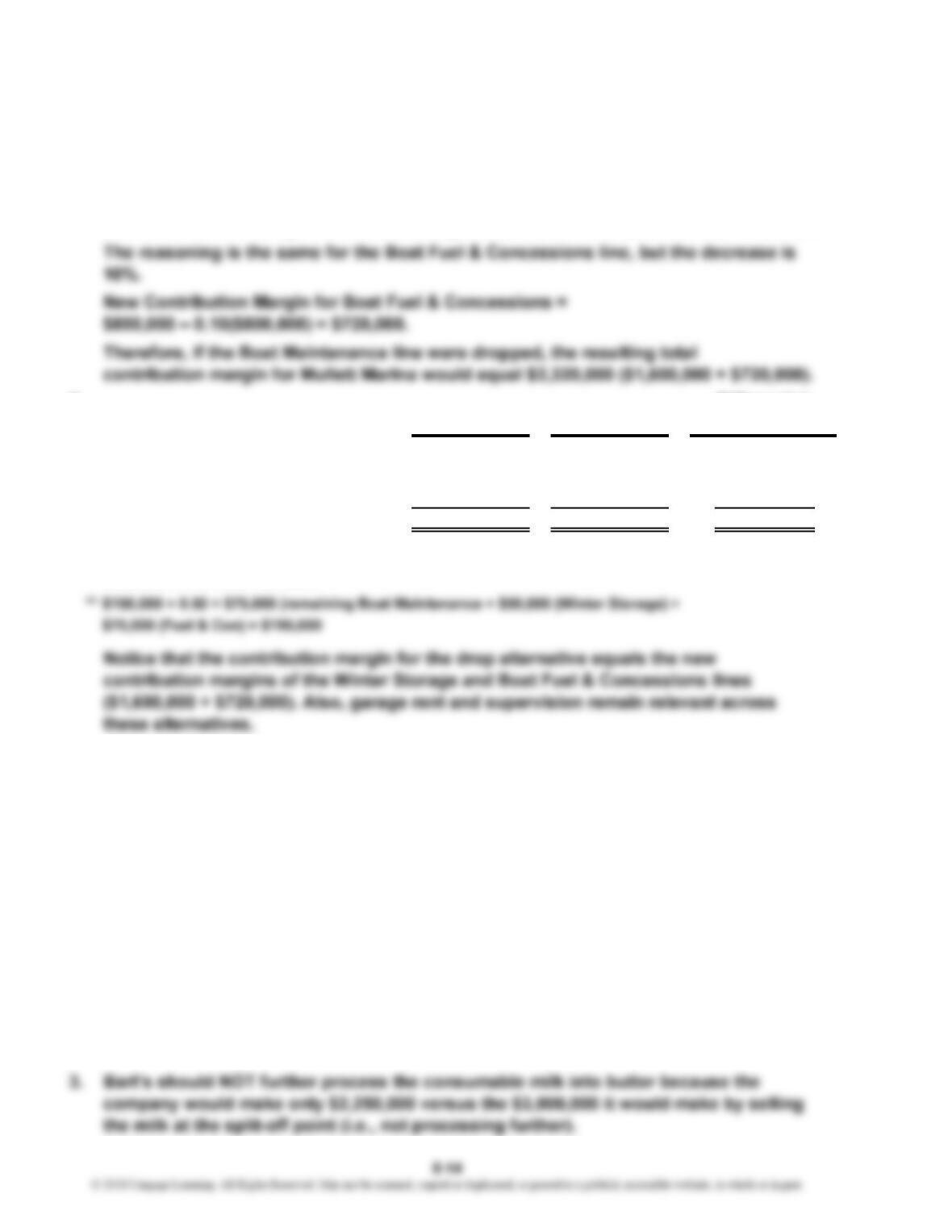
3.
Keep Drop
Sales…………………………………… $5,000,000 —$5,000,000
Less: Variable expenses…………… 4,900,000 — 4,900,000
Contribution margin………………… $ 100,000 —$ 100,000
Less: Garage/warehouse rent*…
…
(210,000) — (210,000)
Supervision**………………
…
(75,000) — (75,000)
Total relevant benefit (loss)………
…
$ (185,000) —$ (185,000)
Differential
Amount to
Accept
CHAPTER 8 Tactical Decision Making and Relevant Analysis
BE 8-30
1. Previous contribution margin of the Winter Storage line was $2,000,000. A 20% decrease
in sales implies a 20% percent decrease in total variable costs, so the contribution
margin decreases by 20%.
New Contribution Margin for Winter Storage = $2,000,000 – 0.20($2,000,000) = $1,600,000.
2.
Keep Drop
Contribution margin………………… $ 2,900,000 $2,320,000 $ 580,000
Less: Garage/warehouse rent……
…
(1,105,000) (895,000) (210,000)
Supervision…………………
…
(270,000) (195,000) (75,000)
Total relevant benefit (loss)………
…
$ 1,525,000 $1,230,000 $ 295,000
* $350,000 × 0.40 = $140,000 (remaining Boat Maintenance) + $700,000 (Winter Storage) +
$55,000 (Fuel & Con) = $895,000
As shown in BE 8-29, the decision to drop the Boat Maintenance line makes Mullett
better off by $185,000 (avoided relevant costs were greater than the lost contribution
margin) when only the Boat Maintenance line is considered. However, as shown in this
exercise (BE 8-30), dropping Boat Maintenance would have a $295,000 net detrimental
effect on the other two lines in that Mullett would lose contribution margin of $580,000
but only avoid relevant costs of $285,000. Therefore, Mullett is better off by $295,000
if it KEEPS the Boat Maintenance line.
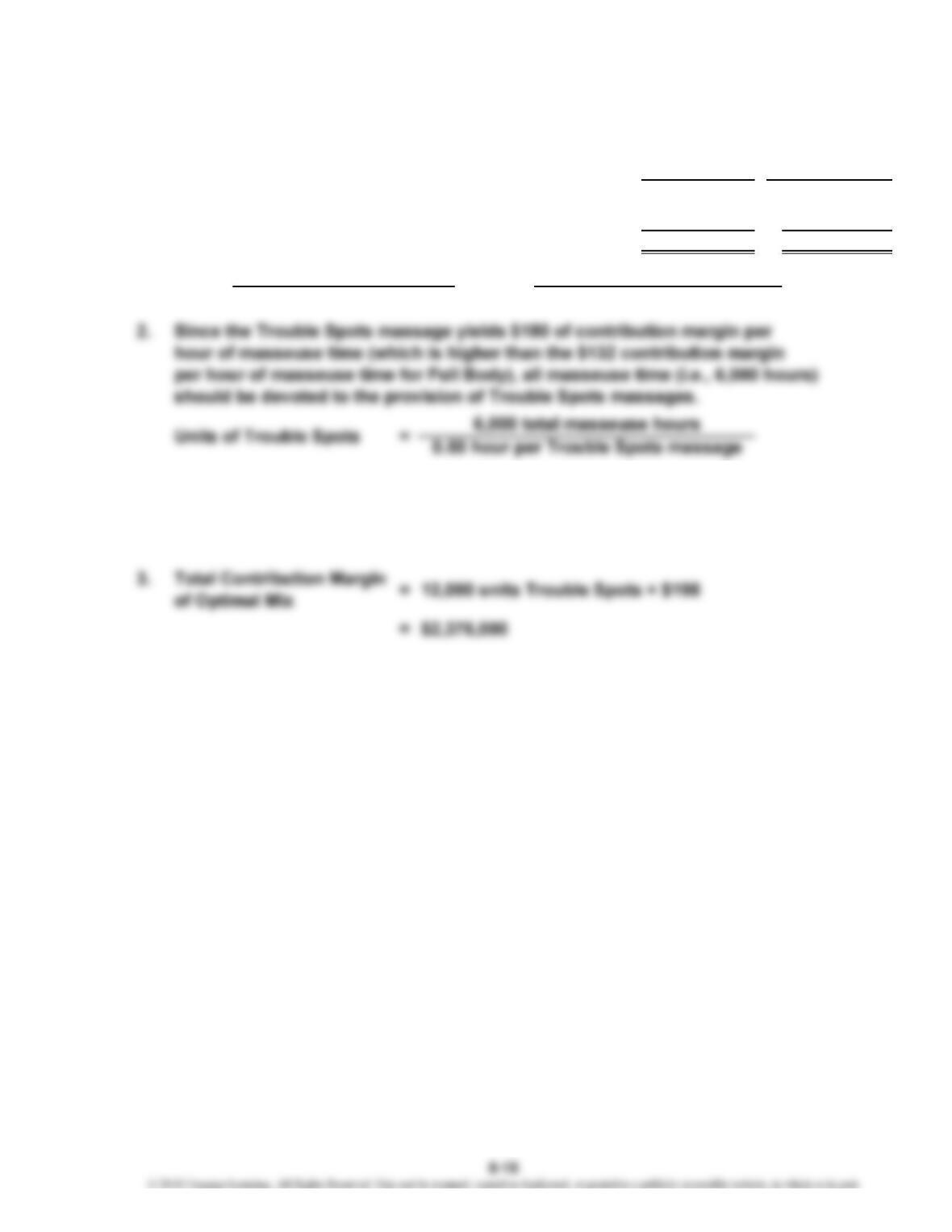
BE 8-31
1. Revenue (or contribution to income) from selling consumable milk =
(1,000,000 × $3) = $3,000,000
2. Revenue from Further Processing = $6.00 × (1,000,000 × 0.50) = $3,000,000
Further Processing Cost = $1.50 × (1,000,000 × 0.50) = $750,000
Income from Further Processing = $3,000,000 – $750,000 = $2,250,000
Differential
Amount to Keep
*
**
CHAPTER 8 Tactical Decision Making and Relevant Analysis
BE 8-32
1. Full Body
Contribution margin per unit……………………………
…
$198.00 $ 90.00
÷ Required masseuse time per massage*……………… 1.50 0.50
Contribution margin per hour of masseuse time……
…
$132.00 $180.00
=12,000 units
The optimal mix is Trouble Spots = 12,000 massages and Full Body =
0 massages
Trouble Spots
30 minutes per Trouble Spots unit
60 minutes
0.50 =*
60 minutes
1.50 = 90 minutes per Full Body unit
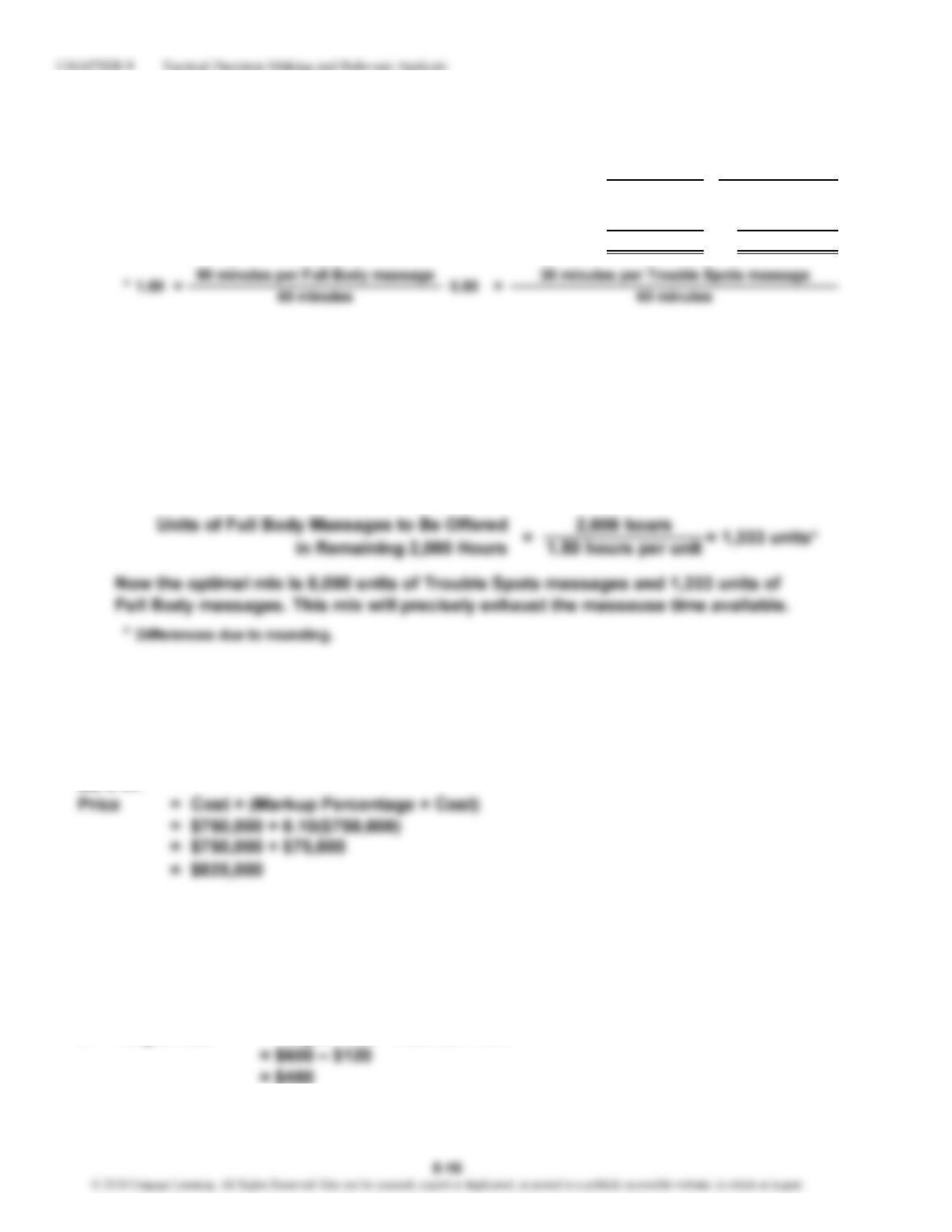
BE 8-33
1. Full Body
Contribution margin per massage $198.00 $ 90.00
÷ Required masseuse time per massage*……………………
…
1.50 0.50
Contribution margin per hour of masseuse time…………
…
$132.00 $180.00
2. Since Trouble Spots yields $180 of contribution margin per hour of masseuse time,
the first priority is to offer all of the Trouble Spots massages that the market will
take (i.e., demands). Masseuse time required for maximum amount of Trouble Spots =
8,000 maximum units × 0.50 hours of masseuse time required per Trouble Spots =
4,000 hours needed to provide 8,000 Trouble Spots massages.
Remaining Masseuse Time
for Full Body Massages
= 2,000 hours
3. Total Contribution Margin of Optimal Mix = 8,000 units Trouble Spots × $90) +
(1,333 units* Full Body × $198)
= $983,934
BE 8-35
1. Desired Profit = 0.20 × Target Price
= 0.20 × $600
= $120
2. Target Cost = Target Price – Desired Profit
Trouble Spots
= 6,000 hours – 4,000 hours
CHAPTER 8 Tactical Decision Making and Relevant Analysis
E 8-36
The correct order is 4, 5, 2, 6, 3, and 1.
E 8-37
Steps in Austin’s decision:
Step 1: Define the problem. The problem is whether to continue studying at his
present university or to study at a university with a nationally recognized
engineering program.
Step 3: Identify the costs and benefits associated with each feasible alternative.
Events c, e, f, and i. (Students may also list Events e and f in Step 5—they are
included here because they may help Austin estimate future income benefits.)
Step 4: Total the relevant costs and benefits for each feasible alternative. No specific
event is listed for this step, although we can assume that it was done, and
that three schools were selected as feasible since Event j mentions that two
of three applications met with success.
Step 5: Assess qualitative factors. Events d, e, f, g, and h.
EXERCISES
© 2018 Cengage Learning. All Rights Reserved. May not be scanned, copied or duplicated, or posted to a publicly accessible website, in whole or in part.
CHAPTER 8 Tactical Decision Making and Relevant Analysis
E 8-38
1. The two alternatives are to make the component in-house or to buy it from Bryce.
2.
Make Buy
Direct materials………………………
…
$12.00 — $ 12.00
Direct labor……………………………
…
8.25 — 8.25
V
ariable overhead……………………
…
4.50 — 4.50
Purchase cost………………………… — $25.00 (25.00)
Total relevant cost………………
…
$24.75 $25.00 $ (0.25)
E 8-39
1.
Make Buy
Direct materials………………………
…
$12.00 — $ 12.00
Direct labor……………………………
…
8.25 — 8.25
V
ariable overhead……………………
…
4.50 — 4.50
Avoidable fixed overhead*…………
…
1.50 1.50
…
Alternatives Differential
Alternatives Differential
Cost to Make
Cost to Make
CHAPTER 8 Tactical Decision Making and Relevant Analysis
E 8-39 (Concluded)
2. As the percentage of avoidable fixed cost increases (above 75%), total relevant
costs of making the component increase, causing the “purchase” decision to
be more financially appealing (compared to the “make” option) than it was when
the percentage was 75%. In other words, as the percentage increases, the $12,500
difference between the “purchase” and “make” options increases resulting in the
3. Total relevant avoidable fixed cost would need to decrease by $12,500. Total
relevant make costs of $262,500 need to decrease to $250,000 to equal the total
relevant buy costs. Holding all other relevant make costs constant, this decrease
of $12,500 ($262,500 – $250,000) in fixed cost would reduce the total relevant
avoidable fixed overhead from $15,000 (0.75 × $2 per unit × 10,000 units) or $1.50
per unit ($15,000/10,000 units) to $2,500 ($15,000 – $12,500) or $0.25 per unit
CHAPTER 8 Tactical Decision Making and Relevant Analysis
E 8-40
1. The two alternatives are:
(1) to accept the special orde
r
(2) to reject the special orde
r
2. Direct materials…………………
…
$3.10
Direct labor………………………
…
2.25
3. The statement that “existing sales will not be affected” indicates that there will
be no product-line cannibalization; in other words, there is sufficient excess
capacity such that the acceptance of the special sales will not decrease Smooth
which was $5 (or 42%) lower.
E 8-41
In this case, it may be easier to deal with the total costs and revenues of the special
order:
Revenue ($7.00 × 15,000)…………………………………………
…
$105,000
Less variable costs:
Direct materials ($3.30 × 15,000).……………………………
…
$49,500
Direct labor ($2.25 × 15,000)…………………………………… 33,750