Problem 8-19 (45 minutes)
1. Schedule of cash collections:
Cash sales—May ………………………………………..
$ 60,000
Collections on account receivable:
April 30 balance ……………………………………….
54,000
May sales (50% × ($200,000 – $60,000)) ……..
70,000
Total cash collections …………………………………..
$184,000
2. Schedule of expected cash disbursements:
April 30 accounts payable balance ………………….
$ 63,000
May purchases (40% × $120,000) …………………
48,000
3.
Minden Company
Cash Budget
For the Month of May
Beginning cash balance ……………………………….
$ 9,000
Add collections from customers (above) …………..
184,000
Total cash available …………………………………….
193,000
Less cash disbursements:
Purchase of inventory (above) …………………….
Selling and administrative expenses ……………..
72,000
Purchases of equipment …………………………….
Total cash disbursements ……………………………..
189,500
Excess of cash available over disbursements …….
Financing:
Borrowing—note ………………………………………
20,000
Repayments—note ……………………………………
(14,500)
Interest …………………………..……………………..
(100)
Total financing …………………………………………..
5,400
Ending cash balance ……………………………………
$ 8,900
Problem 8-19 (continued)
4.
Minden Company
Budgeted Income Statement
For the Month of May
Sales ……………………………………………….
$200,000
Cost of goods sold:
Beginning inventory ………………………….
$ 30,000
Add purchases …………………………………
120,000
Goods available for sale …………………….
150,000
Ending inventory ………………………………
Cost of goods sold …………………………..….
Gross margin …………………………………….
Selling and administrative expenses
($72,000 + $2,000) ………………………….
Net operating income ………………………….
Interest expense ………………………………..
Net income ……………………………………….
5.
Minden Company
Budgeted Balance Sheet
May 31
Assets
Cash (see requirement 3) …………………………………….
$ 8,900
Accounts receivable (50% × $140,000) …………………..
70,000
Inventory ………………………………………………………….
40,000
Buildings and equipment, net of depreciation
($207,000 + $6,500 – $2,000) …………………………….
211,500
Total assets ……………………………………………………….
$330,400
Liabilities and Stockholders’ Equity
Accounts payable (60% × 120,000) ……………………….
$ 72,000
Note payable ……………………………………………………..
Common stock …………………………..………………………
Retained earnings ($42,500 + $15,900) ………………….
Problem 8-20 (45 minutes)
1. Schedule of cash collections:
Cash sales—May ………………………………………..
$ 60,000
Collections on account receivable:
April 30 balance ……………………………………….
54,000
May sales (60% × ($220,000 – $60,000)) ……..
96,000
Total cash collections …………………………………..
$210,000
2. Schedule of expected cash disbursements:
April 30 accounts payable balance ………………….
$ 63,000
May purchases (50% × $120,000) …………………
60,000
3.
Minden Company
Cash Budget
For the Month of May
Beginning cash balance ……………………………….
$ 9,000
Add collections from customers (above) …………..
210,000
Total cash available …………………………………….
219,000
Less cash disbursements:
Purchase of inventory (above) …………………….
123,000
Selling and administrative expenses ……………..
72,000
Purchases of equipment …………………………….
Total cash disbursements ……………………………..
201,500
Excess of cash available over disbursements …….
Financing:
20,000
Interest …………………………..……………………..
(100)
Total financing …………………………………………..
Ending cash balance ……………………………………
Problem 8-20 (continued)
4.
Minden Company
Budgeted Income Statement
For the Month of May
Sales ……………………………………………….
$220,000
Cost of goods sold:
Beginning inventory ………………………….
$ 30,000
Add purchases …………………………………
120,000
Goods available for sale …………………….
Cost of goods sold …………………………..….
Gross margin …………………………………….
Selling and administrative expenses
($72,000 + $2,000) ………………………….
74,000
Net operating income ………………………….
36,000
Interest expense ………………………………..
100
Net income ……………………………………….
$ 35,900
5.
Minden Company
Budgeted Balance Sheet
May 31
Assets
Cash (see requirement 3) …………………………………….
$ 22,900
Accounts receivable (40% × $160,000) …………………..
Inventory ………………………………………………………….
Buildings and equipment, net of depreciation
($207,000 + $6,500 – $2,000) …………………………….
211,500
Total assets ……………………………………………………….
$338,400
Liabilities and Stockholders’ Equity
Accounts payable (50% × 120,000) ……………………….
Note payable ……………………………………………………..
Capital stock ……………………………………………………..
Retained earnings ($42,500 + $35,900) ………………….
78,400
Total liabilities and stockholders’ equity ……………………
$338,400
Problem 8-21 (30 minutes)
1.
December cash sales ……………………………..
$ 83,000
Collections on account:
October sales: $400,000 × 18% …………….
72,000
November sales: $525,000 × 60% …………
315,000
December sales: $600,000 × 20%………….
120,000
Total cash collections …………………………..
$590,000
2.
Payments to suppliers:
December purchases: $280,000 × 30% …..
84,000
Total cash disbursements ……………………..
$245,000
3.
Ashton Company
Cash Budget
For the Month of December
Beginning cash balance ……………………………..
$ 40,000
Add collections from customers ……………………
590,000
Total cash available …………………………………..
630,000
Less cash disbursements:
Payments to suppliers for inventory ……………
$245,000
Selling and administrative expenses* ………….
380,000
New web server ……………………………………..
76,000
Dividends paid ……………………………………….
9,000
Total cash disbursements …………………………...
710,000
Excess (deficiency) of cash available over
disbursements ……………………………………….
(80,000)
Financing:
Borrowings ……………………………………………
100,000
Repayments ………………………………………….
Interest …………………………..……………………
Total financing …………………………………………
100,000
Ending cash balance ………………………………….
$ 20,000
Problem 8-22 (30 minutes)
1. The budget at Springfield is an imposed “top–down” budget that fails to
consider both the need for realistic data and the human interaction
essential to an effective budgeting/control process. The President has
not given any basis for his goals, so one cannot know whether they are
realistic for the company. True participation of company employees in
preparation of the budget is minimal and limited to mechanical
2. Springfield should consider adopting a “bottom–up” budget process. This
means that the people responsible for performance under the budget
would participate in the decisions by which the budget is established. In
addition, this approach requires initial and continuing involvement of
sales, financial, and production personnel to define sales and profit
goals that are realistic within the constraints under which the company
operates. Although time consuming, the approach should produce a
more acceptable, honest, and workable goal-control mechanism.
Problem 8-22 (continued)
3. The functional areas should not necessarily be expected to cut costs
when sales volume falls below budget. The time frame of the budget
(one year) is short enough so that many costs are relatively fixed. For
costs that are fixed, there is little hope for a reduction as a consequence
of short–run changes in volume. However, the functional areas should be
expected to cut costs should sales volume fall below target when:
b. budgeted costs were more than adequate for the originally targeted
(Adapted unofficial CMA Solution)
Problem 8-23 (45 minutes)
1. Schedule of expected cash collections:
Month
April
May
June
Quarter
From accounts receivable
$120,000
$ 16,000
$136,000
From April sales:
30% × $300,000 ……….
90,000
90,000
60% × $300,000 ……….
180,000
180,000
8% × $300,000 …………
24,000
60% × $400,000 ……….
240,000
240,000
From June sales:
30% × $250,000 ……….
Total cash collections …….
Problem 8-23 (continued)
2. Cash budget:
Month
April
May
June
Quarter
Beginning cash balance .
$ 24,000
$ 22,000
$ 26,000
$ 24,000
Add receipts:
Collections from
customers ……………
210,000
316,000
339,000
865,000
Total cash available …….
234,000
338,000
365,000
889,000
210,000
160,000
510,000
Payroll …………………..
Lease payments ………
22,000
22,000
22,000
66,000
Advertising ……………..
60,000
60,000
50,000
170,000
Equipment purchases ..
—
—
65,000
65,000
Total cash
disbursements …………
242,000
312,000
315,000
869,000
Excess (deficiency) of
cash available over
disbursements …………
(8,000)
26,000
50,000
20,000
Financing:
Borrowings ……………..
30,000
30,000
Repayments ……………
Interest ………………….
—
—
(1,200)
(1,200)
Total financing …………..
30,000
—
(1,200)
Ending cash balance ……
$ 22,000
$ 26,000
$ 18,800
$ 18,800
3. If the company needs a minimum cash balance of $20,000 to start each
month, the loan cannot be repaid in full by June 30. Some portion of the
loan balance will have to be carried over to July.
Problem 8-24 (60 minutes)
1. Collections on sales:
April
May
June
Quarter
Cash sales (@ 20%) ……..
$120,000
$180,000
$100,000
$ 400,000
Sales on account:
February: $200,000 ×
80% × 20% ……………
32,000
32,000
March: $300,000 ×
80% × 70%, 20% ……
168,000
48,000
216,000
April: $600,000 × 80%
48,000
96,000
May: $900,000 × 80%
72,000
504,000
576,000
June: $500,000 × 80%
Total cash collections …….
2. a. Merchandise purchases budget:
April
May
June
July
Budgeted cost of goods sold ..
$420,000
$630,000
$350,000
$280,000
Add desired ending
merchandise inventory* ……
126,000
70,000
56,000
Total needs ………………………
Less beginning merchandise
inventory ……………………….
84,000
126,000
70,000
Required inventory purchases
b. Schedule of expected cash disbursements for merchandise purchases:
April
May
June
Quarter
Beginning accounts
payable ……………
$126,000
$ 126,000
April purchases ……
231,000
$231,000
462,000
May purchases …….
287,000
$287,000
574,000
June purchases ……
168,000
168,000
Total cash
disbursements …..
$357,000
$518,000
$455,000
$1,330,000
Problem 8-24 (continued)
3.
Garden Sales, Inc.
Cash Budget
For the Quarter Ended June 30
April
May
June
Quarter
Beginning cash balance ……
$ 52,000
$ 40,000
$ 40,000
$ 52,000
Add collections from
customers ………………….
368,000
636,000
740,000
1,744,000
Total cash available …………
420,000
676,000
780,000
1,796,000
Less cash disbursements:
Purchases for inventory …
357,000
518,000
455,000
1,330,000
Selling expenses ………….
120,000
Administrative expenses ..
Land purchases ……………
Dividends paid …………….
—
49,000
Total cash disbursements.
510,000
686,000
538,000
1,734,000
Excess (deficiency) of cash
available over
disbursements …………….
(90,000)
(10,000)
242,000
62,000
Financing:
Borrowings …………………
130,000
50,000
0
180,000
Repayments ………………..
0
0
(180,000)
(180,000)
0
(4,900)
Total financing ……………….
130,000
(184,900)
(4,900)
Ending cash balance ……….
$ 40,000
Problem 8-25 (60 minutes)
1. Collections on sales:
April
May
June
Quarter
Cash sales …………………..
$120,000
$180,000
$100,000
$ 400,000
Sales on account:
February: $200,000 ×
80% × 20% ……………
32,000
32,000
March: $300,000 ×
April: $600,000 × 80%
× 25%, 65%, 10% …..
May: $900,000 × 80%
× 25%, 65% …………..
180,000
468,000
648,000
June: $500,000 × 80%
× 25% …………………..
100,000
100,000
Total cash collections …….
2. a. Merchandise purchases budget:
April
May
June
July
Budgeted cost of goods sold ..
$420,000
$630,000
$350,000
$280,000
Add desired ending
merchandise inventory* ……
94,500
52,500
42,000
Total needs ………………………
Less beginning merchandise
84,000
52,500
Required inventory purchases
b. Schedule of expected cash disbursements for merchandise purchases:
April
May
June
Quarter
Beginning accounts
payable ……………
$126,000
$ 126,000
April purchases ……
215,250
$215,250
430,500
May purchases …….
294,000
$294,000
588,000
June purchases ……
Total cash
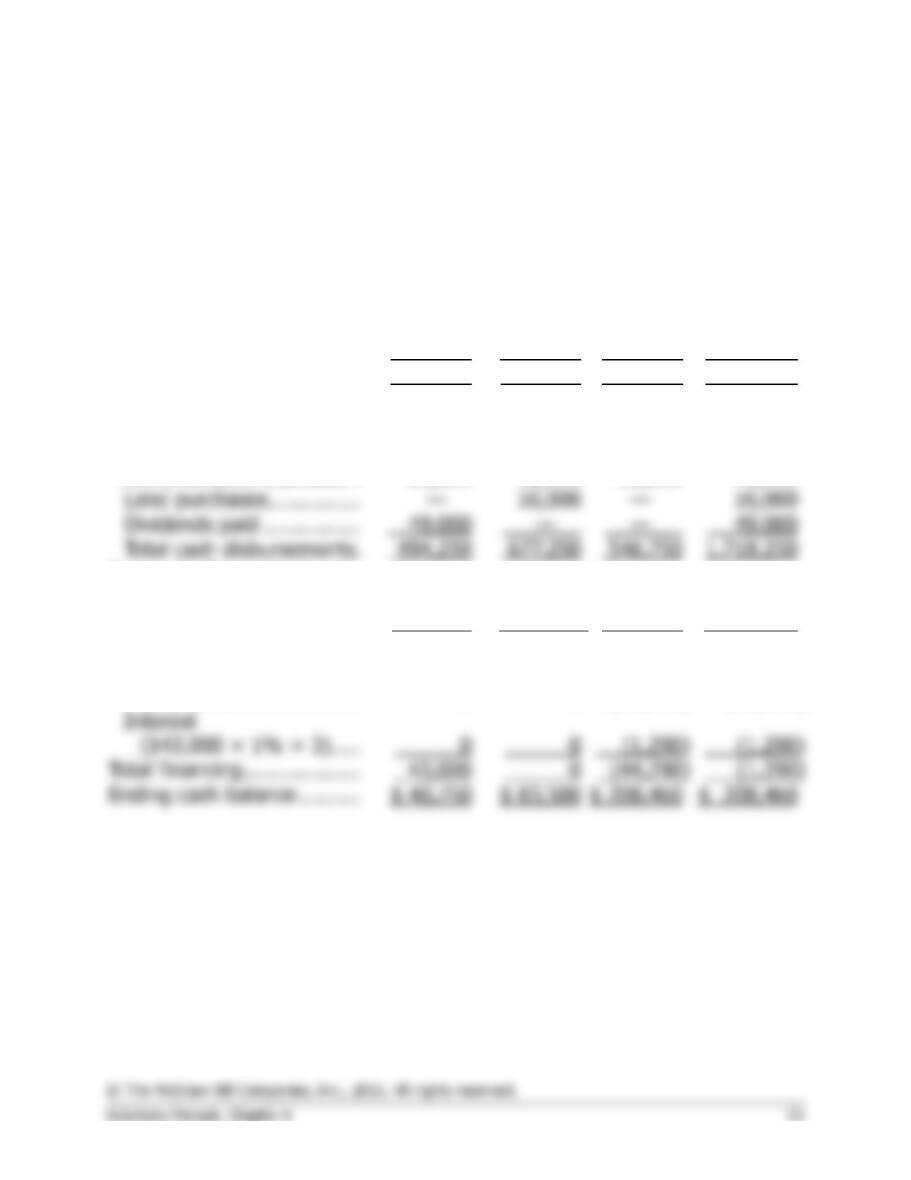
Problem 8-25 (continued)
3.
Garden Sales, Inc.
Cash Budget
For the Quarter Ended June 30
April
May
June
Quarter
Beginning cash balance ……
$ 52,000
$ 40,750
$ 83,500
$ 52,000
Add collections from
customers ………………….
440,000
720,000
716,000
1,876,000
Total cash available …………
492,000
760,750
799,500
1,928,000
Less cash disbursements:
Purchases for inventory …
341,250
509,250
463,750
1,314,250
Selling expenses ………….
79,000
120,000
62,000
261,000
Administrative expenses ..
25,000
21,000
Land purchases ……………
Dividends paid …………….
49,000
—
49,000
Total cash disbursements.
1,718,250
Excess (deficiency) of cash
available over
disbursements …………….
(2,250)
83,500
252,750
209,750
Financing:
Borrowings …………………
43,000
0
0
43,000
Repayments ………………..
0
0
(43,000)
(43,000)
(1,290)
Total financing ……………….
(44,290)
Ending cash balance ……….
$ 208,460
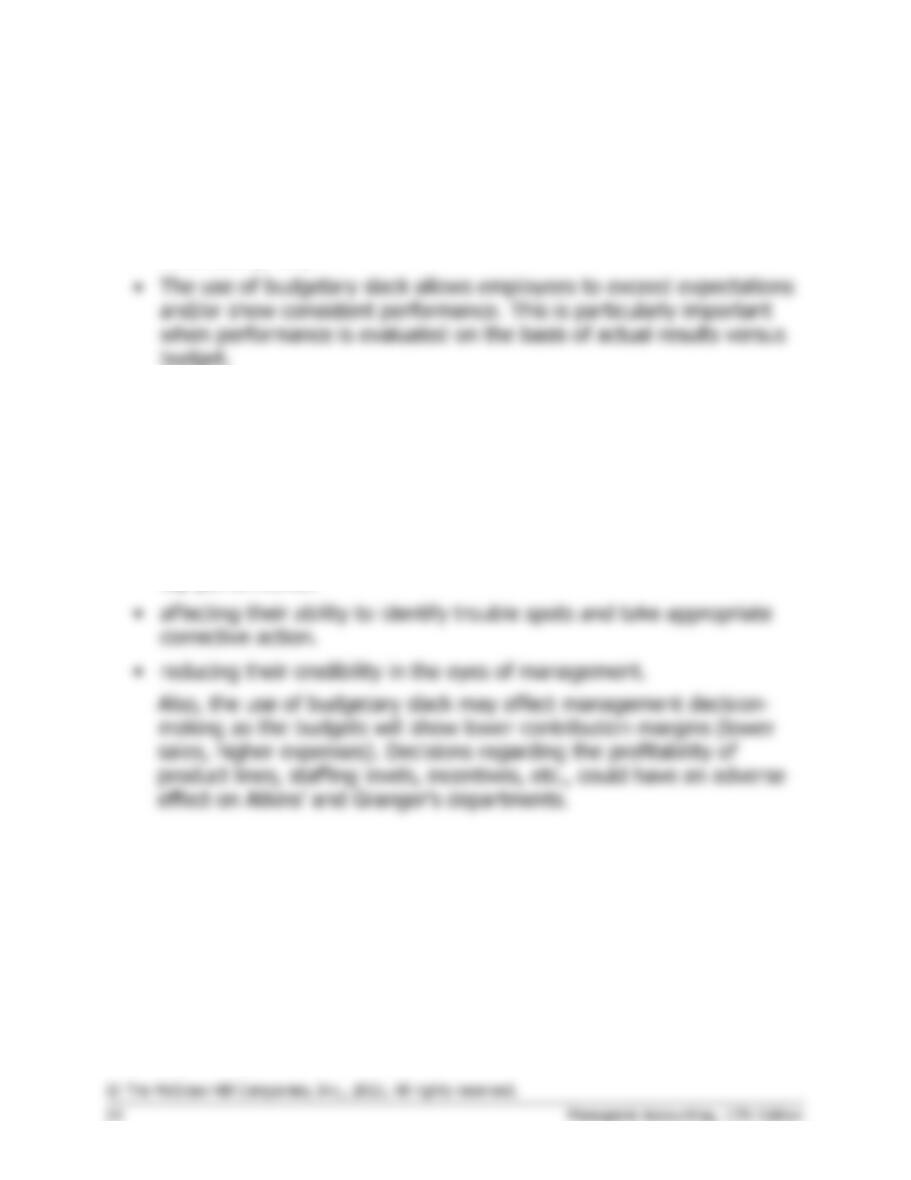
4. Collecting accounts receivable sooner and reducing inventory levels
reduces the company’s borrowing from $180,000 to $43,000. It also
reduces the company’s interest expense from $4,900 to $1,290.
Problem 8-26 (45 minutes)
1. a. The reasons that Marge Atkins and Pete Granger use budgetary slack
include the following:
• These employees are hedging against the unexpected (reducing
uncertainty/risk).
budget.
• Employees are able to blend personal and organizational goals
through the use of budgetary slack as good performance generally
leads to higher salaries, promotions, and bonuses.
b. The use of budgetary slack can adversely affect Atkins and Granger
by:
• limiting the usefulness of the budget to motivate their employees to
top performance.
Problem 8-26 (continued)
2. The use of budgetary slack, particularly if it has a detrimental effect on
the company, may be unethical. In assessing the situation, the specific
standards contained in “Standards of Ethical Conduct for Management
Accountants” that should be considered are listed below.
Confidentiality
The standards of confidentiality do not apply in this situation.
Integrity
Objectivity
• Information should be fairly and objectively communicated.
• All relevant information should be disclosed.
(Unofficial CMA Solution)
Problem 8-27 (45 minutes)
1. The expected cash collections are calculated as follows:
April
May
June
Total
Cash sales ………………..
$ 60,000
$ 66,000
$ 78,000
$204,000
March credit sales
collected ………………..
36,000
36,000
April credit sales
collected: $40,000 ×
20%, 80% ……………..
8,000
32,000
40,000
May credit sales
20%, 80% ……………..
June credit sales
10,400
2. The budgeted merchandise purchases are calculated as follows:
April
May
June
Total
Cost of goods sold ……..
$ 60,000
$ 66,000
$ 78,000
$204,000
Add: desired ending
43,000
49,000
52,000
Total needs ………………
103,000
115,000
130,000
256,000
Less: beginning
merchandise inventory
40,000
43,000
49,000
40,000
Required purchases ……
$ 63,000
$ 72,000
$ 81,000
$216,000
Problem 8-27 (continued)
3. The budgeted cash disbursements for merchandise purchases are
calculated as follows:
April
May
June
Total
Cash purchases …………
$ 6,300
$ 7,200
$ 8,100
$21,600
March purchases paid …
51,300
51,300
April credit purchases
paid: $63,000 × 90% .
56,700
56,700
Total cash disbursed …..
4. The budgeted balance sheet is calculated as follows:
Deacon Company
Balance Sheet
June 30
Assets
Cash ($55,000 + $334,400 – $194,400 – $48,000) ……….
$147,000
Accounts receivable ($130,000 × 40% × 80%) …………….
41,600
Inventory (see requirement 2) ………………………………….
52,000
Buildings and equipment, (net) ($100,000 – $3,000) ……..
97,000
Total assets ………………………………………………………….
$337,600
Liabilities and Stockholders’ Equity
Accounts payable ($81,000 – $8,100) …………………………
$ 72,900
Common stock …………………………..………………………….
$32,500) ………………………………………………………………
$337,600
Problem 8-28 (60 minutes)
1. a. Schedule of expected cash collections:
Next Year’s Quarter
First
Second
Third
Fourth
Total
Current year—Fourth quarter sales:
$200,000 × 33% …………………….
$ 66,000
$ 66,000
Next year—First quarter sales:
$300,000 × 65% …………………….
195,000
195,000
$300,000 × 33% …………………….
Next year—Second quarter sales:
Next year—Third quarter sales:
$500,000 × 65% …………………….
325,000
$500,000 × 33% …………………….
165,000
Next year—Fourth quarter sales:
Total cash collections ………………….
Problem 8-28 (continued)
2. Schedule of expected cash disbursements for merchandise purchases for next year:
Quarter
First
Second
Third
Fourth
Total
Current year—Fourth quarter purchases:
$126,000 × 20% ………………………….
$ 25,200
$ 25,200
Next year—First quarter purchases:
$186,000 × 80% ………………………….
$186,000 × 20% ………………………….
$ 37,200
Next year—Second quarter purchases:
$246,000 × 80% ………………………….
196,800
196,800
$246,000 × 20% ………………………….
$ 49,200
49,200
Next year—Third quarter purchases:
$305,000 × 80% ………………………….
244,000
244,000
$305,000 × 20% ………………………….
$ 61,000
61,000
Next year—Fourth quarter purchases:
$126,000 × 80% ………………………….
Total cash disbursements ………………….