8-21
SOLUTION EXHIBIT 8-23
Actual Costs
Incurred
(1)
Actual Input
× Budgeted Rate
(2)
Flexible Budget:
Budgeted Input
Allowed for
Actual Output
× Budgeted Rate
(3)
Allocated:
Budgeted Input
Allowed for
Actual Output
× Budgeted Rate
(4)
Variable
Manufacturing
Overhead
$618,840
(76,400 × $8)
$611,200
(78,600 × $8)
$628,800
(78,600 × $8)
$628,800
Actual Costs
Incurred
(1)
Same Budgeted
Lump Sum
(as in Static Budget)
Regardless of
Output Level
(2)
Flexible Budget:
Same Budgeted
Lump Sum
(as in Static Budget)
Regardless of
Output Level
(3)
Allocated:
Budgeted Input
Allowed for
Actual Output
× Budgeted Rate
(4)
Fixed
Manufacturing
Overhead
$145,790
$144,000
$144,000
(78,600 × $2)
$157,200
Fixed manufacturing overhead
budgeted rate =$144,000 / 72,000 machine-hours = $2 per machine-hour.
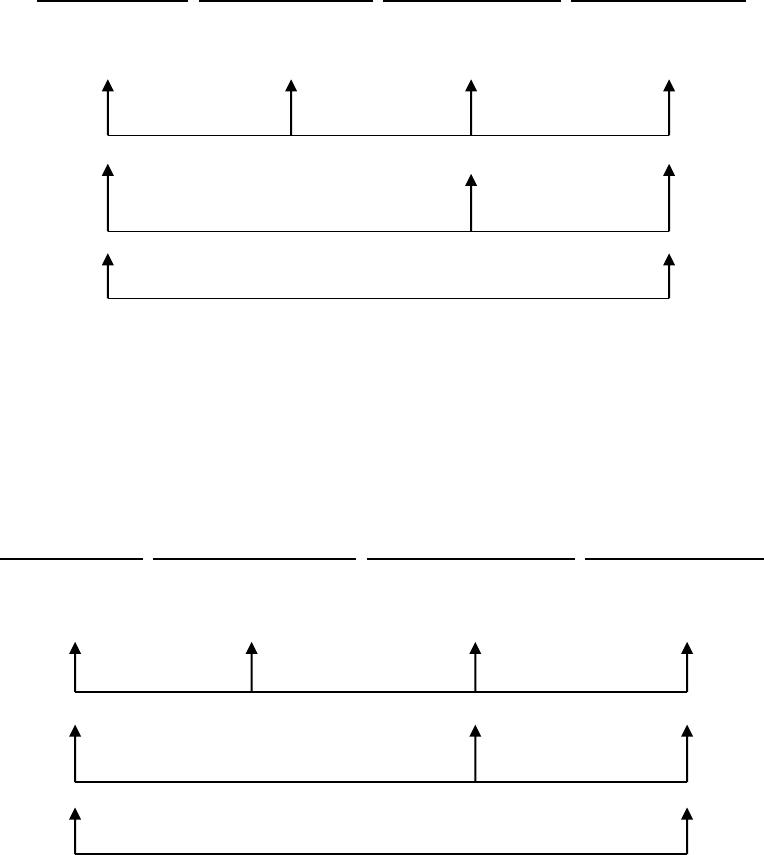
$7,640 U
Spending variance
$17,600 F
Efficiency variance
Never a variance
$1,790 U
Spending variance
Never a variance
$13,200 F
Production-volume variance
$9,960 F
Flexible-budget variance
Never a variance
$9,960 F
Overallocated variable overhead
(Total variable overhead variance)
$1,790 U
Flexible-budget variance
$13,200 F
Production-volume variance
$11,410 F
Overallocated fixed overhead
(Total fixed overhead variance)
8-22
8-24 (20–25 min.) Overhead variances, service sector.
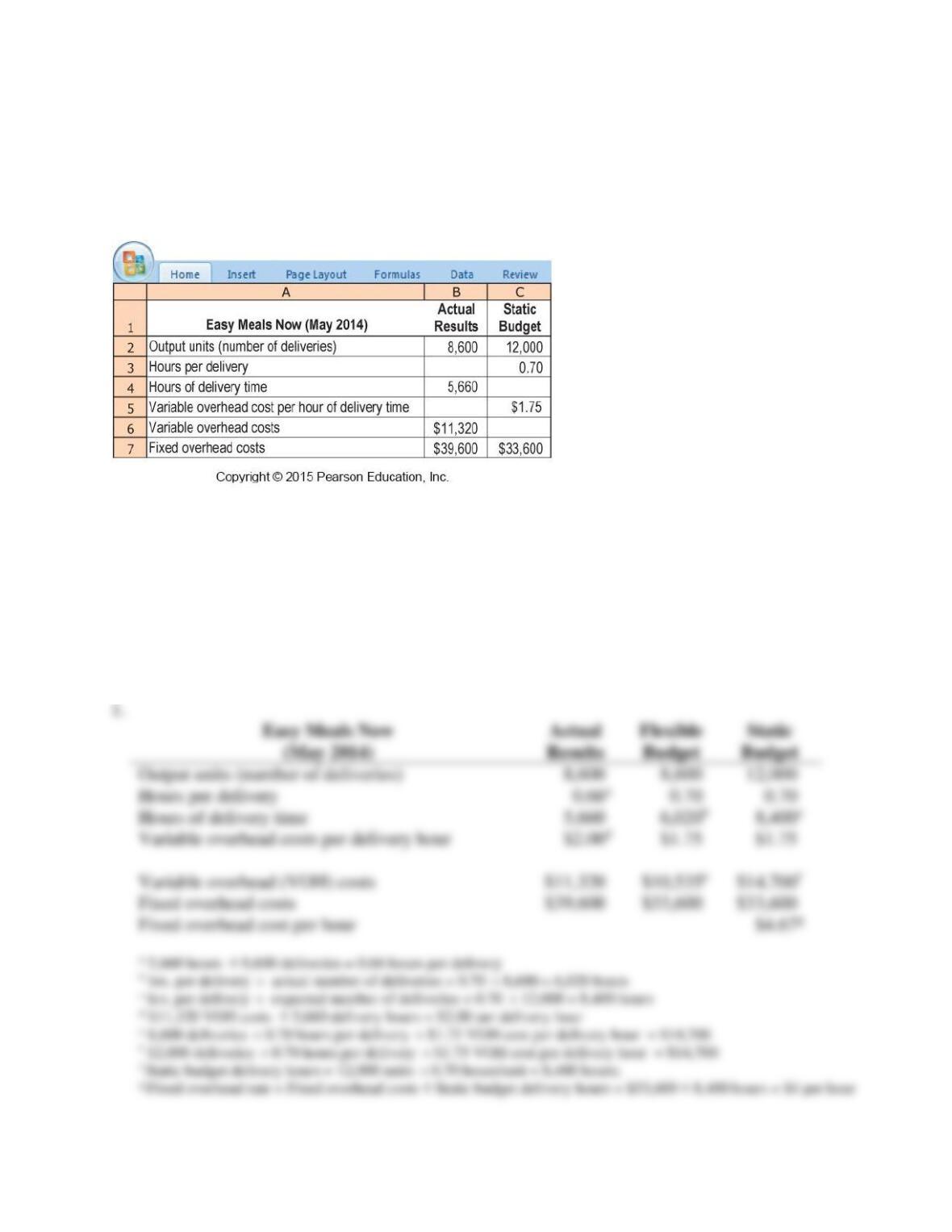
Easy Meals Now (EMN) operates a meal home-delivery service. It has agreements with 20
restaurants to pick up and deliver meals to customers who phone or fax orders to EMN. EMN
allocates variable and fixed overhead costs on the basis of delivery time. EMN’s owner, Steve
Roberts, obtains the following information for May 2014 overhead costs:
Required:
1. Compute spending and efficiency variances for EMN’s variable overhead in May 2014.
2. Compute the spending variance and production-volume variance for EMN’s fixed overhead
in May 2014.
3. Comment on EMN’s overhead variances and suggest how Steve Roberts might manage
EMN’s variable overhead differently from its fixed overhead costs.
SOLUTION
8-23
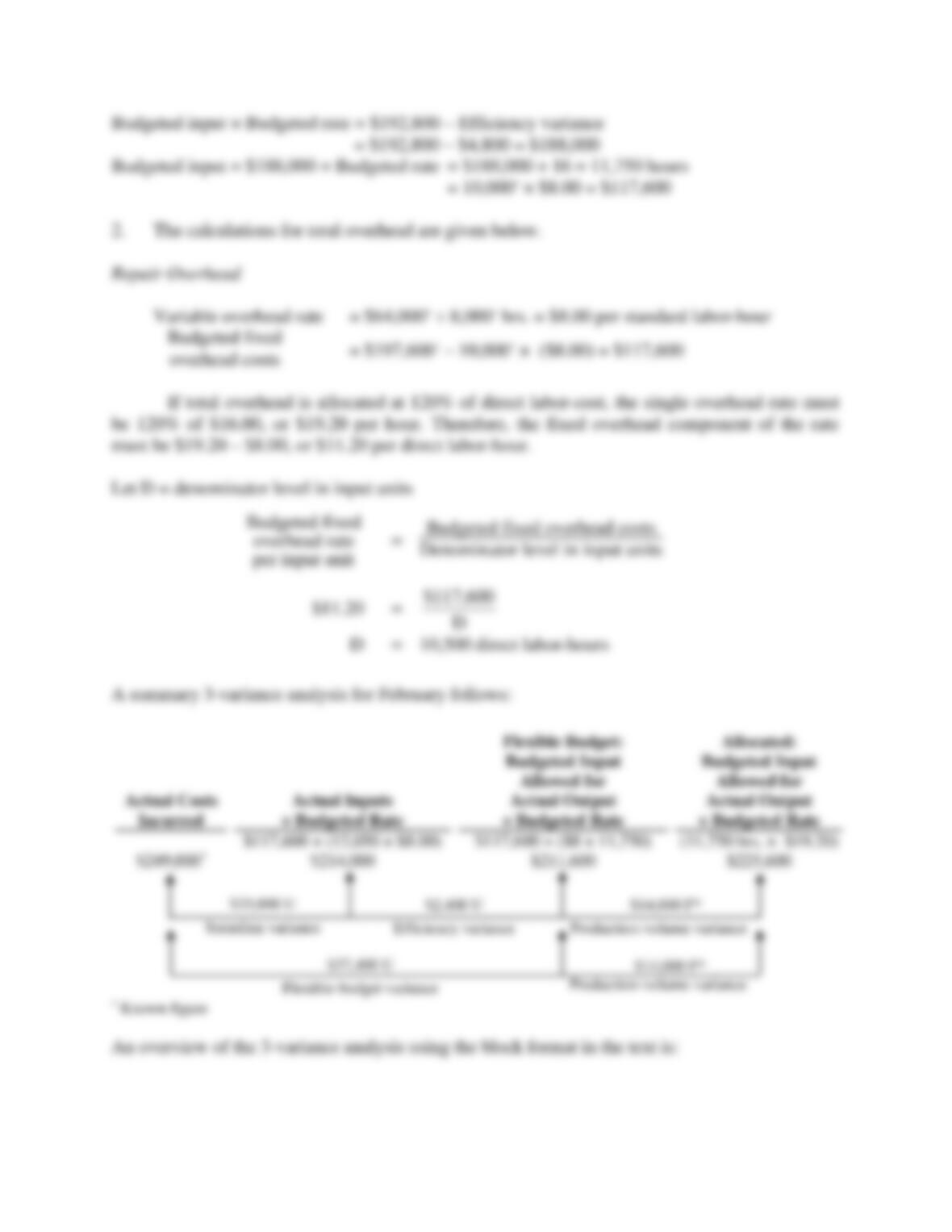
8-25 (45−50 min.) Total overhead, 3-variance analysis.
8-24
Ames Air Force Base has a bay that specializes in maintenance for aircraft engines. It uses
standard costing and flexible budgets to account for this activity. For 2014, budgeted variable
overhead at a level of 8,000 standard monthly direct labor-hours was $64,000; budgeted total
overhead at 10,000 standard monthly direct labor-hours was $197,600. The standard cost
allocated to repair output included a total overhead rate of 120% of standard direct labor costs.
For February, Ames incurred total overhead of $249,000 and direct labor costs of $202,440.
The direct labor price variance was $9,640 unfavorable. The direct labor flexible-budget variance
was $14,440 unfavorable. The standard labor price was $16 per hour. The production-volume
variance was $14,000 favorable.
Required:
1. Compute the direct labor efficiency variance.
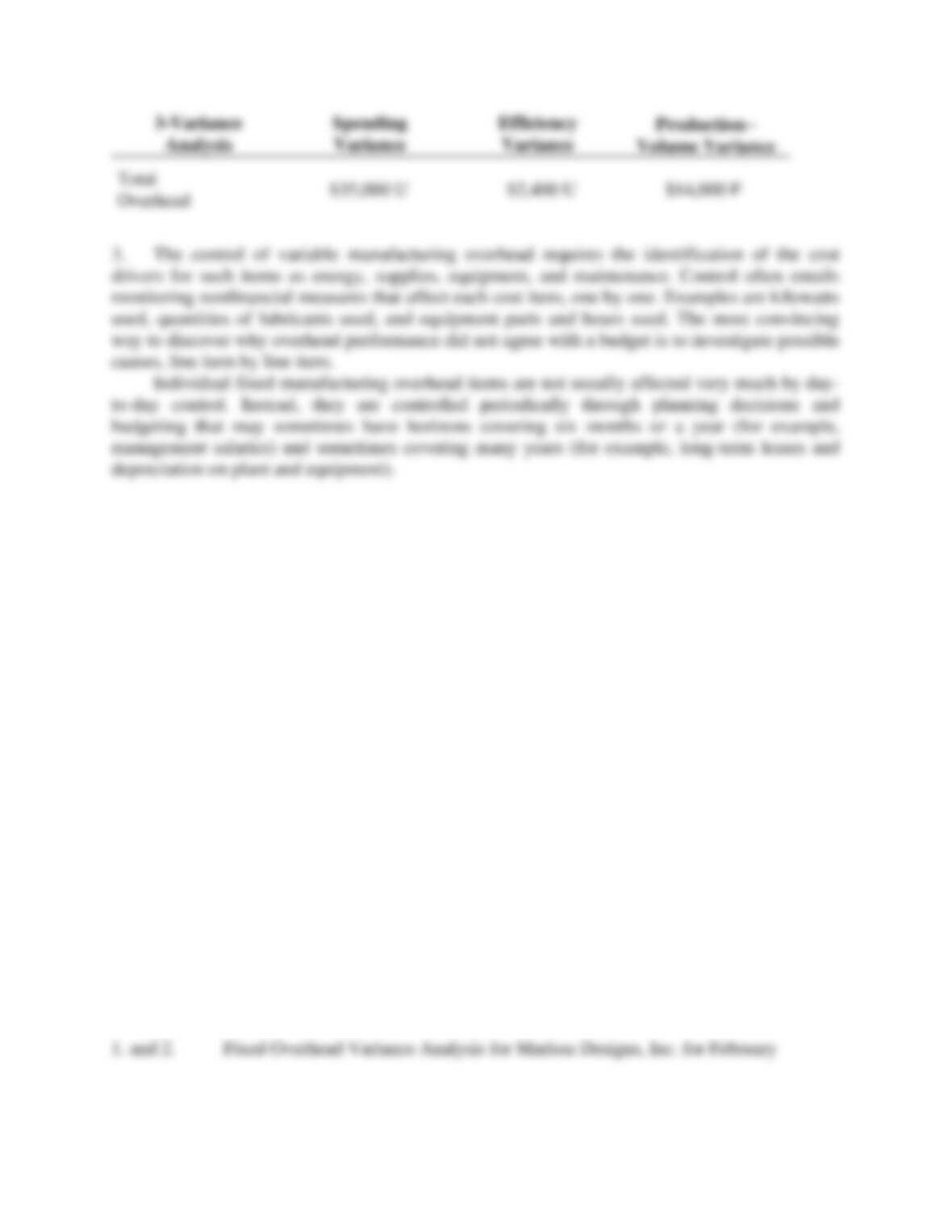
2. Compute the denominator level and the spending and efficiency variances for total overhead.
3. Describe how individual variable overhead items are controlled from day to day. Also,
describe how individual fixed overhead items are controlled.
SOLUTION
8-25
8-26
8-26 (35 min.) Production-volume variance analysis and sales volume variance.
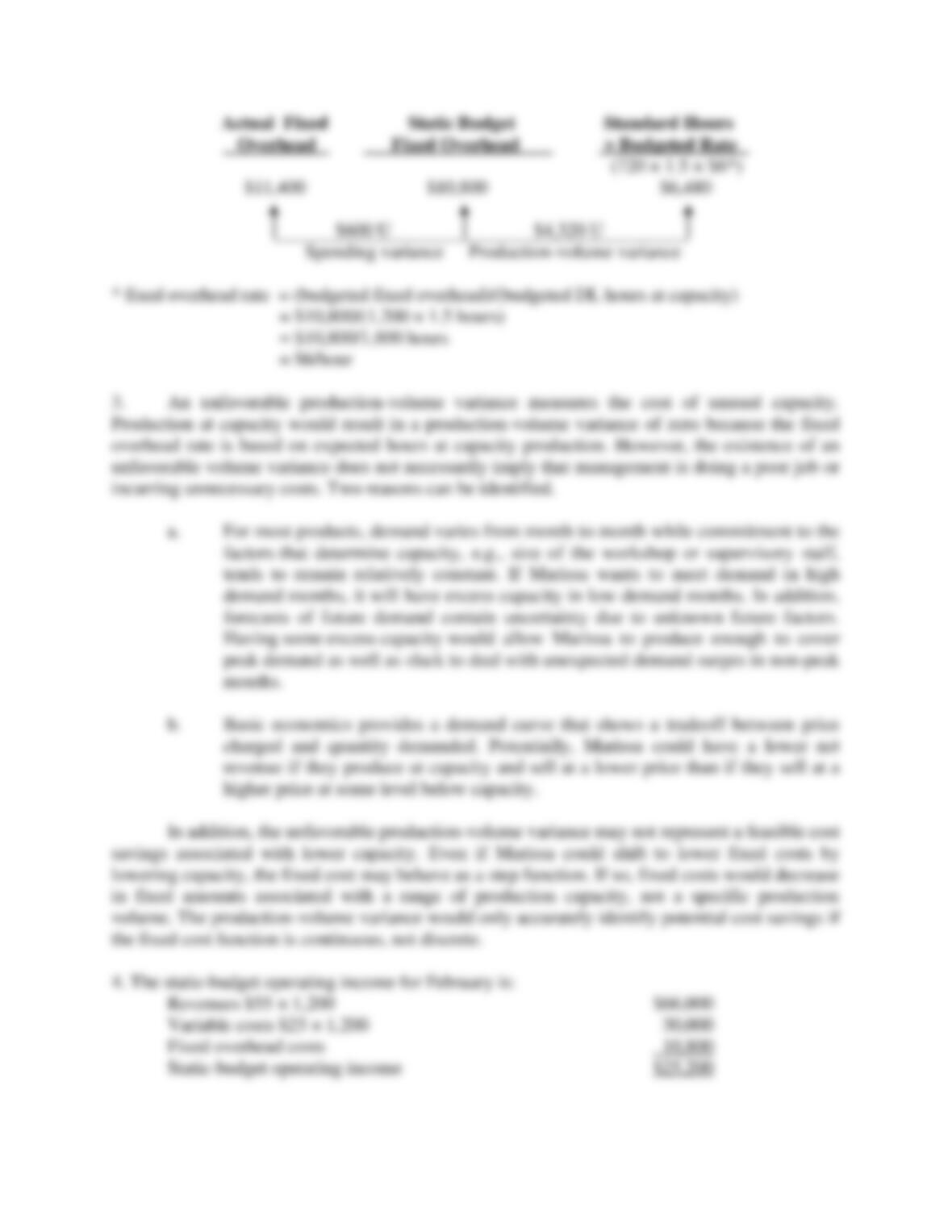
Marissa Designs, Inc., makes jewelry in the shape of geometric patterns. Each piece is handmade
and takes an average of 1.5 hours to produce because of the intricate design and scrollwork.
Marissa uses direct labor-hours to allocate the overhead cost to production. Fixed overhead costs,
including rent, depreciation, supervisory salaries, and other production expenses, are budgeted at
$10,800 per month. These costs are incurred for a facility large enough to produce 1,200 pieces
of jewelry a month.
During the month of February, Marissa produced 720 pieces of jewelry and actual fixed
costs were $11,400.
Required:
1. Calculate the fixed overhead spending variance and indicate whether it is favorable (F) or
unfavorable (U).
2. If Marissa uses direct labor-hours available at capacity to calculate the budgeted fixed
overhead rate, what is the production-volume variance? Indicate whether it is favorable (F) or
unfavorable (U).
3. An unfavorable production-volume variance could be interpreted as the economic cost of
unused capacity. Why would Marissa be willing to incur this cost?
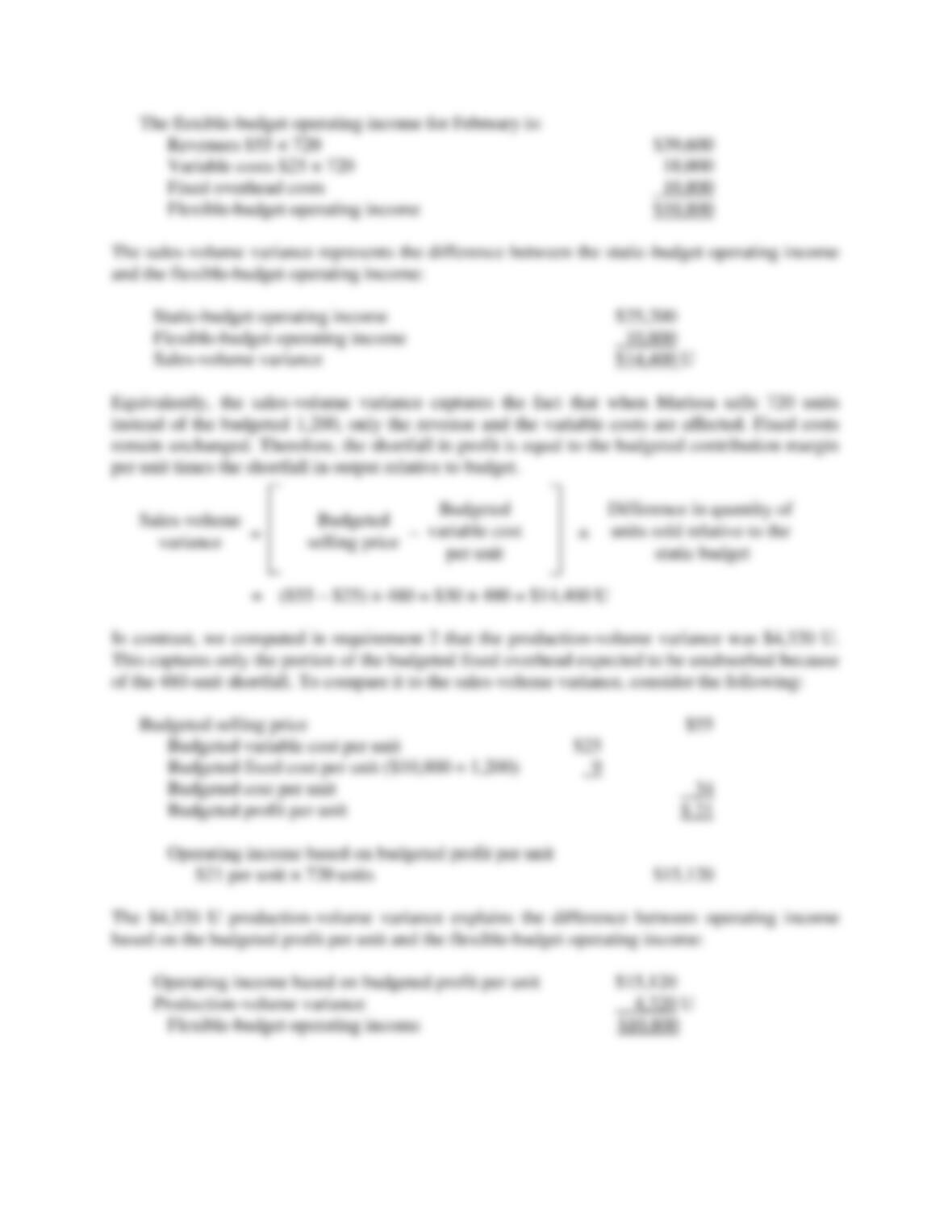
4. Marissa’s budgeted variable cost per unit is $25, and it expects to sell its jewelry for $55
apiece. Compute the sales-volume variance and reconcile it with the production-volume
variance calculated in requirement 2. What does each concept measure?
SOLUTION
8-27
8-28
8-29
8-27 (20 min.) Overhead variances, service setting.
Munich Partners provides a diverse array of back office services to its clients in the financial
services industry, ranging from record keeping and compliance to order processing and trade
settlement. Munich has grown increasingly reliant on technology to acquire, retain, and serve its
clients. Worried that its spending on information technology is getting out of control, Munich has
recently embraced variance analysis as a tool for cost management.
After some study, Munich determines that its variable and fixed technology overhead costs are
both driven by the processing time involved in meeting client requests. This is typically
measured in CPU units of usage of a high-performance computing cluster. Munich’s primary
measure of output is the number of client interactions its partners have in a given period.
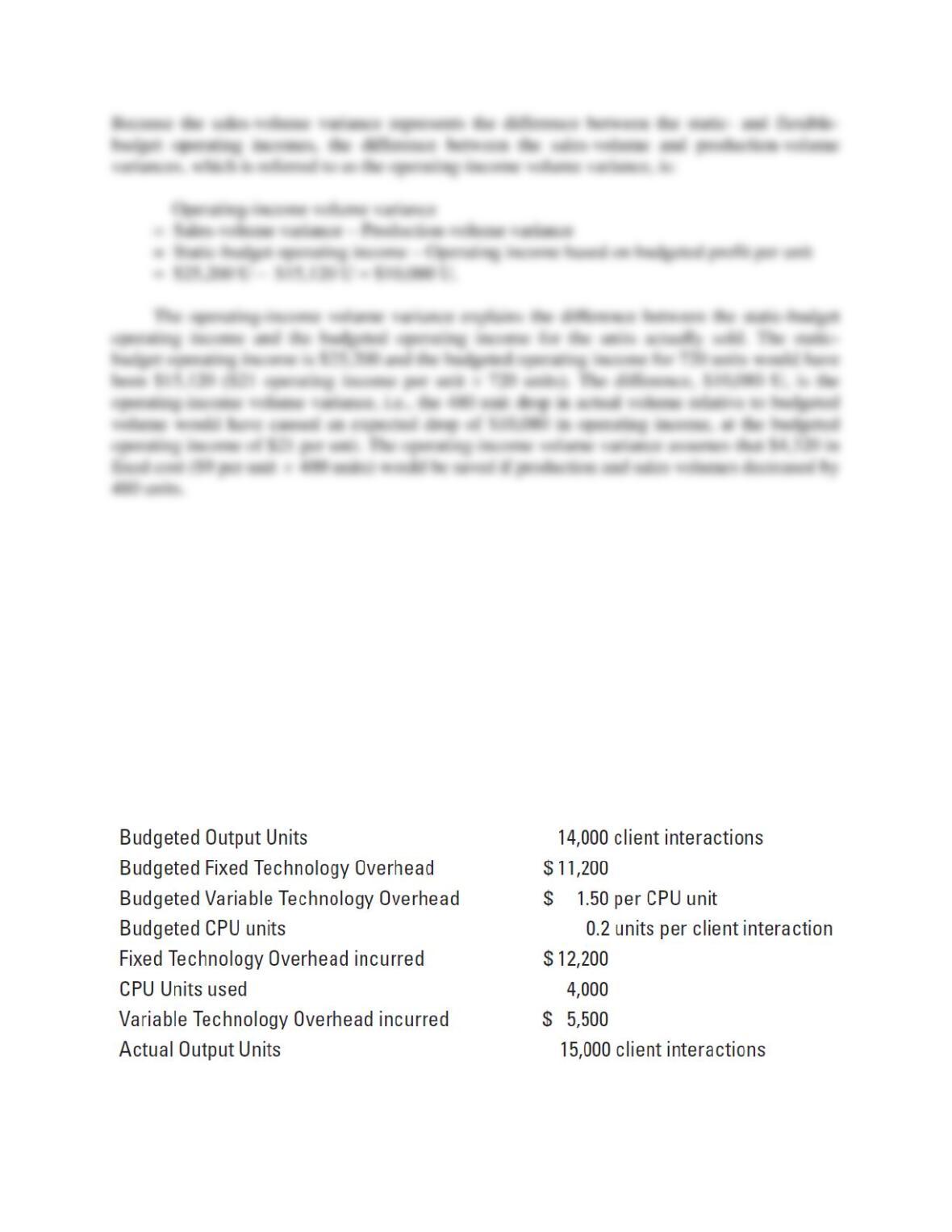
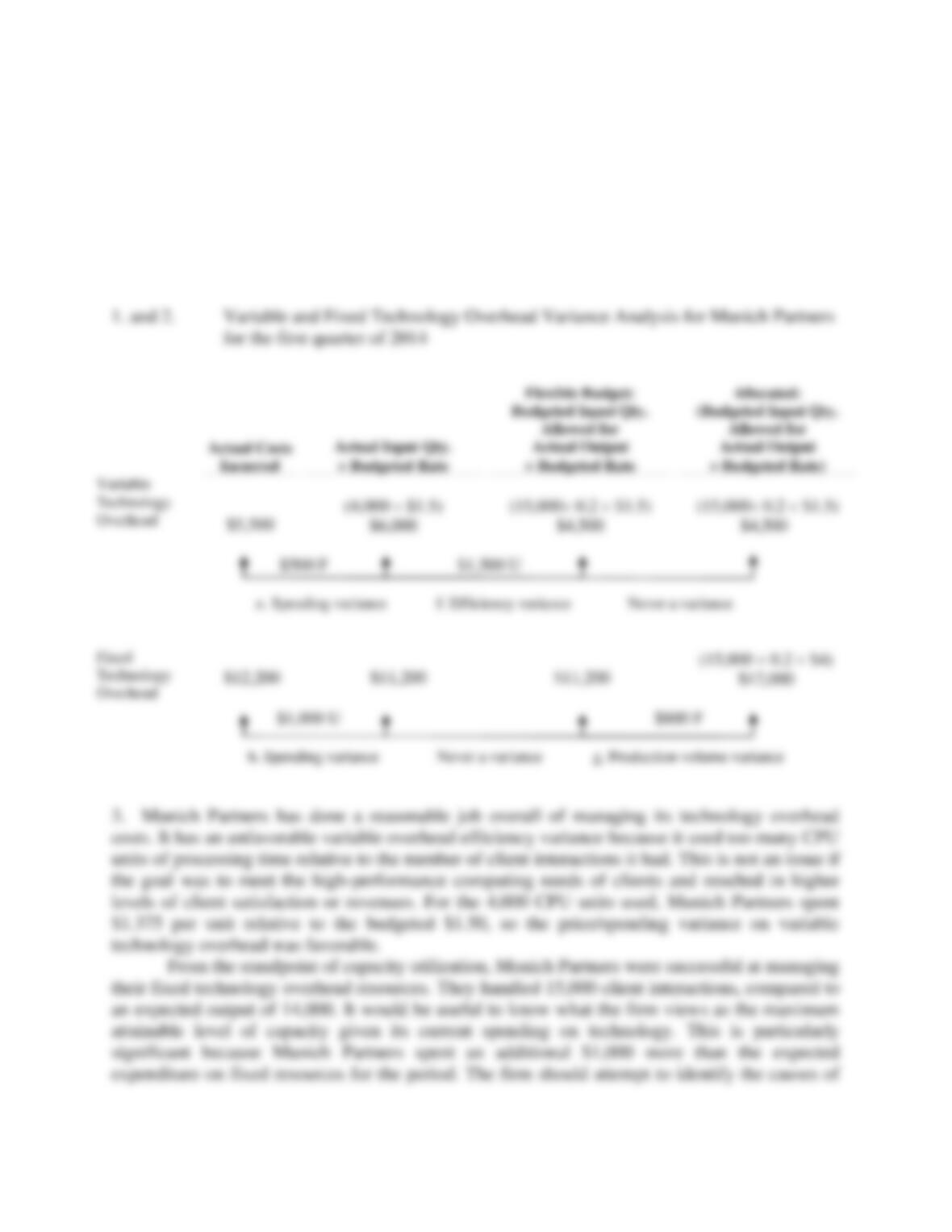
The following information pertains to the first quarter of 2014 (dollars in thousands):
Required:
8-30
1. Calculate the variable overhead spending and efficiency variances, and indicate whether each
is favorable (F) or unfavorable (U).
2. Calculate the fixed overhead spending and production volume variances, and indicate
whether each is favorable (F) or unfavorable (U).
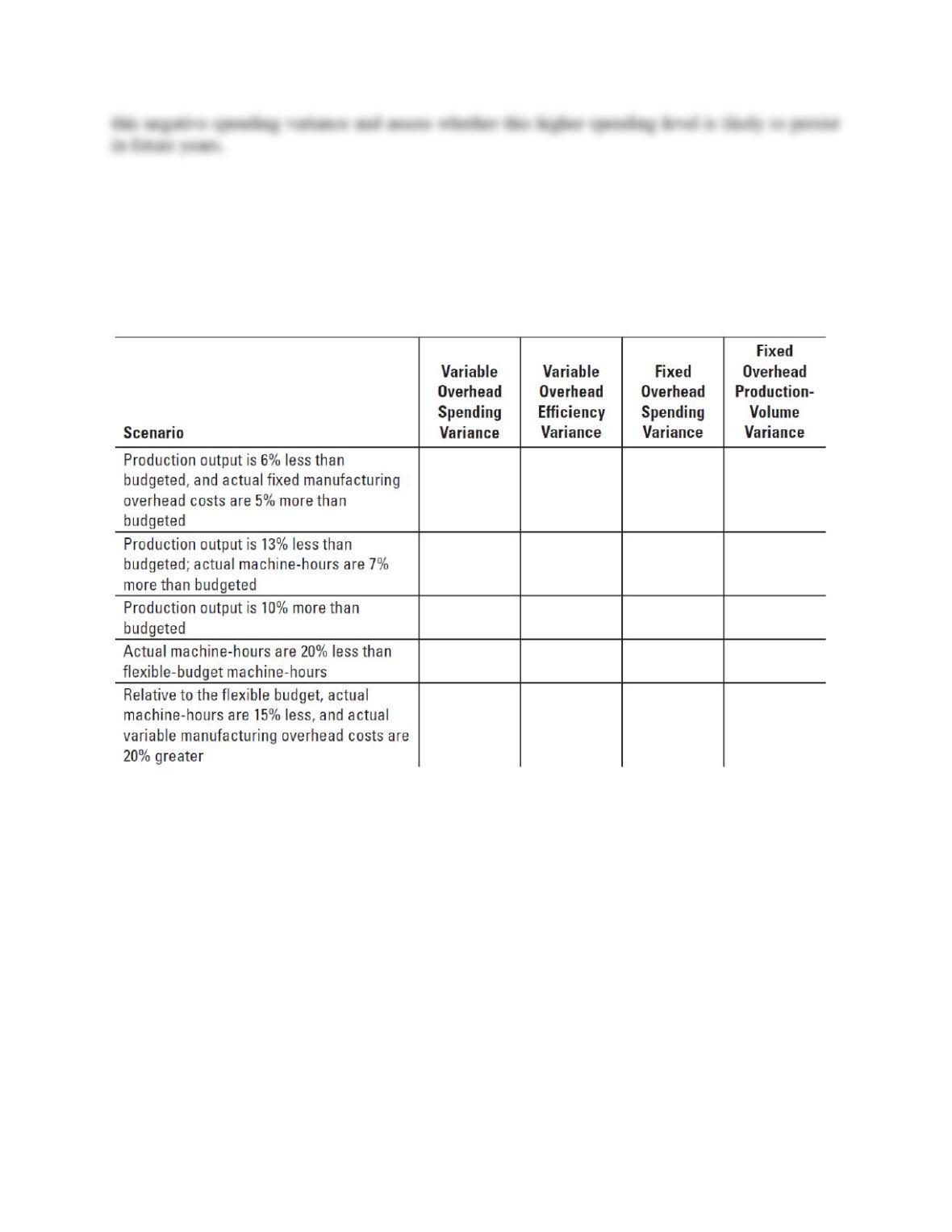
3. Comment on Munich Partners’ overhead variances. In your view, is the firm right to be
worried about its control over technology spending?
SOLUTION
8-31
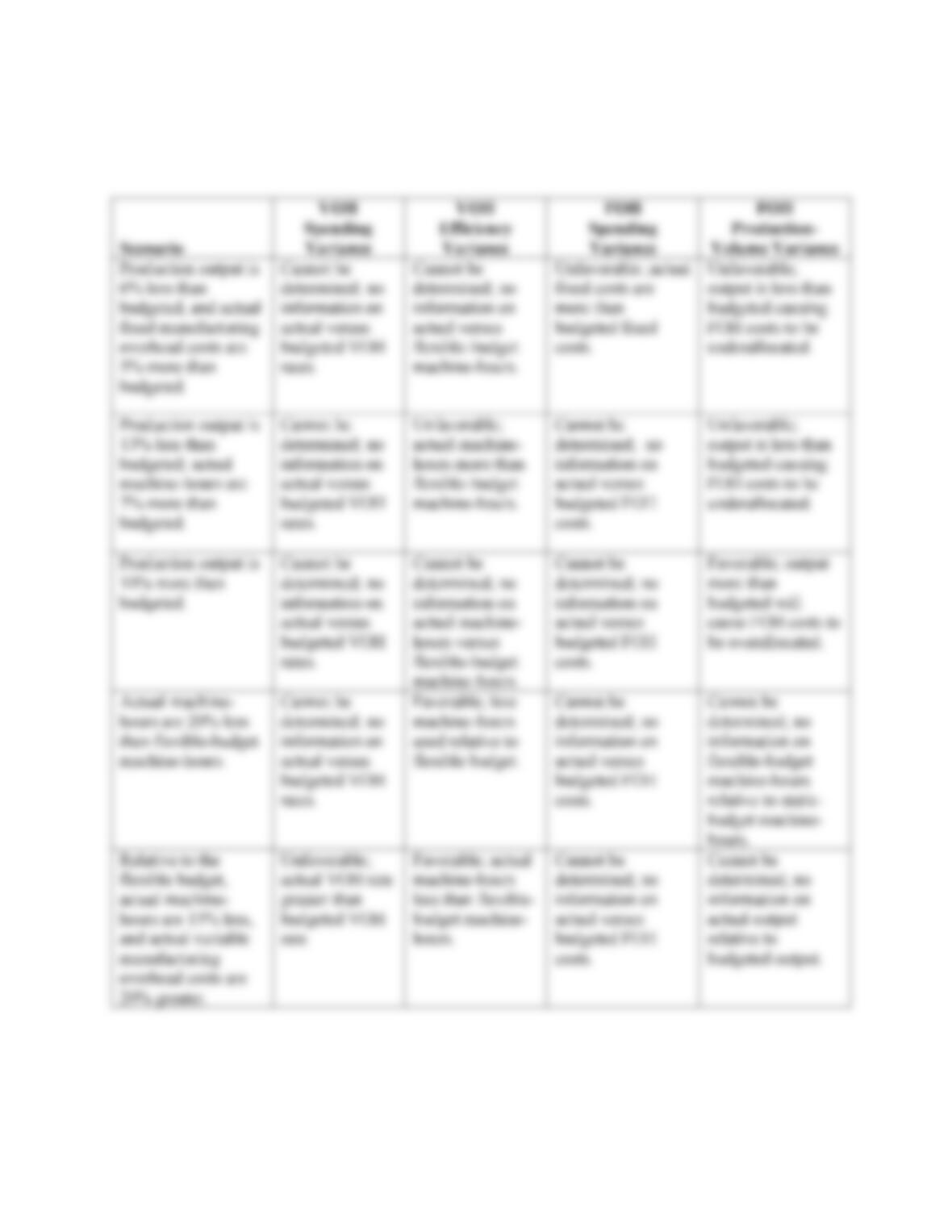
8-28 (15 min.) Identifying favorable and unfavorable variances.
Purdue, Inc., manufactures tires for large auto companies. It uses standard costing and allocates
variable and fixed manufacturing overhead based on machine-hours. For each independent
scenario given, indicate whether each of the manufacturing variances will be favorable or
unfavorable or, in case of insufficient information, indicate “CBD” (cannot be determined).
8-32
SOLUTION
8-33
8-29 (35 min.) Flexible-budget variances, review of Chapters 7 and 8.
Michael Roberts is a cost accountant and business analyst for Darby Design Company (DDC),
which manufactures expensive brass doorknobs. DDC uses two direct cost categories: direct
materials and direct manufacturing labor. Roberts feels that manufacturing overhead is most
closely related to material usage. Therefore, DDC allocates manufacturing overhead to
production based upon pounds of materials used.
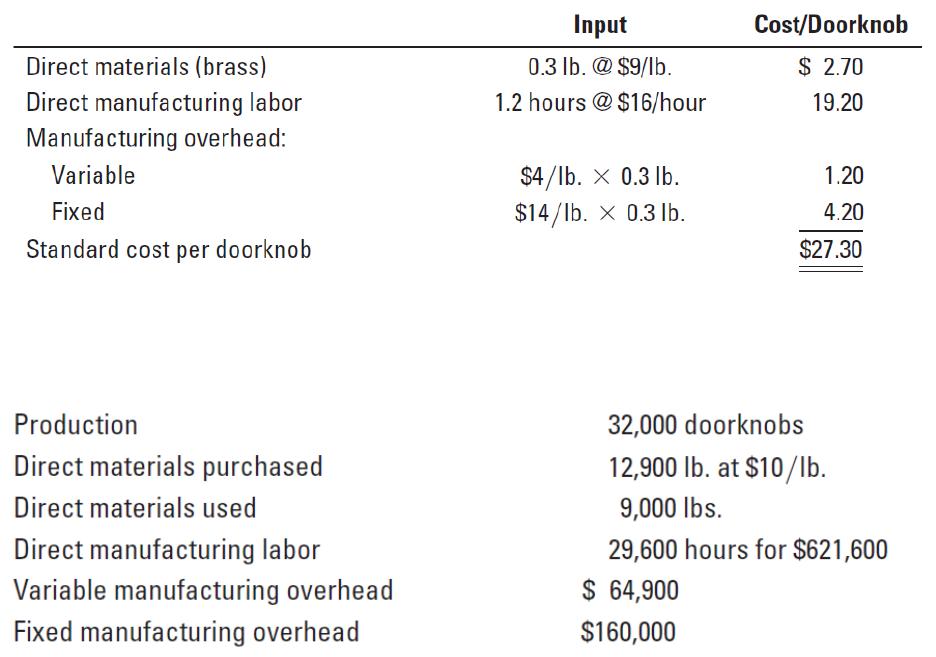
At the beginning of 2014, DDC budgeted annual production of 410,000 doorknobs and
adopted the following standards for each doorknob:
Actual results for April 2014 were as follows:
Required:
1. For the month of April, compute the following variances, indicating whether each is
favorable (F) or unfavorable (U):
a. Direct materials price variance (based on purchases)
b. Direct materials efficiency variance
c. Direct manufacturing labor price variance
d. Direct manufacturing labor efficiency variance
e. Variable manufacturing overhead spending variance
f. Variable manufacturing overhead efficiency variance
g. Production-volume variance
8-34
h. Fixed manufacturing overhead spending variance
2. Can Roberts use any of the variances to help explain any of the other variances? Give
examples.
SOLUTION
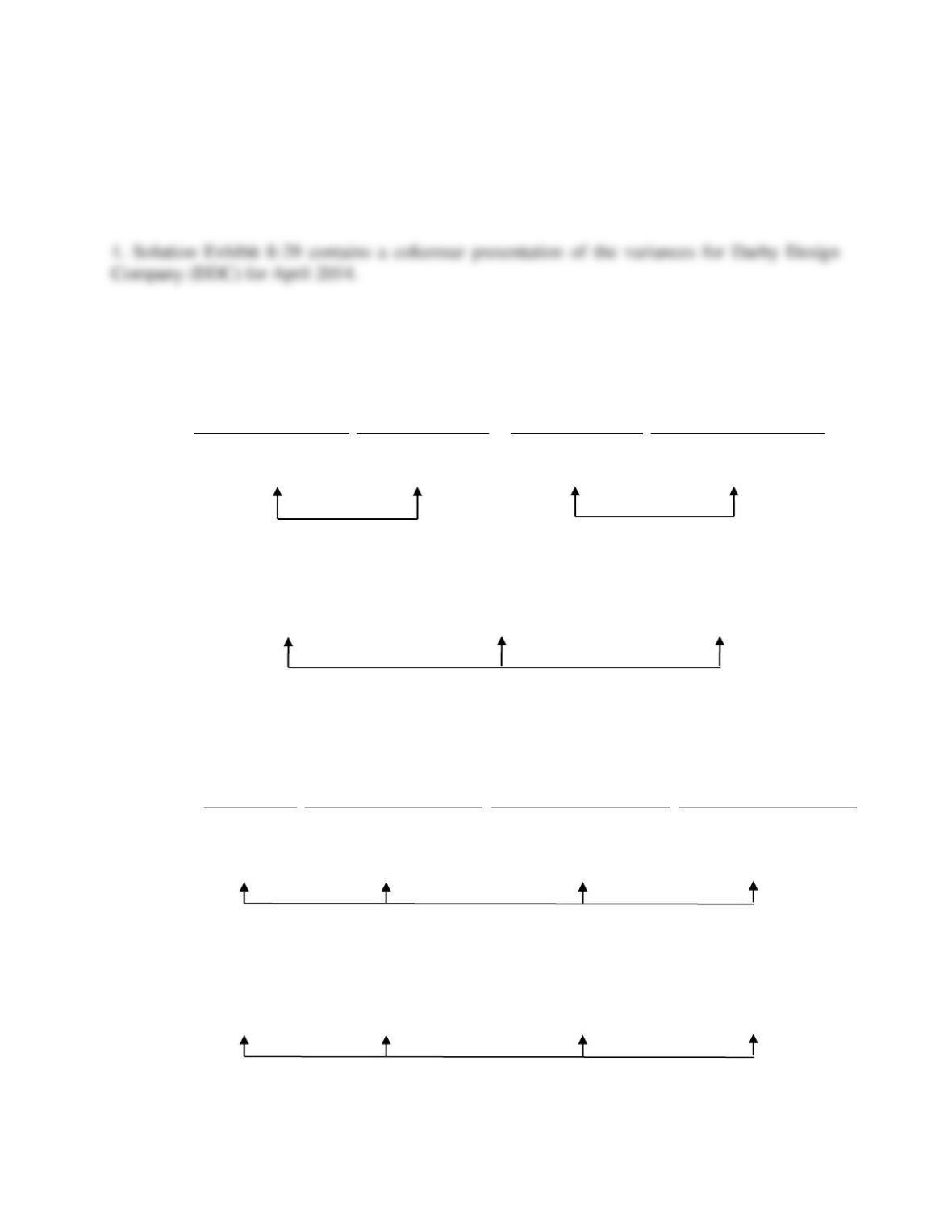
SOLUTION EXHIBIT 8-29
Actual Costs
Incurred:
Actual Input Qty.
Actual Input Qty.
Budgeted Price
Flexible Budget:
Budgeted Input Qty.
Allowed for
Actual Output
× Actual Rate
Purchases
Usage
× Budgeted Price
Direct
Materials
(12,900 $10)
$129,000
(12,900 $9)
$116,100
(9,000 $9)
$81,000
(32,000 0.3 $9)
$86,400
$12,900 U $5,400 F
a. Price variance b. Efficiency variance
Direct
Manufacturing
Labor
$621,600
(29,600 $16)
$473,600
(32,000 1.2 $16)
$614,400
$148,000 U $140,800 F
c. Price variance d. Efficiency variance
Actual Costs
Incurred
Actual Input Qty.
Budgeted Rate
Flexible Budget:
Budgeted Input Qty.
Allowed for
Actual Output
Budgeted Rate
Allocated:
(Budgeted Input Qty.
Allowed for
Actual Output
Budgeted Rate)
Variable
Manufacturing
Overhead
$64,900
(9,000 $4)
$36,000
(9,600 $4)
$38,400
(9,600 $4)
$38,400
$28,900 U $2,400 F
e. Spending variance f. Efficiency variance Never a variance
Fixed
Manufacturing
Overhead
$160,000
$143,500*
$143,500
(32,000 0.3 $14)
$134,400
$16,500 U $9,100 U
h. Spending variance Never a variance g. Production volume variance
8-35
*Denominator level (Annual) in pounds of material: 410,000 × 0.3 = 123,000 pounds
Annual Budgeted Fixed Overhead: 123,000 × $14/lb = $1,722,000
Monthly budgeted FOH: $1,722,000 / 12 = $143,500
2. The direct materials price variance indicates that DDC paid more for brass than they had
planned. If this is because they purchased a higher quality of brass, it may explain why they used
less brass than expected (leading to a favorable material efficiency variance). In turn, because
variable manufacturing overhead is assigned based on pounds of materials used, this directly led
to the favorable variable overhead efficiency variance. The purchase of a better quality of brass
may also explain why it took less labor time to produce the doorknobs than expected (the
favorable direct labor efficiency variance). Finally, the unfavorable direct labor price variance
could imply that the workers who were hired were more experienced than expected, which could
also be related to the positive direct material and direct labor efficiency variances.
8-30 (30 min.) Comprehensive variance analysis.
Chef Whiz manufactures premium food processors. The following are some manufacturing
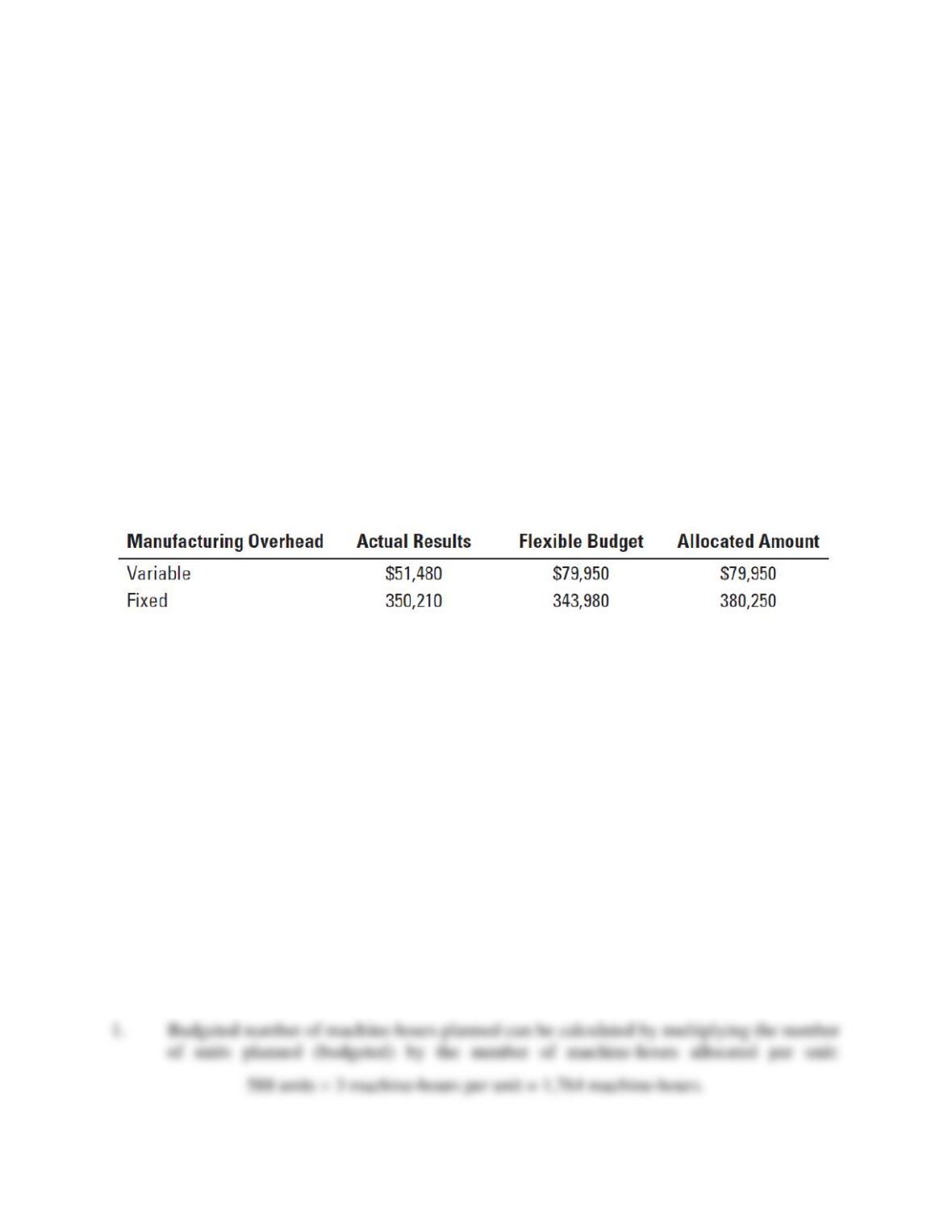
overhead data for Chef Whiz for the year ended December 31, 2014:
Budgeted number of output units: 588
Planned allocation rate: 3 machine-hours per unit
Actual number of machine-hours used: 1,170
Static-budget variable manufacturing overhead costs: $72,324
Required:
Compute the following quantities (you should be able to do so in the prescribed order):
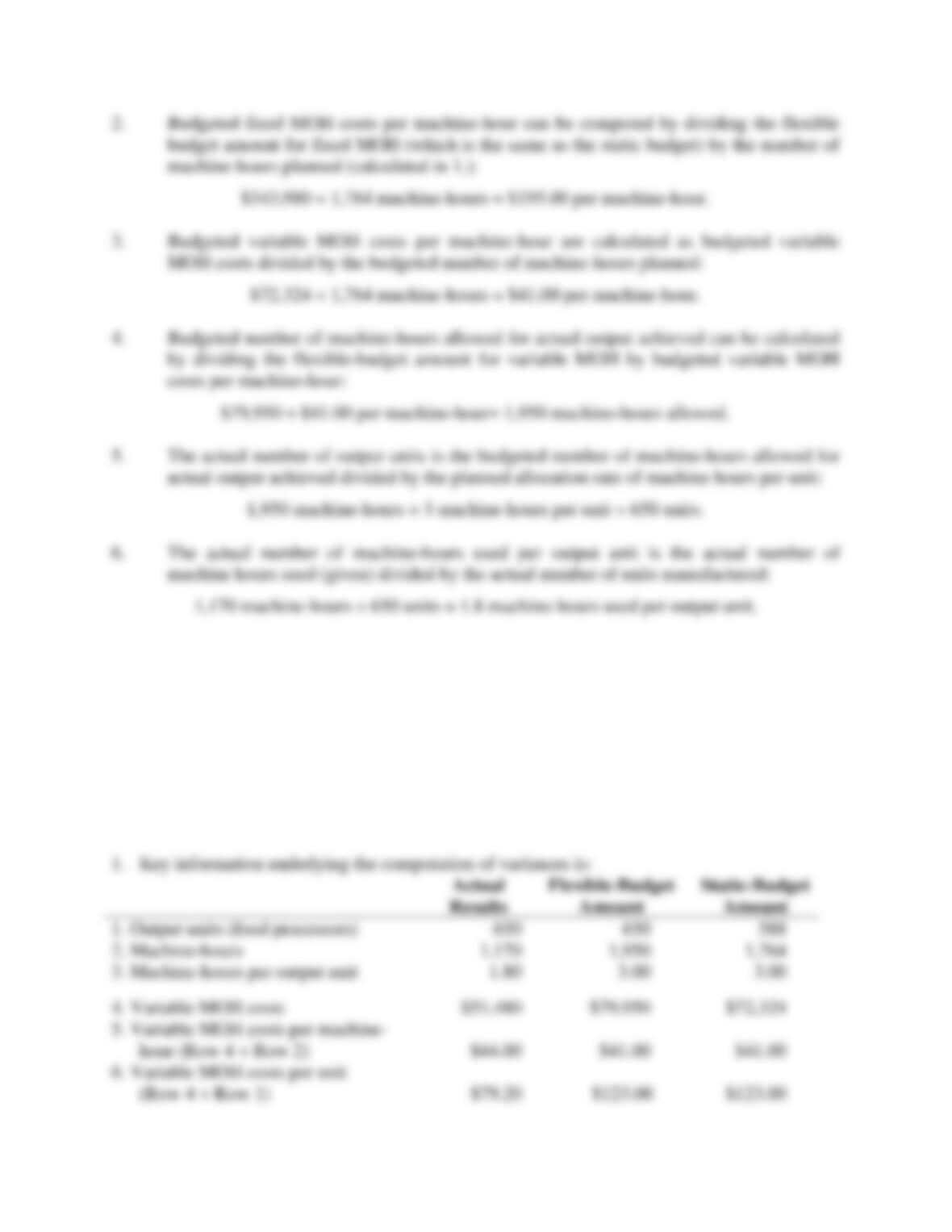
1. Budgeted number of machine-hours planned
2. Budgeted fixed manufacturing overhead costs per machine-hour
3. Budgeted variable manufacturing overhead costs per machine-hour
4. Budgeted number of machine-hours allowed for actual output produced
5. Actual number of output units
6. Actual number of machine-hours used per output unit
SOLUTION
8-36
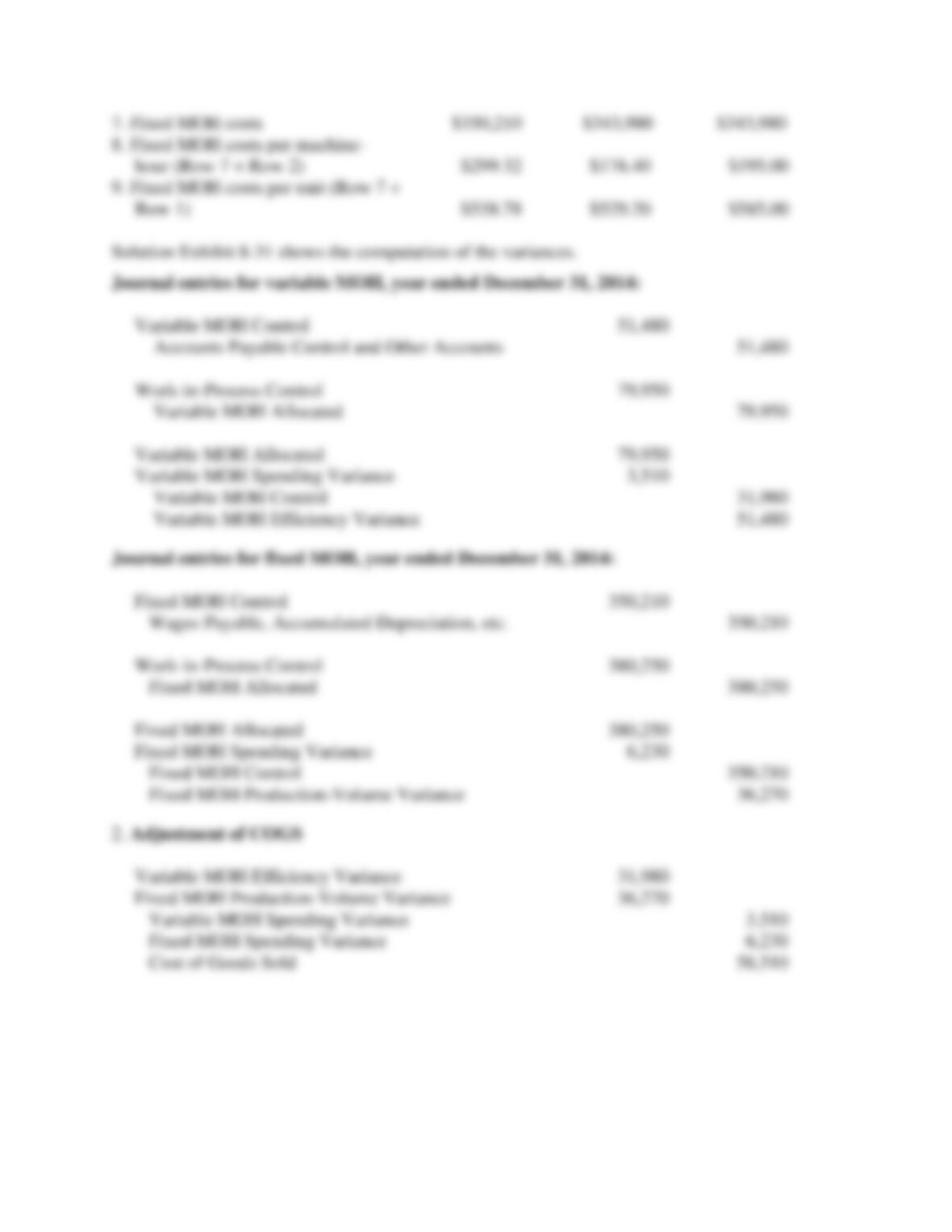
8-31 (60 min.) Journal entries (continuation of 8-30).
Required:
1. Prepare journal entries for variable and fixed manufacturing overhead (you will need to
calculate the various variances to accomplish this).
2. Overhead variances are written off to the Cost of Goods Sold (COGS) account at the end of
the fiscal year. Show how COGS is adjusted through journal entries.
SOLUTION
8-37
8-38
SOLUTION EXHIBIT 8-31
Variable Manufacturing Overhead
Actual Costs
Incurred
(1)
Actual Input Qty.
× Budgeted Rate
(2)
Flexible Budget:
Budgeted Input Qty.
Allowed for
Actual Output
× Budgeted Rate
(3)
Allocated:
Budgeted Input Qty.
Allowed for
Actual Output
× Budgeted Rate
(4)
(1,170 $44)
$51,480
(1,170 $41)
$47,970
(1,950 $41)
$79,950
(1,950 $41)
$79,950
Fixed Manufacturing Overhead
Actual Costs
Incurred
(1)
Same Budgeted
Lump Sum
(as in Static Budget)
Regardless Of
Output Level
(2)
Flexible Budget:
Same Budgeted
Lump Sum
(as in Static Budget)
Regardless of
Output Level
(3)
Allocated:
Budgeted Input Qty.
Allowed for
Actual Output
× Budgeted Rate
(4)
(1,950 × $195)
$350,210
$343,980
$343,980
$380,250
$3,510 U
Spending variance
$31,980 F
Efficiency variance
Never a variance
$6,230 U
Spending variance
Never a variance
$36,270 F
Production-volume variance
8-39
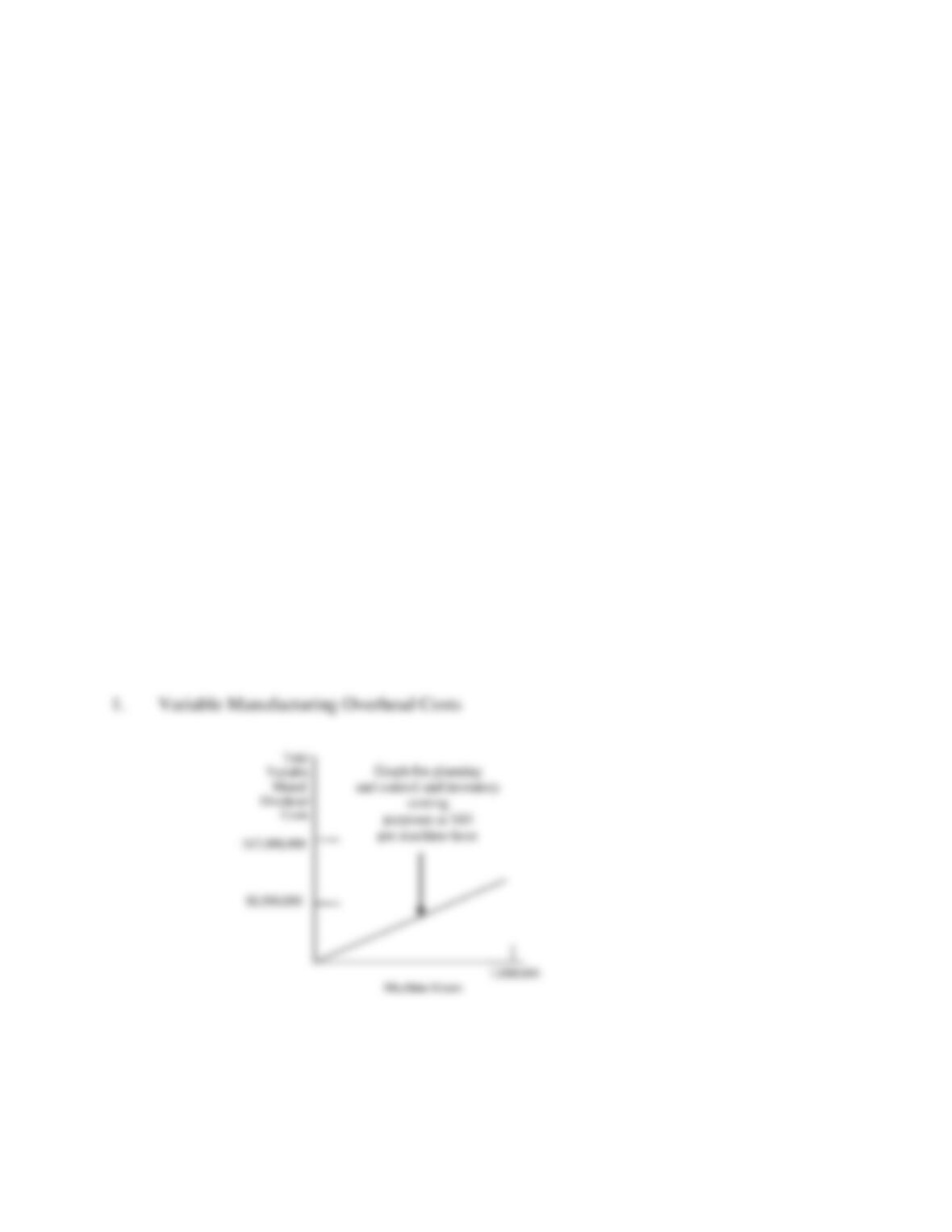
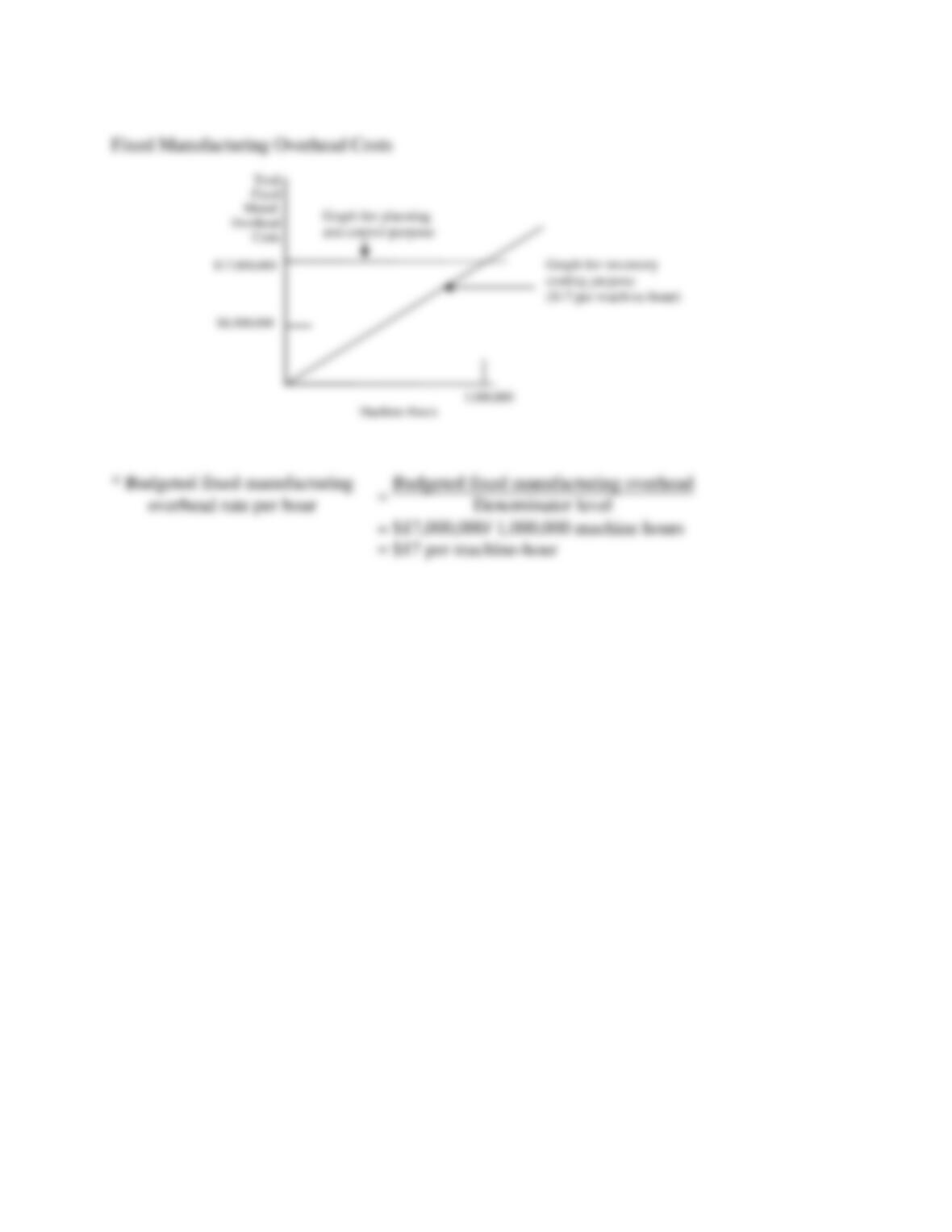
8-32 (30−40 min.) Graphs and overhead variances.
Best Around, Inc., is a manufacturer of vacuums and uses standard costing. Manufacturing
overhead (both variable and fixed) is allocated to products on the basis of budgeted machine–
hours. In 2014, budgeted fixed manufacturing overhead cost was $17,000,000. Budgeted variable
manufacturing overhead was $10 per machine-hour. The denominator level was 1,000,000
machine-hours.
Required:
1. Prepare a graph for fixed manufacturing overhead. The graph should display how Best
Around, Inc.’s fixed manufacturing overhead costs will be depicted for the purposes of (a)
planning and control and (b) inventory costing.
2. Suppose that 1,125,000 machine-hours were allowed for actual output produced in 2014, but
1,200,000 actual machine-hours were used. Actual manufacturing overhead was
$12,075,000, variable, and $17,100,000, fixed. Compute (a) the variable manufacturing
overhead spending and efficiency variances and (b) the fixed manufacturing overhead
spending and production-volume variances. Use the columnar presentation illustrated in
Exhibit 8-4 (page 304).
3. What is the amount of the under– or overallocated variable manufacturing overhead and the
under- or overallocated fixed manufacturing overhead? Why are the flexible-budget variance
and the under- or over- allocated overhead amount always the same for variable
manufacturing overhead but rarely the same for fixed manufacturing overhead?
4. Suppose the denominator level was 1,700,000 rather than 1,000,000 machine-hours. What
variances in requirement 2 would be affected? Recompute them.
SOLUTION
8-40