Chapter 8
Master Budgeting
Solutions to Questions
8-1 A budget is a detailed quantitative plan
for the acquisition and use of financial and other
resources over a given time period. Budgetary
control involves using budgets to increase the
likelihood that all parts of an organization are
working together to achieve the goals set down
in the planning stage.
8-2
1. Budgets encourage managers to
think
4. Budgets
coordinate
the plans and
activities of departmental managers.
5. Budgets uncover potential
bottlenecks
before they occur.
6. Budgets can be compared to actual
results to improve the efficiency
and
effectiveness of operations and to evaluate and
reward employees.
8-3 A perpetual budget is a 12-month
budget that continuously rolls forward one
month (or quarter) at a time as the current
month (or quarter) is completed. This approach
keeps managers continually focused one year
ahead.
production, raw materials, direct labor,
manufacturing overhead, selling and
administrative expenses, and inventories. The
master budget usually also contains a budgeted
income statement, budgeted balance sheet, and
cash budget.
8-5 The level of sales impacts virtually every
other aspect of the firm’s activities. It
determines the production budget, cash
collections, cash disbursements, and selling and
administrative budget that in turn determine the
cash budget and budgeted income statement
involves the means by which management
attempts to ensure that the goals set down at
the planning stage are attained.
8-7 Creating a “budgeting assumptions” tab
simplifies the process of determining how
changes to a master budget’s underlying
assumptions impact all supporting schedules and
the projected financial statements.
8-8 A self-imposed budget is one in which
persons with responsibility over cost control
prepare their own budgets. This is in contrast to
a budget that is imposed from above. The major
advantages of a self-imposed budget are: (1) It
imposed goals. (4) It empowers lower-level
managers to take ownership of the budget and
to be accountable for deviations from it.

Self-imposed budgets do carry with
them the risk of budgetary slack. The budgets
prepared by lower-level managers should be
carefully reviewed to prevent too much slack.
8-9 The direct labor budget and other
budgets can be used to forecast workforce
8-10 The principal purpose of the cash
budget is NOT to see how much cash the
company will have in the bank at the end of the
year. Although this is one of the purposes of the
cash budget, the principal purpose is to provide
information on probable cash needs
during
the
budget period, so that bank loans and other
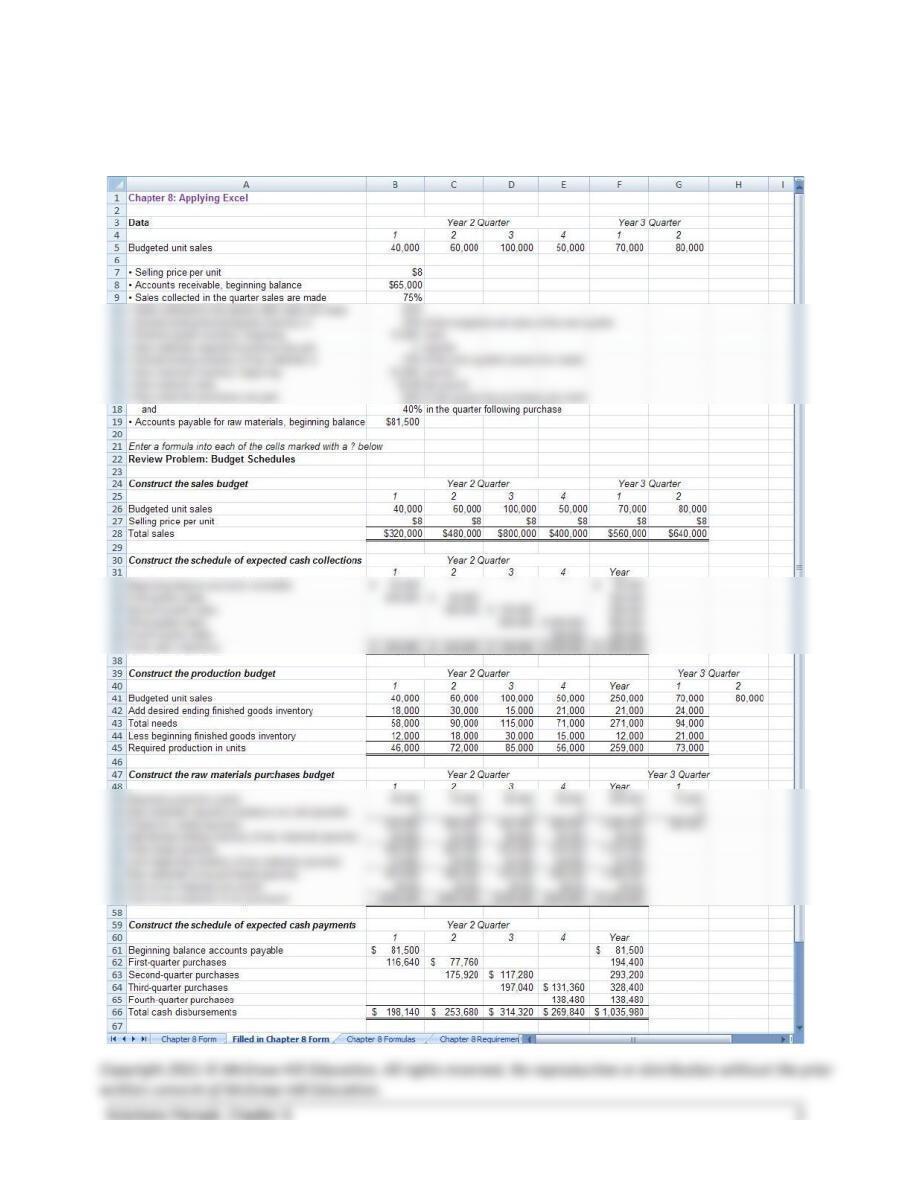
Chapter 8: Applying Excel
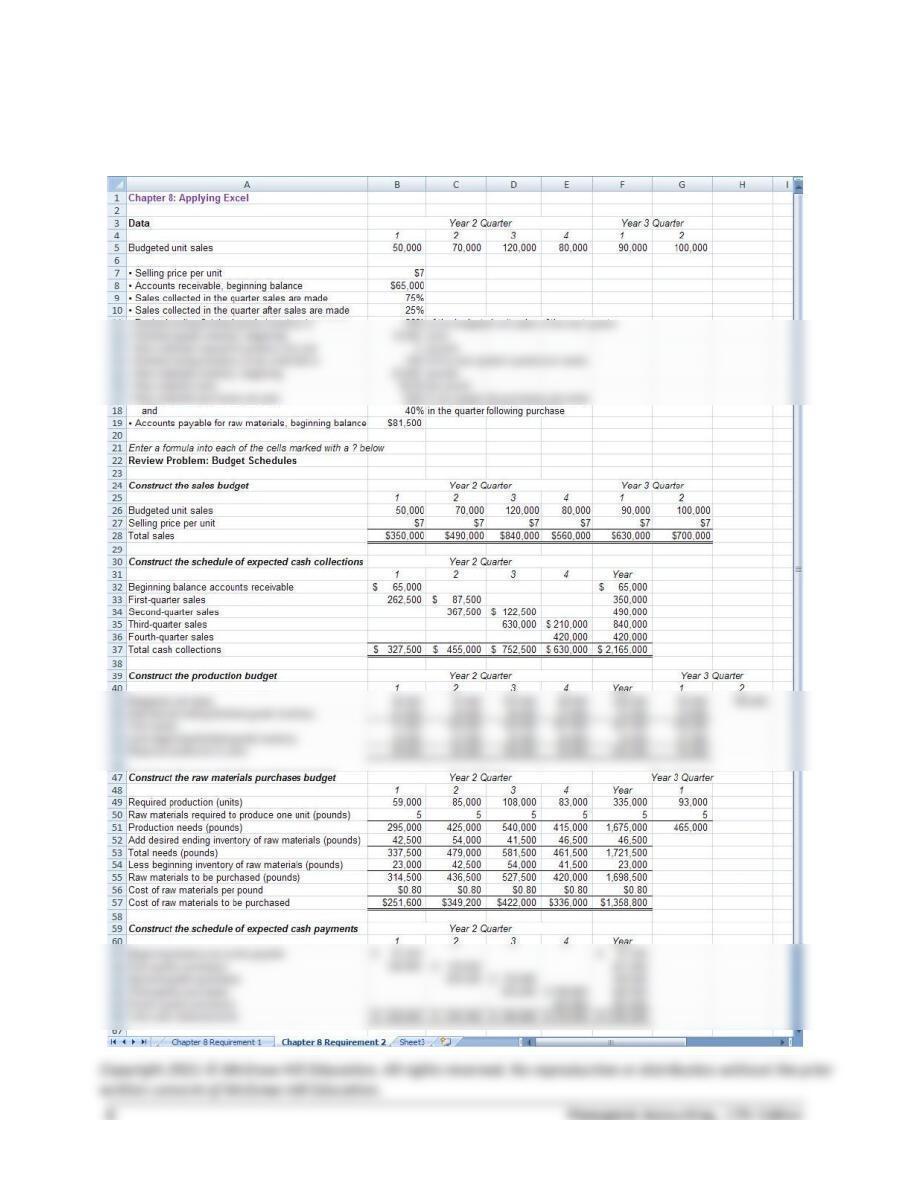
The completed worksheet is shown below.
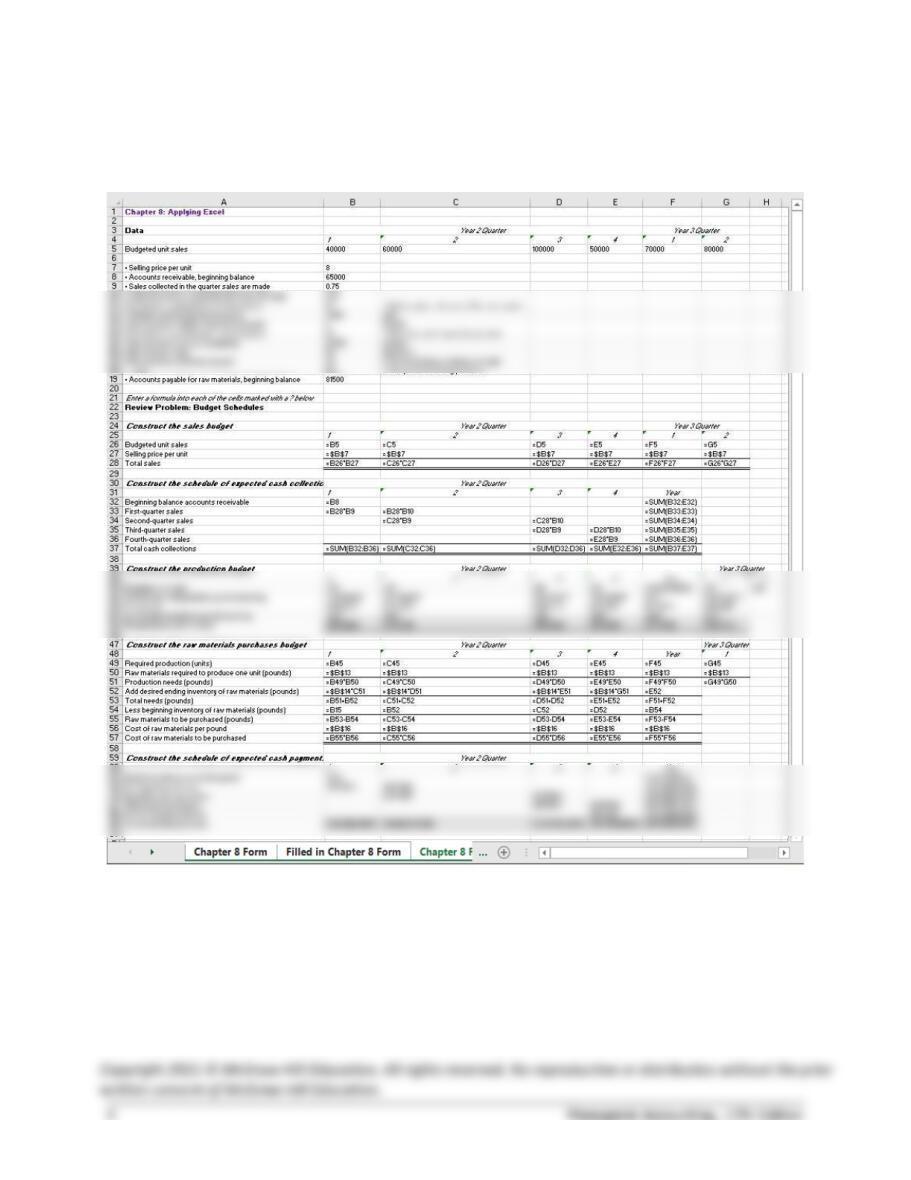
Chapter 8: Applying Excel (continued)
The completed worksheet, with formulas displayed, is shown below.

Chapter 8: Applying Excel (continued)
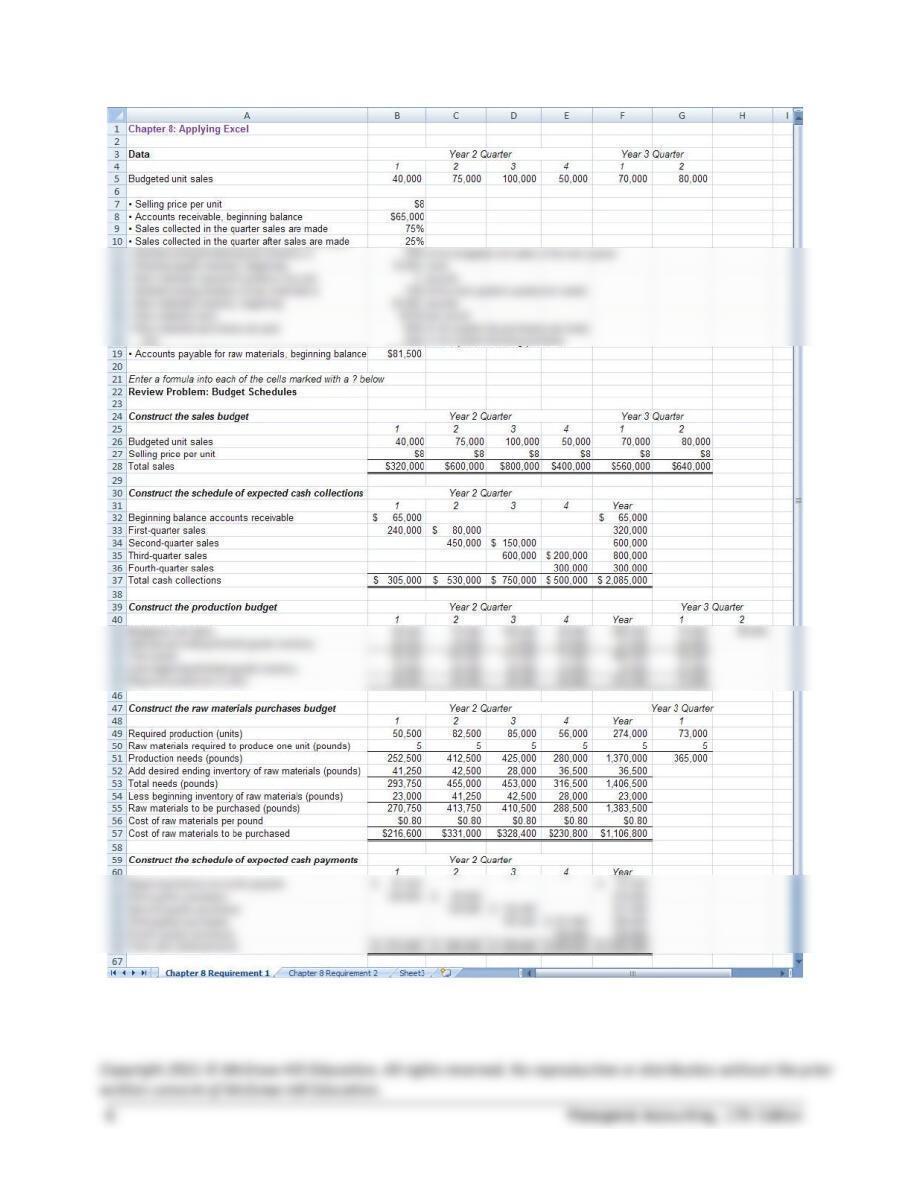
1. When the budgeted unit sales in the second quarter are increased from
60,000 units to 75,000 units, the result is:

Chapter 8: Applying Excel (continued)
The cash disbursements for raw materials have increased from
$1,035,980 to $1,095,980 because the increased unit sales in the
second quarter require additional purchases of raw materials.
Chapter 8: Applying Excel (continued)
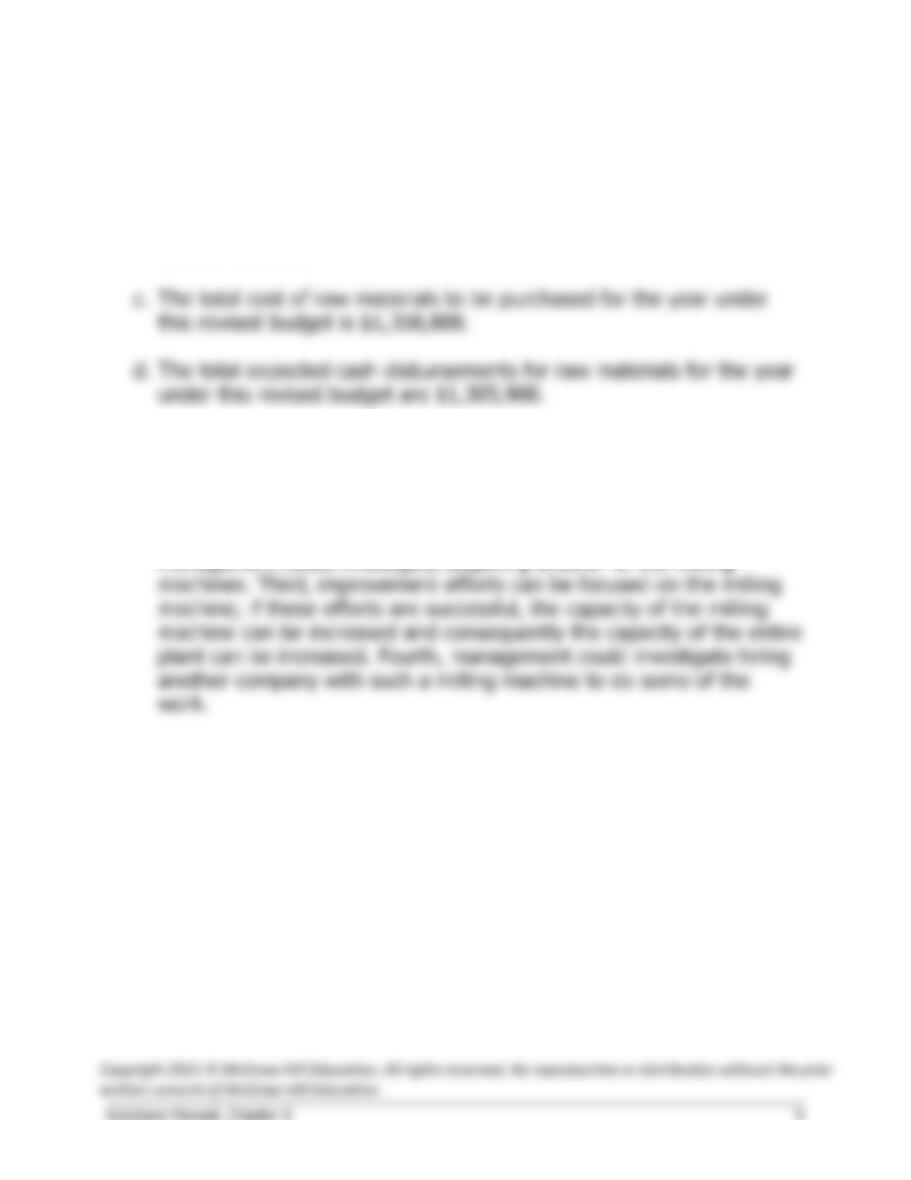
2. With the revised sales budget, the worksheet should look like this:
Chapter 8: Applying Excel (continued)
a. The total expected cash collections for the year under this revised
budget are $2,165,000.
b. The total required production for the year under this revised budget
is 335,000 units.
e. The production constraint of 90,000 units per quarter is a problem in
the third quarter of Year 2 and may be a problem later in Year 3. This
problem can be approached in a variety of ways. First, the excess
capacity in the first and second quarters could be used to build up
finished goods inventories beyond the usual levels. Second,
The Foundational 15
1. The budgeted sales for July are computed as follows:
Unit sales (a) …………………………
10,000
Selling price per unit (b) …………..
$70
Total sales (a) × (b) ………………..
$700,000
2. The expected cash collections for July are computed as follows:
Total cash collections …………….
3. The accounts receivable balance at the end of July is:
July sales (a) …………………………
$700,000
Percent uncollected (b) …………….
60%
Accounts receivable (a) × (b) ……
$420,000
4. The required production for July is computed as follows:
July
Budgeted sales in units ………………
10,000
Add desired ending inventory* …….
2,400
Total needs ……………………………..
Less beginning inventory** ………..
Required production ………………….
The Foundational 15 (continued)
5. The raw material purchases for July are computed as follows:
July
Required production in units of finished goods ……………..
10,400
Units of raw materials needed per unit of finished goods
5
Units of raw materials needed to meet production……….
Add desired units of ending raw materials inventory* …….
Total units of raw materials needed ………………………….
58,100
Units of raw materials to be purchased ……………………..
52,900
6. The cost of raw material purchases for July is computed as follows:
Units of raw materials to be purchased (a) ……..
52,900
Unit cost of raw materials (b)……………………….
$2.00
Cost of raw materials to be purchased (a) × (b)
$105,800
7. The estimated cash disbursements for materials purchases in July is
computed as follows:
July
Total cash disbursements …………
8. The accounts payable balance at the end of July is:
July purchases (a) …………………..
$105,800
Percent unpaid (b) ………………….
70%
Accounts payable (a) × (b) ……….
$74,060
The Foundational 15 (continued)
9. The estimated raw materials inventory balance at the end of July is
computed as follows:
Ending raw materials inventory (pounds) (a) …..
6,100
Cost per pound (b) …………………………………….
$2.00
Raw material inventory balance (a) × (b) ……….
$12,200
10. The estimated direct labor cost for July is computed as follows:
July
Required production in units …………
Direct labor hours per unit ……………
× 2.0
Total direct labor-hours needed (a) ..
Direct labor cost per hour (b) ………..
Total direct labor cost (a) × (b) ……..
11. The estimated unit product cost is computed as follows:
Quantity
Cost
Total
Direct materials ……………….
5 pounds
$2 per pound
$10.00
Direct labor …………………….
2 hours
$15 per hour
30.00
Manufacturing overhead ……
2 hours
$10 per hour
20.00
Unit product cost …………….
$60.00
12. The estimated finished goods inventory balance at the end of July is
computed as follows:
Ending finished goods inventory in units (a) ……
2,400
Unit product cost (b) ………………………………….
$60.00
Ending finished goods inventory (a) × (b) ………
The Foundational 15 (continued)
13. The estimated cost of goods sold for July is computed as follows:
Unit sales (a) ……………………………………………
10,000
Unit product cost (b) ………………………………….
Estimated cost of goods sold (a) × (b) …………..
Total sales (a) …………………………………………..
Cost of goods sold (b) …………………………..……
Estimated gross margin (a) – (b) ………………….
14. The estimated selling and administrative expense for July is computed
as follows:
July
Budgeted unit sales …………………………..…
10,000
Variable selling and administrative ………….
expense per unit ………………………………
× $1.80
Total variable expense ………………………….
$18,000
Fixed selling and administrative expenses …
60,000
Total selling and administrative expenses …
$78,000
15. The estimated net operating income for July is computed as follows:
Gross margin (a) ……………………………………….
Selling and administrative expenses (b) ………….
Net operating income (a) – (b) …………………….
Exercise 8-1 (20 minutes)
1.
April
May
June
Total
February sales:
$230,000 × 10% ……..
$ 23,000
$ 23,000
March sales: $260,000
× 70%, 10% …………..
182,000
$ 26,000
208,000
20%, 70%, 10% ……..
$ 30,000
350,000
450,000
June sales: $200,000 ×
Total cash collections …..
$336,000
April sales: $300,000 ×
2. Accounts receivable at June 30:
From May sales: $500,000 × 10% ……………………
$ 50,000
From June sales: $200,000 × (70% + 10%) ………
160,000
Total accounts receivable at June 30 …………………
$210,000
Exercise 8-2 (10 minutes)
April
May
June
Quarter
Budgeted unit sales ……………..
50,000
75,000
90,000
215,000
Add desired units of ending
finished goods inventory* ……
7,500
9,000
8,000
8,000
Total needs ………………………..
Less units of beginning finished
Required production in units ….
Exercise 8-3 (15 minutes)
Quarter—Year 2
First
Second
Third
Fourth
Year
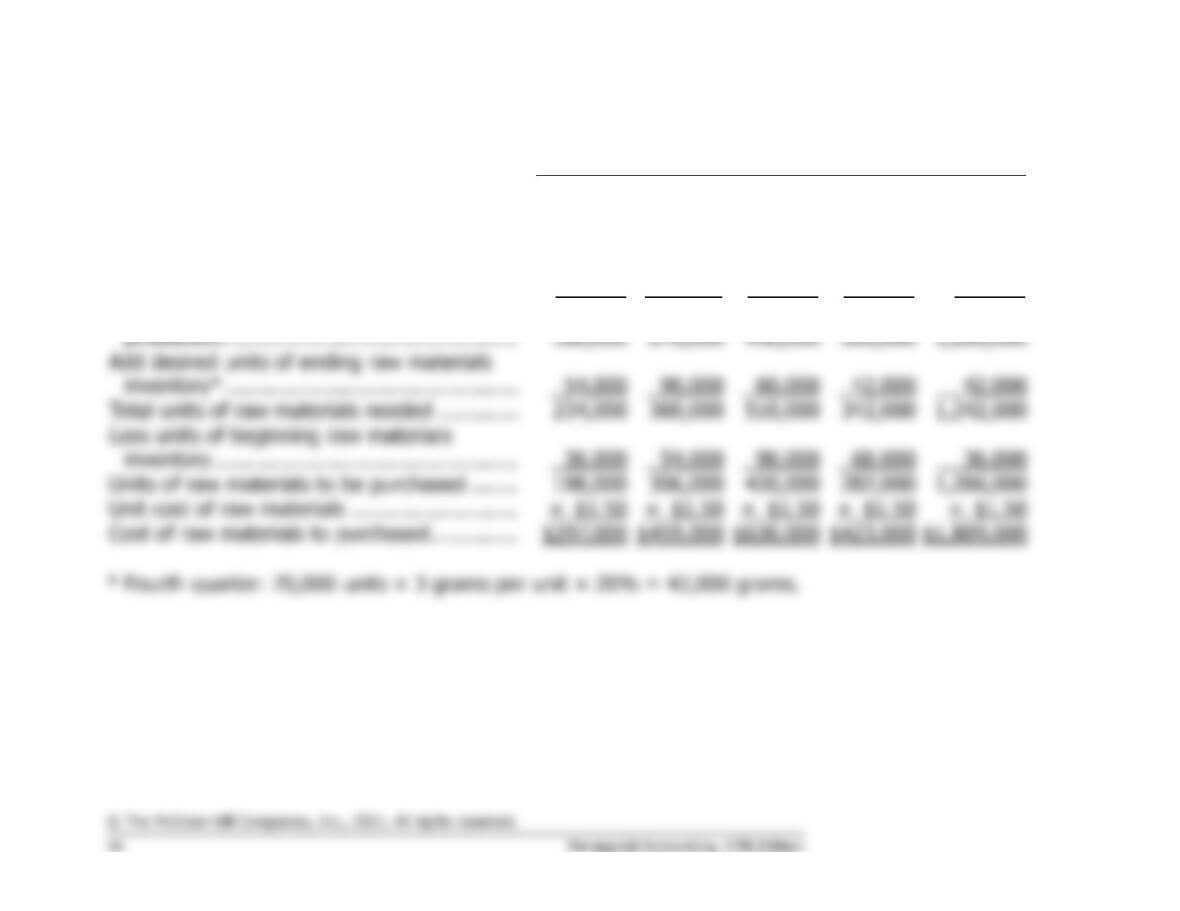
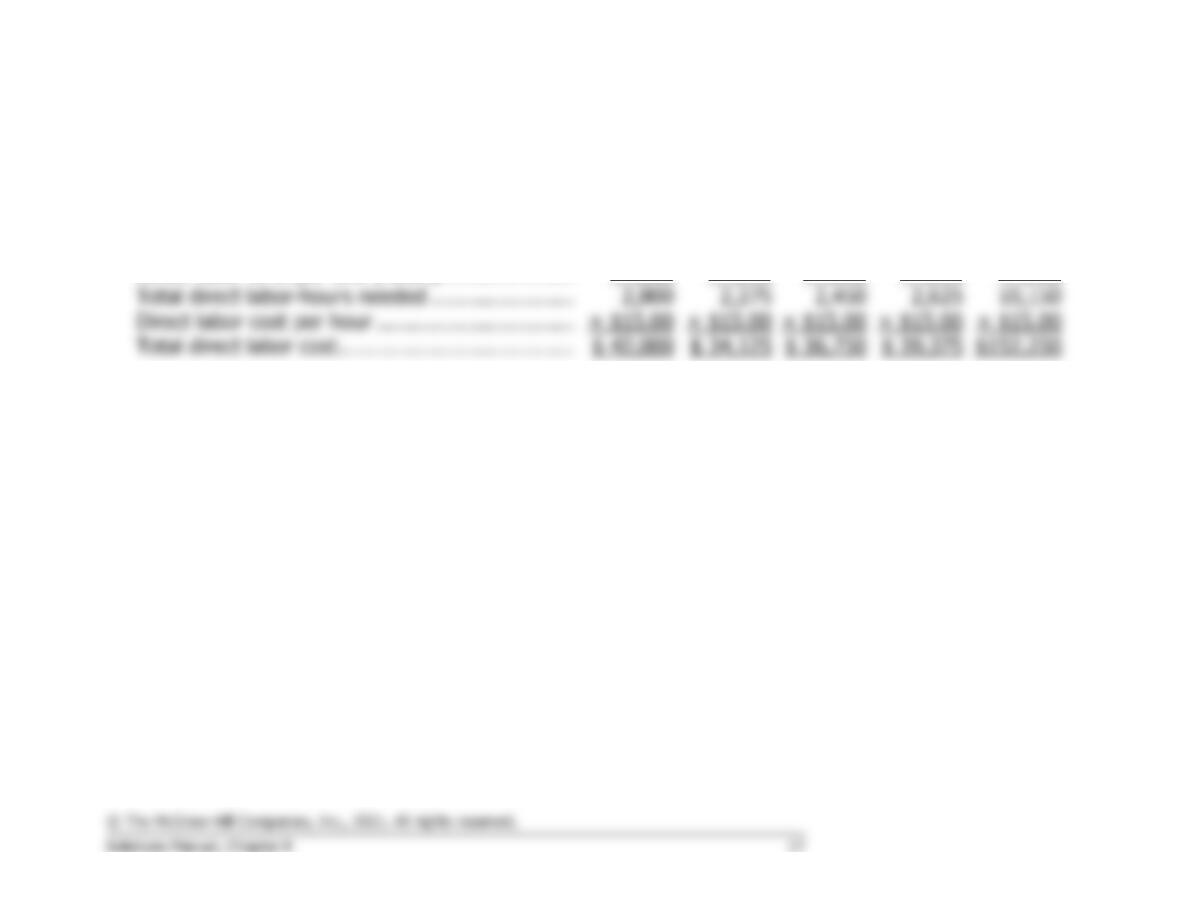
Required production in units of finished
goods ………………………………………………
60,000
90,000
150,000
100,000
400,000
Units of raw materials needed per unit of
finished goods …………………………………..
× 3
× 3
× 3
× 3
× 3
Units of raw materials needed to meet
production …………………………..……………
180,000
270,000
450,000
300,000
inventory* ………………………………………..
Total units of raw materials needed ………….
1,242,000
Less units of beginning raw materials
Units of raw materials to be purchased ……..
1,206,000
Unit cost of raw materials ………………………
Cost of raw materials to purchased …………..
Exercise 8-4 (10 minutes)
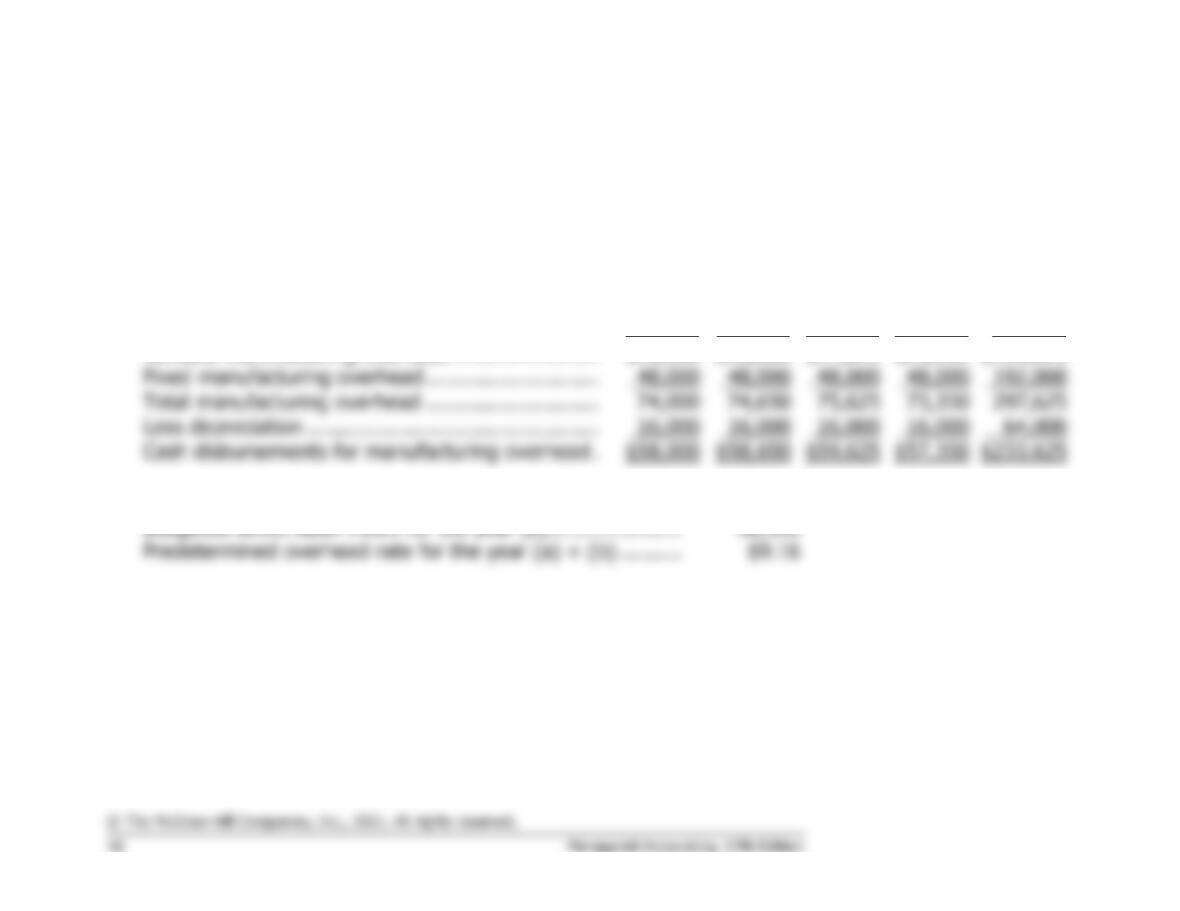
The direct labor budget is as follows:
1st
Quarter
2nd
Quarter
3rd
Quarter
4th
Quarter
Year
Required production in units ……………………….
8,000
6,500
7,000
7,500
29,000
Exercise 8-5 (15 minutes)
1.
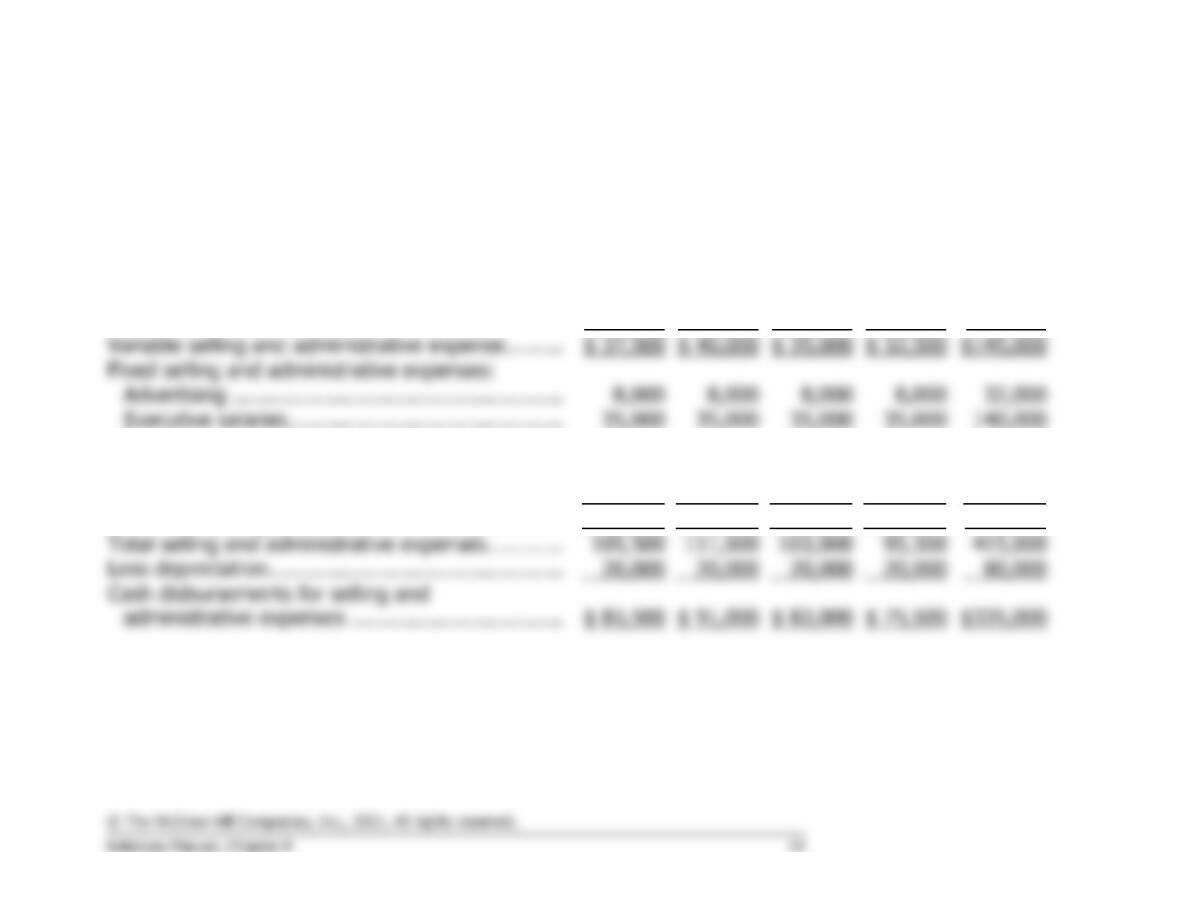
Yuvwell Corporation
Manufacturing Overhead Budget
1st
Quarter
2nd
Quarter
3rd
Quarter
4th
Quarter
Year
Budgeted direct labor-hours…………………………..
8,000
8,200
8,500
7,800
32,500
Variable manufacturing overhead rate ……………..
× $3.25
× $3.25
× $3.25
× $3.25
× $3.25
Variable manufacturing overhead ……………………
$26,000
$26,650
$27,625
$25,350
Fixed manufacturing overhead ……………………….
Total manufacturing overhead ……………………….
Less depreciation ………………………………………..
Cash disbursements for manufacturing overhead .
2.
Total budgeted manufacturing overhead for the year (a) …
$297,625
Budgeted direct labor-hours for the year (b) …………………
Predetermined overhead rate for the year (a) ÷ (b) ……….
Exercise 8-6 (15 minutes)
Weller Company
Selling and Administrative Expense Budget
1st
Quarter
2nd
Quarter
3rd
Quarter
4th
Quarter
Year
Budgeted unit sales …………………………………….
15,000
16,000
14,000
13,000
58,000
Variable selling and administrative expense per
unit ……………………………………………………….
× $2.50
× $2.50
× $2.50
× $2.50
× $2.50
Variable selling and administrative expense ………
Fixed selling and administrative expenses:
Advertising ……………………………………………..
8,000
8,000
8,000
8,000
32,000
Executive salaries ……………………………………..
35,000
35,000
35,000
35,000
Insurance ……………………………………………….
5,000
5,000
10,000
Property taxes …………………………………………
8,000
8,000
Depreciation ……………………………………………
20,000
20,000
20,000
20,000
80,000
Total fixed selling and administrative expenses ….
68,000
71,000
68,000
63,000
270,000
Total selling and administrative expenses …………
105,500
111,000
103,000
95,500
Less depreciation ………………………………………..
Exercise 8-7 (15 minutes)
Garden Depot
Cash Budget
1st
Quarter
2nd
Quarter
3rd
Quarter
4th
Quarter
Year
Beginning cash balance .
$ 20,000
$ 10,000
$ 35,800
$ 25,800
$ 20,000
Total cash receipts ……..
180,000
330,000
210,000
230,000
950,000
Total cash available ……
200,000
340,000
245,800
255,800
970,000
260,000
230,000
220,000
240,000
950,000
(60,000)
110,000
25,800
20,000
Financing:
Borrowings (at
beginnings of
quarters)* ……………
70,000
70,000
Repayments (at ends
of quarters) ………….
(70,000)
(70,000)
Interest§ ………………..
(4,200)
(4,200)
Total financing ………….
70,000
(74,200)
(4,200)
Ending cash balance …..
$ 10,000
$ 35,800
$ 25,800
$ 15,800
$ 15,800