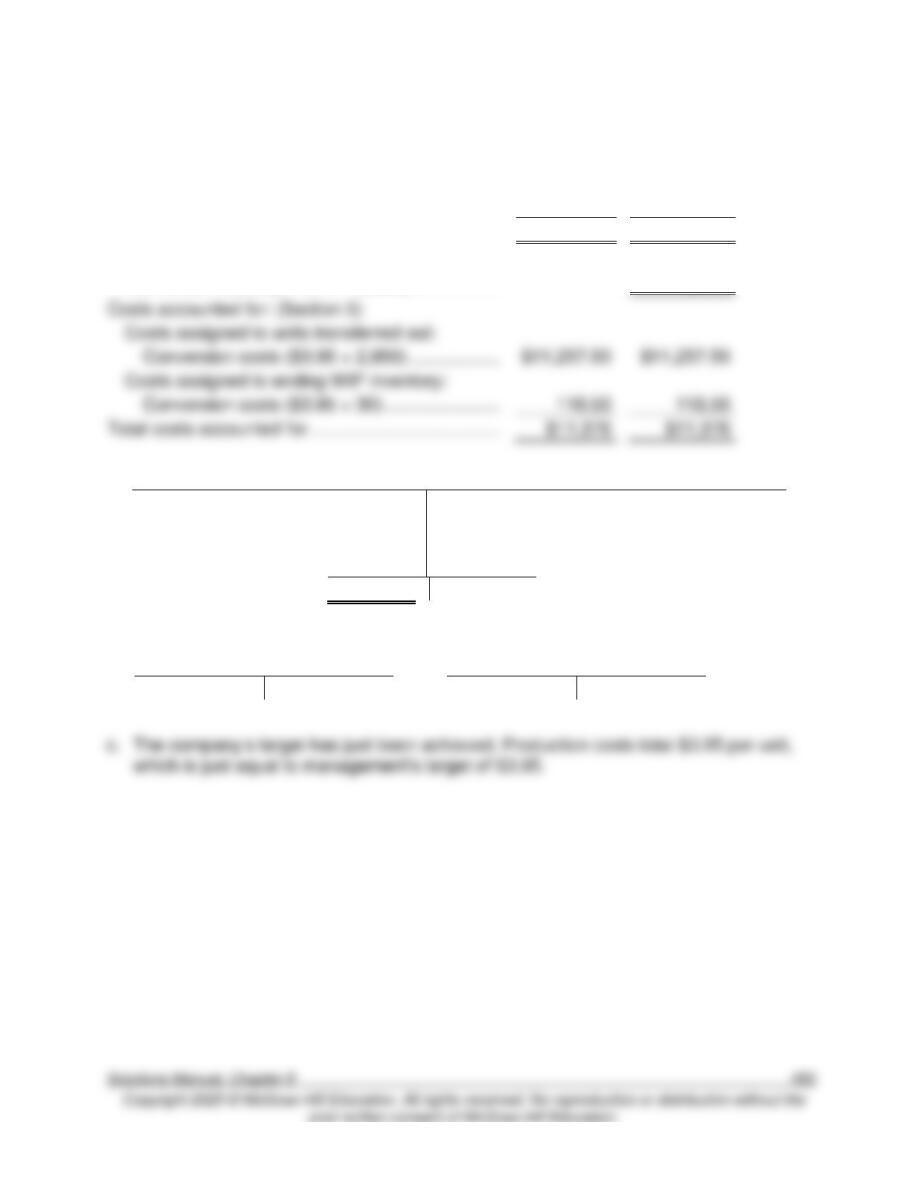
8-59. (continued)
Costs
Total costs
Conversion
costs
Costs to be accounted for: (Section 3)
Costs in beginning WIP inventory ………………….
$ 576
$ 576
Current period costs ……………………………………
10,800
10,800
Total costs to be accounted for ………………………..
$11,376
$11,376
Cost per equivalent unit: (Section 4)
Conversion costs ($11,376 2,880) ………………
$3.95
Costs accounted for: (Section 5)
Costs assigned to units transferred out:
Conversion costs ($3.95 × 2,850) ………………
Costs assigned to ending WIP inventory:
Conversion costs ($3.95 × 30) …………………..
Total costs accounted for ………………………………..
b.
Work in Process
Beginning inventory:
Conversion costs
576.00
This period’s costs:
Conversion costs
10,800.00
11,257.50
To Finished Goods Inventory
Ending inventory
118.50
All costs have been accounted for.
Various Payables
Finished Goods Inventory
10,800
11,257.50
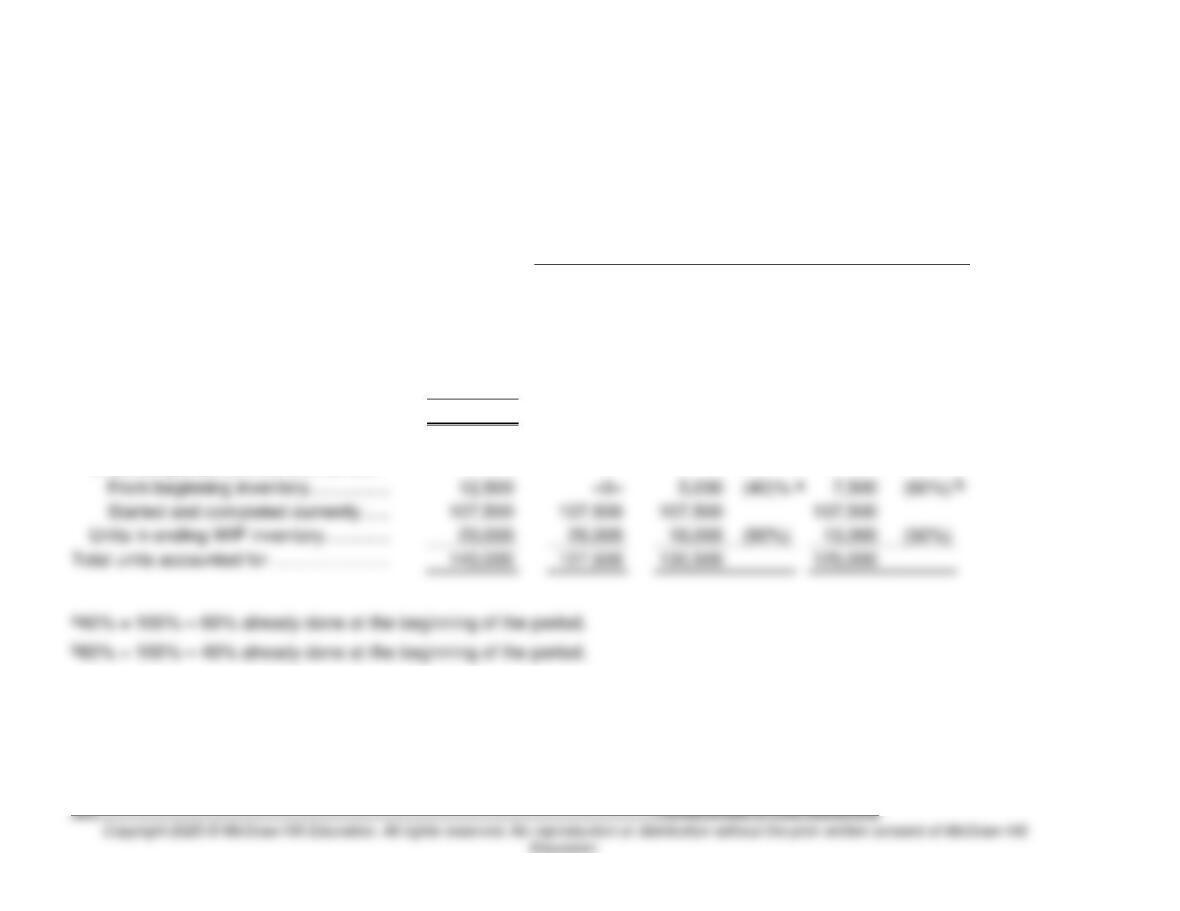
8-60. (60 min.) FIFO Process Costing: Pantanal, Inc.
Pantanal, Inc.
Assembling Department
Production Cost Report—FIFO
Flow of Production Units
(Section 1)
(Section 2)
COMPUTE EQUIVALENT UNITS
Physical units
Prior
department
costs
Materials
Conversion
Units to be accounted for:
Beginning WIP inventory ………………..
12,500
Units started this period ………………….
127,500
Total units to be accounted for ……………
140,000
Units accounted for:
Units completed and transferred out:
Started and completed currently …..
107,500
Units in ending WIP inventory ………….
20,000
Total units accounted for ……………………
130,500
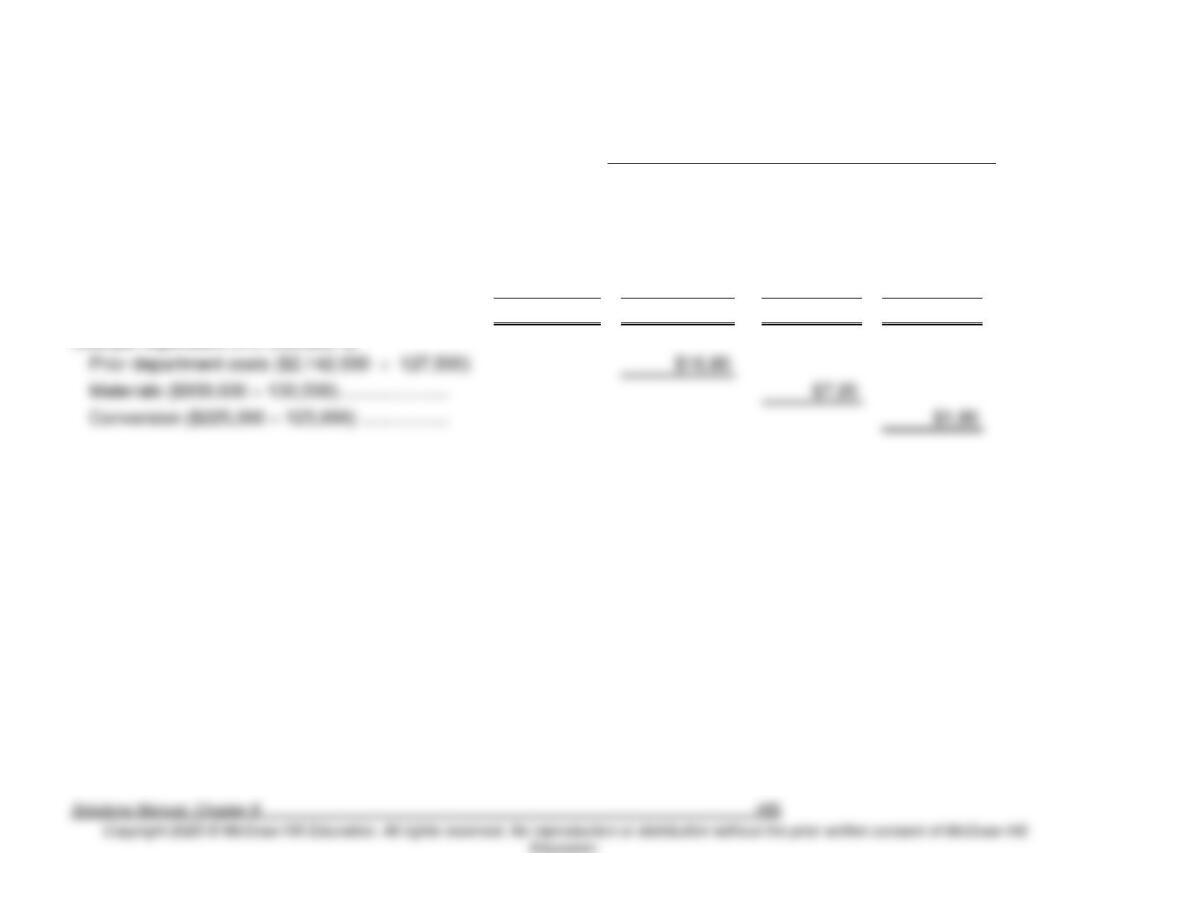
8-60. (continued)
Costs
DETAILS
Total Costs
Prior
department
costs
Materials
Conversion
Costs to be accounted for: (Section 3)
Costs in beginning WIP inventory ……………….
$323,400
$ 98,000
$ 164,400
$ 61,000
Current period costs …………………………………
3,306,600
2,142,000
939,600
225,000
Total costs to be accounted for ……………………..
$3,630,000
$2,240,000
$1,104,000
$286,000
Cost per equivalent unit: (Section 4)
Prior department costs ($2,142,000 127,500)
Materials ($939,600 130,500) ………………….
Conversion ($225,000 125,000) ………………
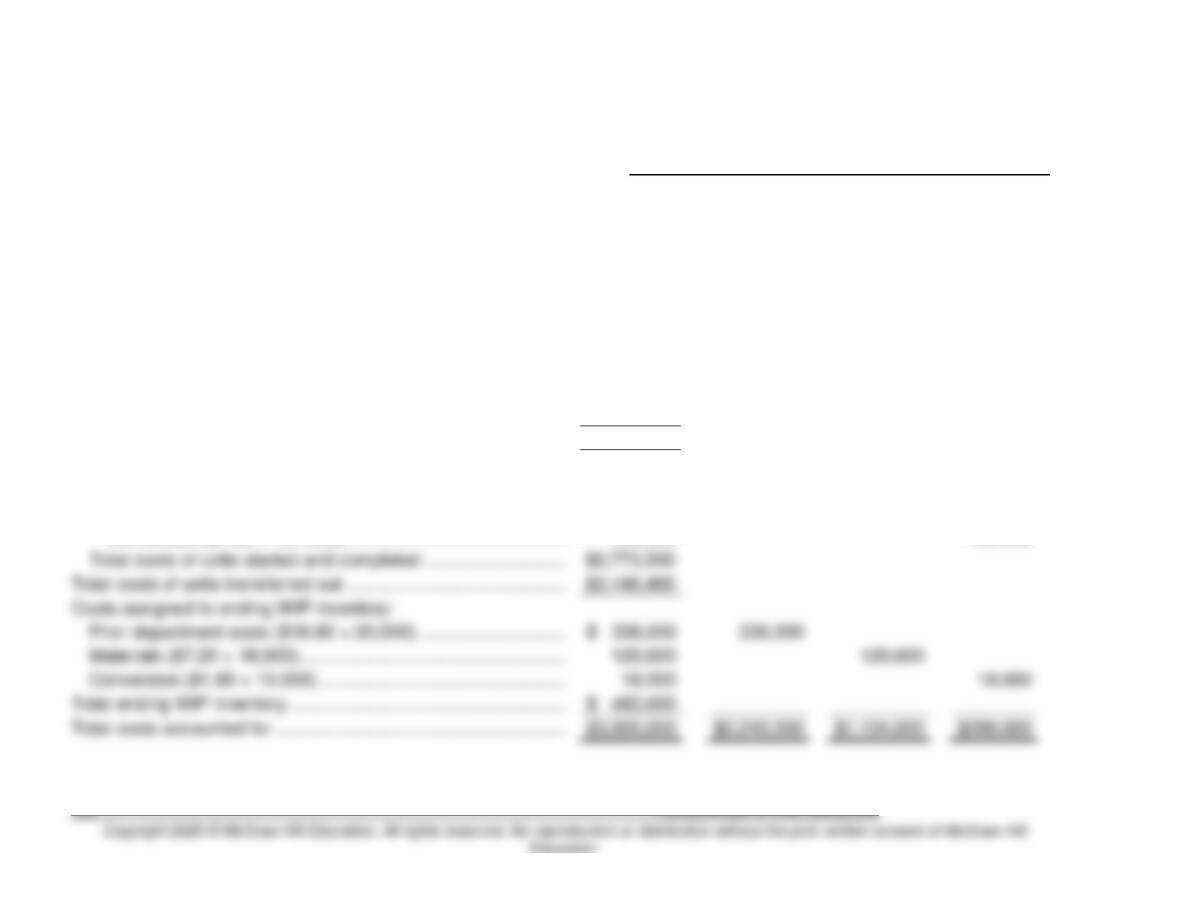
8-60. (continued)
Details
Total Costs
Prior
department
costs
Materials
Conversion
Costs accounted for: (Section 5)
Costs assigned to units transferred out:
Costs from beginning WIP inventory …………………………….
$ 323,400
$ 98,000
$ 164,400
$ 61,000
Current costs added to complete beginning WIP inventory:
Prior department costs ……………………………………………
–0–
–0–
Materials ($7.20 × 5,000) ………………………………………..
36,000
36,000
Conversion ($1.80 × 7,500) …………………………………….
13,500
13,500
Total costs from beginning inventory …………………………….
$ 372,900
Current costs of units started and completed:
Prior department costs ($16.80 × 107,500) ……………………
$1,806,000
1,806,000
Materials ($7.20 × 107,500) ………………………………………..
774,000
774,000
Conversion ($1.80 × 107,500) ……………………………………..
Total costs of units started and completed ……………………….
$2,773,500
$3,146,400
Costs assigned to ending WIP inventory:
Prior department costs ($16.80 × 20,000) ………………………..
$ 336,000
Materials ($7.20 × 18,000) ……………………………………………..
129,600
129,600
Conversion ($1.80 × 10,000) ………………………………………….
18,000
$ 483,600
Total costs accounted for ………………………………………………….
$3,630,000
$286,000
8-61. (50 min.) Prepare a Production Cost Report—Weighted-Average Method:
Saline Solutions.
a. 60 percent complete. The key to this problem is to set up the production cost report to
the extent you can and then fill in the missing information.
Physical
Units
Equivalent Units
Materials
Conversion
Flow of units:
Units to be accounted for:
Beginning WIP inventory …………………….
50,000
Units started this period ………………………
490,000
Total units to account for ………………….
540,000
Units accounted for:
Completed and transferred out …………….
470,000
470,000
470,000
Units in ending inventory …………………….
70,000
Mixing (70,000 units × 100%) …………..
Finishing (70,000 units × ??% [i]) ………
h
Total units accounted for ………………
540,000
b
512,000
Total
Direct
Materials
Conversion
Costs
Flow of costs:
Costs to be accounted for:
Costs in beginning WIP inventory …………
$482,424
$438,400
d
$ 44,024
e
Current period costs …………………………..
5,043,976
3,449,600
1,594,376
Total costs to be accounted for …………
$5,526,400
$3,888,000
c
$1,638,400
f
Cost per equivalent unit
Materials ($3,888,000 ÷ 540,000 units) …
$ 7.20
a
Conversion ($1,638,400 ÷ 512,000 [g]) …
$ 3.20
a
Costs accounted for:
Costs assigned to units transferred out …
$4,888,000
$3,384,000
$1,504,000
Costs of ending WIP inventory …………….
Total costs accounted for ……………………….
$5,526,400
$3,888,000
$1,638,400
8-61. (continued)
Notes:
a. Given.
b. Because the units are fully complete with respect to materials, the equivalent
units are equal to the physical units.
c. $3,888,000 = 540,000 EU × $7.20.
d. $438,400 = $3,888,000 – $3,449,600.
e. $44,024 = $482,424 (given) – $438,400.
b. $4,888,000 (see the cost of production report).
c. $638,400 (see the cost of production report).
8-62. (30 min.) Determine Degree of Completion—FIFO method: Saline Solutions.
a. The ending work in process is at least 60% complete with respect to conversion costs.
This is a problem that requires relatively few computations, but a thorough understanding
of process costing. There are various ways to work through to an answer; the following is
one.
First, note that rubber is added at the beginning of the process, so that any work–in–
process inventories are always fully complete with respect to rubber. Second, the
beginning work-in-process inventory is 80% complete with respect to conversion, so it is
fully complete with respect to thinner as well.
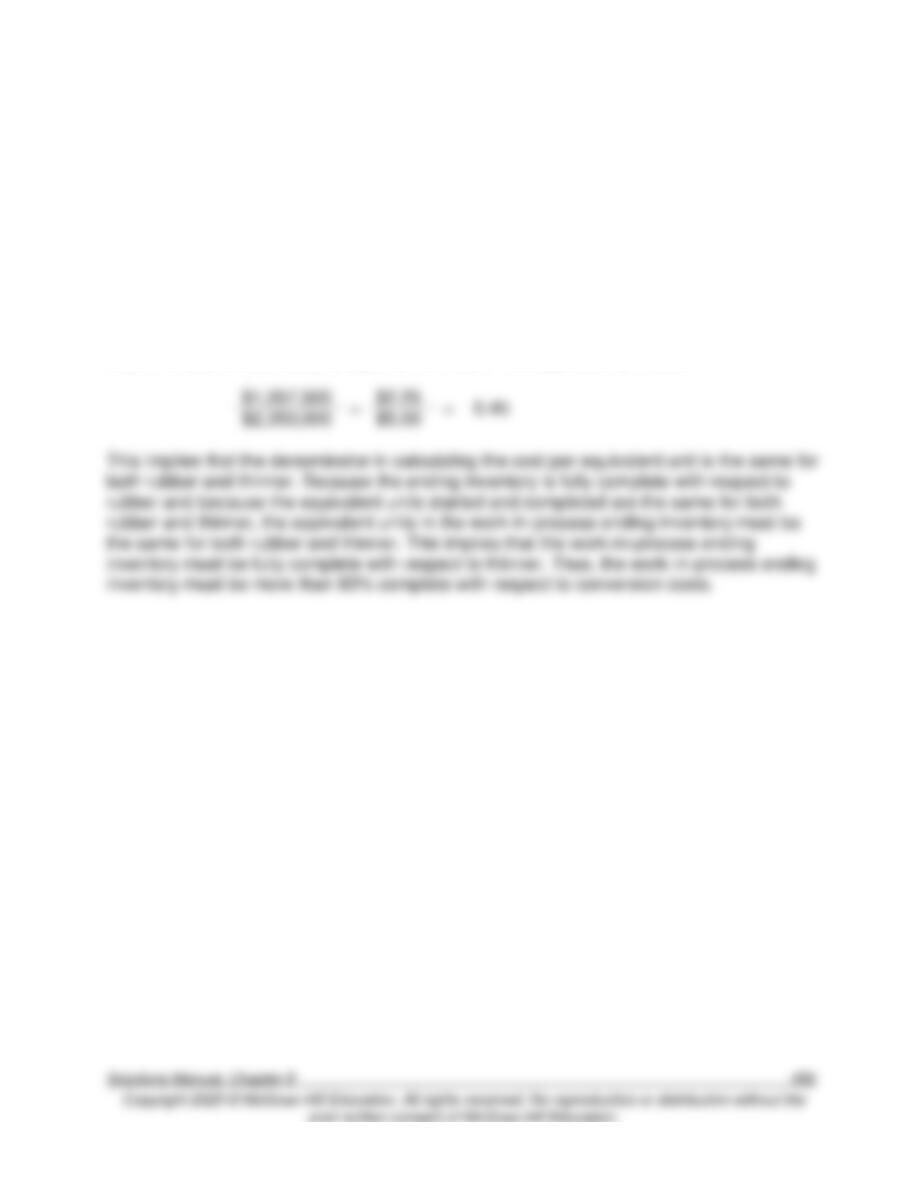
Now, the ratio of total costs is equal to the ratio of the equivalent unit cost:
8-63. (40 min.) Solving For Unknowns—FIFO Method.
a.
Units started and completed equals the units transferred out (units completed this
period) less the units started in a previous period (beginning inventory):
40,000
units transferred out
–5,000
units in beginning inventory
35,000
units started and completed.
b.
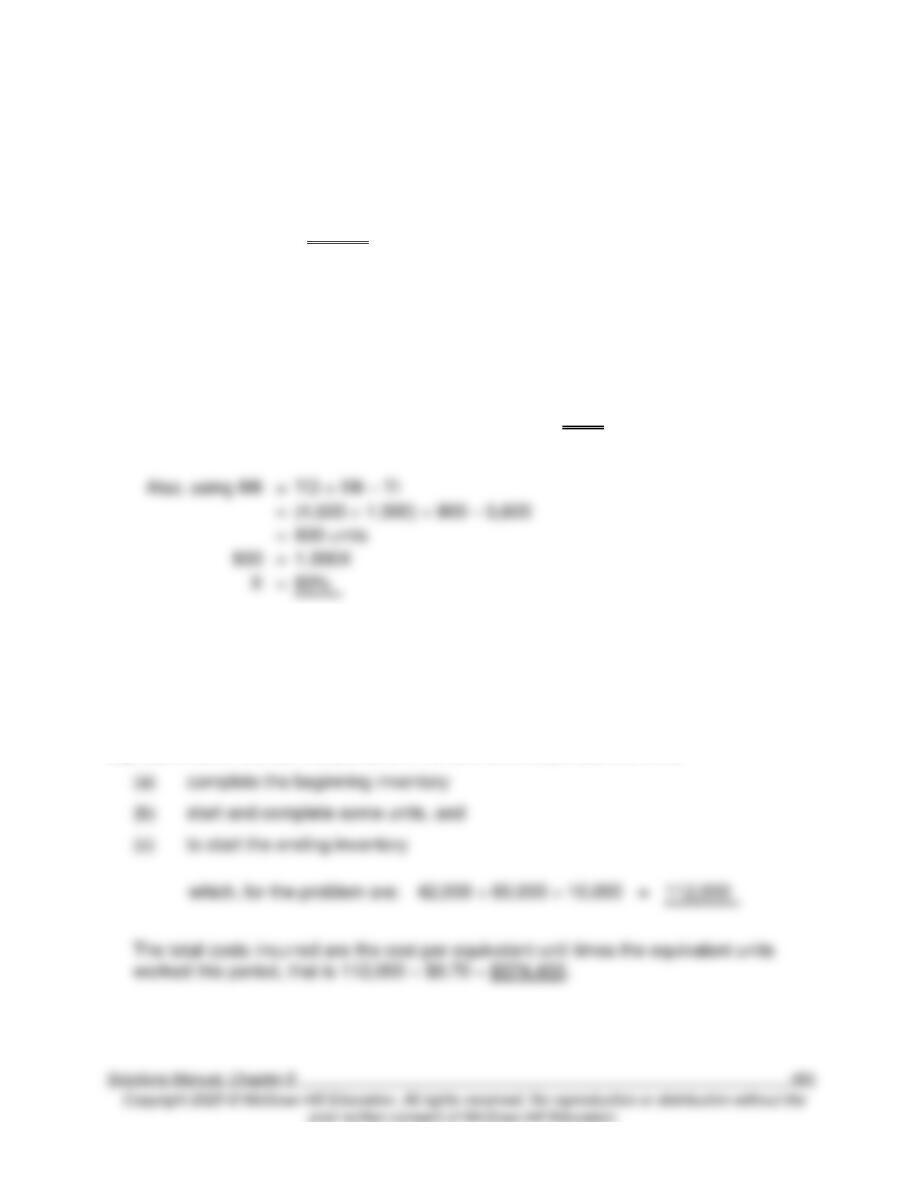
Current units started
8-63. (continued)
c.
Equivalent units
=
Beginning inventory
x (1 – percentage of completion of beginning inventory)
+ 100% of units started and completed
+ ending inventory times its percentage of completion
=
5,600
equivalent units
Let X be the unknown percentage of completion. Then,
5,600
=
1,000 (1 – X) + 4,500 + (3,000 × 30%)
5,600
=
1,000 – 1,000X + 5,400
collecting terms:
5,600 – 5,400 – 1,000
=
–1,000X
800
=
1,000X
X
=
80%
TO + EB – TI
=
(4,500 + 1,000) + 900 – 5,600
=
800 units
1,000X
=
d. The cost per equivalent unit is obtained by dividing the ending inventory costs by the
equivalent units in ending inventory:
$87,000 ÷ 10,000
= $8.70 per EU
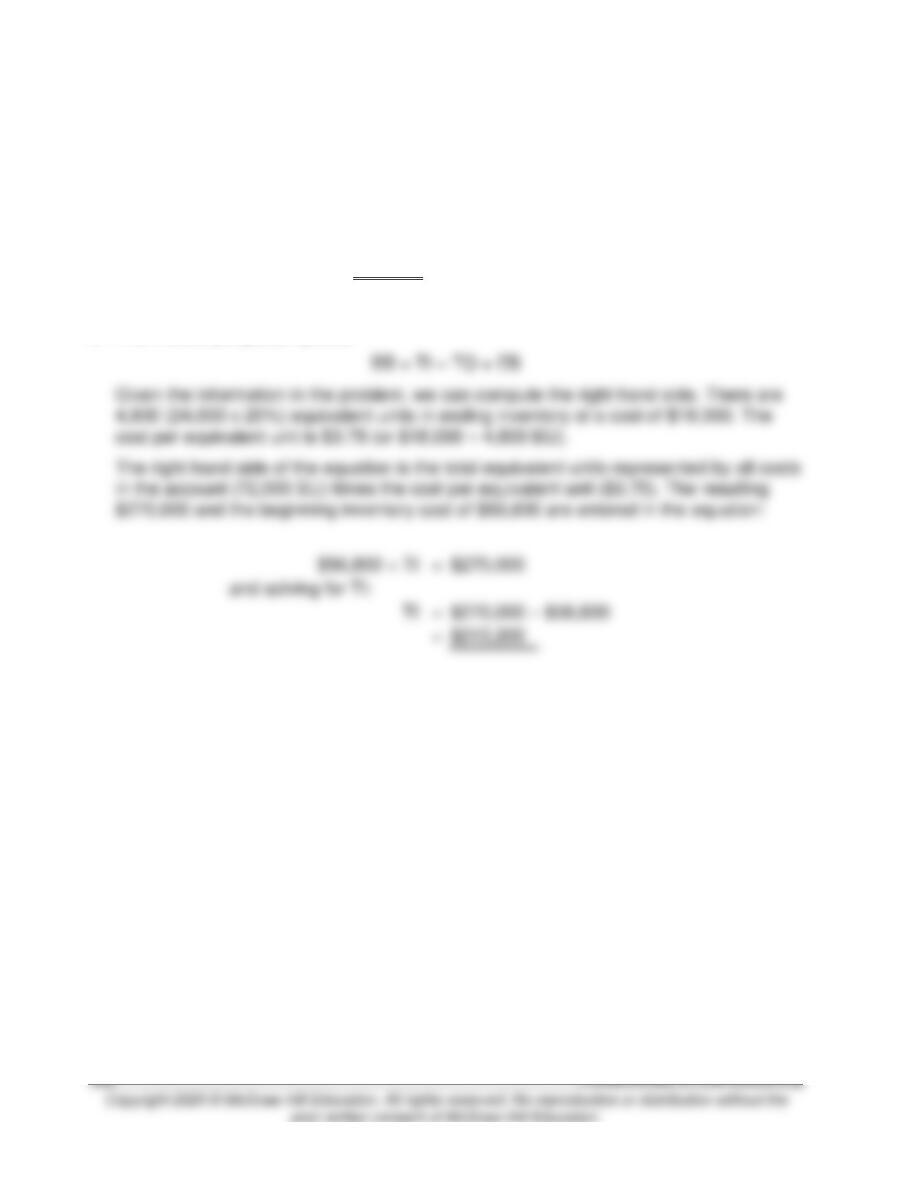
Equivalent units worked this period are the sum of the equivalent units to:
which, for the problem are:
42,000 + 60,000 + 10,000
=
8-64. (50 min.) Solving For Unknowns—Weighted-Average Method.
a. Units transferred out equals beginning inventory plus current work minus ending
inventory. In equation form:
TO
=
BB + TI (current work) – EB
=
12,300 + 10,500 – 10,000
=
12,800
b. The inventory equation yields:
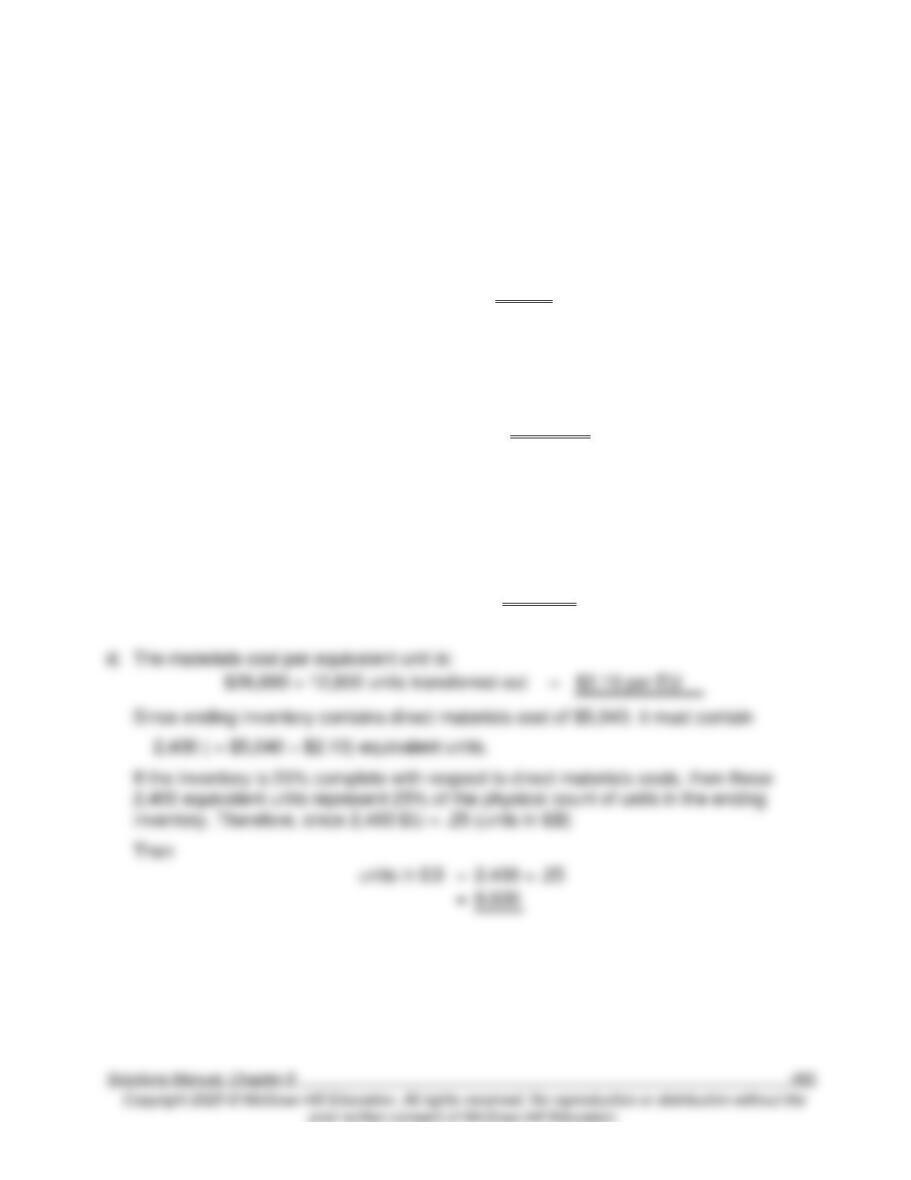
$270,000
and solving for TI:
$270,000 – $56,800
$213,200
8-64. (continued)
c. First, we compute the cost of ending inventory:
BB + TI (current work)
=
TO + EB
$11,400 + $108,600
=
$115,200 + EB
EB
=
$120,000 – $115,200
=
$4,800
Equivalent units in ending inventory equals $4,800 divided by the cost per
equivalent unit.
Costs per equivalent unit is the $115,200 transferred out costs divided by the units
transferred out:
$115,200 ÷ 28,800 units
=
$4 per EU
Cost assigned to ending inventory is based on the relationship:
$4,800 = Equivalent units in EB times $4.00 and solving for EU in EB
EU in EB
=
$4,800 ÷ $4
=
1,200 EU
$26,880 ÷ 12,800 units transferred out
=
$2.10 per EU
units in EB
=
2,400 ÷ .25
9,600
8-65. (20 min.) Job Costing and Process Costing: Franklin Corporation.
Note: Part (a) is a job costing problem, but the purpose is to illustrate that the two
approaches differ by how costs are accumulated, but not in the basic idea: that
costs incurred are allocated to products in a systematic way. If students have not
been introduced to job costing (unlikely if they are learning process costing), this
might not be an appropriate assignment.
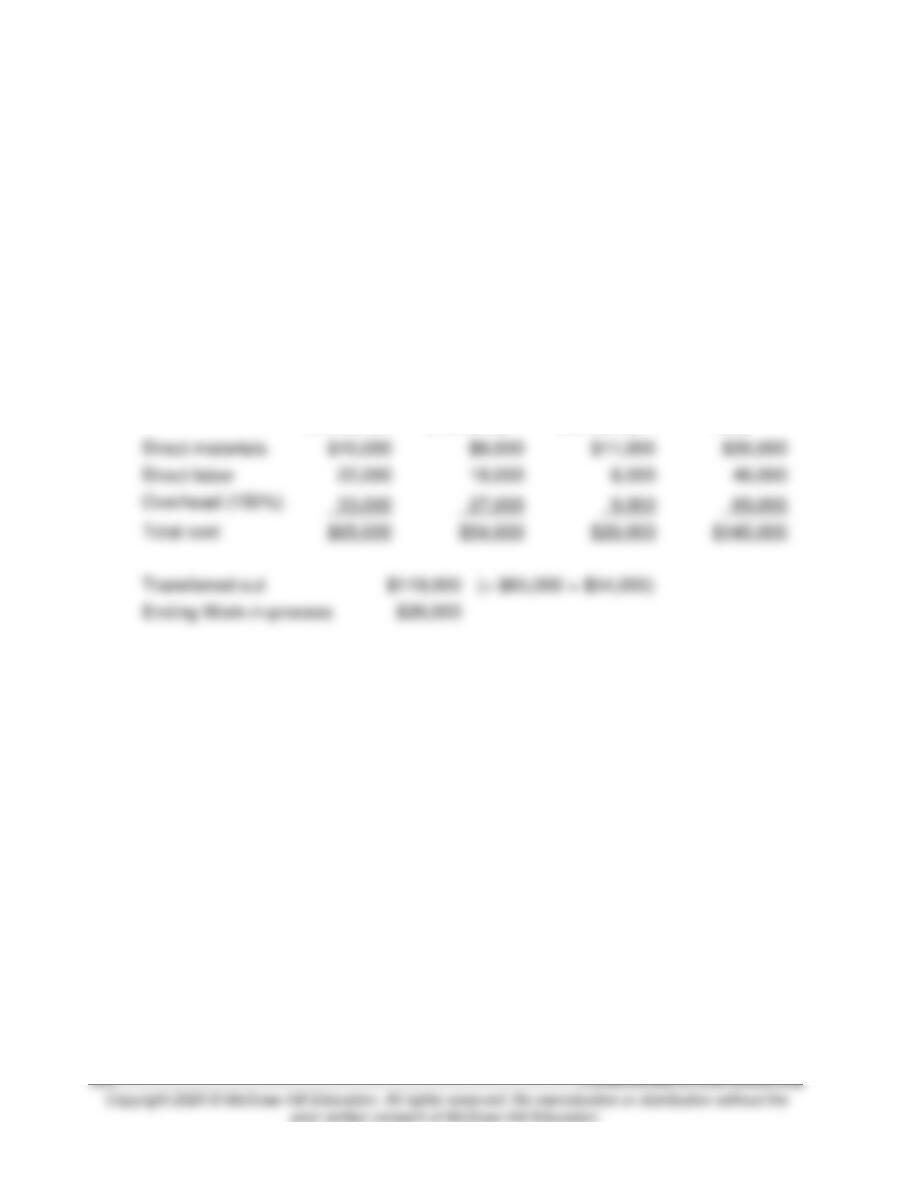
a. First, compute the predetermined overhead rate and apply overhead to the jobs
(units).
Predetermined rate
=
(Conversion Cost
÷
Direct labor cost)
Assembly:
150%
=
($69,000
÷
$46,000)
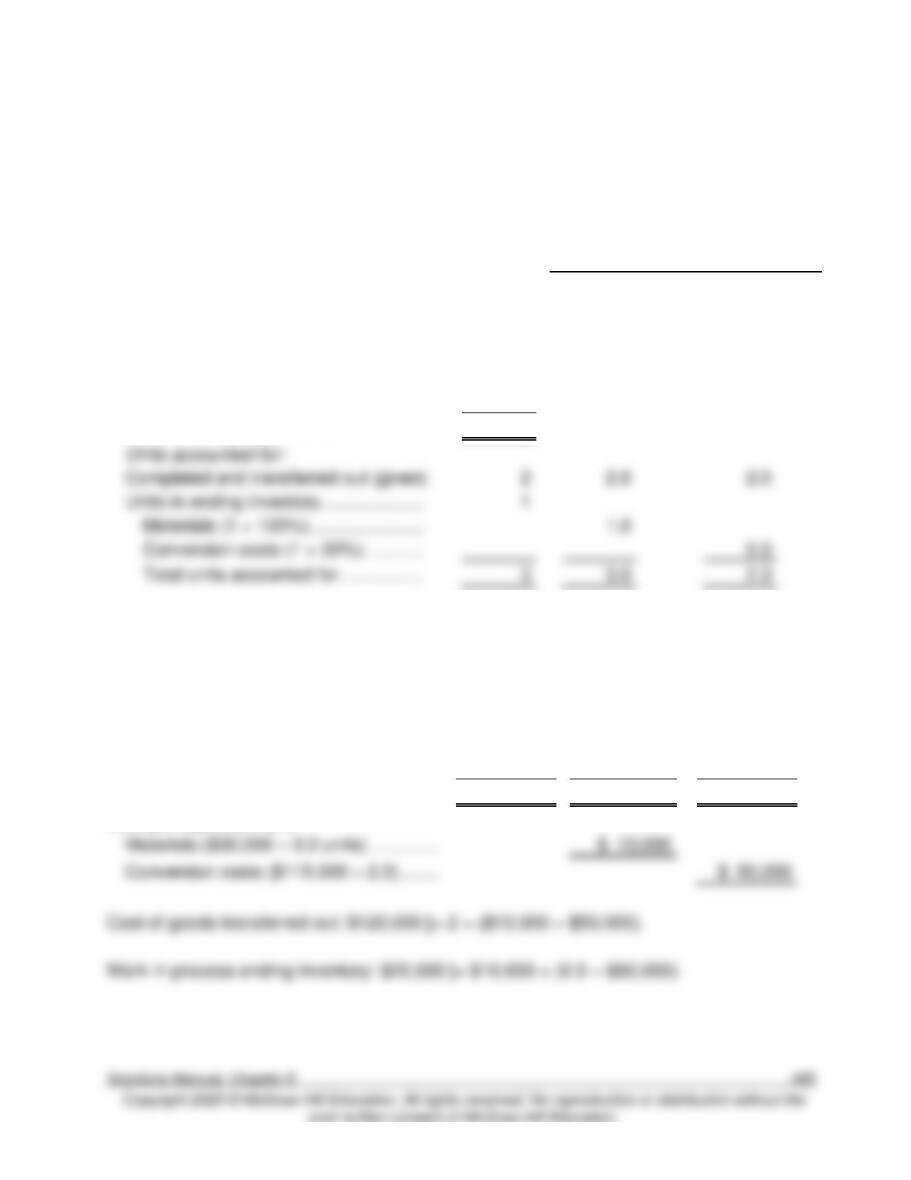
Unit 03-01
Unit 03-02
Unit 03-03
Total
Direct materials
Direct labor
Total cost
Transferred out
(= $65,000 + $54,000)
8-65. (continued)
b. Using process costing, the company combines direct labor costs and overhead into
conversion costs. Note that because there is no beginning work in process, there is no
difference between the weighted-average method and the FIFO method.
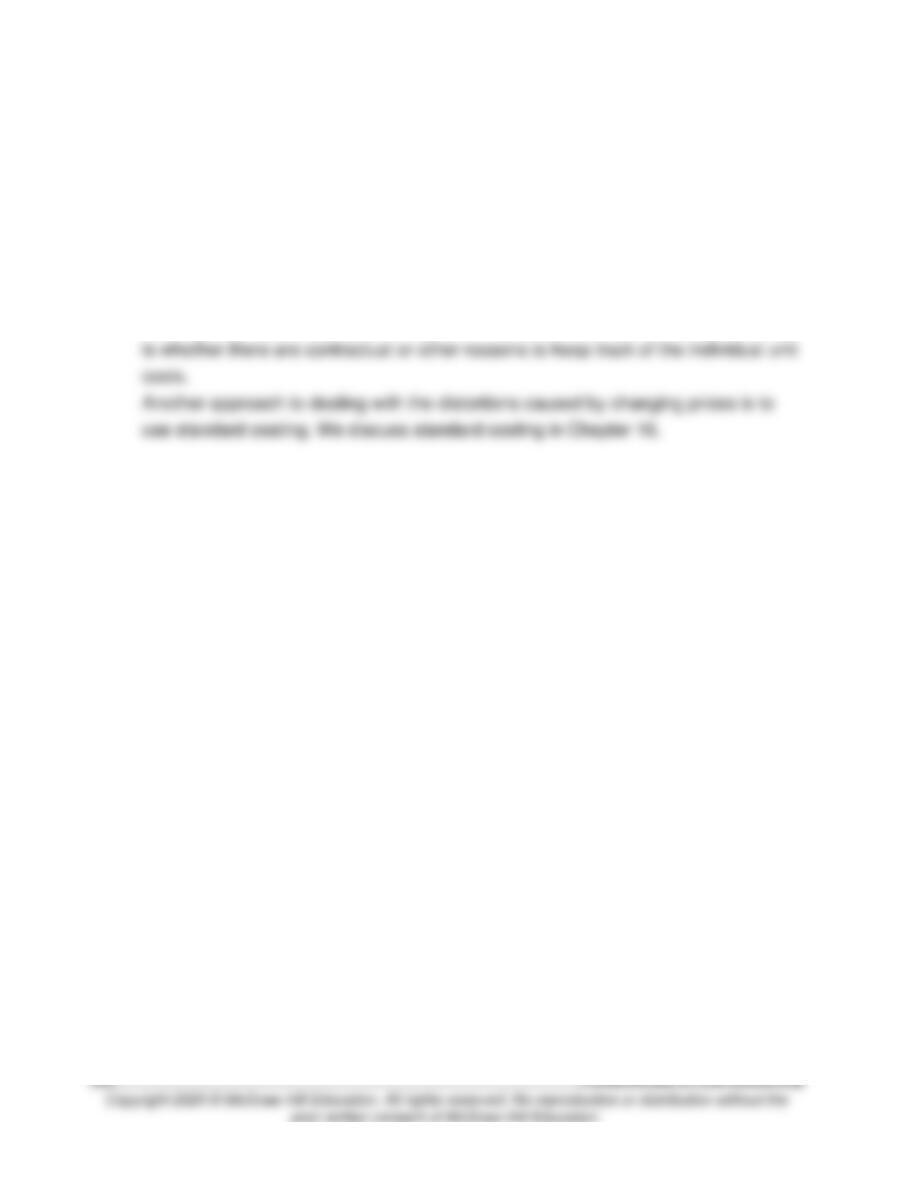
Physical
Units
Equivalent Units
Materials
Eq. units
Conversion Costs
Eq. units
Flow of units:
Units to be accounted for:
Beginning WIP inventory ………………..
0
Units started this perioda
3
Total units to account for ……………..
3
Completed and transferred out (given)
2
Materials (1 × 100%) …………………..
Conversion costs (1 × 30%) …………
Total units accounted for ……………..
3
Total
Direct
Materials
Conversion
Costs
Flow of costs:
Costs to be accounted for:
Costs in beginning WIP inventory ……….
$ 0
$ 0
$ 0
Current period costs …………………………
145,000
30,000
115,000
Total costs to be accounted for ……….
$145,000
$30,000
$115,000
Cost per equivalent unit
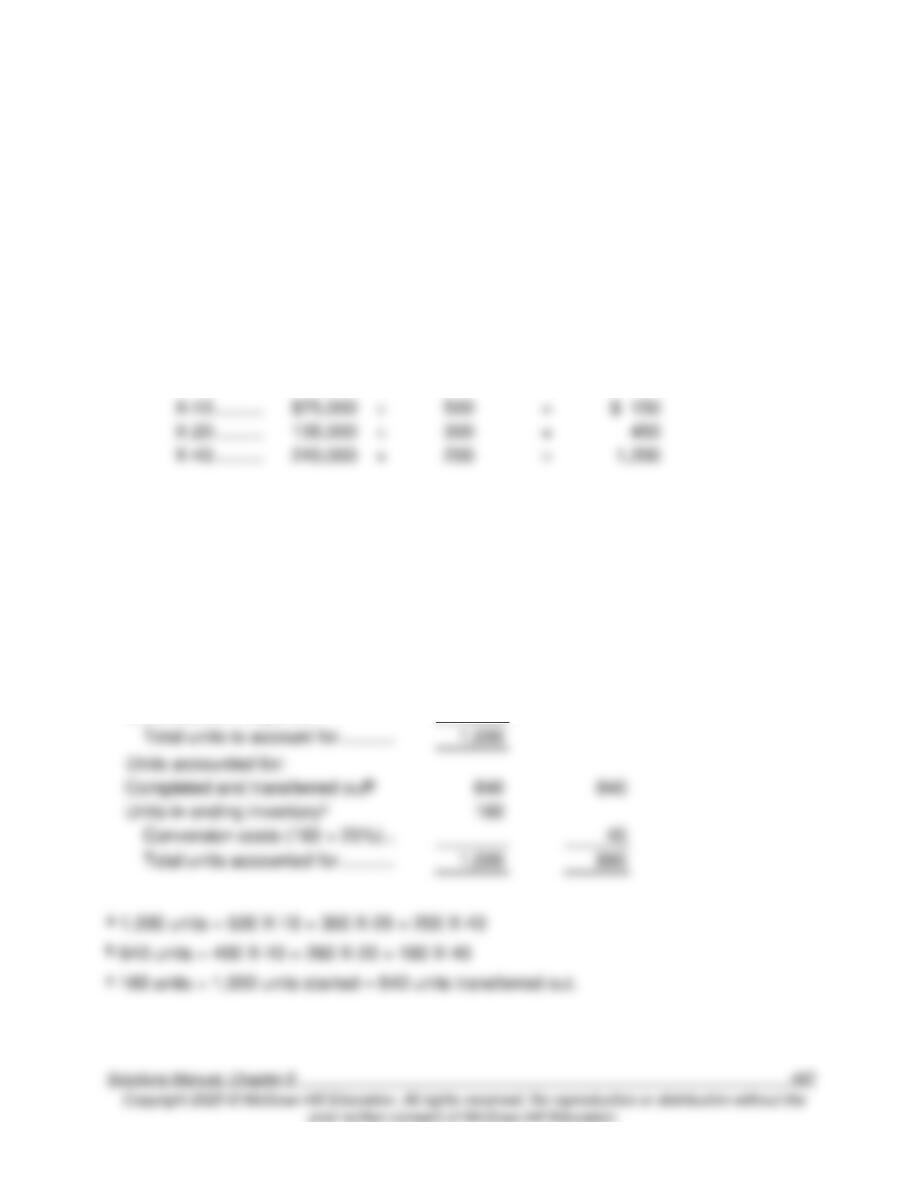
Materials ($30,000 ÷ 3.0 units) …………..
8-65. (continued)
c. Answers will vary.
Whether or not the company should use process costing or job costing depends on
at least a couple of factors. The first is whether there is any reason for units to have
a different cost. From the description of the process, the units are identical and the
only reasons for differences in costs is timing (when were the direct materials
purchased) and scheduling (labor of different seniority). Based on this, process
costing would seem to provide adequate information. The second factor to consider
8-66. (50 min.) Operations Costing—Work-in-Process Inventory: Washington,
Inc.
The solution to this problem is to apply process costing methods for the conversion
costs and then add the cost of materials for each product. Because there is no
beginning work-in-process inventory, FIFO and weighted-average process costing
gives the same results.
a.
The material costs per unit are:
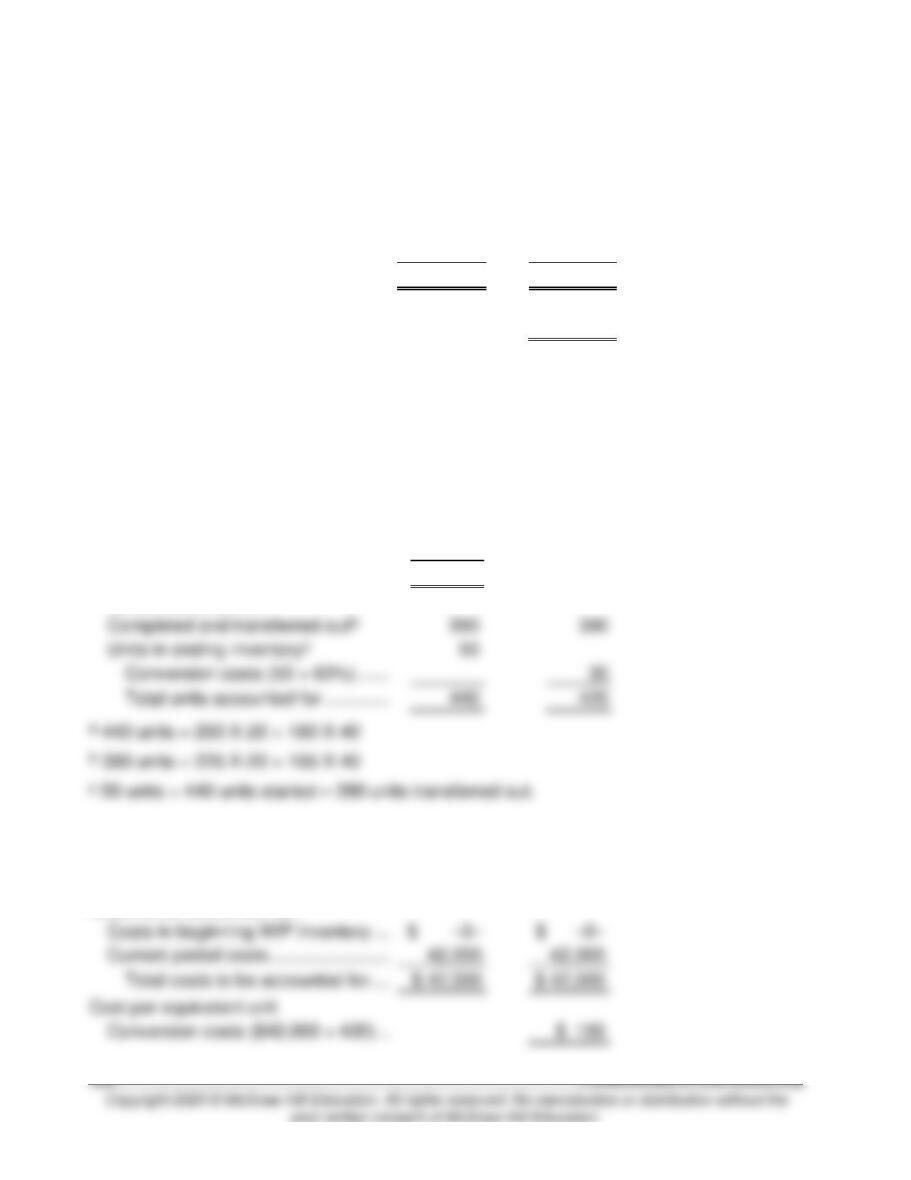
Product
Material
Cost
Number of
Units
Unit Material
Cost
÷
The conversion costs per equivalent unit are:
Department A:
Physical
Units
Conversion Costs
Equivalent Units
Flow of units:
Units to be accounted for:
Beginning WIP inventory …………..
–0–
Units started this perioda
1,000
Total units to account for ………..
1,000
Completed and transferred outb
Units in ending inventoryc
Conversion costs (160 × 25%) ..
Total units accounted for ………..
1,000
8-66. (continued)
Total
Conversion
Costs
Flow of costs:
Costs to be accounted for:
Costs in beginning WIP inventory …
$ –0–
$ –0–
Current period costs ……………………
264,000
264,000
Total costs to be accounted for ….
$ 264,000
$ 264,000
Cost per equivalent unit
Conversion costs ($264,000 ÷ 880)
$ 300
Department B:
Physical
Units
Conversion Costs
Equivalent Units
Flow of units:
Units to be accounted for:
Beginning WIP inventory ……………..
–0–
Units started this perioda
440
Total units to account for ………….
440
Units accounted for:
Completed and transferred outb
390
Conversion costs (50 × 60%) ……
Total units accounted for ………….
440
Total
Conversion
Costs
Flow of costs:
Costs to be accounted for:
Costs in beginning WIP inventory …
Current period costs ……………………
$ 42,000
Cost per equivalent unit