CHAPTER 22 (FIN MAN); CHAPTER 8 (MAN) Budgeting
Prob. 22–3B (FIN MAN); Prob. 8–3B (MAN) (Continued)
4.
Gold Medal Athletic Co.
Direct Labor Cost Budget
For the Month Ending March 31
Molding
Department
Assembly
Department
Total
Hours required for production:
1 1,210 × 0.2 hr. = 242 hrs.
2 1,210 × 0.5 hr. = 605 hrs.
5.
Gold Medal Athletic Co.
Factory Overhead Cost Budget
For the Month Ending March 31
Indirect factory wages
$ 86,000
Depreciation of plant and equipment
12,000
Insurance and property tax
CHAPTER 22 (FIN MAN); CHAPTER 8 (MAN) Budgeting
Prob. 22–3B (FIN MAN); Prob. 8–3B (MAN) (Continued)
6.
Gold Medal Athletic Company
Cost of Goods Sold Budget
For the Month Ending March 31
Finished goods inventory, March 11
$ 19,480
Work in process inventory, March 1
$ 15,300
Direct materials:
Cost of direct materials placed in
production
$186,092
Direct labor (from part 4)
241,406
Factory overhead (from part 5)
104,300
Total manufacturing costs
531,798
Work in process, March 31
Cost of goods manufactured
Cost of finished goods available for sale
Cost of goods sold
1 Batting helmet (40 × $25.00) …………………………………………………
$ 1,000
Football helmet (240 × $77.00) …………………………..…………………
18,480
Finished goods inventory, March 1 ………………………………………
$19,480
2 Plastic (90 × $6.00) ……………………………………………………………….
$ 540
Foam lining (80 × $4.00) ……………………………………………………….
320
Direct materials inventory, March 1 ………………………………………
$ 860
CHAPTER 22 (FIN MAN); CHAPTER 8 (MAN) Budgeting
Prob. 22–3B (FIN MAN); Prob. 8–3B (MAN) (Concluded)
7.
Gold Medal Athletic Co.
Selling and Administrative Expenses Budget
For the Month Ending March 31
Selling expenses:
Sales salaries expense
$184,300
Advertising expense
87,200
Telephone expense—selling
5,800
Travel expense—selling
9,000
Office salaries expense
Depreciation expense—office equipment
Telephone expense—administrative
1,200
Office supplies expense
1,100
Miscellaneous administrative expense
8.
Gold Medal Athletic Co.
Budgeted Income Statement
For the Month Ending March 31
Revenue from sales (from part 1)
$1,088,000
Cost of goods sold (from part 6)
(533,368)
Gross profit
$ 554,632
Operating expenses:
Administrative expenses (from part 7)
Operating income
$ 228,832
Interest revenue
Income before income tax
$ 228,900
Income tax expense (30% rate)
Net income
Selling expenses (from part 7)
$286,300
CHAPTER 22 (FIN MAN); CHAPTER 8 (MAN) Budgeting
Prob. 22–4B (FIN MAN); Prob. 8–4B (MAN)
1.
Newport Inc.
Sales Budget
For the First Quarter Ending August 31
June
July
August
First Quarter
Estimated units sold
300,000
400,000
500,000
1,200,000
Selling price per unit
× $36
× $36
× $36
× $36
Total budgeted sales
$10,800,000
$14,400,000
$18,000,000
$43,200,000
2.
Newport Inc.
Production Budget
For the First Quarter Ending August 31
June
July
August
First Quarter
Estimated units sold
300,000
400,000
500,000
1,200,000
Total units available for sale
Less estimated beginning
1 400,000 units × 5% = 20,000 units
2 500,000 units × 5% = 25,000 units
3.
Newport Inc.
Direct Materials Purchases Budget
For the First Quarter Ending August 31
June
July
August
First Quarter
Units to be produced
304,000
405,000
500,000
1,209,000
Materials required per unit
× 1.5
lbs.
× 1.5
lbs.
× 1.5
lbs.
× 1.5
lbs.
Materials required for
production
456,000
lbs.
607,500
lbs.
750,000
lbs.
1,813,500
lbs.
Desired ending inventory
lbs.
lbs.
50,000
lbs.
lbs.
Total materials available
496,000
lbs.
652,500
lbs.
800,000
lbs.
lbs.
Less estimated beginning
inventory
lbs.
lbs.
lbs.
lbs.
purchased
461,000
lbs.
612,500
lbs.
lbs.
1,828,500
lbs.
Cost per pound
× $4
× $4
× $4
Cost of materials to be
CHAPTER 22 (FIN MAN); CHAPTER 8 (MAN) Budgeting
Prob. 22–4B (FIN MAN); Prob. 8–4B (MAN) (Continued)
4.
Newport Inc.
Direct Labor Cost Budget
For the First Quarter Ending August 31
June
July
August
First Quarter
Units to be produced
304,000
405,000
500,000
1,209,000
Direct labor required per unit
× 0.4
hr.
× 0.4
hr.
× 0.4
hr.
× 0.4
hr.
162,000
Direct labor hourly rate
× $25
× $25
× $25
Direct labor cost
5.
Newport Inc.
Factory Overhead Cost Budget
For the First Quarter Ending August 31
June
July
August
First Quarter
Variable factory overhead:
Budgeted direct labor
hours
121,600
162,000
200,000
483,600
Variable factory
Fixed factory overhead:
Budgeted fixed factory
overhead
Total factory overhead cost
CHAPTER 22 (FIN MAN); CHAPTER 8 (MAN) Budgeting
Prob. 22–4B (FIN MAN); Prob. 8–4B (MAN) (Continued)
6.
Newport Inc.
Cost of Goods Sold Budget
For the First Quarter Ending August 31
June
July
August
First Quarter
Beginning finished goods inventory
$ 320,0001
$ 400,0002
$ 500,0003
$ 320,000
Cost of goods manufactured:
Direct materials
$1,824,0004
$2,430,0005
$ 3,000,0006
$ 7,254,000
Factory overhead (from part 5)
Cost of goods available for sale
$8,728,000
Ending finished goods inventory
Cost of goods sold
1 16,000 units (from part 2) × $20
2 20,000 units (from part 2) × $20
3 25,000 units (from part 2) × $20
4 456,000 lbs. (from part 3) × $4
5 607,500 lbs. (from part 3) × $4
CHAPTER 22 (FIN MAN); CHAPTER 8 (MAN) Budgeting
Prob. 22–4B (FIN MAN); Prob. 8–4B (MAN) (Concluded)
7.
Newport Inc.
Selling and Administrative Expenses Budget
For the First Quarter Ending August 31
June
July
August
First Quarter
Selling expenses:
Budgeted sales units
300,000
400,000
500,000
1,200,000
Variable selling expenses
per unit sold
× $3.00
× $3.00
× $3.00
× $3.00
Fixed selling expenses
800,000
800,000
2,400,000
Administrative expenses:
Budgeted fixed administrative
Total selling and
8.
Newport Inc.
Budgeted Income Statement
For the First Quarter Ending August 31
June
July
August
First Quarter
Sales (from part 1)
$10,800,000
$14,400,000
$18,000,000
$43,200,000
Cost of goods sold (from part 6)
(6,470,400)
(8,228,000)
(10,000,000)
(24,698,400)
Gross profit
$ 4,329,600
$ 6,172,000
$ 8,000,000
$18,501,600
Selling and administrative
Selling expenses (from part 7)
$ (2,550,000)
CHAPTER 22 (FIN MAN); CHAPTER 8 (MAN) Budgeting
Prob. 22–5B (FIN MAN); Prob. 8–5B (MAN)
1.
Mercury Shoes Inc.
Cash Budget
For the Three Months Ending August 31
June
July
August
Estimated cash receipts from:
Less estimated cash payments for:
Cash sales
$ 16,000
$ 18,500
$ 20,000
Selling and administrative expenses
(40,000)
(46,000)
(51,000)
Capital expenditures
(120,000)
Other purposes:
Income tax
(24,000)
Dividends
(15,000)
Total cash payments
$ (96,200)
$(136,800)
$(274,400)
Cash increase (decrease)
$ 57,800
$ 28,100
$ (96,900)
$ 99,800
$ 31,000
Less minimum cash balance
(40,000)
(40,000)
(40,000)
CHAPTER 22 (FIN MAN); CHAPTER 8 (MAN) Budgeting
Prob. 22–5B (FIN MAN); Prob. 8–5B (MAN) (Concluded)
Computations:
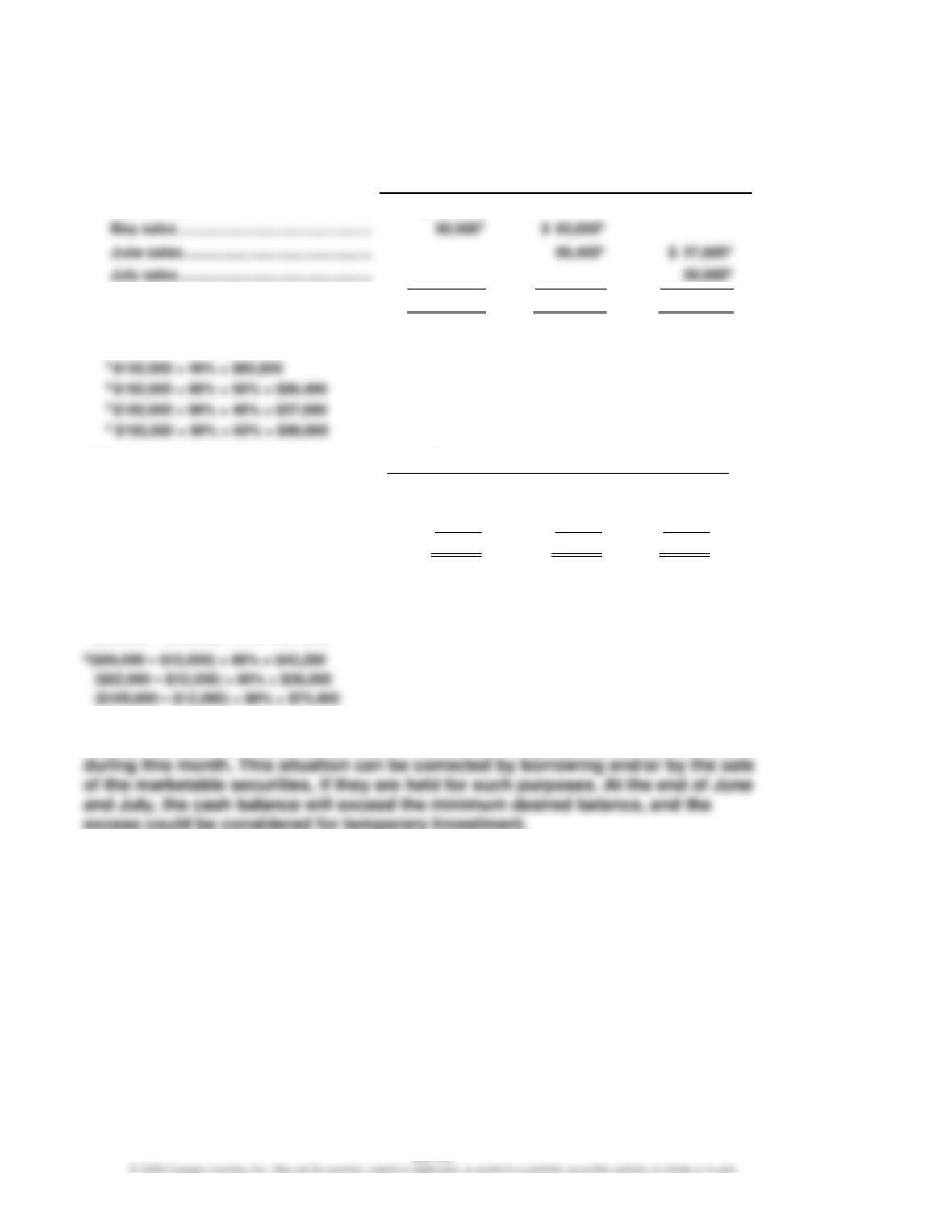
a Collections of accounts receivable:
June
July
August
April sales …………………………………………
$ 48,0001
Total ……………………………………………….
$138,000
$146,400
$157,500
1 $120,000 × 40% = $48,000
2 $150,000 × 60% = $90,000
b Payments for manufacturing costs:
June
July
August
Payment of accounts payable,
beginning of month balancec …………..
$13,000
$10,800
$14,000
Payment of current month’s costd ………
43,200
56,000
74,400
Total ……………………………………………….
$56,200
$66,800
$88,400
c Accounts payable, June 1 balance = $13,000
($66,000 – $12,000) × 20% = $10,800
($82,000 – $12,000) × 20% = $14,000
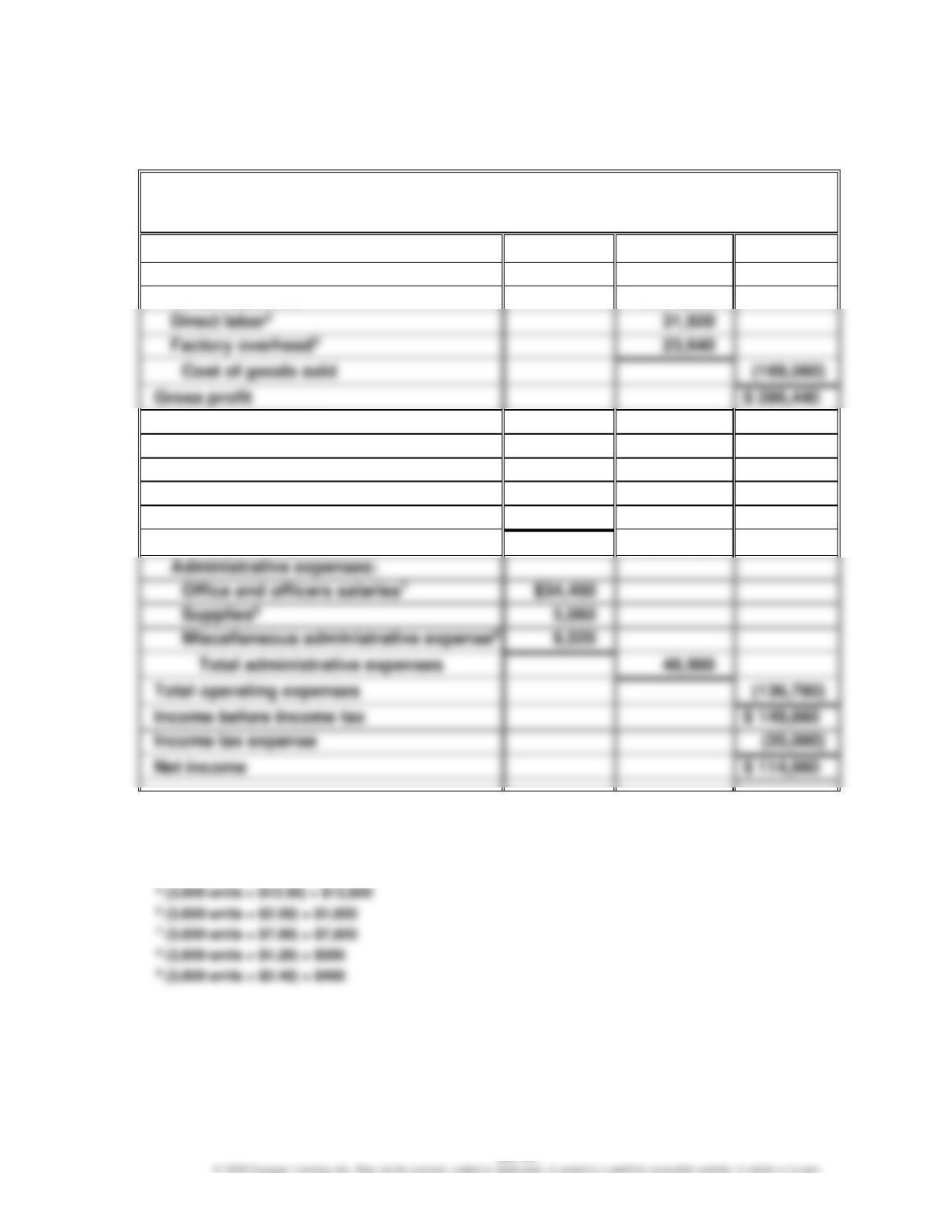
2. The budget indicates that the minimum cash balance will not be maintained in
August. This is due to the capital expenditures requiring significant cash outflows
CHAPTER 22 (FIN MAN); CHAPTER 8 (MAN) Budgeting
Prob. 22–6B (FIN MAN); Prob. 8–6B (MAN)
1.
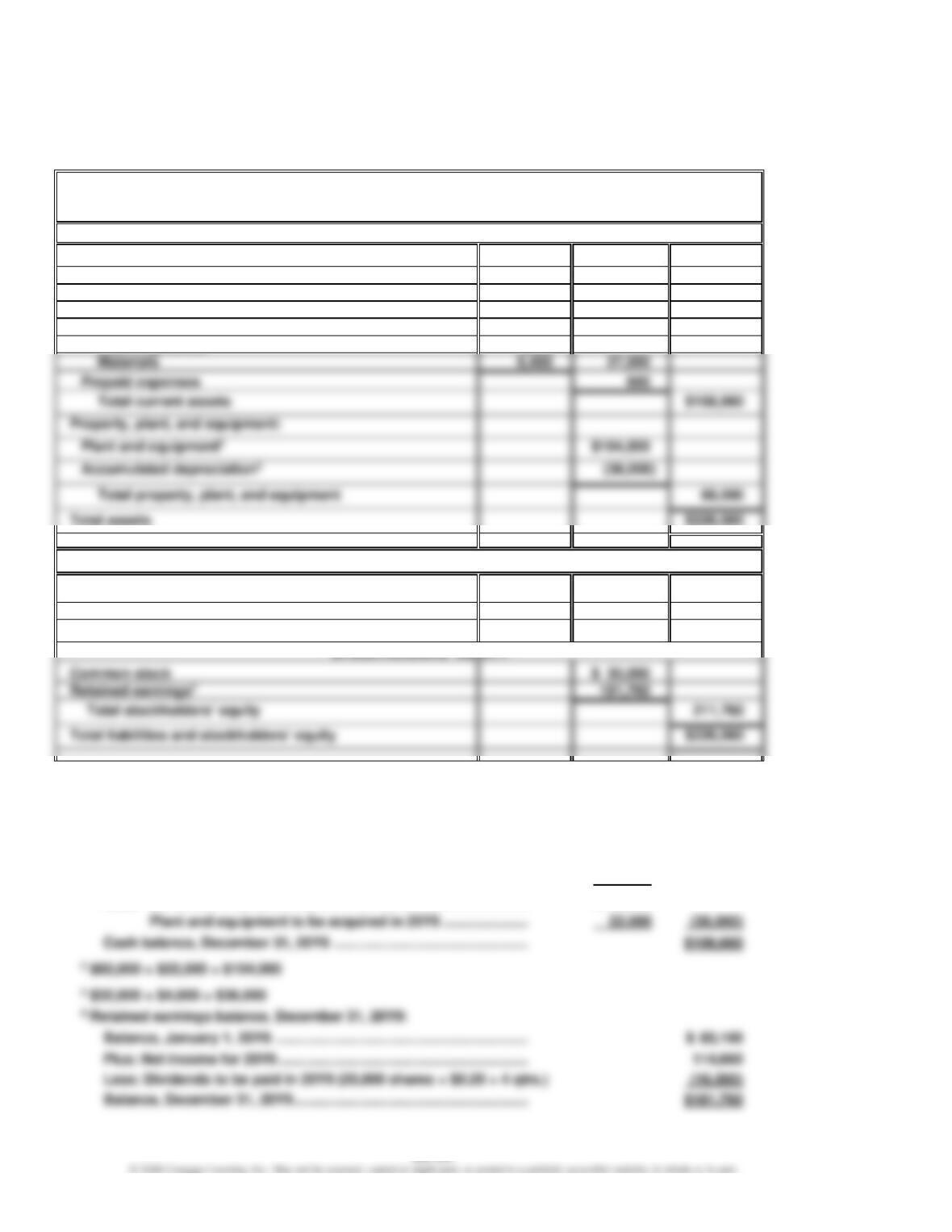
Mesa Publishing Co.
Budgeted Income Statement
For the Year Ending December 31, 20Y9
Sales1
$ 456,000
Cost of goods sold:
Direct materials2
$114,000
Gross profit
Operating expenses:
Selling expenses:
Sales salaries and commissions5
$64,100
Advertising
13,200
Miscellaneous selling expenses6
10,500
Total selling expenses
$ 87,800
Administrative expenses:
Office and officers salaries7
$34,400
Total operating expenses
Income tax expense
1 3,800 units × $120
2 3,800 units × $30
3 3,800 units × $8.40
4 (3,800 units × $4.80) + $4,000 + $1,400
CHAPTER 22 (FIN MAN); CHAPTER 8 (MAN) Budgeting
Prob. 22–6B (FIN MAN); Prob. 8–6B (MAN) (Concluded)
2.
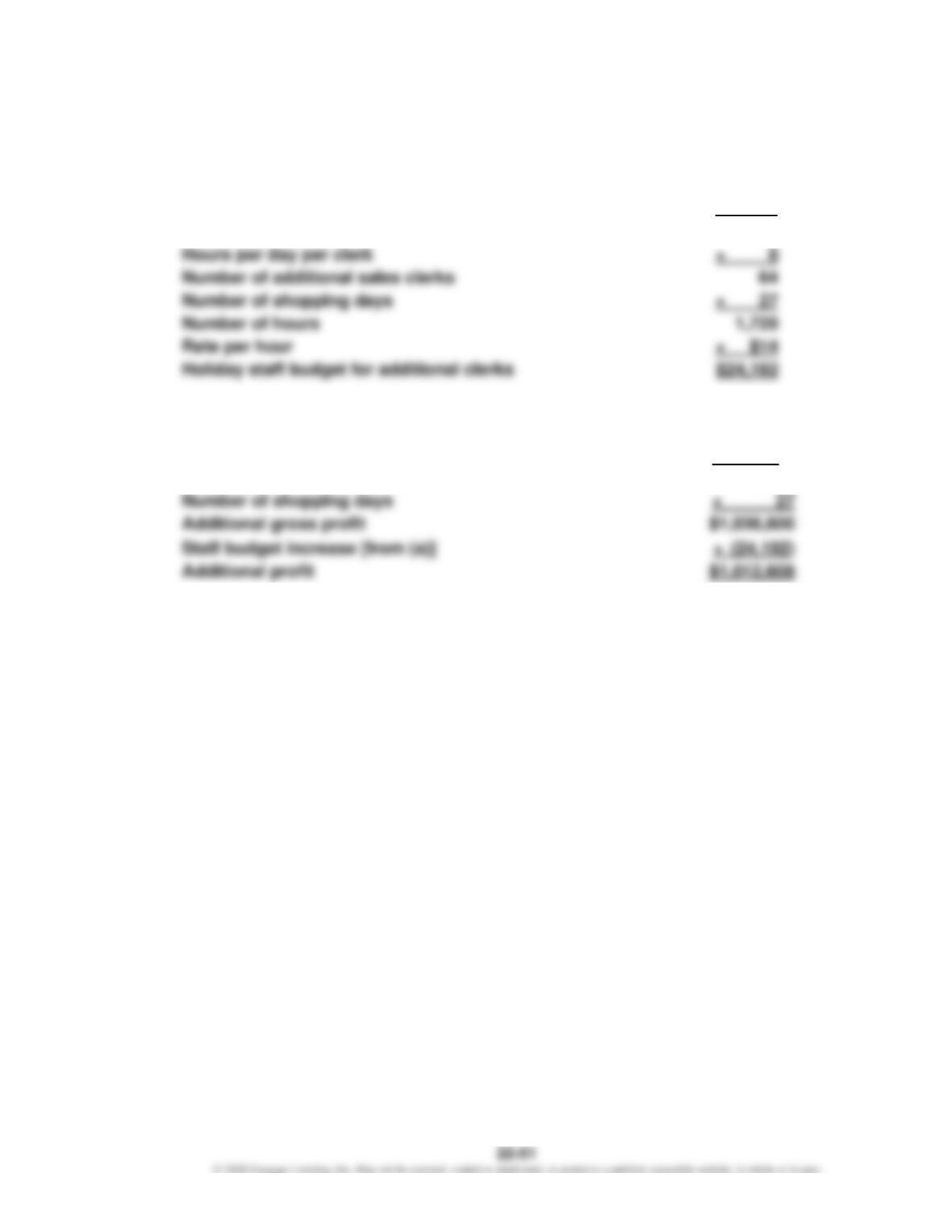
Mesa Publishing Co.
Budgeted Balance Sheet
December 31, 20Y9
ASSETS
Current assets:
Cash 1
$106,660
Accounts receivable
23,800
Inventories:
Finished goods
$16,900
Work in process
4,200
6,400
27,500
Prepaid expenses
Property, plant, and equipment:
Total assets
LIABILITIES
Current liabilities:
Accounts payable
$ 14,800
Total liabilities and stockholders’ equity
1 Cash balance, December 31, 20Y9:
Balance, January 1, 20Y9 …………………………..…………………………...
$ 26,000
Add:
Cash from operations
Net income …………………………………………………………………..
$114,660
Depreciation of plant and equipment …………………………….
4,000
118,660
Less:
Dividends to be paid in 20Y9 …………………………………………
$ 16,000
Plant and equipment to be acquired in 20Y9 ………………….
CHAPTER 22 (FIN MAN); CHAPTER 8 (MAN) Budgeting
MAKE A DECISION
MAD 22–1 (FIN MAN); MAD 8–1 (MAN)
a.
Average daily revenue
$96,000
Revenue per clerk
÷12,000
Number of additional sales clerks
8
Hours per day per clerk
Number of shopping days
Rate per hour
b.
Johnson Stores should add the staff because it will be profitable.
Increase in daily revenue
$ 96,000
Gross profit percentage
× 40%
Increase in daily gross profit
$ 38,400
Staff budget increase [from (a)]
CHAPTER 22 (FIN MAN); CHAPTER 8 (MAN) Budgeting
MAD 22–2 (FIN MAN); MAD 8–2 (MAN)
a. There are 680 expected RVUs per day for the coming week.
Number of Patients
RVUs per Day
Total Daily
RVUs
5
20
100
8
25
200
b. Total daily RVUs ……………………………………….
680
Daily RVUs per nurse ………………………………..
÷ 40
MAD 22–3 (FIN MAN); MAD 8–3 (MAN)
a.
School Days
Nonschool
Days
Total
Number of vehicles per day
3,000
8,000
Vehicles per staff member
÷ 200
÷ 200
Number of staff
Daily staff expense
b.
School Days
Nonschool
Days
Total
Number of vehicles per day
3,000
8,000
c.
Total budgeted revenues [from (b)] ………………………………………………..
$20,950,000
Parking lot staff expenses [from (a)] ………………………………………………
Other expenses …………………………………………………………………………….
Budgeted parking lot profit ……………………………………………………………
$17,797,750
CHAPTER 22 (FIN MAN); CHAPTER 8 (MAN) Budgeting
MAD 22–4 (FIN MAN); MAD 8–4 (MAN)
a.
Weekday
Weekend Day
Room occupancy
Room capacity
300
300
Occupancy
×80%
×40%
Rooms occupied (1)
240
120
Number of minutes to clean a room (2)
Total minutes [(a) × (b)]
Labor rate per hour
c.
Restaurant staff
Base restaurant staff
6
6
Incremental staff for room blocks [(1) ÷
60 room blocks]
+4
+2
Total staff
10
8
CHAPTER 22 (FIN MAN); CHAPTER 8 (MAN) Budgeting
TAKE IT FURTHER
TIF 22–1 (FIN MAN); TIF 8–1 (MAN)
Cam should reject Megan’s request to charge the convention-related costs against July’s
budget. This is just one example of many attempts to slide expenses into different budget
periods than when actually incurred. This is a common issue that controllers face. Often,
TIF 22–2 (FIN MAN); TIF 8–2 (MAN)
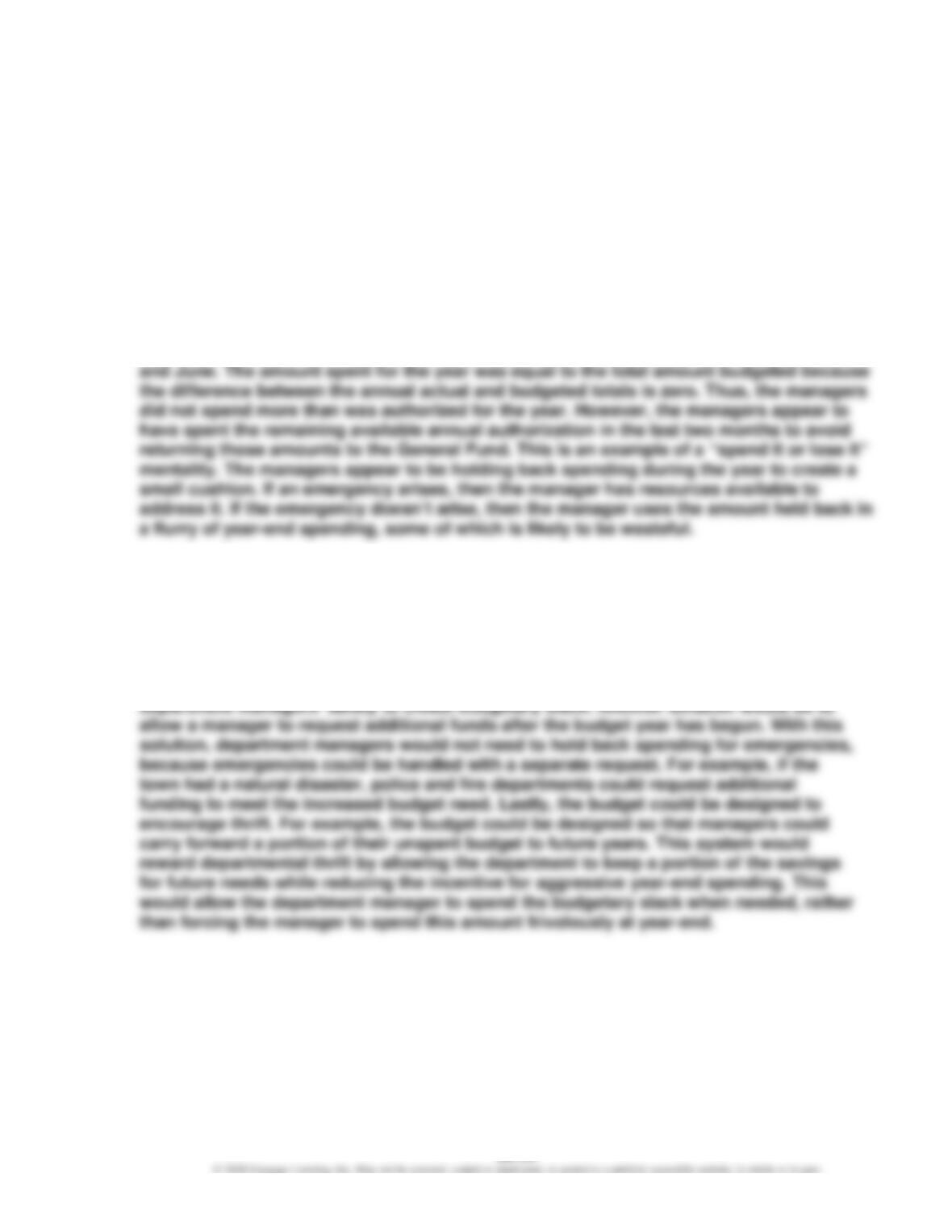
Answers will vary per state selected. Examples from the state of Tennessee are shown here.
a.
b.
CHAPTER 22 (FIN MAN); CHAPTER 8 (MAN) Budgeting
TIF 22–3 (FIN MAN); TIF 8–3 (MAN)
Memo
To: Stacy Poindexter
From: Ima Student
Re: Evaluating City of Milton Budget
After reviewing the city of Milton’s budget data, it appears that considerable goal conflict
exists within departments, resulting in department managers making poor budgeting and
spending decisions. The amount of actual expenditures was less than budgeted for the
first 10 months of the budget year. As the budget year-end approached, department
managers appear to have spent the remaining excess budget, going over budget in May
There are a number of techniques that the city could undertake to more effectively
budget and align departmental behavior with the city’s goals. First, departments could
adopt flexible budgets, which allow for monthly budgets to change with underlying
activity. For example, if the number of prisoners in the jail increased, then the budget
would increase proportionately. Department managers with a flexible budget would be
less likely to “reserve” a large portion of the budget during the year because an activity
change would automatically be reflected in the monthly budget. This reduces the
CHAPTER 22 (FIN MAN); CHAPTER 8 (MAN) Budgeting
TIF 22–4 (FIN MAN); TIF 8–4 (MAN)
a. The hospital’s new budget method is clearly an example of a flexible budget. The
budget changes with changes in underlying activity, such as patient days.
The budget helps the managers plan month-by-month expenditures.
b. The advantage of a flexible budget is to accurately plan variable costs of the
hospital with changes in the underlying activity base. Using a static budget
would create actual deviations from budget that would be difficult to
TIF 22–5 (FIN MAN); TIF 8–5 (MAN)
a. The budget information indicates that the actual expenditures by the Operations
b. The bank manager does not know if the actual resources consumed by the
Operations Department are the right amount of resources for doing the right things.
In other words, this budget doesn’t say anything about the actual work of the
CHAPTER 22 (FIN MAN); CHAPTER 8 (MAN) Budgeting
TIF 22–5 (FIN MAN); TIF 8–5 (MAN) (Concluded)
The budget doesn’t indicate why there was more travel and training than
expected. Maybe the department introduced a new computer system, and all
TIF 22–6 (FIN MAN); TIF 8–6 (MAN)
Domino’s could use a master budget to plan operations consistent with the sales
forecast. The sales forecast could be used to develop the production budget for
pizzas. The sales and production budgets would be identical because there would
be no finished goods inventory for cooked pizzas. The sales (production) budget
would be used to develop a direct materials purchases budget. For example, the
The budget process could be used to direct and coordinate all the various
restaurants. In this way, all the managers would be operating under the same set of
assumptions. The actual performance of the company and the individual stores
could be compared with the budget in order to provide all levels of the organization
appropriate feedback and control. This feedback can be used to adjust operations
CHAPTER 22 (FIN MAN); CHAPTER 8 (MAN) Budgeting
CERTIFIED MANAGEMENT ACCOUNTANT (CMA®)
EXAMINATION QUESTIONS (ADAPTED)
1. d. Flexible budgets are based on the output actually achieved and therefore
provide a realistic comparison of budgeted and actual revenue and costs.
2. b. Hannon’s budget for the purchase of inventory should be $540,000, computed as
follows:
75% of the cost of inventory to be sold in August
3. c. Ming should plan to produce 7,133 units in July, computed as follows:
4. c. The cost of one laminated putter head is $52, computed as follows:
Laminated putter head cost per unit:
Steel
$ 5.00
Copper
15.00
Direct labor
22.00
Variable OH
6.25*
Fixed OH
3.75**
Total cost
$52.00
Direct labor hours required for production:
Forged units:
8,200 – 300 + 100 = 8,000 units;
8,000 units × 0.25 hr. per unit =
2,000 hours
Laminated units:
2,000 units × 1.0 hr. per unit = 2,000 hours
2,000 hours