COMPREHENSIVE PROBLEM SOLUTION
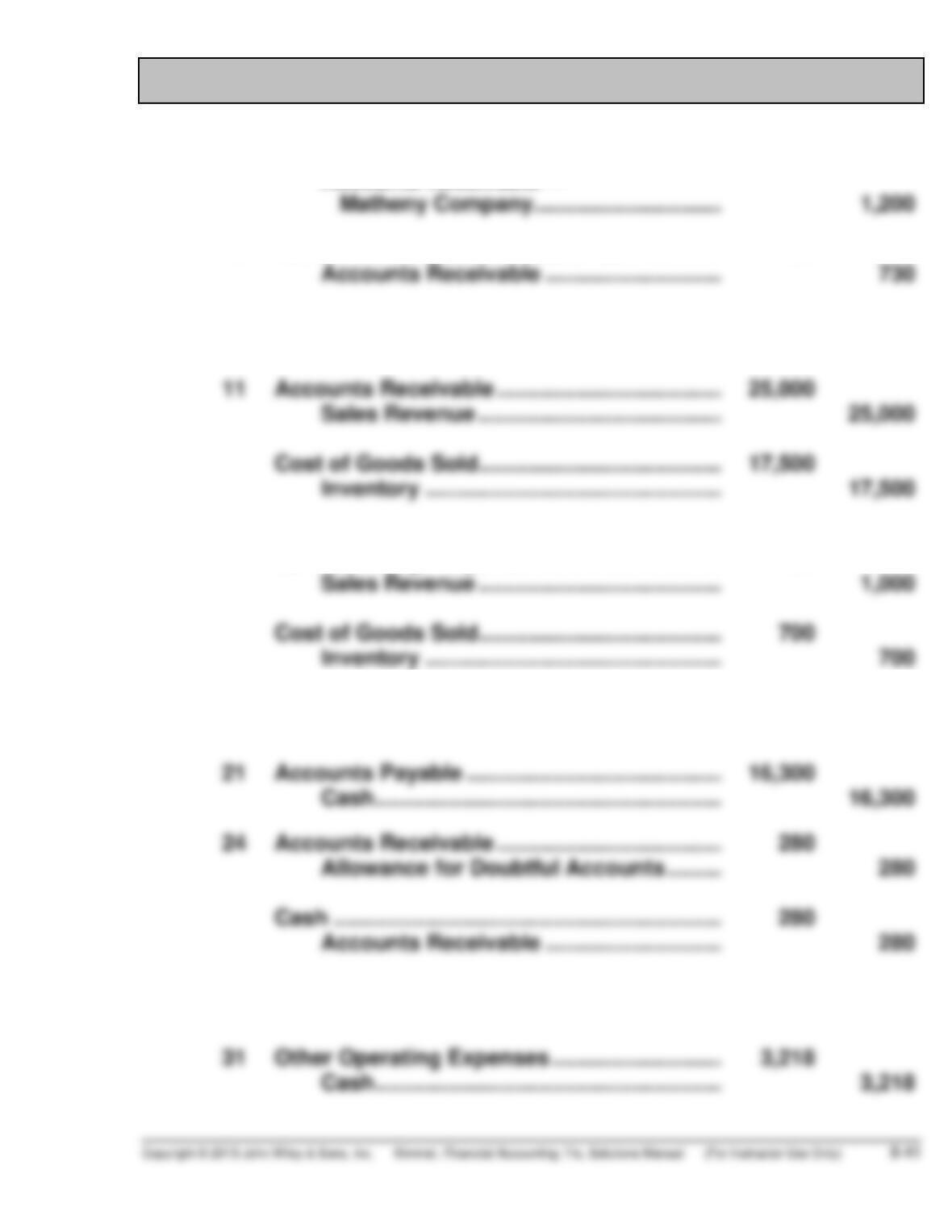
(a) Jan. 1 Notes Receivable …………………………………….
Accounts Receivable—
1,200
3 Allowance for Doubtful Accounts……………..
730
8 Inventory …………………………………………………
Accounts Payable ……………………………..
17,200
17,200
15 Cash ……………………………………………………….
Service Charge Expense ………………………….
970
30
17 Cash ……………………………………………………….
Accounts Receivable ………………………..
22,900
22,900
27 Supplies ………………………………………………….
Cash …………………………………………………
1,400
1,400
COMPREHENSIVE PROBLEM SOLUTION (Continued)
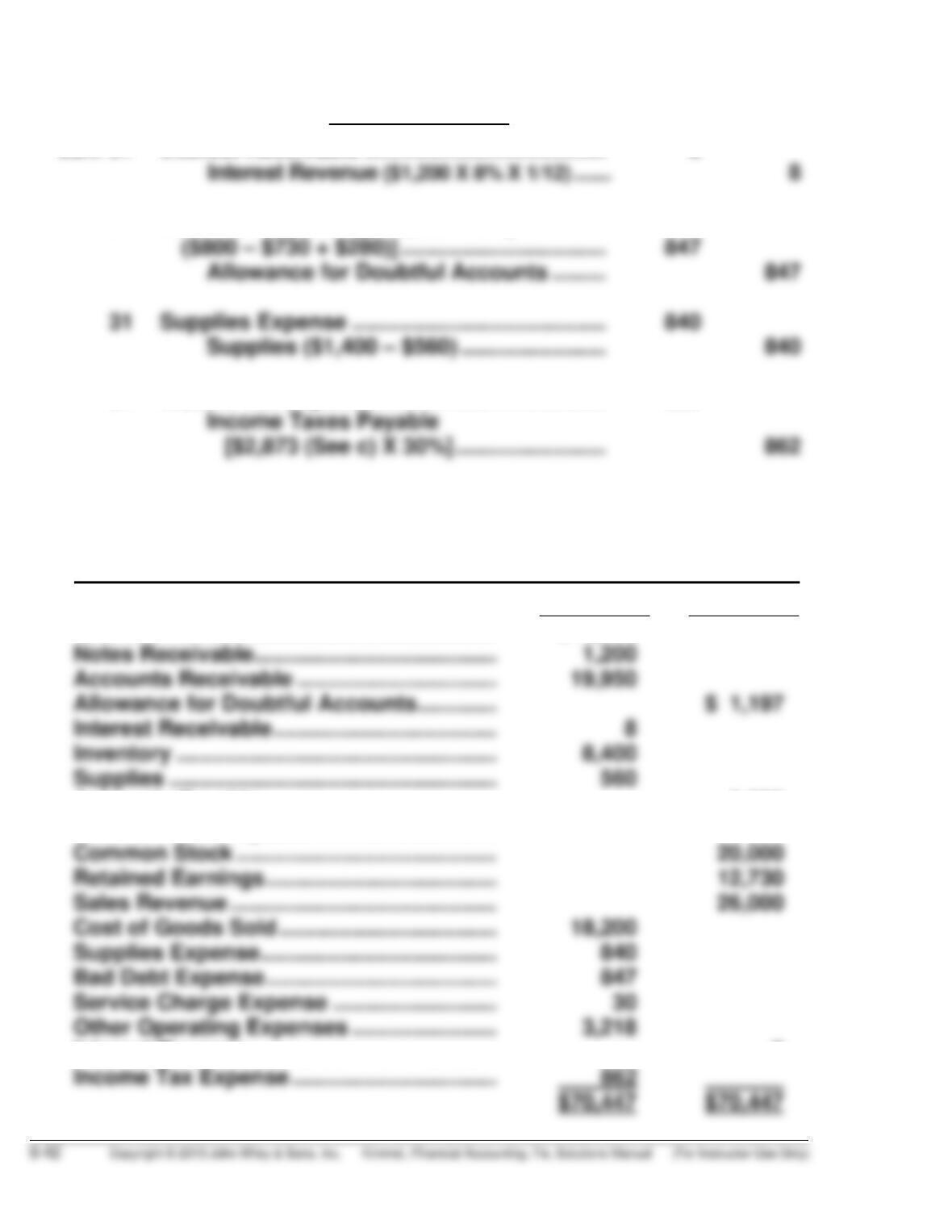
Adjusting Entries
Jan. 31 Interest Receivable ………………………………….
8
31 Bad Debt Expense [($19,950 X 6%)
–
31 Income Tax Expense ………………………………..
862
(b) MADSON CORPORATION
Adjusted Trial Balance
January 31, 2014
Debit Credit
Cash ……………………………………………………. $16,332
Accounts Payable ……………………………….. 9,650
Income Taxes Payable …………………………. 862
Interest Revenue …………………………………. 8
COMPREHENSIVE PROBLEM SOLUTION (Continued)
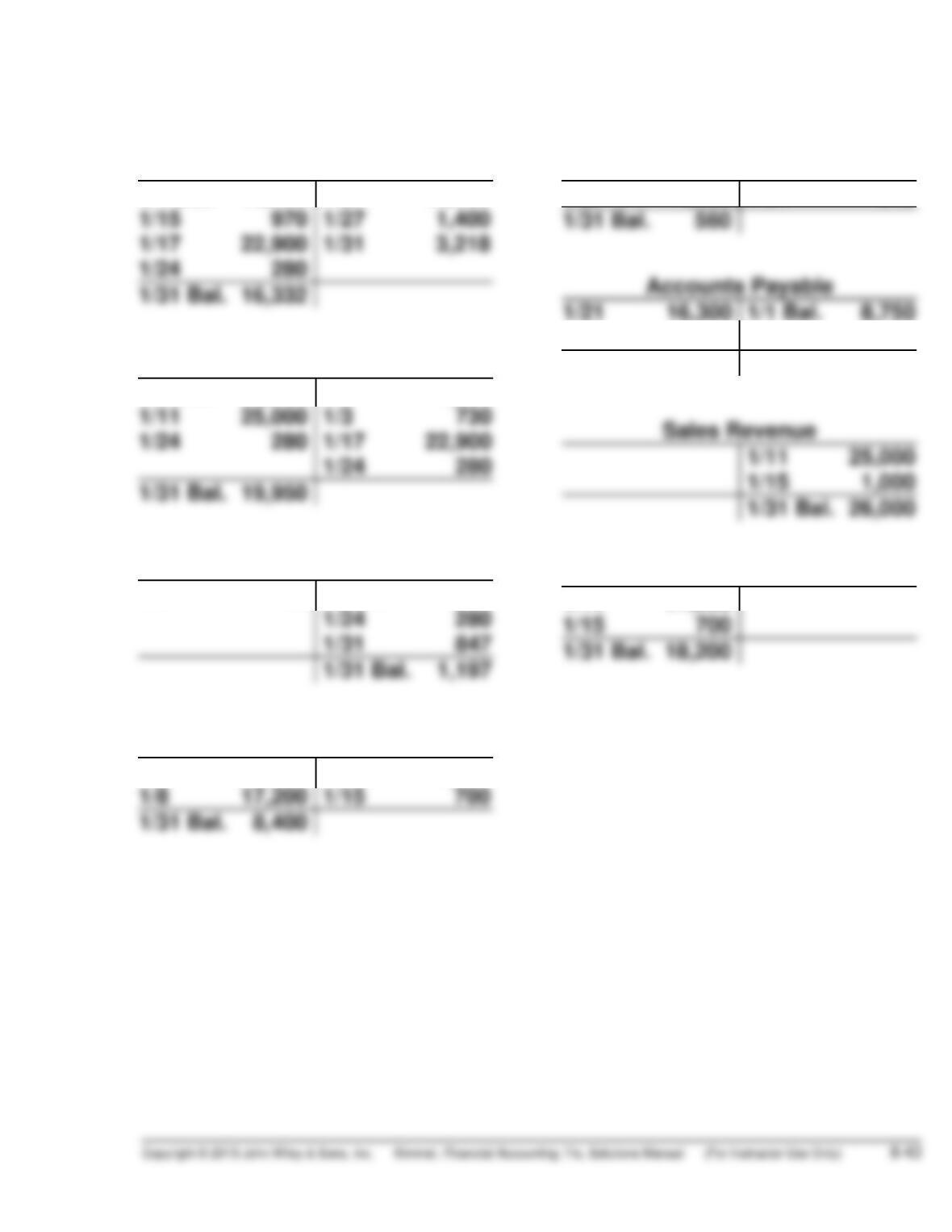
(b) Optional T accounts for accounts with multiple transactions
Cash
1/1 Bal. 13,100
1/21 16,300
Accounts Receivable
1/1 Bal. 19,780
1/1 1,200
Allowance for Doubtful Accounts
1/3 730 1/1 Bal. 800
Inventory
1/1 Bal. 9,400
1/11 17,500
Supplies
1/27 1,400 1/31 840
1/8 17,200
1/31 Bal. 9,650
Cost of Goods Sold
1/11 17,500
COMPREHENSIVE PROBLEM SOLUTION (Continued)
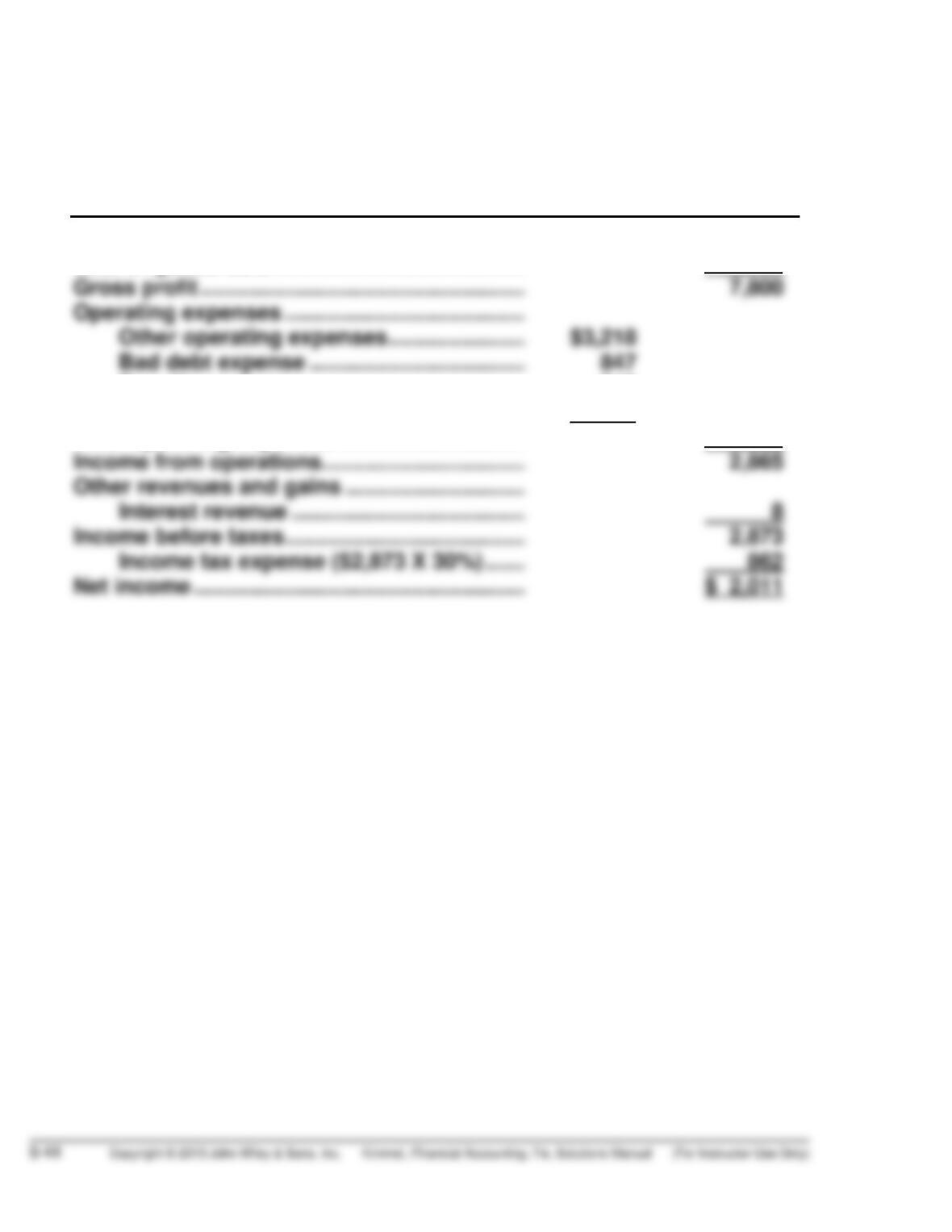
(c) MADSON CORPORATION
Income Statement
For the Month Ending January 31, 2014
Sales revenue ………………………………………….
.
$26,000
Cost of goods sold …………………………………..
.
18,200
Supplies expense ………………………………
.
840
Service charge expense …………………….
.
30
Total operating expenses …………………………
.
4,935

COMPREHENSIVE PROBLEM SOLUTION (Continued)
MADSON CORPORATION
Retained Earnings Statement
For the Month Ending January 31, 2014
Retained earnings, January 1 ……………………………………
.
$12,730
Add: Net income ………………………………………………………
.
2,011
Retained earnings, January 31 ………………………………….
.
$14,741
MADSON CORPORATION
Balance Sheet
January 31, 2014
Assets
Current assets
Cash …………………………………………………. $16,332
Notes receivable……………………………….. 1,200
Accounts receivable………………………….. $19,950
Less: Allowance for doubtful
accounts ………………………………… 1,197 18,753
Interest receivable…………………………….. 8
Inventory ………………………………………….. 8,400
Supplies …………………………………………… 560
Total assets …………………………………………….. $45,253
Liabilities and Stockholders’ Equity
Current liabilities
Accounts payable……………………………… $ 9,650
Income taxes payable ……………………….. 862
Total liabilities …………………………………………. $10,512
Stockholders’ equity
Common stock …………………………………. $20,000
Retained earnings …………………………….. 14,741
Total stockholders’ equity…………………. 34,741
Total liabilities and stockholders’ equity…… $45,253

BYP 8-1 FINANCIAL REPORTING PROBLEM
2011
(a) Accounts receivable
turnover =
$528,369
($41,895 + $37,394) 2÷
= $528,369 = 13.3
$39,644.5 times
Average collection period = 365 = 27.4 days
13.3
(b) Note 1 states that revenue from a major customer exceeded 20% of net
product sales in recent years. Note 9 reports significant foreign sales,
primarily Mexico and Canada. Material sales to a single customer could
create potential credit risk problems.
(c) At 27.4 days, Tootsie Roll’s average collection period appears
reasonable. It should be compared to its credit terms (normally 30 days)
and to previous years to determine whether it is of concern.

BYP 8-2 COMPARATIVE ANALYSIS PROBLEM
(a) (1) Accounts receivable turnover ratio
Tootsie Roll Hershey Company
$528,369
($41,895 + $37,394) 2÷
$6,080,788
($399,499 + $390,061) 2÷
$528,369 = 13.3 times
$39,644.5 $6,080,788 = 15.4 times
$394,780
(2) Average collection period
365 = 27.4 days
13.3 365 = 23.7 days
15.4
(b) The general rule for the average collection period is that it should not
greatly exceed the credit term period. Tootsie Roll’s average collection
period (approximately 27 days) is shorter than the normal credit term
period of 30 days but is worse than Hershey Company’s 24 day average
collection period.

BYP 8-3 RESEARCH CASE
(a) InBev told its suppliers that it would take up to 120 days to pay. This is
compared to 30 days previously.
(b) To free up cash, General Electric shortened collection times, collected on
past-due accounts, and stretched out its payments to suppliers. By doing
this the company says that it freed up $3.8 billion.
(c) Companies with sales of more than $5 billion took an average of
55.8 days to pay suppliers and they took an average of 41 days to
collect from customers. Companies with sales of less than $500 million
took an average of 40.1 days to pay suppliers and they took an average
of 58.9 days to collect from customers.
(d) If a company negotiates payment terms that are too severe for its
suppliers, the suppliers may be forced out of business. This can then
disrupt the company’s operations as it searches for substitute suppliers.

BYP 8-4 INTERPRETING FINANCIAL STATEMENTS
(a) Accounts receivable
turnover = $2,981.8
($259.8* +$248.3**)/2 =11.7 times
*$270.4
–
$10.6
**$259.7
–
$11.4
Average collection period= 365 days
11.7 = 31.2 days
(b) Accounts receivable represent 24.9% [($270.4 – $10.6)/$1,044.9] of the
company’s current assets. This is a material amount of the current
assets.
(c) The ratios would probably vary throughout the year as receivables
increase during the busy season and decrease in the “off” season. To
improve the accuracy of the ratio, average receivables should be calcu-
lated using monthly or quarterly data, rather than just the beginning
and ending balance.
(d) It is difficult to evaluate Scotts’ credit risk with only a single year’s data
and no industry norms. An average collection period of 31.2 days may be
reasonable for the type of customers that make up Scotts’ receivables.
Scotts explained that a majority of its receivables were from its North
American Consumer segment. Within this segment, there were several
subgroups (i.e., home centers, mass merchandisers, hardware stores).
The note explains that its top 3 customers accounted for 48% of its total
receivables from the North American consumer business. In addition its
two largest customers accounted for more than 34% of its net sales.
These facts indicate a higher degree of credit risk than having numerous
smaller customers.

BYP 8-4 (Continued)
(e) Note 19 addressed the issues that surround credit risk. It provided the
reader with at least a moderate degree of “comfort” that Scotts’
accounts receivable and allowance policies were acceptable. The note
also appears to comply with the full disclosure principle required
under GAAP. It does not, however, disclose what the company’s
credit exposure is to any individual customers. This would be of
interest, since some of its customers are probably very large. As noted in
part (d), having the receivables balance spread across multiple
customers is usually less risky than having a few large customers.

BYP 8-5 REAL-WORLD FOCUS
(a) Factoring invoices enhances cash flow and allows a company to meet
business expenses and take on new opportunities. The benefits of
factoring include:
• Predictable cash flow and elimination of slow payments
• Flexible financing, as factoring line is tied to sales. It’s the ideal
tool for growth
• Factoring is easy to obtain. Works well with startups and estab-
lished companies
• Factoring financing lines can be setup in a few days
(b) Factoring rates range between 1.5% and 3.5% per month. The two major
variables considered when determining the rate are: (1) the size of the
transaction, and (2) the credit quality of the company’s clients .
(c) The first installment is paid within a couple of days and is typically
90% of the invoice amount. After customers pay the invoice amount
to the factor, the second installment (10%) is paid, less a fee for the
transaction.

BYP 8-6 DECISION MAKING ACROSS THE ORGANIZATION
(a)
2014 2013 2012
Net credit sales ……………………………. $500,000 $600,000 $400,000
Credit and collection expenses
Collection agency fees ………….. $ 2,900 $ 2,600 $ 1,600
Salary of accounts receivable
clerk……………………………….. 4,400 4,400 4,400
Uncollectible accounts …………. 8,000 9,600 6,400
Billing and mailing costs ………. 2,500 3,000 2,000
Credit investigation fees ……….. 1,000 1,200 800
Total ………………………………. $ 18,800 $ 20,800 $ 15,200
Total expenses as a percentage
of net credit sales …………………. 3.8% 3.5% 3.8%
(b) Average accounts receivable (5%) … $ 25,000 $ 30,000 $ 20,000
Investment earnings (10%) ………….. $ 2,500 $ 3,000 $ 2,000
Total credit and collection expense
per above …………………………….. $ 18,800 $ 20,800 $ 15,200
Add: Investment earnings* …………. 2,500 3,000 2,000
Net credit and collection expense …. $ 21,300 $ 23,800 $ 17,200
Net expenses as a percentage
of net sales ………………………….. 4.3% 4.0% 4.3%
*The investment earnings on the cash tied up in accounts receivables
is an additional expense of continuing the existing credit policies.
(c) The analysis shows that the credit card fee of 4% of net credit sales will
be higher than the percentage cost of credit and collection expenses in
each year before considering the effect of earnings from other invest-
ment opportunities. However, after considering investment earnings,
the credit card fee of 4% will be less than or equal to the company’s per-
centage cost.

BYP 8-6 (Continued)
Finally, the decision hinges on (1) the accuracy of investment earnings,
(2) the expected trend in credit sales, and (3) the effect the new policy
will have on sales. Nonfinancial factors include the effects on customer
relationships of the alternative credit policies and whether the Falcons
want to continue with the handling of their own accounts receivable.

BYP 8-7 COMMUNICATION ACTIVITY
To: John Doe, President
From: Mary Jane, Student
Re: Improving debt-paying ability
Date: September 14, 2014
The first step that should be taken to improve your company’s debt-paying
ability is to accelerate collections of your accounts receivable. The current
credit policy (i.e., “pay when they can”) encourages slow payment from credit
customers. Most companies have a 30-day credit period with finance charges
applied on late payments. You may also want to consider adopting a discount
period which allows customers a reduction in the amount owed if payment
is made within a specified time period.
Measuring success in improving collections can be done by monitoring
collections and evaluating the receivables balance. Monitoring collections
is done by preparing an accounts receivable aging schedule on a monthly
basis. Evaluating receivables is accomplished by computing an accounts
receivable turnover and an average collection period.
Another step that can be taken with receivables to ease your company’s
liquidity problems is to sell the receivables to another company for cash.
Selling receivables to another company (called a factor) shortens the cash-
to-cash operating cycle. It should be pointed out that factors normally
charge a commission of 1% to 3%.
Hopefully this memo addresses the questions you have on improving your
company’s debt-paying ability. Please contact me if you have any questions
or need additional information.

BYP 8-8 ETHICS CASE
(a) The stakeholders in this situation are:
The president of Ortiz Corp.
The controller of Ortiz Corp.
The stockholders of Ortiz Corp.
(b) Yes. The controller is posed with an ethical dilemma—should he/she
follow the president’s “suggestion” and prepare misleading financial
statements (understated net income) or should he/she attempt to stand
up to and possibly anger the president by preparing a fair (realistic)
income statement.
(c) No. Ortiz Corp.’s growth rate should be a product of fair and accurate
financial statements, not vice versa. That is, one should not prepare
financial statements with the objective of achieving or sustaining a
predetermined growth rate. The growth rate should be a product of
management and operating results, not of creative accounting.

BYP 8-9 ALL ABOUT YOU
(a) There are a number of sources that compare features of credit cards. Here
are three: www.creditcards.com/, www.federalreserve.gov/pubs/shop/,
and www.creditorweb.com/.
(b) Here are some of the features you should consider: annual percentage
rate, credit limit, annual fees, billing and due dates, minimum payment,
penalties and fees, premiums received (airlines miles, hotel discounts etc.),
and cash rebates.
(c) Answer depends on present credit card and student’s personal situation.
BYP 8-10 FASB CODIFICATION ACTIVITY
(a) Receivables represent contractual rights to receive money on fixed or
determinable dates, whether or not there is any stated provision for
(b) The conditions under which receivables exist usually involve some
degree of uncertainty about their collectibility, in which case a contin-
gency exists.
Subtopic 450-20 requires recognition of a loss when both of the
following conditions are met:
a. Information available prior to issuance of the financial statements
b. The amount of the loss can be reasonably estimated.
IFRS8-1 IFRS CONCEPTS AND APPLICATION
FASB and IASB have both worked toward reporting financial instruments at
fair value. Both require disclosure of fair value information in notes to
financial statements and both permit (but do not require) companies to
record some types of financial instruments at fair value.
IFRS8-2 INTERNATIONAL FINANCIAL REPORTING PROBLEM
(a) Zetar indicated that a later Easter contributed to a £5.9m increase in
receivables due from customers compared to the previous year.
(b) Note 3.14 states that loans and receivables are non-derivative financial
(d) Note 18 indicates that the provision for impairment of receivables was
£65 or 0.3% of trade receivables for 2011. In 2010, the provision was