Chapter 8
Pricing Decisions, Analyzing Customer Profitability,
and Activity-Based Pricing
QUESTIONS
1. The manager would estimate the quantity that could be sold at various prices. The
quantities would then be multiplied by the contribution margin per unit and fixed
2. The cost-plus price is based on full cost per unit. However, to determine full cost
3. The target cost depends on price, and marketing staff is needed to determine
product features and price. Engineers are needed to determine efficient production
4. In customer profitability analysis, indirect costs are grouped into cost pools (e.g.,
the cost pool related to processing fax orders, the cost pool related to processing
5. With activity-based pricing, customers are charged for various services. For
6. The target costing process starts with specifying the desired features and price for
7. The quantity of products demanded at various prices should be estimated at each
price level. The variable costs should be subtracted from the price to obtain the
Jiambalvo Managerial Accounting
8-2
8. A special order is an order that is not considered part of a company’s normal
9. Deciding what markup percentage to use for cost-plus pricing is difficult;
experimentation with various levels may be necessary. Cost-plus pricing is also
10. The lowest special-order price should be the incremental cost of the order
Chapter 8 Pricing Decisions, Analyzing Customer Profitability, and Activity-Based Pricing
8-3
EXERCISES
E1. [LO 2, 3]
While the computers may be a commodity, the business processes used by Bell to
E2. [LO 5]
The CFO wants to spend the $1,000,000 to determine the profitability of Brindle
Corporation’s customers. He is worried that the company is losing money with
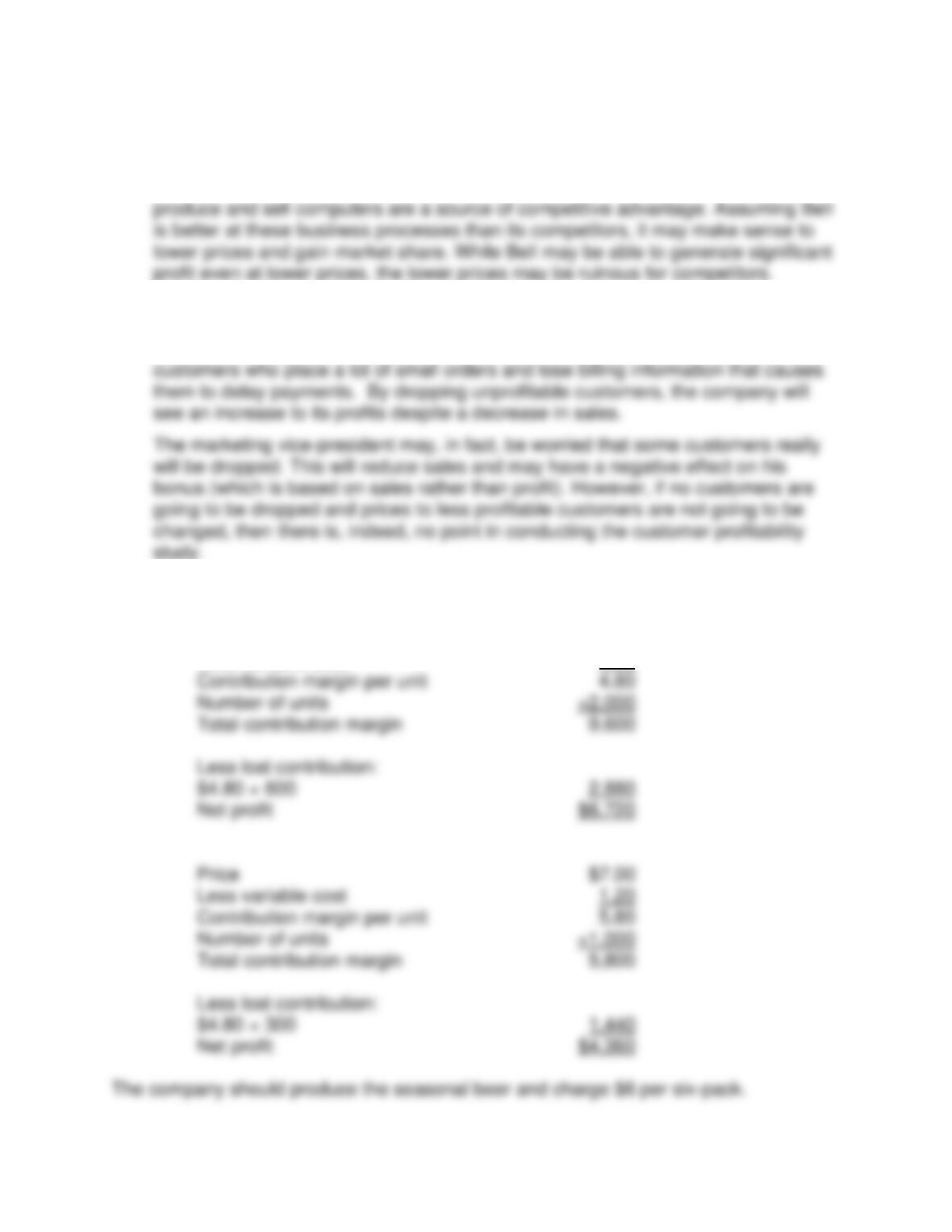
E3. [LO 1]
Price
$6.00
Less variable cost
1.20
Contribution margin per unit
4.80
Number of units
Total contribution margin
9,600
Less lost contribution:
$4.80 × 600
2,880
Net profit
Price
$7.00
1.20
Contribution margin per unit
5.80
Number of units
Total contribution margin
5,800
Less lost contribution:
$4.80 × 300
1,440
Net profit
Jiambalvo Managerial Accounting
8-4
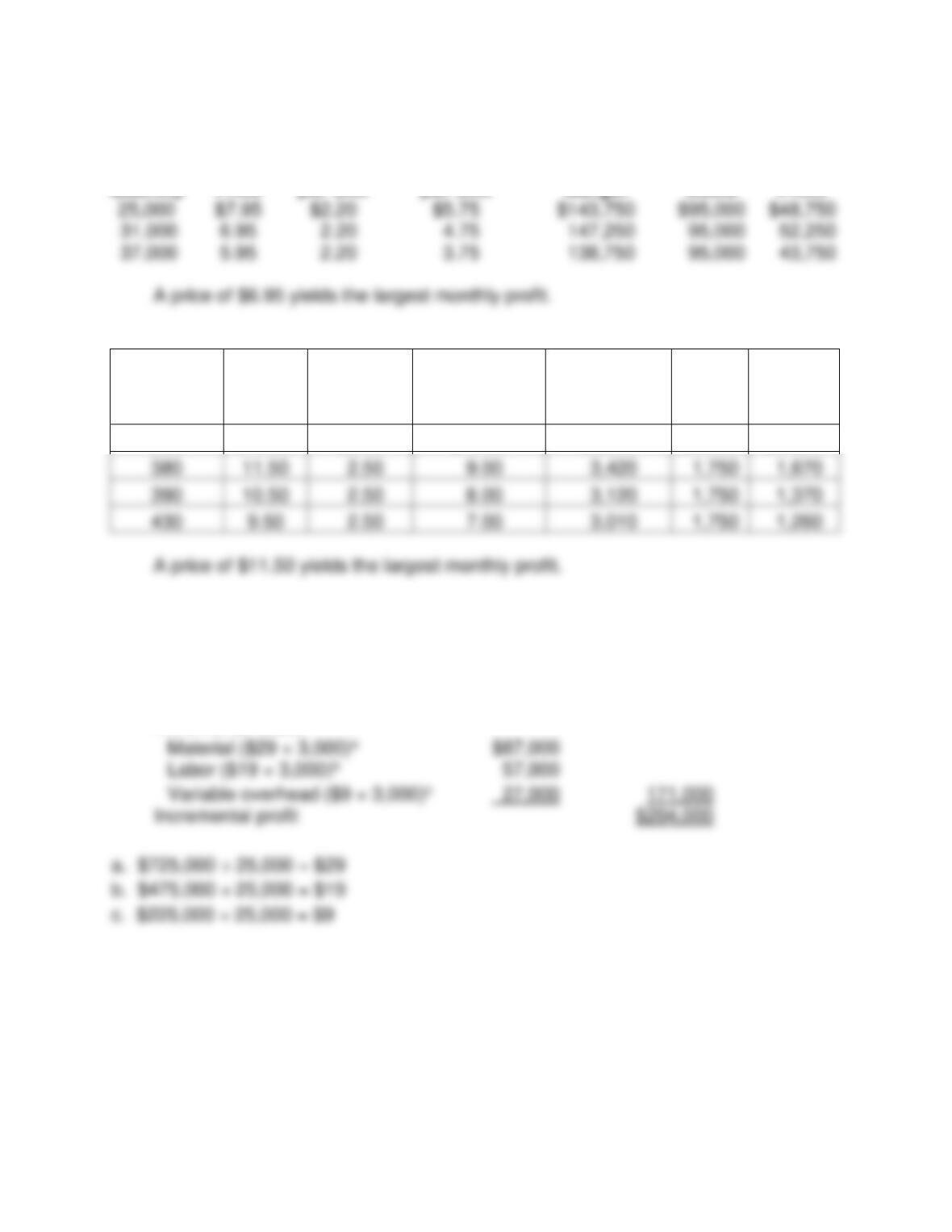
E4. [LO 1]
Quantity
Price
Variable
Cost
per Unit
Contribution
Margin
per Unit
Total
Contribution
Margin
Fixed
Costs
Profit
E5. [LO 1]
Quantity
Demanded
Price
Variable
Cost per
Unit
Contribution
Margin per
Unit
Total
Contribution
Margin
Fixed
Costs
Profit
330
$12.50
$2.50
$10.00
$3,300
$1,750
$1,550
380
390
430
E6. [LO 1]
Accepting the order will result in $204,000 of incremental profit.
Incremental revenue
($125 × 3,000) $375,000
Incremental costs:
$2.20
8-5
E7. [LO 1]
Incremental revenue
($900 × 150)
$135,000
Incremental costs:
Incremental profit
$7,500
E8. [LO 1]
Incremental revenue
$57 × 130
$7,410
Incremental costs:
Incremental profit
$3,510
E9. [LO 2]
a.
Variable cost per unit $ 80
Jiambalvo Managerial Accounting
8-6
E10. [LO 2]
a.
Variable cost per unit
$15.00
b.
Variable cost per unit
$15.00
Fixed costs per unit ($210,000 ÷ 40,000)
Cost
Markup of 30%
Price
$26.33
E11. [LO 2]
Student answers will vary.
E12. [LO 2]
E13. [LO 4]
E14. [LO 2]
Fixed costs per unit ($210,000 ÷ 60,000)
Cost
Markup of 30%
Price
$24.05
E15. [LO 3]
Sales $55,000
Less:
E16. [LO 3]
a. Revenue
Sales $55,000
Order processing fee (250 × $7) 1,750
E17. [LO 3]
Sales
$22,000
Less:
Profitability of Julius Company account
Jiambalvo Managerial Accounting
8-8
E18. [3]LO 6
a.
Sales
$22,000
Order processing fees ($11 x 170)
1,870
Rush fees ($20 x .80 x 170)
2,720
Customer support fees ($21 x 90)
Less:
$17,600
1,530
1,496
1,170
Profitability of Julius Company account
Chapter 8 Pricing Decisions, Analyzing Customer Profitability, and Activity-Based Pricing
8-9
PROBLEMS
P1. [LO 1]
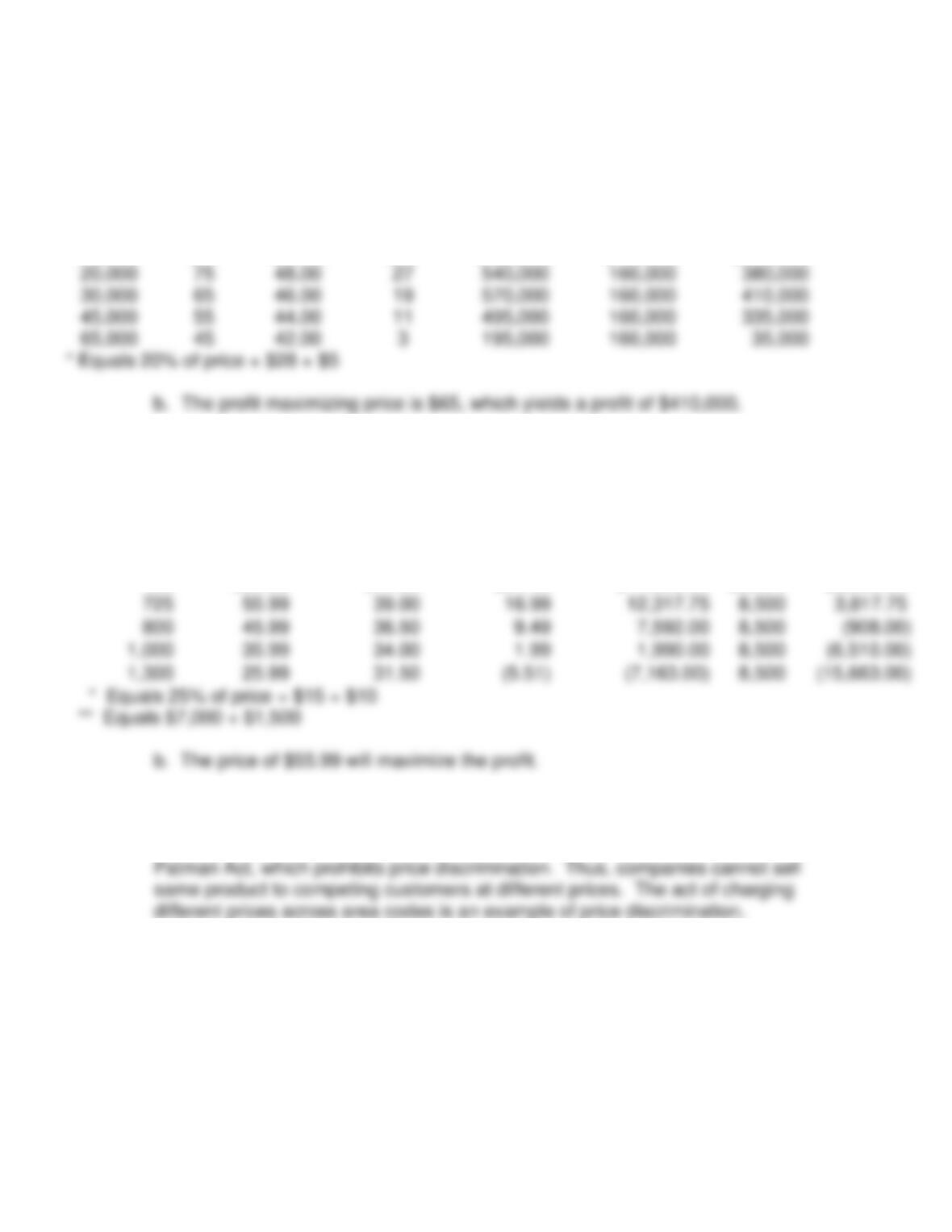
a.
Quantity
Price
Variable
Cost*
CM/Unit
Total CM
Fixed Costs
Profit
15,000
$85
$50.00
$35
$525,000
$160,000
$365,000
P2. [LO 1]
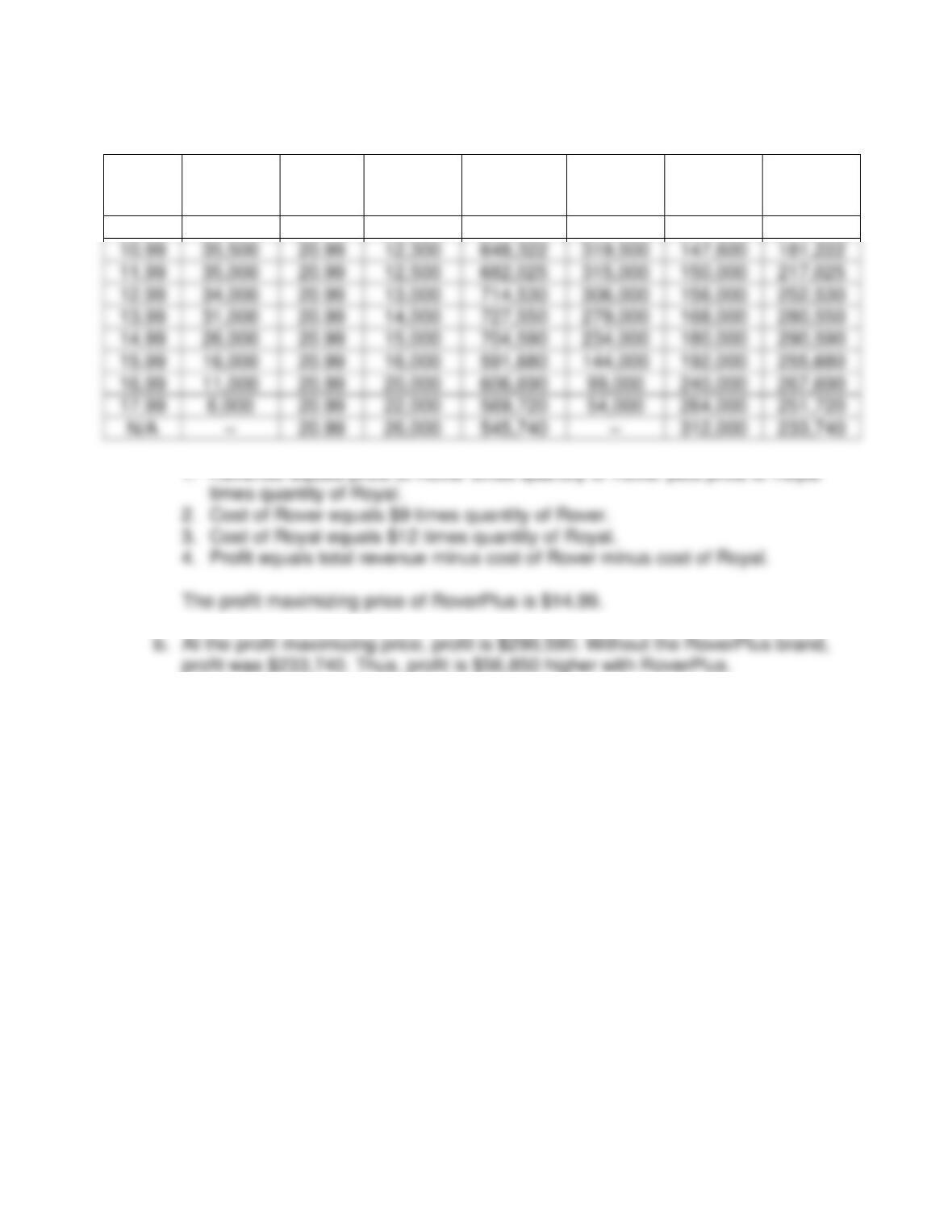
a.
Quantity
Demanded
Price
Variable Cost
per Unit*
Contribution
Margin per
Unit
Total
Contribution
Margin
Fixed
Costs**
Profit
450
$65.99
$41.50
$24.49
$11,020.50
$8,500
$2,520.50
725
800
8,500
(15,663.00)
P3. [LO 1]
This approach does seem unethical. It seems to be a violation of the Robinson–
Jiambalvo Managerial Accounting
8-10
P4. [LO 1]
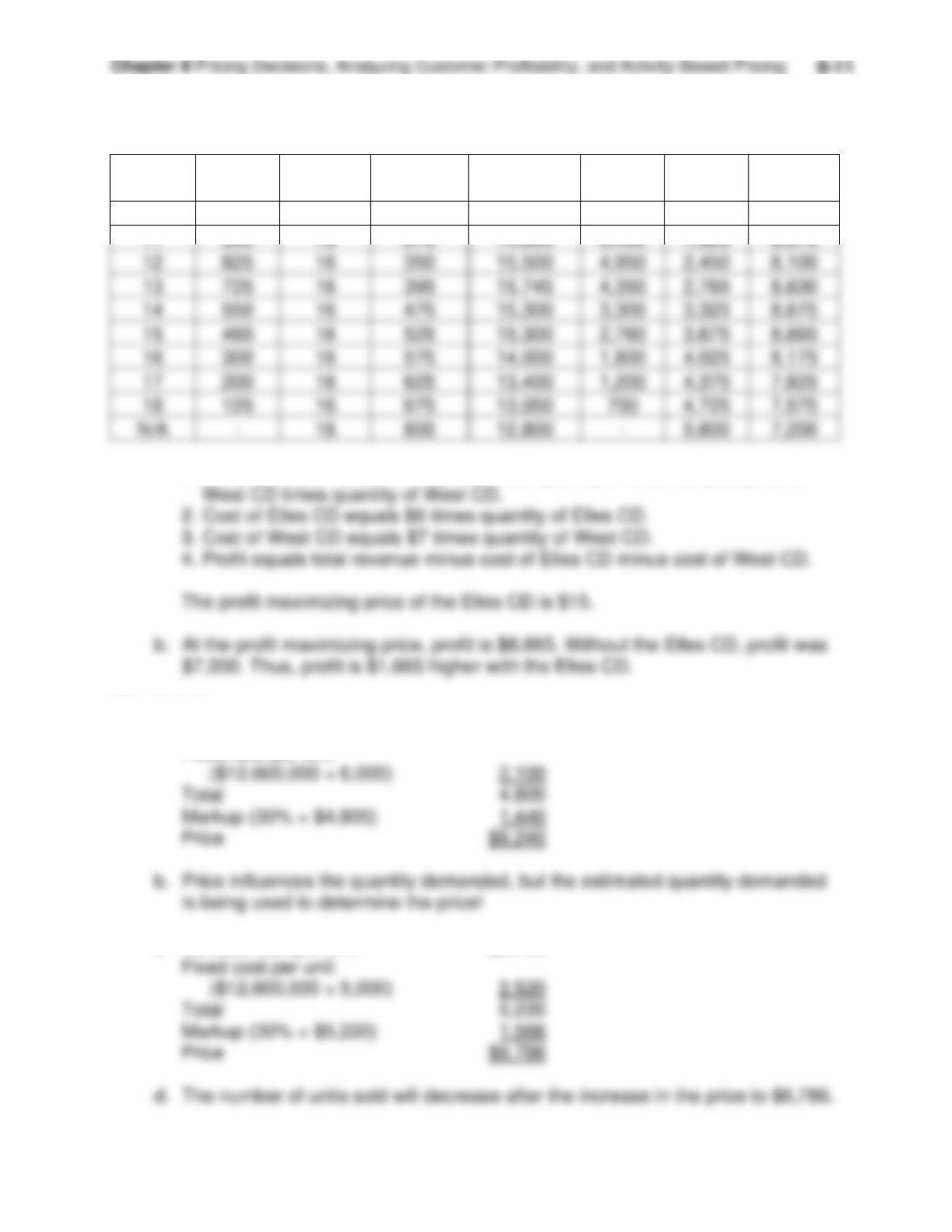
a.
Price
of
Rover
Quantity
of Rover
Price
of
Royal
Quantity
of Royal
Total
Revenue1
Cost of
Rover2
Cost of
Royal3
Profit4
$9.99
36,000
$20.99
12,000
$611,520
$324,000
$144,000
$143,520
1. Revenue equals price of Rover times quantity of Rover plus price of Royal
10.99
35,500
12,300
11.99
35,000
12,500
12.99
34,000
13,000
13.99
31,000
14,000
14.99
26,000
15,000
15.99
16,000
16,000
17.99
22,000
54,000
26,000
P5. [LO 1]
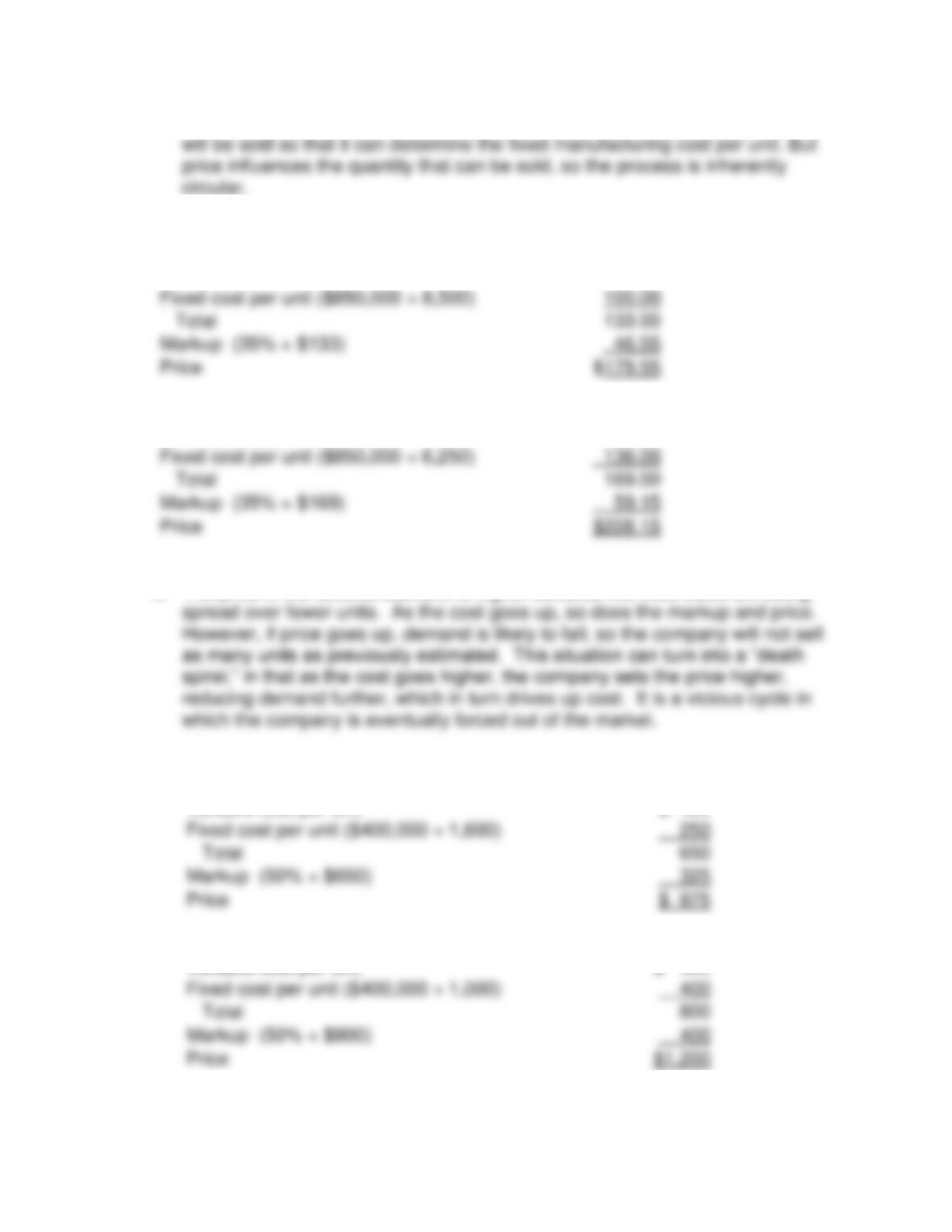
a.
Price of
Quantity
Price of
Quantity
Total
Cost of
Cost of
Profit (4)
Elles CD
Elles CD
West CD
West CD
Revenue (1)
Elles (2)
West (3)
$10
950
$16
200
$12,700
$5,700
$1,400
$5,600
900
275
825
350
725
395
15,745
550
475
460
525
300
575
125
675
750
800
1. Revenue equals price of Elles CD times quantity of Elles CD plus price of
P6. [LO 2]
a. Variable cost per unit $2,700
Fixed cost per unit
c. Variable cost per unit $2,700
Jiambalvo Managerial Accounting
8-12
e. To mark-up full cost, a manufacturing firm must first estimate the quantity that
P7. [LO 2]
a.
Variable cost per unit
$ 33.00
Fixed cost per unit ($850,000 ÷ 8,500)
Markup (35% × $133)
Price
$179.55
b.
Variable cost per unit
$ 33.00
Fixed cost per unit ($850,000 ÷ 6,250)
Markup (35% × $169)
Price
$228.15
c. The price in the second scenario is higher because the fixed costs are being
P8. [LO 2]
a.
Variable cost per unit
$ 400
Fixed cost per unit ($400,000 ÷ 1,600)
Markup (50% × $650)
Price
$ 975
b.
Variable cost per unit
$ 400
Fixed cost per unit ($400,000 ÷ 1,000)
Markup (50% × $800)
Price
$1,200
8-13
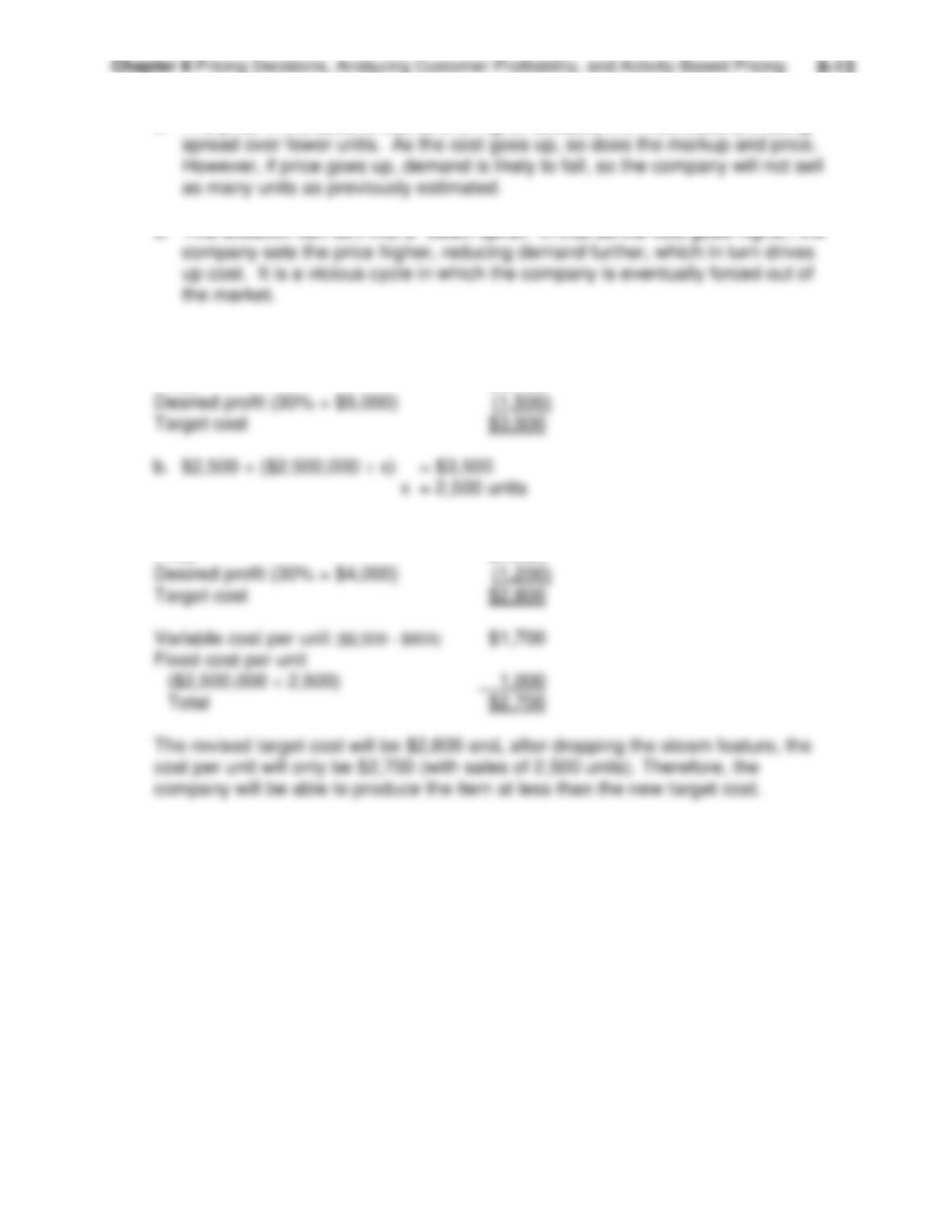
c. The price in the second scenario is higher because the fixed costs are being
P9. [LO 2]
a.
Price $5,000
c.
Price $4,000
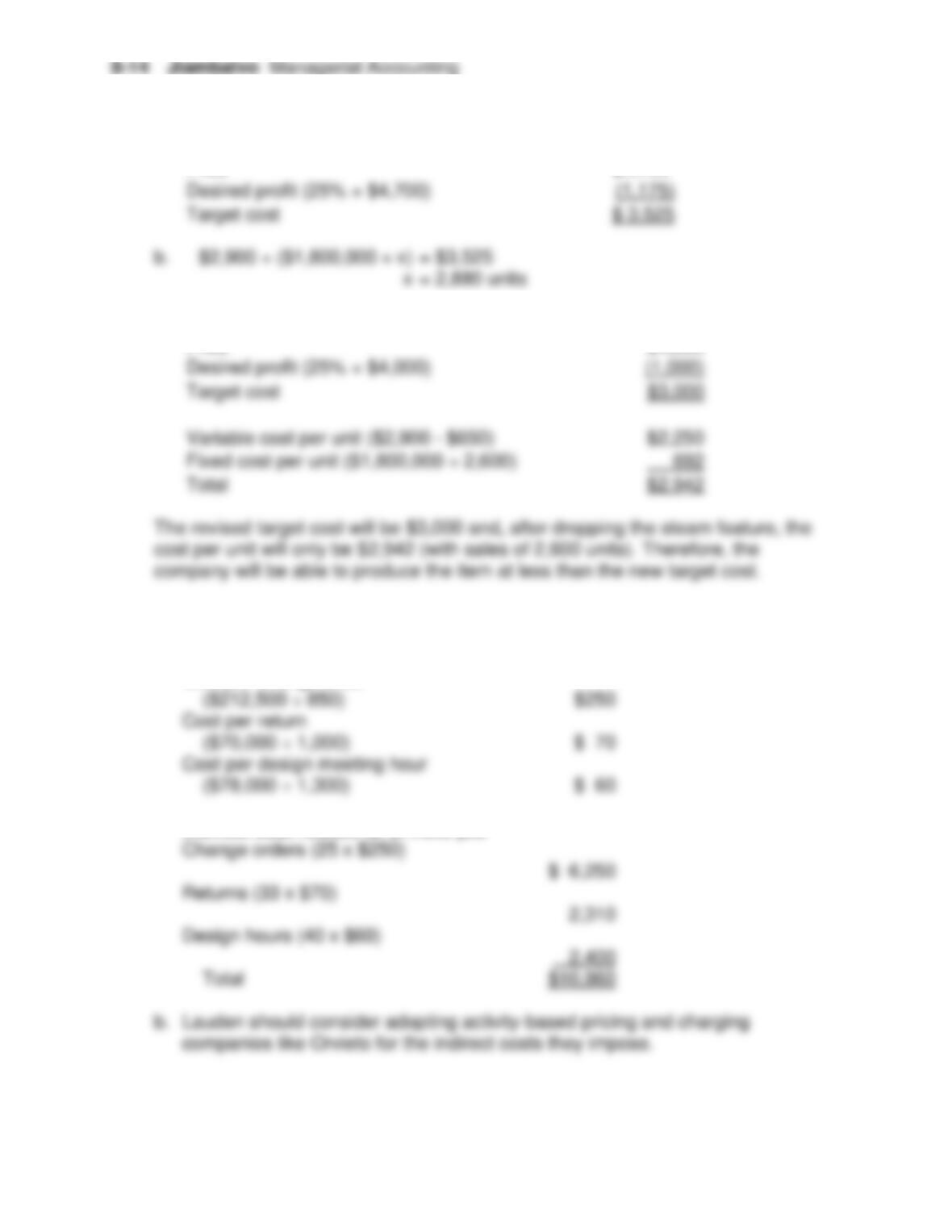
P10. [LO 2]
a.
Price
$4,700
Desired profit (25% × $4,700)
Target cost
c.
Price
$4,000
Desired profit (25% × $4,000)
Target cost
Variable cost per unit ($2,900 – $650)
Fixed cost per unit ($1,800,000 ÷ 2,600)
Total
P11. [LO 3]
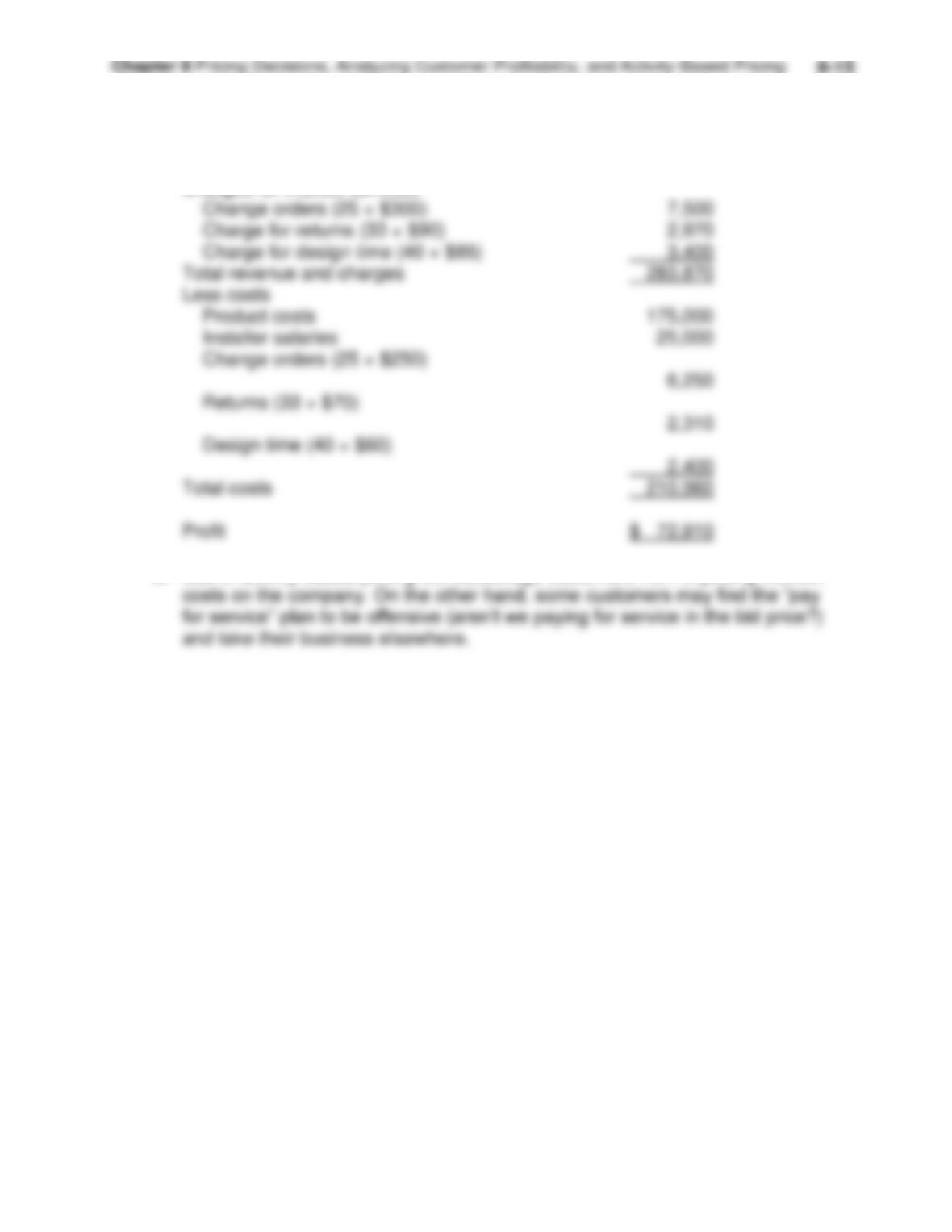
a. Cost per change order
Indirect cost related to Orvieto job
8-15
P12. [LO 3]
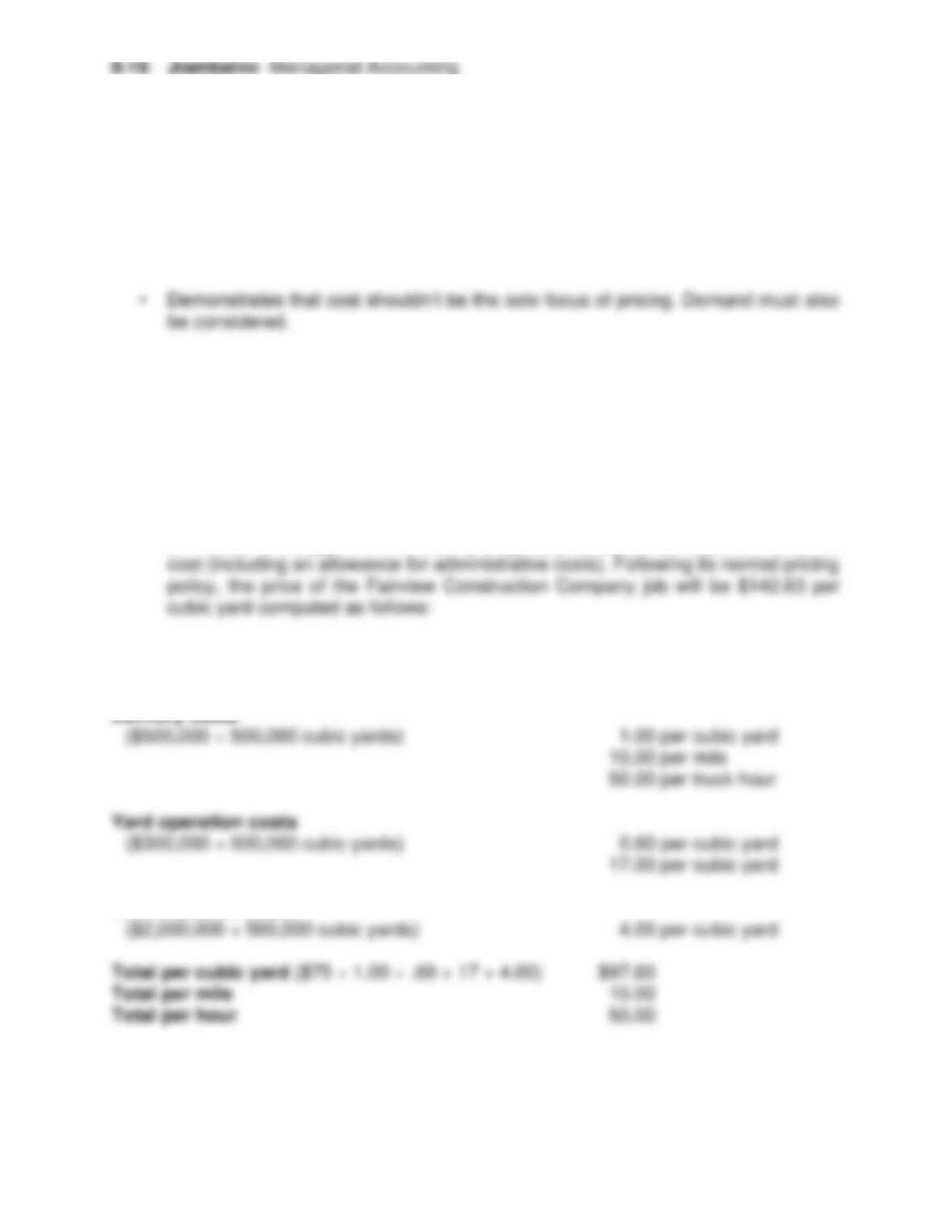
a. Mark-up of product cost and installer salary $270,000
Charges for indirect services
b. Use of activity-based pricing will discourage customers from imposing indirect
Case 8-1 [LO 1, 2]
PRESTON CONCRETE
Summary
A supplier of concrete uses full cost pricing, but a sharp increase in interest rates has
reduced demand for concrete and the company is considering a lower price.
Questions to ask students
1. What’s the situation facing Preston Concrete and what is the cost plus price of the
Fairview Construction Company job?
2. Should Preston lower its price to $115 per cubic yard?
Discussion
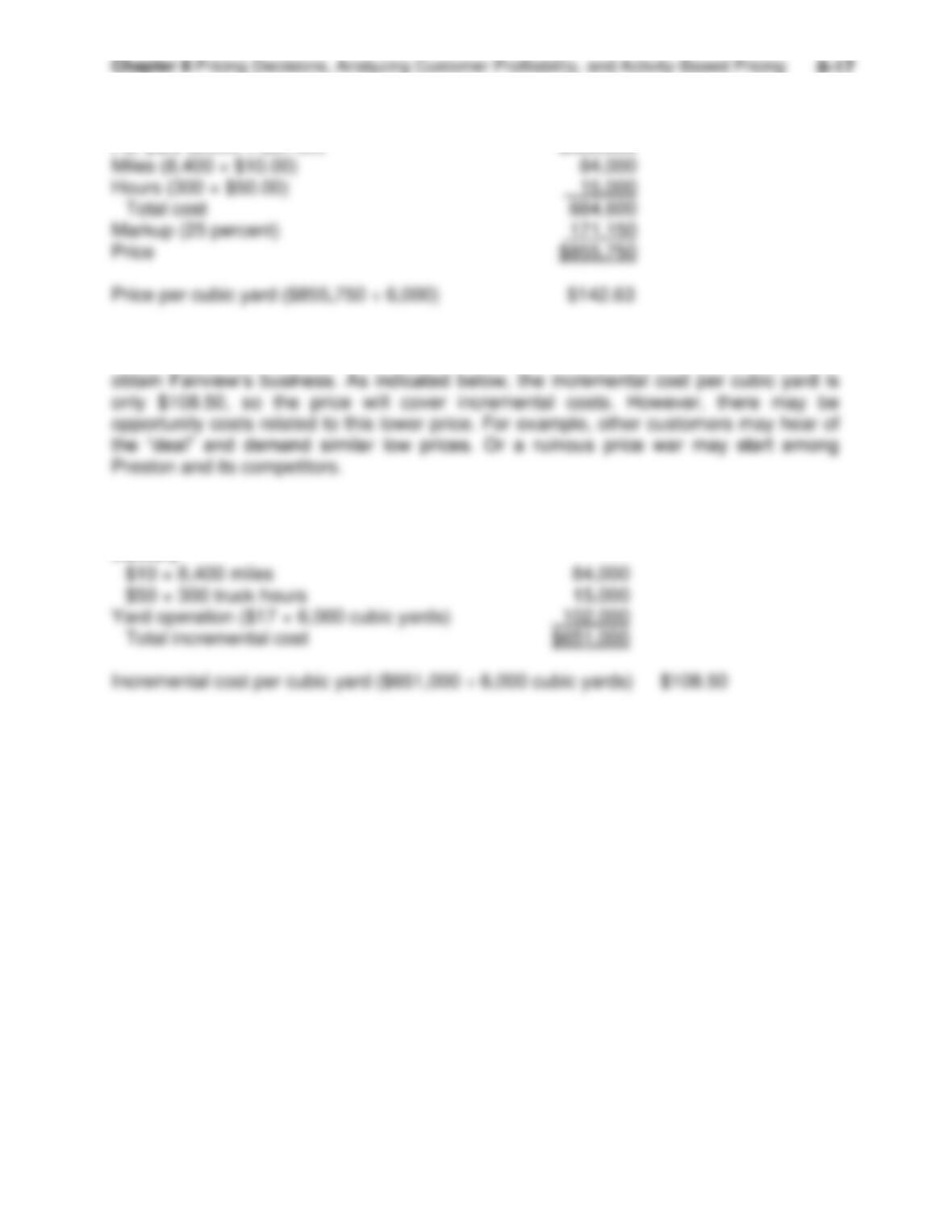
a. Preston is a supplier of concrete and typically sets price at 25 percent over full
Material costs $75.00 per cubic yard
Administrative costs
8-17
Price for Fairview job
Per yard (6,000 × $97.60) $585,600
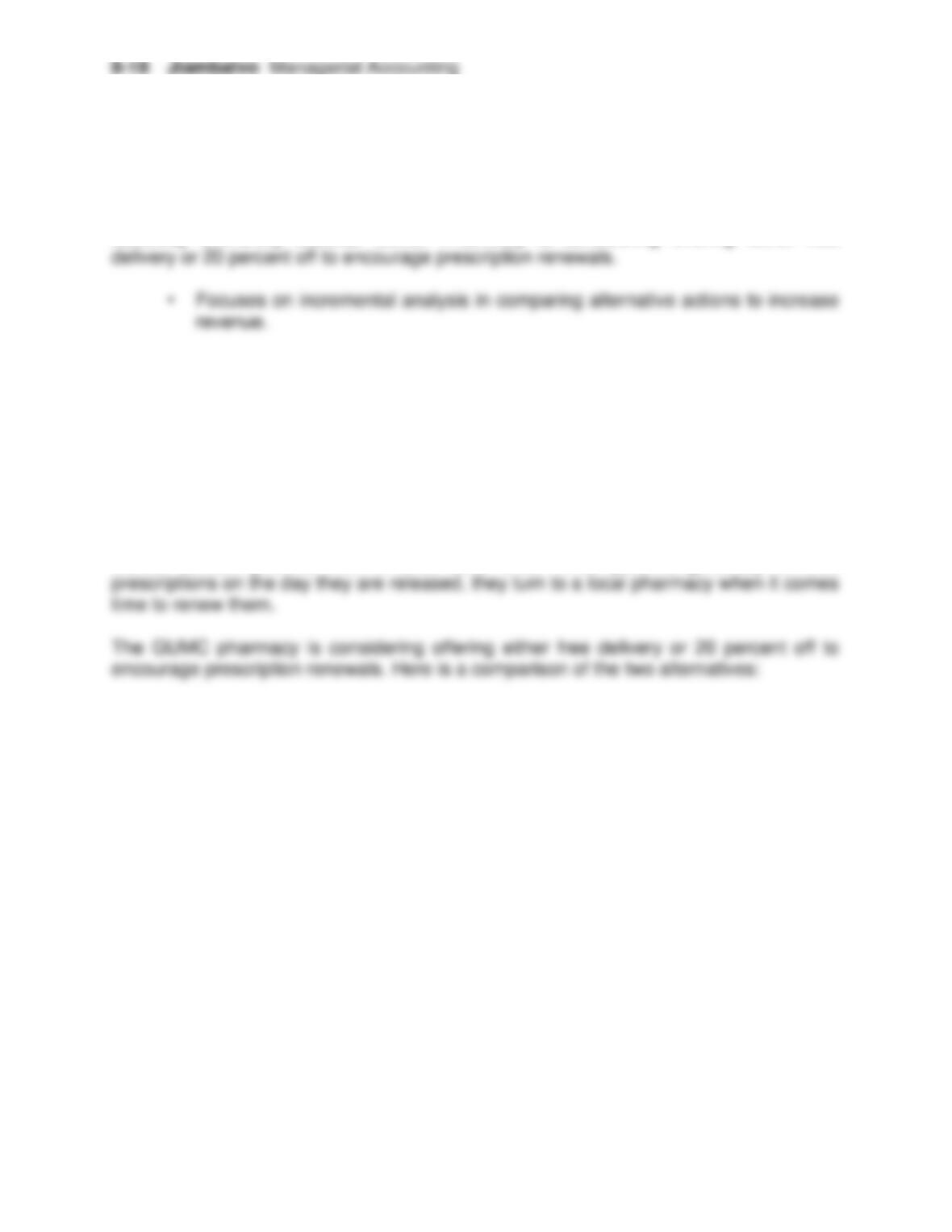
b. Now let’s consider whether Preston should lower its price to $115 per cubic yard to
Incremental cost of Fairview job
Material ($75 × 6,000 cubic yards) $450,000
Delivery
Case 8-2 [LO 1]
GALLOWAY UNIVERSITY MEDICAL CENTER PHARMACY
Summary
Galloway University Medical Center Pharmacy is considering offering either free
Questions to ask students
1. What is the situation at Galloway University Medical Center Pharmacy?
2. Which option should be selected: offer free delivery, or offer 20 percent off on
prescription renewals?
Discussion
GUMC attracts patients from a three state area. While patients generally fill their
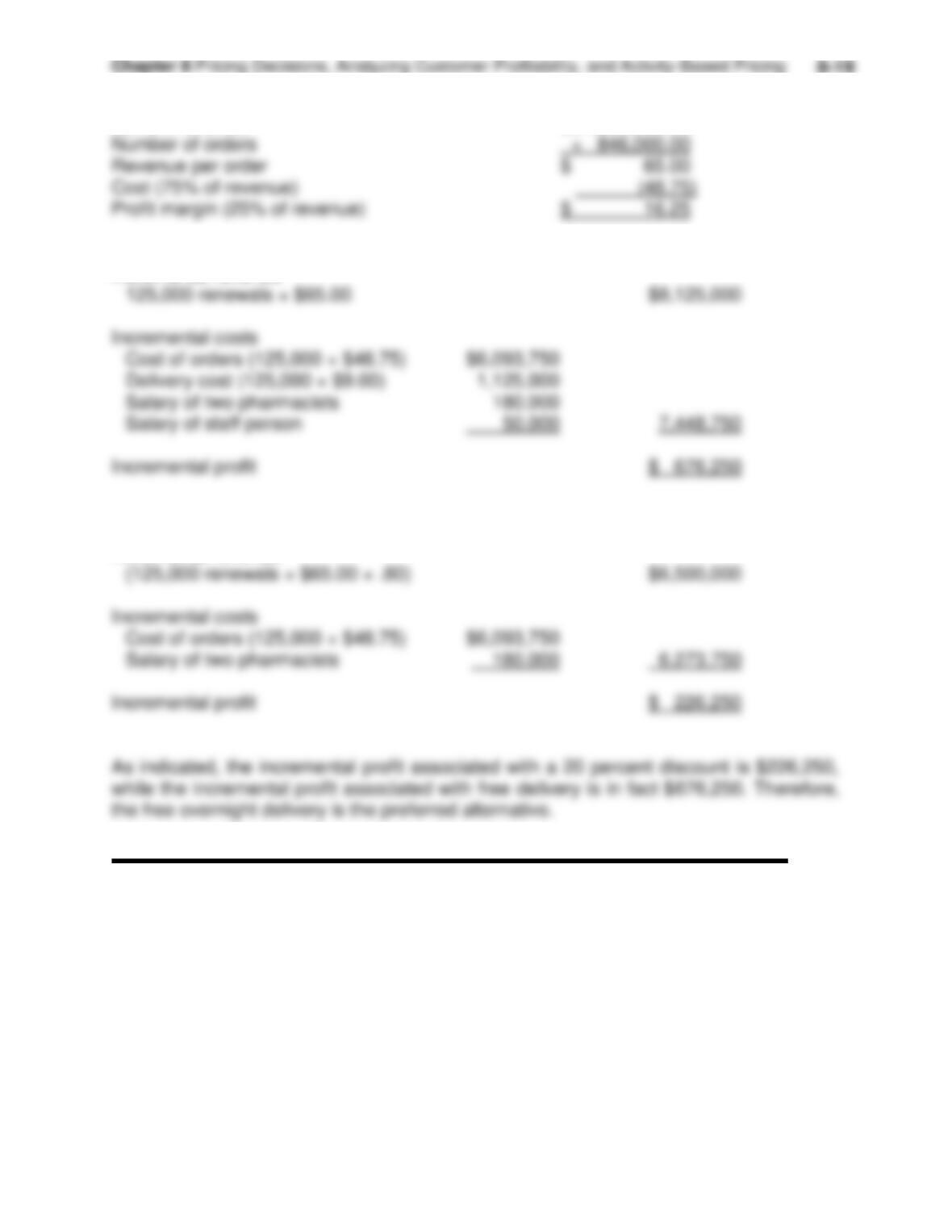
8-19
Current revenue $54,990,000.00
Free overnight delivery
Incremental revenue
20 percent discount
Incremental revenue