Chapter 08 – Reporting and Interpreting Property, Plant, and Equipment; Natural Resources; and Intangibles
8-56
COMP8-1. (continued)
Case D (continued)
c. Weighted average
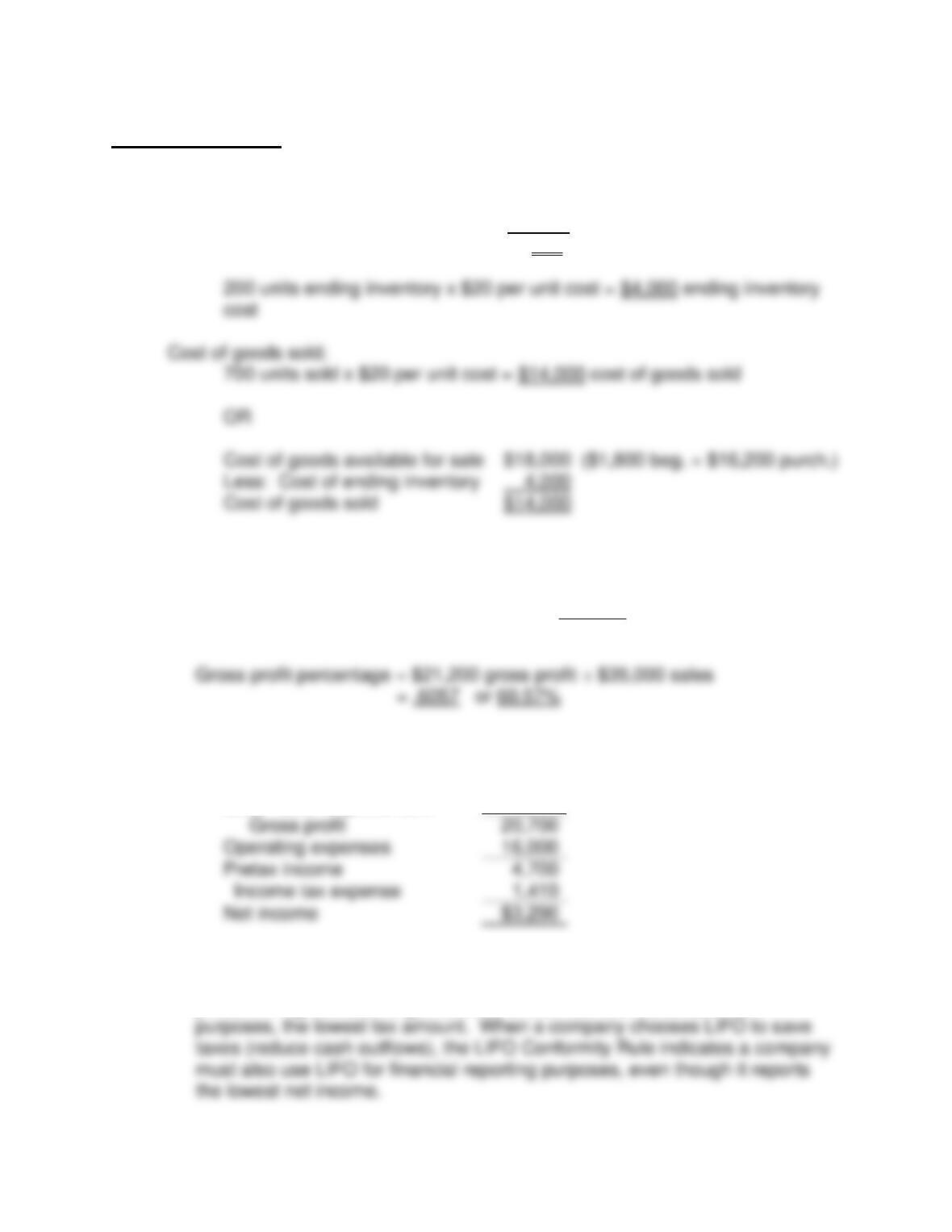
Cost of ending inventory:
Cost of goods available for sale $18,000 ($1,800 beg. + $16,200 purch.)
÷ Number of goods available ÷ 900 units
Cost per unit $20 per unit
Req. 2
a. Gross profit under FIFO method
Sales revenue (700 units sold x $50) $35,000
Less: Cost of goods sold 13,800
Gross profit $21,200
b. Net income under LIFO method
Sales revenue
$35,000
Less: Cost of goods sold
14,300
20,700
Operating expenses
16,000
Pretax income
Net income
$3,290
c. The LIFO method should be recommended to Stewart for tax and financial
reporting purposes. Prices of inventory are rising. When prices rise, LIFO
yields the highest cost of goods sold, lowest net income, and, for tax
Chapter 08 – Reporting and Interpreting Property, Plant, and Equipment; Natural Resources; and Intangibles
8-57
COMP8-1. (continued)
Case D (continued)
Req. 2
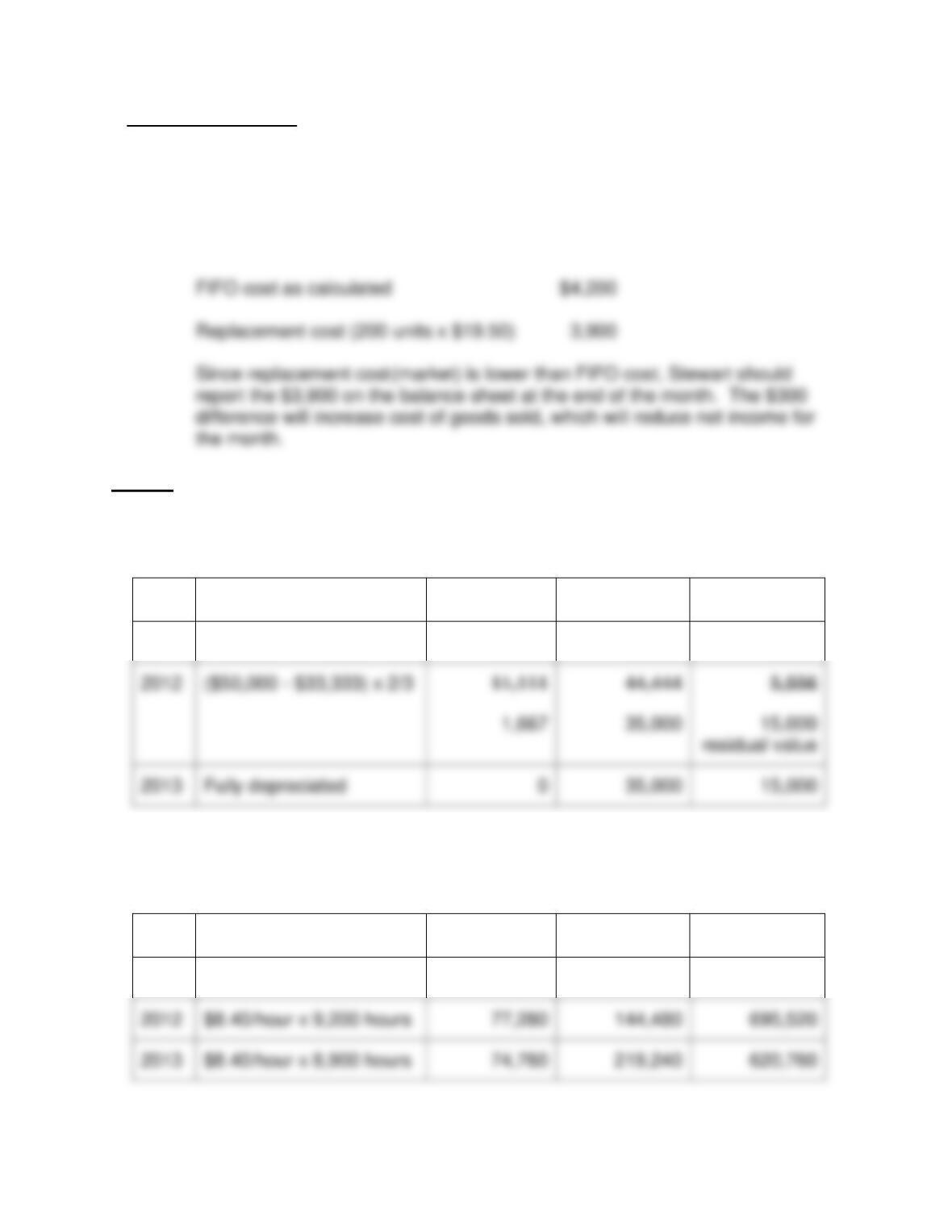
For valuation purposes, ending inventory is to be reported at the lower of cost
or market, a conservative approach so that assets are not overstated, thus
reducing net income. When Stewart applied the LCM method, the following
comparisons were made:
Case E
Req. 1 Partial depreciation schedules:
a. Office equipment using double-declining-balance method
Year
Computation
Depreciation
Expense
Accumulated
Depreciation
Net Book
Value
2011
($50,000 – $0) x 2/3
33,333
33,333
16,667
2013
Fully depreciated
35,000
b. Factory equipment using units-of-production method
(Cost – Residual Value) / Total estimated production =Depreciation rate
($840,000 – $0) / 100,000 hours = $8.40 per hour
Year
Computation
Depreciation
Expense
Accumulated
Depreciation
Net Book
Value
2011
$8.40/hour x 8,000 hours
67,200
67,200
772,800
2012
$8.40/hour x 9,200 hours
77,280
695,520
Chapter 08 – Reporting and Interpreting Property, Plant, and Equipment; Natural Resources; and Intangibles
8-58
COMP8-1. (continued)
Case E
Req. 2
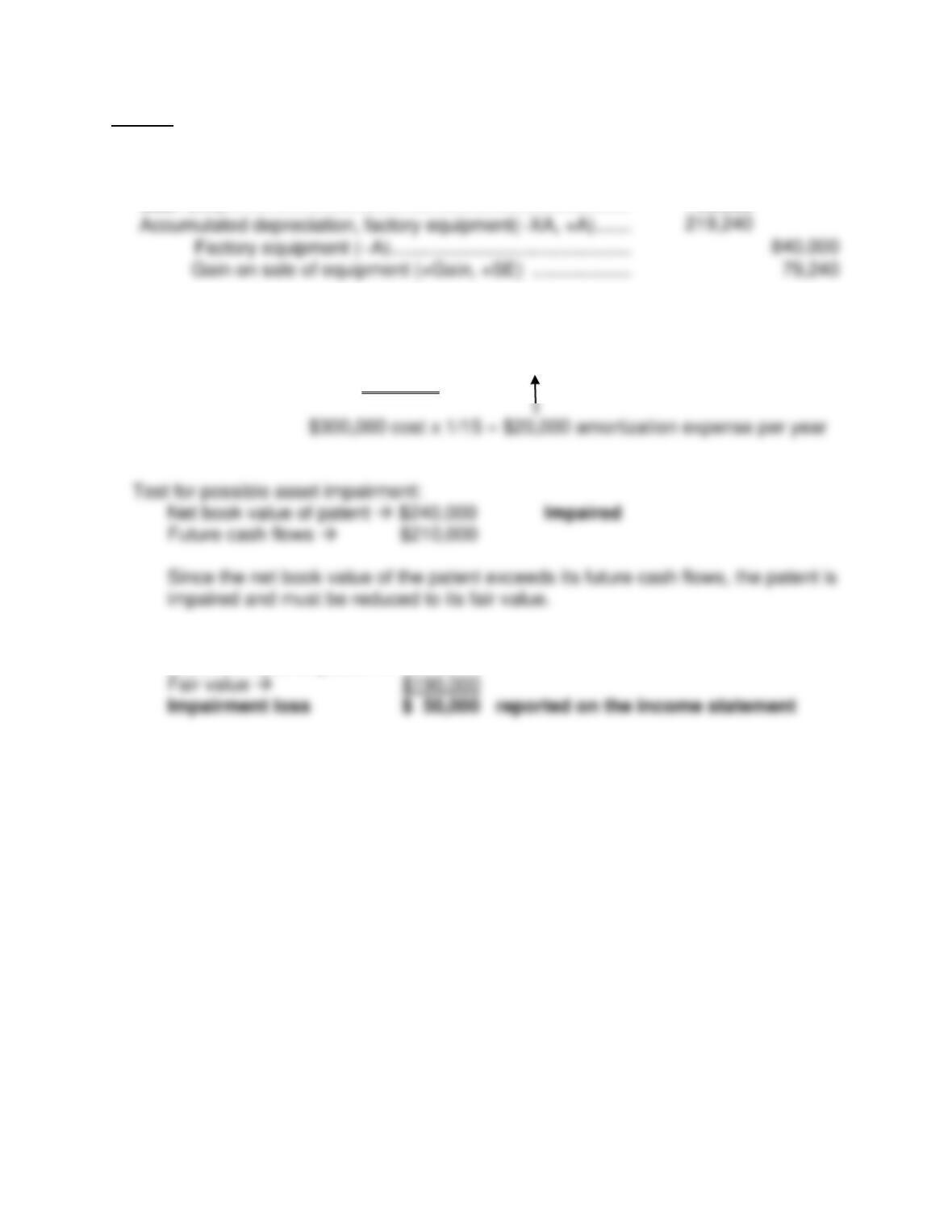
Cash (+A) ……………………………………………………………………
700,000
Req. 3
Net book value of patent = $300,000 cost – ($20,000 annual expense x 3 years)
= $240,000
Computation of impairment loss:
Net book value of patent → $240,000
Chapter 08 – Reporting and Interpreting Property, Plant, and Equipment; Natural Resources; and Intangibles
8-59
CASES AND PROJECTS
ANNUAL REPORT CASES
CP8–1.
1. The company spent $265,335,000 on property and equipment in the 2008 year
(this information is disclosed on the Statement of Cash Flows).
2. The estimated useful life of leasehold improvements is the lesser of 5 to 10 years
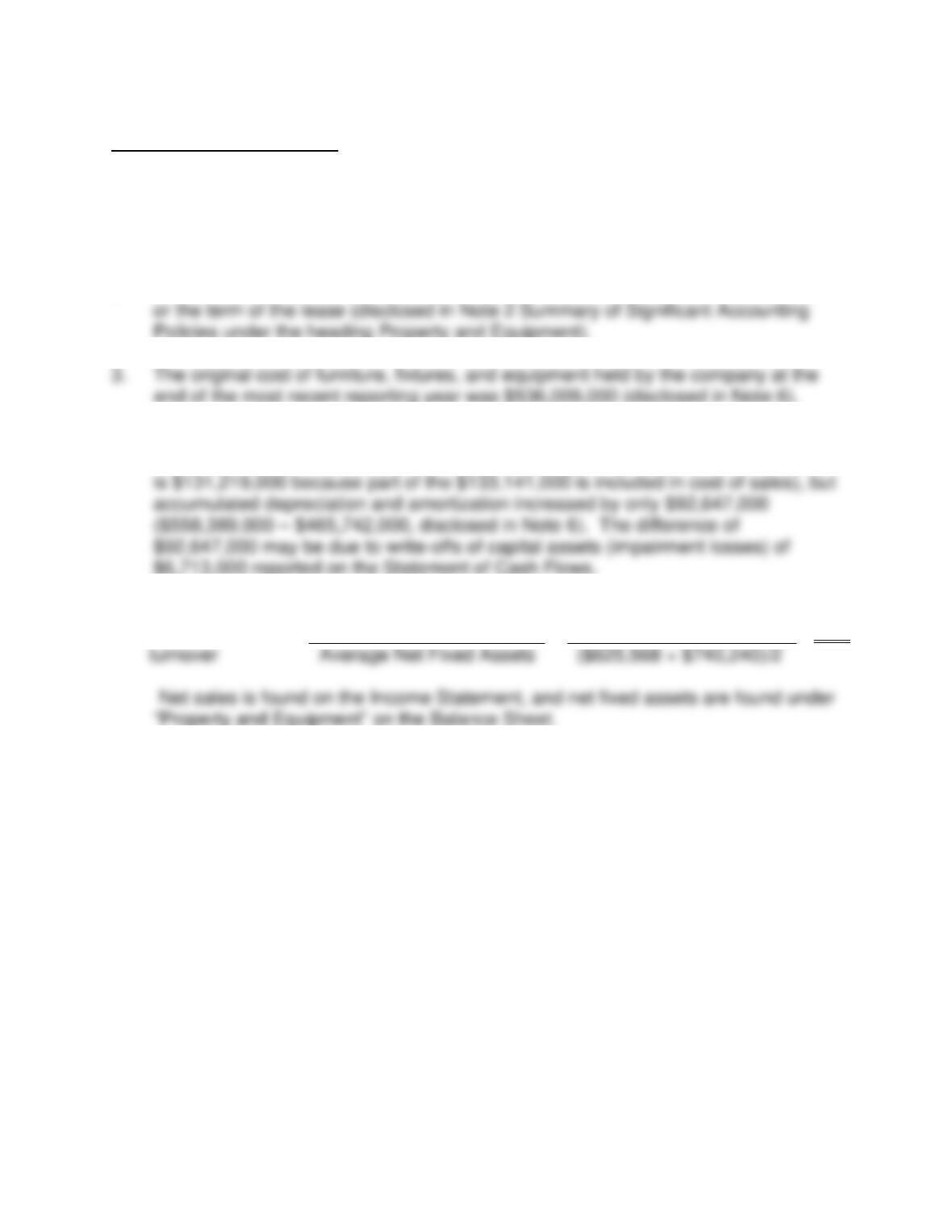
4. Current depreciation and amortization expense is $133,141,000 (disclosed on the
Statement of Cash Flows; note that the amount reported on the Income Statement
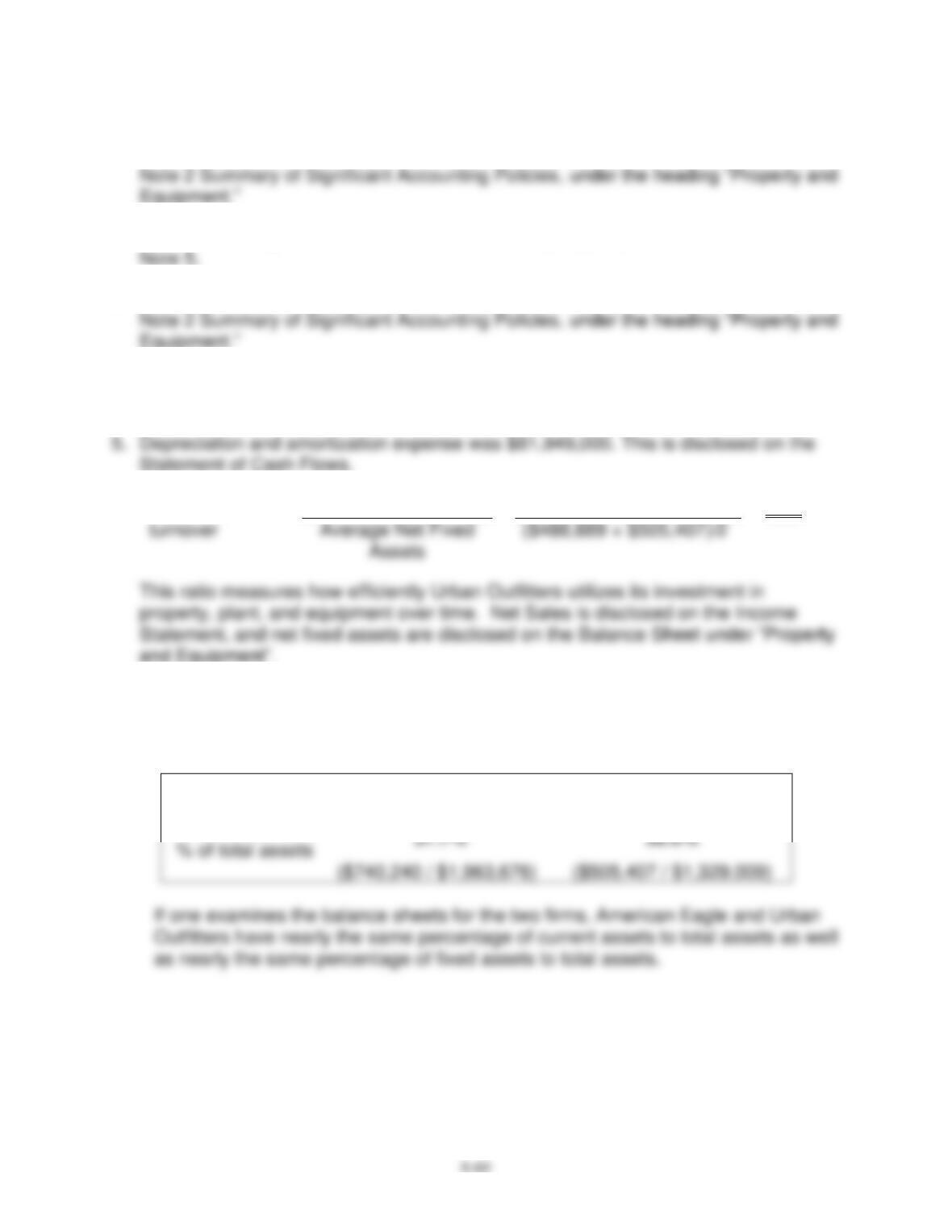
5. (in thousands)
Fixed asset
=
Net Sales
=
$2,988,866
=
4.38
turnover
Chapter 08 – Reporting and Interpreting Property, Plant, and Equipment; Natural Resources; and Intangibles
CP8–2.
1. The company uses the straight-line method of depreciation. This is disclosed in
2. Accumulated depreciation and amortization was $355,957,000. This is disclosed in
3. Furniture and fixtures have estimated useful lives of 5 years. This is disclosed in
4. The original cost of the leasehold improvements was $486,959,000. This is
disclosed in Note 5.
6. (in thousands)
Fixed asset
=
Net Sales
=
$1,834,618
=
3.69
CP8–3.
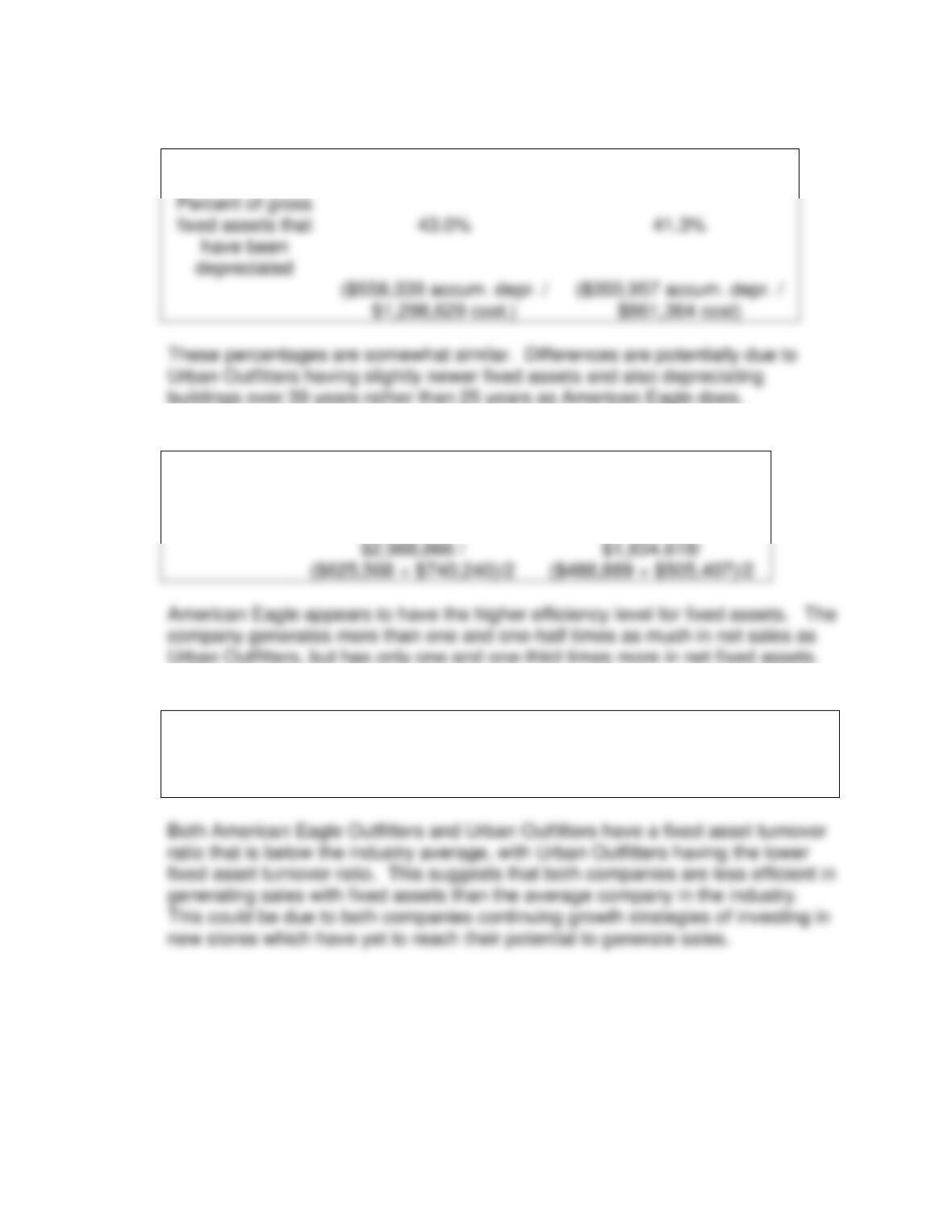
1.
American Eagle
Outfitters
Urban
Outfitters
Fixed assets as a
Chapter 08 – Reporting and Interpreting Property, Plant, and Equipment; Natural Resources; and Intangibles
8-61
CP8–3. (continued)
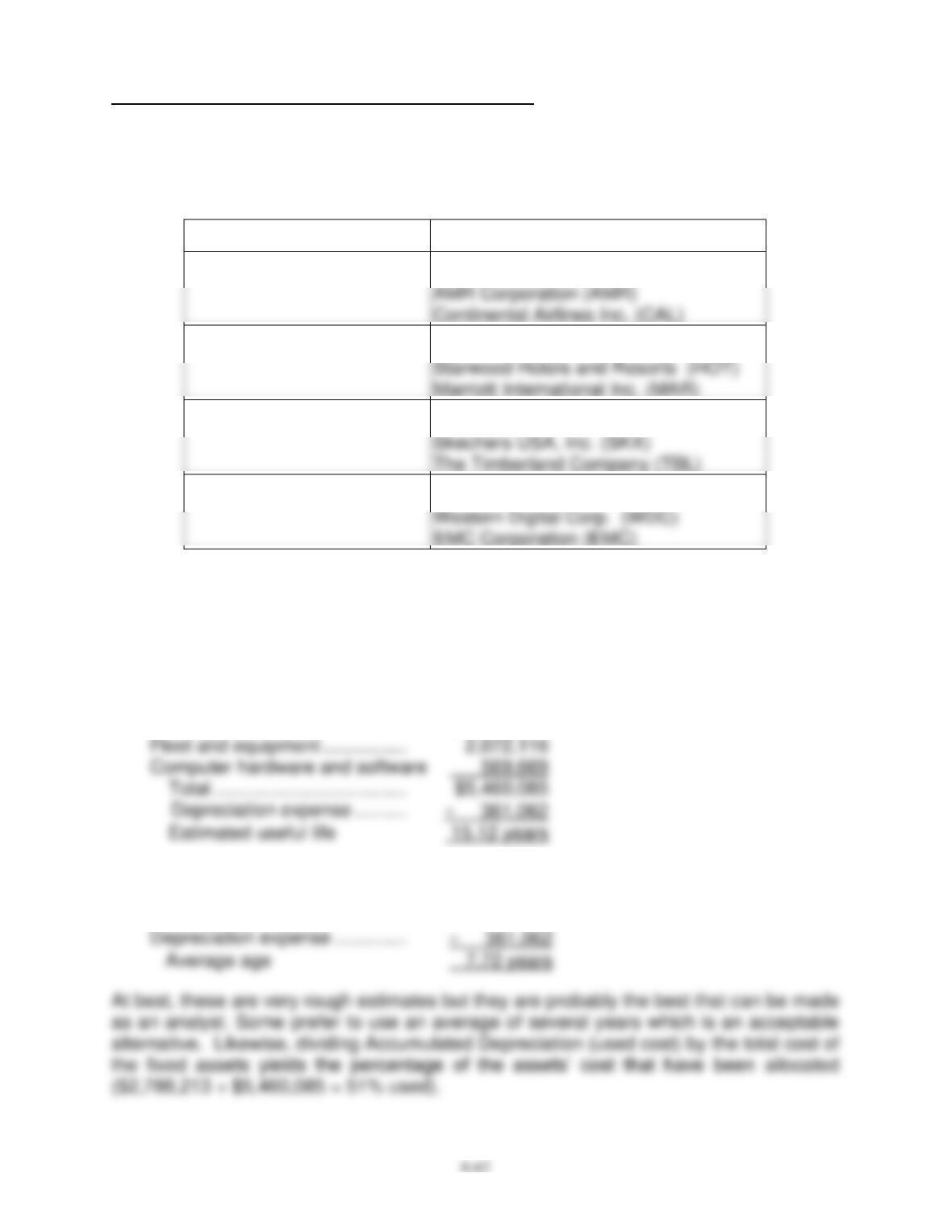
2.
American Eagle
Outfitters
Urban
Outfitters
3.
American Eagle
Outfitters
Urban
Outfitters
Fixed Asset
Turnover
4.38
3.69
4.
Industry
Average
American Eagle
Outfitters
Urban
Outfitters
Fixed Asset
Turnover
5.76
4.38
3.69
Chapter 08 – Reporting and Interpreting Property, Plant, and Equipment; Natural Resources; and Intangibles
FINANCIAL REPORTING AND ANALYSIS CASES
CP8–4.
More than three competitors are listed in each of the following industries.
Examples include:
Industry
Company name (Symbol, if available)
1.
Airline
Delta Air Lines,Inc. (DAL)
AMR Corporation (AMR)
Continental Airlines Inc. (CAL)
2.
Hotels & Motels
Wyndham Worldwide (WYN)
Starwood Hotels and Resorts (HOT)
Marriott International Inc. (MAR)
3.
Footwear
Brown Shoe Company, Inc. (BWS)
Skechers USA, Inc. (SKX)
The Timberland Company (TBL)
4.
Computer Hardware
Hewlett-Packard (HPQ)
Western Digital Corp. (WDC)
EMC Corporation (EMC)
CP8–5.
Req. 1
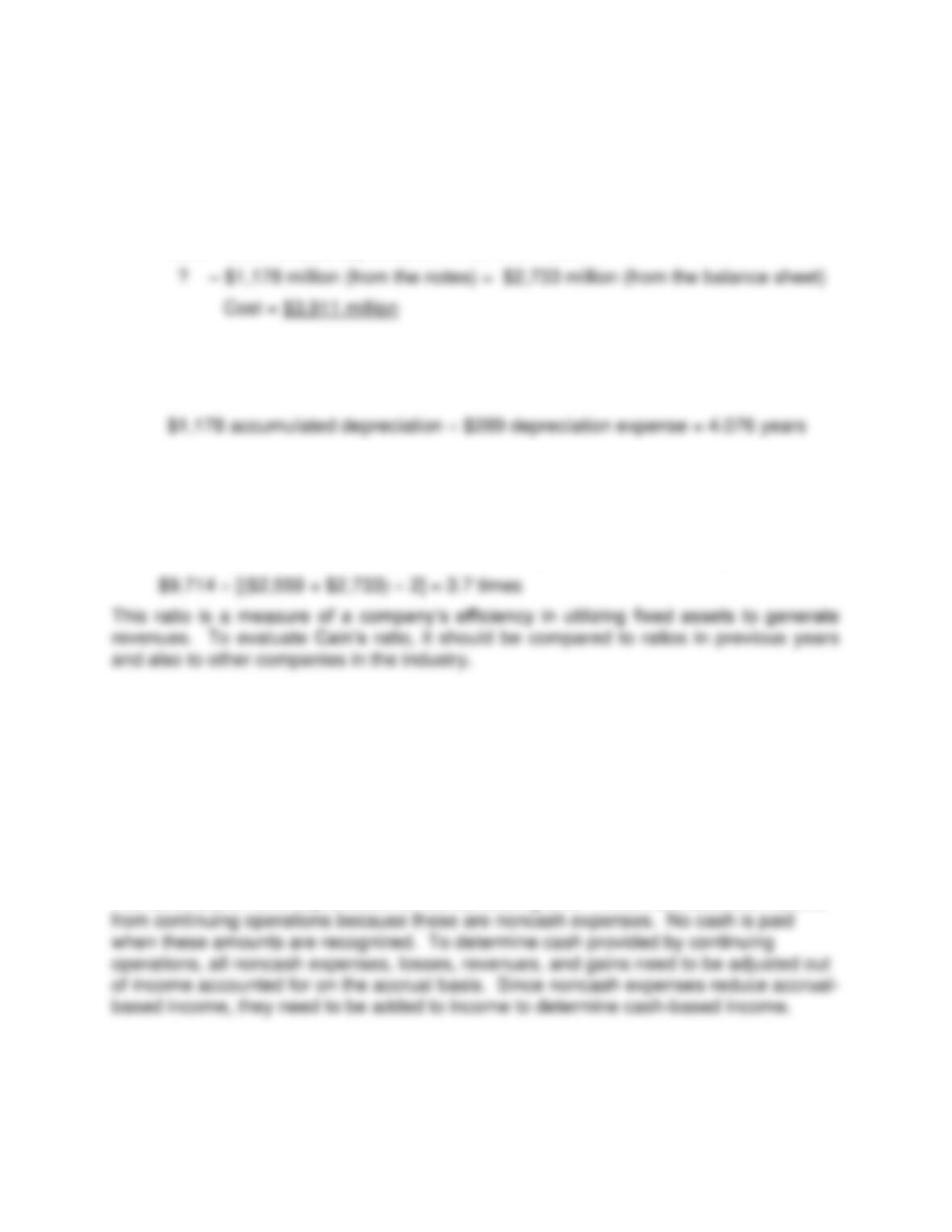
Depreciable assets:
Buildings and improvements ….
$ 2,818,300
Computer hardware and software
Req. 2
Accumulated depreciation ……..
$ 2,788,213
Average age
Chapter 08 – Reporting and Interpreting Property, Plant, and Equipment; Natural Resources; and Intangibles
8-63
CP8–6.
Req. 1
The cost of the property, plant, and equipment at the end of the current year is $3,911
million computed as follows:
Cost – accumulated depreciation = Net book value
Req. 2
The approximate age of the property on that date was 4 years, computed as follows:
Req. 3
Current year fixed asset turnover ratio:
Sales [(Beginning net fixed assets + Ending net fixed assets) 2)]
Req. 4
Cain reported $3,076 million as goodwill that represents the amount Cain paid above
fair market value for the net assets of other companies Cain purchased.
Req. 5
The amortization and depreciation amounts, totaling $497 million, are added to income
Chapter 08 – Reporting and Interpreting Property, Plant, and Equipment; Natural Resources; and Intangibles
CP8–7.
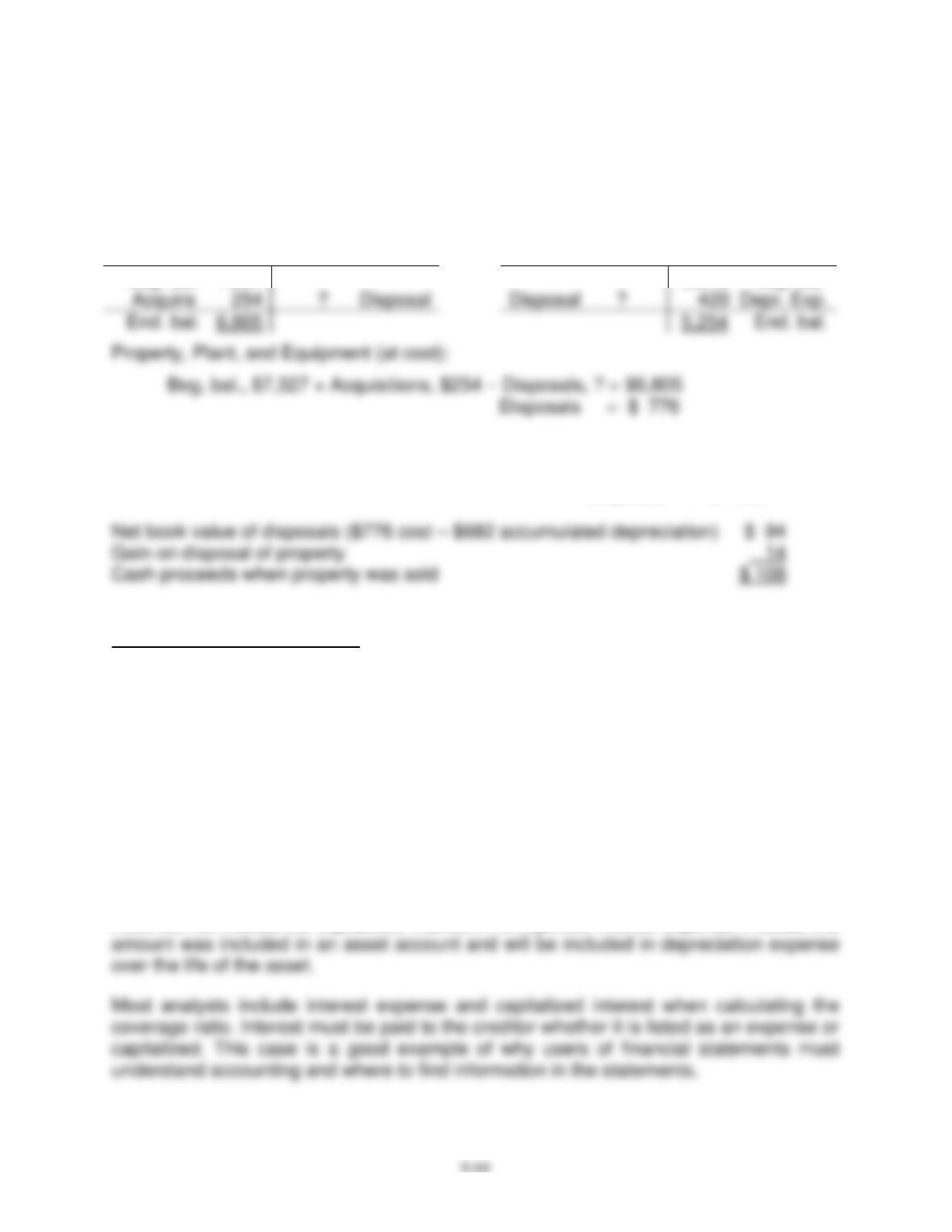
Consider the kinds of transactions that make Property, Plant, and Equipment and
Accumulated Depreciation change during a period:
(in millions)
Property, Plant, and Equipment
Accumulated Depreciation
Beg. bal. 7,327
5,516 Beg. bal.
Acquire 254
Disposal ?
End. bal. 6,805
5,254 End. bal.
Accumulated Depreciation (used):
Beg. bal., $5,516 + Depreciation expense, $420 − Disposals, ? = $5,254
Disposals = $ 682
CRITICAL THINKING CASES
CP8–8.
Req. 1
The interest coverage ratio is a measure of the ability of a company to meet its
obligatory interest payments from current operations. A company with a large coverage
ratio has a greater ability to meet its interest obligations than a company with a small
ratio (other things being equal).
Req. 2
Hess did not include the capitalized interest in its reported interest expense. Instead this
Chapter 08 – Reporting and Interpreting Property, Plant, and Equipment; Natural Resources; and Intangibles
8-65
CP8–9.
Req. 1
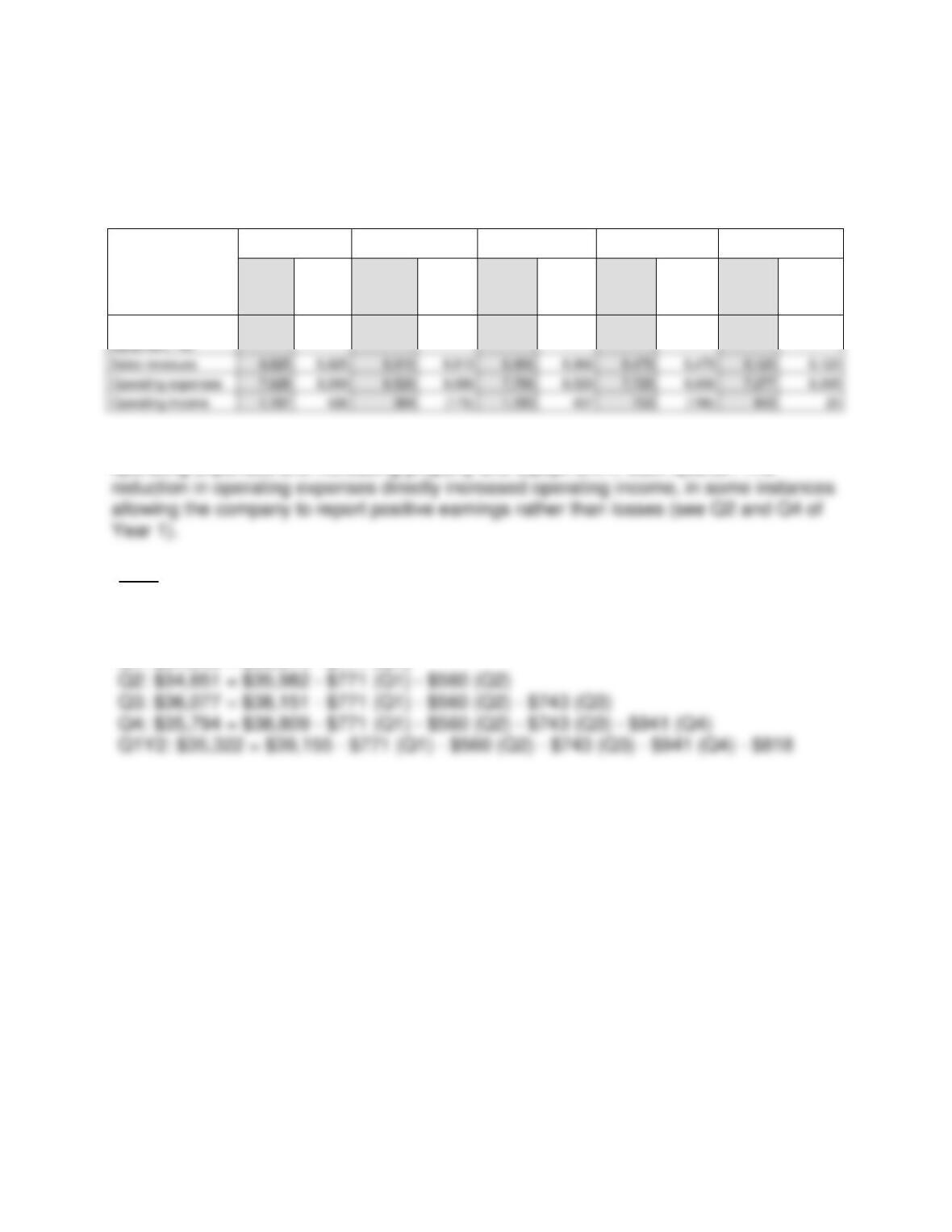
Amounts in millions of
US dollars
Q1 Year 1
(March 31)
Q2 Year 1
(June 30)
Q3 Year 1
(September 30)
Q4 Year 1
(December 31)
Q1 Year 2
(March 31)
With
the
entries
Without
the
entries
With
the
entries
Without
the
entries
With
the
entries
Without
the
entries
With
the
entries
Without
the
entries
With
the
entries
Without
the
entries
Property and
$ 38,614
$37,843
$ 35,982
$34,651
$ 38,151
$36,077
$ 38,809
$35,794
$ 39,155
$35,322
The above table shows that the “special journal entries” had the effect of reducing
operating expenses and increasing property and equipment in each quarter. The
Note: Because Property and Equipment is a balance sheet account that carries its
balance forward from one period to the next, the computation of its book value
“without the entries” must take into consideration the cumulative effects of the entries,
calculated as:
Q1: $37,843 = $38,614 – $771 (Q1)
Q3: $36,077 = $38,151 – $771 (Q1) – $560 (Q2) – $743 (Q3)
Q4: $35,794 = $38,809 – $771 (Q1) – $560 (Q2) – $743 (Q3) – $941 (Q4)
Q1Y2: $35,322 = $39,155 – $771 (Q1) – $560 (Q2) – $743 (Q3) – $941 (Q4) – $818
Chapter 08 – Reporting and Interpreting Property, Plant, and Equipment; Natural Resources; and Intangibles
CP8-9. (continued)
Req. 2
Q2 Yr 1
Q3 Yr 1
Q4 Yr 1
Q1 Yr 2
Fixed Asset
$8,910
$8,966
$8,478
$8,120
=
0.24
0.24
0.22
0.21
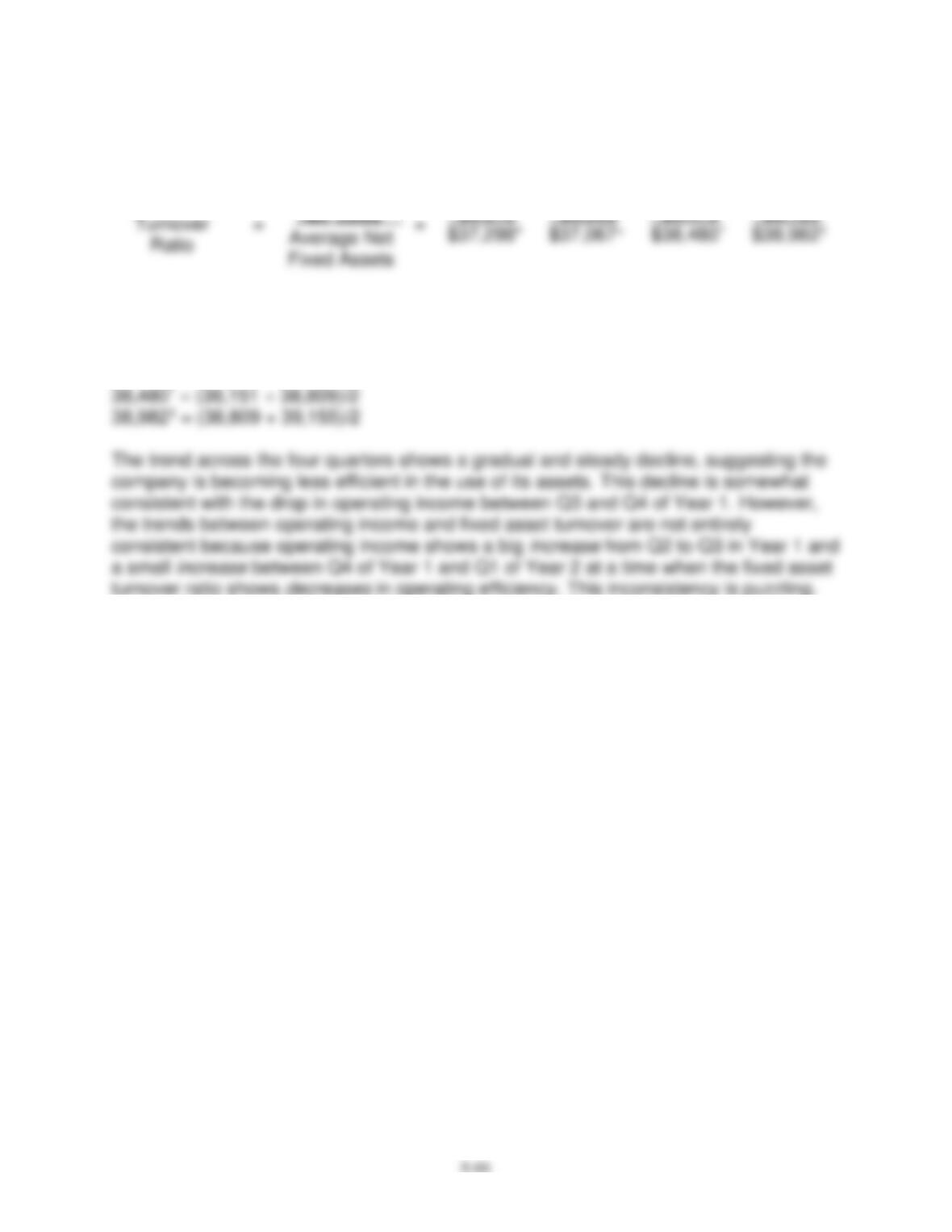
37,298* = (38,614 + 35,982)/2
37,067+ = (35,982 + 38,151)/2
Chapter 08 – Reporting and Interpreting Property, Plant, and Equipment; Natural Resources; and Intangibles
8-67
CP8-9. (continued)
Req. 3
Looking back, there are a number of questions that might have been raised:
• Why you? It’s unusual that the CFO chose someone who doesn’t have
experience with transactions of that magnitude.
the request of management are sometimes called “top–side adjustments.”)
• Why no support for the amounts? If these truly represented contractual
prepayments for equipment, they would be supported by a copy of the contract or
a cashed check.
• Why were the sources of information untraceable? Anonymous Post-it notes and
easily deleted voicemail messages might lead you to wonder if someone is being
careful to cover their tracks.
• Why were the amounts so big in comparison to the existing property and
equipment balances and other equipment purchases that period?
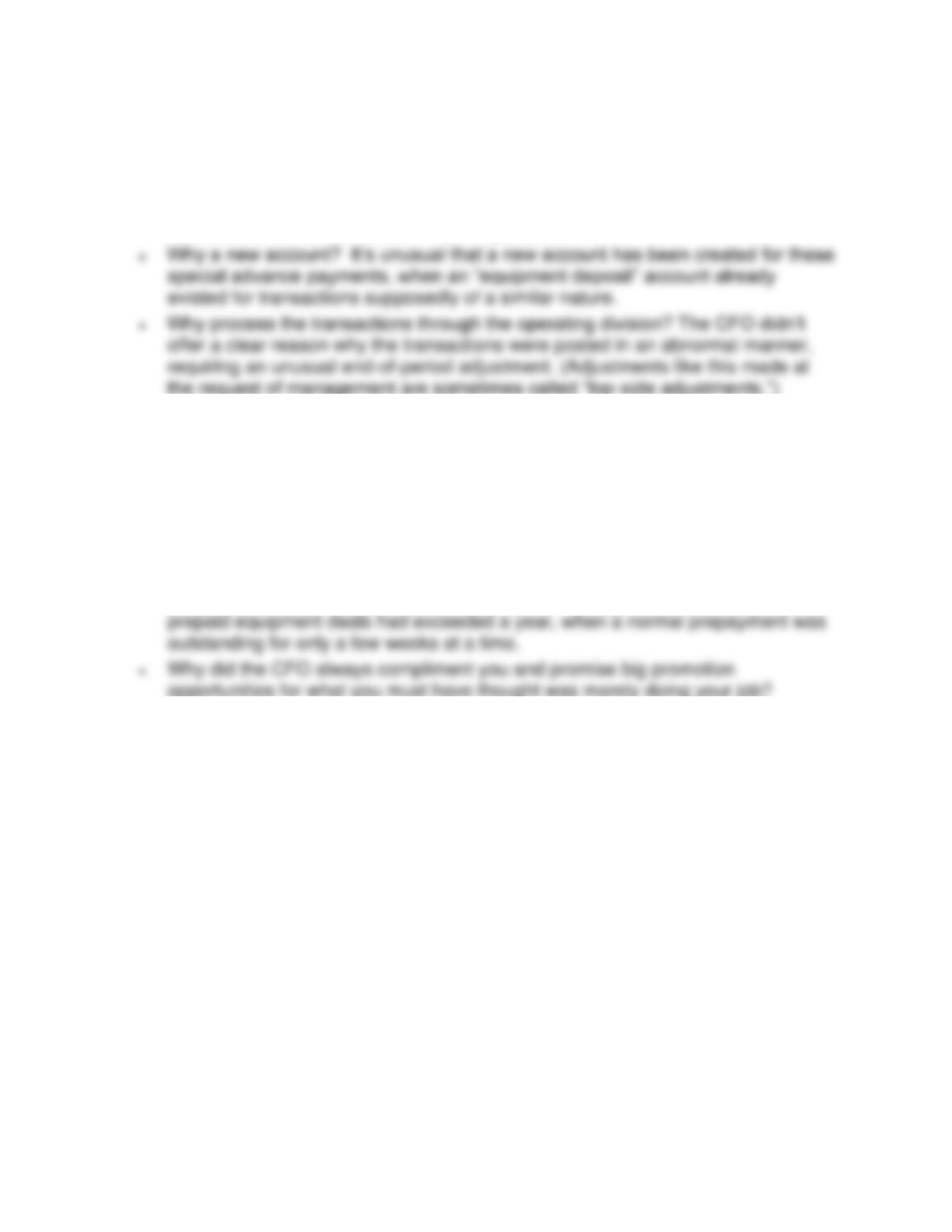
• Why weren’t the prepayments ever reduced? The length of time to complete the
Chapter 08 – Reporting and Interpreting Property, Plant, and Equipment; Natural Resources; and Intangibles
CP8-9. (continued)
Req. 4
As a staff person, you can’t doubt or mistrust every assignment you are given. If you
did, you’d likely find yourself out of a job. So, instead, you need to be able to tell the
difference between routine/ordinary requests and unusual requests. When you are
Req. 5
Clearly, the investors in WorldCom (or World-Con, as it was being called) were
devastated by the news. In the days following the announcement that the company
would restate its 2001 and 2002 financial results, WorldCom’s stock price lost about
90% of its value. Ultimately, stockholders would lose all that they had invested, when
the company entered into and emerged from bankruptcy. This meant that millions of
working people and retirees no longer had the investment income for which they had
saved and on which they had made their retirement plans. It also meant that money
The company’s external auditors also were severely hurt because they had failed to
detect the fraud. Undetected fraud is always bad news for external auditors, but this
situation was even worse because WorldCom’s external auditors had been Arthur
Andersen—the same firm that had failed to detect and report the Enron fraud just one
year earlier. Just as Andersen was bracing for a whirlwind of Enron-related lawsuits,
Chapter 08 – Reporting and Interpreting Property, Plant, and Equipment; Natural Resources; and Intangibles
CP8–10.
Req. 1
a. Cash flows: Because cash was paid for interest, cash decreases (-). However, the
amount of interest expense that was capitalized caused expenses to be lower and
net income to be higher.
Req. 2
Because the fixed asset turnover ratio has decreased due to the additional interest
Req. 3
Although the fixed asset turnover ratio decreased due to the interest capitalization, this
does not indicate a real change in asset efficiency. The same asset is used to generate
FINANCIAL REPORTING AND ANALYSIS TEAM PROJECT
CP8–11. Due to the nature of this project, responses will vary.