
Chapter 8
Paying the Payroll, Depositing Payroll Taxes, and Filing the
Required Quarterly and Annual Tax Forms: The Conclusion of
the Payroll Process
Chapter Overview
This chapter examines the paying of the payroll, depositing of the payroll taxes, and the filing of the
required tax forms. Payroll tax expense is recorded when the employee earns the pay. Payroll tax is
debited and wages payable is credited along with the payroll tax liabilities for the employee’s
Learning Objectives
After studying Chapter 8, your students should gain proficiency in the following:
2. Prepare Quarterly Reports for Federal and State Governments.
3. Prepare Annual Reports, Forms W-2 and W-3.
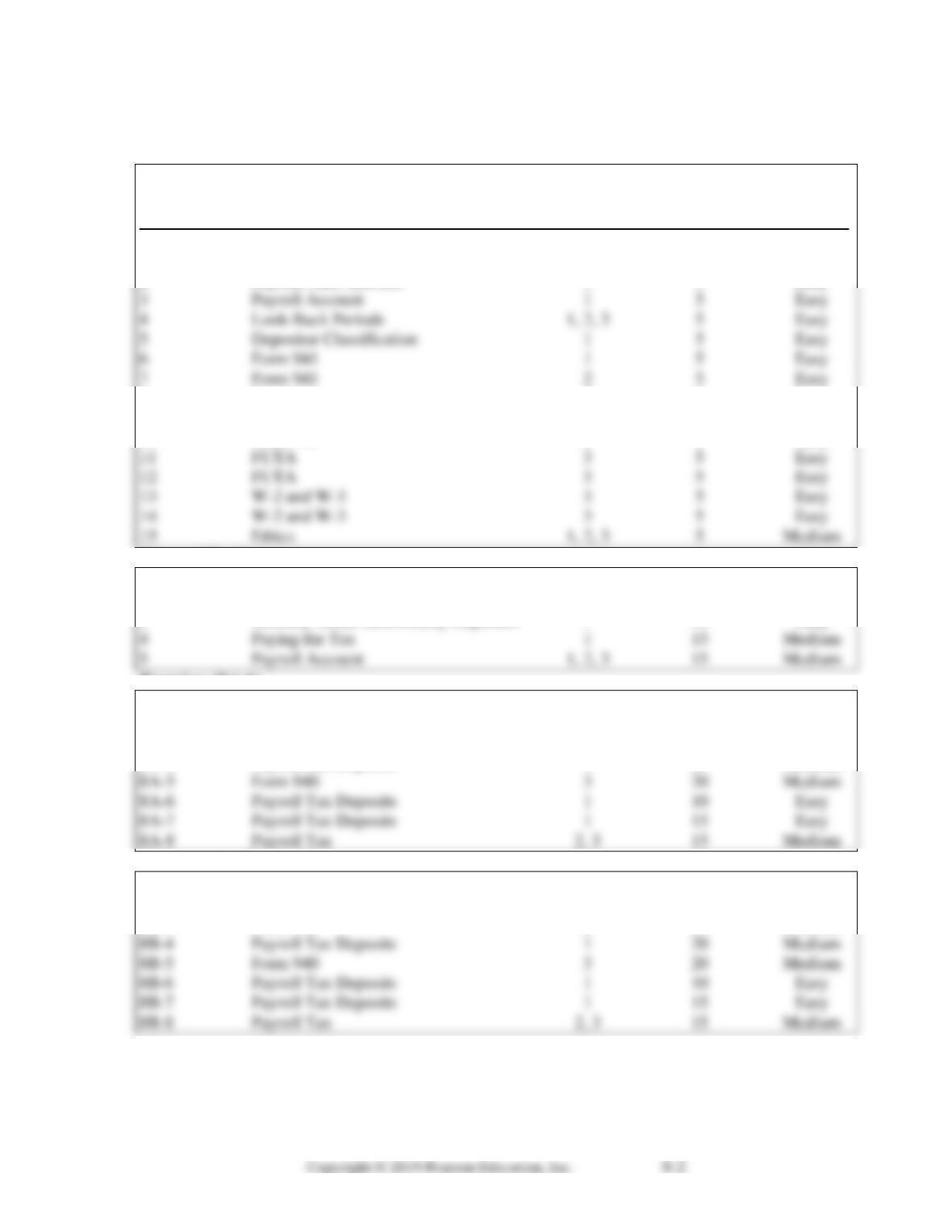
Chapter 8 Assignment Grid
Estimated Level
Learning Time in of
Assignment Topic(s) Objective(s) Minutes Difficulty
Discussion Questions and Critical Thinking/Ethical Case
1 Payroll Cash Account 1 5 Easy
2 Payroll Cash Account 1 5 Easy
8 Form 941 2 5 Easy
9 W-2 3 5 Easy
10 Form 940 3 5 Easy
Concept Checks
1 Look-Back Periods 1 10 Easy
2 Monthly versus Semiweekly Depositor 1 15 Easy
3 Monthly versus Semiweekly Depositor 1 15 Easy
Exercises (Set A)
8A-1 Recording Payroll 1 10 Easy
8A-2 Payroll Tax Deposits 1 15 Easy
8A-3 Form 941 2 20 Medium
8A-4 Payroll Tax Deposits 1 20 Medium
Exercises (Set B)
8B-1 Recording Payroll 1 10 Easy
8B-2 Payroll Tax Deposits 1 15 Easy
8B-3 Form 941 2 20 Medium
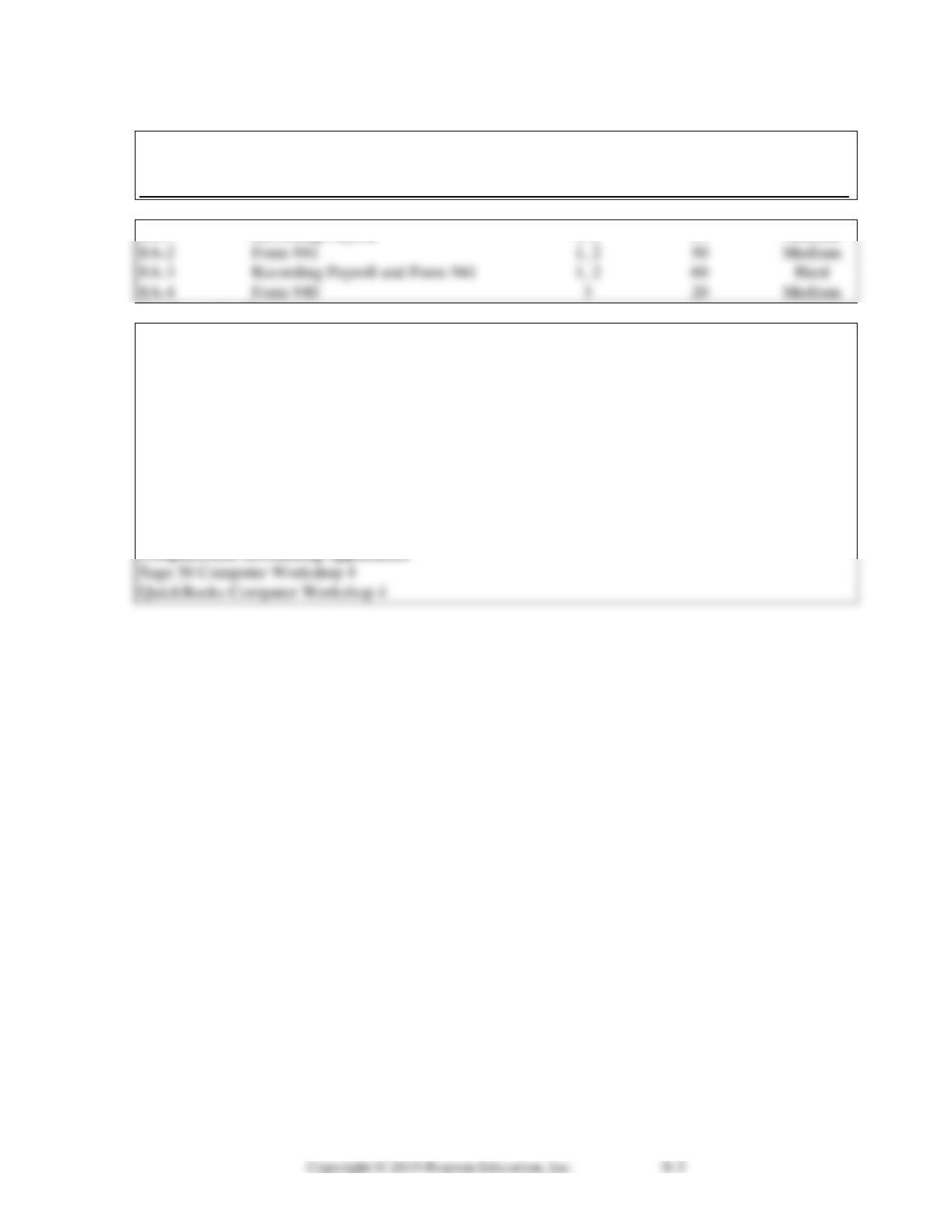
Estimated Level
Learning Time in of
Assignment Topic(s) Objective(s) Minutes Difficulty
Problems (Set A)
8A-1 Recording Payroll 1, 2 50 Medium
Problems (Set B)
8B-1 Recording Payroll 1, 2 50 Medium
8B-2 Form 941 1, 2 50 Medium
8B-3 Recording Payroll and Form 941 1, 2 60 Hard
8B-4 Form 940 3 20 Medium
Financial Report Problem
Reading the Amazon’s Annual Report 1 20 Medium
Keeping It Real
Suarez Computer Center 1, 2, 3 40 Hard
Computerized Accounting Application
Learning Unit 8-1: Payroll and Depositing Taxes
Summary: Most organizations use a special checking account for paying its payroll. This account is
called Cash – Payroll Checking and only paychecks are written from this account. A company with a
substantial number of employees might want to use an extra account just for payroll for a number of
reasons. First, having a separate account just for paychecks provides much better internal control over
the funds deposited to pay employees. Also, because only payroll checks are written from this account,
it is easier to reconcile it to the bank statement each month and determine whether someone has not
For any organization, the process began when the business opened. Every employer must get an
Employer Identification Number (EIN) which is like a Social Security Number for businesses. The
As required by law, all employers withhold federal income tax from employees’ paychecks, along with
Social Security (OASDI) and Medicare taxes as established by the Federal Insurance Contributions
To comply with federal law, businesses do two things. First, the business must determine when FIT and
The IRS developed a rule known as the look-back period rule to determine how to classify an
employer for payroll tax deposits. Under this rule, the IRS looks back to a one-year time period that
Key Concepts: Employer identification number (EIN), Form SS-4, Form 941 taxes, look-back period,
monthly depositor, semiweekly depositor, banking day.
Lecture Outline:
1. A special payroll checking account is used by most businesses because:
a. Checks with a special format and pay stub for payroll information are used.
b. It is easier to reconcile the account
c. It is used for effective cash management
2. The journal entry to record the payment of payroll is:
4. FICA (Federal Insurance Contributions Act) is part of the Social Security law that requires
employees and employers to pay OASDI taxes and Medicare taxes.
1) Monthly Depositors –
a. Makes its payroll tax deposits only once each month for the amount of Form 941 taxes due
2) Semi-weekly depositors –
3) If a business’s payday is Wednesday, Thursday, or Friday, the payroll tax deposit is due the
6. Deposit can be made by check accompanied with Form 8109, Federal Tax Deposit Coupon at a
Federal Reserve Bank or authorized depository.
Teaching Tips/Strategy: Use as classroom discussion the Discussion Questions #3, #4, and #5. Use
the Accounting Coach LU 8-1 to assess understanding of payroll deposit requirements. Exercise 8A-2
can be used to illustrate payroll tax deposit due dates.
Use the “Ten–Minute Quiz” questions #2, #5, and #6 to reinforce the Learning Objective #1
concept.
Learning Unit 8-2: Quarterly Reports for Federal and State
Governments
Summary: To comply with federal law, businesses do two things. First, the business must determine
when FIT and FICA taxes need to be paid to the federal government and make this payment on time.
Second, the business must report these taxes on Form 941, the Employer’s Quarterly Federal Tax
Return. (See Figure 8.5) When taxes total more than $1,000 for a calendar year, then employers
must complete Form 941, Employer’s Quarterly Federal Tax Return, and submit it to the IRS for
every quarter in a calendar year.
Key Concepts: Form 941 (Employer’s Quarterly Federal Tax Return), calendar quarter.
Lecture Outline:
1. Completing the Employer’s Quarterly Federal Tax Return, Form 941
1) The business must complete Form 941 for every quarter in the calendar year to report FIT and
2. Paying SUTA Taxes. This tax is usually paid only by employers to the state for employee
unemployment insurance.
1) The Experience/merit rating is a percentage rate assigned to a business by the state to calculate
the unemployment taxes.
3) The tax is paid to the state in which the business is located and is due by the end of the month
following the quarter.
1) Tax is 0.6% on the first $7,000 of earnings after the normal FUTA tax credit is applied.
3) If the amount owed is less than $500, the tax must be paid by the end of January of the next
year.
5) If the employer is required to make Form 941 tax payments by EFTPS, it must also deposit
FUTA tax through the same method.
Teaching Tips/Strategy: Use Exercise 8A-3 to illustrate completion of Form 941. In addition, you may
wish to use Problem 8A-1 as a comprehensive demonstration for Learning Objectives #1 and #2. Then
you can assign the students to complete Problem 8B-1.
Use the “Ten–Minute Quiz” questions #1, #2, and #10 to reinforce the Learning Objective #2
concept.
Learning Unit 8-3: Annual Reports, Forms W-2 and W-3
Summary: Businesses must complete Form 940, Employer’s Annual Federal Unemployment
(FUTA) Tax Return, by January 31 of the following year. However, if all taxes owed for the year were
deposited by January 31, then the business has until February 10 to file its return. To make sure that
corporations make its FUTA deposits on time, the accountant keeps track of the amount of FUTA tax
owed. The accountant prepares the worksheet to determine the amount of FUTA taxes that the
organization owes for the first quarter of the year.
The Internal Revenue Service requires that each calendar year employers complete a Form W-2, Wage
and Tax Statement, a multipart form. The IRS requires every employer to give or mail copies of the
Form W-2 to each person who worked for the company in the past year. These forms must be
distributed by January 31 of the following year. Employees use the amount on the W-2 form to prepare
their income tax returns and calculate the amounts of income tax they owe. They must attach one copy
of the form to their federal income tax return, and other copies are attached to any state or local income
tax returns that they may be required to file. Note that OASDI wages and taxes are shown separately
Key Concepts: Form 940 (Employer’s Annual Federal Unemployment Tax Return), Form W-2
(Wage, and Tax Statement), Form W-3 (Transmittal of Wage and Tax Statements).
Lecture Outline:
1. Completing the Employer’s Annual Federal Unemployment (FUTA) Tax Return, Form 940:
1) One version of the form is used by employers at the end of the calendar year to report the
amount of unemployment tax due for the year. Generally, an employer with workers in more
2) Form 940-EZ: The other/simpler version of the form used by employer who generally operates
in only one state is allowed to use the EZ form.
2. Form W-2: Wage and Tax Statement (See Figure 8.7).
2) At least three copies go to the employee, one copy to the IRS, one copy to any state where
3. Form W-3: Transmittal of Income and Tax Statements (See Figure 8.8).
2) Form is sent to the Social Security Administration data processing center along with copies of
each employee’s W-2 forms.
Teaching Tips/Strategy: Use Exercise 8A-5 to illustrate completion of Form 940. Then you can assign
the students to complete Exercises 8B-5.
Use the “Ten–Minute Quiz” questions #8 and #9 to reinforce the Learning Objective #3 concept.
Teaching Tips/Strategy: Each chapter contains a Try It! at the end of each Learning Unit. The Try its!

Name Date Section
CHAPTER 8
TEN-MINUTE QUIZ
Circle the letter of the best response.
1. The Employer’s Annual Federal Unemployment Tax Return is called
a. Form W-2
b. Form W-3
c. Form W-4
d. Form 940
2. Form 941 requires the reporting of the following taxes?
a. FUTA and FICA
b. FICA and FIT
c. FICA, FIT, and FUTA
d. FICA
3. The employer becomes liable for payroll taxes when
a. the employee earns the wages
b. the employee is paid the wages
c. the federal tax return is filed
d. the payroll tax return is filed
4. Payroll tax expense is debited to record
a. the employee’s FIT
b. the employee’s portion of FICA
c. the employer’s portion of FICA
d. the employee’s FUTA
5. The total amount of FICA taxes due must be deposited in
a. the business’s bank account
b. with the state social security office
c. with the IRS
d. an authorized depository
6. Businesses are classified as monthly or semi-weekly depositors based on
a. the look-back period rule
b. the number of pay periods expected next year
c. the amount of federal payroll taxes paid
d. the number of employees
7. An insurance program that provides benefits to workers who are injured on the job is called
a. federal unemployment insurance
b. state unemployment insurance
c. workers’ compensation insurance
d. social security
8. The Employer’s Annual Federal Unemployment Tax Return. This shows the annual amount of
FUTA tax the employer owes for the year.
a. Form 940

b. Form 941
c. Form W-4
d. Form W-2
9. The annual report by an employer to each employee showing the employee’s wages subject to
FICA and federal income taxes along with withholdings for various taxes.
a. Form 940
b. Form 941
c. Form W-4
d. Form W-2
10. The rating assigned to an employer by a state based on the employer’s record of employment
and unemployment.
a. tax rating
b. merit rating
c. FUTA tax credit
d. SUTA tax credit
Answer Key to Chapter 8 Quiz