8
Process Costing
Solutions to Review Questions
8-1.
Process costing is most likely to be used in industries that produce relatively
homogeneous products using continuous processes.
8-2.
Using the basic cost flow equation, rearrange the terms to solve for the unknown
8-3.
With FIFO costing, the units in the beginning inventory are transferred out first. These
8-4.
The five steps are:
1) Measure the physical flow of resources.
3) Identify product costs for which to account.
5) Assign product costs to batches of work.
8-5.
Under FIFO costing, the equivalent units represent only the work done in the current
period. Under weighted average, the equivalent units represent the work associated with
all of the costs charged to work in process regardless of the period in which those costs
were incurred (i.e., including costs from prior periods that are in beginning inventory).
8-6.
8-7.
Prior department costs behave the same as direct materials, which are typically added at
8-8.
Disagree. The more important individual unit costs are for decisions, the more likely it is
that a company will want to use a costing system that separates costs by units. With job
costing, the company can treat every unit as a separate job.
8-9.
From the inventory equation:
Solutions to Critical Analysis and Discussion Questions
8-10.
To assign costs to specific barrels of liquid cleaning products or similarly mass–produced
items requires a considerable amount of record keeping. Assuming products are all the
same, a process costing system provides sufficient information for control purposes.
Record keeping is simplified since all costs in a given month are accumulated in one
account and assigned at the end of the period.
8-11.
This is a fairly common problem. LIFO is usually beneficial for tax purposes when prices
are rising and inventory levels are steady or rising. However, maintaining internal records
8-12.
The results will be the same using either costing system. The important point is that job
costing and process costing are both methods to assign costs incurred to services
completed. When there is only one service, the method of accumulation and assignment
does not affect the final cost.
8-13.
396 Fundamentals of Cost Accounting
8-14.
We could treat direct labor costs and manufacturing overhead as a single resource
8-15.
It is not necessary that both departments use the same cost-flow assumption. Department
B will essentially treat the product from Department A as any other material it purchased
from another firm.
8-16.
With prior period costs, a department manager often does not control the decision to
8-17.
It is unlikely, but not impossible, for process costing to work well in a service firm. Process
costing is designed for production of large quantities of homogeneous units. Service firms
tend to provide slightly different services to each customer.
Solutions to Exercises
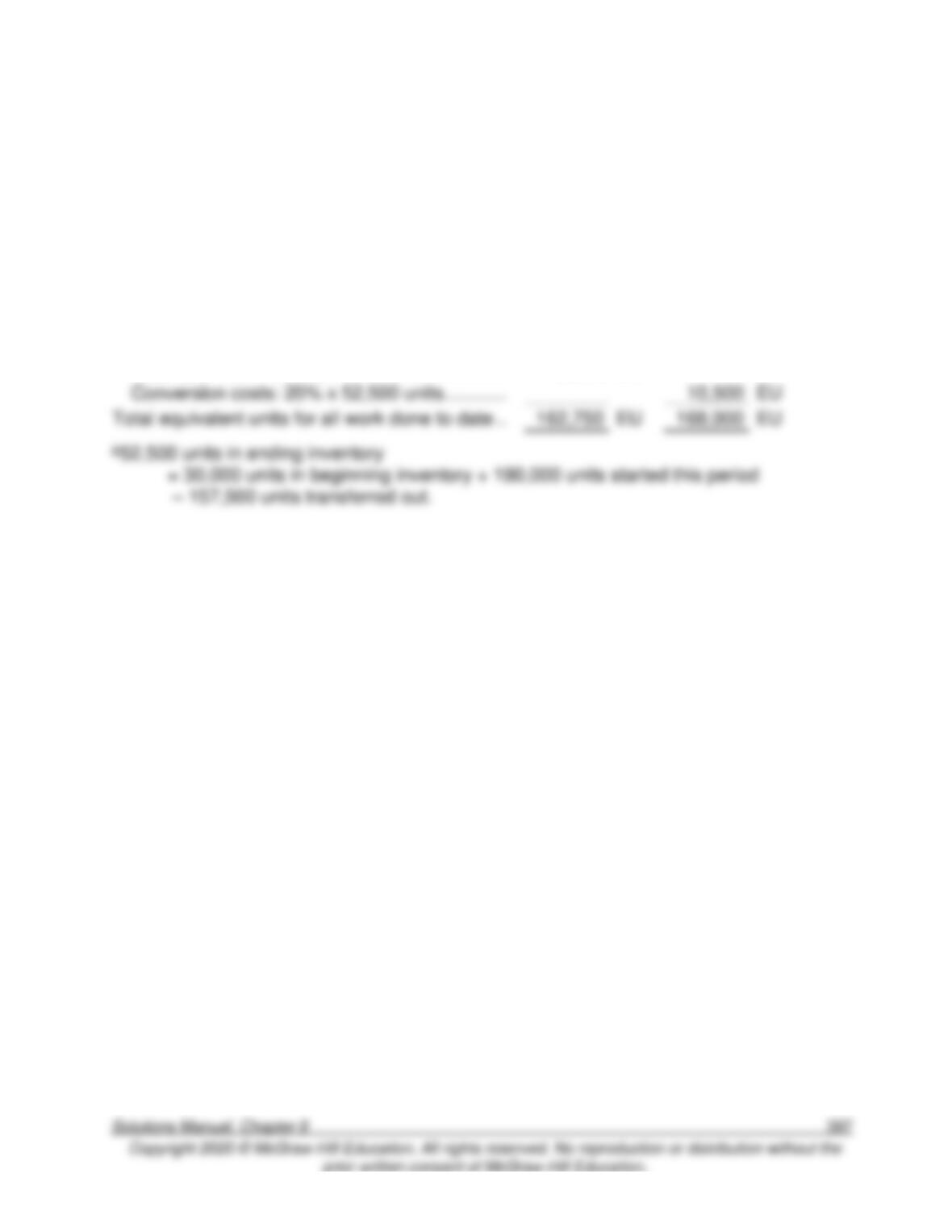
8-18. (20 min.) Compute Equivalent Units—Weighted-Average Method: Conlon
Chemicals.
a.
Materials
b.
Conversion Costs
Units transferred out …………………………………….
157,500
157,500
Equivalent units in ending inventory:
Materials: 10% x 52,500a units …………………..
5,250
EU
Total equivalent units for all work done to date ..
168,000
398 Fundamentals of Cost Accounting
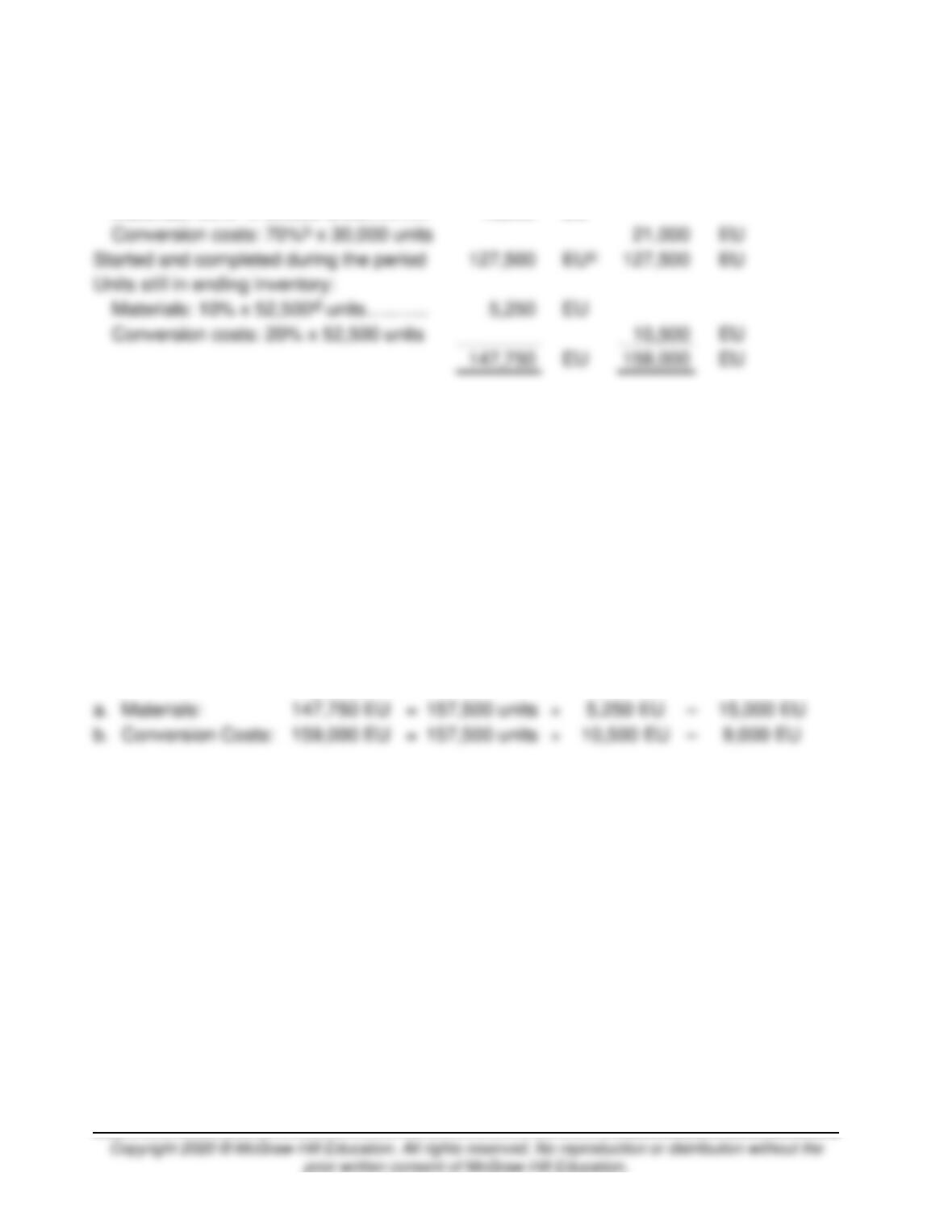
8-19. (20 min.) Compute Equivalent Units—FIFO method: Conlon Chemicals.
Compute Equivalent Units—FIFO
a.
Materials
b.
Conversion Costs
To complete beginning inventory:
a50% = 100% – 50% already done at the beginning of the period.
b70% = 100% – 30% already done at the beginning of the period.
C127,500 units started and completed = 157,500 units transferred out less 30,000 units
from beginning inventory.
d 52,500 units in ending inventory = 30,000 units in beginning inventory + 180,000 units
started this period – 157,500 units transferred out.
Alternative Method:
Equivalent
units of work
done this
period
=
Units
transferred
out
+
EU
ending
inventory
–
EU
beginning
inventory
8-20. (15 min.) Compute Equivalent Units—Weighted-Average Method: Pierce &
Company.
a.
Materials
b.
Conversion
Costs
Units transferred out ………………………………………..
210,000
210,000
Equivalent units in ending inventory:
Materials: 100% x 140,000 units …………………….
140,000
Conversion costs: 45% x 140,000 units …………..
63,000
Total equivalent units for all work done to date ……
350,000
273,000
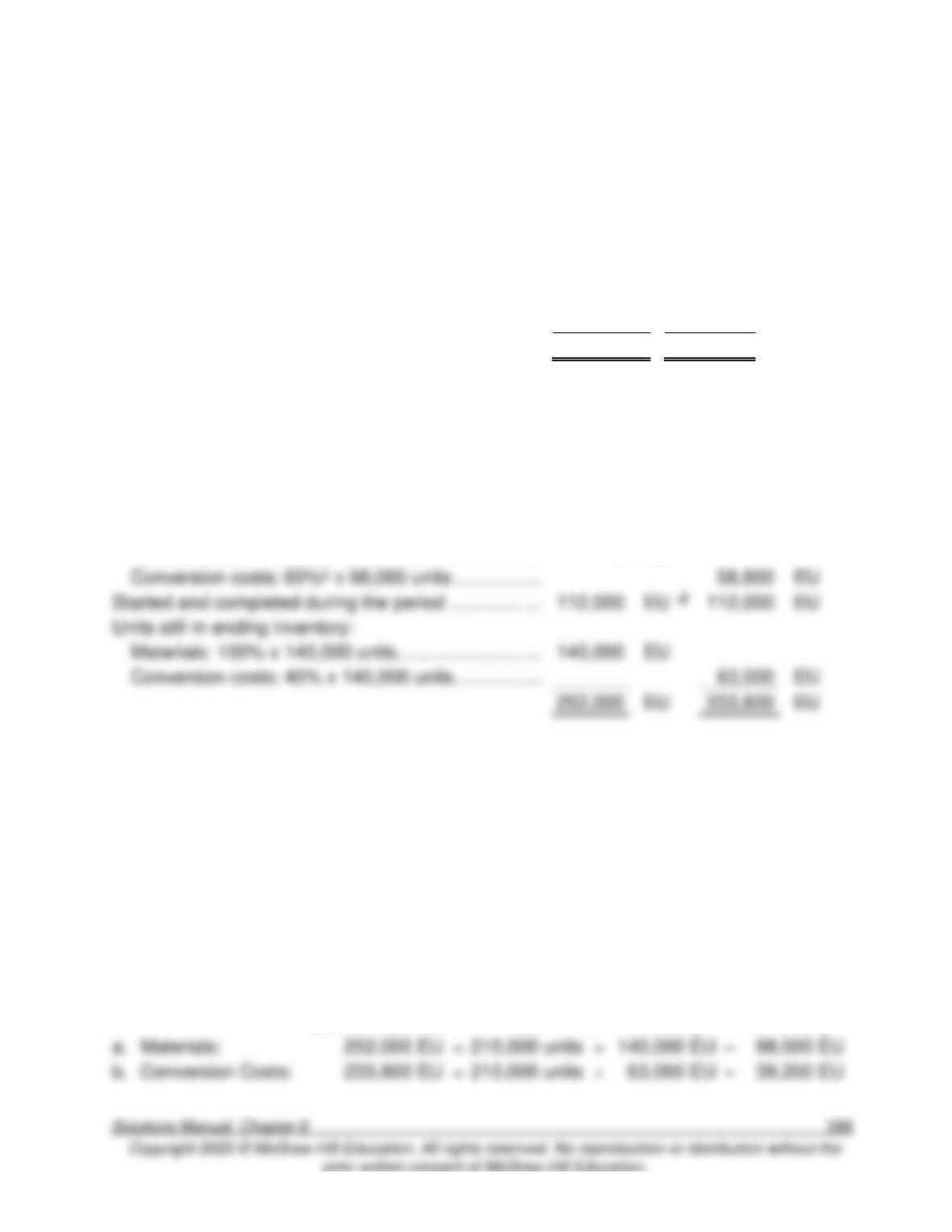
8-21. (20 min.) Compute Equivalent Units—FIFO method: Pierce & Company.
a.
Materials
b.
Conversion
Costs
To complete beginning inventory:
Materials: 0%b x 98,000a units …………………………
0
EU
Started and completed during the period ………………
Units still in ending inventory:
Materials: 100% x 140,000 units ……………………….
140,000
Conversion costs: 45% x 140,000 units ……………..
63,000
a 98,000 units in beginning inventory
= 210,000 units transferred out + 140,000 units in ending inventory
– 252,000 units started this period.
b 0% = 100% – 100% already done at the beginning of the period.
c 60% = 100% – 40% already done at the beginning of the period.
d 112,000 units started and completed = 210,000 units transferred out less 98,000 units
from beginning inventory.
Alternative Method
Equivalent
units of work
done this period
=
Units
transferred
out
+
EU
ending
inventory
–
EU
beginning
inventory
Materials:
400 Fundamentals of Cost Accounting
8-22. (30 min.) Compute Equivalent Units: Magic Company.
a. Weighted-average method:
Materials
Conversion
Costs
Units transferred out ……………………………………………….
480,000
480,000
Equivalent units in ending inventory:
Materials: 100% x 72,000 units ……………………………..
72,000
Conversion costs: 30% x 72,000 units ……………………
21,600
Total equivalent units for all work done to date ……………
552,000
501,600
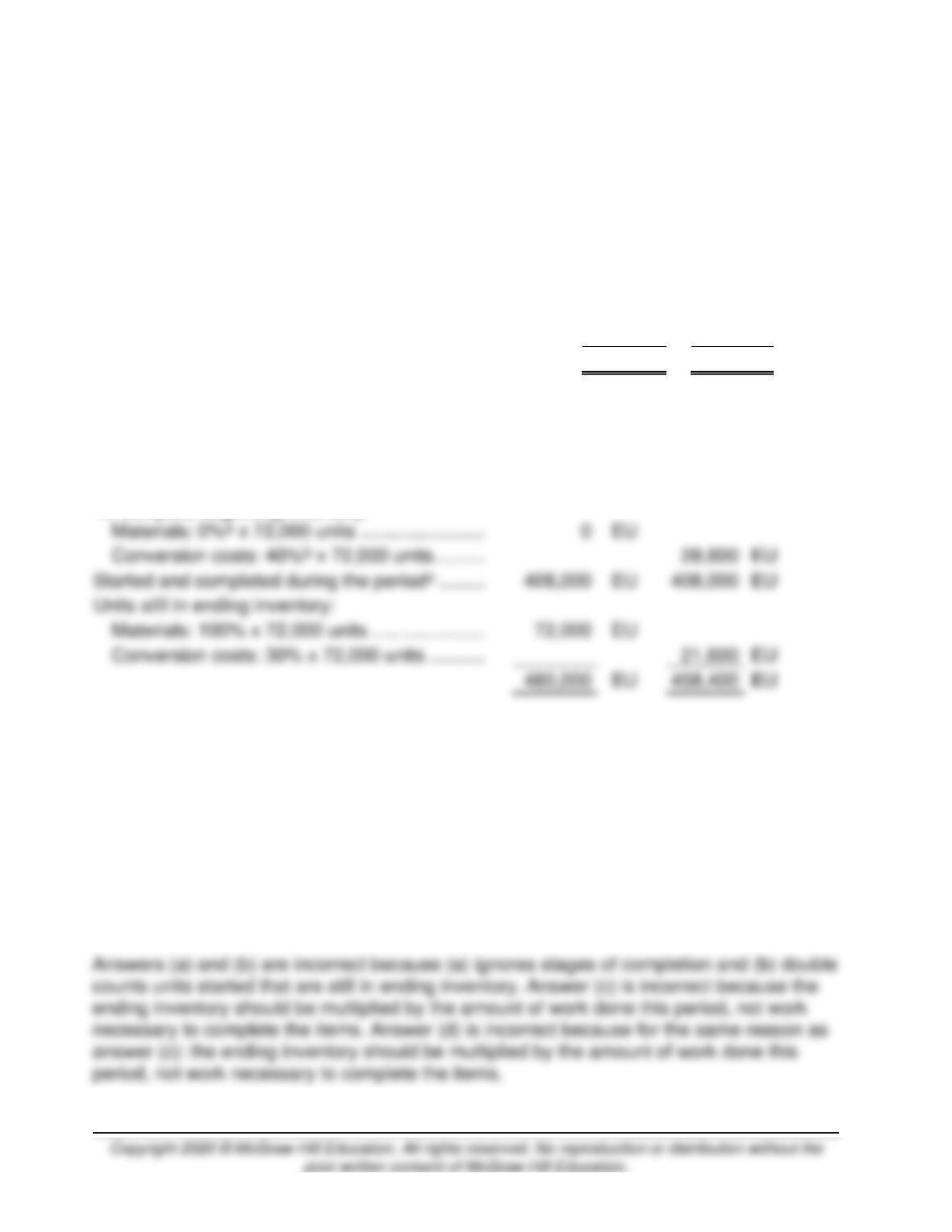
b. First-in, First-out (FIFO) method:
Materials
Conversion
Costs
408,000
Units still in ending inventory:
Materials: 100% x 72,000 units ………………….
Conversion costs: 30% x 72,000 units ………..
480,000
a 0% = 100% – 100% already done at the beginning of the period.
b 40% = 100% – 60% already done at the beginning of the period.
c 408,000 units started and completed
= 480,000 units transferred out less 72,000 units from beginning inventory.
8-23. (10 min.) Equivalent Units: Weighted-Average Process Costing.
(e). None of these answers are correct.

402 Fundamentals of Cost Accounting
8-24. (10 min.) Compute Equivalent Units: Weighted Method: GP Industries.
(c). (90,000; 84,000).
Weighted-average method:
Units transferred out ……………………………………………….
Equivalent units in ending inventory:
20,000
Total equivalent units for all work done to date ……………
Conversion
8-25. (10 min.) Compute Equivalent Units: FIFO Method: GP Industries.
(d). (80,000; 81,000).
FIFO method:
Materials
Conversion
Costs
To complete beginning inventory:
Materials: 0%a x 10,000 units ……………………
0
EU
Conversion costs: 70%b x 10,000 units ……….
7,000
EU
Started and completed during the periodc ………
60,000
EU
60,000
EU
Units still in ending inventory:
Materials: 100% x 20,000 units ………………….
20,000
EU
Conversion costs: 70% x 20,000 units ………..
14,000
EU
80,000
EU
EU
8-26. (30 min.) Compute Equivalent Units—Ethical Issues: Aaron Company.
a. Weighted-average method:
Materials
Conversion
Costs
Units transferred out ………………………………………..
630,000
630,000
Equivalent units in ending inventory:
Materials: 0% x 120,000 units………………………..
0
Conversion costs: 40% x 120,000 units …………..
48,000
Total equivalent units for all work done to date ……
630,000
678,000
b. First-in, First-out (FIFO) method:
a.
Materials
b.
Conversion
Costs
To complete beginning inventory:
480,000
Units still in ending inventory:
Materials: 0% x 120,000 units…………………….
Conversion costs: 40% x 120,000 units ……….
480,000
a 0% = 100% – 100% already done at the beginning of the period (conversion was 60%
complete).
b 40% = 100% – 60% already done at the beginning of the period.
c 480,000 units started and completed
= 630,000 units transferred out less 150,000 units from beginning inventory.
c.
1. The change will reduce the unit cost for the units transferred to finished goods.
404 Fundamentals of Cost Accounting
8-27. (10 min.) Equivalent Units and Cost of Production.
If the percentage completion is overstated, (a) the total equivalent units for the period will
be overstated, because the work-in-process ending inventory will be assumed to have
more equivalent units than it actually does. (b) The costs per equivalent unit will be
understated, as the cost is divided by equivalent units that are overstated. (c) Because the
equivalent units in ending work-in-process are overstated, the costs transferred-out will be
understated (and the ending work-in-process costs overstated).
8-28. (20 min.) Compute Cost per Equivalent Unit—Weighted-Average Method:
Moline Facility.
Physical
Units
Materials
Eq. Units
Flow of units:
Units to be accounted for:
Beginning WIP inventory …………………………..
54,000
Units started this period…………………………….
144,000
Total units to account for ……………………….
198,000
Units accounted for:
Completed and transferred out
Materials (153,000 x 100%) ……………………
153,000
Units in ending inventory:
Materials (45,000 x 100%) ……………………..
Total units accounted for …………………….
198,000
Direct Materials
Flow of costs:
Costs to be accounted for:
Costs in beginning WIP inventory …………………………..
Current period costs ……………………………………………..
Total costs to be accounted for …………………………...
Cost per equivalent unit
Materials ($623,700 ÷ 198,000 units) ……………………..
8-29. (20 min.) Compute Cost per Equivalent Unit—FIFO method: Moline Facility.
Physical
Units
Materials Eq.
Units
Flow of units:
Units to be accounted for:
Beginning WIP inventory ………………………………….
54,000
Units started this period ……………………………………
144,000
Total units to account for ……………………………….
198,000
Units accounted for:
Completed and transferred out
From beginning WIP inventory (54,000 x 100%)
99,000
Units in ending inventory:
Materials (45,000 x 100%) …………………………….
Total units accounted for …………………………...
198,000
Direct
Materials
Flow of costs:
Costs to be accounted for:
Total costs to be accounted for (current period costs only) ………..
$475,200
Cost per equivalent unit
Materials ($475,200 ÷ 144,000 units) ……………………………………….
406 Fundamentals of Cost Accounting
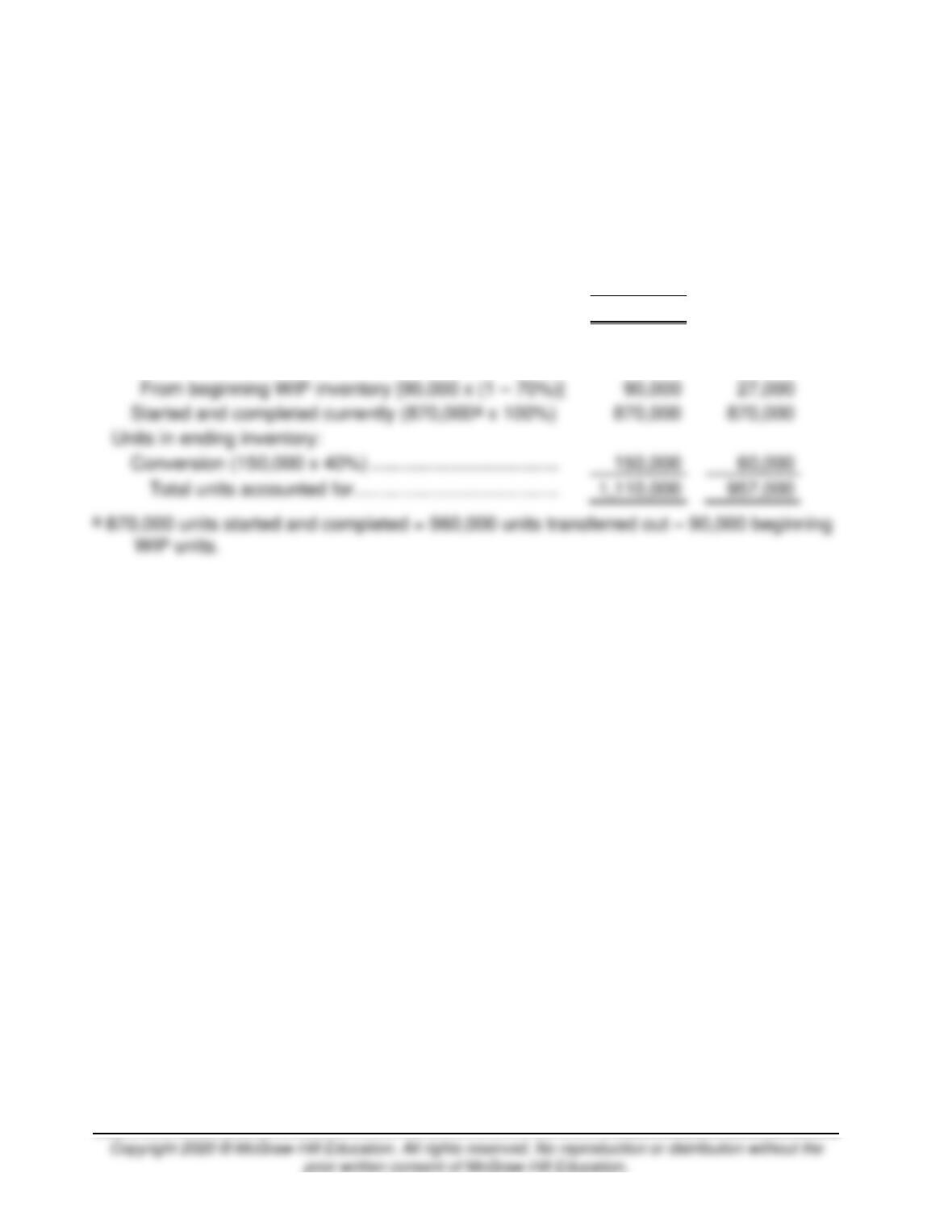
8-30. (20 min.) Compute Equivalent Units—FIFO method: Campo Company.
Physical
Units
Conversion
Eq. Units
Flow of units:
Units to be accounted for:
Beginning WIP inventory ……………………………………….
90,000
Units started this period…………………………………………
1,020,000
Total units to account for ……………………………………
1,110,000
Units accounted for:
Completed and transferred out
From beginning WIP inventory [90,000 x (1 – 70%)]
90,000
Units in ending inventory:
Conversion (150,000 x 40%) ………………………………
Total units accounted for …………………………………
1,110,000
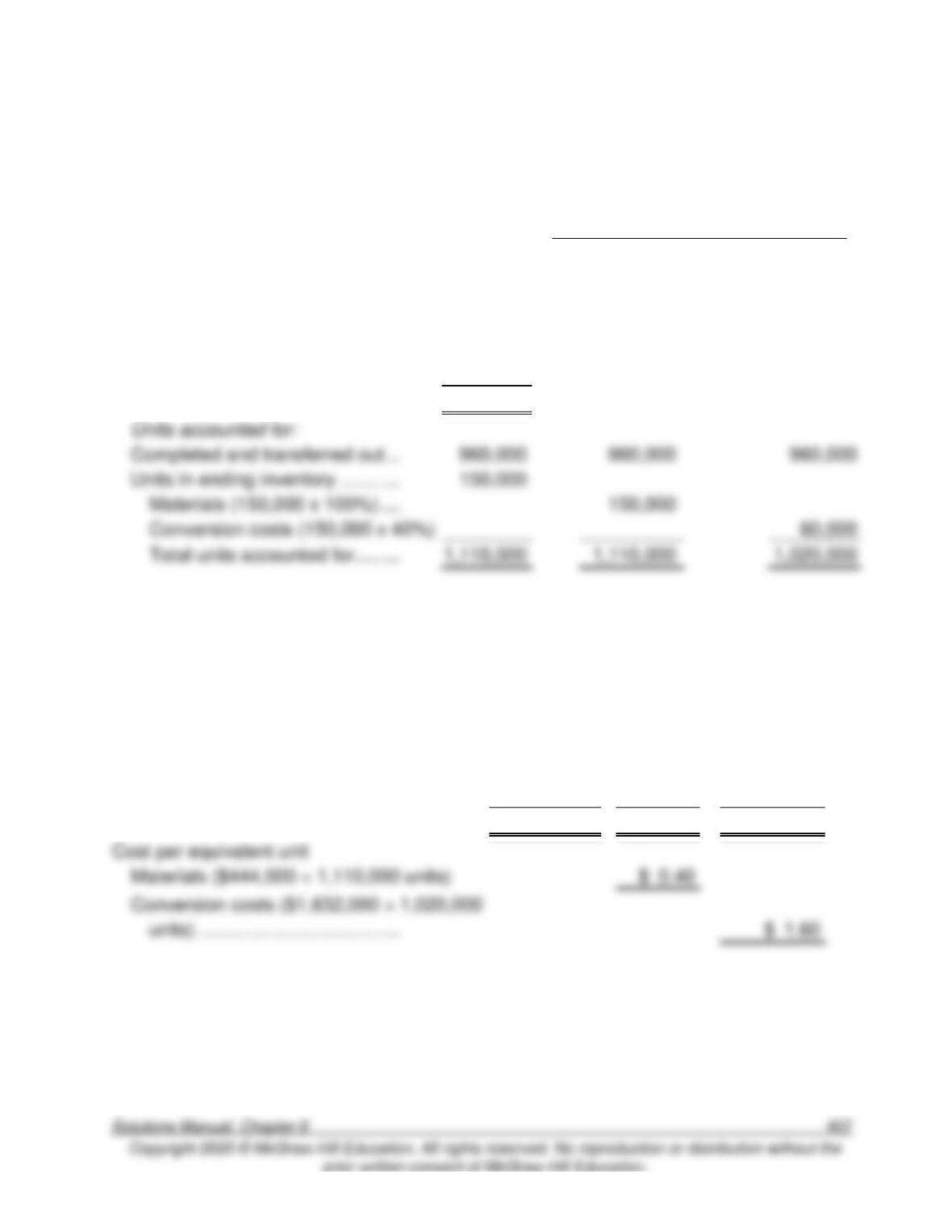
8-31. (20 min.) Compute Equivalent Units and Cost per Equivalent Unit—
Weighted-Average method: Campo Company.
a.
Physical
Units
Equivalent Units
Materials
Eq. units
Conversion
Costs Eq. units
Flow of units:
Units to be accounted for:
Beginning WIP inventory …………
90,000
Units started this period …………..
1,020,000
Total units to account for ………
1,110,000
Completed and transferred out …
Units in ending inventory …………
Materials (150,000 x 100%) ….
Conversion costs (150,000 x 40%)
60,000
Total units accounted for ………
1,110,000
1,020,000
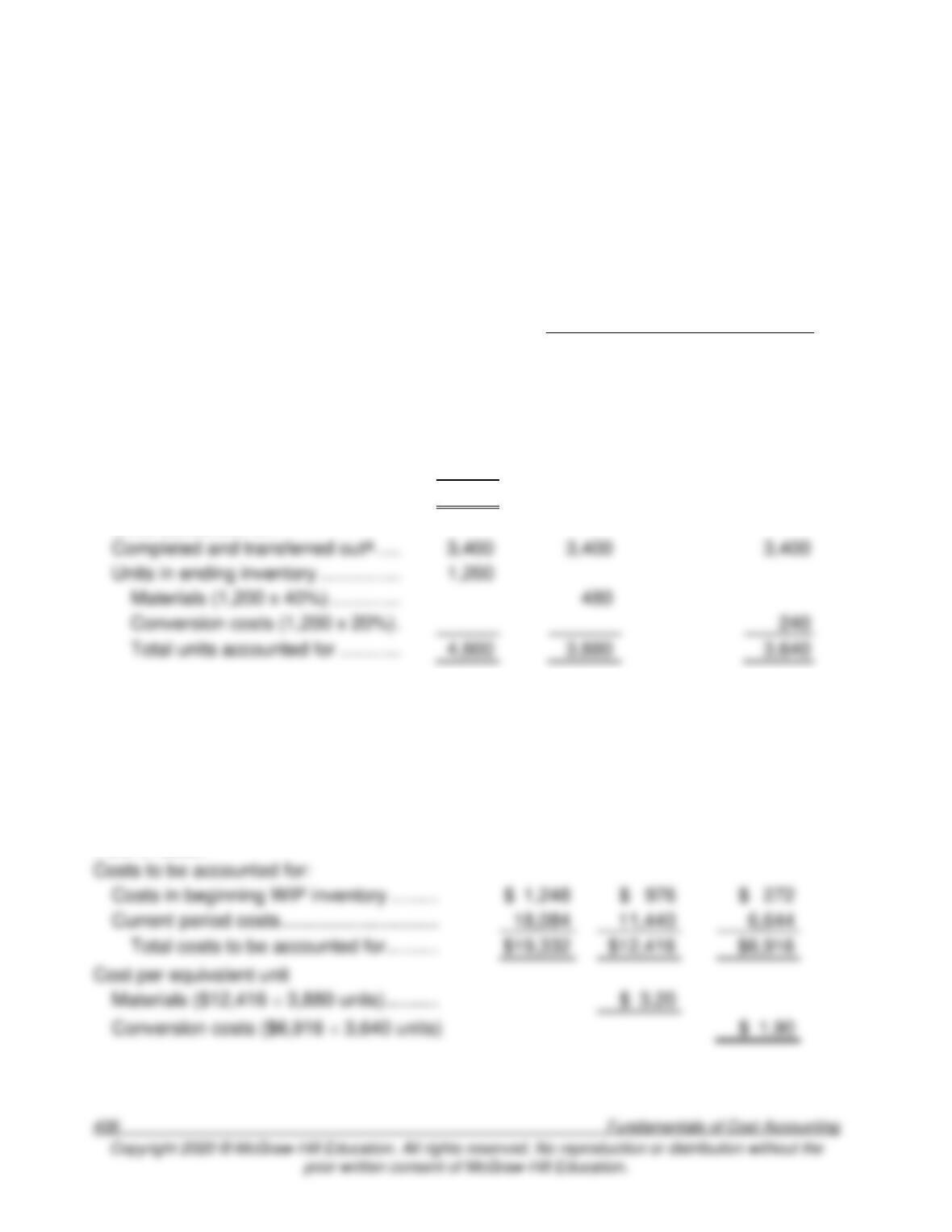
b.
Total
Direct
Materials
Conversion
Costs
Flow of costs:
Costs to be accounted for:
Costs in beginning WIP inventory
$ 146,300
$35,670
$110,630
Current period costs ……………….
1,929,700
408,330
1,521,370
Total costs to be accounted for
$2,076,000
$444,000
$1,632,000
Cost per equivalent unit
Materials ($444,000 ÷ 1,110,000 units)
8-32. (10 min.) Cost Per Equivalent Unit: Weighted-Average Method.
The correct answer is (b). The weighted-average method of process costing combines the
costs of work done in the previous period and the current period.
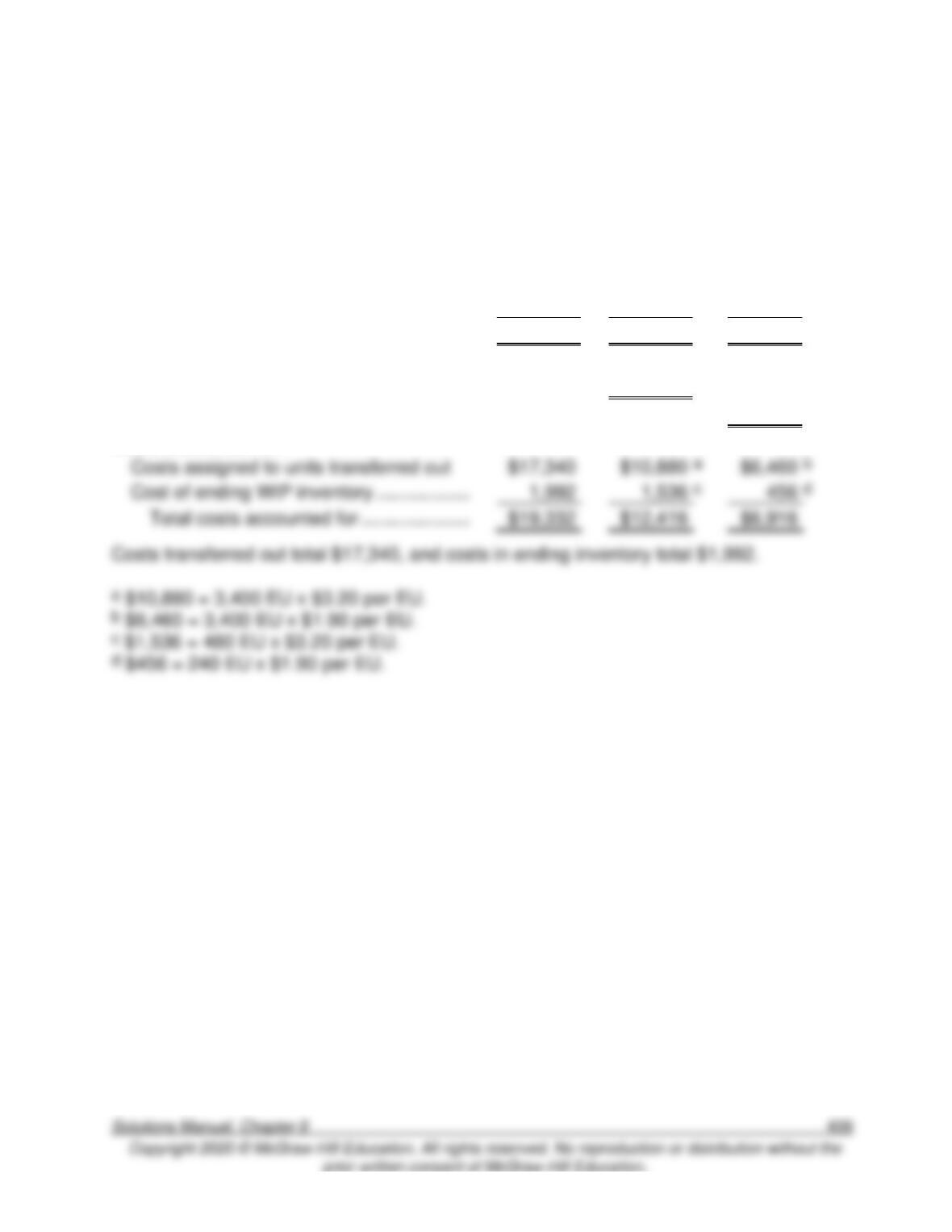
8-33. (35 min.) Compute Costs per Equivalent Unit—Weighted-Average Method:
Matsui Lubricants.
Physical
Units
Equivalent Units
Materials
Eq. units
Conversion
Costs Eq. units
Flow of units:
Units to be accounted for:
Beginning WIP inventory …………….
600
Units started this period………………
4,000
Total units to account for …………
4,600
Units accounted for:
3,400
Units in ending inventory …………….
1,200
Materials (1,200 x 40%) …………..
Conversion costs (1,200 x 20%) .
Total units accounted for …………
4,600
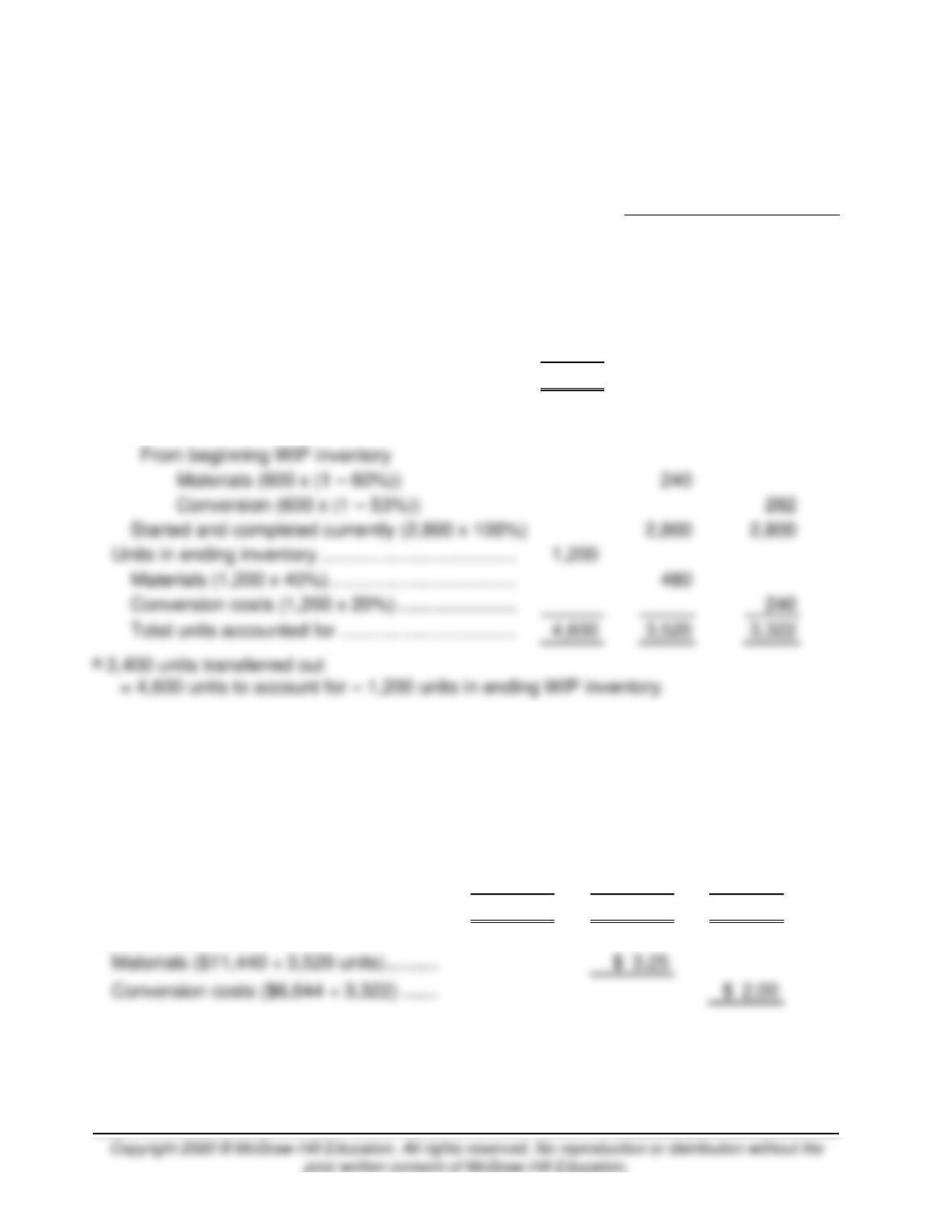
a 3,400 units transferred out = 4,600 units to account for – 1,200 units in ending WIP
inventory.
Total
Direct
Materials
Conversion
Costs
Flow of costs:
Costs to be accounted for:
$12,416
Cost per equivalent unit
8-34. (20 min.) Assign Costs to Goods Transferred Out and Ending Inventory—
Weighted-Average Method: Matsui Lubricants.
Total
Direct
Materials
Conversion
Costs
Flow of costs:
Costs to be accounted for:
Costs in beginning WIP inventory …………
$ 1,248
$ 976
$ 272
Current period costs …………………………..
18,084
11,440
6,644
Total costs to be accounted for …………
$19,332
$12,416
$6,916
Cost per equivalent unit
Materials ($12,416 ÷ 3,880 units) …………
$ 3.20
Conversion costs ($6,916 ÷ 3,640) ……….
$ 1.90
Costs accounted for:
$17,340
$10,880
Cost of ending WIP inventory ………………
$19,332
$12,416
410 Fundamentals of Cost Accounting
8-35. (35 min.) Compute Costs per Equivalent Unit—FIFO Method: Matsui
Lubricants.
Physical
Units
Equivalent Units
Materials
Eq. units
Conversion
Costs Eq. units
Flow of units:
Units to be accounted for:
Beginning WIP inventory ………………………………..
600
Units started this period………………………………….
4,000
Total units to account for …………………………….
4,600
Units accounted for:
Completed and transferred outa ………………………
3,400
From beginning WIP inventory
Materials (600 x (1 – 60%))
Conversion (600 x (1 – 53%))
Started and completed currently (2,800 x 100%)
2,800
Units in ending inventory ………………………………..
1,200
Materials (1,200 x 40%) ………………………………
Conversion costs (1,200 x 20%) …………………..
Total units accounted for …………………………….
4,600
Total
Direct
Materials
Conversion
Costs
Flow of costs:
Costs to be accounted for:
Costs in beginning WIP inventory ………
$ 1,248
$ 976
$ 272
Current period costs …………………………
18,084
11,440
6,644
Total costs to be accounted for ……….
$19,332
$12,416
$6,916
Cost per equivalent unit
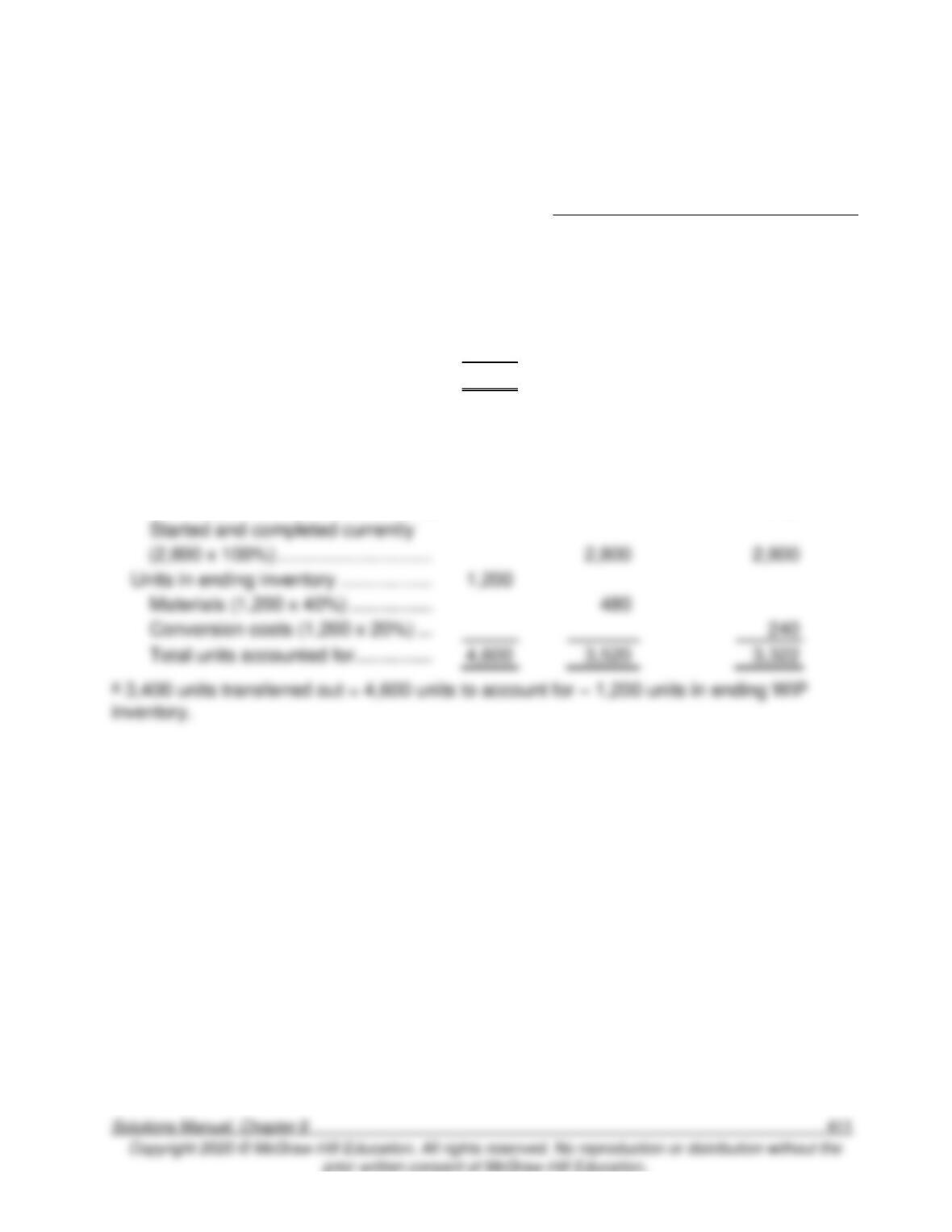
Materials ($11,440 ÷ 3,520 units) ……….
Conversion costs ($6,644 ÷ 3,322) …….
8-36. (20 min.) Assign Costs to Goods Transferred Out and Ending Inventory—
FIFO Method: Matsui Lubricants.
Physical
Units
Equivalent Units
Materials
Eq. units
Conversion Costs
Eq. units
Flow of units:
Units to be accounted for:
Beginning WIP inventory ………………
600
Units started this period ………………..
4,000
Total units to account for ……………
4,600
Units accounted for:
Completed and transferred outa …….
3,400
From beginning WIP inventory
Materials (600 x (1 – 60%))
240
Conversion (600 x (1 – 53%))
282
Units in ending inventory ………………
1,200
Materials (1,200 x 40%) …………….
480
Conversion costs (1,200 x 20%) …
240
Total units accounted for ……………
4,600
412 Fundamentals of Cost Accounting
8-36. (continued)
Total
Direct
Materials
Conversion
Costs
Flow of costs:
Costs to be accounted for:
Costs in beginning WIP inventory …..
$ 1,248
$ 976
$ 272
Current period costs ……………………..
18,084
11,440
6,644
Total costs to be accounted for ……
$19,332
$12,416
$6,916
Cost per equivalent unit
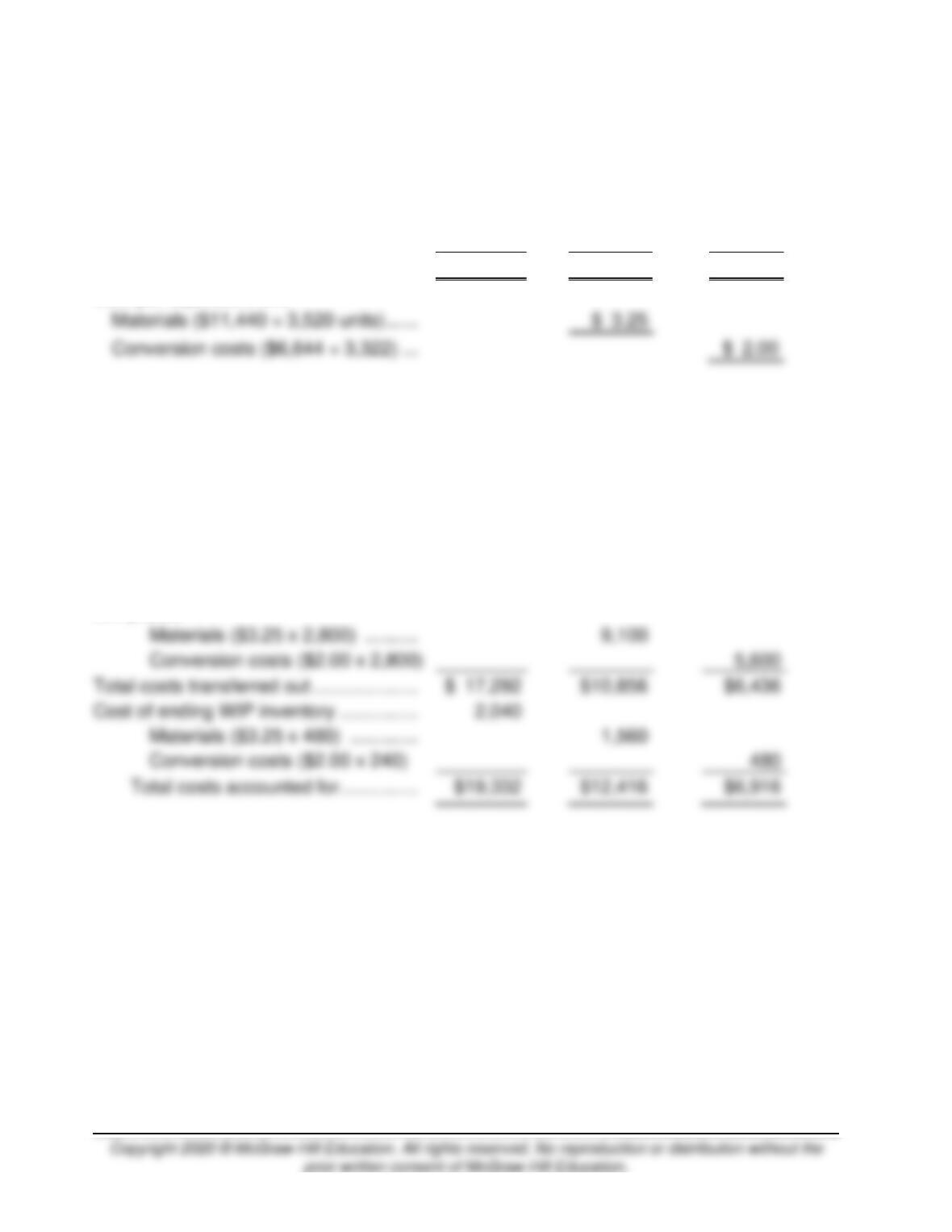
Materials ($11,440 ÷ 3,520 units) ……
Conversion costs ($6,644 ÷ 3,322) …
$ 2.00
Costs accounted for:
Costs assigned to units transferred
out:
Costs from beginning WIP inventory
$ 1,248
$ 976
$ 272
Current costs added to complete
beginning WIP inventory …………………..
1,344
Materials ($3.25 x 240) ……….
780
Conversion costs ($2.00 x 282)
564
Current costs of units started and
completed:
14,700
Materials ($3.25 x 2,800) ……….
Conversion costs ($2.00 x 2,800)
Total costs transferred out ………………..
Cost of ending WIP inventory ……………
Materials ($3.25 x 480) ………….
1,560
Conversion costs ($2.00 x 240)
Ending inventory is slightly higher under the FIFO method because the unit costs are
higher under FIFO.