Wild and Shaw, Financial & Managerial Accounting, 8e Solutions Manual: Appendix C
Appendix C
Investments
QUESTIONS
1. To be classified as current assets, investments must be (i) capable of being
converted into cash quickly and (ii) management must intend to sell the investments
as a source of cash to satisfy the needs of current operations (within one year).
2. Short-term debt investments in trading securities are reported on the balance sheet
at the fair (market) value of the portfolio of trading securities.
3. The $2,000 difference between the proceeds ($12,000) and the cost ($10,000) is
credited to Gain on Sale of Stock Investments and reported in the income statement.
4. The three classes of debt investments in securities are:
a) Trading.
b) Held-to-maturity.
c) Available-for-sale.
5. To be classified as current assets, investments must be capable of being converted
into cash quickly and management must intend to sell the investments as a source
of cash to satisfy the needs of current operations. To be classified as long term,
investments must not meet the requirements for short-term investments—not
marketable and not intended to be converted into cash. Long-term investments also
include funds earmarked for a special purpose, and other assets not used in
company operations.
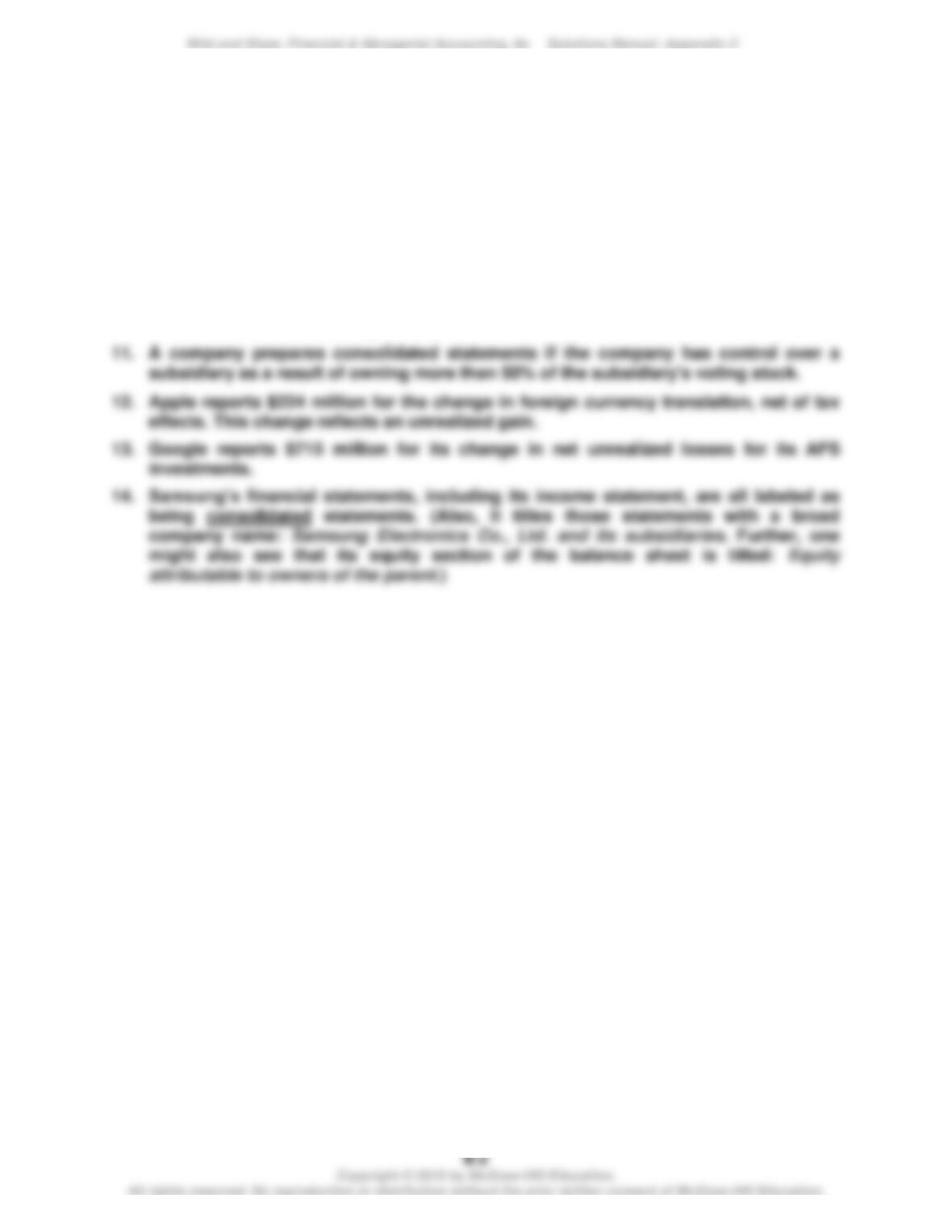
7. Unrealized Loss⎯Equity ……………………………………………. ##
Fair Value Adjustment—Available-for-Sale (LT) ……. ##
8. The portfolio for investments in available-for-sale debt securities is reported on the
balance sheet at fair (market) value—this is separated into short- and long-term.
9. The portfolio of long-term investments in debt securities is reported at cost and
adjusted for amortization of any difference between cost and maturity when the
investments are classified as held-to-maturity (HTM) debt securities (debt
investments are classified as HTM when they do not meet the criteria for Trading
and AFS).
10. The equity method is used when the investor has a “significant influence” over the
investee corporation; this is generally when the investor owns between 20% and
50% of the investee’s voting stock.
QUICK STUDIES
Quick Study C-1 (10 minutes)
True statements: b, d, f
Quick Study C-2 (10 minutes)
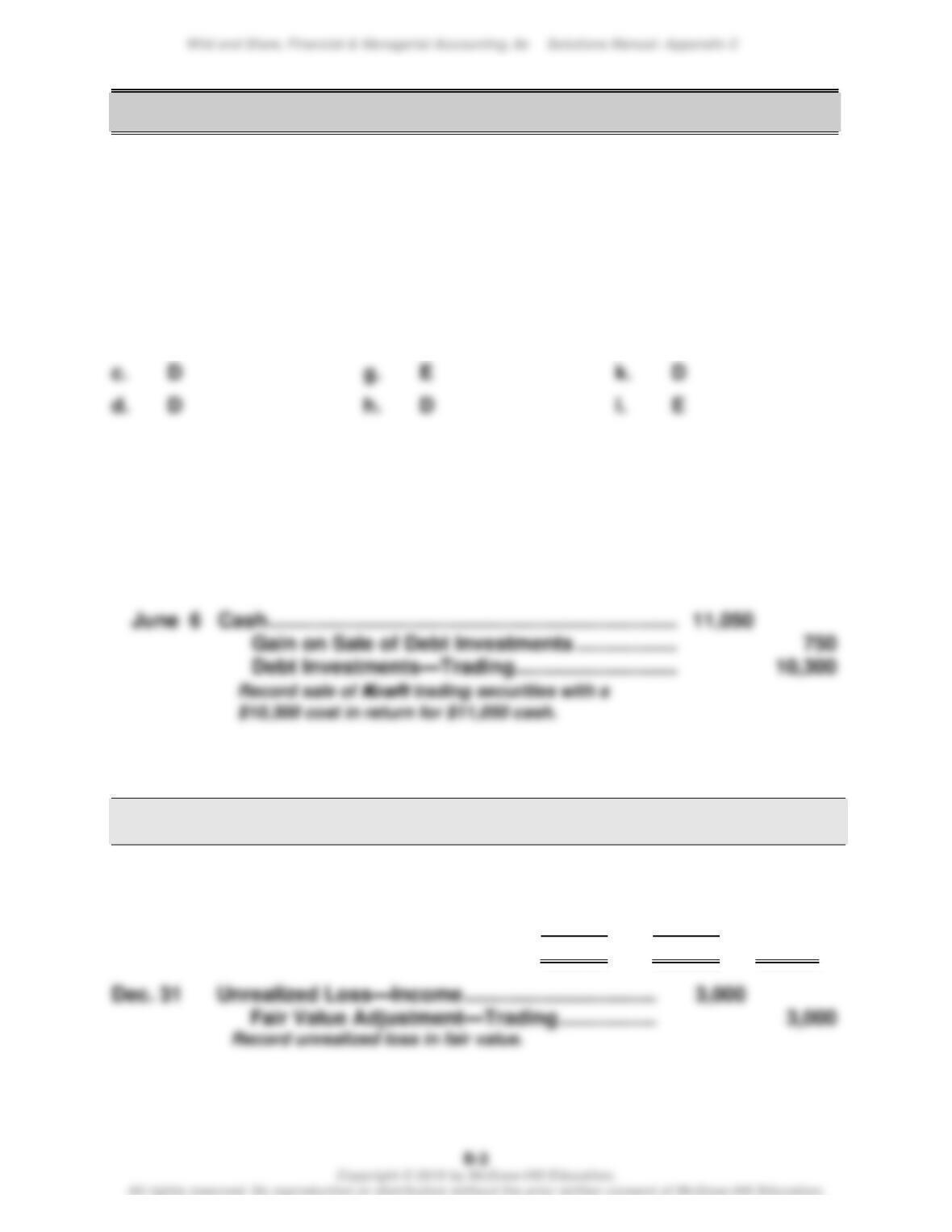
a. D
b. E
e. D
f. D
i. D
j. E
Quick Study C-3 (10 minutes)
May 7
Debt Investments—Trading ………………………………
10,300
Cash …………………………………………………………..
10,300
Purchased
Kraft
bonds at $10,300.
Cash ………………………………………………………………..
11,050
Debt Investments—Trading …………………………
10,300
Quick Study C-4 (15 minutes)
Unrealized
Portfolio of Trading Securities Cost Fair Value Gain (Loss)
Tesla bonds ………………………………………………… $12,000 $ 9,000
Nike bonds ………………………………………………….. 20,000 21,000
Ford bonds …………………………………………………. 5,000 4,000
$37,000 $34,000 $(3,000)
Quick Study C-5 (15 minutes)
1.
KITTY COMPANY
Assets Section of Balance Sheet
December 31
Assets
Current Assets
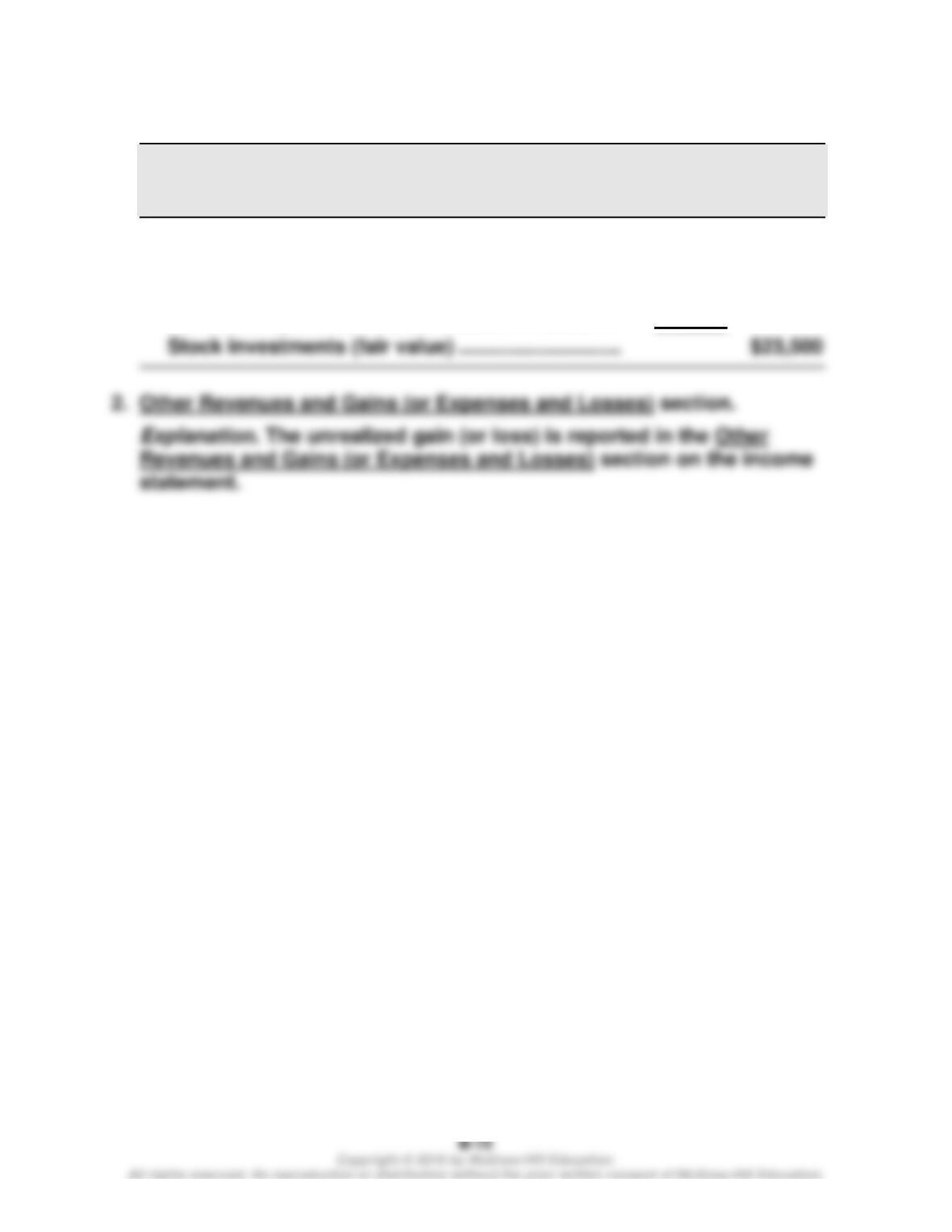
2. Other Revenues and Gains (or Expenses and Losses) section.
The unrealized gain (or loss) is reported in the Other Revenues and
Gains (or Expenses and Losses) section on the income statement.
Quick Study C-6 (10 minutes)
Jan. 1
Debt Investments—HTM ………………………………………..
40,000
Cash ………………………………………………………………..
40,000
Purchased bonds to be HTM.
July 1
Cash ……………………………………………………………………..
1,200
Interest Revenue ………………………………………………
1,200
Record interest earned ($40,000 x 6% x 6/12).
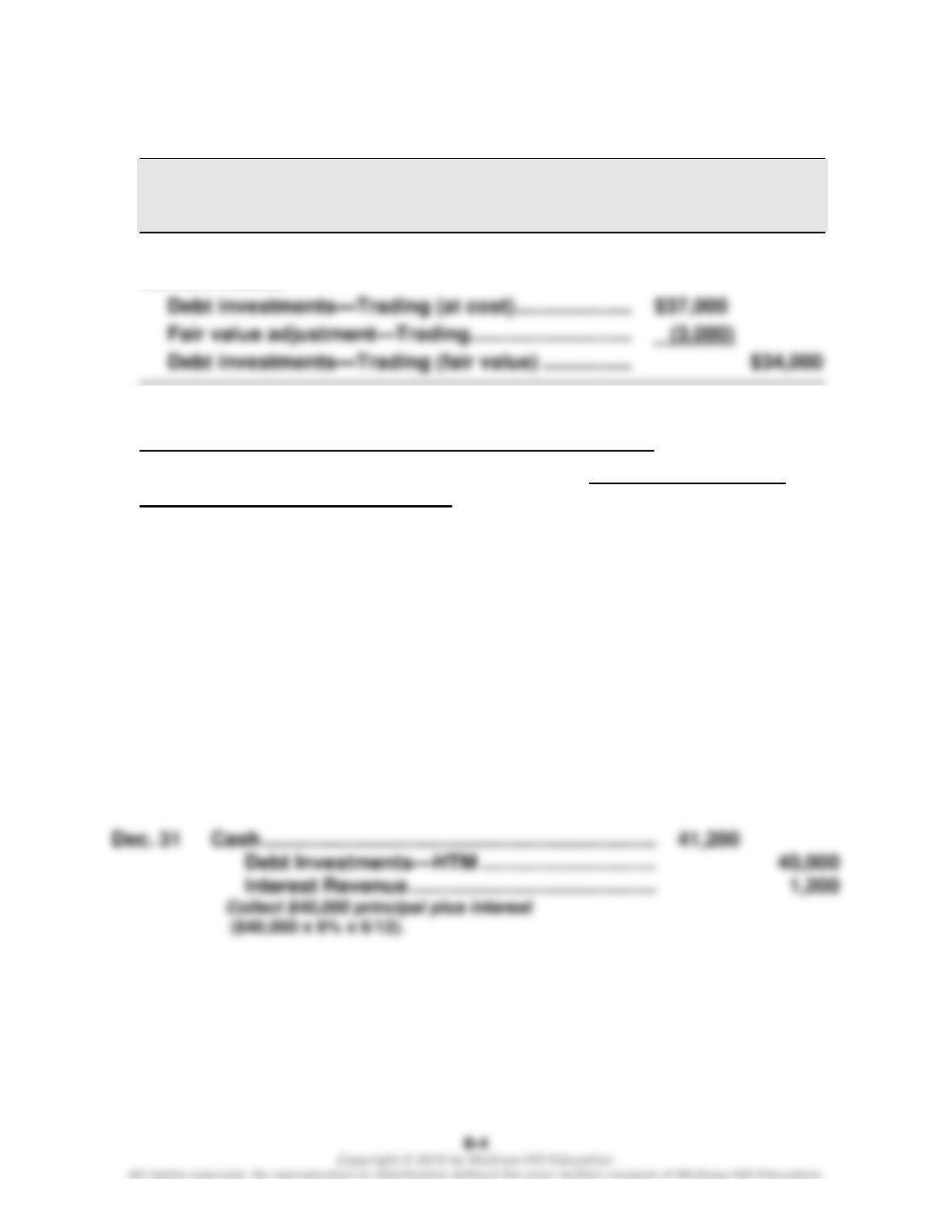
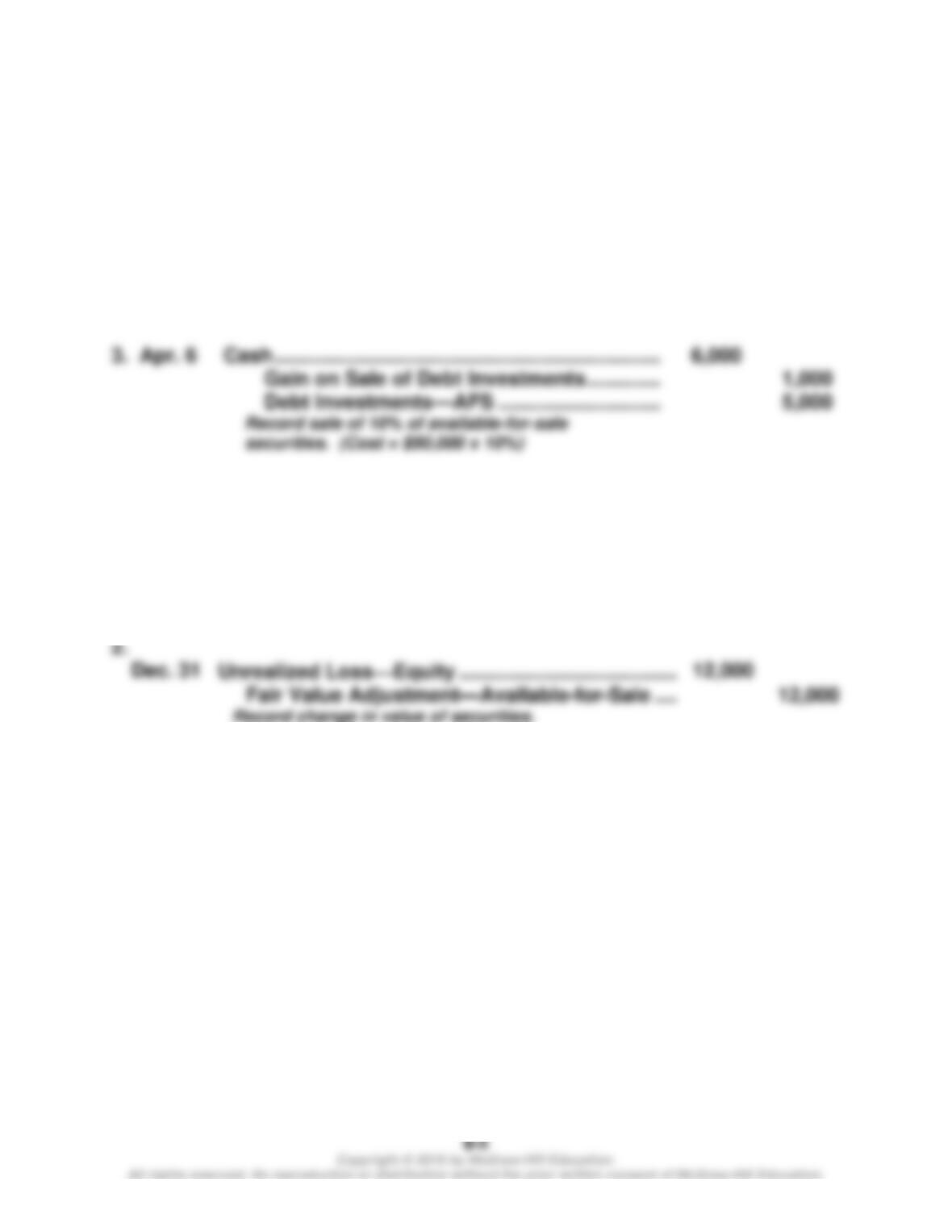
Dec. 31
Cash ……………………………………………………………………..
41,200
Debt Investments—HTM …………………………..
Interest Revenue ………………………………………………
Quick Study C-7 (15 minutes)
1. Nov. 25 Debt Investments—AFS ………………………………… 50,000
Cash ………………………………………………………. 50,000
Record purchase of available-for-sale securities.
2. Dec. 31 Unrealized Loss—Equity ……………………………….. 3,000
Fair Value Adjustment—Available-for–Sale .. 3,000
Record unrealized loss in fair value
of available-for-sale securities’ portfolio (ST).
Quick Study C-8 (10 minutes)
1. July 1 Debt Investments—AFS ………………………………….. 70,000
Cash …………………………………………………………. 70,000
Record purchase of available-for-sale securities.
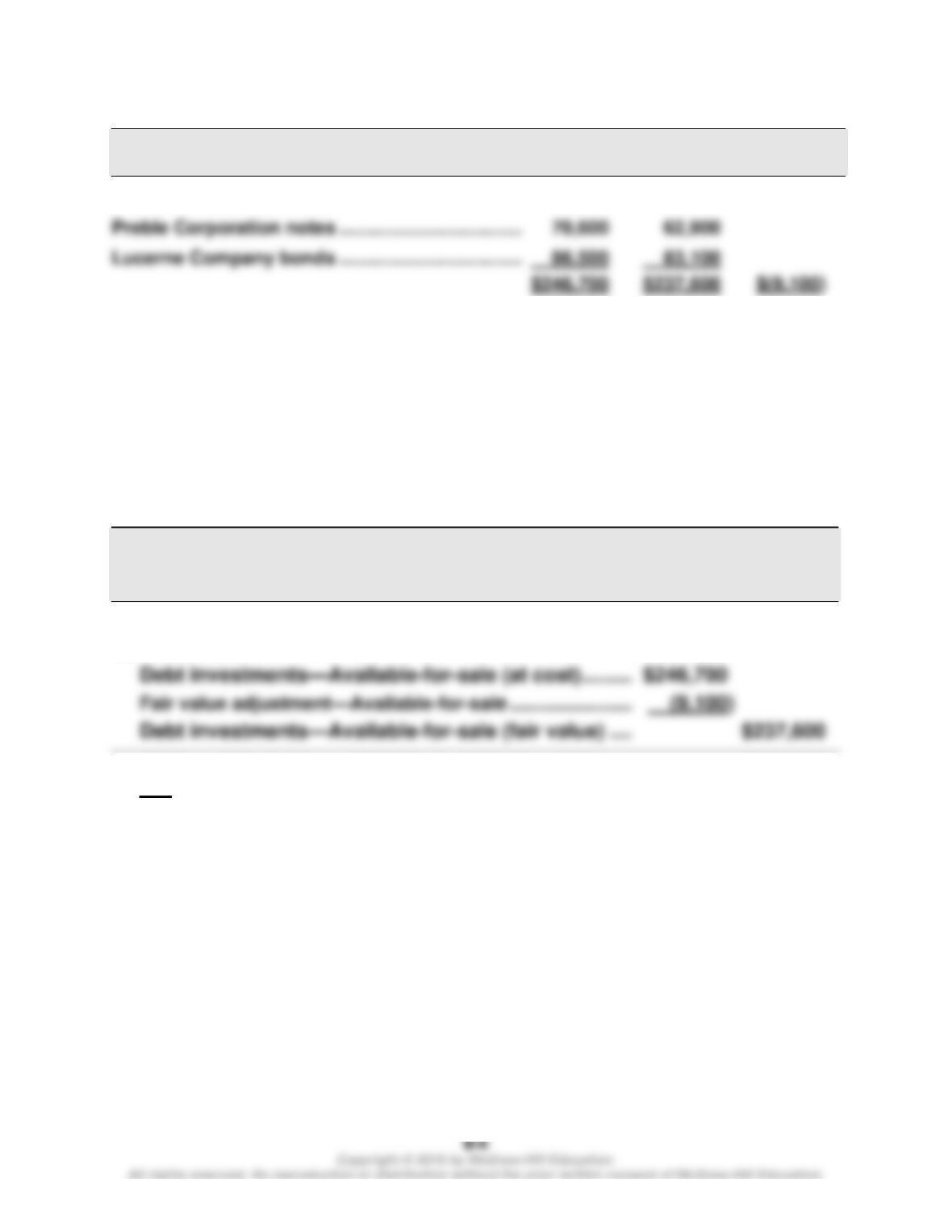
Quick Study C-9 (15 minutes)
Unrealized
Available-for-Sale Portfolio Cost Fair Value Gain (Loss)
Verrizano Corporation bonds ……………………….. $ 89,600 $ 91,600
Dec. 31
Unrealized Loss—Equity …………………………………
9,100
Fair Value Adjustment—AFS ……………………..
9,100
Record unrealized loss in fair value of ST portfolio.
Quick Study C-10 (15 minutes)
1.
REGGIT COMPANY
Assets Section of Balance Sheet
December 31
Assets
Current Assets
2. No.
Explanation: An unrealized gain or loss for the portfolio of AFS
securities is not reported on the income statement. It is reported in the
equity section of the balance sheet.
Quick Study C-11 (10 minutes)
Apr. 18
Stock Investments …………………………………………..
12,600
Cash ………………………………………………………….
12,600
Purchased 300 shares at $42 per share.
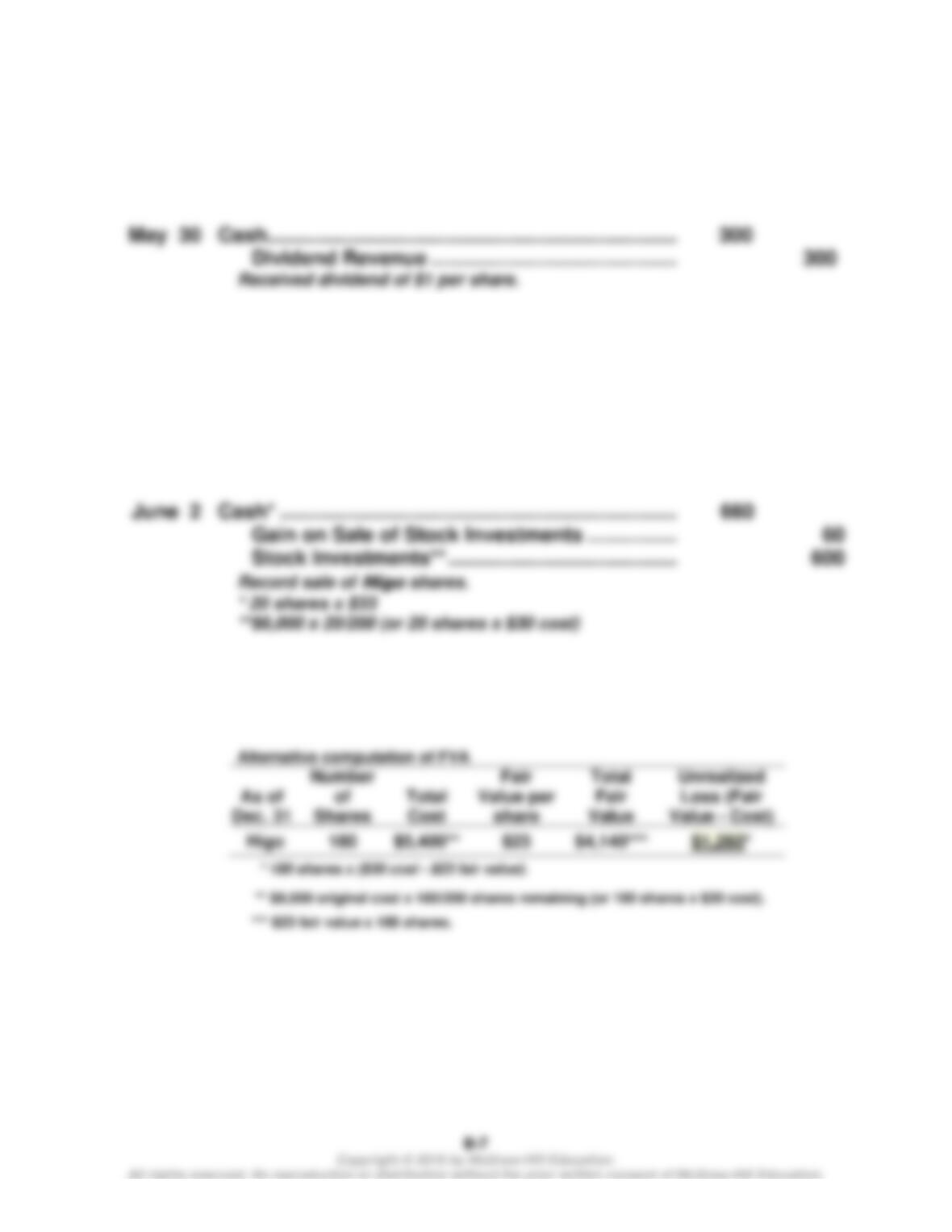
Dividend Revenue ……………………………………..
Quick Study C-12 (10 minutes)
May 9
Stock Investments …………………………………………..
6,000
Cash ………………………………………………………….
6,000
Purchased 200 shares of
Higo
at $30.
Gain on Sale of Stock Investments …………….
Stock Investments** …………………………………..
Dec. 31
Unrealized Loss—Income …………………………………..
1,260
Fair Value Adjustment—Stock ……………………….
1,260
Record an unrealized loss in fair value of equity
securities.
Quick Study C-13 (10 minutes)
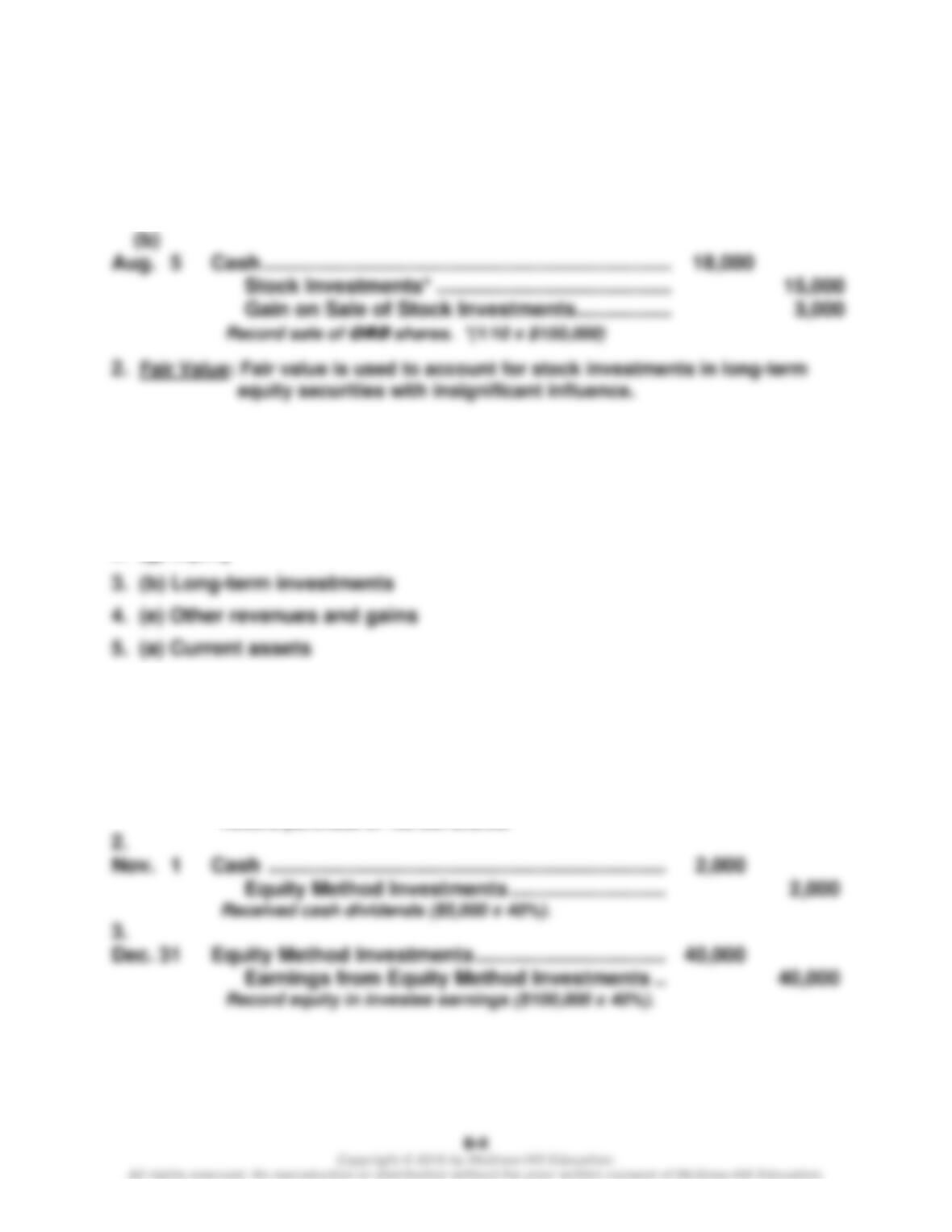
1. (a)
May 20
Stock Investments …………………………………………………
150,000
Cash ………………………………………………………………..
150,000
Record purchase of
ORD
shares.
(b)
Gain on Sale of Stock Investments ……………………
Quick Study C-14 (10 minutes)
1. (a) Current assets
2. (g) Equity
Quick Study C-15 (10 minutes)
1.
July 1
Equity Method Investments …………………………….
500,000
Cash …………………………………………………………
500,000
2.
Equity Method Investments ……………………….
3.
Equity Method Investments …………………………….
Earnings from Equity Method Investments ..
Quick Study C-16 (10 minutes)
1. Consolidation Method.
Explanation. Accenture uses the Consolidation Method to account for
the investment in JBL. An investor who owns more than 50% of a
company’s voting stock has control over the investee. The
consolidation method is used for long-term investments in equity
securities with controlling influence.
2. Consolidated Financial Statements.
Quick Study C-17 (15 minutes)
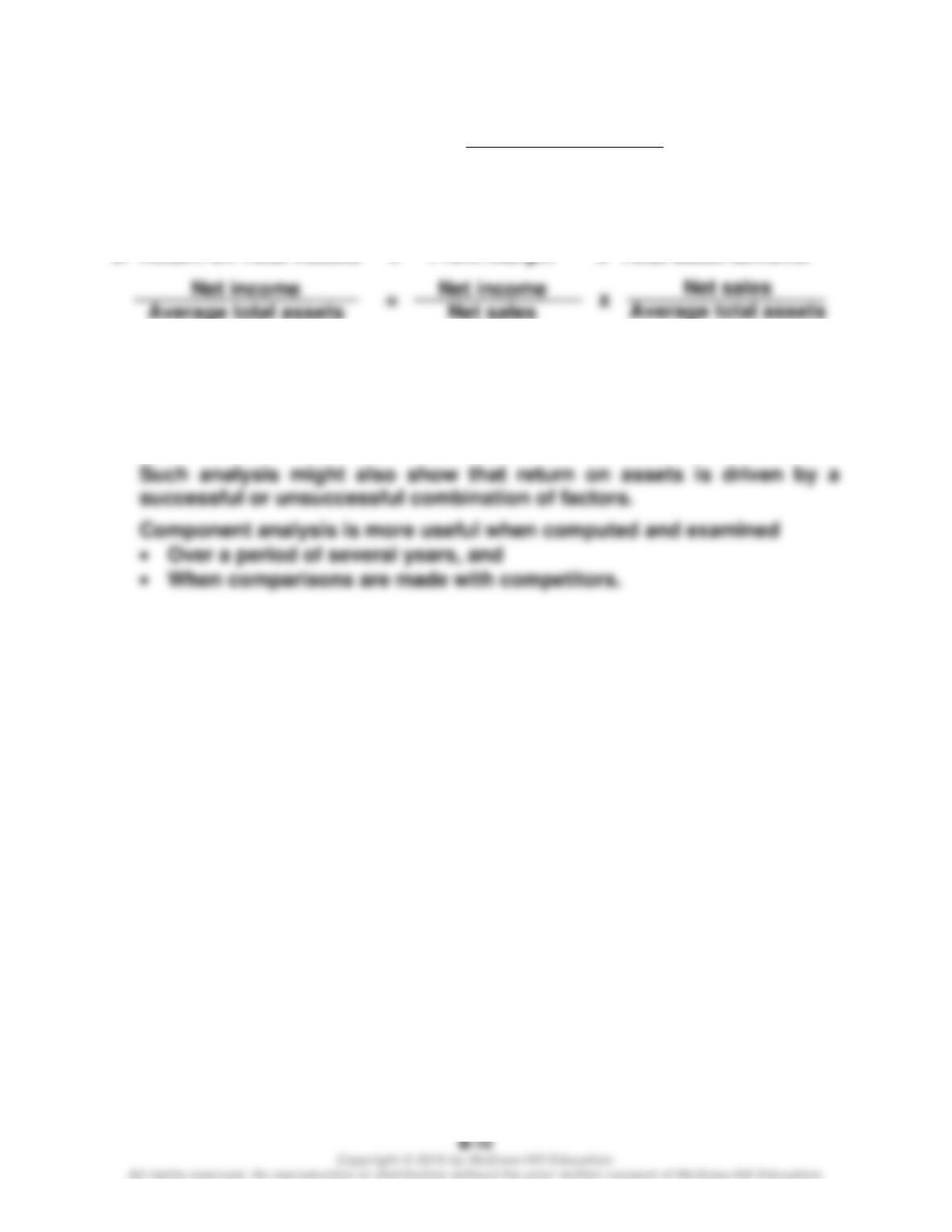
1.
One year ago return on total assets Current year return on total assets
= 14% = 10%
2. Less efficient.
Explanation. Fivio appears to be less efficient in its use of total assets
$38,400
($340,000 + $210,000)/2
$55,500
($770,000 + $340,000)/2
Quick Study C-18 (10 minutes)
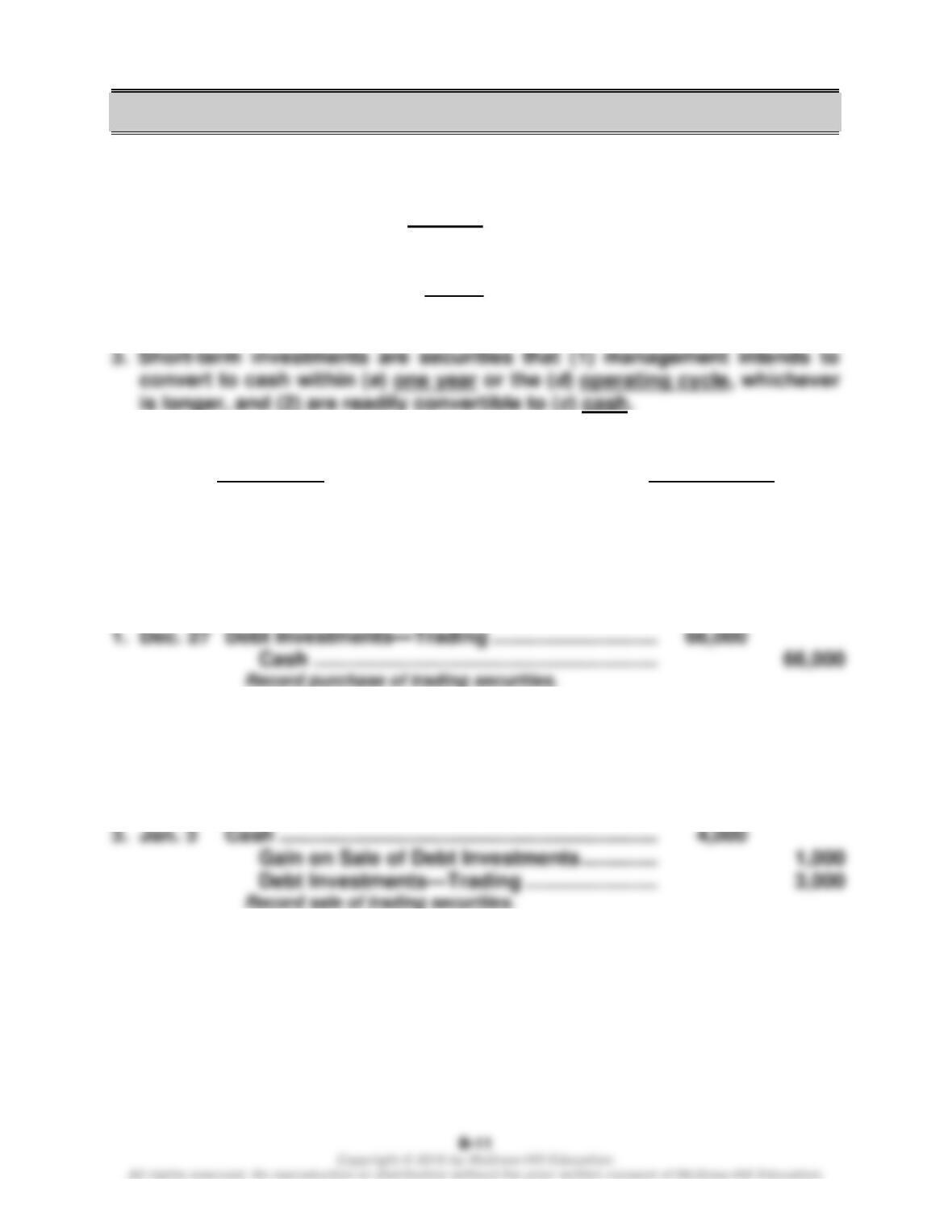
1. Return on total assets =
2. This ratio provides information to evaluate a company’s profitability
(efficiency) in using its available assets.
4. Component analysis is useful as it allows the determination of whether
return on assets is achieved primarily due to
• Profitability, or
• Efficiency of asset usage.
Net income
Average total assets
EXERCISES
Exercise C-1 (10 minutes)
1. Debt securities reflect a (g) creditor relation such as with investments in
notes and bonds.
2. Equity securities reflect an (f) owner relation such as with investments in
shares of stock.
4. Long-term investments in securities are defined as those securities that
are (b) not readily convertible to cash or are (a) not intended to be
converted into cash in the short term.
Exercise C-2 (20 minutes)
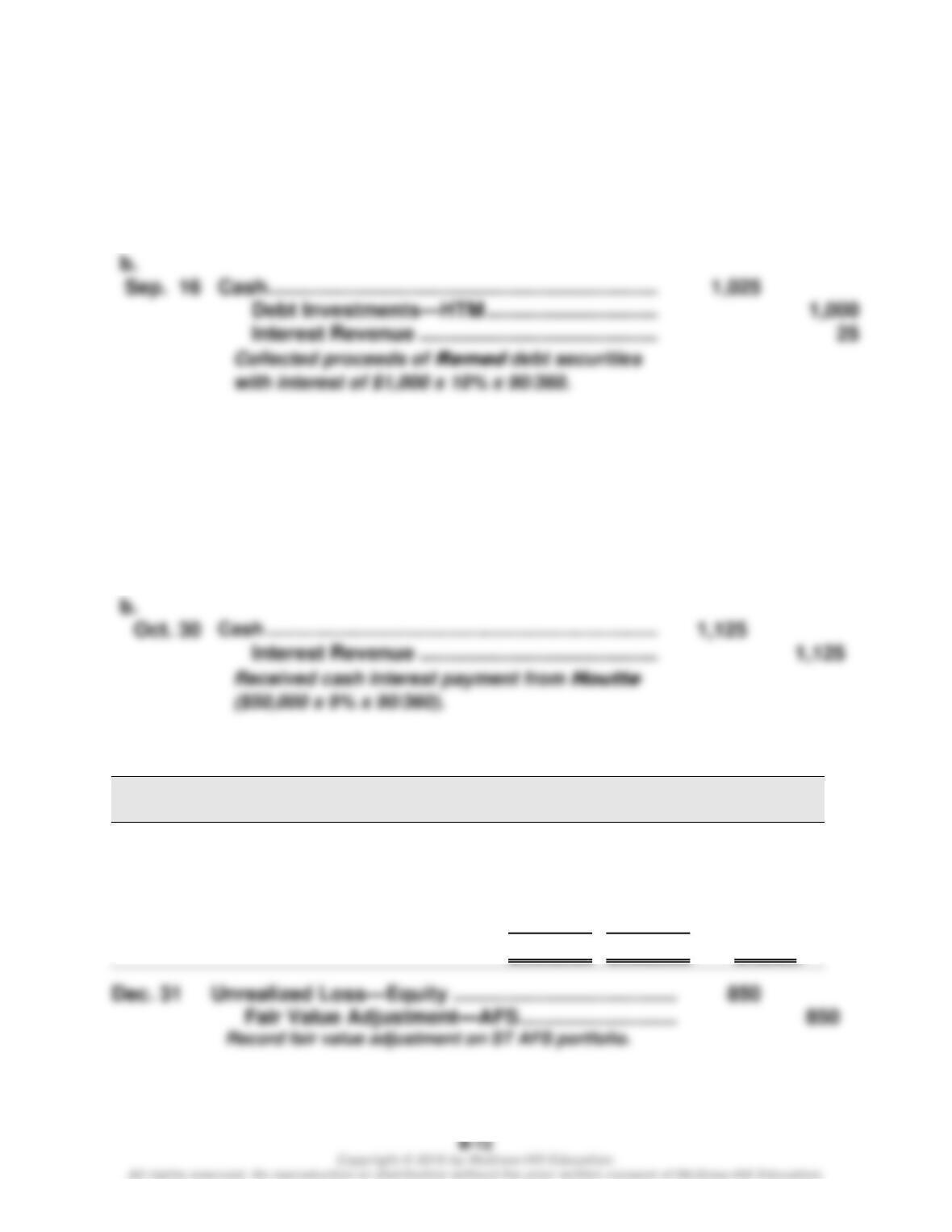
1. Dec. 27
Cash ……………………………………………………….
2. Dec. 31
Fair Value Adjustment—Trading ……………………
6,000
Unrealized Gain—Income …………………………
6,000
Record unrealized gain in fair value of trading
securities. $72,000 fair value – $66,000 cost
Gain on Sale of Debt Investments ……………..
Debt Investments—Trading ………………………
3,000
Exercise C-3 (10 minutes)
a.
Jun. 15
Debt Investments—HTM …………………………………
1,000
Cash ……………………………………………………….
1,000
Purchased 90-day, 10% debt securities
of
Remed
.
Cash ………………………………………………………………
1,025
Debt Investments—HTM …………………………..
1,000
Interest Revenue ………………………………………
Exercise C-4 (10 minutes)
a.
Aug. 1
Debt Investments—AFS ………………………………….
50,000
Cash ……………………………………………………….
50,000
Purchased 6-month, 9% debt securities
of
Houtte
.
1,125
Interest Revenue ……………………………………….
1,125
Exercise C-5 (15 minutes)
Computation of Fair Value Adjustment
Cost
Fair
Value
Unrealized
Gain (Loss)
Nintendo Co. notes ………………………………………………..
$ 44,450
$ 48,900
Atlantic bonds ……………………………………………………….
49,000
47,000
Kellogg Co. notes ………………………………………………….
25,000
23,200
McDonald’s Corp. bonds …………………………..
46,300
44,800
$164,750
$163,900
$ (850)
Dec. 31
Unrealized Loss—Equity ……………………………………….
Fair Value Adjustment—AFS …………………………..
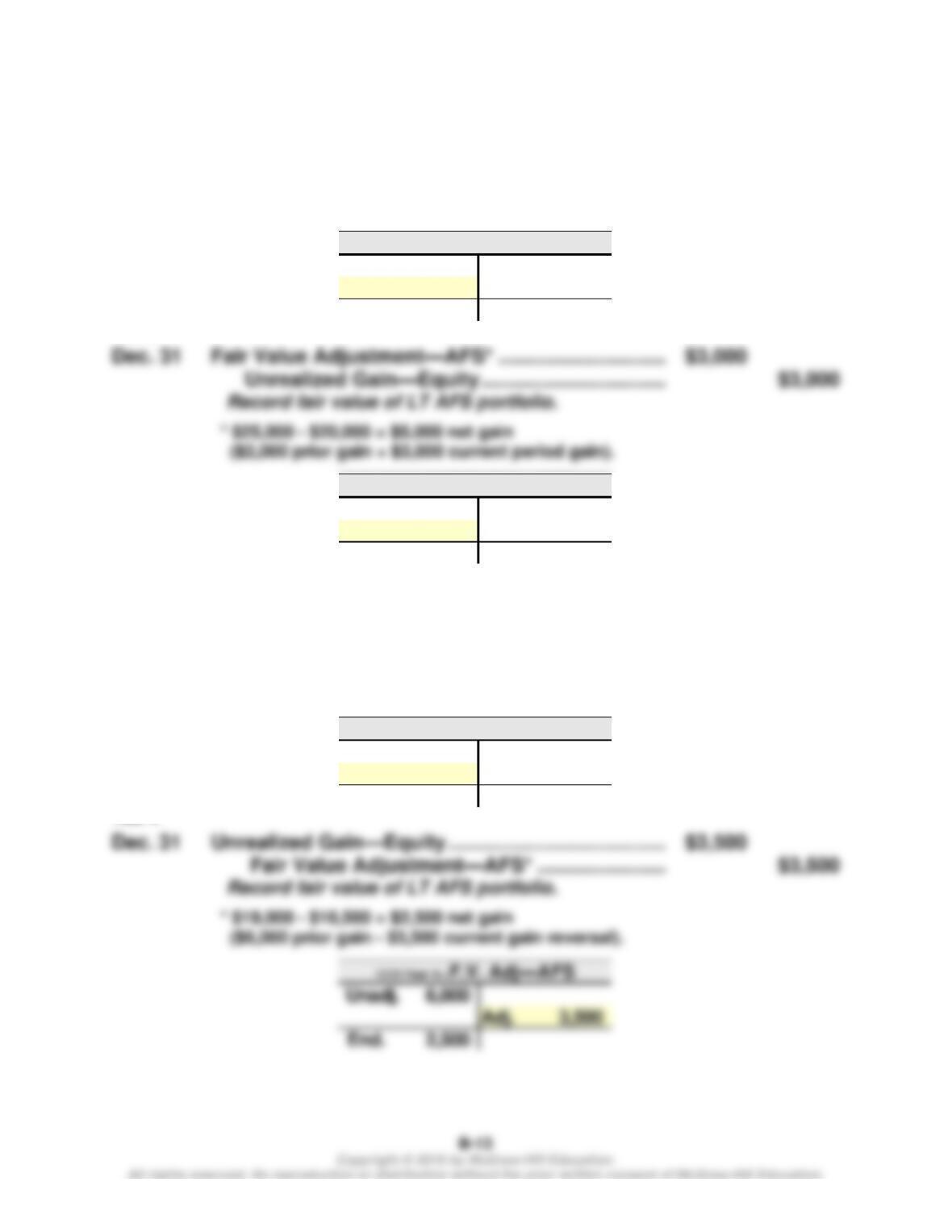
Exercise C-6 (30 minutes)
Year 1
Dec. 31
Fair Value Adjustment—AFS …………………………..
$2,000
Unrealized Gain—Equity …………………………………..
$2,000
Record fair value of
LT
AFS portfolio ($15,000-$13,000).
12/31/Year 1—F.V. Adj—AFS
Unadj.
0
Adj.
2,000
End.
2,000
Year 2
Dec. 31
Fair Value Adjustment—AFS* …………………………..
$3,000
* $25,000 – $20,000 = $5,000 net gain
12/31/Year 2—F.V. Adj—AFS
Unadj.
2,000
Adj.
3,000
End.
5,000
Year 3
Dec. 31
Fair Value Adjustment—AFS* …………………………..
$1,000
Unrealized Gain—Equity …………………………………..
$1,000
Record fair value of LT AFS portfolio.
* $29,000 – $23,000 = $6,000 net gain
($5,000 prior gain + $1,000 current period gain).
12/31/Year 3—F.V. Adj—AFS
Unadj.
5,000
Adj.
1,000
End.
6,000
Unrealized Gain—Equity ………………………………………..
$3,500
Fair Value Adjustment—AFS* ………………………….
$3,500
Record fair value of LT AFS portfolio.
12/31/Year 4—F.V. Adj—AFS
Unadj.
6,000
Adj.
End.
2,500
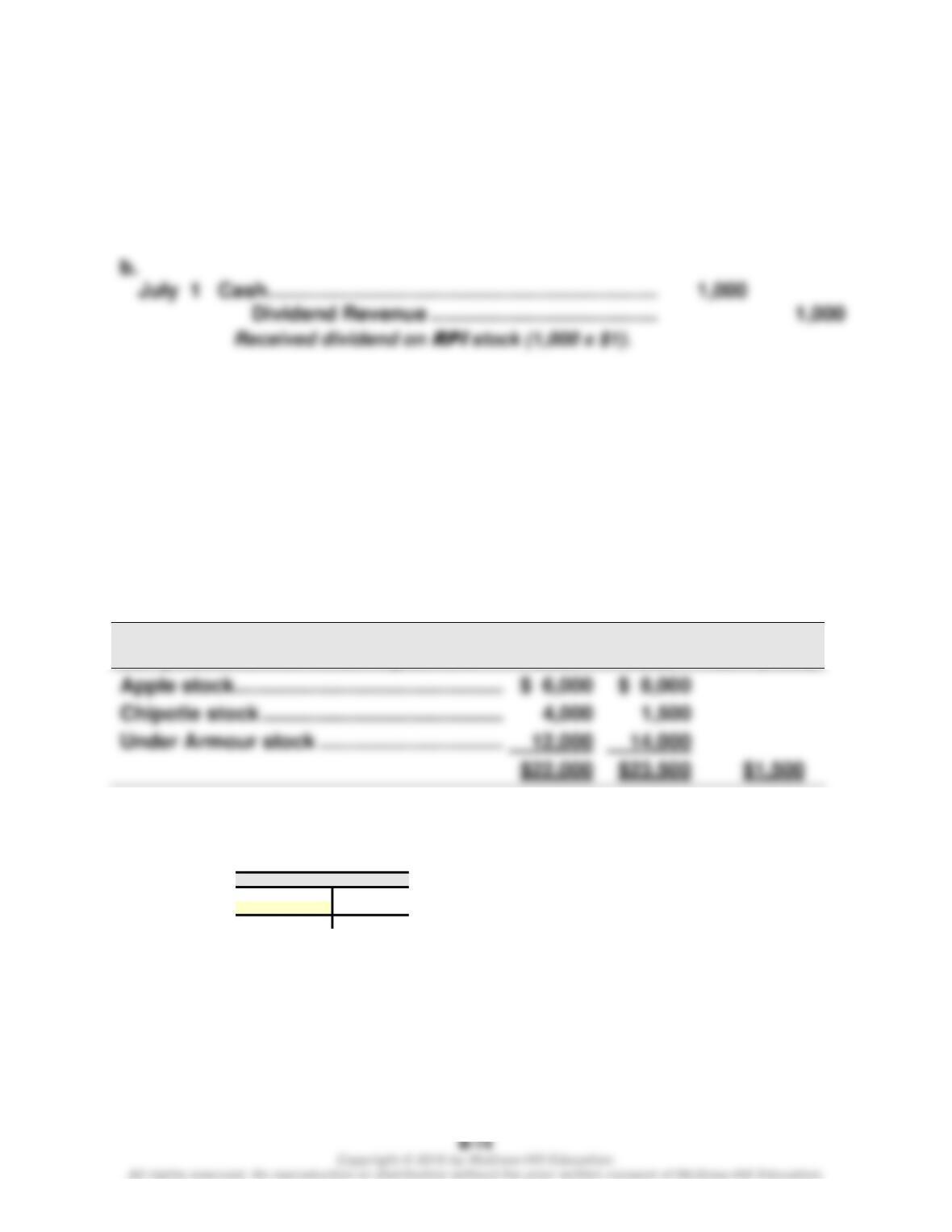
Exercise C-7 (15 minutes)
a.
Mar. 22
Stock Investments ………………………………………….
10,000
Cash ……………………………………………………….
10,000
Purchased 1,000 shares of
RPI
.
Cash ………………………………………………………………
Dividend Revenue …………………………………….
Received dividend on
c.
Oct. 8
Cash* …………………………………………………………….
750
Stock Investments** ………………………………….
500
Gain on Sale of Stock Investments …………….
250
Sold 50 shares of
RPI
stock.
*50 shares x $15 **$10,000 x (50 sh / 1,000 sh)
Exercise C-8 (15 minutes)
Computation of Fair Value Adjustment
Cost
Fair
Value
Unrealized
Gain (Loss)
Apple stock ……………………………………………………….
Chipotle stock ……………………………………………………….
Under Armour stock ………………………………………………
Dec. 31
Fair Value Adjustment—Stock …………………………..
1,500
Unrealized Gain—Income …………………………..
1,500
Record fair value of stock investments.
F.V. Adj—Stock
Unadj.
0
Adj.
1,500
End.
1,500
Exercise C-9 (15 minutes)
1.
MARS CO.
Assets Section of Balance Sheet
December 31
Assets
Current Assets
Stock investments (at cost) ……………………………. $22,000
Fair value adjustment—Stock ……………………………. 1,500
Exercise C-10 (25 minutes)
July 22
Stock Investments …………………………………………
48,000
Cash ………………………………………………………..
48,000
Purchased
Hunt
shares (1,600 sh x $30).
Cash ………………………………………………………………
Cash ………………………………………………………..
Purchased
HCA
Oct. 3
Cash ……………………………………………………………..
40,000
Loss on Sale of Stock Investments ………………..
8,000
Stock Investments ……………………………………
48,000
Sold
Hunt
shares (1,600 sh x $25).
Oct. 30
Stock Investments …………………………………………
60,000
Cash ………………………………………………………..
60,000
Purchased
Black & Decker
shares
(1,200 sh x $50).
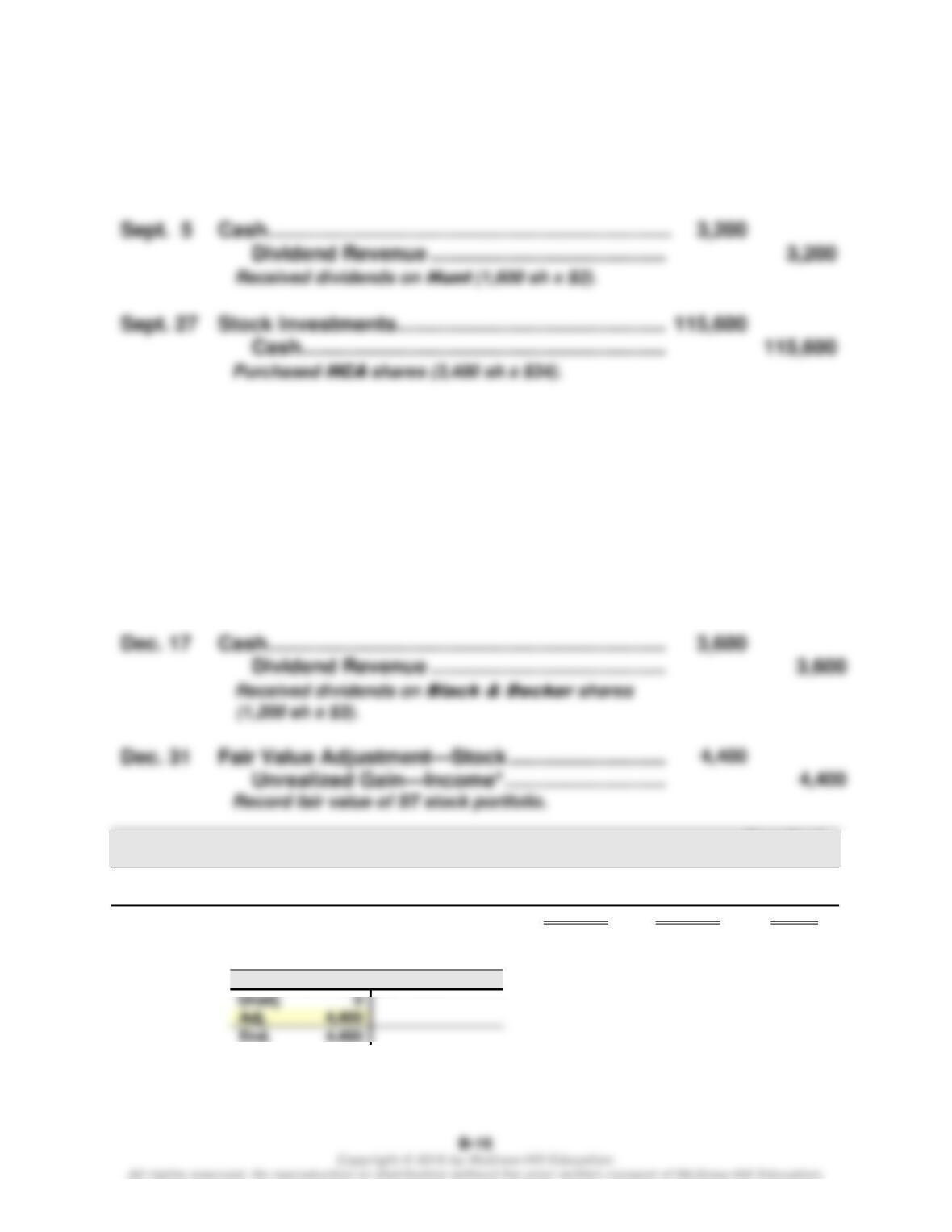
Fair Value Adjustment—Stock ……………………….
Unrealized Gain—Income* ………………………..
Unrealized
Portfolio of Stock Investments (ST) Cost Fair Value Gain (Loss)
HCA 3,400 x $34 …………………………….. $115,600
Black & Decker 1,200 x $50 …………………………….. 60,000
$175,600 $180,000 *$4,400
We can also use a T-account to help determine the needed adjustment to fair value:
12/31—F.V. Adj—Stock
Adj.
End.
Exercise C-11 (30 minutes)
(a) Feb. 15
Debt Investments—HTM ………………………………………..
160,000
Cash ……………………………………………………….
160,000
Purchased 10%, 90-day notes of
GMI
.
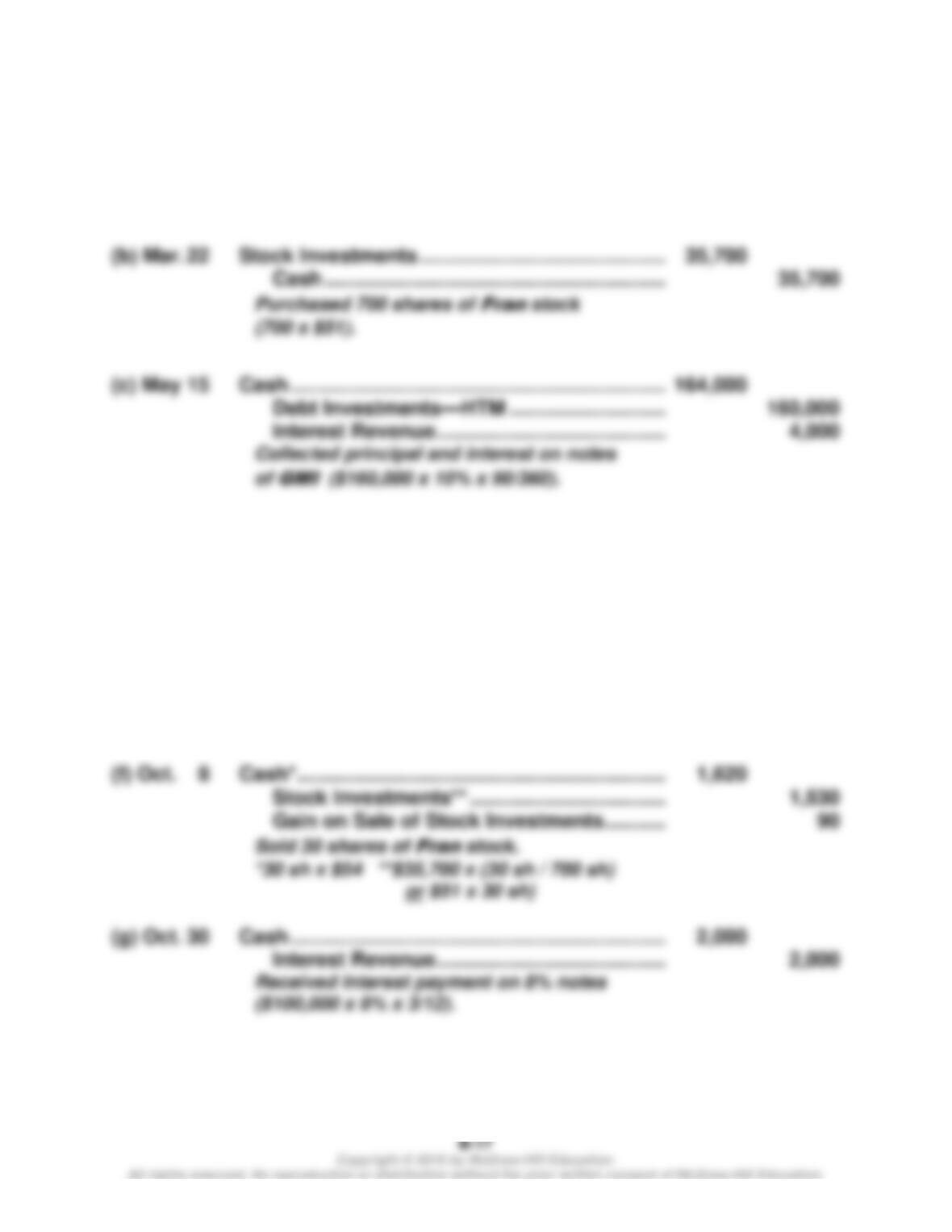
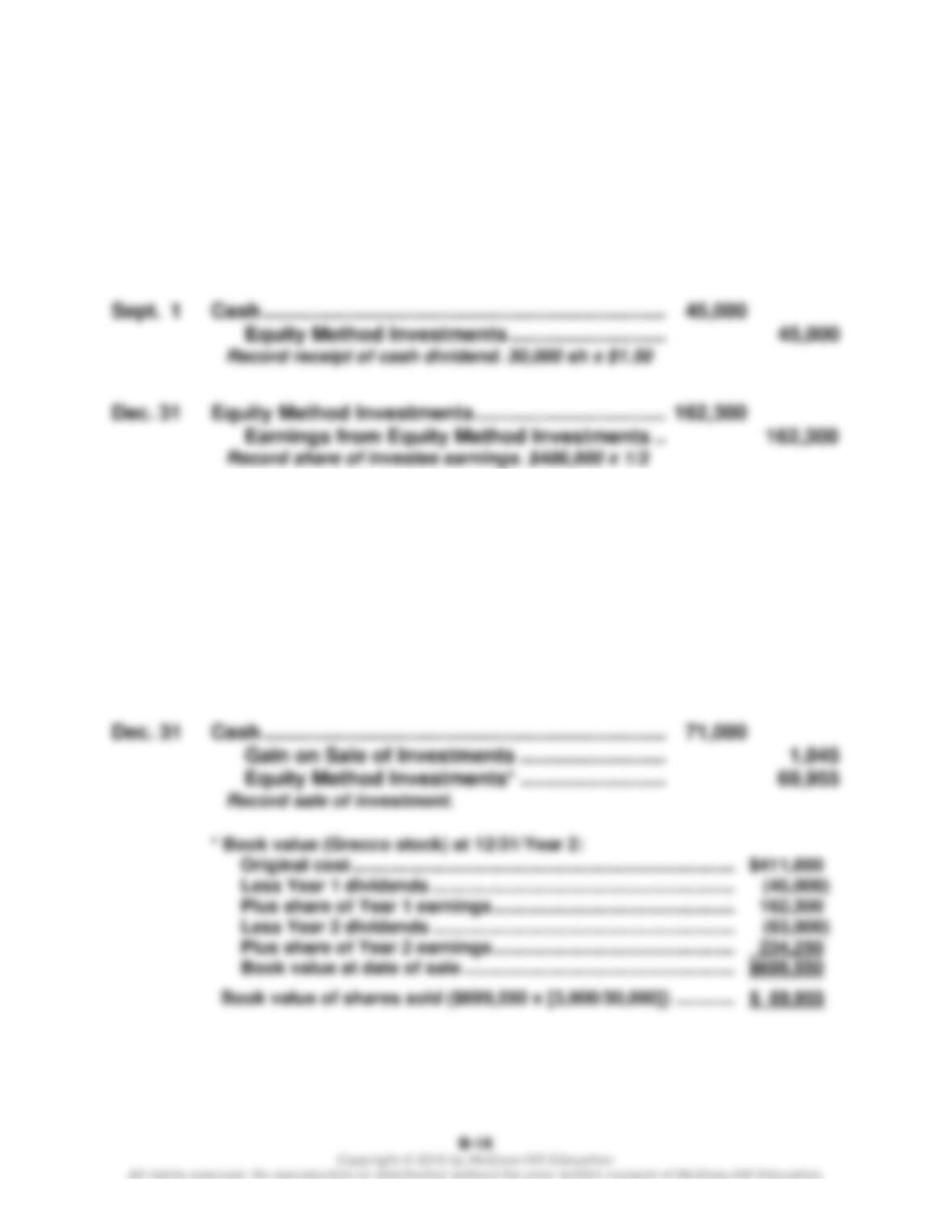
(b) Mar. 22
Cash ……………………………………………………….
Purchased 700 shares of
(700 x $51).
(c) May 15
Cash ……………………………………………………………………..
164,000
Debt Investments—HTM …………………………..
160,000
Interest Revenue ………………………………………………
(d) July 30
Debt Investments—Trading …………………………..
100,000
Cash ……………………………………………………….
100,000
Purchased 8%, 6-month notes of
MP
.
(e) Sept. 1
Cash ……………………………………………………………………..
700
Dividend Revenue ……………………………………………
700
Received dividend on
Fran
shares
(700 shares x $1).
(f) Oct. 8
Cash* …………………………………………………………………….
Stock Investments** …………………………………………
Gain on Sale of Stock Investments ……………………
(g) Oct. 30
Cash ……………………………………………………………………..
Interest Revenue ………………………………………………
($100,000 x 8% x 3/12).
Exercise C-12 (30 minutes)
Year 1
Jan. 2
Equity Method Investments* …………………………..
411,000
Cash ………………………………………………………………..
411,000
Record purchase of equity method investment.
* Kodax’s investment equals 1/3 of Grecco’s stock (30,000/90,000).
Kodax should use the equity method to account for its investment.
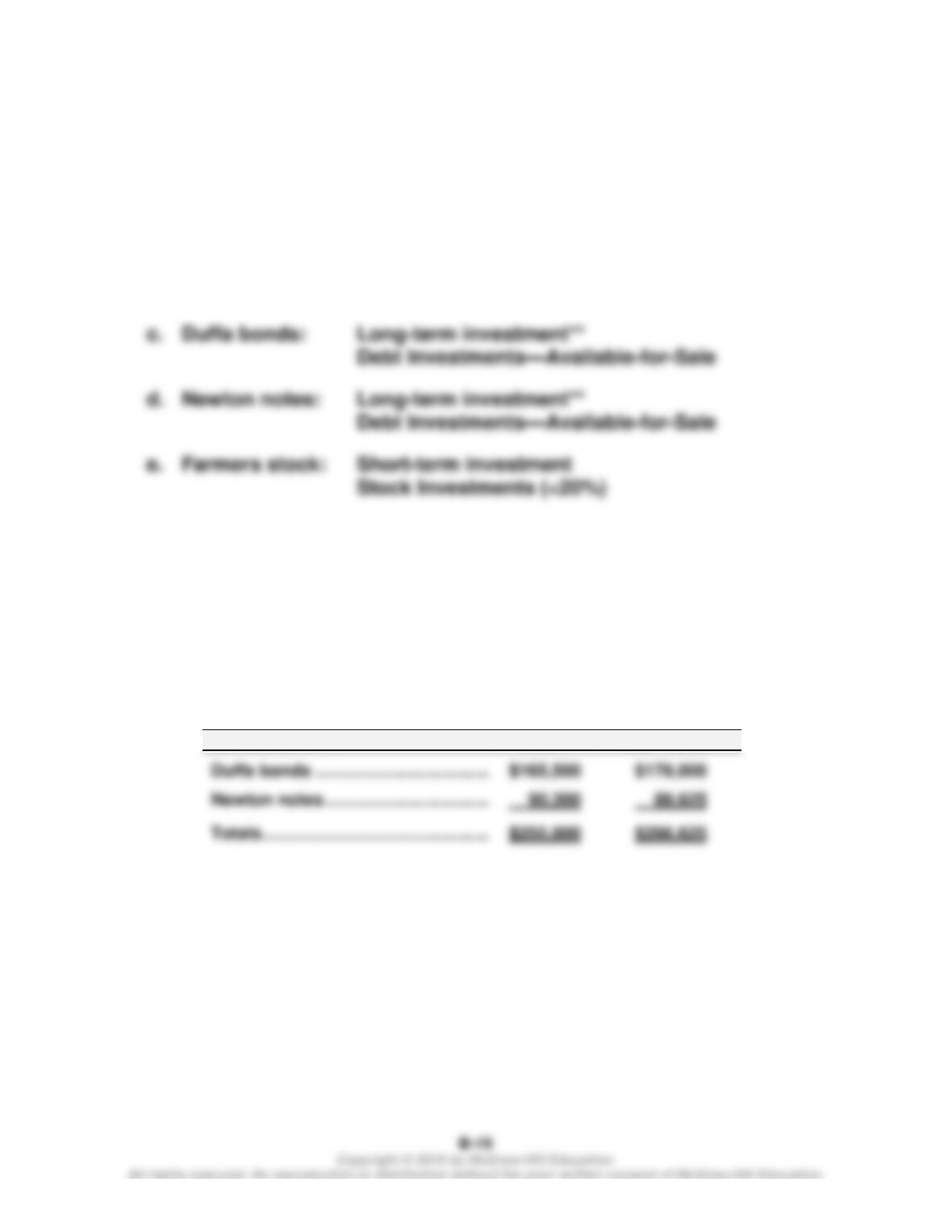
Sept. 1
Cash ……………………………………………………………………..
45,000
Equity Method Investments …………………………..
45,000
Record receipt of cash dividend. 30,000 sh x $1.50
Dec. 31
Equity Method Investments ……………………………………
162,300
Earnings from Equity Method Investments ……….
Record share of investee earnings. $486,900 x 1/3
Year 2
June 1
Cash ……………………………………………………………………..
63,000
Equity Method Investments …………………………..
63,000
Record receipt of cash dividend. 30,000 sh x $2.10
Dec. 31
Equity Method Investments ……………………………………
234,250
Earnings from Equity Method Investments ……….
234,250
Record share of investee earnings. $702,750 x 1/3
Cash ……………………………………………………………………..
71,000
Gain on Sale of Investments …………………………..
Equity Method Investments* …………………………..
69,955
* Book value (Grecco stock) at 12/31/Year 2:
Less Year 1 dividends ……………………………………………………….
Plus share of Year 1 earnings ………………………………………………..
Less Year 2 dividends ……………………………………………………….
Plus share of Year 2 earnings ………………………………………………..
Exercise C-13 (15 minutes)
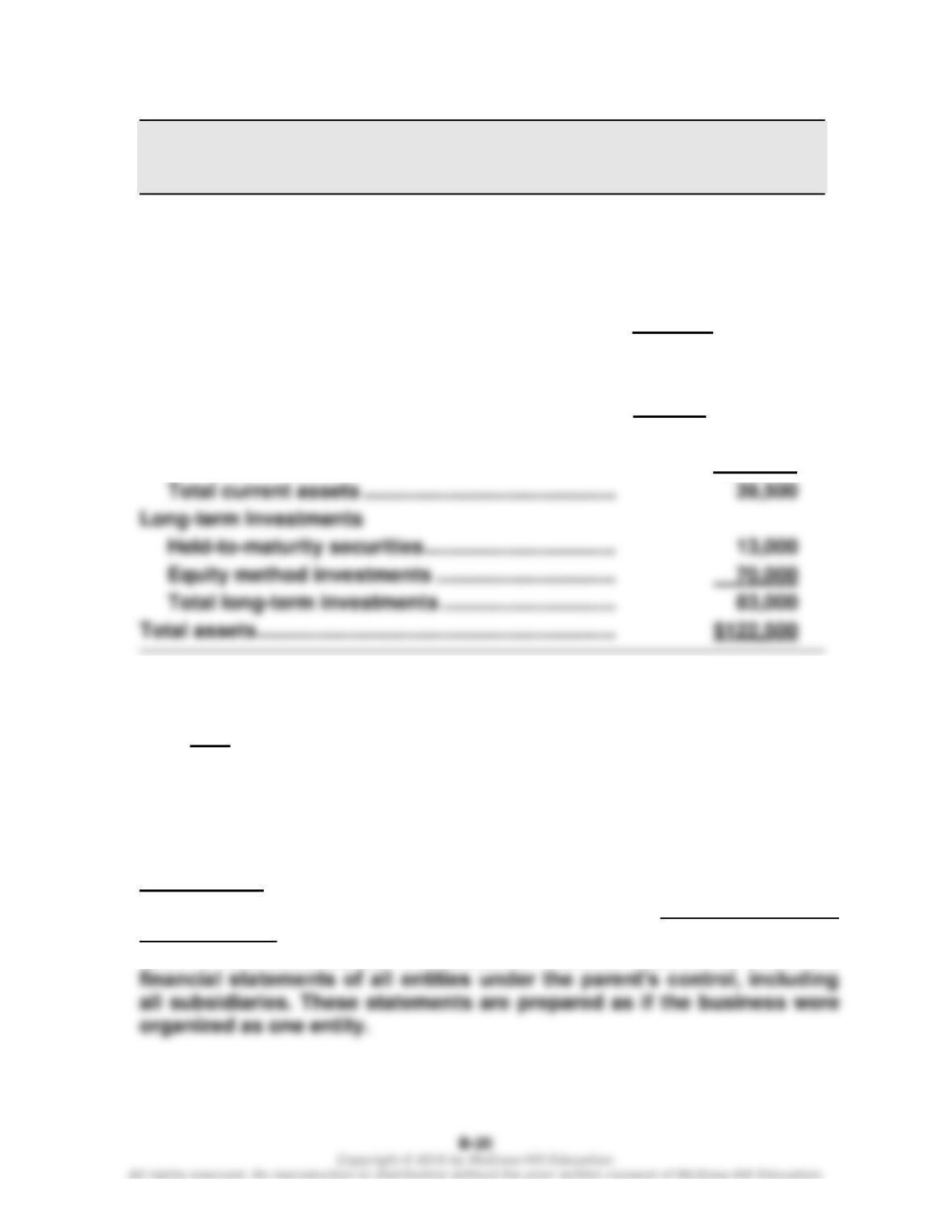
1. Classification of Investments in Securities
a. Brava bonds: Long-term investment
Debt Investments—Held–to-Maturity
b. Baybridge stock: Long-term investment*
Equity Method Investments (20%–50%)
*The reason is because an equity method investment is classified as long-term.
**The reason is because the investment is not readily marketable.
2. Fair Value Adjustment entry at December 31.
Dec. 31
Fair Value Adjustment—AFS ………………………………….
10,825
Unrealized Gain⎯Equity …………………………………..
10,825
Record fair value of AFS portfolio ($255,800 – $266,625).
AFS securities
Cost
Fair Value
Exercise C-14 (20 minutes)
GERMX CO.
Assets Section of Balance Sheet
December 31
Assets
Current assets
Cash ……………………………………………………………. $ 10,000
Stock investments (at cost) …………………………... $23,000
Fair value adjustment—Stock ……………………….. (1,000)
Stock investments (at fair value) …………………… 22,000
Trading securities (at cost) …………………………... 5,000
Fair value adjustment—Trading…………………….. 500
Trading securities (at fair value) ……………………. 5,500
Accounts receivable …………………………………….. 2,000
Exercise C-15 (15 minutes)
1. Only FSN is considered a subsidiary of Wixi.
Explanation: An investor who owns more than 50% of a company’s
voting stock has control over the investee. The controlling investor is
called the parent and the investee is called the subsidiary.
2. Individual assets and liabilities of a parent and its subsidiary are
consolidated into one balance sheet.
Explanation: This means assets and liabilities are combined on one
balance sheet. The investor reports consolidated financial statements
when it has subsidiaries. Consolidated financial statements show the