Financial Accounting, 9/e 8-57
Case B
Req. 1
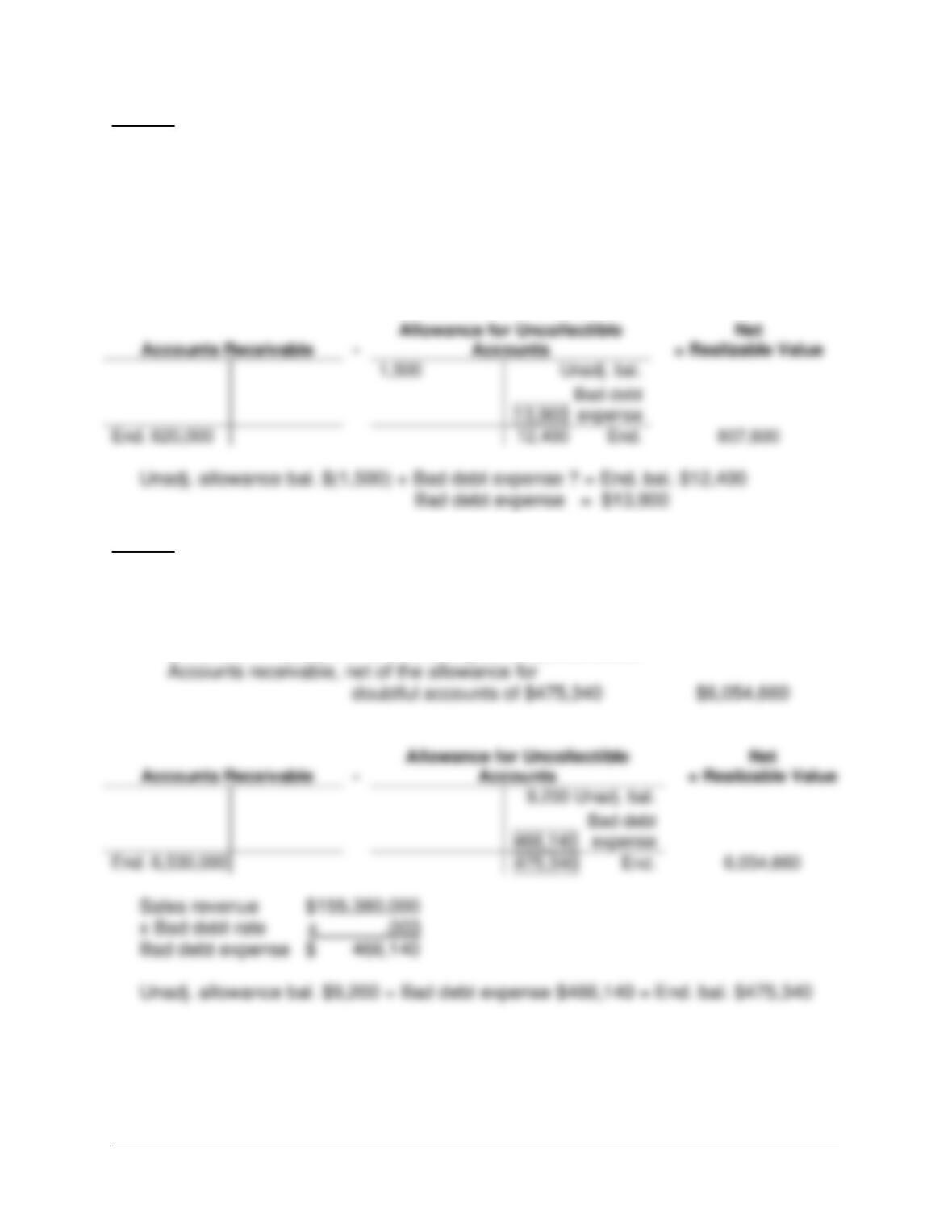
The company should record bad debt expense of $13,900 for the current year.
Req. 2
Under current assets on the current year’s balance sheet:
Accounts receivable, net of the allowance for
doubtful accounts of $12,400 $607,600
Case C
Req. 1
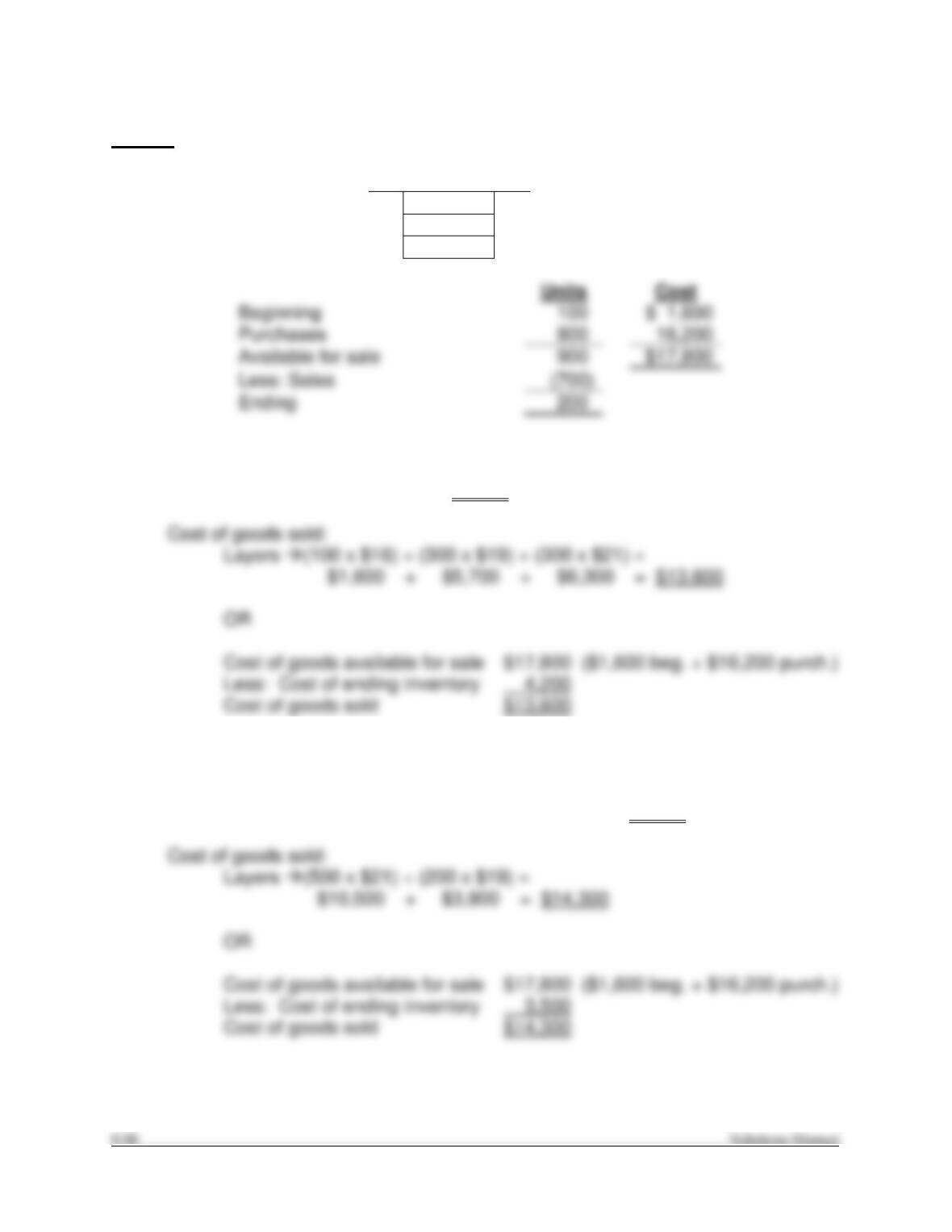
The company should record bad debt expense of $466,140 for the current year.
Req. 2
Under current assets on the current year’s balance sheet:
COMP8-1. (continued)
Case D
Req. 1
11/13 Purch
500
@
$21 = $10,500
11/4 Purch
300
@
$19 = $ 5,700
Beg.
100
@
$16 = $ 1,600
Beginning
Purchases
Available for sale
Less: Sales
Ending
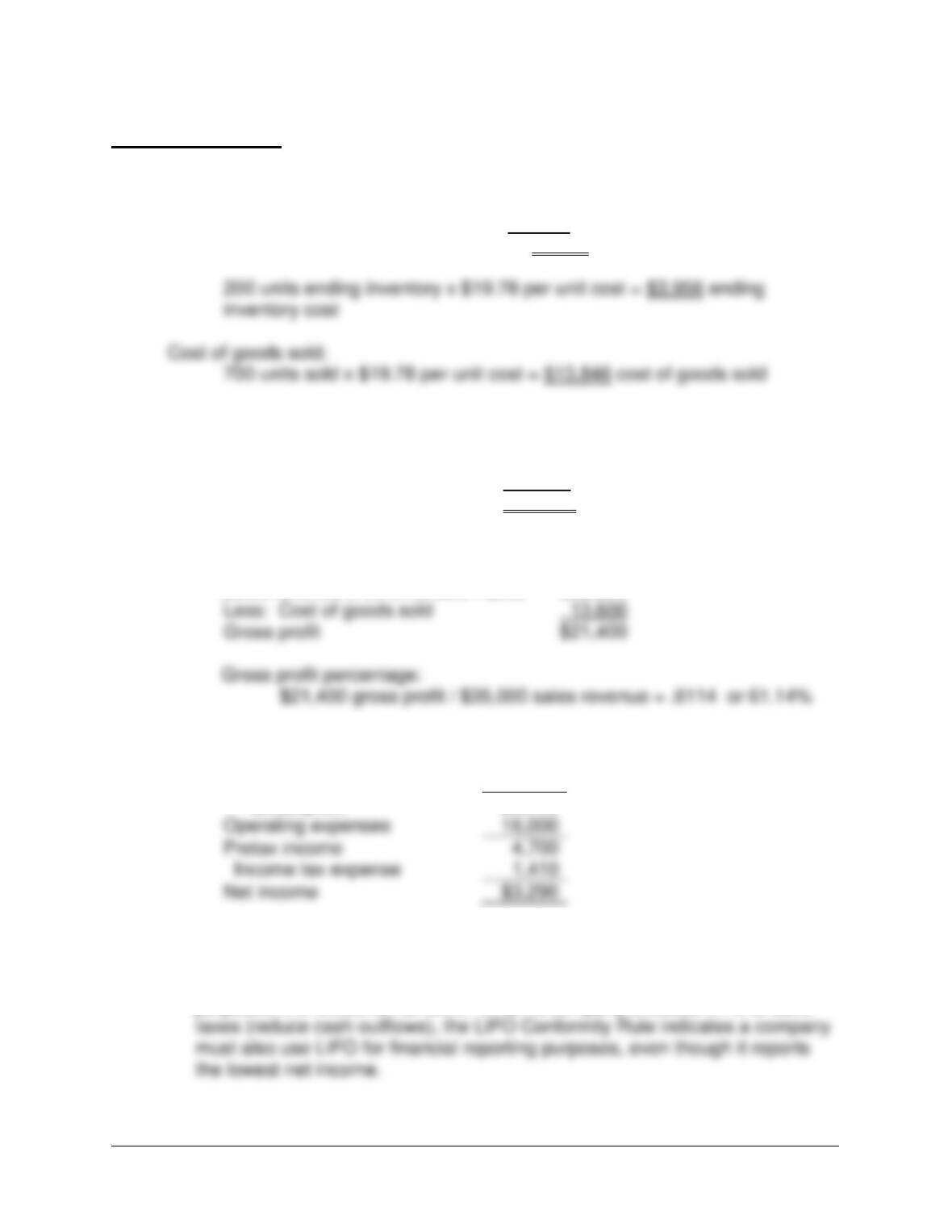
a. FIFO
Cost of ending inventory:
Layer → 200 units x $21 = $4,200
b. LIFO
Cost of ending inventory:
Layers → (100 units x $16) + (100 units x $19)
$1,600 + $1,900 = $3,500
Financial Accounting, 9/e 8-59
COMP8-1. (continued)
Case D (continued)
c. Weighted average
Cost of ending inventory:
Cost of goods available for sale $17,800 ($1,600 beg. + $16,200 purch.)
÷ Number of goods available ÷ 900 units
Cost per unit $19.78 per unit (rounded)
OR
Cost of goods available for sale $17,800 ($1,600 beg. + $16,200 purch.)
Less: Cost of ending inventory 3,956
Cost of goods sold $13,844 (difference due to rounding)
Req. 2
a. Gross profit under FIFO method
Sales revenue (700 units sold x $50) $35,000
b. Net income under LIFO method
Sales revenue
$35,000
Less: Cost of goods sold
14,300
Gross profit
20,700
Operating expenses
16,000
Pretax income
Income tax expense
Net income
$3,290
c. The LIFO method should be recommended to Stewart for tax and financial
reporting purposes. Prices of inventory are rising. When prices rise, LIFO
yields the highest cost of goods sold, lowest net income, and, for tax
purposes, the lowest tax amount. When a company chooses LIFO to save
COMP8-1. (continued)
Case D (continued)
Req. 3
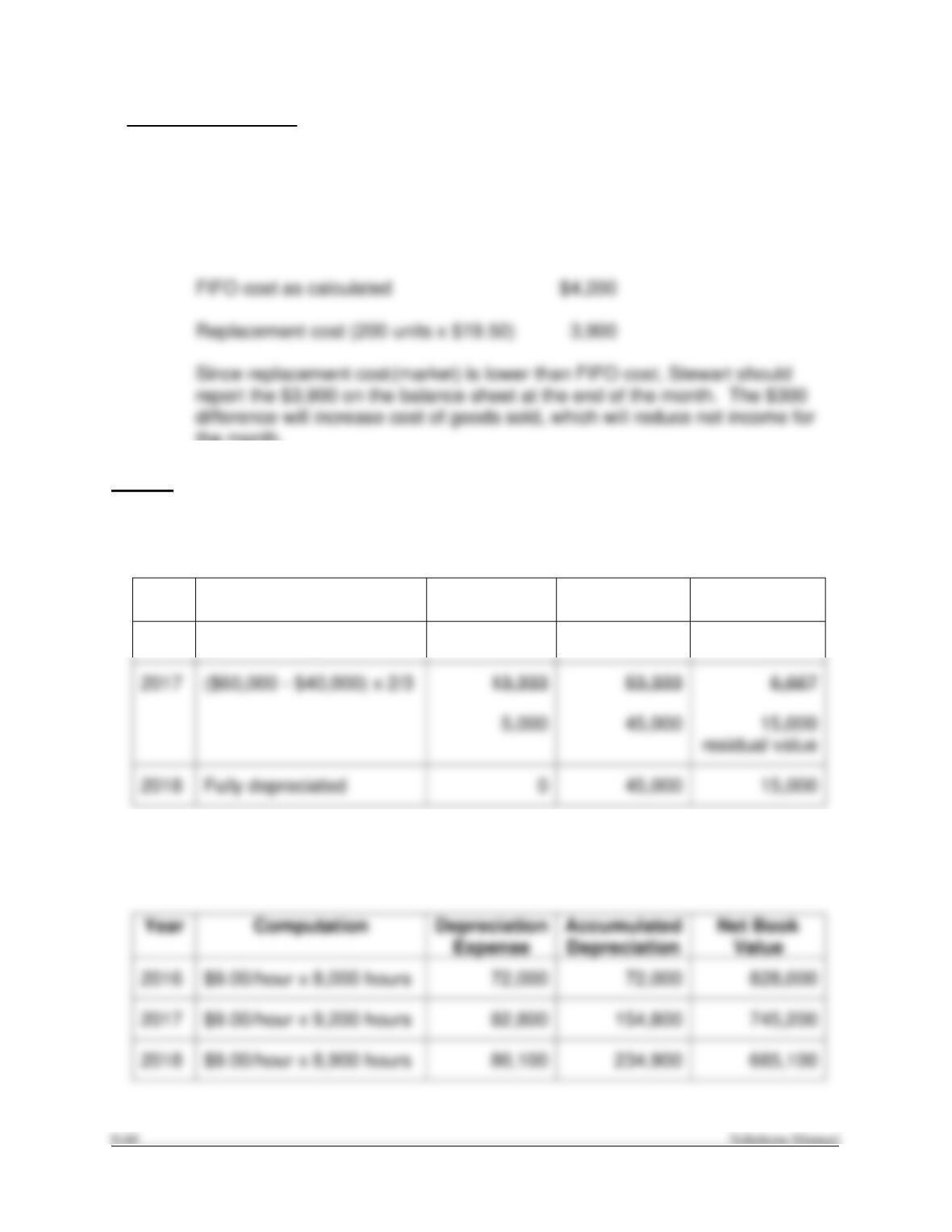
For valuation purposes, ending inventory is to be reported at the lower of cost
or market, a conservative approach so that assets are not overstated, thus
reducing net income. When Stewart applied the LCM method, the following
comparisons were made:
the month.
Case E
Req. 1 Partial depreciation schedules:
a. Office equipment using double-declining-balance method
Year
Computation
Depreciation
Expense
Accumulated
Depreciation
Net Book
Value
2016
($60,000 – $0) x 2/3
40,000
40,000
20,000
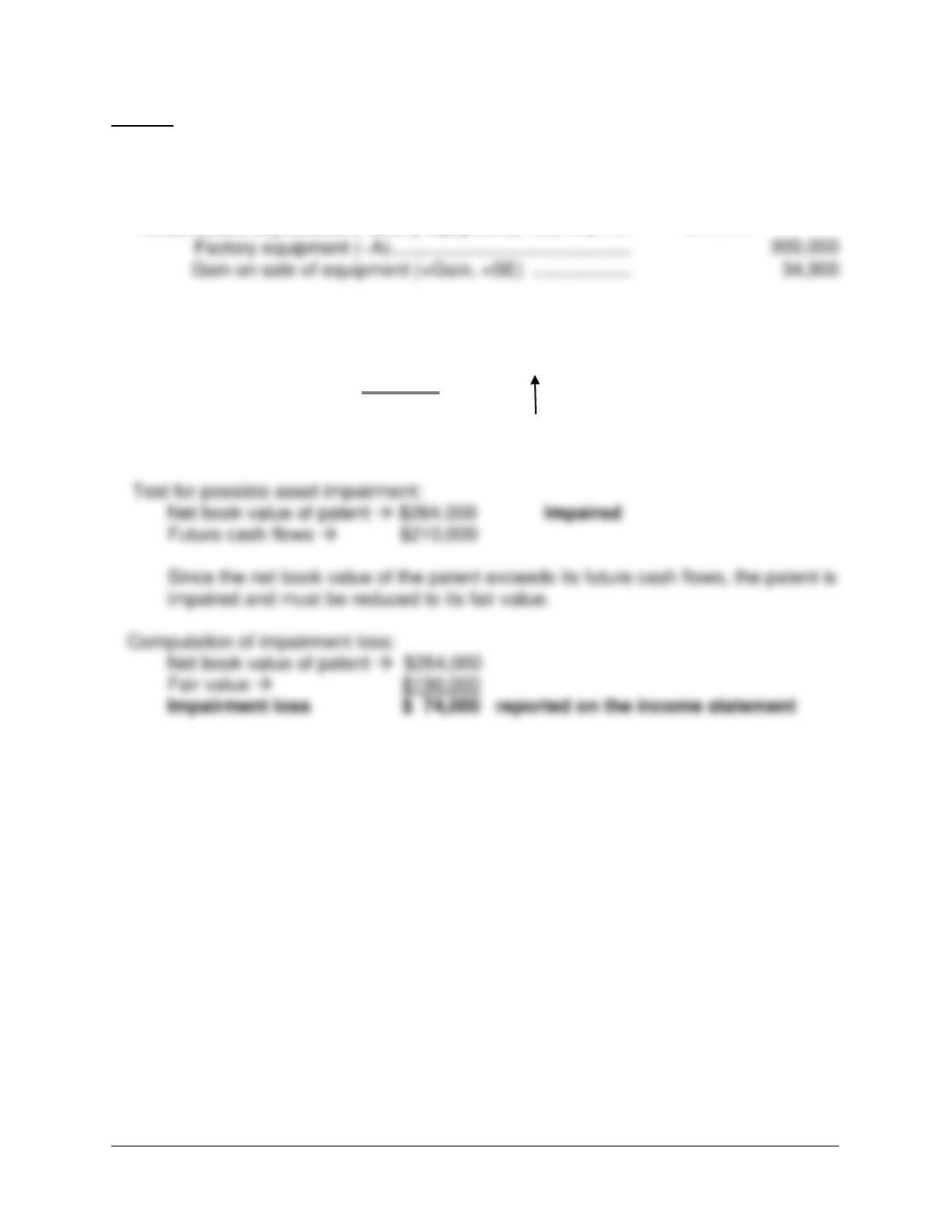
b. Factory equipment using units-of-production method
(Cost – Residual Value) / Total estimated production =Depreciation rate
($900,000 – $0) / 100,000 hours = $9.00 per hour
Year
Computation
Depreciation
Expense
Accumulated
Depreciation
Net Book
Value
Financial Accounting, 9/e 8-61
COMP8-1. (continued)
Case E
Req. 2
Cash (+A) ……………………………………………………………………
Accumulated depreciation, factory equipment(−XA, +A) …….
700,000
234,900
Req. 3
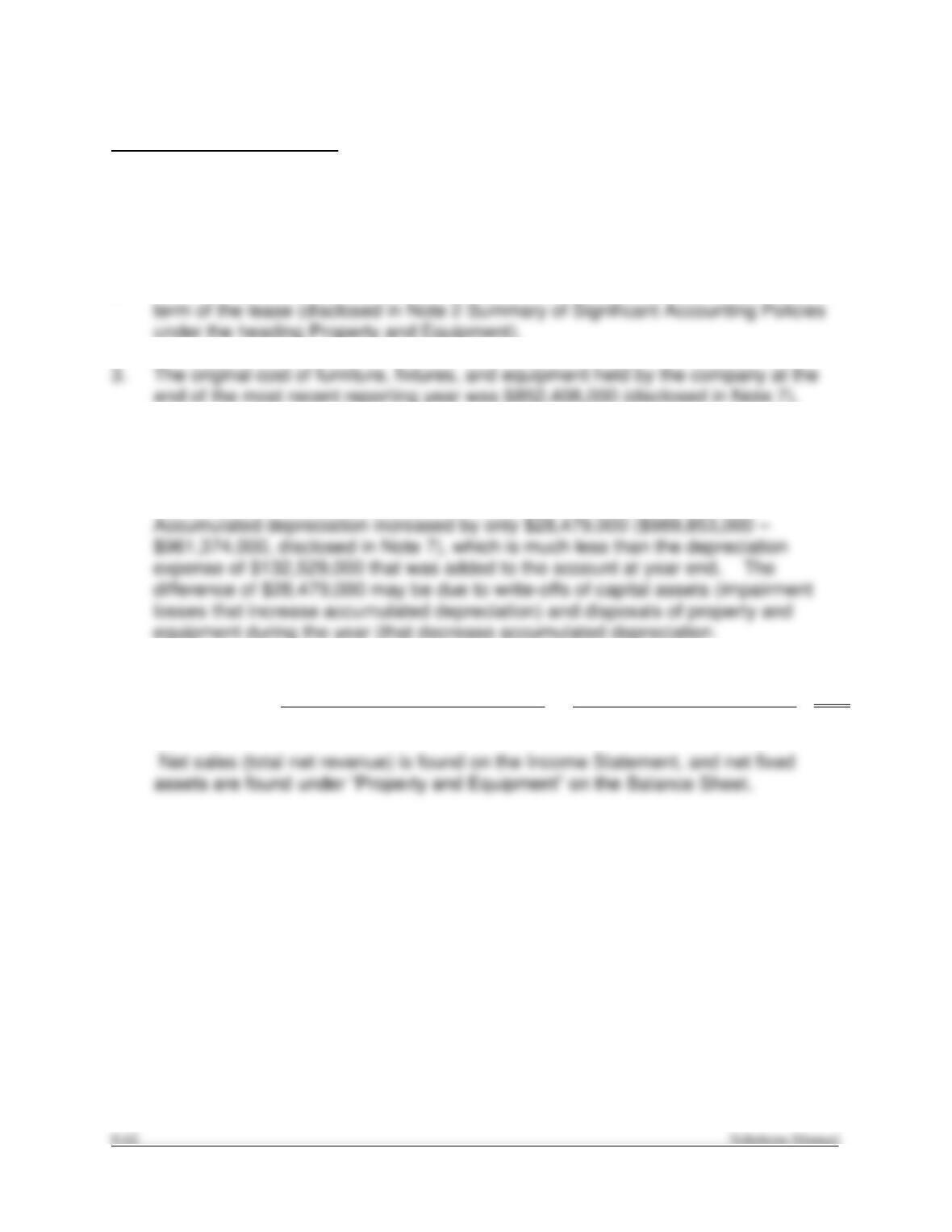
Net book value of patent = $330,000 cost – ($22,000 annual expense x 3 years)
= $264,000
$330,000 cost x 1/15 = $22,000 amortization expense per year
CASES AND PROJECTS
ANNUAL REPORT CASES
CP8–1.
1. The company spent $245,002,000 on property and equipment in the 2014 fiscal
year (this information is disclosed on the Statement of Cash Flows).
2. The estimated useful life of leasehold improvements is the lesser of 10 years or the
4. Current depreciation expense is $132,529,000 (disclosed in Note 7); note that the
amount reported on the Income Statement is $141,191,000 because this amount
includes amortization expense.
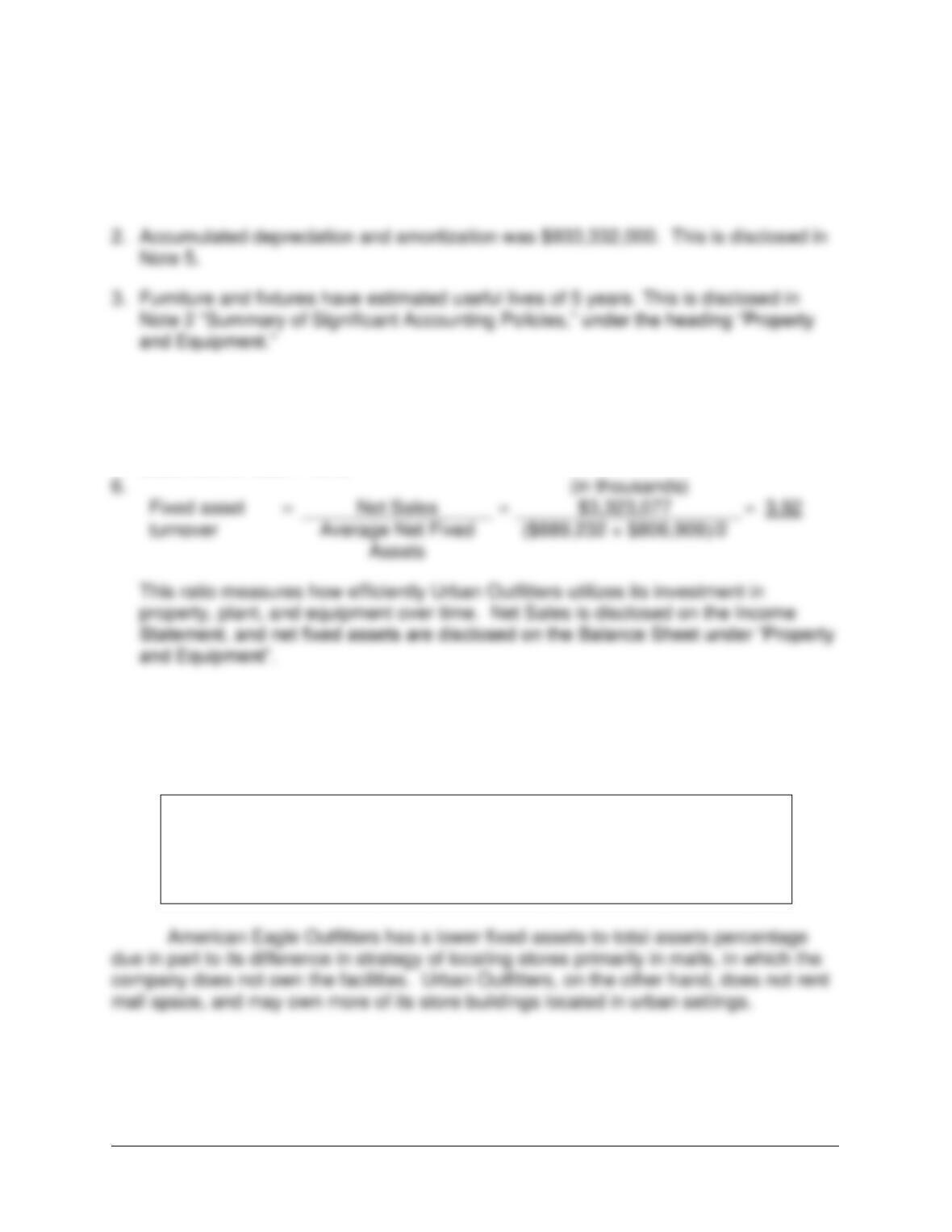
5. (in thousands)
Fixed asset
=
Net Sales (operating revenues)
=
$3,282,867
=
4.94
turnover
Average Net Fixed Assets
($694,856 + $632,986)/2
Financial Accounting, 9/e 8-63
CP8–2.
1. The company uses the straight-line method of depreciation. This is disclosed in
Note 2 “Summary of Significant Accounting Policies,” under the heading “Property
and Equipment.”
4. The original cost of the leasehold improvements was $794,995,000. This is
disclosed in Note 5.
5. Depreciation and amortization expense was $138,110,000. This is disclosed on the
Statement of Cash Flows.
CP8–3.
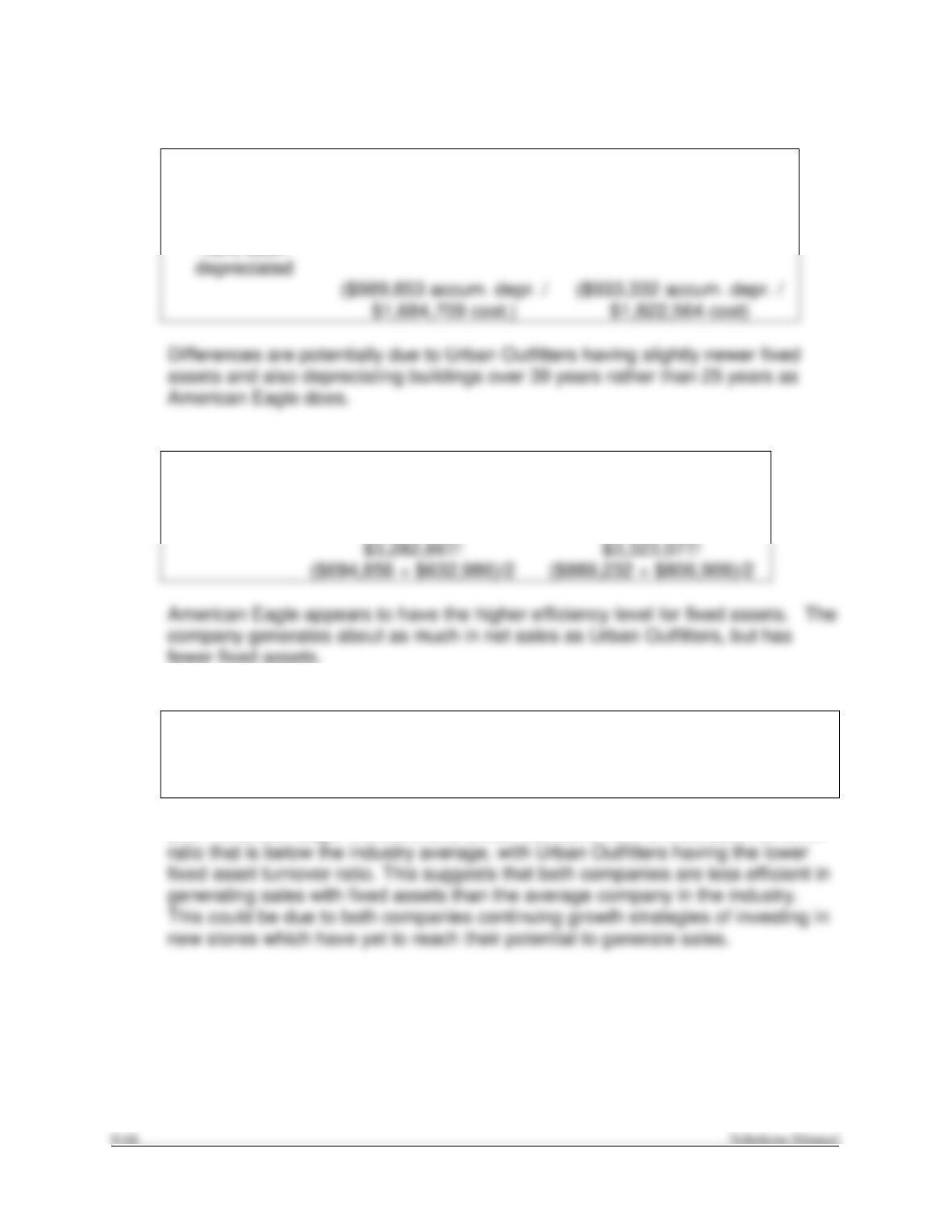
1.
American Eagle
Outfitters
Urban
Outfitters
Fixed assets as a
% of total assets
40.9%
47.1%
($694,856 / $1,696,908)
($889,232 / $1,888,741)
CP8–3. (continued)
2.
American Eagle
Outfitters
Urban
Outfitters
Percent of gross
fixed assets that
have been
58.8%
51.2%
3.
American Eagle
Outfitters
Urban
Outfitters
Fixed Asset
Turnover
4.94
3.92
4.
Industry
Average
American Eagle
Outfitters
Urban
Outfitters
Fixed Asset
Turnover
6.60
4.94
3.92
Both American Eagle Outfitters and Urban Outfitters have a fixed asset turnover
Financial Accounting, 9/e 8-65
FINANCIAL REPORTING AND ANALYSIS CASES
CP8–4.
Req. 1
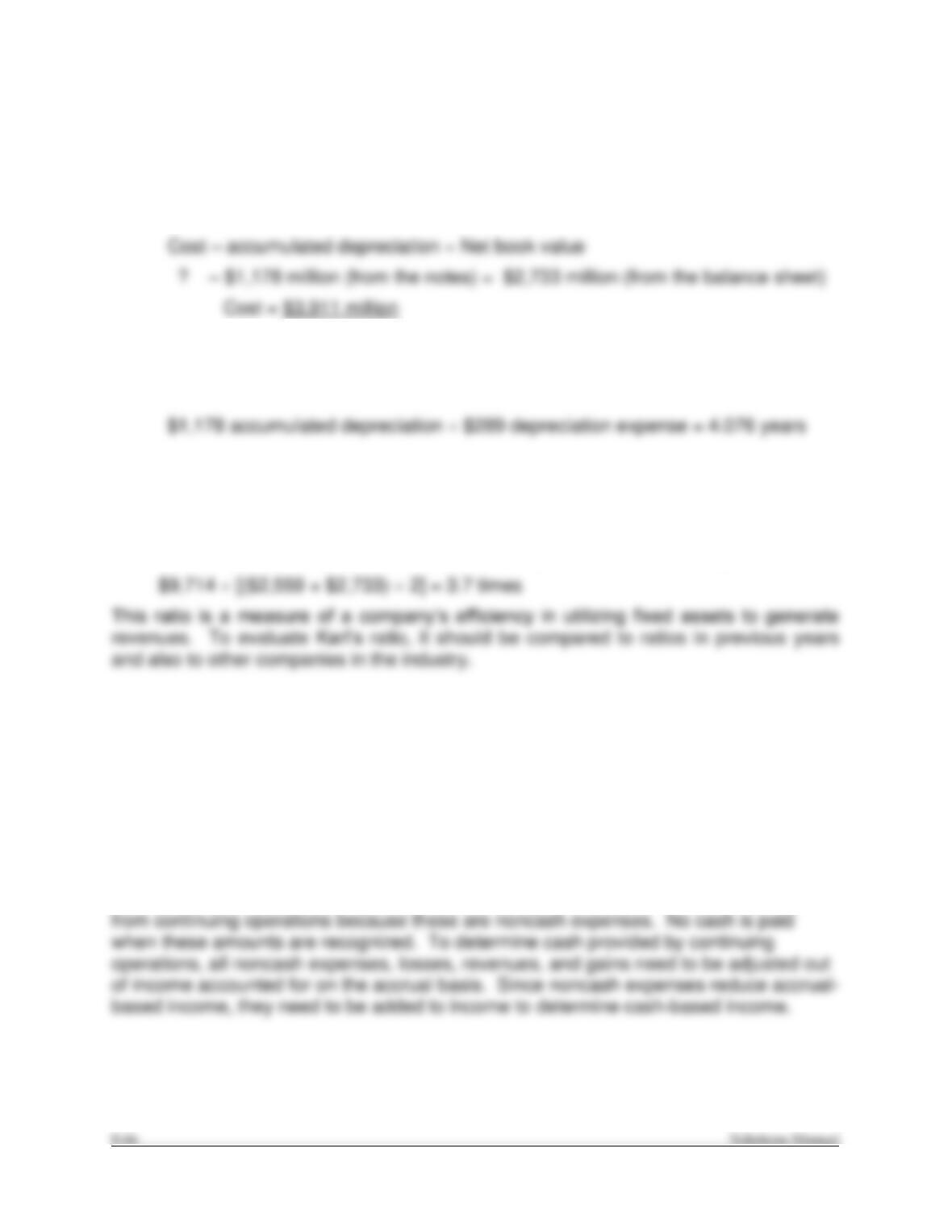
Depreciable assets (in thousands):
Buildings and improvements ….
$ 3,816,387
Req. 2
Accumulated depreciation ……..
$ 4,098,257
Depreciation expense …………..
493,800
Average age
8.3 years
Computer hardware and software
CP8–5.
Req. 1
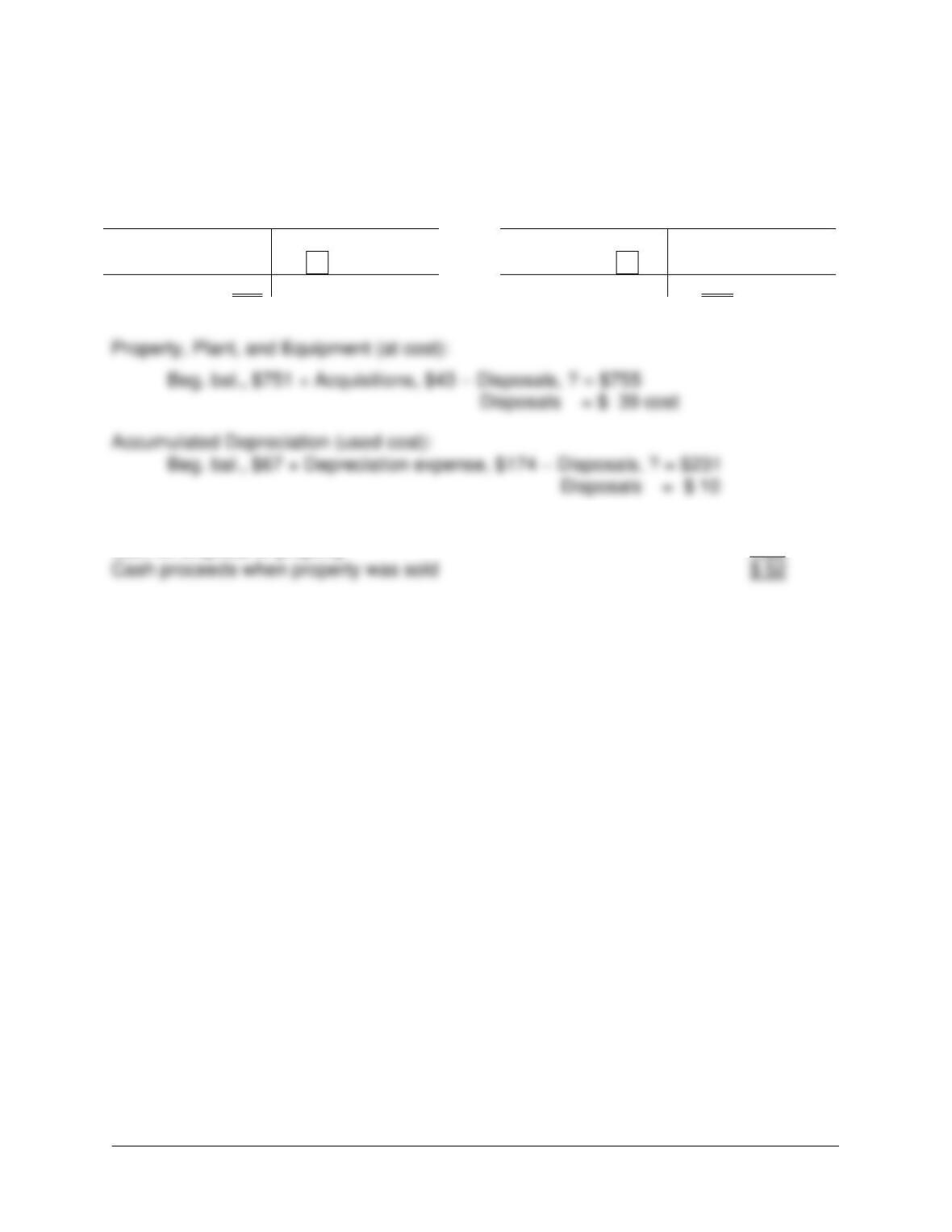
The cost of the property, plant, and equipment at the end of the current year is $3,911
million computed as follows:
Req. 2
The approximate age of the property on that date was 4 years, computed as follows:
Req. 3
Current year fixed asset turnover ratio:
Sales [(Beginning net fixed assets + Ending net fixed assets) 2)]
Req. 4
Karl reported $3,076 million as goodwill that represents the amount Karl paid above fair
market value for the net assets of other companies Karl purchased.
Req. 5
The amortization and depreciation amounts, totaling $497 million, are added to income
Financial Accounting, 9/e 8-67
CP8–6.
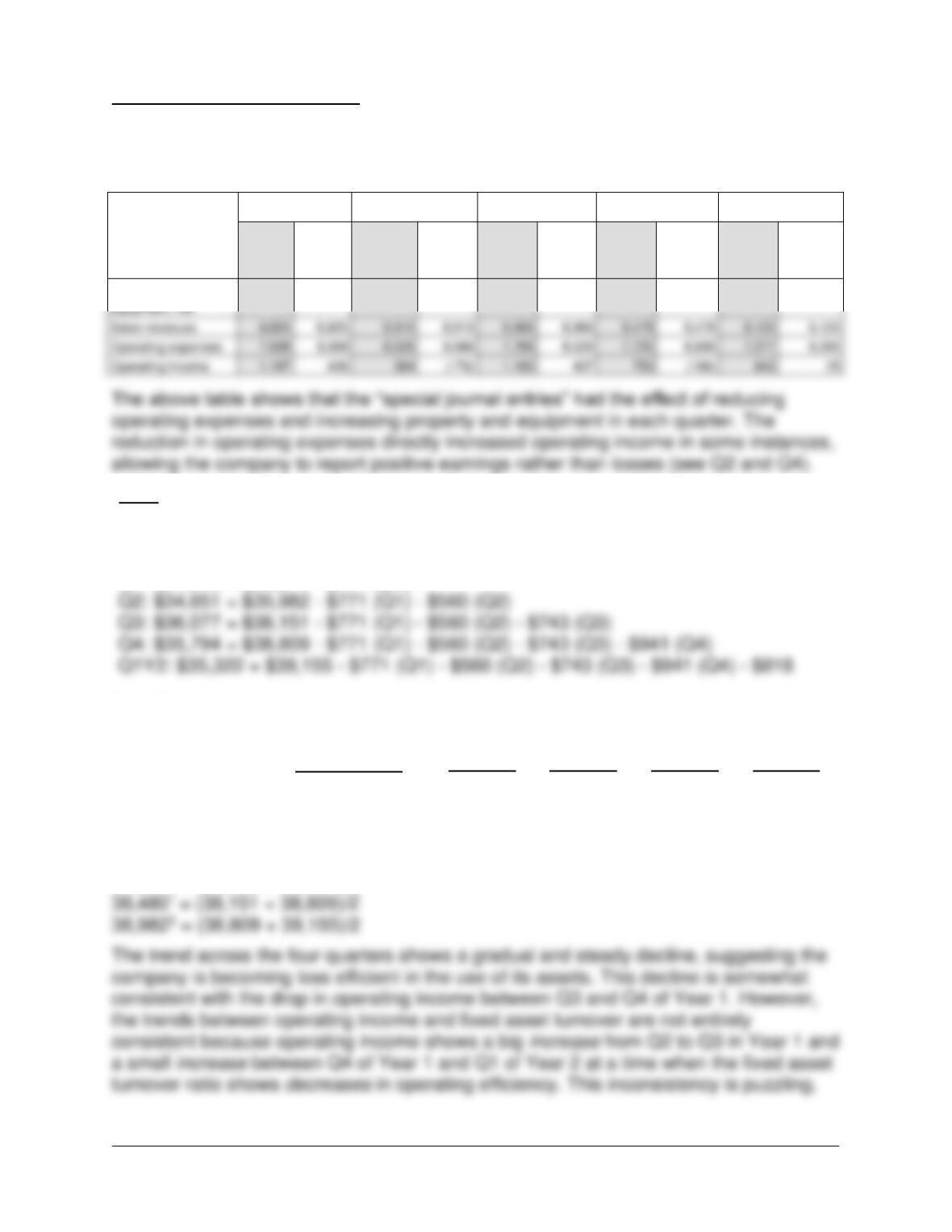
Consider the kinds of transactions that make Property, Plant, and Equipment and
Accumulated Depreciation change during a period:
(in millions)
Property, Plant, and Equipment
Accumulated Depreciation
Beg. bal. 751
67 Beg. bal.
Acquire 43
39 Disposal
Disposal 10
174 Depr. Exp.
End. bal. 755
231 End. bal.
Net book value of disposals ($39 cost – $10 accumulated depreciation) $ 29
Gain on disposal of property 23
8-68 Solutions Manual
CRITICAL THINKING CASES
CP8–7.
Req. 1
Amounts in millions of
US dollars
Q1 Year 1
(March 31)
Q2 Year 1
(June 30)
Q3 Year 1
(September 30)
Q4 Year 1
(December 31)
Q1 Year 2
(March 31)
With
the
entries
Without
the
entries
With
the
entries
Without
the
entries
With
the
entries
Without
the
entries
With
the
entries
Without
the
entries
With
the
entries
Without
the
entries
Property and
$ 38,614
$37,843
$ 35,982
$34,651
$ 38,151
$36,077
$ 38,809
$35,794
$ 39,155
$35,322
Note: Because Property and Equipment is a balance sheet account that carries its
balance forward from one period to the next, the computation of its book value
“without the entries” must take into consideration the cumulative effects of the entries,
calculated as:
Q1: $37,843 = $38,614 – $771 (Q1)
Q3: $36,077 = $38,151 – $771 (Q1) – $560 (Q2) – $743 (Q3)
Q1Y2: $35,322 = $39,155 – $771 (Q1) – $560 (Q2) – $743 (Q3) – $941 (Q4) – $818
Req. 2
Q2 Yr 1
Q3 Yr 1
Q4 Yr 1
Q1 Yr 2
Fixed Asset
Turnover
Ratio
=
Net Sales
=
$8,910
$37,298*
$8,966
$37,067+
$8,478
$38,480^
$8,120
$38,982†
Average Net
Fixed Assets
=
0.24
0.24
0.22
0.21
37,298* = (38,614 + 35,982)/2
37,067+ = (35,982 + 38,151)/2
Financial Accounting, 9/e 8-69
CP8–7. (continued)
Req. 3
Looking back, there are a number of questions that might have been raised:
• Why you? It’s unusual that the CFO chose someone who doesn’t have
experience with transactions of that magnitude.
• Why no support for the amounts? If these truly represented contractual
prepayments for equipment, they would be supported by a copy of the contract or
a cashed check.
• Why were the sources of information untraceable? Anonymous Post-it notes and
easily deleted voicemail messages might lead you to wonder if someone is being
careful to cover their tracks.
Req. 4
As a staff person, you can’t doubt or mistrust every assignment you are given. If you
did, you’d likely find yourself out of a job. So, instead, you need to be able to tell the
difference between routine/ordinary requests and unusual requests. When you are
CP8-7. (continued)
Req. 5
Clearly, the investors in WorldCom (or World-Con, as it was being called) were
devastated by the news. In the days following the announcement that the company
would restate its 2001 and 2002 financial results, WorldCom’s stock price lost about
WorldCom’s creditors also were severely harmed. Soon after the company’s true
financial condition became known, WorldCom filed for bankruptcy protection. This legal
maneuver gave the company time to restructure its operations and propose new
financing arrangements that would keep the company alive. Existing creditors
eventually resigned themselves to the fact that they would have to forgive $36 billion of
the company’s debt if the company was to survive. This meant that the average creditor
was repaid only 42% of what was owed by WorldCom.
Financial Accounting, 9/e 8-71
CP8–8.
Req. 1
a. Cash flows: Because cash was paid for interest, cash decreases (-). However, the
amount of interest expense that was capitalized caused expenses to be lower and
net income to be higher.
Req. 2
Because the fixed asset turnover ratio has decreased due to the additional interest
Req. 3
Although the fixed asset turnover ratio decreased due to the interest capitalization, this
does not indicate a real change in asset efficiency. The same asset is used to generate
FINANCIAL REPORTING AND ANALYSIS TEAM PROJECT
CP8–9. Due to the nature of this project, responses will vary.