Multiple Choice
1. There are 2,000 units in the ending work-in-process inventory which are 65 percent complete
with respect to conversion costs. What are the equivalent units of production for the ending
inventory with respect to conversion?
a. 1,300 equivalent units
b. 1,500 equivalent units
c. 1,700 equivalent units
d. 2,100 equivalent units
Use the following information to answer questions 2 through 7:
At Mixing Department, all materials are added at the beginning of the process. Labor and
overhead (conversion resources) are added evenly throughout the process. The following
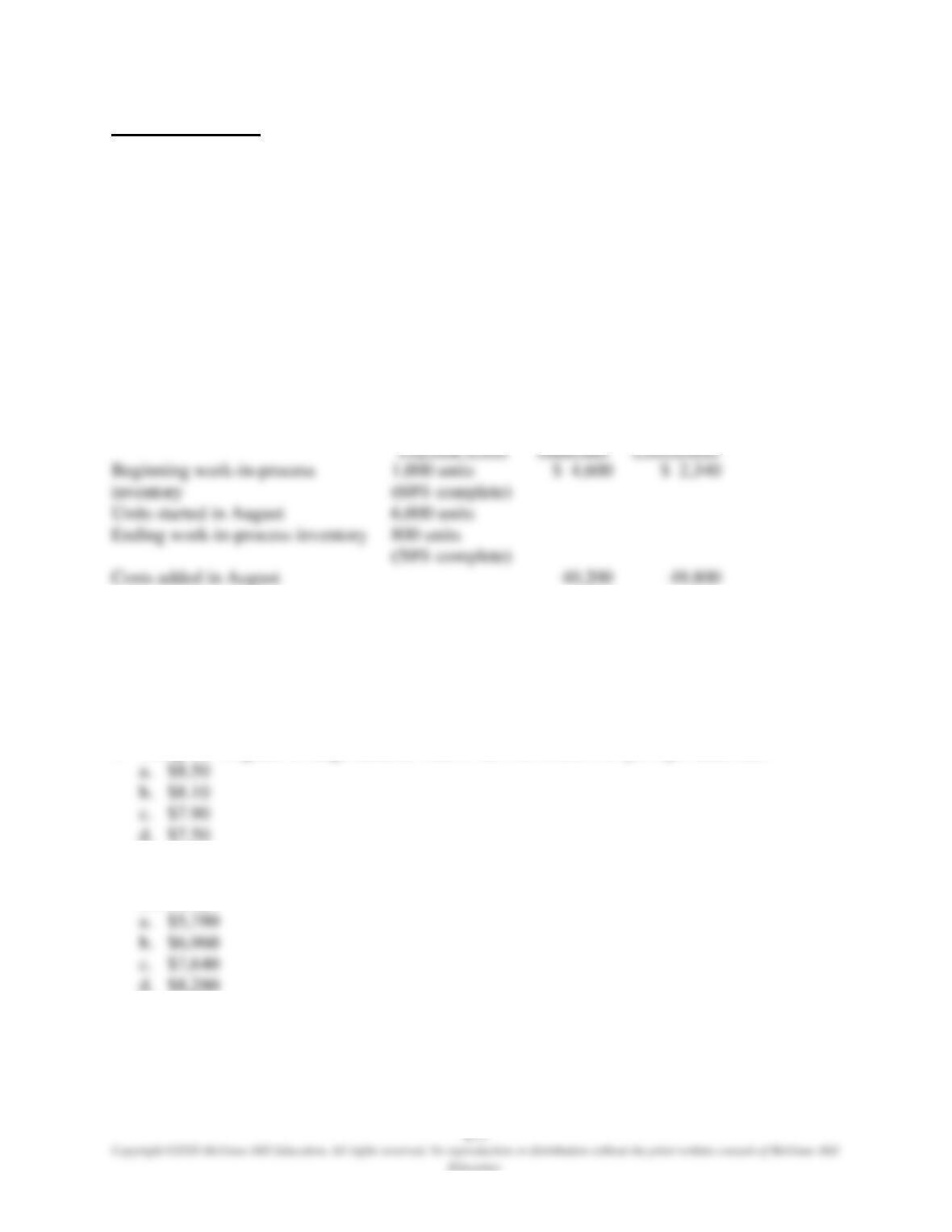
information pertains to the Mixing Department for the month of August.
2. How many units were completed and transferred out?
a. 4,100 units
b. 5,300 units
c. 5,900 units
d. 6,200 units
3. Using the weighted-average method, what is the conversion cost per equivalent unit?
4. Using the weighted-average method, what is the cost assigned to the ending work-in-process
inventory?
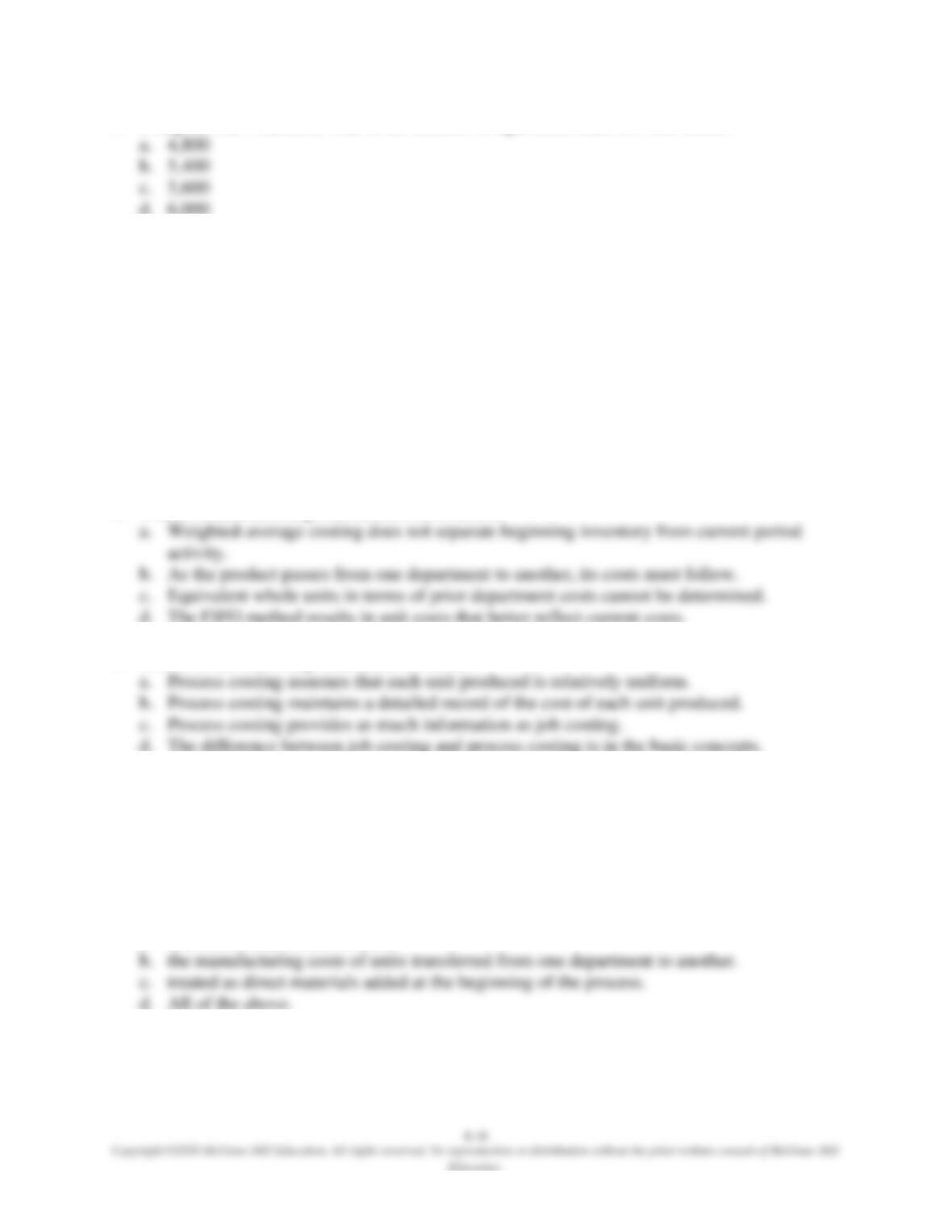
5. Using the FIFO method, what is the number of equivalent units for conversion?
6. Using the FIFO method, what is the conversion cost per equivalent unit?
a. $7.90
b. $8.30
c. $8.60
d. $9.10
7. Using the FIFO method, what is the cost assigned to the ending work-in-process inventory?
a. $8,280
b. $8,680
c. $9,140
d. $10,260
8. Which of the following statements is not correct?
9. Which of the following statements is correct?
10. Operation costing system:
a. is a hybrid system.
b. treats materials costs using job order costing method.
c. treats conversion costs using process costing approach
d. All of the above.
11. Prior department costs are:
a. also called transferred-in costs.

12. Which of the following statements is correct?
a. In practice, only one of the production methods can be found.
b. An operation is a standardized method of making a product repeatedly performed.
c. Every company follows a standard costing method mandated by regulators.
d. The system that costs the most should be adopted because it provides the most accurate
information.
Multiple Choice Answers
2. d (LO2)
1,000 + 6,000 = Units transferred out (?) + 800
Units transferred out = 6,200 units.
3. c (LO3, LO4)
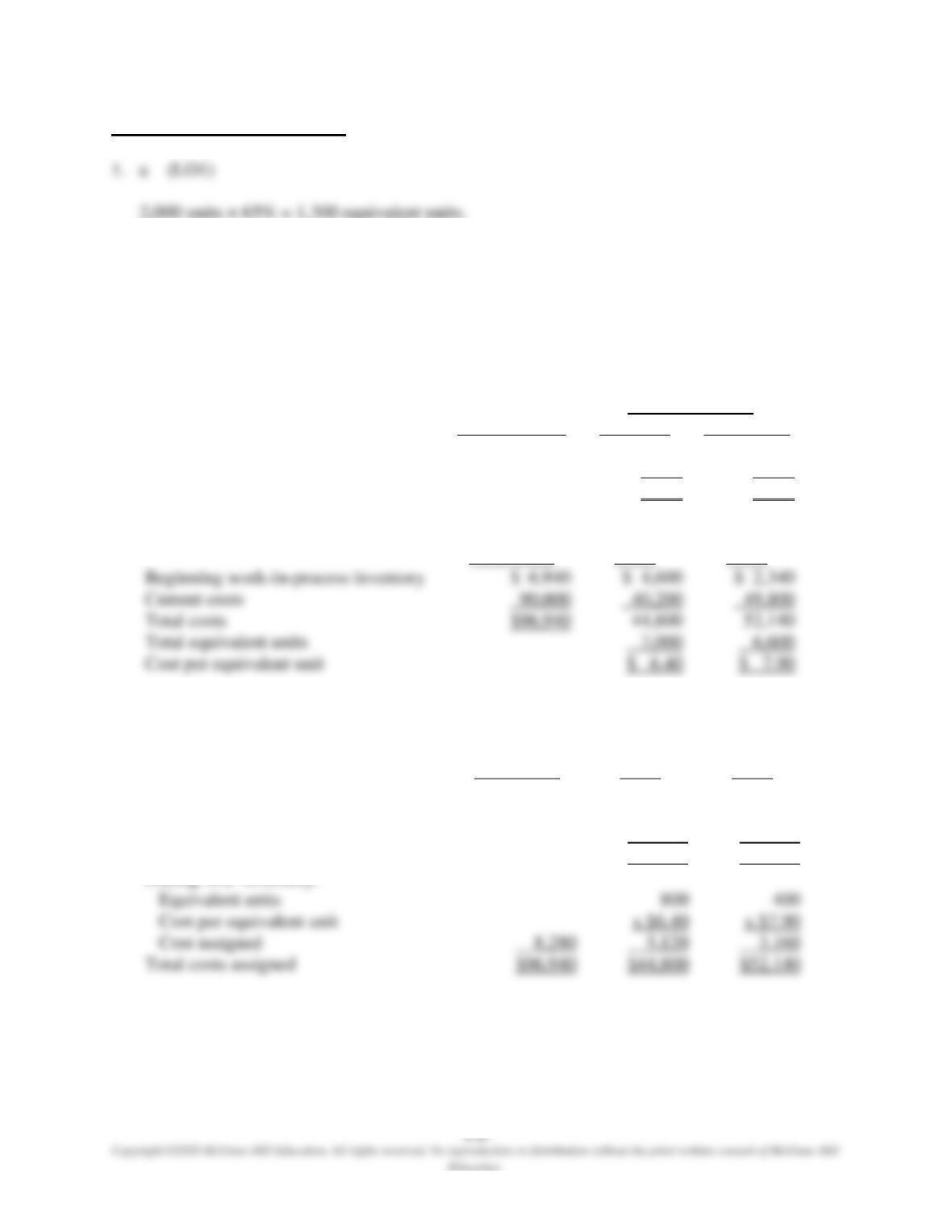
Equivalent Units
Physical Units
Materials
Conversion
Units transferred out
6,200
6,200
6,200
Ending work-in-process inventory
800
800
400
Total work
7,000
6,600
Total Costs
Costs
Costs
Beginning work-in-process inventory
$ 6,940
$ 4,600
$ 2,340
Current costs
90,000
40,200
49,800
Total costs
$96,940
Cost per equivalent unit
$ 6.40
$ 7.90
Materials
Conversion
4. d (LO3, LO4)
Total Costs
Materials
Costs
Conversion
Costs
Transferred out:
Equivalent units
6,200
6,200
Cost per equivalent unit
x $6.40
x $7.90
Cost assigned
$88,660
$39,680
$48,980
Ending WIP inventory:
Equivalent units
Cost per equivalent unit
x $6.40
x $7.90
Cost assigned
8,280
5,120
3,160
Total costs assigned
$96,940
$44,800
$52,140
5. d (LO3, LO5)
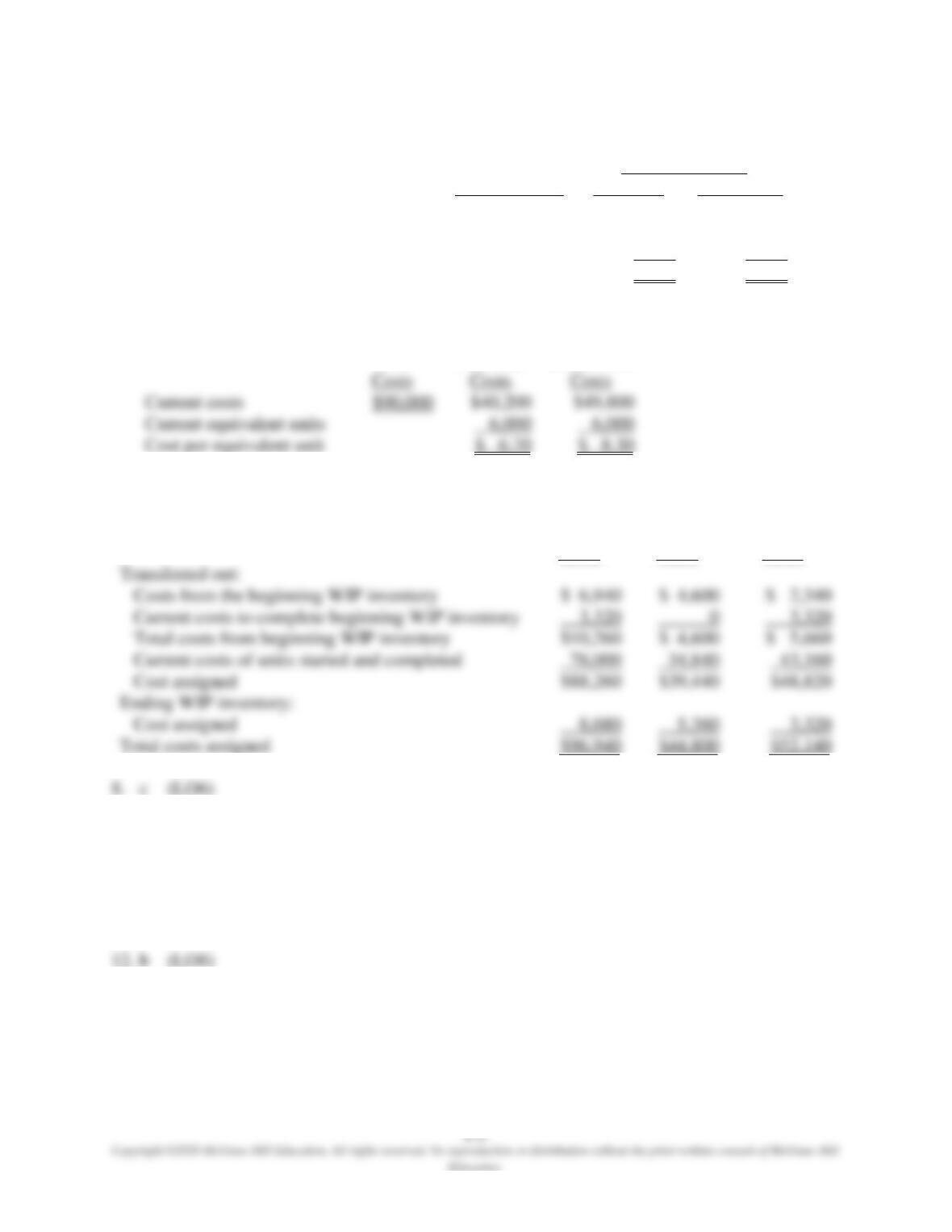
Equivalent Units
Physical Units
Materials
Conversion
To complete beginning WIP inventory
1,000
0
400
Units started and completed
5,200
5,200
5,200
Work in ending WIP inventory
800
800
400
Current work
6,000
6,000
6. b (LO3, LO5)
Total
Current costs
$90,000
$40,200
Current equivalent units
Cost per equivalent unit
Materials
Conversion
7. b (LO3, LO5)
Total
Costs
Materials
Costs
Conversion
Costs
Transferred out:
Costs from the beginning WIP inventory
$ 6,940
$ 4,600
Current costs to complete beginning WIP inventory
3,320
0
Total costs from beginning WIP inventory
$10,260
$ 4,600
Current costs of units started and completed
78,000
Cost assigned
$88,260
$39,440
Ending WIP inventory:
Cost assigned
8,680
Total costs assigned
$96,940
$44,800
9. a (LO7)
10. d (LO8)
11. d (LO6)
Demonstration Problem 1
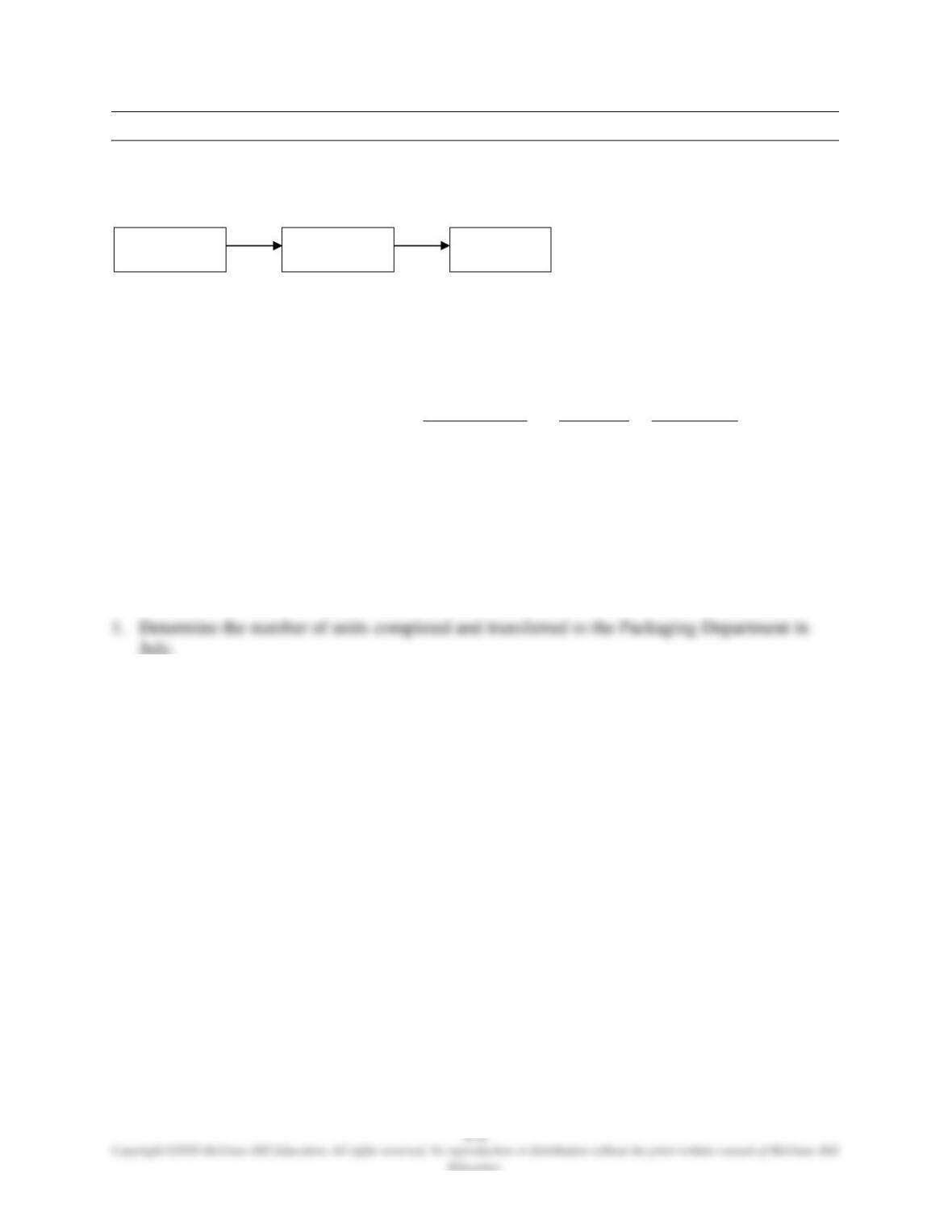
Process Excellence (PE), Inc. has two production departments: Mixing and Packaging.
Mixing
Department
Packaging
Department
Warehouse
At Mixing Department, all materials are added at the beginning of the process. Labor and
overhead (conversion resources) are added evenly throughout the process. The following
information pertains to the Mixing Department for the month of July.
Physical units
Materials
Conversion
Beginning work-in-process inventory
1,000 units
(40% complete)
$8,500
$7,552
Units started in July
5,000 units
Ending work-in-process inventory
400 units
(30% complete)
Costs added in July
60,500
130,872
Required:
2. Compute the equivalent units using the weighted-average method.
3. Compute the costs per equivalent unit using the weighted-average method.
4. Compute the costs of goods transferred out and the ending work-in-process inventory using
the weighted-average method.
Demonstration Problem 1 – Solution
Part 1
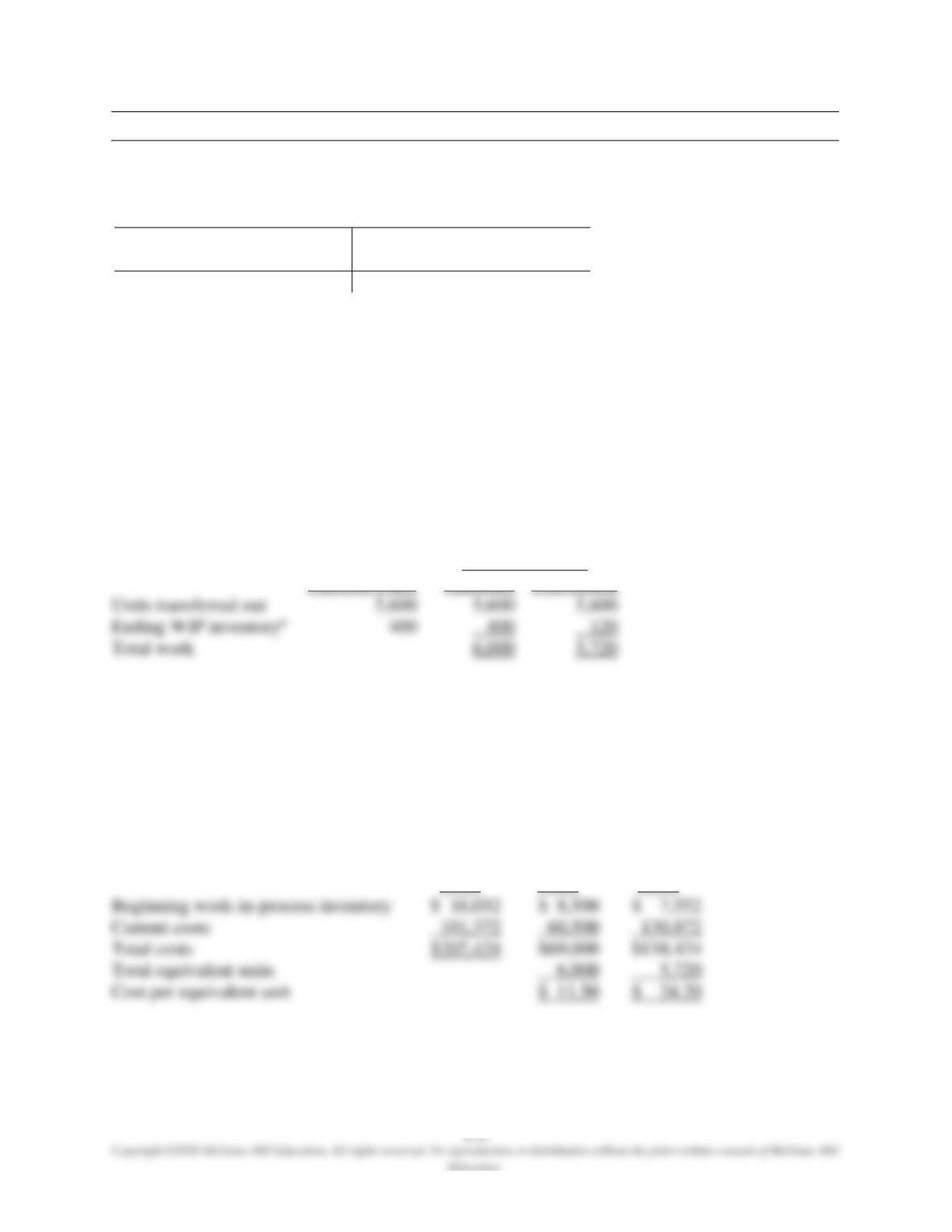
Work-in-Process Inventory
Beginning balance 1,000
Plus: Units started 5,000
Less: Units transferred out ?
Ending balance 400
1,000 + 5,000 = Units transferred out (?) + 400
The number of units completed and transferred to the Packaging Department in July was 5,600
units.
Part 2
Since materials and conversion (labor and overhead) were added at different pace during the
production process, separate equivalent units have to be calculated, one for materials and the
other for conversion.
Equivalent Units
Physical Units
Conversion
Units transferred out
400
Total work
a 30% complete with respect to conversion.
Part 3
Under the weighted-average method, the costs for current work and work in beginning work-in–
process inventory are combined. This total cost is then divided by the total equivalent units of
production for July.
Total
Beginning work-in-process inventory
Current costs
Total costs
Total equivalent units
Cost per equivalent unit
Materials
Conversion
Demonstration Problem 1 – Solution, continued
Part 4
Total
Costs
Materials
Costs
Conversion
Costs
Transferred out:
Equivalent units
5,600
5,600
Cost per equivalent unit
x $11.50
Cost assigned
$ 64,400
Ending WIP inventory:
Equivalent units
400
Cost per equivalent unit
x $11.50
Cost assigned
$ 4,600
Total costs assigned
$ 69,000
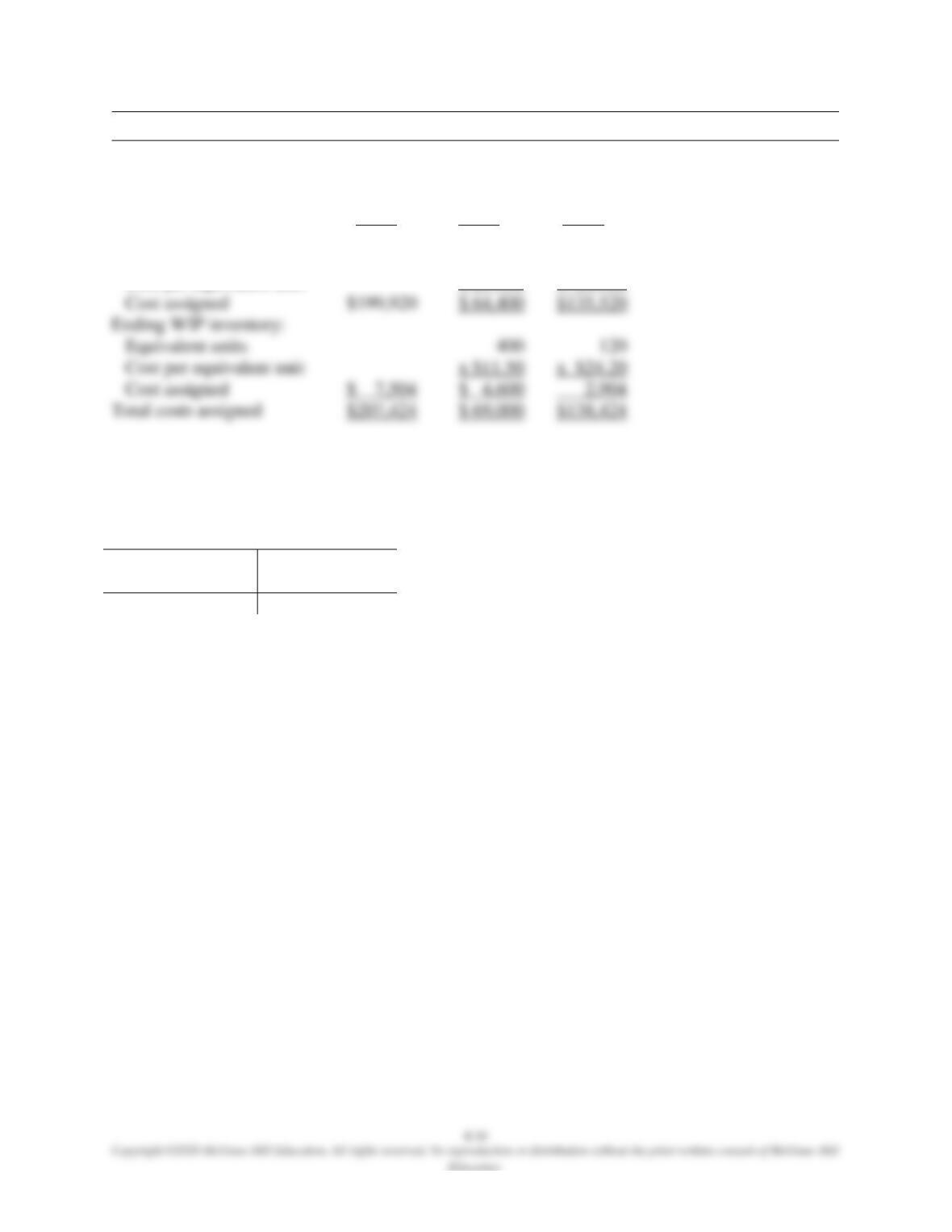
As a final check, the following T-account summarizes the flow of costs for the Mixing
Department for the month of July:
Work-in-Process Inventory
16,052
191,372
199,920
7,504
Demonstration Problem 2
(Continued from Demonstration Problem 1)
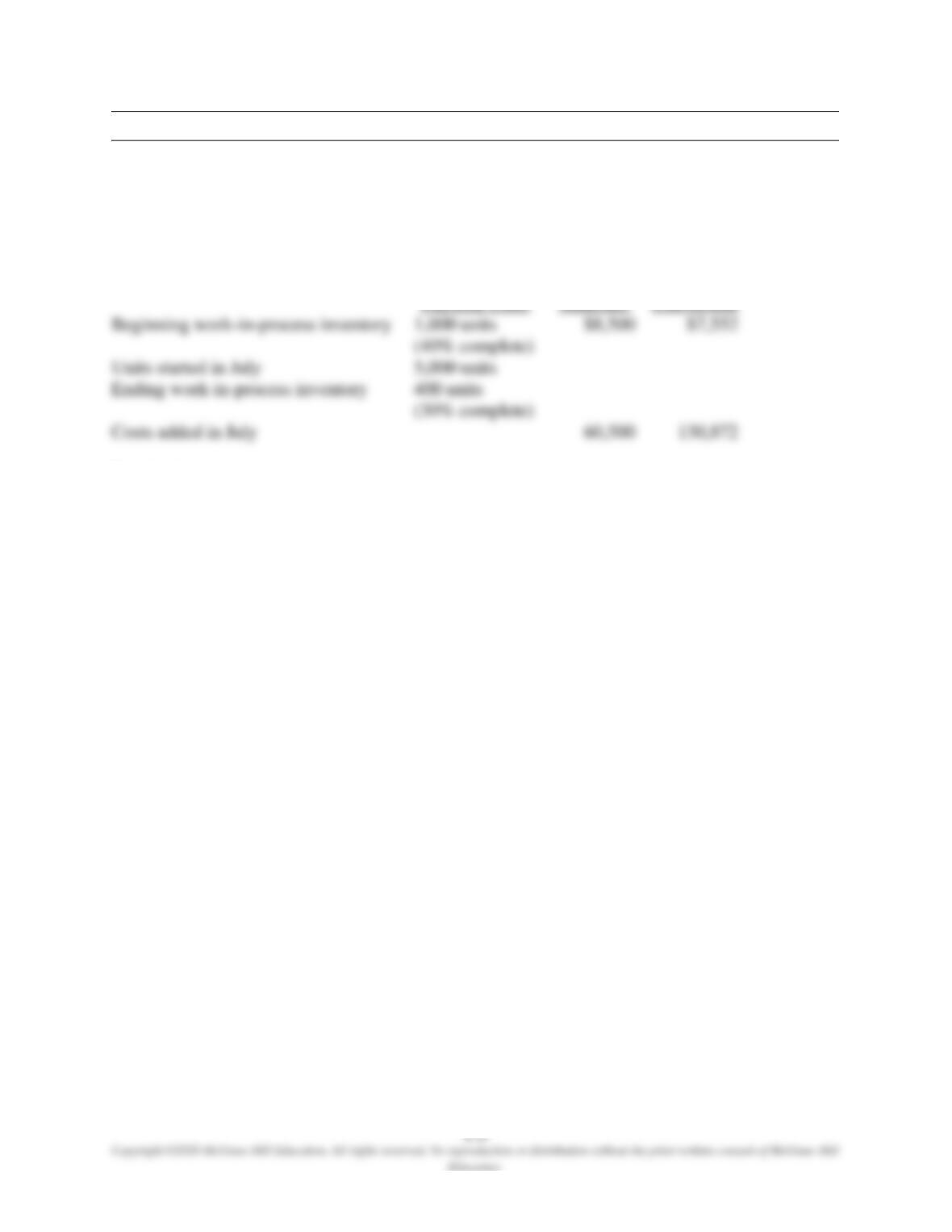
The information that pertains to the Mixing Department for the month of July is reproduced here.
All materials are added at the beginning of the process. Labor and overhead (conversion
resources) are added evenly throughout the process.
Required:
1. Determine the number of units completed and transferred to the Packaging Department in
July.
2. Compute the equivalent units using the FIFO method.
3. Compute the cost per equivalent unit using the FIFO method.
4. Compute the costs of goods transferred out and the ending work-in-process inventory using
the FIFO method.
Demonstration Problem 2 – Solution
Part 1
Work-in-Process Inventory
Beginning balance 1,000
Plus: Units started 5,000
Less: Units transferred out ?
Ending balance 400
1,000 + 5,000 = Units transferred out (?) + 400
Units transferred out (?) = 1,000 + 5,000 – 400 = 5,600
The number of units completed and transferred to the Packaging Department in July was 5,600
units.
According to the FIFO method, the beginning work-in-process inventory (1,000 units) would be
completed first. The rest, 4,600 completed units (= 5,600 units – 1,000 units), came from the
units started in July.
Part 2
To complete beginning WIP inventory
Units started and completed
Current work
Demonstration Problem 2 – Solution, continued
Part 3
Under the FIFO method, current period costs are divided by the current equivalent units of
production in July to determine the cost per equivalent unit.
Total
Materials
Conversion
Current costs
$191,372
$60,500
$130,872
Current equivalent units
÷ 5,000
÷ 5,320
Cost per equivalent unit
$ 12.10
$ 24.60
Part 4
Total
Costs
Materials
Costs
Conversion
Costs
Transferred out:
Costs from the beginning WIP inventory
$ 16,052
$ 8,500
$ 7,552
Current costs to complete beginning WIP inventory
14,760
0
Total costs from beginning WIP inventory
$ 30,812
$ 8,500
$ 22,312
Current costs of units started and completed
168,820
Cost assigned
$199,632
$64,160
$135,472
Ending WIP inventory:
Cost assigned
7,792
Total costs assigned
$207,424
$69,000
$138,424
a $24.60 × 600 EU
b $12.10 × 4,600 EU
c $24.60 × 4,600 EU
d $12.10 × 400 EU
e $24.60 × 120 EU
As a final check, the following T-account summarizes the flow of costs for the Mixing
Department for the month of July:
7,792
Demonstration Problem 3
(Continued from Demonstration Problem 1)
Process Excellence (PE), Inc., has two production departments: Mixing and Packaging.
Mixing
Department
Packaging
Department
Warehouse
At the Packaging Department, all materials are added at the beginning of the process. Labor and
overhead (conversion resources) are added evenly throughout the process. The following
information pertains to the Packaging Department for the month of July.
Physical Units
(60% complete)
Units completed
6,000 units
(50% complete)
Costs added in July
a This is the cost of goods completed and transferred out of the Mixing Department in July using
the weighted-average method.
Required:
2. Compute the equivalent units using the weighted-average method.
3. Compute the cost per equivalent unit using the weighted-average method.
4. Compute the costs of goods transferred out and the ending work-in-process inventory using
the weighted-average method.
Demonstration Problem 3 – Solution
Part 1
Work-in-Process Inventory
Beginning balance 900
Plus: Units started ?
Less: Units transferred out 6,000
Ending balance 500
900 + Units started (?) = 6,000 + 500
Units started (?) = 6,000 + 500 – 900 = 5,600
The number of units started in July at the Packaging Department was 5,600 units, which matched
the number of units completed and transferred out of the Mixing Department during the same
time period.
Part 2
Units transferred out
Total work
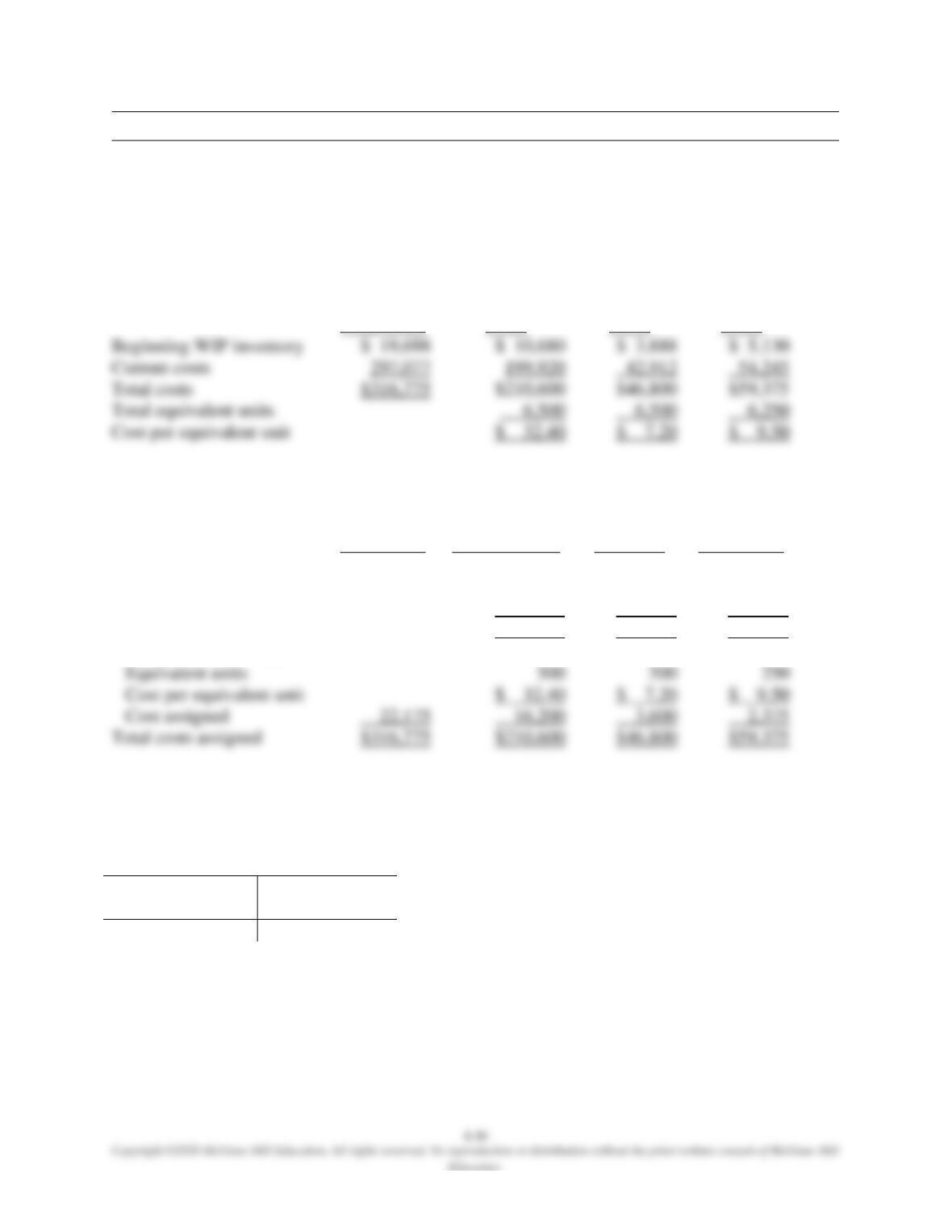
Demonstration Problem 3 – Solution, continued
Part 3
Under the weighted-average method, the costs for current work and work in beginning work-in–
process inventory are combined. This total cost is then divided by the total equivalent units of
production for July.
Total Costs
Beginning WIP inventory
$ 19,698
$ 10,680
$ 3,888
$ 5,130
Current costs
297,077
42,912
54,245
Total costs
$316,775
$210,600
$46,800
$59,375
Total equivalent units
6,500
6,250
Transferred-in
Materials
Conversion
Part 4
Total Costs
Transferred-in
Materials
Conversion
Transferred out:
Equivalent units
6,000
6,000
6,000
Cost per equivalent unit
$ 32.40
$ 7.20
$ 9.50
Cost assigned
$294,600
$194,400
$43,200
$57,000
Ending WIP inventory:
Equivalent units
Cost per equivalent unit
$ 32.40
$ 7.20
$ 9.50
Cost assigned
22,175
16,200
3,600
2,375
Total costs assigned
$316,775
$210,600
$46,800
$59,375
As a final check, the following T-account summarizes the flow of costs for the Packaging
Department for the month of July:
Work-in-Process
19,698
297,077
294,600
22,175
Demonstration Problem 4
Operations Excellence (OE), Inc. has two production departments: Mixing and Packaging.
Mixing
Department
Packaging
Department
Warehouse
OE manufactures two products: Compound H and Compound L. Compound H is a high-end
product that requires more expensive materials than Compound L and is produced at smaller
volume. The two products go through the two production departments in essentially the same
conversion processes. There is no work-in-process inventory for either product.
The production and cost data are available for July:
Compound H
Compound L
Total
2,500 Units
4,800 Units
Materials:
Mixing
$120,000
Packaging
Total materials cost
$158,400
Conversion:
Mixing
Packaging
Total conversion cost
Demonstration Problem 4 – Solution
For materials costs, the costing system at OE operates like a job order system. For conversion, a
process costing system is appropriate.
Compound H
Compound L
Total
2,500 Units
4,800 Units
Materials:
Mixing
$220,000
$100,000
$120,000
Packaging
75,900
37,500
38,400
Total materials cost
$295,900
$137,500
$158,400
Conversion:
Mixing
$219,000
$ 75,000
$144,000
Packaging
131,400
45,000
86,400
Total conversion cost
350,400
120,000
230,400
Total product cost
$646,300
388,800
Number of units
4,800
Cost per unit
$ 81
The conversion cost is assigned to the two products based on total units.
For Mixing Department:
Each unit is allocated $30 (=
$219,000
2,500 units + 4,800 units
)
Conversion cost for Compound H in the Mixing Department becomes:
$30 × 2,500 units = $75,000
Conversion cost for Compound L in the Mixing Department becomes:
$30 × 4,800 units = $144,000
For Packaging Department, each unit is allocated: