Problem 8-6B (20 minutes)
1.
Jan. 1
Machinery …………………………………………………………
150,000
Cash ……………………………………………………………
150,000
Record machinery costs.
Jan. 4
Machinery …………………………………………………………
3,510
Cash ……………………………………………………………
3,510
Record machinery costs.
Jan. 4
Machinery …………………………………………………………
4,600
Cash ……………………………………………………………
4,600
Record machinery costs.
2. a. First year
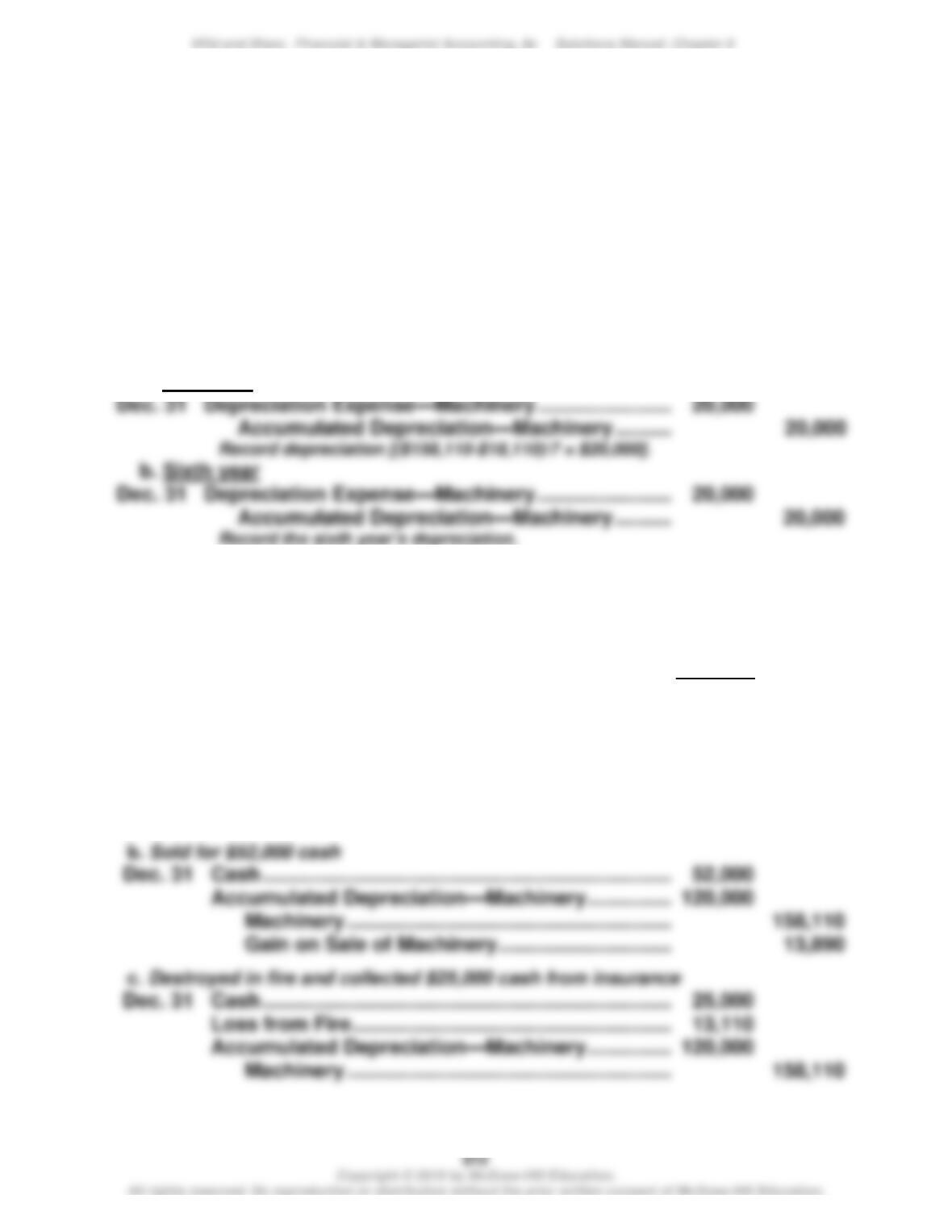
Depreciation Expense—Machinery ……………………….
20,000
Accumulated Depreciation—Machinery …………..
Record depreciation [($158,110-$18,110)/7 = $20,000].
Depreciation Expense—Machinery ……………………….
20,000
Accumulated Depreciation—Machinery …………..
20,000
Record the sixth year’s depreciation.
3. Accumulated depreciation at the date of disposal
First six years’ depreciation (6 x $20,000) …………………
$120,000
Book value at the date of disposal
Original total cost …………………………..……………………….
$158,110
Accumulated depreciation ……………………………………….
(120,000)
Total …………………………..…………………………………………..
$ 38,110
a. Sold for $28,000 cash
Dec. 31
Cash ……………………………………………………………………
28,000
Loss on Sale of Machinery …………………………………..
10,110
Accumulated Depreciation—Machinery ………………..
120,000
Machinery ………………………………………………………
158,110
Dec. 31
Cash ……………………………………………………………………
52,000
Accumulated Depreciation—Machinery ………………..
120,000
Machinery ………………………………………………………
158,110
Gain on Sale of Machinery …………………………..
13,890
Dec. 31
Cash ……………………………………………………………………
25,000
Loss from Fire ……………………………………………………..
13,110
Accumulated Depreciation—Machinery ………………..
120,000
Problem 8-7B (20 minutes)
a.
Feb. 19
Mineral Deposit ……………………………………………………
5,400,000
Cash ……………………………………………………….
5,400,000
Record purchase of mineral deposit.
b.
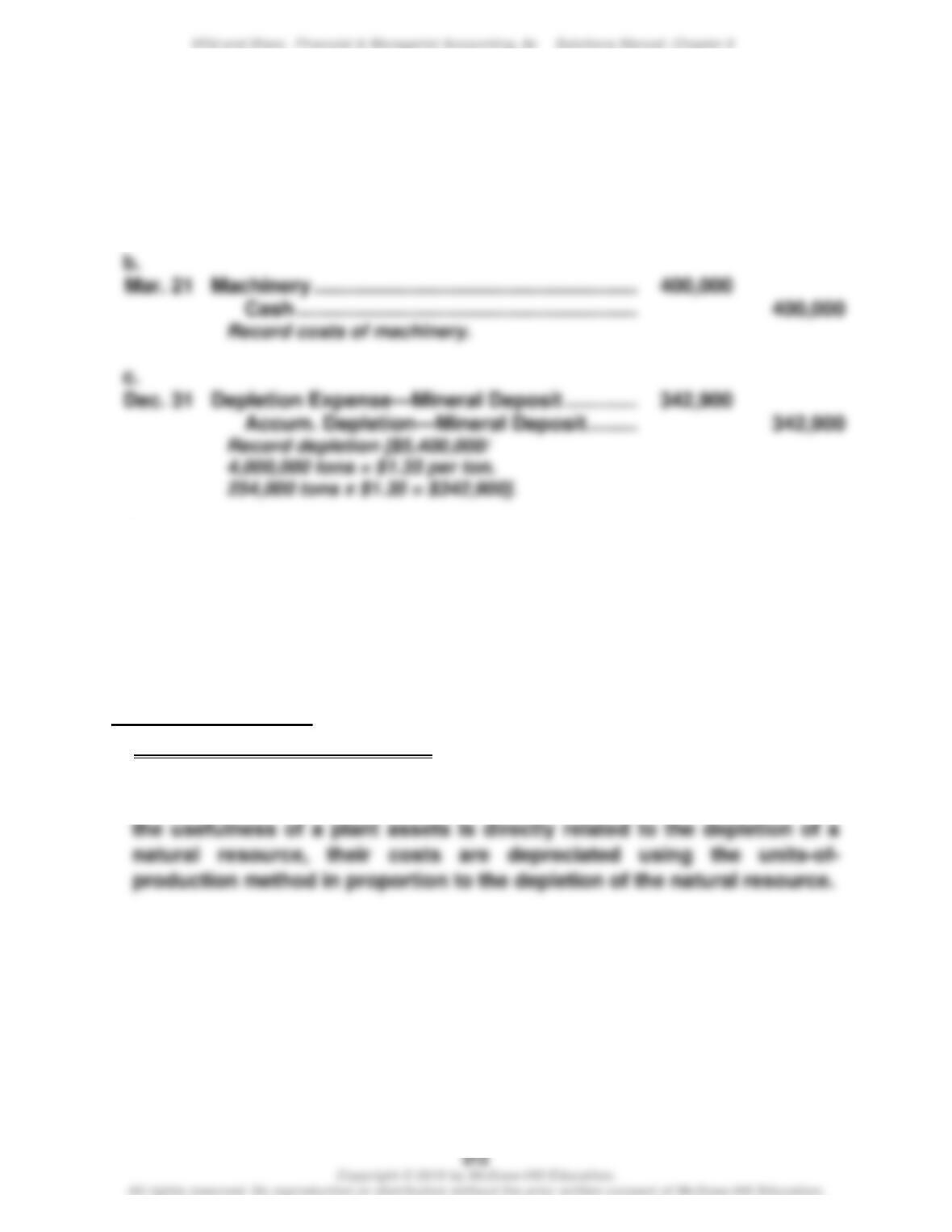
Mar. 21
Machinery ……………………………………………………….
Cash ……………………………………………………….
Record costs of machinery.
c.
Dec. 31
Accum. Depletion—Mineral Deposit ………………..
Record depletion [$5,400,000/
254,000 tons x $1.35 = $342,900].
d.
Dec. 31
Depreciation Expense—Machinery ……………………….
25,400
Accum. Depreciation—Machinery …………………..
25,400
Record depreciation [$400,000/
4,000,000 tons = $0.10 per ton.
254,000 tons x $0.10 = $25,400].
Analysis Component
e. Depreciated over its useful life.
Explanation: If the machine will be used at another site when extraction
is complete, it is depreciated over its own useful life. Alternatively, when
Problem 8-8B (20 minutes)
(a)
Jan. 1
Right–of-Use Asset ……………………………………………..
60,000
Lease Liability ……………………………………………….
60,000
Record lease asset and obligation.
(b)
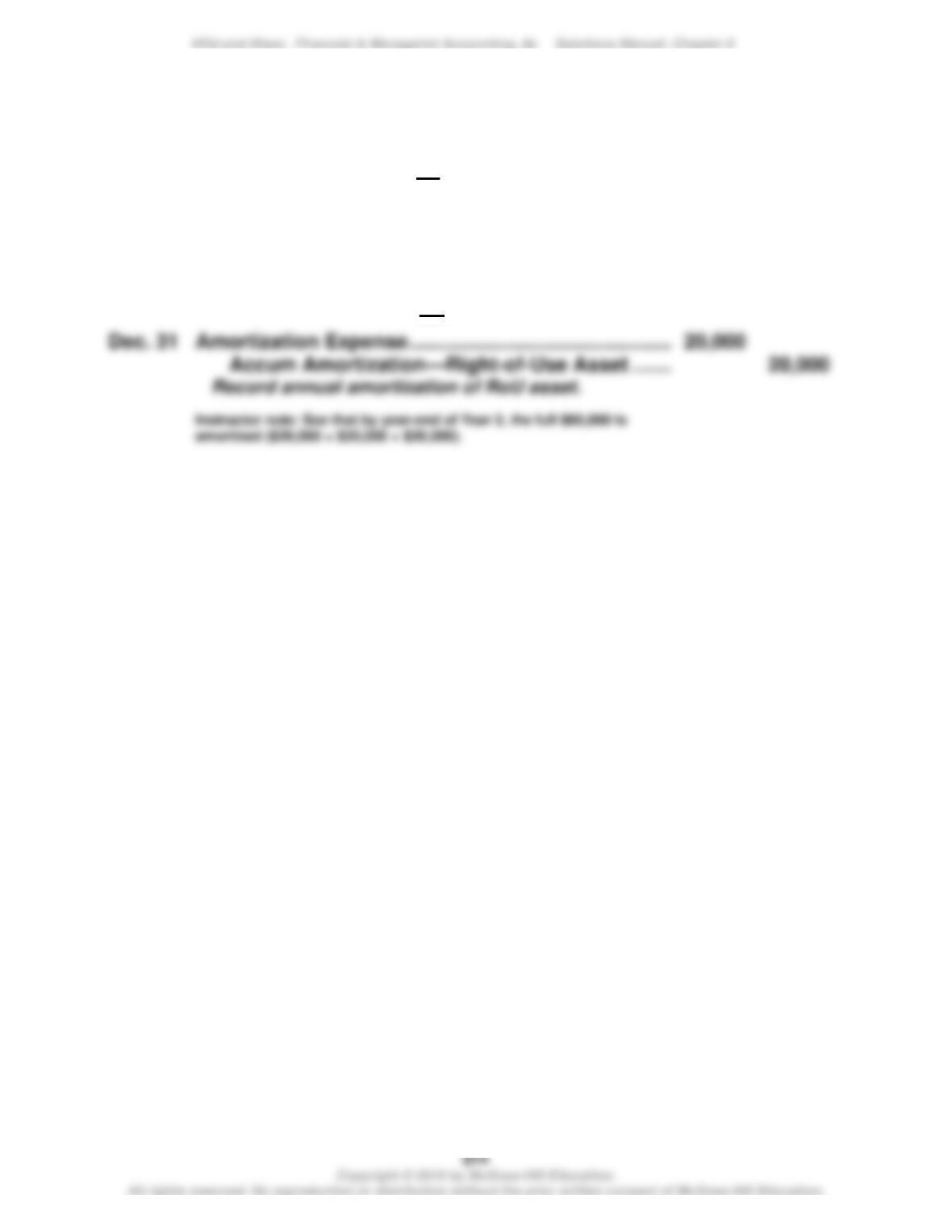
20,000
Accum Amortization—Right–of-Use Asset ……..
20,000
Record annual amortization of RoU asset.
Serial Problem — SP 8
Serial Problem — SP 8, Business Solutions (45 minutes)
1. For the three months ended March 31, 2020, depreciation expense was
$400 for office equipment and $1,250 for the computer equipment.
Annualizing (multiplying quarterly results by four) these three-month
totals yield the following annual amounts for depreciation expense:
Depreciation Expense—Office Equipment ($400 x 4) ………………… $1,600
Depreciation Expense—Computer Equipment ($1,250 x 4)………… $5,000
2.
December 31,
2019
December 31,
2020
Office Equipment ………………………………….
$ 8,000
$ 8,000
Less: Accumulated Depreciation–
Office Equipment …………………………..
400
2,000
Office Equipment (book value) ……………..
$ 7,600
$ 6,000
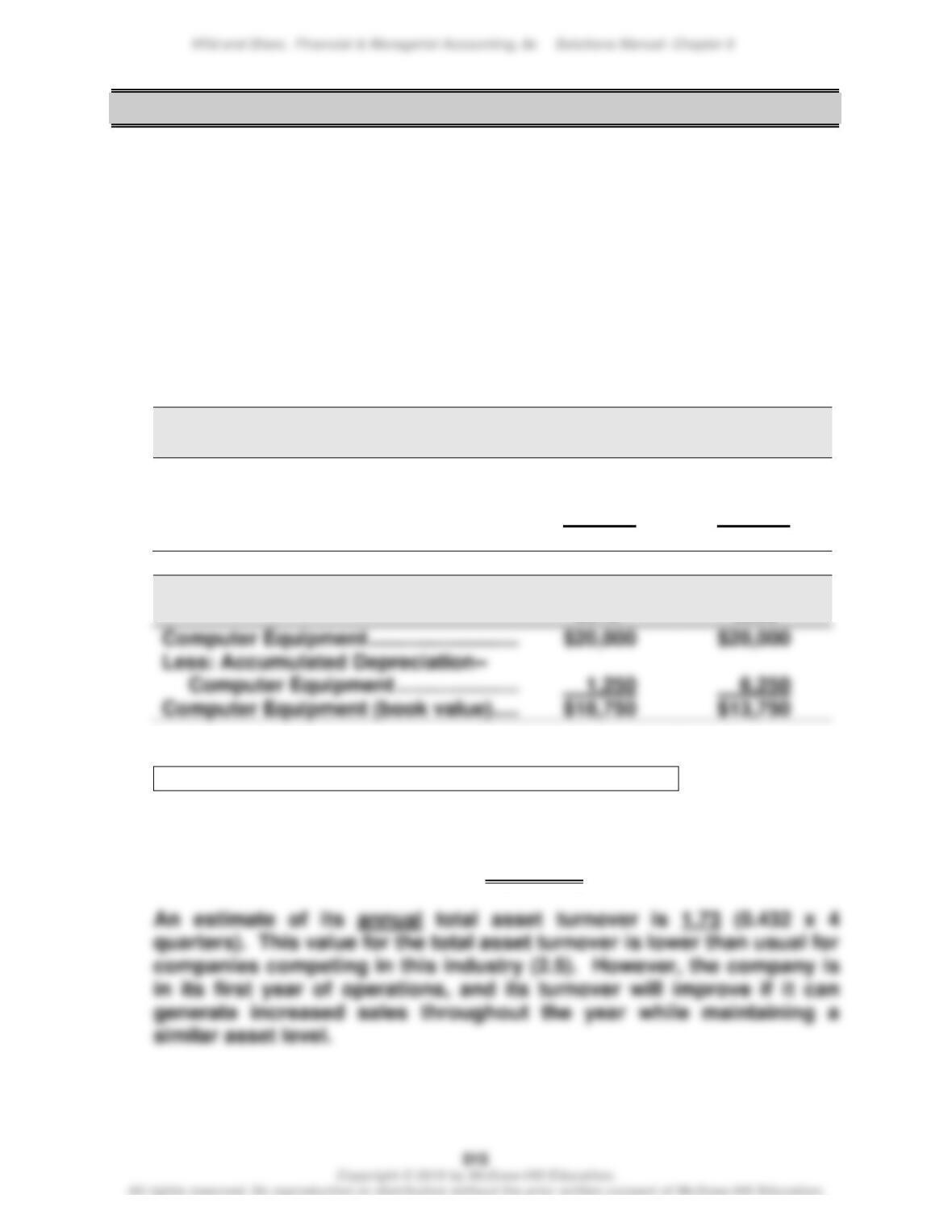
December 31,
$20,000
$20,000
Less: Accumulated Depreciation–
$13,750
December 31,
3.
Total asset turnover = Net sales / Average total assets
The 3-month total asset turnover at March 31, 2020:
$44,000 / [($83,460 + $120,268)/2] = 0.43 times (rounded)
Company Analysis — AA 8-1
All $ millions
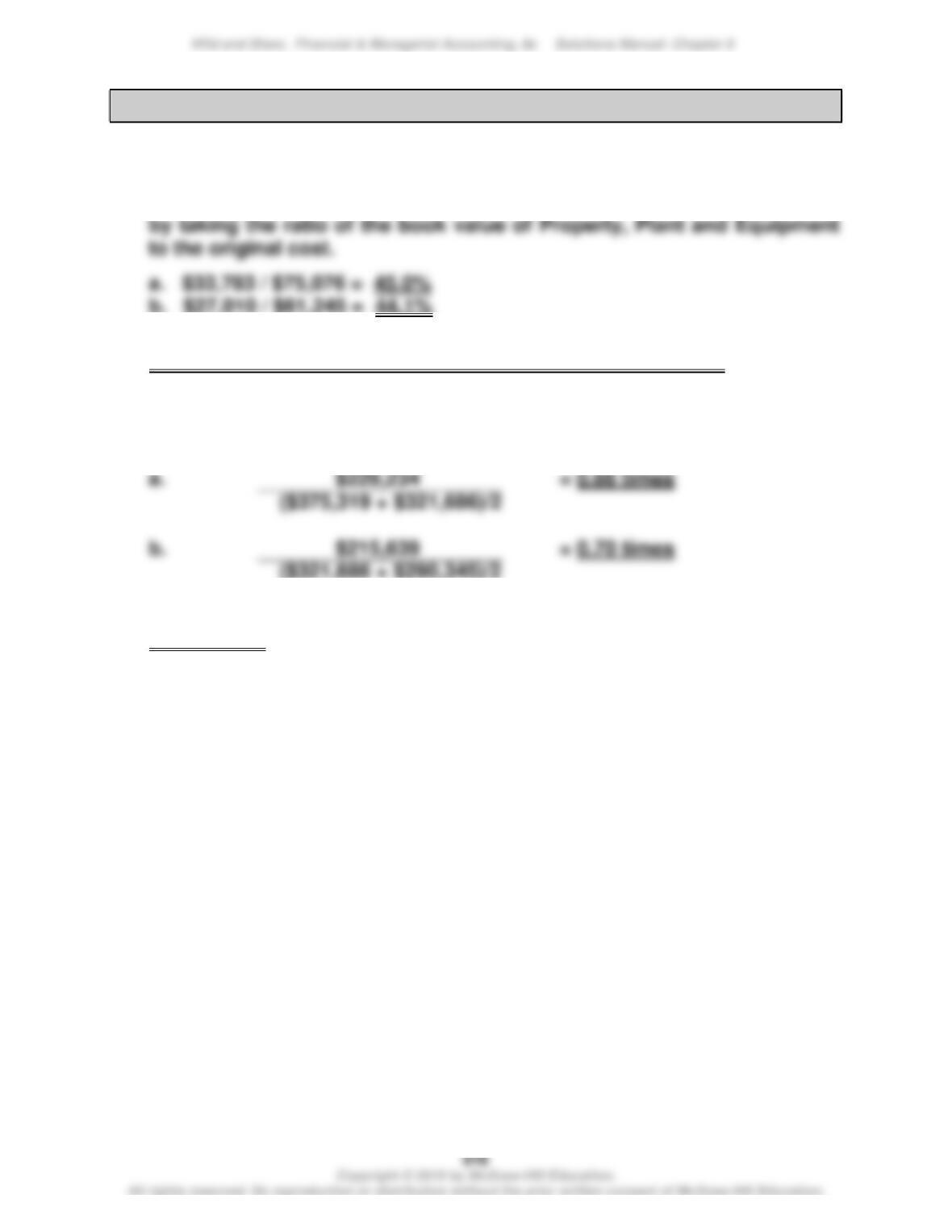
1. The percent of original cost remaining to be depreciated is computed
2. Research and development costs are expensed as incurred.
3. Total asset turnover:
4. Unfavorable
Explanation: Apple’s turnover decreased in the current year versus the
prior year. A lower turnover suggests Apple has become less efficient
in generating net sales given total assets.
Comparative Analysis — AA 8-2
Note: Total asset turnover = Net sales / Average total assets
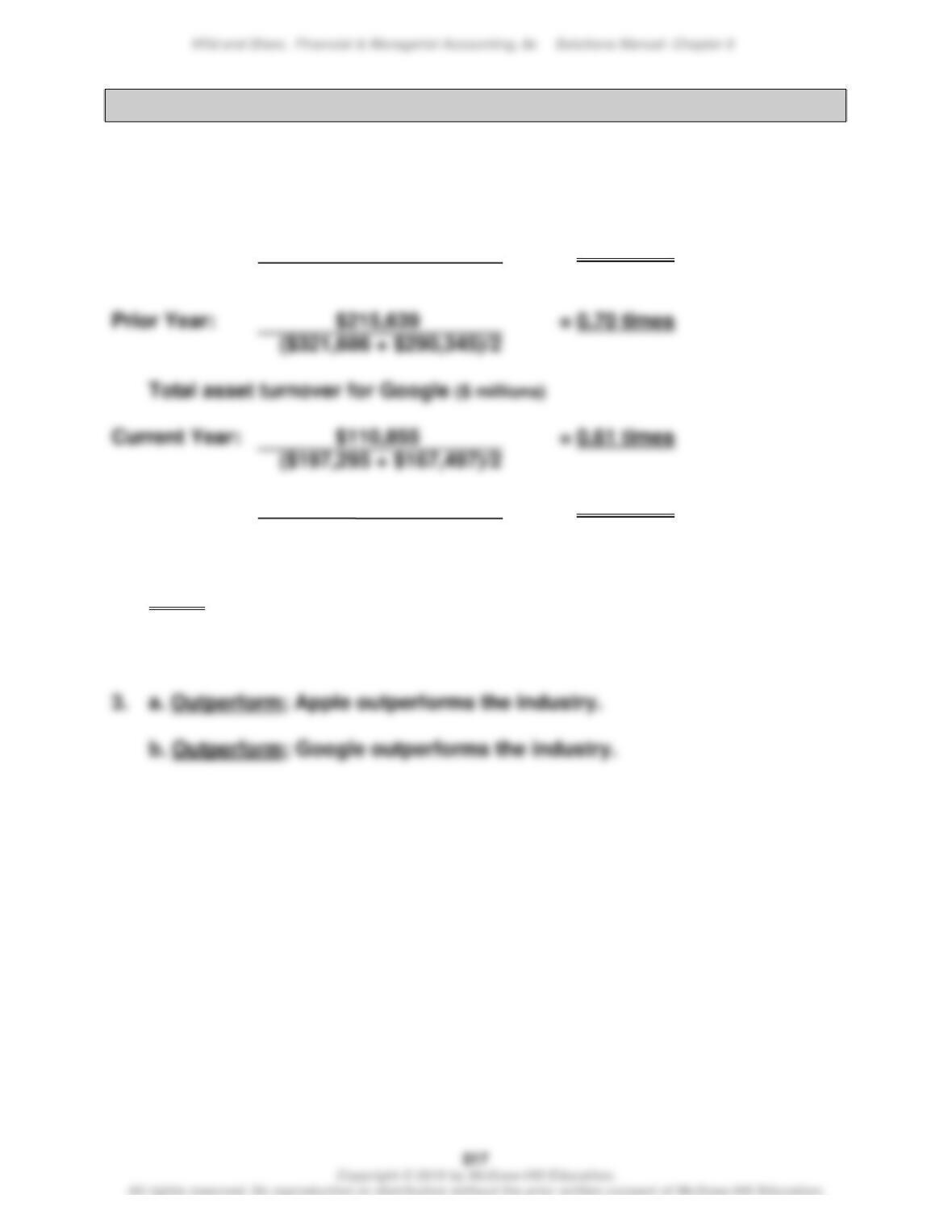
1. Total asset turnover for Apple ($ millions)
Current Year: $229,234 = 0.66 times
($375,319 + $321,686)/2
Prior Year: $90,272 = 0.57 times
($167,497 + $147,461)/2
2. Apple
Explanation: Apple employs its assets more efficiently than Google for
the current year. This is evident in its higher total asset turnover.
Global Analysis — AA 8-3
Note: Total asset turnover = Net sales / Average total assets
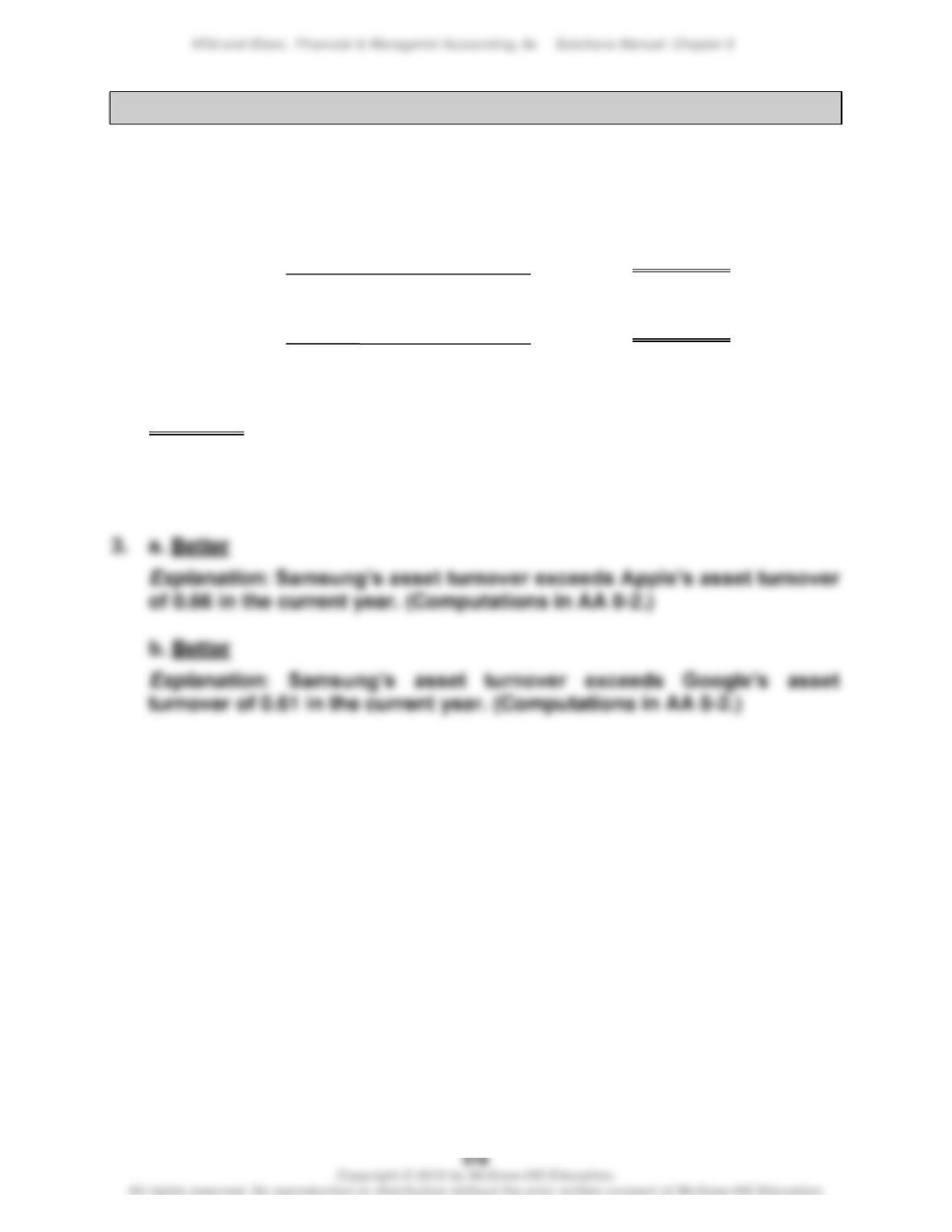
1. Total asset turnover for Samsung (KRW in millions):
₩239,575,376 = 0.85 times
Current Year: (₩301,752,090 + ₩262,174,324)/2
₩201,866,745 = 0.80 times
Prior Year: (₩262,174,324 + ₩242,179,521)/2
2. Favorable
Explanation: Samsung’s asset turnover increased in the current year
versus the prior year, which is a favorable trend.
Ethics Challenge — BTN 8-1
1. When managers acquire new assets a number of decisions relative to
depreciation must be made. Specifically, the asset must be assigned a
useful life, a salvage value, and a method of depreciation.
2. When assets are placed in use on a day other than the first day of the
month an assumption is often made that the assets are placed in use on
the first day of the month nearest to the date of the purchase. For
3. By always assuming the first day of the following month as the date of
purchase, less depreciation is (initially) accrued for the assets
employed. This means depreciation expense will be less than if assets
were considered employed on the first of the month closest to the date
of purchase. With reduced depreciation charges, net income will be
higher for this current year. Therefore, this practice will result in a
higher profit margin for her company for this year.
Communicating in Practice — BTN 8-2
The solution to this activity will vary based on the industry and the
companies chosen for analysis. Many instructors find it useful to report
the results from the teams to the class for purposes of classroom
discussion and analysis.
Taking It to the Net — BTN 8-3
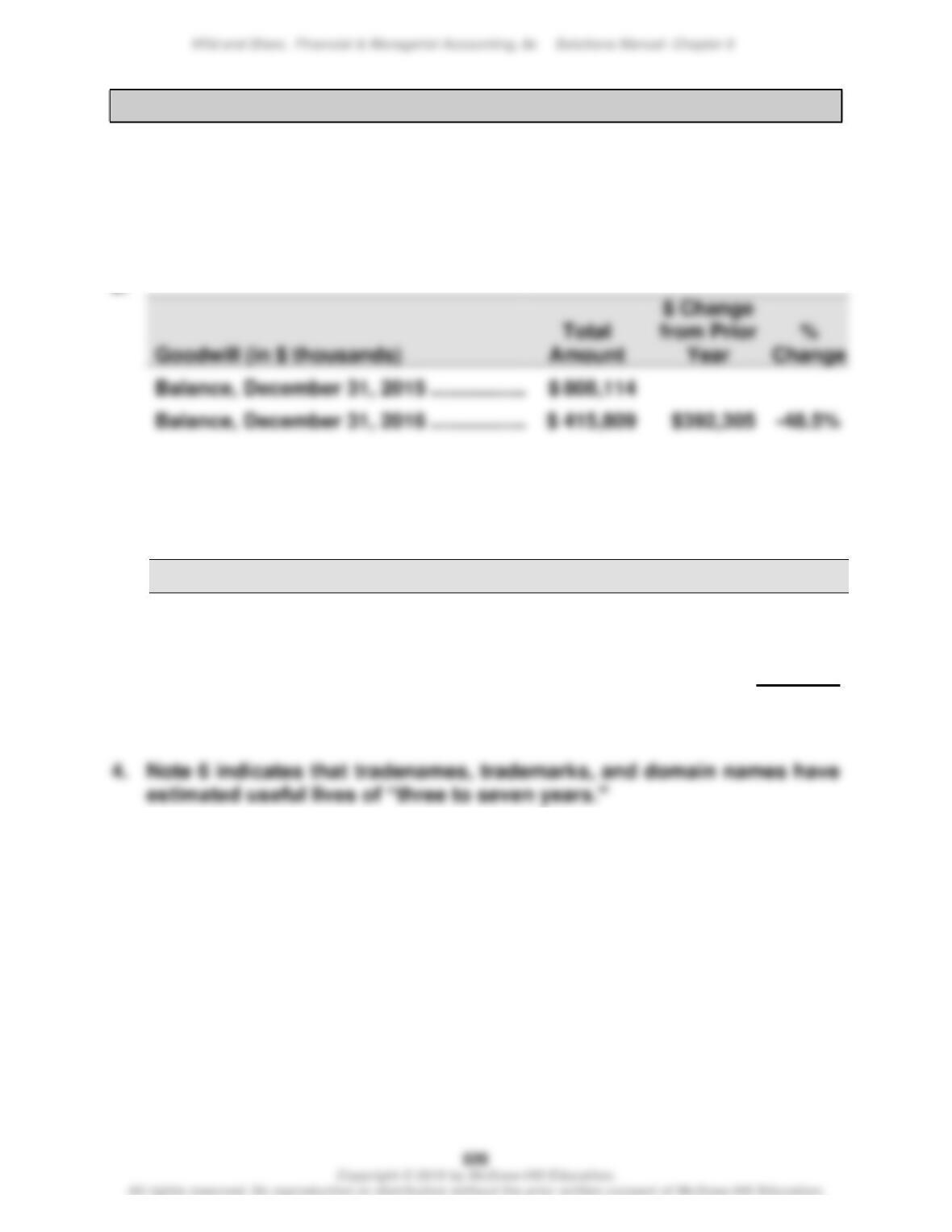
1. Yahoo! reports Goodwill in the amount of ($ thousands) $415,809 at
December 31, 2016.
Goodwill represents 0.9% ($415,809 / $48,083,079) of Yahoo!’s total
assets. Goodwill is not a substantial asset for Yahoo!.
3. Yahoo!’s intangible assets are categorized into the three categories
below at December 31, 2016. These intangibles represent 0.3%
($161,644 / $48,083,079) of total assets.
December 31, 2016 (in thousands)
Customer, affiliate, and advertiser related relationships …………….
$102,765
Developed technology and patents ……………………………………………
47,243
Tradenames, trademarks, and domain names …………………………..
11,636
Total intangible assets, net ……………………………………………………….
$161,644
Teamwork in Action — BTN 8-4
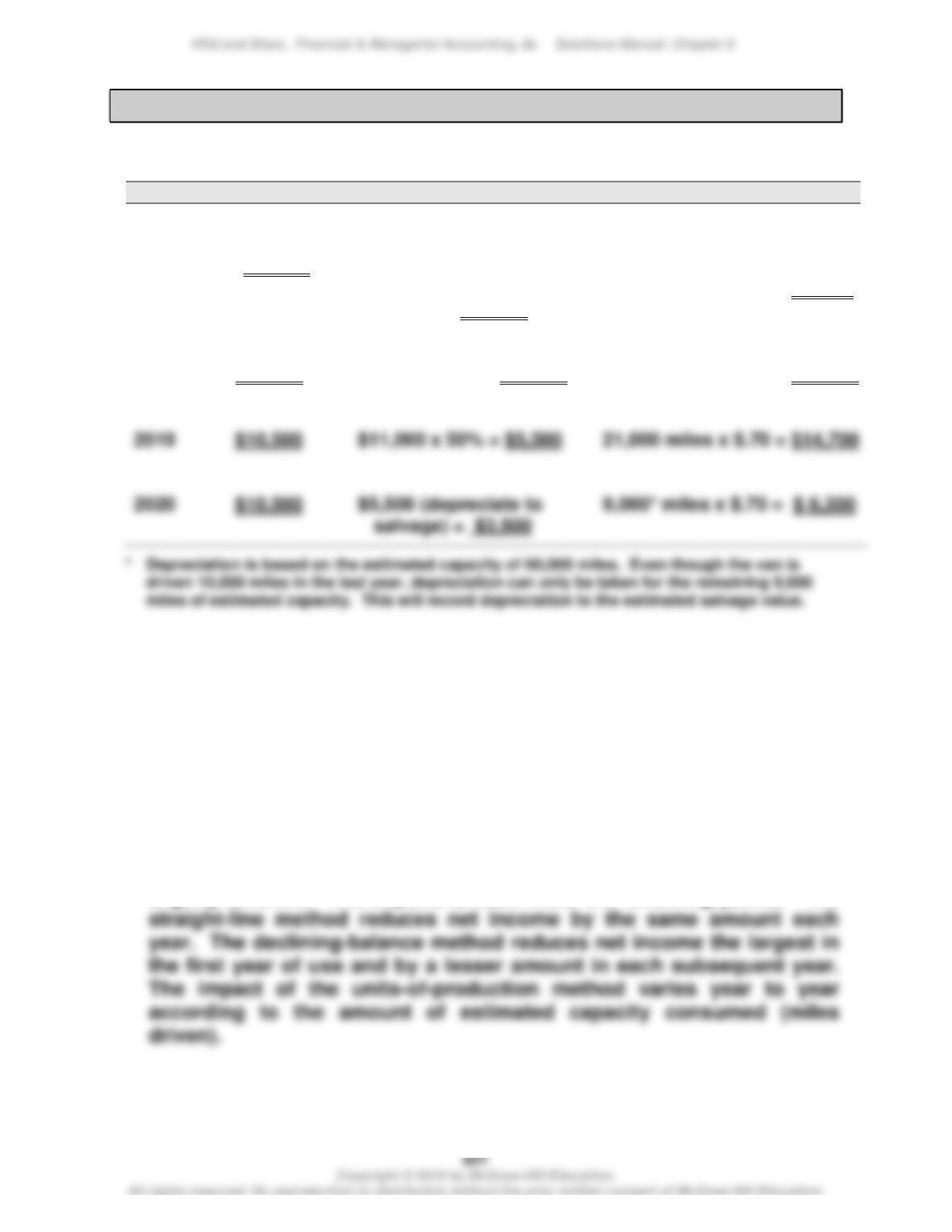
1. Annual depreciation for each year of the asset’s useful life:
Year
Straight-line
Double-Declining-Balance
Units-of-Production
2017
($44,000-$2,000)/4
= $10,500
(100%/4) x 2 = 50% is
declining-balance rate.
BV x rate = $44,000 x 50%
= $22,000
($44,000-$2,000)/60,000 miles
= $.70 per mile.
12,000 miles x $.70 = $ 8,400
2018
$10,500
$22,000 x 50%= $11,000
18,000 miles x $.70 = $12,600
2019
$10,500
$11,000 x 50% = $5,500
21,000 miles x $.70 = $14,700
2. Depreciation is recorded in an adjusting entry at the end of each
period. The entry is:
Depreciation Expense …………………………….. xxxx*
Accumulated Depreciation ………….. xxxx*
*Amount varies by method and year (see part 1).
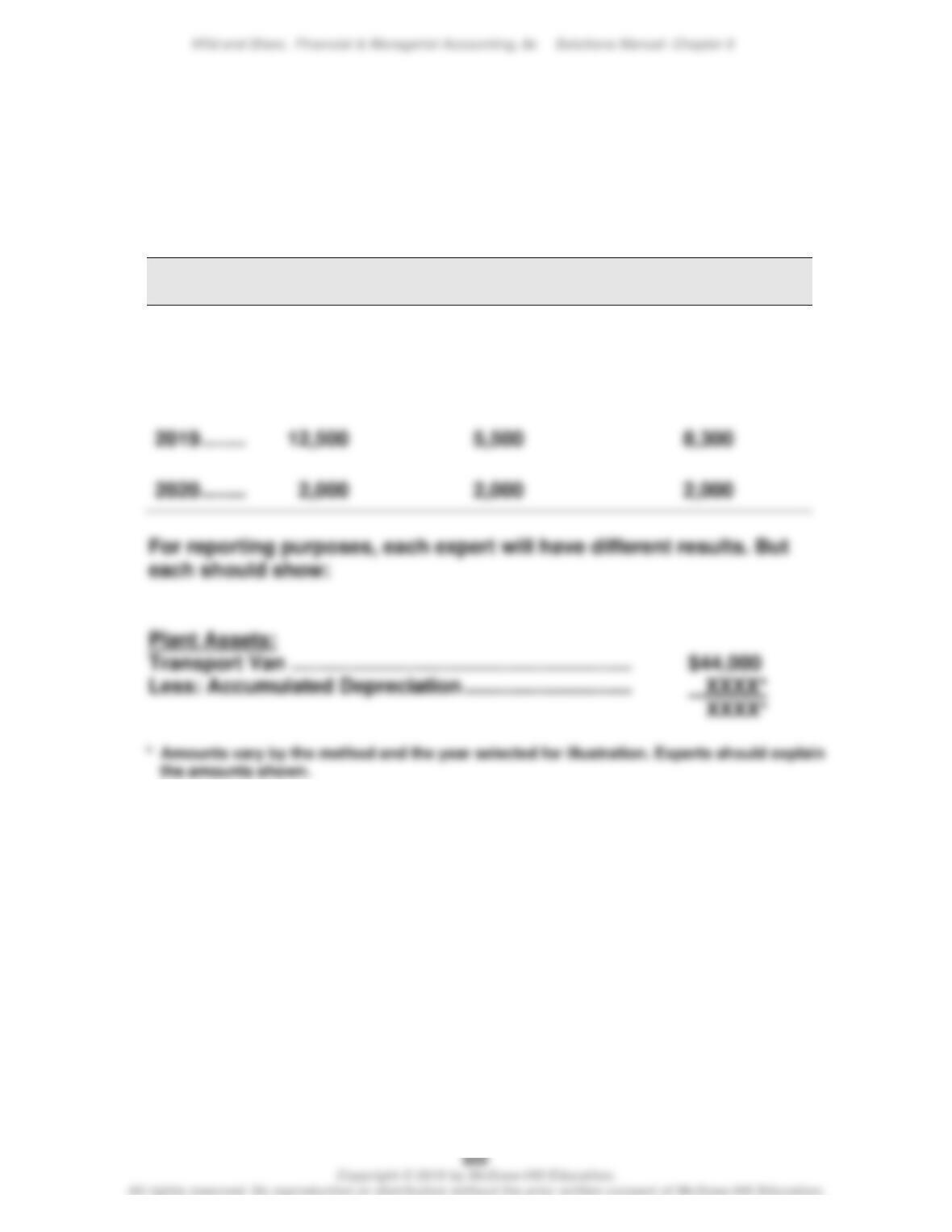
3. Each expert’s presentation of the comparison of methods will be
slightly different. The experts should make the following points: The
Teamwork in Action — BTN 8-4 – continued
4. Book value at the end of each year
= Cost – Accumulated depreciation
= $44,000 – (amount varies by method—see part 1 for annual amounts)
Year
Straight–line
Double-Declining-
Balance
Units of Production
2017 ……..
$33,500
$22,000
$35,600
2018 ……..
23,000
11,000
23,000
2019 ……..
2020 ……..
Wild and Shaw, Financial & Managerial Accounting, 8e Solutions Manual: Chapter 8
Entrepreneurial Decision — BTN 8-5
Part 1
(a) Under current conditions, the total asset turnover is 3.2. This is
computed as net sales of $8,000,000 divided by its average total assets
of $2,500,000.* This means the company turns its assets over 3.2 times
per year or, stated differently, each $1 of assets produces $3.20 of net
sales per year.
* Total asset turnover =
Part 2
The proposal would yield an improved total asset turnover of 4 vis-à-vis the
current total asset turnover of 3.2. However, we need to recognize that this
proposal depends on our confidence in both maintaining current sales,
meeting future sales expectations, and not losing or alienating current
and/or future customers due to the expanded operations. Assuming all of
Hitting the Road — BTN 8-6
No formal solution exists for this activity. It is usually interesting for the
class to exchange their discoveries via class discussion. This is
particularly the case with respect to patents, copyrights, and trademarks.
Net sales
Average total assets