
8-16
Item
Book Value
Cumulative
Book
Cumulative
Book Plus
Random
Start
Included in
Sample –
Selection
Amount
0
0
25,000
1
3,900
3,900
28,900
2
54,900
100,000
5
2,000
166900
191,900
6
260,000
426,900
451,900
Yes,
200,300, &
400,000
7
100
427,000
452,000
8
452,000
477,000
9,000
490,000
515,000
2,500
492,500
517,500
600,000
8-17
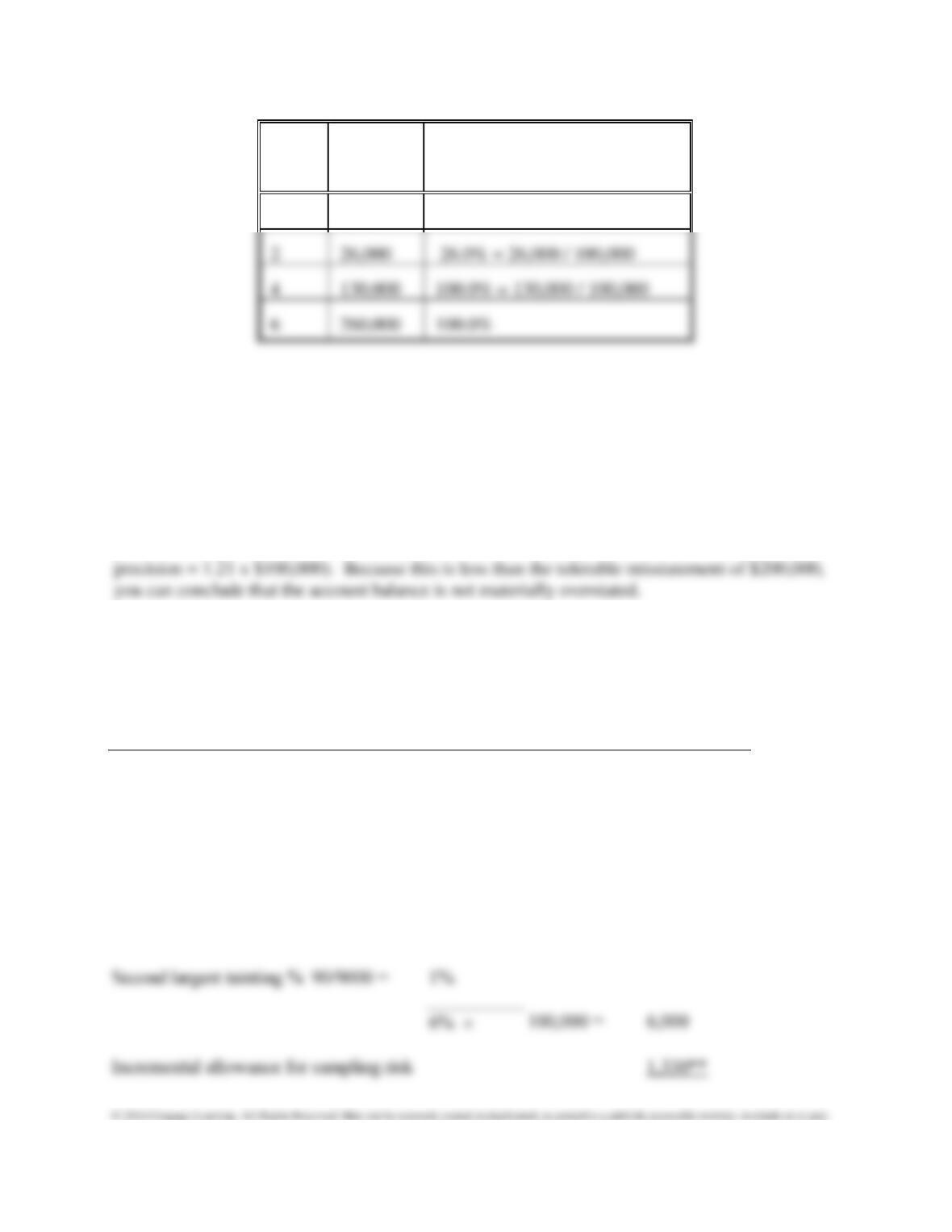
e. The probability of selecting each item is as follows:
Item
Book
Value
Probability of Selection
1
3,900
3.9% = 3,900 / 100,000
2
26,000
26.0% = 26,000 / 100,000
f. Because logical units with recorded amounts greater than the sampling interval might be
selected more than once, the actual number of logical units selected for the sample might be less
than the computed sample size.
8-57
a. The audit conclusion if no misstatements are found in the sample is that the auditor is 70
percent confident that accounts receivable are not overstated by more than $121,000 (the basic
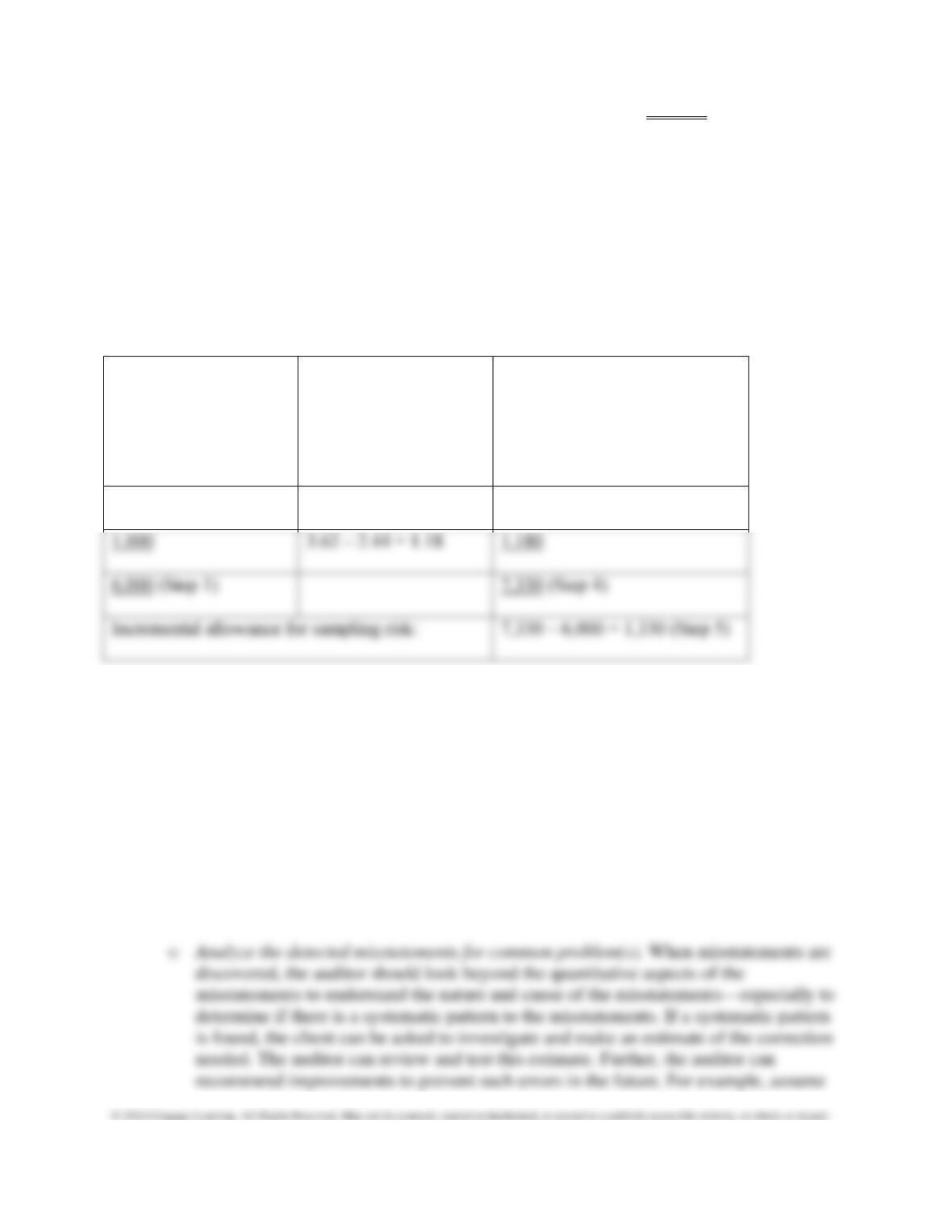
b. The audit evaluation of the sample results is as follows:
Confidence
Factor*
Tainting
Percent
Sampling
Interval
Conclusion
Factual misstatement in
top-stratum
Basic precision
Projected misstatement:
1.21
100,000 =
2,000
121,000
First largest tainting %
750/15,000 =
5%
Second largest tainting %
90/9000 =
1%
8-18
Total Estimated Misstatement:
130,330
*Confidence factors come from the 30% column in Exhibit 8.9.
** See below for the calculation of this value.
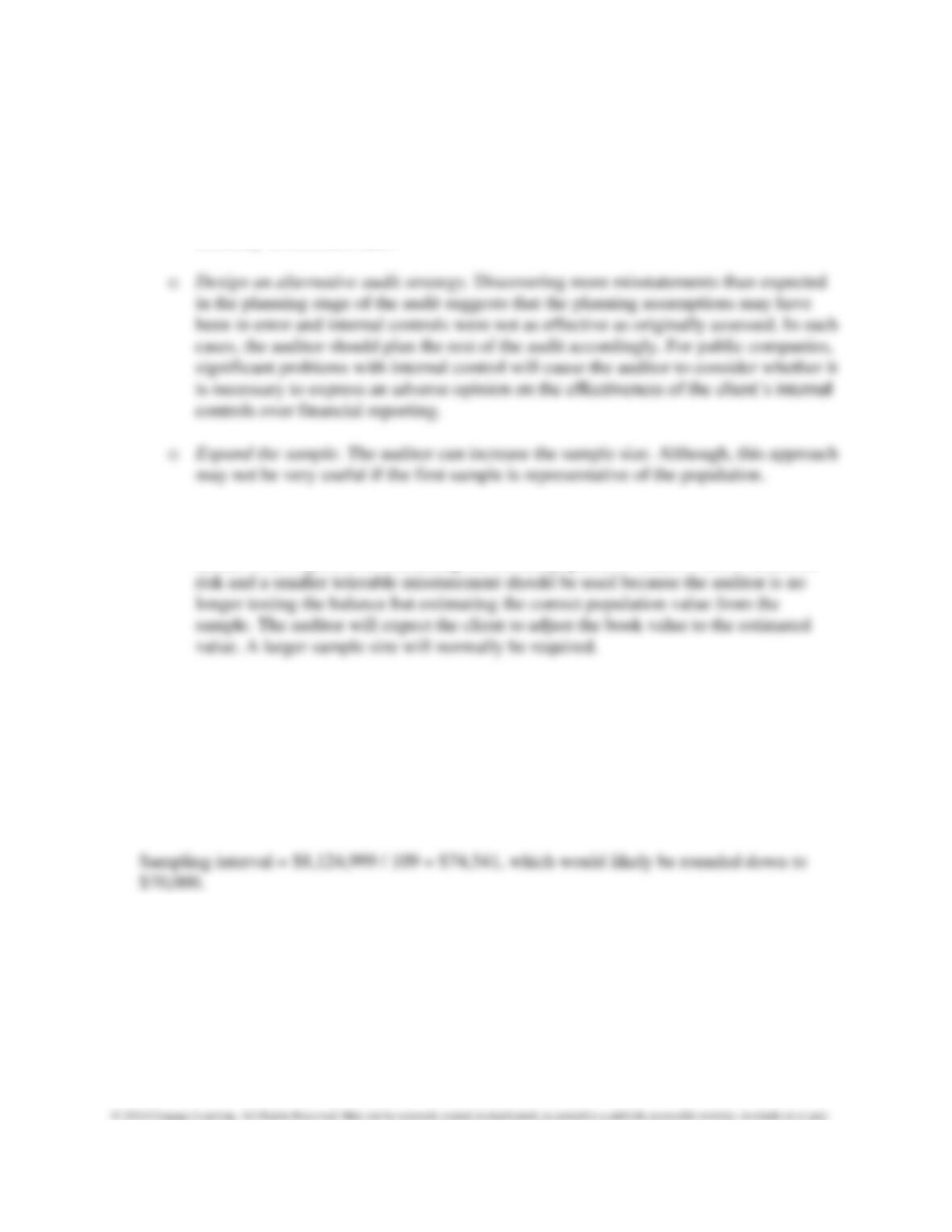
Projected Misstatement
Incremental Changes in
Confidence Factor
(Step 2)
Projected Misstatement X
Factor (Step 3)
5,000 +
2.44 – 1.21 = 1.23
6,150 +
1,000
3.62 – 2.44 = 1.18
1,180
6,000 (Step 1)
7,330 (Step 4)
c. These results are acceptable because the total estimated misstatement ($130,330) is less than
tolerable misstatement ($175,000).
d. When the total estimated misstatement exceeds the tolerable misstatement, the auditor
has available several possible courses of action. The auditor can:
o Ask the client to correct the factual misstatements. If this is done, the total estimated
misstatement can be adjusted for those corrections but not for the projection of
misstatements associated with those items. In some cases, simply correcting the
factual misstatement can bring the total estimated misstatement below the auditor’s
tolerable misstatement level.
8-19
several confirmation replies indicate that merchandise was returned prior to year end
but credit was not recorded until the subsequent year. A careful review of receiving
reports related to merchandise returned prior to year end and of credits recorded in the
subsequent year will provide evidence regarding the extent of the needed correction.
The auditor should also consider the relationship of the misstatements to other phases
of the audit—problems in recording receivables may also reveal problems in the
accuracy of recorded sales.
o Change the audit objective to estimating the correct value. In cases where material
misstatements are likely, it may be necessary to change from an objective of testing
details to an objective of estimating the correct population value. A lower detection
8-58
a. Round the ratio of expected to tolerable misstatement up to 30%, and round the ratio of the
tolerable misstatement to the population book value down to 4%. From Exhibit 8.7, the sample
size is 109. This is found by looking in the 10% row, the 0.30 row, and the 4% column.
Sampling interval = population size / sample size, so:

8-20
b. The total estimated misstatement is calculated as follows:
Confidence
Factor*
Tainting
Percent
Sampling
Interval
Conclusion
lower stratum:
First largest tainting %
11.93%
Factual misstatement in
top-stratum
Projected misstatement in
2,000
11.93%
in lower stratum
Total Estimated Misstatement:
176,896
Incremental allowance for sampling risk
4,844**
*Confidence factors come from the 10% column in Exhibit 8.9.
** See below and Exhibit 8.12 for the calculation of this value.
First largest tainting % = $41,906.45 – $36,906.45 = $5,000 / $41,906.45 = 0.119313
Projected Misstatement
Incremental Changes in
Confidence Factor
(Step 2)
Projected Misstatement X
Factor (Step 3)
The statistical conclusion is that the auditor is 90% confident that this population is not
overstated by more than $176,896. Because the total estimated misstatement is less than the
8-21
8-59
a. Round the ratio of the tolerable misstatement to the population book value down to 2%.
From Exhibit 8.7, the sample size is 171. This is found by looking in the 10% row, the 0.20 row,
and the 2% column.
b.
Item
Dollar/Percent Misstatement
Problem
1.
$0 / 0%
Account balance is correct, just
posted to wrong customer.
2.
$20,000; 50%; Lower-stratum
Credit memo problem.
3.
$75,000; Top-stratum
Cost overrun.
4.
$ 5,000; Top-stratum
Cost overrun
5.
$ 122; 100 percent; Lower-
stratum
Credit memo problem.

8-22
c. The total estimated misstatement is calculated as follows:
Confidence
Factor*
Tainting
Percent
Sampling
Interval
Conclusion
Factual misstatement in
Projected misstatement in
the lower stratum:
First largest tainting %
Second largest tainting %
100%
50%
Incremental allowance for sampling risk in lower
stratum
36,000**
Total Estimated Misstatement:
$287,450
8-23
First largest tainting % = $122 – 0 = 122 / $122 = 100%
Second largest tainting % = $40,000 – $20,000 = $20,000 / $40,000 = 50%
Projected Misstatement
Incremental Changes in
Confidence Factor
(Step 2)
Projected Misstatement X Factor (Step
3)
45,000 +
3.89 – 2.31 = 1.58
71,100 +
22,500
5.33 – 3.89 = 1.44
32,400
67,500 (Step 1)
103,500 (Step 4)
Incremental allowance for sampling risk:
103,500 – 67,500 = 36,000 (Step 5)
The statistical conclusion is that the auditor is 90% confident that this population is not
overstated by more than $287,450. Because the total estimated misstatement is more than the
d. The auditor would expand audit tests on the account balance. There are two types of
misstatement patterns that should concern the auditor. First, there appears to be a problem with
timely issuance of credit memos. The auditor should find out more about the causes of the credit
memo problems and examine the process of issuing credit memos further. Second, there is a
8-60
When the total estimated misstatement exceeds the tolerable misstatement, the auditor has
available several possible courses of action. The auditor can:
• Ask the client to correct the factual misstatements. If this is done, the total estimated
misstatement can be adjusted for those corrections but not for the projection of
misstatements associated with those items. In some cases, simply correcting the factual
misstatement can bring the total estimated misstatement below the auditor’s tolerable
misstatement level.
8-24
• Design an alternative audit strategy. Discovering more misstatements than expected in
the planning stage of the audit suggests that the planning assumptions may have been in
error and internal controls were not as effective as originally assessed. In such cases, the
• Expand the sample. The auditor can calculate the additional sample size needed by
substituting the most likely misstatement from the sample evaluation for the original
expected misstatement in the sample interval formula and determine a new interval and
total sample size based on the new expectations. The number of additional sample items
8-61
Scenario 1 (a). The implication of the closeness of this amount to the tolerable misstatement is
that the auditor should exercise considerable professional skepticism in concluding that the
account balance is correct in all material respects.
Appropriate Course of Action Considering Option (a). Utilitarian Theory and Rights Theory
imply that the auditor should do what is in the interests of shareholders and debt holders in this
setting, since these stakeholders have a vested financial interest in the accuracy of the financial
information. These individuals have a right to receive financial information that is correct in all
material respects. Turning to the ethical decision making framework, the auditor should consider
the following steps:
1. Identify the ethical issue. By doing no more audit work, the auditor is in danger of
8-25
than fraud, no further action might be needed. However, if the misstatements may be the
2. Determine the affected parties. As noted above, the shareholders and debt-holders are the
most significant affected parties.
3. Develop alternative courses of action. One course of action is to do nothing, i.e., maintain
4. Determine likely consequences. If the auditor does nothing, the account balance may be
correct, and in that case there is no harm done. If the account balance is materially
overstated, the stock may be over-priced, or debt-holders may be providing funds at
5. The Rights Framework would likely eliminate the do nothing course of action because of
the associated downside risk, which applies to many stakeholders. The cost of collecting
6. The appropriate course of action is to collect additional audit evidence.
Scenario 1 (b). Utilitarian Theory and Rights Theory imply that the auditor should do what is in
the interests of shareholders and debt-holders in this setting, since these stakeholders have a
vested financial interest in the accuracy of the financial information. These individuals have a
right to receive financial information that is correct in all material respects. Turning to the ethical
decision making framework, the auditor should consider the following steps:
1. Identify the ethical issue. By disregarding the detected overstatements, the upper
misstatement limit calculation is incorrect. The statistical conclusion will be invalid, i.e.,
2. Determine the affected parties. As noted above, the shareholders and debt-holders are the
most significant affected parties.
3. Develop alternative courses of action. One course of action is to do nothing, i.e., maintain
the status quo and do as the senior proposes. Another course of action is to make the
4. Determine likely consequences. If the auditor does nothing, the account balance will
8-26
the difficult choice of ignoring the issue or notifying his/her superiors, which will likely
5. The Rights Framework would clearly eliminate the do nothing course of action because
of the associated downside risk, which applies to many stakeholders. The option of
6. The option of trying to convince the senior (and hoping for a good outcome) seems like
the best option.
Scenario 2. The information in the problem implies that there is a 10% chance that the actual
amount of the overstatement is no greater than $230,000. While this amount is greater than the
original tolerable misstatement amount of $215,000, it is less than the new amount of $250,000.
The implication of the change in the tolerable misstatement amount with regards to whether the
accounts receivable amount requires downward adjustment is that the new amount suggests that
If that is not the case, then the auditor should follow the ethical decision making framework
outlined in Chapter 4. That decision making might proceed as follows:
1. Identify the ethical issue. By altering the tolerable amount simply so that the
misstatement will not be material, the senior allows a materially misstated amount to
2. Determine the affected parties. As noted above, the shareholders and debt holders are
3. Develop alternative courses of action. One course of action is to do nothing, i.e.,
maintain the status quo and do as the senior proposes. Another course of action is to
4. Determine likely consequences. If the auditor does nothing, the account balance will
8-27
properly adjusted (assuming that the client agrees). If the senior is not convinced, the
5. The Rights Framework would clearly eliminate the do nothing course of action
because of the associated downside risk, which applies to many stakeholders. The
6. The option of trying to convince the senior (and hoping for a good outcome) seems
like the best option.
Scenario 3. Management’s incentive is generally to overstate assets, including accounts
receivable. This trend of overstatements reveals either that management is intentionally
overstating the accounts, or they have not invested in adequate internal controls or accounting
staff to assure the accurate recording of accounts receivable. Therefore, the audit firm should
consider this issue in its client continuance decision, increasing the assessed risk profile of
8-62
a. Analyze a file. Use GAS to create a graphical analysis of items making up a population,
for example graphing the dollar value of account balances to see how many are above a certain
amount.
b. Select transactions based on logical identifiers. Use GAS to select transactions that are
greater than a certain dollar amount, or that occur during a certain period in time, such as the last
8-28
8-63
Advantages of using GAS as part of the audit include:
• The software is independent of the system being audited and simply needs a read-
only copy of the file to avoid any corruption of an organization’s data.
• The software includes many audit-specific routines, such as sampling.
Application Activities
8-64
PCAOB definition of sampling risk (AU 350): “Sampling risk arises from the possibility that,
when a test of controls or a substantive test is restricted to a sample, the auditor’s conclusions
may be different from the conclusions he would reach if the test were applied in the same way to
all items in the account balance or class of transactions.”
AICPA definition of sampling risk (AU-C 530): “The risk that the auditor’s conclusion based on
a sample may be different from the conclusion if the entire population were subjected to the
same audit procedure.”
Academic Research Case
8-65
a. The purpose of this study is to provide evidence on the extent to which Generalized Audit
Software (GAS) is used by auditors in the UK. While GAS is a popular type of computer assisted
audit tool, there is little evidence on its use by auditors, especially by auditors at small and
medium sized audit firms.

limited benefits when auditing small companies, lack of ease in using, and significant learning
curve to implement. The two primary uses of GAS were to evaluate fraud risks and to identify
journal entries and other adjustments to be tested.
c. This paper is important in that most clients are expected to have accounting data that is
computerized. Therefore, it might be reasonable to expect that many audit process would be
d. The authors obtained evidence on the use of GAS by using a web-based survey.
Responses were obtained from 205 auditors across the UK.
e. One of the limitations of this paper is that it focuses on auditors on small and medium