
PROBLEMS
P8–1
1. and 2.
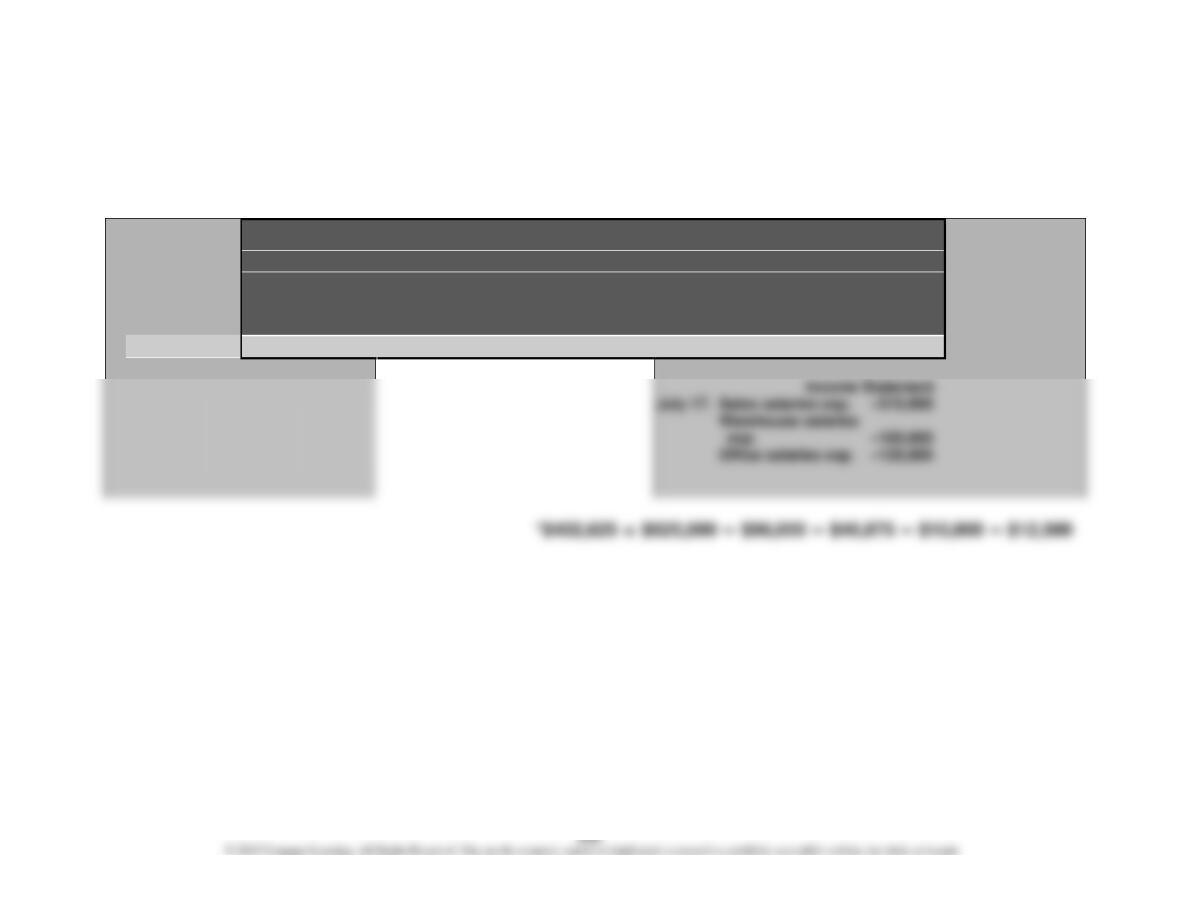
Deferred Income
Income Tax Tax Payable
Deducted Income Tax
on Income Payments for Year’s Addition Year-End
Year Statement the Year (40%) (Deduction) Balance
First
$ 170,000
$ 140,000
$ 30,000
$ 30,000
Second
40,000
Third
80,000
Fourth
540,000
690,000
$ 0
3.
Balance Sheet
Statement of
Assets
=
Liabilities
+
Stockholders’ Equity
Income
Cash Flows
Income Tax
Deferred Income
Retained
Statement
Payable
+
Tax Payable
+
Earnings
140,000
30,000
–170,000
Income tax exp.
P8–2
1. $46,875 ($625,000 × 7.5%)
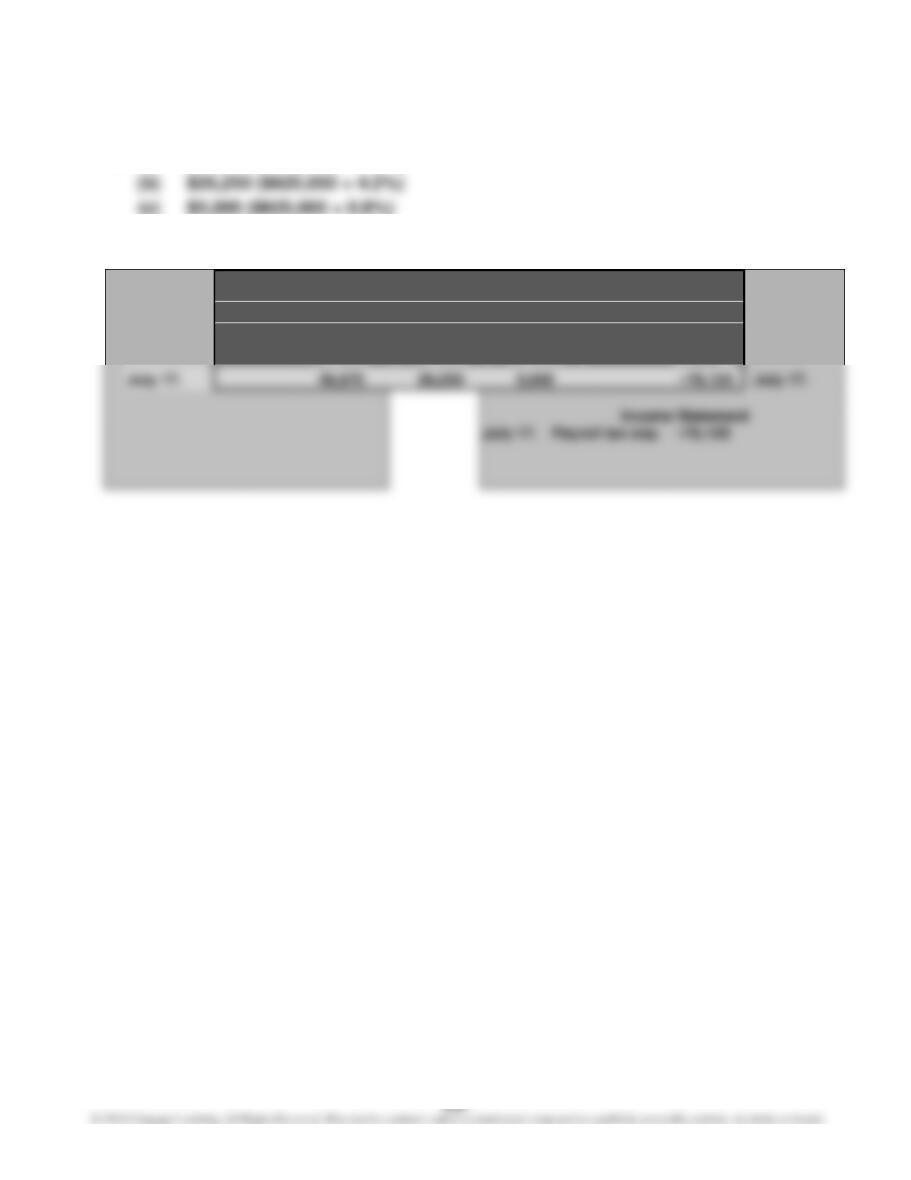
2.
Balance Sheet
Statement of
Assets
=
Liabilities
+
Stockholders’ Equity
Income
Cash Flows
Employee
FICA
Bond
Group
Statement
Income Tax
Payable
+
Tax
Payable
+
Deduction
Payable
+
Ins.
Payable
+
Salaries
Payable
+
Retained
Earnings
July 17.
98,000
46,875
15,000
12,500
452,625*
–625,000
July 17.
exp.
–185,000
Office salaries exp.
–125,000
P8–2, Concluded
3. (a) $46,875 ($625,000 × 7.5%)
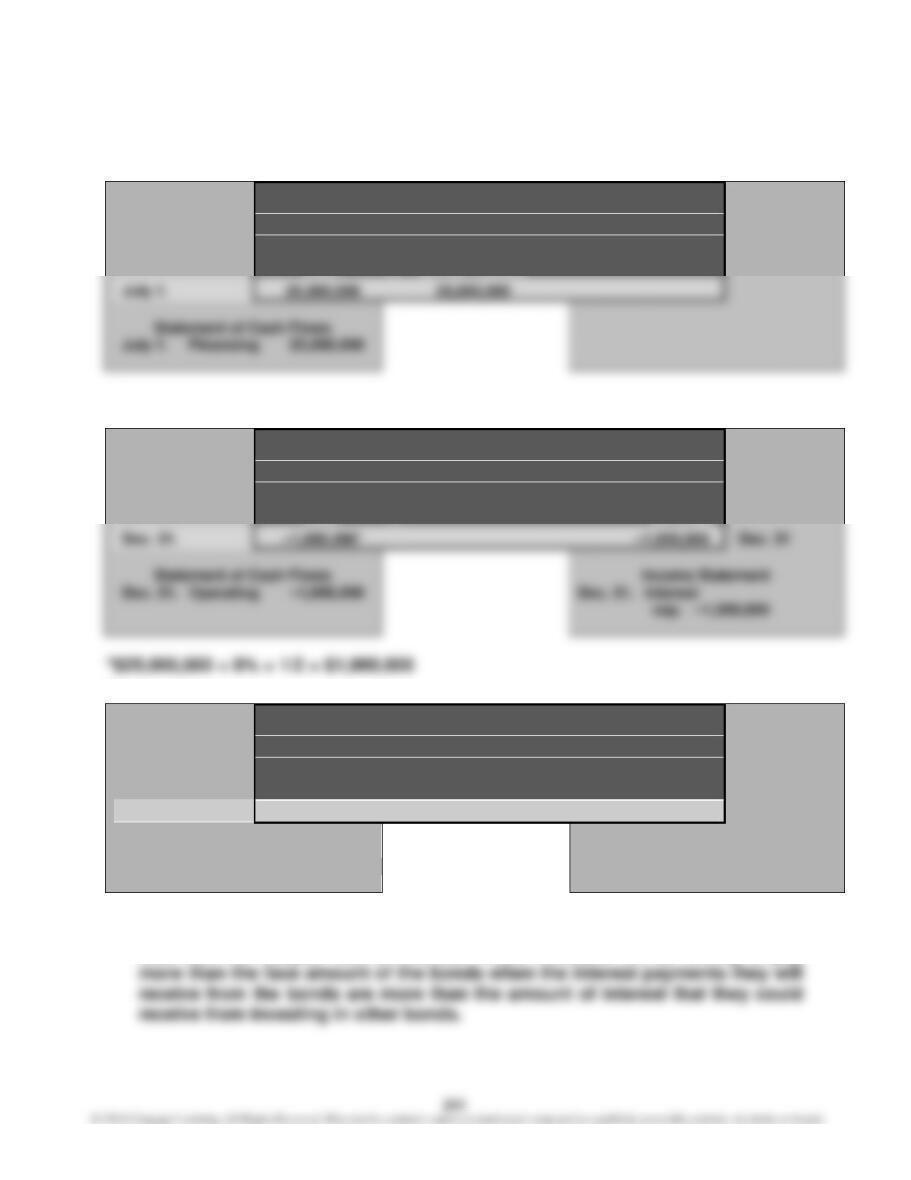
4.
Balance Sheet
Statement of
Assets
=
Liabilities
+
Stockholders’ Equity
Income
Cash Flows
FICA Tax
SUTA
FUTA
Retained
Statement
Payable
+
Payable
+
Payable
+
Earnings
P8–3
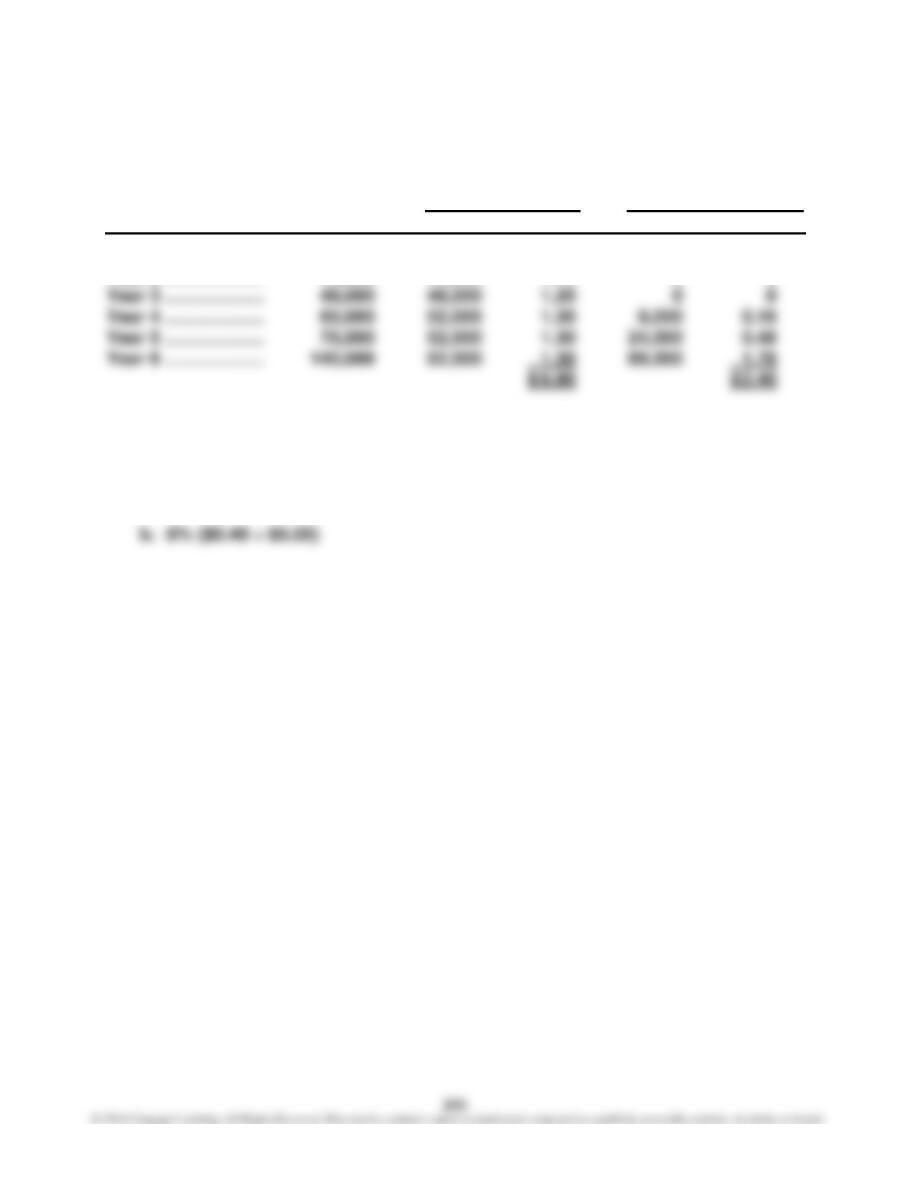
1.
Balance Sheet
Statement of
Assets
=
Liabilities
+
Stockholders’ Equity
Income
Cash Flows
Statement
Cash
=
Bonds Payable
July 1.
Statement of Cash Flows
July 1.
Financing
25,000,000
2.
Balance Sheet
Statement of
Assets
=
Liabilities
+
Stockholders’ Equity
Income
Cash Flows
Retained
Statement
Cash
=
Earnings
Dec. 31.
–1,000,000*
Dec. 31
Statement of Cash Flows
exp. –1,000,000
3.
Balance Sheet
Statement of
Assets
=
Liabilities
+
Stockholders’ Equity
Income
Cash Flows
Statement
Cash
=
Bonds Payable
June 30.
–25,000,000
–25,000,000
Statement of Cash Flows
June 30.
Financing
–25,000,000
4. The bonds would have sold at a premium since the market rate of interest is
less than the coupon rate of interest. Thus, investors will be willing to pay

P8–4
Balance Sheet
Statement of
Assets
=
Liabilities
+
Stockholders’ Equity
Income
Cash Flows
Mortgage
Statement
Cash
=
Note Payable
Mar. 8.
4,500,000
4,500,000
Statement of Cash Flows
Mar. 8.
Financing
4,500,000
Balance Sheet
Statement of
Assets
=
Liabilities
+
Stockholders’ Equity
Income
Cash Flows
Preferred
Paid-In Capital in Excess
Statement
Cash
=
Stock
+
of Par—Common Stock
Mar. 13.
Mar. 13 Financing 2,600,000
Balance Sheet
Statement of
Assets
=
Liabilities
+
Stockholders’ Equity
Income
Cash Flows
Common
Paid-In Capital in Excess
Statement
Building* + Land*
=
Stock
+
of Par—Common Stock
Mar. 26.
1,200,000 900,000
2,055,000**
45,000***
Statement of Cash Flows*
P8–5
1.
Total Preferred Dividends Common Dividends
Year Dividends Total Per Share Total Per Share
Year 1 ……………….. $ 28,000 $28,000 $ 0.70 $ 0 $ 0
Year 2 ……………….. 44,000 44,000 1.10 0 0
2. Average annual dividend for preferred: $1.15 per share ($6.90 ÷ 6)
Average annual dividend for common: $0.40 per share ($2.40 ÷ 6)
3. a. 2.0% ($1.15 ÷ $57.50)
P8–6
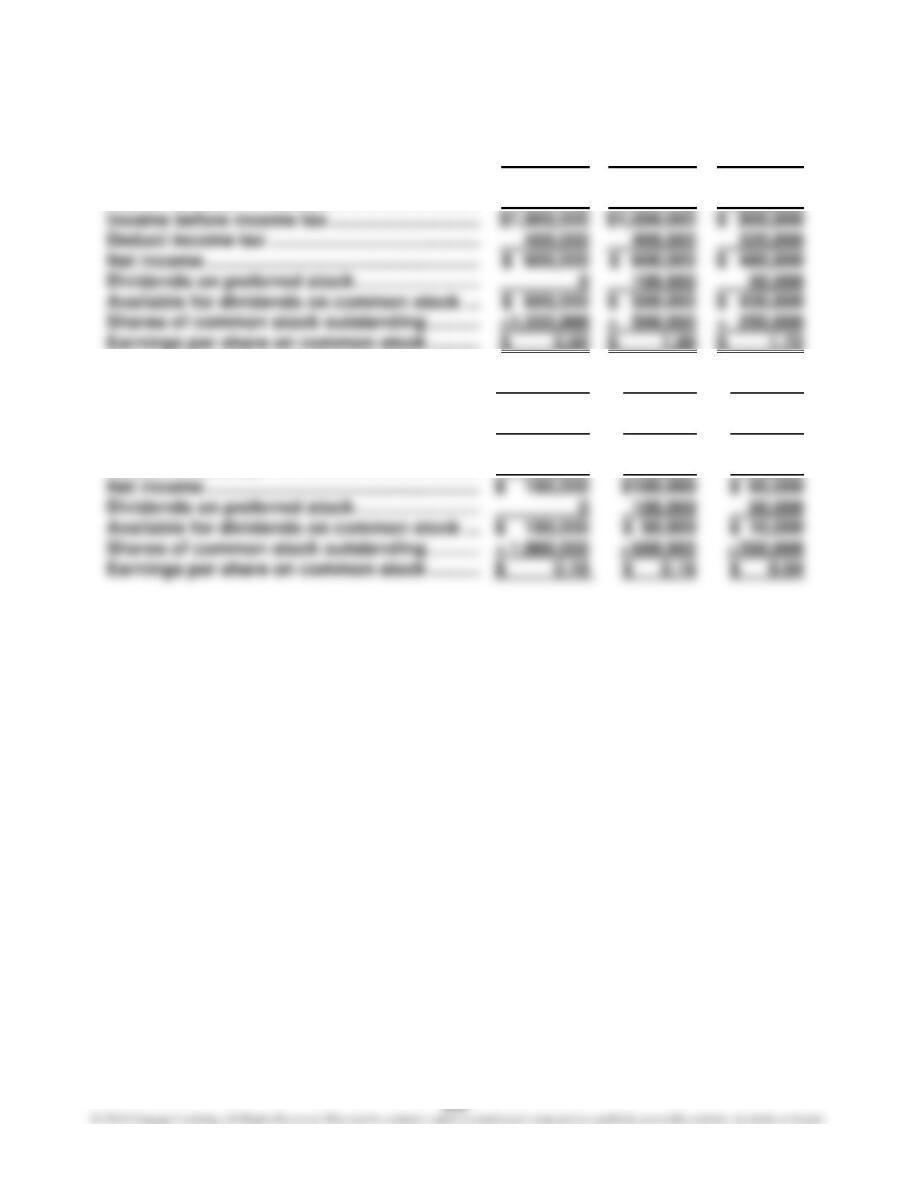
1. Plan 1 Plan 2 Plan 3
Earnings before interest and income tax …… $1,000,000 $1,000,000 $1,000,000
Deduct interest on bonds …………………………. 0 0 200,000
2. Plan 1 Plan 2 Plan 3
Earnings before interest and income tax …… $ 300,000 $300,000 $300,000
Deduct interest on bonds …………………………. 0 0 200,000
Income before income tax ………………………… $ 300,000 $300,000 $100,000
Deduct income tax …………………………………… 120,000 120,000 40,000
P8–6, Concluded
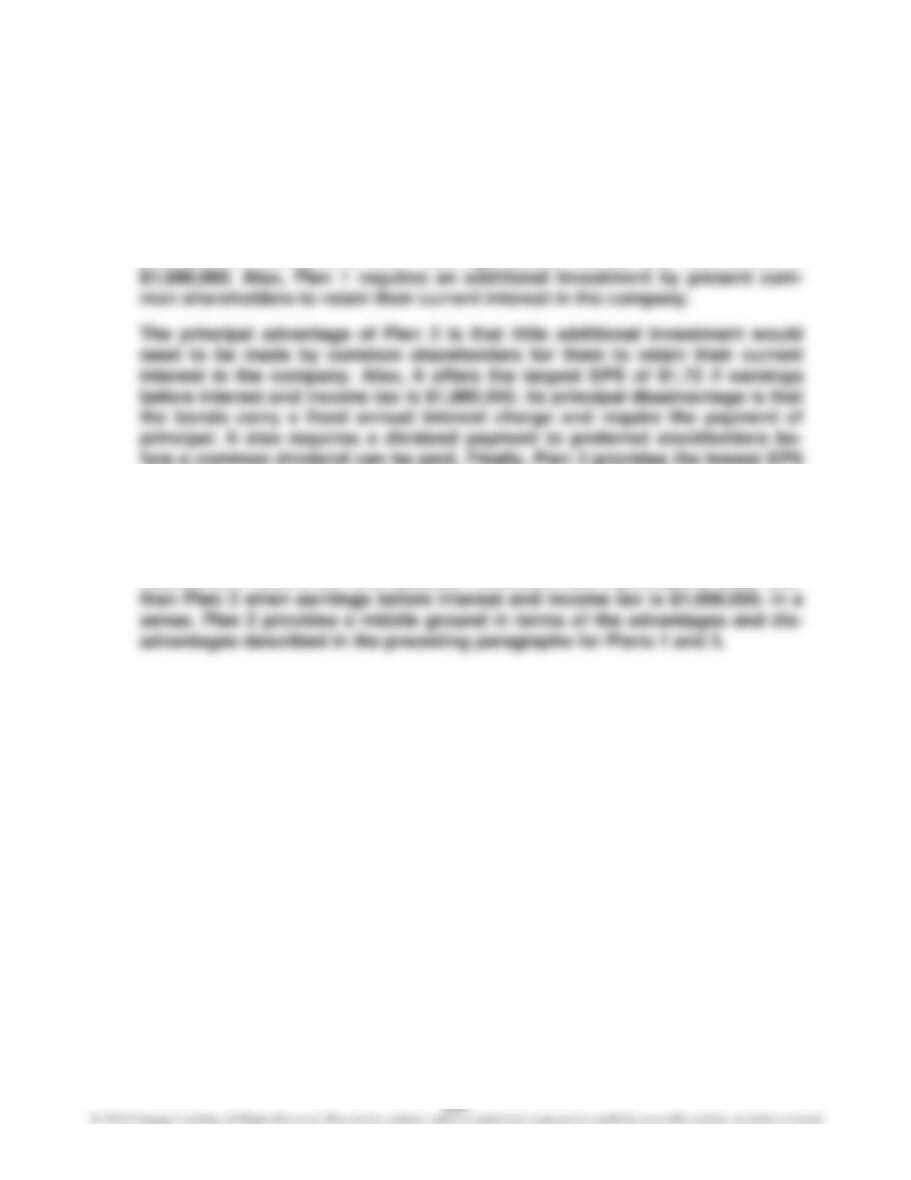
3. The principal advantage of Plan 1 is that it involves only the issuance of
common stock, which does not require a periodic interest payment or return
of principal, and a payment of preferred dividends is not required. However, it
provides the lowest EPS when earnings before interest and income tax is
of $0.04 if earnings before interest and income tax is $300,000.
Plan 2 provides an EPS of $0.16 when earnings before interest and income
tax is $300,000, which is lower than Plan 1, but higher than Plan 3. Plan 2 pro-
vides an EPS of $1.00, which is higher than Plan 1 when earnings before
interest and income tax is $1,000,000. However, Plan 2 provides a lower ESP
FINANCIAL ANALYSIS
FA8–1
1. Year 2 Year 1
2. Ratio of stockholders’ equity to total assets:
(100.0 – 55.8%) or ($17,898 ÷ $40,518) ……… 44.2%
(100.0 – 52.9%) or ($18,889 ÷ $40,125) ……… 47.1%
3. Ratio of liabilities to stockholders’ equity:
4. Home Depot is financed primarily with debt. The ratios of liabilities to total
6. 26.7 ($66.60 ÷ $2.49)
7. 21.8 ($44.20 ÷ $2.03)
8. The price-earnings ratio has increased from 21.8 to 26.7 during Year 2. This
increase in the price-earnings ratio implies that the market has changed its
FA8–2
1. Lowe’s Home Depot
Year 2 Year 1 Year 2 Year 1
2. Lowe’s Home Depot
Year 2 Year 1 Year 2 Year 1
Price-earnings ratio ……………………………….. 26.9 18.6 26.7 21.8
FA8–3
1. Year 2 Year 1
Ratio of liabilities to total assets:
($22,083 ÷ $93,798) …………………………………. 23.5%
($14,429 ÷ $72,574) …………………………………. 19.9%
2. Ratio of stockholders’ equity to total assets:
(100.0 – 23.5%) or ($71,715 ÷ $93,798) ……… 76.5%
(100.0 – 19.9%) or ($58,145 ÷ $72,574) ……… 80.1%
5. Total liabilities have increased slightly as a percent of total assets in Year 2;
thus, creditors would feel less safe. However, the large amount of equity fi-
nancing implies that creditors have little to worry about.
6. 23.2 ($762.10 ÷ $32.81)
FA8–4
1. Year 2 Year 1
Ratio of liabilities to total assets:
($57,854 ÷ $176,064) ……………………………….. 32.9%
($39,756 ÷ $116,371) ……………………………….. 34.2%
4. Apple is financed primarily with equity. The ratios of liabilities to total assets,
stockholders’ equity to total assets, and liabilities to stockholders’ equity for
Years 1 and 2 all indicate that total liabilities are less than total stockholders’
equity.
5. Total liabilities have decreased slightly as a percent of total assets in Year 2;
7. 16.4 ($459.68 ÷ $28.05)
8. The price-earnings ratio has decreased from 16.4 to 10.0 during Year 2. This
decrease in the price-earnings ratio implies that the market has changed its
expectation for earnings growth and that it expects earnings to grow slower
FA8–5
Ratio of Liabilities to Total Assets Price-Earnings Ratio
More than 50% (Yes, No) Above 10 (Yes, No)
Alcoa Yes Yes
McDonald’s Yes Yes
56.4% ($18,600 ÷ $32,990) 17.8 ($94.80 ÷ $5.33)
Nike No Yes
32.9% ($5,084 ÷ $15,465) 11.2 ($53.88 ÷ $4.83)
Walmart Yes Yes
60.8% ($117,645 ÷ $193,406) 15.3 ($69.62 ÷ $4.54)
Note to Instructors: The ratio of liabilities to total assets and price-earnings ratios
are based upon recent financial statements and market prices. The objective was
to get students to think about these companies and what they would expect for
CASES
Case 8–1
1. The so-called “underground economy” hides transactions from IRS scrutiny
by conducting business with cash (not check or credit card, which leaves an
audit trail). The intent in many such transactions is to evade income tax ille-
2. Jas should respond that he would rather receive a payroll check as a normal
employee does. Receiving cash as an employee, rather than a payroll check,
subverts the U.S. tax system. That is, such cash payments do not include
Case 8–2
This activity does not require the student to research the contingency notes for
the Altria Group. The contingency disclosure is extensive and complicated.
Rather, the student should identify Altria Group’s main business and, from this
information, determine the likely cause of the contingency disclosures
1. Altria Group is a holding company for a number of businesses including
2. The health concerns surrounding tobacco products give rise to numerous
lawsuits and legal actions against Altria. The notes to the financial statements
Case 8–3
1. This case involves a transaction in which a security has been issued that has
characteristics of both stock and debt. The primary argument for classifying
the issuance of the common stock as debt is that the investors have a legal
right to an amount equal to the purchase price of the security. This is similar
2. In practice, the $25 million stock issuance would probably be classified as
common stock. However, full disclosure should be made of the 2% of net
sales and $50 per share payment obligation in the notes to the financial
statements. In addition, as Sahara Unlimited Inc. generates net sales, a cur-
Case 8–4
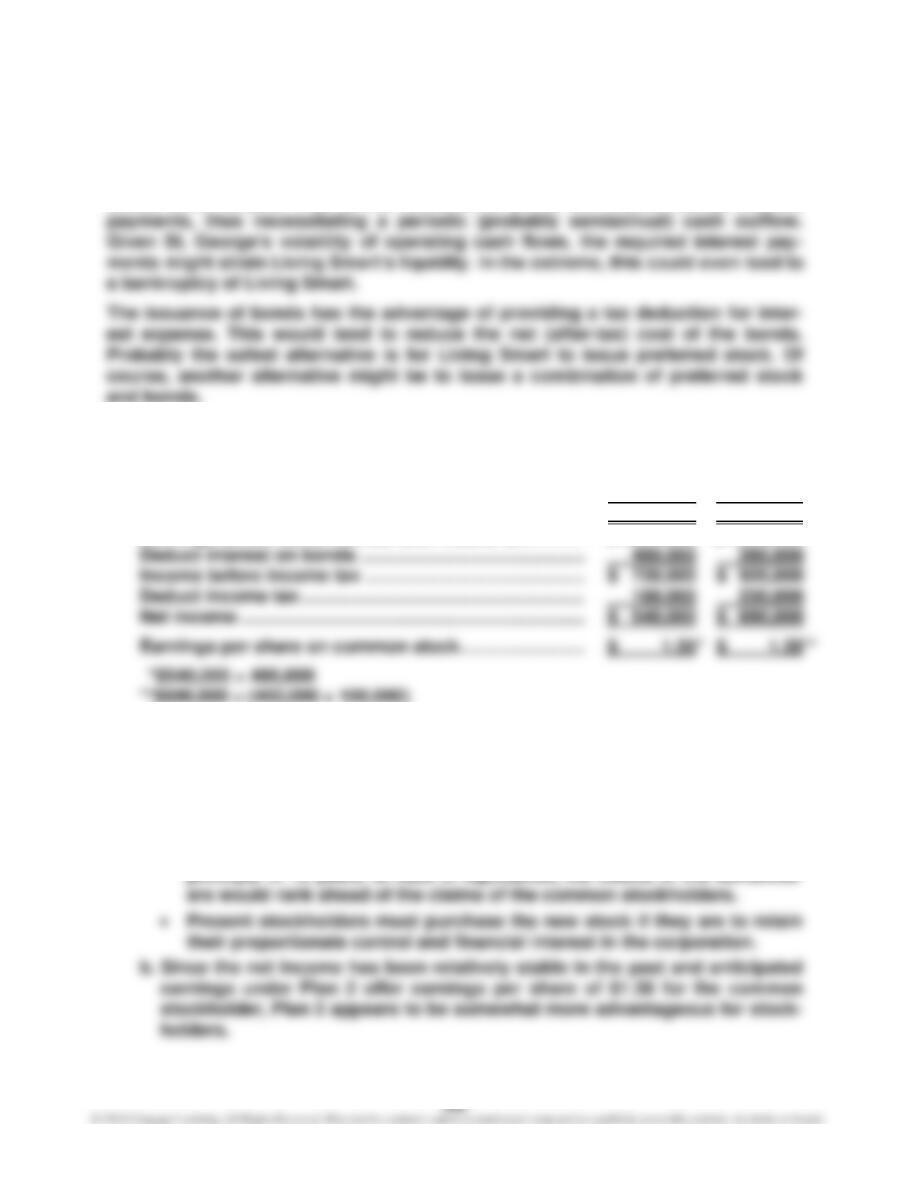
The primary advantage of issuing preferred stock rather than bonds is that the
preferred stock does not obligate Living Smart to pay dividends, while interest on
bonds must be paid. That is, the issuance of bonds will require annual interest
Case 8–5
1. Plan 1 Plan 2
Shares of common stock ………………………………………. 400,000 500,000
Earnings before bond interest and income tax ……….. $1,200,000 $1,200,000
2. a. Factors to be considered in addition to earnings per share:
• There is a definite legal obligation to pay interest on bonds, but there is
no definite commitment to pay dividends on common stock. Therefore,
if net income should drop substantially, bonds would be less desirable
than common stock.
• If the bonds are issued, there is a definite commitment to repay the
Case 8–6
Note to Instructors: The purpose of this activity is to familiarize students with
sources of information about corporations and how that information is useful in
evaluating the corporation’s activities.
The following information was prepared for Google Inc. based upon the SEC 10-K
filing for the year ending December 31, 2012.
1. Google Inc.
2. Delaware
3. The following is taken from Google’s 10–K:
“Google is a global technology leader focused on improving the ways people
connect with information. We aspire to build products that improve the lives
of billions of people globally. Our mission is to organize the world’s infor-
mation and make it universally accessible and useful. Our innovations in
4. $72,574,000,000
5. $50,175,000,000
Case 8–6, Concluded
Class A and Class B common stock and additional paid-in capital, $0.001 par
value per share: 9,000,000 shares authorized (Class A 6,000,000, Class B
3,000,000) and 12,000,000 shares authorized (Class A 9,000,000, Class B
3,000,000); 324,895 (Class A 257,553, Class B 67,342) and par value of $325
Note to Instructors: The rights of Class A and Class B common stock are identi–
cal except for voting rights. Specifically, each share of Class A common stock is
entitled to one vote per share. Each share of Class B common stock is entitled to
10 votes per share. Shares of Class B common stock may be converted at any
time at the option of the stockholder and automatically convert upon sale or
transfer to Class A common stock. The Class A common stock is the stock that is
actively traded on the New York Stock Exchange. The Class B common stock al-
lows the founders of Google (Sergey Brin and Larry Page) and the CEO (Eric
Schmidt) to maintain control of the corporation. Specifically, the following is stat-
ed in Google’s 10–K:
8. $923.00 as of close on July 12, 2013
9. $568.40 – $923.00
10. Google Inc. does not pay dividends as stated in its December 31, 2012, 10–K: