
8-1
CHAPTER 8
BUDGETING FOR PLANNING AND CONTROL
DISCUSSION QUESTIONS
1. Budgets are the quantitative expressions of
plans. Budgets are used to translate the
goals and strategies of an organization into
operational terms.
2. Control is the process of setting standards,
receiving feedback on actual performance,
and taking corrective action whenever actual
performance deviates from planned perfor-
mance. Budgets are the standards, and they
are compared with actual costs and reve-
nues to provide feedback.
3. Budgeting forces managers to plan, provides
resource information for decision making,
sets benchmarks for control and evaluation,
and improves the functions of communication
and coordination.
4. The master budget is the collection of all
individual area and activity budgets. Operat-
ing budgets are concerned with the income–
generating activities of a firm. Financial
budgets are concerned with the inflows and
outflows of cash and with planned capital
expenditures.
5. The sales forecast is a critical input for build-
ing the sales budget. It, however, is not nec-
essarily equivalent to the sales budget. Upon
receiving the sales forecast, management
may decide that the firm can do better or
needs to do better than the forecast is indi–
cating. Consequently, actions may be taken
to increase the sales potential for the coming
year (e.g., increasing advertising). This ad-
justment then becomes the sales budget.
6. Yes. All budgets essentially are founded on
the sales budget. The production budget
depends on the level of planned sales. The
manufacturing budgets, in turn, depend on
the production budget. The same is true for
the financial budgets since sales is a critical
input for budgets in that category.
7. An accounts receivable aging schedule gives
the proportion of accounts receivable that
are, on average, collected in the months fol-
lowing sale. It is important in creating the
cash budget, since the sales on account for
past months can be multiplied by the appro–
priate percentage to yield the amount of cash
expected.
8. If the vice president of sales is a pessimistic
individual, one might expect that she or he
would underestimate sales for the coming
year. In your role as head of the budget pro-
cess, you might increase the budgeted sales
figure to take out the individual bias.
9. If the factory controller is a particularly opti-
mistic individual, it is possible that the costs
for direct materials, direct labor, and over-
head could be underestimated. For exam-
ple, an optimistic person might assume that
everything will go well (e.g., that there will be
no problems in obtaining an adequate sup-
ply of materials at the lowest possible price).
As head of the budget process, you might
allow for somewhat higher costs to more ac-
curately reflect reality.
10. The learning curve is the relationship be-
tween unit costs of production and increas-
ing number of units. As time goes on, the
number of units produced in a time period
will increase and the cost per unit will de-
crease. The budgets affected will be the
direct materials purchases budget, the direct
labor budget, and the overhead budget.
11. Small firms often do not engage in a compre-
hensive master budgeting process. (Person–
ally, we believe that is a mistake. The budget–
ing process helps management more fully
understand the business and helps them to
plan for the coming year.) Even small busi–
nesses create cash budgets, however, be-
cause cash flow is critically important. For
example, it is possible to have positive oper-
ating income, but negative cash flow (e.g., if
sales on account are high, but customers are
slow to pay). Negative cash flow could put a
company out of business in short order.
12. The master budget has been criticized for
the following reasons: it does not recognize
the interdependencies among departments,
it is static, and it is results rather than pro-
cess oriented. These criticisms are especially
apparent when companies are in a competi-

8-2
tive, dynamic environment. When the envi-
ronment changes slowly, if at all, the master
budget would do a good job of both planning
and control.
13. A static budget is one that is not adjusted for
changes in activity. Using a static budget for
control can be a real problem. For example,
suppose that the master (static) budget is
based on the production and sale of 100,000
units, but that only 90,000 units are actually
produced and sold. Further suppose that the
budgeted variable cost of goods sold was
$2,000,000, and that the actual variable cost
of goods sold was $1,890,000. It looks as if
the company spent less than expected for
variable manufacturing costs. However, the
budgeted variable cost was $20 per unit
($2,000,000/100,000), and the actual varia-
ble cost per unit is $21 per unit
($1,890,000/90,000). Not adjusting the
budget for changes in activity level can mis-
lead managers about efficiency.
14. A flexible budget is (1) a budget for various
levels of activity or (2) a budget for the actual
level of activity. The first type of flexible
budget is used for planning and sensitivity
analysis. The second type of budget is used
for control, since the actual costs of the actual
level of activity can be compared with the
planned costs for the actual level of activity.
15. The activity-based budget starts with output,
determines the activities necessary to create
that output, and then determines the re-
sources necessary to support the activities.
This differs from the traditional master
budgeting process in that the master budget
leaps directly from output to resources.
Some of the resource levels are assumed to
be fixed. This makes them independent of
volume changes and hides the drivers that
actually do affect the fixed resources. As a
result, the budget format does not support
the creation of value and the thinking that
would go into determining the sources of
waste.
CORNERSTONE EXERCISES
Cornerstone Exercise 8.1
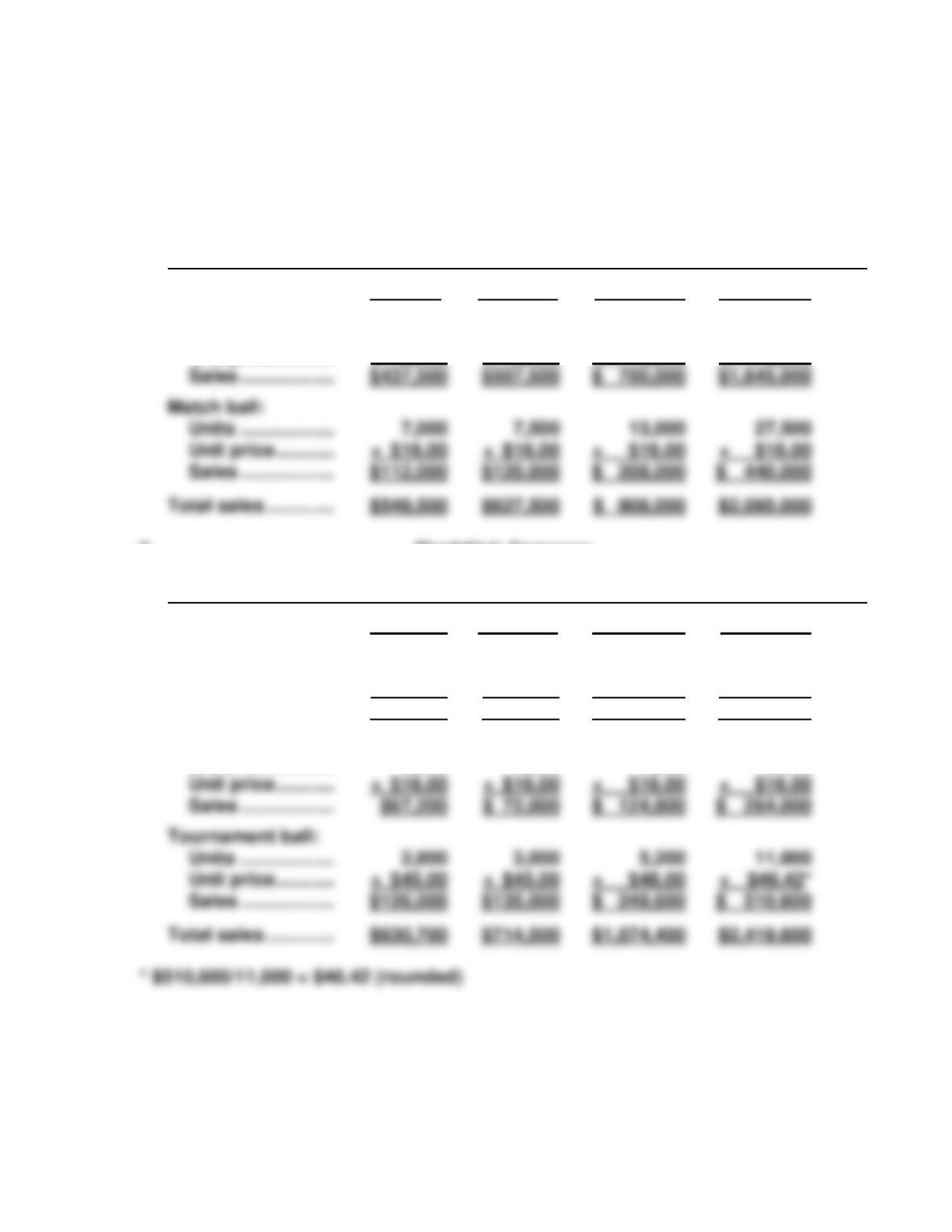
1. FlashKick Company
Sales Budget
For the First Quarter
January February March Quarter
Practice ball:
Units ……………… 50,000 58,000 80,000 188,000
Unit price ……….. × $8.75 × $8.75 × $8.75 × $8.75
2. FlashKick Company
Sales Budget
For the First Quarter
January February March Quarter
Practice ball:
Units ……………… 50,000 58,000 80,000 188,000
Unit price ……….. × $8.75 × $8.75 × $8.75 × $8.75
Sales ……………… $437,500 $507,500 $ 700,000 $1,645,000
Match ball:
Units ……………… 4,200 4,500 7,800 16,500
Cornerstone Exercise 8.2
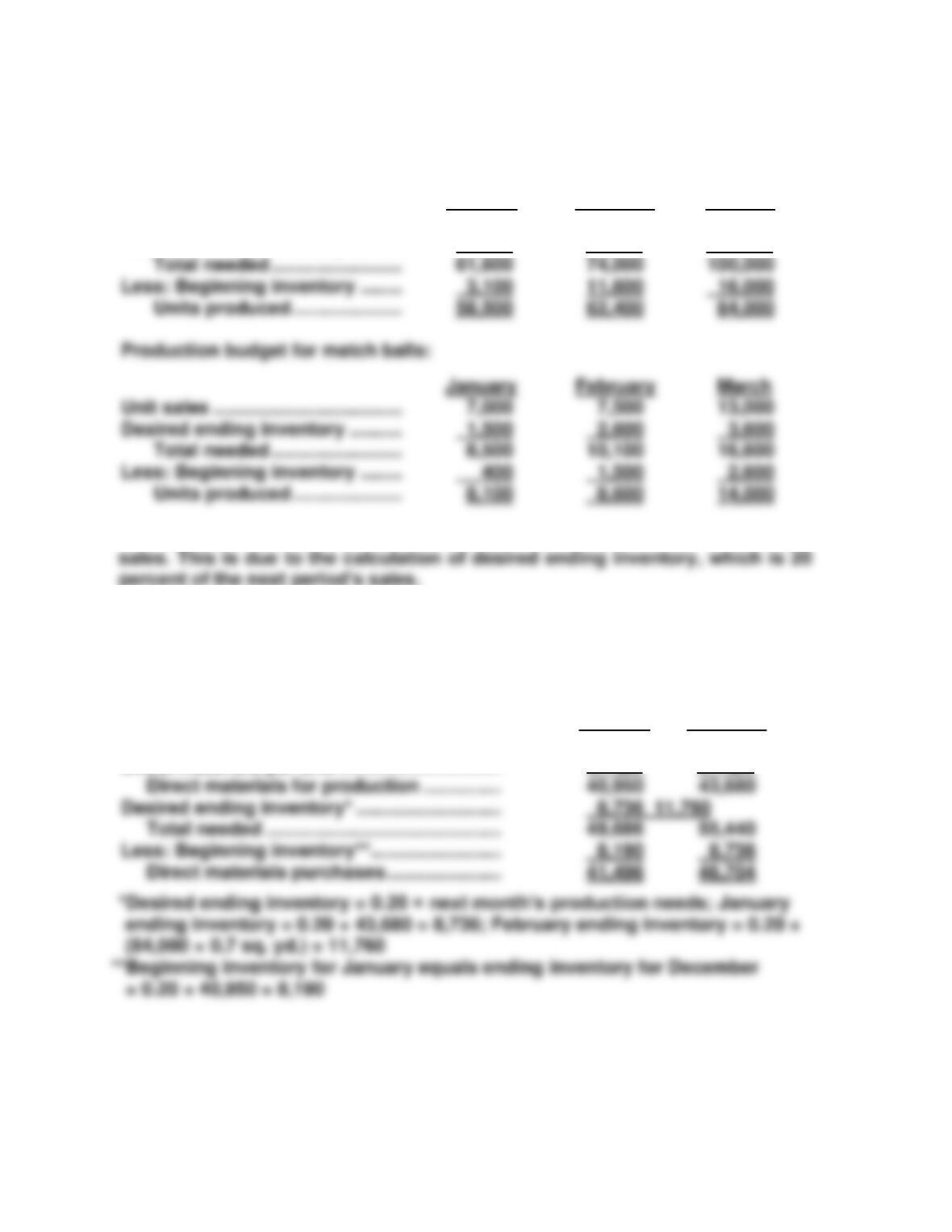
1. Production budget for practice balls:
January February March
Unit sales ……………………………… 50,000 58,000 80,000
Desired ending inventory ………. 11,600 16,000 20,000
2. In order to construct a production budget for April, you would need May
Cornerstone Exercise 8.3
1. Direct materials purchases budget for practice balls:
Polyvinyl chloride panels: January February
Units produced ………………………………………. 58,500 62,400
Direct materials per unit …………………………. × 0.7 × 0.7
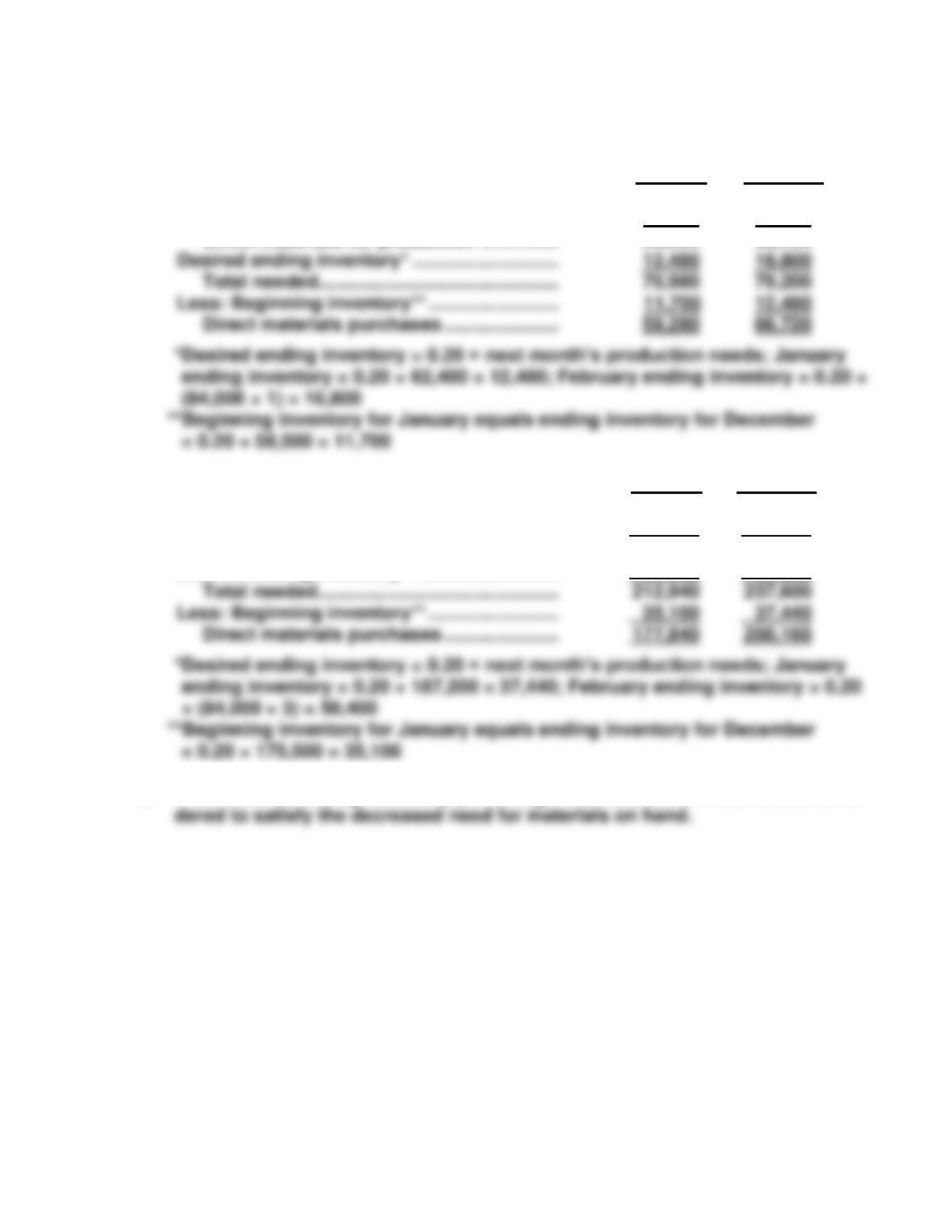
Cornerstone Exercise 8.3 (Concluded)
Bladder and valve: January February
Units produced ………………………………………. 58,500 62,400
Direct materials per unit ………………………….. × 1 × 1
Direct materials for production …………… 58,500 62,400
Glue: January February
Units produced ………………………………………. 58,500 62,400
Direct materials per unit ………………………….. × 3 × 3
Direct materials for production …………… 175,500 187,200
Desired ending inventory* ………………………. 37,440 50,400
2. If the desired ending inventory percentage decreases, then less would be or-
Cornerstone Exercise 8.4
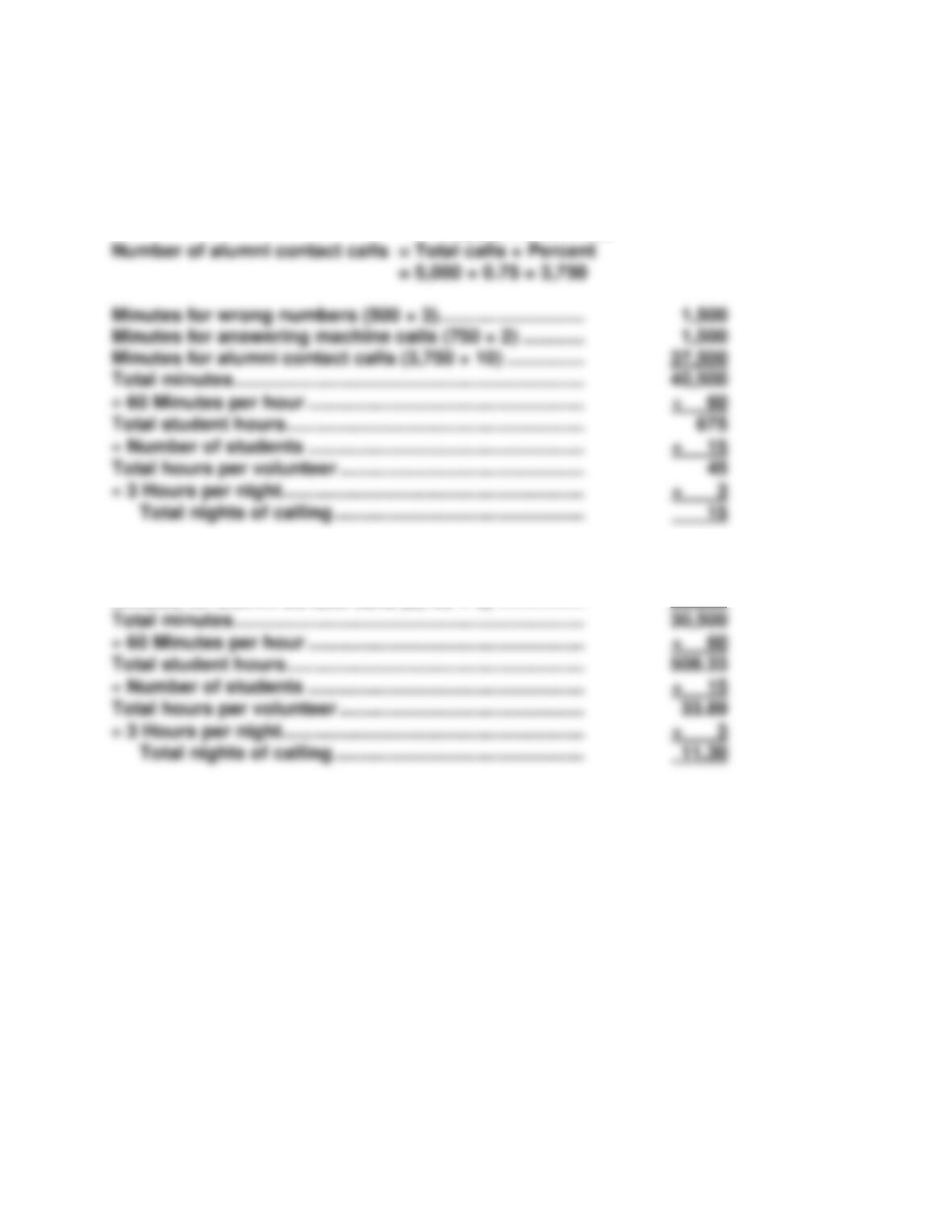
1. Number of wrong numbers = Total calls × Percent
= 5,000 × 0.10 = 500
Number of answering machine calls = Total calls × Percent
= 5,000 × 0.15 = 750
2. Minutes for wrong numbers (500 × 1) ………………………. 500
Minutes for answering machine calls (750 × 0) ………… 0
Minutes for alumni contact calls (3,750 × 8) …………….. 30,000
Cornerstone Exercise 8.5
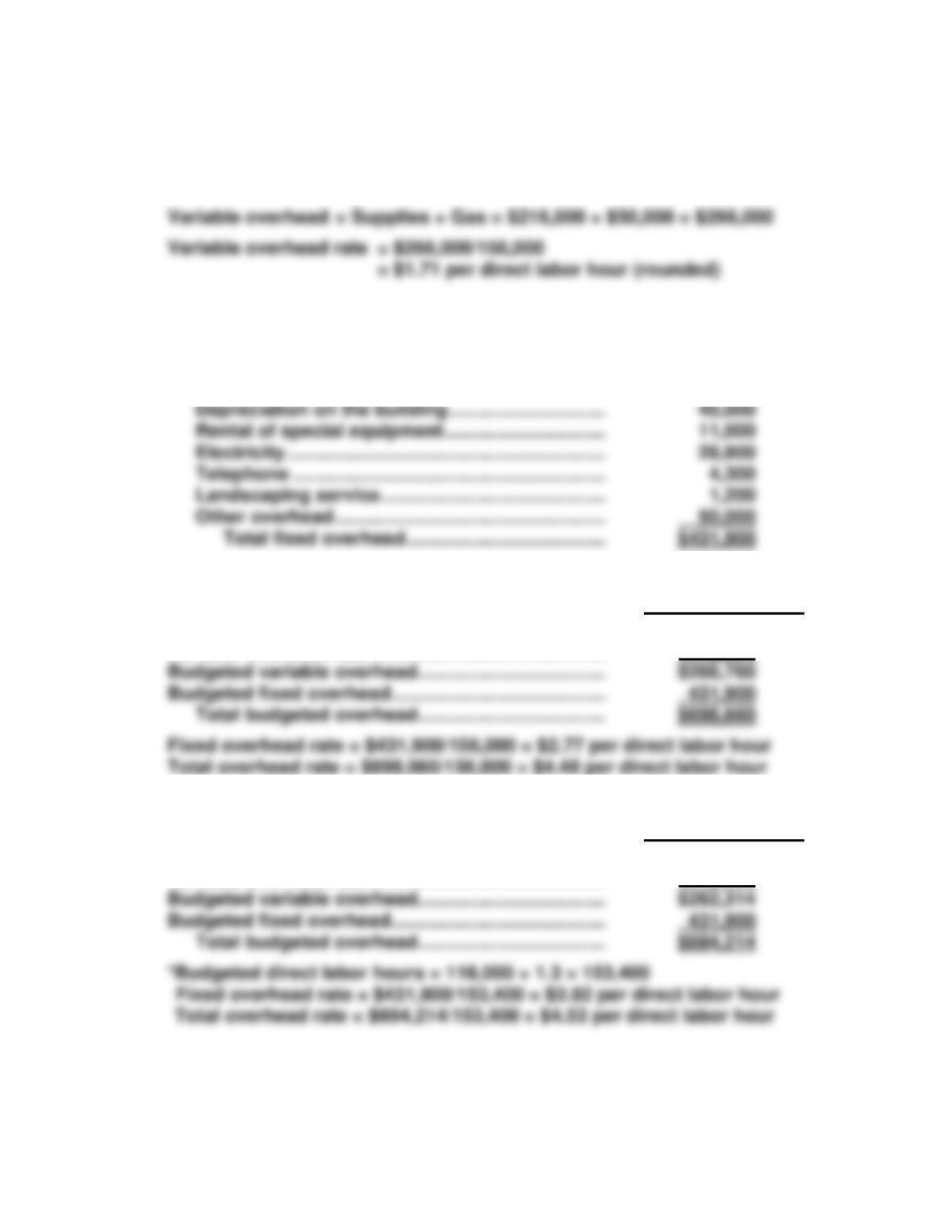
1. Direct labor hours = Budgeted unit × Budgeted direct labor hours per unit
= 120,000 × 1.3 = 156,000 direct labor hours
Budgeted fixed overhead:
Indirect labor ………………………………………………. $176,000
Supervision …………………………………………………. 73,500
Depreciation on equipment ………………………….. 47,000
2. Overhead Budget
For the Year
Budgeted direct labor hours……………………………… 156,000
Variable overhead rate ……………………………………… × $1.71
3. Overhead Budget
For the Year
Budgeted direct labor hours* ……………………………. 153,400
Variable overhead rate ……………………………………… × $1.71
Cornerstone Exercise 8.6
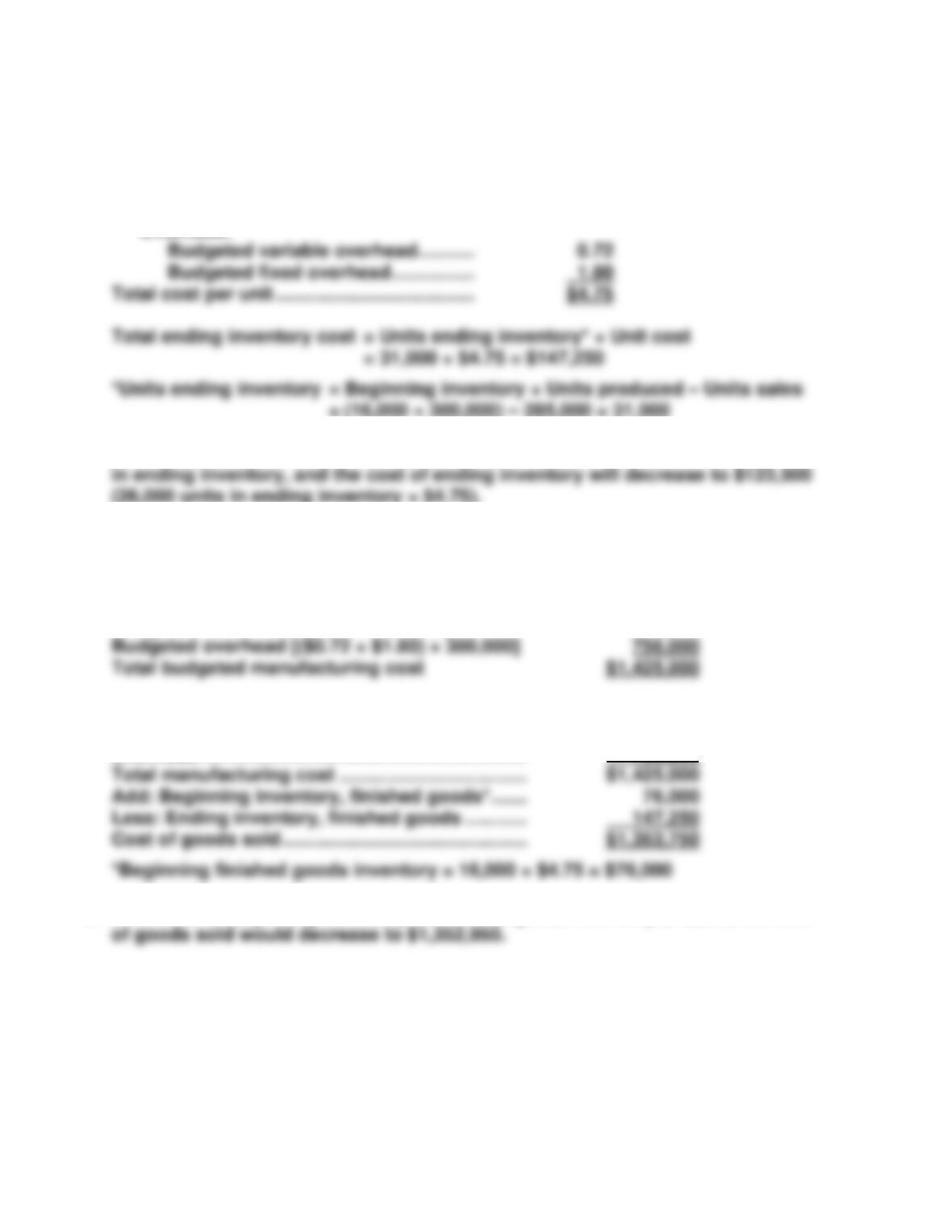
1. Unit costs:
Direct materials ………………………………. $1.67
Direct labor …………………………………….. 0.56
Overhead:
= (16,000 + 300,000) – 285,000 = 31,000
2. If the number of units sold increases to 290,000, there will be 5,000 fewer units
Cornerstone Exercise 8.7
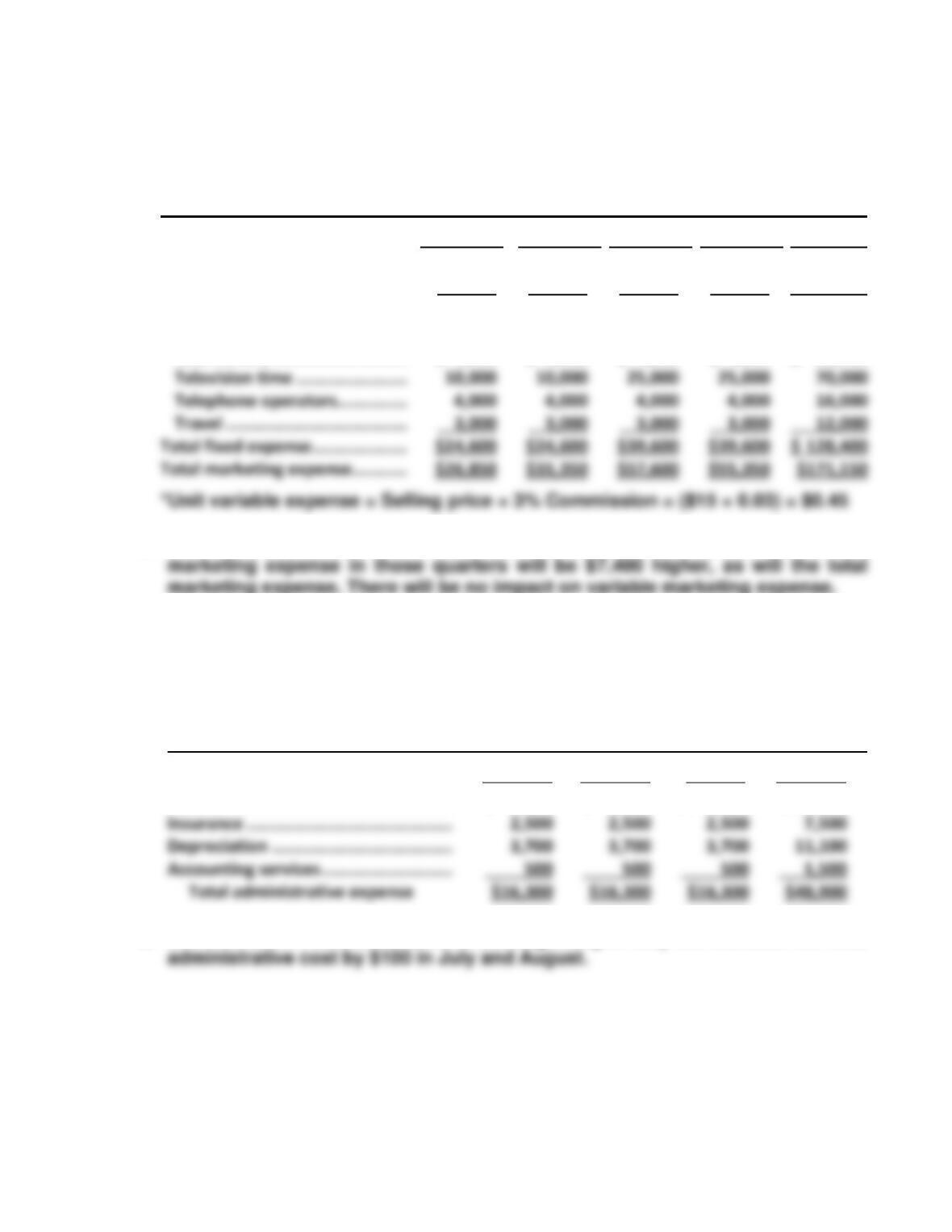
1. Budgeted direct materials ($1.67 × 300,000) $ 501,000
Budgeted direct labor($0.56 × 300,000) 168,000
2. Direct materials ……………………………………………. $ 501,000
Direct labor ………………………………………………….. 168,000
Overhead ……………………………………………………… 756,000
3. If the cost of beginning inventory of finished goods was only $75,200, the cost
Cornerstone Exercise 8.8
1. Hair-Again
Marketing Expense Budget
For the Year Ended December 31
Quarter 1 Quarter 2 Quarter 3 Quarter 4 Total
Budgeted unit sales ……………… 5,000 15,000 40,000 35,000 95,000
Unit variable expense* …………. × $0.45 × $0.45 × $0.45 × $0.45 × $0.45
Total variable expense ………….. $ 2,250 $ 6,750 $18,000 $15,750 $ 42,750
Fixed marketing expense:
Internet ads ……………………… $ 7,600 $ 7,600 $ 7,600 $ 7,600 $ 30,400
2. If the cost of internet ads rises to $15,000 in Quarters 2, 3, and 4, the fixed
Cornerstone Exercise 8.9
1. Green Earth Landscaping Company
Administrative Expense Budget
For the Summer Months
June July August Total
Salaries …………………………………….. $ 9,600 $ 9,600 $ 9,600 $28,800
2. The increase in insurance rates at the beginning of July will increase the total
Cornerstone Exercise 8.10
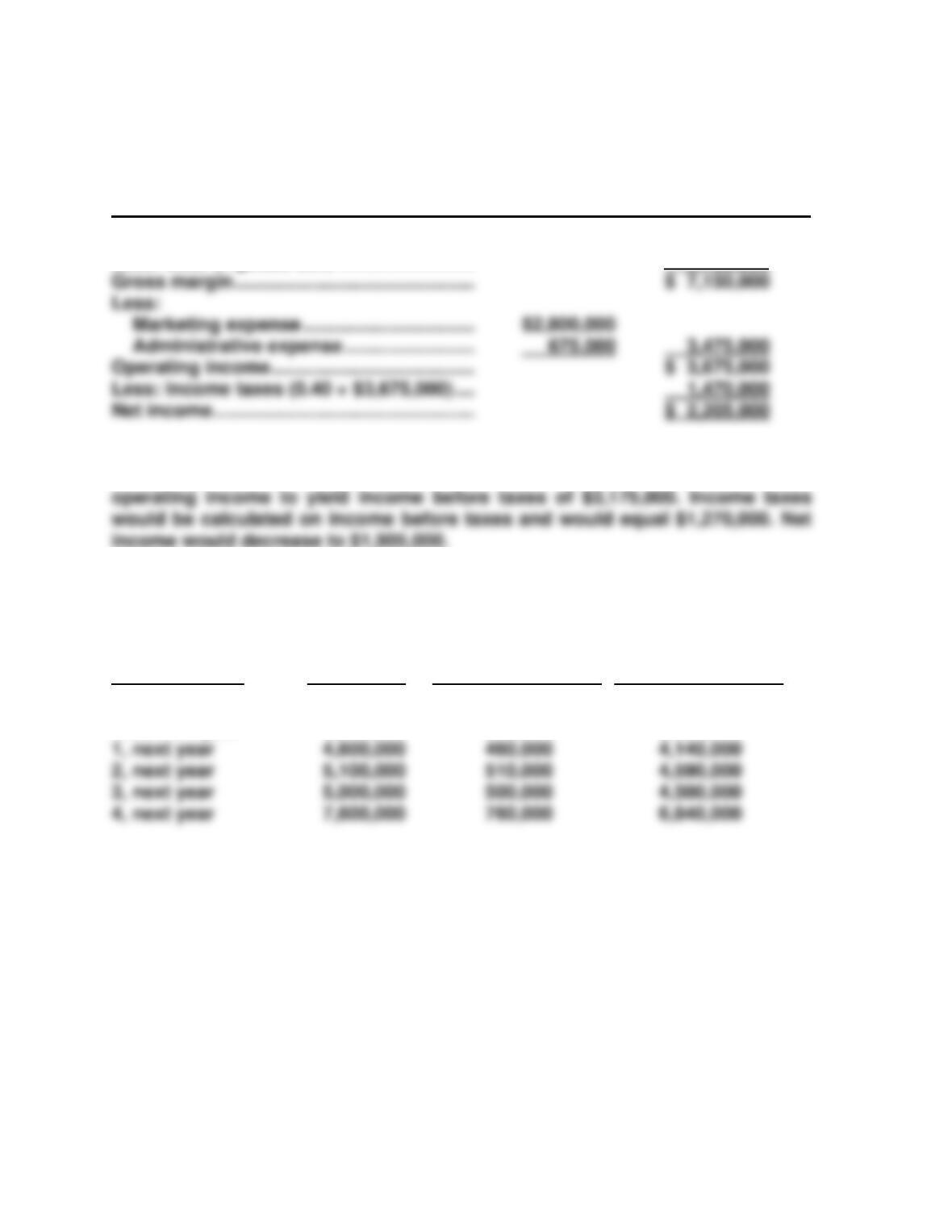
1. Coral Seas Jewelry Company
Budgeted Income Statement
For the Coming Year
Sales …………………………………………………… $ 15,900,000
Less: Cost of goods sold …………………….. 8,750,000
2. If Coral Seas Jewelry Company has interest expense of $500,000, there would
be no impact on operating income. Interest expense would be subtracted from
Cornerstone Exercise 8.11
1. Cash Sales Credit Sales
Quarter Total Sales (10% of total sales) (90% of total sales)
3, current year $4,900,000 $490,000 $4,410,000
4, current year 6,850,000 685,000 6,165,000
Cornerstone Exercise 8.11 (Concluded)
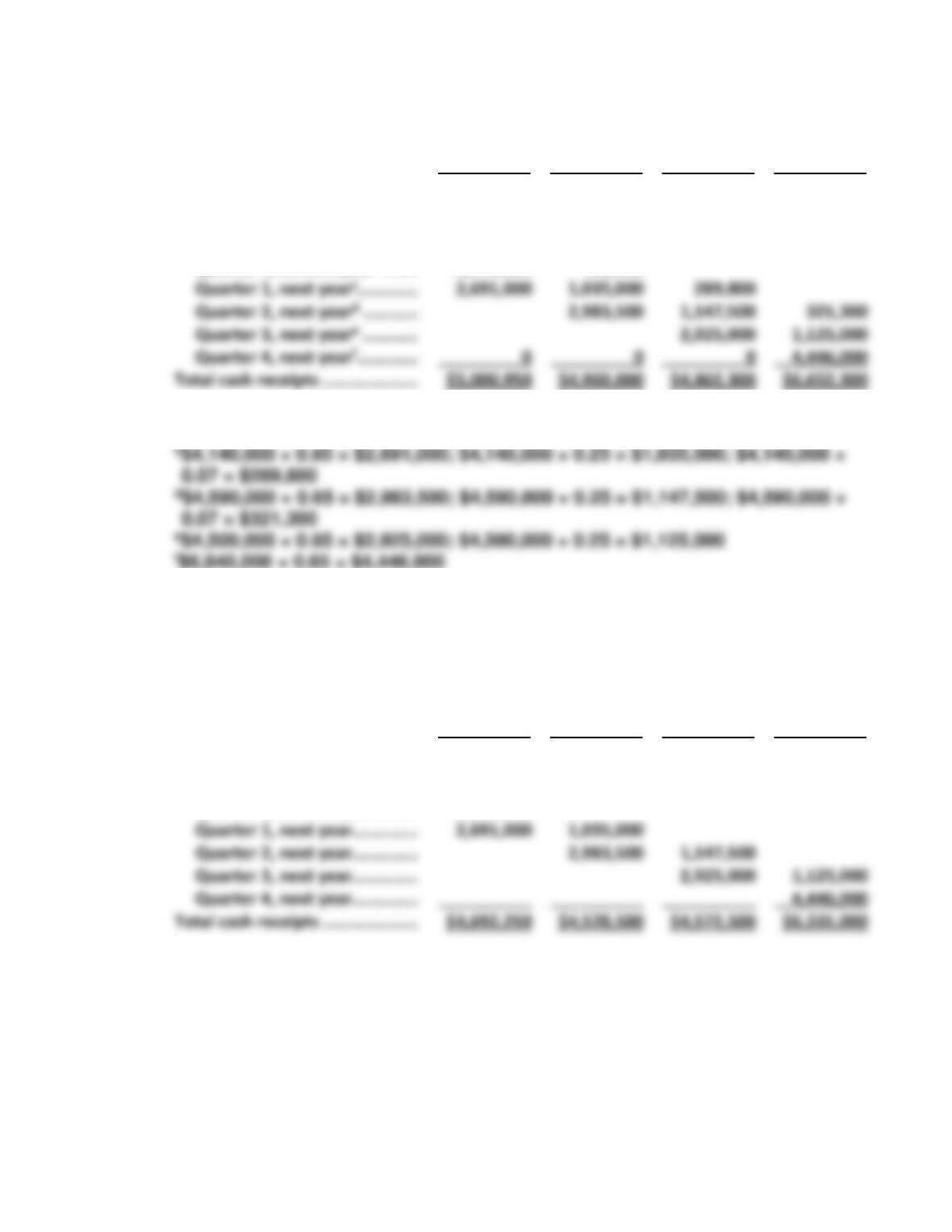
2. Quarter 1 Quarter 2 Quarter 3 Quarter 4
Cash sales ………………………….. $ 460,000 $ 510,000 $ 500,000 $ 760,000
Received on account from:
Quarter 3, current yeara …….
308,700
Quarter 4, current yearb ……. 1,541,250 431,500
a$4,410,000 × 0.07 = $308,700
b$6,165,000 × 0.25 = $1,541,250; $6,165,000 × 0.07 = $431,500
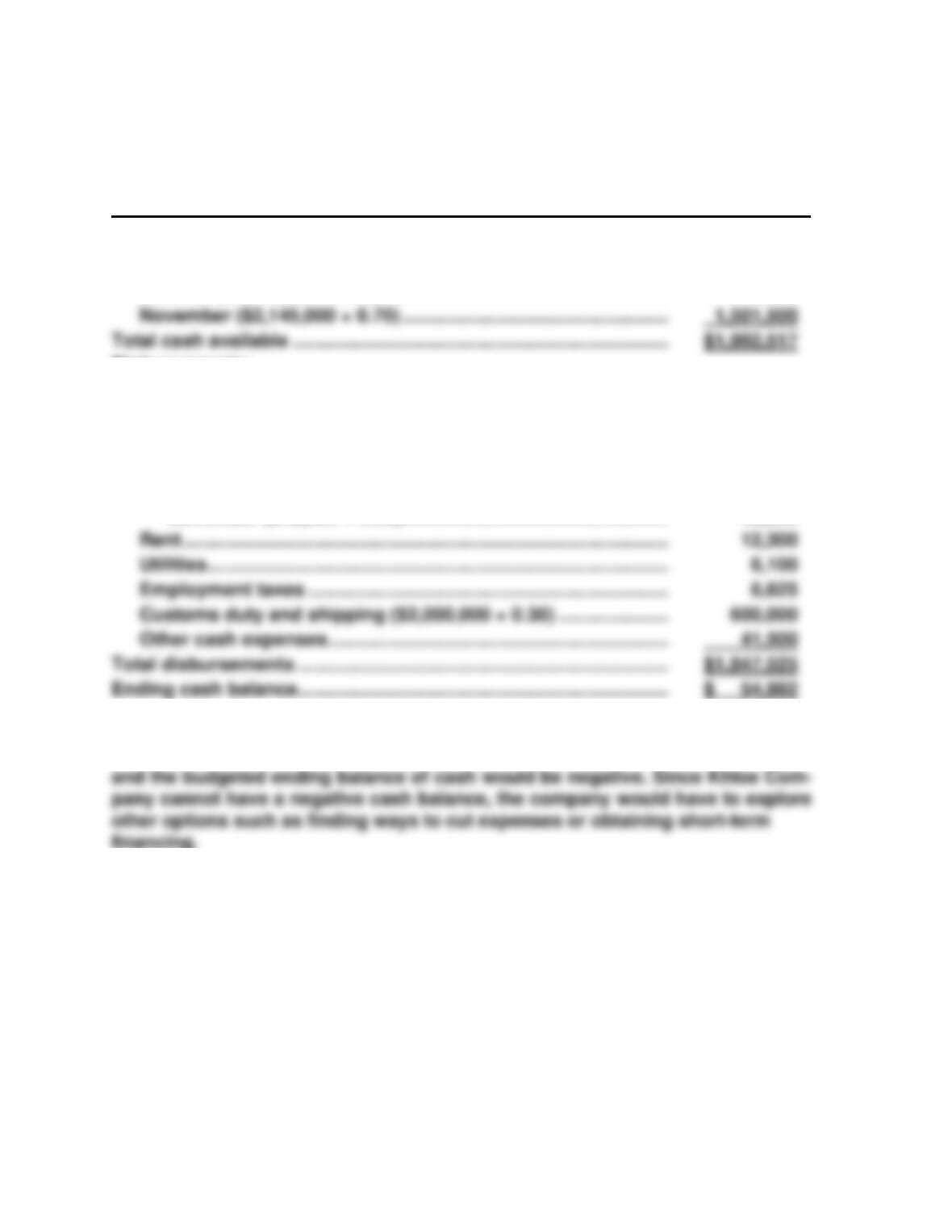
3. If Shalimar’s percentage of uncollectible accounts rises to 10 percent, then no
cash would be collected in the second quarter after the sale. The 10 percent of
credit sales is bad debt expense; it never appears on the cash budget since it
is never collected in cash. The following is the cash receipts budget using the
new assumption.
Quarter 1 Quarter 2 Quarter 3 Quarter 4
Cash sales ………………………….. $ 460,000 $ 510,000 $ 500,000 $ 760,000
Received on account from:
Quarter 4, current year …….. 1,541,250
Cornerstone Exercise 8.12
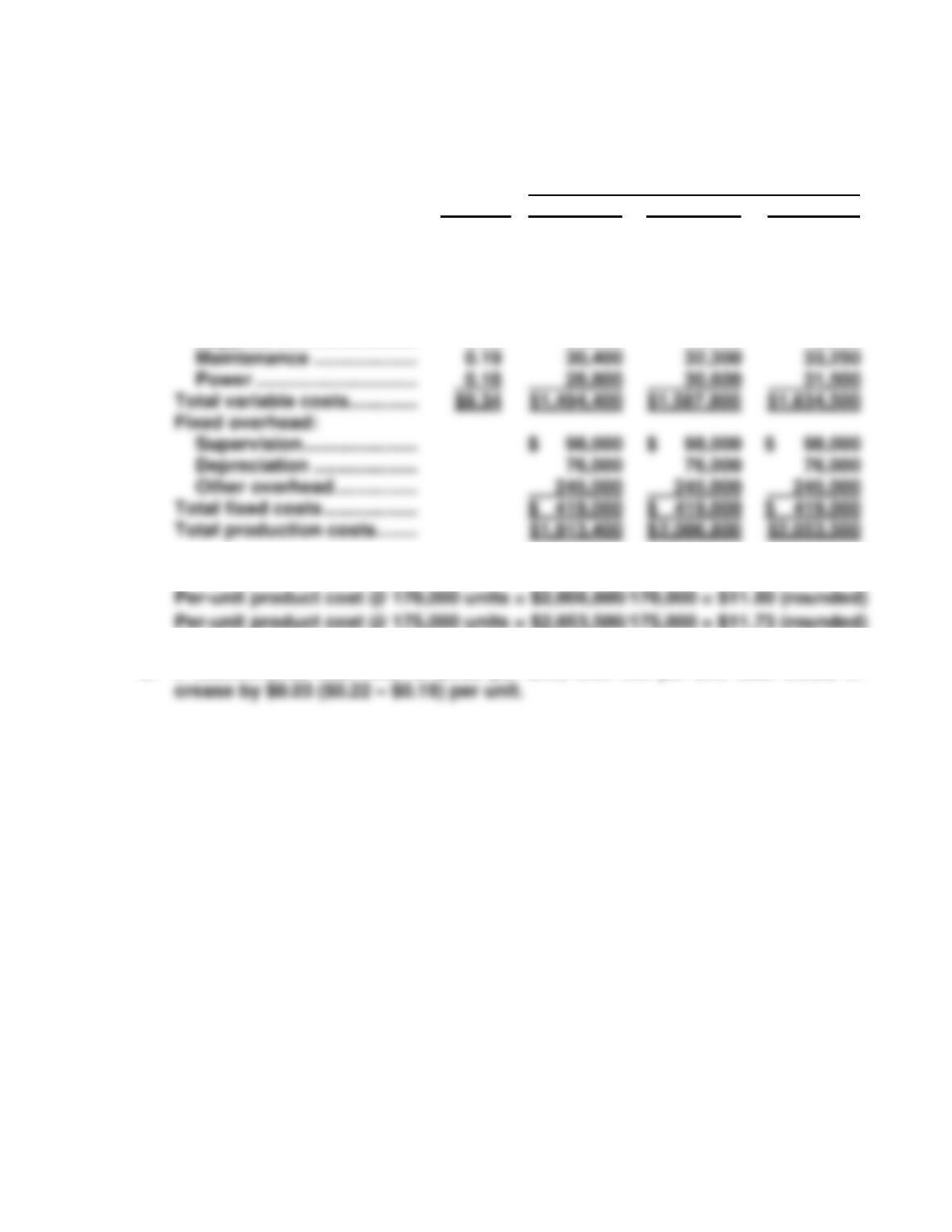
1. Khloe Company
Cash Budget
For the Month of November
Beginning balance, cash account………………………………………….. $ 53,817
Received on account from sales in:
October ($1,240,000 × 0.28) ………………………………………………. 347,200
Disbursements:
Payments for purchases made in:
October ($980,000 × 0.85) …………………………..……………….. 833,000
November ($2,000,000 × 0.15) ………………………………………. 300,000
Salaries paid for work in:
October ($48,000 × 0.10) ……………………………………………… 4,800
November ($48,000 × 0.90) …………………………………………… 43,200
2. If Khloe Company faced a customs duty and shipping percentage of 35 percent,
the cost of customs duty and shipping for November would be $100,000 higher
Cornerstone Exercise 8.13
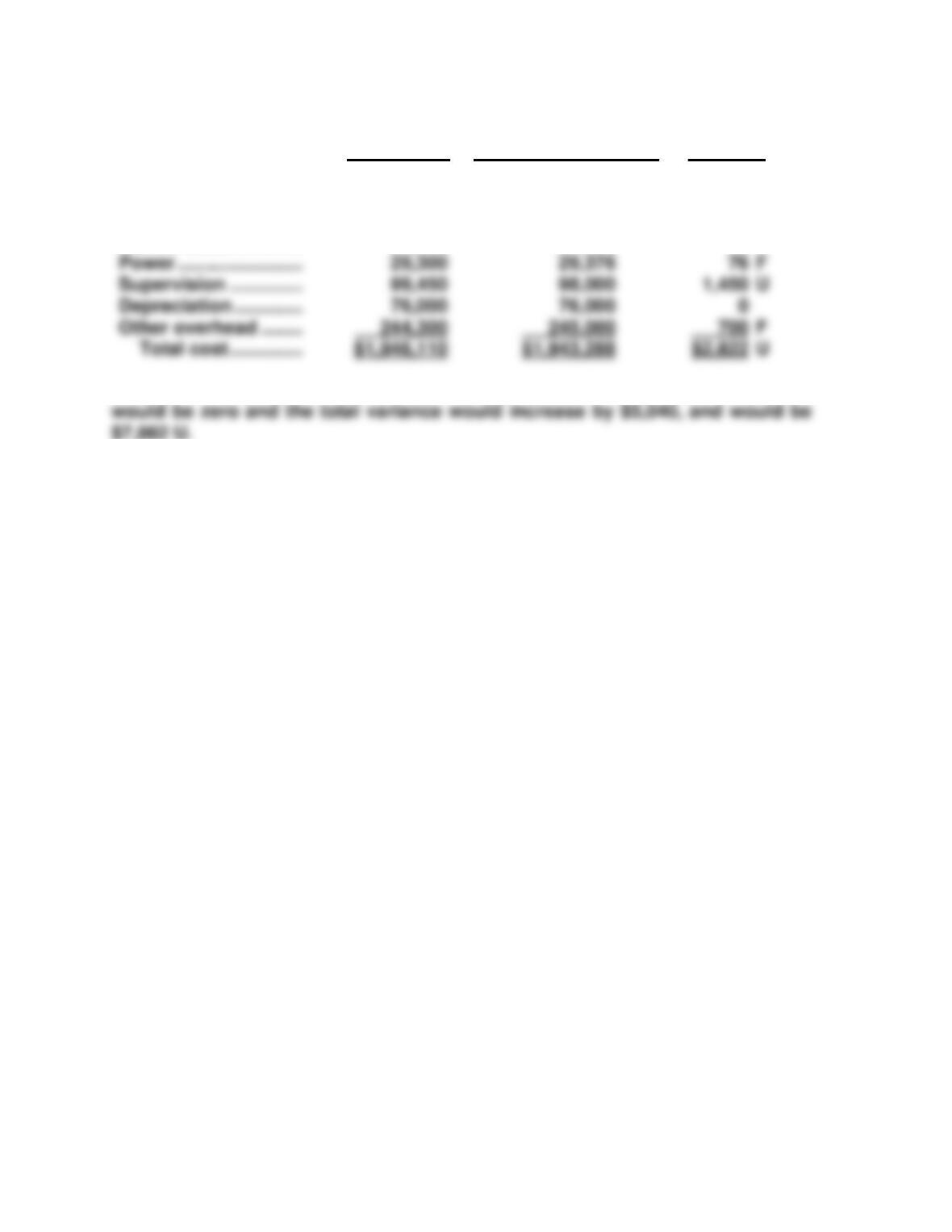
1. Variable
Cost Range of Production in Units
per Unit 160,000 170,000 175,000
Production costs:
Variable:
Direct materials …………… $7.20 $ 1,152,000 $ 1,224,000 $ 1,260,000
Direct labor …………………. 1.54 246,400 261,800 269,500
Variable overhead:
Supplies ……………………… 0.23 36,800 39,100 40,250
2. Per-unit product cost @ 160,000 units = $1,913,400/160,000 = $11.96 (rounded)
3. If maintenance cost rose to $0.22 per unit, then the per-unit cost would in-
Cornerstone Exercise 8.14
1. Actual Cost Flexible Budget Cost Variance
Direct materials …….. $1,170,000 $1,175,040 $5,040 F
Direct labor …………… 258,000 251,328 6,672 U
Supplies ……………….. 38,100 37,536 564 U
Maintenance …………. 30,960 31,008 48 F
2. If Nashler Company’s actual direct materials cost was $1,175,040, the variance
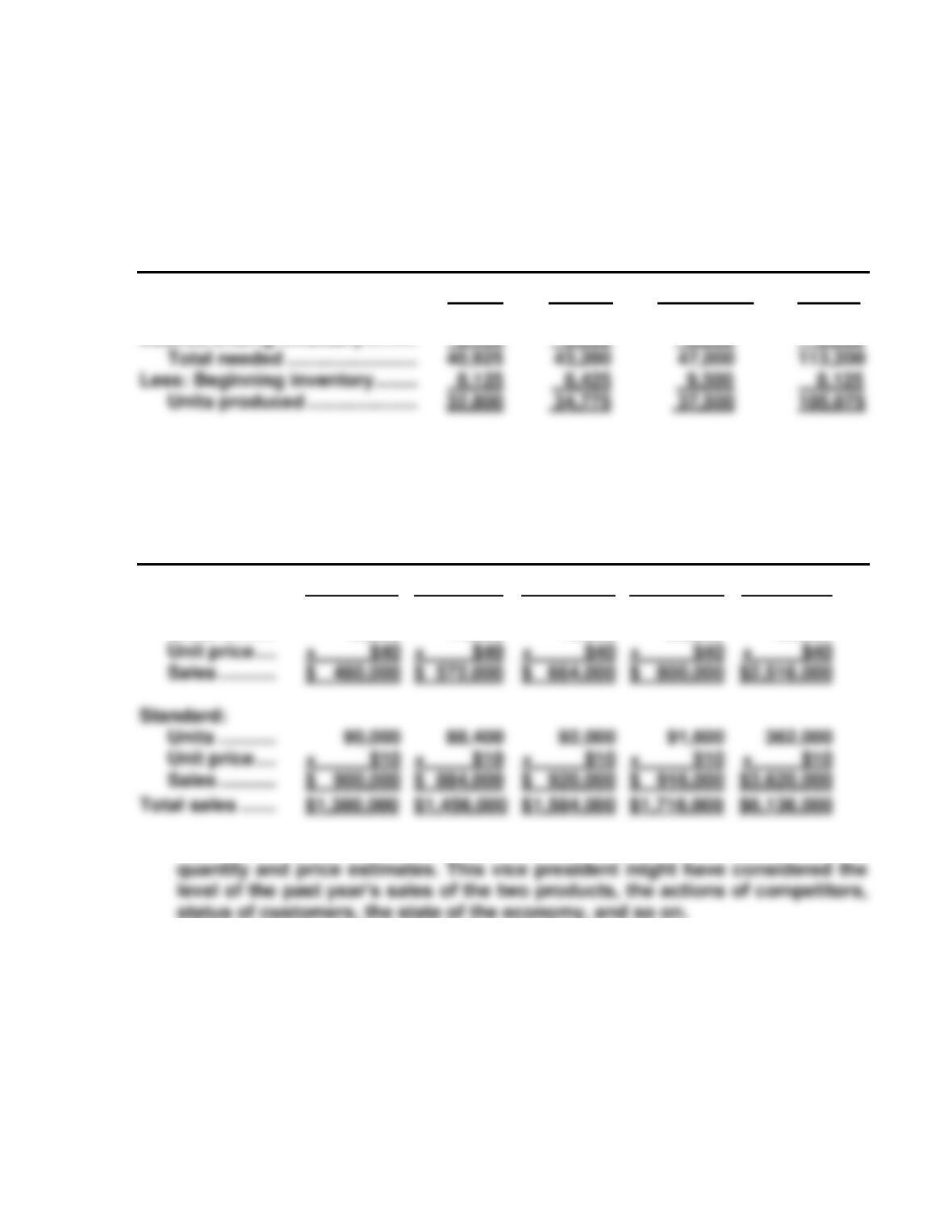
EXERCISES
Exercise 8.15
Palmgren Company
Production Budget
For the Third Quarter
July August September Total
Unit sales ……………………………… 32,500 33,700 38,000 104,200
Desired ending inventory ………. 8,425 9,500 9,000 9,000
Exercise 8.16
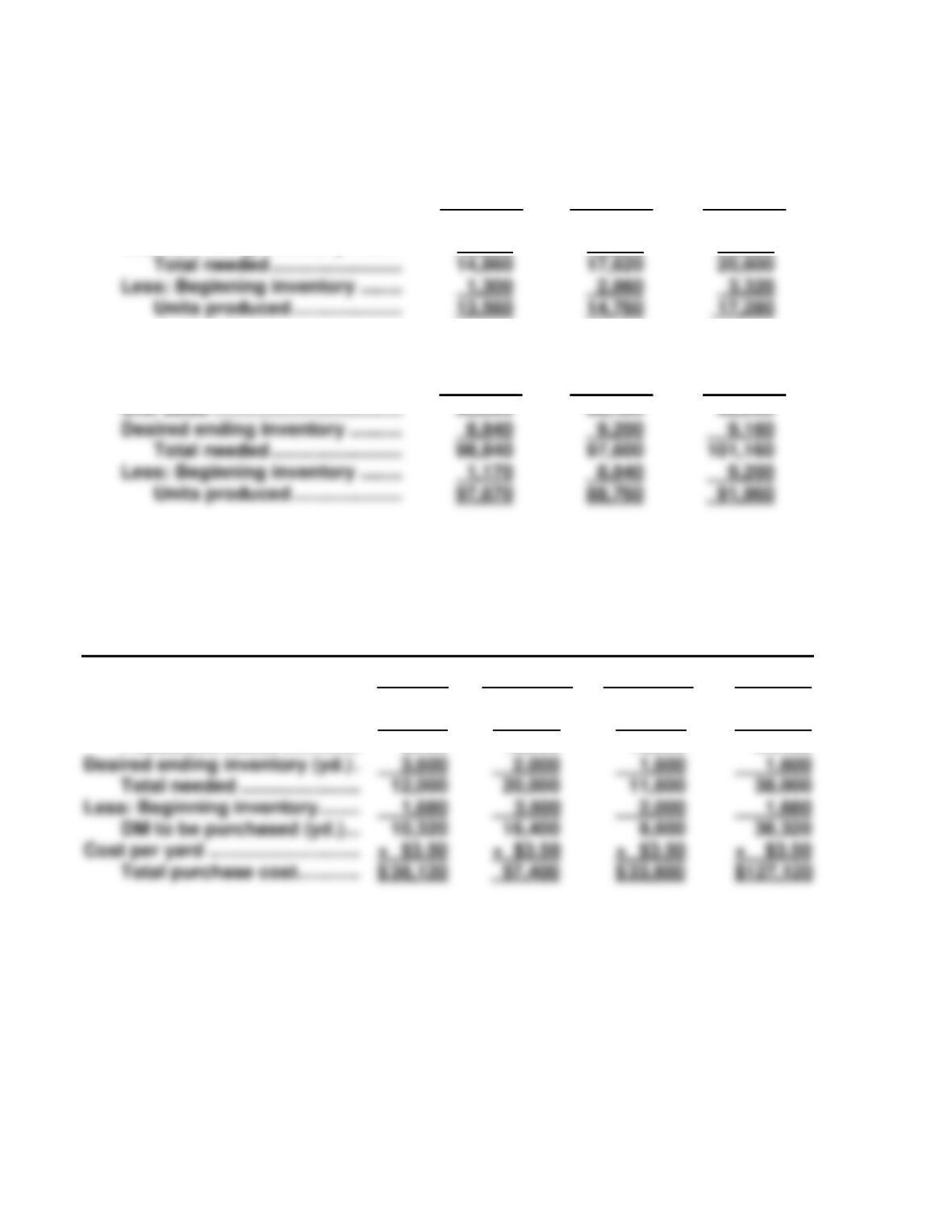
1. Berring Company
Sales Budget
For the Year Ended December 31
Quarter 1 Quarter 2 Quarter 3 Quarter 4 Year
Deluxe:
Units ……….. 12,000 14,300 16,600 20,000 62,900
2. Berring Company probably asked the marketing vice president for sales
Exercise 8.16 (Concluded)
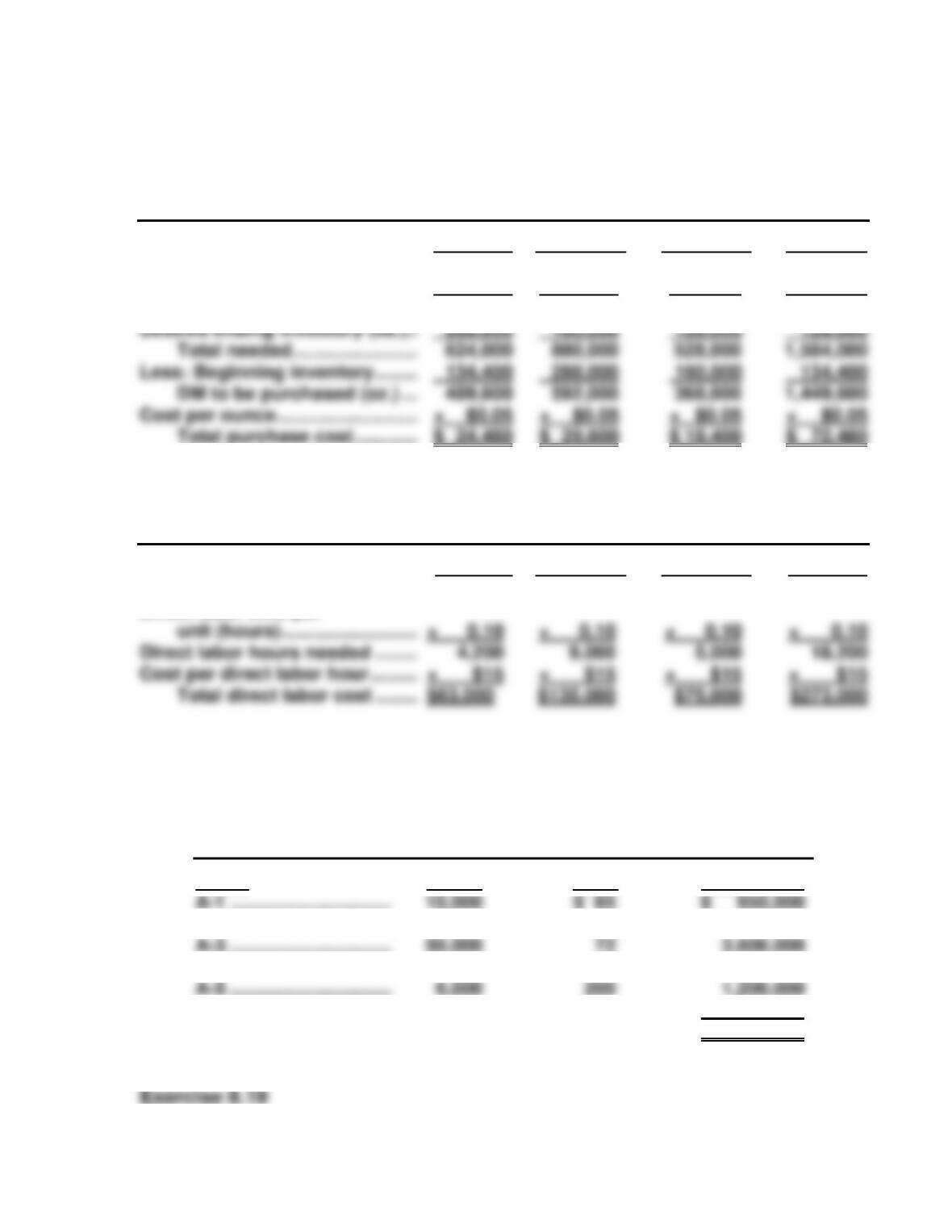
3. Production budget for deluxes:
Quarter 1 Quarter 2 Quarter 3
Unit sales ……………………………… 12,000 14,300 16,600
Desired ending inventory ………. 2,860 3,320 4,000
Production budget for standards:
Quarter 1 Quarter 2 Quarter 3
Exercise 8.17
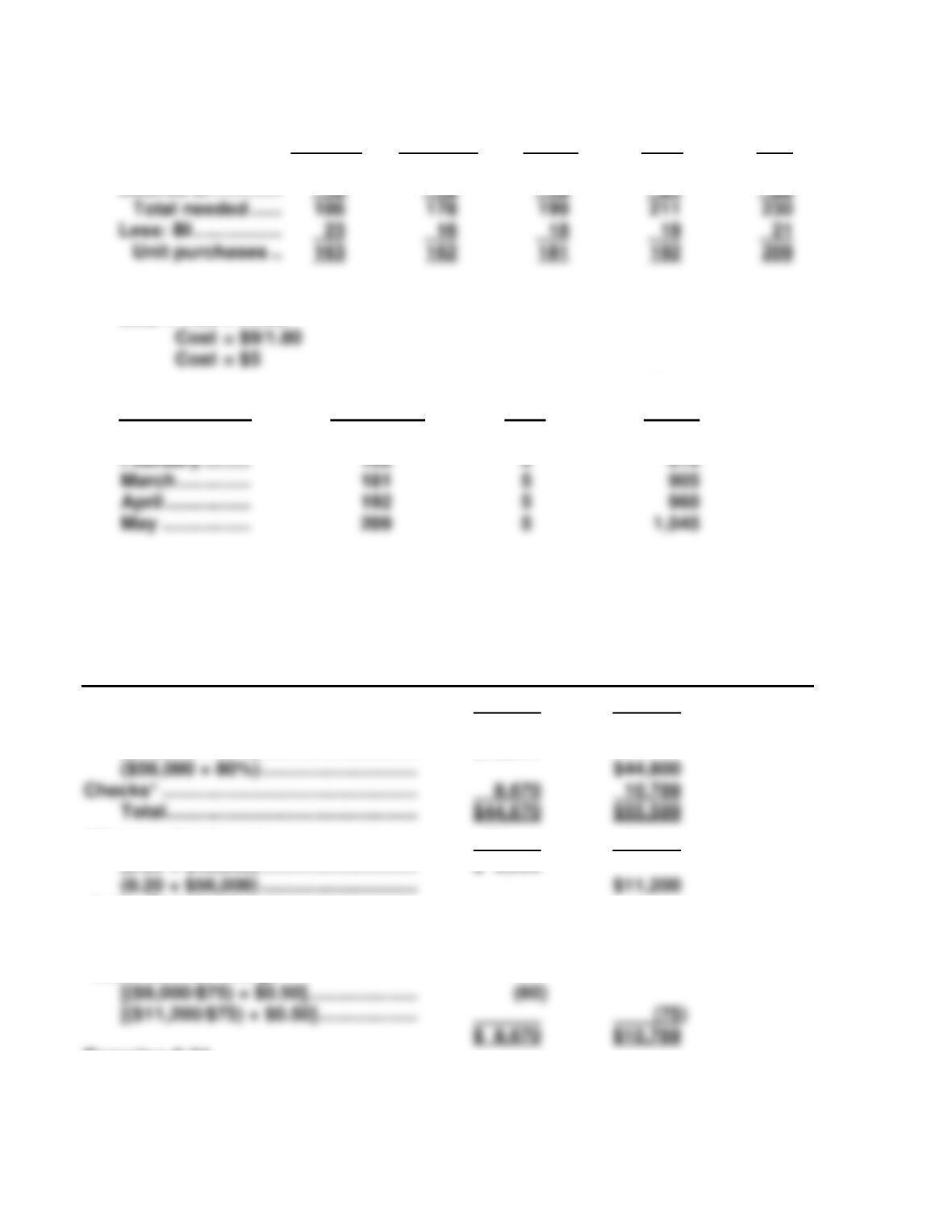
1. Crescent Company
Direct Materials Purchases Budget for Fabric
For the Fourth Quarter
October November December Total
Units produced …………………….. 42,000 90,000 50,000 182,000
DM per unit (yd.) …………………… × 0.20 × 0.20 × 0.20 × 0.20
Production needs …………… 8,400 18,000 10,000 36,400
Exercise 8.17 (Concluded)
2. Crescent Company
Direct Materials Purchases Budget for Polyfiberfill
For the Fourth Quarter
October November December Total
Units produced ……………………… 42,000 90,000 50,000 182,000
DM per unit (oz.) ……………………. × 8 × 8 × 8 × 8
Production needs ………………….. 336,000 720,000 400,000 1,456,000
3. Crescent Company
Direct Labor Budget
For the Fourth Quarter 20XX
October November December Total
Units produced ……………………… 42,000 90,000 50,000 182,000
Direct labor time per
Exercise 8.18
Audio-2-Go, Inc.
Sales Budget
For 2013
Model Units Price Total Sales
A-2 …………………………. 33,000 75 2,475,000
A-4 …………………………. 16,500 120 1,980,000
A-6 …………………………. 15,000 180 2,700,000
Total …………………….. $12,605,000
1.
January February March April May
Unit sales ………….. 170 160 180 190 210
Desired EI …………. 16 18 19 21 20
2. Sales price = $9 (Monthly dollar sales/Unit sales)
Cost × 1.80 = Price
Unit Unit Total
Month Purchases Cost Cost
January ……….. 163 $5 $ 815
Exercise 8.20
Rosita’s Mexican Restaurant
Schedule of Cash Receipts
For the Months of May and June
May June
Cash sales:
($45,000 × 80%) ………………………… $36,000
*Check collections for: May June
(0.20 × $45,000) ………………………… $ 9,000
Less: Bad checks
(0.03 × $9,000) ………………………….. (270)
(0.03 × $11,200) ………………………… (336)
Less: Service charge
Exercise 8.21
Revised sales estimates:
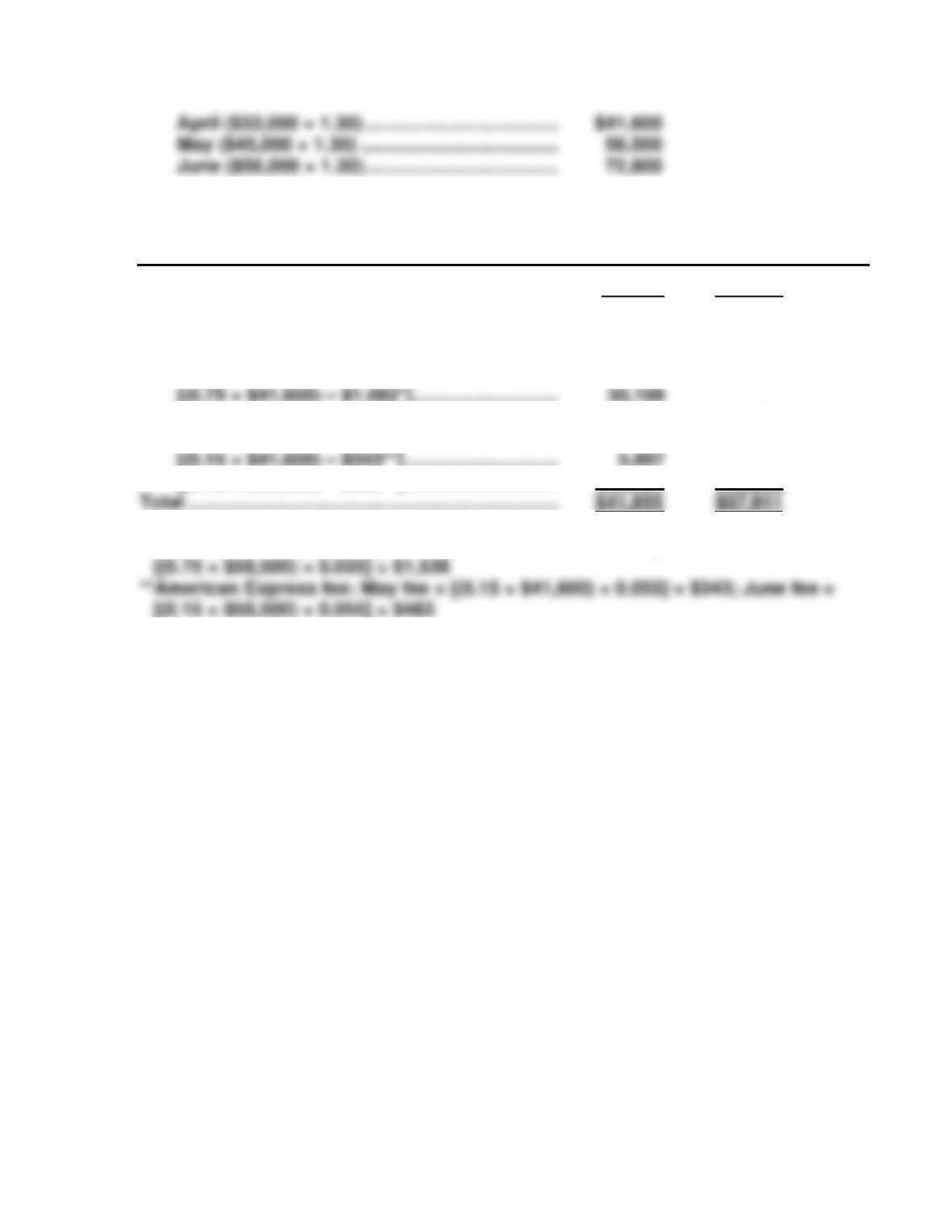
Rosita’s Mexican Restaurant
Schedule of Cash Receipts
For the Months of May and June
May June
Cash sales:
($58,500 × 10%) ………………………………………. $ 5,850
($72,800 × 10%) ………………………………………. $ 7,280
VISA/MasterCard:
[(0.75 × $45,000) – $1,536*] ………………………. 42,339
American Express:
[(0.15 × $58,500) – $483**] ……………………….. 8,292
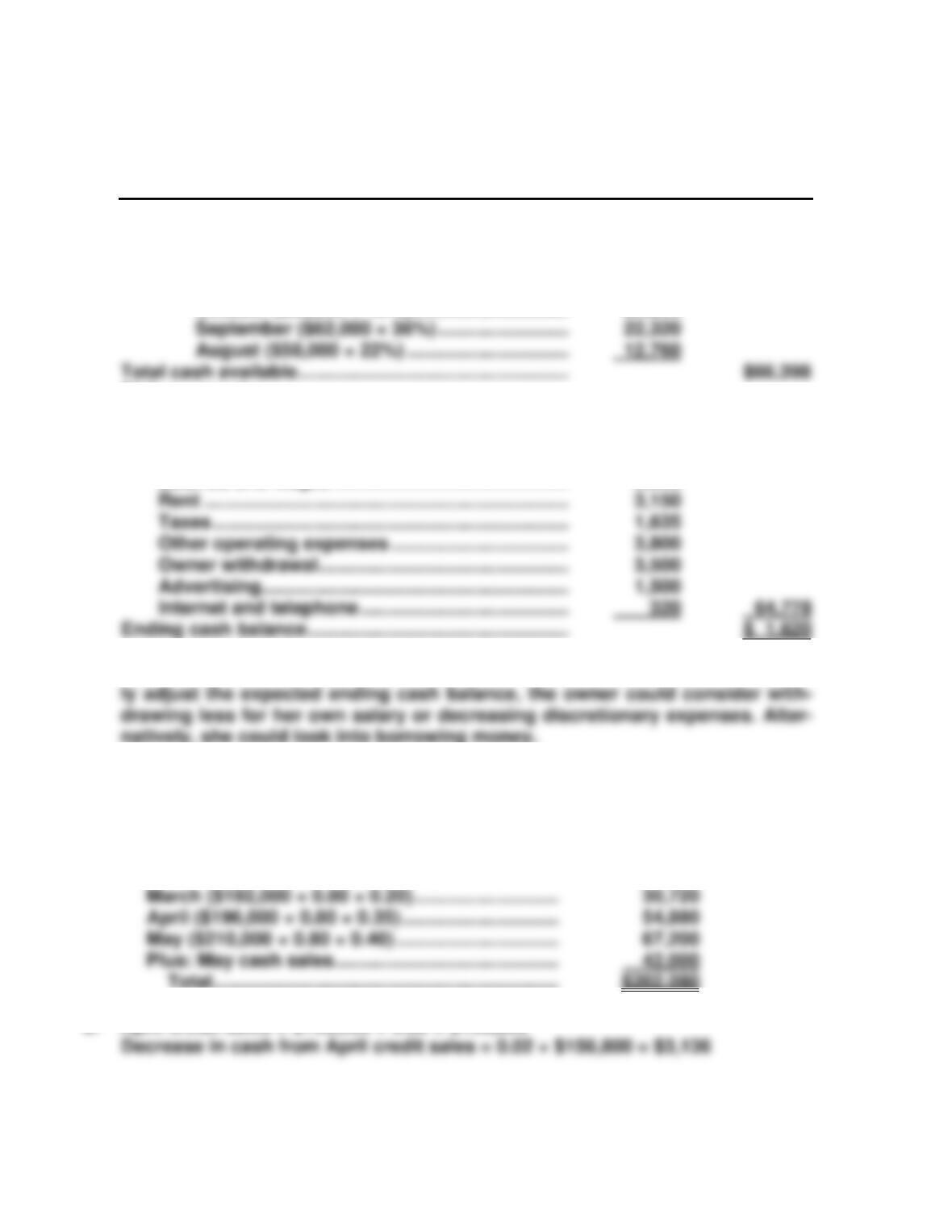
*VISA/MasterCard fee: May fee = [(0.75 × $41,600) × 0.035] = $1,092; June fee =
Exercise 8.22
1. Cash Budget
For the Month of October
Beginning cash balance……………………………………… $ 1,118
Collections:
Cash sales ………………………………………………….. 5,000
Credit sales:
October ($63,000 × 40%) ………………………… 25,200
Disbursements:
Inventory purchases:
October ($68,000 × 70% × 45%) ………………. $21,420
September ($66,500 × 70% × 55%) ………….. 25,603
Salaries and wages ……………………………………… 3,850
2. The ending cash balance does not meet the desired level of $3,000. To quick-
Exercise 8.23
1. From payments in May for credit sales in:
February ($182,000 × 0.80 × 0.05) ………………….. $ 7,280
2. April credit sales = $196,000 × 0.80 = $156,800