Wild and Shaw, Financial & Managerial Accounting, 8e Solutions Manual: Appendix D
Appendix D
Lean Principles and Accounting
QUESTIONS
1. The three key principles of the lean business model are: Production occurs in value
streams; production follows a “pull” system which starts with a customer order;
and, the goal is zero waste and zero defects.
2. Push production begins with a sales forecast. Goods are produced and pushed into
inventory, where they await customer orders. Pull production begins with a
customer order. Goods are produced to order and delivered immediately to
customers upon completion of production.
3. Three common problems of push production include the production of goods that
customers do not want or value; inventory levels that are too high; and, large batch
sizes that lead to increased defects.
4. Supply chain management is the control of materials, information, and finances as
they move between suppliers, manufacturers, and customers.
5. In a closed-loop supply chain, products are built using renewable resources or
recycled material. Apple works with suppliers to reduce mining, encourages its
customers to recycle old devices, and uses robots to disassemble old iPhones for
use as raw materials in new iPhones.
Wild and Shaw, Financial & Managerial Accounting, 8e Solutions Manual: Appendix D
11. Value-added time is the portion of cycle time spent on activities that add value to
customers. Non-value-added time is the portion of cycle time spent on activities that
do not add value to customers. Only process time is considered value-added time;
inspection, move, and wait times are considered non-value-added time.
QUICK STUDIES
Quick Study D-1 (5 minutes)
Quick Study D-2 (10 minutes)
1. L (Lean) 2. T (Traditional) 3. L (Lean) 4. T (Traditional)
5. L (Lean) 6. T (Traditional) 7. L (Lean) 8. T (Traditional)
Quick Study D-3 (5 minutes)
Work in Process Inventory …………………………………….
28,000
Accounts Payable ……………………………………………..
28,000
Quick Study D-4 (5 minutes)
1.
Work in Process Inventory …………………………………….
43,600
Conversion Costs ……………………………………………..
43,600
Applied conversion costs to production.
2. Conversion Costs ………………………………………….
43,600
Various Accounts ……………………………………..
43,600
Record actual conversion costs.
Quick Study D-5 (5 minutes)
1.
Accounts Receivable …………………………………………….
16,800
Sales ………………………………………………………………..
16,800
Record sales on account.
2. Cost of Goods Sold ……………………………………..
Work in Process Inventory ………………………
11,760
Record cost of goods sold.
Quick Study D-6 (10 minutes)
33,250
Sales ………………………………………………………………..
33,250
2. Finished Goods Inventory …………………………...
Cost of Goods Sold …………………………..…………
1,860
23,250
Work in Process Inventory ………………………
25,110
Record ending inventory and COGS.
Quick Study D-7 (5 minutes)
Quick Study D-8 (10 minutes)
1.
Rate = Estimated conversion costs = $1,000,000 = $625 per hour
Estimated production hours 1,600
2.
Work in Process Inventory ………………………..
Conversion Costs ……………………………….
Quick Study D-9 (15 minutes)
a.
Process time ……………………………………………………………………
15.0 minutes
Inspection time ………………………………………………………………..
2.0 minutes
Move time ………………………………………………………………………..
6.4 minutes
Wait time …………………………………………………………………………
Manufacturing cycle time …………………………………………………
Manufacturing cycle efficiency (15.0 min./ 60.0 min.) ………..
Wild and Shaw, Financial & Managerial Accounting, 8e Solutions Manual: Appendix D
Quick Study D-10 (10 minutes)
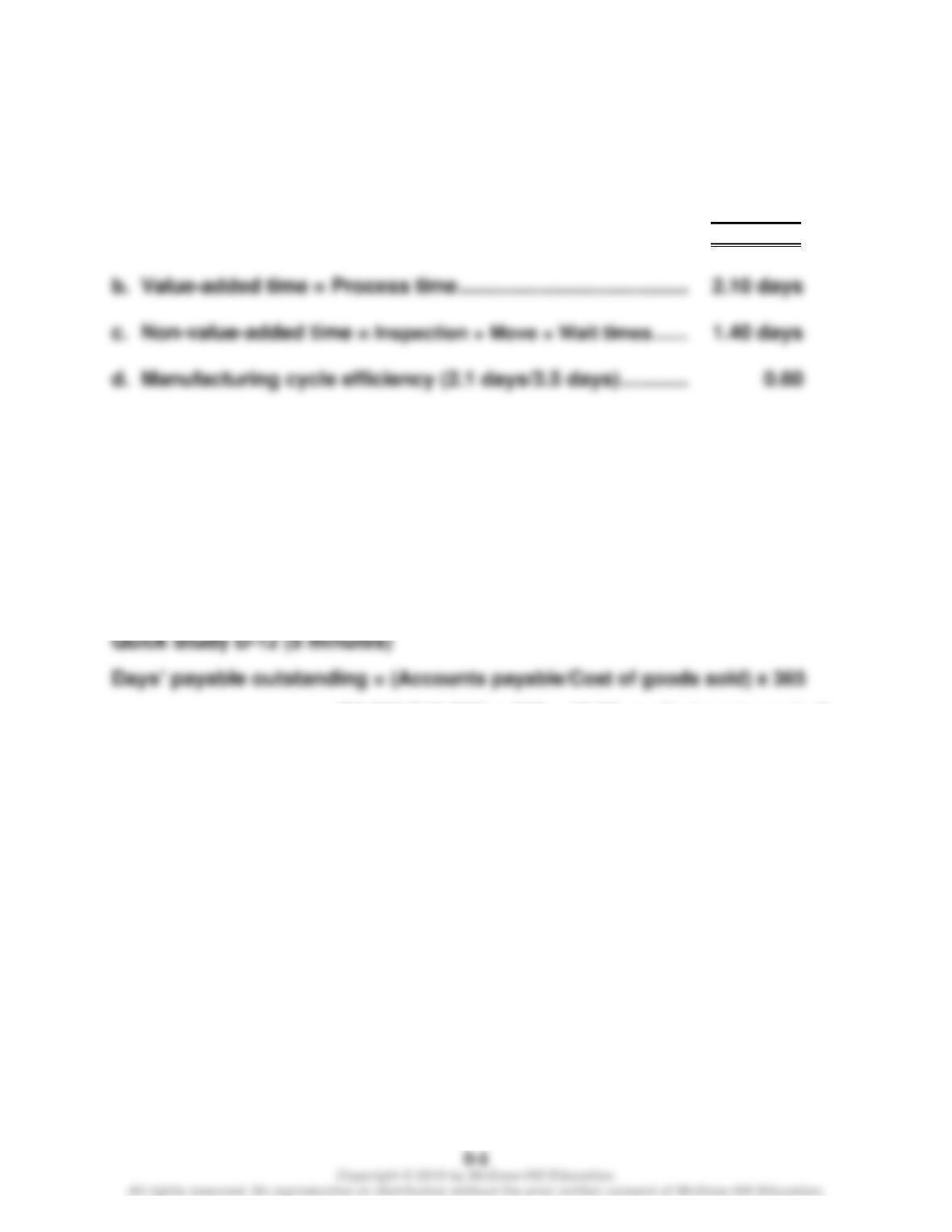
a.
Process time ……………………………………………………………………
2.10 days
Inspection time ………………………………………………………………..
0.50 days
Move time ………………………………………………………………………..
0.75 days
Wait time …………………………………………………………………………
0.15 days
Manufacturing cycle time …………………………………………………
3.50 days
d.
Manufacturing cycle efficiency (2.1 days/3.5 days) ……………
Quick Study D-11 (5 minutes)
Days’ sales in WIP Inventory = (WIP Inventory/Cost of goods sold) x 365
($770/$23,404) x 365 = 12.0086, or 12 days (rounded)
Quick Study D-13 (5 minutes)
Days’ payable outstanding = (Accounts payable/Cost of goods sold) x 365
(₩9,569,549/₩28,155,597) x 365 = 124.06, or 124 days (rounded)
EXERCISES
Exercise D-1 (10 minutes)
1. T (Traditional) 2. T (Traditional) 3. L (Lean) 4. L (Lean)
Exercise D-2 (15 minutes)
1.
Work in Process Inventory ……………………………………..
22,500
Accounts Payable ……………………………………………..
22,500
Purchased materials on credit.
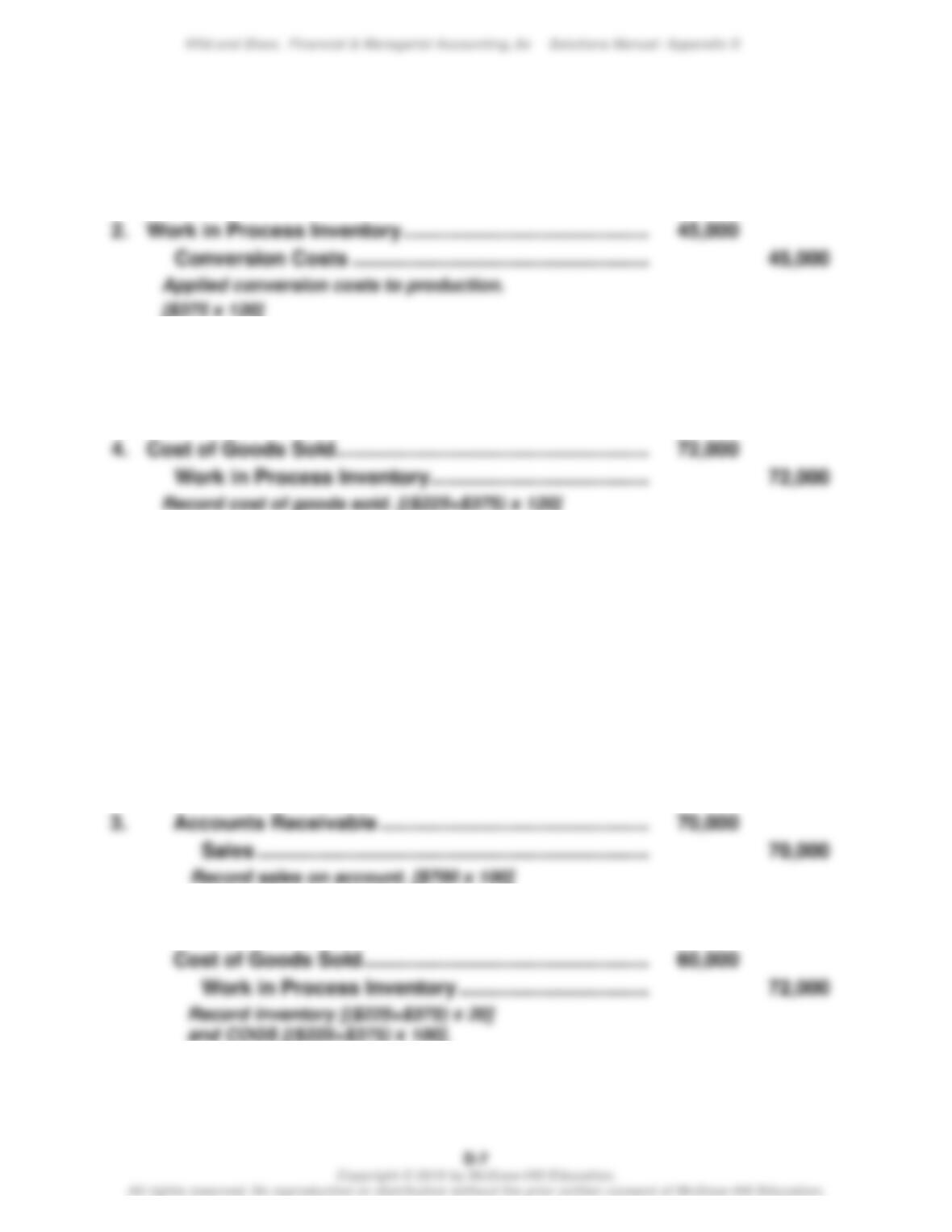
2.
Work in Process Inventory ……………………………………..
67,500
Conversion Costs ……………………………………………..
67,500
Applied conversion costs to production.
3.
Conversion Costs ………………………………………………….
67,500
Various Accounts ………………………………………………
67,500
4.
Accounts Receivable ……………………………………………..
120,000
Sales …………………………..…………………………………….
120,000
Record sales on account.
5.
90,000
Work in Process Inventory …………………………………
90,000
Exercise D-3 (15 minutes)
1.
Work in Process Inventory ……………………………………..
27,000
Accounts Payable ……………………………………………..
27,000
Purchased materials on credit. [$225 x 120]
2.
Work in Process Inventory ……………………………………..
45,000
Conversion Costs ……………………………………………..
45,000
3.
Accounts Receivable ……………………………………………..
84,000
Sales …………………………..…………………………………….
84,000
Record sales on account. [$700 x 120]
4.
72,000
Work in Process Inventory …………………………………
72,000
Exercise D-4 (15 minutes)
1.
Work in Process Inventory …………………………………
27,000
Accounts Payable …………………………………………
27,000
Purchased materials on credit. [$225 x 120]
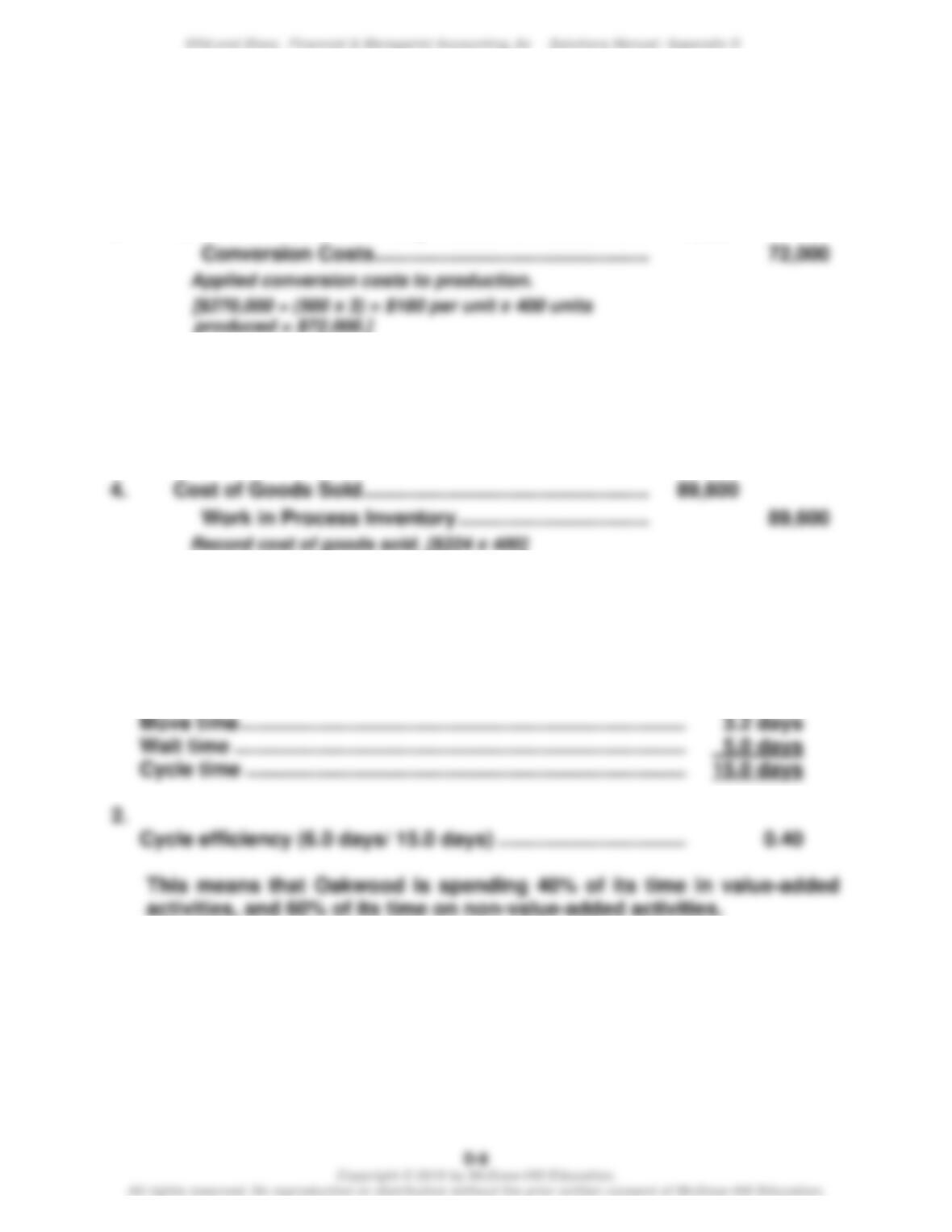
2.
Work in Process Inventory …………………………………
45,000
Conversion Costs ………………………………………….
45,000
Applied conversion costs to production. [$375 x 120]
3.
Accounts Receivable …………………………………………
70,000
Sales …………………………………………………………….
70,000
4.
Finished Goods Inventory ………………………………….
60,000
Work in Process Inventory …………………………….
72,000
12,000
Exercise D-5 (15 minutes)
1.
Work in Process Inventory …………………………………
17,600
Accounts Payable …………………………………………
17,600
Purchased materials on credit. [$44 x 400]
2.
Work in Process Inventory …………………………………
72,000
Conversion Costs ………………………………………….
72,000
3.
Accounts Receivable …………………………………………
128,000
Sales …………………………………………………………….
128,000
Record sales on account. [$320 x 400]
4.
89,600
Work in Process Inventory …………………………….
89,600
Exercise D-6 (15 minutes)
1.
Process time ……………………………………………………………………
6.0 days
Inspection time ………………………………………………………………..
0.8 days
Move time ……………………………………………………….……………….
3.2 days
Wait time …………………………………………………………………………
Cycle time ……………………………………………………………………….
Cycle efficiency (6.0 days/ 15.0 days) ……………………………….
3. If move time is reduced by 1.2 days and wait time is reduced by 2.8
days, cycle time will be reduced to 11.0 days (computed as 15 days –
1.2 days – 2.8 days). Cycle efficiency will be 0.545 (54.5%), computed
as 6.0 days divided by 11.0 days.
Exercise D-7 (15 minutes)
1.
Process time ……………………………………………………………………
16.0 hours
Inspection time ………………………………………………………………..
3.5 hours
Move time ……………………………………………………….……………….
9.0 hours
Wait time …………………………………………………………………………
21.5 hours
Manufacturing cycle time …………………………………………………
50.0 hours
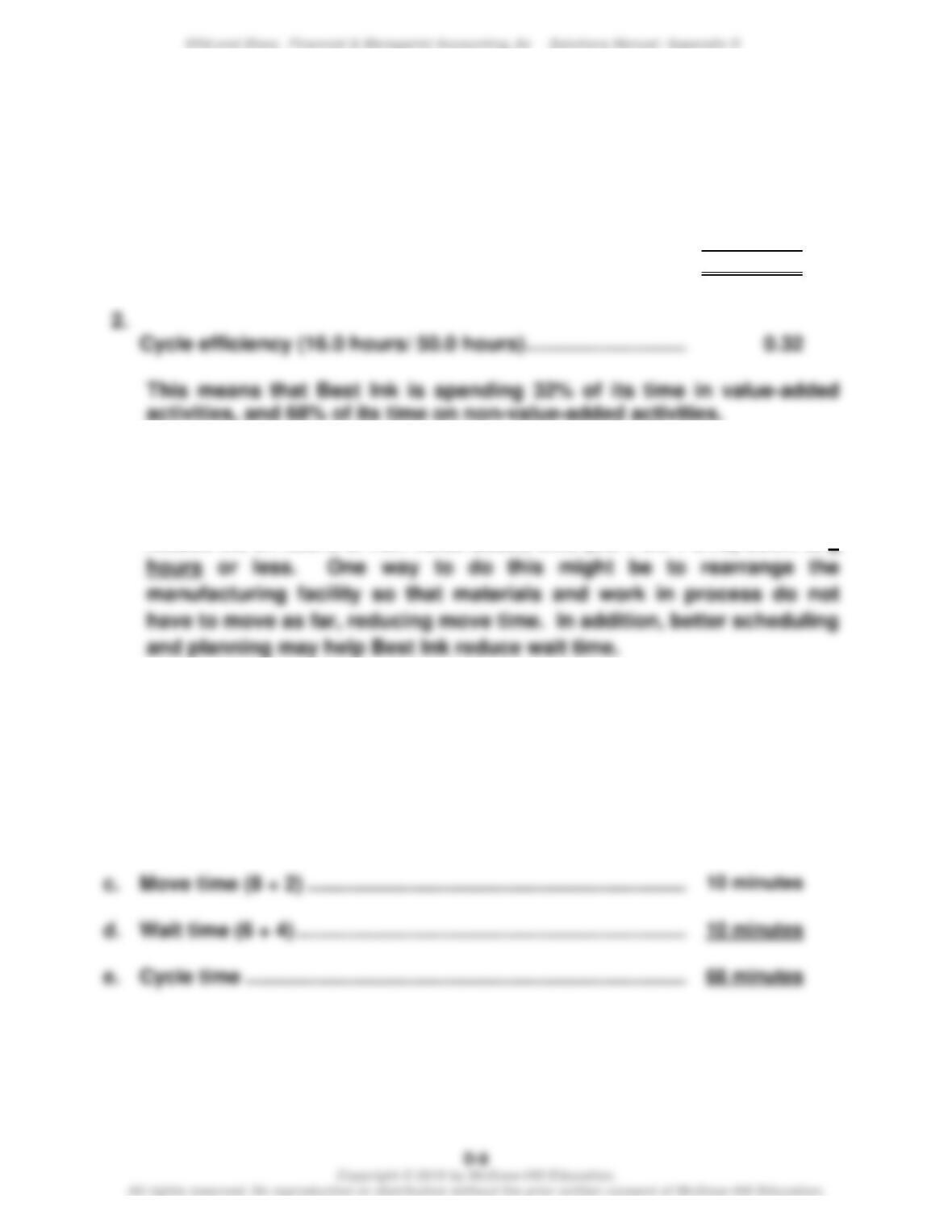
Cycle efficiency (16.0 hours/ 50.0 hours) …………………………..
3. To increase manufacturing cycle efficiency to 0.80, Best Ink must
reduce the total manufacturing cycle time to 20 hours without changing
the process time (16 hours/ 0.80 = 20 hours). To do this, Best Ink must
reduce the 34 hours of non-value-added time (3.5 + 9.0 + 21.5) down to 4
Exercise D-8 (15 minutes)
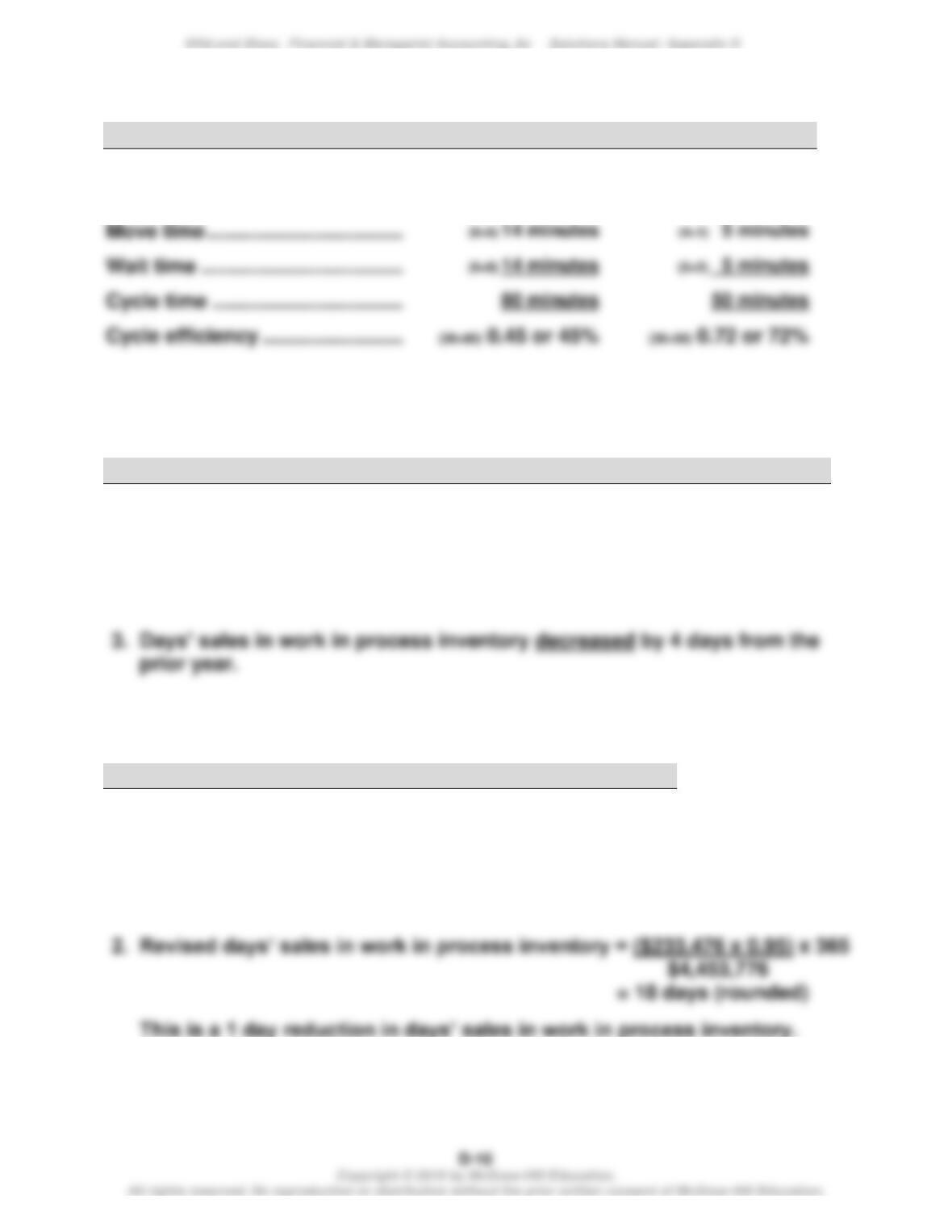
a.
Value-added time = Process time (18 + 8 + 10) ………………….
36 minutes
b.
Inspection time ………………………………………………………………..
12 minutes
d.
e.
Exercise D-9 (20 minutes)
Activity
(a) Traditional
(b) Lean
Process time ……………………………………………………………………
(18+8+10) 36 minutes
(18+8+10) 36 minutes
Inspection time ………………………………………………………………..
16 minutes
4 minutes
Move time ……………………………………………………….……………….
Wait time …………………………………………………………………………
Cycle time ……………………………………………………………………….
80 minutes
Exercise D-10 (10 minutes)
1. and 2.
$ thousands
Current
Prior
WIP Inventory, end of year ………………………
$ 81,000
$ 94,000
Cost of goods sold, for the year ………………
$ 1,967,000
$ 1,800,000
Days’ sales in WIP* (rounded)………………….
15 days
19 days
*(WIP Inventory/Cost of goods sold) x 365
Exercise D-11 (10 minutes)
1.
$ thousands
Current Year
WIP Inventory, end of year …………………
$ 233,476
Cost of goods sold, for the year …………..
$ 4,453,776
Days’ sales in WIP* (rounded)……………..
19 days
*(WIP Inventory/Cost of goods sold) x 365
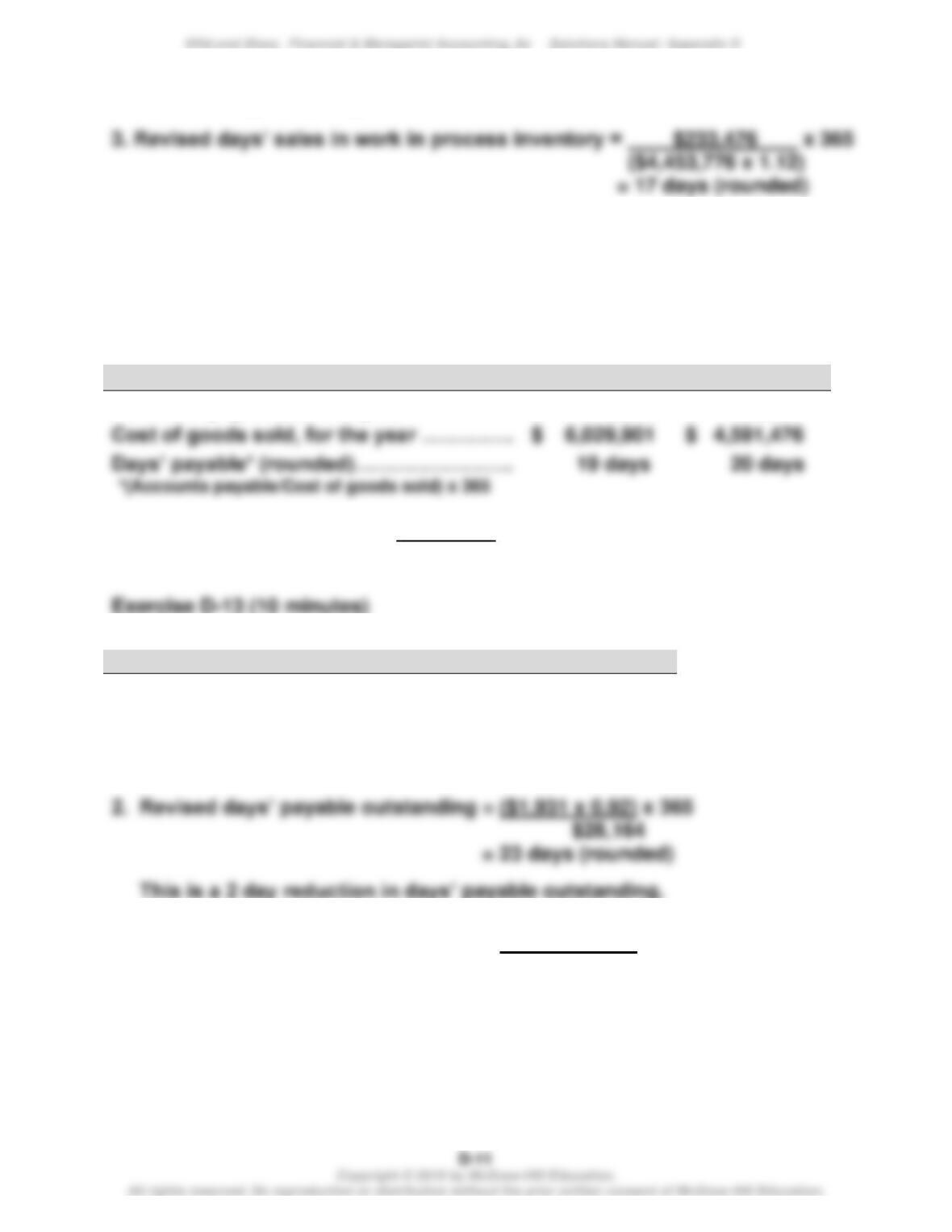
Exercise D-11 (continued)
This is a 2 day reduction in days’ sales in work in process inventory.
Exercise D-12 (10 minutes)
1. and 2.
$ thousands
Current Year
Prior Year
Accounts payable, end of year ……………
$ 312,842
$ 253,491
3. Days’ payable outstanding decreased by 1 day from the prior year.
1.
$ millions
Current Year
Accounts payable, end of year ……………
$ 1,931
Cost of goods sold, for the year …………..
$ 28,164
Days’ payable* (rounded)……………………
25 days
*(Accounts payable/Cost of goods sold) x 365
3. Revised days’ payable outstanding = ($1,931 x 1.08) x 365
$28,164
= 27 days (rounded)
This is a 2 day increase in days’ payable outstanding.
Wild and Shaw, Financial & Managerial Accounting, 8e Solutions Manual: Appendix D
Exercise D-14 (10 minutes)
1. Apple’s use of energy from renewable sources increased during the
current year (from 93% to 96%).
*28.2 – 19.6 (both in millions of pounds).
PROBLEMS
Problem D-1 (25 minutes)
1. Conversion cost = $800,000/2,000 = $400 per mower
2. Journal entries
a.
Work in Process Inventory …………………………………….
150,000
Accounts Payable ……………………………………………..
150,000
Purchased materials on credit. [$250 x 600]
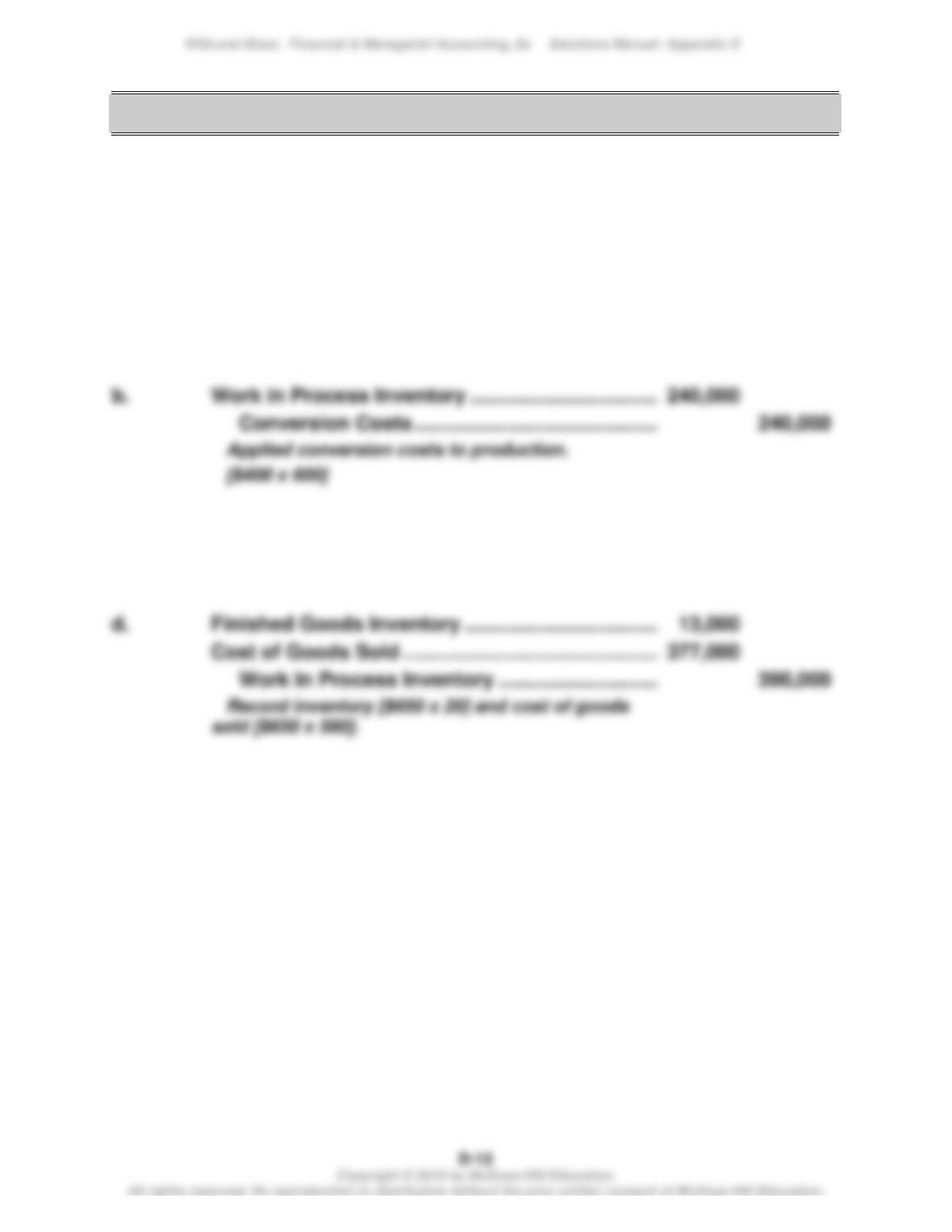
Work in Process Inventory …………………………………….
240,000
Conversion Costs …………………………..…………………
240,000
c.
Accounts Receivable …………………………………………….
580,000
Sales ………………………………………………………………..
580,000
Record sales on account. [$1,000 x 580]
377,000
Work in Process Inventory ………………………………..
390,000
Record inventory [$650 x 20] and cost of goods
Problem D-2 (25 minutes)
1. Journal entries
a.
Work in Process Inventory …………………………………….
344,000
Accounts Payable ……………………………………………..
344,000
Purchased materials on credit. [$4,300 x 80]
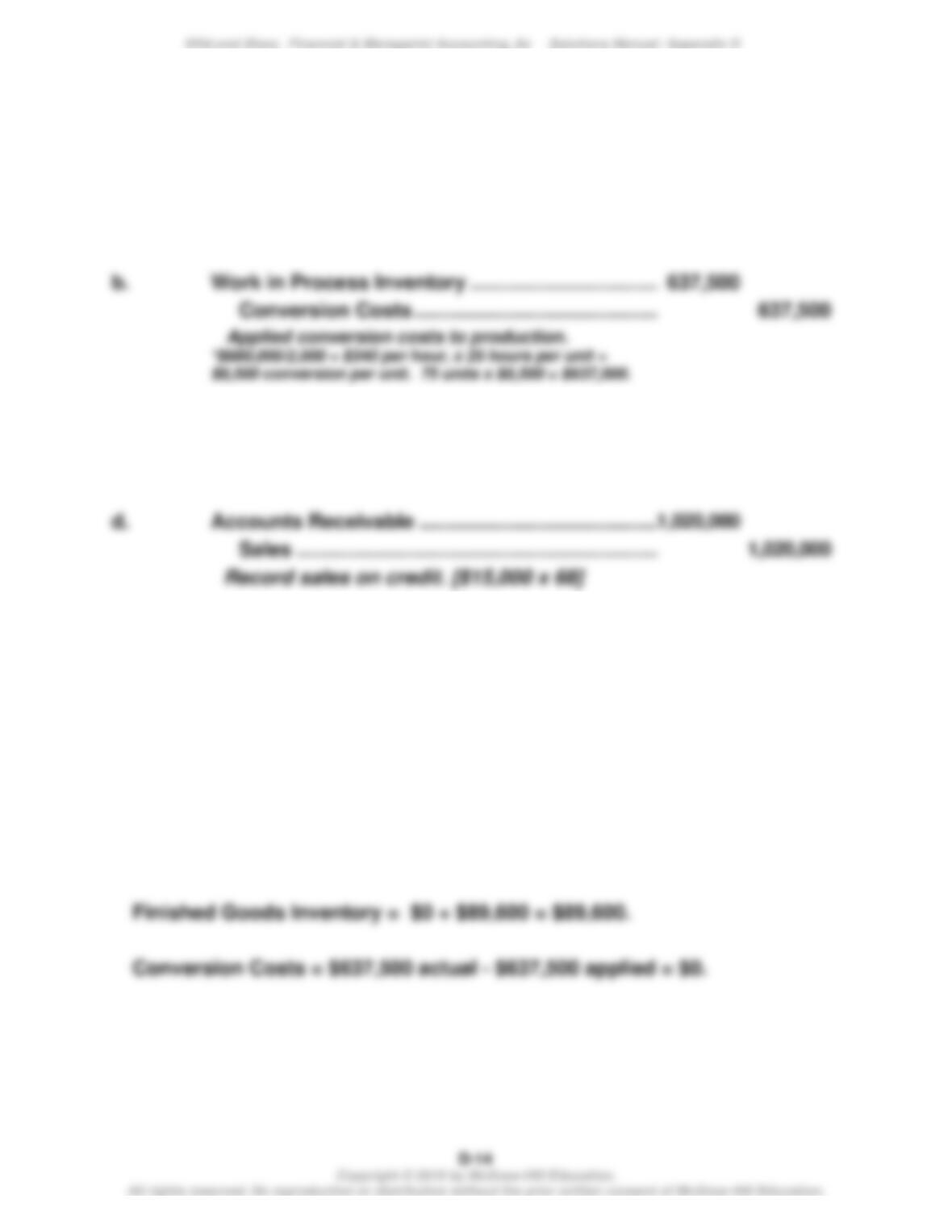
Work in Process Inventory …………………………………….
637,500
Conversion Costs …………………………..…………………
637,500
c.
Conversion Costs …………………………..……………………..
637,500
Various Accounts ……………………………………………..
637,500
Record actual conversion costs.
e.
Finished Goods Inventory* …………………………………….
Cost of Goods Sold** …………………………………………….
89,600
870,400
Work in Process Inventory ………………………………..
960,000
Record inventory and cost of goods sold.
*7 units x ($4,300 + $8,500). Conversion per unit = $340 x
25 = $8,500. **68 units x ($4,300 + $8,500).
2. Ending balances
Work in Process Inventory = $0 + $344,000 + $637,500 – $960,000 = $21,500.
Problem D-3 (25 minutes)
Traditional approach
Inspection time ………………………………………………………………..
4 hours
Move time ……………………………………………………….……………….
6 hours
Wait time …………………………………………………………………………
2 hours
1.
2.
Manufacturing cycle efficiency (24 hours/36 hours*) …………
0.67
*Total cycle time = 12 hours + 24 hours.
Lean approach
Inspection time ………………………………………………………………..
4 hours
Move time ……………………………………………………….………………
3 hours
Wait time …………………………………………………………………………
1 hours
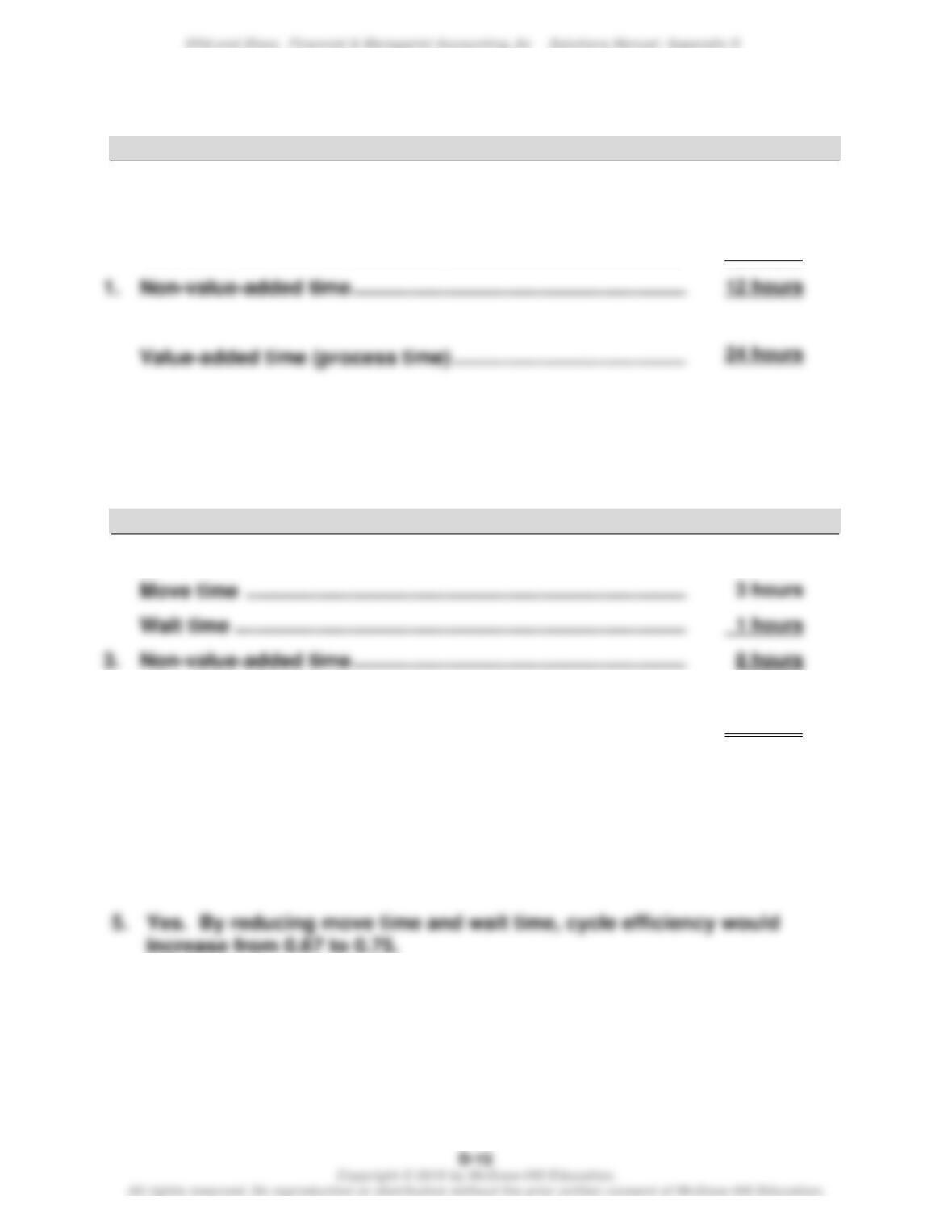
3.
8 hours
Value-added time (process time) ………………………………………
24 hours
4.
Manufacturing cycle efficiency (24 hours/32 hours*) …………
0.75
*Total cycle time = 8 hours + 24 hours.