E8-1 Compute Target Cost
Mesa Cheese Company has developed a new cheese slicer called Slim Slicer. The company plans to sell this slicer through its catalog,
which it issues monthly. Given market research, Mesa believes that it can charge $20 for the Slim Slicer. Prototypes of the Slim Slicer,
however, are costing $22. By using cheaper materials and gaining efficiencies in mass production, Mesa believes it can reduce Slim
Slicer’s cost substantially. Mesa wishes to earn a return of 40% of the selling price.
Instructions
(a) Compute the target cost for the Slim Slicer.
(b) When is target costing particularly helpful in deciding whether to produce a given product?
NOTE: Enter a number in cells requesting a value; enter either a number or a formula in cells with a “?” .
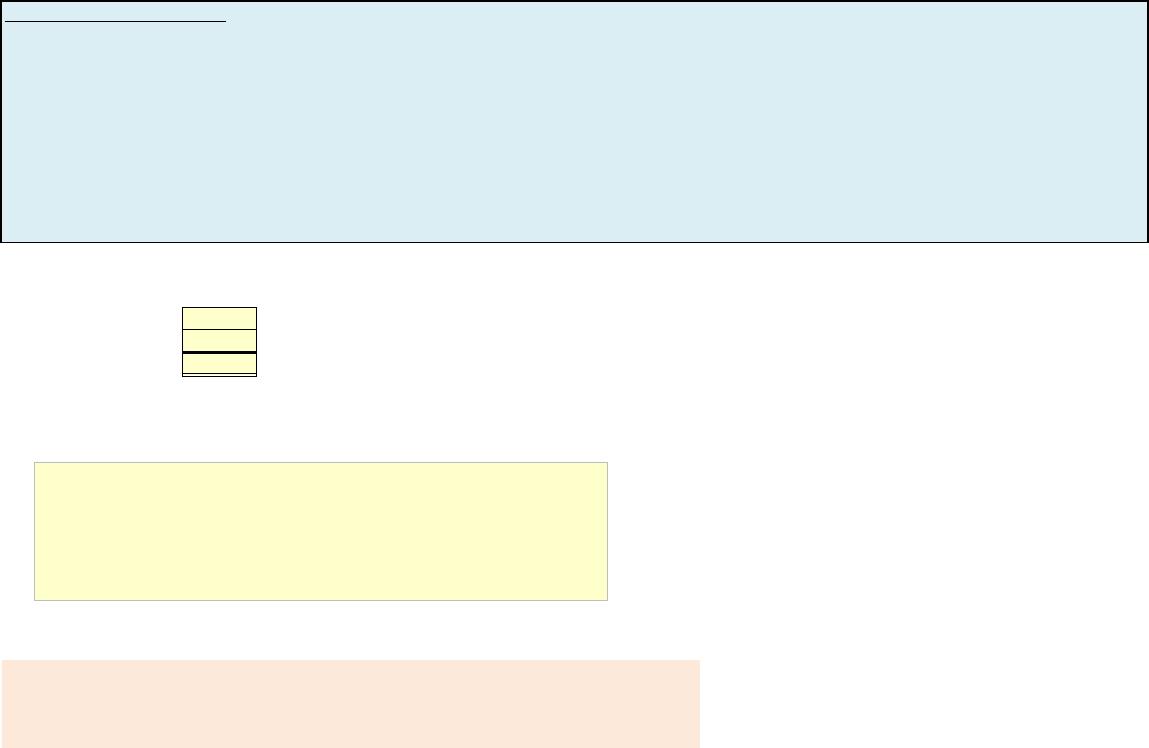
(a) Compute the target cost for the Slim Slicer.
Market price Value
Desired profit ?
Target cost ?
(b) When is target costing particularly helpful in deciding whether to produce a given product?
After you have completed E8-1, consider the additional question.
1. Assume that the company wishes to earn a return of 50% of the selling price and
believe that it can sell its product for $21. What is the revised target cost?
(Round to 2 decimal points.)
Response:
E8-1 Solution
(a) Compute the target cost for the Slim Slicer.
Market price $20
(b) When is target costing particularly helpful in deciding whether to produce a given product?
Target costing is particularly helpful when a company faces a

E8-1 Solution to additional question
1. Assume that the company wishes to earn a return of 50% of the selling price and believes
that it can sell its product for $21. What is the revised target cost? (Round to2 decimal points.)
Compute the target cost for the Slim Slicer.
E8-4 Use cost-plus pricing to determine selling price
Caspar Corporation makes a commercial-grade cooking griddle. The following information is available for Kaspar’s Corporation’s
anticipated annual volume of 30,000 units. Per Unit Total
Direct materials $17
Direct labor $8
Variable manufacturing overhead $11
Fixed manufacturing overhead $300,000
Variable selling and administrative expenses $4
Fixed selling and administrative expenses $150,000
The company uses a 40% markup percentage on total cost.
Instructions
(a) Compute the total cost per unit.
(b) Compute the target selling price.
NOTE: Enter a number in cells requesting a value; enter either a number or a formula in cells with a “?” .
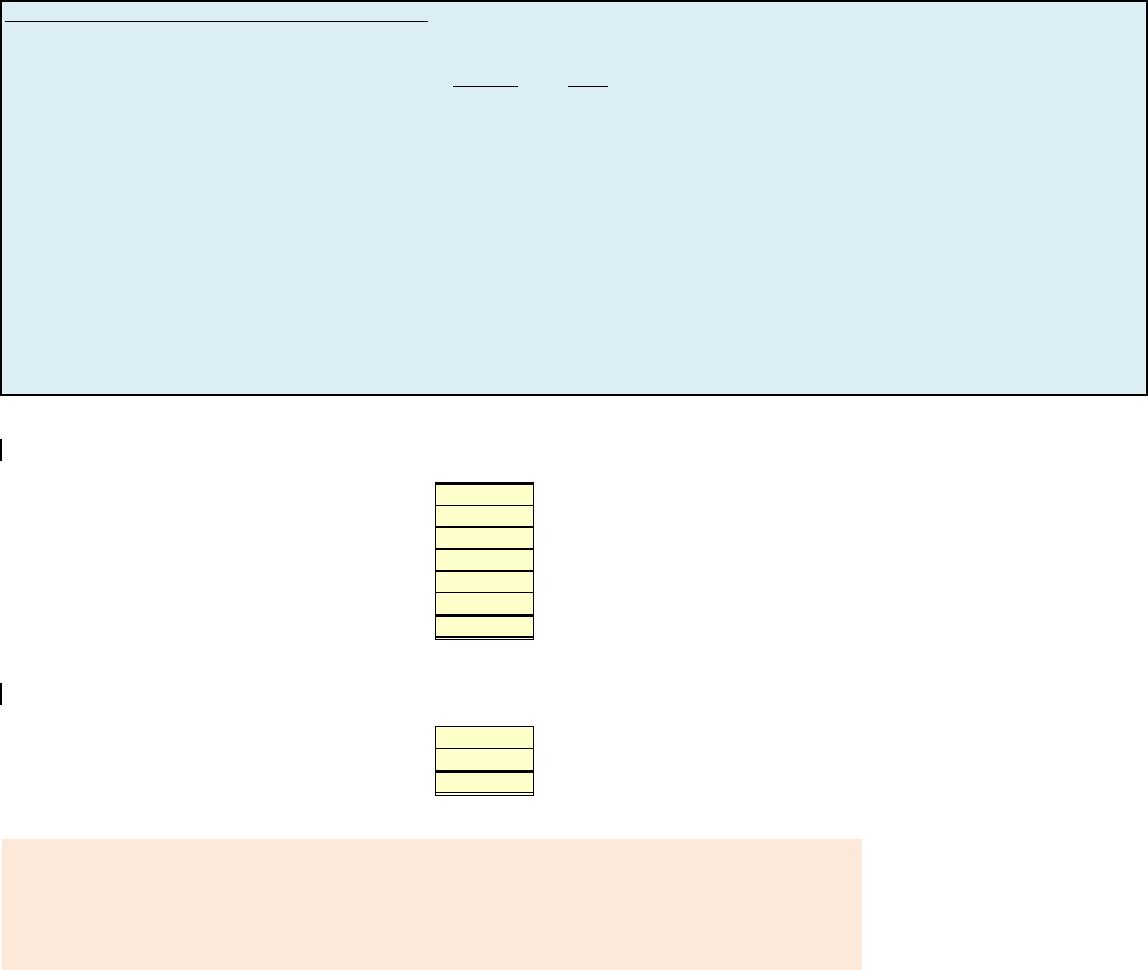
(a) Compute the total cost per unit. Per Unit
Direct materials Value
Direct labor Value
Variable manufacturing overhead Value
Fixed manufacturing overhead ?
Variable selling and administrative expenses Value
Fixed selling and administrative expenses ?
Total cost per unit ?
(b) Compute the target selling price.
Total cost per unit Value
Markup ?
Target selling price ?
After you have completed E8-4, consider the additional question.
1. Assume that annual volume changed to 25,000 units and the markup percentage changed to
45% on total cost. Show the impact of these changes on total cost per unit and target selling
price.
E8-4 Solution
(a) Compute the total cost per unit. Per Unit
Direct materials $17
Direct labor 8
(b) Compute the target selling price.
Total cost per unit $55
E8-4 Solution to additional question
1. Assume that annual volume changed to 25,000 units and the markup percentage changed to
45% on total cost. Show the impact of these changes on total cost per unit and target selling
price.
(a) Compute the total cost per unit. Per Unit
Direct materials $17
Direct labor 8
Variable manufacturing overhead 11
(b) Compute the target selling price.
E8-5 Use cost-plus pricing to determine various amounts
Schopp Corporation makes a mechanical stuffed alligator that sings the Martian national anthem.
The following information is available for Schopp Corporation’s anticipated annual volume of
500,000 units. Per Unit Total
Direct materials $7
Direct labor $11
Variable manufacturing overhead $15
Fixed manufacturing overhead $3,000,000
Variable selling and administrative expenses $14
Fixed selling and administrative expenses $1,500,000
The company has a desired ROI of 25%. It has invested assets of $28,000,000.
Instructions
(a) Compute the total cost per unit.
(b) Compute the desired ROI per unit.
(c) Compute the markup percentage using total cost per unit.
(d) Compute the target selling price.
NOTE: Enter a number in cells requesting a value; enter either a number or a formula in cells with a “?” .
(a) Compute the total cost per unit. Per Unit
Direct materials Value
Direct labor Value
Variable manufacturing overhead Value
Fixed manufacturing overhead ?
Variable selling and administrative expenses Value
Fixed selling and administrative expenses ?
Total cost per unit ?
(b) Compute the desired ROI per unit.
Invested assets Value
ROI percentage Value
Return on investment ?
Estimated annual volume Value
Desired ROI per unit ?
(c) Compute the markup percentage using total cost per unit.
Desired ROI per unit Value
Total cost per unit
Value
Markup Percentage ?
(d) Compute the target selling price.
Total cost per unit
Value
Desired ROI per unit Value
Target selling price ?
After you have completed E8-5, consider the additional question.
1. Assume that the company wishes to earn a return of 30% of the selling price. What is
the impact of this change on your calculations? (Round to nearest dollar.)
E8-5 Solution
(a) Compute the total cost per unit. Per Unit
Direct materials $7
Direct labor 11
(b) Compute the desired ROI per unit.
Invested assets $28,000,000
ROI percentage 25%
(c) Compute the markup percentage using total cost per unit.
Desired ROI per unit $14
(d) Compute the target selling price.
Total cost per unit $56
E8-5 Solution to Additional Question
1. Assume that the company wishes to earn a return of 30% of the selling price. What is
the impact of this change on your calculations? (Round to nearest dollar.)
(a) Compute the total cost per unit. Per Unit
Direct materials $7
Direct labor 11
Variable manufacturing overhead 15
Fixed manufacturing overhead 6
Variable selling and administrative expenses
14
Fixed selling and administrative expenses 3
Total cost per unit $56
(b) Compute the desired ROI per unit.
Invested assets $28,000,000
(c) Compute the markup percentage using total cost per unit.
(d) Compute the target selling price.
P8-1A Use cost-plus pricing to determine various amounts.
National Corporation needs to set a target price for its newly designed product M14-M16. The following data
relate to this new product. Per Unit Total
Direct materials $25
Direct labor $40
Variable manufacturing overhead $10
Fixed manufacturing overhead $1,440,000
Variable selling and administrative expenses $5
Fixed selling and administrative expenses $960,000
These costs are based on a budgeted volume of 80,000 units produced and sold each year. National uses cost-plus
pricing methods to set its target selling price. The markup percentage on total unit cost is 40%.
Instructions
(a) Compute the total variable cost per unit, total fixed cost per unit, and total cost per unit for M14-M16.
(b) Compute the desired ROI per unit for M14-M16.
(c) Compute the target selling price for M14-M16.
(d) Compute variable cost per unit, fixed cost per unit, and total cost per unit assuming that 60,000 M14-M16s
are sold during the year.
NOTE: Enter a number in cells requesting a value; enter either a number or a formula in cells with a “?” .
(a) Compute the total variable cost per unit, total fixed cost per unit, and total cost per unit for M14-M16.
Direct materials Value
Direct labor Value
Variable manufacturing overhead Value
Variable selling and administrative expenses Value
Variable cost per unit ?
Total Costs ÷
Budgeted
Volume
=
Cost
per Unit
Fixed manufacturing overhead Value
÷Value =Value
Fixed selling and administrative expenses Value
÷Value =Value
Fixed cost per unit ?
÷Value =?
Variable cost per unit Value
Fixed cost per unit Value
Total cost per unit ?
(b) Compute the desired ROI per unit for M14-M16.
Total cost per unit Value
Markup percentage Value
Desired ROI per unit ?
(c) Compute the target selling price for M14-M16.
Total cost per unit Value
Desired ROI per unit Value
Target selling price ?
(d) Compute variable cost per unit, fixed cost per unit, and total cost per unit assuming that 60,000 M14-M16s
are sold during the year.
Direct materials Value
Direct labor Value
Variable manufacturing overhead Value
Variable selling and administrative expenses Value
Variable cost per unit ?
Total Costs ÷
Budgeted
Volume
=
Cost
per Unit
Fixed manufacturing overhead Value
÷Value = ?
Fixed selling and administrative expenses Value
÷Value =?
Fixed cost per unit ?
÷Value =?
Variable cost per unit Value
Fixed cost per unit Value
Total cost per unit ?
After you have completed P8-1A, consider the additional question.
1. Assume that the company wishes to earn a return of 45% of the selling price and variable manufacturing overhead
costs increase to $12. What is the impact of this change on part (a), (b) and (c) of your calculations?
(Round calculation of desired ROI per unit and target selling price to 2 decimal points)
P8-1A Solution
(a) Compute the total variable cost per unit, total fixed cost per unit, and total cost per unit for M14-M16.
Direct materials $25
Total costs ÷
Budgeted
Volume
=
Cost
per Unit
Fixed manufacturing overhead $1,440,000
÷80,000 =$18
(b) Compute the desired ROI per unit for M14-M16.
Total cost per unit
$110
(c) Compute the target selling price for M14-M16.
Total cost per unit
$110
(d) Compute variable cost per unit, fixed cost per unit, and total cost per unit assuming that 60,000 M14-M16
are sold during the year.
Direct materials $25
Direct labor 40
Total costs ÷
Budgeted
Volume
=
Cost
per Unit
Fixed manufacturing overhead $1,440,000
÷60,000 =$24
P8-1A Solution to additional question
1. Assume that the company wishes to earn a return of 45% of the selling price and variable manufacturing overhead
costs increase to $12. What is the impact of this change on part (a), (b) and (c) of your calculations?
(Round calculation of desired ROI per unit and target selling price to 2 decimal points)
(a) Compute the total variable cost per unit, total fixed cost per unit, and total cost per unit for M14-M16.
Direct materials $25
Direct labor 40
Total costs ÷
Budgeted
Volume
=
Cost per
Unit
Fixed manufacturing overhead $1,440,000
÷80,000 =$18
(b) Compute the desired ROI per unit for M14-M16.
Total cost per unit $112
(c) Compute the target selling price for M14-M16.
Total cost per unit $112
P8-7A Compute the target price using absorption-cost pricing and variable-cost pricing
Stent Corporation needs to set a target price for its newly designed product EverReady. The following data
relate to this new product.
Per Unit Total
Direct materials $20
Direct labor $40
Variable manufacturing overhead $10
Fixed manufacturing overhead
$1,600,000
Variable selling and administrative expenses $5
Fixed selling and administrative expenses $1,120,000
The costs shown above are based on a budgeted volume of 80,000 units produced and sold each year. Stent
uses cost-plus pricing methods to set its target selling price. Because some managers prefer absorption-cost
pricing and others prefer variable-cost pricing, the accounting department provides information under both
approaches using a markup of 50% on absorption cost and a markup of 80% on variable cost.
Instructions
(a) Compute the target price for unit of EverReady using absorption-cost pricing.
(b) Compute the target price for unit of EverReady using variable-cost pricing.
NOTE: Enter a number in cells requesting a value; enter either a number or a formula in cells with a “?” .
(a) Compute the target price for unit of EverReady using absorption-cost pricing.
Direct materials Value
Direct labor Value
Variable manufacturing overhead Value
Fixed manufacturing overhead
?
Unit manufacturing cost ?
Unit manufacturing cost Value
Markup ?
Target selling price ?
(b) Compute the target price for unit of EverReady using variable-cost pricing.
Direct materials Value
Direct labor Value
Variable manufacturing overhead Value
Variable selling and administrative expenses Value
Unit total variable cost ?
Unit total variable cost Value
Markup ?
Target selling price ?
After you have completed P8-7A, consider the additional question.
1. Assume that the company markup percentage changed to 60% under absorption costing and to 92%
under variable costing. What is the impact of this change on your calculations?
P8-7A Solution
(a) Compute the target price for unit of EverReady using absorption-cost pricing.
Direct materials $20
Direct labor 40
Variable manufacturing overhead 10
Fixed manufacturing overhead 20
Unit manufacturing cost $90
Unit manufacturing cost $90
Markup 45
Target selling price $135
The markup of $45 per unit must cover selling and administrative expenses (variable and fixed) plus
provide a desired return on investment.
(b) Compute the target price for unit of EverReady using variable-cost pricing.
Direct materials $20
Direct labor 40
Variable manufacturing overhead 10
Variable selling and administrative expenses 5
Unit total variable cost $75
Unit total variable cost $75
Markup 60
Target selling price $135
The markup of $60 per unit must cover fixed manufacturing and fixed selling and administrative
costs plus provide a desired return on investment.
P8-7A Solution to additional question
1. Assume that the company markup percentage changed to 60% under absorption costing and to 92%
under variable costing. What is the impact of this change on your calculations?
(a) Compute the target price for unit of EverReady using absorption-cost pricing.
Direct materials $20
Direct labor 40
(b) Compute the target price for unit of EverReady using variable-cost pricing.
Direct materials $20
Direct labor 40
CD8 Creative Designs
As a service to its customers, Creative Designs repairs damaged kayaks. This is especially valuable to customers
that have made a significant investment in the composite kayaks. To price the repair jobs, Creative Designs uses
time-and-material pricing with a desired profit margin of $20 per labor hour and a 50% materials loading charge.
Recently, Bill Johnson, Vice President of Sales and Marketing, received a phone call from a dealer in Brainerd,
Minnesota. The dealer has a customer who recently damaged his composite kayak and would like an estimate
of the cost to repair it. After the dealer emailed pictures of the damage, Bill reviewed the pictures with the repair
technician and determined that the total materials charges for the repair would be $100. Bill estimates that the
job will take 3 labor hours to complete. Following is the budgeted cost data for Creative Designs:
Repair technician wages $30,000
Fringe benefits $10,000
Overhead $10,000
Creative Designs has allocated 2,000 hours of repair time for the upcoming year. The customer has agreed to transport
the kayak to the Winona production facility for the repairs.
Instructions
Determine the price that Creative Designs would charge to complete the repairs for the customer.
NOTE: Enter a number in cells requesting a value; enter either a number or a formula in cells with a “?” .
Total
Cost
Total
Hours
Per Hour
Charge
Repair technician’s wages Value Value ?
Fringe benefits Value Value ?
Overhead Value Value ?
? Value ?
Profit margin ?
Rate charged per labor hour ?
Job: Composite kayak repair
Labor charges ?
Material charges
Cost of parts and materials Value
Materials loading charge
? ?
Total price of labor and material ?
After you have completed CD8, consider the additional question.
1. Assume that the allocated hours of repair time change to 2,500 for the upcoming year.
What is the impact of this change on the price charge for the repair job?
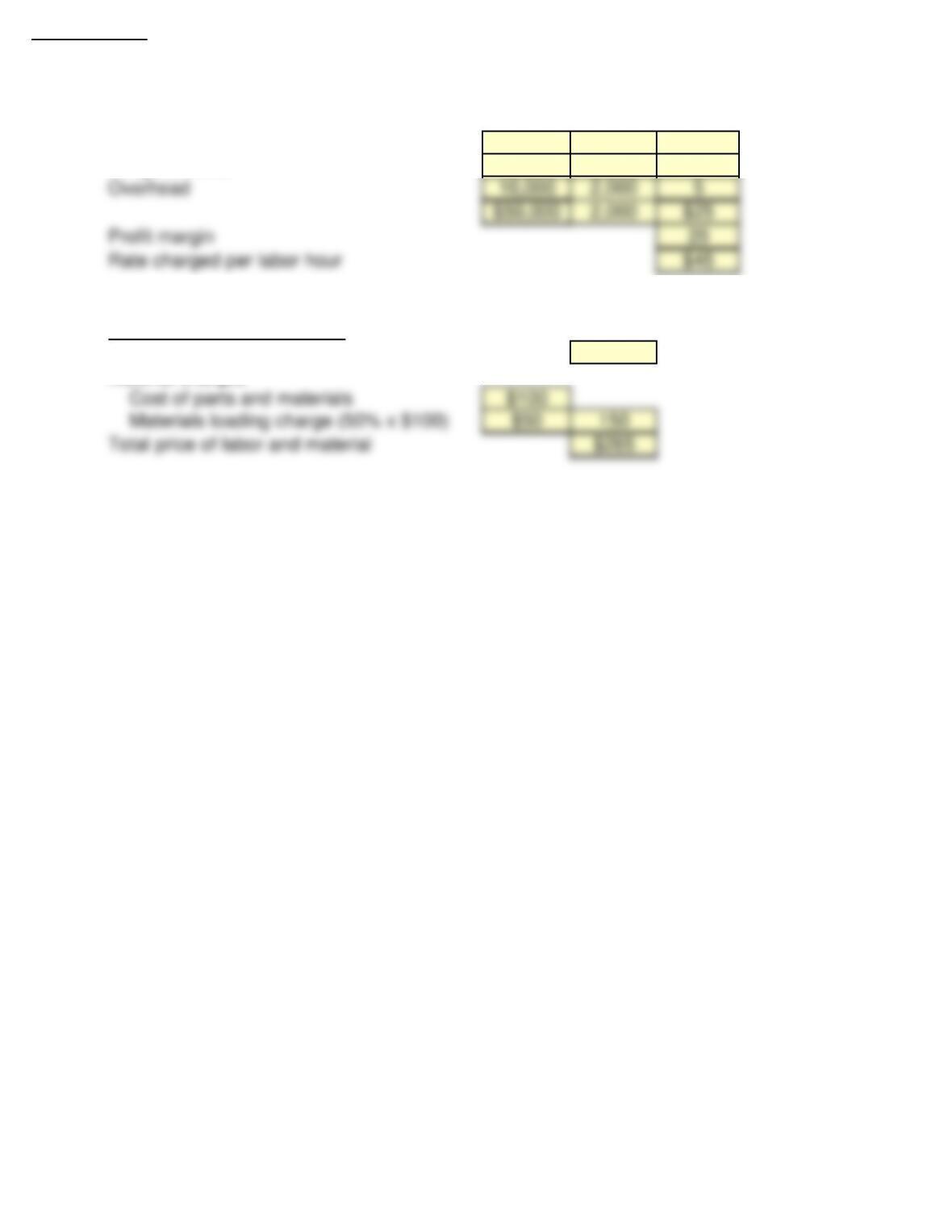
CD8 Solution
Total
Cost
Total
Hours
Per Hour
Charge
Repair technician’s wages $30,000 2,000 $15
Fringe benefits 10,000 2,000 5
Job: Composite kayak repair
Labor charges ( 3 hours @ $45) $135
Material charges
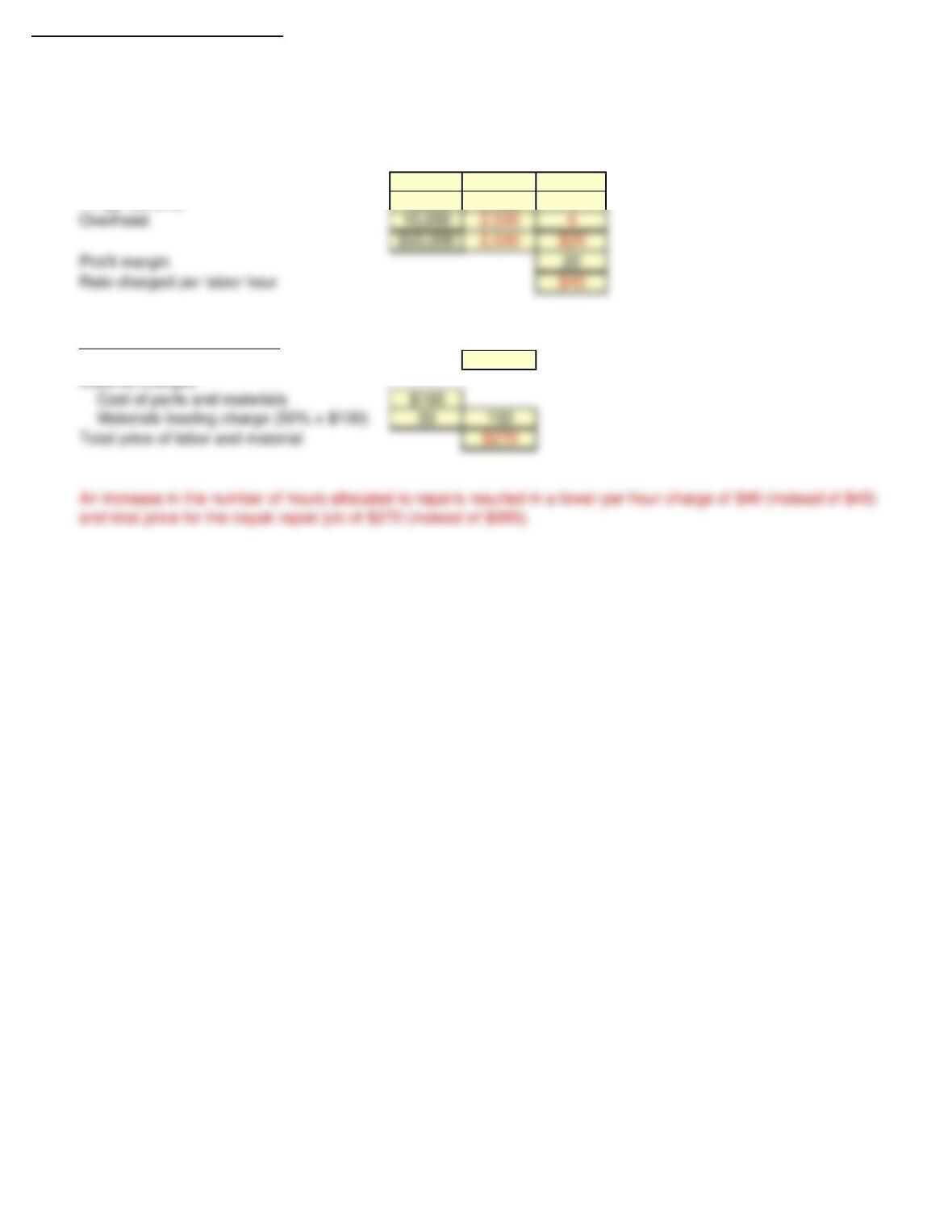
CD8 Solution to additional question
1. Assume that the allocated hours of repair time change to 2,500 for the upcoming year.
What is the impact of this change on the price charge for the repair job?
Total
Cost
Total
Hours
Per Hour
Charge
Repair technician’s wages $30,000 2,500 $12
Fringe benefits 10,000 2,500 4
Job: Composite kayak repair
Labor charges ( 3 hours @ $40) $120