CHAPTER 8
8-1
© 2021 Cengage Learning, Inc. May not be scanned, copied or duplicated, or posted to a publicly accessible website, in whole or in part.
CHAPTER 8 Internal Control and Cash
DISCUSSION QUESTIONS (Continued)
9. a. Yes. Even though the petty cash fund is only $750, if the fund is replenished frequently, a
significant amount of cash could be stolen. For example, if the fund is replenished weekly,
$39,000 ($750 × 52 weeks) could be subject to theft.
b. Controls for petty cash include (1) designating one person who is responsible for the fund,
(2) maintaining a written record of all payments, (3) requiring support (receipts) for
payments from the fund, and (4) having an independent person periodically review the funds
b. Examples of cash equivalents include certificates of deposit, U.S. government securities,
corporate notes and bonds, and commercial paper.
8-2
© 2021 Cengage Learning, Inc. May not be scanned, copied or duplicated, or posted to a publicly accessible website, in whole or in part.
CHAPTER 8 Internal Control and Cash
PE 8-1A
1. (c) monitoring
2. (a) the control environment
3. (b) control procedures
2. (c) information and communication
3. (b) control procedures
credit memo increases
debit memo decreases
credit memo increases
debit memo decreases4
3
PRACTICE EXERCISES
4
3
8-3
© 2021 Cengage Learning, Inc. May not be scanned, copied or duplicated, or posted to a publicly accessible website, in whole or in part.
CHAPTER 8 Internal Control and Cash
PE 8-3A
a. $9,660, determined as follows:
Bank section of reconciliation: $14,385 + $2,125 – $6,850 = $9,660
Company section of reconciliation: $11,200 – $60 – $1,480 = $9,660
b. Accounts Receivable 1,480
Miscellaneous Expense 60
Cash 11,170
Notes Receivable 10,640
Interest Revenue 530
b. Store Supplies 780
Miscellaneous Selling Expense 280
Cash Short and Over 50
Cash 1,110
8-4
© 2021 Cengage Learning, Inc. May not be scanned, copied or duplicated, or posted to a publicly accessible website, in whole or in part.
CHAPTER 8 Internal Control and Cash
PE 8-5A
$97,200
12 months
Ratio of Cash to
Monthly Cash Expenses
Ratio of Cash to
Monthly Cash Expenses
b. The preceding computations indicate that McMasters Company has 5.4 months
of cash remaining as of December 31. McMasters Company will need to generate
positive cash flow from operations or raise additional financing from its owners
or by issuing debt.
Monthly Cash Expenses
Cash as of Year-End
Monthly Cash Expenses
6.7 months==
$8,100 per month
5.4 months
$25,700 per month
$54,270
=Cash as of Year-End
Monthly Cash Expenses
=$138,780 =
a.
=
= $8,100 per month
Negative Cash Flow from Operations
12 months
=
=
8-5
© 2021 Cengage Learning, Inc. May not be scanned, copied or duplicated, or posted to a publicly accessible website, in whole or in part.
CHAPTER 8 Internal Control and Cash
Ex. 8-1
Section 404 requires management’s internal control report to:
(1) state the responsibility of management for establishing and maintaining
an adequate internal control structure and procedures for financial
reporting; and
(2) contain an assessment, as of the end of the issuer’s fiscal year, of the
effectiveness of the internal control structure and procedures of the
issuer for financial reporting.
(1) state the responsibility of management for establishing and maintaining
an adequate internal control structure and procedures for financial
reporting; and
(2) contain an assessment, as of the end of the issuer’s fiscal year, of the
effectiveness of the internal control structure and procedures of the
issuer for financial reporting.
Directs the SEC to require each issuer to disclose whether it has adopted a
code of ethics for its senior financial officers and the contents of that code.
Directs the SEC to revise its regulations concerning prompt disclosure on
Form 8-K to require immediate disclosure “of any change in, or waiver of,” an
issuer’s code of ethics.
EXERCISES
8-6
© 2021 Cengage Learning, Inc. May not be scanned, copied or duplicated, or posted to a publicly accessible website, in whole or in part.
CHAPTER 8 Internal Control and Cash
Ex. 8-2
a. Agree. Jimmy has made one employee responsible for the cash drawer in
accordance with the internal control principle of assignment of responsibility.
In addition, Jimmy has segregated the operations (preparing the orders) from
the accounting (taking orders and payments).
b. Disagree. It is commendable that Jimmy has given the employee a specific
responsibility and is holding that employee accountable for it. However, after
the cashier has counted the cash, another employee (or perhaps Jimmy)
should remove the cash register tape and compare the amount on the tape
to the cash in the drawer. Also, Jimmy’s standard of no mistakes may
encourage the cashiers to overcharge a few customers in order to cover any
c. A store credit for any merchandise returned without a receipt would reduce
the possibility of theft of cash. In this case, a clerk could only issue a phony
store credit rather than taking money from the cash register. A store credit is
not as tempting as cash. In addition, salesclerks could only use a few store
credits to purchase merchandise for themselves without management getting
suspicious.
An advantage of issuing a store credit for returns without a receipt is that the
possibility of stealing cash is reduced. The store will also lose less revenue if
customers must choose other store merchandise instead of receiving a cash
refund. The overall level of returns/exchanges may be reduced because
customers will not return an acceptable gift simply because they need cash
more than the gift. The policy will also reduce the “cash drain” during the
weeks immediately following the holidays, allowing Ramona’s Clothing to keep
more of its money earning interest or use that cash to purchase spring
8-7
© 2021 Cengage Learning, Inc. May not be scanned, copied or duplicated, or posted to a publicly accessible website, in whole or in part.
CHAPTER 8 Internal Control and Cash
Ex. 8-3 (Concluded)
A disadvantage of issuing a store credit for returns without a receipt is that
preholiday sales might drop as gift-givers realize that the return policy has
tightened. After the holidays, customers wanting to return items for cash
refunds may be frustrated when they learn the store policy has changed. The
ill will may reduce future sales. It may take longer to explain the new policy
and fill out the paperwork for a store credit, lengthening lines at the return
counter after the holidays. Salesclerks will need to be trained to apply the
new policy and write up a store credit. Salesclerks also will need to be
trained to handle the redemption of the store credit on future merchandise
attempting to ring up a refund and remove cash when a customer is not
present at the sales desk. These security measures could include cameras or
additional security personnel discreetly monitoring the sales desk.
Finally, an employee on the following work shift could be assigned the
responsibility of restocking returned merchandise and reconciling the returns
to a refund list for the department.
Allowing the bank president to have sole authority to grant large loans can lead
to the president granting loans to friends and business associates without the
required due diligence. This can result in a bank becoming exposed to very poor
credit risks. Indeed, this scenario is one of the causes of the savings and loan
failures of the past.
8-8
© 2021 Cengage Learning, Inc. May not be scanned, copied or duplicated, or posted to a publicly accessible website, in whole or in part.
CHAPTER 8 Internal Control and Cash
Ex. 8-5
The Societe Generale trading losses show how small lapses in internal control can
have large consequences. When the losses became so large that they could no
longer be hidden, it was too late. The loss could have been avoided using a number
of internal controls. First, the separation of duties control was overcome by the
trader’s intimate knowledge of the monitoring software. This knowledge of the
monitoring system allowed the trader to hide trades effectively. The design of the
monitoring software would need to be improved and access prohibited by traders.
If traders have access to the monitoring software, the separation of duties control
is violated. Second, the trader should be under managerial oversight. For example,
trades that exceed a certain amount of exposure should require management
approval. In this way, a trader would be forced to slow down or stop once trades
reached a certain limit. This would avoid the trader’s tendency to try to “make up”
losses with even larger bets. Finally, if the trader had had to take required vacation
time, managers may have been alerted then to the hidden losses once the trader
discovered that the claim was fictitious. However, the very nature of the process was to
resolve small claims quickly without excessive control. Finally, corrupt lawyers were
brought into the fraud to act as attorneys for the claimants. This gave the claims even
more credibility. In actuality, the lawyers had done legitimate business with the trucking
company, so all appeared normal. This fraud was discovered when the fraudulent
employee’s bank noticed irregularities in his bank account and notified authorities.
As the saying goes, “Follow the money!”
8-9
© 2021 Cengage Learning, Inc. May not be scanned, copied or duplicated, or posted to a publicly accessible website, in whole or in part.
CHAPTER 8 Internal Control and Cash
Ex. 8-7
All-Around Sound Co. should not have relied on the unusual nature of the vendors and
frequency of deliveries to uncover this fraud. The purchase and payment cycle is one
of the most critical business cycles to control because the potential for abuse is so
great. Purchases should be initiated by a requisition document. This document should
be countersigned by a superior so that two people agree as to what is being purchased.
The requisition should initiate a purchase order to a vendor for goods or services. The
vendor responds to the purchase order by delivering the goods. The goods should be
formally received using a receiving document. An accounts payable clerk matches
the requisition, purchase order, and invoice before any payment is made. Such “triple
matching” prevents unauthorized requests and payments. In this case, the requests
were unauthorized, suggesting that the employee has sole authority to make a request.
Another issue is that this employee had access to the invoices. This access allowed the
employee to change critical characteristics of the invoice to hide the true nature of the
goods being received. The invoice should have been delivered directly to the accounts
payable clerk to avoid corrupting the document. There apparently was no receiving
document (common for smaller companies); thus, only the invoice provided proof of
what was received and needed to be paid. If there had been a receiving report, the
invoice could not have been doctored and gone undetected because it would not
have matched the receiving report.
b. Overall, this type of fraud can be stopped if there is a strong oversight of senior
management, such as an audit committee of the board of directors. Individual
whistle-blowers in the company can make their concerns known to the independent
or internal auditors who, in turn, can inform the audit committee. The audit
committee should be independent of management and have the power to monitor
the actions of management.
8-10
© 2021 Cengage Learning, Inc. May not be scanned, copied or duplicated, or posted to a publicly accessible website, in whole or in part.
CHAPTER 8 Internal Control and Cash
Ex. 8-9
a. The salesclerks should not have access to the cash register tapes.
b. The cash register tapes should be locked in the cash register and the key
retained by the cashier. An employee of the cashier’s office should remove
the cash register tape, record the total on the memo form, and note
discrepancies.
If another employee cannot be added, the weakness in internal control could be
improved with more thorough supervision. The restaurant manager should be
directed to keep a watchful eye on the drive-through area in order to detect when
a clerk takes an order without ringing up the sale.
Another option is for Big & Bad Burgers to implement a policy that any customer who
does not receive a receipt is entitled to a free burger and advertise this policy at the
cash register and drive-through window. This approach uses the customer as an
internal control.
Ex. 8-11
a. The remittance advices should not be sent to the cashier.
b. The mailroom employees should send the remittance advices directly to the
Accounting Department.
8-11
© 2021 Cengage Learning, Inc. May not be scanned, copied or duplicated, or posted to a publicly accessible website, in whole or in part.
CHAPTER 8 Internal Control and Cash
Ex. 8-12
Cash 25,538
Cash Short and Over 132
Sales 25,670
Ex. 8-13
Cash 66,670
Sales 66,341
Cash Short and Over 329
Ex. 8-14
The use of the voucher system is appropriate, the essentials of which are outlined
below. (Although invoices could be used instead of vouchers, vouchers more
satisfactorily provide for account distribution, signatures, and other significant data.)
1. Each voucher should be approved for payment by a designated official only
after completion of the following verifications: (a) that prices, quantities, terms,
etc., on the invoice are in accordance with the provisions of the purchase order;
(b) that all quantities billed have been received in good condition, as indicated
each day of the month. Each voucher should be filed in the compartment
representing the last day of the discount period or the due date if the invoice is
implementation and use of a computerized system would also reduce the chance
that any available cash discounts are missed. For example, when invoices are
received and approved for payment, they are automatically scheduled for payment
within the discount period. However, even in a computerized system, the use of
an approval process that requires supporting documents and indicating “paid”
on these supporting documents is an important control for avoiding duplicate
8-12
© 2021 Cengage Learning, Inc. May not be scanned, copied or duplicated, or posted to a publicly accessible website, in whole or in part.
CHAPTER 8 Internal Control and Cash
Ex. 8-15
To prevent the fraud scheme described, Paragon Tech must separate responsibilities
for related operations. As in the past, all service requisitions should be submitted
to the Purchasing Department. After receiving the service request, Purchasing
should complete a Service Verification form stating the service that has been
ordered and the name of the company that will provide the service. This form
should be delivered via intercompany mail to the person responsible for verifying
that the service was performed. This person should have firsthand knowledge of
whether the service was performed. This person, who must be someone other than
the manager requesting the service, should fill in the date and time the service was
received and sign the form. In addition, the vendor providing the service should
sign the form before leaving the premises. When completed, the Service Verification
form should be forwarded to the Accounting Department. Accounting will authorize
payment of the vendor’s invoice after the Service Verification form has been
compared with the invoice.
Ex. 8-16
a. Addition to the balance per bank: (5)
b. Deduction from the balance per bank: (4), (6)
c. Addition to the balance per company’s records: (7)
d. Deduction from the balance per company’s records: (1), (2), (3)
Ex. 8-17
(1), (2), (3), (7)
The preceding additions and deductions to the cash balance according to the
company’s records require journal entries in the company’s records. Additions
and deductions to the cash balance according to the bank’s records do not require
8-13
© 2021 Cengage Learning, Inc. May not be scanned, copied or duplicated, or posted to a publicly accessible website, in whole or in part.
CHAPTER 8 Internal Control and Cash
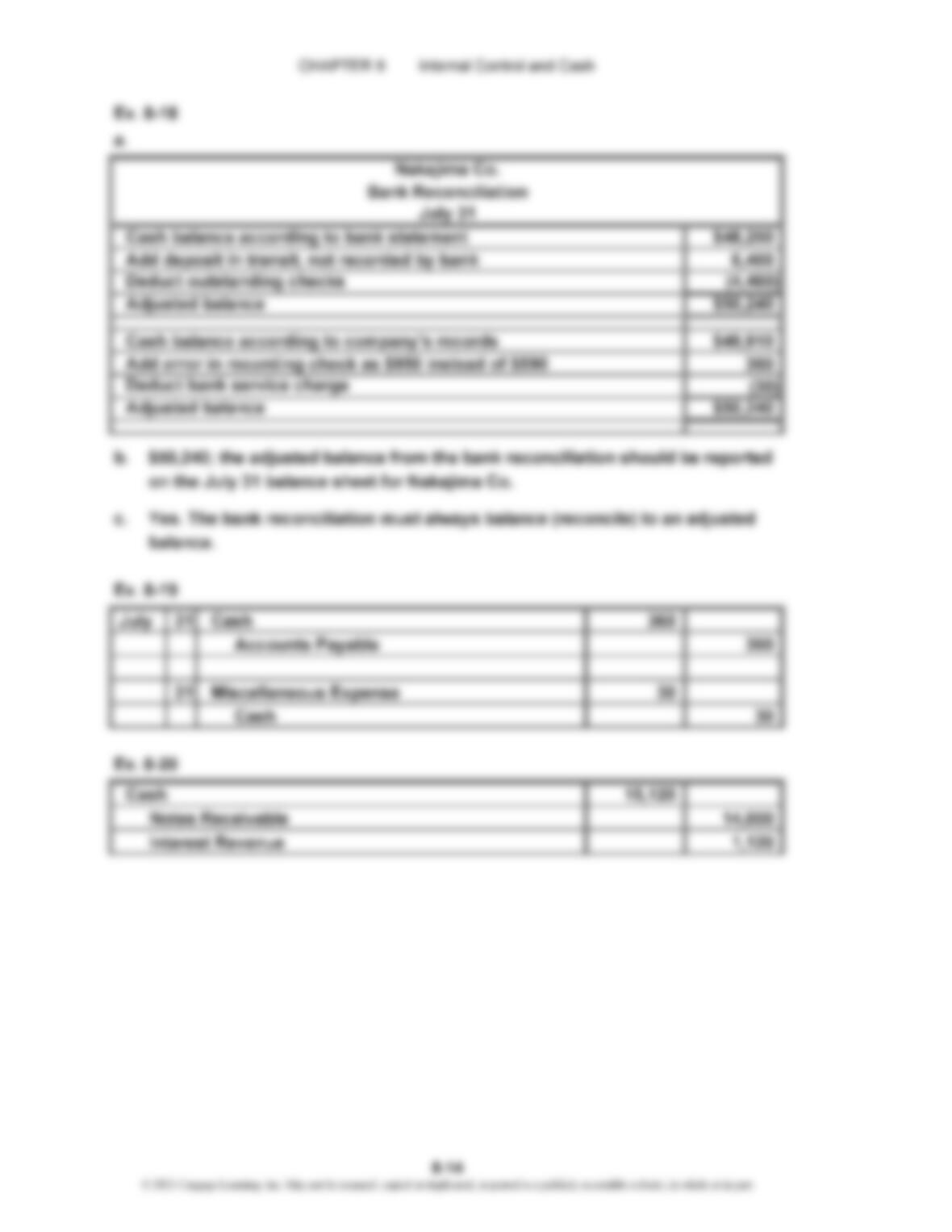
Ex. 8-18
a.
Cash balance according to bank statement $48,250
Add deposit in transit, not recorded by bank 6,450
Deduct outstanding checks (4,460)
Adjusted balance $50,240
Cash balance according to company’s records $49,910
Add error in recording check as $950 instead of $590 360
Deduct bank service charge (30)
Adjusted balance $50,240
c. Yes. The bank reconciliation must always balance (reconcile) to an adjusted
balance.
Ex. 8-19
31 Cash 360
Accounts Payable 360
31 Miscellaneous Expense 30
Cash 30
Ex. 8-20
Cash 15,120
Notes Receivable 14,000
Interest Revenue 1,120
Nakajima Co.
Bank Reconciliation
July 31
July
8-14
© 2021 Cengage Learning, Inc. May not be scanned, copied or duplicated, or posted to a publicly accessible website, in whole or in part.
CHAPTER 8 Internal Control and Cash
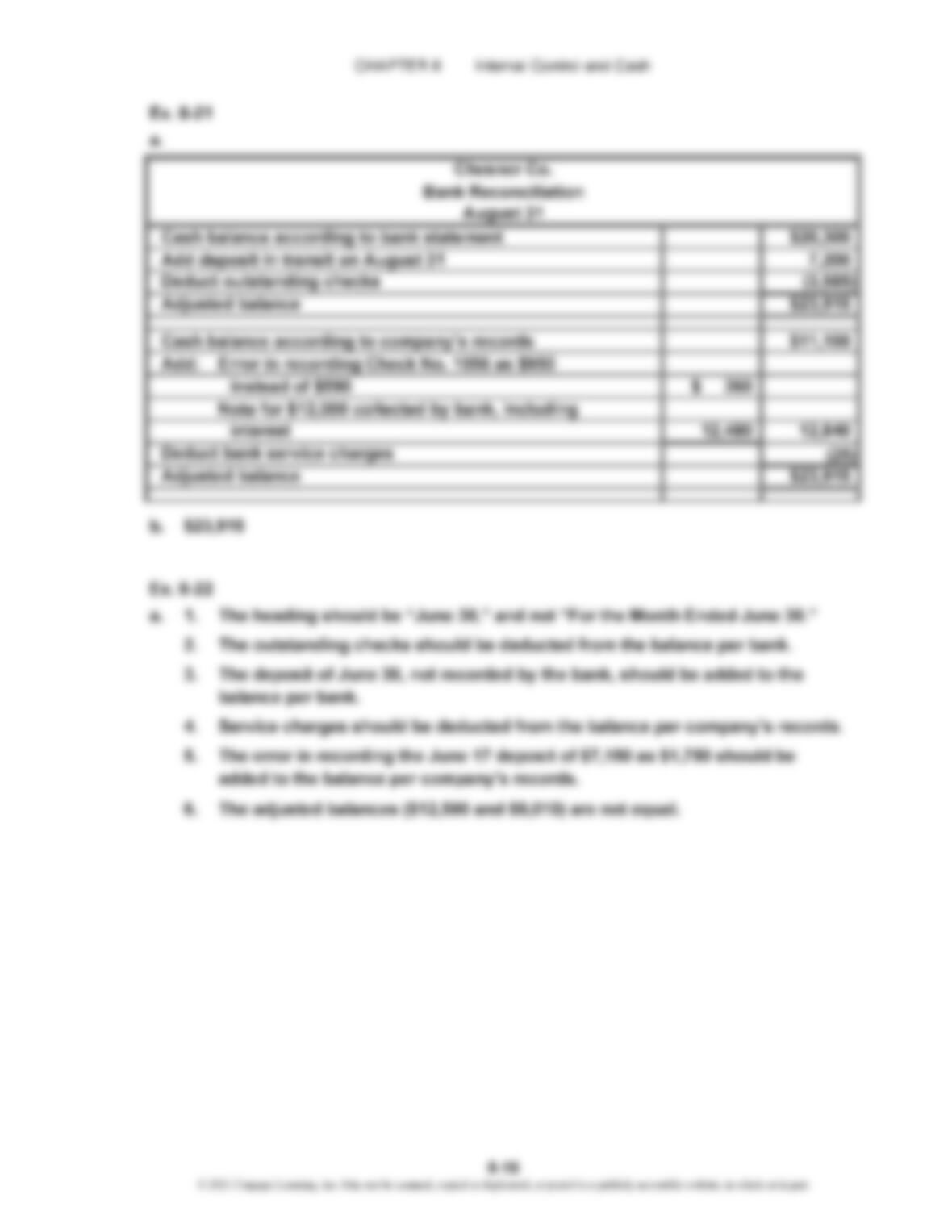
Ex. 8-21
a.
Cash balance according to bank statement $20,300
Add deposit in transit on August 31 7,200
Deduct outstanding checks (3,585)
Adjusted balance $23,915
Cash balance according to company’s records $11,100
Add: Error in recording Check No. 1056 as $950
instead of $590 $ 360
Note for $12,000 collected by bank, including
interest 12,480 12,840
Deduct bank service charges (25)
Adjusted balance $23,915
4. Service charges should be deducted from the balance per company’s records.
5. The error in recording the June 17 deposit of $7,150 as $1,750 should be
added to the balance per company’s records.
6. The adjusted balances ($12,590 and $9,010) are not equal.
Chesner Co.
Bank Reconciliation
August 31
8-15
© 2021 Cengage Learning, Inc. May not be scanned, copied or duplicated, or posted to a publicly accessible website, in whole or in part.
CHAPTER 8 Internal Control and Cash
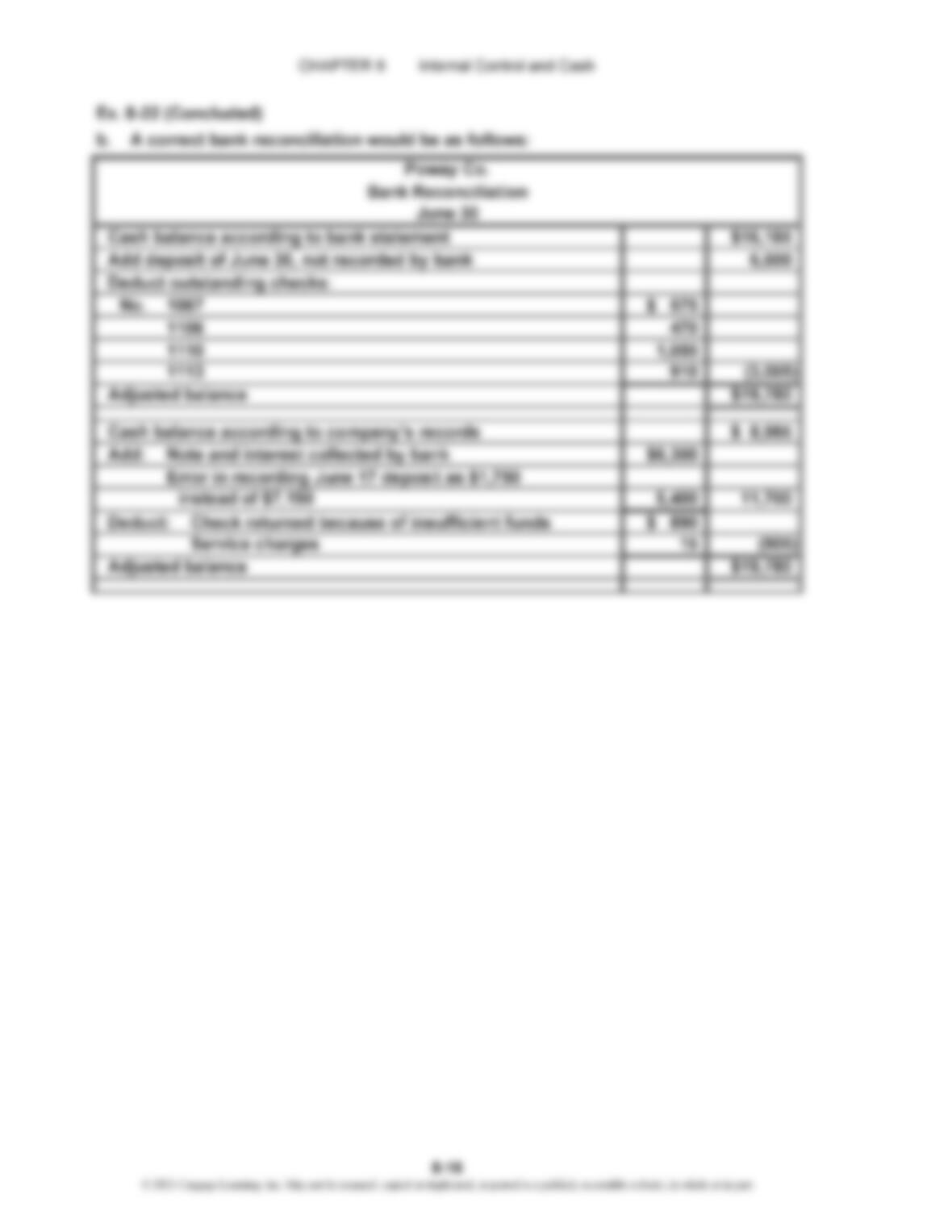
Ex. 8-22 (Concluded)
b. A correct bank reconciliation would be as follows:
Cash balance according to bank statement $16,185
Add deposit of June 30, not recorded by bank 6,600
Deduct outstanding checks:
No. 1067 $ 575
1106 470
1110 1,050
1113 910 (3,005)
Adjusted balance $19,780
Cash balance according to company’s records $ 8,985
Add: Note and interest collected by bank $6,300
Error in recording June 17 deposit as $1,750
instead of $7,150 5,400 11,700
Deduct: Check returned because of insufficient funds $ 890
Service charges 15 (905)
Adjusted balance $19,780
Poway Co.
Bank Reconciliation
June 30
8-16
© 2021 Cengage Learning, Inc. May not be scanned, copied or duplicated, or posted to a publicly accessible website, in whole or in part.
CHAPTER 8 Internal Control and Cash
Ex. 8-23
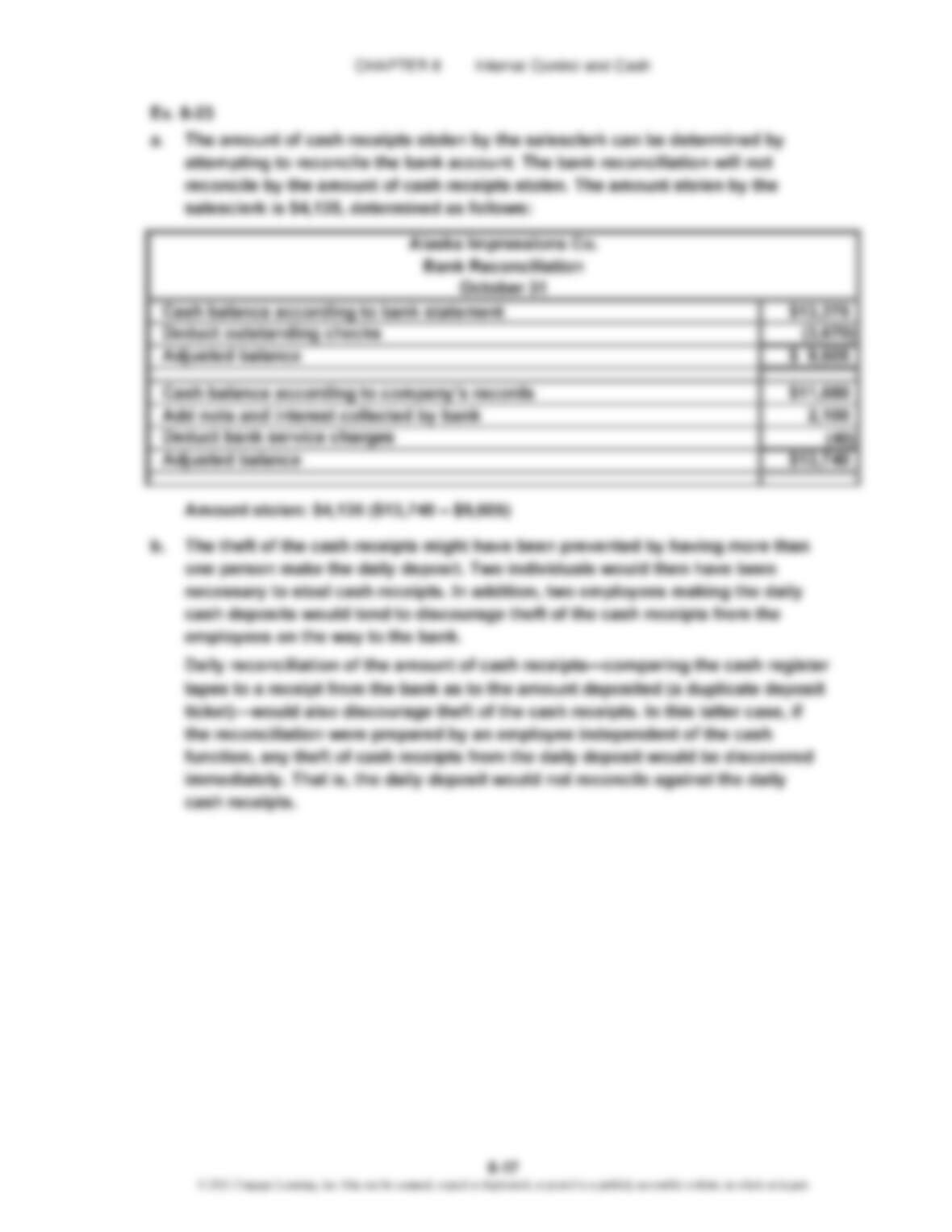
a. The amount of cash receipts stolen by the salesclerk can be determined by
attempting to reconcile the bank account. The bank reconciliation will not
reconcile by the amount of cash receipts stolen. The amount stolen by the
salesclerk is $4,135, determined as follows:
Cash balance according to bank statement $13,275
Deduct outstanding checks (3,670)
Adjusted balance $ 9,605
Cash balance according to company’s records $11,680
Add note and interest collected by bank 2,100
Deduct bank service charges (40)
Adjusted balance $13,740
Daily reconciliation of the amount of cash receipts—comparing the cash register
tapes to a receipt from the bank as to the amount deposited (a duplicate deposit
ticket)—would also discourage theft of the cash receipts. In this latter case, if
the reconciliation were prepared by an employee independent of the cash
function, any theft of cash receipts from the daily deposit would be discovered
immediately. That is, the daily deposit would not reconcile against the daily
cash receipts.
Alaska Impressions Co.
Bank Reconciliation
October 31
8-17
© 2021 Cengage Learning, Inc. May not be scanned, copied or duplicated, or posted to a publicly accessible website, in whole or in part.