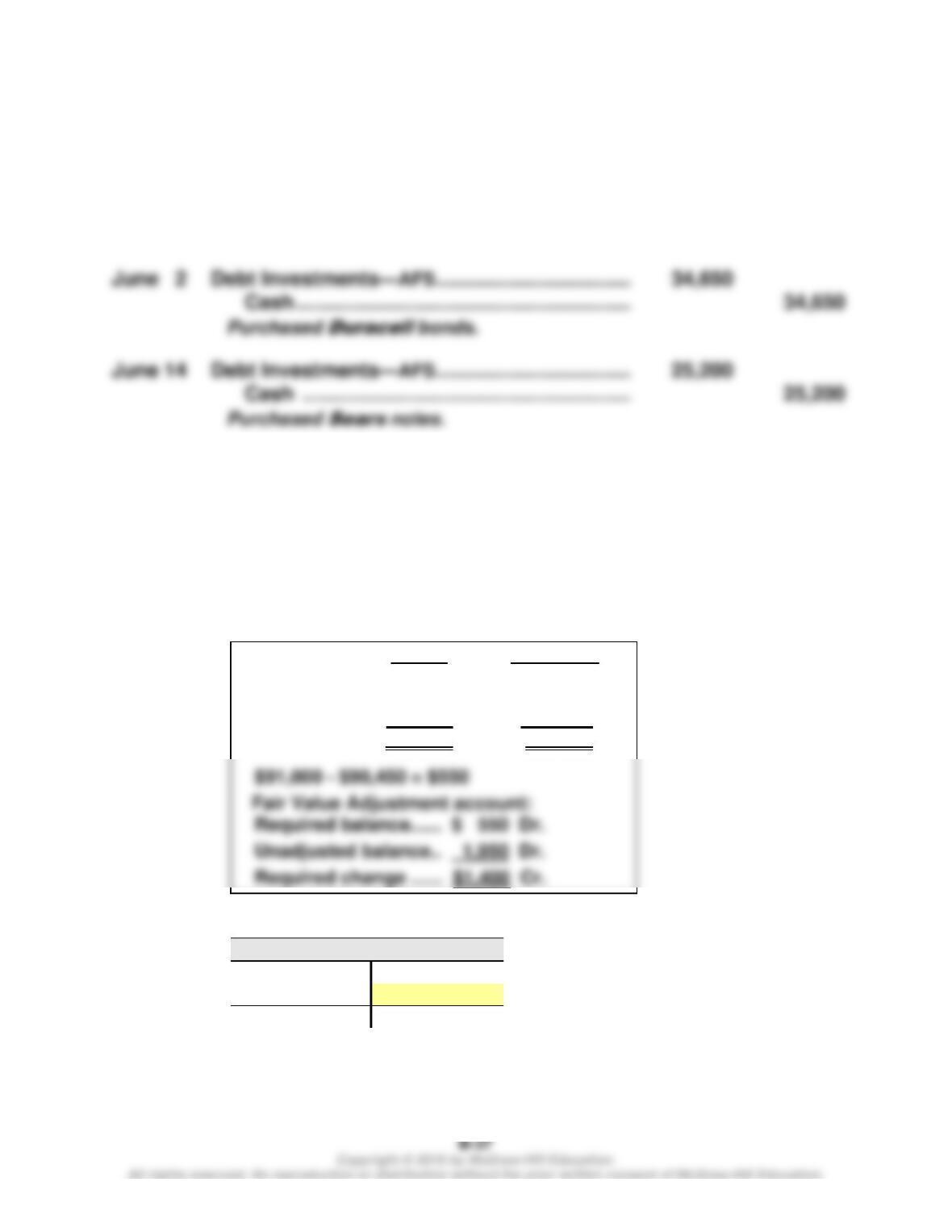
Problem C-2B (Continued)
Year 2
Apr. 26
Cash ………………………………………………………………………………
51,250
Loss on Sale of Debt Investments …………………………..
5,000
Debt Investments—AFS …………………………..
56,250
Sold
Ford
notes.
Debt Investments—AFS …………………………………………………..
34,650
Cash ……………………………………………………….
34,650
Purchased
Debt Investments—AFS …………………………………………………..
25,200
Cash ……………………………………………………….
25,200
Purchased
Nov. 27
Cash ……………………………………………………………………………..
30,600
Gain on Sale of Debt Investments …………………………..
2,400
Debt Investments—AFS …………………………..
28,200
Sold
Polaroid
bonds.
Dec. 31
Unrealized Gain—Equity ………………………………………………….
1,400
Fair Value Adjustment—AFS* …………………………..
1,400
Adjustment to fair value of LT AFS portfolio.
*
Cost _
Fair Value
Apple ………..
$30,600
$31,000
Duracell …….
34,650
32,400
Sears ………..
25,200
27,600
Total …………
$90,450
$91,000
We can also use a T-account to help determine the needed adjustment to fair value:
12/31/Year 2—F.V. Adj—AFS (LT)
Unadj.
1,950
Adj.
1,400
End.
550
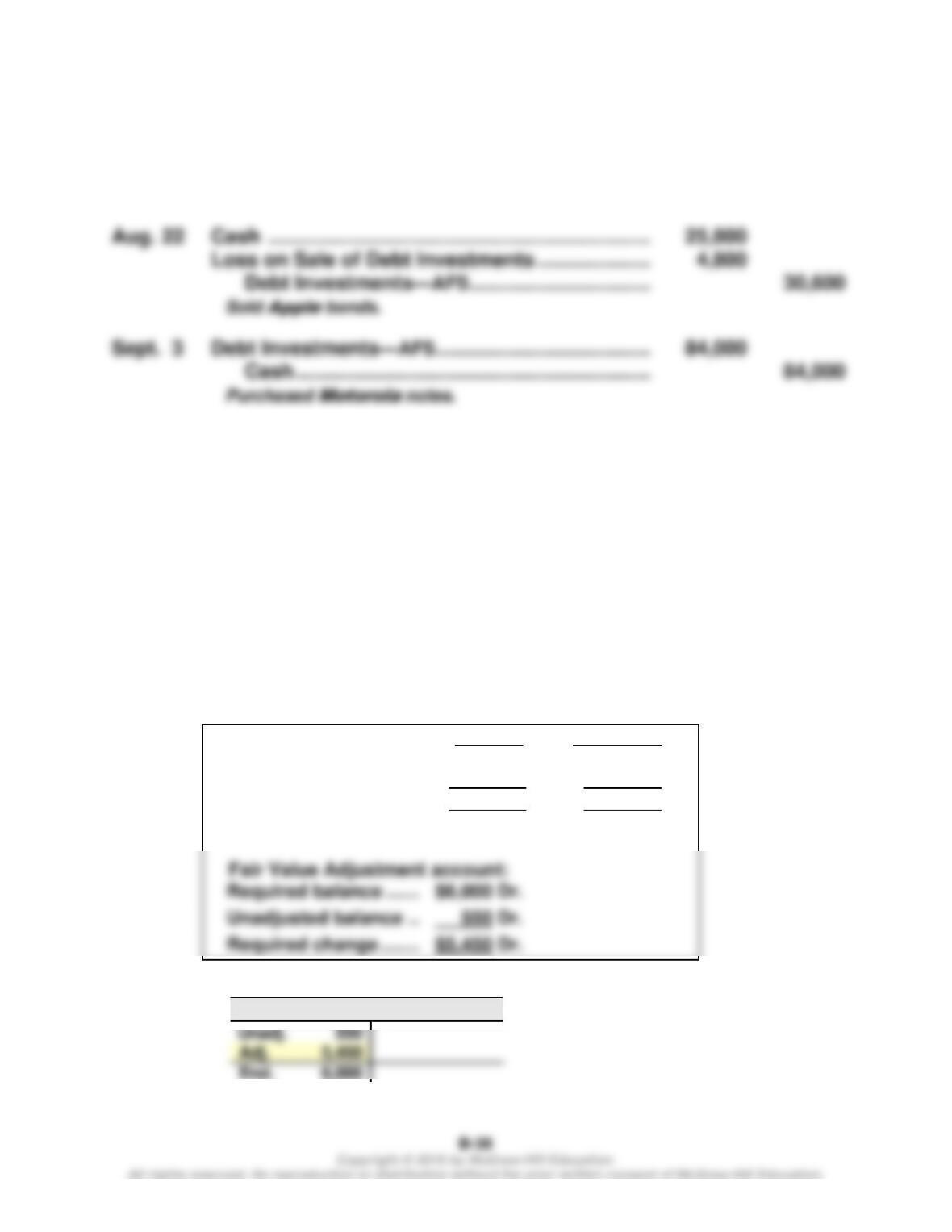
Problem C-2B (Continued)
Year 3
Jan. 28
Debt Investments—AFS …………………………………………………..
40,000
Cash ……………………………………………………….
40,000
Purchased
Coca-Cola
bonds.
Aug. 22
Cash ……………………………………………………………………………..
25,800
Loss on Sale of Debt Investments …………………………..
4,800
Debt Investments—AFS ……………………………………………..
30,600
Sold
Apple
bonds.
Debt Investments—AFS …………………………………………………..
84,000
Cash ……………………………………………………….
84,000
Purchased
Motorola
Oct. 9
Cash ……………………………………………………………………………..
28,800
Gain on Sale of Debt Investments …………………………..
3,600
Debt Investments—AFS ……………………………………………..
25,200
Sold
Sears
notes.
Oct. 31
Cash ………………………………………………………………………………
27,000
Loss on Sale of Debt Investments …………………………..
7,650
Debt Investments—AFS ……………………………………………..
34,650
Sold Duracell bonds.
Dec. 31
Fair Value Adjustment—AFS* …………………………..
5,450
Unrealized Gain—Equity ……………………………………………..
5,450
Adjustment to fair value of LT AFS portfolio.
*
Cost _
Fair Value
Coca-Cola ……………………
$ 40,000
$ 48,000
Motorola ………………………
84,000
82,000
Total…………………………….
$124,000
$130,000
$130,000 – $124,000 = $6,000
We can also use a T-account to help determine the needed adjustment to fair value:
12/31/Year 3—F.V. Adj—AFS (LT)
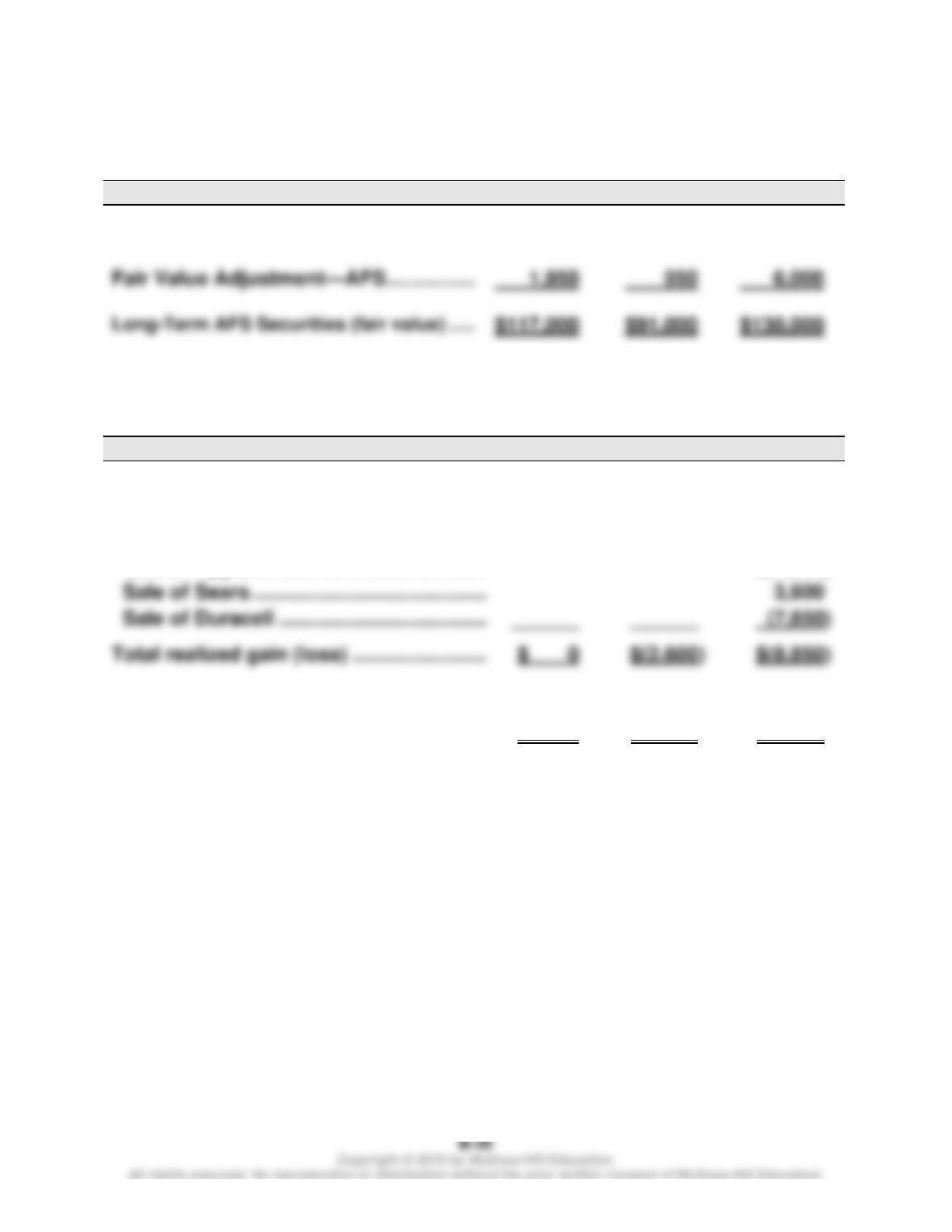
Problem C-2B (Concluded)
Part 2
Portfolio of LT AFS Securities
12/31/Yr. 1
12/31/Yr. 2
12/31/Yr. 3
Long-Term AFS Securities (cost)……………
$115,050
$90,450
$124,000
Long-Term AFS Securities (fair value) ……
Part 3
Year 1
Year 2
Year 3
Realized gains (losses)
Sale of Ford ……………………………………..
$(5,000)
Sale of Polaroid ……………………………….
2,400
Sale of Apple ……………………………………
$(4,800)
Sale of Sears ……………………………………
Sale of Duracell ……………………………….
Total realized gain (loss) ……………………
$(2,600)
Unrealized gains (losses) at year–end*..
$1,950
$ 550
$ 6,000
*The unrealized gains (losses) at year-end are reported in the Fair Value
Adjustment—AFS account balance (see the matching row in part 2).
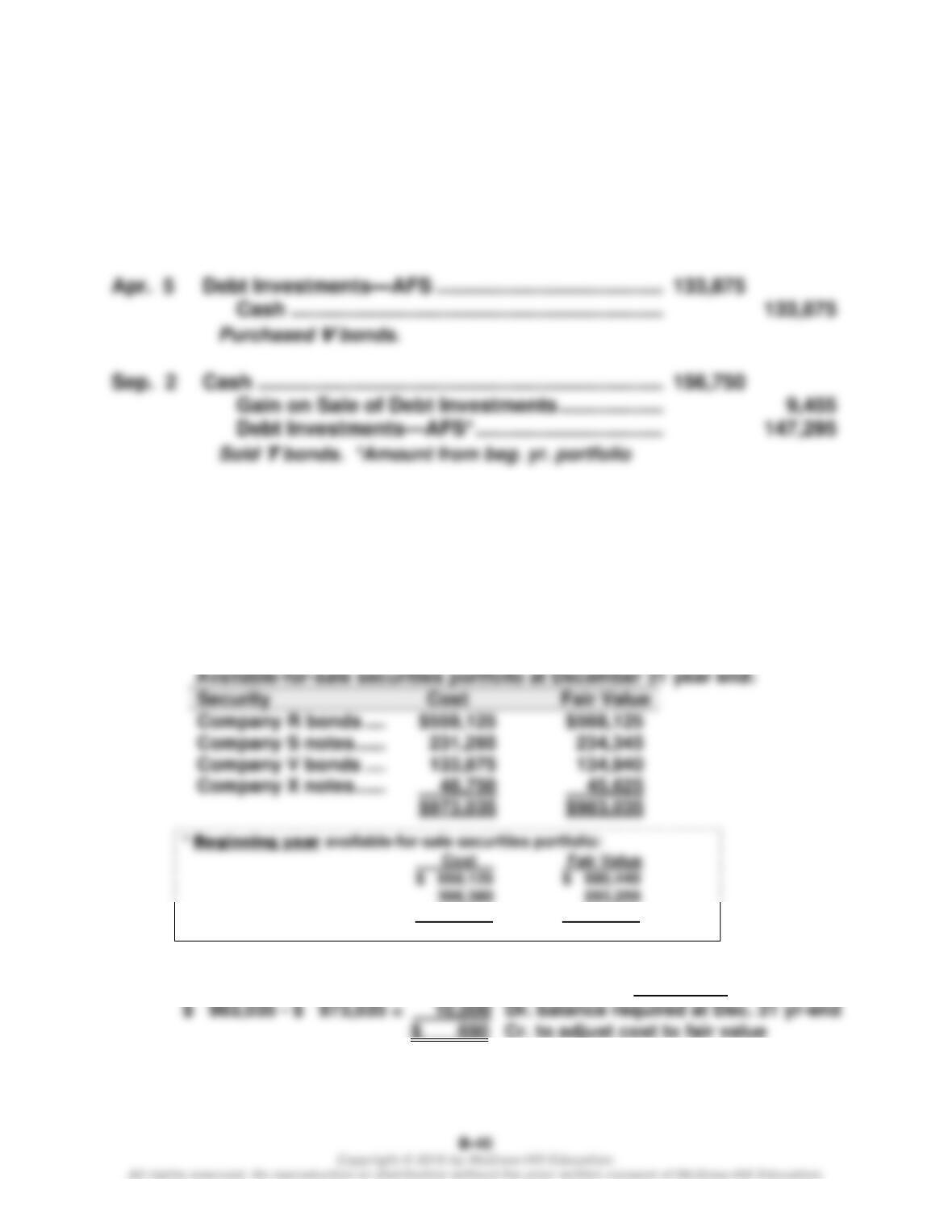
Problem C-3B (40 minutes)
Part 1
Jan. 13
Cash ………………………………………………………………………………
72,250
Loss on Sale of Debt Investments …………………………..
4,845
Debt Investments—AFS* ……………………………………………
77,095
Sold
S
notes. *$308,380 x 1/4
Apr. 5
Debt Investments—AFS …………………………………………
Cash ………………………………………………………………..
Purchased
V
Gain on Sale of Debt Investments …………………………..
9,455
Debt Investments—AFS* ……………………………………………
Sold
T
Oct. 30
Debt Investments—AFS …………………………………………
48,750
Cash ………………………………………………………………..
48,750
Purchased
X
notes.
Dec. 31
Unrealized Gain—Equity …………………………………………………
690
Fair Value Adjustment—AFS* …………………………..
690
Adjustment to fair value of LT AFS portfolio.
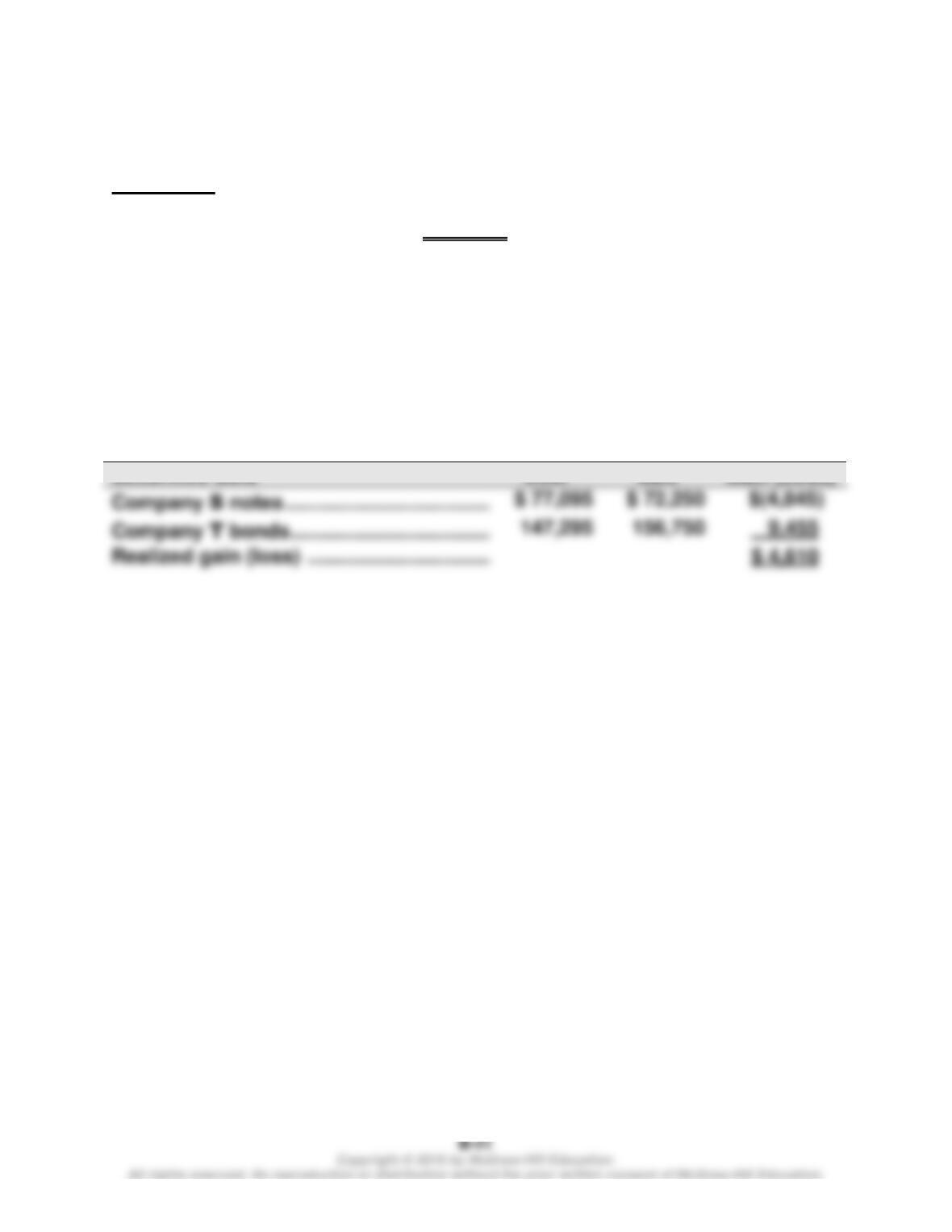
Security
Company R bonds …………………………..
Company S notes …………………………..
Company V bonds …………………………..
Company X notes …………………………..
147,295
151,800
$1,014,800
$1,025,490
Fair Value Adjustment account:
$1,025,490 – $1,014,800 = $ 10,690 Dr. balance at beginning of year
Problem C-3B (Concluded)
Part 2
Disclosure
The portfolio of available-for-sale securities is reported on the December 31
balance sheet at its fair value of $983,035.
Part 3
Only realized gains or realized losses on the sale of available–for-sale
securities appear on the annual income statement. Unrealized gains or
losses for available-for-sale securities appear in the equity section of the
balance sheet.
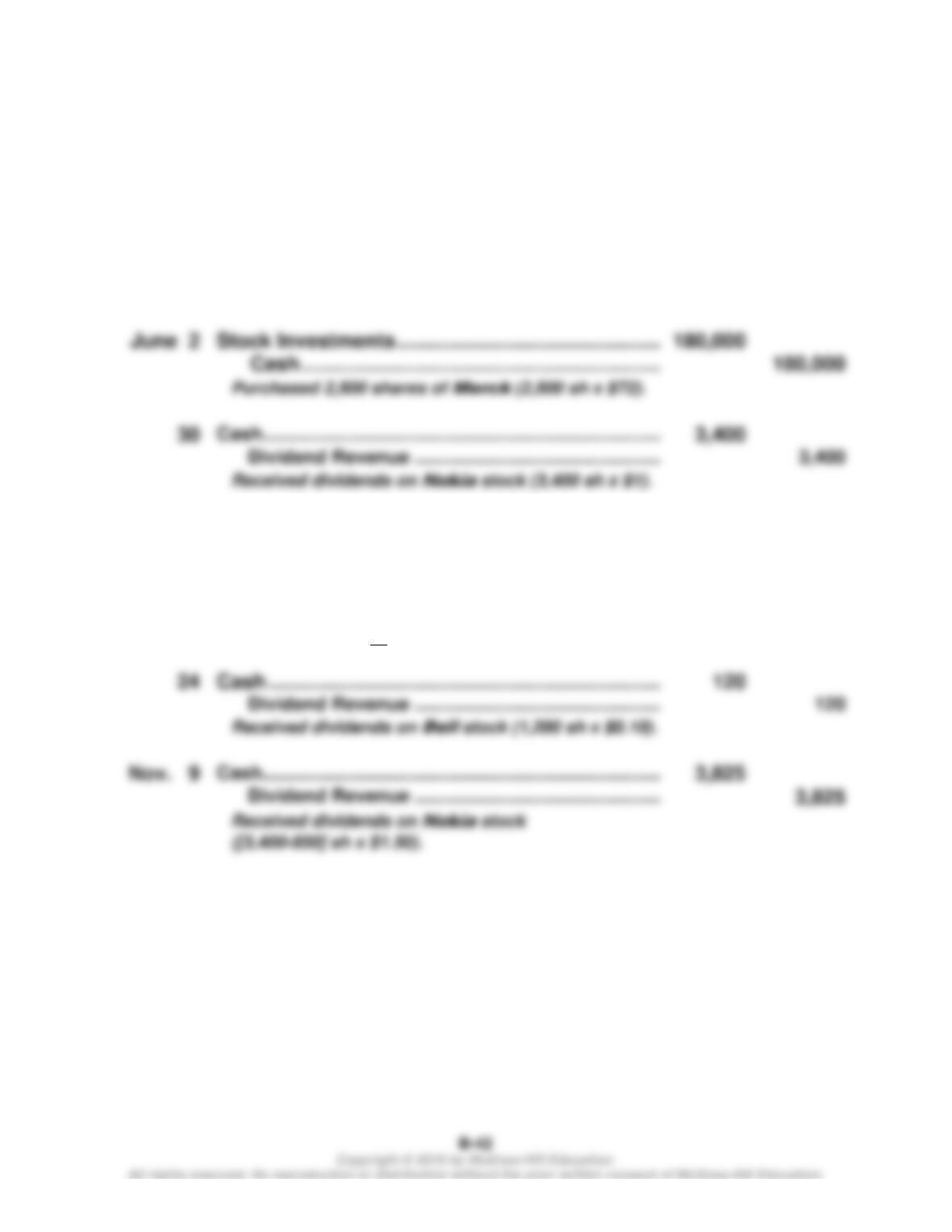
Realized gains (losses) for the year
Problem C-4B (40 minutes)
Part 1
Feb. 6
Stock Investments ………………………………………..
139,400
Cash ……………………………………………………….
139,400
Purchased 3,400 shares of
Nokia
(3,400 sh x $41).
Apr. 7
Stock Investments ………………………………………..
46,800
Cash ……………………………………………………….
46,800
Purchased 1,200 shares of
Dell
(1,200 sh x $39).
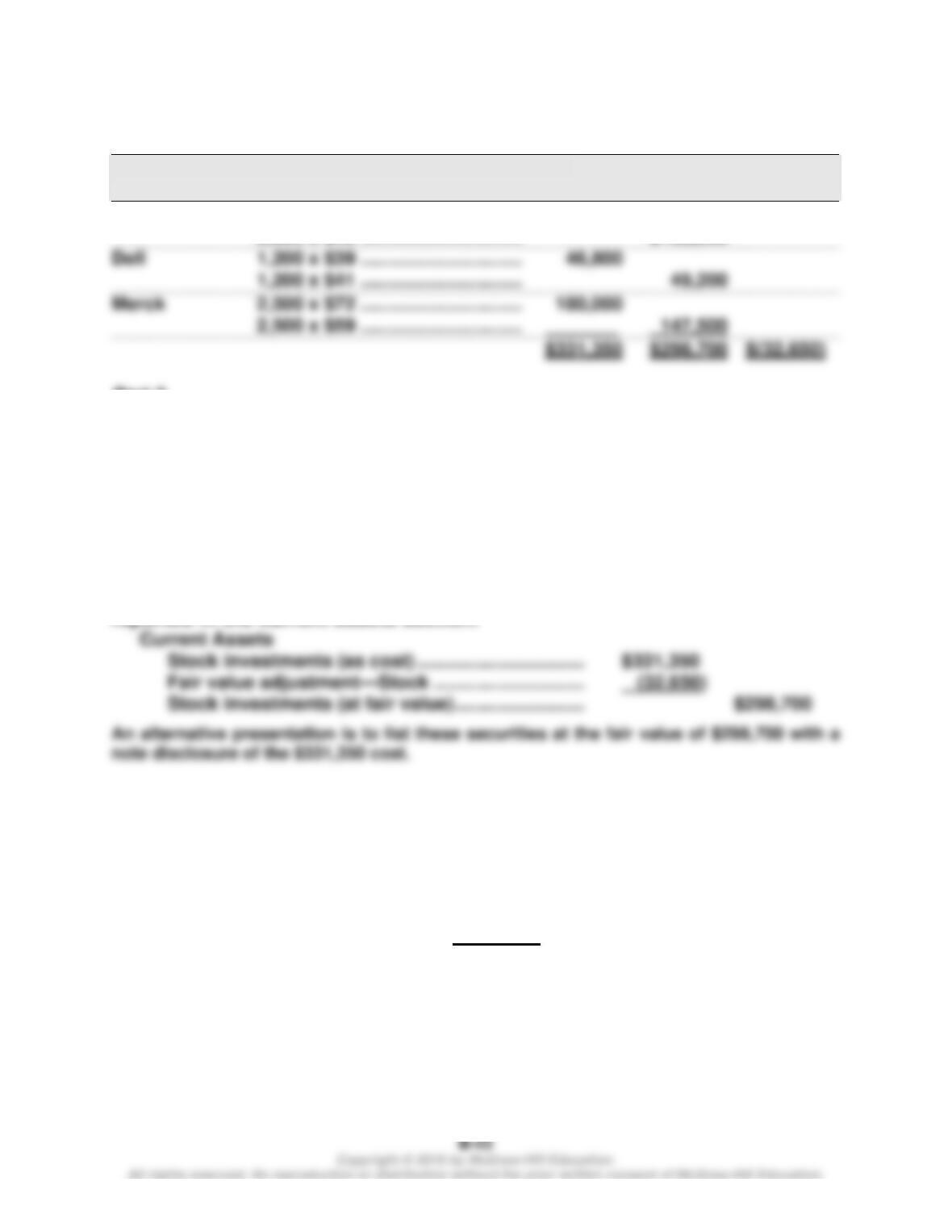
Stock Investments ………………………………………..
Cash ……………………………………………………….
Purchased 2,500 shares of
Merck
Cash ……………………………………………………………..
Dividend Revenue …………………………..…………
Received dividends on
Nokia
Aug. 11
Cash*……………………………………………………………
39,100
Gain on Sale of Stock Investments …………….
4,250
Stock Investments** ………………………………..
34,850
Sold 850 shares of
Nokia
.
*850 sh x $46 **$139,400 x (850 sh / 3,400 sh)
or 850 sh x $41
Cash …………………………..………………………………..
120
Dividend Revenue …………………………..…………
120
Received dividends on
Dell
stock (1,200 sh x $0.10).
Dec. 18
Cash ……………………………………………………………..
180
Dividend Revenue …………………………..…………
180
Received dividends on
Dell
stock (1,200 sh x $0.15).
Problem C-4B (Concluded)
Part 2
Comparison of Cost and Fair Values of Stock Portfolio
Unrealized
Cost Fair Value Gain (Loss)
Nokia 2,550 x $41 …………………………. $104,550
Part 3
Dec. 31
Unrealized Loss—Income ……………………………………
32,650
Fair Value Adjustment—Stock ………………………..
32,650
Record unrealized loss in fair value of ST stock portfolio.
Part 4
The balance sheet would report the cost of the short-term stock
investments at $331,350 and show a subtraction of $32,650 for the fair
value adjustment. This yields $298,700 as the fair value for these securities
Part 5
(a) Income statement
(i) Dividend Revenue, $7,525 [$3,400 + $120 + $3,825 + $180]
(ii) Gain on Sale of Stock Investments, $4,250
(iii) Unrealized Loss—Income, $32,650
(iv) Net effect on income is a decrease of $20,875 [$7,525 + $4,250 – $32,650]
(b) Equity section of Balance sheet
(i) Decrease to equity from the $20,875 decrease in income (loss)
Problem C-5B (30 minutes)
Journal entries—Assuming significant influence
Year 1
Jan. 5
Equity Method Investments …………………………………………….
200,500
Cash …………………………………………………………………………
200,500
Purchased
Bloch
shares.
Aug. 1
Cash ………………………………………………………………………………
21,000
Equity Method Investments ………………………………………………
21,000
Received cash dividend (20,000 sh x $1.05).
Dec. 31
Equity Method Investments …………………………………………….
20,500
Earnings from Equity Method Investments …………………
20,500
Record 25% equity in investee’s earnings
($82,000 x 25%).
Year 2
Aug. 1
Cash ………………………………………………………………………………
27,000
Equity Method Investments …………………………..
27,000
Record cash dividend (20,000 sh x $1.35).
Dec. 31
Equity Method Investments …………………………………………….
19,500
Earnings from Equity Method Investments …………………
19,500
Record 25% equity in investee’s earnings
($78,000 x 25%).
Year 3
Jan. 8
Cash ………………………………………………………………………………
12,025
Equity Method Investments* …………………………..
9,625
Gain on Sale of Stock Investments …………………………..
2,400
Sold
Bloch
shares. 5% x $192,500*
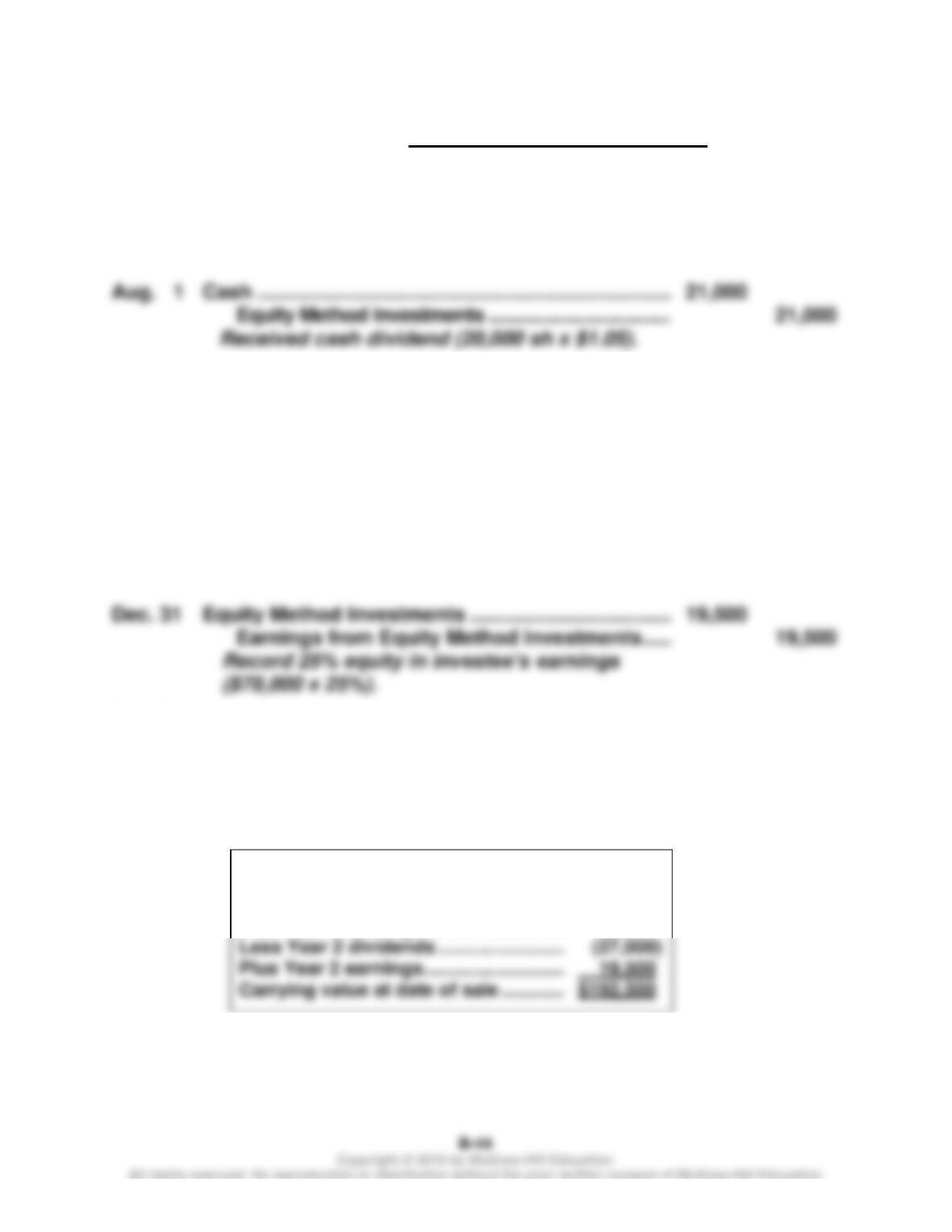
*Investment carrying value at Jan. 8, Year 3
Original cost ……………………………………
$200,500
Less Year 1 dividends ……………………..
(21,000)
Plus Year 1 earnings ………………………..
20,500
Less Year 2 dividends ……………………..
Plus Year 2 earnings ………………………..
Carrying value at date of sale …………..
$192,500
Problem C-6B (30 minutes)
Journal entries—Assuming NO significant influence
Year 1
Jan. 5
Stock Investments ……………………………………………………….
200,500
Cash ……………………………………………………….
200,500
Purchased
Bloch
shares.
Aug. 1
Cash ………………………………………………………………………………
21,000
Dividend Revenue …………………………………………………….
21,000
Received cash dividend (20,000 sh x $1.05).
Dec. 31
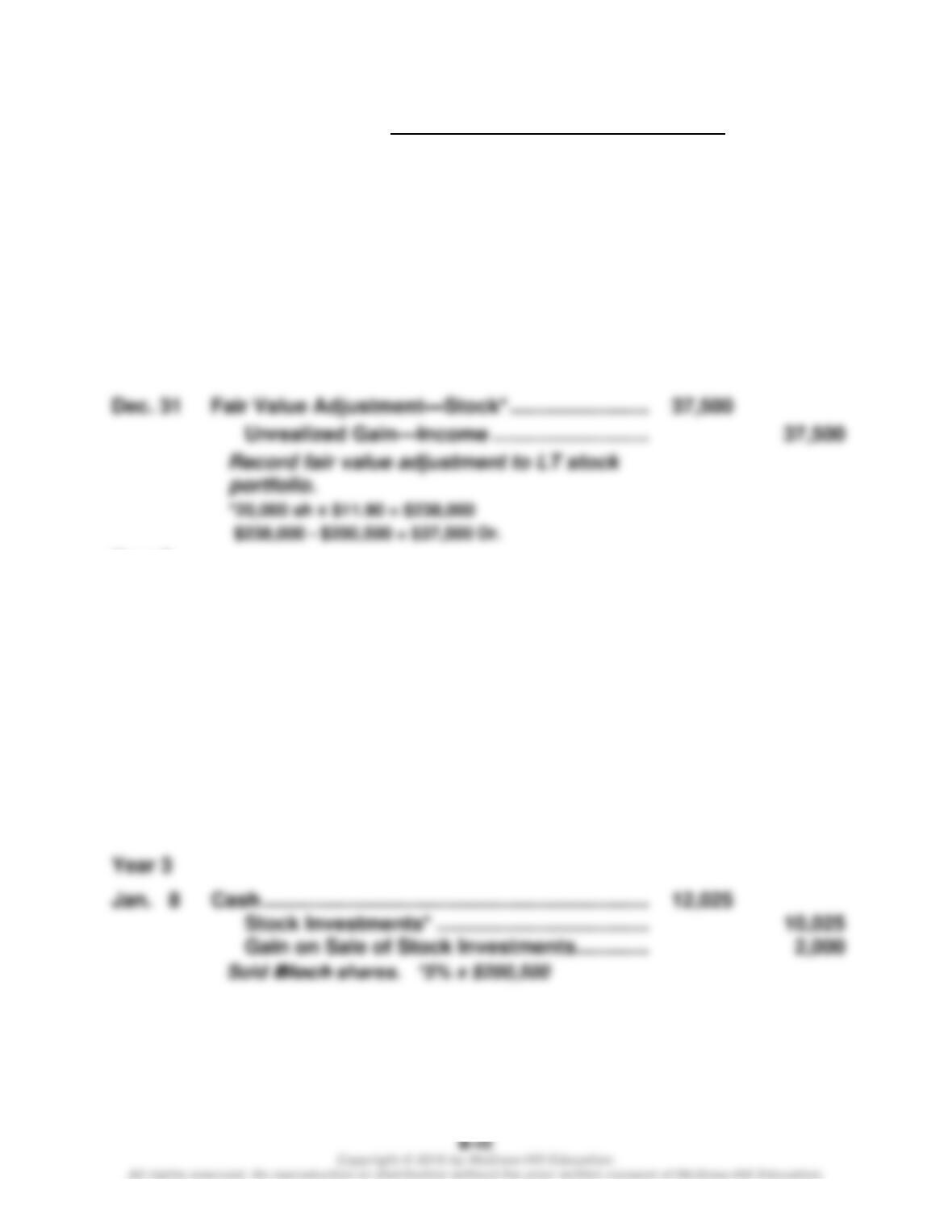
Fair Value Adjustment—Stock* …………………………..
37,500
Unrealized Gain—Income …………………………..
37,500
*20,000 sh x $11.90 = $238,000
$238,000 – $200,500 = $37,500 Dr.
Year 2
Aug. 1
Cash ………………………………………………………………………………
27,000
Dividend Revenue …………………………………………………….
27,000
Received cash dividends (20,000 x $1.35).
Dec. 31
Fair Value Adjustment—Stock* …………………………..
35,000
Unrealized Gain—Income …………………………..
35,000
Record fair value adjustment to LT stock
portfolio.
*20,000 sh x $13.65 = $273,000
$273,000 – $200,500 = $72,500 Dr.
$72,500 Dr. – $37,500 Dr. = $35,000 Dr.
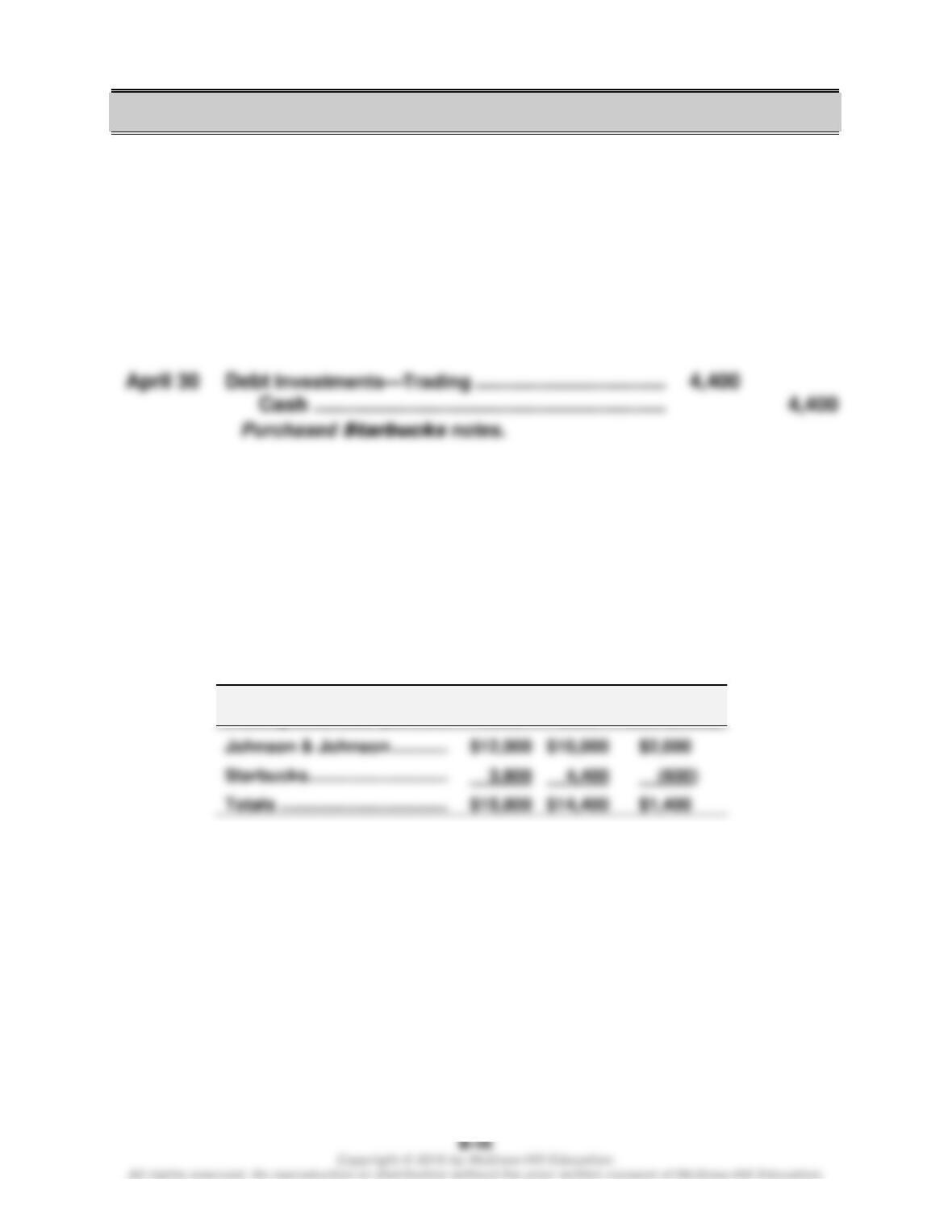
Stock Investments* …………………………………………………..
Gain on Sale of Stock Investments …………………………..
Serial Problem — SP C
Serial Problem, Business Solutions (35 minutes)
Part 1
April 16
Debt Investments—Trading …………………………..
10,000
Cash ……………………………………………………….
10,000
Purchased
Johnson & Johnson
bonds.
Cash ……………………………………………………….
4,400
Purchased
Part 2
June 30
Fair Value Adjustment—Trading* ……………………
1,400
Unrealized Gain—Income ………………………….
1,400
Record unrealized gain in fair value of trading
securities portfolio.
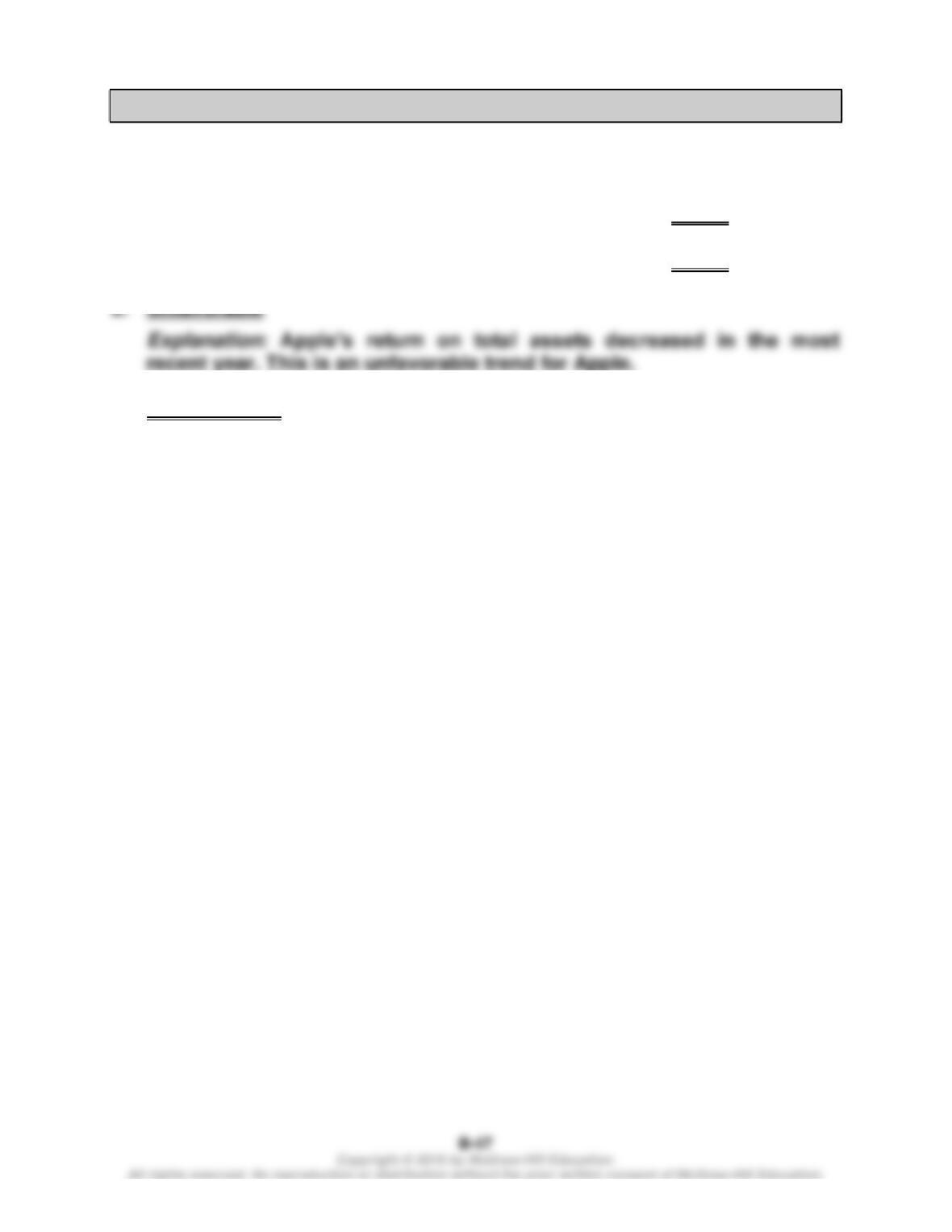
* Fair Value Adjustment computations
Trading securities’ portfolio
Fair
Value
Cost
Unrealized
Gain (Loss)
$12,000
Company Analysis — AA C-1 (20 minutes)
1. Apple’s return on total assets
Current Year: $48,351 / [($375,319 + $321,686) / 2] = 13.9%
One Year Prior: $45,687 / [($321,686 + $290,345) / 2] = 14.9%
3. Consolidation
Explanation: When a company owns over 50% of the voting stock of
another company and can exert controlling influence over that
company, consolidation is used. Because Apple purchased 100% of
Beats Electronics, Apple uses consolidation to account for Beats.
Comparative Analysis — AA C-2 (30 minutes)
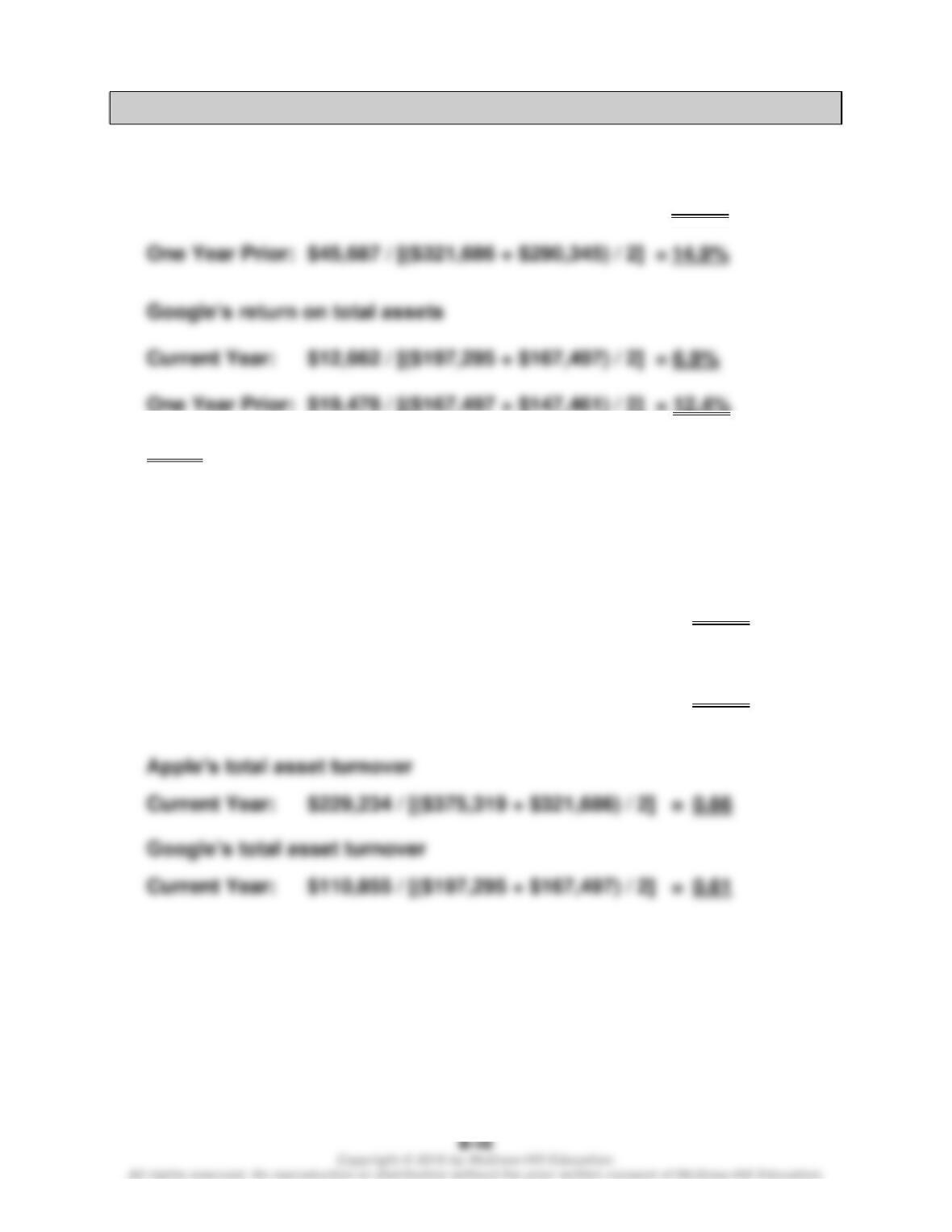
1. Apple’s return on total assets
Current Year: $48,351 / [($375,319 + $321,686) / 2] = 13.9%
2. Apple
Explanation: Apple’s current year return on total assets exceeds
Google’s current year return in the current year.
3. Apple’s profit margin
Current Year: $48,351 / $229,234 = 21.1%
Google’s profit margin
Current Year: $12,662 / $110,855 = 11.4%
Global Analysis — AA C-3 (25 minutes)
₩ millions
1. Samsung
Return on total assets = Net Income / Average Total Assets
Current Year: 42,186,747 / [(301,752,090 + 262,174,324)/2] = 15.0%
Prior Year: 22,726,092 / [(262,174,324 + 242,179,521)/2] = 9.0%
2. a. Better
3. Samsung’s profit margin (Apple and Google results in AA C-2, part 4)
Current Year: $42,186,747 / $239,575,376 = 17.6%
Ethics Challenge — BTN C-1
1. Kasey’s bonus is not contingent on the classification of available–for-
sale versus held-to-maturity. Designation of the bonds as available-for–
sale debt securities will require that an entry be made to recognize the
unrealized holding loss on the bonds—but it will affect equity and not
2. Generally, Kasey must classify its debt securities as either short or long
term and as available-for-sale or held-to-maturity. Since the bonds are
5-year bonds they should be classified as long-term investments unless
management intends to sell them within the current year or operating
3. The company’s auditors (internal and external) and/or its board of
directors should serve as an effective check on Kasey’s accounting for
the company’s long-term investments in securities.
Communicating in Practice — BTN C-2
TO: Mary Jolee
FROM: (Your Name)
SUBJECT: Sale of Kemper Common Stock
The $6,000 loss on the sale of Kemper common stock is correctly stated.
Jolee Company owned 40% of the outstanding shares, and therefore
accounts for the investment according to the equity method. Under the
equity method, investments are reported at the investor’s cost plus its
share in the undistributed earnings accumulated by the investee since the
stock was purchased. At sale, the book value of the investment is
compared to the net proceeds to determine gain or loss.
Please call me if you have any questions.
Taking It to the Net — BTN C-3
2. Mutual funds; Commercial paper; Certificates of deposit; U.S.
government and agency securities; Foreign government bonds;
Mortgage- and asset-backed securities; Corporate notes and bonds;
Municipal securities; Common and preferred stock.
3. Unrealized gains = $4,895; and Unrealized losses = $(302).
4. Fair value (titled “recorded basis”) is greater. Specifically: Fair value
(recorded basis) is $123,646; and the cost basis is $119,053.
Teamwork in Action — BTN C-4
There is no specific solution to this activity. The instructor should serve as
a facilitator during this learning reinforcement activity.
Entrepreneurial Decision — BTN C-5
1.
Jan. 1
Equity Method Investments* ………………………….
Cash ………………………………………………………..
2.
July 1
Cash ……………………………………………………………..
400
Equity Method Investments ………………………
400
Record receipt of cash dividend ($1,000 x 200/500).
3.
Dec. 31
Equity Method Investments …………………………...
2,000
Earnings from Equity Method Investments .
2,000
Record equity in investee earnings ($5,000 x 200/500).
Hitting the Road — BTN C-6