
8-16
LOOKING TO THE FUTURE
It appears likely that the question of recording fair values for financial instruments will
continue to be an important issue to resolve as the Boards work toward convergence. Both
the IASB and the FASB have indicated that they believe that financial statements would be
more transparent and understandable if companies recorded and reported all financial
instruments at fair value. That said, in IFRS 9, which was issued in 2009, the IASB created
a split model, where some financial instruments are recorded at fair value, but other
financial assets, such as loans and receivables, can be accounted for at amortized cost if
certain criteria are met. Critics say that this can result in two companies with identical
securities accounting for those securities in different ways. A proposal by the FASB would
require that nearly all financial instruments, including loans and receivables, be accounted
for at fair value. It has been suggested that IFRS 9 will likely be changed or replaced as the
FASB and IASB continue to deliberate the best treatment for financial instruments. In fact,
one past member of the IASB said that companies should ignore IFRS 9 and continue to
report under the old standard, because in his opinion, it was extremely likely that it would
be changed before the mandatory adoption date of the standard arrived in 2013.
8-17
Chapter 8 Review
✓ Define receivables. What are the different types of receivables? Why is it necessary to
have them in different categories?
✓ Explain how accounts receivable are recognized in the accounts. How are accounts
receivable valued on the balance sheet?
✓ What are the two methods used to account for bad debts? Which method is required by
GAAP if bad debts are material? How is bad debt estimated when using the allowance
method? Prepare journal entries for each method. How is an aging schedule prepared?
How is it used?
✓ What is a promissory note? What is the formula for computing interest on notes
receivable? Discuss the three issues involved in accounting for notes receivable.
Prepare journal entries for note transactions.

8-18
Vocabulary Quiz Name ______________________ Date ____________
Chapter 8
1. A note that is not paid in full at maturity.
2. Amounts owed by customers on account.
3. The party in a promissory note who is making the promise to pay.
4. A method of accounting for bad debts that involves expensing
accounts at the time they are determined to be uncollectible.
5. A measure of the liquidity of receivables, computed by dividing net
credit sales by average net receivables.
6. The average amount of time that a receivable is outstanding,
calculated by dividing 365 days by the receivables turnover ratio.
7. A written promise to pay a specified amount of money on demand or
at a definite time.
8. A method of accounting for bad debts that involves estimating
uncollectible accounts at the end of each period.
9. A finance company or bank that buys receivables from businesses for
a fee and then collects the payments directly from the customers.
10. An analysis of customer balances by the length of time they have
been unpaid.
8-19
Solutions to Vocabulary Quiz
Chapter 8
1. Dishonored note

8-20
Multiple Choice Quiz Name __________________ Date
__________
Chapter 8
1. To ensure receivables are not overstated on the balance sheet, they are reported:
a. at gross realizable value.
b. at their cash (net) realizable value.
c. less estimated uncollectible receivables.
d. both at their cash (net) realizable value and less estimated uncollectible
receivables.
2. Which of the following is the most liquid asset?
a. Unearned revenue.
b. Long-lived assets.
c. Receivables.
d. Intangibles.
3. Receivables are often classified as:
a. accounts, notes, long-lived.
b. accounts, notes, other.
c. accounts, notes, inventory.
d. none of these answer choices are correct.
4. All of the following are “other receivables” except:
a. petty cash.
b. interest receivable.
c. income taxes refundable.
d. advances to employees.
5. The method of accounting for bad debt expense, which conforms to GAAP is:
a. direct write-off method.
b. allowance method.
c. both the direct write-off method and the allowance method.
d. none of these answer choices are correct.
6. An aging schedule of accounts receivable
a. is only prepared on the last day of the accounting period.
b. is only meaningful to the accounting department employees.
c. arranges the accounts by the length of time they have been unpaid.
d. applies percentages that are determined by the FASB to the totals of each
category.
7. When the allowance method is used and an account is subsequently written off as
uncollectible, the following account is debited:
a. Bad Debts Expense.
b. Allowance for Doubtful Accounts.
c. Accounts Receivable.
d. both the Allowance for Doubtful Accounts and Accounts Receivable.

8-21
8. When using the allowance method, the balance in the Allowance for Doubtful
Accounts:
a. can have a debit balance before the end of period adjusting entry is made.
b. is a contra asset account and must have a credit balance after the end of
period adjusting entry is made.
c. equals the total estimated uncollectible accounts, as determined by
management at the end of the period.
d. all of these answer choices are correct.
9. Notes receivable:
a. earn interest.
b. give the holder a stronger legal claim on assets than accounts receivable.
c. are negotiable instruments.
d. all of these answer choices are correct.
10. On May 1, Smith Company makes sales of $10,000 to Jones Company. Jones
needs longer than the normal 30 days to pay and signs a 90 day 8% note. On May
1, Smith Company should
a. credit Interest Revenue for $200.
b. debit Notes Receivable for $10,000.
c. debit Notes Receivable for $10,200.
d. credit Sales Revenue for $10,200.

8-22
Solutions to Multiple Choice Quiz
Chapter 8
1. d
8-23
Exercise 1 – World Wide Web Research and Financial Statement Presentation
Activity
Chapter 8
American Express launched The Travelers Cheque in 1891. Since that time, the company
significantly expanded its range of products. Go to http://www.americanexpress.com/ to find
the information needed to answer the following questions.
1. What are some of the benefits to businesses of accepting the American Express
2. Is Card Member Receivables of American Express increasing or decreasing? (Click
on About Us, then Investor Relations, then Annual Reports and Proxy Statements to
access the latest annual report.)
3. What was the amount of the Reserve for Card Member Receivables for the two most
current years? What does this represent?
4. Is the Bad Debt Expense of American Express increasing or decreasing?
8-24
Exercise 2 – World Wide Web Research and International Activity
Chapter 8
MasterCard International is a leading global payments company with one of the most
recognized and respected brands in the world. MasterCard serves consumers and
businesses, both large and small, in 210 countries and territories. MasterCard is a leader in
quality and innovation, offering a wide range of payment solutions in the virtual and
traditional worlds. Visit MasterCard’s Web Site at http://www.mastercard.com/.
1. List the suggested actions for individuals who are concerned about how to handle debt.
2. Discuss three ways MasterCard is working to help businesses that accept MasterCard.
3. List the four steps a business can take to prevent credit card fraud.
4. Discuss MasterCard’s role as it relates to global business strategies.
8-25
Exercise 3 – World Wide Web Research and Accounts Receivable Activity
Chapter 8
On October 8, 1998 CitiCorp and Travelers Group, Inc. merged, resulting in the formation
of a new company called Citigroup. Citigroup offers customers a range of quality products
and services unmatched in the financial services industry. Citigroup serves a broader
spectrum of customers, in more places and by more means of access and delivery, than
any other financial organization. Included in the Financial Data Supplement section of the
annual report of Citigroup, is a schedule entitled “Details of Credit Loss Experience.” Also,
information regarding credit losses is found in the notes to the financial statements and
management’s discussion and analysis. Go to http://www.citigroup.com/to find answers to
the following questions. (Note: View the financial statements by accessing Form 10K.)
1. Is the dollar amount of the allowance for credit losses account increasing or
decreasing?
2. Would you expect the allowance to increase or decrease? Why or why not?
3. What percentage of the total loan portfolio is made up of consumer loans? What
types of consumer loans are represented in the portfolio?
4. When are consumer loans generally written off? What method does Citigroup use to
estimate uncollectible consumer loans?
8-26
Exercise 4 – World Wide Web Research and Factoring Activity
Chapter 8
Since 1979, American Receivable Corporation has provided small businesses with the
financial resources they need to grow their business and effectively compete in the
marketplace. Visit American Receivable at http://www.americanreceivable.com/, where you
will find information to answer the following questions.
1. Describe the steps outlined in the flow chart “How Does Factoring Work?”
2. What is the advantage of factoring?
3. How can the additional working capital gained from factoring be put to use?
4. Define the following terms used in factoring:
a. Advance rate
b. Discount rate
c. Factor
d. Reserve
8-27
Exercise 5 – Accounts Receivable Activity
Chapter 8
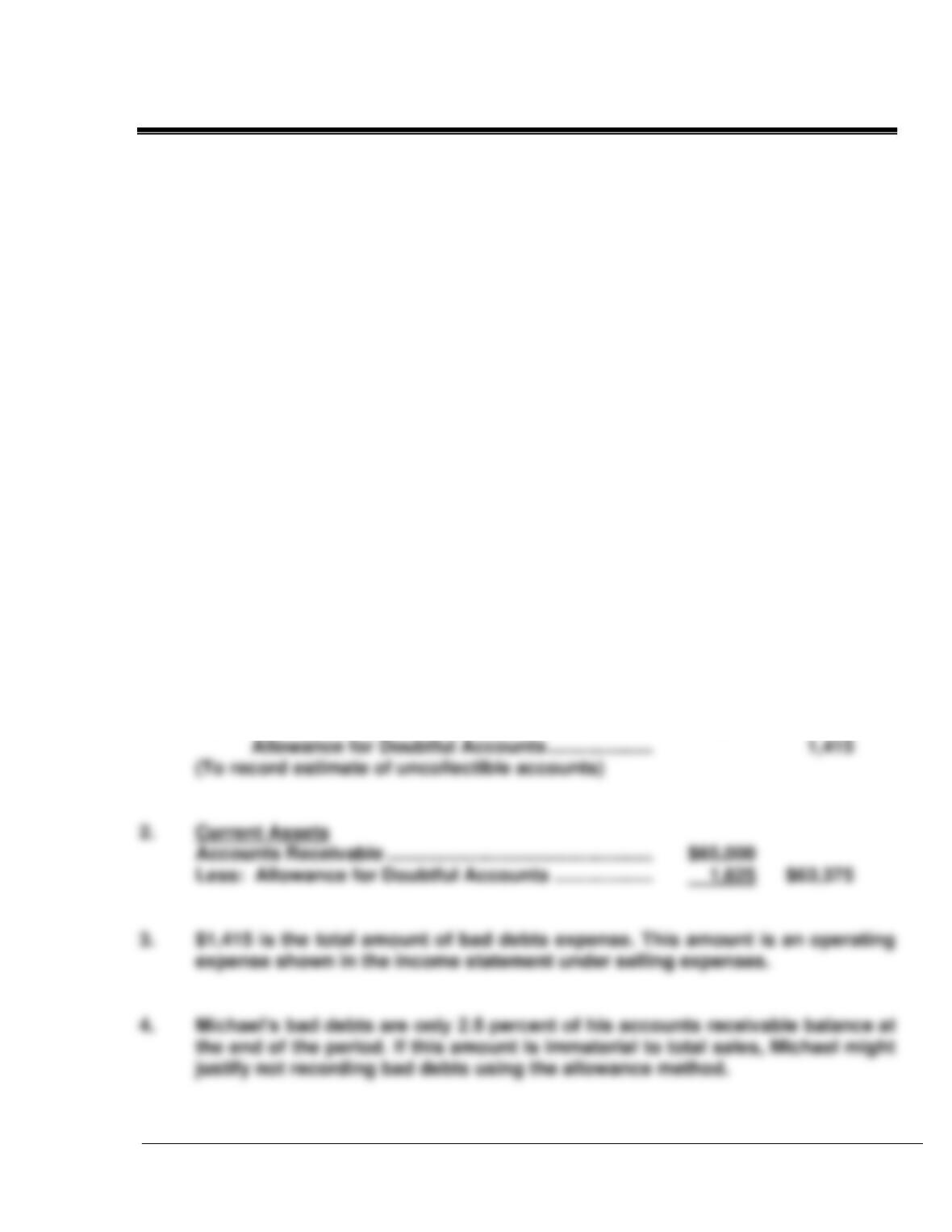
Michael’s Bookshelf specializes in used, rare, and out–of-print books. The store has a large
base of repeat customers who purchase books on 30-day accounts. At 15 days overdue,
each customer gets a phone call from Michael requesting payment. Michael has
experienced a high success rate with this collection effort. Michael’s CPA is preparing year-
end financial statements and has asked him for his estimate of uncollectible accounts.
Michael has a balance of $65,000 in the Accounts Receivable account at the end of the
year. He has analyzed his uncollectible accounts using an aging of the accounts
receivable. He estimates that only 2.5 percent of his accounts receivable balance will not
be collected. The Allowance for Doubtful Accounts has a credit balance of $210 in the trial
balance.
1. Prepare the journal entry to record the bad debts expense at year end.
2. Show the balance sheet presentation of the accounts receivable account.
3. What is the amount of bad debts expense that appears on the income statement?
How is this amount classified?
4. What would be the justification, if any, for Michael to use the direct write-off method
for accounting for uncollectible accounts?
Solutions:
1. Bad Debts Expense ……………………………………………… 1,415
8-28
Exercise 6 – Note Receivable Activity
Chapter 8
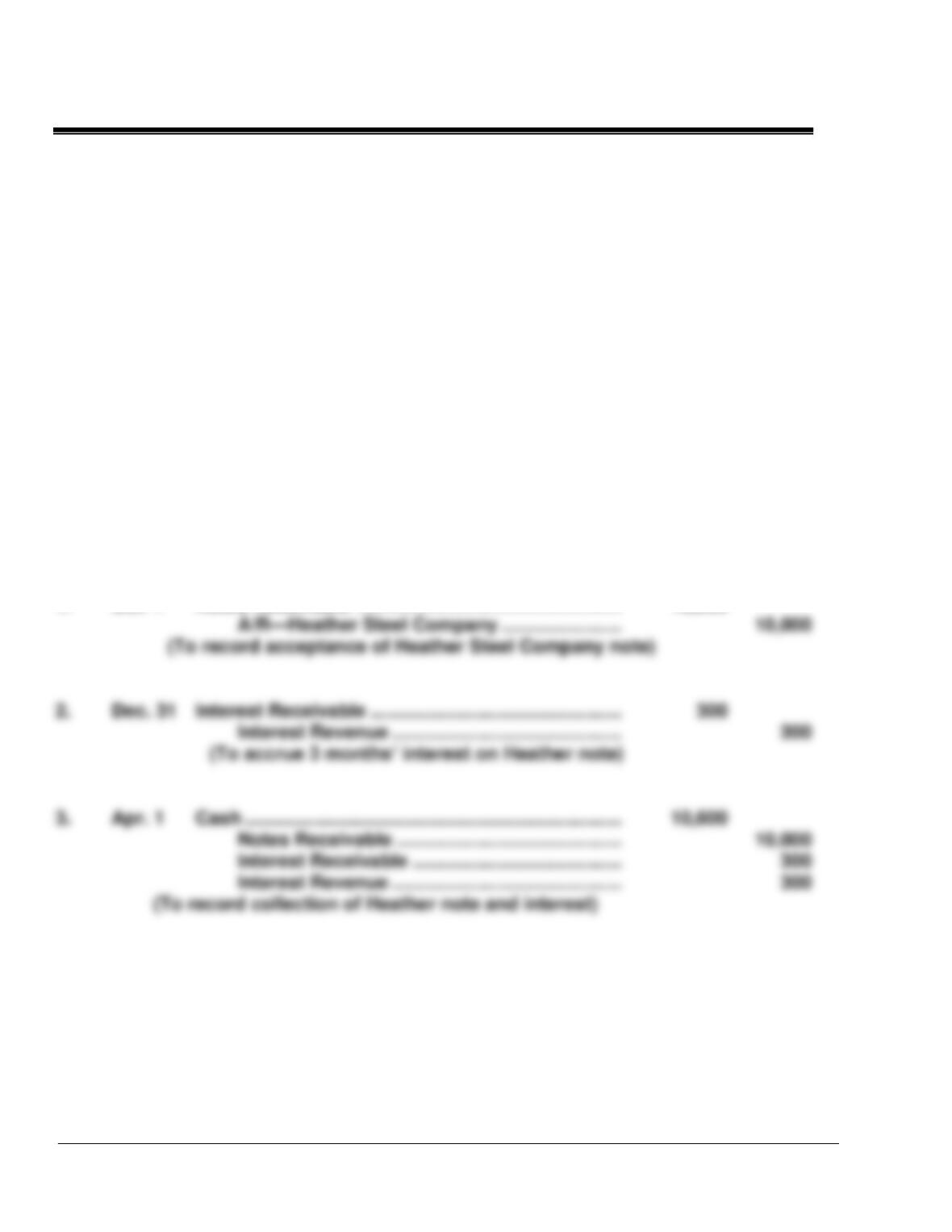
Jerry’s Drafting Service closes its books on December 31. On October 1, Jerry accepts a
$10,000 six-month, 12% note receivable from his customer, Heather Steel Company in
exchange for an outstanding account receivable.
1. Record the receipt of the note receivable on October 1.
2. Record the accrual of interest on December 31
3. Record the payment of the note on April 1.
Solutions:
1. Oct. 1 Notes Receivable …………………………………………… 10,000
8-29
Exercise 7 – Credit Card Sales Activity
Chapter 8
Lee’s Wildlife Art Gallery accepts national credit cards because he does not want the
headaches and costs associated with collecting overdue accounts. During the month of
December, Lee made a total of $32,000 in VISA First Bank Card sales. The service fee that
First Bank charges Lee is 3 percent.
1. Record the entry by Lee’s Wildlife Art Gallery to record the credit card sales
transactions.
2. What are the advantages of accepting credit cards to Lee?
Solutions:
1. Cash ……………………………………………………………………………. 31,040
Service Charge Expense ………………………………………………. 960
8-30
Exercise 8 – Allowance for Uncollectible Accounts, Accrual Accounting, and
Communication Activity
Chapter 8
Your sister and brother-in-law have just opened a boutique specializing in shoes and
accessories called “To Paputsi,” which is Greek for “the shoe.” The upscale shop will
provide store credit for customers. The CPA who helped in setting up the books for the
boutique included an account entitled Allowance for Doubtful Accounts. Your sister and
brother-in-law do not want to use the allowance account, electing to write off bad debts as
they are deemed to be uncollectible. Although you have had only one semester of
accounting, you realize the importance of estimating bad debts and using the allowance
account. Write a letter to your sister and brother–in-law explaining the importance of
estimating bad debts and establishing the allowance account.
Solution:
Dear Sister and Brother-in-law:
Congratulations on the grand opening of your new boutique. “To Paputsi” will be a
great success. I wish you luck!