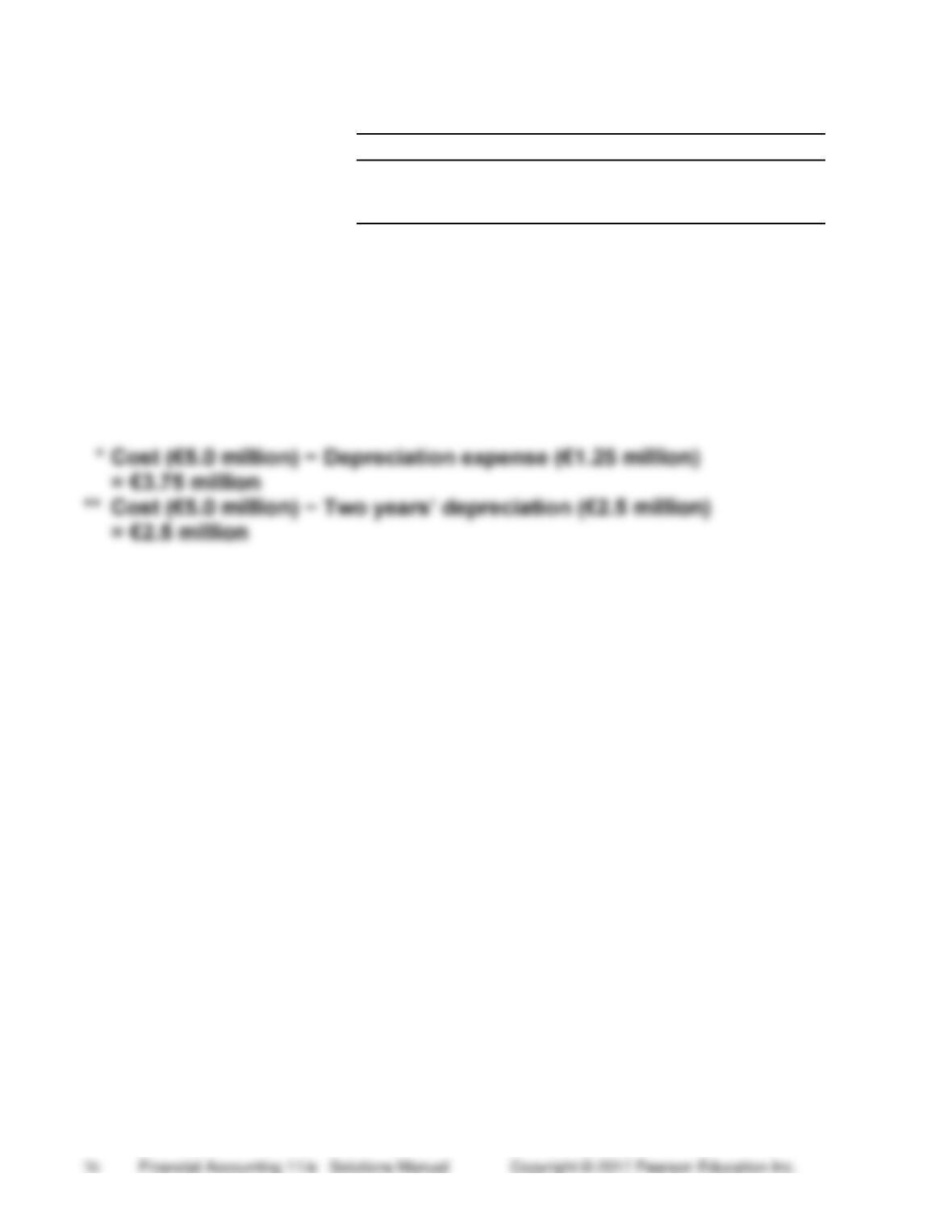
(15-25 min.) E 7-85
Year
1
2
3
4
Millions of Euros (€)
1.
Total current assets
No effect
2.
Equipment, net
€3.75 U*
€2.5 U**
€1.25 U
Correct
3.
Net income
€3.75 U*
€1.25 O
€1.25 O
€1.25 O
_____
U = Understated
O = Overstated
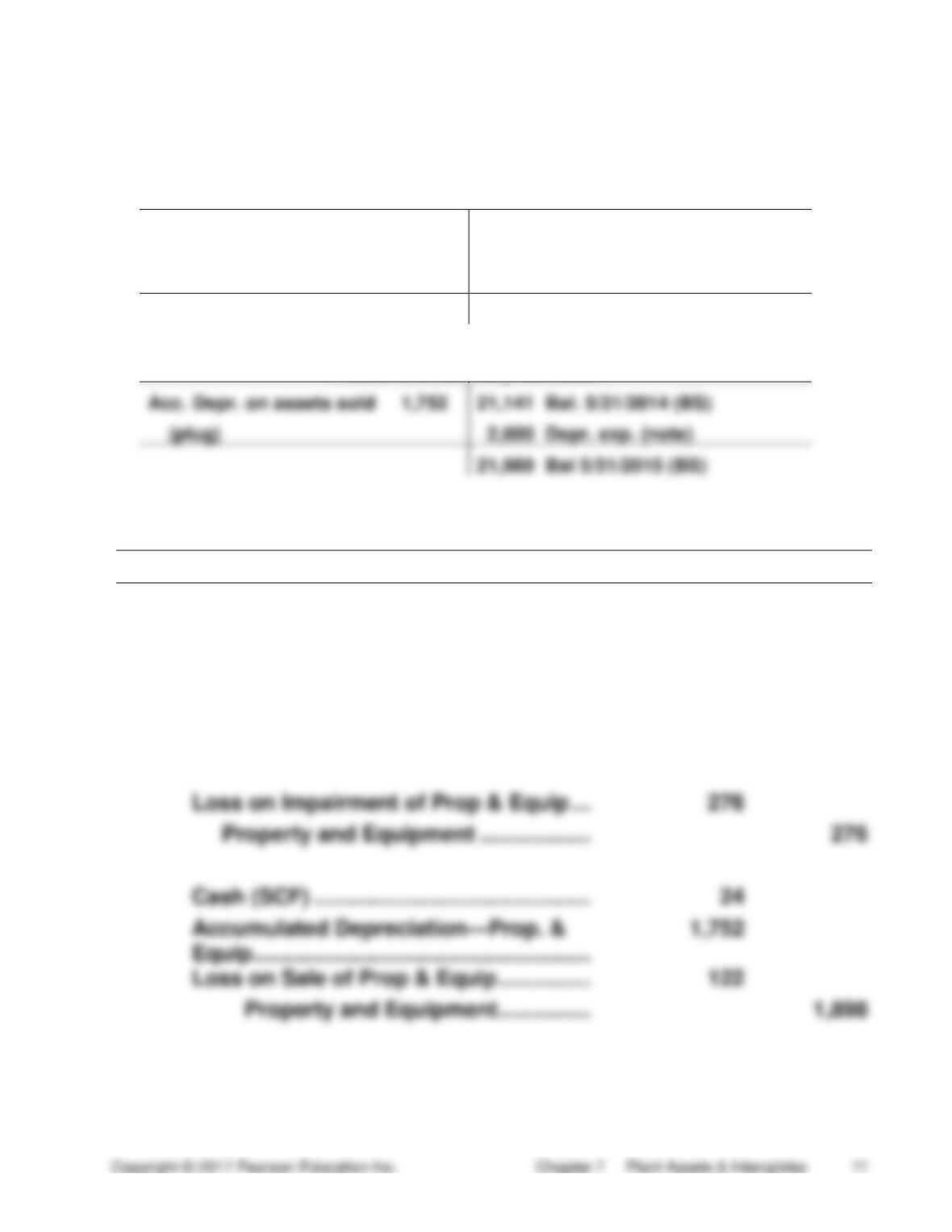
(20-30 min.) P 7-86
(All amounts in millions)
Req.1
Property and Equipment
Bal 5/31/2014 (BS) 40,691
Capital expenditures (SCF) 4,347
276 Impairment loss
1,898 Original cost of plant and
equipment sold (plug)
Bal.5/31/2015 (BS) 42,864
Accumulated Depreciation
21,989 Bal 5/31/2015 (BS)
Req. 2
Journal
DATE
ACCOUNT TITLES AND EXPLANATION
DEBIT
CREDIT
Property and Equipment …………………..
4,347
Cash ……………………………………………
4,347
Depreciation Expense—Prop. & Equip.
2,600
Accumulated Depreciation—Prop. &
Equip.
2,600
Loss on Impairment of Prop & Equip …
Property and Equipment ………………
Accumulated Depreciation—Prop. &
Loss on Sale of Prop & Equip ……………
Property and Equipment ……………
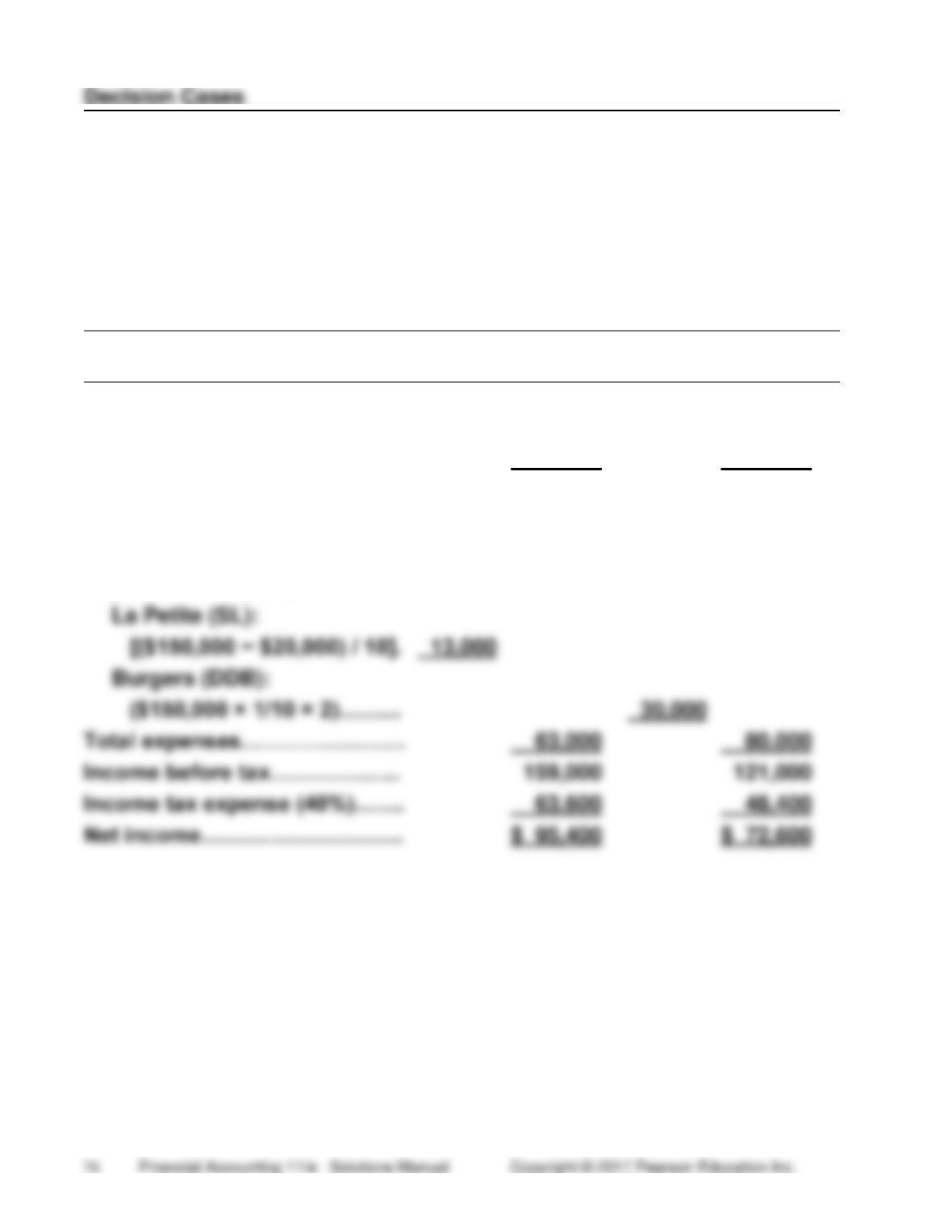
(30-45 min.) Decision Case 1
Req. 1
La Petite France Bakery and Burgers Ahoy!
Income Statements
For the Year Ended December 31
ACCOUNT TITLE
La Petite France
(FIFO and SL)
Burgers Ahoy!
(LIFO and DDB)
Sales revenue……………………
$350,000
$350,000
Cost of goods sold……………..
128,000*
149,000*
Gross margin………………….…
222,000
201,000
Operating expenses………….…
$50,000
$50,000
Depreciation expense
La Petite (SL):
Burgers (DDB):
Total expenses…………………..
63,000
80,000
Income before tax…………….…
159,000
121,000
Income tax expense (40%)…….
63,600
48,400
Net income……………………….
$ 95,400
$ 72,600
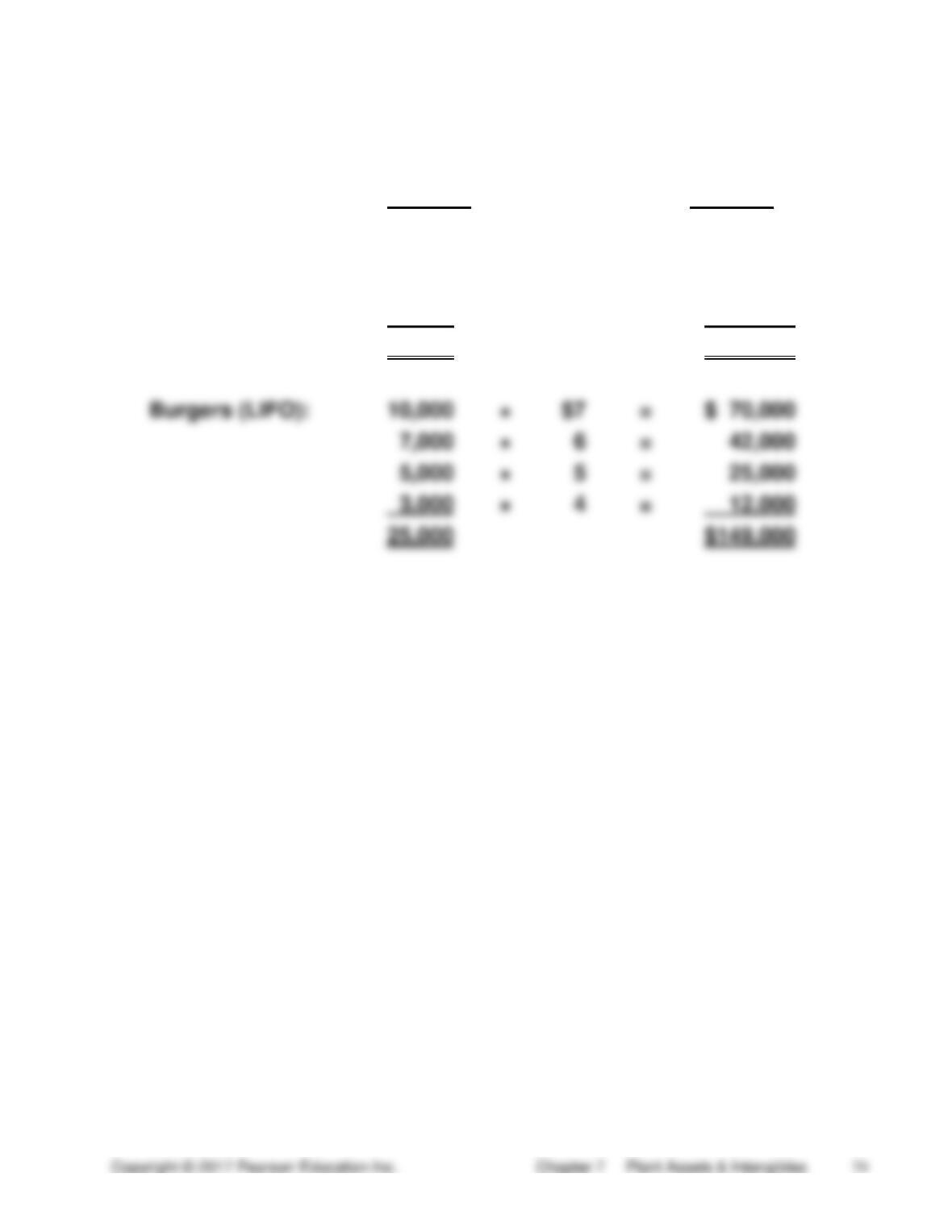
(continued) Decision Case 1
Req. 1
*Cost of goods sold:
Units
Cost
La Petite (FIFO):
10,000
×
$4
=
$ 40,000
5,000
×
5
=
25,000
7,000
×
6
=
42,000
3,000
×
7
=
21,000
25,000
$128,000
Burgers (LIFO):
10,000
×
$7
=
$ 70,000
7,000
×
6
=
42,000
5,000
×
5
=
25,000
3,000
×
4
=
12,000
25,000
$149,000
(continued) Decision Case 1
Req. 2
INVESTMENT NEWSLETTER
TO: Our Clients
FROM: Student Name
RE: Selecting the stock of La Petite France Bakery or Burgers
Ahoy! as a long-term investment
In picking a stock we suggest you consider the following factors:
La Petite France and Burgers Ahoy! are basically identical companies.
The two companies started operations at the same time and engaged in
essentially the same transactions. Their main difference lies in the
accounting methods that they use.
1. La Petite France’s income statement reports a net income of $95,400
compared to $72,600 for Burgers Ahoy!. On the surface La Petite
France appears to be more profitable. This difference is illusory,
however, because La Petite uses the FIFO method to account for
inventories and the straight-line method to account for depreciation of
its plant assets. If prices continue to rise, use of these methods result
(continued) Decision Case 1
importantly, LIFO and DDB result in the lowest amount of income tax
and thereby save money that Burgers can invest in new projects.
3. Over the long run we favor Burgers Ahoy! because Burgers will have
(20-30 min.) Decision Case 2
1. A dishonest manager might debit an expense account for the cost of a
plant asset for two reasons: (1) To obtain a quicker tax deduction for
the expense than for depreciation expense over the life of the asset,
and (2) To understate reported asset and income amounts.
2. A dishonest manager might debit the cost of an expense to a plant
3. We support the recording and reporting of intangible assets at cost,
less accumulated amortization, in accordance with GAAP because the
business paid a price for intangibles like any other asset. The
argument for recording intangibles at $1 or $0 is consistent with the
perspective of a lender, who might reason that, in the liquidation of a
business, most of its intangibles are worthless. However, accounting
serves other users besides lenders. Also, someone who evaluates a
Student responses will vary.
Ethical Issue
Req. 1
The ethical issue in this case is “What is the proper amount of the
purchase price to allocate to the land and the proper amount to allocate to
the building?” The taxpayer wants to allocate as much of the purchase
price as possible to the building because tax laws allow a deduction from
Req. 2 and Req. 3
The stakeholders in this situation include Dellroy National Bank, their
management, their shareholders, the Internal Revenue Service, creditors,
and taxpayers in general. The immediate economic consequences of the
decision are positive for Dellroy National Bank as well as their
Req. 4
Dellroy National Bank should change the allocation of their purchase price
to 60% building and 40% land. In the long run, for fair and equitable
treatment for all taxpayers, as well as the best economic and legal
outcome, there is nothing like the truth.
Focus on Financials: Apple Inc.
(30-40 min.)
Req. 1
Property, Plant and Equipment includes buildings, land, machinery,
equipment, leasehold improvements and internal-use software.
Req. 2
Note 1 states that the depreciation method used for the financial
statements is the straight-line method. Note 1 does not state the method
used for income-tax purposes, but Apple most likely uses the Modified
Req. 3
Millions
Depreciation (and amortization) expense
$ 6,900
Accumulated depreciation and amortization
$ 18,391
Depreciation (and amortization) expense on property and equipment of
$6.9 billion includes the straight-line amount of buildings, machinery,
(continued) Apple Inc.
amortization amounts for all years the company has used its property
and equipment.
Req. 4
Apple Inc. reports goodwill of $4,616 million on its 2014 balance sheet,
and acquired intangible assets on the balance sheet, of $4,142 million.
As explained in Notes 1 and 4 to the Consolidated Financial Statements,
the company does not amortize goodwill and other indefinite-lived
assets. It evaluates the assets that are not being amortized to determine
whether circumstances or events suggest impairment of the assets.
Focus on Analysis: Under Armour, Inc.
(20-30 min.)
Req. 1
Under Armour, Inc. paid $141 million for capital expenditures during
fiscal 2014. They also paid $11 million for the acquisition of a business,
which may include property and equipment. This information is found in
the investing activities section of the cash flows statement.
Req. 2
Depreciation and amortization are calculated using the straight-line
method over the following useful lives: 3–10 years for furniture, office
Req. 3
Under Armour includes the following categories in its property, plant
and equipment: leasehold and tenant improvements; furniture, fixtures,
and displays; buildings; software; office and plant equipment; land;
(continued) Under Armour, Inc.
Accumulated Depreciation
÷
2014
2013
Based on this ratio, the property and equipment is slightly newer in 2014
when compared to 2013. At December 31, 2013, 43.5% of the assets are
used up. At December 31, 2014, 41.5% of the assets are used up.
Req. 4
Under Armour records intangibles when it acquires technology,
customer relationships, or another business. An increase in goodwill in
2014 came from an acquisition in other foreign countries (not North
(continued) Under Armour, Inc.
Req. 5 (in millions)
The Dupont formula:
Net profit margin ratio:
2014
2013
Net income
$208
$162
÷ Sales
÷
$3,084
÷
$2,332
=
6.74%
=
= 6.95%
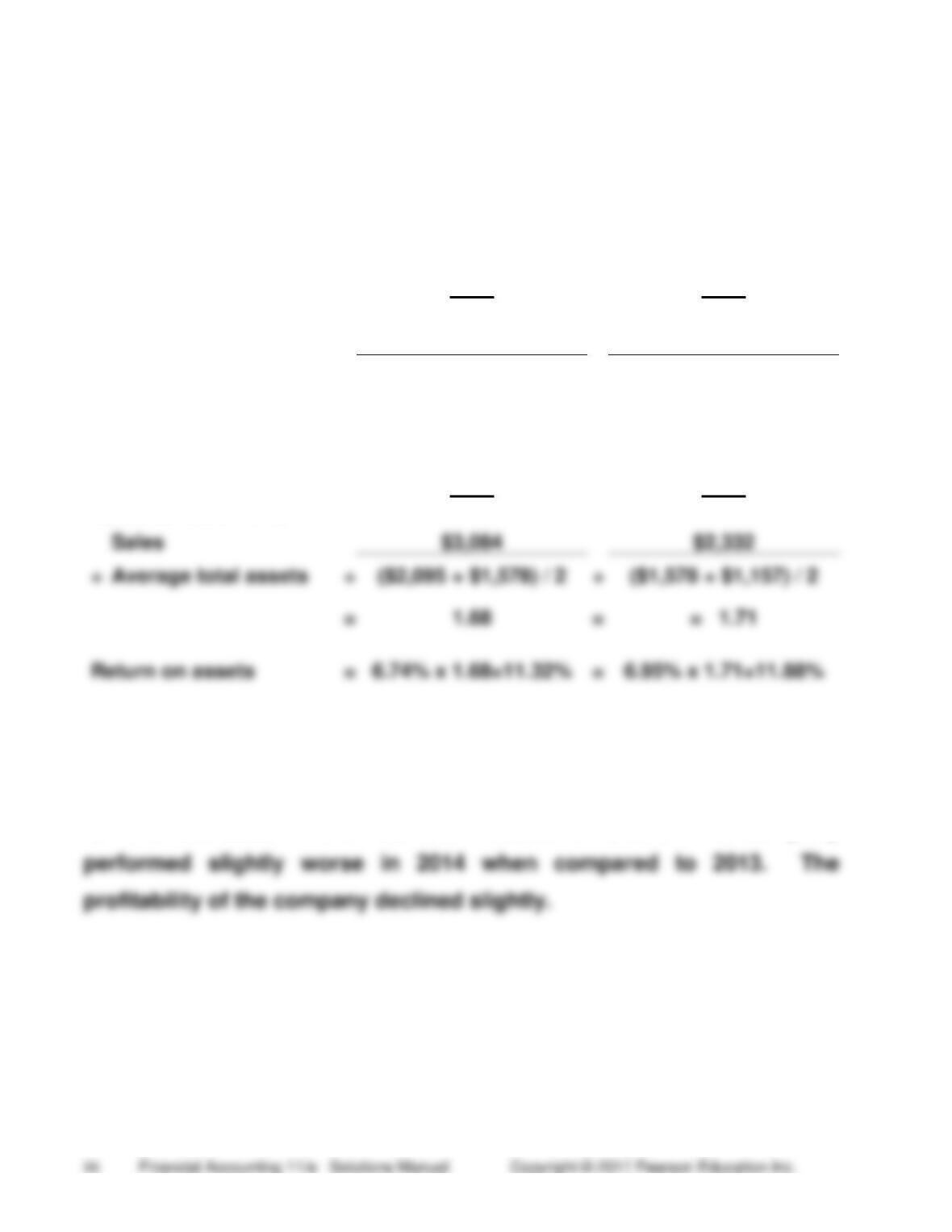
Asset turnover ratio:
2012
2011
Sales
$3,084
$2,332
÷ Average total assets
÷
÷
=
From this analysis, we can see that both the net profit margin ratio and
the asset turnover ratio declined in 2014. So, both ratios are responsible
for the decrease in the return on assets of 0.56%. The company

Group Projects
Student responses will vary.