CHAPTER 8 Internal Control and Cash
Ex. 8-24
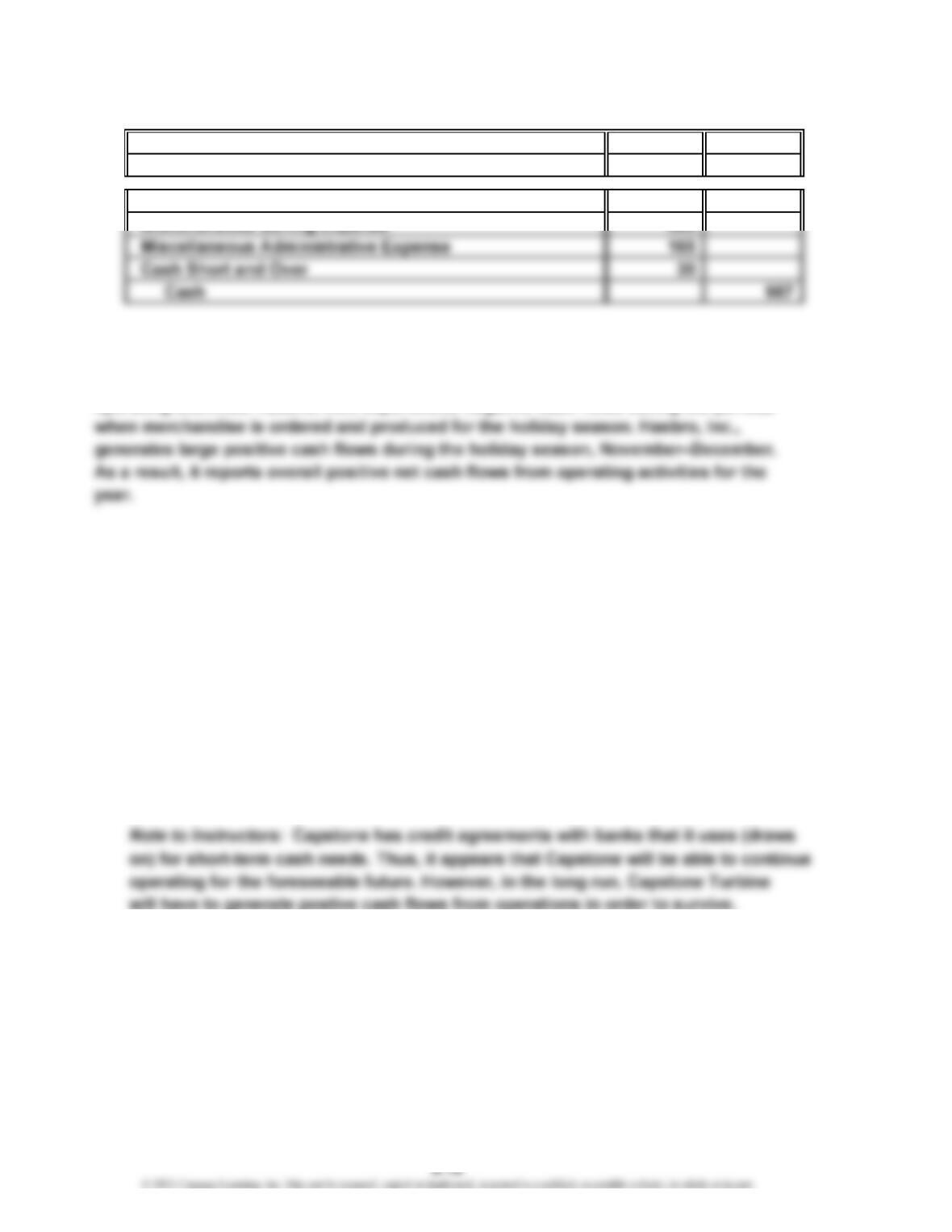
a. Petty Cash 1,290
Cash 1,290
b. Office Supplies 427
Ex. 8-25
Toy manufacturers and retailers experience a seasonal trend in cash flows from
operating activities. Hasbro, Inc., experiences negative cash flows during the periods
Ex. 8-26
a. 8.4 months ($1,415,400 ÷ $168,500)
b. At the current rate of operations, El Dorado has 8.4 months of cash remaining.
El Dorado should either restructure its operations or plan on raising additional
financing in order to continue in business.
Ex. 8-27
a. $720.1 thousand ($8,641 ÷ 12)
b. 20.0 months ($14,408 ÷ $720.1)
c. Capstone Turbine has cash to continue its operations for approximately 20.0 months
.
CHAPTER 8 Internal Control and Cash
Ex. 8-28
a. (in thousands)
Year 3: $24,996.3 per month ($299,955 ÷ 12)
Year 2: $17,807.9 per month ($213,695 ÷ 12)
Year 1: $12,512.3 per month ($150,147 ÷ 12)
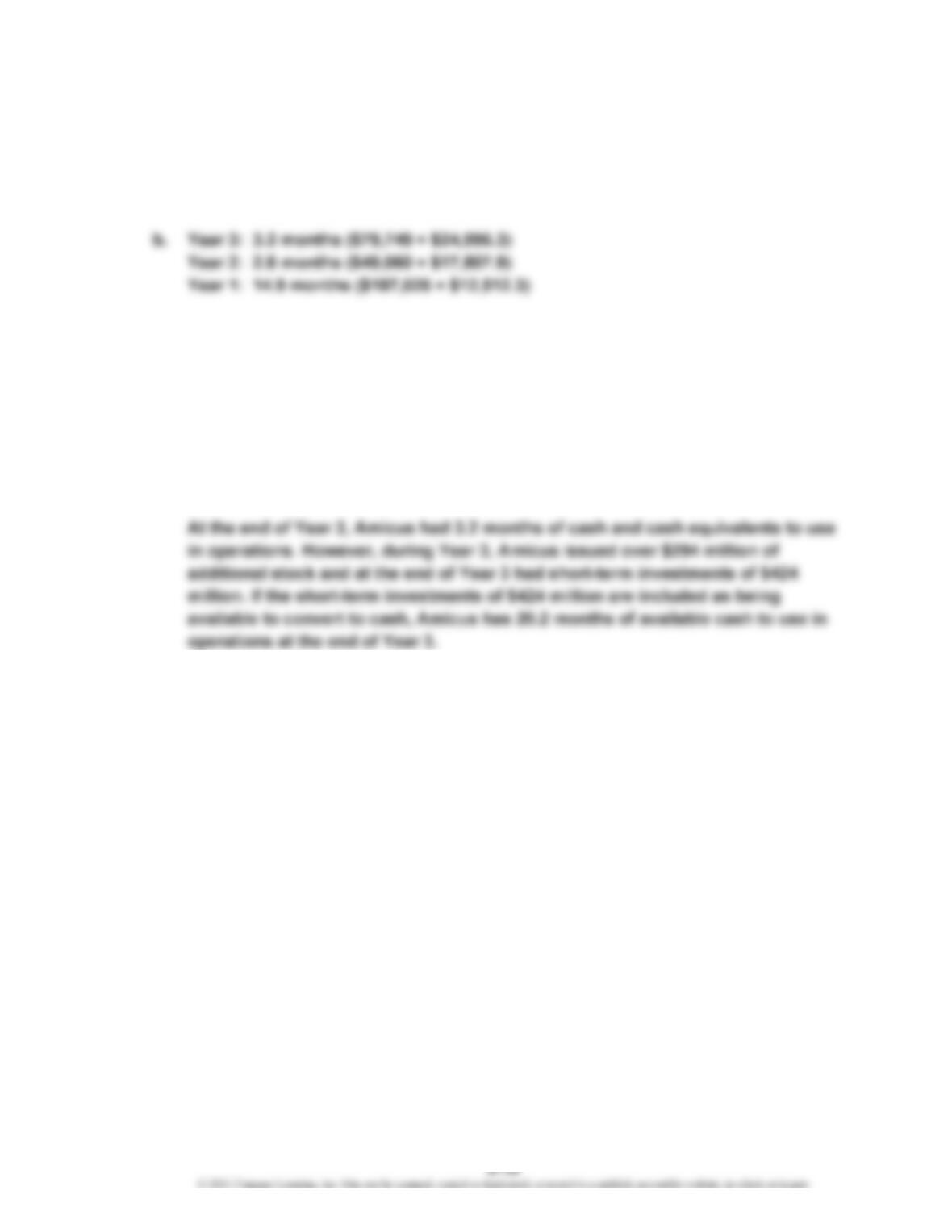
c. At the end of Year 1, Amicus Therapeutics had 14.9 months of cash and cash
equivalents remaining to use in operations.
At the end of Year 2, Amicus had 2.8 months of cash and cash equivalents to use
in operations. However, during Year 2, Amicus issued over $243 million of
additional stock and at the end of Year 2, had short-term investments of $309
million. If the short-term investments of $309 million are included as being
available to convert to cash, Amicus has 20.1 months of available cash to use in
operations at the end of Year 2.
Overall, Amicus has been able to support its operations by issuing additional
stock. However, its negative cash flows have increased from $(150,147) in Year 1
to $(299,955) in Year 3. Unless Amicus generates positive cash flows from
operations, its ability to continue raising funds from issuing stock or debt will be
limited. Thus, in the long run, Amicus must generate positive cash flows from
operations to survive.
CHAPTER 8 Internal Control and Cash
Prob. 8-1A
Strengths: a, b, e, and f
Weaknesses:
c. Employees should not be allowed to use the petty cash fund to cash personal
checks. In any case, postdated checks should not be accepted. In effect,
postdated checks represent a receivable from the employees.
g. The mail clerk should prepare an initial listing of cash remittances before
forwarding the cash receipts to the cashier. This establishes initial accountability
for the cash receipts. The mail clerk should forward a copy of the listing of
remittances to the accounts receivable clerk for recording in the accounts.
PROBLEMS
CHAPTER 8 Internal Control and Cash
Prob. 8-2A
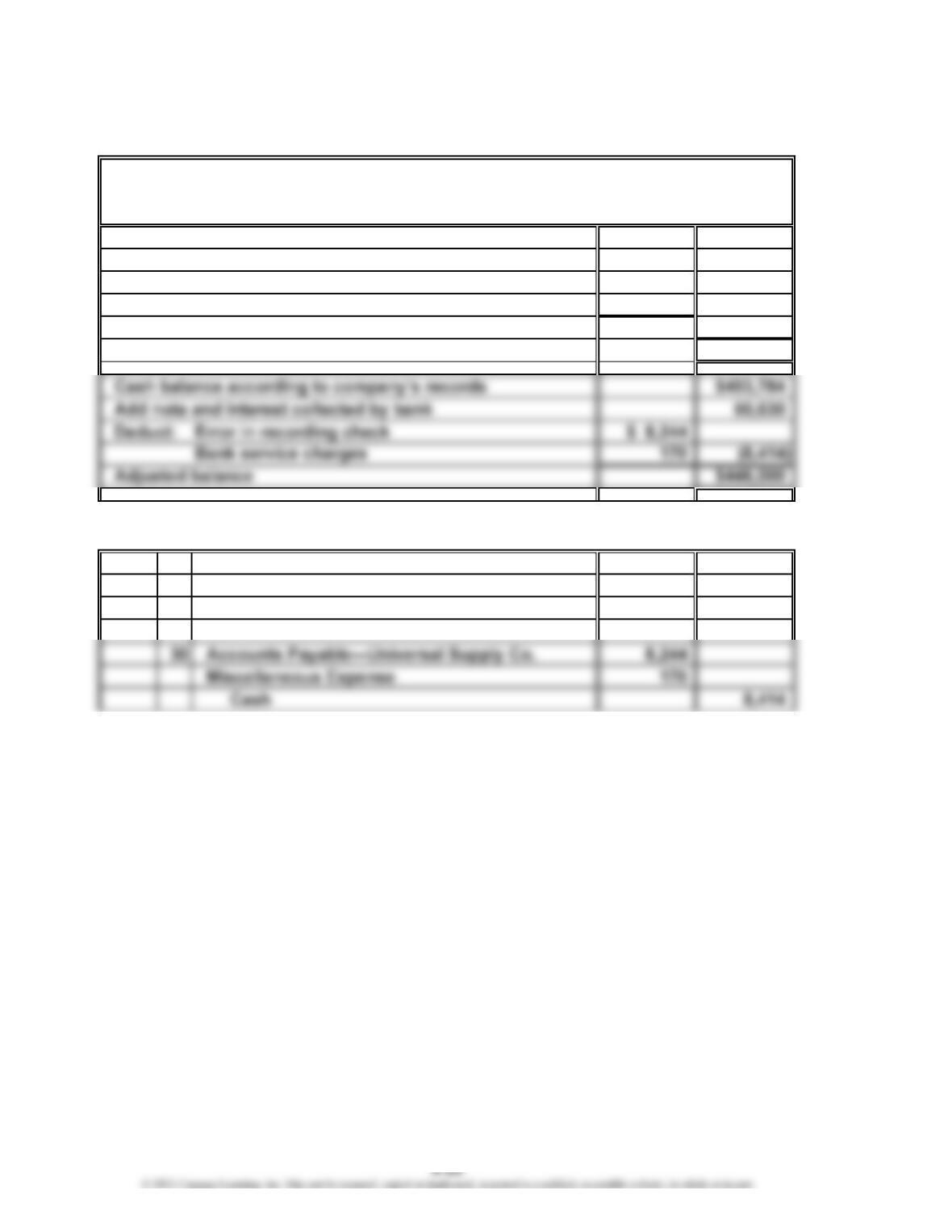
1 Petty Cash 900
Cash 900
31 Store Supplies 470
Delivery Expense 140
Office Supplies 110
Miscellaneous Administrative Expense 90
Cash Short and Over 15
Cash 825
Jan.
CHAPTER 8 Internal Control and Cash
Prob. 8-3A
1.
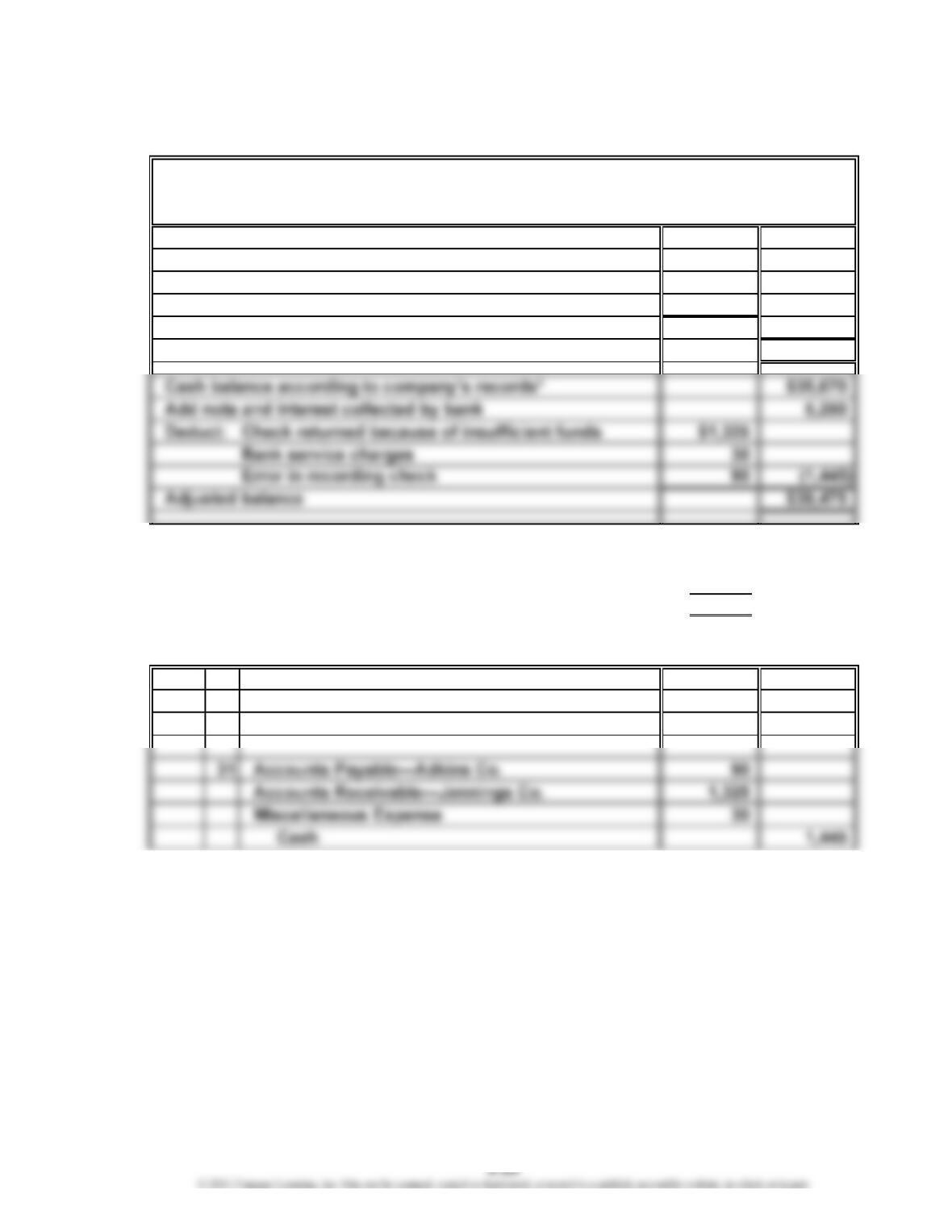
Cash balance according to bank statement $468,460
Add: Deposit of April 30, not recorded by bank $51,230
Bank error in charging check as $860 instead
of $680 180 51,410
Deduct outstanding checks (73,870)
Adjusted balance $446,000
2.
Apr. 30 Cash 50,630
Notes Receivable 48,220
Interest Revenue 2,410
3. $446,000; the adjusted balance from the bank reconciliation should be reported
as cash on the April 30 balance sheet for Norwegian Medical Co.
Norwegian Medical Co.
Bank Reconciliation
April 30
CHAPTER 8 Internal Control and Cash
Prob. 8-4A
1.
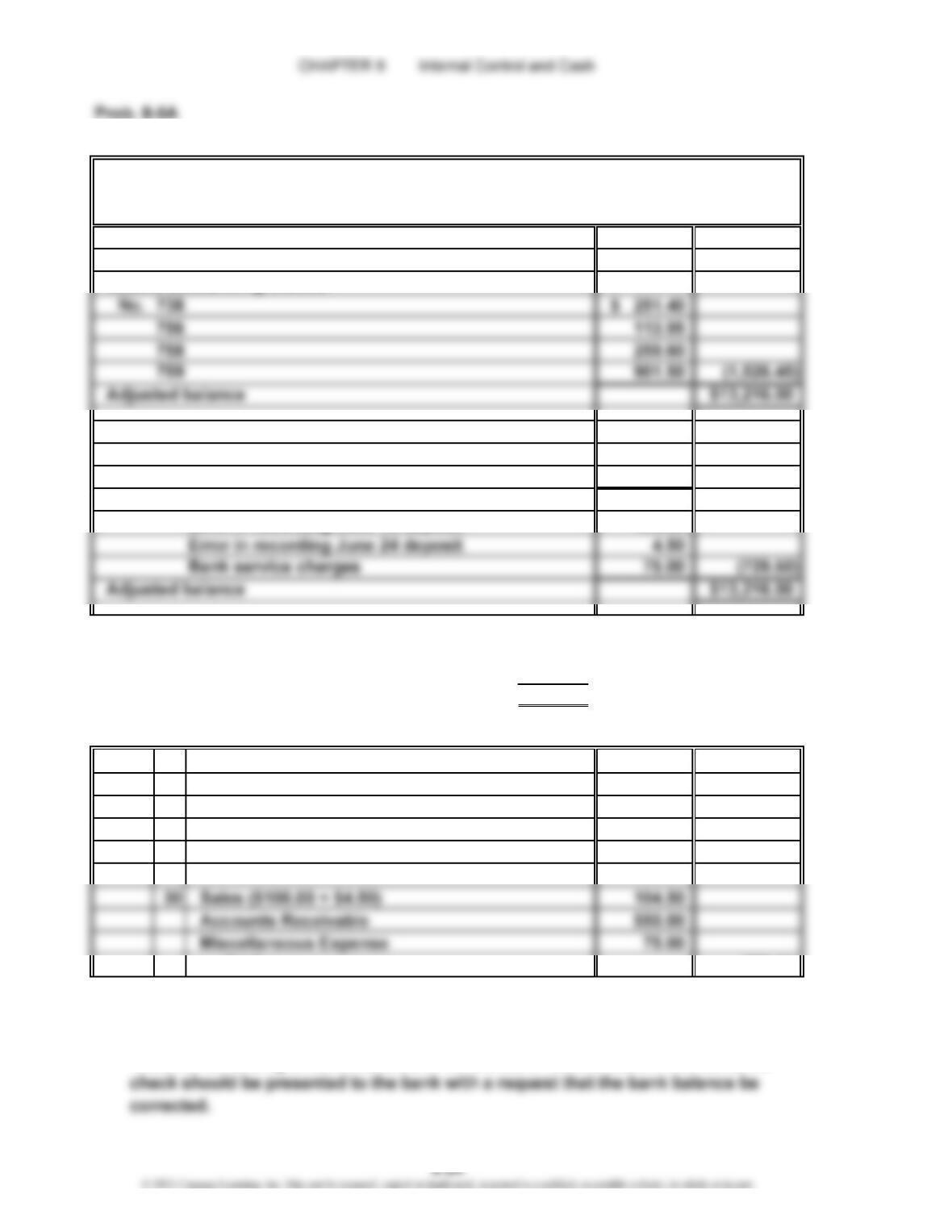
Cash balance according to bank statement $43,525
Add: Deposit of May 31, not recorded by bank $1,850
Bank error in charging check as $930 instead
of $390 540 2,390
Deduct outstanding checks (6,440)
Adjusted balance $39,475
*Cash balance, May 1………………………………………………………………
…
$ 34,250
Plus cash deposited in May………………………………………………………
…
140,300
Less checks written in May………………………………………………………
…
(138,880)
Balance per company’s books, May 31………………………………………… $ 35,670
2.
May 31 Cash 5,250
Notes Receivable 5,000
Interest Revenue 250
3. $39,475; the adjusted balance from the bank reconciliation should be reported
as cash on the May 31 balance sheet for Brentwood Bike Co.
Brentwood Bike Co.
Bank Reconciliation
May 31
1.
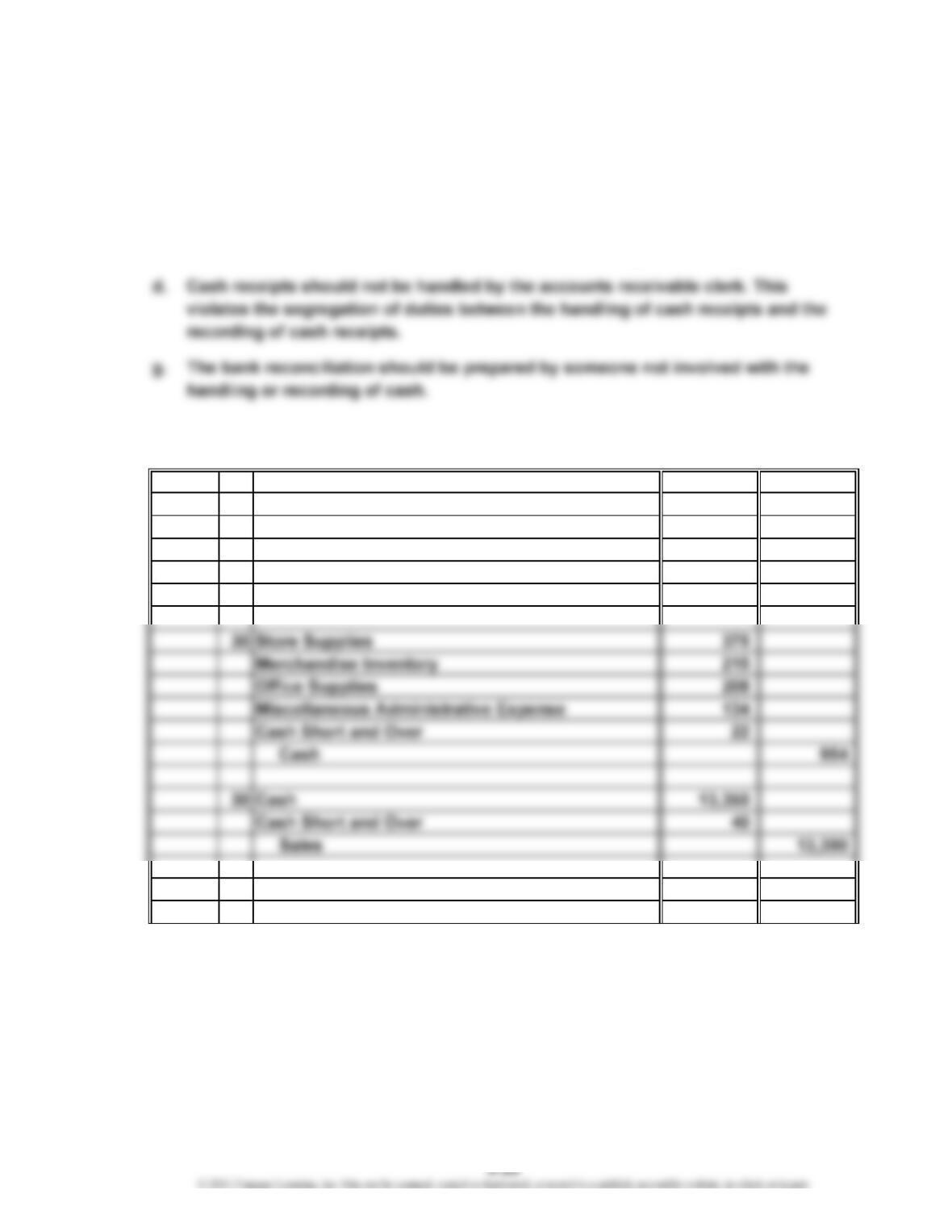
Cash balance according to bank statement $13,624.71
Add deposit of June 30, not recorded by bank 1,117.74
Deduct outstanding checks:
Cash balance according to company’s records* $10,145.50
Add: Note and interest collected by bank $3,710.00
Error in recording Check No. 743 90.00 3,800.00
Check returned because of insufficient funds $ 550.00
Error in recording June 10 deposit 100.00
*Balance per cash in bank account, June 1………………
…
$ 9,317.40
Add June receipts……………………………………………
…
9,223.76
Deduct June disbursements………………………………… (8,395.66)
Balance per cash in bank account, June 30……………… $10,145.50
2.
20Y2
June 30 Cash 3,800.00
Notes Receivable 3,500.00
Interest Revenue 210.00
Accounts Payable 90.00
Cash 729.50
3.
4. The error of $540 ($930 – $390) in the canceled check should be added to the
“balance according to bank statement” on the bank reconciliation. The canceled
$13,216.00
Deduct:
Beeler Furniture Company
Bank Reconciliation
June 30, 20Y2
CHAPTER 8 Internal Control and Cash
Prob. 8-1B
Strengths: a, b, e, and f
Weaknesses:
c. An independent person (e.g., a supervisor) should count the cash in each
cashier’s cash register, unlock the record, and compare the amount of cash
with the amount on the record to determine cash shortages or overages.
Prob. 8-2B
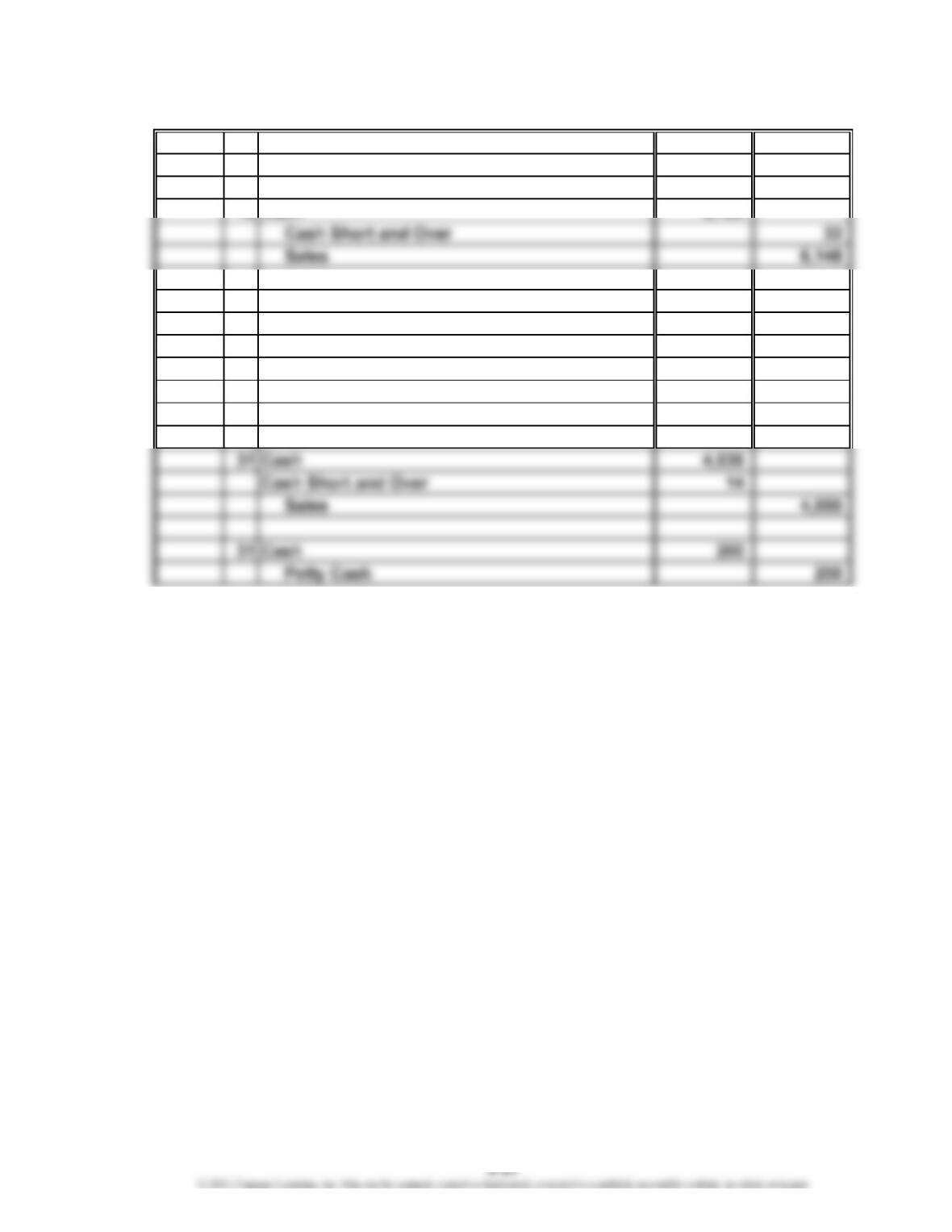
1 Petty Cash 1,000
Cash 1,000
12 Cash 9,506
Cash Short and Over 66
Sales 9,440
30 Petty Cash 200
Cash 200
June
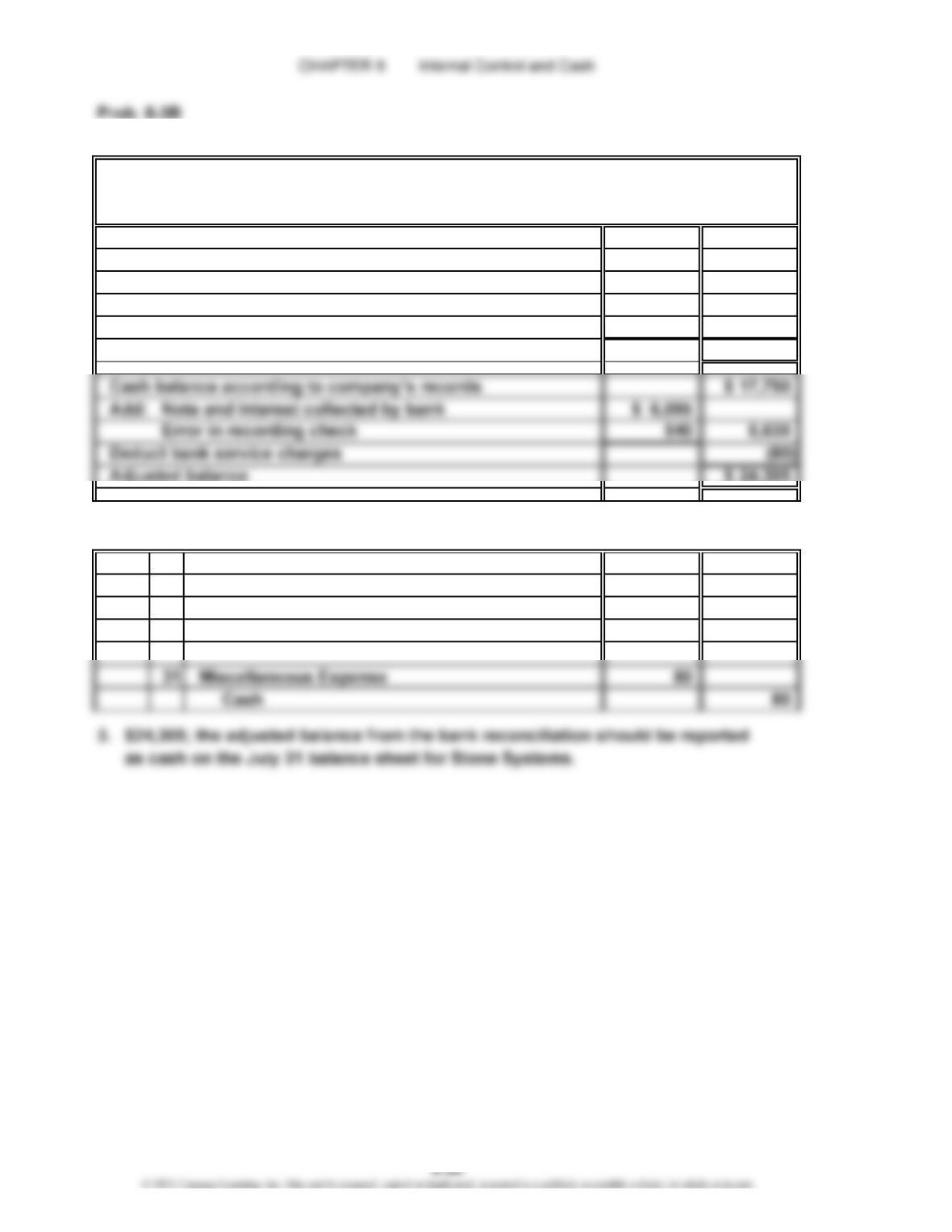
1.
Cash balance according to bank statement $ 33,650
Add deposit of July 31, not recorded by bank 9,150
Deduct: Outstanding checks $17,865
Bank error in charging check as $1,180 instead
of $1,810 630 (18,495)
Adjusted balance $ 24,305
Adjusted balance $ 24,305
2.
July 31 Cash 6,635
Notes Receivable 5,750
Interest Revenue 345
Accounts Payable—Holland Co. 540
Stone Systems
Bank Reconciliation
July 31
CHAPTER 8 Internal Control and Cash
Prob. 8-4B
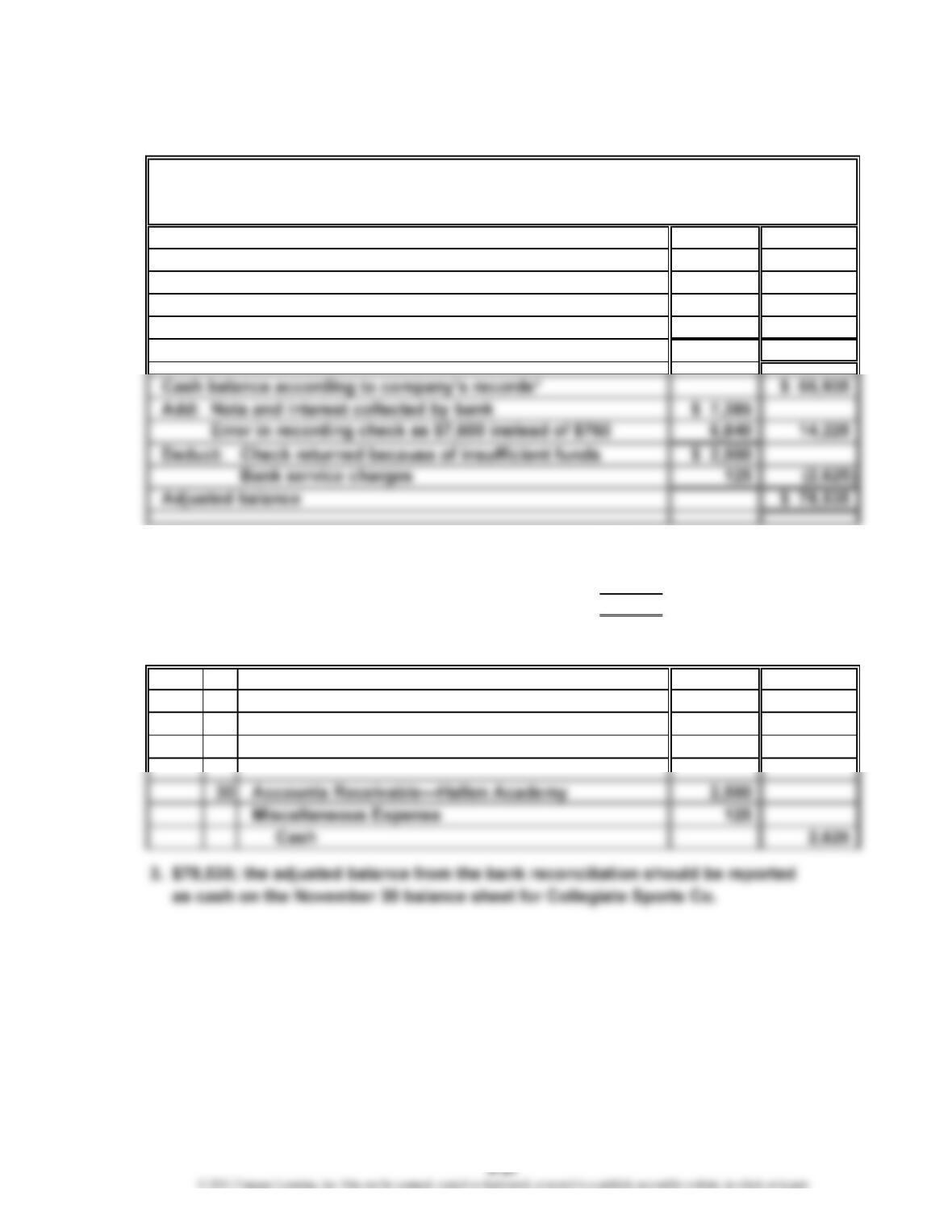
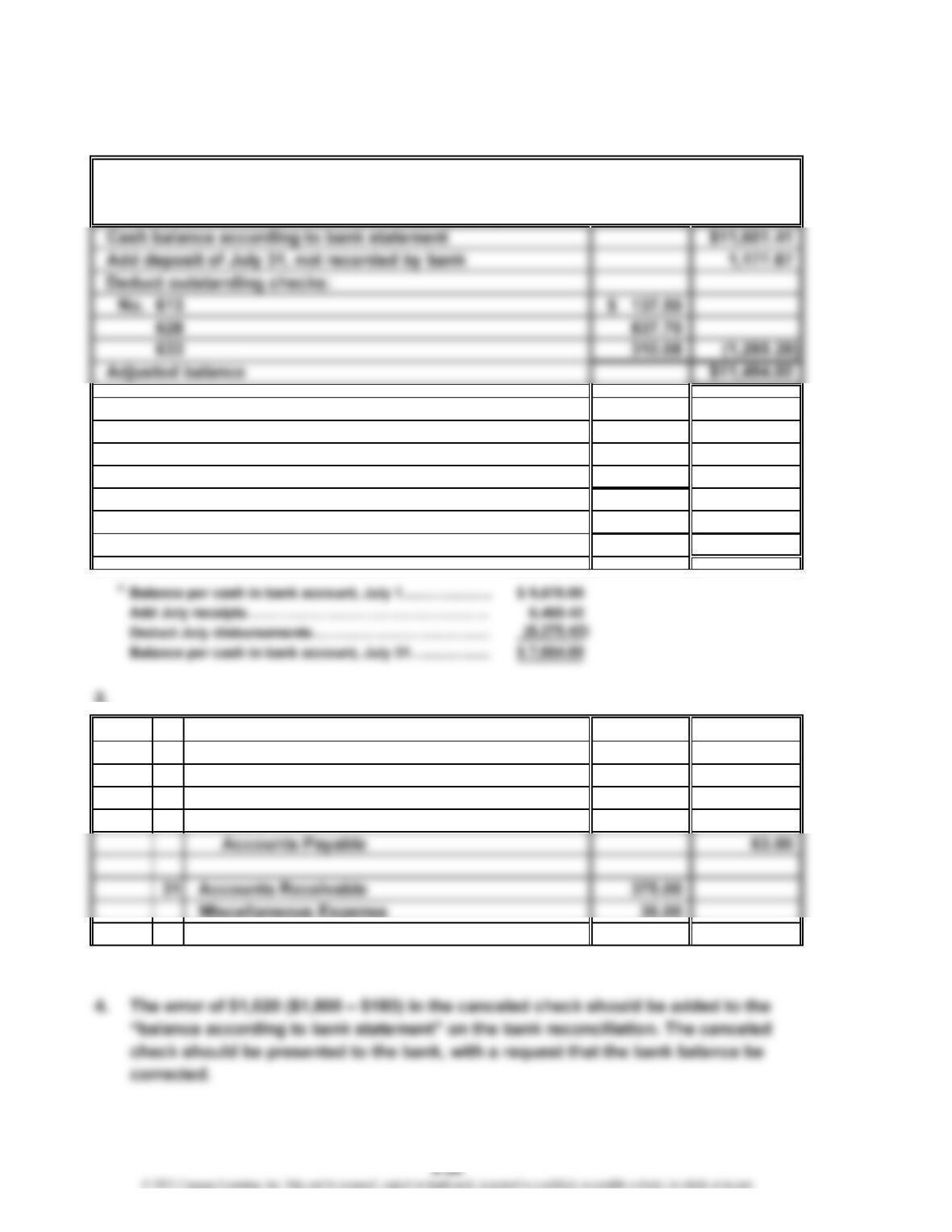
1.
Cash balance according to bank statement $112,675
Add deposit of November 30, not recorded by bank 12,200
Deduct: Outstanding checks $41,840
Bank error in charging check as $2,750 instead
of $7,250 4,500 (46,340)
Adjusted balance $ 78,535
*Cash balance, November 1…………………………………………
…
$ 81,145
Plus cash deposited in November………………………………… 293,150
Less checks written in November…………………………………
…
(307,360)
Balance per company’s records, November 30…………………
…
$ 66,935
2.
Nov. 30 Cash 14,225
Notes Receivable 7,000
Interest Revenue 385
Accounts Payable—Ramirez Co. 6,840
Collegiate Sports Co.
Bank Reconciliation
November 30
CHAPTER 8 Internal Control and Cash
Prob. 8-5B
1.
Cash balance according to company’s records* $ 7,664.00
Add: Note and interest collected by bank $4,160.00
Error in recording July 23 deposit 18.00
Error in recording Check No. 627 63.00 4,241.00
Deduct: Check returned because of insufficient funds $ 375.00
Bank service charges 36.00 (411.00)
Adjusted balance $11,494.00
2.
20Y5
July 31 Cash 4,241.00
Notes Receivable 4,000.00
Interest Revenue 160.00
Sales 18.00
Cash 411.00
3.
Sunshine Interiors
Bank Reconciliation
July 31, 20Y5
$11,494.00
CHAPTER 8 Internal Control and Cash
CP 8-1
Both Tehra and her supervisor are acting in an unethical manner. While Tehra’s
disappointment at not receiving a raise may be justified, it is not appropriate for
Tehra to submit personal expenses for reimbursement. By knowingly submitting
false expense reimbursements, Tehra is effectively stealing from the company and
CP 8-2
Acceptable business and professional conduct requires Joel Knolls to notify the
bank of the error. Note to Instructors: Individuals may be criminally prosecuted for
knowingly using funds that are erroneously credited to their bank accounts.
CP 8-3
1. a. $4,249 million (from balance sheet)
b. 28.1% ($4,249 ÷ $15,134) in 2018; 23.7% ($3,808 ÷ $16,061) in 2017. Cash as a
percentage of total current assets has increased.
2. Management’s Annual Report on Internal Control Over Financial Reporting is
included in the annual report immediately before the financial statements.
a. Management
b. Internal control over financial reporting is a process designed to provide
CASES & PROJECTS
CHAPTER 8 Internal Control and Cash
CP 8-4
Note to Instructors: The purpose of this activity is to familiarize students with the
internal controls used by specific businesses. For example, when you order food
at a McDonald’s drive-through lane, your order is processed as follows:
1. The order is taken at a remote location by speaking with the cashier who rings
up the order and indicates the amount you owe.
2. The order is simultaneously shown on a computer screen in the food
preparation area.
CP 8-5
MEMO
To: My Instructor
From: A+ Student
Re: Control Procedures for Self-Checkout Lanes
Wholesome and Happy Foods could incorporate several features into the kiosks that
would increase the likelihood of customers scanning all of the items in their carts for
purchase. First, the scanning system should be set up so that an audible beep is
heard each time an item is scanned and a sale recorded. This will alert the attendant
CHAPTER 8 Internal Control and Cash
CP 8-6
Several control procedures could be implemented to prevent or detect the theft of
cash from fictitious returns.
One procedure would be to establish a policy of “no cash refunds.” That is, returns
could only be exchanged for other merchandise. However, such a policy might not
be popular with customers, and Turpin Meadows Electronics might lose sales from
customers who would shop at other stores with a more liberal return policy.
Yet another procedure would be to allow returns at the individual cash registers but
require that all returns be approved by a supervisor. In this way, cash could be
stolen through fictitious returns only through the supervisor and the cash register
clerk agreeing to steal.
CP 8-7
Several possible procedures for preventing or detecting the theft of grocery items by
failing to scan their prices include the following:
b. Some grocery stores have their cash registers networked so that a monitor in a
centralized office, usually high above the floor, can monitor any cash register’s
activity. In this way, a supervisor could monitor cash register activity on a
periodic basis.
CHAPTER 8 Internal Control and Cash
CP 8-8
1. Several methods could be used to determine how much the cashier stole. The
method described here is based on preparing a bank reconciliation as illustrated
in the chapter. Because of the theft of the undeposited receipts, the bank
reconciliation adjusted balances will not agree. The difference between the
adjusted balances is the estimate of the amount stolen by the cashier.
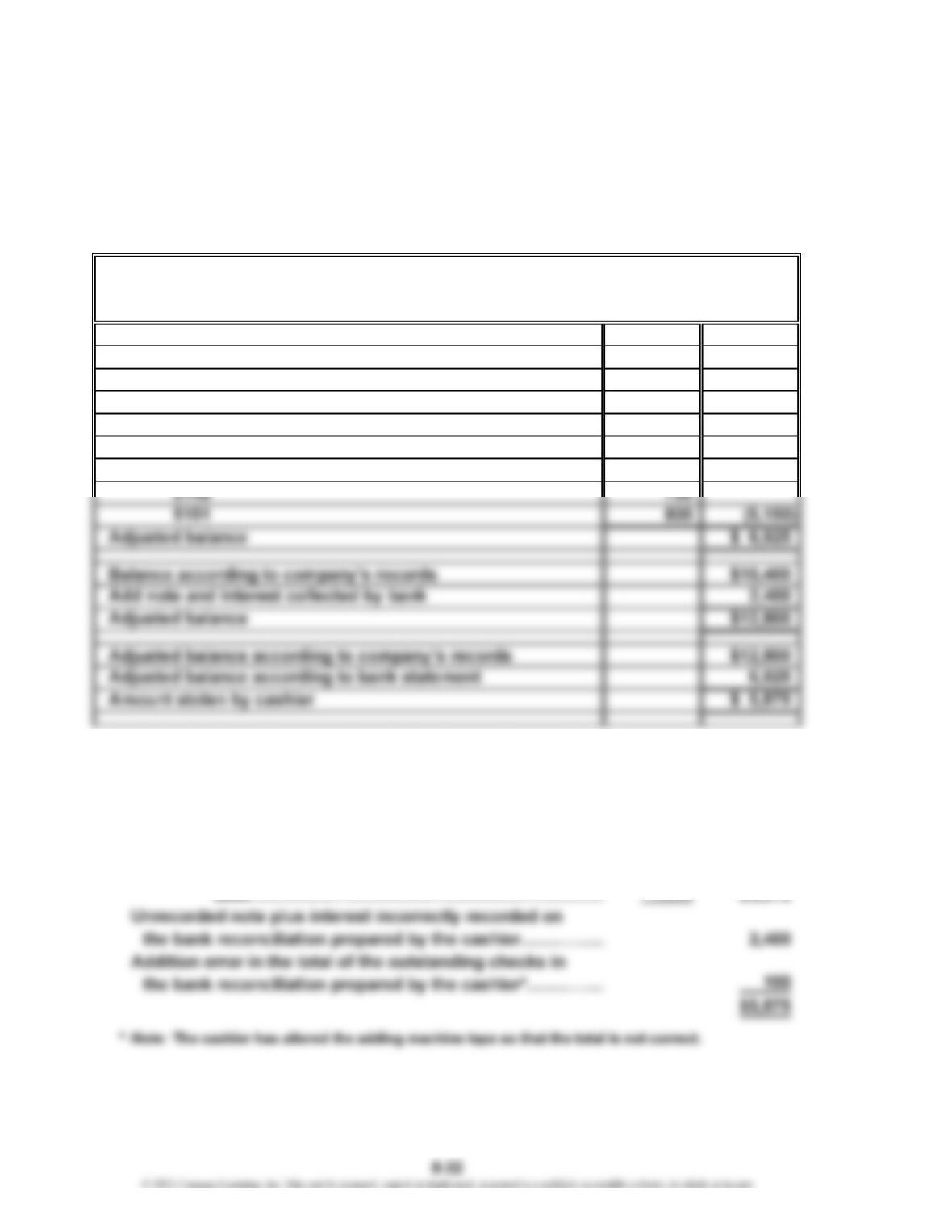
Balance according to bank statement $10,575
Add undeposited cash receipts on hand 1,500
Deduct outstanding checks:
No. $1,050
675
1,650
225
Note to Instructors: The amount stolen by the cashier could also be computed directly
from the cashier-prepared bank reconciliation as follows:
Outstanding checks omitted from the bank
reconciliation prepared by the cashier:
No. 2670……………………………………………………… $1,050
3679……………………………………………………… 675
3679
3690
5148
Parker Company
Bank Reconciliation
July 31
2670
CHAPTER 8 Internal Control and Cash
CP 8-8 (Concluded)
2. The cashier attempted to conceal the theft by preparing an incorrect bank
reconciliation. Specifically, the cashier (1) omitted outstanding checks on
3. a. Two major weaknesses in internal controls that allowed the cashier to
steal the undeposited cash receipts are as follows:
●Large amounts of undeposited cash receipts were kept on hand
during the month. For example, cash receipts for July 30 and 31 had
yet to be deposited as of July 31. The large amount of undeposited
cash receipts allowed the cashier to steal the cash without arousing
suspicion that any cash was missing.
b. Two recommendations that would improve internal controls so that similar
types of thefts of undeposited cash receipts can be prevented are as
follows:
●All cash receipts should be deposited daily. This would reduce the
risk of significant cash losses. In addition, any missing cash would be
more easily detected.
Note to Instructors: In addition to the above recommendations, Parker Company
should be counseled that it is standard practice for any disgruntled employees,
fired employees, or employees who have announced quitting dates to be removed
from sensitive positions (such as the cashier position) so that company assets or
records will not be jeopardized. Finally, checks that have been outstanding for
long periods of time (such as Nos. 2670, 3679, and 3690) should be voided (with
stop payment instructions given to the bank) and reentered in the cash records.
This establishes control over these items and prevents their misuse.
CHAPTER 8 Internal Control and Cash
CP 8-9
1. (in thousands)
Year 3: $804.7 per month ($9,656 ÷ 12)
Year 2: $1,043.0 per month ($12,516 ÷ 12)
Year 1: $1,975.3 per month ($23,703 ÷ 12)
2. Year 3: 9.0 months ($7,272 ÷ $804.7)
Year 2: 14.8 months ($15,471 ÷ $1,043.0)
Year 1: 7.0 months ($13,838 ÷ $1,975.3)