
Order processing cost per order 9.00$
Additional costs if order must be expedited (rushed) 11.00$
Customer technical support calls (per call) 13.00$
Relationship management costs (per customer per year) 1,800$
Portion of sales that are product costs 80%
In the prior year, Triumph had the following experience with one of its customers, Julius Company:
Sales 22,000$
Number of orders 170
Percent of orders marked rush 80%
Calls to technical support 90
Required
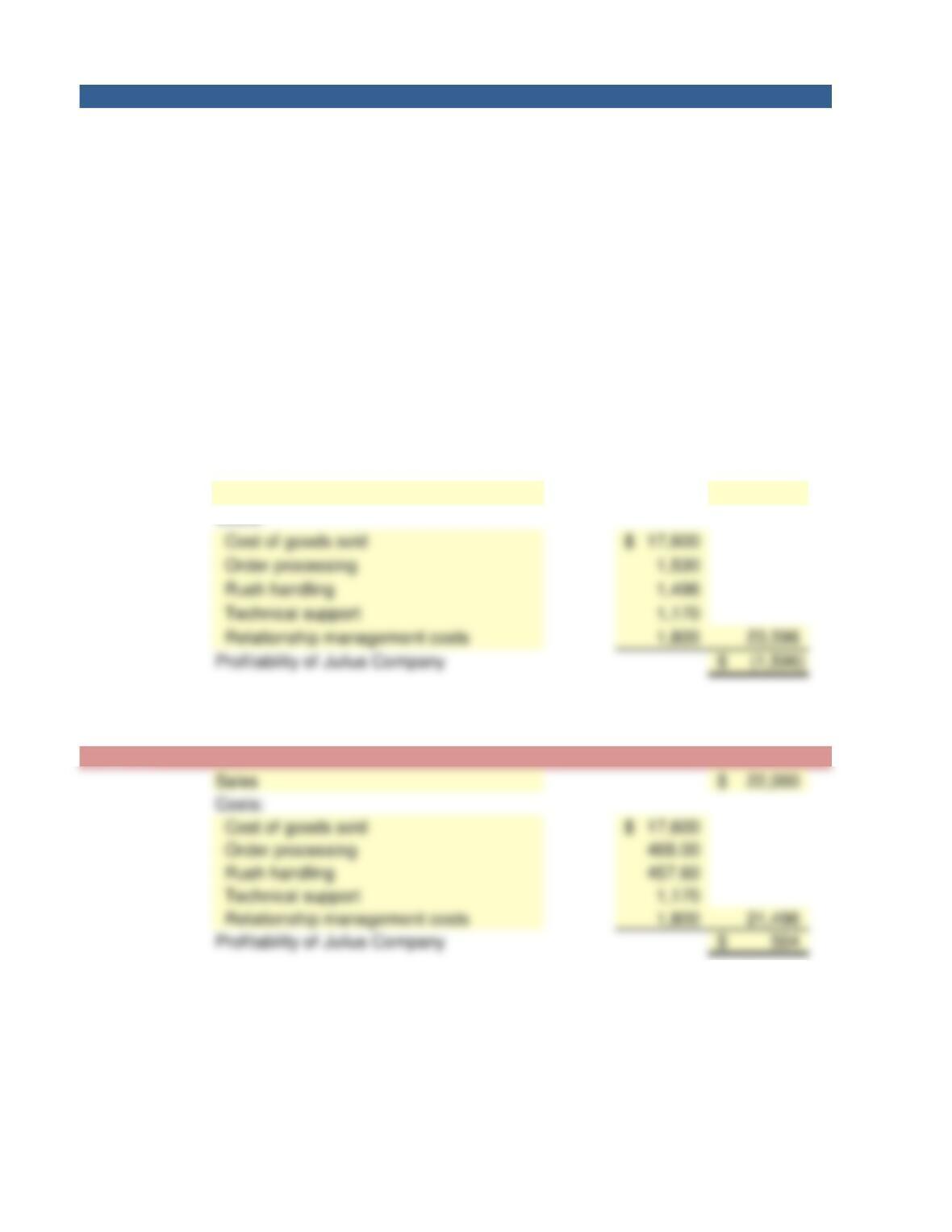
Calculate the profitability of the Julius Company account.
Costs:
Profitability of Julius Company
What-if?
Consider the following after you have completed the requirements of E8-17.
Costs:
Triumph Corporation has determined that order processing costs are due to customers who
typically fail to plan for what will be needed for the next week’s work. Triumph estimates it can
reduce the number of orders for all of its customers by 30% if it offers a 5% discount incentive
to customers that order only once a week. Management believes that Julius Company‘s current
number of annual orders of 170 can be reduced to 52 orders per year with the discount
incentive. Determine the probability of Julius Company if the discount is implemented.
Exercise 8-17 Customer Profitability Analysis
Triumph Corporation has analyzed its customer and order handling data for the past year and has
determined the following costs and other information:

Profitability of Julius Company
Problem data follows:
Order processing cost per order 9.00$
Additional costs if order must be expedited (rushed) 11.00$
Customer technical support calls (per call) 13.00$
Relationship management costs (per customer per year) 1,800$
Portion of sales that are product costs 80%
Prior year experience with Julius Company
Sales 22,000$
Number of orders 170
Percent of orders marked rush 80%
Calls to technical support 90
Required
Calculate the profitability of the Julius Company account.
22,000$
Costs:
What-if?
Solution: Exercise 8-17 Customer Profitability Analysis
Sales

Fee charged by cable company for selling items 20% of revenue
Fixed costs per production run 160,000$
Variable production costs per unit 28.00$
Shipping cost per calendar to customers 5.00$
Price Quantity
$85 15,000
$75 20,000
$65 30,000
$55 45,000
$45 65,000
Required
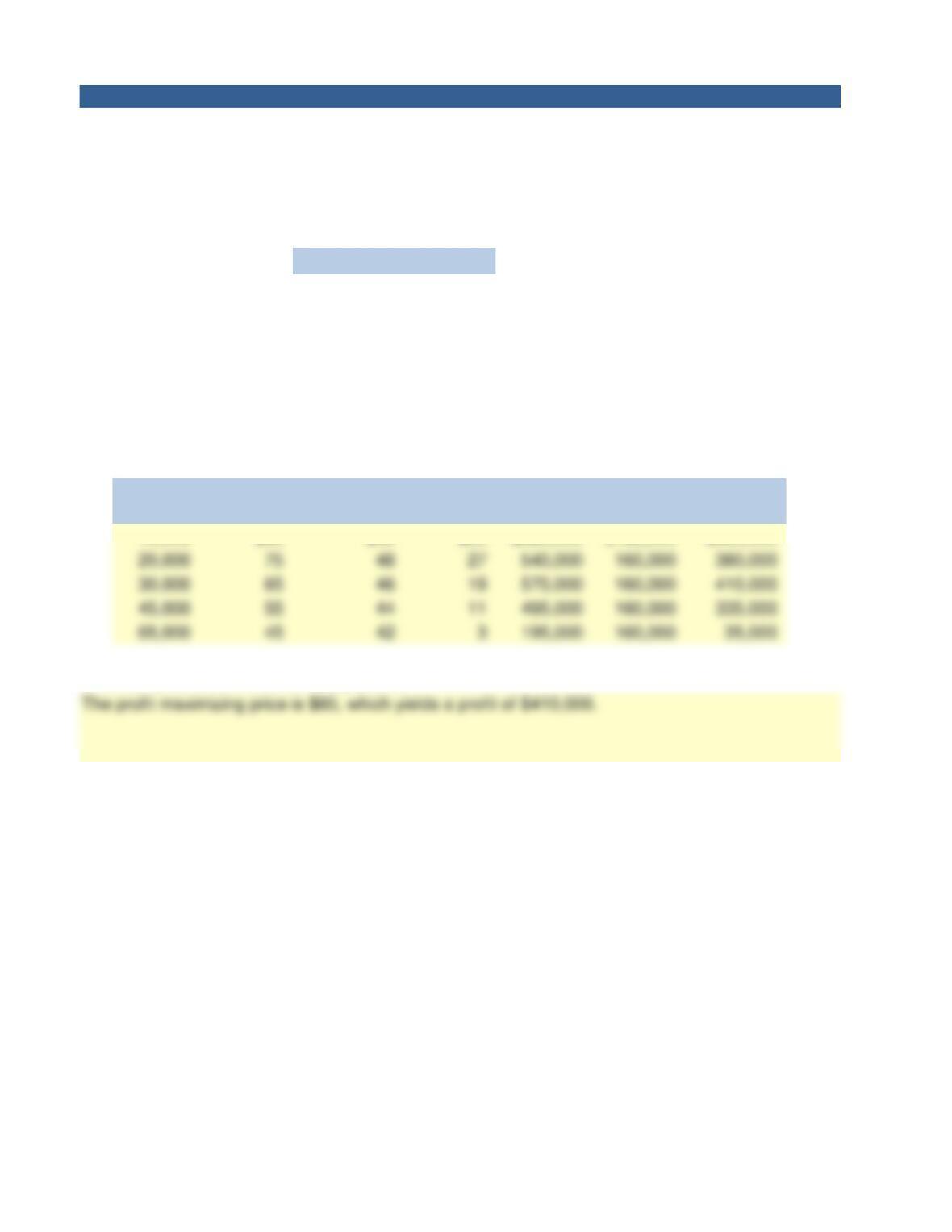
a. Calculate expected profit for each price.
Quantity Price
Variable
Cost
CM/Unit Total CM
Fixed
Costs
Profit
b. Which price maximizes company profit?
Marsha Andersen, a product manager at Spencer, is charged with recommending a price for the
item. Based on her experience with similar items, focus group responses, and survey information,
she has estimated the number of units that can be sold at various prices:
Problem 8-1 Determining the Profit-Maximizing Price
Spencer Electronics has just developed a low-end electronic calendar that it plans to sell via a
cable channel marketing program. A fee is charged by the cable company for selling the item, for
which the program will sell the calendar over six 10-minute segments in September. The company
plans to wait for all orders to come in, then it will produce exactly the number of units ordered.
Production time will be less than three weeks. Spencer has provided the following cost information:
Problem data follows:
Fee charged by cable company for selling items 20% of revenue
Fixed costs per production run 160,000$
Variable production costs per unit 28.00$
Shipping cost per calendar to customers 5.00$
Price Quantity
$85 15,000
$75 20,000
$65 30,000
$55 45,000
$45 65,000
Required
a. Calculate expected profit for each price.
Quantity Price
Variable
Cost
CM/Unit Total CM
Fixed
Costs
Profit
15,000 $85 $50 $35 $525,000 $160,000 $365,000
b. Which price maximizes company profit?
Solution: Problem 8-1 Determining the Profit-Maximizing Price