
Chapter 08 – Accounting for Fiduciary Activities—Custodial and Trust Funds
8-1
CHAPTER 8: ACCOUNTING FOR FIDUCIARY ACTIVITIES—
CUSTODIAL AND TRUST FUNDS
OUTLINE
Number
Topic
Type/Task
Status
(re: 18/e)
Questions:
8-1
Determining a fiduciary relationship
Define
Same
8-2
Distinction between custodial and trust funds
Distinguish, compare
Same
8-3
Identifying custodial funds and their purpose
Explain
New
8-4
Identifying trust funds and their purpose
Explain
8-3
8-5
Fiduciary and governmental fund reporting
Compare
Same
8-6
External investment pools and investment
trusts
Compare
Revised 8-6
8-7
Private purpose trusts and permanent funds
Compare
New
8-8
Net pension liability and covered payroll
Analyze
New
8-9
Accounting for pension expenses/expenditures
Explain
Revised 8-10
8-10
OPEB
Explain
8-11
8-11
IRC Sec. 148 rules on arbitrage
Explain
New
Cases:
8-12
Research Case—CalPERS
Locate, interpret
Revised
8-13
Research Case—OPEB Plans
Compare, evaluate
Revised
8-14
Research Case—Tax Custodial Fund
Locate
New
8-15
Research Case—Custodial and Trust Funds
Identify, analyze
New
Exercises/Problems:
8-16
Examine a CAFR
Examine
Revised
8-17
Various custodial and trust fund issues
Multiple Choice
New 3 and 4,
revised 1, 2, 8
and 9
8-18
Various agency and trust fund issues
Multiple Choice
Items 1-5
new. Item 7
revised.
8-19
Tax custodial fund
Journal entries
Revised
8-20
Identification of fiduciary funds
Analysis
8-21 revised
8-21
Investment trust fund
Journal entries
8-22
8-22
Pass-through custodial funds
Journal entries
8-23
8-23
Pension trust fund
Journal entries
New
8-24
Fiduciary financial statements
Financial statements
Revised
8-25
Fiduciary fund financial statements
Financial statements
New
8-26
Pension calculations
Calculate
Revised
8-27
Investment risk exposure
Apply
Same
Chapter 08 – Accounting for Fiduciary Activities—Custodial and Trust Funds
8-2
CHAPTER 8: ACCOUNTING FOR FIDUCIARY ACTIVITIES—
AGENCY AND TRUST FUNDS
Answers to Questions
8-1. To establish a fiduciary relationship, the GASB Codification identifies three criteria that
need to be met. The three criteria are: (1) The assets related to the activity must be
controlled by the government, (2) The assets related to the activity cannot be generated
by the government’s exchange or non-exchange revenues (there is an exception for pass-
through grants on this criterion), and (3) The government cannot benefit from the assets.
General Problem Information: Determining a fiduciary relationship
Learning Objective: 8-1
Level of Difficulty: Easy
8-2. All fiduciary funds hold assets that benefit individuals, private organizations, or other
governments that are not a part of the reporting entity. However, a fiduciary trust fund
only exists if the fund meets certain requirements identified by the GASB, which include:
(1) Assets are administered through a trust, (2) Assets are used only to provide benefits to
recipients in accordance with benefit terms, and (3) Assets are legally protected from the
government’s creditors. Assets that are held in a fiduciary relationship that does not meet
the requirements of a trust are reported as custodial funds.
Trust funds are reported in the statement of fiduciary net position and the statement of
changes in fiduciary net position. Trust funds are reported in separate columns by type
(i.e., pension [and other employee benefit] trust funds, investment trust funds, private-
purpose trusts).
General Problem Information: Distinction between custodial and trust funds
Learning Objective: 8-1
Learning Objective: 8-2
Chapter 08 – Accounting for Fiduciary Activities—Custodial and Trust Funds
8-3
Ch. 8, Answers, Question 8–2 (Cont’d)
Topic: Identifying Fiduciary Activities; Custodial Funds; Investment & Private-Purpose
Trust Funds; Illustrative Financial Statements
Bloom’s Taxonomy: Understand
8-3. As mentioned in the text, custodial funds can serve many purposes and be of several
types since any fiduciary activity that is not part of a trust agreement is reported as a
custodial fund. Examples provided in the text include tax custodial funds, special
assessment debt service funds, pass-through funds, and external investment pool funds.
A tax custodial fund serves to collect and distribute tax and other types of revenues for
several different governments. A special assessment debt service fund is one in which the
government has no obligation to assume the debt service on special assessment debt.
However, the government has agreed to collect the special assessments and pay the
General Problem Information: Identifying custodial funds and their purpose
Learning Objective: 8-2
Topic: Custodial Funds
Bloom’s Taxonomy: Understand
Accreditation Skills tag: AACSB: Communication, AICPA: FN Reporting
Level of Difficulty: Easy
8-4. There are many different types of trust funds. For reporting purposes, the GASB
classifies trust funds as investment trusts, private-purpose trusts, and pension trusts (also
referred to as pension and other employee benefit trusts). An investment trust fund is
used to account for and report the fund equity in pooled investments held by fund
participants who are external to the government operating the fund. Private-purpose trust
Chapter 08 – Accounting for Fiduciary Activities—Custodial and Trust Funds
8-4
Ch. 8, Answers, Question 8-4 (Cont’d)
General Problem Information: Identifying trust funds and their purpose
Learning Objective: 8-3
Learning Objective: 8-5
8-5. Unlike governmental funds, the activities of fiduciary funds are never included in the
government-wide financial statements. Instead, their activities are reported in a set of
fiduciary fund financial statements. Governmental funds, however, are included in the
Governmental Activities column of the government-wide financial statements.
The fiduciary fund financial statements are prepared using the accrual basis of accounting
and the economic resources measurement focus, while the governmental fund financial
statements use the modified accrual basis and the current financial resources
measurement focus.
Bloom’s Taxonomy: Understand
Accreditation Skills tag: AACSB: Communication, AICPA: FN Reporting
Level of Difficulty: Medium
8-6. Both an external investment pool and an investment trust fund conduct investment
activities on behalf of parties external to the government. However, an external
investment pool that is administered through a formal trust agreement is reported as an
investment trust. It is reported in the Investment Trust column of the fiduciary fund
Chapter 08 – Accounting for Fiduciary Activities—Custodial and Trust Funds
8-5
Ch. 8, Answers, Question 8-6 (Cont’d)
General Problem Information: External investment pools
Accreditation Skills tag: AACSB: Communication, AICPA: FN Reporting
Level of Difficulty: Medium
8-7. A private-purpose trust fund is a fiduciary fund administered by a government entity for
beneficiaries external to the administering government, such as individuals,
organizations, or governments other than the government administering the trust. The
General Problem Information: Private purpose trusts and permanent funds
Learning Objective: 8-3
Topic: Investment & Private-Purpose Trust Funds
Bloom’s Taxonomy: Understand
Accreditation Skills tag: AACSB: Communication, AICPA: FN Reporting
Level of Difficulty: Medium
8-8. The net pension liability as a percentage of covered payroll tells the reader the size of the
net pension liability relative to the annual payroll for employees the pension must cover.
As the trend indicates, the liability has grown relative to the payroll. It has gone from
being somewhat larger than the payroll (at 121.45% in 2014) to over two and a half times
as large as the payroll in 2023. The increase in the size of the liability relative to the
payroll over a ten-year period is troublesome and will need to be addressed by
management if the pension is to be sustainable.
General Problem Information: Net pension liability and covered payroll
Learning Objective: 8-5
Chapter 08 – Accounting for Fiduciary Activities—Custodial and Trust Funds
8-6
8-9. A government employer reports pension expenditures in a governmental fund on the
modified accrual basis of accounting. Thus, the amount recognized will be the actual
amount paid to the plan and the net annual change in amounts normally expected to be
liquidated with expendable available financial resources. In proprietary funds and in the
governmental activities journal at the government-wide level, employers would recognize
General Problem Information: Accounting for pension expenses/expenditures
Learning Objective: 8-5
Topic: Pension Trust Funds
Bloom’s Taxonomy: Understand
Accreditation Skills tag: AACSB: Communication, AICPA: FN Reporting
Level of Difficulty: Medium
8-10. OPEB stands for other post-employment benefits and includes retirement benefits other
than pensions. The primary OPEB benefit is healthcare, but examples of other benefits
include life insurance and long-term care. Like pension funds, OPEB funds are
considered employee related trust funds. As a result, the recognition and reporting of
OPEB is very similar to pension reporting. Trust fund activity is reported in the pension
column of the fiduciary financial statements.
8-11. The Internal Revenue Code, Sec. 148 limits the amount of interest a government can earn
on tax-exempt bond debt proceeds. If a government chooses to invest its bond proceeds
in investments with higher yields than the interest on the bonded debt it will have to pay
the excess of permitted interest earnings to the Internal Revenue Service. In addition, it
may be subject to penalties for violating arbitrage rules.
General Problem Information: IRC Sec. 148 rules on arbitrage
Learning Objective: 8-7
Topic: Managing Investments
Chapter 08 – Accounting for Fiduciary Activities—Custodial and Trust Funds
8-7
Solutions to Cases
8-12. Note the answers provided are based on Fiscal Year 2018-2019 information. If students
access data for subsequent fiscal years answers may be different.
a. CalPERS was established in 1932.
d. Perf B and Perf C are cost-sharing multiple employer defined benefit pension
programs. Perf B serves school district and charter school employees, while Perf C
serves public agencies (which include cities, counties, and special districts).
e. For fiscal year 2018-2019 the total net position was $386.1 billion.
f. For fiscal year 2018-2019 the total change in net position was $20.5 billion.
General Problem Information: Research Case – CalPERS
Learning Objective: 8-5
Topic: Pension Trust Funds
Bloom’s Taxonomy: Understand
Accreditation Skills tag: AACSB: Communication, AICPA: FN Reporting
Level of Difficulty: Medium
8-13. Following are answers based on the 2018-2019 fiscal year CAFRs for the City of Boston
and New York City. The answers to the questions will vary with the year of the CAFRs
examined; therefore, the answers provided serve as a guide to what should be considered
in the analysis.
a. The Boston ending total OPEB liability was $3,009,584,000 and its ending plan
fiduciary net position was $594,249,000. This resulted in a plan net position as a
percentage of total pension liability of 19.75 percent.
c. Neither plan is well funded given that over the years displayed Boston has a high
percentage of just 19.75 percent, and New York City has a high of only 5.0 percent
over the same three-year time period. Of the two, Boston has the more well-funded
plan. Boston also appears to have a funding strategy given it has improved its
Chapter 08 – Accounting for Fiduciary Activities—Custodial and Trust Funds
Ch. 8, Solutions, Case 8-13 (Cont’d)
General Problem Information: Research case—OPEB plans
Learning Objective: 8-6
8-14. a. The tax collector’s office collects current and delinquent real and personal property
taxes, special assessments for all local taxing authorities, local business tax receipts,
d. A one percent discount is offered for each month prior to the month in which the
payment is due, up to four months in advance of the due date. That is, a 4 percent
discount is offered if taxes are paid four months prior to the due date, 3 percent if paid
three months before the due date, etc.
General Problem Information: Research case—Tax custodial funds
Learning Objective: 8-2
Topic: Custodial Funds
Bloom’s Taxonomy: Find
Accreditation Skills tag: AACSB: Communication, AICPA: FN Research
Level of Difficulty: Easy
8-9
8-15. a. On the City of Boston’s 2019 CAFR the term agency is used. GASB Statement No.
84, which changed terminology from agency funds to custodial funds, had been
issued prior to the 2019 CAFR and is referenced in the CAFR; however, the effective
date for implementing the new standard was for reporting periods beginning after
December 15, 2018. Therefore, if students use a CAFR subsequent to the 2019
CAFR the terminology may differ.
c. In the 2019 CAFR the custodial/agency funds listed are a Law Enforcement Trust
Fund, Student Activity Fund, and the Before and After School Fund (see combining
statements). Law Enforcement Trust Fund is a drug evidence account for property
d. Both a Pension and an OPEB trust fund are reported. It would appear that the pension
and OPEB funds are properly reported as trusts. In addition, the City has some
private-purpose trust funds. The four pools in the private-purpose trust are
improvements of the City’s parks and cemeteries, educational scholarships and
sporting equipment, creation of public utility and beauty, and co-mingled non-
testamentary trusts. Educational scholarships and non-testamentary trusts appear to
General Problem Information: Research Case—Custodial and Trust Funds
Learning Objective: 8-2
Learning Objective: 8-3
Topic: Custodial Funds; Investment & Private-purpose Trust Funds
Bloom’s Taxonomy: Analyze
Accreditation Skills tag: AACSB: Reflective thinking, AICPA: FN Critical thinking
Level of Difficulty: Hard

Chapter 08 – Accounting for Fiduciary Activities—Custodial and Trust Funds
8-10
Solutions to Exercises and Problems
8-16. Each student will have an annual report from a different government unit; therefore, the
answers to these questions will differ from student to student.
General Problem Information: Examine the CAFR
Topic: Various
Bloom’s Taxonomy: Apply
Accreditation Skills tag: AACSB: Communication, AICPA: FN Reporting
Level of Difficulty: Medium
8-17.
2. d. 7. c. 12. b.
4. a. 9. a. 14. a.
5. c. 10. d. 15. d.
General Problem Information: Various fiduciary and trust fund issues
Learning Objective: 8-1
Learning Objective: 8-2
Learning Objective: 8-3
Learning Objective: 8-4
1. a. 6. c.
3. b. 8. c.
5. b. 10. d.
General Problem Information: Various agency and trust fund issues
Learning Objective: 8-1
Learning Objective: 8-2
Learning Objective: 8-3
Learning Objective: 8-4

Chapter 08 – Accounting for Fiduciary Activities—Custodial and Trust Funds
8-11
Ch. 8, Solutions, Exercise 8–18 (Cont’d)
Learning Objective: 8-5
Learning Objective: 8-6

Chapter 08 – Accounting for Fiduciary Activities—Custodial and Trust Funds
8-12
8-19. a. SUN COUNTY
TAX CUSTODIAL FUND
GENERAL JOURNAL
Debits Credits
1. TAXES RECEIVABLE FOR OTHER FUNDS
AND GOVERNMENTS⎯CURRENT 23,951,500
2. CASH 20,358,000
TAXES RECEIVABLE FOR OTHER FUNDS
AND GOVERNMENTS⎯CURRENT 20,358,000
3. DEDUCTIONS—ADMINISTRATIVE FEE 276,869
DUE TO OTHER FUNDS 276,869
Shares:
COMPUTATION
Taxes
Collected
2.0% Fee
Custodian‘s
Payments
County
7,664,480/23,951,500 × 20,358,000
= 6,514,560
+ 276,869
6,791,429
4. DUE TO OTHER FUNDS 6,791,429

8-13
5. ADDITIONS—PROPERTY TAX COLLECTIONS
FOR OTHER GOVERNMENTS 16,287,020
DEDUCTIONS—ADMINISTRATIVE FEE 276,869
DEDUCTIONS—PAYMENTS OF PROPERTY
b. SUN COUNTY
GENERAL FUND
GENERAL JOURNAL
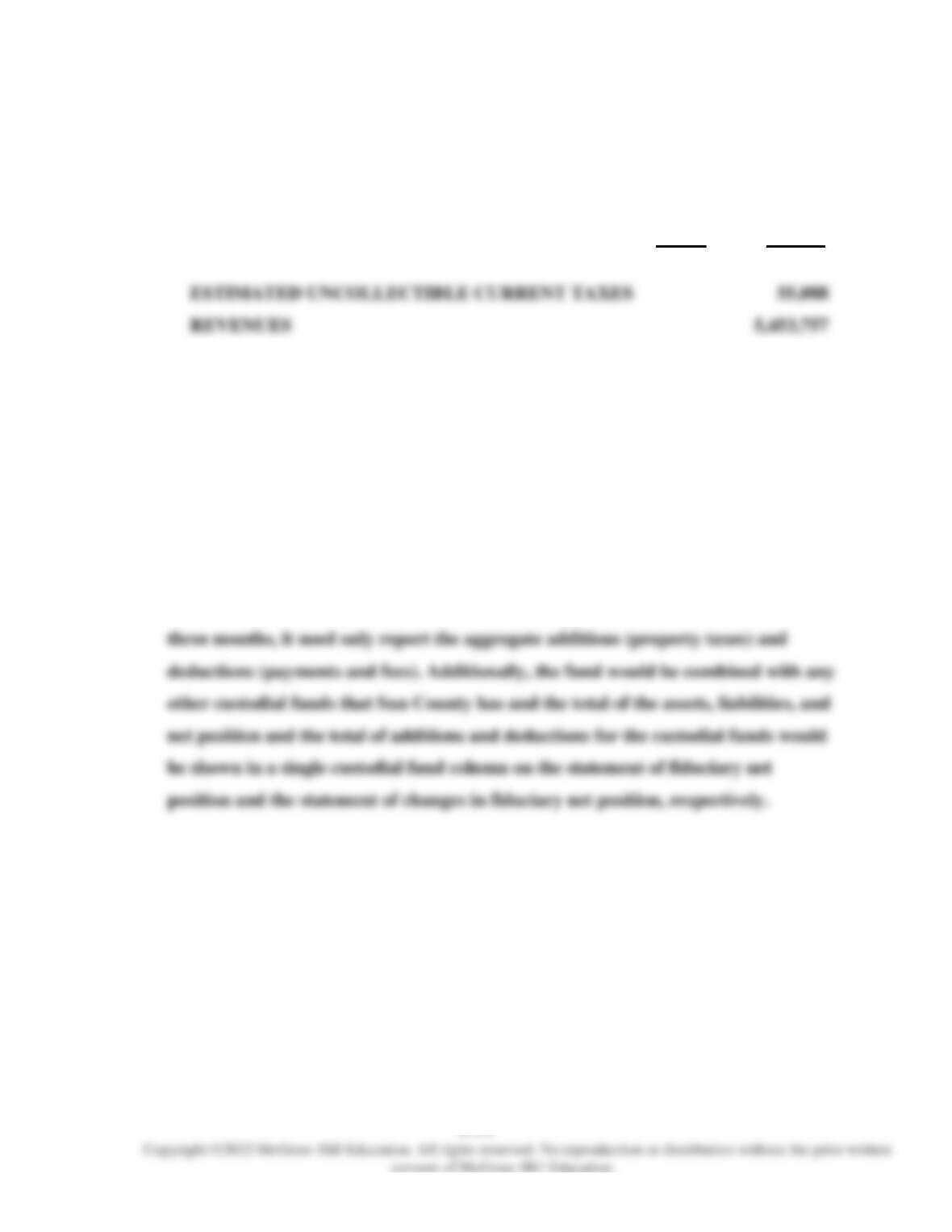
1. TAXES RECEIVABLE⎯CURRENT 7,664,480
ESTIMATED UNCOLLECTIBLE CURRENT TAXES 76,645
REVENUES 7,587,835
4. CASH 6,791,429
Chapter 08 – Accounting for Fiduciary Activities—Custodial and Trust Funds
Ch. 8, Solutions, Exercise 8–19 (Cont’d)
c. TOWN OF BAYSHORE
GENERAL JOURNAL
Debits Credits
1. TAXES RECEIVABLE⎯CURRENT 5,508,845
4. CASH 4,588,693
EXPENDITURES (COLLECTION FEES) 93,647
TAXES RECEIVABLE⎯CURRENT 4,682,340
d. The tax custodial fund would prepare a statement of tax custodial fund net position
reflecting the asset, liability, and net position balances of the fund. It would also
prepare a statement of changes in tax custodial net position to reflect the additions
and deductions during the period. Since the fund holds the resources for less than
General Problem Information: Tax agency fund
Learning Objective: 8-2
Topic: Tax Agency Funds
Bloom’s Taxonomy: Apply
Accreditation Skills tag: AACSB: Knowledge Application, AICPA: Financial
Reporting
Level of Difficulty: Medium
8-15
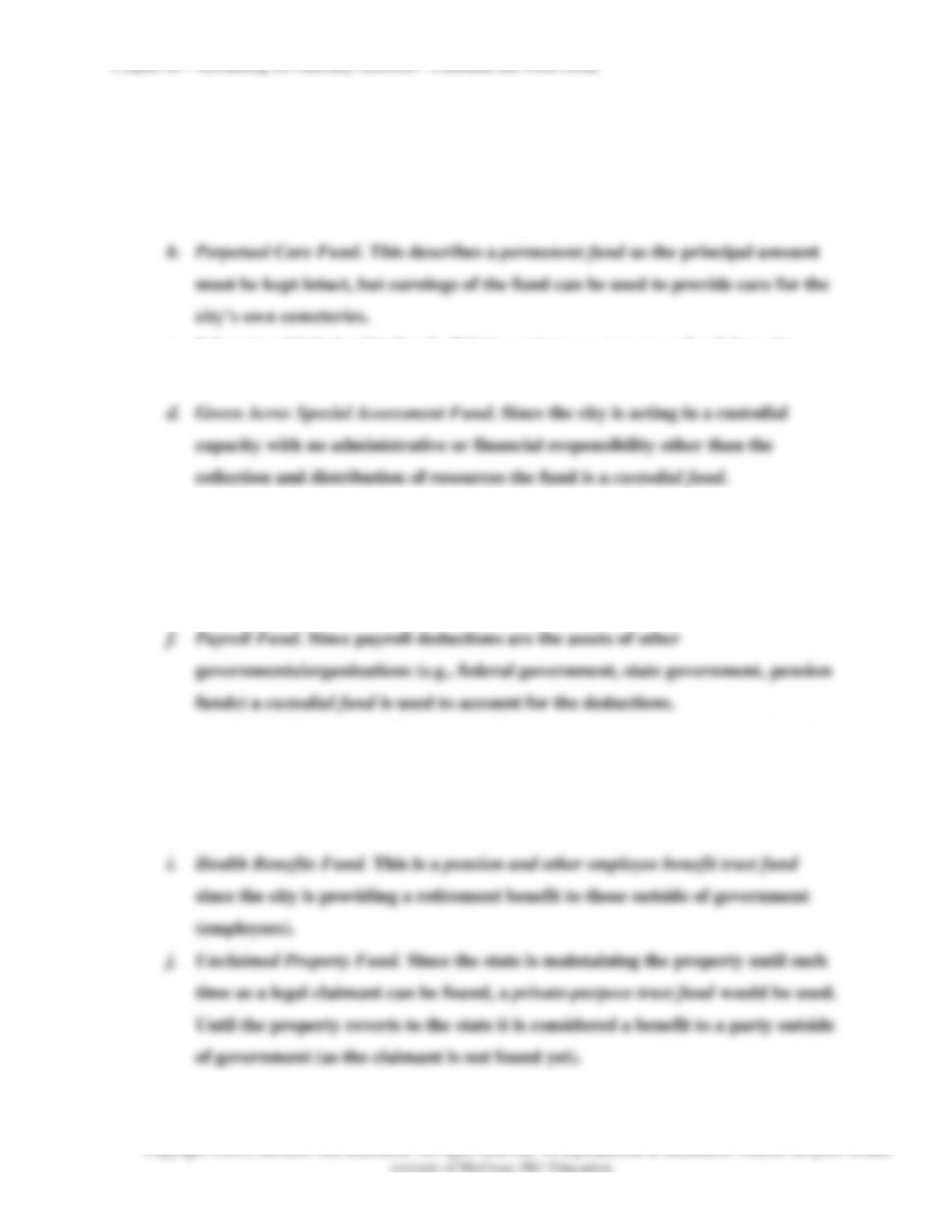
8-20. Fiduciary funds are described in a, c, d, f, g, i, and j. See explanations for each fund
type below.
a. Tri-Centennial Fund. This is a private-purpose trust fund since the resources will
benefit a broad constituency rather than just the citizens of the city.
c. Educational Scholarship Fund. This is a private-purpose trust fund since the
resources will benefit individual local students with financial need.
e. Cultural Services and Facilities Fund. Since the resources are funds of the
government, the program primarily benefits the government, and the majority
of resources are provided on an ongoing basis from performing arts center and
museum fees, it should be accounted for as a special revenue fund.
g. Youth Activities League. The city would use a private-purpose trust fund since the
resources will benefit a not-for-profit organization and not the city.
h. Block Grant Fund. Since the city is required to provide matching funds, the
grant would be reported in a special revenue fund.