8-1
Chapter 8
Reporting and Analyzing Receivables
Learning Objectives
1. Identify the different types of receivables.
2. Explain how accounts receivable are recognized in the accounts.
3. Describe the methods used to account for bad debts.
4. Compute the interest on notes receivable.
8-2
Chapter Outline
Learning Objective 1 – Identify the Different Types of Receivables
▪ Types of Receivables—the term receivables refers to amounts due from
individuals and companies. Receivables are claims that are expected to be collected
in cash. Receivables represent one of a company’s most liquid assets. Receivables
are frequently classified as:
▪ Accounts receivable:
o Are amounts customers owe on account.
o Result from the sale of goods and services (often called trade
▪ Notes receivable:
o Represent claims for which formal instruments of credit are issued as
evidence of debt.
▪ Other receivables:
o Non-trade receivables including interest receivable, loans to company
TEACHING TIP
Go over the following transactions and ask students to identify what type receivable would
be increased—accounts receivable, a note receivable, or other receivables.
(1) The vice-president of manufacturing is sending his youngest child to a prestigious
Learning Objective 2 – Explain how Accounts Receivable are Recognized in
the
Accounts
8-3
▪ Recognizing accounts receivable
o Service organizations—A receivable is recorded when service is provided on
Learning Objective 3 – Describe the Methods Used to Account for Bad Debts
Valuing accounts receivable—Determining the amount of accounts receivable to
report
is difficult because some receivables will become uncollectible. This creates bad debts
expense – a normal and necessary risk of doing business on a credit basis. Two
methods
are used in accounting for uncollectible accounts:
1. Direct Write-off Method
2. Allowance Method
▪ Direct Write-Off Method for Uncollectible Accounts
Dec. 12 Bad Debts Expense ………………………………………………… 200
o Bad debts expense will show only actual losses from uncollectibles.
o Bad debts expense is often recorded in a period different from that in which the
revenue was recorded.
8-4
TEACHING TIP
Using the direct write-off method, entries to record write-offs are often made in a period
following sales rather than in the period in which the sales were made. Therefore, there is no
matching of expenses with the revenue the expenses help to produce.
▪ Allowance Method—The allowance method of accounting for bad debts involves
estimating uncollectible accounts at the end of each period. It provides better matching
of
expenses and revenues on the income statement and ensures that receivables are
stated
at their cash (net) realizable value on the balance sheet.
o Cash (net) realizable value is the net amount of cash expected to be
received. It excludes amounts that the company estimates it will not
collect.
o Three essential features of the allowance method are:
1. Companies estimated uncollectible accounts receivable and match
them against revenues in the same accounting period in which the
revenues are recorded.
2. Companies record estimated uncollectibles as an increase (a debit) to
▪ Recording Estimated Uncollectibles
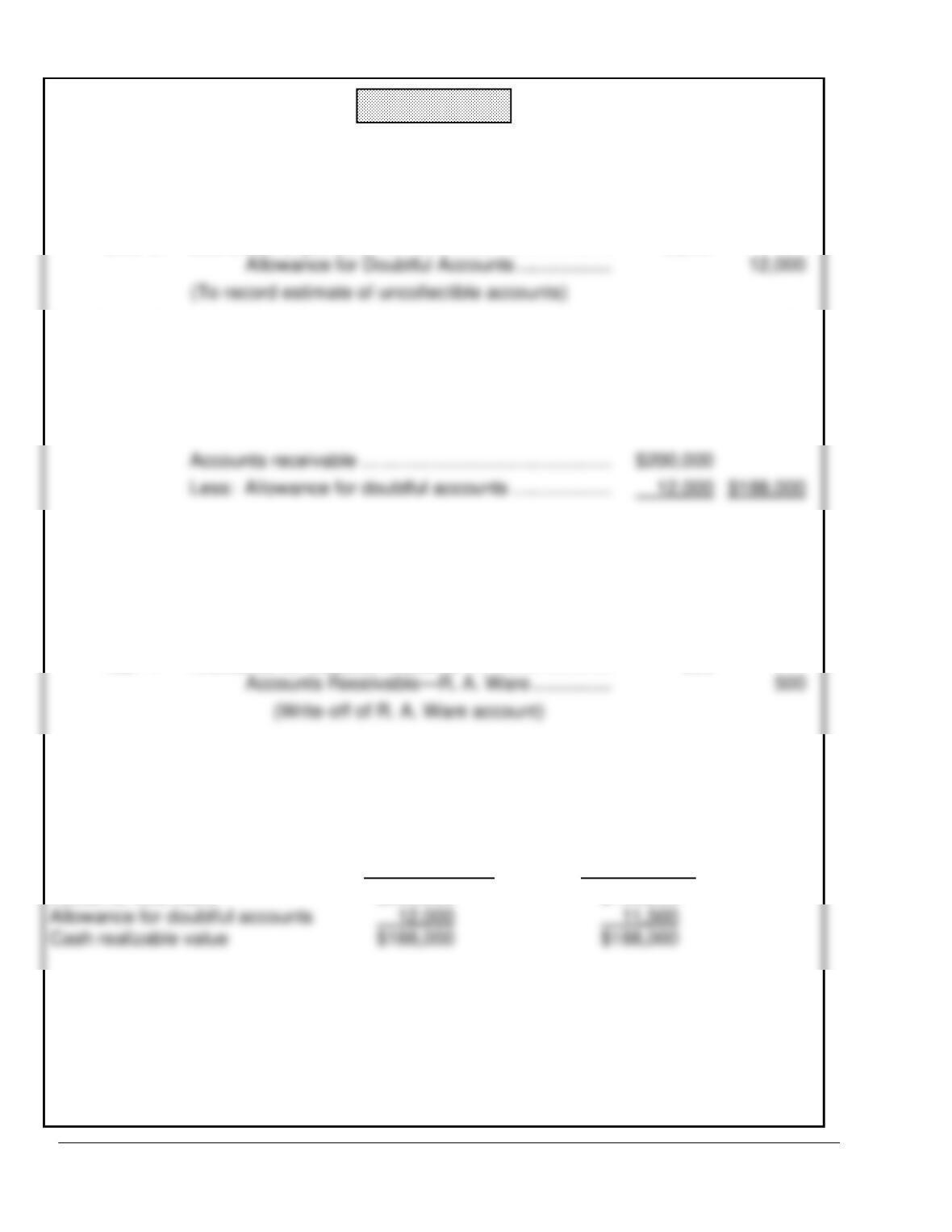
o Allowance for Doubtful Accounts shows the estimated amount of claims on
customers that are expected to become uncollectible in the future.
o he credit balance in the allowance account will absorb the specific write-offs
when they occur.
▪ Recording the Write-Off Of An Uncollectible Account
o Each write-off should be approved in writing by authorized management
personnel.

8-5
▪ Recovery of an Uncollectible Account
o When a customer pays after the account has been written off, two entries are
required:
8-6
TEACHING TIP
Work through the Hampson Furniture example. Assume Hampson Furniture has credit sales
of $1,200,000 in 2012, of which $200,000 remains uncollected at December 31. The credit
manager estimates that $12,000 of these sales will prove uncollectible. The adjusting entry
to record the estimated uncollectibles is:
Dec. 31 Bad Debts Expense …………………………………………. 12,000
Bad Debts Expense is a selling expense. This entry has no effect on cash flows. The
Allowance for Doubtful Accounts is a contra asset account and is shown on the balance
sheet as a reduction from accounts receivable. Therefore Hampson’s balance sheet would
report accounts receivable as follows:
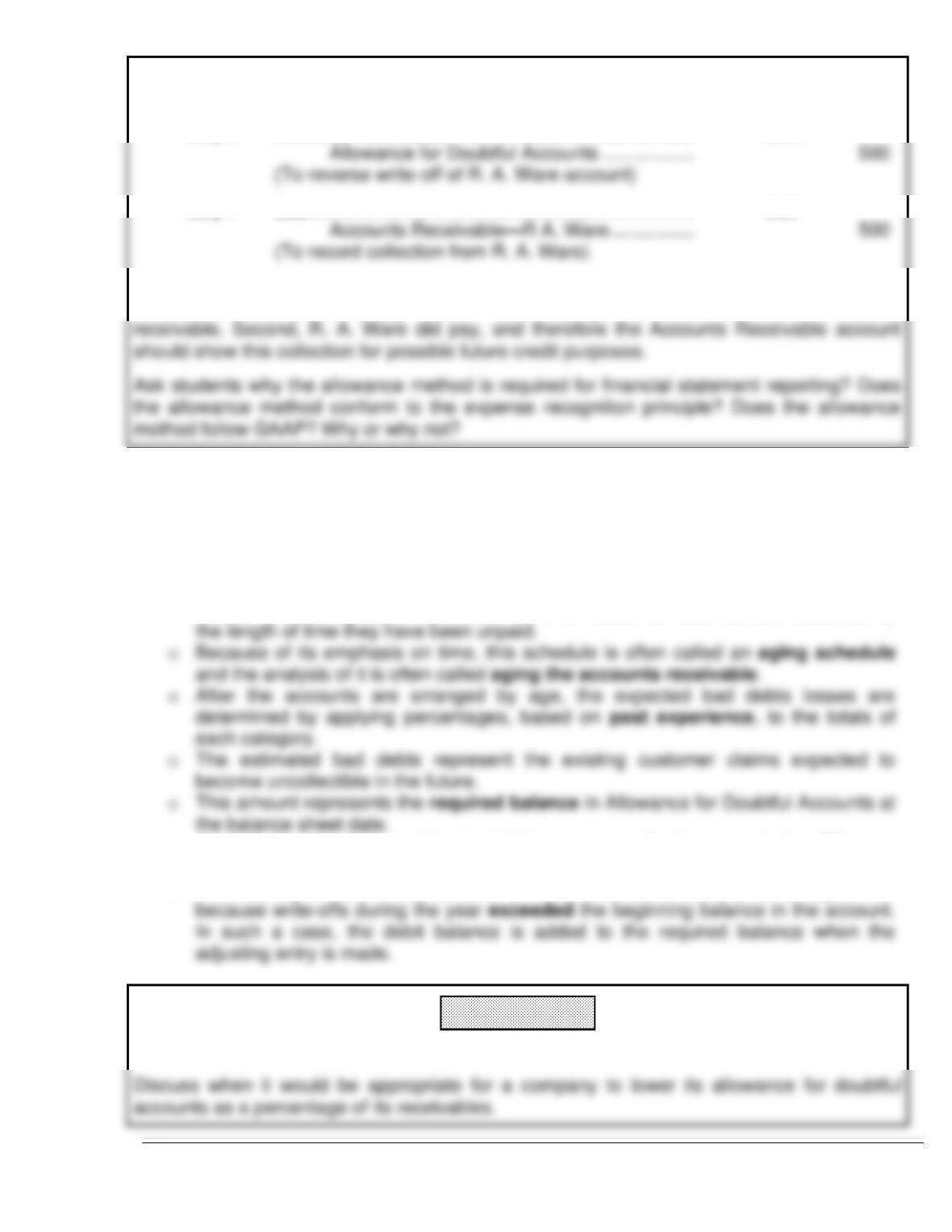
Assume that the vice-president of finance of Hampson Furniture on March 1, 2013,
authorizes a write-off of a $500 balance owed by R. A. Ware. The entry to record the write–
off is:
Mar. 1 Allowance for Doubtful Accounts ……………………….. 500
Notice, the bad debt was written off to the allowance account not to the Bad Debts Expense
account. Therefore, the write-off does not affect net income, nor does it affect net assets.
Before Write-off After Write-off
Accounts receivable $200,000 $199,500
8-7
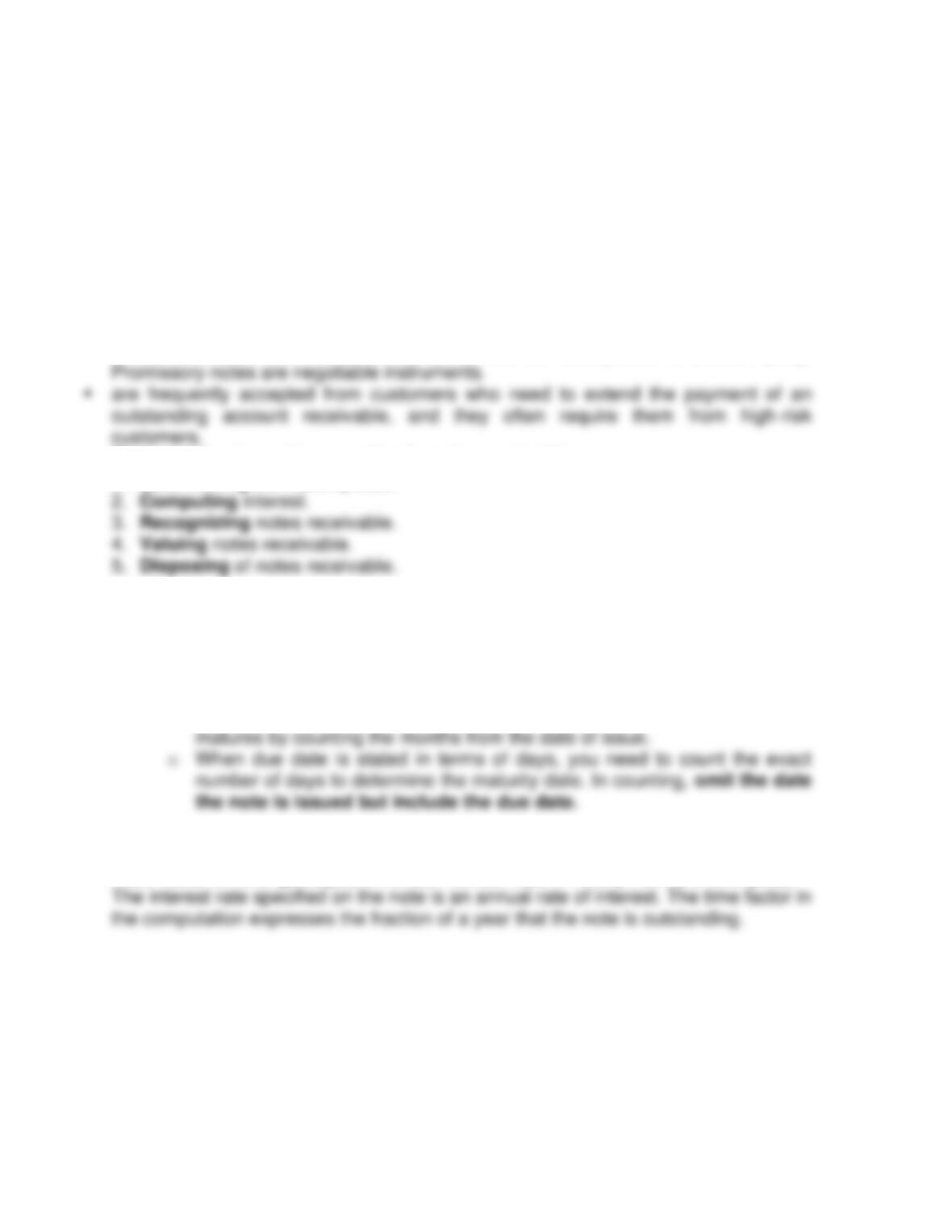
When R. A. Ware pays Hampson the $500, two journal entries are required to record the
collection:
July 1 Accounts Receivable—R. A. Ware …………………….. 500
July 1 Cash ……………………………………………………………… 500
Accounts Receivable and the Allowance for Doubtful Accounts both increase in entry (1) for
two reasons: First the company made an error in judgment when it wrote off the account
▪ Estimating the Allowance—In “real life,” companies must estimate the amount of
expected uncollectible accounts if they use the allowance method. Frequently the
allowance is estimated as a percentage of the outstanding receivables. To do this:
o Management establishes a percentage relationship between the amount of
receivables and expected losses from uncollectible accounts.
o Companies often prepare a schedule in which customer balances are classified by
o Accordingly, the amount of the bad debts expense adjusting entry is the difference
between the required balance and the existing balance in the allowance account.
o Occasionally the allowance account will have a debit balance prior to adjustment
TEACHING TIP
Go over the “Ethics Insight” for this objective.
8-8
Learning Objective 4 – Compute the Interest on Notes Receivable
Notes Receivable—A promissory note is a written promise to pay a specified amount
of
money on demand or at a definite time. Promissory notes may be used:
1. When individuals and companies lend or borrow money
2. When the amount of the transaction and the credit period exceed normal limits
3. In settlement of accounts receivable
In a promissory note, the party making the promise to pay is called the maker.
The party to whom payment is to be made is called the payee. The payee may be
specifically identified by name or may be designated simply as the bearer of the note.Notes
receivable:
▪ give the holder a stronger legal claim to assets than accounts receivable.
▪ notes receivable, like accounts receivable, can be readily sold to another party.
▪ There are five issues in accounting for notes receivable:
1. Determining the maturity date.
▪ Determining the Maturity Date—The maturity date of a promissory note may be
stated in one of three ways:
1. On demand
2. On a stated date
3. At the end of a stated period of time.
o When life is expressed in terms of months, you find the date when it
▪ Computing Interest—The formula for computing interest is:
Face Value of Note (principal) x Annual Interest Rate x Time (in terms of one year)
8-9
TEACHING TIP
Some students may need help remembering how many days in each month. There is a little
ditty, author unknown, which goes:
30 days hath September, April, June, and November.
TEACHING TIP
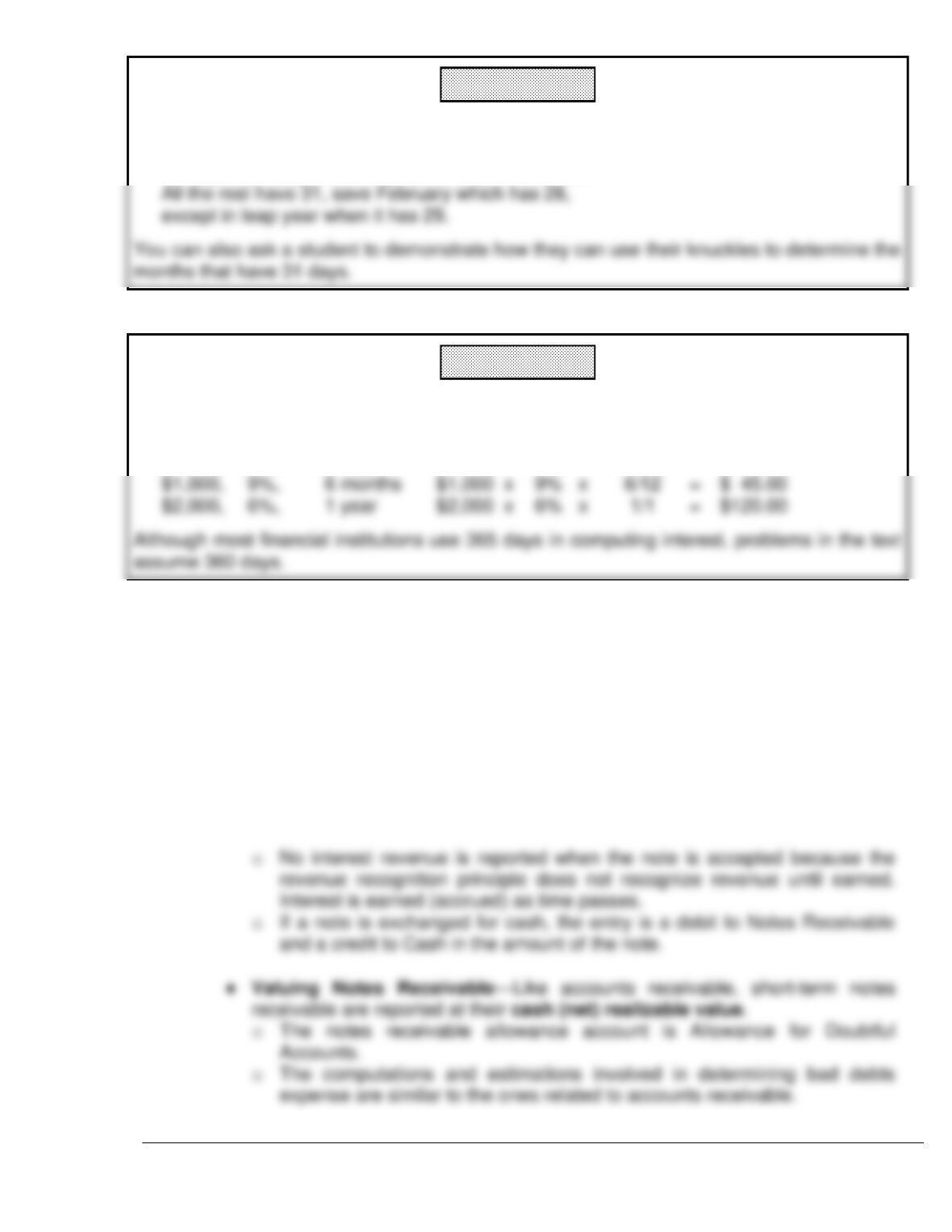
Go through the calculations of interest illustrated in the text:
Terms of Note Interest Computation.
$ 730, 12%, 120 days $ 730 x 12% x 120/360 = $ 29.20
▪ Recognizing Notes Receivable— The note receivable is recorded at its face
value, the value shown on the face of the note. To illustrate the basic entry
for notes receivable, the text uses Brent Company’s $1,000, two-month, 8%
promissory note dated May 1. Assume that the note was written to settle an
open account. The entry for the receipt of the note by Wilma Company is as
follows:
May 1 Notes Receivable …………………………………………….. 1,000
Accounts Receivable—Brent Company …….. 1,000
(To record acceptance of Brent Company note)
8-10
Learning Objective 5 – Describe the Entries to Record the Disposition of Notes
Receivable
Disposing Of Notes Receivable—Notes may be held to their maturity date, at
which time the face value plus accrued interest is due. In some situations, the
maker of the note defaults, and an appropriate adjustment must be made by
TEACHING TIP
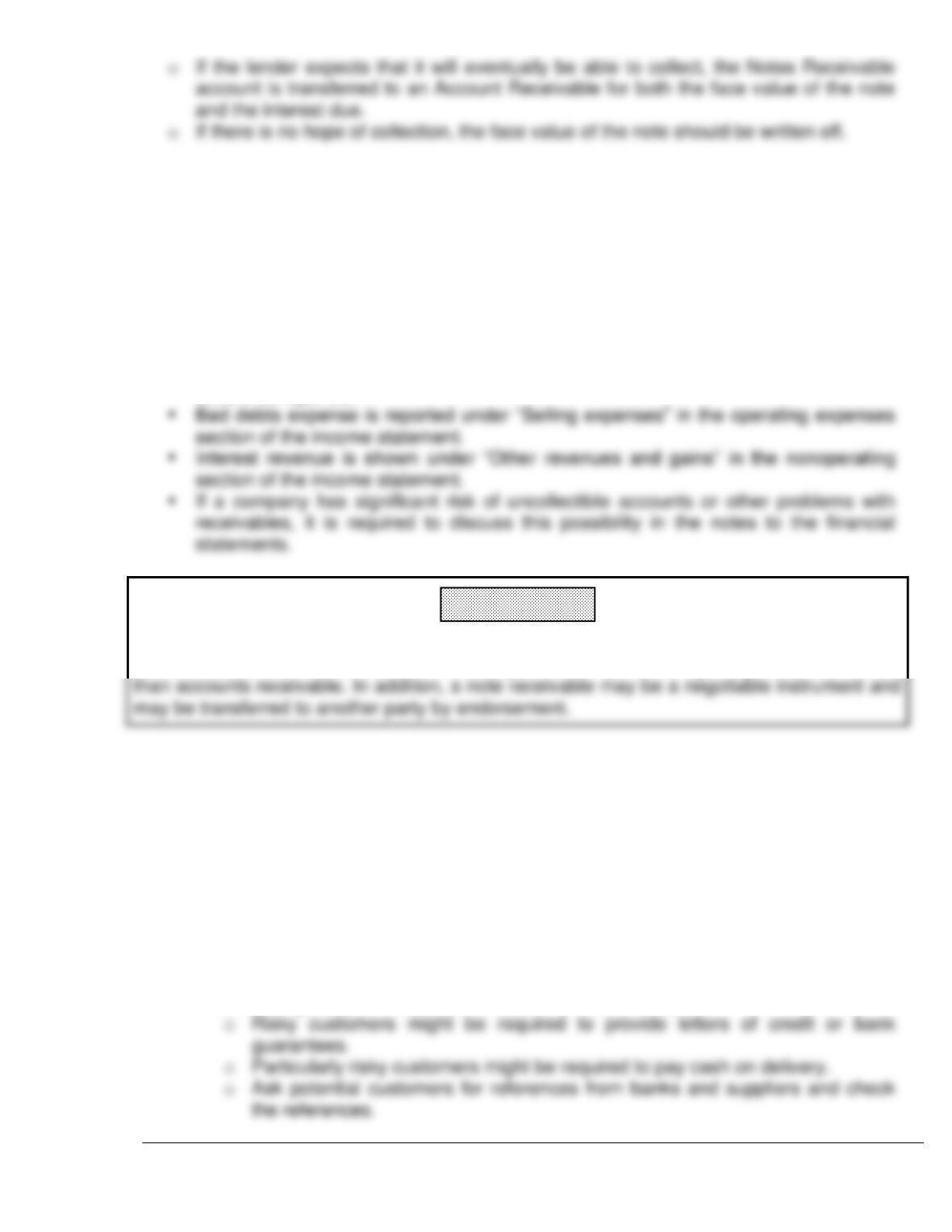
Work through the illustration in the text which assumes that Wolder Co. lends Higley, Inc.
$10,000 on June 1, accepting a 5-month, 9% interest note. If Wolder presents the note to
Higley Inc. on November 1, the maturity date, the entry by Wolder to record the collection is:
Nov. 1 Cash ……………………………………………………………… 10,375
If Wolder prepares financial statements as of September 30, the following adjusting entry
would be made to accrue interest revenue.
Sept. 30 Interest Receivable ………………………………………….. 300
When interest has been accrued, the entry to record the honoring of Higley’s note on
November 1 is:
Nov. 1 Cash ……………………………………………………………… 10,375
Notes Receivable …………………………………….. 10,000
▪ Accrual of Interest Receivable—To reflect interest earned but not yet received,
Interest Receivable is debited and Interest Revenue is credited. This is usually an
adjusting entry at the end of the accounting period.
8-11
Learning Objective 6 – Explain the Statement Presentation of Receivables
Financial Statement Presentation of Receivables—Each of the major types of
receivables should be identified in the balance sheet or in the notes to the financial
statements.
▪ Short-term receivables are reported in the current assets section of the balance
sheet below short-term investments. These assets are nearer to cash and are thus
more liquid.
▪ Both the gross amount of receivables and the allowance for doubtful accounts
should be reported.
TEACHING TIP
Students need to understand the advantage of having a note receivable rather than an
account receivable. Notes earn interest and give the holder a stronger legal claim to assets
Learning Objective 7 – Describe the Principles of Sound Accounts Receivable
Management
Managing Receivables—Managing accounts receivable involves five steps:
1. Determine to whom to extend credit.
2. Establish a payment period.
3. Monitor collections.
4. Evaluate the liquidity of receivables.
5. Accelerate cash receipts from receivables when necessary.
▪ Extending Credit— Determine to whom to extend credit.
8-12
▪ Establishing a Payment Period:
o Determine a required payment period and communicate that policy to
customers.
o Make sure company’s payment period is consistent with that of competitors.
▪ Monitor collections:
o Prepare accounts receivable aging schedule at least monthly.
TEACHING TIP
Stress the importance of having competent personnel working in the credit department and
the collections department. Discuss this as a control to prevent fraud. Ask students to list
effective credit policies.
o If a company has significant concentrations of credit risk, it must discuss this
risk in the notes to its financial statements.
Learning Objective 8 – Identify Ratios to Analyze a Company’s Receivables
Evaluating Liquidity of Receivables—Liquidity is measured by how quickly certain
assets can be converted into cash.
▪ The ratio used to assess the liquidity of the receivables is the receivables turnover
ratio.
▪ The ratio measures the number of times, on average, receivables are collected
during the period.
▪ The receivables turnover ratio is computed by dividing net credit sales (net sales
8-13
Learning Objective 9 – Describe Methods to Accelerate the Receipt of Cash
from Receivables
Accelerating Cash Receipts—As credit sales and receivables have grown in size and
significance, the “normal course or events” has changed. Two common expressions
apply to the collection of receivables:
1. “Time is money”—that is, waiting for the normal collection process costs
money.
2. “A bird in the hand is worth two in the bush”—that is, getting the cash now is
better than getting it later or not at all.
▪ There are three reasons for the sale of receivables:
o The size of the receivables may cause a company to sell them because it
may not want to hold such a large amount of receivables. In recent years, for
Sale of Receivables to a Factor—A common way to accelerate receivables collection
is a sale to a factor.
▪ A factor is a finance company or bank that buys receivables for a fee.
▪ Factors collect payments directly from the customers.
National Credit Card Sales—Approximately one billion credit cards are recently in use.
▪ A common type of credit card is a national credit card such as Visa and MasterCard.
▪ Three parties are involved when national credit cards are used in making retail
sales:
o the credit card issuer, who is independent of the retailer.
o the retailer.
o the customer.
▪ A retailer’s acceptance of a national credit card is another form of selling—
factoring—the receivable by the retailer.
▪ There are several advantages of credit cards for the retailer:
8-14
o Retailer receives cash more quickly from credit card issuer.
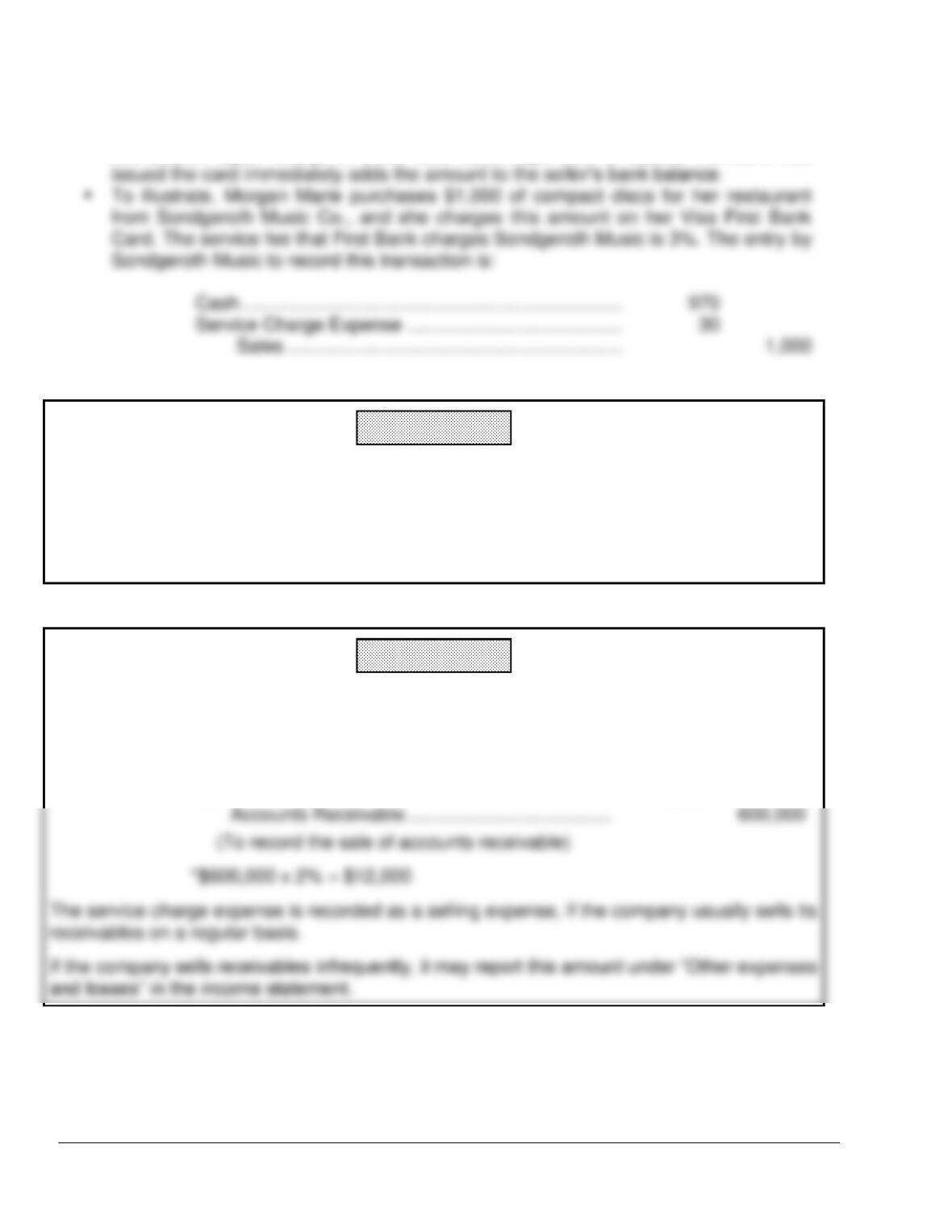
▪ In exchange for these advantages, the retailer pays the credit card issuer a fee of
2% to 4% of the invoice price for its services.
▪ Sales resulting from the use of national credit cards are considered cash sales by
the retailer. Upon receipt of credit card sales slips from a retailer, the bank that
TEACHING TIP
Ask students if it is a good idea to issue credit? If you had a small business would you issue
credit directly to customers or would you accept VISA, MasterCard, Discover and/or
American Express.
How do VISA, MasterCard, and American Express make money? Why do some businesses
accept VISA and MasterCard but not accept American Express or Discover?
TEACHING TIP
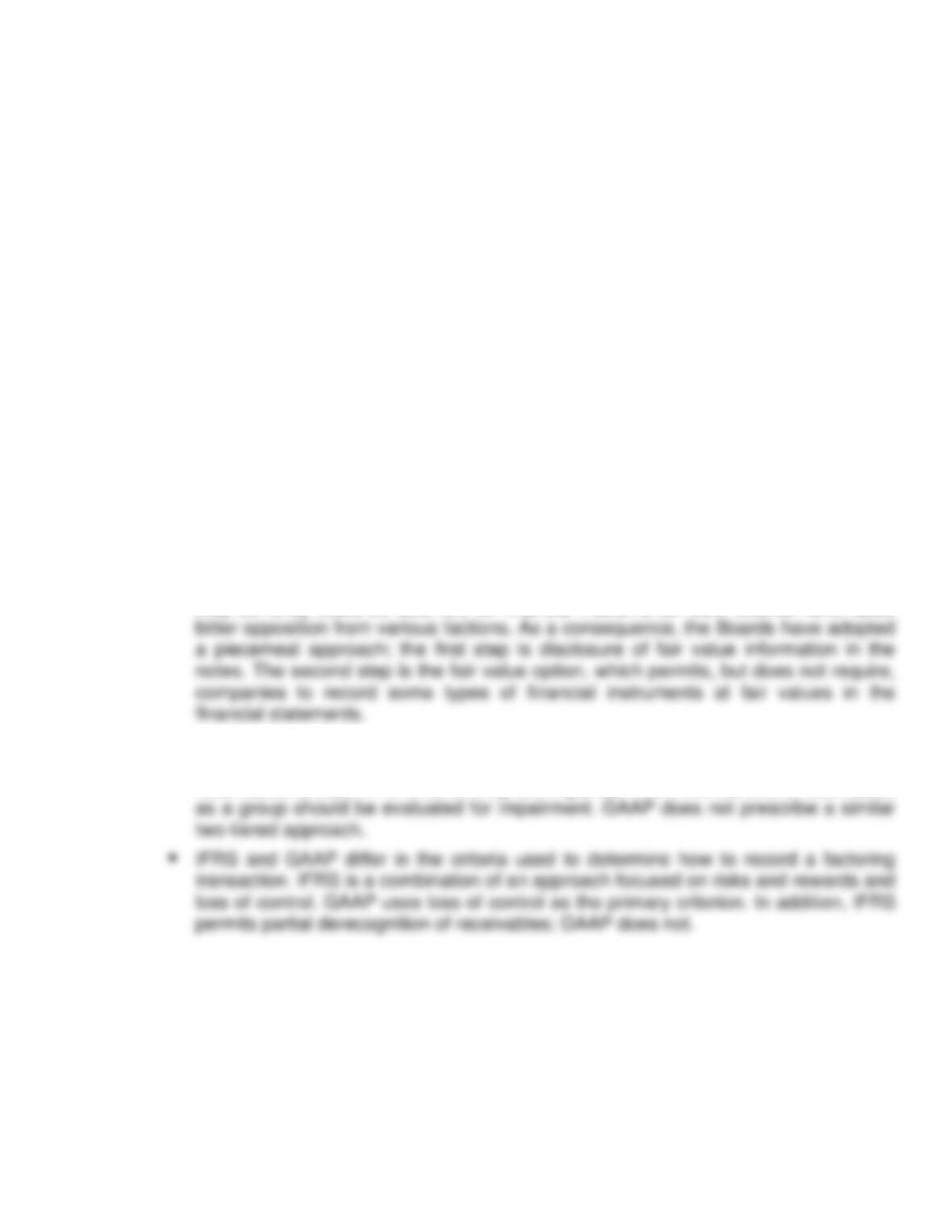
Go through the example on factoring in the book, assuming Hendredon Furniture factors
$600,000 of receivables to Federal Factors, Inc. Federal Factors assesses a service charge
of 2% of the amount of receivables sold. Hendredon makes the following journal entry:
Cash ……………………………………………………………… 588,000
Service Charge Expense ………………………………….. 12,000*
Keeping An Eye on Cash—Companies with strong sales growth may still have cash
problems since there may be a considerable time lag between the time Sales Revenue is
recorded and when the amount of cash from that sale is received.
8-15
Learning Objective 10 – Compare the procedures for receivables under GAAP and
IFRS.
A Look at IFRS—The basic accounting and reporting issues related to
recognition and measurement of receivables, such as the use of allowance
accounts, how to record discounts, use of the allowance method to account
for bad debts, and factoring, are essentially the same between IFRS and
GAAP.
KEY POINTS
IFRS requires that loans and receivables be accounted for at amortized cost, adjusted for
allowances for doubtful accounts. IFRS sometimes refers to these allowances as
provisions. The entry to record the allowance would be:
Bad Debts Expense ……………………………….. XXXXXX
Allowance for Doubtful Accounts …….. XXXXXX
▪ Although IFRS implies that receivables with different characteristics should be
reported separately, there is no standard that mandates this segregation.
▪ The FASB and IASB have worked to implement fair value measurement (the amount
they currently could be sold for) for financial instruments. Both Boards have faced
▪ IFRS requires a two-tiered approach to test whether the value of loans and
receivables are impaired. First, a company should look at specific loans and
receivables to determine whether they are impaired. Then, the loans and receivables