8-34
PROBLEM 8-40 (40 MINUTES)
1.
The factors that should be present for an organization’s quality program to be
successful include the following:
• Training of those involved, including employees and suppliers.
2.
From an analysis of the cost-of-quality report, the program appears to have been
successful, because of the following:
• Total quality cost has declined from 23.4 to 13.1 percent of total production costs.
• External failure costs, those costs signaling customer dissatisfaction, have
8-35
PROBLEM 8-40 (CONTINUED)
3.
Tony Reese’s current reaction to the quality improvement program is more favorable
because he is seeing the benefits of having the quality problems investigated and
4.
To measure the opportunity cost of not implementing the quality program,
management could do the following:
PROBLEM 8-41 (60 to 180 MINUTES)
Chapter 08 – Variable Costing and the Costs of Quality and Sustainability
8-36
SOLUTION TO CASES
CASE 8-42 (35 MINUTES)
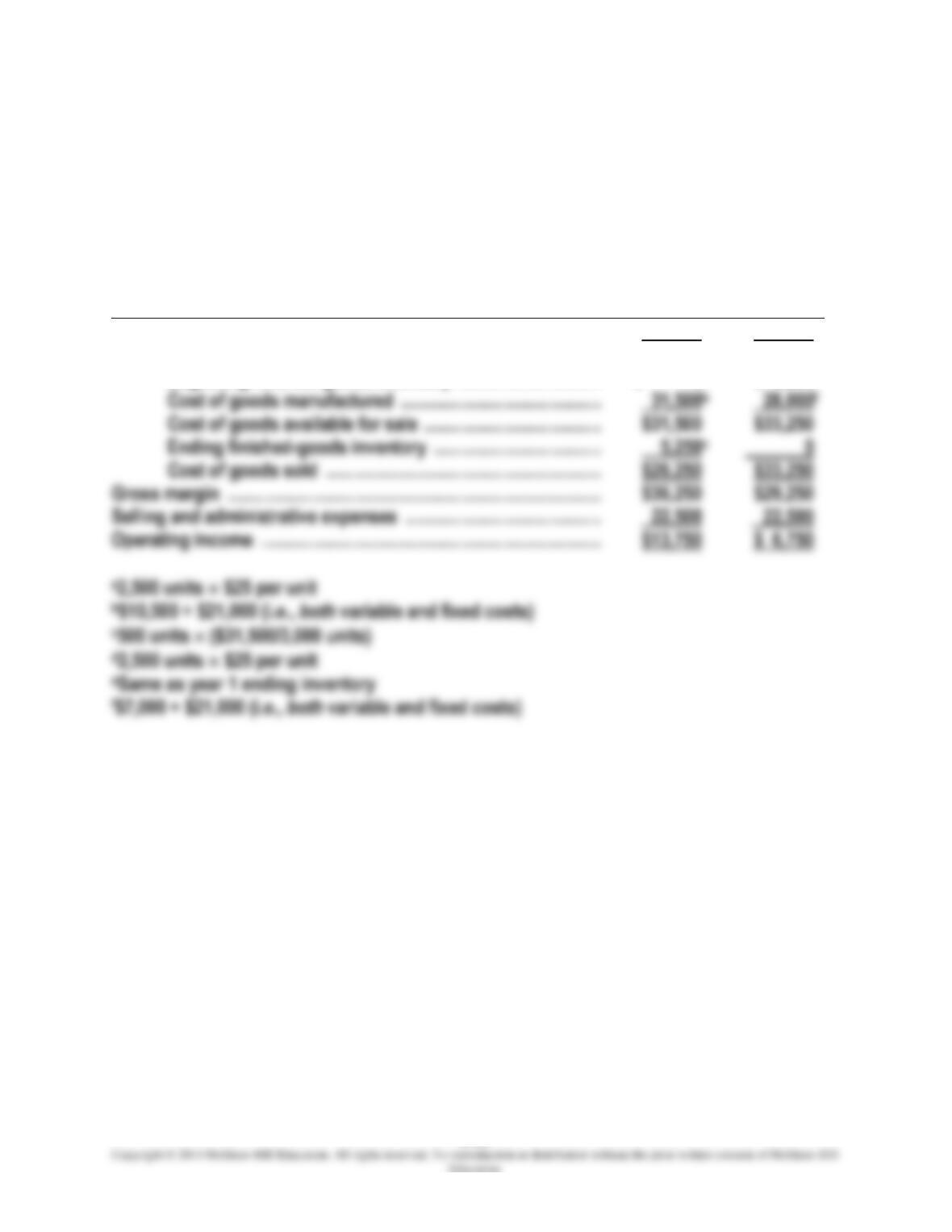
1. Absorption-costing operating income statements:
Year 1
Year 2
Sales revenue ……………………………………………………………………………..
$62,500
a
$62,500
d
Less: Cost of goods sold:
Beginning finished-goods inventory …………………………..
$ 0
$ 5,250
e
Cost of goods manufactured …………………………………………….
b
f
Cost of goods available for sale ………………………………………..
$31,500
$33,250
Ending finished-goods inventory ………………………………………
5,250
c
Cost of goods sold ……………………………………………………….
$26,250
$33,250
Gross margin ……………………………………………………………………………..
$36,250
$29,250
Selling and administrative expenses ……………………………………………
Operating income ……………………………………………………………………….
$13,750
$ 6,750
Chapter 08 – Variable Costing and the Costs of Quality and Sustainability
8-37
CASE 8-42 (CONTINUED)
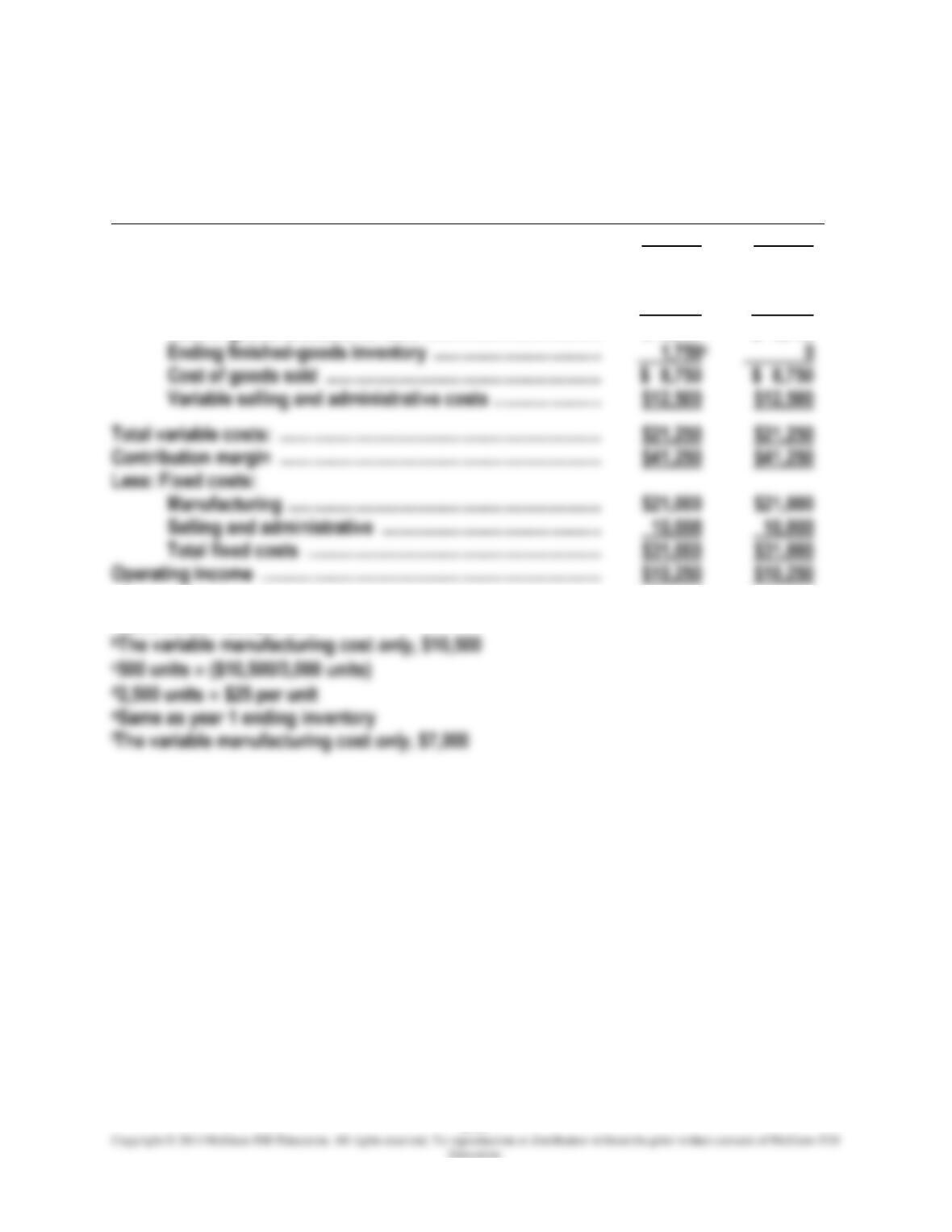
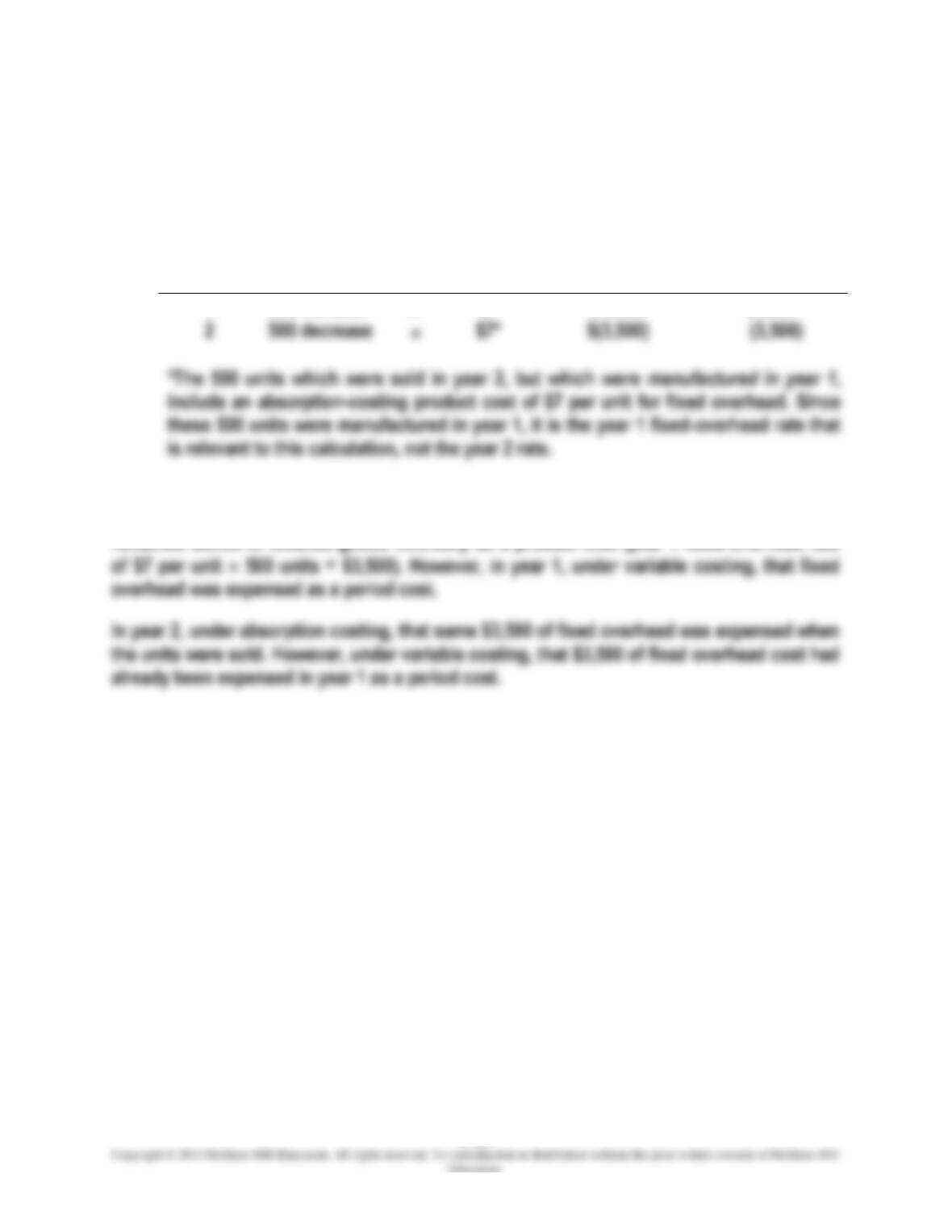
2. Variable-costing operating income statements:
Year 1
Year 2
Sales revenue ……………………………………………………………………………..
$62,500
a
$62,500
d
Less: Cost of goods sold:
Beginning finished-goods inventory …………………………..
$ 0
$ 1,750
e
Cost of goods manufactured …………………………………………….
10,500
b
7,000
f
Cost of goods available for sale ………………………………………..
$10,500
$ 8,750
Ending finished-goods inventory ………………………………………
c
Cost of goods sold ……………………………………………………….
$ 8,750
$ 8,750
Variable selling and administrative costs …………………………..
$12,500
$12,500
Total variable costs: ……………………………………………………………………
$21,250
$21,250
Contribution margin ……………………………………………………………………
$41,250
$41,250
Less: Fixed costs:
Manufacturing ……………………………………………………….…………
$21,000
$21,000
Selling and administrative ………………………………………………..
Total fixed costs ……………………………………………………….
$31,000
$31,000
Operating income ……………………………………………………………………….
$10,250
$10,250
a2,500 units $25 per unit
Chapter 08 – Variable Costing and the Costs of Quality and Sustainability
8-38
CASE 8-42 (CONTINUED)
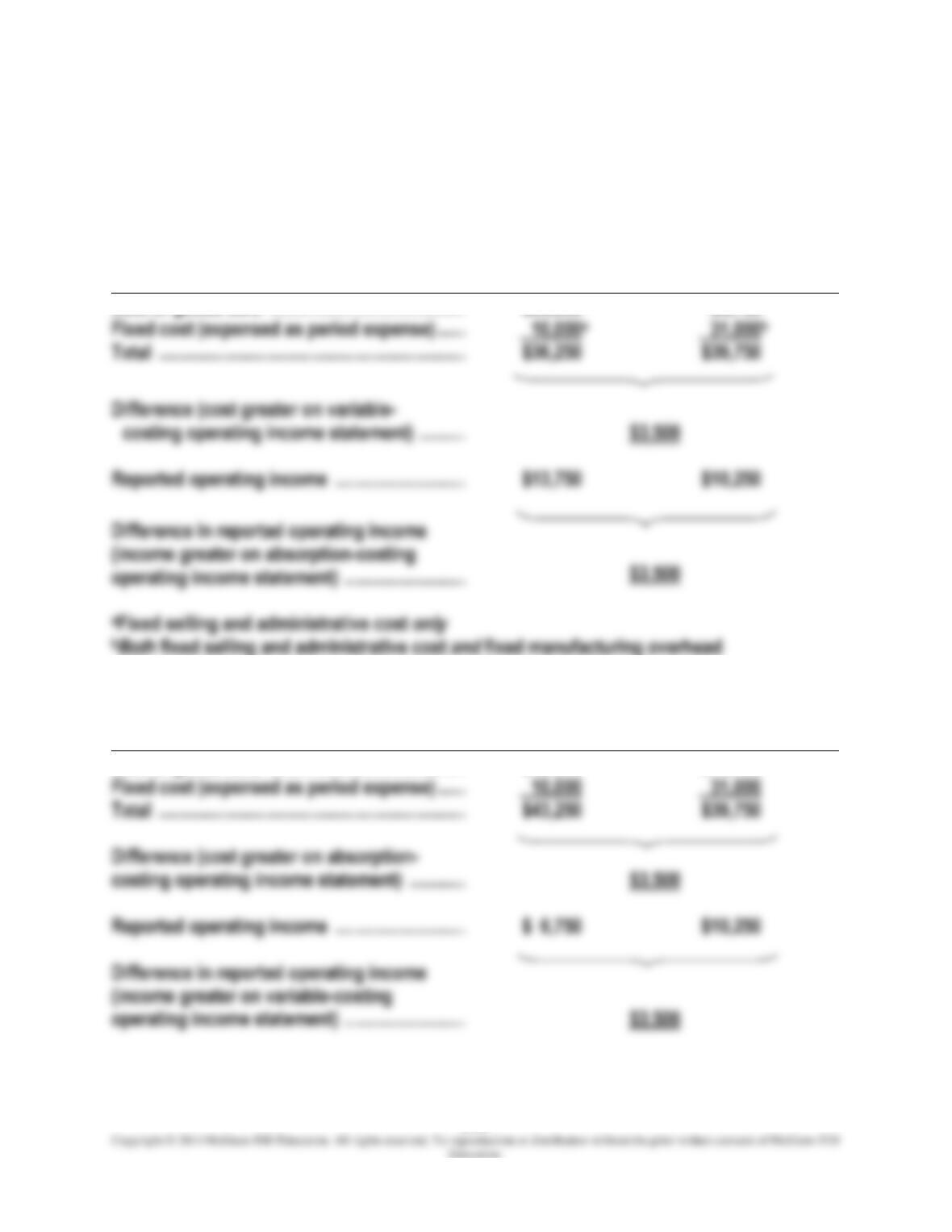
3. Reconciliation of reported operating income under absorption and variable costing:
Year
Change in
Inventory
(in units)
Actual
Fixed-
Overhead
Rate
Difference in
Fixed
Overhead
Expensed
Absorption-
Minus Variable-
Costing
Op’g Income
1
500 increase
$7
$ 3,500
$3,500
Explanation: At the end of year 1, under absorption costing, $3,500 of fixed overhead
remained stored in finished-goods inventory as a product cost (year 1 fixed-overhead rate
Chapter 08 – Variable Costing and the Costs of Quality and Sustainability
8-39
CASE 8-43 (30 MINUTES)
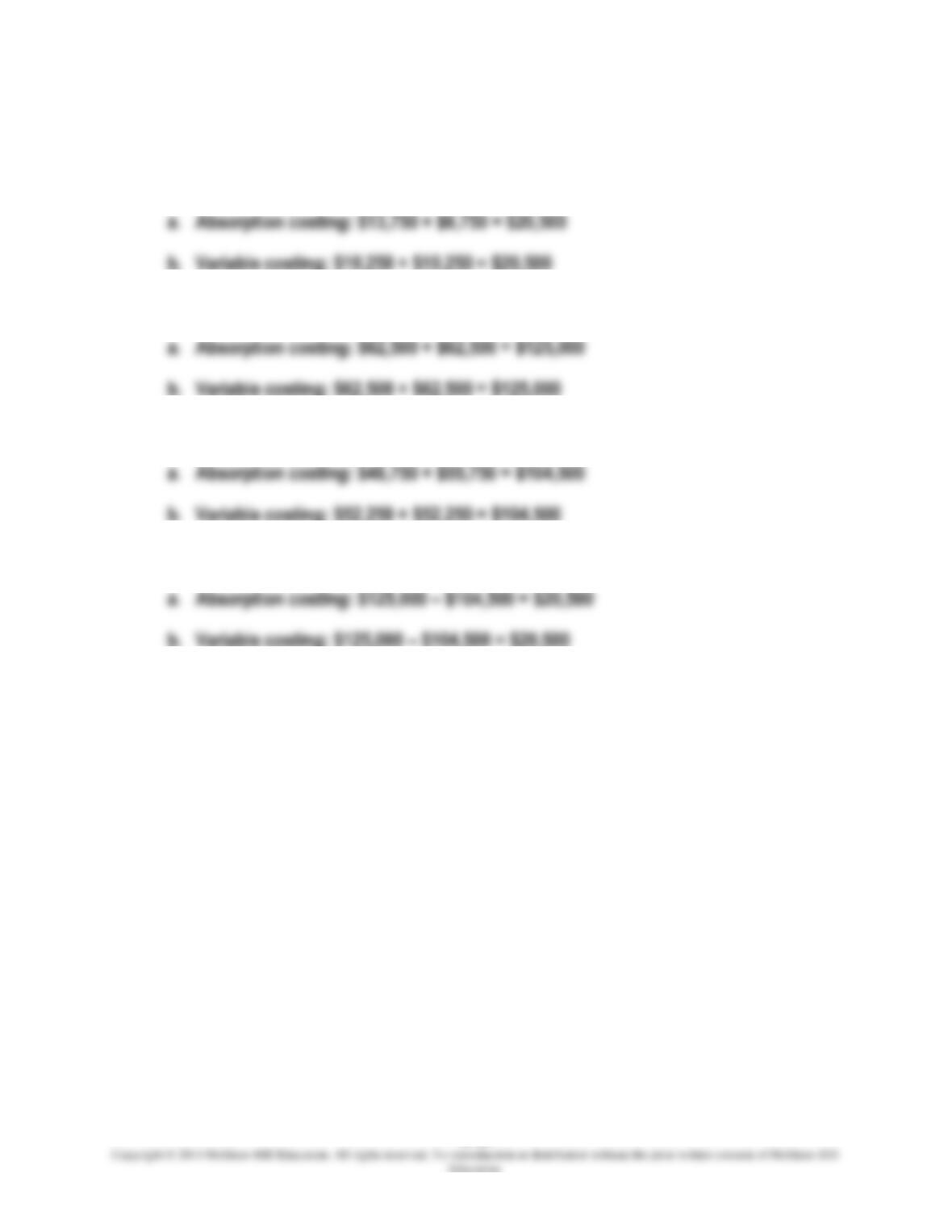
1. Reconciliation of reported operating income:
Year 1
Absorption Costing
Operating Income
Statement
Variable Costing
Operating Income
Statement
Cost of goods sold ……………………………………
$26,250
$8,750
Fixed cost (expensed as period expense) ……
Total …………………………………………………………
$36,250
$39,750
Reported operating income ……………………….
$13,750
$10,250
Year 2
Absorption Costing
Operating Income
Statement
Variable Costing
Operating Income
Statement
Cost of goods sold ……………………………………
$33,250
$ 8,750
Fixed cost (expensed as period expense) ……
Total …………………………………………………………
$43,250
$39,750
Reported operating income ……………………….
$ 6,750
$10,250
Chapter 08 – Variable Costing and the Costs of Quality and Sustainability
8-40
CASE 8-43 (CONTINUED)
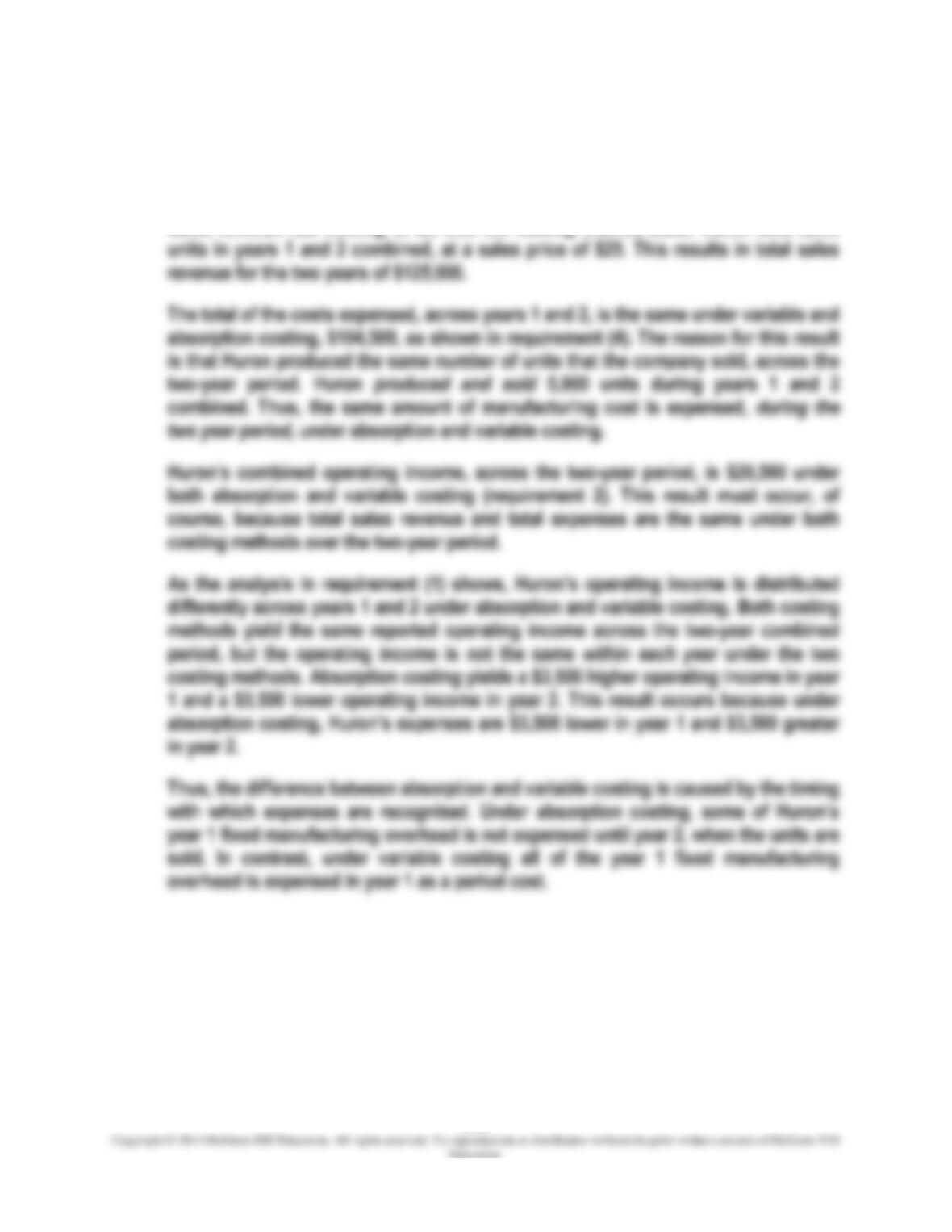
2. Total operating income across both years:
3. Total sales revenue across both years:
4. Total of all costs expensed across both years:
5. Total sales revenue minus total costs expensed across both years.
Chapter 08 – Variable Costing and the Costs of Quality and Sustainability
8-41
CASE 8-43 (CONTINUED)
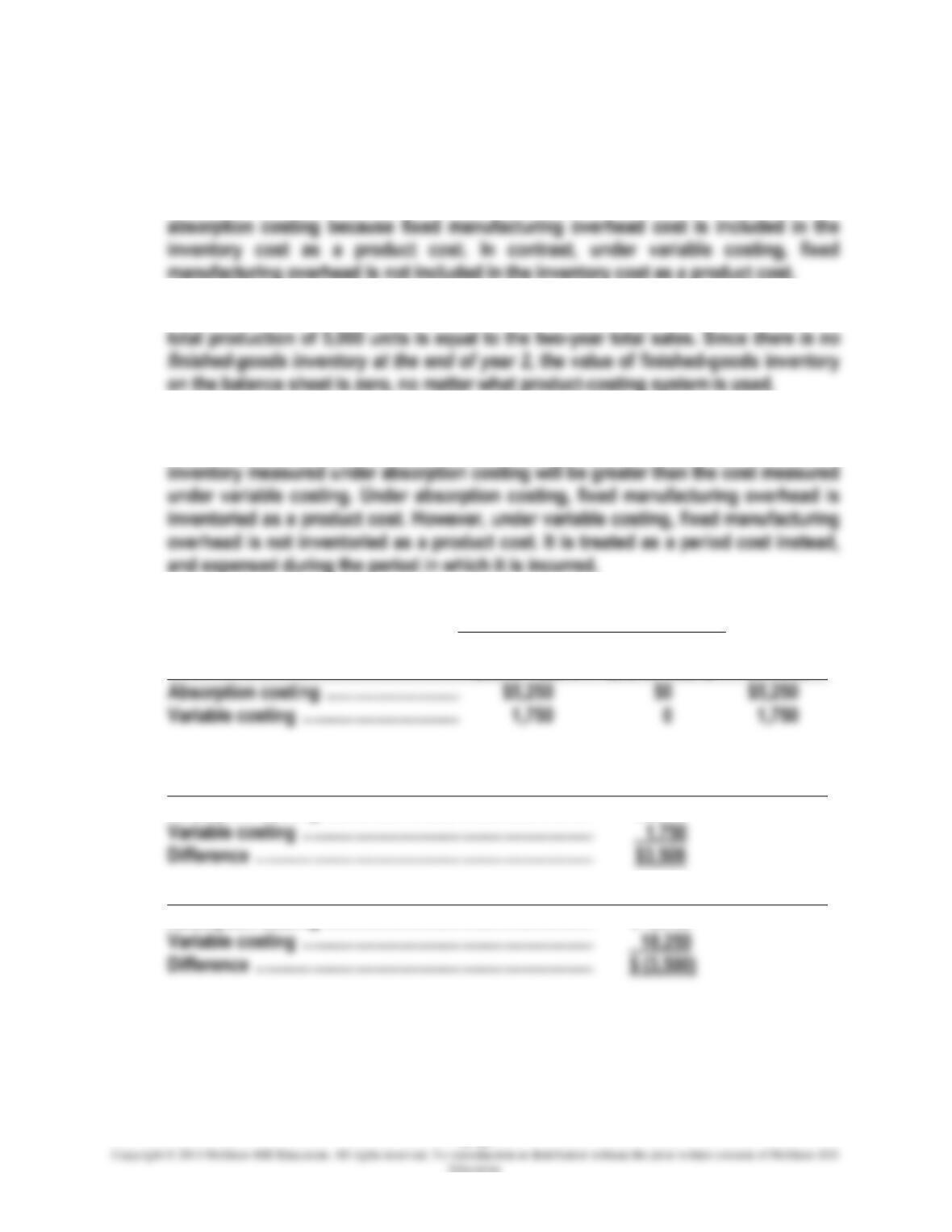
6. The total sales revenue across both of Huron’s first two years of operation is the
same under absorption and variable costing, $125,000, as shown in requirement (3).
Sales revenue has nothing to do with the costing method used. Huron sold 5,000
Chapter 08 – Variable Costing and the Costs of Quality and Sustainability
8-42
CASE 8-44 (40 MINUTES)
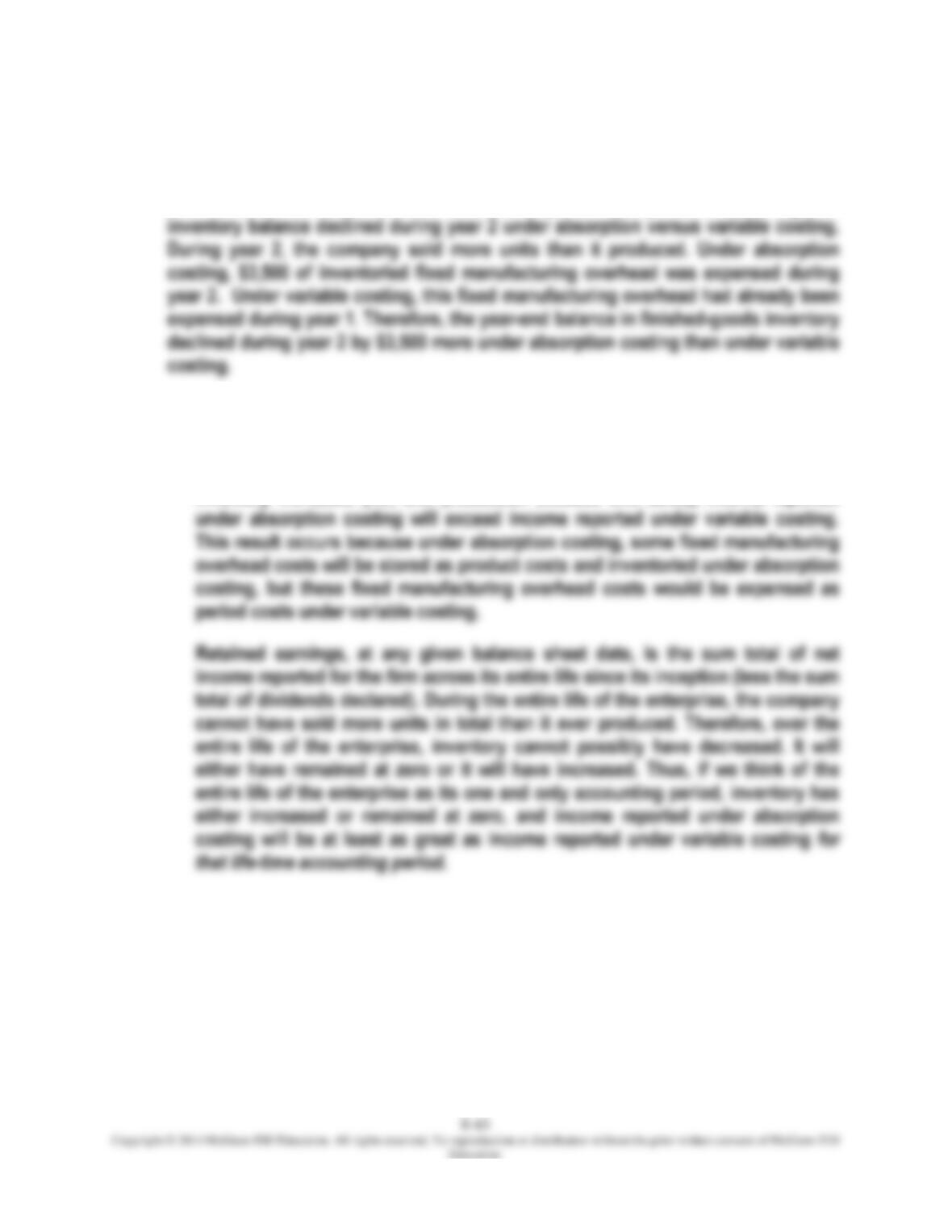
1. At the end of year 1, Huron has 500 units in its finished-goods inventory (production
minus sales). The year-end balance in finished-goods inventory is higher under
2. At the end of year 2, Huron has no finished-goods inventory on hand. The two-year
3. Yes, this relationship will be true at any balance sheet date. For any balance sheet
date when the company has nonzero finished-goods inventory, the cost of that
4.
Finished-Goods Inventory
End of Year 1
End of Year 2
Amount of
Decline
Absorption costing …………………………..
Variable costing ……………………………………………………….
5.
Amount of Decline in Finished-
Goods Inventory Balance During Year 2
Absorption costing ……………………………………………………….
$5,250
Variable costing ……………………………………………………….
Difference …………………………………………………………………………………..
$3,500
Reported Operating Income for Year 2
Absorption costing ……………………………………………………….
$ 6,750
Variable costing ……………………………………………………….
Difference …………………………………………………………………………………..
Chapter 08 – Variable Costing and the Costs of Quality and Sustainability
CASE 8-44 (CONTINUED)
Reported operating income for year 2 is $3,500 lower under absorption costing. This
amount matches the difference in the amount by which the year-end finished-goods
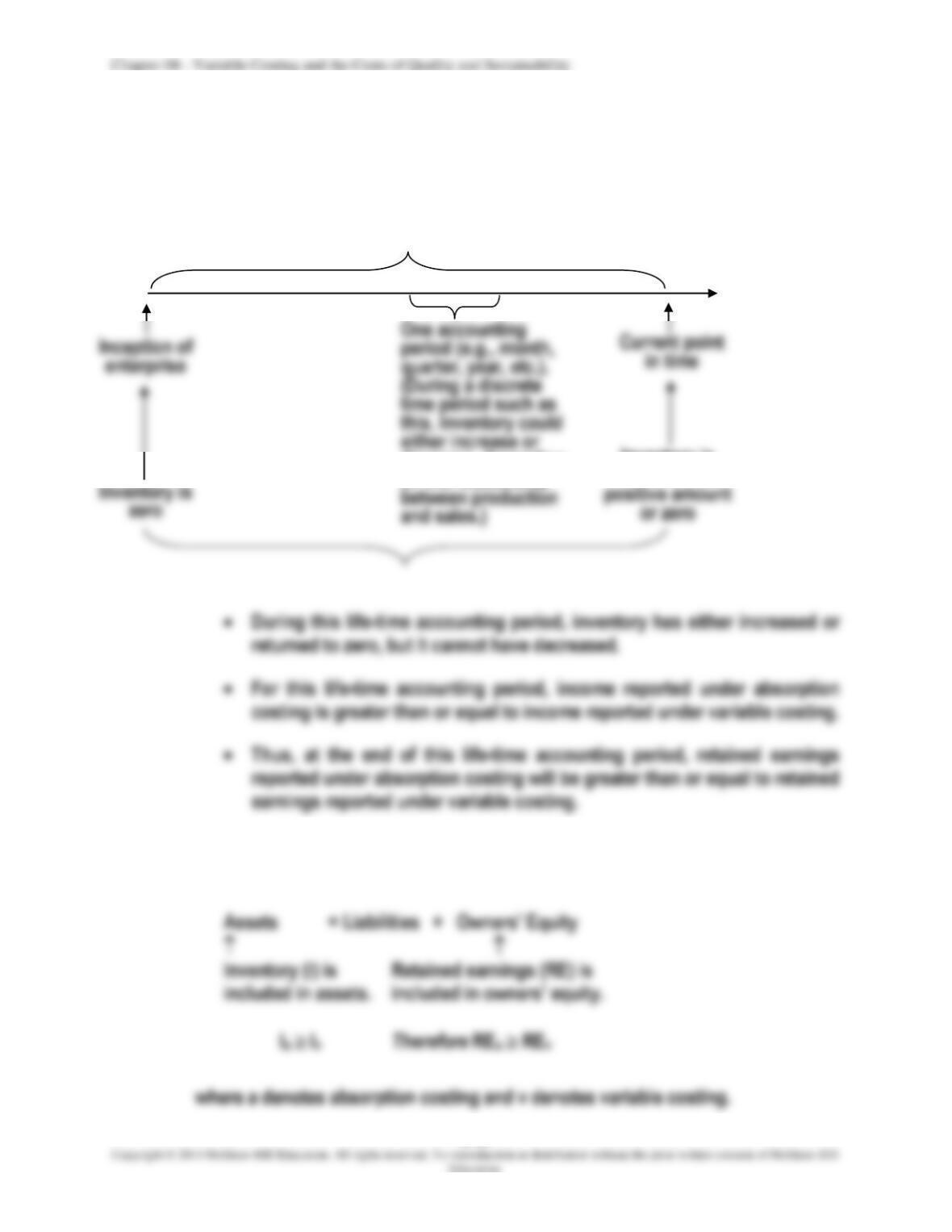
6. Yes, this relationship will always hold true at any balance sheet date. There are two
ways to think about this issue.
(a) As explained in the text, during any time period during which the amount of
inventory increases (i.e., unit production exceeds unit sales), income reported
8-44
CASE 8-44 (CONTINUED)
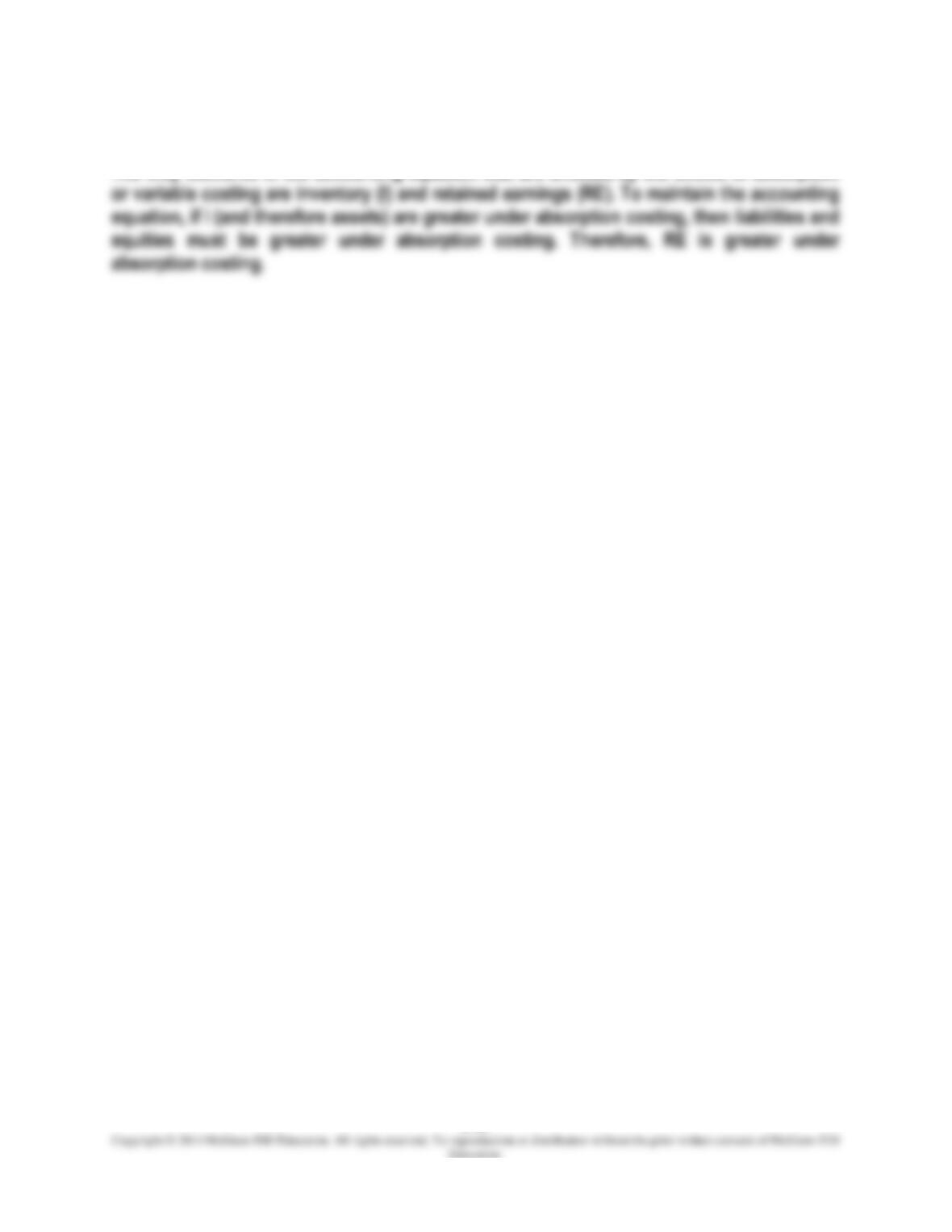
The following diagram may help in understanding the foregoing explanation.
(b) Another way to explain the answer to this question involves the basic accounting
equation, which follows.
Entire life of the enterprise
up to the current time
Time
Inventory is
either some
decrease, depending
on the relationship
•
•
•
•
•
•
•
Chapter 08 – Variable Costing and the Costs of Quality and Sustainability
8-45
CASE 8-44 (CONTINUED)
The only elements in the accounting equation that are affected by the choice of absorption
Chapter 08 – Variable Costing and the Costs of Quality and Sustainability
8-46
FOCUS ON ETHICS (See pages 336-337 in the text.)
It is often asserted that absorption costing results in an incentive for managers to
overproduce inventory, even during a period of slack demand, in order to boost income.
This scenario is just such an example.
The year 1 and year 2 income statements presented in the text for Brandolino Company are
prepared under absorption costing. While sales revenue, direct manufacturing costs, and
Sales (10,000,000 units at $6)………………………. $ 60,000,000
Less: Cost of goods sold (10,000,000 at $2)……. (20,000,000)
What has happened in this company? Brandolino’s new president, taking advantage of the