Case 8-2 Cumberland Lumber
“It’s impossible! There is no justification for ignoring these entries.” These are the words spoken
by Jackie Bauman at a meeting with the CFO of the company, Glen Donner.
Cumberland Lumber is a regional company and privately owned by members of the Simon
The issue being discussed between Jackie and Glen is whether a variety of year-end accruals
should be recorded. These include:
1. Accrual for future vacation pay of $50,000.
3. Reserve for inventory obsolescence, $80,000.
Jackie provides the following reasons for recording these amounts:
1. The accrual for vacation pay is based on a commitment to employees to pay these amounts so
long as they use their vacation hours by the end of the following calendar year.
3. The reserve for inventory obsolescence is a new item but reflects the failure of the company
1. Employees may not take vacation time next year because the employment market is tight and
2. Repairs and maintenance are discretionary expenditures, and there is no reason to accrue for
them.
3. The “obsolete” inventory will be sold to a buyer who is willing to take it off the company’s
hands so Glen suggests waiting until it is sold at that time for scrap value.
Ethical Obligations and Decision Making in Accounting, 4/e 2
Questions
1. Discuss the appropriateness of making the accrual entries based on the perspectives of
Jackie and Glen. What do you believe to be the intent of Glen in this matter? Explain.
Jackie is right. These entries should be made. They are accruals that should be made based on the
matching concept. However, an argument can be made that the repairs and maintenance are
discretionary. Any attempt to ignore nondiscretionary accruals smacks of earnings management
perhaps to smooth out the effect of accruals on net income.
Vacation pay: The commitment is to allow for vacation pay so long as it is used up within one
year. The matching concept dictates that the cost of vacation pay should be matched against
There is an official accounting rule for the reporting of vacation pay. It is discussed in the
Financial Accounting Standards Board’s Statement No. 43, Accounting for Compensated
Absences. Depending on a company’s vacation policy, earned but unused vacation time may be
an accrued liability if specific criteria, as determined by the Financial Accounting Standards
Board, are met. Unused vacation time that is carried over from period to period, related to work
already performed by an employee, paid even if an employee leaves the company, “reasonably”
estimable and likely to be paid, meets the FASB criteria and must be accrued. Vacation time that
does not meet all of these conditions, perhaps because it is forfeited when an employee leaves
the company, need not be accrued.
Ethical Obligations and Decision Making in Accounting, 4/e 3
2. Characterize the leadership style of Glen and the culture of the company.
Glen is aggressively treating the contentious items and expecting Jackie to go along or she will
lose her job. He is making decisions based on how he wants the earnings to look for a given year
rather than the way they should look under generally accepted accounting principles. This kind
of decision making threatens the ethical culture of the organization and sends a message that
employees are expected to be team players rather than act based on ethical, professional
judgment.
Glen is not an authentic leader. As discussed in this chapter, authentic leaders are focused on
building long-term shareholder value, not in just beating quarterly estimates. Authentic leaders
are individuals “who are deeply aware of how they think and behave and are perceived by others
3. How does professional identity influence what Jackie might do in this case?
As discussed in this chapter, commitment to the organization contrasts with colleague
commitment, with the latter dependent on a sense of responsibility and readiness to support
colleagues within the organization. Auditors may choose to act on behalf of their colleagues,
mindless of the welfare of the firm as a whole. Thus, unlike professional identity, which exists
independent of organizational affiliation, organizational colleague commitment and firm
Ethical Obligations and Decision Making in Accounting, 4/e 4
the auditor may show evidence of low commitment to the profession and the firm, but the event
is so egregious that she feels she must act. Individuals must weigh all of these influences and
weigh their significance in arriving at their reporting intention.
4. What would be most important to you in deciding what to do in this case if you were in
Jackie’s position? What would you do and why? Be sure to consider the culture of the
company and leadership style in crafting a response.
As mentioned above, Jackie needs to be true to her values and try to find a way to voice those
values and counteract the reasons and rationalizations provided by Glen to go along with
aggressive and unsupportable accounting. Both the leadership style of Glen and culture of
Cumberland Lumber creates dissidence for Jackie because she has high ethics while the
Ethical Obligations and Decision Making in Accounting, 4/e 5
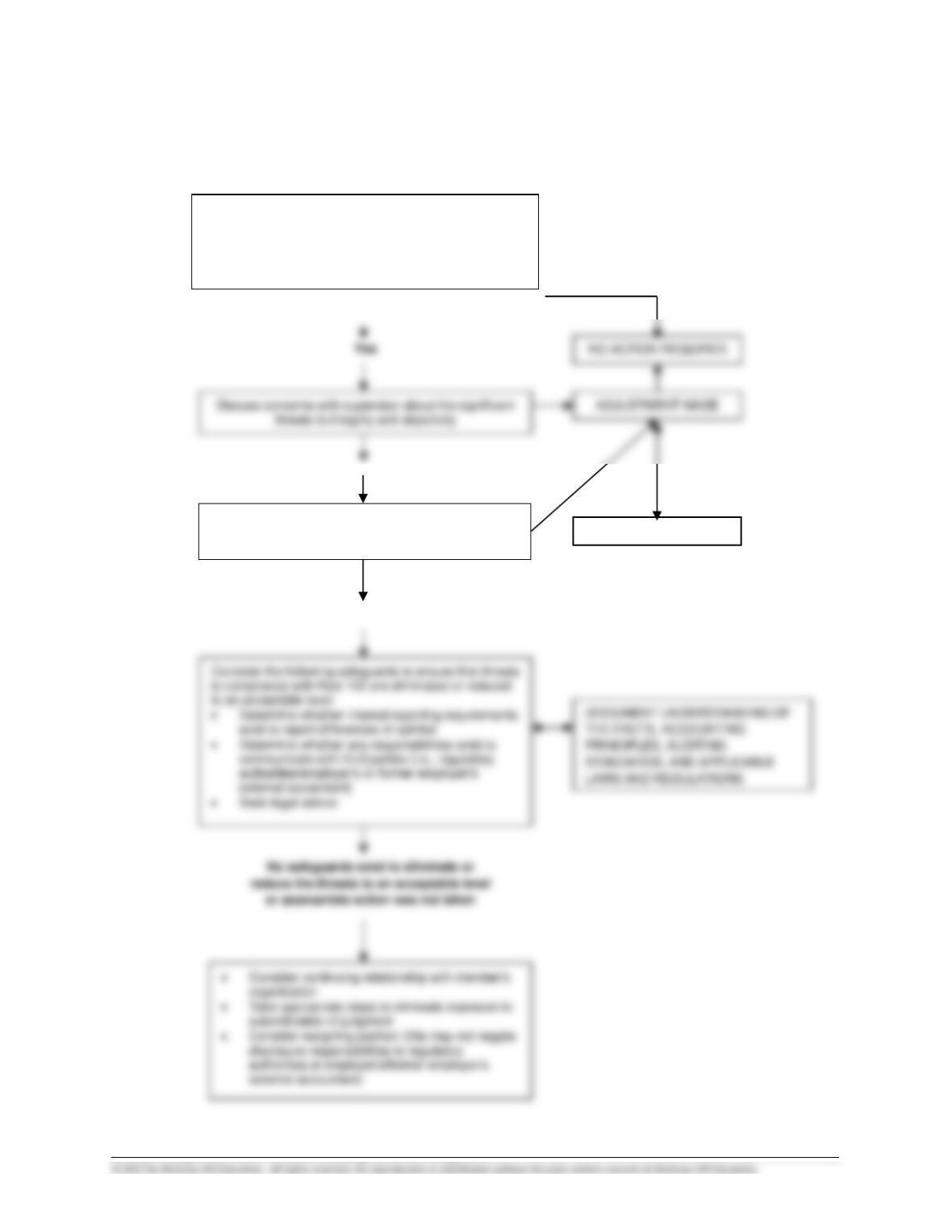
Exhibit 1.3
Ethical Responsibilities of CPAs to Avoid Subordination of Judgment
Does the supervisor’s opinion at the reporting entity
organization or at the external audit firm fail to comply with
professional standards, create a material
misrepresentation of fact, or violate applicable laws or
regulations?
Bring concerns to higher levels of management of client
organization (i.e., senior management/board of
directors) or audit firm
No adjustment
adjustm
ent
END PROCESS
No