CHAPTER 8 Tactical Decision Making and Relevant Analysis
E 8-42
1.
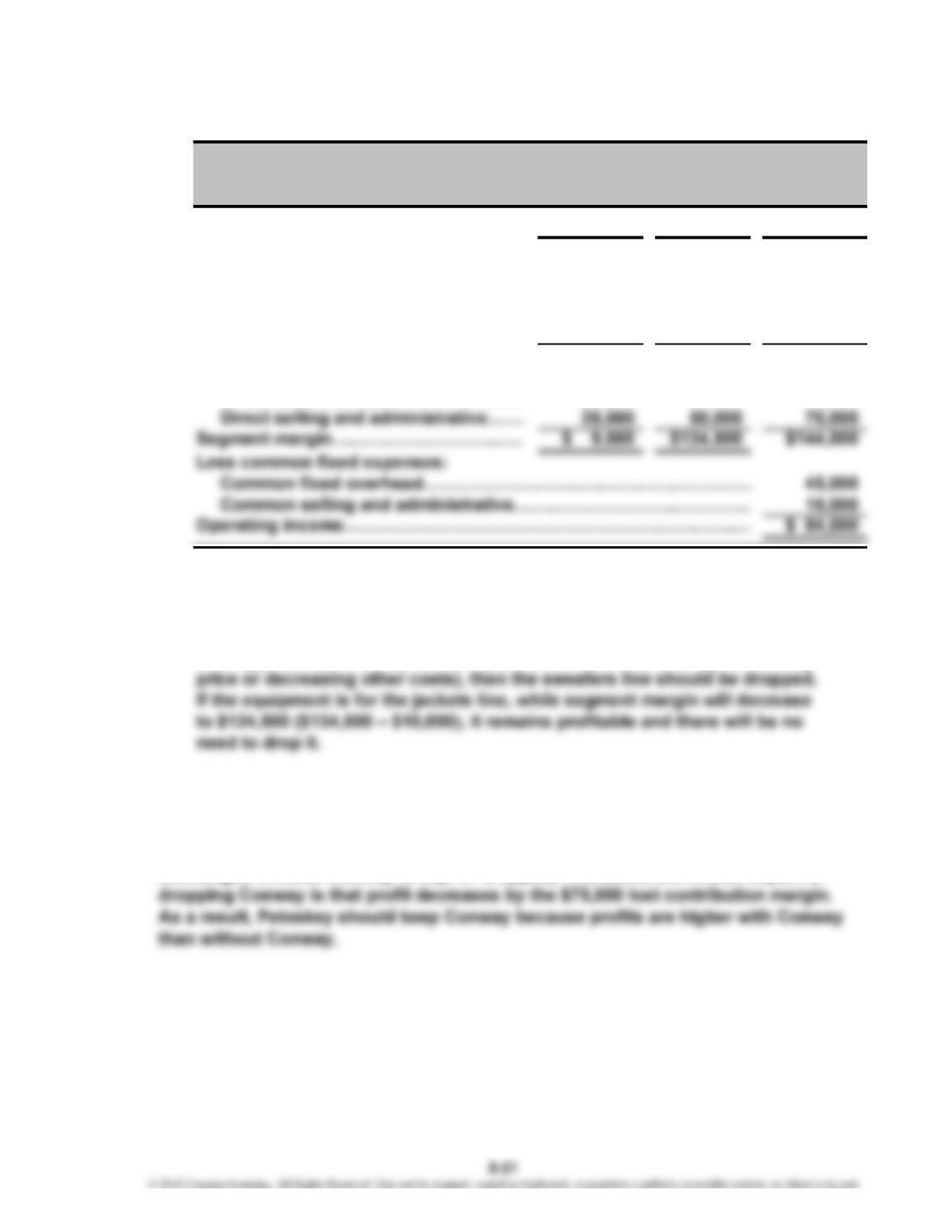
Sweaters Jackets Total
Sales……………………….………………… $210,000 $450,000 $660,000
Less variable expenses:
V
ariable cost of goods sold…………
…
145,000 196,000 341,000
V
ariable selling expense……………
…
10,500 22,500 33,000
Contribution margin………………………. $ 54,500 $231,500 $286,000
Less direct fixed expenses:
Direct fixed overhead…………………
…
25,000 47,000 72,000
2. For the company as a whole, an increase of $10,000 in fixed expense will
result in a decrease in operating income to $74,000 ($84,000 – $10,000). If
the equipment is for the sweaters line, then that line’s segment margin will
be $(500), and management will need to consider whether the line should
be dropped. If profitability is not expected to improve (either by increasing
E 8-43
If Petoskey drops Conway, overall profit will decrease by $75,000 as a result of the
lost contribution margin ($300,000 – $225,000). Note that the direct fixed expense for
depreciation is a sunk cost and not relevant to the decision (i.e., it will remain
Knitline Inc.
Segmented Income Statement
For the Coming Year
CHAPTER 8 Tactical Decision Making and Relevant Analysis
E 8-44
If Petoskey drops Conway, overall profit will increase by $5,000. Contribution margin will
decrease by $75,000 as a result of the lost contribution margin ($300,000 – $225,000).
Note that the fixed expense for depreciation is a sunk cost and not relevant to the
decision (i.e., it will remain unchanged whether Conway is kept or dropped). However,
E 8-45
If Petoskey drops Conway, profit will decrease by $28,000. There will be a decrease of
$75,000 as a result of the lost Conway contribution margin ($300,000 – $225,000). Note
that the direct fixed expense for depreciation is a sunk cost and not relevant to the
decision (i.e., it will remain unchanged whether Conway is kept or dropped). However,
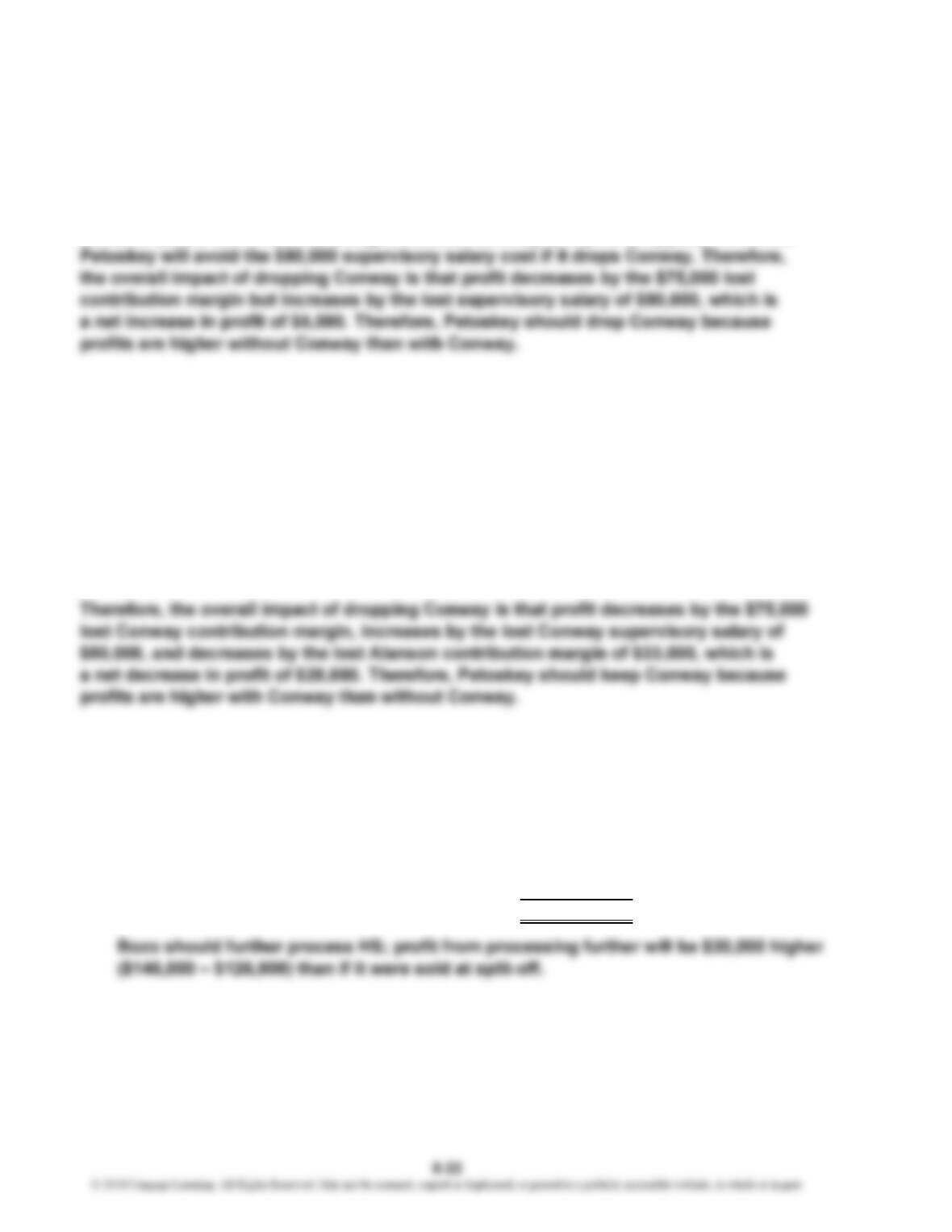
Petoskey will avoid the $80,000 supervisory salary cost for Conway if it drops Conway.
Finally, if Petoskey drops Conway, 20% of Alanson’s contribution margin, or $33,000
(i.e., 0.20 × $165,000), will also be lost as Conway-loving customers shop elsewhere for
Alanson.
E 8-46
1. Contribution Margin if HS Is Sold at Split-Off = $9 × 14,000 pounds
= $126,000
2. Contribution margin if HS is processed into CS
Revenue ($45 × 4,000)……………………………
…
$180,000
Less further processing cost……………………
…
34,000
Contribution margin………………………………
…
$146,000
CHAPTER 8 Tactical Decision Making and Relevant Analysis
E 8-47
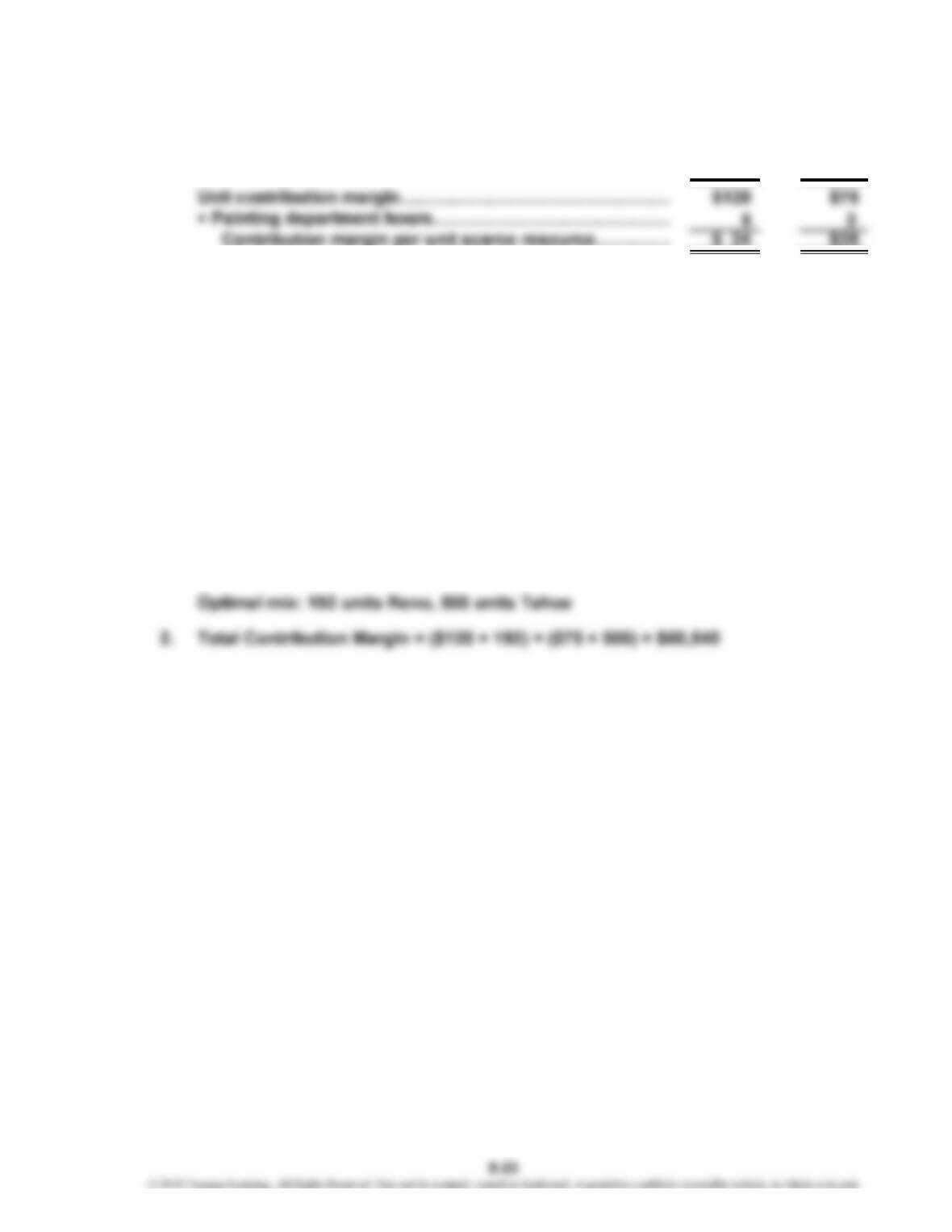
1. Reno Tahoe
2. Assuming no other constraints, the optimal mix is zero units of Reno and 820
units of Tahoe. Total painting department time is 2,460 hours per year; if all of
them are devoted to Tahoe production, then 820 units (2,460/3) of Tahoe can
be produced.
3. Contribution Margin = ($120 × 0) + ($75 × 820) = $61,500
E 8-48
1. If 500 units of each product can be sold, then the company will first make and
sell 500 units of Tahoe (the product with the higher contribution margin per hour
of painting department time). This will take 1,500 hours (500 units × 3 hours)
of painting department time, leaving 960 hours (2,460 hours – 1,500 hours)
for Reno production. This time will yield 192 units (960 hours/5 hours per unit)
of Reno.
CHAPTER 8 Tactical Decision Making and Relevant Analysis
E 8-49
1. Price of National Parks Memory Card Game = $20.00 + (0.65 × $20) = $33.00
3. The financial manager might encounter one or more common challenges to using
cost-plus (or markup) pricing. One challenge might be identifying the most
appropriate percentage by which to mark up gift shop costs. For example, if the
percentage is too high (and 65% seems high), the manager risks setting prices
too high, thereby causing some customers to decide not to buy the gift shop’s
products. One factor working in the manager’s favor in this environment is that
businesses in remote locations, such as many national park gift shops, face
little or no competition. This can spur customers to spend more money than
they would when more competition exists. Alternatively, if the markup percentage
is too low, the manager risks setting prices too low. When prices are too low,
profits are less than they would be with higher prices. In extreme cases, profits
can be negative if total revenues are less than total costs.
E 8-50
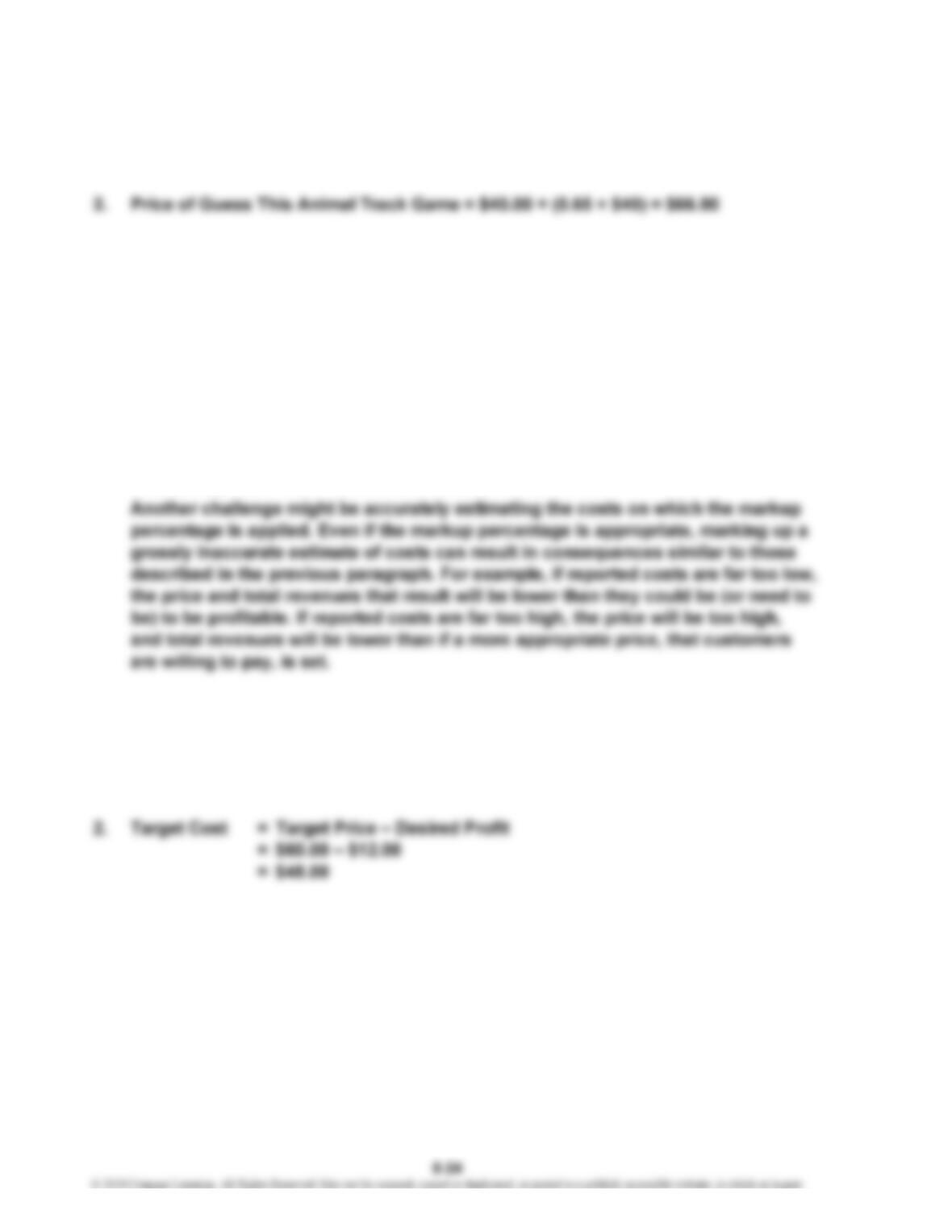
1. Desired Profit = 0.20 × Target Price
= 0.20 × $60
= $12.00
CHAPTER 8 Tactical Decision Making and Relevant Analysis
E 8-51
2.
Restore
Cost Item Grand Am
Transmission…………………………………
…
$2,000 $ 0
Water pump…………………………………
…
400 0
Master cylinder………………………………
…
1,100 0
Sell Grand Am………………………………
…
0 (6,400)
Cost of new car………………………………
…
0 9,400
Total………………………………………
…
$3,500 $ 3,000
Heather should sell the Grand Am and buy the Neon because it provides a net
savings of $3,500 – $3,000.
E 8-52
1. If the analysis is done using total costs, each variable cost as well as the purc
price will be the unit cost multiplied by 35,000 units. The direct fixed overhead
$77,000 is avoidable if the part is purchased.
…
…
2. Maximum Price = $409,500/35,000 = $11.70 per uni
t
3. Income would increase by $24,500 ($409,500 – $385,000).
a$6.00 × 35,000 = $210,000
b$2.00 × 35,000 = $70,000
c$1.50 × 35,000 = $52,500
d$11.00 × 35,000 = $385,000
Alternatives
Buy Neon
CHAPTER 8 Tactical Decision Making and Relevant Analysis
E 8-53
Make Buy
1. Direct materialsa…………………………
…
$210,000 $ 0
Direct laborb………………………………
…
70,000 0
2. Maximum Price = $332,500/35,000 = $9.50 per uni
t
3. Income would decrease by $52,500 ($332,500 – $385,000).
a$6.00 × 35,000 = $210,000
b$2.00 × 35,000 = $70,000
CHAPTER 8 Tactical Decision Making and Relevant Analysis
P 8-54
1. If the special order is accepted:
Revenues ($7 × 100,000)……………………………………….………………… $ 700,000
Direct materials ($2 × 100,000)………………………………….………………
…
(200,000)
Direct labor ($1 × 100,000)……………………………………….………………
…
(100,000)
V
ariable overhead ($3 × 100,000)……………………………….………………
…
(300,000)
Total net benefit………………………………………………………………
…
$ 100,000
2. The qualitative factors are those that cannot be easily quantified. The company is
faced with a problem of idle capacity. Accepting the special order would bring
production up to near capacity and allow the company to avoid laying off
employees. This would also enhance the company’s community image.
The special-order price is well below the company’s normal price. Will this have a
potential impact on regular customers? Considering the fact that the customer is
PROBLEMS
CHAPTER 8 Tactical Decision Making and Relevant Analysis
P 8-55
1.
Coffee
Blenders Makers Total
Sales……………………………………………..
.
$1,560,000 $2,175,000 $3,735,000
Less: Variable cost of goods sold…………
…
1,170,000 2,025,000 3,195,000
Contribution margin…………………………
…
$ 390,000 $ 150,000 $ 540,000
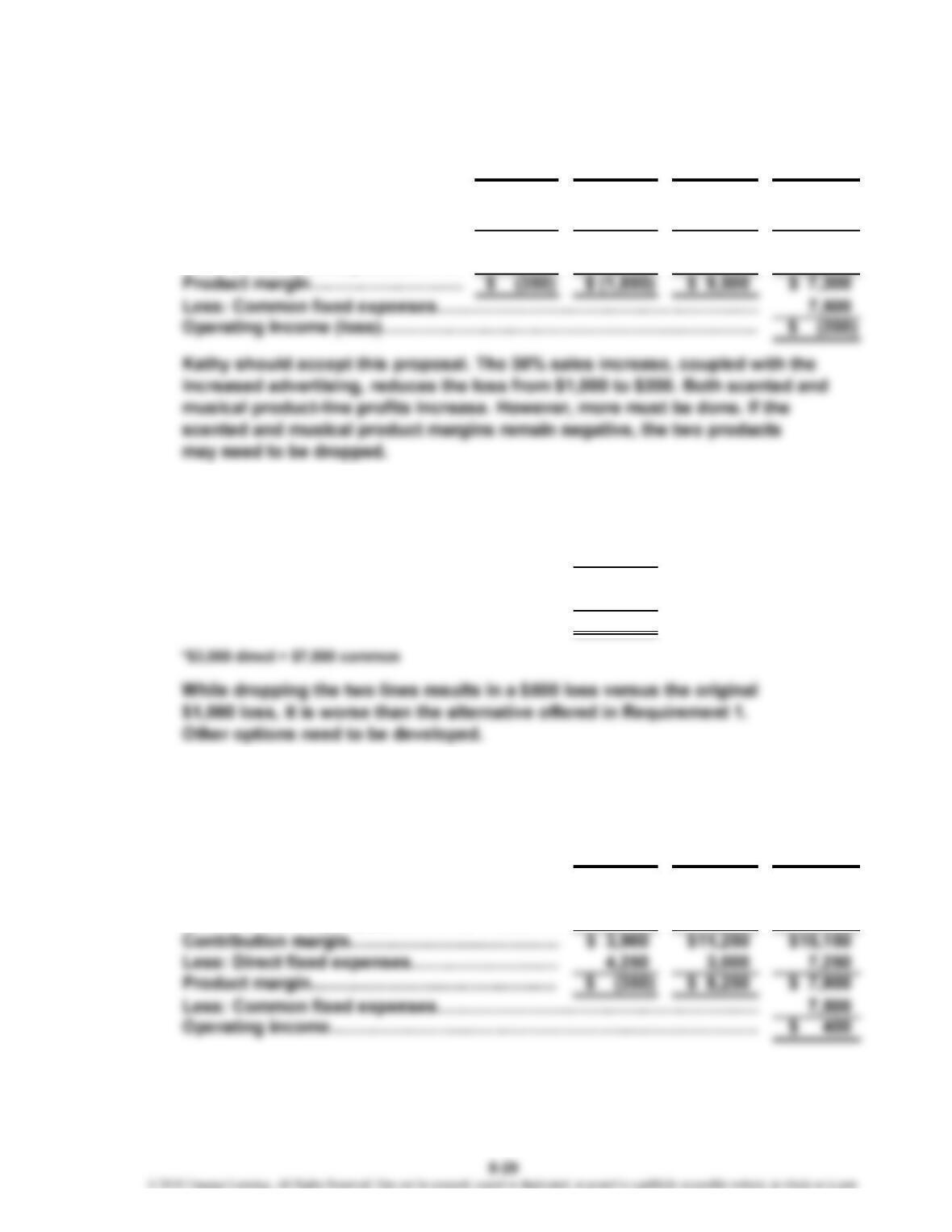
2. If the coffee maker line is dropped, profits will decrease by $7,500, the segment
margin. If the blender line is dropped, profits will decrease by $206,000.
3. Coffee
Blenders Makers Total
Sales……………………………………………..
.
$1,775,000 $2,175,000 $3,950,000
Less: Variable cost of goods sold…………
…
1,350,000 2,025,000 3,375,000
Contribution margin…………………………
…
$ 425,000 $ 150,000 $ 575,000
Alard Company
Segmented Income Statement
CHAPTER 8 Tactical Decision Making and Relevant Analysis
P 8-56
Scented Musical Regula
r
Total
1. Sales…………………………………
…
$13,000 $19,500 $25,000 $57,500
Less: Variable expenses…………
…
9,100 15,600 12,500 37,200
Contribution margin………………
…
$ 3,900 $ 3,900 $12,500 $20,300
Less: Direct fixed expenses……… 4,250 5,750 3,000 13,000
2. Regular:
Sales………………………………………………… $20,000
Less: Variable expenses………………………… 10,000
Contribution margin……………………………… $10,000
Less: Fixed expenses*…………………………… 10,500
Operating income (loss)…………………………
…
$ (500)
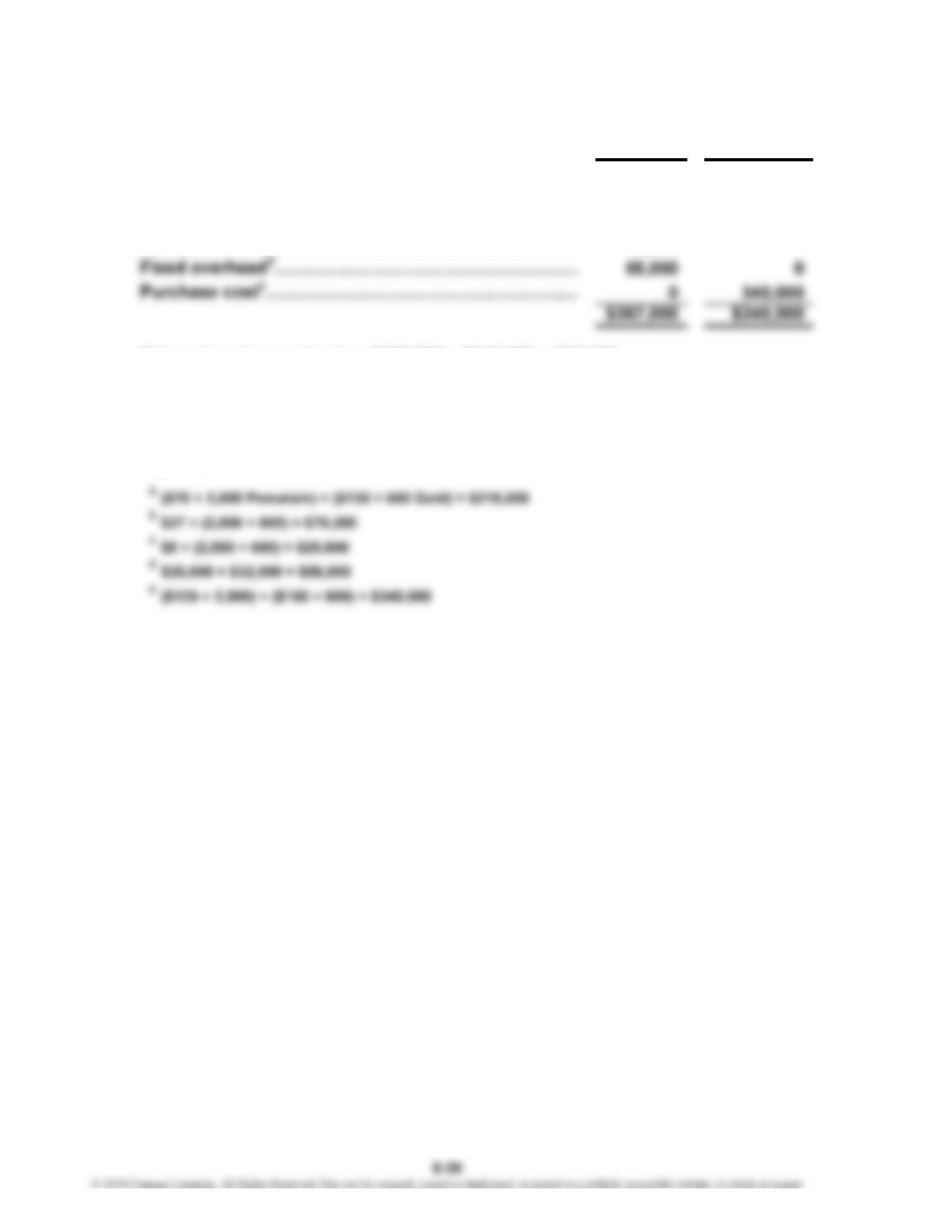
3. Combinations would be beneficial. Dropping the musical line (which
shows the greatest segment loss) and keeping the scented line while
increasing advertising yields a profit (the optimal combination).
Scented Regula
r
Total
Sales…………………………………………………
…
$13,000 $22,500 $35,500
Less: Variable expenses…………………………
…
9,100 11,250 20,350
CHAPTER 8 Tactical Decision Making and Relevant Analysis
P 8-57
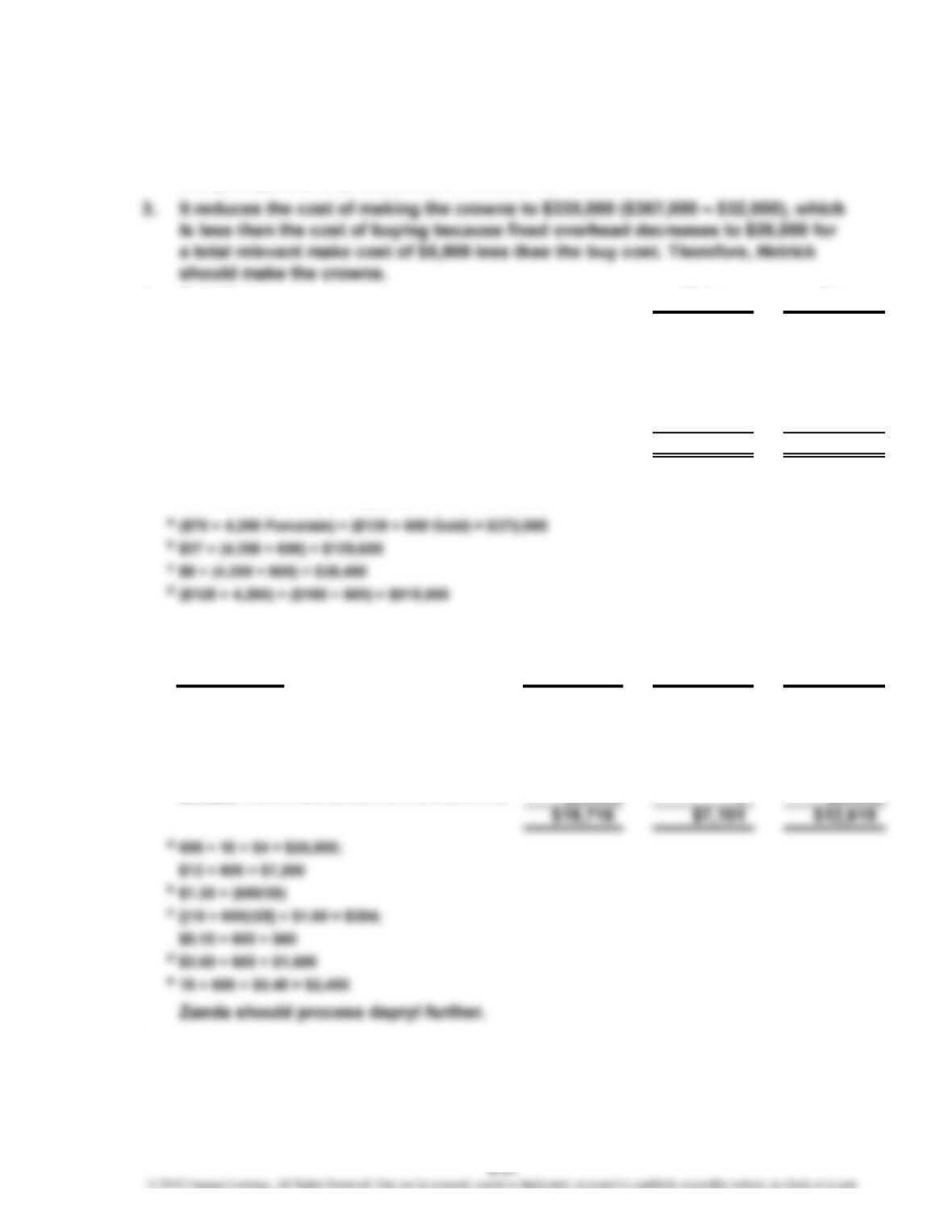
1. Cost Item Make Buy
Raw materialsa………………………………………………
…
$218,000 $ 0
Direct laborb…………………………………………………
…
70,200 0
Variable overheadc…………………………………………
…
20,800 0
Net savings by purchasing: $367,000 – $340,000 = $27,000.
Hetrick should purchase the crowns rather than make them.
Depreciation of $5,000 is irrelevant (and therefore excluded from the analysis
here) because it will NOT change regardless of whether Hetrick makes or
buys the crowns.
CHAPTER 8 Tactical Decision Making and Relevant Analysis
P 8-57 (Concluded)
2. Qualitative factors that Hetrick should consider include quality of crowns, reliability
and promptness of producer, and reduction of workforce.
4. Cost Item Make Buy
Raw materials
a
………………………………………………
…
$372,000 $ 0
Direct labor
b
…………………………………………………
…
129,600 0
Variable overhead
c
…………………………………………
…
38,400 0
Fixed overhead………………………………………………
…
58,000 0
Purchase cost
d
………………………………………………
…
0 615,000
$598,000 $615,000
Hetrick should produce its own crowns if demand increases to this level because
the fixed overhead is spread over more units.
P 8-58
Process
Per 600 lbs. Furthe
r
Sell Difference
Revenues
a
…………………………………… $24,000 $7,200 $16,800
Bags
b
…………………………………………
…
0 (39) 39
Shipping
c
……………………………………
…
(384) (60) (324)
Grinding
d
……………………………………
…
(1,500) 0 (1,500)
e
2. $12,615/600 = $21.025 additional income per pound
$21.025 × 265,000 = $5,571,625
CHAPTER 8 Tactical Decision Making and Relevant Analysis
P 8-59
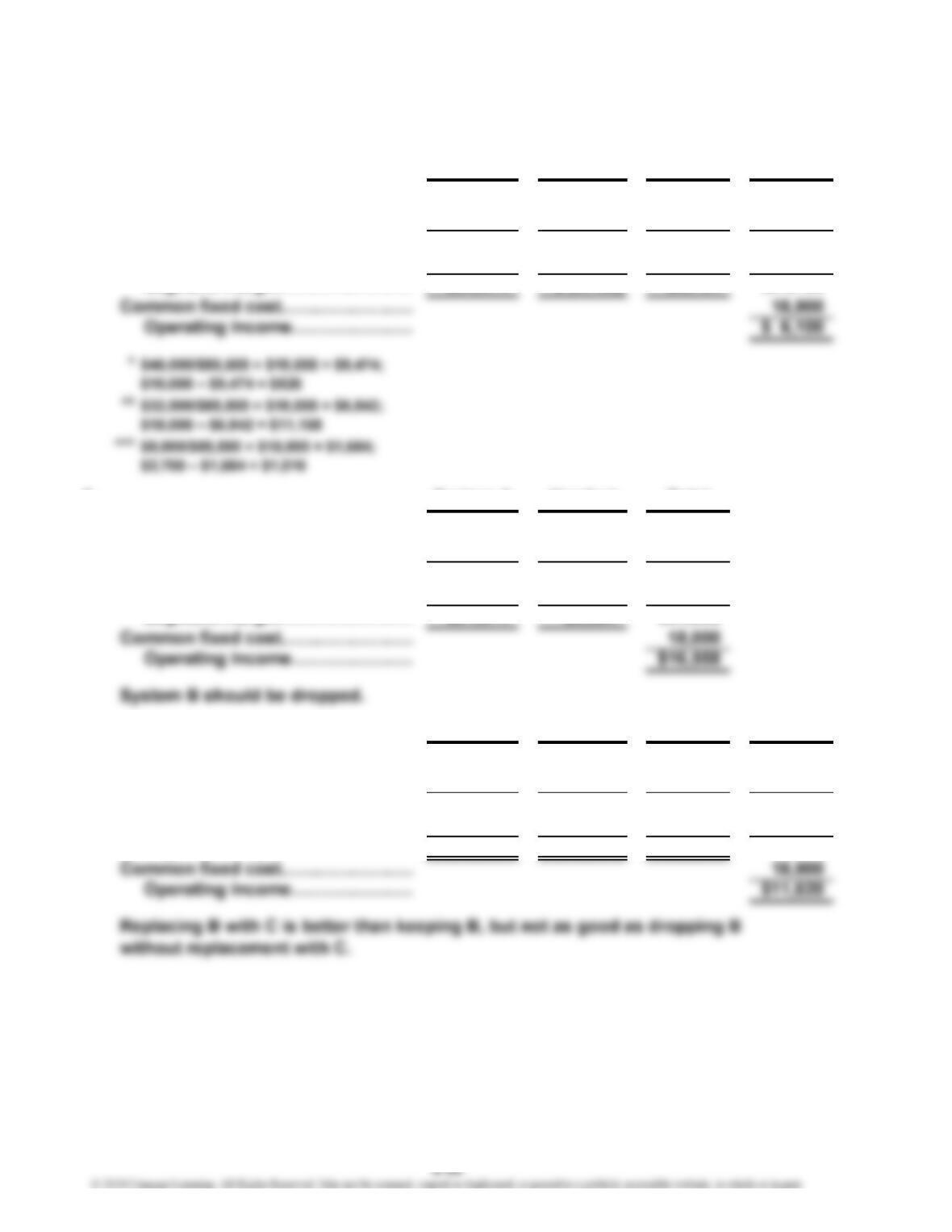
1. System A System B Headset Total
Sales……………………………………
…
$45,000 $32,500 $8,000 $85,500
V
ariable expenses……………………
…
20,000 25,500 3,200 48,700
Contribution margin…………………
…
$25,000 $ 7,000 $4,800 $36,800
Direct fixed cost……………………… 526 11,158 1,016 12,700
2. System A Headset Total
Sales……………………………………
…
$58,500 $6,000 $64,500
V
ariable expenses……………………
…
26,000 2,400 28,400
Contribution margin…………………
…
$32,500 $3,600 $36,100
Direct fixed cost……………………… 526 1,016 1,542
…
3. System A System C Headset Total
Sales……………………………………
…
$45,000 $26,000 $7,200 $78,200
V
ariable expenses……………………
…
20,000 13,000 2,880 35,880
Contribution margin…………………
…
$25,000 $13,000 $4,320 $42,320
Direct fixed cost*……………………
…
526 11,158 1,016 12,700
Segment margin…………………
…
$24,474 $ 1,842 $3,304 $29,620
* ** ***
…
CHAPTER 8 Tactical Decision Making and Relevant Analysis
P 8-60
1. Steve should consider selling the part for $1.85 because his division’s profits would
increase $12,800:
Accept Reject
Revenues (2 × $1.85 × 8,000)………………………………
…
$29,600 $0
V
ariable expenses (2 × $1.05 × 8,000)……………………
…
16,800 0
Total…………………………………………………………
…
$12,800 $0
Pat’s divisional profits would increase by $18,400:
Accept Reject
2. Pat should accept the $2 price. This price will increase the cost of the component
from $29,600 to $32,000 (2 × $2 × 8,000) and yield an incremental benefit of $16,000
($18,400 – $2,400).
Steve’s division will see an increase in profit of $15,200 (8,000 units × 2 components
per unit × $0.95 contribution margin per component).
Y
P 8-61
1. Markup based on cost of goods sold:
Cost of Goods Sold + (Cost of Goods Sold × Markup) = Sell Price
$48,100 + ($48,100 × Markup) = $130,000
Markup = ($130,000 – $48,100)/$48,100
= 1.703, or 170.3%
V
CHAPTER 8 Tactical Decision Making and Relevant Analysis
P 8-62
Basic Standard Deluxe
1. Price……………………………………………… $ 9.00 $30.00 $35.00
V
ariable cost……………………………………
…
6.00 20.00 10.00
Contribution margin…………………………
…
$ 3.00 $10.00 $25.00
÷ Machine hours………………………………
…
0.10 0.50 0.75
Contribution margin pe
r
machine hour…………………………………
…
$30.00 $20.00 $33.33
2. First, produce and sell 12,000 deluxe units, which would use 9,000 machine
hours (12,000 × 0.75). Then, produce and sell 50,000 basic units, which would
use 5,000 machine hours (50,000 × 0.10). Finally, with the remaining 1,000
P 8-63
1. The company should not accept the offer because the additional revenue is
less than the additional costs (assuming fixed overhead is allocated and will
not increase with the special order):
2. Costs associated with the layoff:
Increase state UI premiums (0.01 × $1,460,000)………………………
…
$14,600
Notification costs ($25 × 20)………………………………………………
…
500
Rehiring and retraining costs ($150 × 20)………………………………
…
3,000
Total………………………………………………………………………… $18,100
*
CHAPTER 8 Tactical Decision Making and Relevant Analysis
P 8-64
1. Sales………………………………………………………………………………
…
$263,000
Costs………………………………………………………………………………
…
223,000
Operating profit……………………………………………………………… $ 40,000
Process
2. Sell Furthe
r
Difference
Revenues………………………………… $40,000 $75,000 $35,000
Further processing cost………………
…
0 23,900 23,900
P 8-65
1. ($30 × 2,000) + ($60 × 4,000) = $300,000
2. Juno Hera
Contribution margin………………………………………
…
$30 $60
÷ Pounds of material………………………………………
…
2 5
Contribution margin/pound………………………………
…
$15 $12
CHAPTER 8 Tactical Decision Making and Relevant Analysis
P 8-66
1. Process
Sell Furthe
r
Revenues……………………
…
$24,000 $33,000 $ 9,000
Processing cost……………
…
— (4,100) (4,100)
Total………………………
…
$24,000 $28,900 $ 4,900
2. Process
Sell Furthe
r
Revenues……………………
…
$24,000 $33,000 $ 9,000
Processing cost……………
…
— (4,100) (4,100)
Distribution cost……………
…
— (800) (800)
Commissions………………
…
— (3,300) (3,300)
…
P 8-67
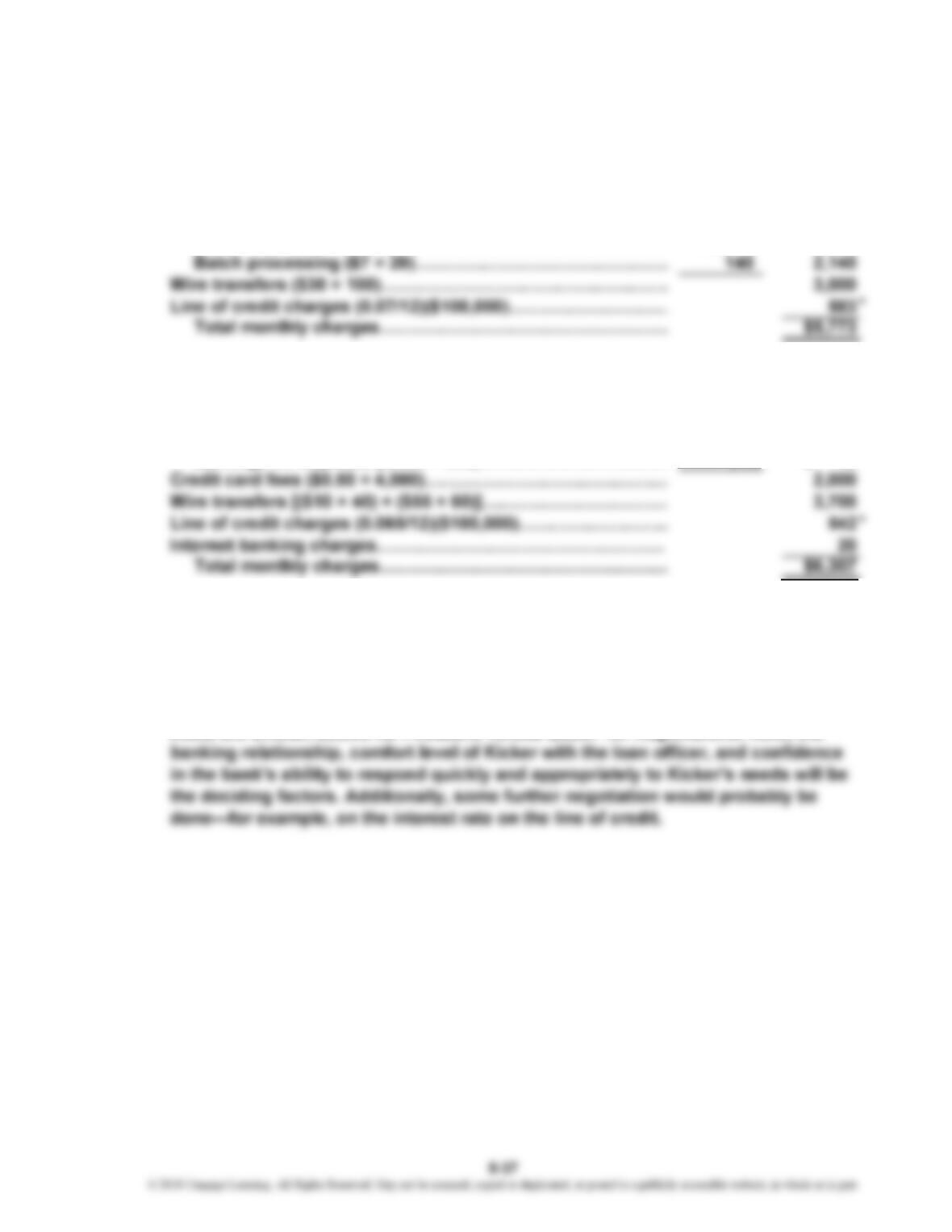
1. Monthly cost for FirstBank:
Checking accounts:
Maintenance fees ($5 × 6)………………………….……… $ 30
Foreign DR/CR ($0.10 × 200)……………………………
…
20
Returned checks ($3 × 25)…….…………………………
…
75
Earnings on deposits ($0.50 × 300)……………………
…
(150) $ (25)
Credit card fees ($0.50 × 4,000)……………………………
…
2,000
Differential Amount
to Process Furthe
r
Differential Amount
to Process Furthe
r
CHAPTER 8 Tactical Decision Making and Relevant Analysis
P 8-67 (Concluded)
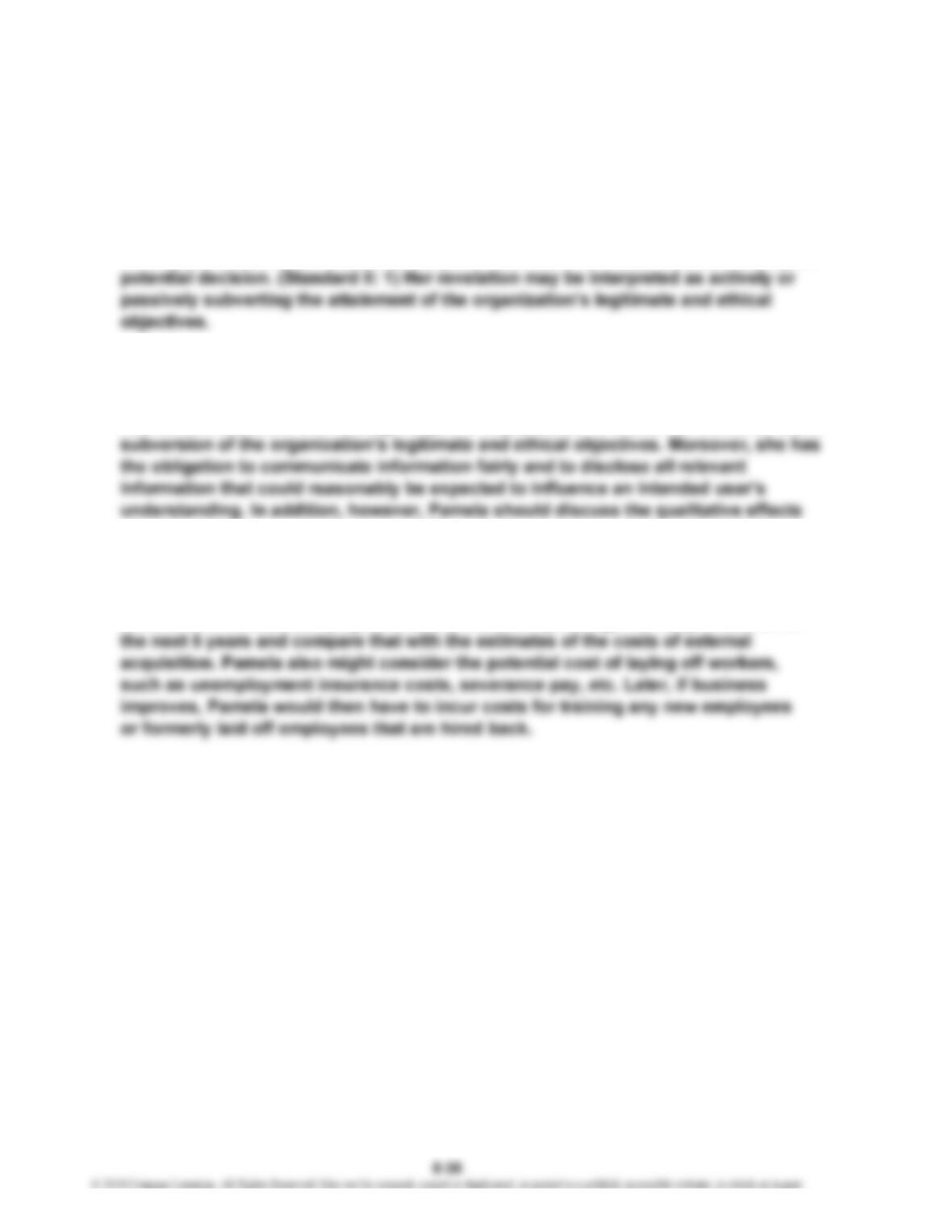
Monthly cost for Community Bank:
Checking accounts: Returned checks ($2 × 25)…….…………
…
$ 50
Credit card fees
Per item ($0.50 × 4,000)…………………………………………
…
$2,000
Monthly cost for RegionalOne Bank:
Checking accounts:
Foreign DR/CR ($0.20 × 200)…………………………………
…
$40
Returned checks ($3.80 × 25)…………………………………
…
95
Earnings on deposits ($0.30 × 300)…………………………
…
(90) $ 45
* Answers rounded to the nearest dollar.
Community Bank has the lowest overall monthly fees. On quantitative factors
alone, it would be chosen.
2. If the full online banking access were crucial, Community Bank would be eliminated
immediately. This leaves FirstBank and RegionalOne Bank. The two sets of monthly
.
CHAPTER 8 Tactical Decision Making and Relevant Analysis
Case 8-68
1. Pamela should not have told Roger about the deliberations concerning the power
department because this is confidential information. She had been explicitly told
to keep the details quiet but deliberately informed the head of the unit affected by the
2. The romantic relationship between Pamela and Roger sets up a conflict of interest
for this particular decision. Pamela should have withdrawn from any active role in it.
(Standard III: 1) However, she should definitely provide the information she currently
has about the cost of eliminating the power department. To not do so would be active
of eliminating the power department. The effects on workers, community relations,
reliability of external service, and any ethical commitments the company may have
to its workers should all enter into the decision. Pamela should communicate the
short-term quantitative effects and express any concerns about the qualitative
factors. She should also project what the costs of operating internally would be for
CASES
CHAPTER 8 Tactical Decision Making and Relevant Analysis
Case 8-69
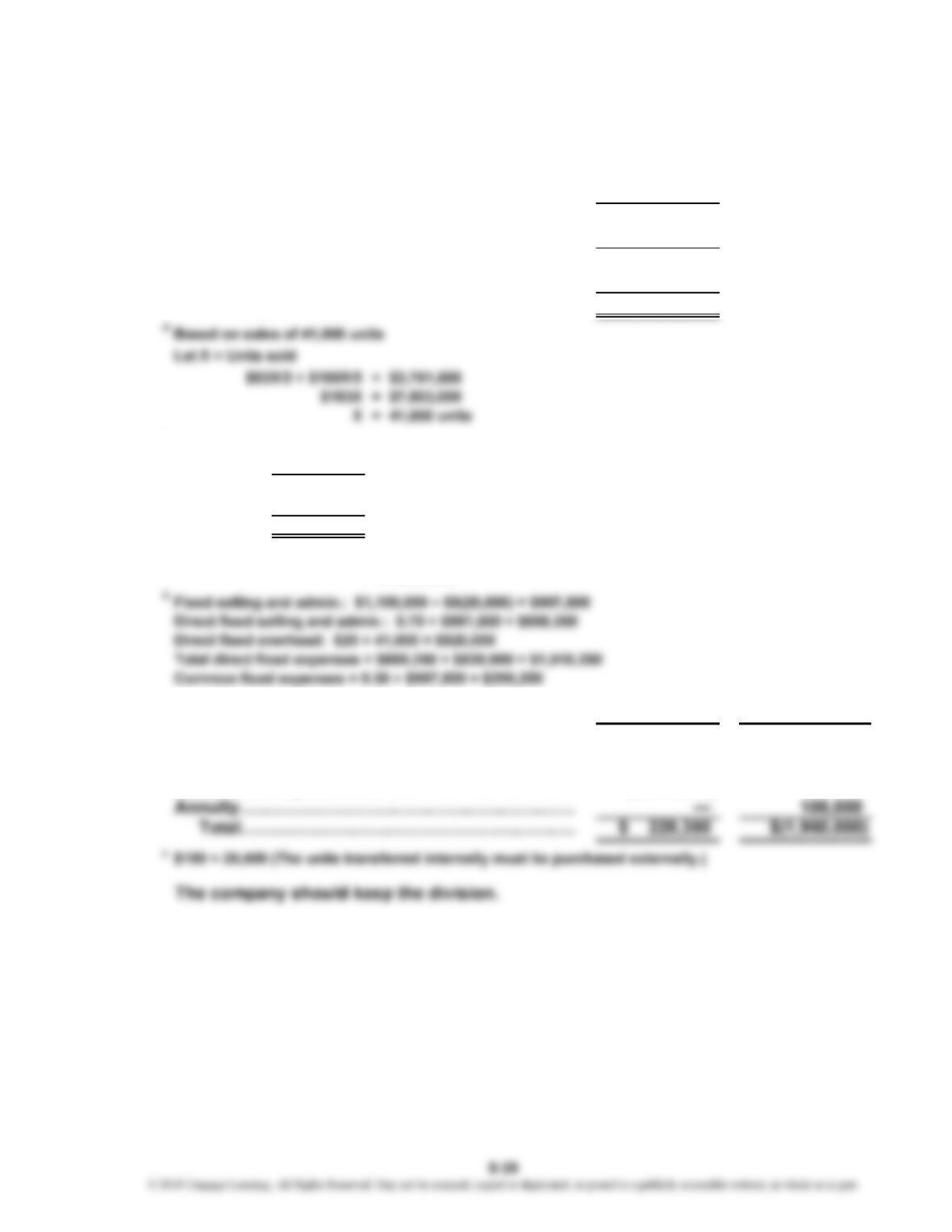
1. Sales
a
…………………………………………………… $3,751,500
Less: Variable expenses
b
…………………………… 2,004,900
Contribution margin…………………………………
…
$1,746,600
Less: Direct fixed expenses
c
………………………
…
1,518,250
Divisional margin……………………………………
…
$ 228,350
Less: Common fixed expenses
c
…………………… 299,250
Operating (loss)……………………………………
…
$ (70,900)
b
$83X/125.0% $66.40 Manufacturing cost
– 20.00 Fixed overhead
$46.40 Per internal unit variable cost
+ 5.00 Selling expenses
$51.40 Per external unit variable cost
Variable Costs = ($46.40 × 20,500) + ($51.40 × 20,500)
= $2,004,900
2. Keep Drop
Sales……………………………………………………
…
$ 3,751,500 $—
V
ariable costs…………………………………………
…
(2,004,900) (2,050,000)
Direct fixed expenses………………………………
…
(1,518,250) —
Case 8-70
Answers will vary.
*