CHAPTER 8
Reporting and Analyzing Receivables
Learning Objectives
1. Identify the different types of receivables.
2. Explain how accounts receivable are recognized in the accounts.
3. Describe the methods used to account for bad debts.
4. Compute the interest on notes receivable.
5. Describe the entries to record the disposition of notes receivable.
6. Explain the statement presentation of receivables.
7. Describe the principles of sound accounts receivable management.
8. Identify ratios to analyze a company’s receivables.
9. Describe methods to accelerate the receipt of cash from receivables.
Summary of Questions by Learning Objectives and Bloom’s Taxonomy
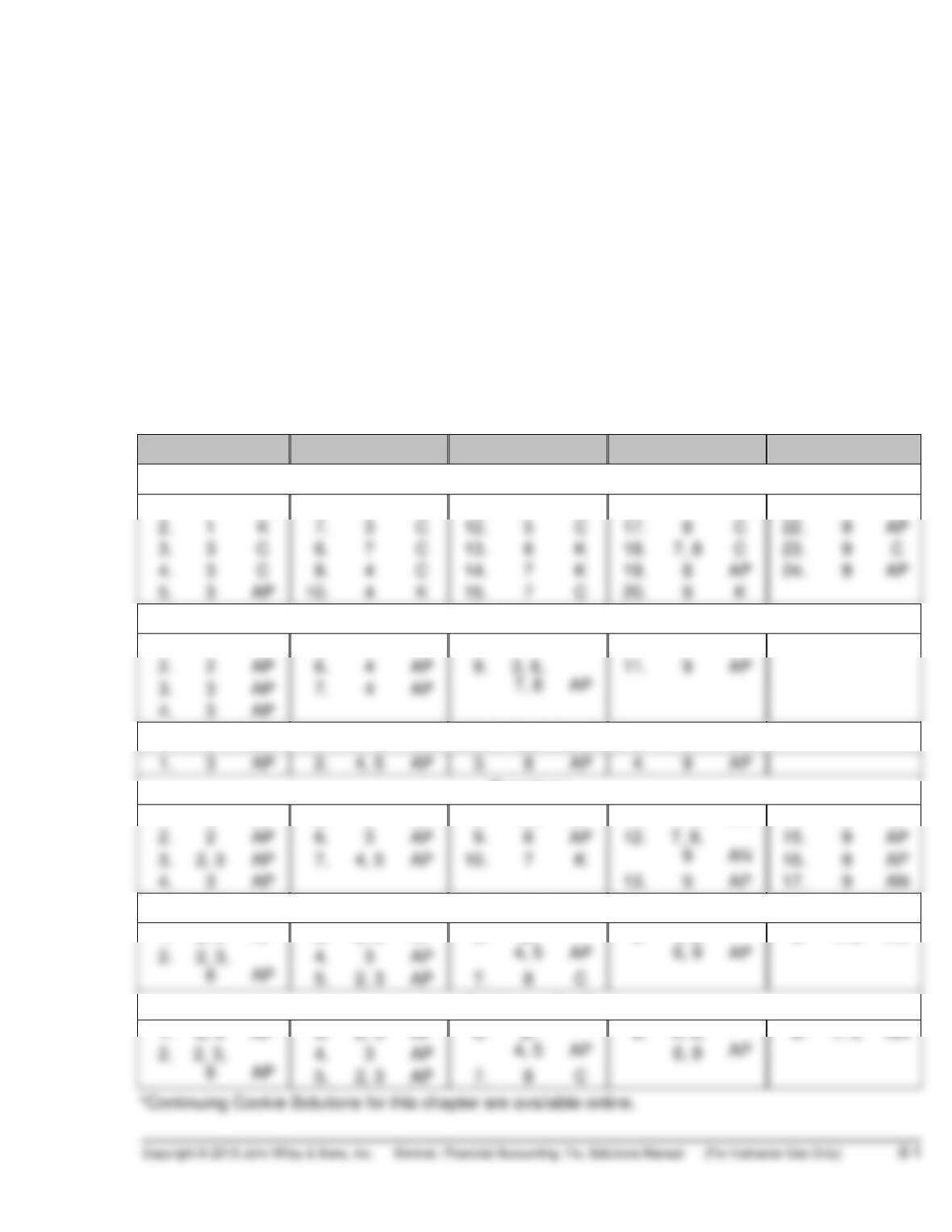
Item LO BT Item LO BT Item LO BT Item LO BT Item LO BT
Questions
1. 1 C 6. 3 K 11. 4 AP 16. 7 K 21. 9 C
Brief Exercises
1. 1 C 5. 3 AP 8. 4 AP 10. 8 AP 12. 9 AP
Do It! Review Exercises
Exercises
1. 2 AP 5. 3 AP 8. 4, 5 AP 11. 7, 8 AN 14. 9 C
Problems: Set A
1. 2, 3 AP 3. 2, 3 AP 6. 2,
8. 4, 5,
9. 7, 8 AN
Problems: Set B
ASSIGNMENT CHARACTERISTICS TABLE
Problem
Number
Description
Difficulty
Level
Time
Allotted (min.)
1A Journalize transactions related to bad debts. Simple 15–20
2A Prepare journal entries related to bad debt expense,
and compute ratios.
Simple 15–20
7A Explain the impact of transactions on ratios. Moderate 20–30
8A Prepare entries for various credit card and notes
receivable transactions.
Complex 50–60
9A Calculate and interpret various ratios. Moderate 10–15
1B Journalize transactions related to bad debts. Simple 15–20
2B Prepare journal entries related to bad debt expense,
and compute ratios.
Simple 15–20
6B Journalize various receivables transactions. Moderate 40–50
7B Explain the impact of transactions on ratios. Moderate 20–30
8B Prepare entries for various credit card and notes
receivable transactions.
Complex 50–60
ANSWERS TO QUESTIONS
1. Accounts receivable are amounts customers owe on account. They result from the sale of goods
and services (i.e., in trade). Notes receivable represent claims that are evidenced by formal
instruments of credit.
2. Other receivables include nontrade receivables such as interest receivable, loans to company
officers, advances to employees, and income taxes refundable.
3. The essential features of the allowance method of accounting for bad debts are:
(1) Uncollectible accounts receivable are estimated and matched against revenues in the same
4. Mitch should realize that the decrease in cash realizable value occurs when estimated uncollectibles
are recognized in an adjusting entry. The write-off of an uncollectible account reduces both accounts
receivable and the allowance for doubtful accounts by the same amount. Thus, cash realizable
value does not change.
5. The adjusting entry under the percentage of receivables basis is:
Bad Debt Expense ……………………………………………………………………….. 2,900
Allowance for Doubtful Accounts ($5,100 – $2,200) …………………….. 2,900
6. Tootsie Roll reports two types of receivables on its balance sheet: Accounts receivable trade, and
Other receivables. Since Tootsie Roll’s balance sheet reports allowance amounts for receivables,
we know that Tootsie Roll uses the allowance method rather than the direct write-off method.
7. Under the direct write-off method, bad debt losses are not estimated and no allowance account is used.
When an account is determined to be uncollectible, the loss is debited to Bad Debt Expense and
8. Offering credit usually results in an increase in sales because customers prefer to “buy now and
pay later”. If a company decides to extend credit to customers, it should also establish credit
standards to determine if a particular customer is credit worthy. Standards that are easily met can
9. A promissory note gives the holder a stronger legal claim than one on an account receivable. As
a result, it is easier to sell to another party. Promissory notes are negotiable instruments, which
means they can be transferred to another party by endorsement. The holder of a promissory note
also can earn interest.
Questions Chapter 8 (Continued)
11. The missing amounts are: (a) $27,000, (b) 10%, (c) six months or 180 days, and (d) $7,200.
12. When Carrera Company has dishonored a note, the lender can renegotiate new terms for the
13. Each of the major types of receivables should be identified in the balance sheet or in the notes
to the financial statements. Both the gross amount of receivables and the allowance for doubtful
accounts should be reported. If collectible within a year or the operating cycle, whichever is longer,
these receivables are reported as current assets immediately below short-term investments. Notes
receivables are usually listed before accounts receivable because notes are more easily converted
to cash.
14. The steps involved in receivables management are:
(1) Determine to whom to extend credit.
15. A company can prepare an aging schedule to monitor collection success. An aging schedule provides
information about the overall collection experience of a company and identifies problem accounts.
16. A concentration of credit risk is a threat of nonpayment from either a single large customer or class
of customers that could adversely affect the company’s financial health.
17. An increase in the current ratio normally indicates an improvement in short-term liquidity. This may
not always be the case because the composition of current assets may vary. In order to determine if
18. An increase of more than 100% in the average collection period is probably caused by the adoption
of looser credit standards. The new sales director may have increased sales by extending credit to
19. Net credit sales for the period are 9.05 X $3,424 million = $30,987.2 million.
Questions Chapter 8 (Continued)
20. From its own credit cards, the JC Penney Company may realize financing charges from cus-
tomers who do not pay the balance due within a specified grace period. National credit cards
offer the following advantages:
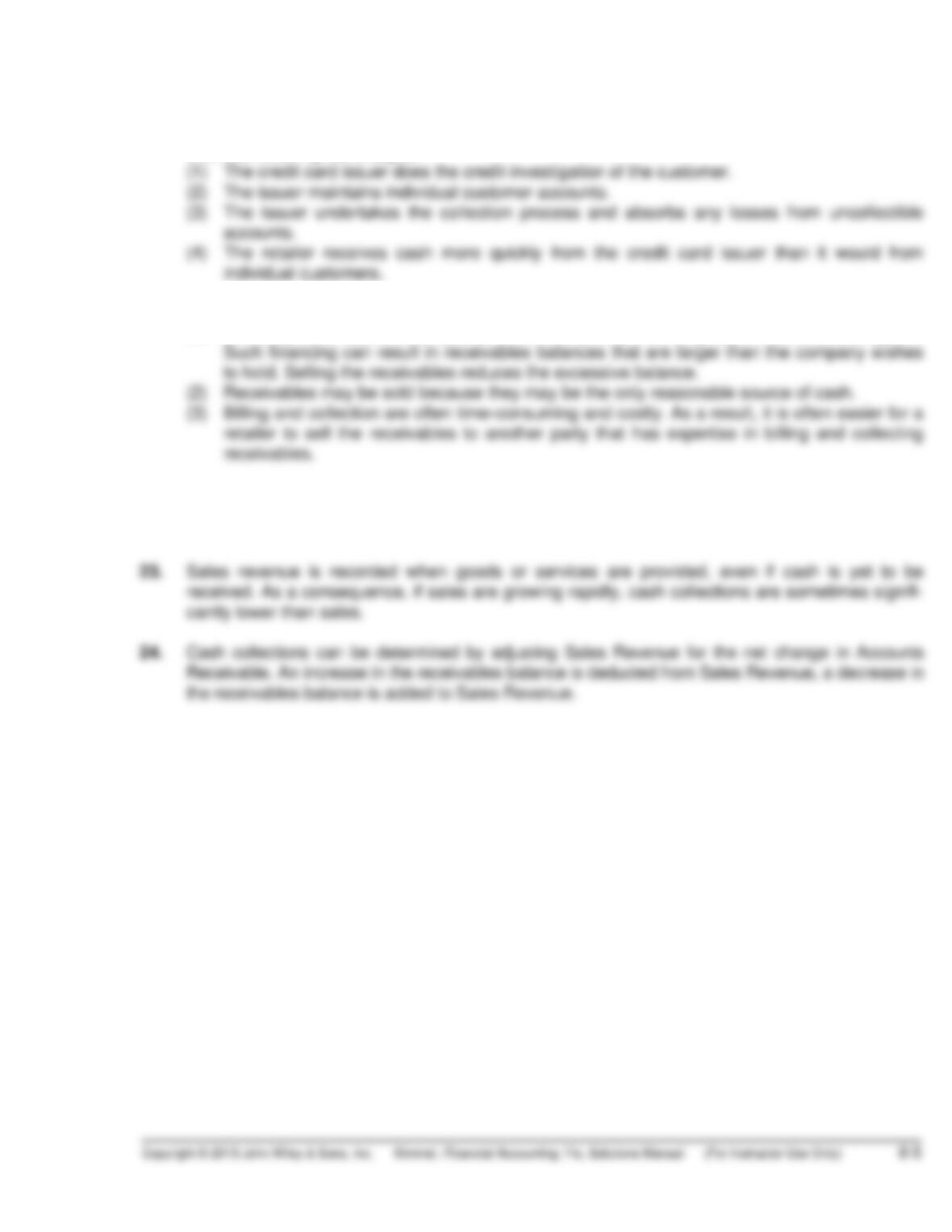
21. The reasons companies sell their receivables are:
(1) For competitive reasons, companies often must provide financing to purchasers of their goods.
22. Cash ………………………………………………………………………………………………….. 388,000
Service Charge Expense (3% X $400,000) ……………………………………………… 12,000
Accounts Receivable …………………………………………………………………….. 400,000
SOLUTIONS TO BRIEF EXERCISES
BRIEF EXERCISE 8-1
(a) Other receivables.
(b) Notes receivable.
(c) Accounts receivable.
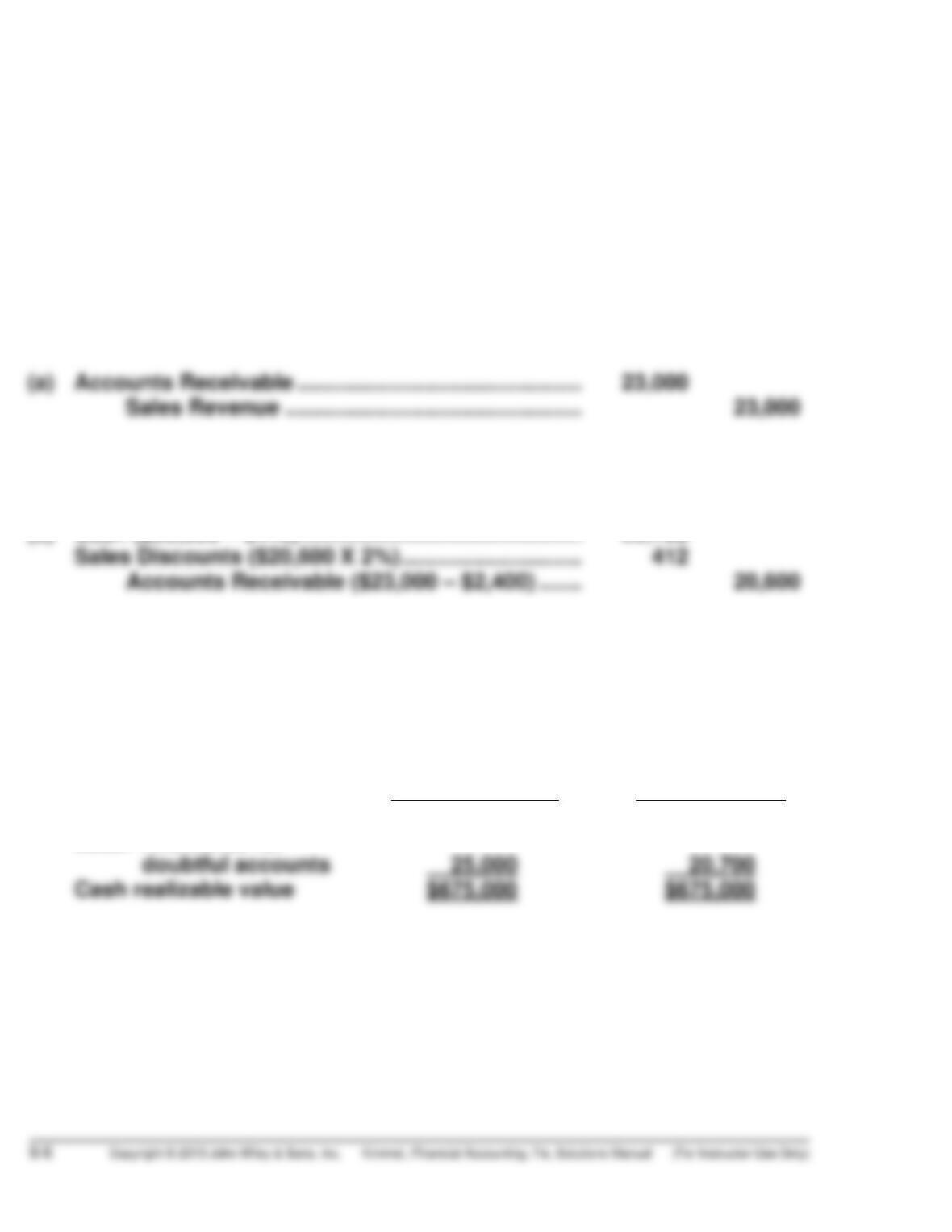
BRIEF EXERCISE 8-2
(b) Sales Returns and Allowances …………………………. 2,400
Accounts Receivable ………………………………… 2,400
(c) Cash ($20,600 – $412) ………………………………………. 20,188
BRIEF EXERCISE 8-3
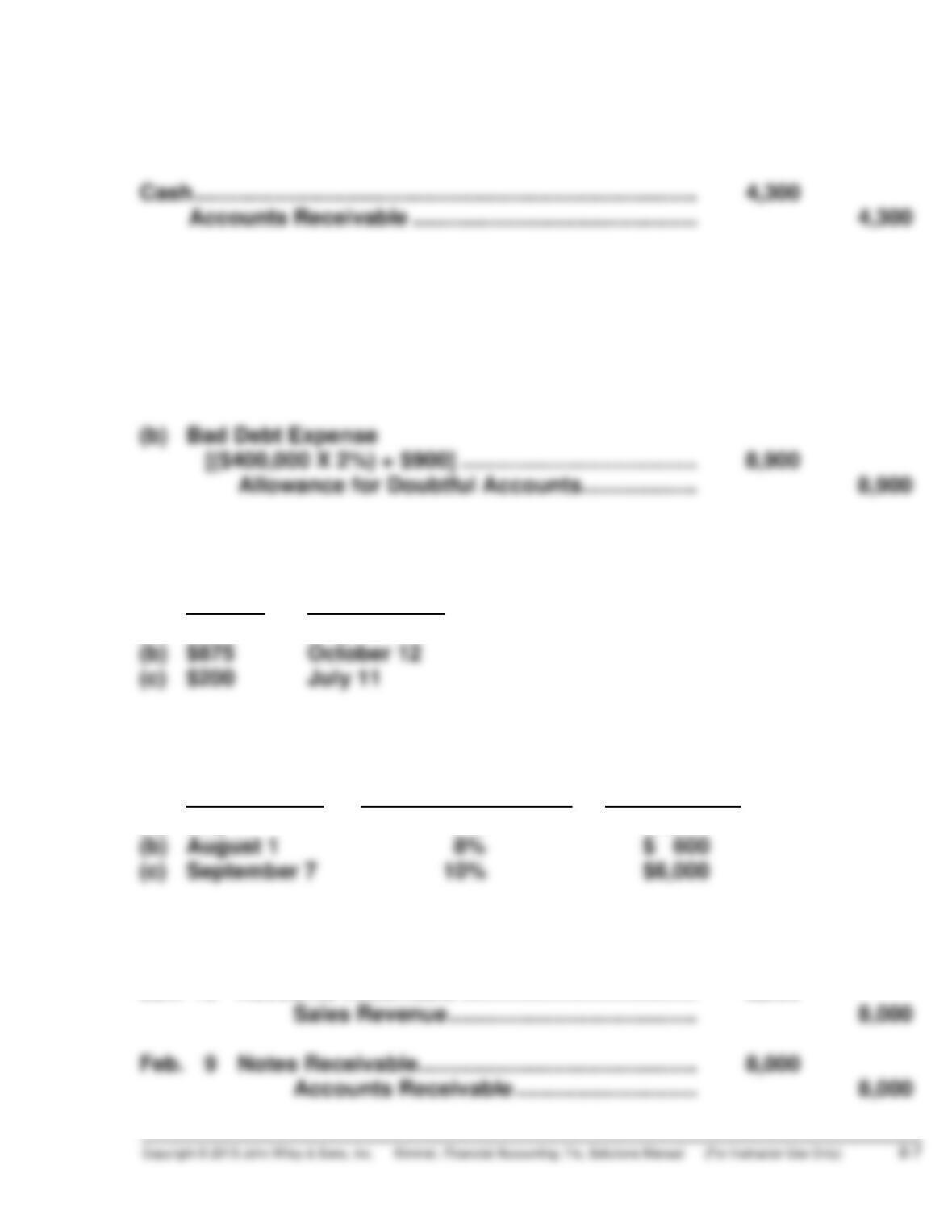
(a) Allowance for Doubtful Accounts ……………………… 4,300
Accounts Receivable ………………………………… 4,300
(b) (1) Before Write-Off (2) After Write-Off
Accounts receivable $700,000 $695,700
Less: Allowance for
BRIEF EXERCISE 8-4
Accounts Receivable ………………………………………………. 4,300
Allowance for Doubtful Accounts ……………………… 4,300
BRIEF EXERCISE 8-5
(a) Bad Debt Expense
[($400,000 X 2%) – $2,800] ……………………………… 5,200
Allowance for Doubtful Accounts ………………. 5,200
BRIEF EXERCISE 8-6
Interest Maturity Date
(a) $800 August 9
BRIEF EXERCISE 8-7
Maturity Date Annual Interest Rate Total Interest
(a) May 31 9% $9,000
BRIEF EXERCISE 8-8
Jan. 10 Accounts Receivable ………………………………… 8,000
BRIEF EXERCISE 8-9
(a) Bad Debt Expense …………………………………………… 18,000
Allowance for Doubtful Accounts ……………… 18,000
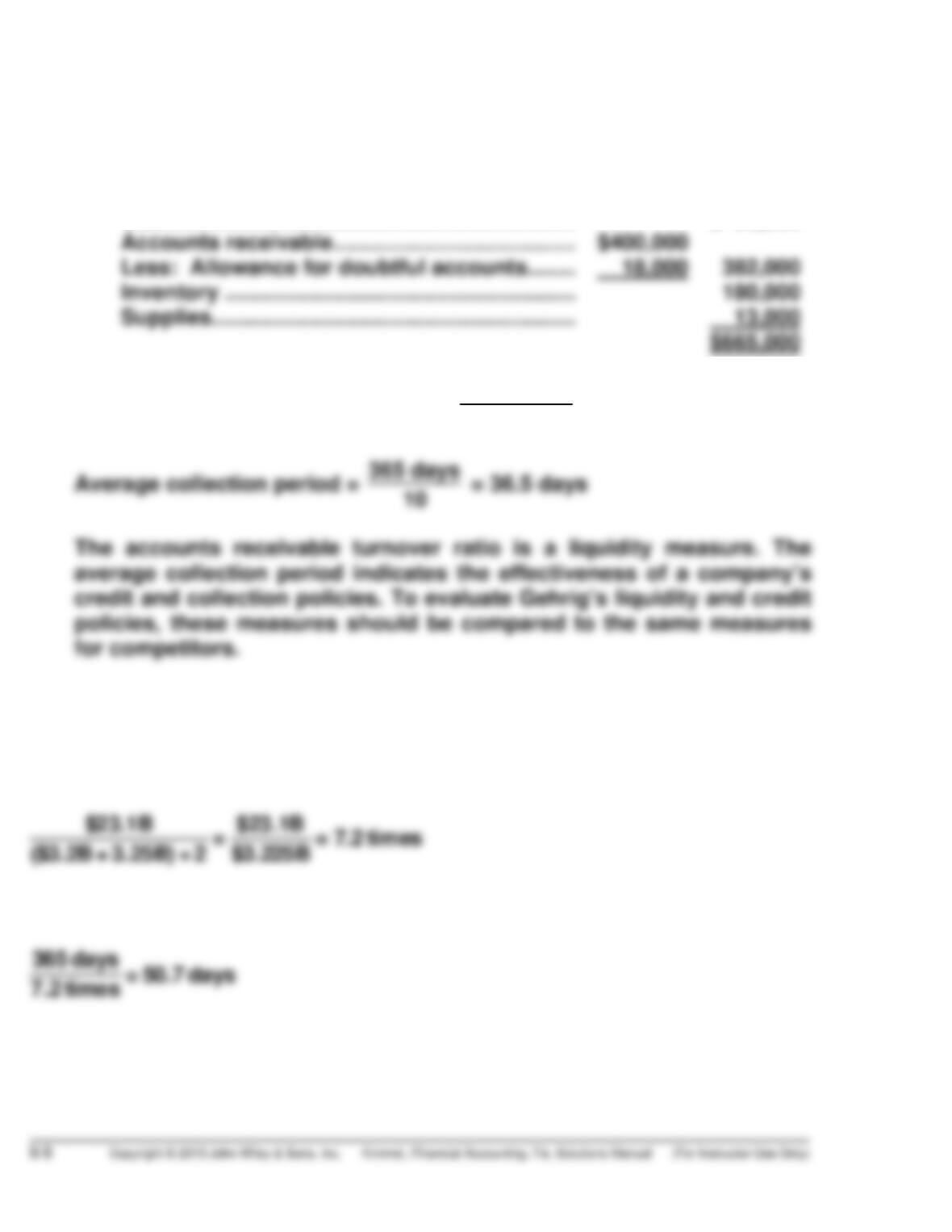
(b) Current assets
Cash ………………………………………………………… $ 90,000
(c) Accounts receivable turnover ratio = $3,000,000
$300,000 = 10 times
BRIEF EXERCISE 8-10
Accounts Receivable Turnover Ratio:
Average Collection Period:
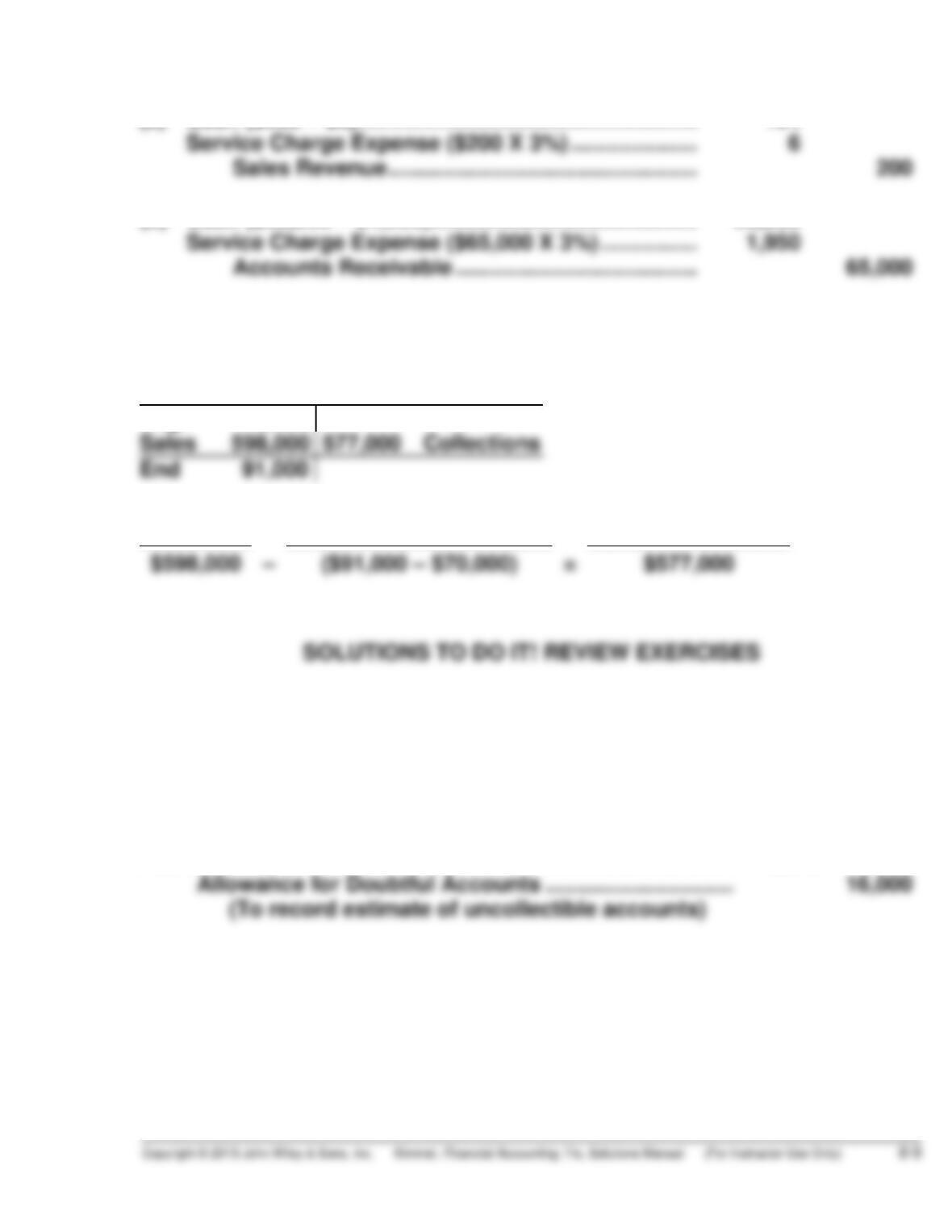
BRIEF EXERCISE 8-11
(a) Cash ($200 – $6) ……………………………………………….. 194
(b) Cash ($65,000 – $1,950) …………………………………….. 63,050
BRIEF EXERCISE 8-12
Accounts Receivable
Beg. 70,000
or
Sales – Increase in Receivables = Cash Collections
DO IT! 8-1
The following entry should be prepared to bring the balance in the Allow-
ance for Doubtful Accounts up from $5,700 credit to $21,700 credit (7% X
$310,000):
Bad Debt Expense ………………………………………………………… 16,000
DO IT! 8-2
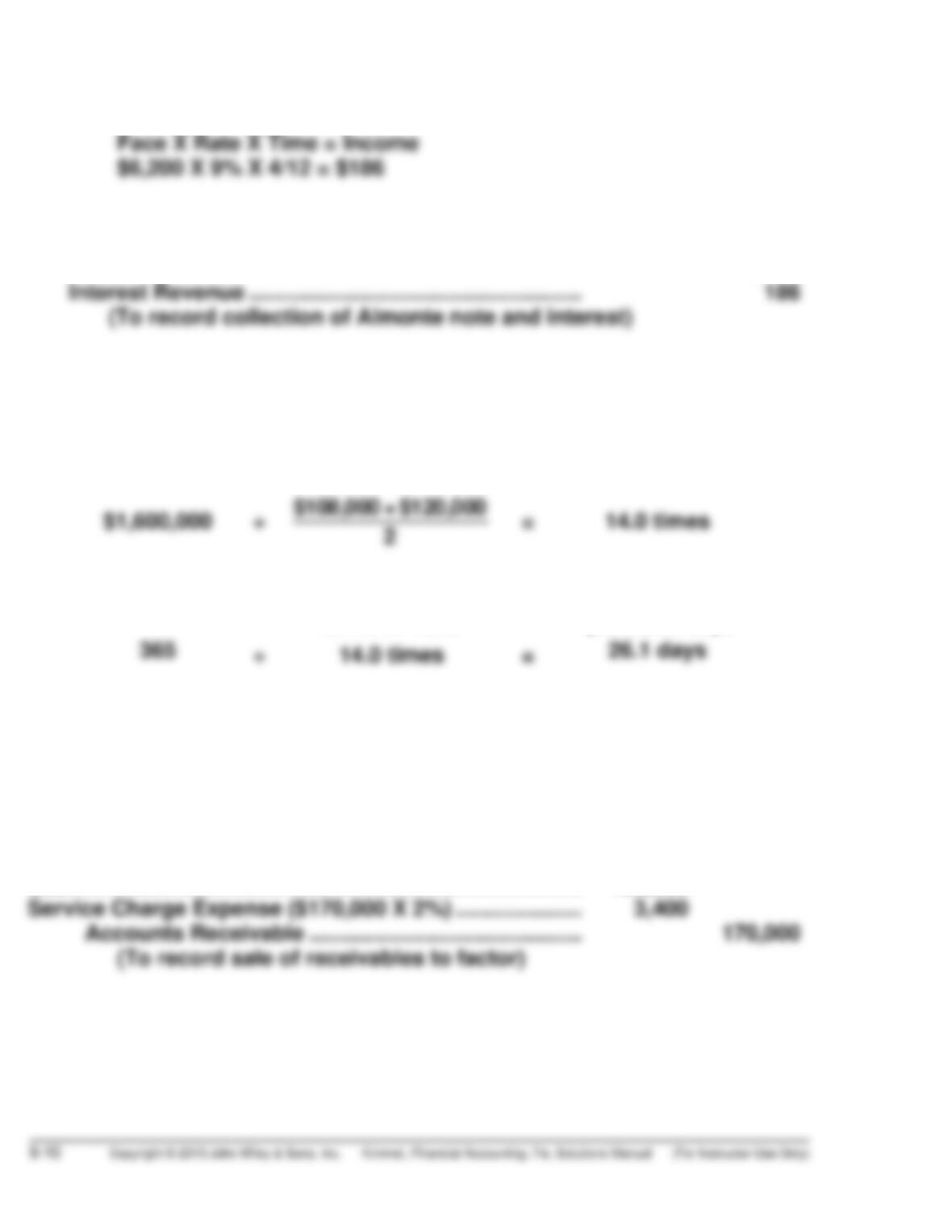
The interest payable at maturity is $186:
The entry recorded by Berkman Wholesalers at the maturity date is:
Cash ………………………………………………………………………. 6,386
Notes Receivable ……………………………………………… 6,200
DO IT! 8-3
(a) Net credit sales ÷ Average net
accounts receivable =Accounts receivable
turnover ratio
(b) Days in year ÷ Accounts receivable
turnover ratio =Average collection
period in days
DO IT! 8-4
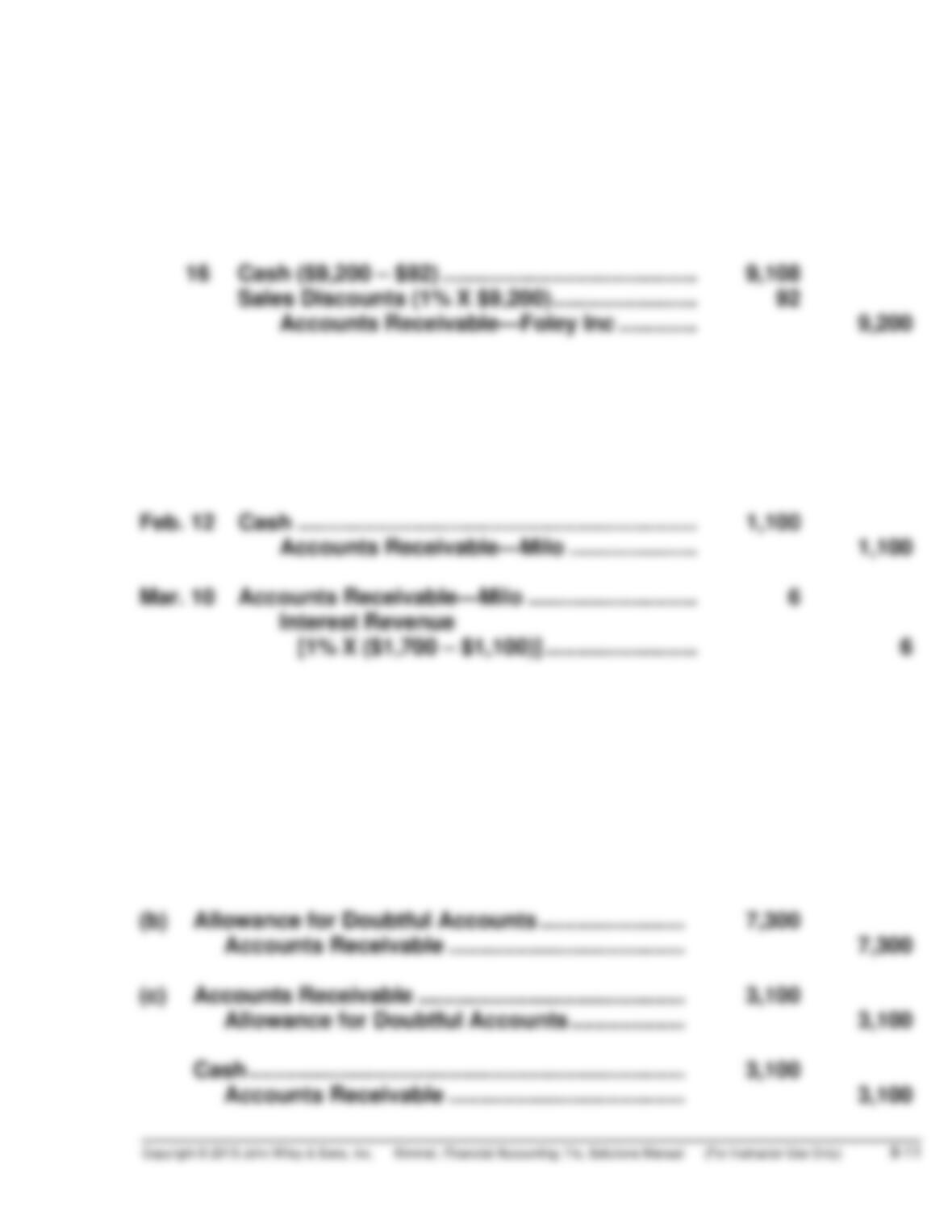
To speed up the collection of cash, Lounow sells $170,000 of its accounts
receivable to a factor. Assuming the factor charges Lounow a 2% service
charge, it would make the following entry:
Cash ………………………………………………………………………. 166,600
SOLUTIONS TO EXERCISES
EXERCISE 8-1
Jan. 6 Accounts Receivable—Foley Inc ……………….. 9,200
Sales Revenue ……………………………………. 9,200
EXERCISE 8-2
Jan. 10 Accounts Receivable—Milo ………………………. 1,700
Sales Revenue ……………………………………. 1,700
EXERCISE 8-3
(a) Accounts Receivable …………………………………….. 800,000
Sales Revenue ………………………………………….. 800,000
Cash ……………………………………………………………… 763,000
Accounts Receivable ………………………………… 763,000
EXERCISE 8-3 (Continued)
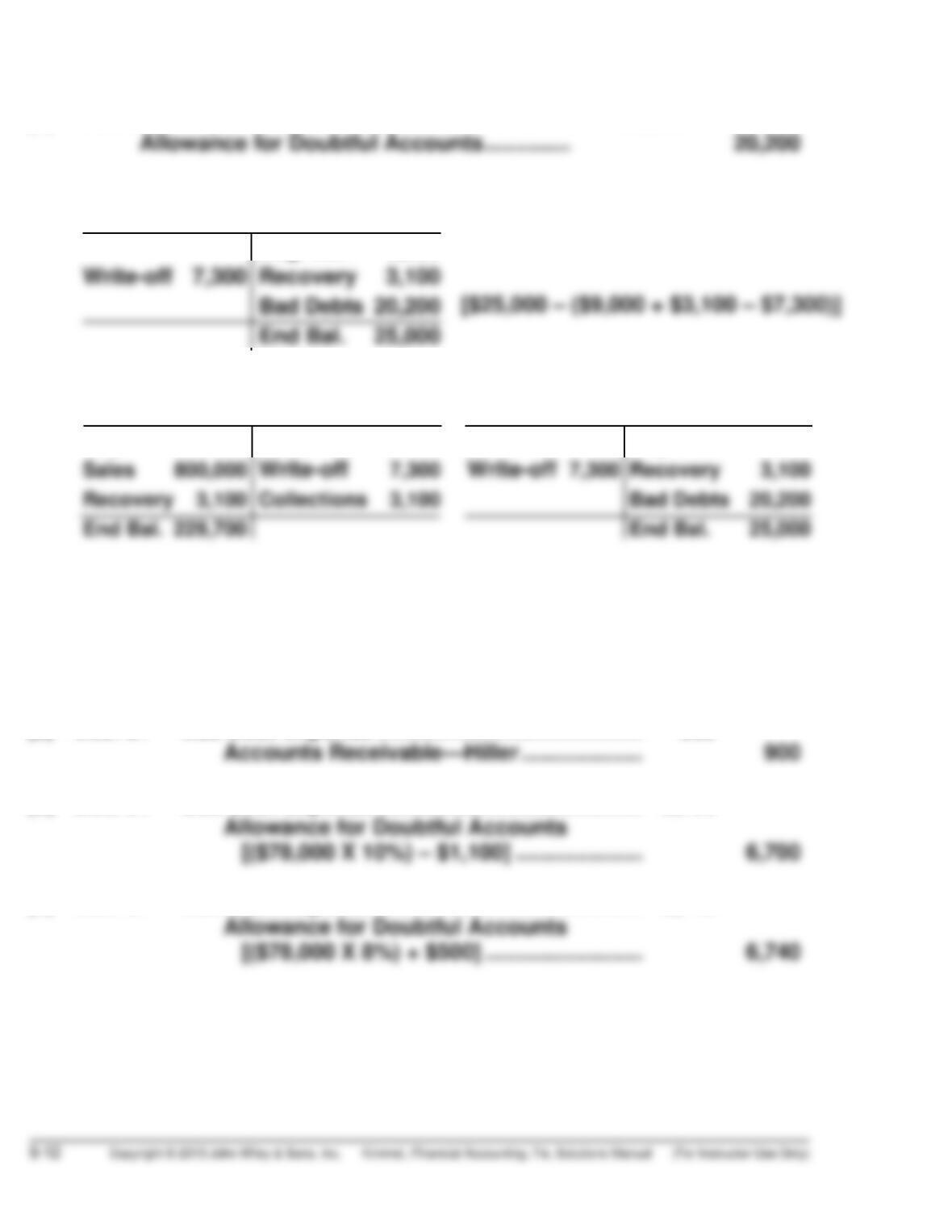
(d) Bad Debt Expense…………………………………………. 20,200
Allowance for Doubtful Accounts
Beg. Bal. 9,000
(e) Accounts Receivable Allowance for Doubtful Accounts
Beg. Bal. 200,000 Collections 763,000 Beg. Bal. 9,000
(f) Net realizable value of receivables is $204,700 ($229,700 – $25,000)
EXERCISE 8-4
(a) Dec. 31 Bad Debt Expense …………………………………….. 900
(b) Dec. 31 Bad Debt Expense …………………………………….. 6,700
(c) Dec. 31 Bad Debt Expense …………………………………….. 6,740
EXERCISE 8-5
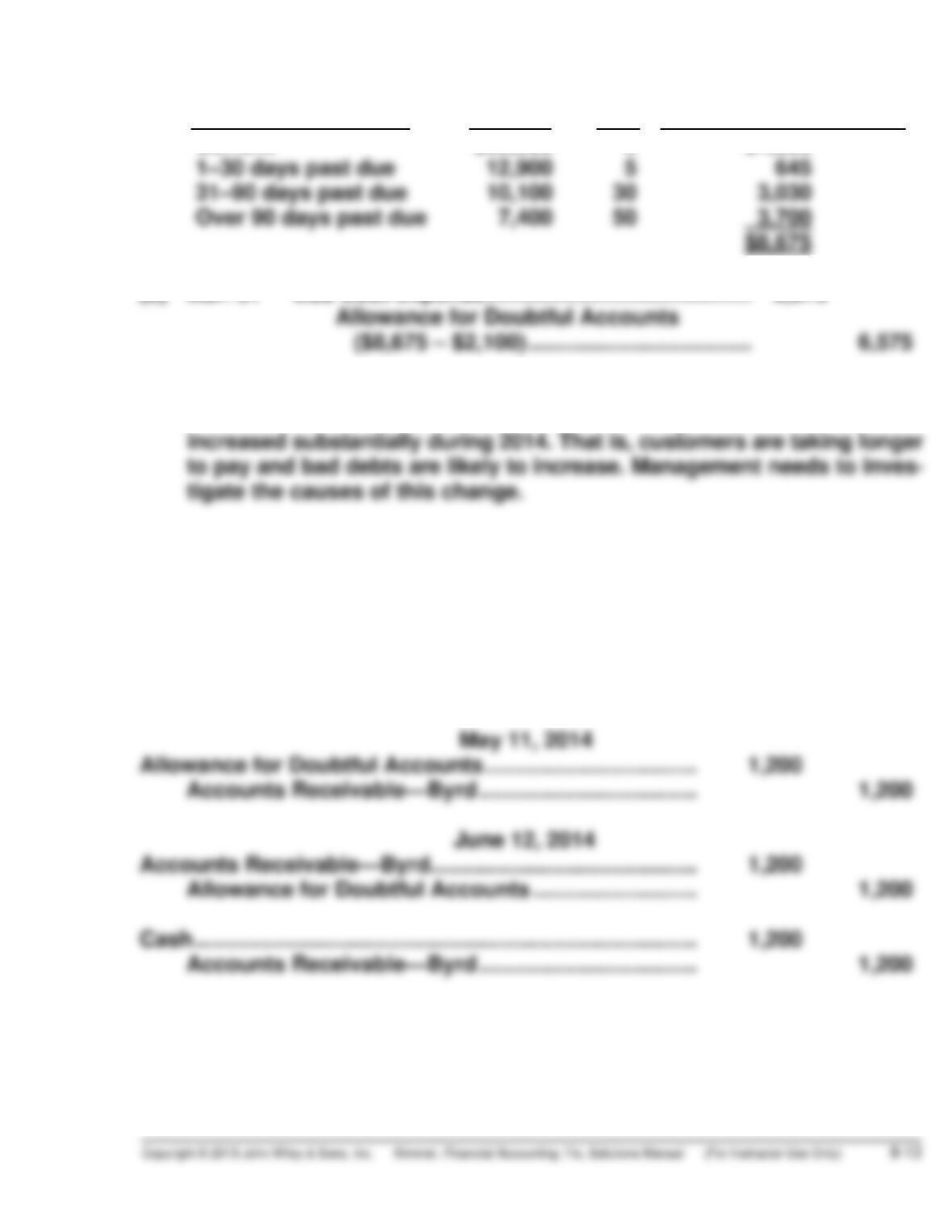
(a) Accounts Receivable Amount % Estimated Uncollectible
Current $65,000 2 $1,300
(b) Mar. 31 Bad Debt Expense …………………………………….. 6,575
(c) The total balance of receivables increased from 2013 to 2014. However,
of concern is the fact that each of the three categories of older accounts
EXERCISE 8-6
December 31, 2013
Bad Debt Expense ………………………………………………….. 9,500
Allowance for Doubtful Accounts
[(9% X $90,000) + $1,400] ……………………………….. 9,500
EXERCISE 8-7
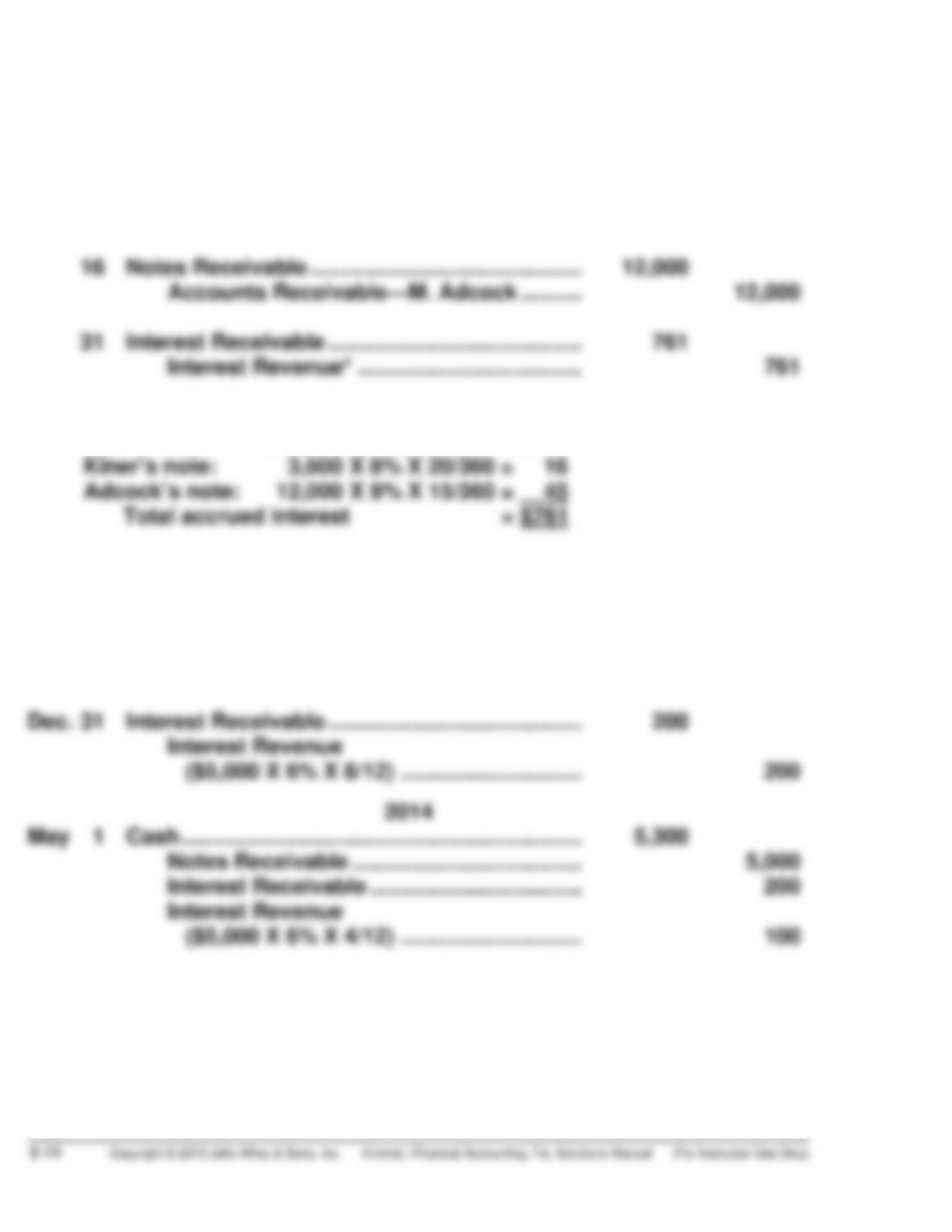
Nov. 1 Notes Receivable ……………………………………… 60,000
Cash ………………………………………………….. 60,000
Dec. 11 Notes Receivable ……………………………………… 3,600
Sales Revenue …………………………………… 3,600
*Calculation of interest revenue:
Carr’s note: $60,000 X 7% X 2/12 = $700
EXERCISE 8-8
2013
May 1 Notes Receivable ……………………………………… 5,000
Accounts Receivable—S. Rooney ……….. 5,000
EXERCISE 8-9
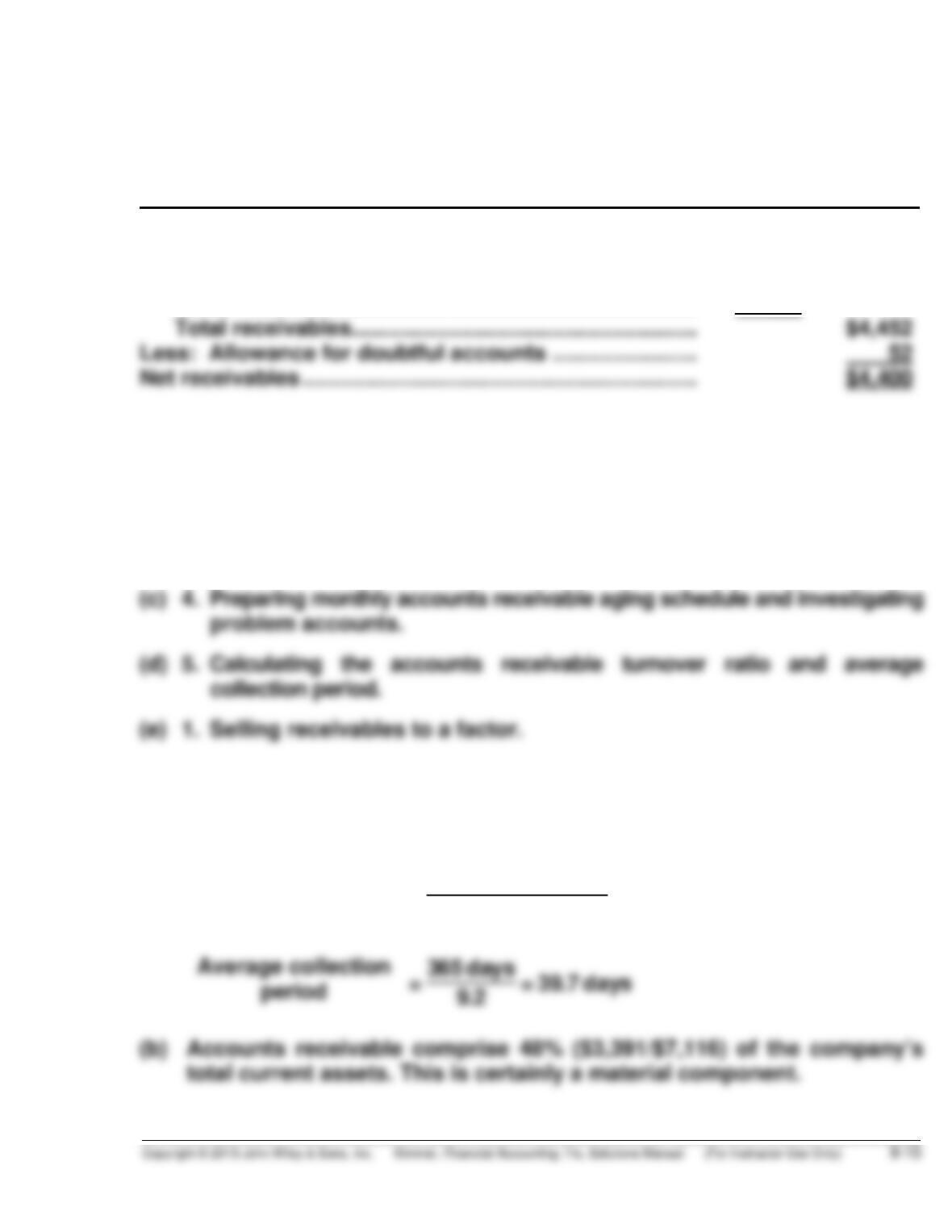
SHANNON CORP.
Balance Sheet (Partial)
October 31, 2014
(in thousands)
Receivables
Notes receivable ………………………………………………… $1,353
Accounts receivable …………………………………………… 2,910
Other receivables ……………………………………………….. 189
EXERCISE 8-10
(a) 2. Reviewing company ratings in the Dun and Bradstreet Reference Book
of American Business.
(b) 3. Collecting information on competitors’ payment period policies.
EXERCISE 8-11
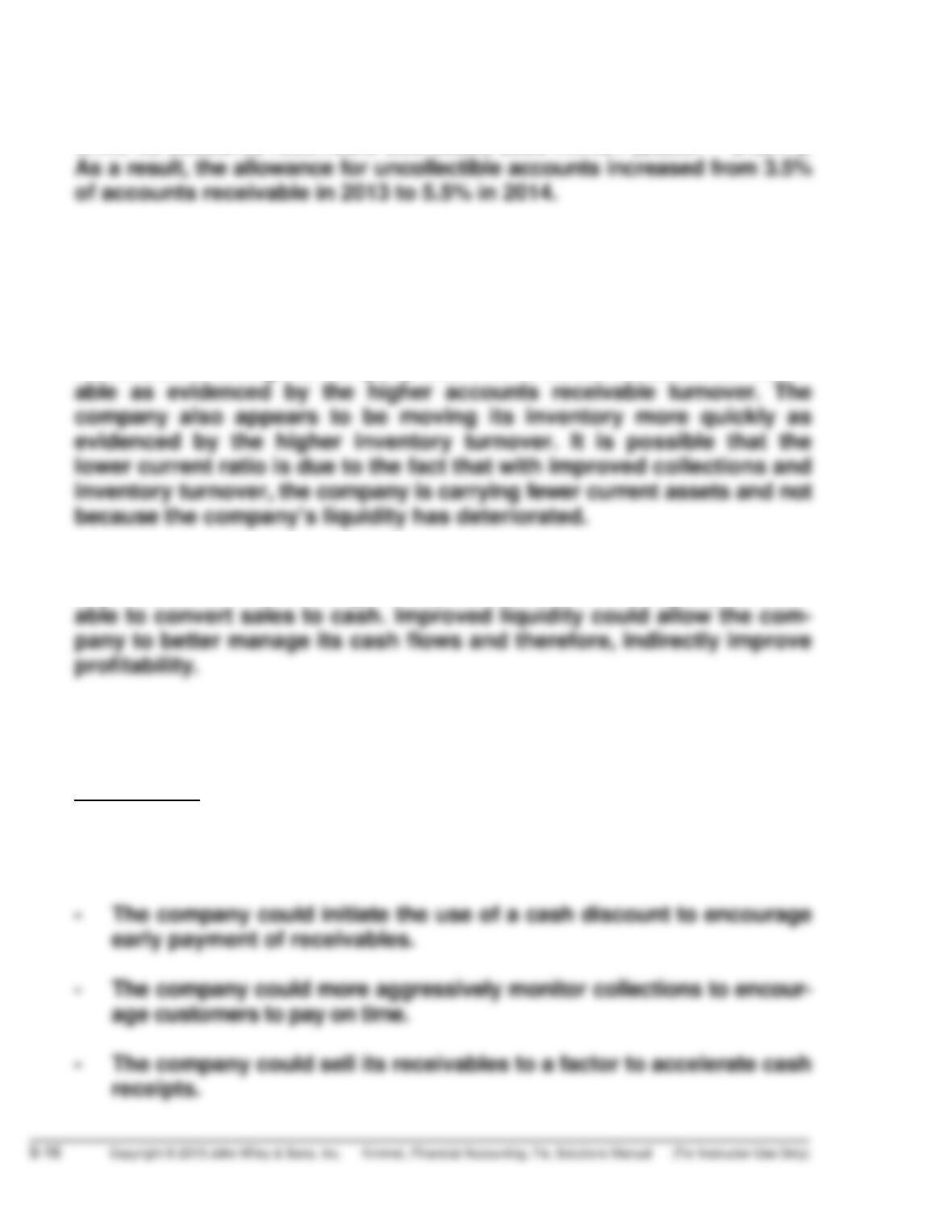
(a)
Accounts receivable
turnover ratio =$35,497
($3,391+ $4,359)/2 =9.2 times
EXERCISE 8-11 (Continued)
(c) The balance in the allowance account increased $38 million ($196 – $158)
while its accounts receivable decreased $930 million ($3,587 – $4,517).
EXERCISE 8-12
(a) At first glance it appears that Lin’s liquidity had deteriorated over the
past year since the company’s current ratio has fallen from 1.5:1 to 1.3:1.
However, it is taking the company less time to collect its accounts receiv-
(b) Changes in the turnover ratios do not directly affect profitability. However,
improvements in turnover generally indicate that the company is better
(c) There are several steps that Lin might have taken to improve its
receivables and inventory turnover:
Receivables
– The company could limit credit to only the best customers, however,
this could negatively affect sales.
EXERCISE 8-12 (Continued)
Inventory
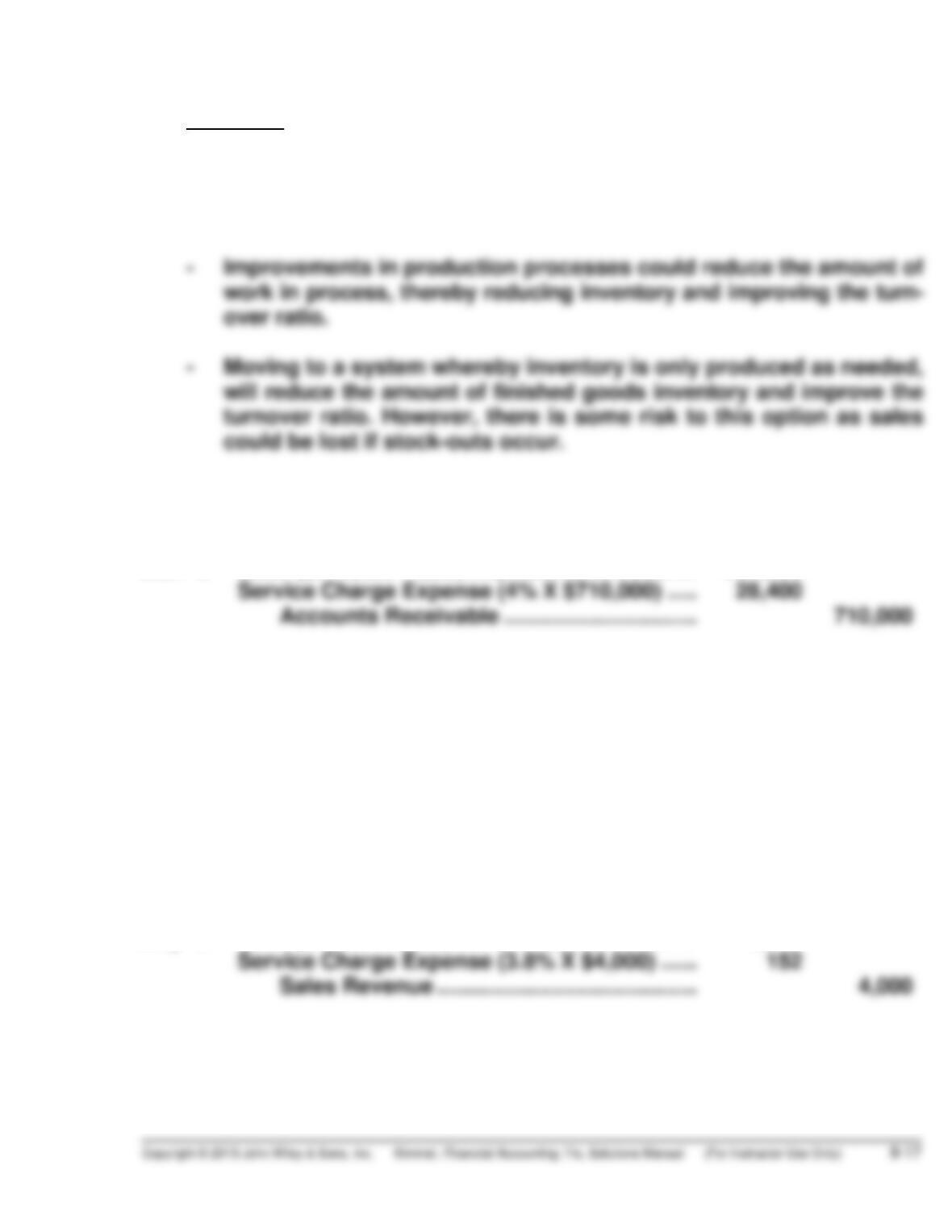
– The company could limit the amount of inventory by improving its
purchasing relationships with suppliers. If inventory could be pur-
chased more frequently, required inventory levels could be reduced.
EXERCISE 8-13
Mar. 3 Cash ($710,000 – $28,400) …………………………. 681,600
EXERCISE 8-14
One possible reason Office Depot chose to sell its receivables may have
been to improve its financial ratios. Other reasons include not wanting to
deal with the administration of collecting accounts or the desire to accelerate
cash receipts.
EXERCISE 8-15
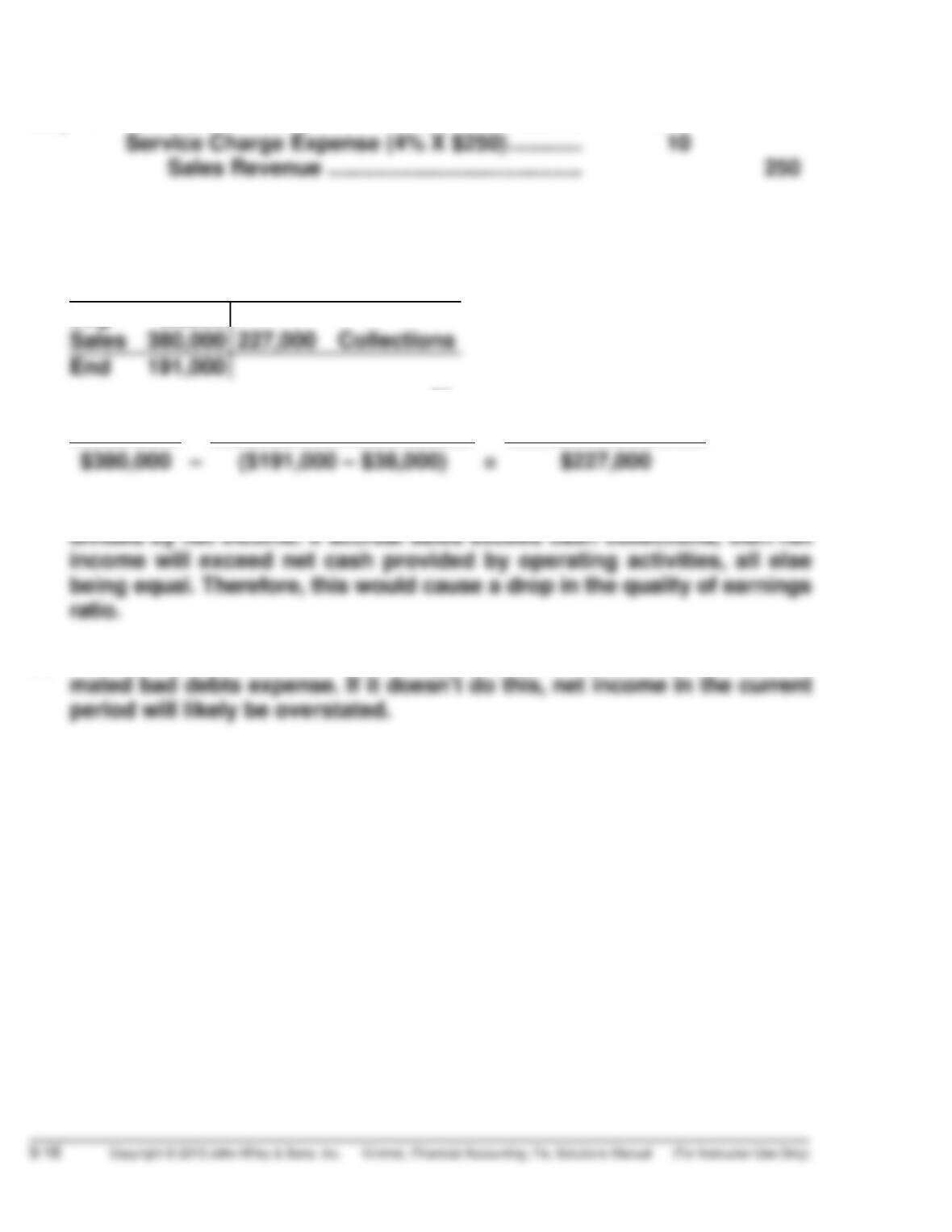
May 10 Cash ($4,000 – $152) …………………………………. 3,848
EXERCISE 8-16
July 4 Cash ($250 – $10) ……………………………………… 240
EXERCISE 8-17
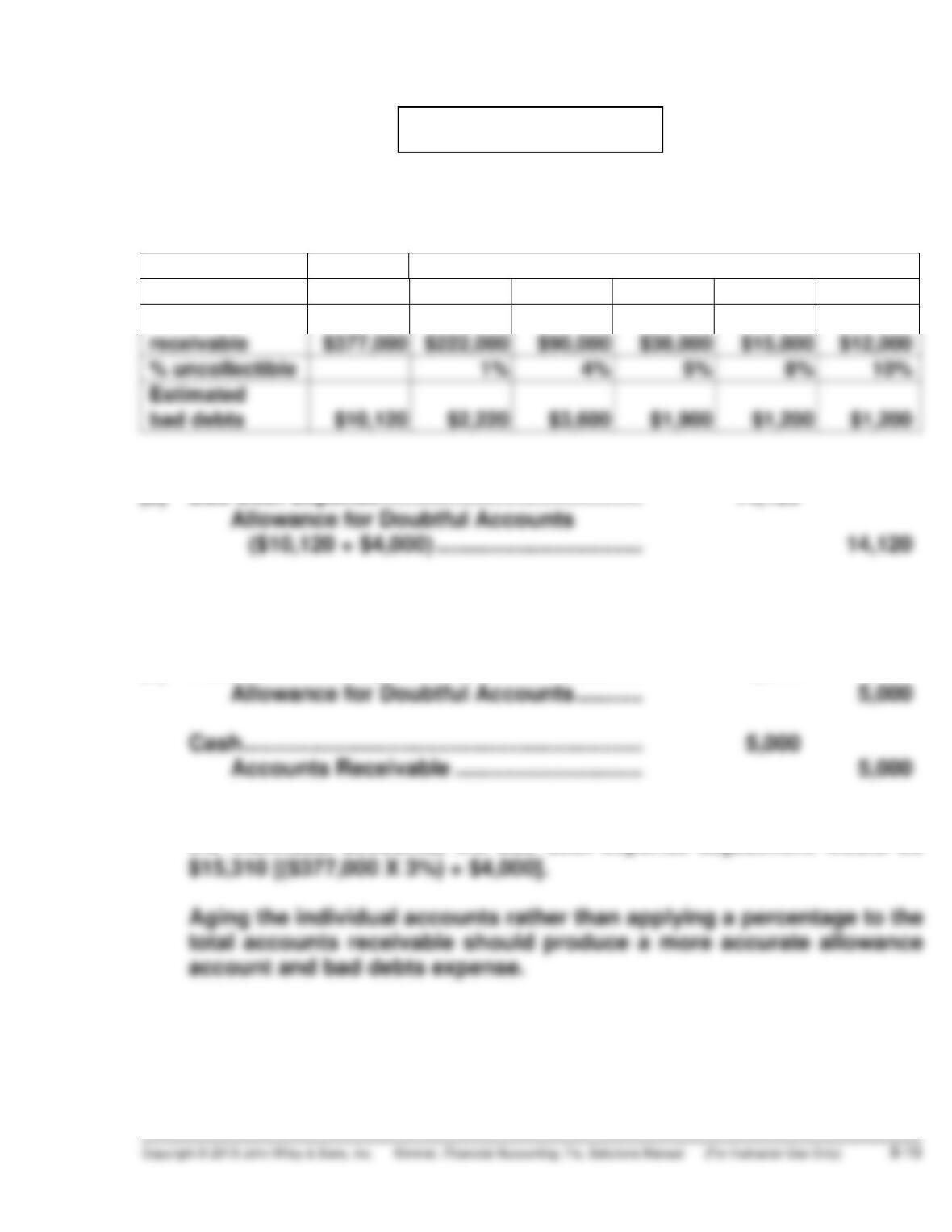
(a) Accounts Receivable
Beg 38,000
or
Sales – Increase in Receivables = Cash Collections
(b) The quality of earnings ratio is net cash provided by operating activities
(c) If the company relaxed its credit requirements it should increase its esti-
SOLUTIONS TO PROBLEMS
PROBLEM 8-1A
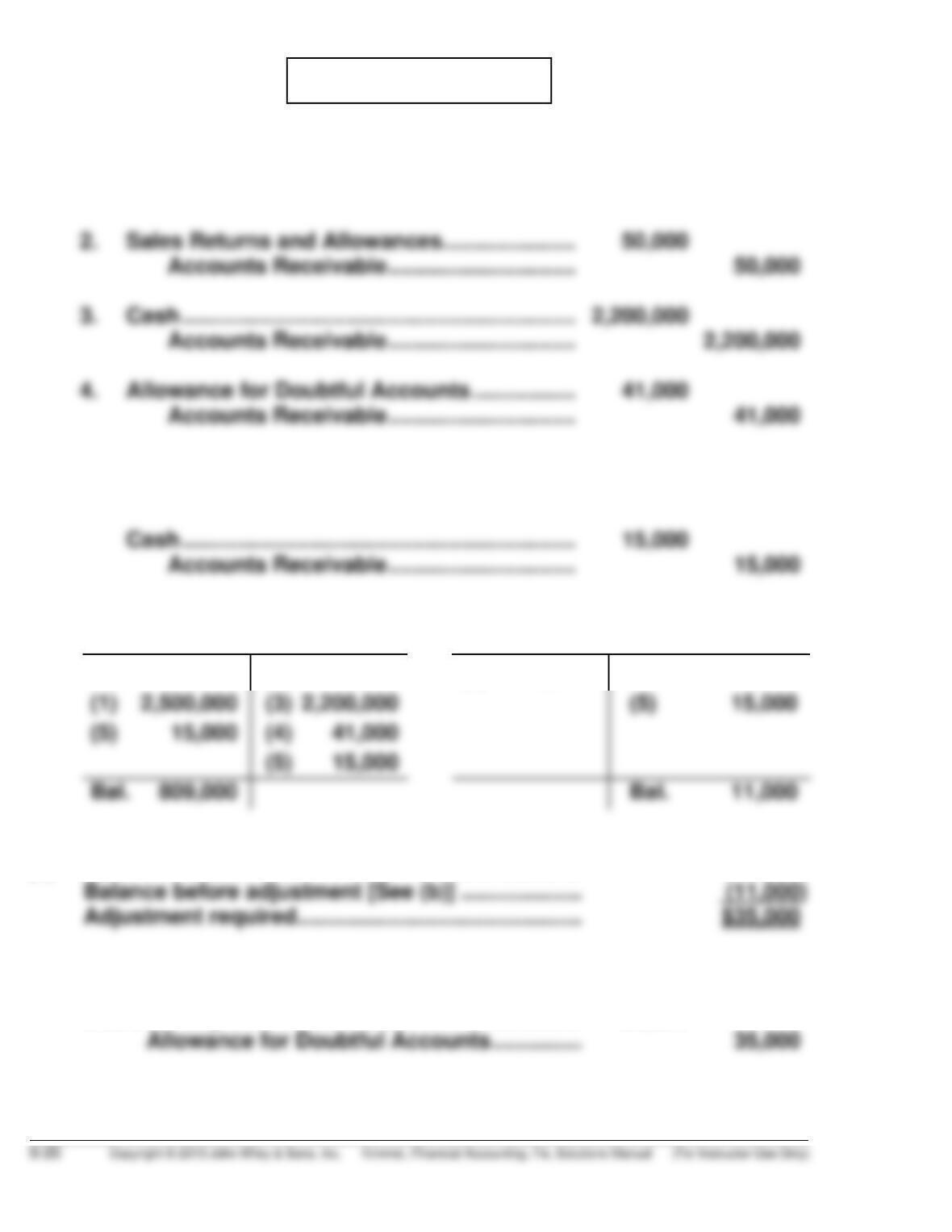
(a) Total estimated bad debts
Number of Days Outstanding
Total 0–30 31–60 61–90 91–120 Over 120
Accounts
(b) Bad Debt Expense ……………………………………. 14,120
(c) Allowance for Doubtful Accounts ……………… 5,000
Accounts Receivable …………………………. 5,000
(d) Accounts Receivable ……………………………….. 5,000
(e) If Reynolds.com used 3% of total accounts receivable rather than aging
the individual accounts, the bad debt expense adjustment would be
PROBLEM 8-2A
(a) 1. Accounts Receivable ……………………………….. 2,500,000
Sales Revenue ………………………………….. 2,500,000
5. Accounts Receivable ……………………………….. 15,000
Allowance for Doubtful Accounts ………. 15,000
(b) Accounts Receivable Allowance for Doubtful Accounts
Bal. 600,000 (2) 50,000 (4) 41,000 Bal. 37,000
(c) Balance needed ……………………………………………… $46,000
The journal entry would therefore be as follows:
Bad Debt Expense ………………………………………….. 35,000