CHAPTER 8
SOLUTIONS TO EXERCISES—SET B
EXERCISE 8-1B
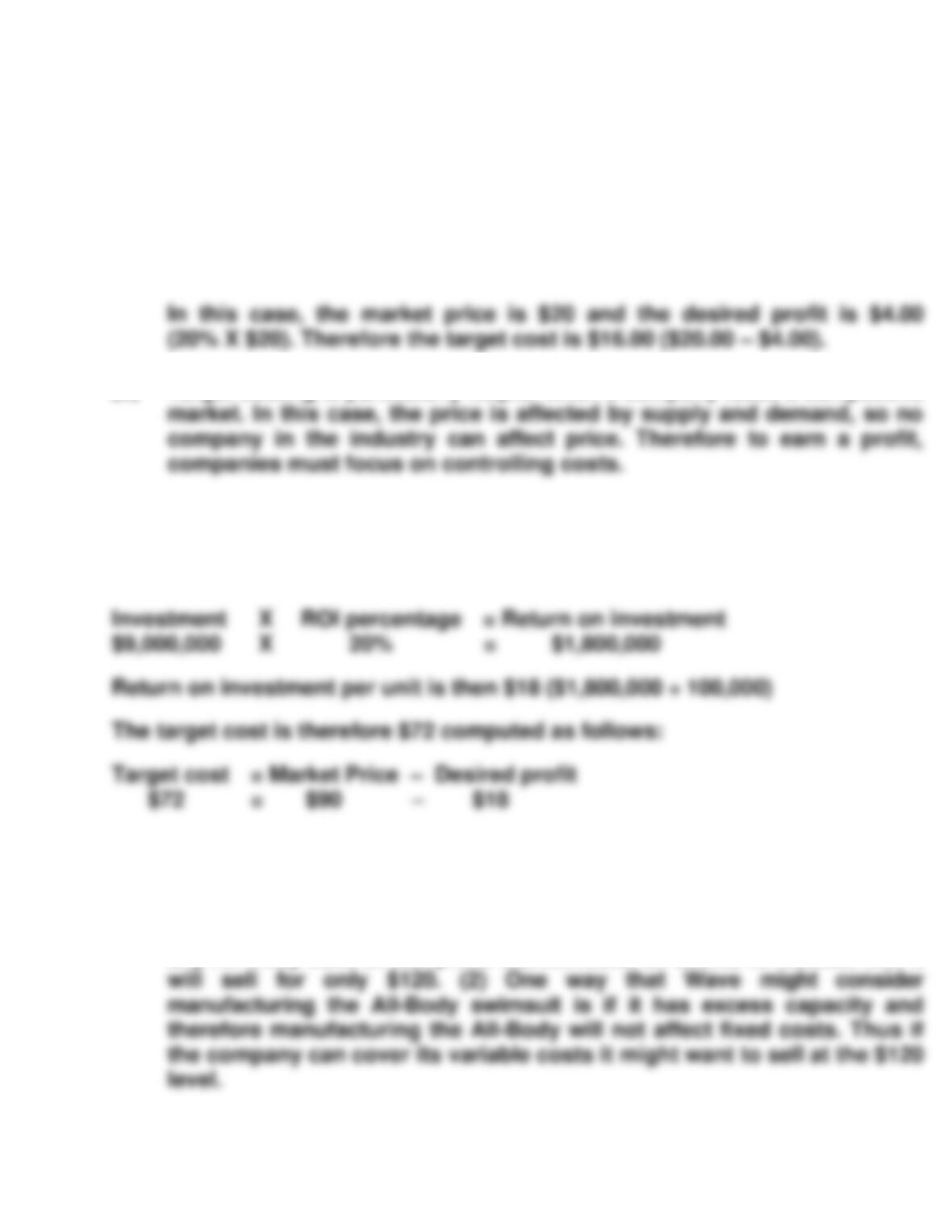
(a) The target cost formula is: Target cost = Market price – Desired profit.
(b) Target costing is particularly helpful when a company faces a competitive
EXERCISE 8-2B
The following formula may be used to determine return on investment
EXERCISE 8-3B
(a) (1) In this case the selling price would be $132 ($110 + [$110 X 20%]). The
problem with the $132 is that it is unlikely that Wave will be able to sell
any All-Body suits at that price. Market research seems to indicate that it
EXERCISE 8-3B (Continued)
(b) In this case the amount would be the selling price of $120.
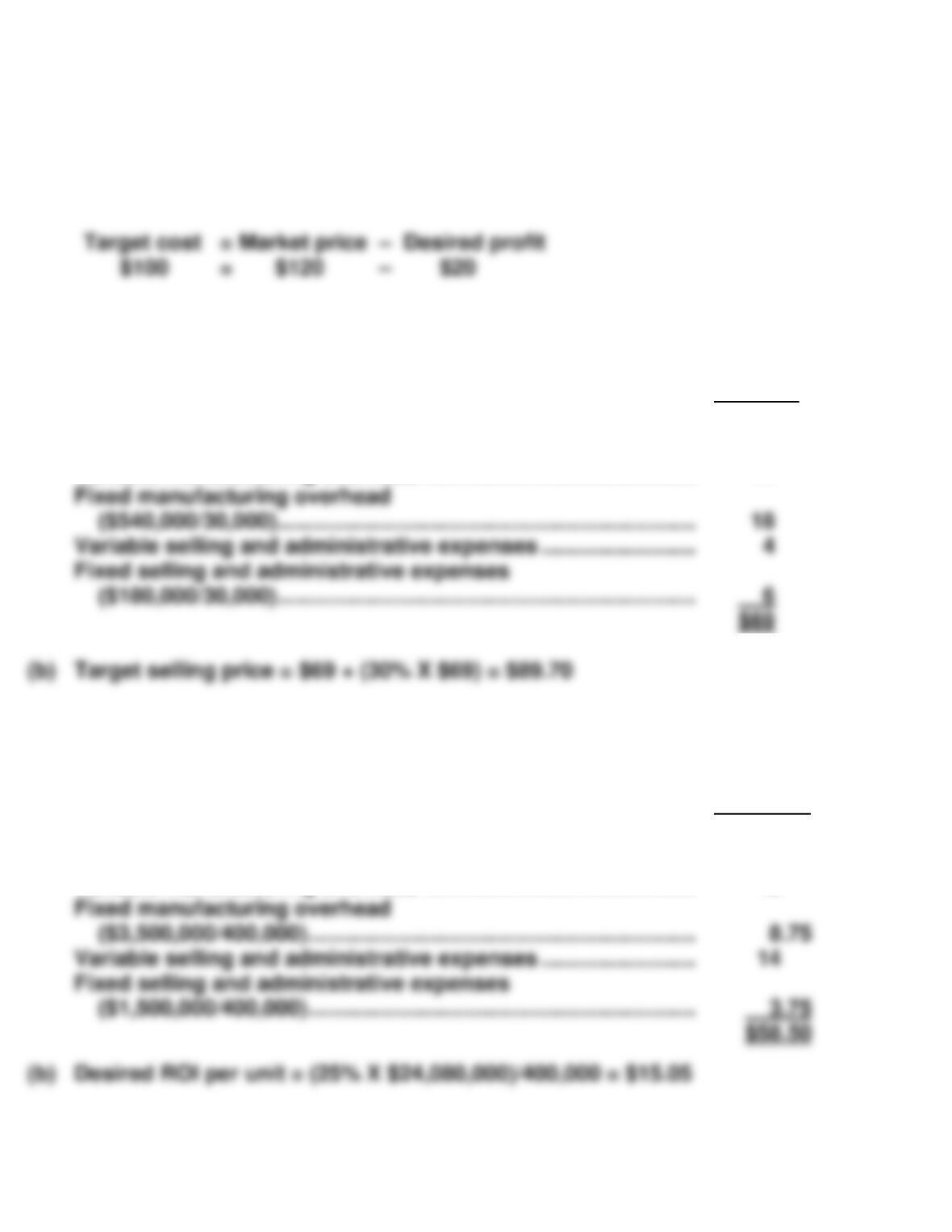
(c) The highest acceptable cost would be the target cost. The target cost is
$100 as shown below:
EXERCISE 8-4B
(a) Total cost per unit:
Per Unit
Direct materials ………………………………………………………………..
Direct labor ………………………………………………………………………
Variable manufacturing overhead ……………………………………..
$20
10
11
EXERCISE 8-5B
(a) Total cost per unit:
Per Unit
Direct materials ………………………………………………………………..
Direct labor ………………………………………………………………………
Variable manufacturing overhead ……………………………………..
$ 8
9
15
EXERCISE 8-5B (Continued)
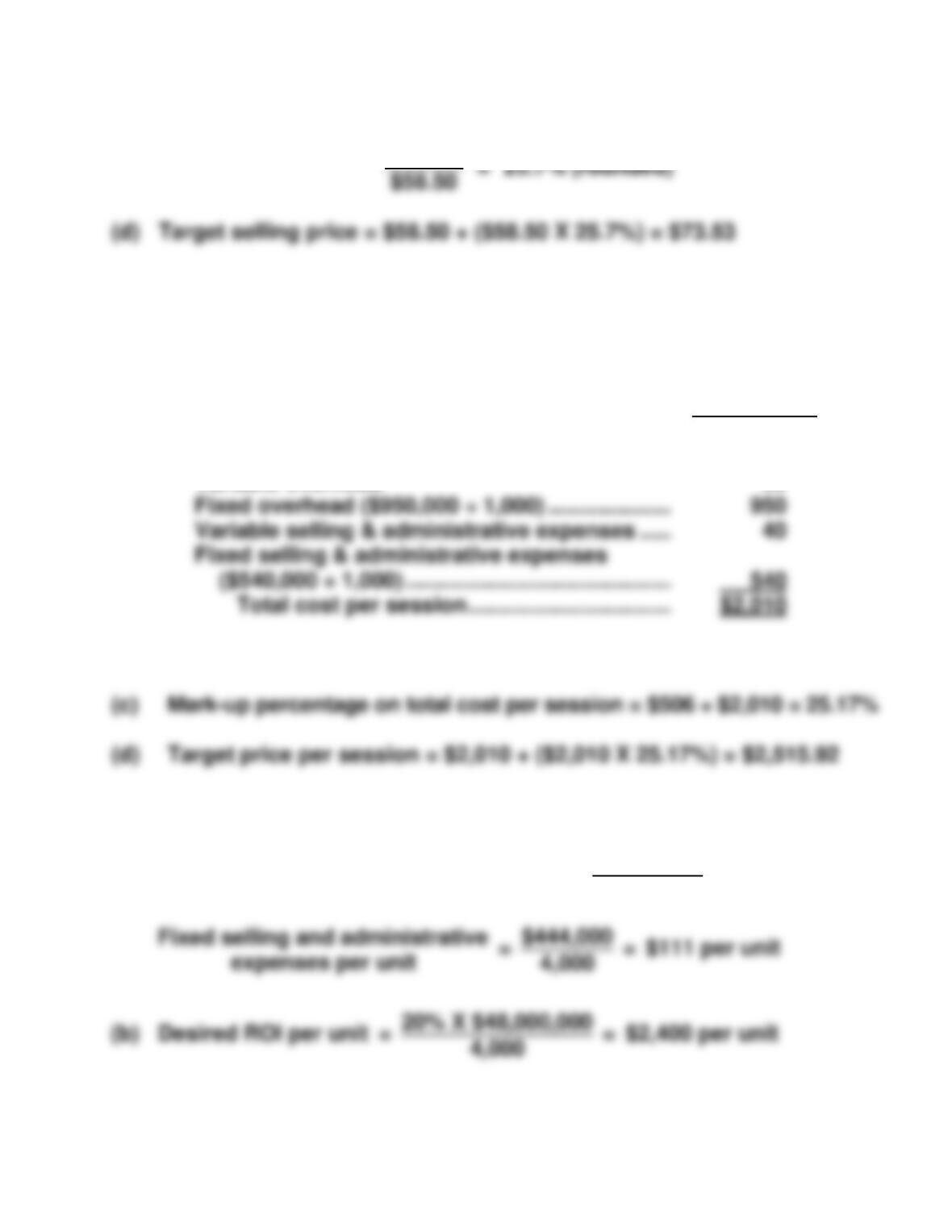
(c) Markup percentage using total cost per unit:
$15.05
EXERCISE 8-6B
(a)
Total cost per session:
Per Session
Direct materials …………………………………………..
$ 30
Direct labor …………………………………………………
400
Variable overhead
50
Fixed overhead ($950,000 ÷ 1,000) ………………..
950
Variable selling & administrative expenses …..
Fixed selling & administrative expenses
($540,000 ÷ 1,000) …………………………………….
540
Total cost per session …………………………...
$2,010
(b) Desired ROI per session = (22% X $2,300,000) ÷ 1,000 = $506
EXERCISE 8-7B
(a)
Fixed manufacturing overhead per unit
=
$2,160,000
=
$540 per unit
4,000
(b)
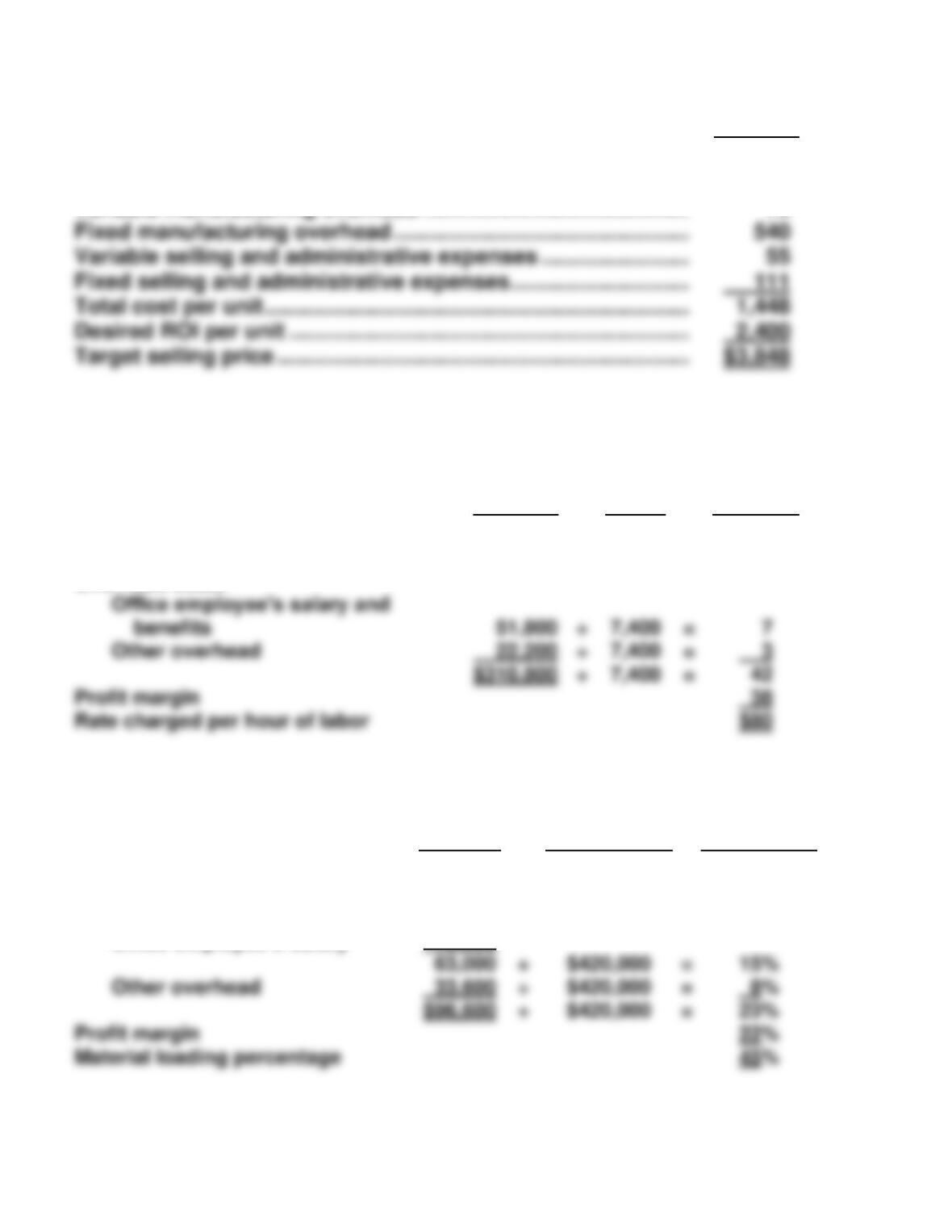
Desired ROI per unit
=
=
EXERCISE 8-7B (Continued)
(c)
Per Unit
Direct materials ………………………………………………………………..
Direct labor ………………………………………………………………………
Variable manufacturing overhead ……………………………………..
$ 380
290
72
EXERCISE 8-8B
(a)
Total
Cost
÷
Total
Hours
=
Per Hour
Charge
Hourly labor rate for repairs
Technician’s wages and benefits
Overhead costs
$236,800
÷
7,400
=
$32
(b)
Material
Loading
Charges
÷
Total
Invoice Cost,
Parts and
Materials
=
Material
Loading
Percentage
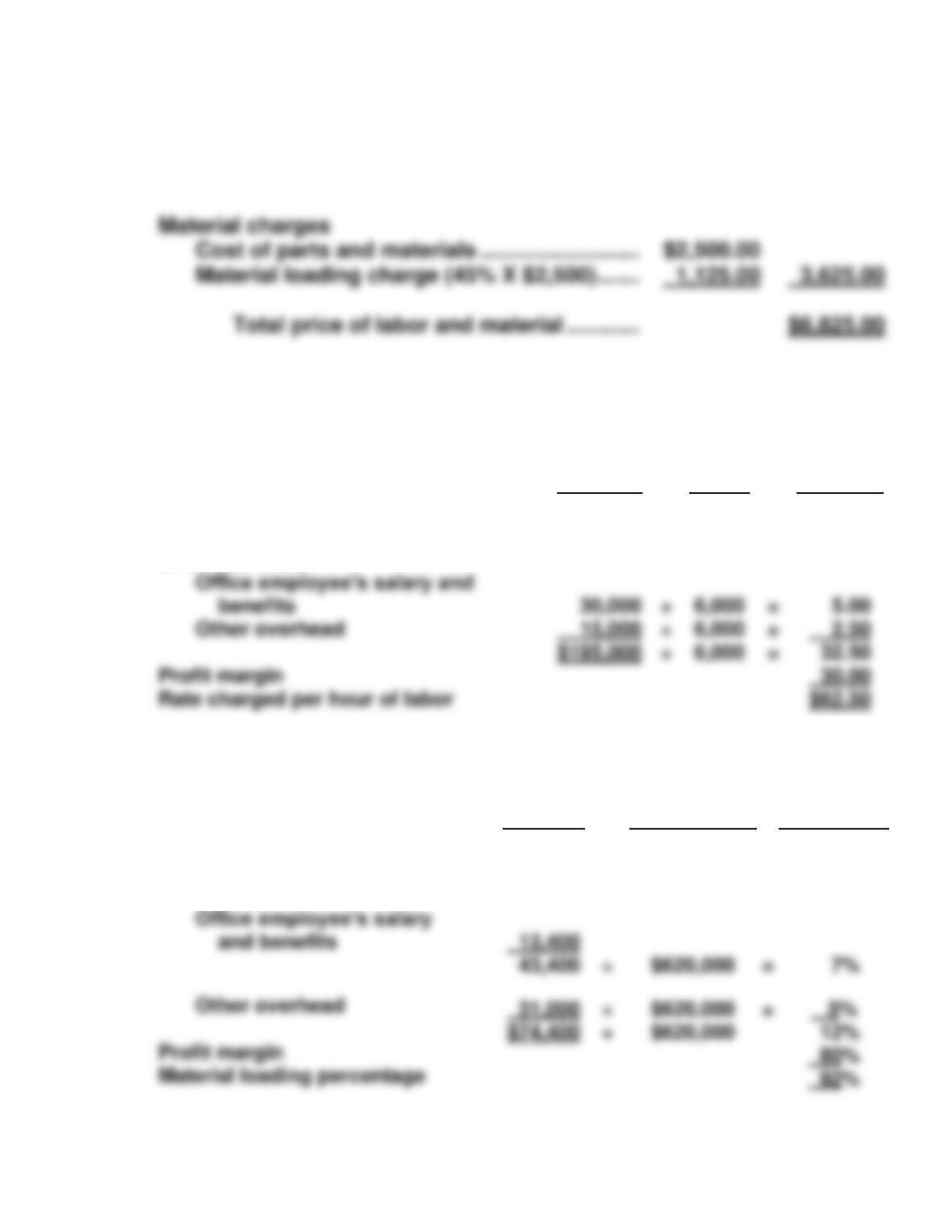
Overhead costs
Parts manager’s salary and
benefits
Office employee’s salary
$50,000
13,000
EXERCISE 8-8B (Continued)
(c) Job: Lore Corporation—Rebuild spot welder
Labor charges
40 hours @ $80 ………………………………………. $3,200.00
EXERCISE 8-9B
(a)
Total
Cost
÷
Total
Hours
=
Per Hour
Charge
÷
=
Hourly labor rate for repairs
Technician’s wages and benefits
Overhead costs
$150,000
÷
6,000
=
$25.00
(b)
Material
Loading
Charges
÷
Total
Invoice Cost,
Parts and
Materials
=
Material
Loading
Percentage
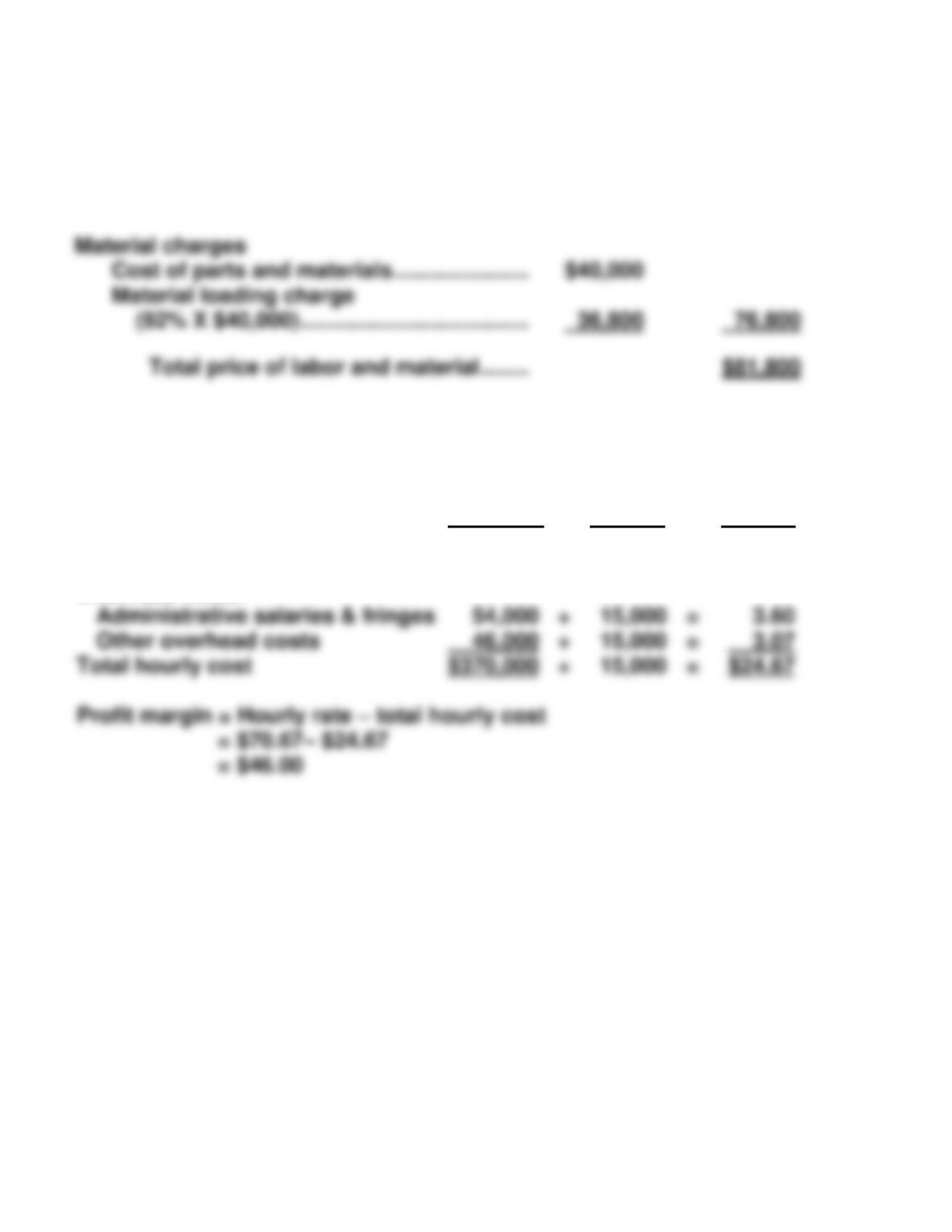
Overhead costs
Parts manager’s salary and
benefits
$30,000
EXERCISE 8-9B (Continued)
(c) Job: Brock Casey
Labor charges
80 hours @ $62.50 ……………………………… $ 5,000
EXERCISE 8-10B
(a)
Total
Cost
÷
Total
Hours
=
Hourly
Charge
Hourly labor rate:
Restorers’ wages and fringes
$270,000
÷
15,000
=
$18.00
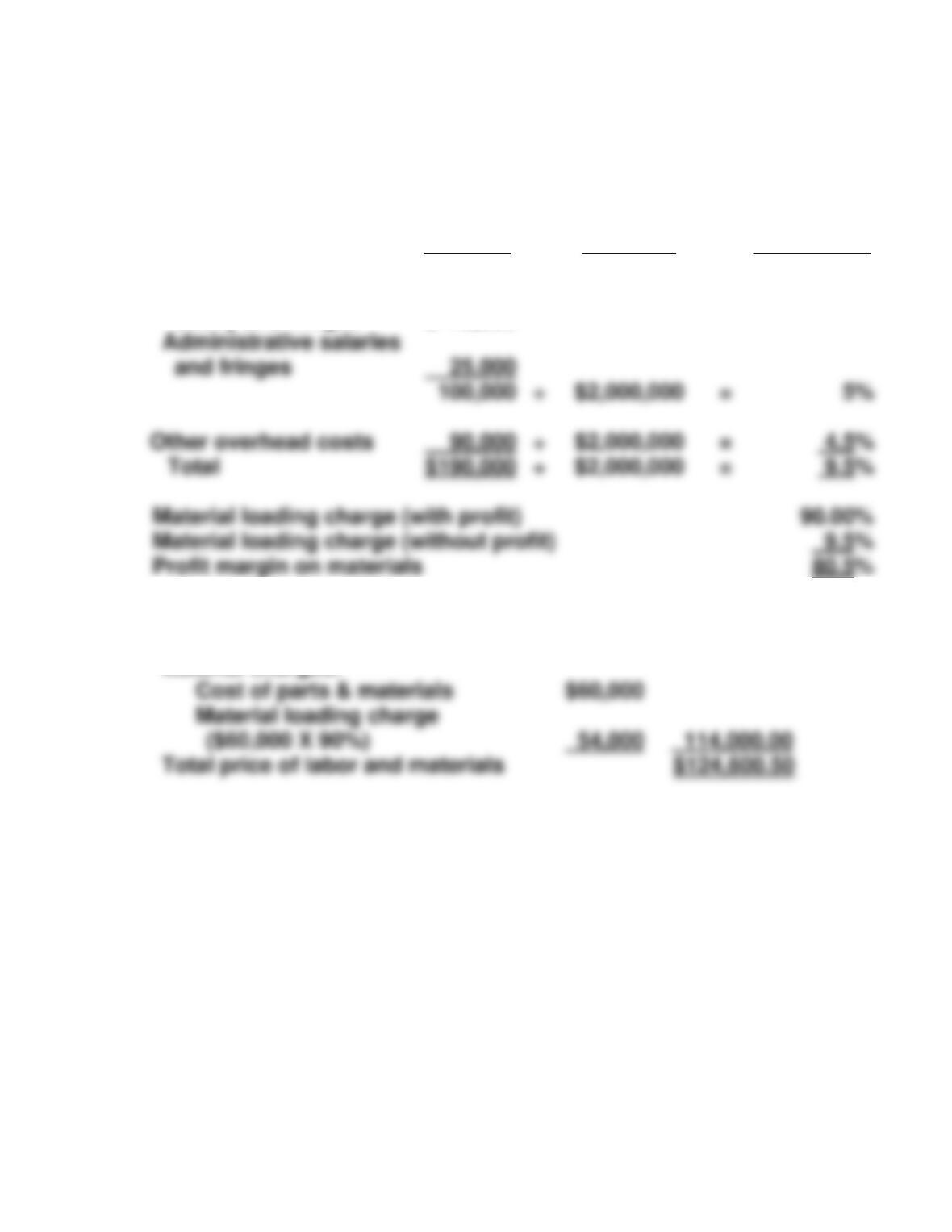
Overhead costs:
Administrative salaries & fringes
Other overhead costs
46,000
÷
=
Total hourly cost
$370,000
÷
=
$24.67
Profit margin = Hourly rate – total hourly cost
EXERCISE 8-10B (Continued)
(b)
Material
Loading
Charges
÷
Total Invoice
Cost, Parts &
Materials
=
Material
Loading
Percentage
Overhead costs:
Purchasing agent’s
salary and fringes
$ 75,000
(c)
Labor charges:
150 hours @ $70.67
$ 10,600.50
Material charges:
Cost of parts & materials
Material loading charge
($60,000 X 90%)
Total price of labor and materials
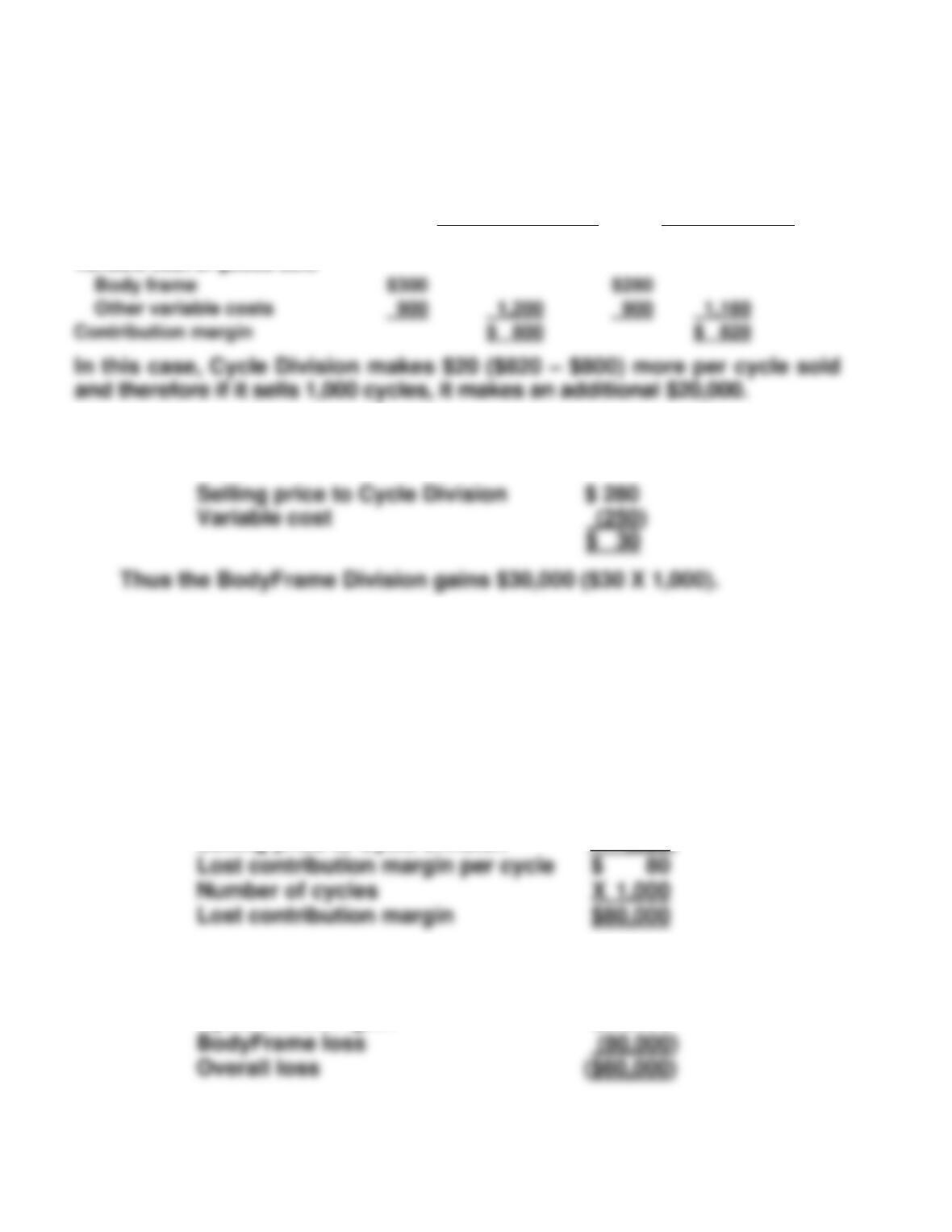
Administrative salaries
and fringes
÷
=
Other overhead costs
÷
=
Total
$190,000
÷
=
EXERCISE 8-11B
(a) As indicated, BodyFrame has excess capacity and therefore should be
willing to accept any price that equals or exceeds its variable cost.
(1) The effect on Cycle Division is as follows:
Present Situation
Purchase from
BodyFrame
Selling price
Variable cost of goods sold
$2,000
$2,000
(2) The effect on BodyFrame is that it makes $30 on each frame sold as
shown below:
(3) As a result, the overall income for Morton increases $50,000 ($20,000
from Cycle Division and $30,000 from BodyFrame).
(b) (1) The answer would not change from (a)(1). Cycle Division would
gain $20,000 if it purchased the frames from BodyFrame.
(2) However, BodyFrame would incur a loss of $80,000 as computed
below:
Selling price to outside buyer $ 360
Selling price to Cycle Division (280)
(3) The effect on the overall income to Morton is a net loss of
$60,000 as shown below:
Cycle Division gain $20,000
EXERCISE 8-12B
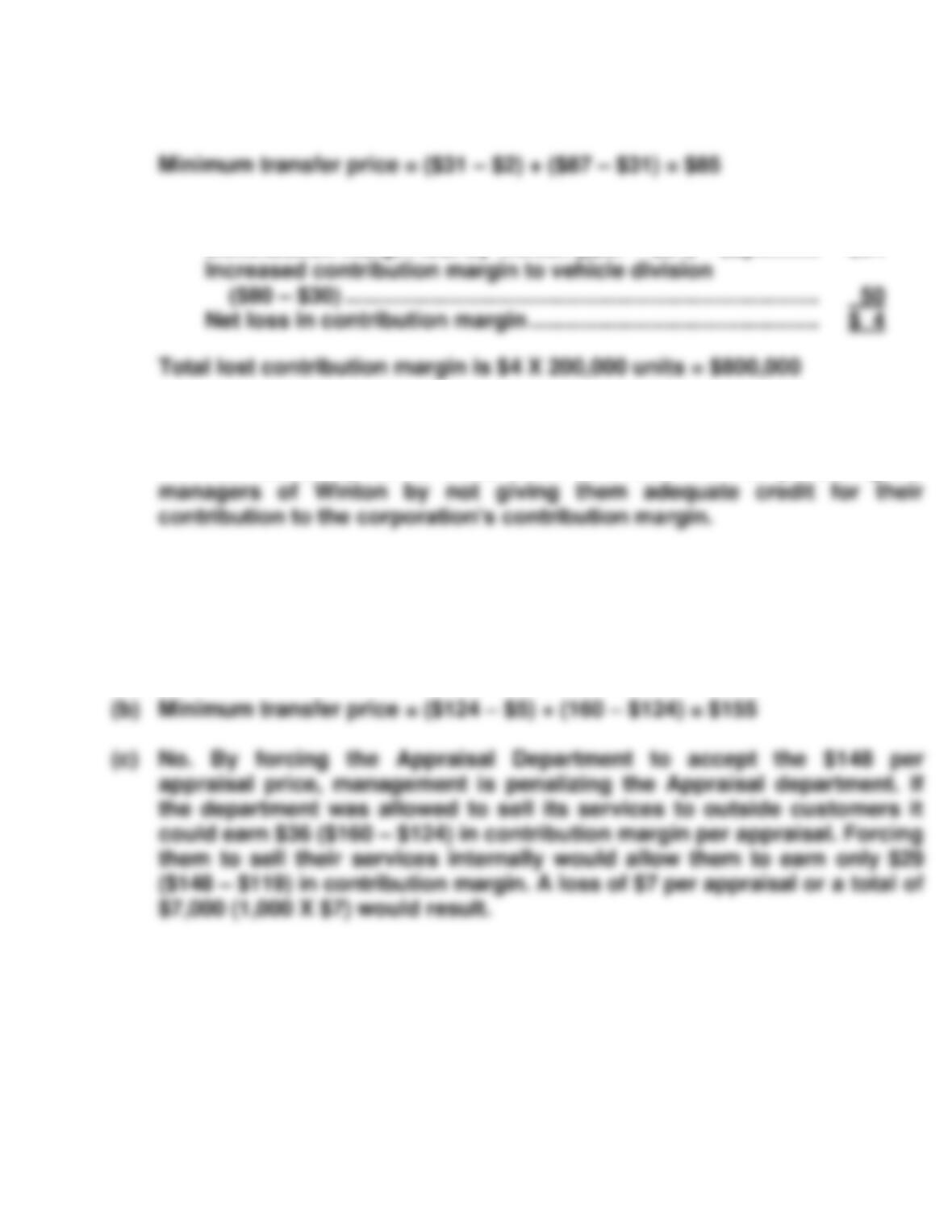
(a) The minimum transfer price that Winton should accept is:
(b) The lost contribution margin per unit to the company is:
Contribution margin lost by Winton [($87 – $31) – $2] ……….. $54
(c) If management insists that it wants Winton to provide the stereo units,
and Winton is operating at full capacity, then it must be willing to pay the
minimum transfer price for those units. Otherwise it will be penalizing the
EXERCISE 8-13B
(a) Minimum transfer price = ($124 – $5) + $0 = $119
EXERCISE 8-14B
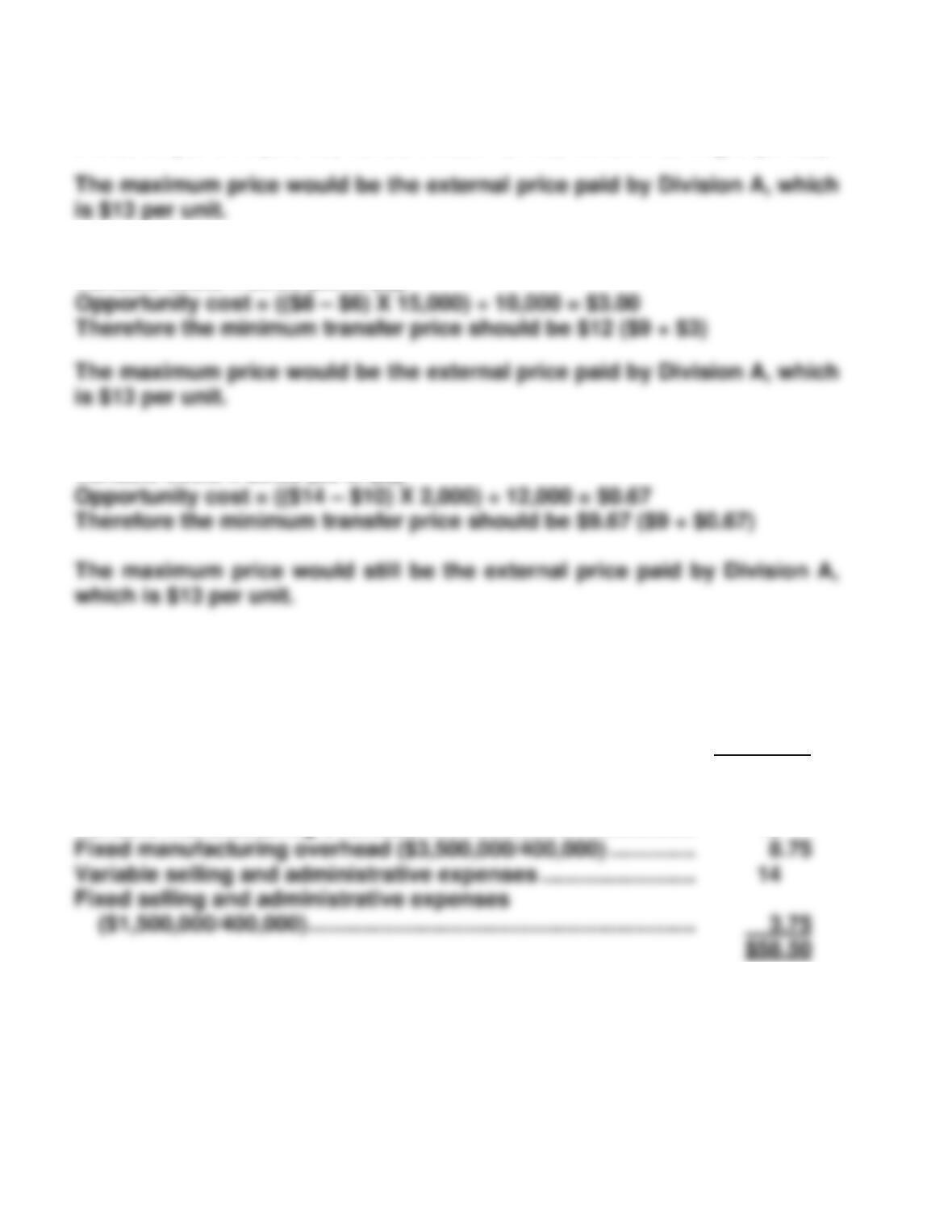
(a) The minimum transfer price for Division B would be variable costs, which
are $9.00 per unit ($10.00, variable cost – $1.00, variable selling expense).
(b) Minimum transfer price = variable costs + opportunity cost
Variable costs = $9.00 (as in (a))
(c) Minimum transfer price = variable costs + opportunity cost
Variable costs = $9.00 (as in (a))
*EXERCISE 8-15B
(a) Cost per unit:
Per Unit
Direct materials ………………………………………………………………..
Direct labor ………………………………………………………………………
Variable manufacturing overhead ……………………………………..
$ 8
9
15
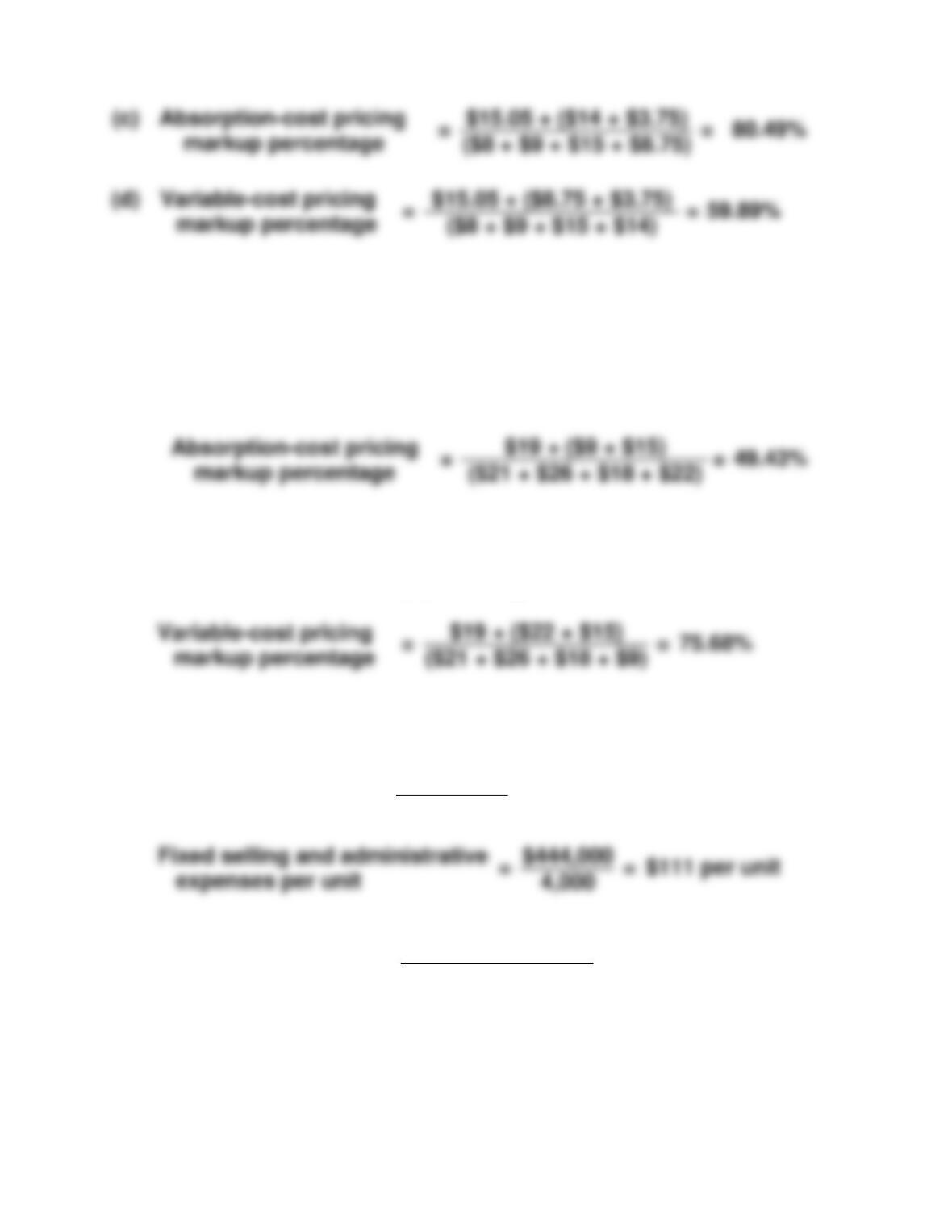
(b) Desired ROI per unit = (25% X $24,080,000)/400,000 = $15.05
*EXERCISE 8-15B (Continued)
=
*EXERCISE 8-16B
(a) The cost base of absorption-cost pricing includes only manufacturing
costs. All selling and administrative costs are excluded from the cost
base and are added back in the numerator of the markup percentage.
(b) The cost base of variable-cost pricing includes only variable costs. All
fixed costs are excluded from the cost base and are added back in the
numerator of the markup percentage.
*EXERCISE 8-17B
(a)
Fixed manufacturing
overhead per unit
=
$2,160,000
=
$540 per unit
4,000
Fixed selling and administrative
expenses per unit
(b)
Desired ROI per unit
=
20% X $48,000,000
=
$2,400 per unit
4,000
*EXERCISE 8-17B (Continued)
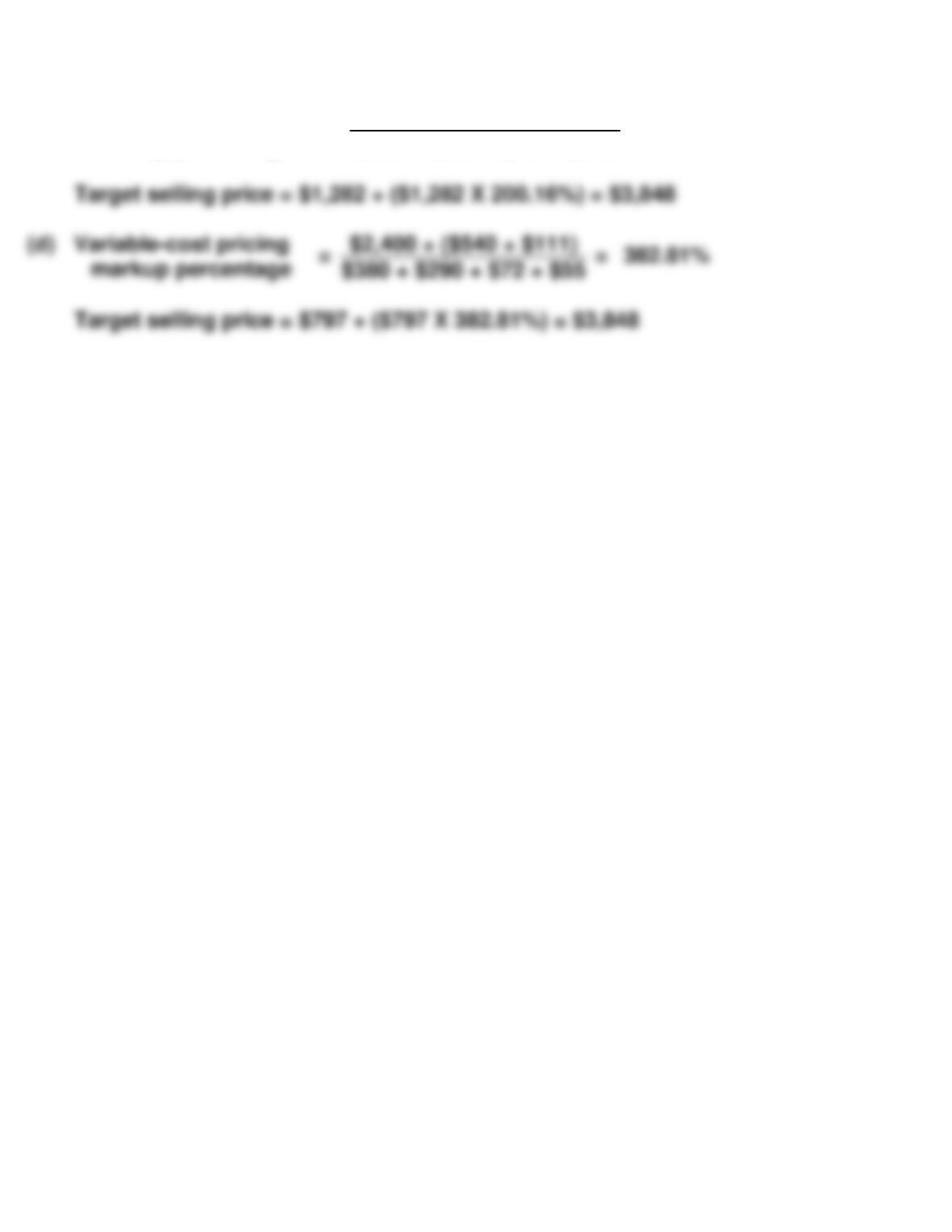
(c)
Absorption-cost pricing
markup percentage
=
$2,400 + ($55 + $111)
=
200.16%
$380 + $290 + $72 + $540
markup percentage
SOLUTIONS TO PROBLEMS—SET C
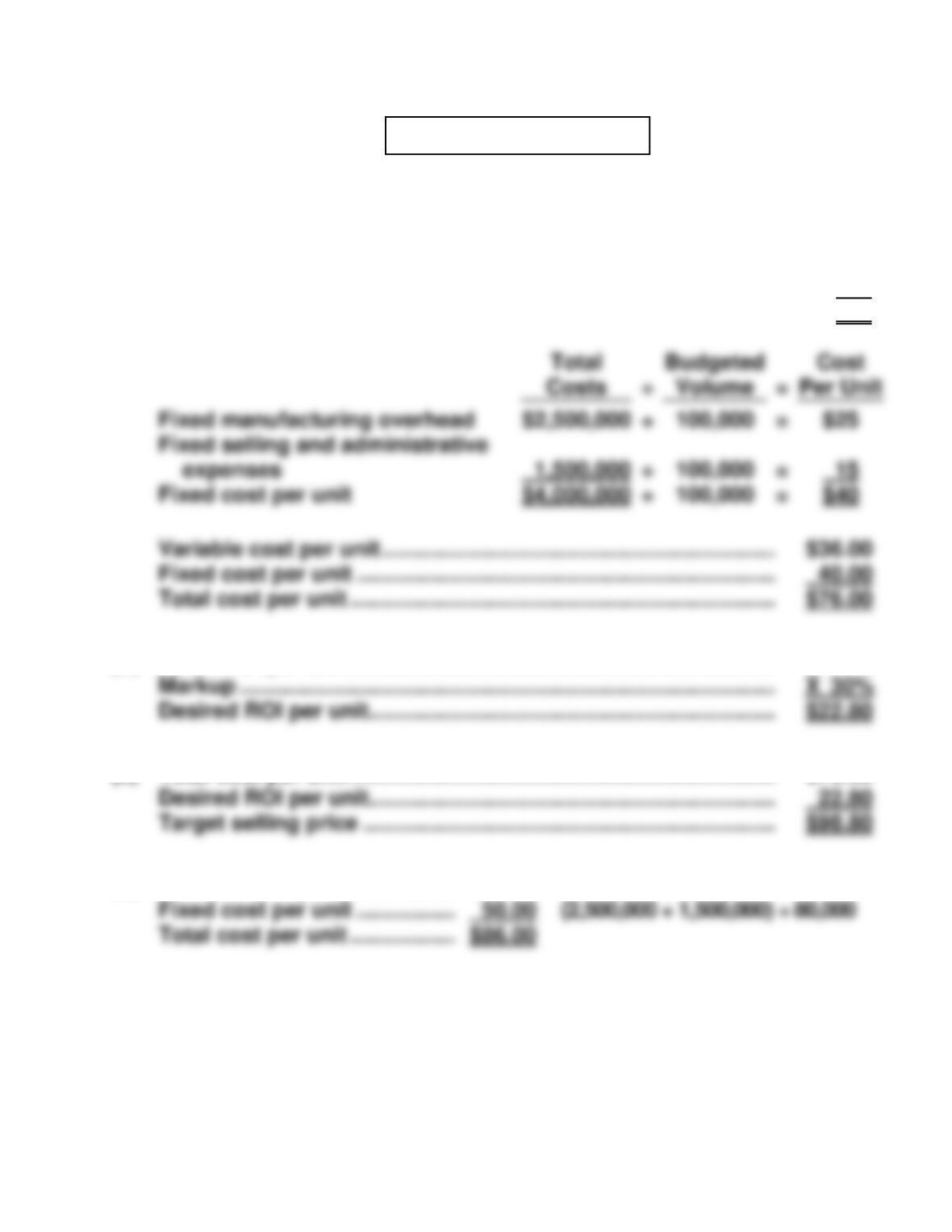
PROBLEM 8-1C
(a) Direct materials ………………………………………………………………. $ 8
Direct labor …………………………………………………………………….. 16
Variable manufacturing overhead …………………………………….. 7
Variable selling and administrative expenses……………………. 5
Variable cost per unit ………………………………………………………. $36
(b) Total cost per unit …………………………………………………………… $ 76
(c) Total cost per unit …………………………………………………………… $76.00
(d) Variable cost per unit ………… $36.00 (same as above)
PROBLEM 8-2C
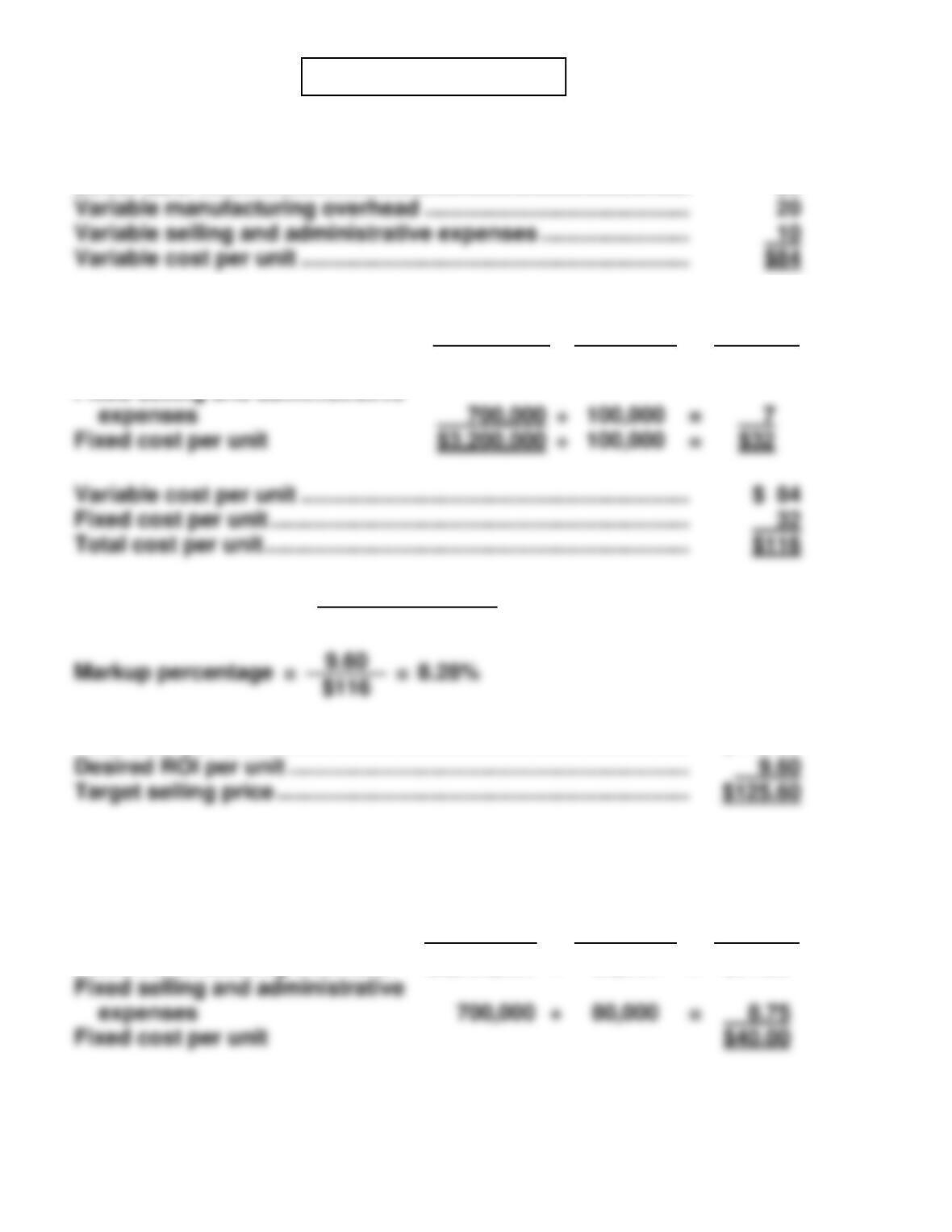
(a) Direct materials ………………………………………………………………. $34
Direct labor …………………………………………………………………….. 20
Total
Costs
÷
Budgeted
Volume
=
Cost
Per Unit
expenses
Fixed cost per unit
÷
100,000
100,000
=
=
Fixed manufacturing overhead
Fixed selling and administrative
$2,500,000
÷
100,000
=
$25
Desired ROI per unit
=
30% X $3,200,000
=
9.60
100,000
Total cost per unit …………………………………………………………… $116.00
(b) Variable cost per unit ……………………………………… $84 (same as (a))
Total
Costs
÷
Budgeted
Volume
=
Cost
Per Unit
Fixed selling and administrative
expenses
Fixed cost per unit
700,000
÷
=
Fixed manufacturing overhead
$2,500,000
÷
80,000
=
$31.25
PROBLEM 8-2C (Continued)
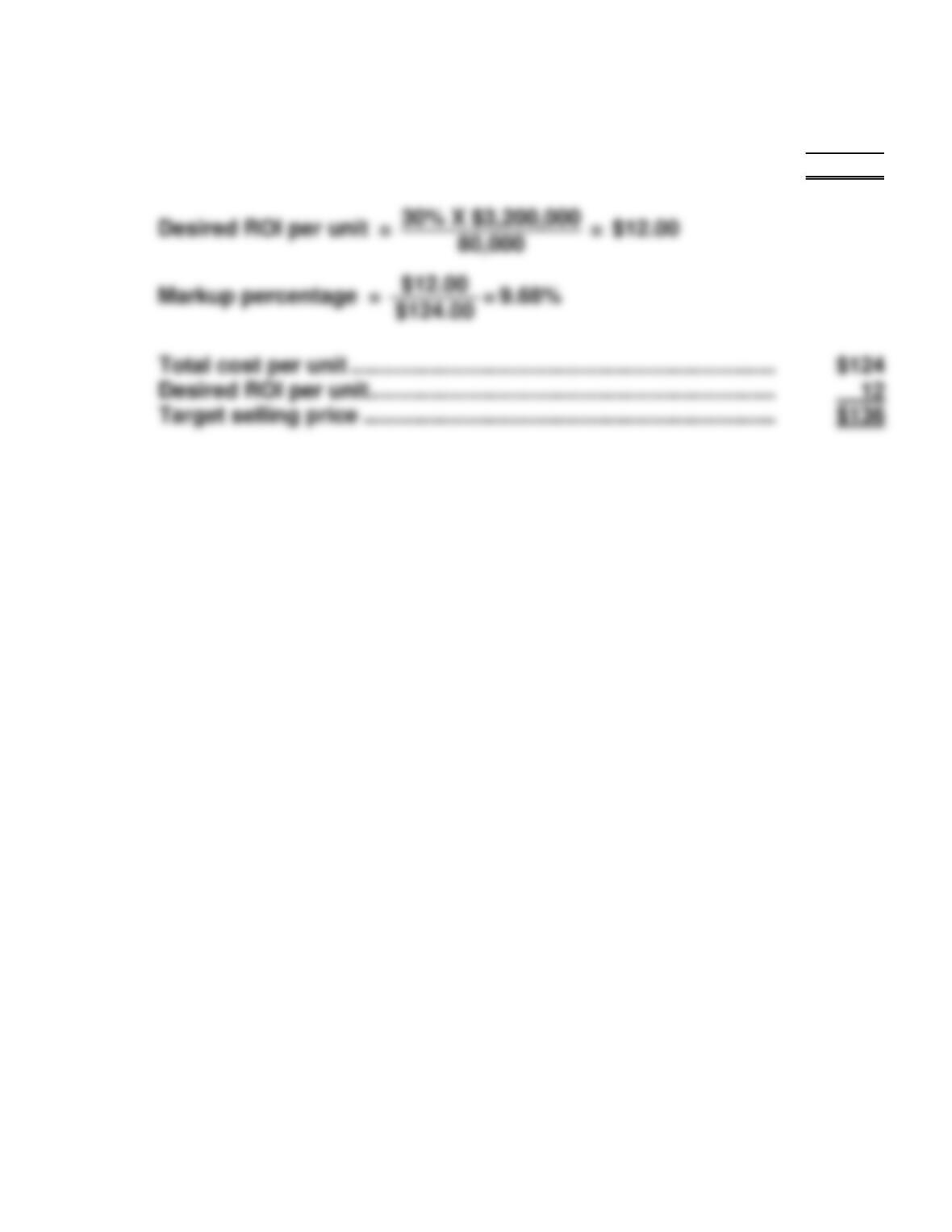
Variable cost per unit ………………………………………………………. $ 84.00
Fixed cost per unit ………………………………………………………….. 40.00
Total cost per unit …………………………………………………………… $124.00
PROBLEM 8-3C
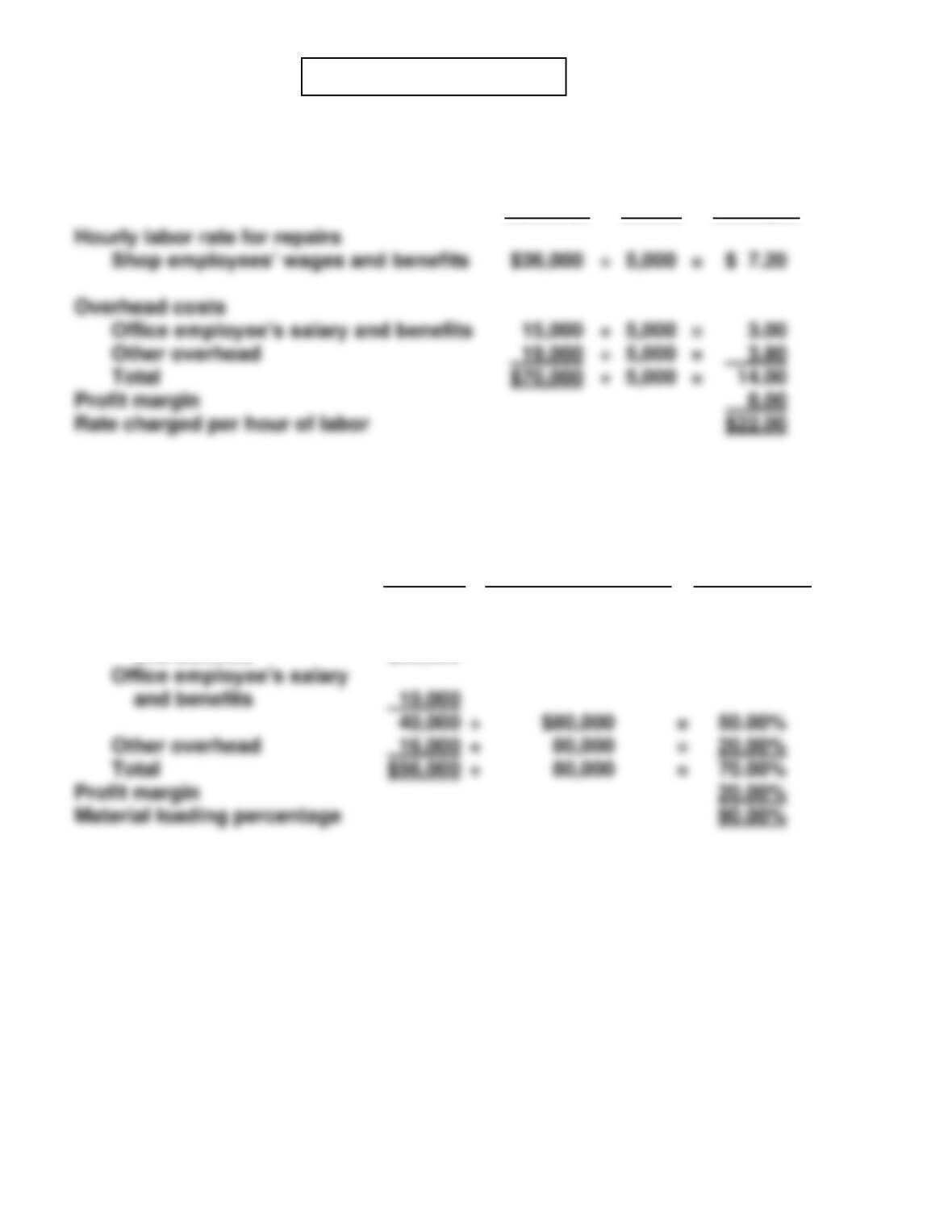
(a) Computation of time charge rate
Total
Cost
Total
Hours
Per Hour
Charge
(b) Computation of material loading charge
Material
Loading
Charges
Total Invoice Cost,
Parts and Materials
Material
Loading
Percentage
Total
Overhead costs
Parts manager’s salary
and benefits
$30,000
PROBLEM 8-3C (Continued)
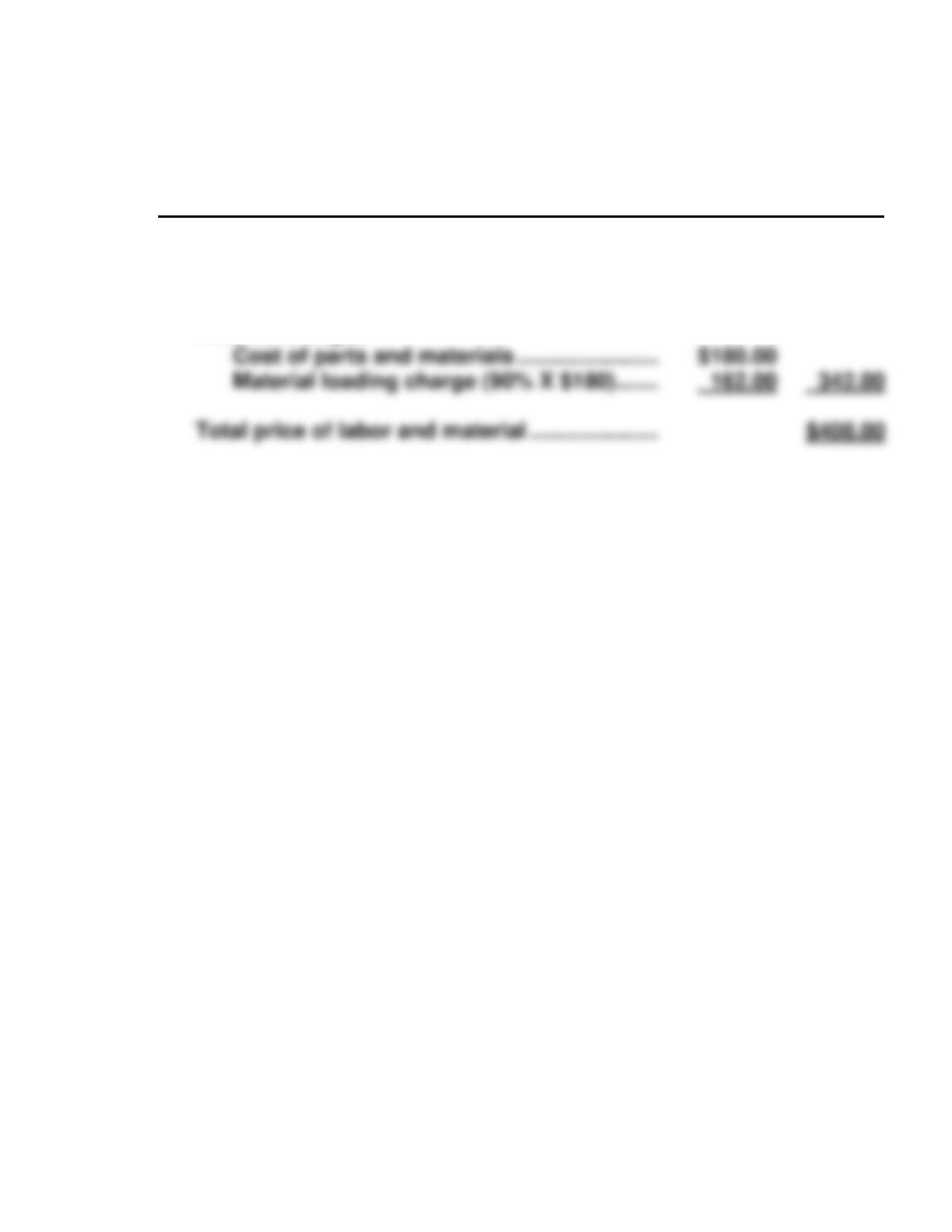
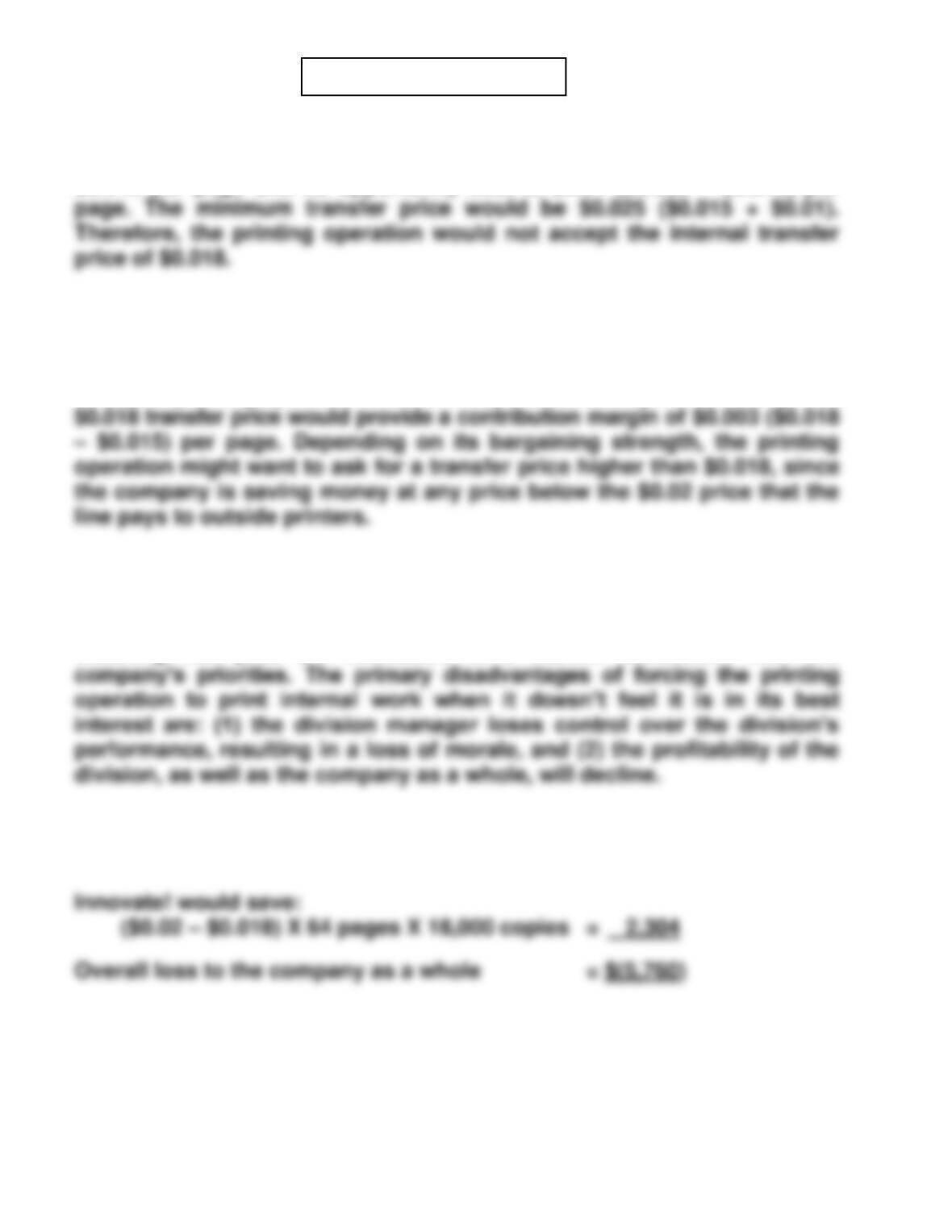
(c) Price quotation for time and material
RAJIB BIKE REPAIR SHOP
Time and Material Price Quotation
Job: Fix Alpine Mountain bike
Labor charges: 3 hours @ $22.00 ……………… $ 66.00
Material charges
PROBLEM 8-4C
(a) Assuming no available capacity, the printing operation’s variable cost is
$0.015 per page and its opportunity cost is $0.01 ($0.025 – $0.015) per
(b) Assuming that the printing operation has available capacity, the printing
operation’s variable cost is $0.015 and its opportunity cost is $0. The
minimum transfer price would be $0.015 ($0.015 + $0). Therefore, in this
case, the printing operation should accept the offer to print internally. The
(c) The advantages of having all of the company’s printing done internally
include: (1) ensuring that the company’s quality expectations are met, (2)
ensuring that all projects are completed on a timely basis, and (3)
ensuring that jobs are scheduled in a manner consistent with the
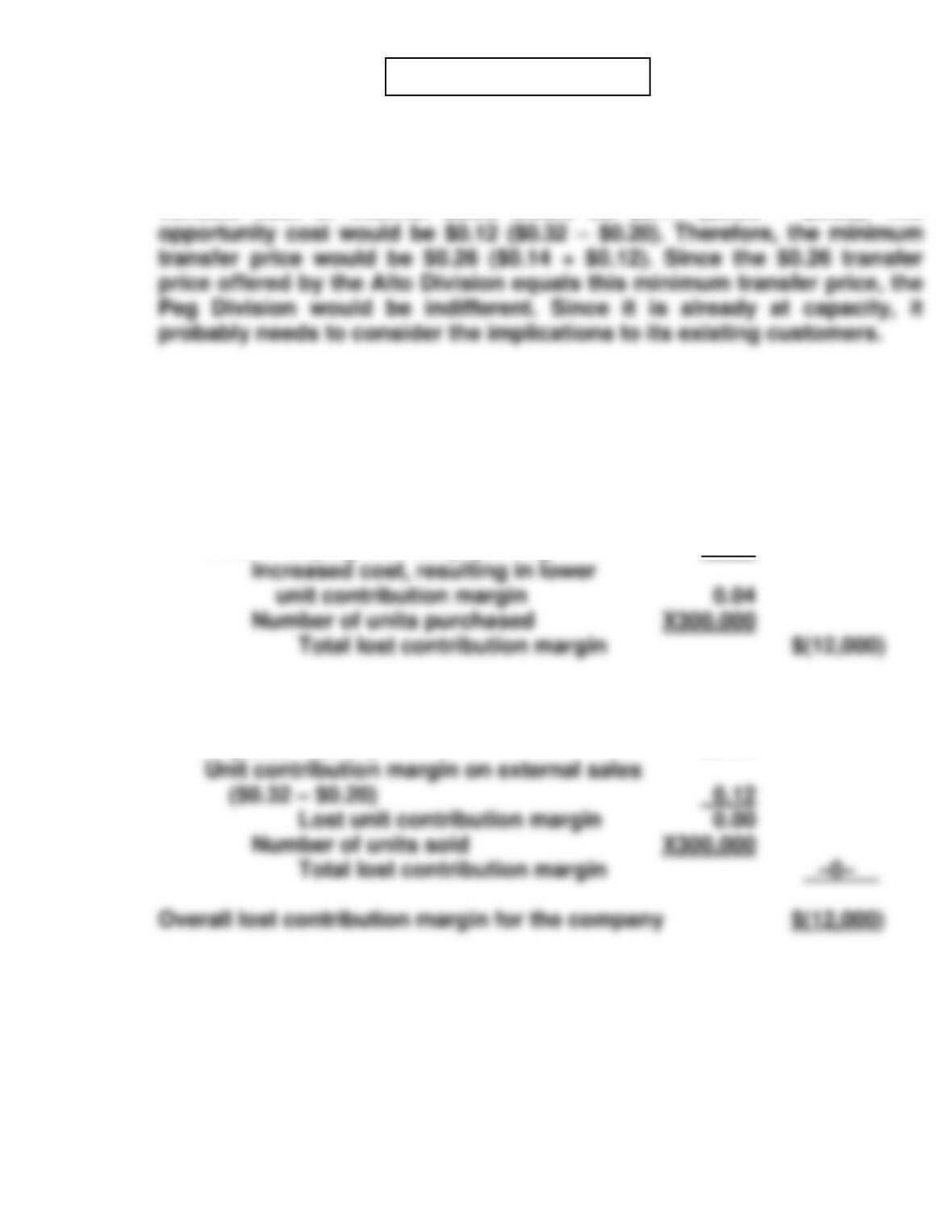
(d) The printing operation would lose:
($0.025 – $0.018) X 64 pages X 18,000 copies = $(8,064)
PROBLEM 8-5C
(a) The minimum transfer price is based on the variable cost of units
transferred internally, plus the opportunity cost of units sold externally. The
variable cost of internal sales would be $0.14 ($0.20 – $0.06). The
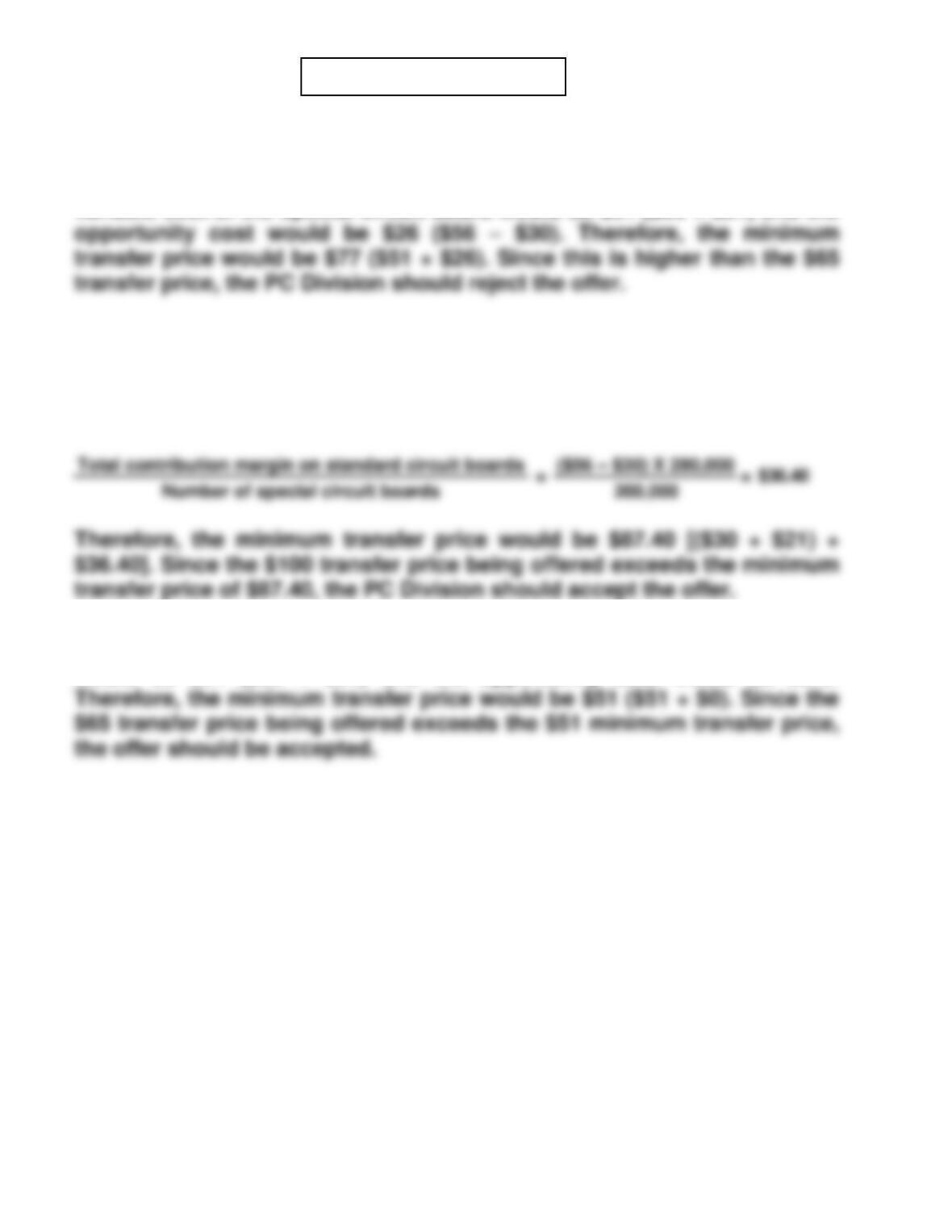
(b) If the Peg Division rejects the offer, the Alto division will suffer a loss of
contribution margin, as well as the company as a whole. The amount of
this loss is calculated as:
Lost contribution margin by Alto Division:
Cost of buying externally, per Peg $0.30
Cost of buying internally, per Peg 0.26
Lost contribution margin by Peg Division:
Unit contribution margin on internal sales
($0.26 – $0.14) $0.12
PROBLEM 8-6C
(a) Assuming no available capacity, and that the number of new units
produced would be equal to the number of standard units forgone,
variable cost of the special circuit board would be $51 ($30 + $21) and the
(b) Assuming no available capacity, and that in order to produce the 200,000
circuit boards, 280,000 standard circuit boards would be forgone, the
minimum variable cost would be ($30 + $21) or $51 and the opportunity
cost would be:
(c) Assuming that the PC Division has available capacity, variable cost
would be $51 ($30 + $21) and the opportunity cost would be zero.
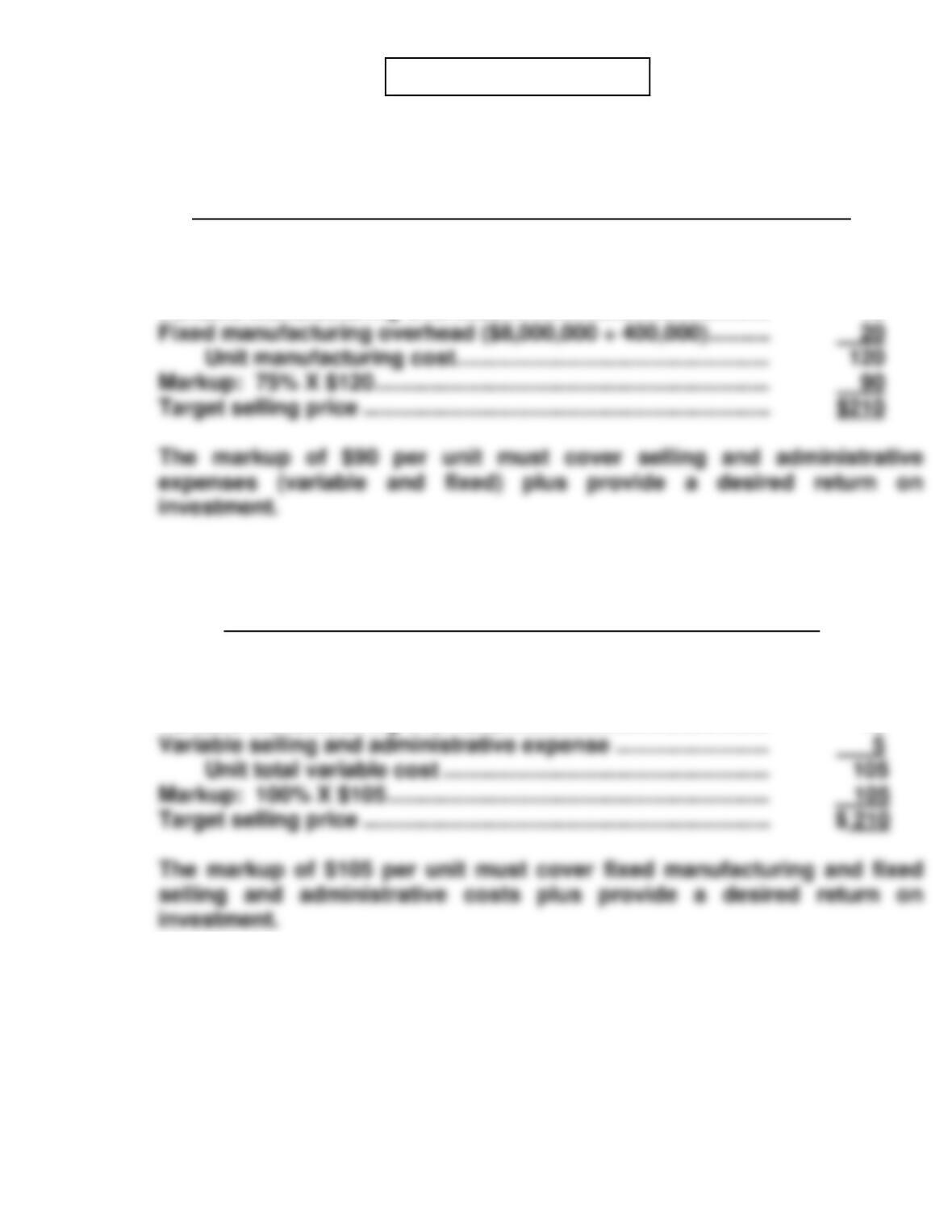
*PROBLEM 8-7C
(a) Absorption-cost pricing:
Computation of unit manufacturing cost and target selling price
Direct materials ……………………………………………………………… $ 50
Direct labor ……………………………………………………………………. 35
Variable manufacturing overhead ……………………………………. 15
(b) Variable-cost pricing:
Computation of total variable cost and target selling price
Direct materials ……………………………………………………………. .. $ 50
Direct labor ……………………………………………………………………. 35
Variable manufacturing overhead ……………………………………. 15
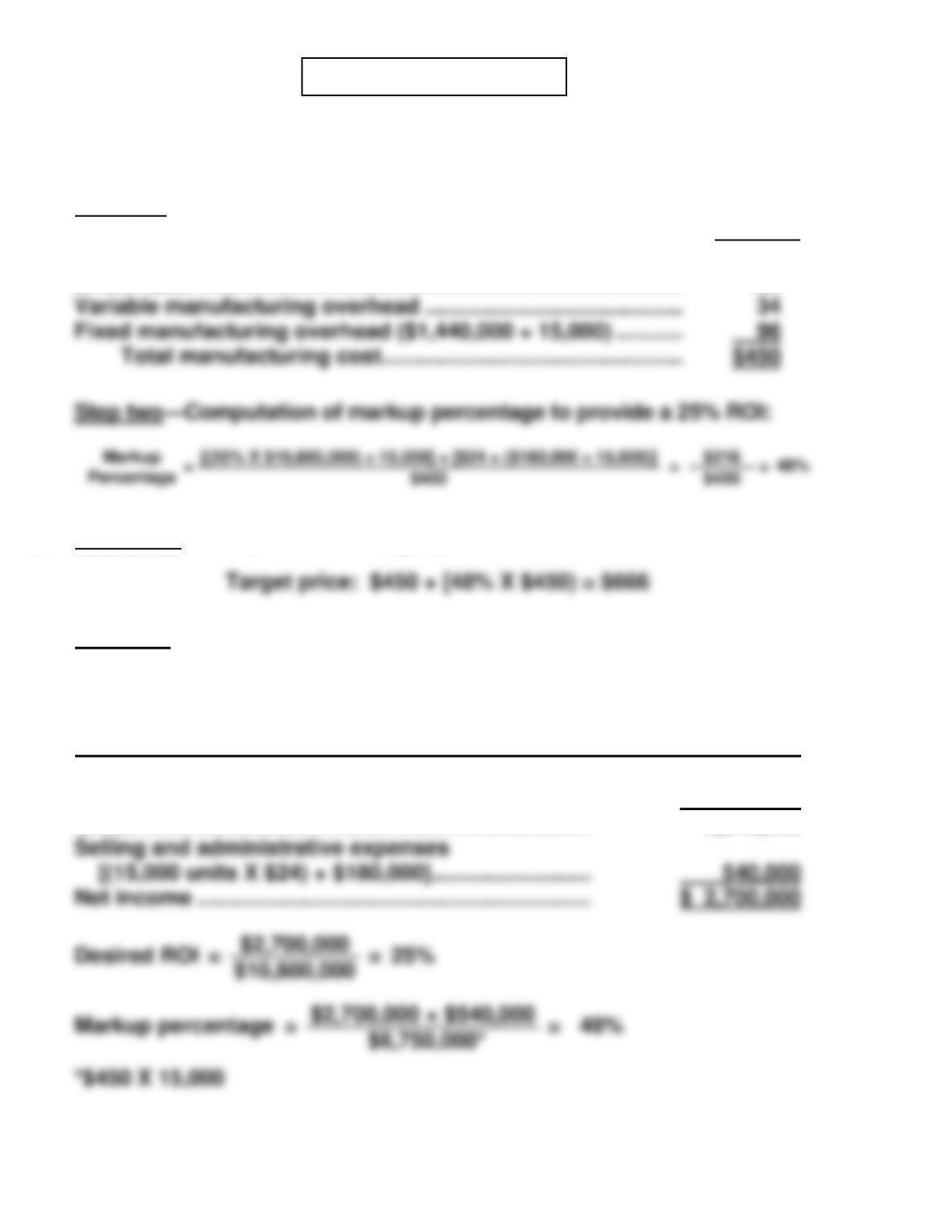
*PROBLEM 8-8C
Absorption-cost pricing
(a) Step one—Computation of unit manufacturing cost:
Per Unit
Direct materials ………………………………………………………………
Direct labor …………………………………………………………………….
$200
120
(b) Step three—Computation of target price:
Step four—Proof of 25% ROI under absorption-cost approach:
HALO BIKES INC.
Budgeted Absorption-Cost Income Statement
(Mountain Bike)
Revenues (15,000 units X $666) …………………………. $9,990,000
Cost of goods sold (15,000 units X $450.00) ……….. 6,750,000
Gross ………………………………………………………………. 3,240,000
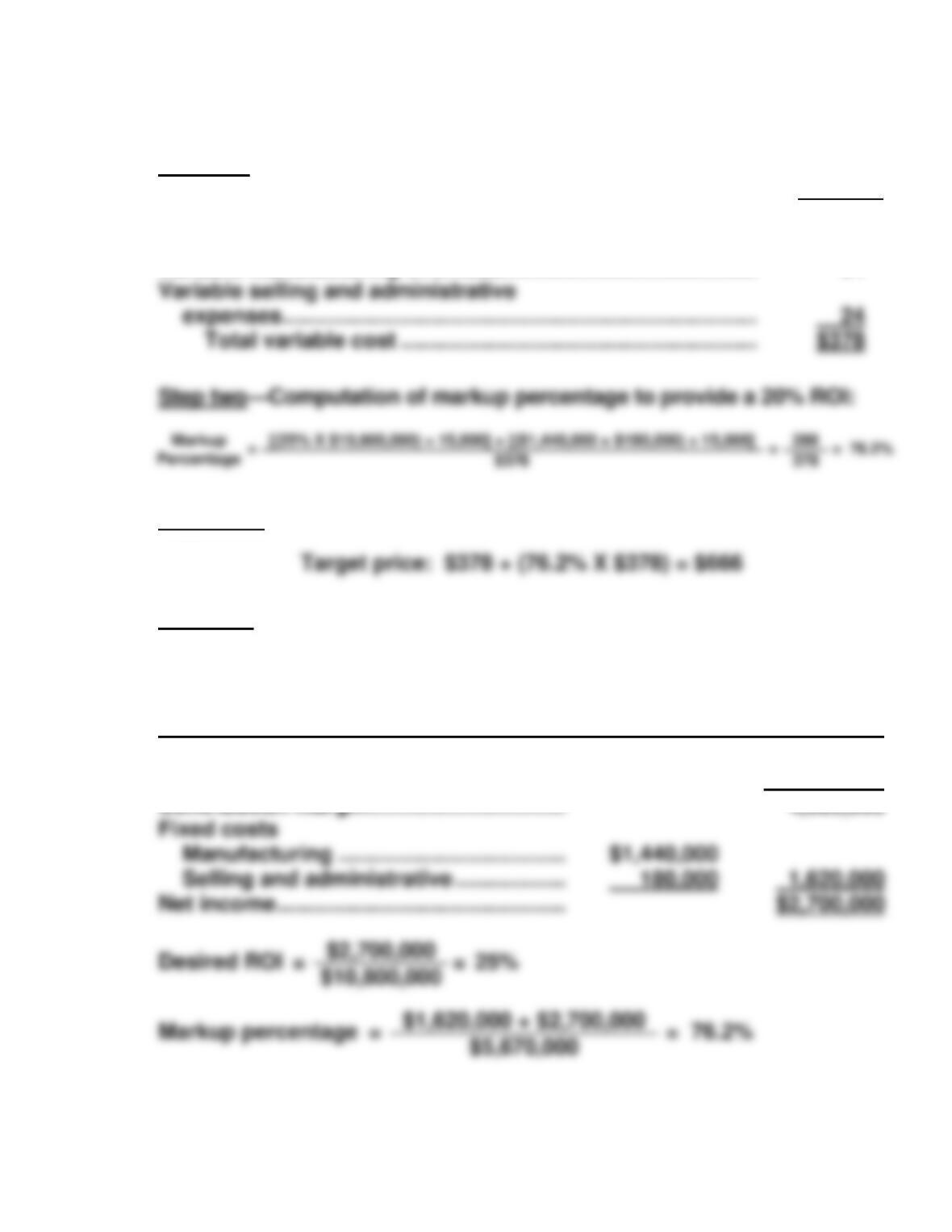
*PROBLEM 8-8C (Continued)
Variable-cost pricing
(c) Step one—Computation of unit variable cost:
Per Unit
Direct materials …………………………………………………………….
Direct labor …………………………………………………………………..
Variable manufacturing overhead …………………………………..
$200
120
34
(d) Step three—Computation of target price:
Step four—Proof of 25% ROI under variable-cost pricing:
HALO BIKES INC.
Budgeted Variable-Cost Income Statement
(Tinted Window)
Revenue (15,000 units X $666) …………… $9,990,000
Variable costs (15,000 units X $378) …… 5,670,000
Contribution margin ………………………….. 4,320,000