Chapter 08 – Reporting and Interpreting Property, Plant, and Equipment; Intangibles; and Natural Resources
8-1
CHAPTER 8
REPORTING AND INTERPRETING PROPERTY, PLANT, AND
EQUIPMENT; INTANGIBLES; AND NATURAL RESOURCES
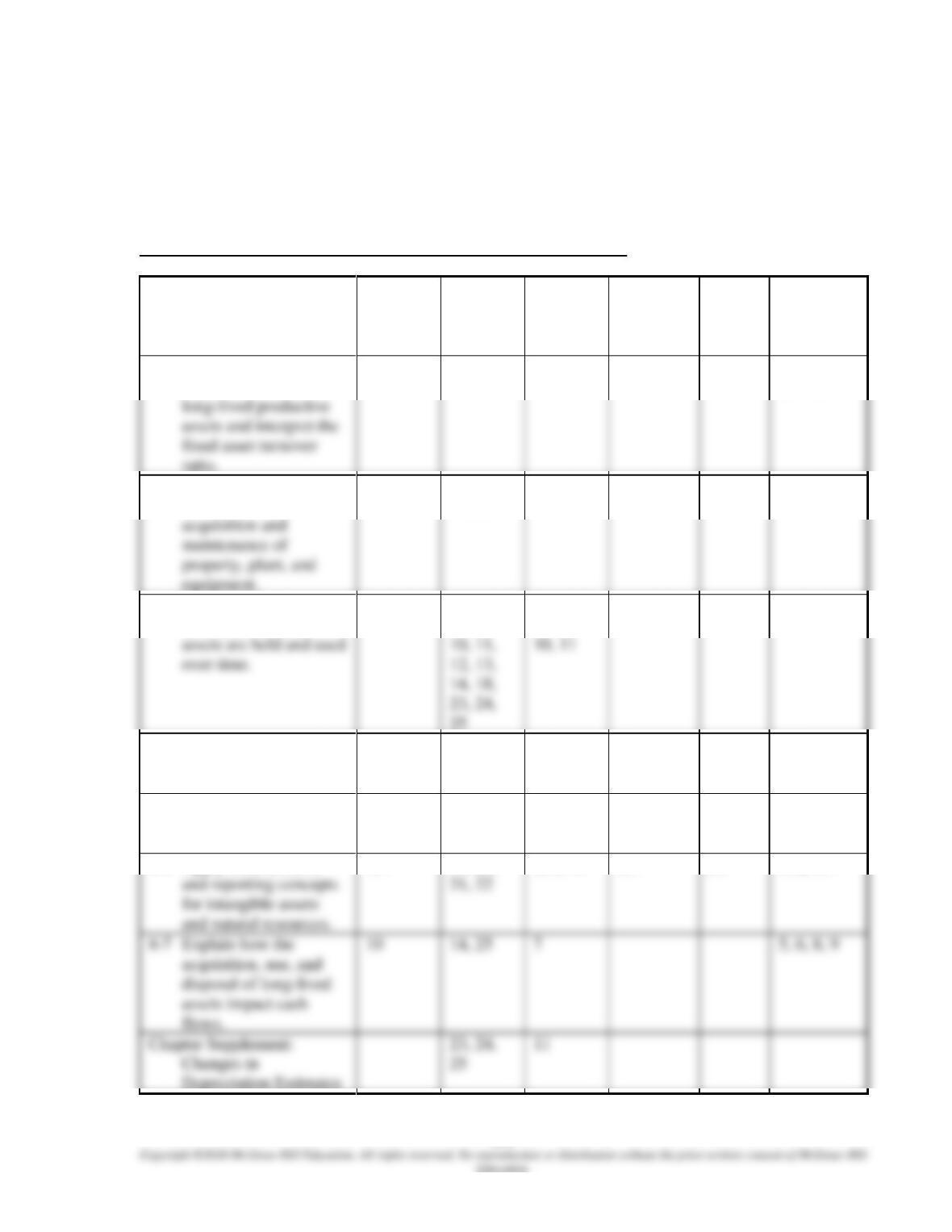
Learning Objectives and Related Assignment Materials
Learning Objectives
Mini-
Exercises
Exercises
Problems
Alternate
Problems
Compre-
hensive
Problems
Cases and
Projects
ratio.
8-1 Define, classify, and
explain the nature of
1, 2
1, 2
1, 4, 5
1, 4
1, 2, 3, 5,
6, 7, 8, 9
8-2 Apply the cost principle
to measure the
3
3, 4, 5, 6,
7, 8, 24
1, 2, 3, 8
1, 2, 3, 6
2
1, 2, 7, 8, 9
8-3 Apply various cost
allocation methods as
1, 4, 5, 6
3, 4, 5, 6,
7, 8, 9,
2, 3, 4, 5,
6, 8, 9,
2, 3, 4, 5,
6, 7
1, 2
3, 4, 9
8-4 Explain the effect of
asset impairment on the
financial statements.
7
15
10
7
1
1, 9
8-5 Analyze the disposal of
property, plant, and
equipment.
8
15, 16,
17, 18
6, 7
5
1, 2
6
for intangible assets
8-7 Explain how the
10
14, 25
7
5, 6, 8, 9
8-6 Apply measurement
1, 9
19, 20,
8, 9, 10
6, 7
1, 2
1, 2, 5, 9
Chapter 08 – Reporting and Interpreting Property, Plant, and Equipment; Intangibles; and Natural Resources
8-2
Synopsis of Chapter Revisions
Focus Company: Southwest Airlines
• Chapter 8 illustrates the acquisition, use, repair and improvement, and disposal of property, plant,
and equipment, followed by an illustration of accounting and reporting for intangible assets and
• Highlighted GUIDED HELP features provide free access to step-by-step video instruction on
determining cost and creating depreciation schedules under straight-line, units-of-production, and
declining-balance methods, as well as a Guided Help on recording a disposal of an asset.
• CONTINUING PROBLEM in the end-ofchapter problems. Based on the activities of Pool
PowerPoint Slides
Learning Objectives
PowerPoint® Slides
8-1 Define, classify, and explain the nature of long-lived productive assets
and interpret the fixed asset turnover ratio.
8-4 through 8-7
property, plant, and equipment.
8-3 Apply various cost allocation methods as assets are held and used over
8-17 through 8-39
8-6 Apply measurement and reporting concepts for intangible assets and
8-49 through 8-57
8-7 Explain how the acquisition, use, and disposal of long-lived assets impact
8-58 through 8-60
8-2 Apply the cost principle to measure the acquisition and maintenance of
8-8 through 8-16
Chapter Take-Aways
8-1 Define, classify, and explain the nature of long-lived productive assets and interpret the fixed
asset turnover ratio.
Chapter 08 – Reporting and Interpreting Property, Plant, and Equipment; Intangibles; and Natural Resources
8-3
a. Productive assets are those that a business retains for long periods of time for use in the course of
8-2 Apply the cost principle to measure the acquisition and maintenance of property, plant, and
equipment.
The acquisition cost of property, plant, and equipment is the cash-equivalent purchase price plus all
reasonable and necessary expenditures made to acquire and prepare the asset for its intended use.
8-3 Apply various cost allocation methods as assets are held and used over time.
Cost allocation methods: In conformity with the expense principle, cost less any estimated residual
value is allocated to periodic expense over the periods benefited. Because of depreciation, the net
8-4 Explain the effect of asset impairment on the financial statements.
When events or changes in circumstances reduce the estimated future cash flows of long-lived assets
8-5 Analyze the disposal of property, plant, and equipment.
When assets are disposed of through sale or abandonment,
8-6 Apply measurement and reporting concepts for intangible assets and natural resources.
The cost principle should be applied in recording the acquisition of intangible assets and natural
resources. Intangibles with definite useful lives are amortized using the straight-line method.
Chapter 08 – Reporting and Interpreting Property, Plant, and Equipment; Intangibles; and Natural Resources
8-4
8-7 Explain how the acquisition, use, and disposal of long-lived assets impact cash flows.
Depreciation expense is a noncash expense that has no effect on cash. It is added back to net income
Chapter 08 – Reporting and Interpreting Property, Plant, and Equipment; Intangibles; and Natural Resources
8-5
Key Ratio
The fixed asset turnover ratio measures how efficiently a company utilizes its investment in property,
plant, and equipment over time. Its ratio can then be compared to competitors’ ratios. The fixed asset
Finding Financial Information
Balance Sheet
Under Noncurrent Assets
Property, plant, and equipment (net of
Income Statement
Under Operating Expenses
Depreciation, depletion, and amortization
note)
Statement of Cash Flows
Under Operating Activities (indirect method)
Net income
+ Depreciation and amortization expense
Notes
Under Summary of Significant Accounting
Policies
Description of management’s choice for
of the major classifications of long-lived
assets at cost and the balance in
accumulated depreciation, depletion, and
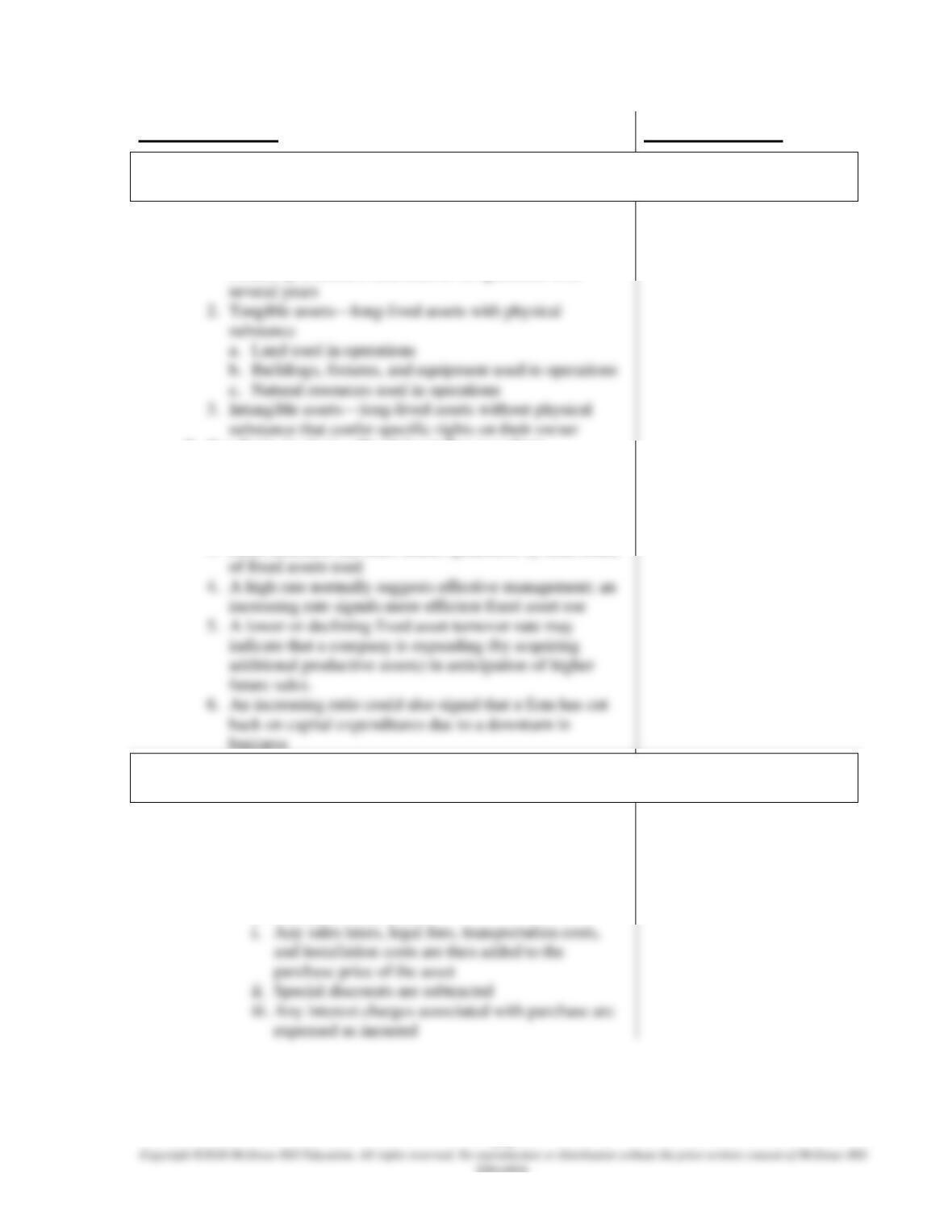
Chapter 08 – Reporting and Interpreting Property, Plant, and Equipment; Intangibles; and Natural Resources
8-6
Chapter Outline
Teaching Notes
LO 8-1 Define, classify, and explain the nature of long-lived productive assets and interpret the
fixed asset turnover ratio.
I. Acquisition and Maintenance of Plant and Equipment
A. Classifying Long-Lived Assets
Illustrated in Exhibit 8.1
several years
2. Tangible assets––long-lived assets with physical
3. Intangible assets––long-lived assets without physical
substance that confer specific rights on their owner
1. Long-lived assets––tangible and intangible resources
owned by a business and used in its operations over
B. Key Ratio Analysis—Fixed Asset Turnover Ratio
1. Fixed Asset Turnover Ratio = Net Sales (or Operating
Revenues) ÷ Average Net Fixed Assets
2. Average Net Fixed Assets = [Beginning + Ending Fixed
Asset balance (net of accumulated depreciation)] ÷ 2
4. A high rate normally suggests effective management; an
3. Ratio measures the sales dollars generated by each dollar
LO 8-2 Apply the cost principle to measure the acquisition and maintenance of property, plant,
and equipment.
C. Measuring and Recording Acquisition Cost
1. Cost principle requires that all reasonable and necessary
expenditures made in acquiring and preparing an asset for
use should be recorded as the cost of the asset
a. Acquisition cost––the net cash equivalent amount paid
or to be paid for an asset
Chapter 08 – Reporting and Interpreting Property, Plant, and Equipment; Intangibles; and Natural Resources
8-7
b. When purchasing land, buildings, and equipment as a
iv. All of the incidental costs of the purchase of land
(e.g., title fees, sales commissions, legal fees, title
dr Flight Equipment (+A)
cr Cash (–A)
Flight Equipment (A) + 120 + Cash (A) – 120 = No
2. For Cash
Assume that Southwest paid $120 million cash for an
aircraft with a net cash invoice price of $122 million, a
discount of $4 million, and $2 million of related
change
3. For Debt
a. Assume instead that Southwest signed a note payable
in the amount of $118 million and paid cash for the $2
million of transportation and preparation costs
cr Notes Payable (+L)
Notes Payable (L) + 118 mill
4. For Equity (or Other Noncash Considerations)
a. Cash equivalent cost = fair value of the asset given or
received
b. Assume that Southwest gave Boeing 1 million shares
of its $1 par value common stock with a market value
Chapter 08 – Reporting and Interpreting Property, Plant, and Equipment; Intangibles; and Natural Resources
8-8
(+SE) (1 mill shares × $54
cr Additional Paid-in Capital
54 mill
5. By Construction
a. Cost includes all the necessary costs associated with
construction, such as labor, materials, and in most
situations, capitalized interest
i. Capitalized interest––interest expenditures
included in the cost of a self-constructed asset
interest is paid
b. Southwest constructed a few new hangars, paying $2
million in labor costs and $5 million in supplies and
materials; Southwest also paid $1 million in interest
expense during the year related to the construction
project
dr Building (+A)
Flight Equipment (A) + 8 mill + Cash (A) – 8 mill =
No change
D. Repairs, Maintenance, and Improvements
1. Most assets require substantial expenditures during their
lives to maintain or enhance their productive capacity
the current accounting period only and are recorded as
expenses
ii. Recorded as expenses in the period in which
a. Ordinary repairs and maintenance––expenditures that
maintain the productive capacity of the asset during
b. Improvements––expenditures that increase the
productive life, operating efficiency, or capacity of the
asset and are recorded as increases in asset accounts,
not as expenses
Chapter 08 – Reporting and Interpreting Property, Plant, and Equipment; Intangibles; and Natural Resources
8-9
efficiency or longer life
c. Southwest spent $300 million in 2019 to modify the
exterior of its aircraft to reduce fuel consumption (a
capital expenditure)
dr. Flight equipment (+A)
300 mill
Cr. Cash (-A)
300 mill
mill = No change
d. Capitalizing expenses will increase assets and net
income in the current year, lowering future years’
income by the amount of annual depreciation. For tax
purposes, expensing amount in current period lowers
See Financial Analysis
feature “WorldCom: Hiding
Billions in Expenses
through Capitalization”
dollar amount are expensed)
Feedback – Self-Study Quiz
LO 8-3 Apply various cost allocation methods as assets are held and used over time.
II. Use, Impairment, and Disposal of Plant and Equipment
A. Depreciation Concepts
be allocated as an expense in the same period that
revenues are generated by its use
1. Expense principle requires that a portion of an asset’s cost
2. Depreciation––process of allocating the cost of buildings
and equipment (but not land) over their productive lives
using a systematic and rational method
period to reflect the use of buildings and equipment
for the period
dr Depreciation Expense (+E, –SE)
a. Depreciation is a process of cost allocation, not a
2. Reporting:
a. The amount of depreciation recorded during each
period is reported on the income statement as
Depreciation Expense
Chapter 08 – Reporting and Interpreting Property, Plant, and Equipment; Intangibles; and Natural Resources
8-10
and deducted from the related asset’s cost
i. Net amount on the balance sheet is called net book
value (or carrying or book value)
c. To calculate depreciation expense, three amounts are
costs, at the end of the asset’s estimated useful life
See Financial Analysis
feature “Book Value as an
Approximation
ii. Net book value (or carrying or book value) of a
B. Alternative Depreciation Methods
1. Managers may choose:
a. From several acceptable depreciation methods that
2. Once selected, the method should be applied consistently
over time to enhance comparability of financial
information
3. Most common depreciation methods:
a. Straight-line (used by 98% of companies)
All three methods illustrated
b. Units of production
c. Declining balance
4. Straight-Line Method
a. Method that allocates the depreciable cost of an asset
in equal periodic amounts over its useful life
c. Depreciable cost = Cost – Residual value; it is the
amount to be depreciated
b. Straight-Line Formula:
d. Straight-line rate = 1 ÷ Useful life
e. Companies often create a depreciation schedule that
shows the computed amount of depreciation expense
each year over the entire useful life of the asset
f. Note that:
i. Depreciation expense is a constant amount each
year
ii. Accumulated depreciation increases by an equal
amount each year
Chapter 08 – Reporting and Interpreting Property, Plant, and Equipment; Intangibles; and Natural Resources
8-11
a. Method that allocates the depreciable cost of an asset
over its useful life based on the relationship of its
periodic output to its total estimated output
Estimated total production] × Actual production
c. Depreciation rate per unit of production = Depreciable
cost ÷ Estimated total production
actual total output, the final adjusting entry to
b. Units-of-Production Formula:
Depreciation Expense = [(Cost − Residual value) ÷
6. Declining-Balance Method
a. Method that allocates the net book value (cost minus
accumulated depreciation) of an asset over its useful
life based on a multiple of the straight-line rate, thus
c. Based on applying a rate exceeding the straight-line
rate to the asset’s net book value over time
d. Rate is often double (two times) the straight-line rate;
termed the double-declining-balance rate
e. Double-Declining-Balance Formula:
Depreciation expense = (Cost − Accumulated
depreciation) × (2 ÷ Useful life)
Use Supplemental
f. Unique to this method:
i. Accumulated depreciation, not residual value, is
included in the formula
• Because accumulated depreciation increases
ii. An asset’s book value cannot be depreciated below
residual value
• If the annual computation reduces net book
value below residual value, a lower amount of
See Financial Analysis
feature “Impact of
Chapter 08 – Reporting and Interpreting Property, Plant, and Equipment; Intangibles; and Natural Resources
8-12
g. Companies in industries that expect fairly rapid
obsolescence of their equipment use the declining-
balance method
See Financial Analysis
C. How Managers Choose
Accounting Adjustment?
Reading the Notes”
See International Perspective
feature “Component
Allocation”
1. Financial Reporting
a. Managers must determine which depreciation method
provides the best matching of revenues and expenses
for any given asset
i. If the asset is expected to provide benefits evenly
over time, the straight-line method is preferred
accelerated method
2. Tax Reporting
a. Least and the latest rule
i. Applied when managers have a choice among
acceptable tax accounting methods
ii. All taxpayers want to pay the lowest amount of tax
that is legally permitted at the latest possible date
c. Most corporations use the IRS-approved Modified
calculate depreciation expense for their tax returns
and therefore the amount it must pay in taxes
b. It is both legal and ethical to maintain separate records
See A Question of Ethics
LO 8-4 Explain the effect of asset impairment on the financial statements.
D. Measuring Asset Impairment
1. Impairment––Occurs when events or changed
2. Corporations must review long-lived tangible and