Financial and Managerial Accounting, 9th Edition
8-1
CHAPTER 8
ACCOUNTING FOR LONG-TERM ASSETS
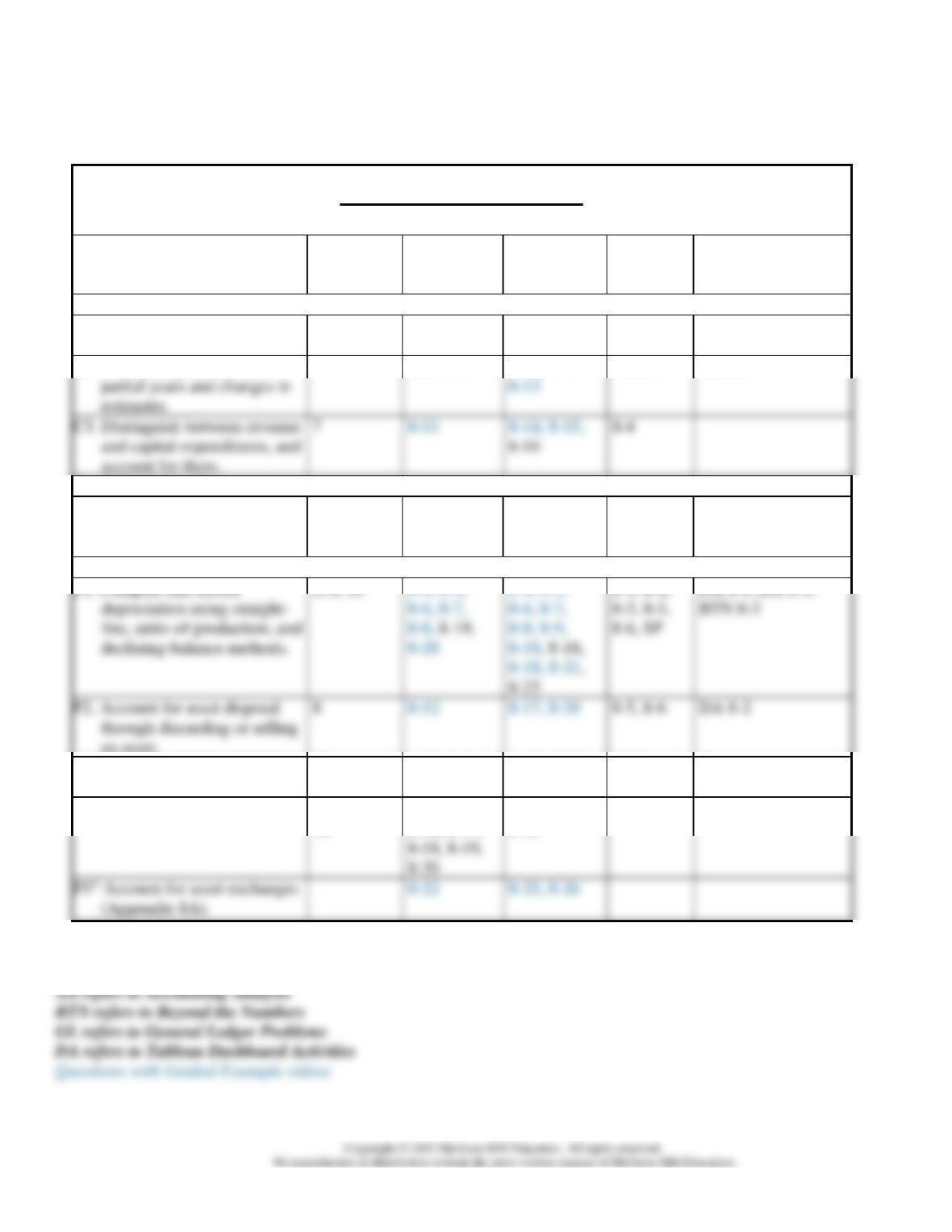
Related Assignment Materials
Student Learning Objectives
Questions
Quick
Studies*
Exercises*
Problems*
AA, BTN, DA
Conceptual objectives:
C1. Compute the cost of plant
assets.
1, 2, 3, 4, 16
8-1, 8-2,
8-3
8-1, 8-2,
8-3
8-1, 8-3,
8-4, 8-6
BTN 8-1
partial years and changes in
8-13
C3. Distinguish between revenue
and capital expenditures, and
account for them.
7
8-11
8-14, 8-15,
8-16
8-4
C2. Explain depreciation for
8-9, 8-10
8-11, 8-12
8-4, 8-5
DA 8-2
Analytical objectives:
A1. Compute total asset turnover
and apply it to analyze a
company’s use of assets.
15
8-21
8-24
SP
AA 8-1, AA 8-2,
AA 8-3, BTN 8-2,
BTN 8-4
Procedural objectives:
8-20
8-18, 8-21,
P2. Account for asset disposal
through discarding or selling
8
8-5, 8-6
an asset.
P3. Account for natural resource
assets and their depletion.
9
8-13, 8-14,
8-17, 8-19
8-19, 8-20,
8-23
8-7
P4. Account for intangible assets.
11, 12, 13,
14
8-18, 8-19,
8-20
8-14, 8-15,
8-16, 8-17,
8-21, 8-22,
8-23
*See additional information on next page that pertains to these quick studies, exercises, and problems.
SP refers to the Serial Problem
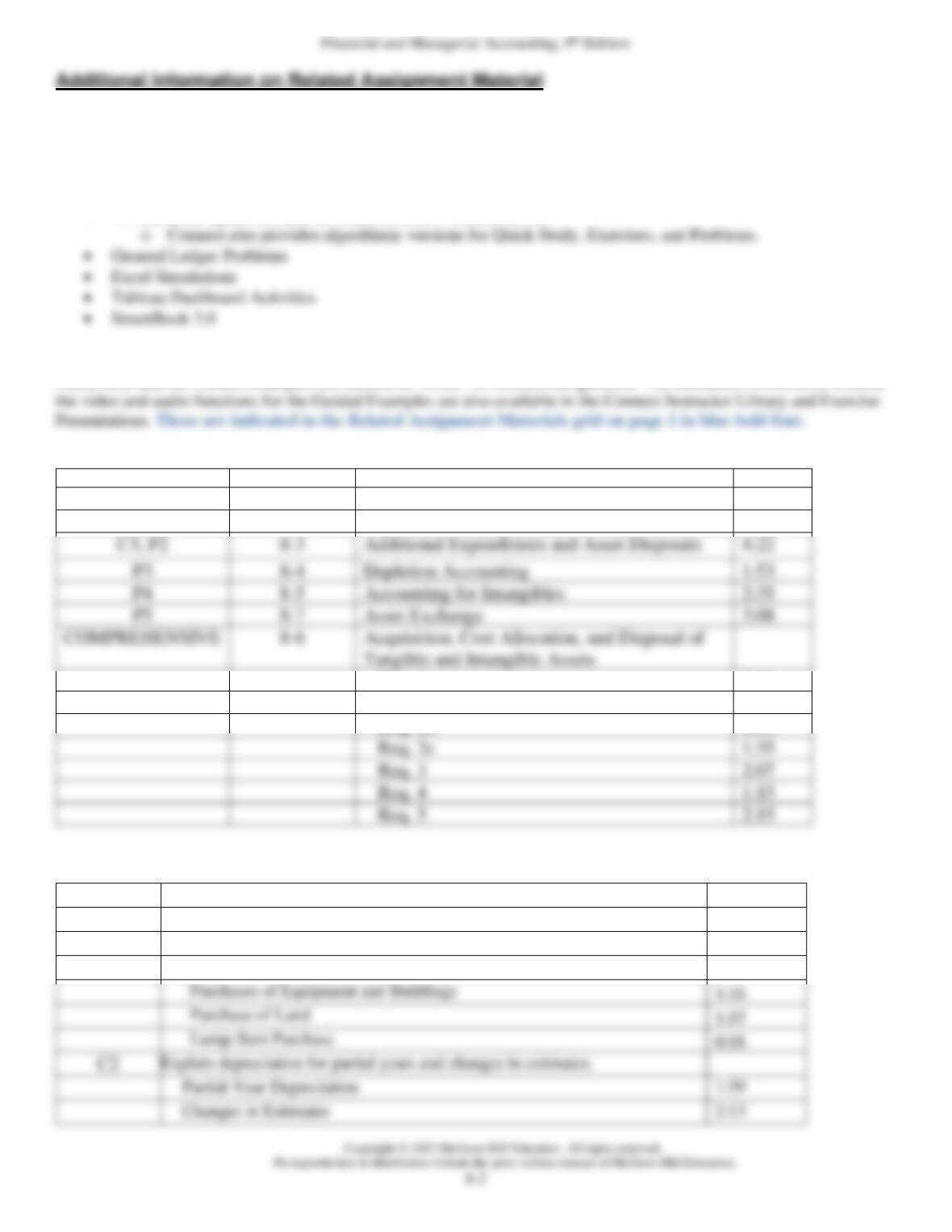
Purchases of Equipment and Buildings
1:15
Purchase of Land
1:27
Lump-Sum Purchase
0:55
C2
See Chapter 1 of the Instructor’s Resource Manual for more information on materials for this text available in
Connect.
Connect
Available on the instructor’s course-specific website, Connect:
• All numerical Quick Studies, all Exercises and Problems Set A.
Hints/Guided Examples
Please note that the Guided Examples are labeled as “Hints” in Connect assignments. The animated PowerPoints without
Need-to-Know Videos
LO
Need–to-Know
Title
Time
C1
8-1
Cost Determination
1:51
P1, C2
8-2
Depreciation Computations
9:16
8-4
Depletion Accounting
1:53
8-5
Accounting for Intangibles
2:35
8-7
Asset Exchange
3:08
Tangible and Intangible Assets
Req. 1
2:16
Req. 2a
1:43
Req. 2b
1:55
Req. 2c
1:35
Req. 3
2:07
Req. 4
1:15
Req. 5
2:15
Concept Overview Videos
LO
Title
Time
C1
Compute the cost of plant assets.
Features of Plant Assets
1:46
Cost Determination
0:56
Financial and Managerial Accounting, 9th Edition
8-3
C3
Distinguish between revenue and capital expenditures, and account for them.
Additional Expenditures
0:41
Ordinary Repairs and Betterments
1:30
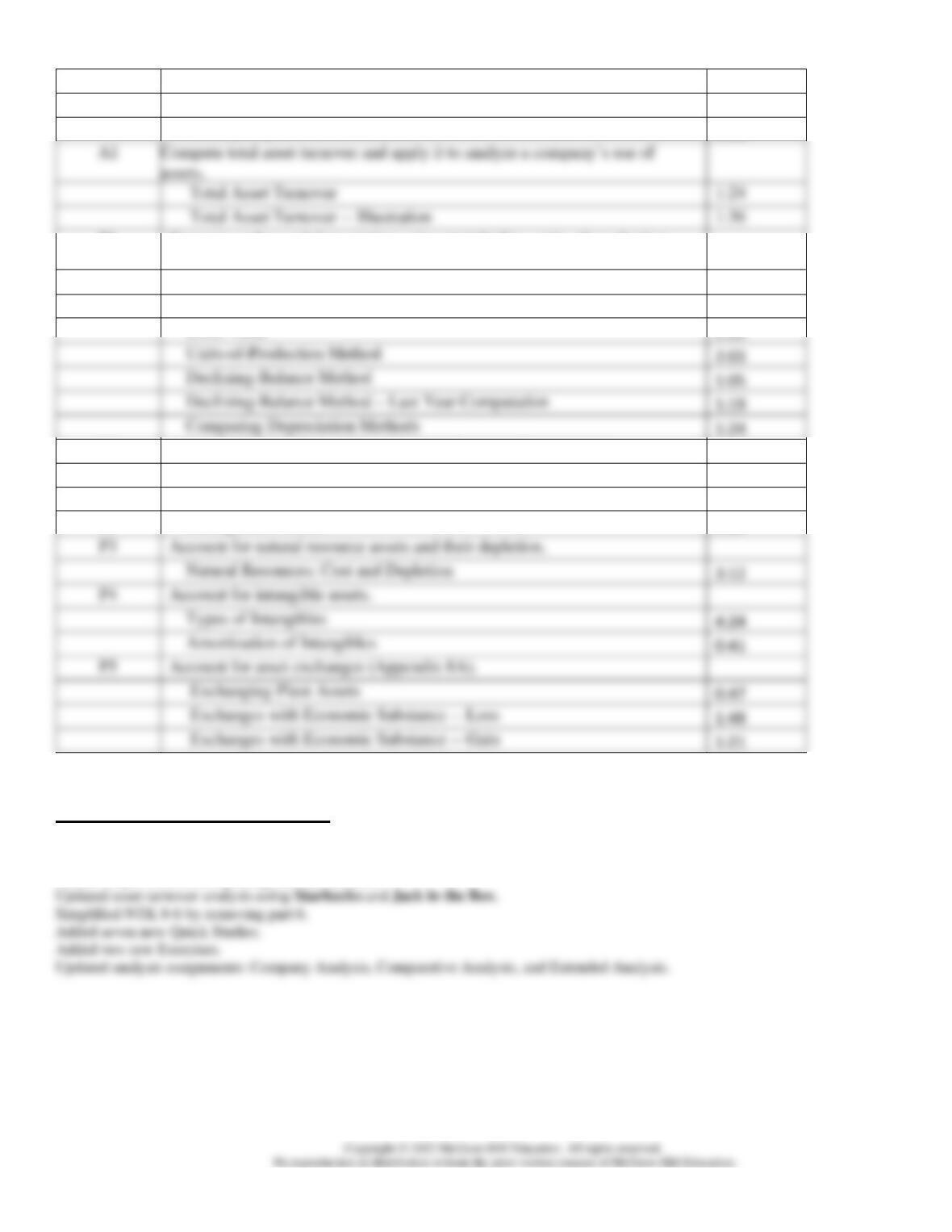
Total Asset Turnover
Total Asset Turnover — Illustration
P1
Compute and record depreciation using straight-line, units-of-production,
and declining-balance methods.
Factors in Computing Depreciation
1:33
Deprecation Methods- Straight-Line Method
2:07
Book Value
2:22
Units-of-Production Method
2:03
Declining-Balance Method
1:05
Declining-Balance Method – Last Year Computation
1:19
Comparing Depreciation Methods
1:24
P2
Account for asset disposal through discarding or selling an asset.
Disposals of Plant Assets
0:47
Discarding Plant Assets
2:19
Selling Plant Assets
2:57
P3
Account for natural resource assets and their depletion.
Natural Resources; Cost and Depletion
3:12
P4
Account for intangible assets.
Types of Intangibles
4:24
Amortization of Intangibles
0:41
P5
Account for asset exchanges (Appendix 8A).
Exchanging Plant Assets
0:47
Exchanges with Economic Substance — Loss
1:48
Exchanges with Economic Substance — Gain
1:21
Synopsis of Chapter Revisions
NEW opener—SpaceX and entrepreneurial assignment.
Plant asset impairments left to advanced courses.
Added simple exhibit on reporting natural resources.
Financial and Managerial Accounting, 9th Edition
Chapter Outline
I. Plant Assets—Tangible assets used in a company’s operations that have a useful life of more than one
accounting period. Consistent with cost principle, recorded at cost. Cost includes all normal and
reasonable expenditures necessary to get an asset in place and ready for use. Must be normal,
reasonable and necessary for its intended use.
installing, assembling and testing of machinery and equipment).
A. Machinery and Equipment
B. Buildings
1. If purchased, cost usually includes its purchase price, taxes, title fees, lawyer fees, and all
C. Land Improvements
Costs that increase the usefulness of the land.
1. Examples: parking lots, driveways, fences, and lighting
D. Land
Cost includes purchase price, realtor commissions, title insurance, legal fees, accrued property taxes,
legal fees, title insurance fees, accrued property taxes, surveying, clearing, landscaping, and local
II. Depreciation—The process of allocating the cost of a plant asset to expense while it is in use. Recorded
as a debit to Depreciation Expense and a credit to Accumulated Depreciation. Accumulated depreciation
has a normal credit balance.
A. Factors in Computing Depreciation
1. Cost—described in section I above.
2. Salvage Value—(residual value or scrap value) an estimate of the asset’s value at the end of its
useful life.
B. Depreciation Methods
Financial and Managerial Accounting, 9th Edition
8-5
1. Straight-Line Method—charges the same amount to expense for each period of the asset’s
2. Units-of-Production Method—charges a varying amount for each period depending on its usage.
Examples of capacity measurements: miles driven, product outputs, hours used. 2-step process
Step 3: Compute depreciation by multiplying this rate by the asset’s beginning-period book
value.
3. Declining-Balance Method—an accelerated depreciation method has more depreciation during
the early years and less in later years. Computation: Multiply the asset’s beginning of period
book value by a depreciation rate (usually twice the straight-line rate) to determine the period’s
4. Depreciation for Tax Reporting—differences between financial and tax accounting systems are
normal and expected.
If estimated salvage and/or useful life is revised:
a. Many companies use accelerated depreciation in computing taxable income because it
postpones its tax payments by charging higher depreciation expense in the early years and
1. Depreciation expense computations are revised by spreading the remaining cost to be
2. The revision is referred to as a change in an accounting estimate and only effects current and
future financial statements.
III. Additional Expenditures—Those made to operate, maintain, repair, or improve plant assets after their
initial purchase. To record these expenditures one must decide whether to capitalize (increase an asset)
or expense in current period.
1. Treated as revenue expenditures (also called income statement expenditures). Recorded as
expenses on current period’s income statement.
2. Examples: cleaning, repainting, and lubricating.
Financial and Managerial Accounting, 9th Edition
8-6
B. Betterments and Extraordinary Repairs—expenditures to make a plant asset more efficient or
productive; both are treated as a capital expenditure.
1. Betterments (Improvements) often involve adding a component to an asset that does not always
extend its useful life.
2. Extraordinary Repairs (Replacements) are expenditures that do extend the asset’s useful life
beyond its original estimate.
a. Examples: roofing replacement and major overhauls of machinery and equipment.
IV. Disposals of Plant Assets—Assets may be discarded, sold, or exchanged due to wear and tear,
obsolescence, inadequacy, or damage by fire or other accident. General accounting steps in a disposal of a
plant asset:
• Record depreciation up to the date of disposal—this also updates Accumulated Depreciation.
A. Discarding Plant Assets—no longer useful and has no market value
Follow general accounting steps above.
2. If not fully depreciated, record loss equal to the book value.
Follow general accounting steps above.
1. If fully depreciated, no loss.
V. Natural Resources—Assets that are physically consumed when used. Examples include timber, mineral
deposits, and oil and gas fields.
asset is depreciated in proportion to the depletion of the resource (use units-of-production method
A. Cost Determination and Depletion
1. Recorded at cost, which includes all expenditures necessary to acquire the resource and prepare
it for use.
VI. Intangible Assets—Certain nonphysical assets (used in operations) that confer on owner’s long-term
rights, privileges, competitive advantages. Examples in B below.
A. Cost Determination and Amortization
1. Recorded at cost when purchased. If simply developed by the business, relative immaterial
costs are expensed.
Financial and Managerial Accounting, 9th Edition
8-7
2. Amortization—process of systematically allocating cost of intangible asset to expense over its
estimated useful or economic life. (If it has an indefinite useful life, it should not be amortized
but is tested annually for impairment—this test is discussed in advanced course)
3. Gross acquisition cost is disclosed on the balance sheet along with their accumulated
amortization.
B. Types of Intangibles
1. Patents—an exclusive right granted to its owner to produce and sell a patented item or to use a
process for 20 years. Costs of research and development leading to a new patent are expense
when incurred.
4. Trademarks and Trade Names—symbols, names, phrases, or jingles identified with a company,
product, or service.
5. Goodwill—the amount by which the value of a company exceeds the value of its individual
assets and liabilities. Implies the company as a whole has certain valuable attributes not
6. Right-of-Use Asset (Lease)—the rights to possess and use leased property granted by the
property’s owner (lessor) to the lessee in a contract called a lease. Recorded, if there was a cost
7. Leasehold Improvements—improvements to leased property, such as partitions, painting, and
storefronts. Amortization results in debit to Amortization Expense—Leasehold Improvements.
VII. Decision Analysis—Total Asset Turnover
A. Measure of company’s efficiency using assets to generate sales.
VIII. Exchanging Plant Assets
A. Accounting for the exchange depends on whether the transaction has commercial substance. An
exchange has commercial substance if the company’s future cash flows change as a result of the
exchange of one asset for another asset.
Financial and Managerial Accounting, 9th Edition
8-8
Financial and Managerial Accounting, 9th Edition
8-9
Chapter 8 Alternate Demonstration Problem
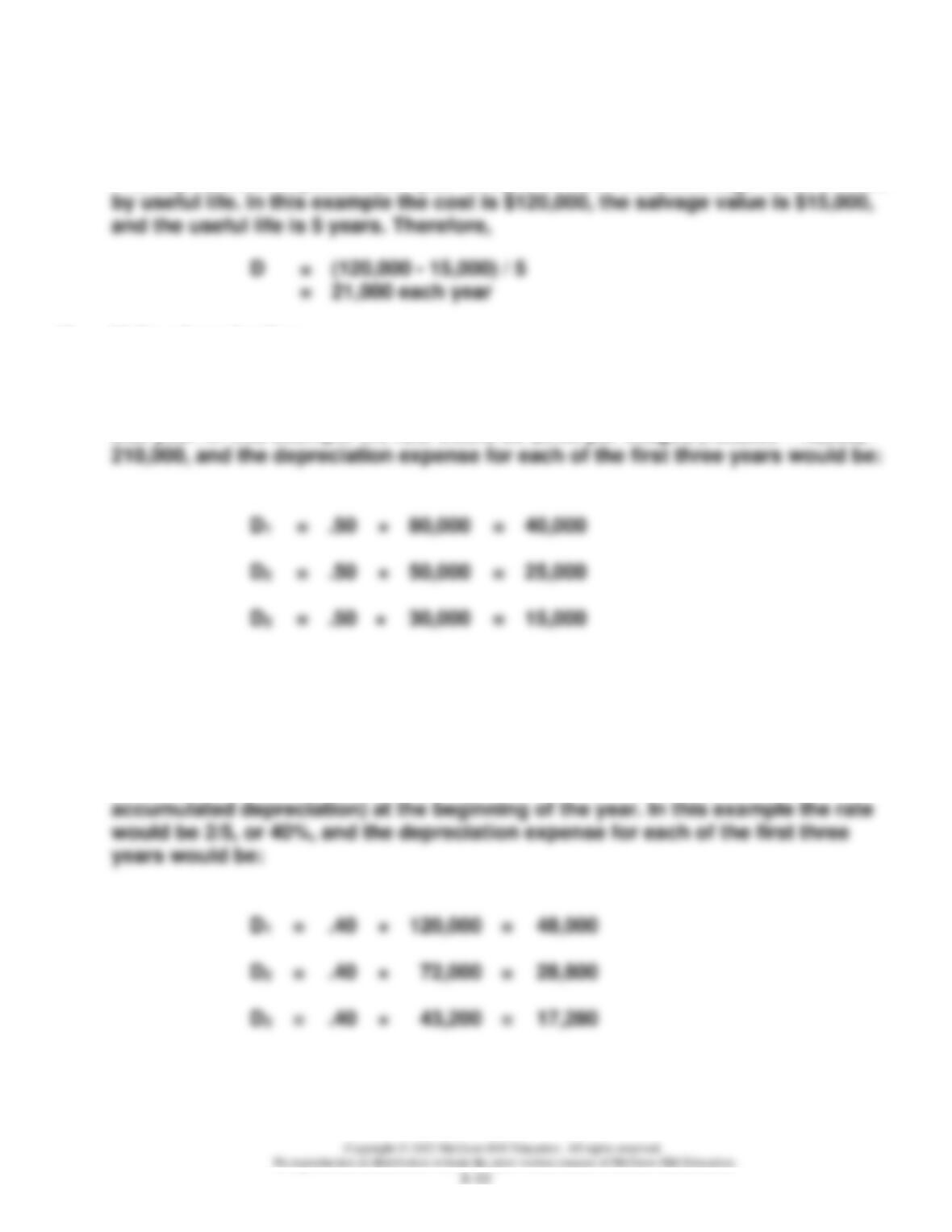
A new machine costs $120,000, has an estimated useful life of five years and an
estimated salvage value of $15,000 at the end of that time. It is expected that the
machine can produce 210,000 widgets during its useful life.
Required:
1. Calculate the depreciation expense for each of the first three years using:
2. Prepare the proper journal entry for the sale of the machine under the three
different depreciation methods.
Financial and Managerial Accounting, 9th Edition
Chapter 8 Solution: Alternate Demonstration Problem
1a. Straight-line
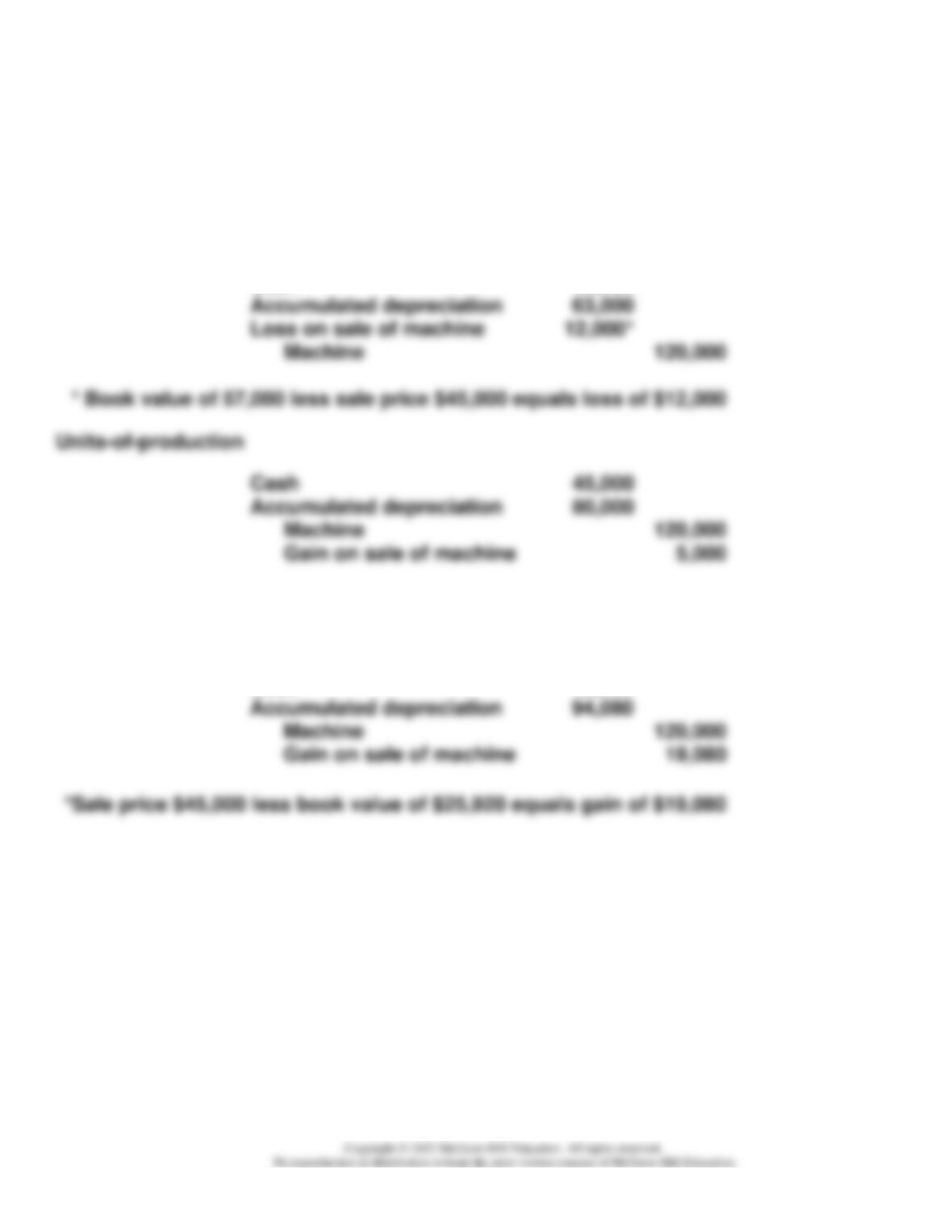
The depreciation expense each year is equal to cost minus salvage value divided
1b. Units–of-production
The depreciation expense each year is equal to a rate [(cost minus salvage)
divided by total production] multiplied by the actual number of units produced
that year. In this example the rate would be $0.50 per widget, (120,000 – 15,000) /
1c. Double-declining balance
The depreciation expense each year is equal to a rate (twice the straight-line rate
divided by useful life) multiplied by the asset’s net book value (cost minus
Financial and Managerial Accounting, 9th Edition
8-11
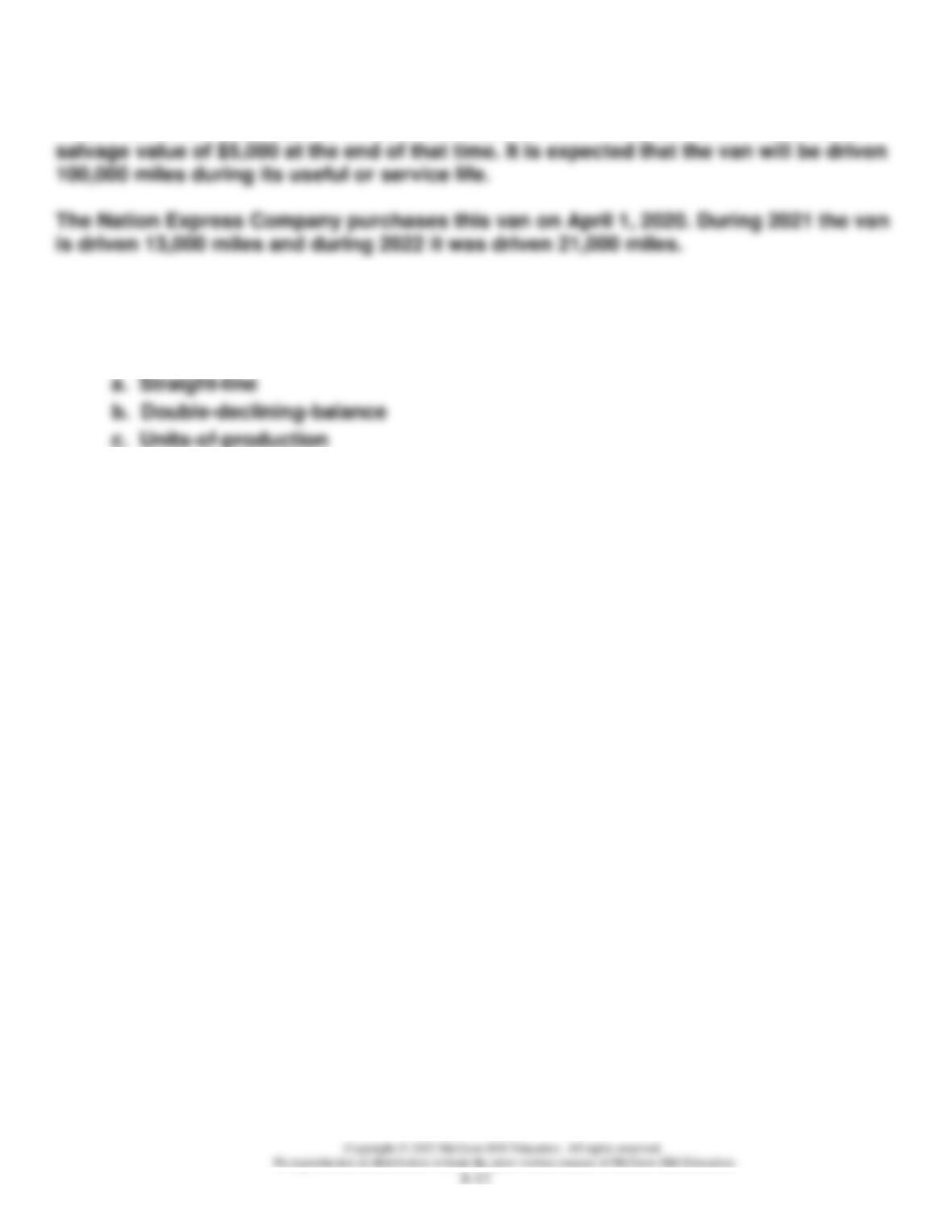
2. The journal entry for the sale of the asset will have the same general form
regardless of the method of depreciation adopted, except that whether there is a
gain or a loss on the sale may change according to the depreciation method used.
The gain or loss on disposal of the asset is determined by comparing the sale
price, in this case $45,000, with the net book value of the asset at the time of the
sale.
Straight-line
Cash
45,000
Accumulated depreciation
63,000
Machine
Cash
45,000
Accumulated depreciation
80,000
Machine
* Sale price $45,000 less book value of $40,000 equals gain of $5,000
Double-declining balance
Cash
45,000
Accumulated depreciation
94,080
Machine
19,080
*Sale price $45,000 less book value of $25,920 equals gain of $19,080
Financial and Managerial Accounting, 9th Edition
Chapter 8 Alternate Demonstration Problem #2
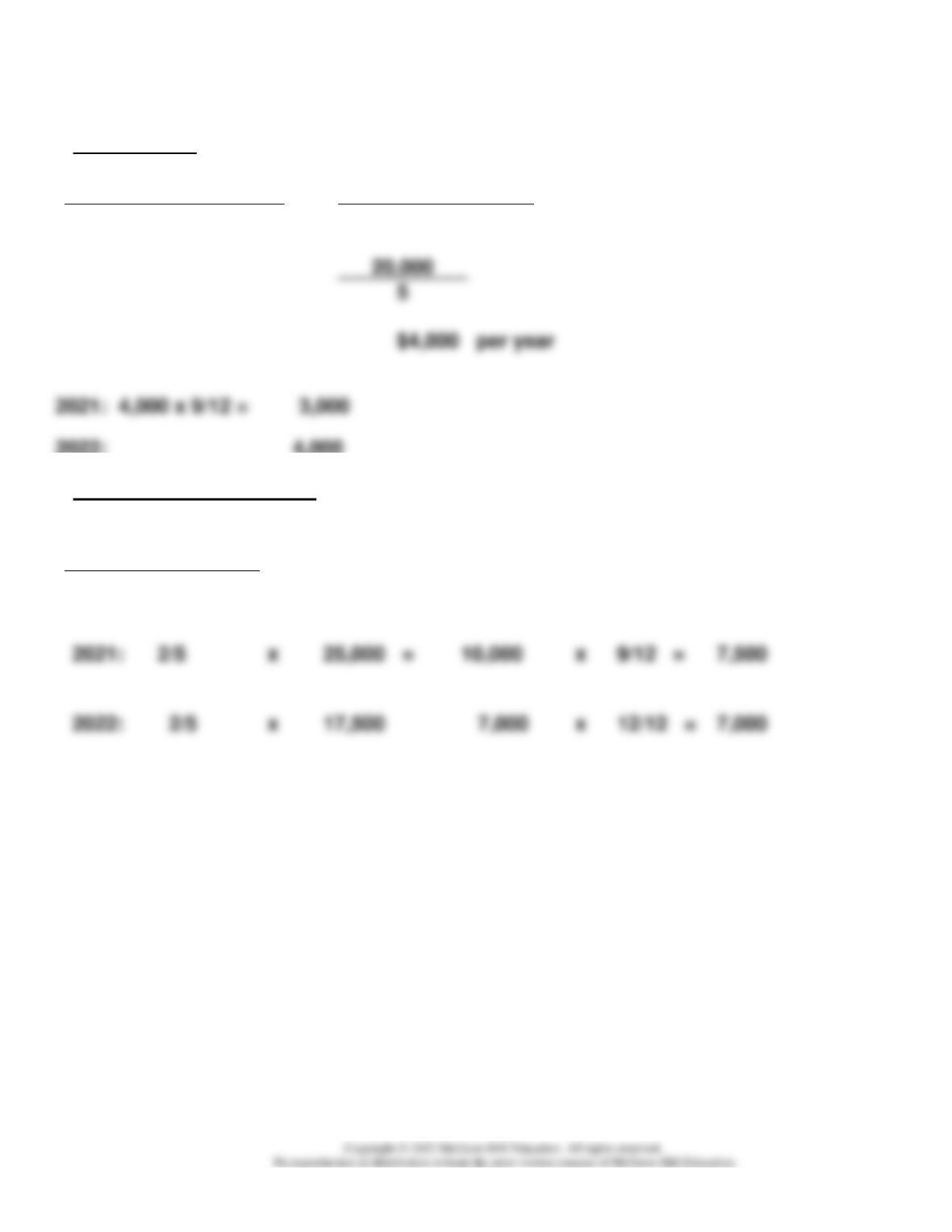
A new van costs $25,000, has an estimated useful life of five years and an estimated
Required:
1. Calculate the depreciation expense for 2021 and 2022 using:
Financial and Managerial Accounting, 9th Edition
8-13
Chapter 8 Solution: Alternate Demonstration Problem #2
Straight Line
Cost – Salvage value
=
25000 – 5000
useful life
5 years
per year
2022: 4,000
Double declining balance
2
x
book
value
=
Depreciation expense
life
2021: 2/5
x
=
x
9/12 =
2022: 2/5
x
x
12/12 =
Financial and Managerial Accounting, 9th Edition
8-14
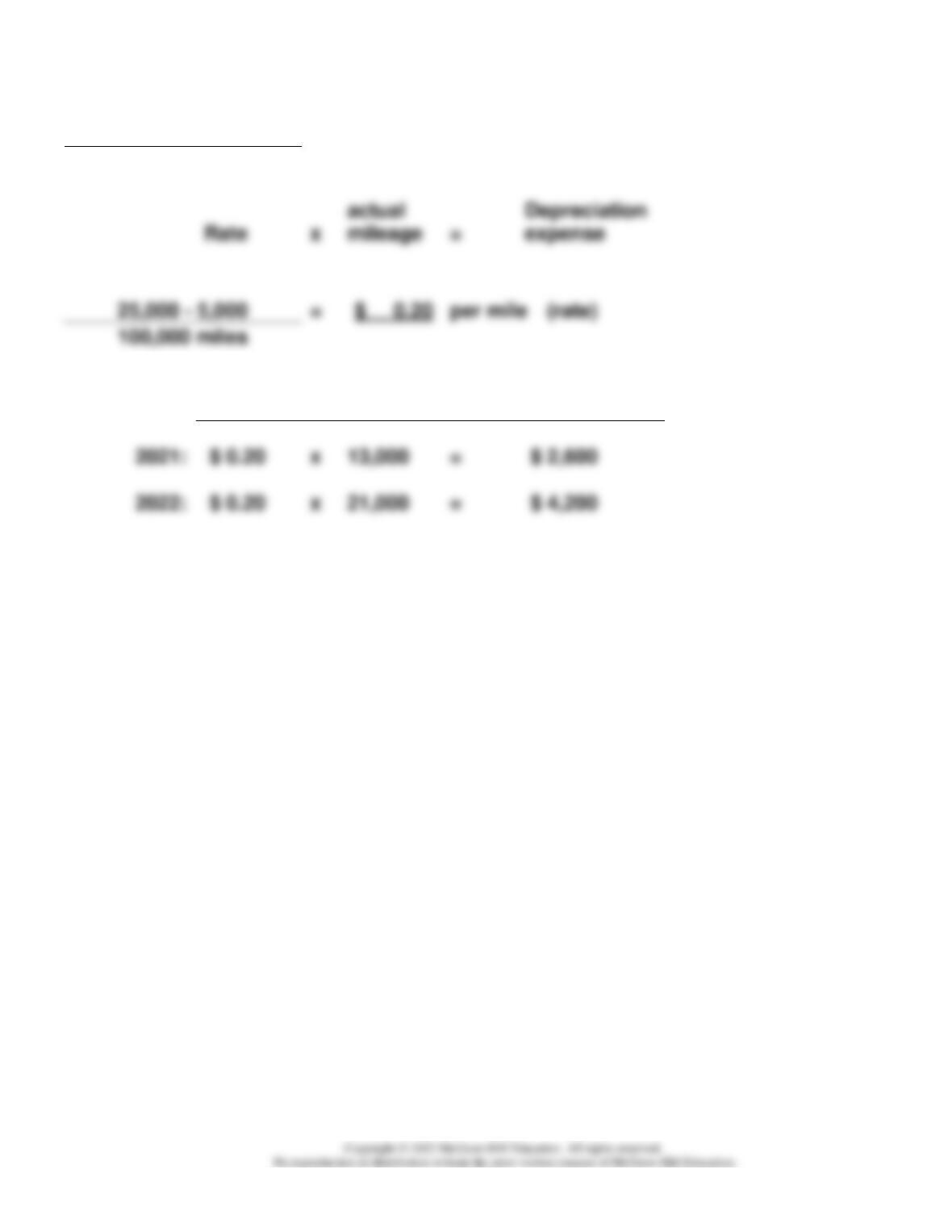
Units of Production
cost – salvage
=
depreciation rate per mile
total miles
x
actual
mileage
=
Depreciation
expense
=
(rate)
rate
x
actual
mileage
=
Expense
$ 0.20
x
13,000
=
$ 2,600
$ 0.20
x
21,000
=
$ 4,200