Wild and Shaw Financial and Managerial Accounting 9e Solutions Manual: Chapter 8
574
Problem 8-6B (20 minutes)
1.
Jan. 1
Machinery ……………………………………………………….
150,000
Cash ………………………………………………………….
150,000
Jan. 4
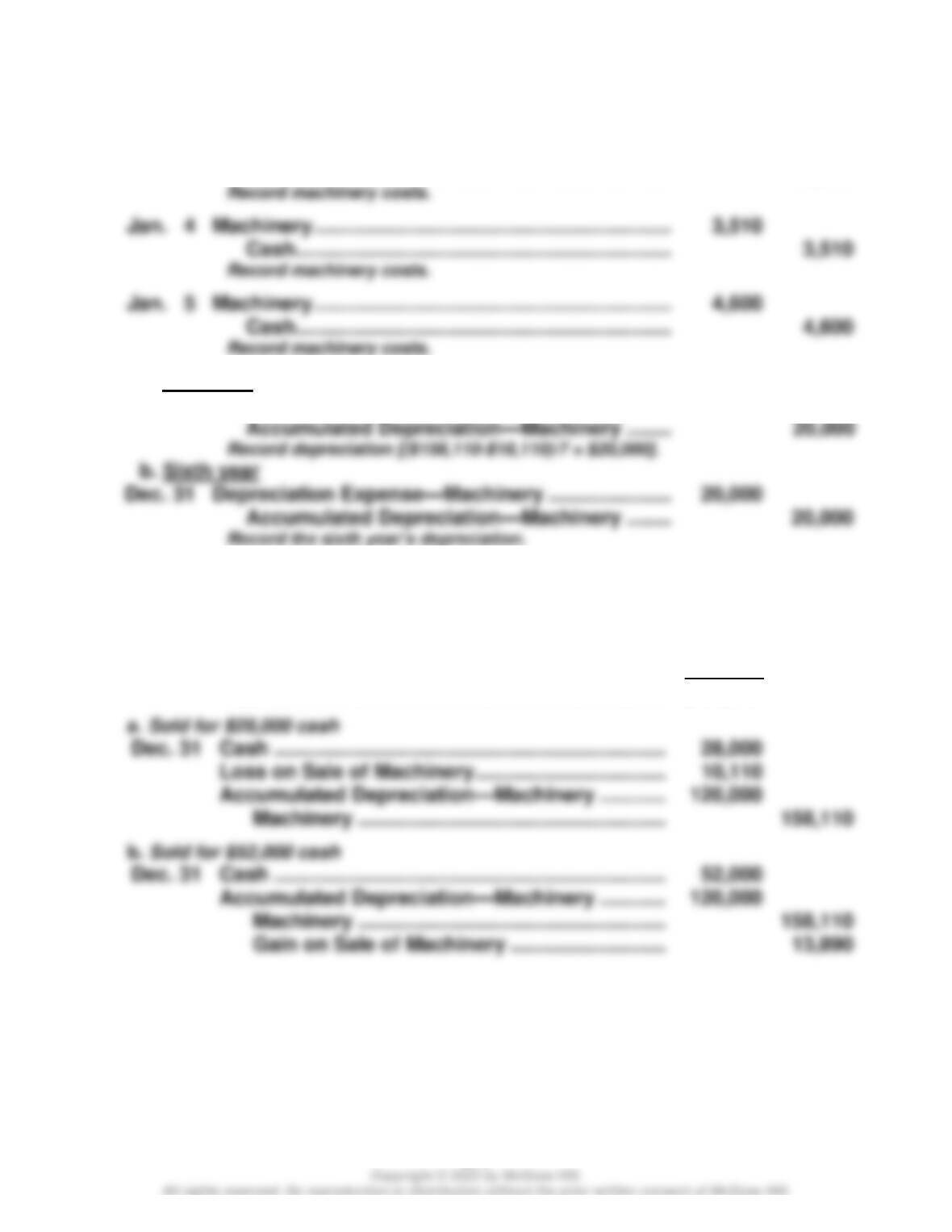
Machinery ……………………………………………………….
Cash ………………………………………………………….
Jan. 5
Machinery ……………………………………………………….
Cash ………………………………………………………….
2. a. First year
Dec. 31
Depreciation Expense—Machinery ………………….
20,000
Accumulated Depreciation—Machinery ……..
Dec. 31
Depreciation Expense—Machinery ………………….
20,000
Accumulated Depreciation—Machinery ……..
20,000
3. Accumulated depreciation at the date of disposal
First six years’ depreciation (6 x $20,000) …………….
$120,000
Book value at the date of disposal
Original total cost ……………………………………………….
$158,110
Accumulated depreciation …………………………………..
(120,000)
Total …………………………………………………………………..
$ 38,110
28,000
10,110
Accumulated Depreciation—Machinery …………
120,000
Machinery ……………………………………………….
158,110
52,000
Accumulated Depreciation—Machinery …………
120,000
Machinery ……………………………………………….
158,110
Gain on Sale of Machinery ……………………….
13,890
Wild and Shaw Financial and Managerial Accounting 9e Solutions Manual: Chapter 8
575
Problem 8-7B (20 minutes)
a.
Feb. 19
Mineral Deposit ……………………………………….
5,400,000
Cash ………………………………………………….
5,400,000
Record purchase of mineral deposit.
b.
Mar. 21
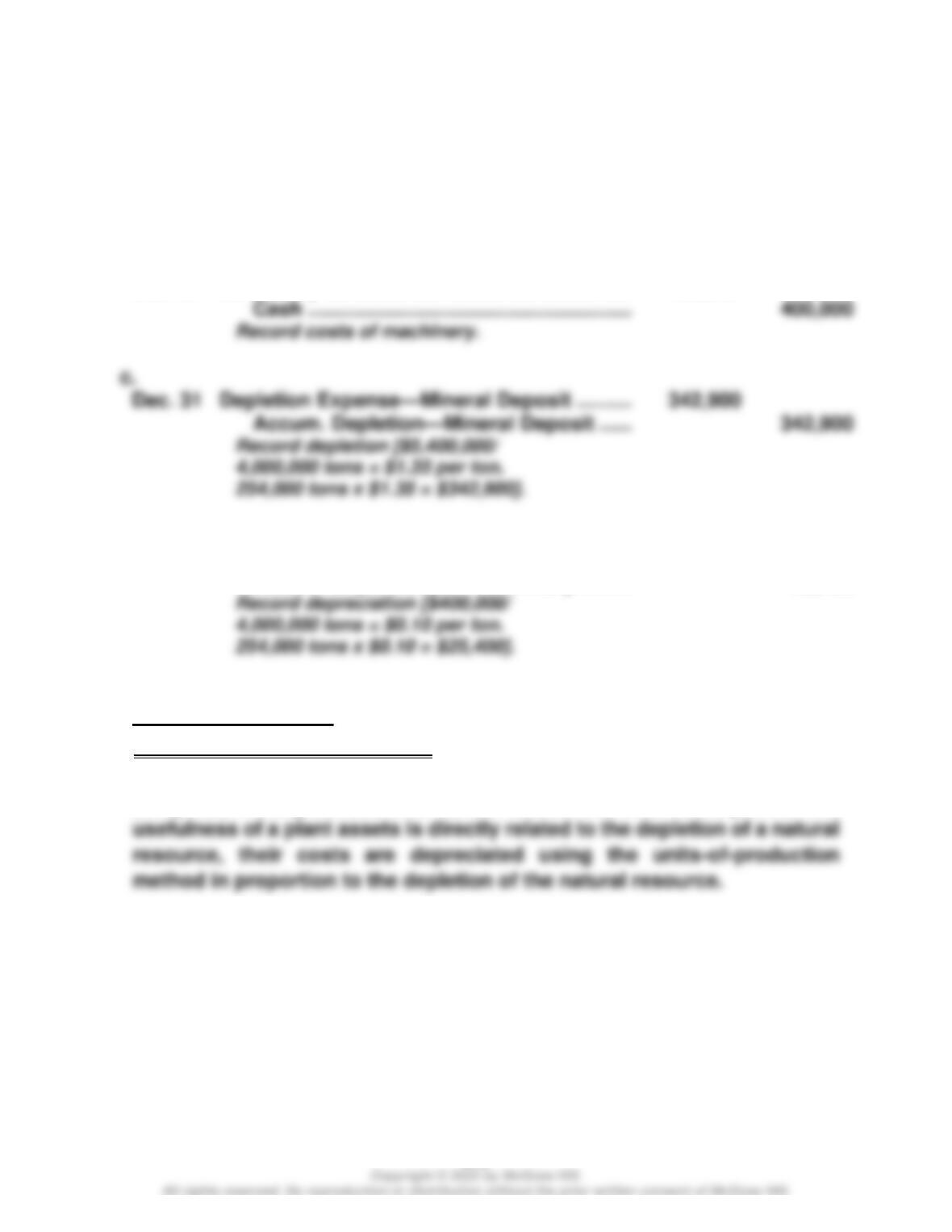
Machinery ……………………………………………….
400,000
Cash ………………………………………………….
Record costs of machinery.
Dec. 31
342,900
Accum. Depletion—Mineral Deposit ……
254,000 tons x $1.35 = $342,900].
d.
Dec. 31
Depreciation Expense—Machinery …………..
25,400
Accum. Depreciation—Machinery ……….
25,400
4,000,000 tons = $0.10 per ton.
254,000 tons x $0.10 = $25,400].
Analysis Component
e. Depreciated over its useful life.
Explanation: If the machine will be used at another site when extraction is
complete, it is depreciated over its own useful life. Alternatively, when the
Wild and Shaw Financial and Managerial Accounting 9e Solutions Manual: Chapter 8
576
Serial Problem — SP 8
Serial Problem — Business Solutions (45 minutes)
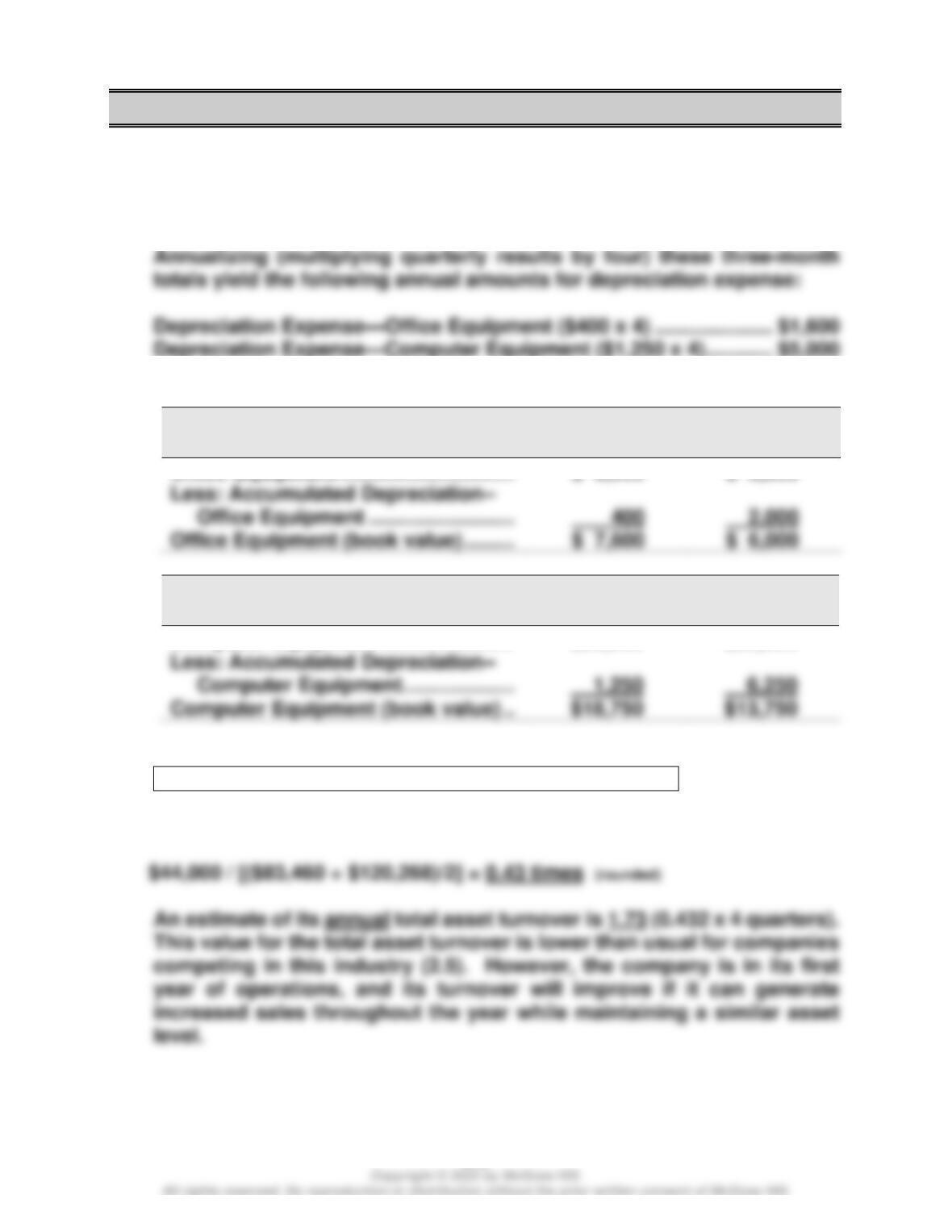
1. For the three months ended March 31, 2022, depreciation expense was
$400 for office equipment and $1,250 for the computer equipment.
2.
December 31,
2021
December 31,
2022
Office Equipment ………………………….
$ 8,000
$ 8,000
Office Equipment (book value) ………
$ 7,600
$ 6,000
December 31,
2021
December 31,
2022
Computer Equipment ……………………
$20,000
$20,000
Computer Equipment (book value) ..
$13,750
3.
Total asset turnover = Net sales / Average total assets
The 3-month total asset turnover for Business Solutions at March 31, 2022:
Wild and Shaw Financial and Managerial Accounting 9e Solutions Manual: Chapter 8
Company Analysis — AA 8-1
All $ millions
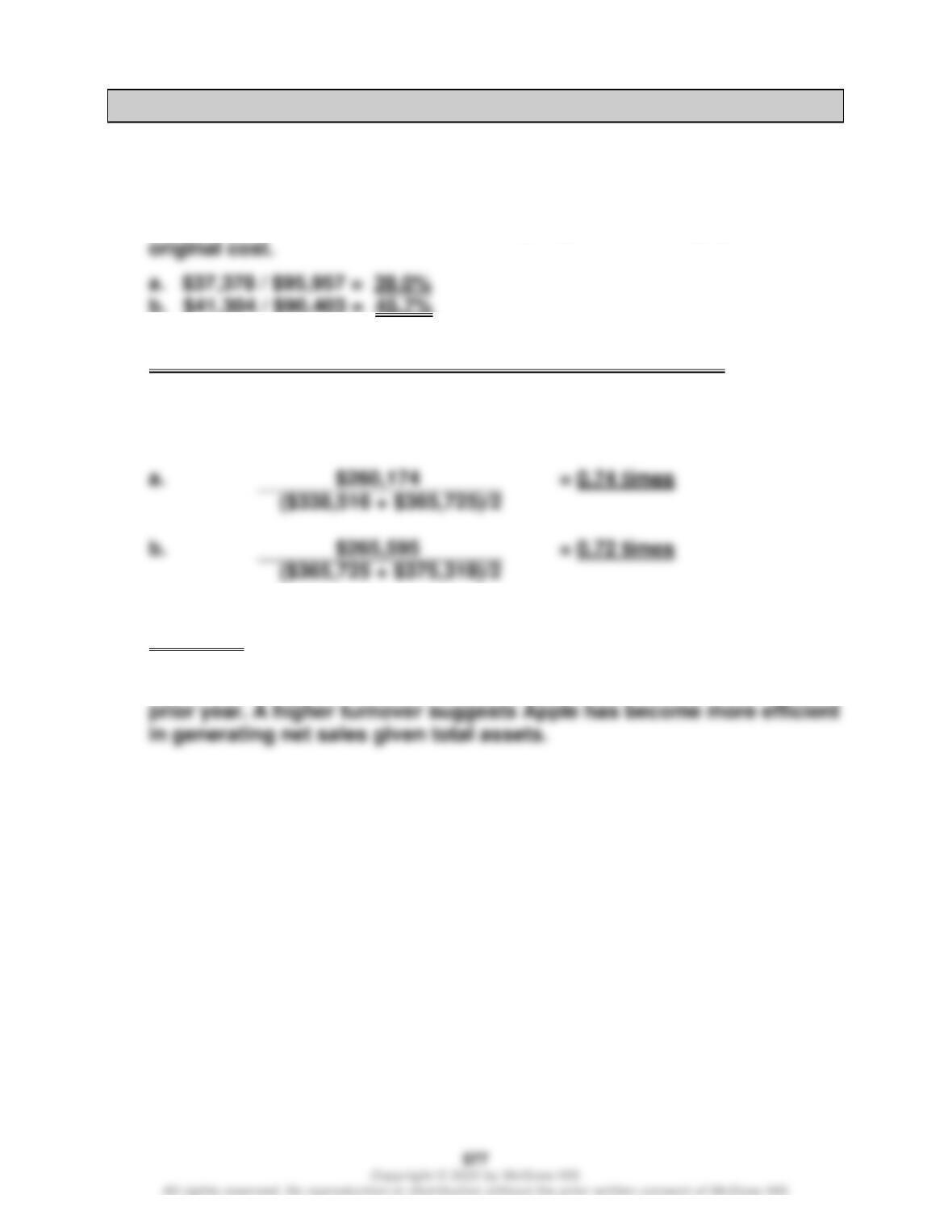
1. The percent of original cost remaining to be depreciated is computed by
taking the ratio of the book value of Property, Plant and Equipment to the
2. Research and development costs are expensed as incurred.
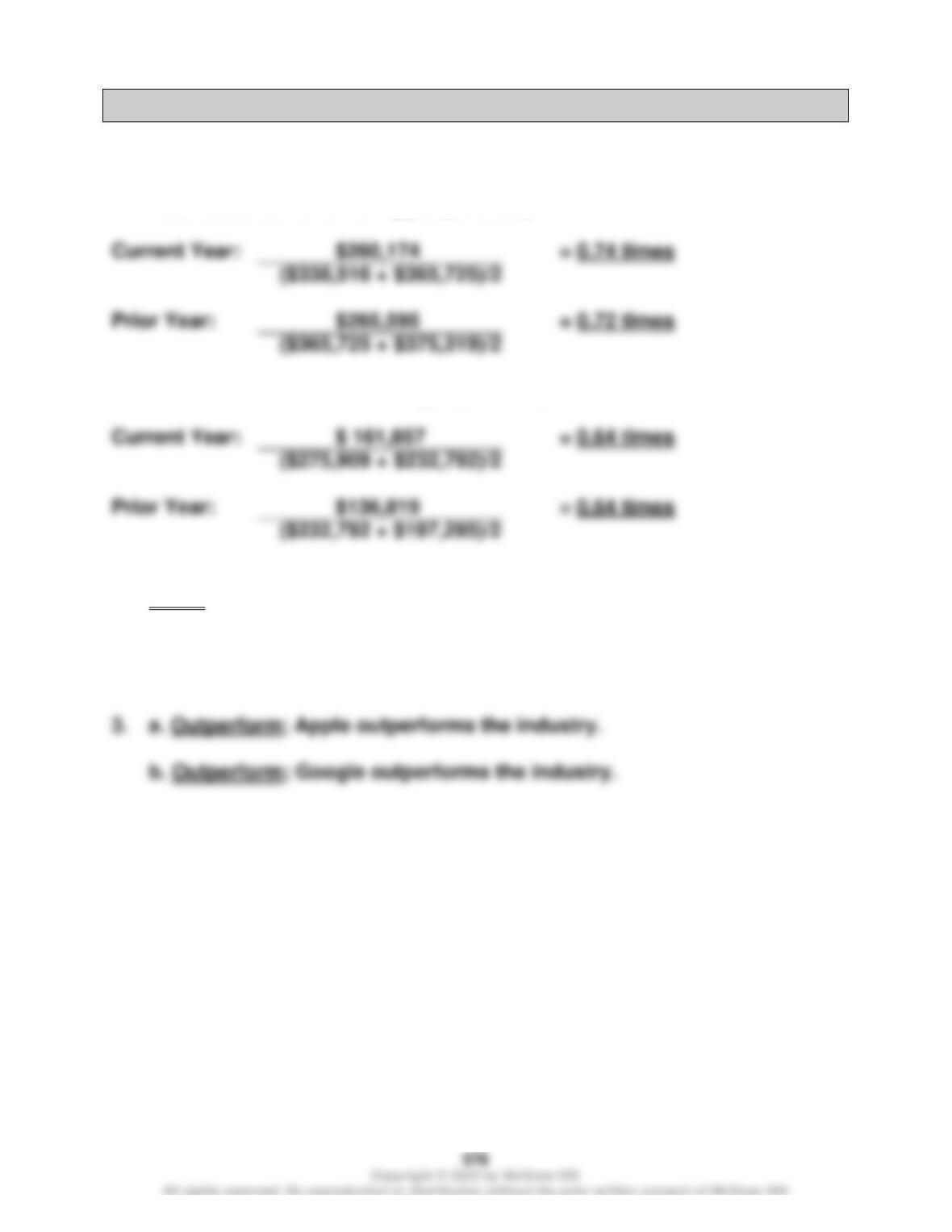
3. Total asset turnover:
4. Favorable
Explanation: Apple’s turnover increased in the current year versus the
Wild and Shaw Financial and Managerial Accounting 9e Solutions Manual: Chapter 8
Comparative Analysis — AA 8-2
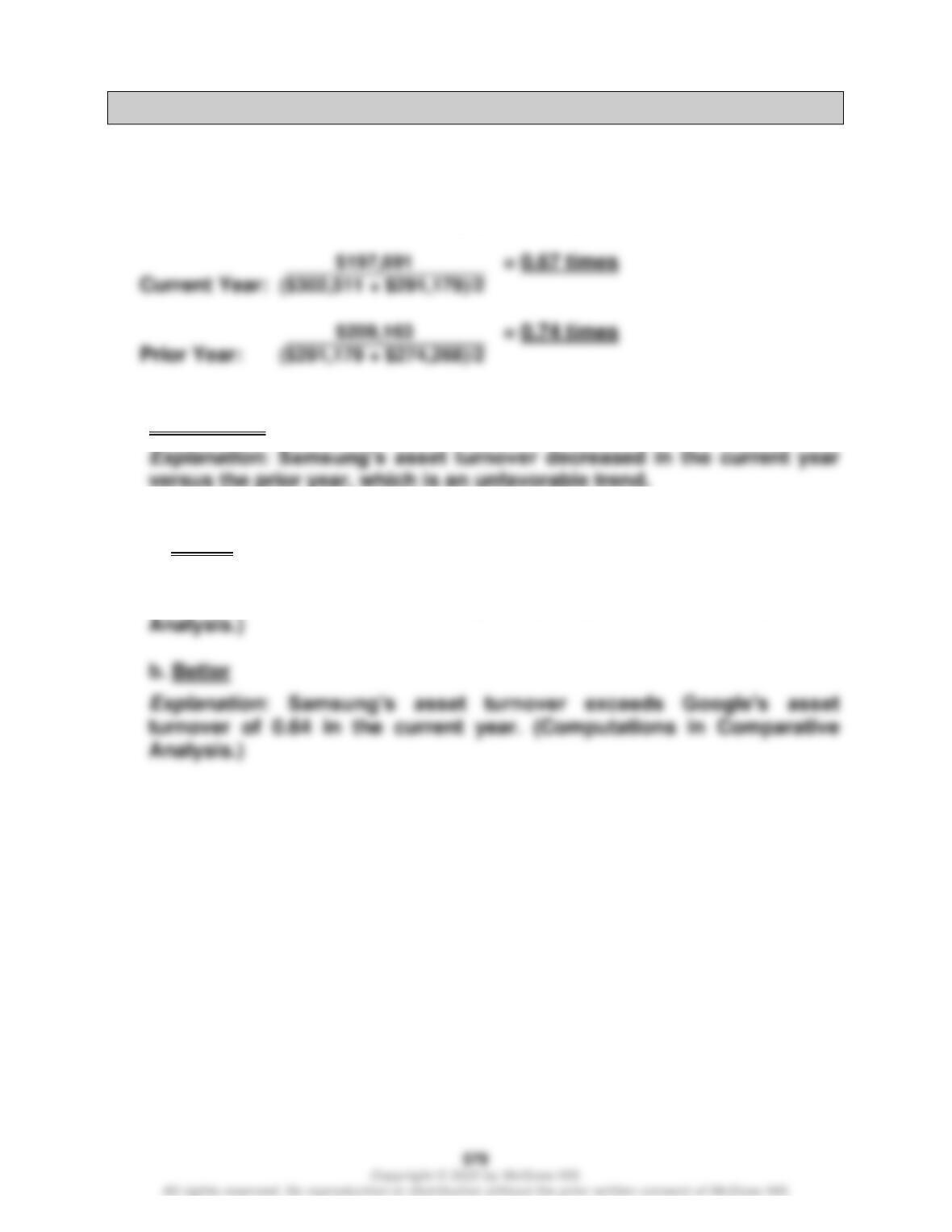
Note: Total asset turnover = Net sales / Average total assets
1. Total asset turnover for Apple ($ millions)
Total asset turnover for Google ($ millions)
2. Apple
Explanation: Apple employs its assets more efficiently than Google for
the current year. This is evident in its higher total asset turnover.
Wild and Shaw Financial and Managerial Accounting 9e Solutions Manual: Chapter 8
Extended Analysis — AA 8-3
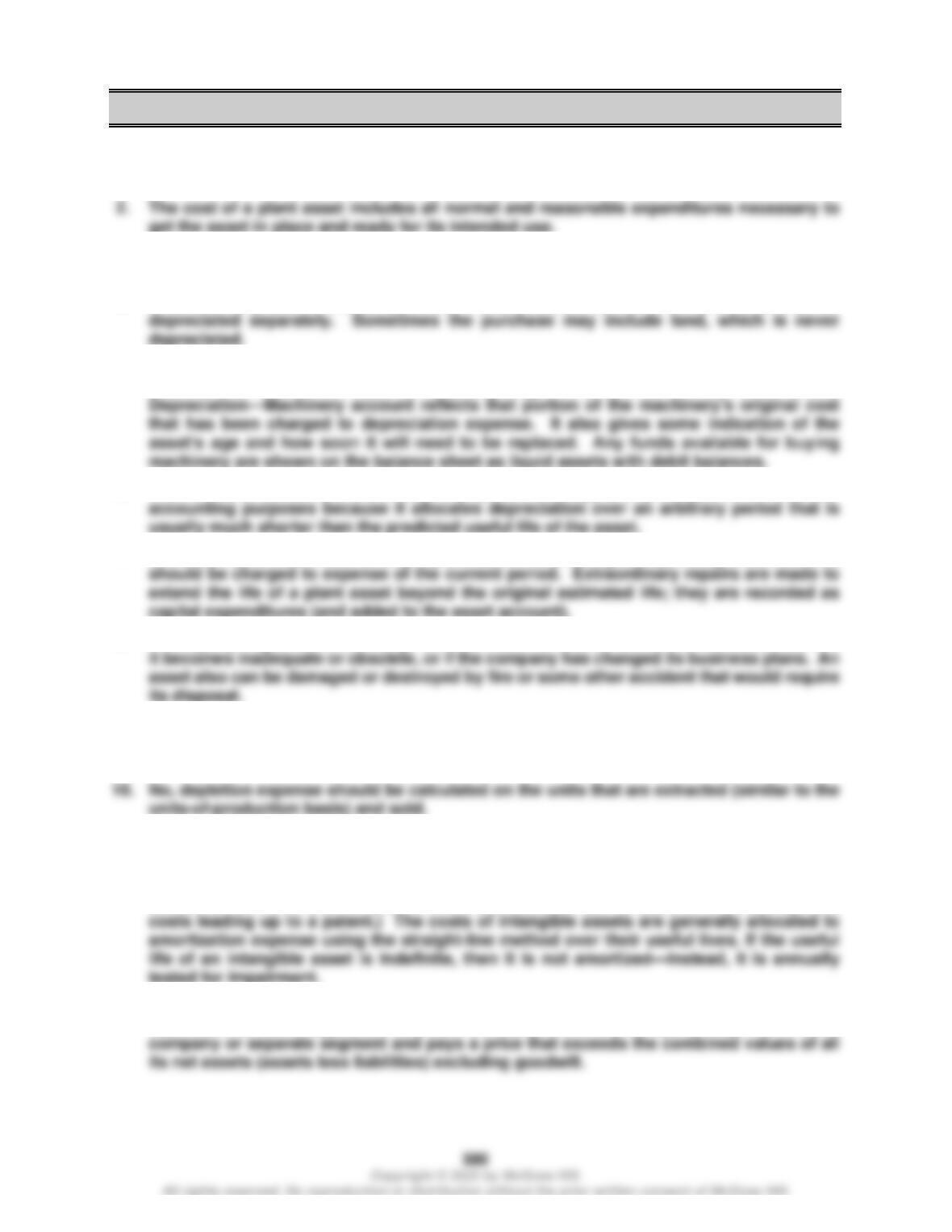
Note: Total asset turnover = Net sales / Average total assets
1. Total asset turnover for Samsung ($ millions):
2. Unfavorable
3. a. Worse
Explanation: Samsung’s asset turnover is less than Apple’s asset
turnover of 0.74 in the current year. (Computations in Comparative
Wild and Shaw Financial and Managerial Accounting 9e Solutions Manual: Chapter 8
DISCUSSION QUESTIONS
1. A plant asset is tangible; it is used in the production or sale of other assets or services;
and it has a useful life longer than one accounting period.
3. Land is an asset with an unlimited life and, therefore, is not subject to depreciation. Land
improvements have limited lives and are subject to depreciation.
4. Often the lump-sum or basket purchase includes assets with different lives that must be
5. The Accumulated Depreciation—Machinery account is a contra asset account with a credit
balance that cannot be used to buy anything. The balance of the Accumulated
6. The Modified Accelerated Cost Recovery System is not generally acceptable for financial
7. Ordinary repairs are made to keep a plant asset in normal, good operating condition, and
8. A company might sell or exchange an asset when it reaches the end of its useful life, or if
9. The process of allocating the cost of natural resources to expense over the periods when
they are consumed is called depletion. The method to compute depletion is similar to
units-of–production depreciation.
11. An intangible asset: (1) has no physical existence; (2) derives value from the unique legal
and contractual rights held by its owner; and (3) is used in the company’s operations.
12. Intangible assets are generally recorded at their cost and amortized over their predicted
useful life. (However, some costs are not included, such as the research and development
13. A company has goodwill when its value exceeds the value of its individual assets and
liabilities. Goodwill appears in the balance sheet when one company acquires another
Wild and Shaw Financial and Managerial Accounting 9e Solutions Manual: Chapter 8
14. No; this type of goodwill would not be amortized. Instead, the FASB (SFAS 142) requires
that goodwill be annually tested for impairment. If the book value of goodwill does not
15. Total asset turnover is calculated by dividing net sales by average total assets. Financial
16. (a) The main difference between plant assets and current assets is that current assets are
consumed or converted into cash within a short period of time, while plant assets have a
useful life of more than one accounting period.
Wild and Shaw Financial and Managerial Accounting 9e Solutions Manual: Chapter 8
582
Ethics Challenge — BTN 8-1
1. When managers acquire new assets a number of decisions relative to
2. When assets are placed in use on a day other than the first day of the
month an assumption is often made that the assets are placed in use on
the first day of the month nearest to the date of the purchase. For
example, for assets purchased on the 1st through 15th days of the month,
3. By always assuming the first day of the following month as the date of
purchase, less depreciation is (initially) accrued for the assets employed.
Communicating in Practice — BTN 8-2
The solution to this activity will vary based on the industry and the
companies chosen for analysis. Many instructors find it useful to report the
results from the teams to the class for purposes of classroom discussion
and analysis.
Wild and Shaw Financial and Managerial Accounting 9e Solutions Manual: Chapter 8
Teamwork in Action — BTN 8-3
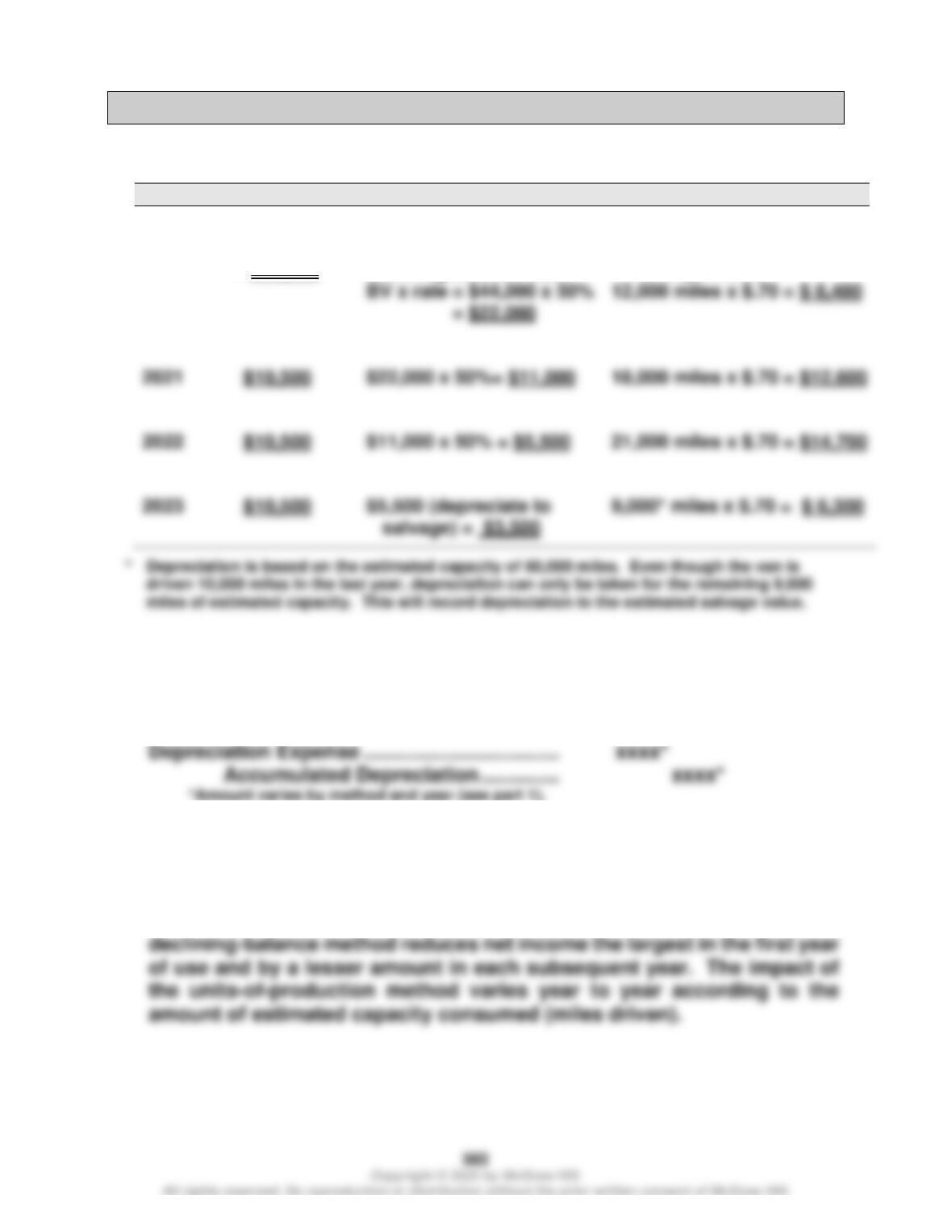
1. Annual depreciation for each year of the asset’s useful life:
Year
Straight-line
Double-Declining-Balance
Units-of-Production
2020
($44,000-$2,000)/4
= $10,500
$22,000 x 50%= $11,000
18,000 miles x $.70 = $12,600
$11,000 x 50% = $5,500
21,000 miles x $.70 = $14,700
(100%/4) x 2 = 50% is
declining-balance rate.
($44,000-$2,000)/60,000 miles
= $.70 per mile.
2. Depreciation is recorded in an adjusting entry at the end of each
period. The entry is:
3. Each expert’s presentation of the comparison of methods will be slightly
different. The experts should make the following points: The straight–
line method reduces net income by the same amount each year. The
Wild and Shaw Financial and Managerial Accounting 9e Solutions Manual: Chapter 8
584
Teamwork in Action — BTN 8-3 – continued
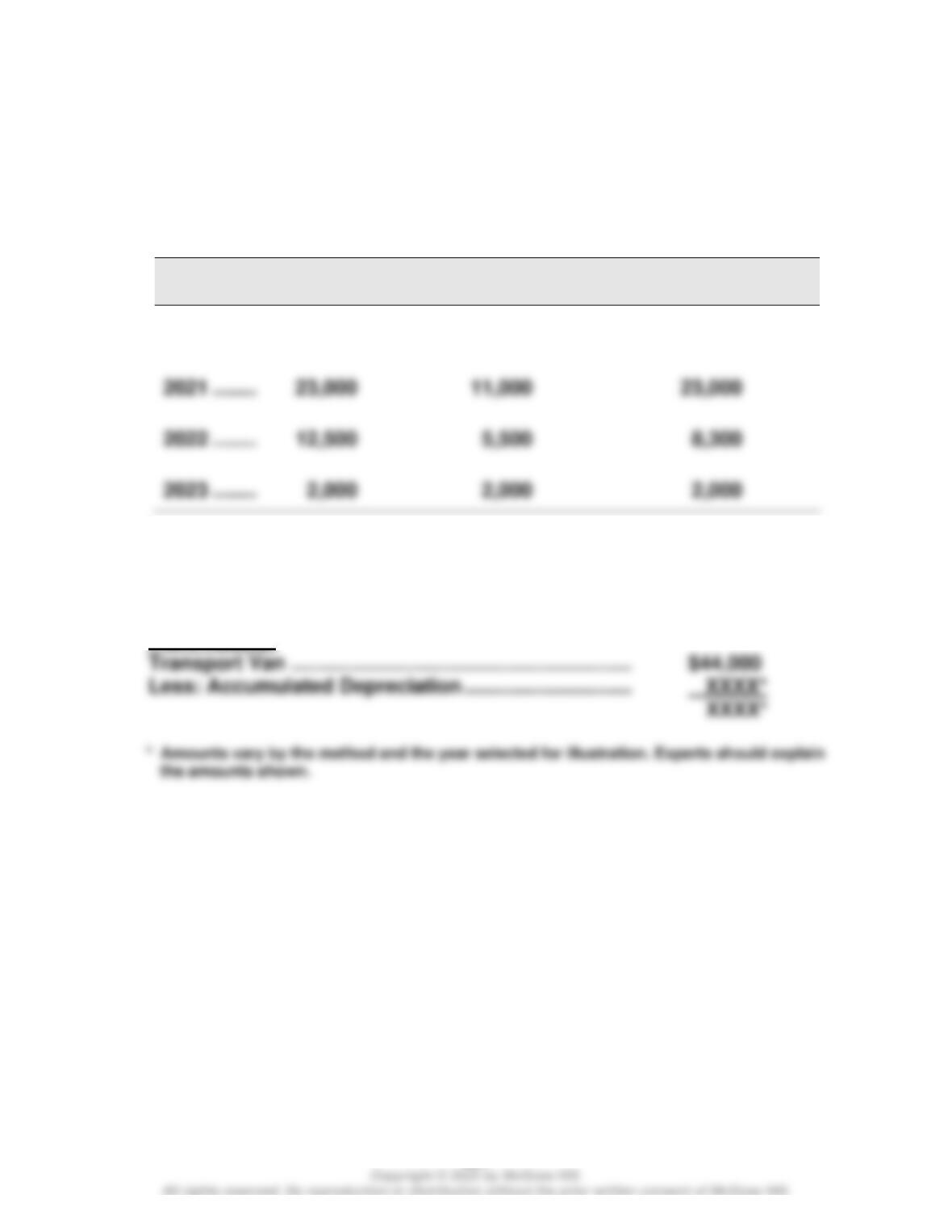
4. Book value at the end of each year
= Cost – Accumulated depreciation
= $44,000 – (amount varies by method—see part 1 for annual amounts)
Year
Straight–line
Double-Declining-
Balance
Units of Production
2020 ……..
$33,500
$22,000
$35,600
2022 ……..
2023 ……..
For reporting purposes, each expert will have different results. But
each should show:
Plant Assets:
Wild and Shaw Financial and Managerial Accounting 9e Solutions Manual: Chapter 8
585
Entrepreneurial Decision — BTN 8-4
Part 1
(a) Under current conditions, the total asset turnover is 3.2. This is computed
as net sales of $8,000,000 divided by its average total assets of
(b) Under this proposal, its asset turnover would increase to 4. This is
computed by taking its net sales of $12,000,000 ($8,000,000 + $4,000,000)
Part 2
The proposal would yield an improved total asset turnover of 4 vis-à-vis the
current total asset turnover of 3.2. However, we need to recognize that this

Wild and Shaw Financial and Managerial Accounting 9e Solutions Manual: Chapter 8
586