Chapter 07 – Reporting and Interpreting Cost of Goods Sold and Inventory
7-1
CHAPTER 7
REPORTING AND INTERPRETING
COST OF GOODS SOLD AND INVENTORY
Learning Objectives and Related Assignment Materials
Learning Objectives
Mini-
Exercises
Exercises
Problems
Alternate
Problems
Compre-
hensive
Problem
Cases and
Projects
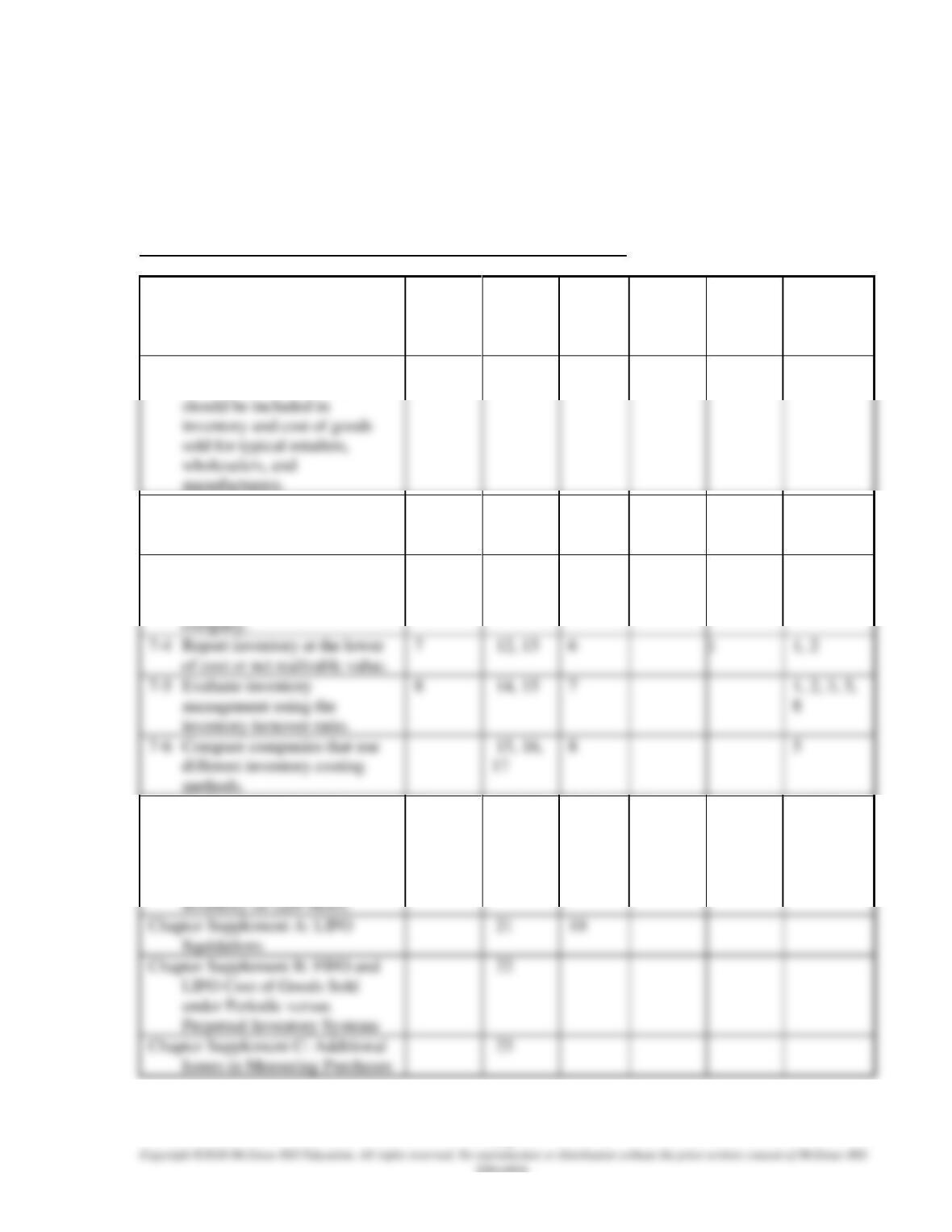
7-1 Apply the cost principle to
identify the amounts that
1, 2, 3,
4
1, 2, 3,
4
1
1
1, 4
7-2 Report inventory and cost of
goods sold using the four
inventory costing methods.
5
5, 6, 7,
8, 9, 10,
11
2, 3, 4,
5
1, 2, 3
1
1, 2, 8
of cost or net realizable value.
7
12, 13
6
1, 2
7-6 Compare companies that use
different inventory costing
methods.
15, 16,
17
8
5
7-3 Decide when the use of
different inventory costing
methods is beneficial to a
6
7, 8, 9,
10, 11
3, 4, 5
2, 3
1
8
21
10
23
7-7 Understand methods for
controlling inventory, analyze
the effects of inventory errors
on financial statements, and
analyze the effects of
9
18, 19,
20
7, 9
4
2, 7, 8
Chapter 07 – Reporting and Interpreting Cost of Goods Sold and Inventory
7-2
Synopsis of Chapter Revisions
Focus Company: Harley-Davidson, Inc.
• Focus and contrast company data updated.
• New FASB’s Accounting Standards update for applying lower-of-cost-or-market to inventories
PowerPoint Slides
Learning Objectives
PowerPoint® Slides
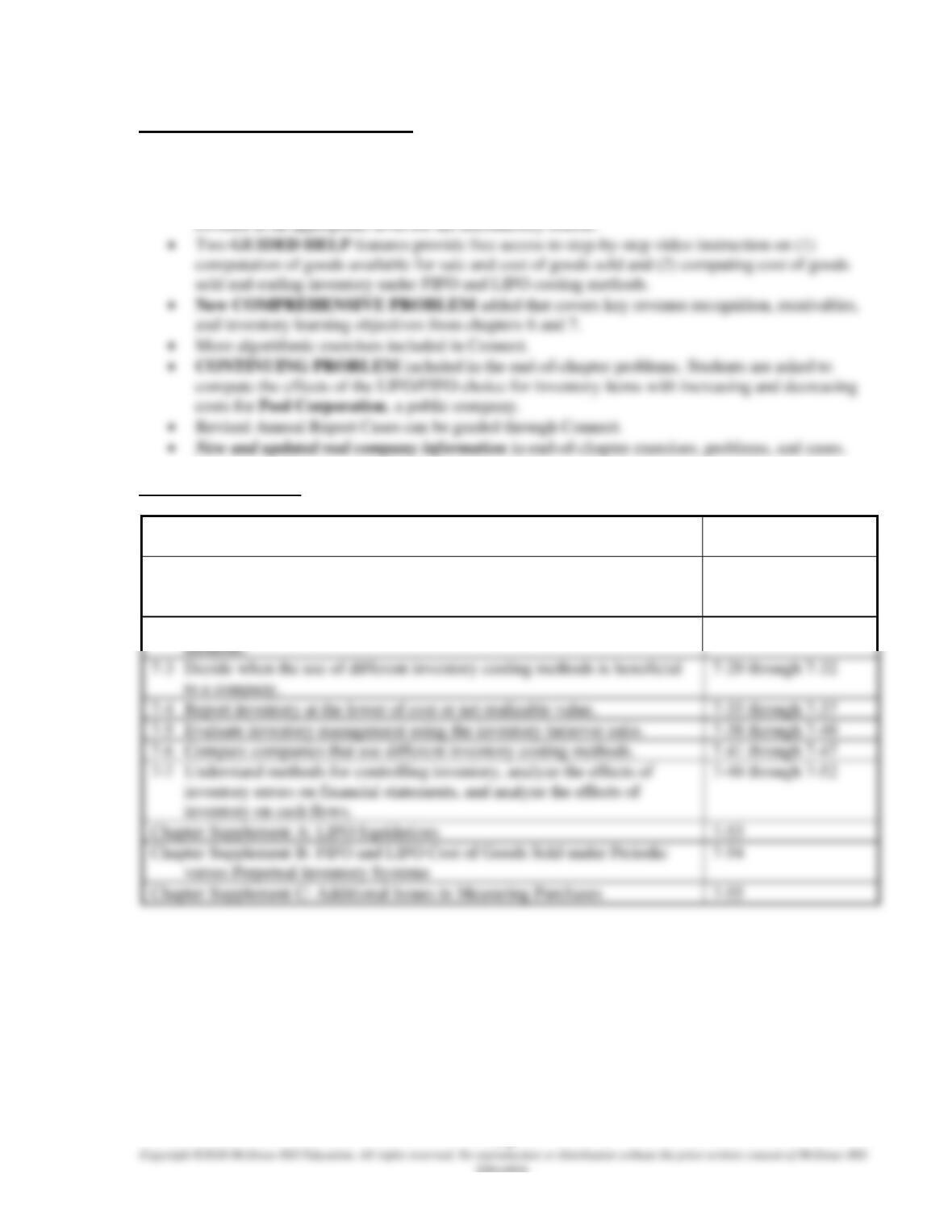
7-1 Apply the cost principle to identify the amounts that should be included in
inventory and cost of goods sold for typical retailers, wholesalers, and
manufacturers.
7-5 through 7-12
to a company.
7-2 Report inventory and cost of goods sold using the four inventory costing
7-13 through 7-28
Chapter 07 – Reporting and Interpreting Cost of Goods Sold and Inventory
7-3
Chapter Take-Aways
7-1 Apply the cost principle to identify the amounts that should be included in inventory and cost
of goods sold for typical retailers, wholesalers, and manufacturers.
Inventory should include all items owned that are held for resale. Costs flow into inventory when
7-2 Report inventory and cost of goods sold using the four inventory costing methods.
The chapter discussed four different inventory costing methods used to allocate costs between the
7-3 Decide when the use of different inventory costing methods is beneficial to a company.
The selection of an inventory costing method is important because it will affect reported income,
7-4 Report inventory at the lower of cost or net realizable value.
Ending inventory should be measured based on the lower of actual cost or net realizable value. This
7-5 Evaluate inventory management using the inventory turnover ratio.
The inventory turnover ratio measures the efficiency of inventory management. It reflects how many
Chapter 07 – Reporting and Interpreting Cost of Goods Sold and Inventory
7-4
Chapter Take-Aways, continued
7-6 Compare companies that use different inventory costing methods.
These comparisons can be made by converting the LIFO company’s statements to FIFO. Public
7-7 Understand methods for controlling inventory, analyze the effects of inventory errors on
financial statements, and analyze the effects of inventory on cash flows.
Various control procedures can limit inventory theft or mismanagement. An error in the
measurement of ending inventory affects cost of goods sold on the current period’s income statement
Key Ratio
Inventory turnover ratio measures the efficiency of inventory management. It reflects how many times
average inventory was produced and sold during the period. It is computed as follows:
Inventory Turnover = Cost of Goods Sold ÷ Average Inventory
Finding Financial Information
BALANCE SHEET
Under Current Assets
Inventories
INCOME STATEMENT
Expenses
Cost of goods sold
STATEMENT OF CASH FLOWS
Under Operating Activities
(Indirect Method):
Net income
NOTES
Under Summary of Significant
Accounting Policies:
Description of management’s choice of inventory
Chapter 07 – Reporting and Interpreting Cost of Goods Sold and Inventory
Chapter Outline
Teaching Notes
LO 7-1 Apply the cost principle to identify the amounts that should be included in inventory and
cost of goods sold for typical retailers, wholesalers, and manufacturers.
I. Nature of Inventory and Cost of Goods Sold
A. Items Included in Inventory
the normal course of business or (2) used to produce
goods or services for sale
2. Reported on balance sheet as a current asset; normally
Illustrated in Exhibit 7.1
1. Inventory – tangible property that is (1) held for sale in
operating cycle
3. Types:
a. Merchandise inventory – goods (or merchandise) held
for resale in the normal course of business; usually
acquired in a finished condition and ready for sale
without further processing
b. Manufacturing businesses hold three types of
inventory:
B. Costs Included in Inventory Purchases
2. In general, the company should cease accumulating
purchase costs when the raw materials are ready for use
a. Any additional costs related to selling the inventory
1. Goods in inventory are initially recorded at cost; includes
the sum of the costs incurred in bringing an article to
See Financial Analysis
C. Flow of Inventory Costs
1. Merchandisers (wholesalers and retailers)
Illustrated in Exhibit 7.2
inventory account is increased
b. When sold, cost of goods sold is increased and
a. When merchandise is purchased, the merchandise
Chapter 07 – Reporting and Interpreting Cost of Goods Sold and Inventory
7-6
2. Manufacturing environment:
Illustrated in Exhibit 7.2
a. When raw materials (also called direct materials) are
purchased, they are added to the raw materials
inventory
increases, and finished goods inventory decreases
3. Three stages to inventory cost flows for both
merchandisers and manufacturers:
a. First stage involves purchasing and/or production
activities
D. Cost of Goods Sold Equation
1. Cost of goods sold (CGS) expense is directly related to
sales revenue
number of units sold multiplied by the sales price
2. Cost of goods sold equation:
Illustrated in Exhibit 7.3
Cost of goods sold
Beginning inventory
3. Illustrated in Merchandise Inventory T-account:
Help 7.1
Chapter 07 – Reporting and Interpreting Cost of Goods Sold and Inventory
7-7
E. Perpetual and Periodic Inventory Systems
1. Perpetual Inventory System – A detailed inventory record
is maintained, recording each purchase and sale during
Assumed in journal entries
for purchases and sales in
2. Periodic Inventory System – Ending inventory and cost of
goods sold are determined at the end of the accounting
period based on a physical count
a. No up-to-date record of inventory is maintained
LO 7-2 Report inventory and cost of goods sold using the four inventory costing methods.
II. Inventory Costing Methods
A. Four generally accepted inventory costing methods are
available for determining cost of goods sold
2. Specific identification identifies individual items that
1. The four inventory costing methods are alternative ways
Chapter 07 – Reporting and Interpreting Cost of Goods Sold and Inventory
7-8
B. Specific Identification Method
1. Specific identification method – identifies the cost of the
C. Cost Flow Assumptions – Note that the choice of an
inventory costing method is not based on the physical flow
of goods on and off the shelves
1. First-In, First-Out Method (FIFO)
Illustrated in Exhibit 7.4
a. FIFO assumes that the first goods purchased (the first
in) are the first goods sold (the first out)
in and out of a bin
iii. The cost of the remaining units become ending
i. First, each purchase is treated as if it were
Have your students visualize
sold and the newest unit costs to ending inventory
2. Last-In, First-Out Method (LIFO)
Illustrated in Exhibit 7.4
a. LIFO assumes that the most recently purchased units
(the last in) are sold first (the first out)
iii. The cost of the remaining units becomes ending
i. First, each purchase is treated as if it were
3. Average Cost Method (Weighted Average Cost Method)
Number of Units Available for Sale
a. Average cost uses the weighted average unit cost of
the goods available for sale for both cost of goods sold
D. Perpetual Inventory Systems and Cost Flow Assumptions in
Practice
Note: Methods are applied as
if all purchases take place
before any sales and cost of
goods sold are recorded.
1. FIFO inventory and cost of goods sold are the same
whether computed on a perpetual or periodic basis
In reality, most companies
make numerous purchases
2. Accounting systems that keep track of the costs of
and sales of the same
Chapter 07 – Reporting and Interpreting Cost of Goods Sold and Inventory
financial reporting
period
goods sold are calculated as if all purchases during the
3. As a consequence, companies that wish to report under
LIFO convert the outputs of their perpetual inventory
calculated and recorded.
LO7- 3 Decide when the use of different inventory costing methods is beneficial to a company.
D. Financial Statement Effects of Inventory Methods
1. Each of the four alternative inventory costing methods is
in conformity with GAAP and the tax law
versus ending inventory
c. The average cost method generally gives income and
inventory amounts that are between the FIFO and
a. Methods differ only in the dollar amount of goods
available for sale allocated to cost of goods sold
Illustrated in Exhibit 7.5
2. Impact of changing costs:
a. When unit costs are rising, LIFO produces lower
income and a lower inventory valuation than FIFO
b. When unit costs are declining, LIFO produces higher
income and higher inventory valuation than FIFO
E. Managers’ Choice of Inventory Methods
1. Factors considered when managers choose accounting
methods:
the least–latest rule)
Chapter 07 – Reporting and Interpreting Cost of Goods Sold and Inventory
2. Any conflict between methods is normally resolved by
3. LIFO conformity rule – if LIFO is used on the income tax
4. Common choices:
taxes
a. For inventory with increasing costs, LIFO is most
5. Consistency in Use of Inventory Methods
a. Regardless of the physical flow of goods, a company
can use any of the inventory costing methods.
c. No particular justification is needed for the selection
b. A company is not required to use the same inventory
Help 7.2
LO 7-4 Report inventory at the lower of cost or net realizable value.
III. Valuation at Lower of Cost or Net Realizable Value
A. Cost Principle – inventories should be measured initially at
their purchase cost
1. When the net realizable value (sales price less costs to
B. Conservatism Constraint – departure from cost principle to
avoid overstating assets and income
C. Under lower of cost or NRV:
1. Companies recognize a “holding” loss in the period in
which the net realizable value of an item drops
Use Supplemental
Enrichment Activity #2
2. The holding loss is the difference between the purchase
cost and the lower net realizable value
Chapter 07 – Reporting and Interpreting Cost of Goods Sold and Inventory
4. Lower of cost or NRV changes only the timing of cost of
goods sold
D. Journal entry to record A $50,000 write-down inventory:
dr Cost of Goods Sold (+E, –SE)
cr Inventory (–A)
Cash (A) – 50,000 = Cost of Goods Sold (E) – 50,000
LO 7-5 Evaluate inventory management using the inventory turnover ratio.
IV. Evaluating Inventory Management
A. Measuring Efficiency in Inventory Management
1. Inventory Turnover = Cost of Goods Sold ÷ Average
Inventory
2. Ratio reflects how many times average inventory was
produced and sold during the period
customer, reducing storage and obsolescence costs
1. Goal of inventory management is sufficient quantities of
high-quality inventory to serve customers’ needs while
C. Average Days to Sell Inventory
1. Average Days to Sell Inventory = 365 ÷ Inventory
Turnover
2. Indicates the average time it takes the company to
produce and deliver inventory to customers
Refer students to Pause for
Feedback—Self-Study Quiz
LO 7-6 Compare companies that use different inventory costing methods.
D. Inventory Methods and Financial Statement Analysis
1. U.S. public companies using LIFO must report beginning
and ending inventory on a FIFO basis in the notes if the
FIFO values are materially different
2. Converting the Income Statement to FIFO
Illustrated in Exhibit 7.6
a. LIFO reserve (or Excess of FIFO over LIFO) – a
contra-asset for the excess of FIFO over LIFO
3. Converting Inventory on the Balance Sheet to FIFO
feature “LIFO and Inventory
a. Adjust the inventory amounts on the balance sheet to
Turnover Ratio”
Chapter 07 – Reporting and Interpreting Cost of Goods Sold and Inventory
7-12
LO 7-7 Understand methods for controlling inventory, analyze the effects of inventory errors on
financial statements, and analyze the effects of inventory on cash flows.
V. Control of Inventory
A. Internal Control of Inventory
physical handling of inventory
2. Storage of inventory in a manner that protects it from theft
and damage
3. Limiting access to inventory to authorized employees
4. Maintaining perpetual inventory records
5. Comparing perpetual records to periodic physical counts
1. Separation of responsibilities for inventory accounting and
B. Errors in Measuring Ending Inventory
1. Measurement of ending inventory affects both the balance
sheet (assets) and the income statement (cost of goods
sold, gross profit, and net income)
2. Measurement of ending inventory affects not only the net
income for that period but also the net income for the next
accounting period
b. Resulting overstatement of beginning inventory in
1. Since inventory is purchased on open credit, reconciling
cost of goods sold with cash paid to suppliers involves
changes in both Inventory and Accounts Payable
2. Inventory:
a. When a net decrease in inventory occurs, sales are
3. Accounts Payable:
a. When a net decrease in accounts payable occurs,
payments to suppliers are greater than new purchases;