CHAPTER 7
Cash and Receivables
ASSIGNMENT CLASSIFICATION TABLE (BY TOPIC)
Topics
Questions
Brief
Exercises
Exercises
Problems
Concepts
for Analysis
1.
Accounting for cash.
1, 2, 3, 4, 23
1
1, 2
1
2.
Accounting for
accounts receivable,
bad debts, other
allowances.
5, 6, 7, 8, 9,
10, 11, 12,
13, 14, 21
2, 3, 4, 5, 6
3, 4, 5, 6,
7, 8, 9, 10,
11, 12, 16
2, 3, 4,
5, 6
1, 2, 3, 4,
9, 10
receivable.
8
receivable.
receivables.
flow.
ASSIGNMENT CLASSIFICATION TABLE (BY LEARNING OBJECTIVE)
Learning Objectives
Questions
Brief
Exercises
Exercises
Problems
Concepts
for
Analysis
1. Indicate how to report cash
and related items.
1, 2, 3, 4
1
1, 2
1
2. Define receivables and
explain accounting issues
related to their recognition.
5, 6
2, 3, 4
3, 4, 5, 6,
12, 16
6
4, 9, 10
3. Explain accounting issues
related to valuation of
accounts receivable.
7, 8, 9, 10,
11, 12, 13,
7, 8, 9, 10,
11, 12, 16
2, 3, 4, 5,
6
1, 3, 10
valuation of notes
receivable.
8
5. Explain other accounting
issues related to accounts
and notes receivable.
17, 18, 19,
20, 21,22,
9, 10, 11,
12, 13
12, 14, 15,
16, 17, 18,
2, 5
employed to control cash.
24
15, 16, 17
22, 23, 24,
12, 13, 14
ASSIGNMENT CHARACTERISTICS TABLE
Item
Description
Level of
Difficulty
Time
(minutes)
E7.1
Determining cash balance.
Moderate
10–15
E7.2
Determining cash balance.
Moderate
10–15
E7.3
Financial statement presentation of receivables.
Moderate
10–15
E7.4
Determining ending accounts receivable.
Simple
10–15
E7.5
Recording sales gross and net.
Simple
15–20
E7.6
Recording sales transactions.
Moderate
E7.7
Recording bad debts.
Moderate
10–15
E7.8
Recording bad debts.
Simple
E7.9
Computing bad debts and preparing journal entries.
Simple
E7.10
Bad-debt reporting.
Simple
10–12
E7.11
Bad debts—aging.
Simple
E7.12
Journalizing various receivable transactions.
Simple
15–20
E7.13
Note transactions at unrealistic interest rates.
Simple
10–15
E7.14
Notes receivable with unrealistic interest rate.
Moderate
20–25
E7.15
Assigning accounts receivable.
Simple
10–15
E7.16
Journalizing various receivable transactions.
Simple
15–18
E7.17
Transfer of receivables with recourse.
Simple
10–15
E7.18
Transfer of receivables with recourse.
Moderate
15–20
E7.19
Transfer of receivables without recourse.
Simple
10–15
E7.20
Analysis of receivables.
Moderate
10–15
E7.21
Transfer of receivables.
Moderate
10–15
Petty cash.
Simple
Petty cash.
Simple
10–15
Bank reconciliation and adjusting entries.
Moderate
15–20
Bank reconciliation and adjusting entries.
Simple
15–20
Expected cash flows.
Moderate
15–25
Expected cash flows.
Moderate
15–25
P7.1
Determine proper cash balance.
Simple
20–25
P7.2
Bad-debt reporting.
Moderate
20–25
P7.3
Bad-debt reporting—aging.
Moderate
20–30
P7.4
Bad-debt reporting.
Moderate
25–35
P7.5
Bad-debt reporting.
Moderate
20–30
P7.6
Journalize various accounts receivable transactions.
Moderate
25–35
P7.7
Notes receivable with realistic interest rate.
Moderate
30–35
P7.8
Notes receivable journal entries.
Moderate
30–35
P7.9
Comprehensive receivables problem.
40–50
P7.10
Assigned accounts receivable—journal entries.
Moderate
25–30
P7.11
Income effects of receivables transactions.
Moderate
20–25
Petty cash, bank reconciliation.
Moderate
20–25
Bank reconciliation and adjusting entries.
Moderate
20–30
ASSIGNMENT CHARACTERISTICS TABLE (Continued)
Item
Description
Level of
Difficulty
Time
(minutes)
CA7.1
Bad-debt accounting.
Simple
10–15
CA7.2
Various receivable accounting issues.
Simple
15–20
CA7.3
Bad-debt reporting issues.
Moderate
25–30
CA7.4
Basic note and accounts receivable transactions.
Moderate
25–30
CA7.5
Sale of notes receivable.
Moderate
20–25
CA7.6
Zero-interest-bearing note receivable.
Moderate
20–30
CA7.8
Accounting for zero-interest-bearing note.
Moderate
25–30
CA7.9
Receivables management.
Moderate
25–30
CA7.10
Bad-debt reporting, ethics.
Moderate
25–30
ANSWERS TO QUESTIONS
1. Cash normally consists of coins and currency on hand, bank deposits, and various kinds of orders
for cash such as bank checks, money orders, travelers’ checks, demand bills of exchange, bank
drafts, and cashiers’ checks. Balances on deposit in banks which are subject to immediate with–
2. (a) Cash (h) Investments, possibly other assets.
(b) Investments (i) Cash.
(c) Temporary investments. (j) Trading securities.
3. A compensating balance is that portion of any demand deposit maintained by a corporation that
constitutes support for existing borrowing arrangements of a corporation with a lending institution.
A compensating balance representing a legally restricted deposit held against short-term borrowing
4. Restricted cash for debt redemption would be reported in the long-term asset section, probably in
5. The seller normally uses trade discounts to avoid frequent changes in its catalogs, to quote different
prices for different quantities purchased, and to hide the true invoice price from competitors. Trade
discounts are not recorded in the accounts because the price finally quoted is generally an
Questions Chapter 7 (Continued)
6. Two methods of recording accounts receivable are:
2. Record receivables and sales net.
The net method is desirable from a theoretical standpoint because it values the receivable at its
7. When companies sell a product with a sales allowance for possible dissatisfaction or other issues,
they should record the accounts receivable and related revenue at the amount of consideration
8. The basic problems that relate to the valuation of receivables are (1) the determination of the face
value of the receivable, (2) the probability of future collection of the receivable, and (3) the length
9. The theoretical superiority of the allowance method over the direct write-off method of accounting
for bad debts is two-fold. First, since revenue is considered to be recognized at the point of sale on
the assumption that the resulting receivables are valid liquid assets merely awaiting collection, peri-
10. The percentage of receivables method based on an aging schedule calculates each year’s debit to
the expense account and credit to the allowance account by evaluating the collectibility of open
accounts receivable at the close of the year. An analysis of the accounts according to their due
Questions Chapter 7 (Continued)
This method of providing for uncollectible accounts is quite accurate for purposes of reporting
accounts receivable at the net amount expected to be collected in the balance sheet. From the
stand-point of the income statement, however, the aging method may not match accurately bad
11. A major part of accounting is the measurement of financial data. Estimates of uncollectibility should
be recognized so that receivables are reported at the net amount expected to be collected and in
order for accounting to provide useful information on a periodic basis.
The very existence of accounts receivable is based on the decision that a credit sale is an objec–
tive indication that revenue should be recognized. The alternative is to wait until the debt is paid in
cash. If revenue is to be recognized and an asset recorded at the time of a credit sale, the need
12. Because estimation of the allowance account balance requires judgment, management could
either over-estimate or under-estimate the amount of uncollectible accounts depending on whether
a higher or lower earnings number is desired. For example, Sun Trust bank (referred to in the
13. The receivable due from Bernstein Company should be written off to an appropriately named loss
account and reported in the income statement as part of income from operations. In this case,
classification as an unusual item would seem appropriate. The loss may properly be reduced by
Questions Chapter 7 (Continued)
14. If the direct write-off method is used, the only alternative is to debit Cash and credit a revenue
account entitled Uncollectible Amounts Recovered. If the allowance method is used, then the
15. The journal entry on Lombard’s books would be:
Notes Receivable ………………………………………………………………….. 1,000,000
16. Imputed interest is the interest ascribed or attributed to a situation or circumstance which is void of
a stated or otherwise appropriate interest factor. Imputed interest is the result of a process of interest
rate estimation called imputation.
17. The fair value option gives companies the option of using fair value as the measurement basis for
financial instruments. The Board believes that fair value measurement for financial instruments
18. A company might sell receivables because money is tight and access to normal credit is not
available or prohibitively expensive. Also, a company may have to sell its receivables, instead of
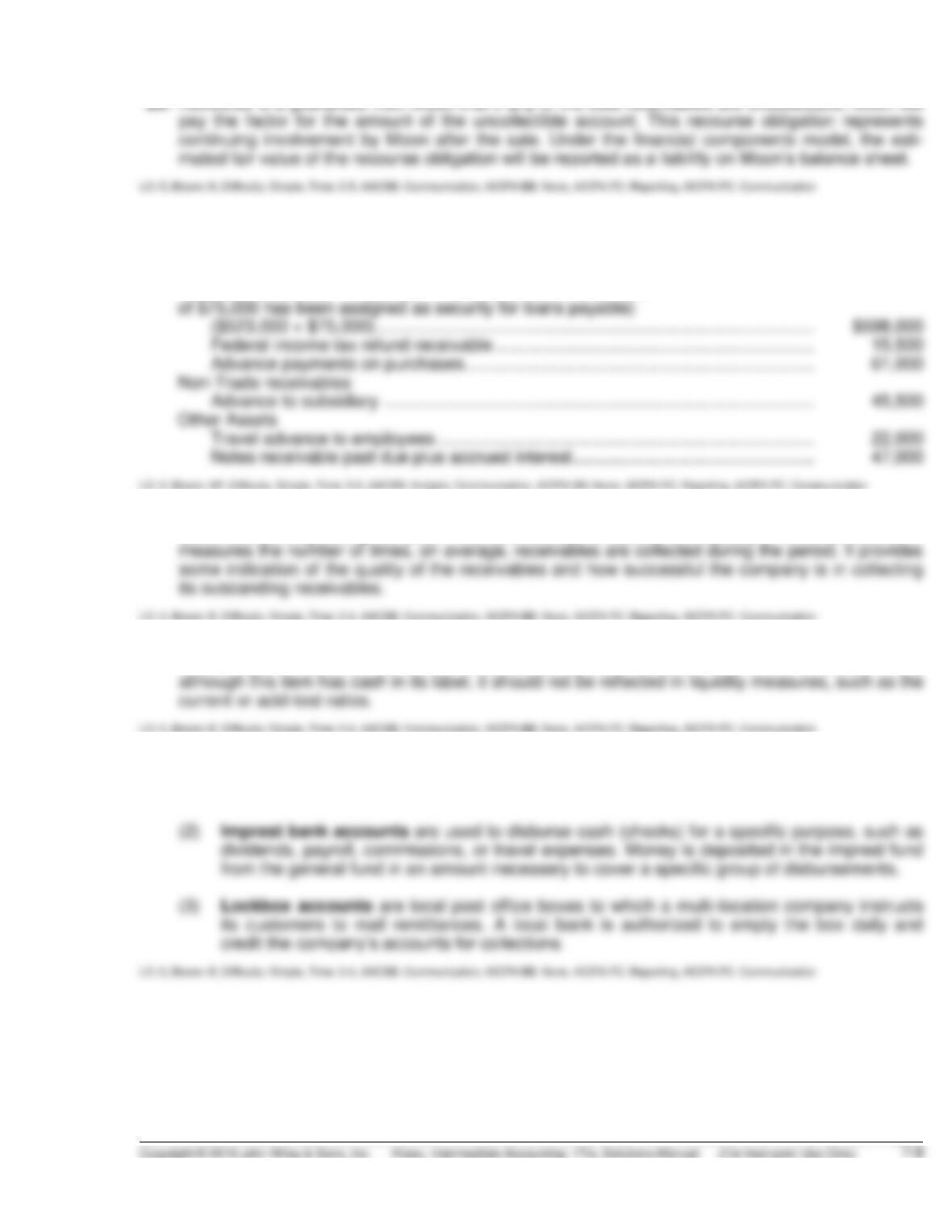
19. The financial components approach is used when receivables are sold but there is continuing
involvement by the seller in the receivable. Examples of continuing involvement are recourse
provisions or continuing rights to service the receivable. A transfer of receivables should be
recorded as a sale when the following three conditions are met:
Questions Chapter 7 (Continued)
21. Several acceptable solutions are possible depending upon assumptions made as to whether certain
items are collectible within the operating cycle or not. The following illustrates one possibility:
Current Assets
Accounts receivable—Trade (of which accounts in the amount
22. The accounts receivable turnover ratio is computed by dividing net sales by average net receiv-
ables outstanding during the year. This ratio is used to assess the liquidity of the receivables. It
23. Because the restricted cash cannot be used by Woodlawn to meet current obligations, it should
not be reported as a current asset—it should be reported in investments or other assets. Thus,
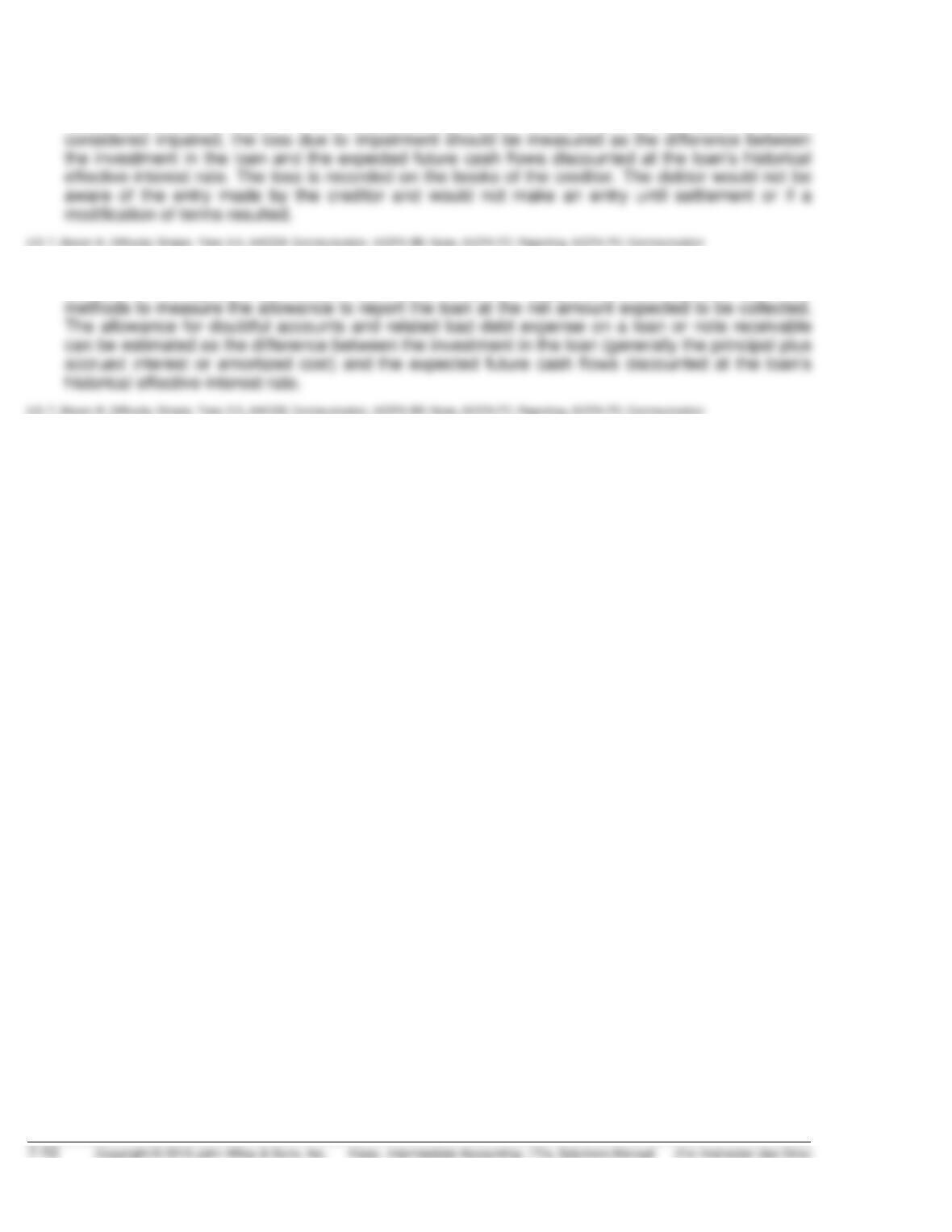
*24. (1) The general checking account is the principal bank account of most companies and fre-
quently the only bank account of small companies. Most if not all transactions are cycled
through the general checking account, either directly or on an imprest basis.
Questions Chapter 7 (Continued)
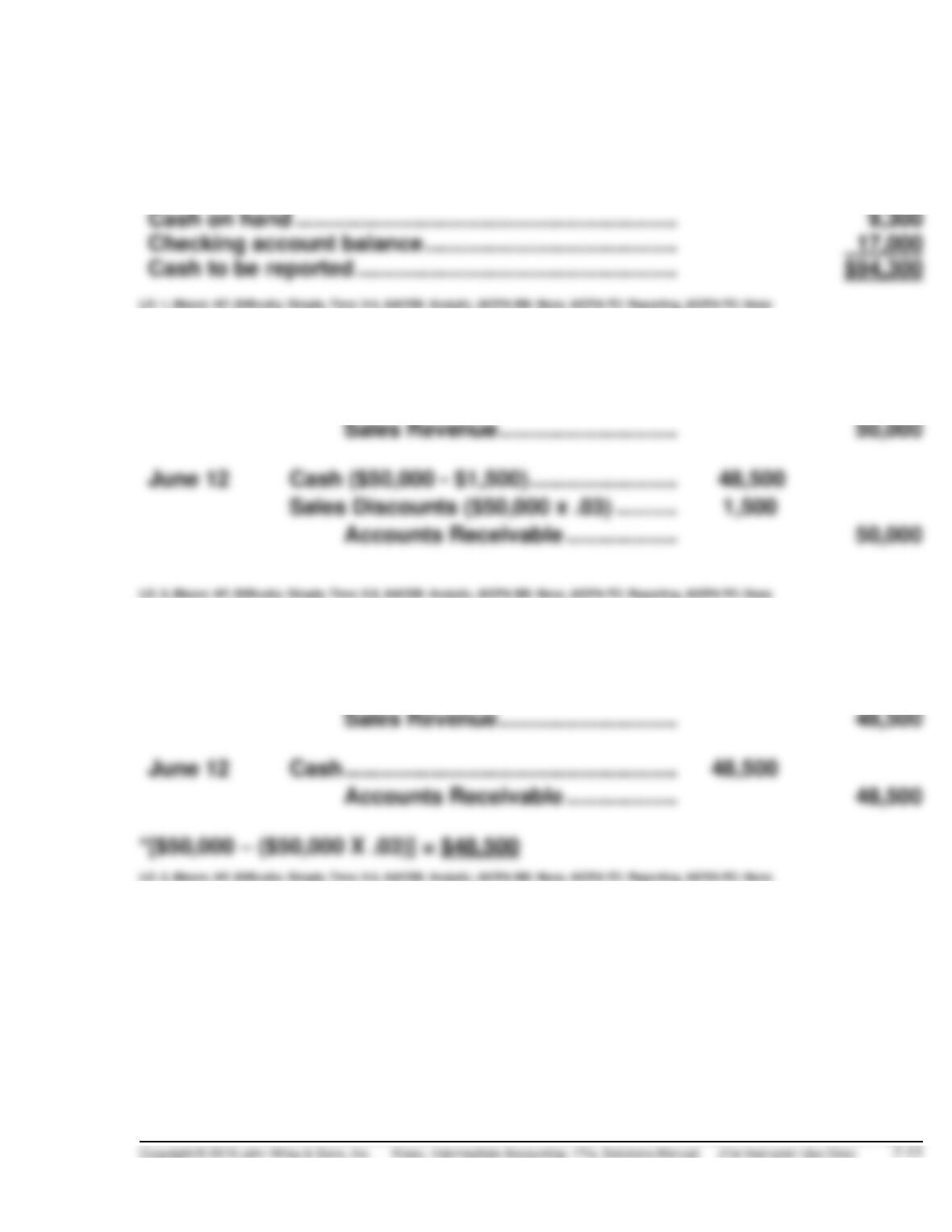
*25. A loan is considered impaired when it is probable that the creditor will be unable to collect all
amounts due (both principal and interest) according to the contractual terms of the loan. If a loan is
*26. Companies commonly evaluate loans (long-term notes receivable) for collectibility based on an
analysis of the expected contractual cash flows. They then apply discounted expected cash flow
SOLUTIONS TO BRIEF EXERCISES
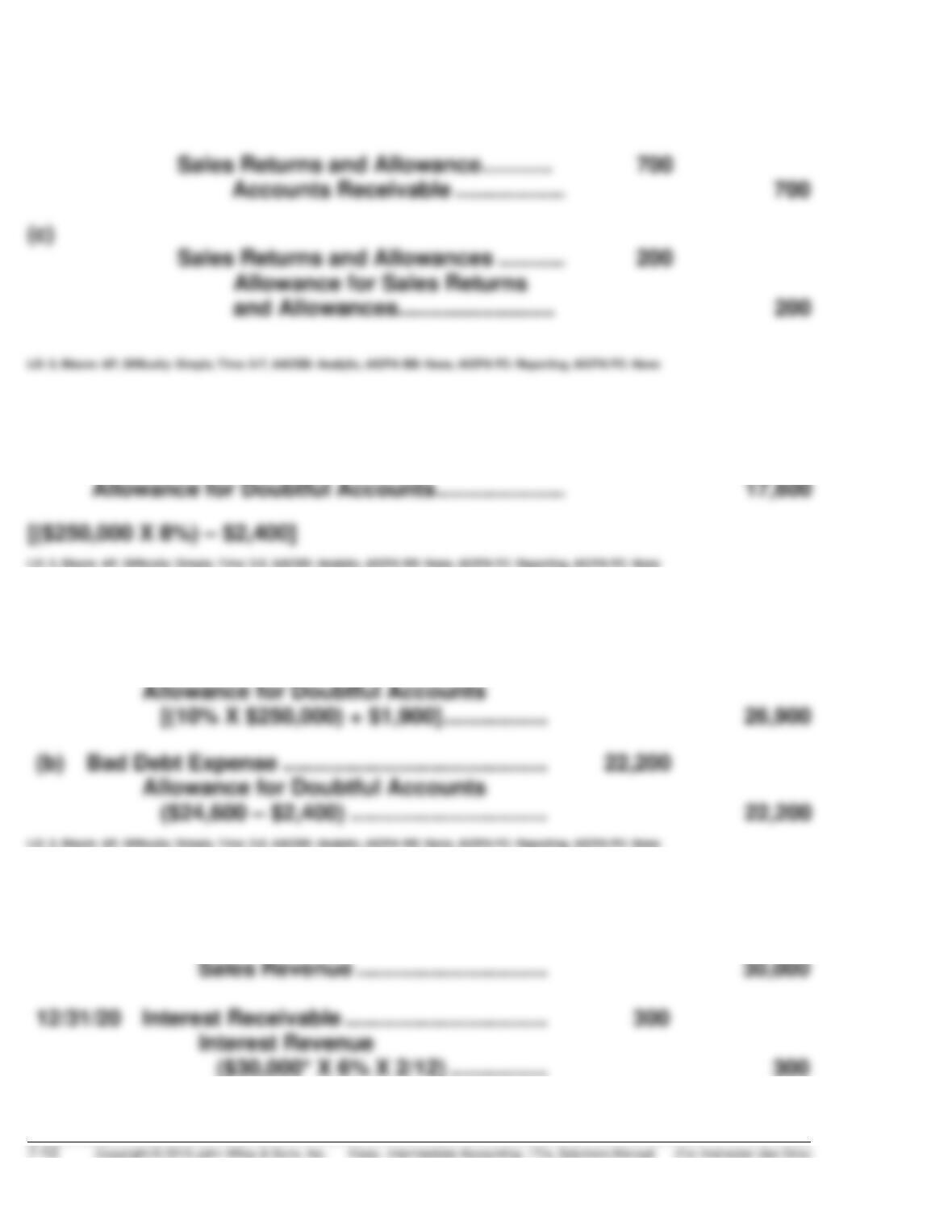
BRIEF EXERCISE 7.1
Cash in bank—savings account …………………………..
$68,000
Cash on hand ……………………………………………………..
Checking account balance …………………………………..
BRIEF EXERCISE 7.2
June 1
Accounts Receivable ………………………
50,000
Sales Revenue ………………………..
BRIEF EXERCISE 7.3
June 1
Accounts Receivable ………………………
48,500*
Sales Revenue ………………………..
BRIEF EXERCISE 7.4
(a)
Accounts Receivable ………………………
9,000
Sales Revenue ………………………..
9,000
BRIEF EXERCISE 7.4 (Continued)
(b)
Accounts Receivable ………………
Sales Returns and Allowances ………..
BRIEF EXERCISE 7.5
Bad Debt Expense …………………………………………………..
17,600
Allowance for Doubtful Accounts …………………….
BRIEF EXERCISE 7.6
(a)
Bad Debt Expense …………………………………………………..
26,900
Allowance for Doubtful Accounts
[(10% X $250,000) + $1,900] …………………………..
(b)
Bad Debt Expense …………………………………………………..
Allowance for Doubtful Accounts
($24,600 – $2,400) …………………………..
BRIEF EXERCISE 7.7
11/1/20
Notes Receivable …………………………………………………….
30,000*
Sales Revenue …………………………..
12/31/20
Interest Receivable ………………………………………………….
Interest Revenue
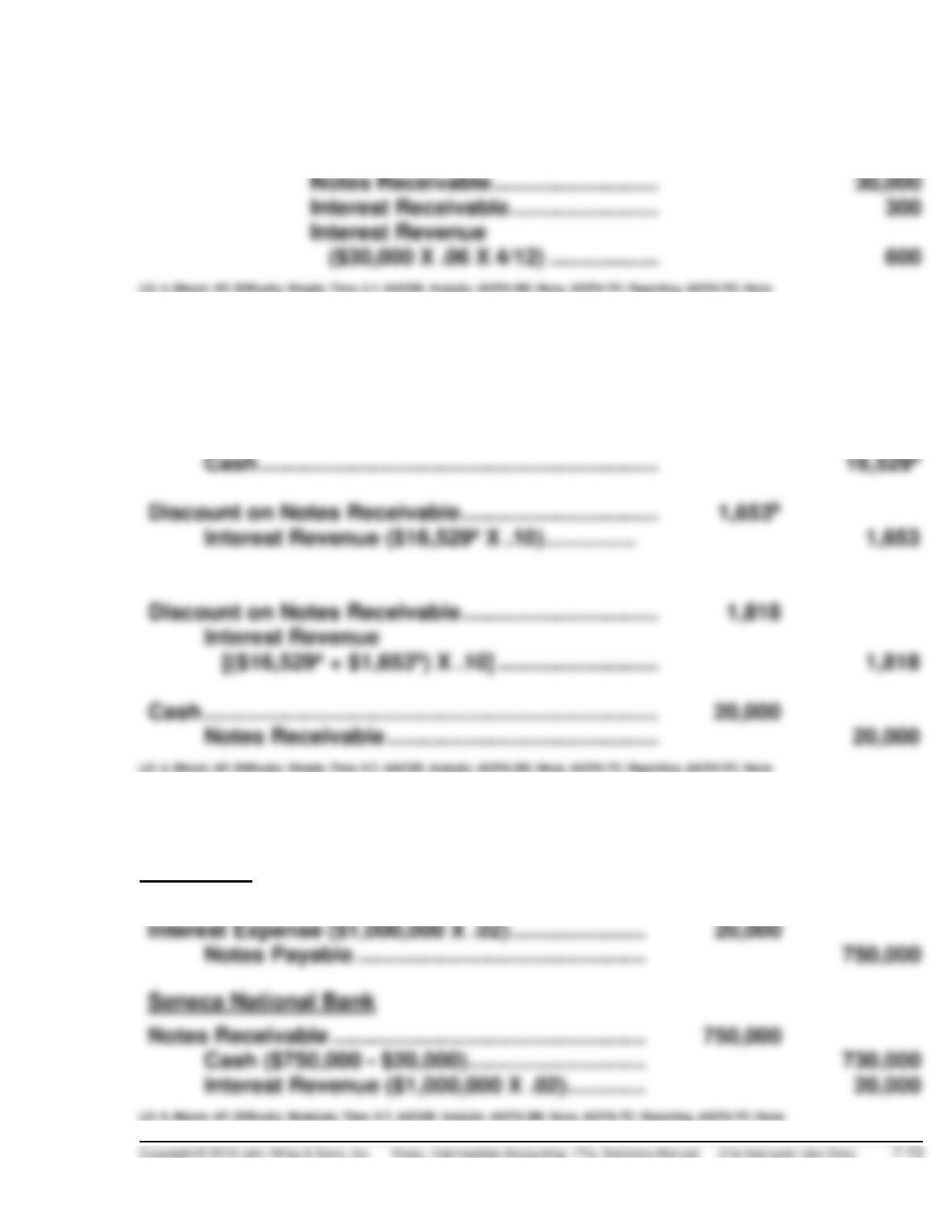
BRIEF EXERCISE 7.7 (Continued)
5/1/21
Cash ($30,000 + $300 + $600) …………………………..
30,900
Interest Receivable …………………………..
Interest Revenue
BRIEF EXERCISE 7.8
Notes Receivable …………………………………………………….
20,000
Discount on Notes Receivable ………………………….
($20,000 – $16,529a)
3,471
Cash ……………………………………………………………….
Discount on Notes Receivable …………………………..
Interest Revenue
Cash ……………………………………………………………………….
20,000
BRIEF EXERCISE 7.9
Chung, Inc.
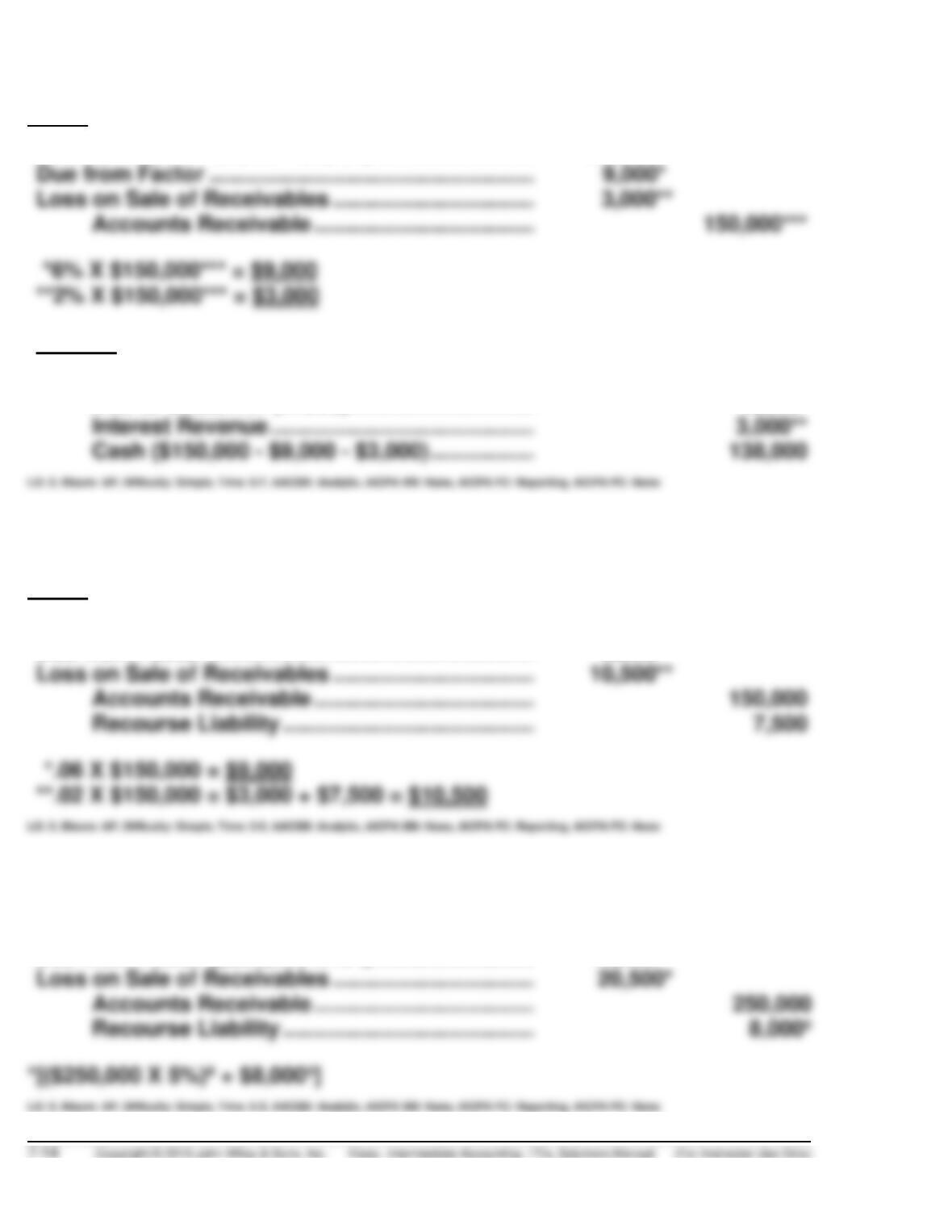
Cash ($750,000 – $20,000) …………………………………………
730,000
Interest Expense ($1,000,000 X .02) …………………………..
Notes Receivable …………………………………………………….
750,000
Cash ($750,000 – $20,000) …………………………..
730,000
BRIEF EXERCISE 7.10
Wood
Cash ($150,000 – $9,000 – $3,000) …………………………..
138,000
Due from Factor ……………………………………………………..
Loss on Sale of Receivables ……………………………………
3,000**
Accounts Receivable ………………………………………
**2% X $150,000*** = $3,000
Engram
Accounts Receivable ………………………………………………
150,000***
Due to Customer (Wood) …………………………..
9,000*
Interest Revenue …………………………………………….
Cash ($150,000 – $9,000 – $3,000) ……………………..
BRIEF EXERCISE 7.11
Wood
Cash ($150,000 – $9,000 – $3,000) …………………………..
138,000
Due from Factor ……………………………………………………..
9,000*
Loss on Sale of Receivables ……………………………………
Accounts Receivable ………………………………………
BRIEF EXERCISE 7.12
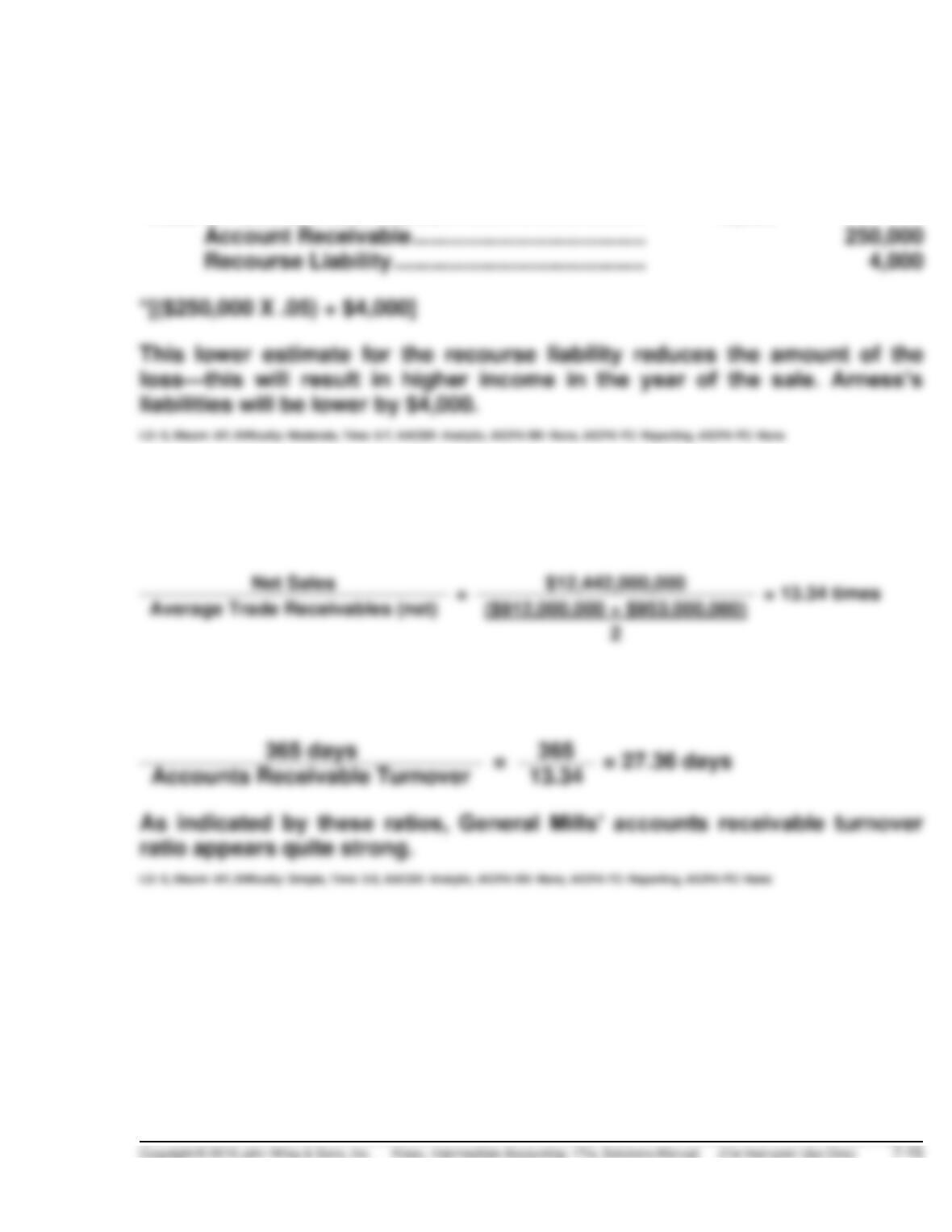
Cash ($250,000 – $12,500a – $10,000b)……………..
227,500
Due from Factor ($250,000 X .04) …………………………..
10,000b
Loss on Sale of Receivables ……………………………………
Accounts Receivable ………………………………………
Recourse Liability …………………………………………..
BRIEF EXERCISE 7.13
The entry for the sale now would be:
Cash ($250,000 – $12,500 – $10,000) ………………………….
227,500
Due from Factor ($250,000 X .04) …………………………..
10,000
Loss on Sale of Receivables …………………………………….
16,500*
Account Receivable …………………………………………
Recourse Liability ……………………………………………
BRIEF EXERCISE 7.14
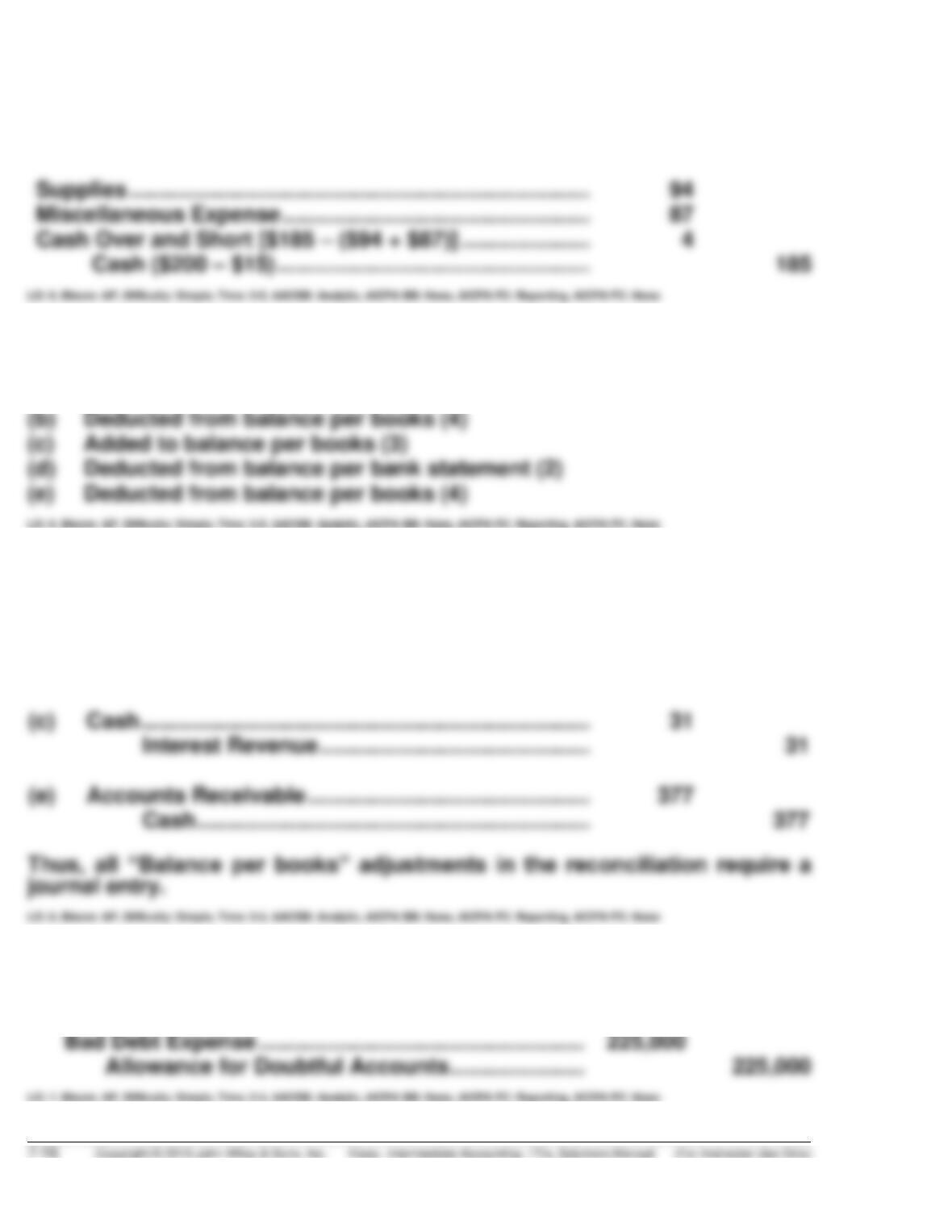
The accounts receivable turnover ratio is computed as follows:
The days outstanding (average collection period) for accounts receivable in
days is
*BRIEF EXERCISE 7.15
Petty Cash ……………………………………………………………..
200
Cash ………………………………………………………………
200
Supplies …………………………..…………………………………….
94
Miscellaneous Expense …………………………………………..
Cash Over and Short [$185 – ($94 + $87)] …………………
Cash ($200 – $15) …………………………..……………….
*BRIEF EXERCISE 7.16
(a) Added to balance per bank statement (1)
*BRIEF EXERCISE 7.17
(b)
Office Expense ……………………………………………………….
25
Cash ……………………………………………………….
25
(c)
Cash ……………………………………………………….………………
31
Interest Revenue ……………………………………………..
31
(e)
Accounts Receivable ……………………………………………….
377
Cash ……………………………………………………….
*BRIEF EXERCISE 7.18
National American Bank (Creditor):
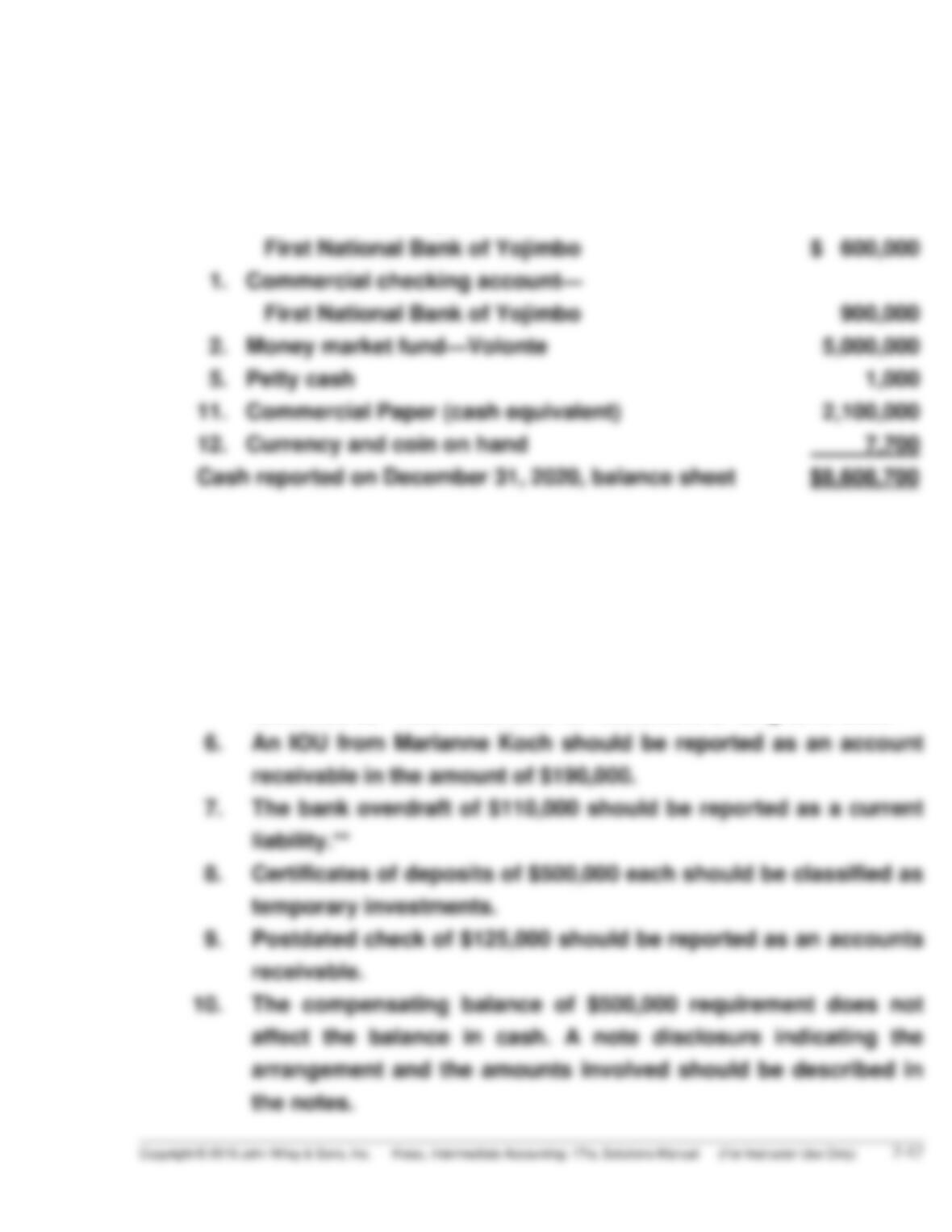
SOLUTIONS TO EXERCISES
EXERCISE 7.1 (10–15 minutes)
(a) Cash includes the following:
1.
1.
Commercial checking account—
Commercial savings account—
(b) Other items classified as follows:
3. Travel advances (reimbursed by employee)* should be reported
as receivable—employee in the amount of $180,000.
4. Cash restricted in the amount of $1,500,000 for the retirement of
long-term debt should be reported as a noncurrent asset
identified as “Cash restricted for retirement of long-term debt.”
EXERCISE 7.1 (Continued)
*If not reimbursed, charge to prepaid expense.
EXERCISE 7.2 (10–15 minutes)
1. Cash balance of $925,000. Only the checking account balance should
be reported as cash.
The certificate of deposit of $1,400,000 should be reported as a
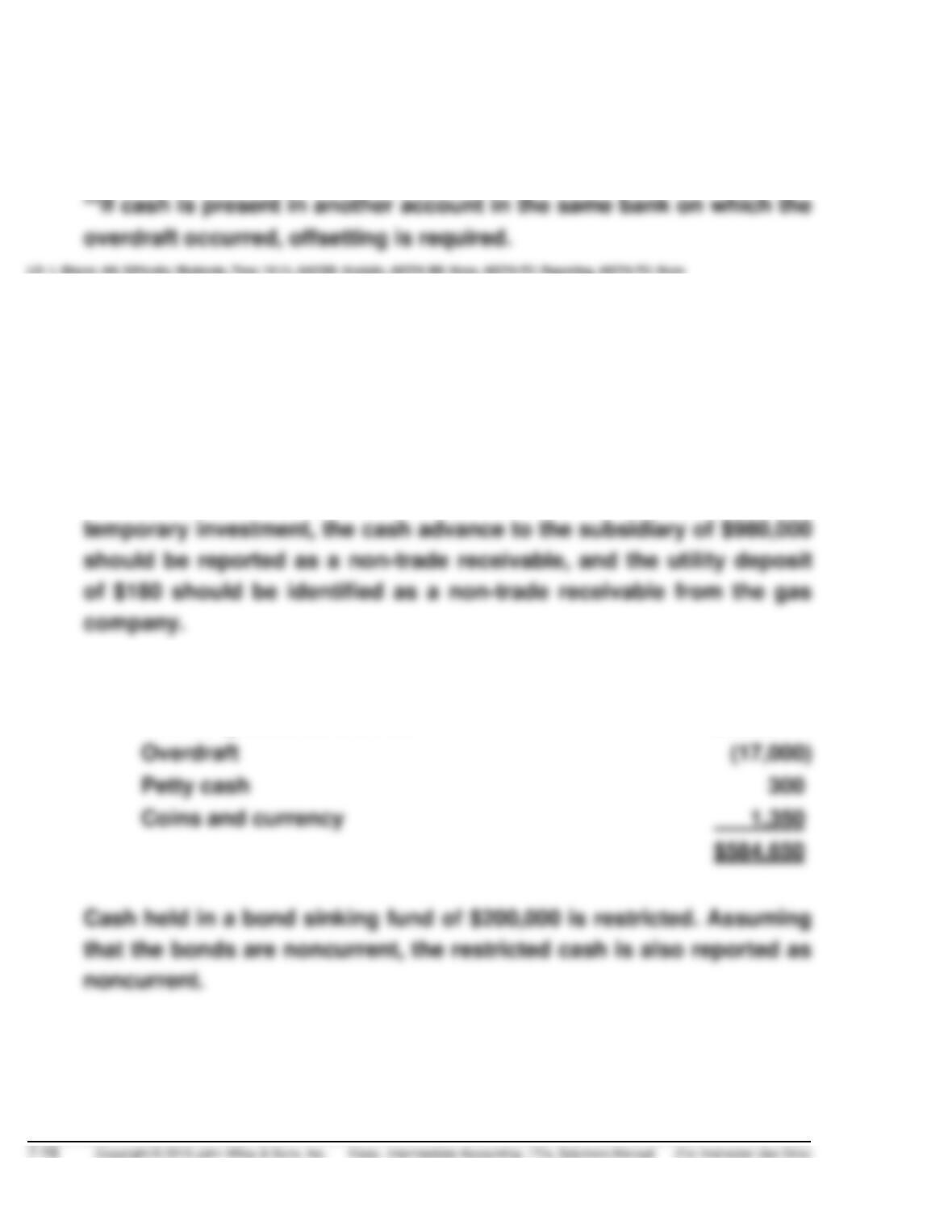
2. Cash balance is $584,650 computed as follows:
Checking account balance
$600,000
Overdraft
Petty cash
Coins and currency
1,350
EXERCISE 7.2 (Continued)
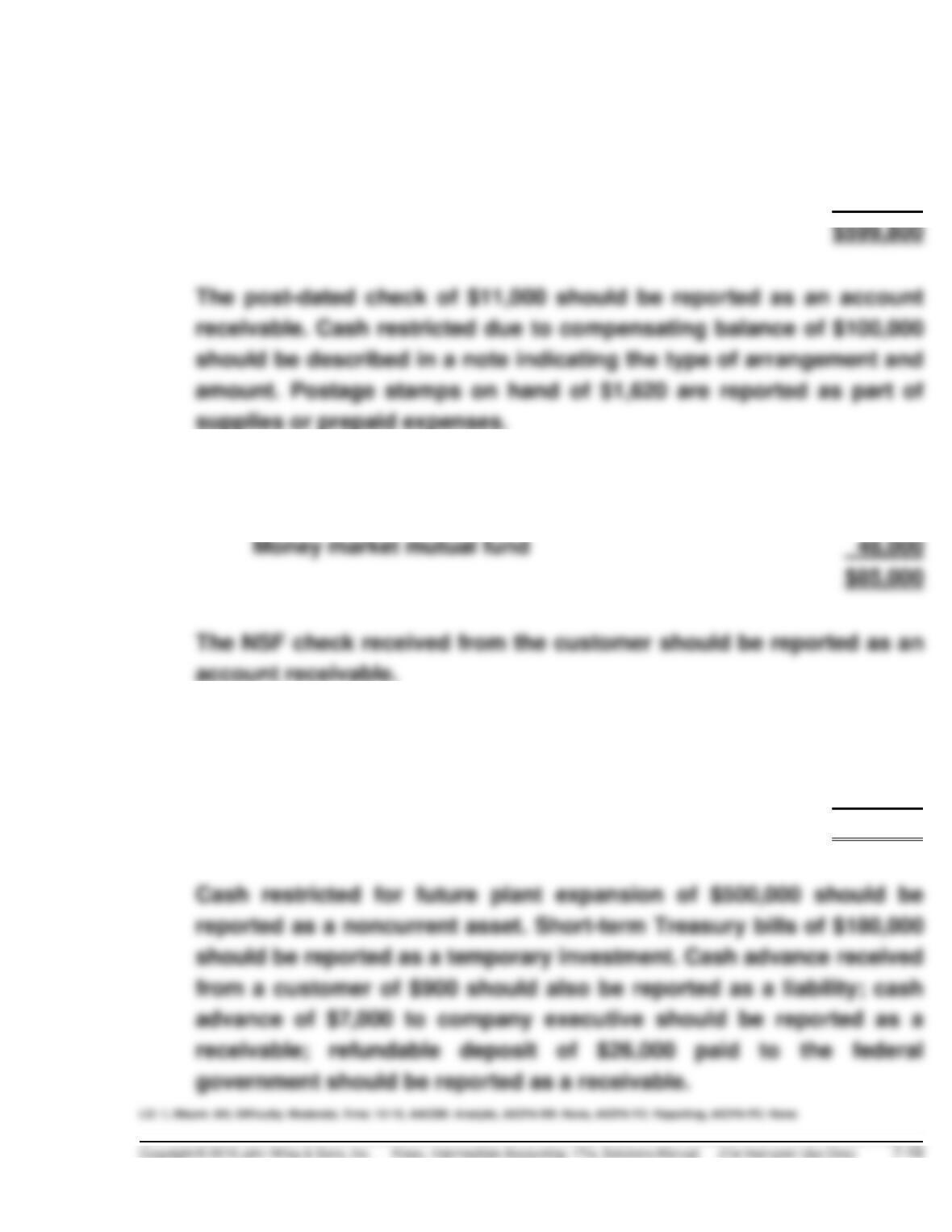
3. Cash balance is $599,800 computed as follows:
Checking account balance
$590,000
Certified check from customer
9,800
4. Cash balance is $85,000 computed as follows:
Checking account balance
$37,000
Money market mutual fund
5. Cash balance is $700,900 computed as follows:
Checking account balance
$700,000
Cash advance received from customer
900
$700,900
EXERCISE 7.3 (10–15 minutes)
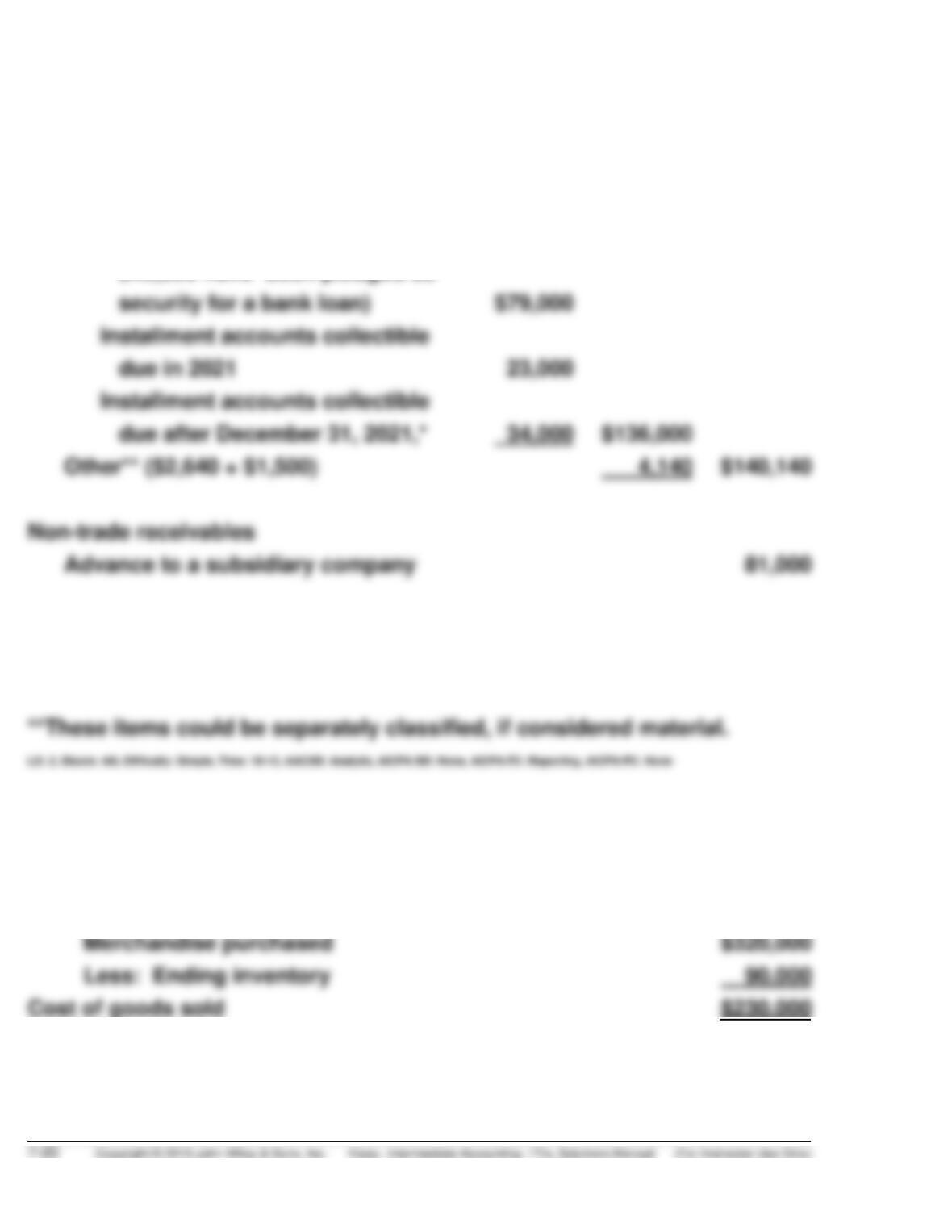
Current assets
Accounts receivable
Customers accounts (of which
security for a bank loan)
Installment accounts collectible
due after December 31, 2021,*
Other** ($2,640 + $1,500)
Non-trade receivables
Advance to a subsidiary company
accounts in the amount of
$40,000 have been pledged as
*This classification assumes that these receivables are collectible within
the operating cycle of the business.
EXERCISE 7.4 (10–15 minutes)
Computation of cost of goods sold:
Merchandise purchased
Less: Ending inventory