Wild and Shaw Financial and Managerial Accounting 9e Solutions Manual: Chapter 7
Problem 7-4B (Concluded)
Year 2
e.
Accounts Receivable ……………………………………
870,220
Sales ………………………………………………………
870,220
Record sales on account.
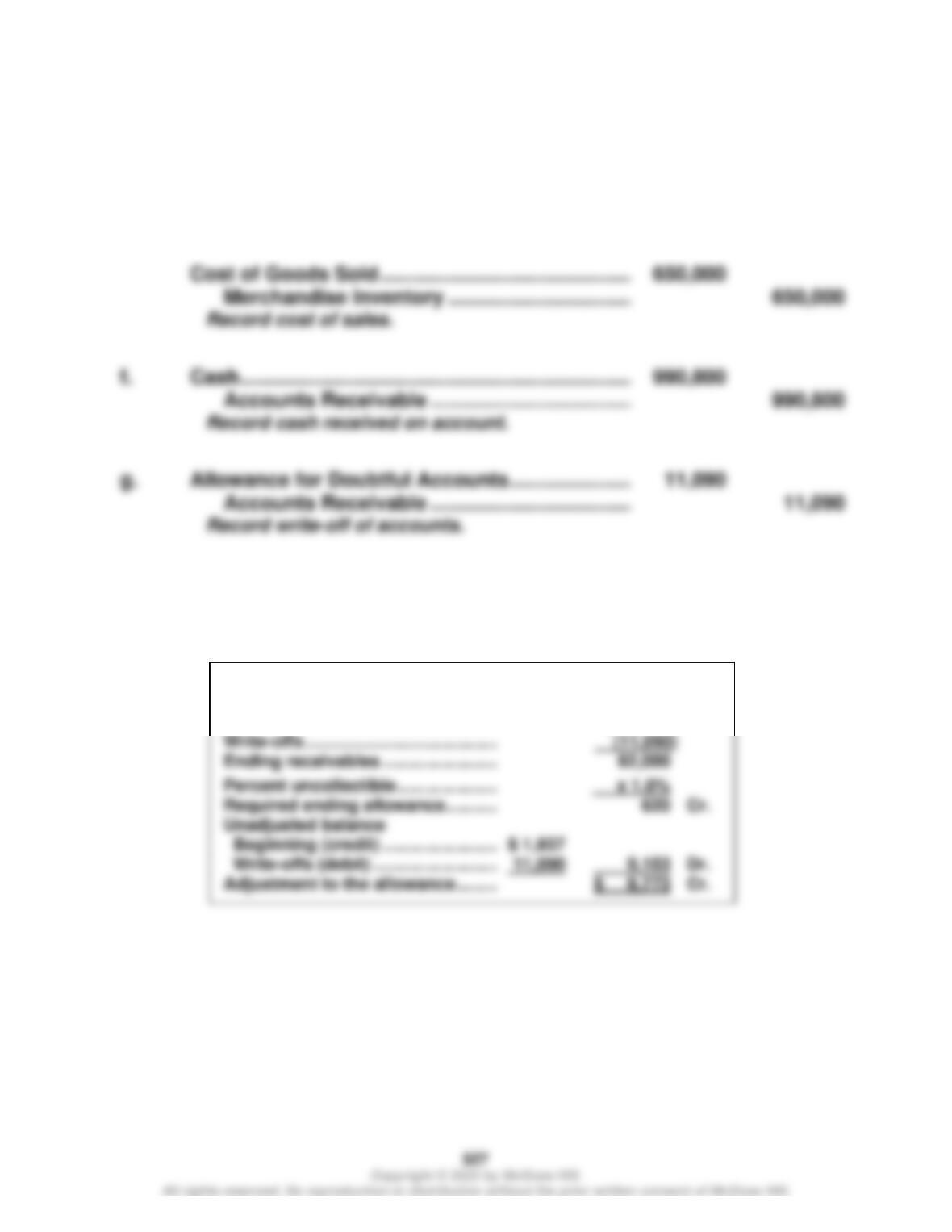
650,000
Merchandise Inventory ……………………………………
650,000
Record cost of sales.
990,800
Accounts Receivable ………………………………
990,800
Record cash received on account.
g.
Allowance for Doubtful Accounts ………………….
Accounts Receivable ………………………………
Record write-off of accounts.
h.
Bad Debts Expense ………………………………………
9,773
Allowance for Doubtful Accounts…………….
9,773
Record estimated bad debts.*
*Beginning receivables ………………………
$ 193,670
Credit sales ……………………………………..
870,220
Collections ………………………………………
(990,800)
Write-offs …………………………………………
(11,090)
Ending receivables …………………………..
Percent uncollectible ………………………..
Required ending allowance ……………….
Cr.
Unadjusted balance
Dr.
Wild and Shaw Financial and Managerial Accounting 9e Solutions Manual: Chapter 7
528
Problem 7-5B (75 minutes)
Part 1
Year 1
Nov. 1
Notes Receivable—S. Julian …………………………..
4,800
Accounts Receivable—S. Julian ………………….
4,800
Record note received on account.
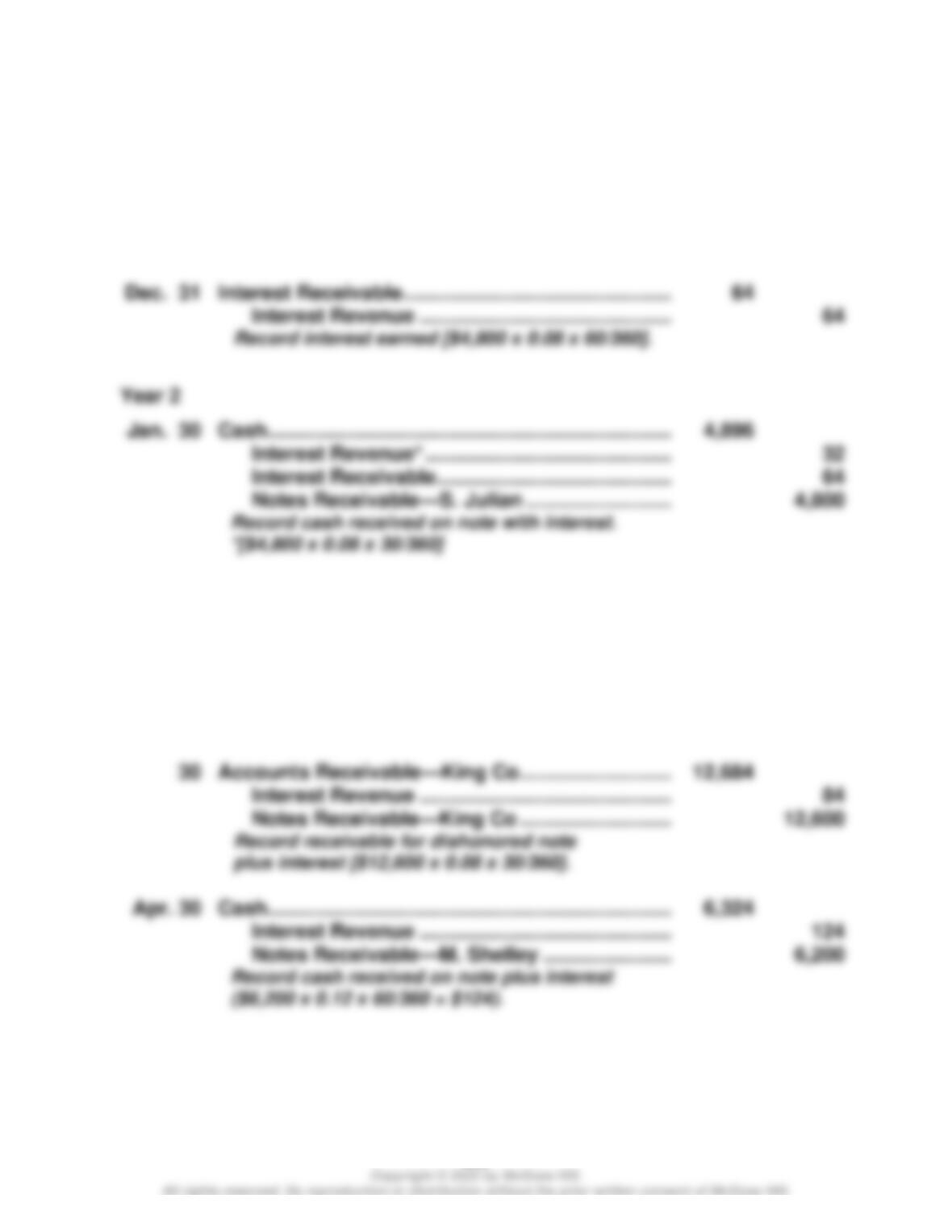
Record interest earned [$4,800 x 0.08 x 60/360].
Year 2
4,896
Notes Receivable—S. Julian ……………………….
4,800
Feb. 28
Notes Receivable—King Co ……………………………..
12,600
Accounts Receivable—King Co. ………………….
12,600
Record note received on account.
Mar. 1
Notes Receivable—M. Shelley ………………………….
6,200
Accounts Receivable—M. Shelley ……………….
6,200
Record note received on account.
Accounts Receivable—King Co ………………………..
12,684
Notes Receivable—King Co ………………………..
12,600
plus interest [$12,600 x 0.08 x 30/360].
6,324
Notes Receivable—M. Shelley …………………….
6,200
Wild and Shaw Financial and Managerial Accounting 9e Solutions Manual: Chapter 7
529
Problem 7-5B (Concluded)
June 15
Notes Receivable—R. Solon …………………………..
2,000
Accounts Receivable—R. Solon …………………
2,000
Record note received on account.
June 21
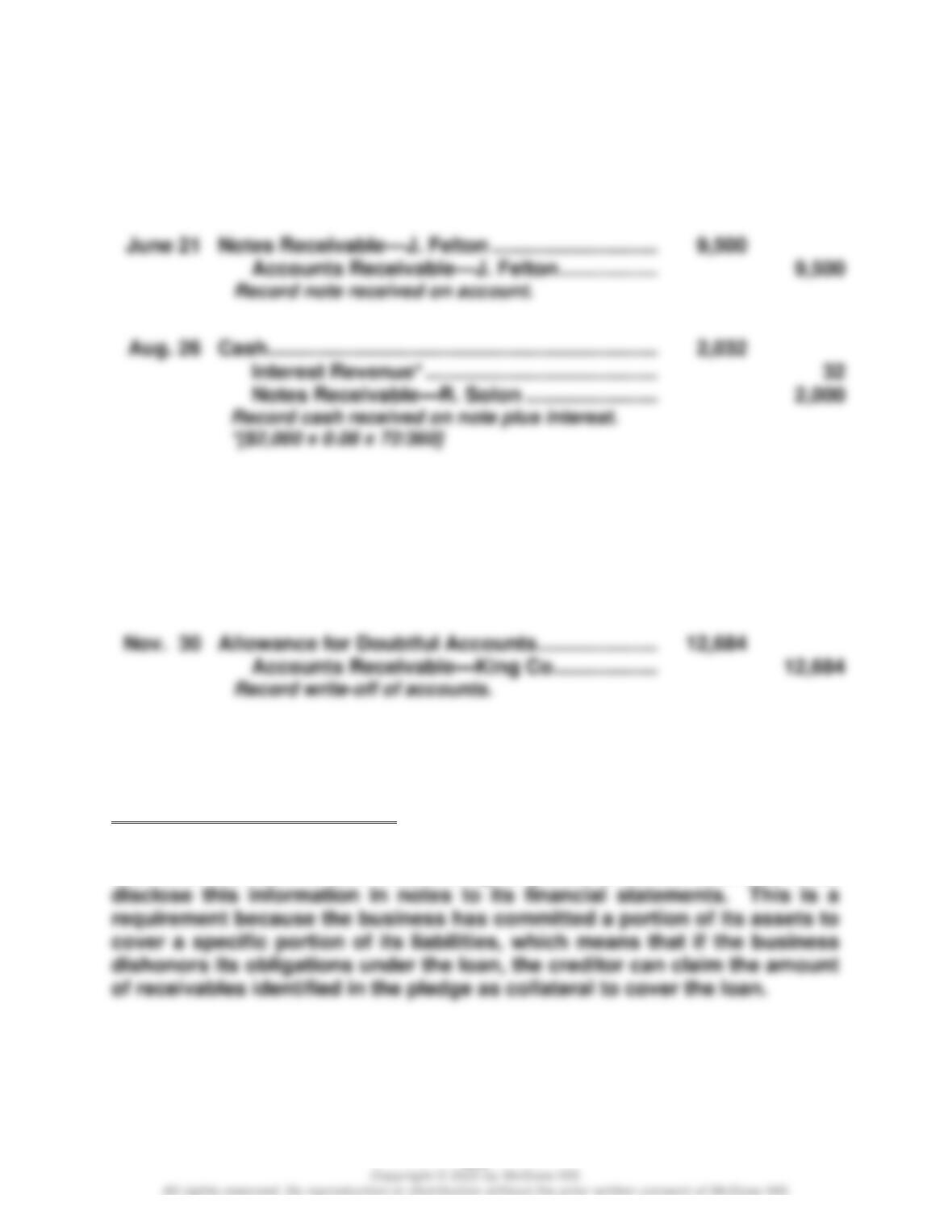
9,500
Accounts Receivable—J. Felton ………………..
9,500
Record note received on account.
Cash ………………………………………………………………
2,032
Notes Receivable—R. Solon ……………………..
2,000
Record cash received on note plus interest.
*[$2,000 x 0.08 x 72/360]
Sept. 19
Cash ………………………………………………………………
9,690
Interest Revenue* ……………………………………..
190
Notes Receivable—J. Felton ……………………..
9,500
Record cash received on note plus interest.
*[$9,500 x 0.08 x 90/360]
Accounts Receivable—King Co …………………
Record write-off of accounts.
Part 2
Financial statement footnotes
Explanation: When a business pledges its receivables as security for a
loan and the loan is still outstanding at period-end, the business must
Wild and Shaw Financial and Managerial Accounting 9e Solutions Manual: Chapter 7
SERIAL PROBLEM — SP 7
Serial Problem — Business Solutions (50 minutes)
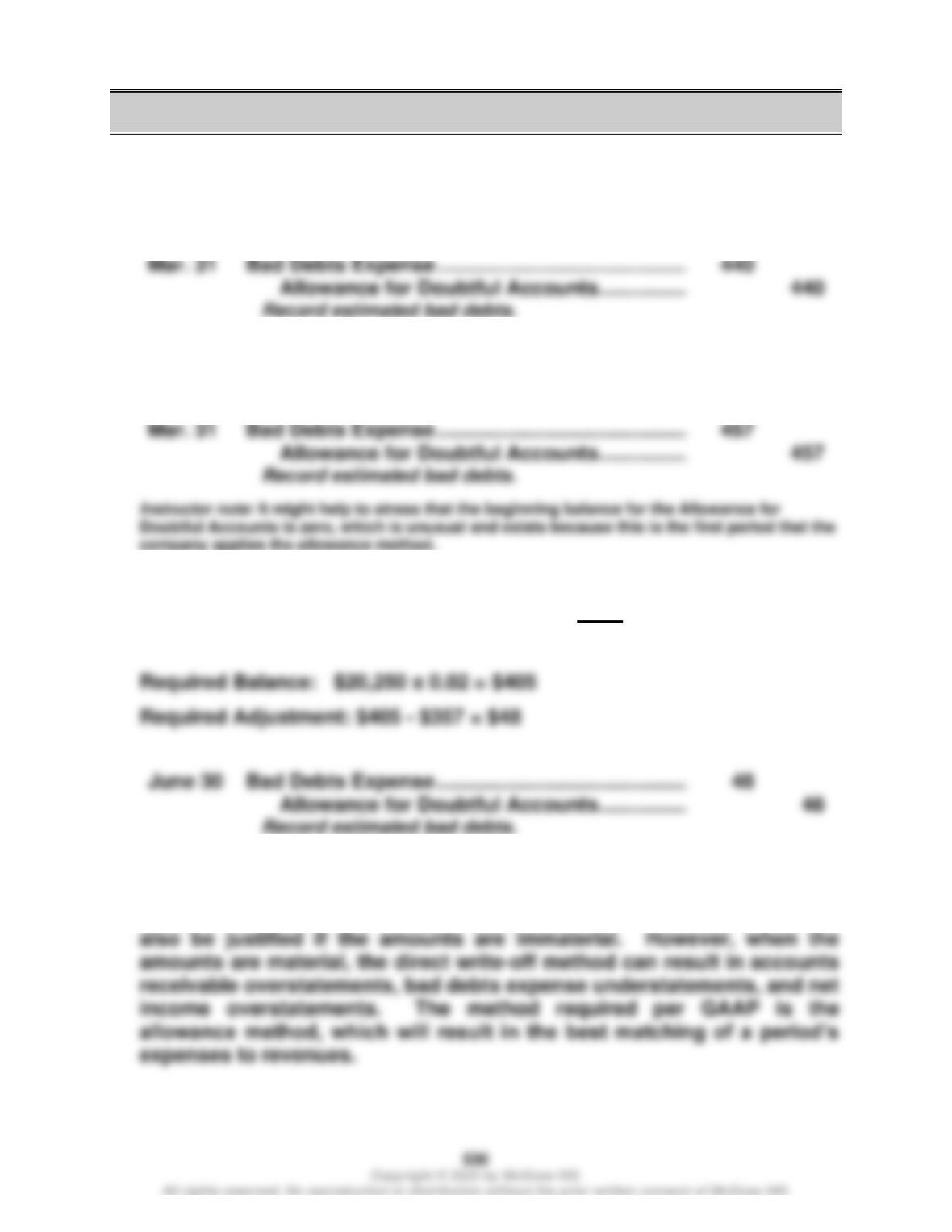
1. a. Bad debts expense is recorded as 1% of total revenues:
$44,000 x .01 = $440.
1. b. Bad debts expense is recorded as 2% of accounts receivable:
$22,867 x .02 = $457.34, which is $457 rounded to the nearest dollar.
2. Allowance Balance as of 3/31 …………………… $457 Cr.
Less: Account written off ………………………… (100) Dr.
Allowance Balance as of 6/30 …………………… $357 Cr. (before adjustment)
3. Many small business owners use the direct write-off method of
recording bad debts expense. The direct method is a simple and
straightforward method of accounting for bad debts expense. It can
Wild and Shaw Financial and Managerial Accounting 9e Solutions Manual: Chapter 7
Company Analysis — AA 7-1 (20 minutes)
1. Apple’s accounts receivables are $22,926 million.
3. Liquid assets as a percent of current liabilities ($ millions)
4. Improved
Explanation: Looking solely at Apple’s ability to satisfy current
obligations using liquid assets (cash, short-term investments, accounts
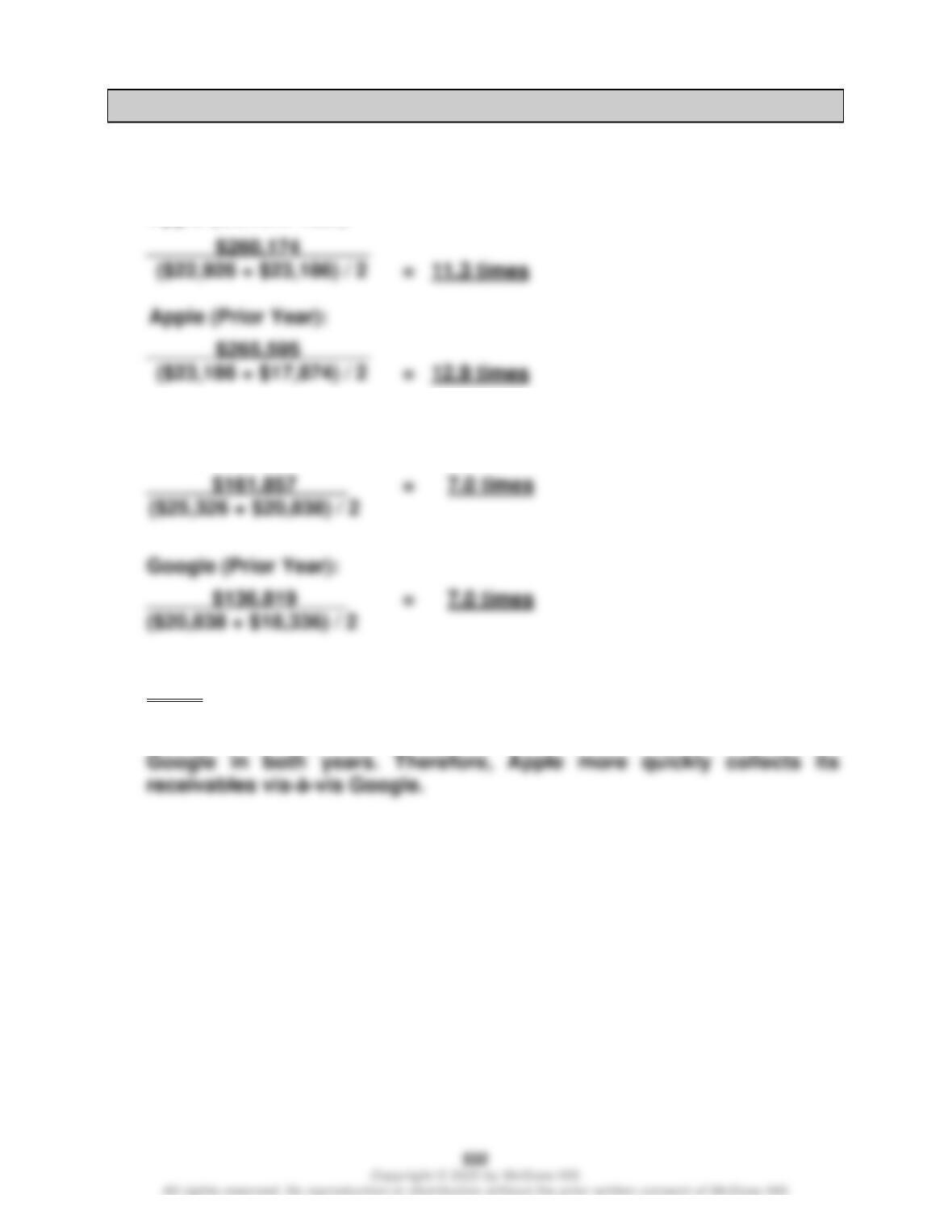
Wild and Shaw Financial and Managerial Accounting 9e Solutions Manual: Chapter 7
Comparative Analysis — AA 7-2 (20 minutes)
1. Accounts Receivable Turnover ($ millions)
a.
Apple (Current Year):
b.
Google (Current Year):
2. Apple
Explanation: Apple has a higher accounts receivable turnover than
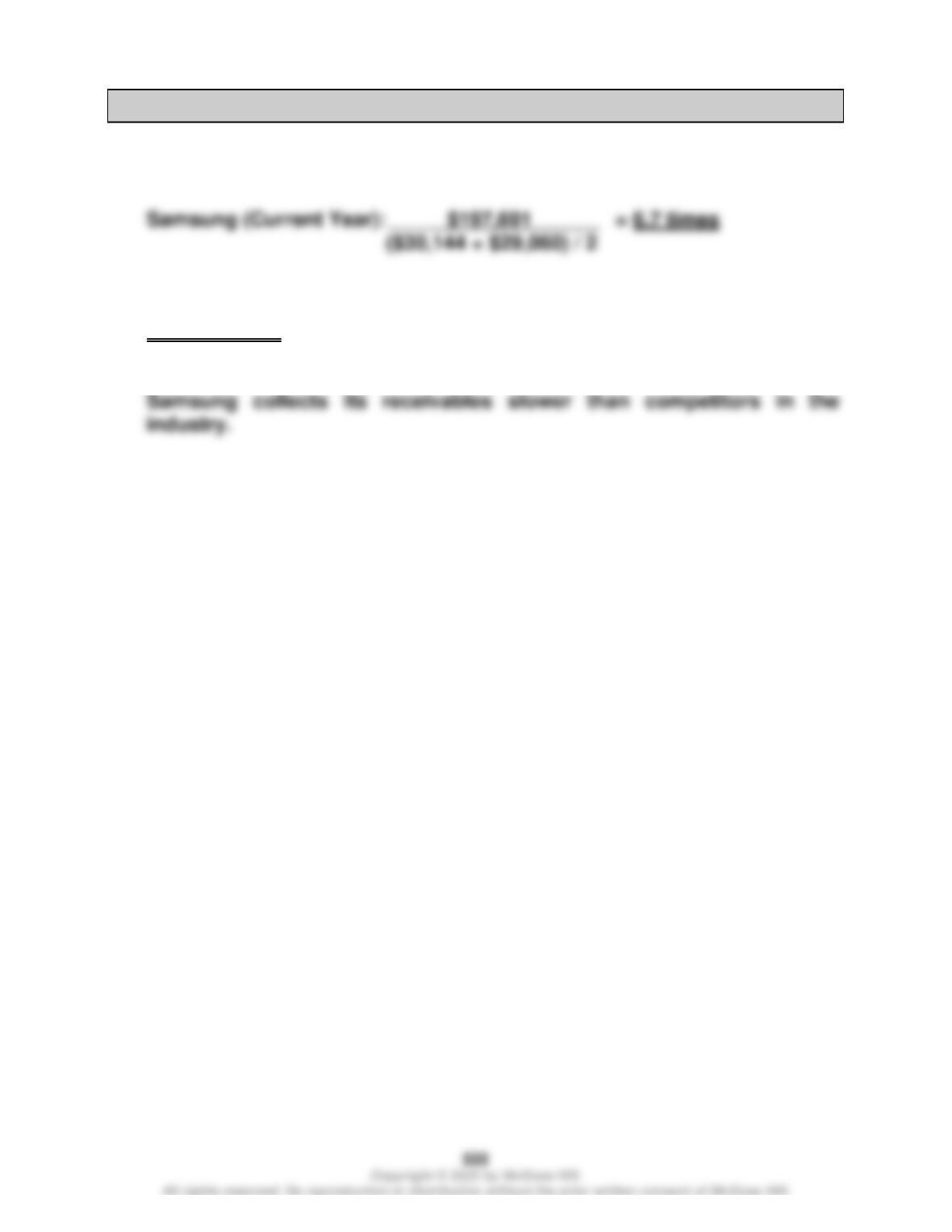
Wild and Shaw Financial and Managerial Accounting 9e Solutions Manual: Chapter 7
Extended Analysis — AA 7-3 (15 minutes)
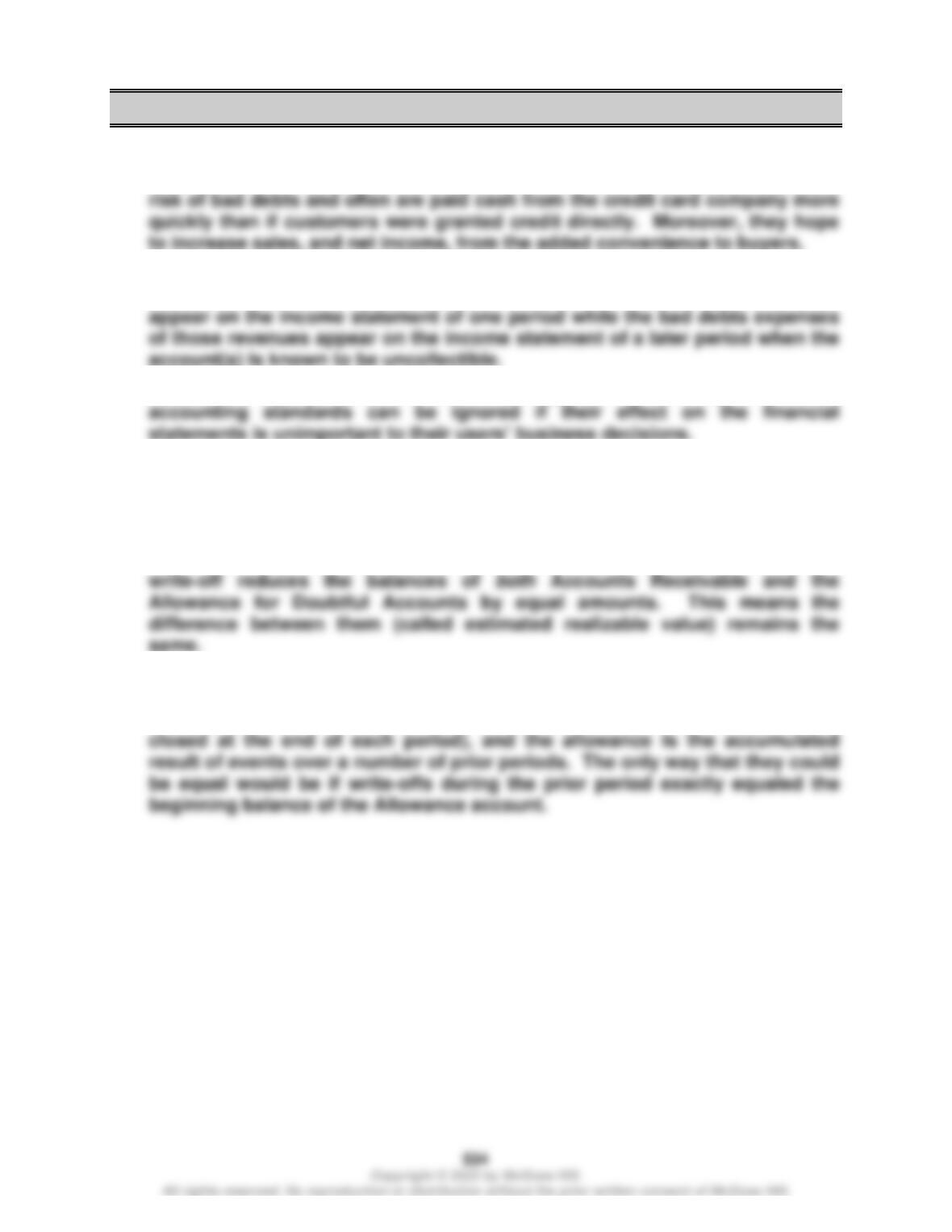
1. Accounts Receivable Turnover ($ millions)
2. Underperform
Explanation: Samsung’s results are worse than the industry average.
Wild and Shaw Financial and Managerial Accounting 9e Solutions Manual: Chapter 7
DISCUSSION QUESTIONS
1. When customers use credit cards, the selling companies can avoid having to
directly evaluate the credit standing of their customers. They also avoid the
2. Revenues and expenses usually are not matched under the direct write-off
method because the revenues recorded from the uncollectible accounts often
3. The accounting constraint of materiality suggests that the requirements of
4. A note represents a written acknowledgment by the debtor of both the debt
and its amount and terms. This results in the note having greater legal
significance.
5. Writing off a bad debt against the Allowance account does not reduce the
estimated realizable value of a company’s accounts receivable because the
6. The adjusted balances of Bad Debts Expense and Allowance for Doubtful
Accounts are virtually never equal because the expense amount reflects only
the events of the current period (because it is a temporary account that is
Wild and Shaw Financial and Managerial Accounting 9e Solutions Manual: Chapter 7
535
Ethics Challenge — BTN 7-1
1. If the estimate for bad debts is reduced then less Bad Debts Expense
will be recognized on the income statement resulting in a higher net
2. Accounting procedures often allow for alternate methods or require the
use of estimates. Therefore, managers have some leeway in their
3. An informed owner or an effective board of directors will be aware of
alternate accounting methods and how estimates can affect the
financial statements. The owner or board should review the
Wild and Shaw Financial and Managerial Accounting 9e Solutions Manual: Chapter 7
536
Communicating in Practice — BTN 7-2
TO: Sid Omar
FROM: (Your Name)
DATE: _______________
SUBJECT: Difference Between Bad Debts Expense and Allowance
For Doubtful Accounts
In accounting for credit sales and bad debts, we report sales revenue in the
period the sales are made, even though some credit sales do not result in
collections until the following period. Of course, some credit sales
eventually prove to be uncollectible. The fact that some accounts will
become uncollectible is what gives rise to bad debts expense and the
allowance for doubtful accounts.
Determining Allowance For Doubtful Accounts
The Allowance for Doubtful Accounts unadjusted balance at the end of the
year is the cumulative result of recording bad debts expense and writing
off specific accounts receivable in all past years. The recognition of bad
debts expense at the end of each year has the effect of increasing the
Allowance for Doubtful Accounts balance. However, when specific
accounts receivable are written off, they decrease the Allowance for
Wild and Shaw Financial and Managerial Accounting 9e Solutions Manual: Chapter 7
537
Taking It to the Net — BTN 7-3
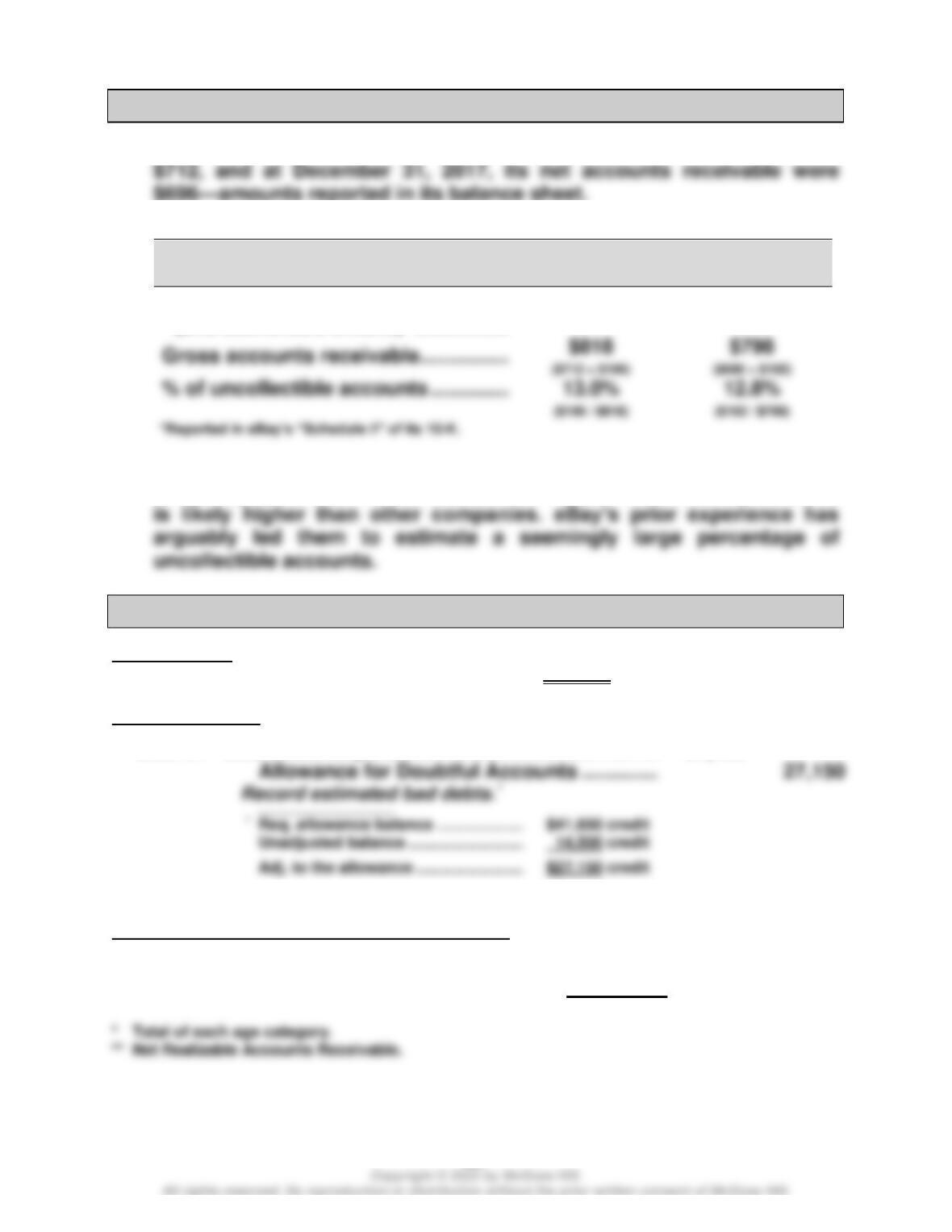
1. At December 31, 2018, eBay’s ($ millions) net accounts receivable were
2.
$ millions
December 31,
2018
December 31,
2017
Allowances for doubtful accounts
(and authorized credits)* ………………
$106
$102
3. These percentages seem high compared to other companies, but
eBay’s operations are all online, and the risk of fraudulent transactions
Teamwork in Action — BTN 7-4
Instructor note: Computations for the aging schedule are in the Problem 7-3A solution.
The check figure for total estimated uncollectibles is $41,650.
Adjusting entry
Dec. 31
Bad Debts Expense ……………………………………….
27,150
27,150
December 31 Balance Sheet Presentation
Accounts Receivable …………………………………….. $1,220,000*
Less Allowance for Doubtful Accounts ………….. 41,650 1,178,350**
Wild and Shaw Financial and Managerial Accounting 9e Solutions Manual: Chapter 7
538
Entrepreneurial Decision — BTN 7-5
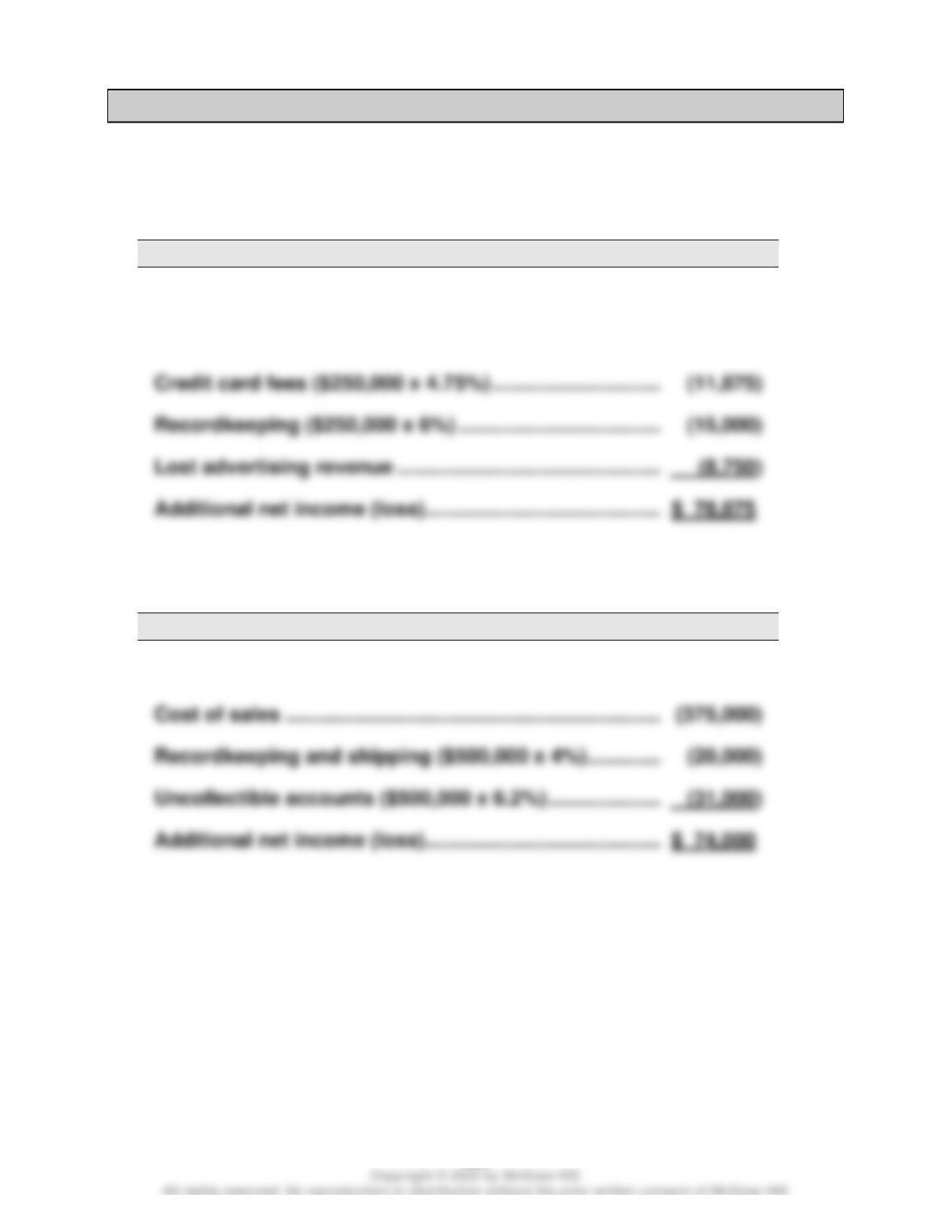
1. Computation of added annual net income or loss
a.
Added Monthly Net Income or Loss under Plan A
Increased sales ……………………………………………………… $250,000
Additional Wages Expense …………………………..………… (135,500)
b.
Added Monthly Net Income or Loss under Plan B
Increased sales ……………………………………………………… $500,000
Wild and Shaw Financial and Managerial Accounting 9e Solutions Manual: Chapter 7
539
Entrepreneurial Decision — BTN 7-5 continued
2. Plan (A) provides a slightly higher income, so if the company can only
pursue one plan now, based purely on the financial aspect, it should
choose Plan (A).
Plan (A) expands its offerings into new markets, and could increase
sales over time. However, this is a new model for the company, and it
Plan (B) is a way to expand sales by offering merchandise.
The client company does run some unknown risk associated with

Wild and Shaw Financial and Managerial Accounting 9e Solutions Manual: Chapter 7
540