FINANCIAL STATEMENT ANALYSIS CASE 2
Part 1
(a) Cash equivalents are short-term, highly liquid investments that are
both (a) readily convertible to known amounts of cash and (b) so near
(b)
(in millions)
Microsoft
Oracle
(1) Current ratio
$114,246
= 2.50
$48,138
= 3.35
$45,625
$14,389
FINANCIAL STATEMENT ANALYSIS CASE 2 (Continued)
Part 2
Current Year
(a)
Receivables Turnover
$69,943
=
$69,943
= 3.78 times
($19,544 + $17,486)/2
$18,515
Or a collection period of 97 days (365 ÷ 3.78).
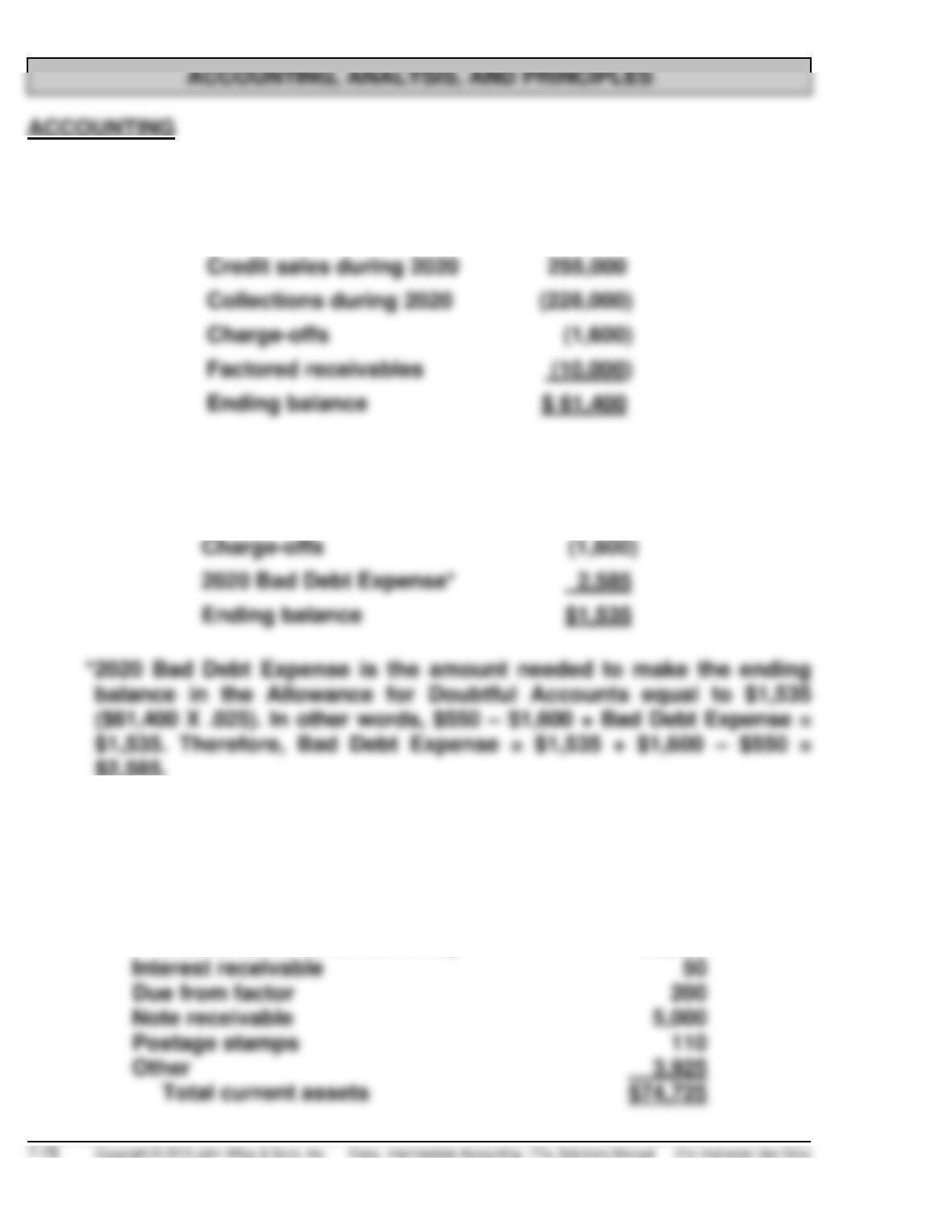
(a) Accounts Receivable:
Beginning balance
$ 46,000
Charge-offs
(1,600)
Allowance for Doubtful Accounts:
Beginning balance
$ 550
Ending balance
$1,535
$2,585.
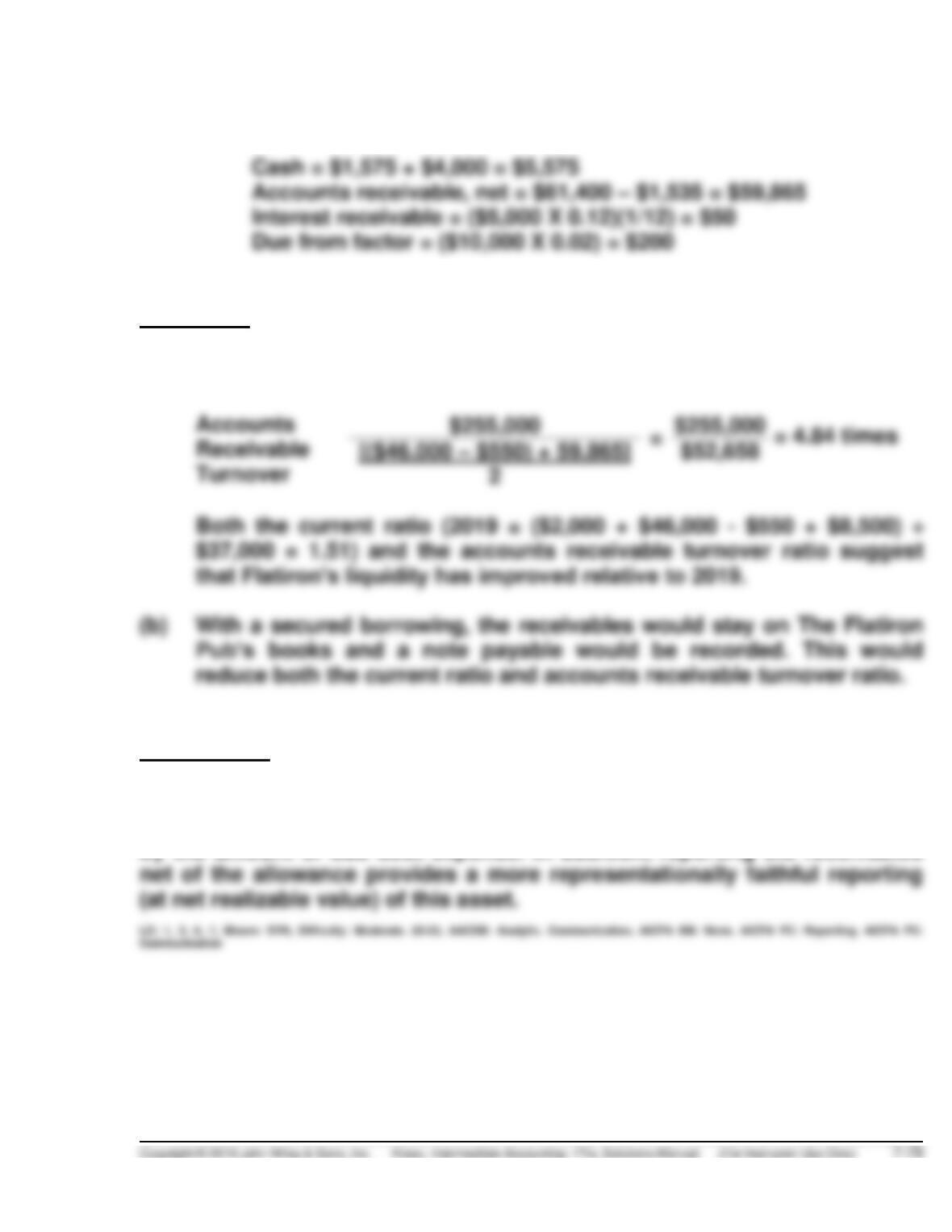
(b) Current assets section of December 31, 2020, The Flatiron Pub’s
balance sheet:
Cash
$ 5,575
Accounts receivable (net of $1,535
allowance for uncollectibles)
59,865
Due from factor
ACCOUNTING, ANALYSIS, AND PRINCIPLES (continued)
Calculations:
ANALYSIS
(a) 2020 current ratio = $74,725 ÷ ($44,600 + $400) = 1.66
PRINCIPLES
The expense recognition principle requires that bad debt expense should
be recorded in the period of the sale. Otherwise, income will be overstated
by the amount of bad debt expense. In addition, reporting the receivables
CE7.1
From the Master Glossary
(a) Consistent with common usage, cash includes not only currency on hand but demand deposits
with banks or other financial institutions. Cash also includes other kinds of accounts that have the
general characteristics of demand deposits in that the customer may deposit additional funds at
CE7.2
According to the FASB ASC Subtopic 825-15 – Financial Instruments—Credit Losses:
Recognition
825–15–25–1 At each reporting date, an entity shall recognize an allowance for expected credit losses
on financial assets within the scope of this Subtopic. Expected credit losses are a current estimate of all
CE7.3
According to FASB ASC 860-10-05 (Overview and Background)
> Types of Transfers
05–6 Transfers of financial assets take many forms. This guidance provides an overview of the fol-
lowing types of transfers discussed in this Topic:
a. Securitizations
05–14 Factoring arrangements are a means of discounting accounts receivable on a nonrecourse,
notification basis. Accounts receivable are sold outright, usually to a transferee (the factor) that
05–15 In a transfer of receivables with recourse, the transferor provides the transferee with full or
limited recourse. The transferor is obligated under the terms of the recourse provision to make
05–16 Securities lending transactions are initiated by broker-dealers and other financial institutions
that need specific securities to cover a short sale or a customer’s failure to deliver securities
05–19 Government securities dealers, banks, other financial institutions, and corporate investors com–
monly use repurchase agreements to obtain or use short-term funds. Under those agreements,
05–22 In certain industries, a typical customer’s borrowing needs often exceed its bank’s legal lending
CE7.3 (Continued)
>> Banker’s Acceptances
05–24 Banker’s acceptances provide a way for a bank to finance a customer’s purchase of goods
from a vendor for periods usually not exceeding six months. Under an agreement between the
bank, the customer, and the vendor, the bank agrees to pay the customer’s liability to the
CE7.4
According to FASB ASC 210-20–45
> Right of Setoff Criteria
45-1 A right of setoff exists when all of the following conditions are met:
a. Each of two parties owes the other determinable amounts.
45-2 A debtor having a valid right of setoff may offset the related asset and liability and report the
net amount.
45-3 If the parties meet the criteria specified in paragraph 210-20–45-1, specifying currency or interest
45-4 If a party does not intend to set off even though the ability to set off exists, an offsetting presen-
tation in the statement of financial position is not representationally faithful.
CODIFICATION RESEARCH CASE
(a) Transfer of receivables is addressed in FASB ASC 860-10: Codification
String: Broad Transactions > 860 Transfers and Servicing > 10 Overall >
05 Background >
(b) Definitions: (Codification String: Broad Transaction > 860 Transfers
and Servicing > 10 Overall > 20 Glossary)
Transfer
The conveyance of a noncash financial asset by and to someone other
than the issuer of that financial asset.
A transfer includes the following:
a. Selling a receivable
Recourse
The right of a transferee of receivables to receive payment from the
transferor of those receivables for any of the following:

CODIFICATION RESEARCH CASE (Continued)
Collateral
Personal or real property in which a security interest has been given.
IFRS CONCEPTS AND APPLICATION
IFRS7.1
The fair value option is similar under GAAP and IFRS but not identical. The
international standard related to the fair value option is subject to certain
qualifying criteria not in the U.S. standard. In addition, there are some
differences in the financial instruments covered.
The question of recording fair values for financial instruments will continue
to be an important issue to resolve as the Boards work toward
convergence. Both the IASB and the FASB have indicated that they believe
IFRS7.2
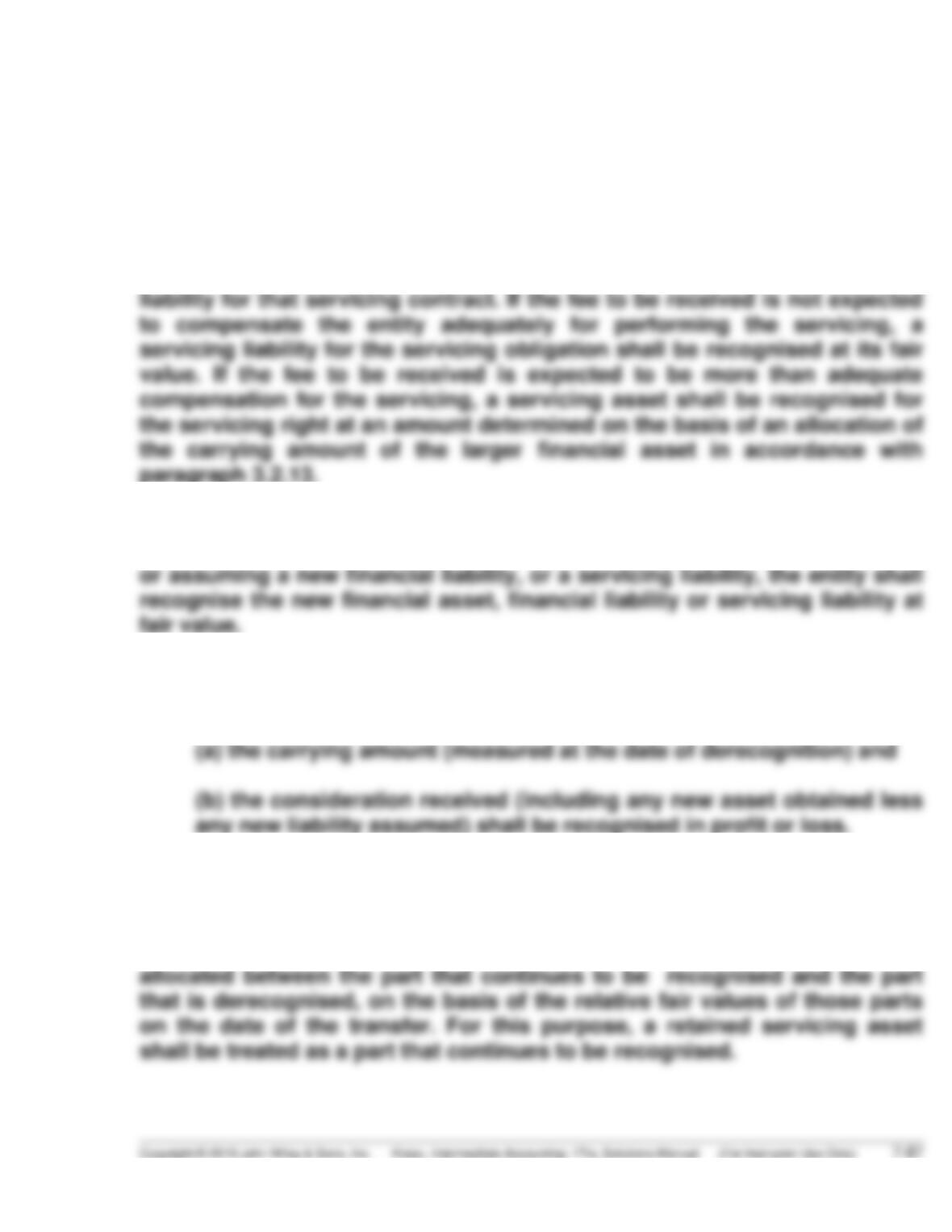
(a)
Note Amortization Schedule
(Before Impairment)
Date
Cash
Received
(0%)
Interest
Revenue
(10%)
Increase in
Carrying
Amount
Carrying
Amount of
Note
12/31/20
$62,092
(a)
December 31, 2022
Bad Debt Expense …………………………………………….
18,782
Allowance for Doubtful Accounts ………………
18,782*
Allowance for Doubtful Accounts ………………………
Bad Debt Expense …………………………..
IFRS7.3
(a) IFRS 9 Financial Instruments (Chapter 3) addresses derecognition of
financial assets.
(b) Transfers that qualify for derecognition
3.2.10 If an entity transfers a financial asset in a transfer that qualifies for
derecognition in its entirety and retains the right to service the financial
asset for a fee, it shall recognise either a servicing asset or a servicing
3.2.11 If, as a result of a transfer, a financial asset is derecognised in its
entirety but the transfer results in the entity obtaining a new financial asset
3.2.12 On derecognition of a financial asset in its entirety, the difference
between:
3.2.13 If the transferred asset is part of a larger financial asset (eg when an
entity transfers interest cash flows that are part of a debt instrument, see
paragraph 3.2.2(a)) and the part transferred qualifies for derecognition in its
entirety, the previous carrying amount of the larger financial asset shall be
The difference between:
(a) the carrying amount (measured at the date of derecognition)
3.2.14 When an entity allocates the previous carrying amount of a larger
financial asset between the part that continues to be recognised and the
part that is derecognised, the fair value of the part that continues to be
recognised needs to be measured. When the entity has a history of selling
(c) According to Appendix A (Defined Terms) of IFRS 9, amortised cost of a
financial asset or financial liability is defined as: The amount at which the
IFRS7.4
(a) M&S’s cash and cash equivalents include short-term deposits with
banks and other financial institutions, with an initial maturity of three