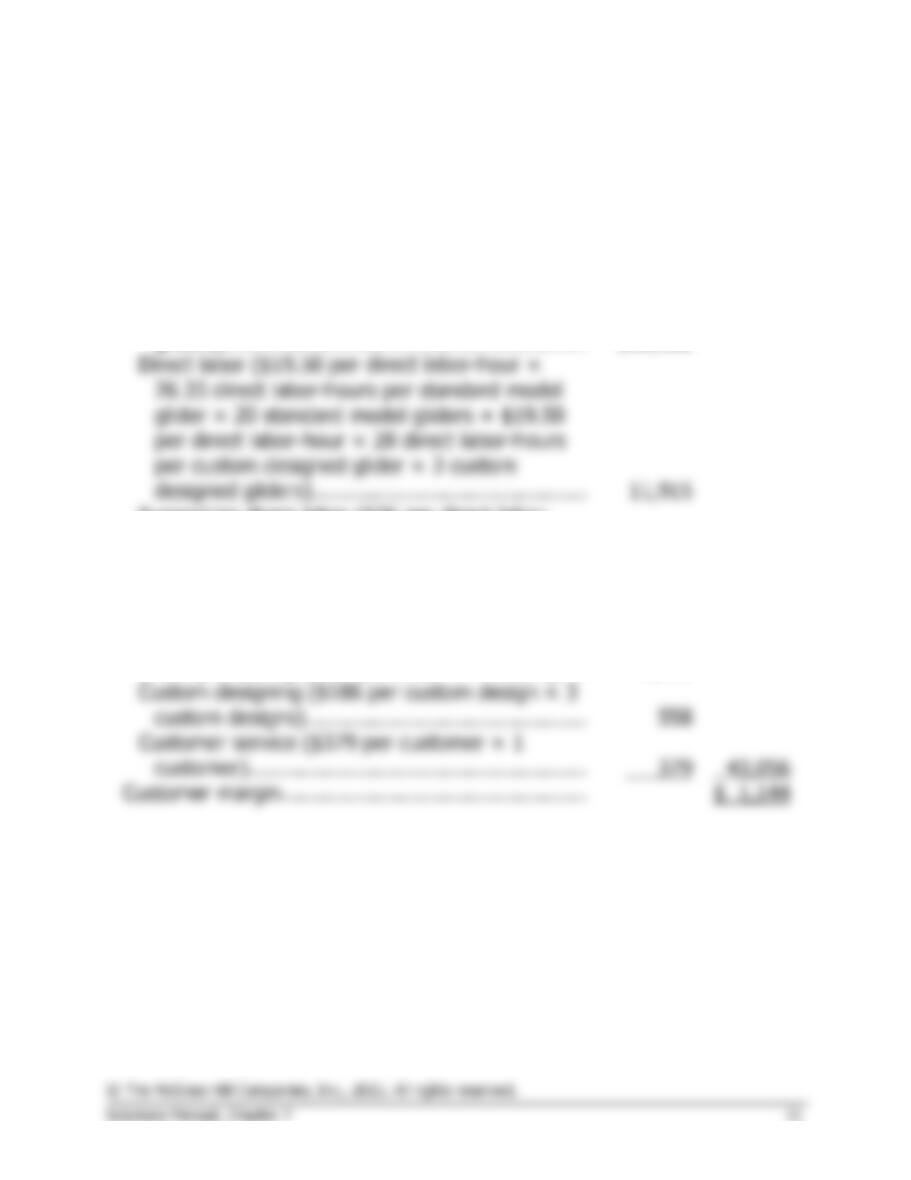
Exercise 7-5 (15 minutes)
Sales ($1,850 per standard model glider × 20
standard model gliders + $2,400 per custom
designed glider × 3 custom designed gliders) …..
$44,200
Costs:
Direct materials ($564 per standard model glider
× 20 standard model gliders + $634 per
custom designed glider × 3 custom designed
$13,182
11,915
Supporting direct labor ($26 per direct labor-
hour × 26.35 direct labor-hours per standard
model glider × 20 standard model gliders +
$26 per direct labor-hour × 28 direct labor-
hours per custom designed glider × 3 custom
designed gliders) ……………………………………..
15,886
Order processing ($284 per order × 4 orders) ….
1,136
Custom designing ($186 per custom design × 3
custom designs) ………………………………………
Customer margin………………………………………….
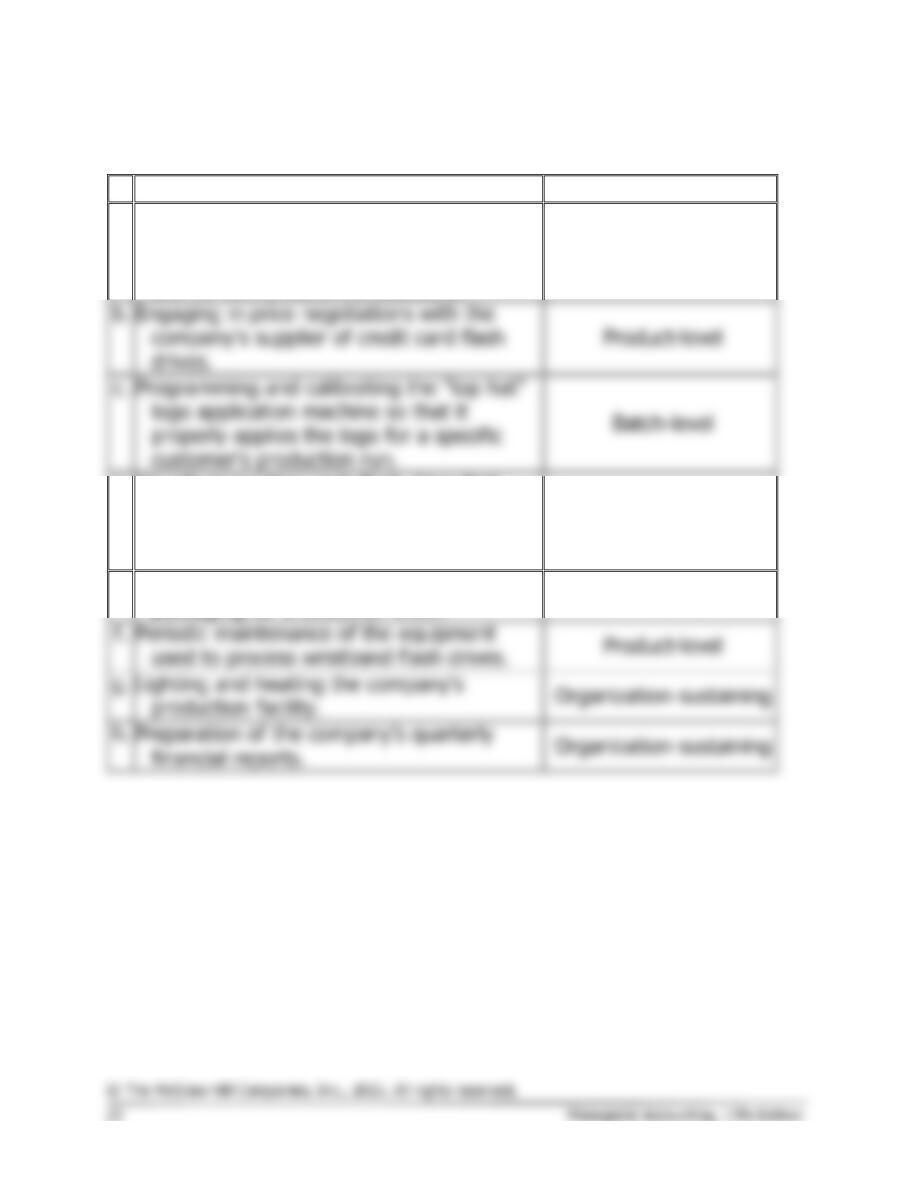
Exercise 7-6 (10 minutes)
Activity
Level
a.
Sales representatives’ periodic visits to
customers to keep them informed
about the company’s existing products
Customer-level
d.
Visually inspecting each flash drive that
has been produced to ensure that the
logo has been applied in a defect-free
manner.
Unit-level
e.
Preparing shipping documents and
Preparation of the company’s quarterly
Batch-level
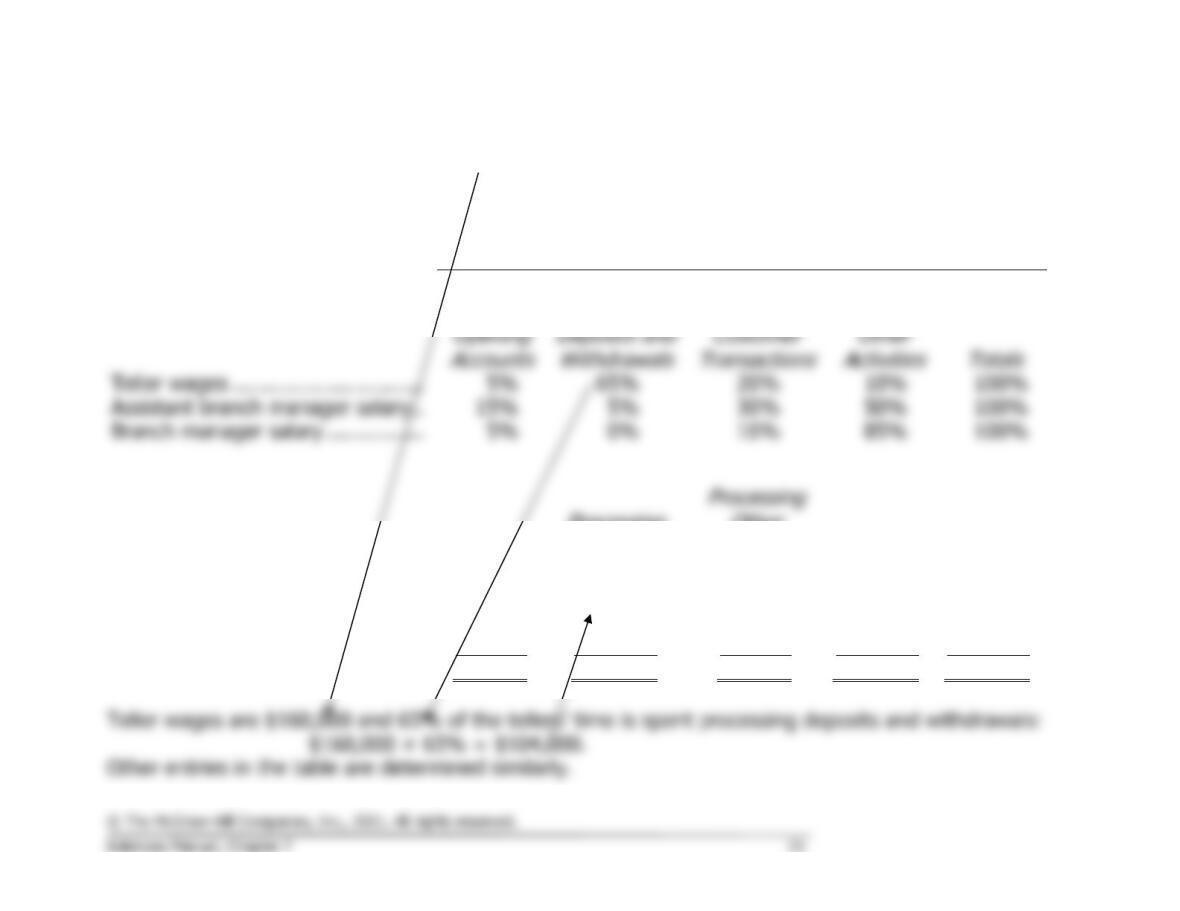
Exercise 7-7 (10 minutes)
Teller wages ………………………….
$160,000
Assistant branch manager salary ..
$75,000
Branch manager salary …………….
$80,000
Distribution of Resource Consumption Across Activities
Teller wages ………………………….
Assistant branch manager salary ..
Branch manager salary …………….
Processing
Processing
Other
Opening
Accounts
Processing
Deposits and
Withdrawals
Other
Customer
Transactions
Other
Activities
Totals
Teller wages …………………………..
$ 8,000
$104,000
$32,000
$ 16,000
$160,000
Assistant branch manager salary ..
11,250
3,750
22,500
37,500
75,000
Branch manager salary …………….
4,000
0
8,000
68,000
80,000
Total cost ………………………………
$23,250
$107,750
$62,500
$121,500
$315,000
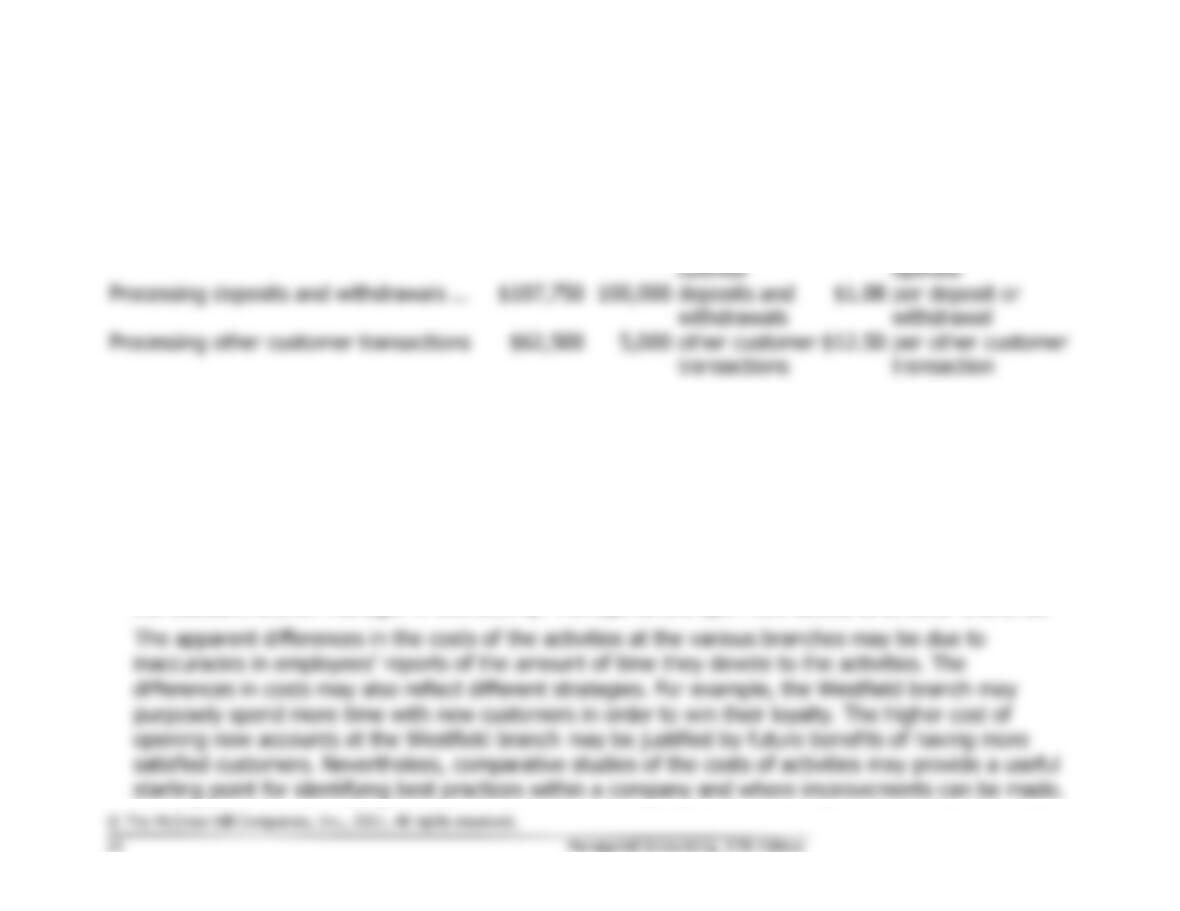
Exercise 7-8 (20 minutes)
1. Computation of activity rates:
Activity Cost Pools
(a)
Total Cost
(b)
Total Activity
(a) ÷ (b)
Activity Rate
Opening accounts ………………………….
$23,250
500
accounts
Processing deposits and withdrawals …
deposits and
per deposit or
Processing other customer transactions
$62,500
other customer
$12.50
per other customer
$46.50
per account
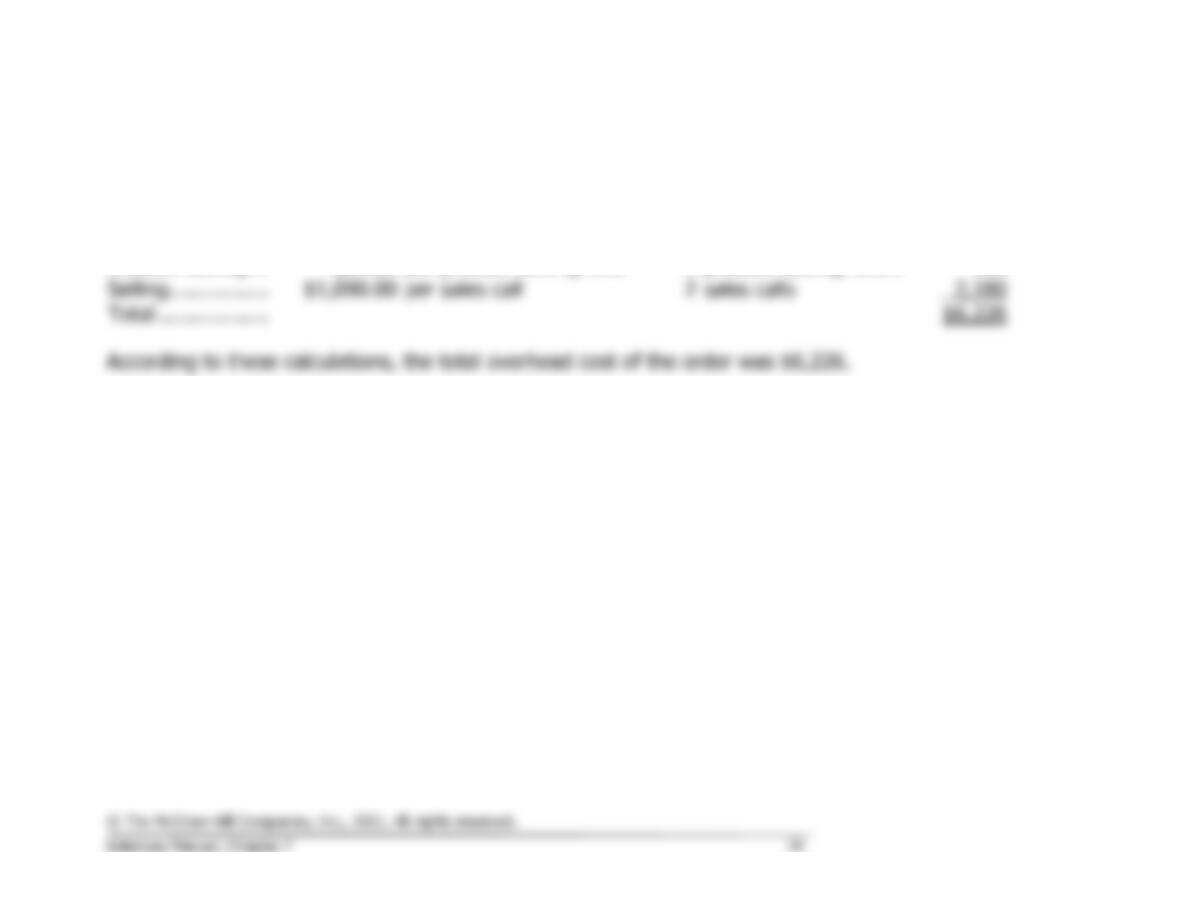
2. The cost of opening an account at the Westfield branch is much higher than at the lowest cost
branch ($46.50 versus $26.75). On the other hand, the cost of processing deposits and withdrawals
is lower than at the lowest cost branch ($1.08 versus $1.24). And the cost of processing other
customer transactions is higher at the Westfield branch ($12.50 versus $11.86). The other branches
may have something to learn from Westfield concerning processing deposits and withdrawals and
Westfield may benefit from learning about how some of the other branches open accounts and
process other transactions. It may be particularly instructive to compare the details of the activity
rates. For example, is the cost of opening accounts at Westfield high because of the involvement of
Exercise 7-9 (10 minutes)
Activity Cost Pool
(a)
Activity Rate
(b)
Activity
(a) × (b)
ABC Cost
Order size ……….
$16.85
per direct labor-hour
200
direct labor-hours
$3,370
Customer orders .
$320.00
per customer order
1
customer order
320
Product testing …
$89.00
per product testing hour
4
product testing hours
356
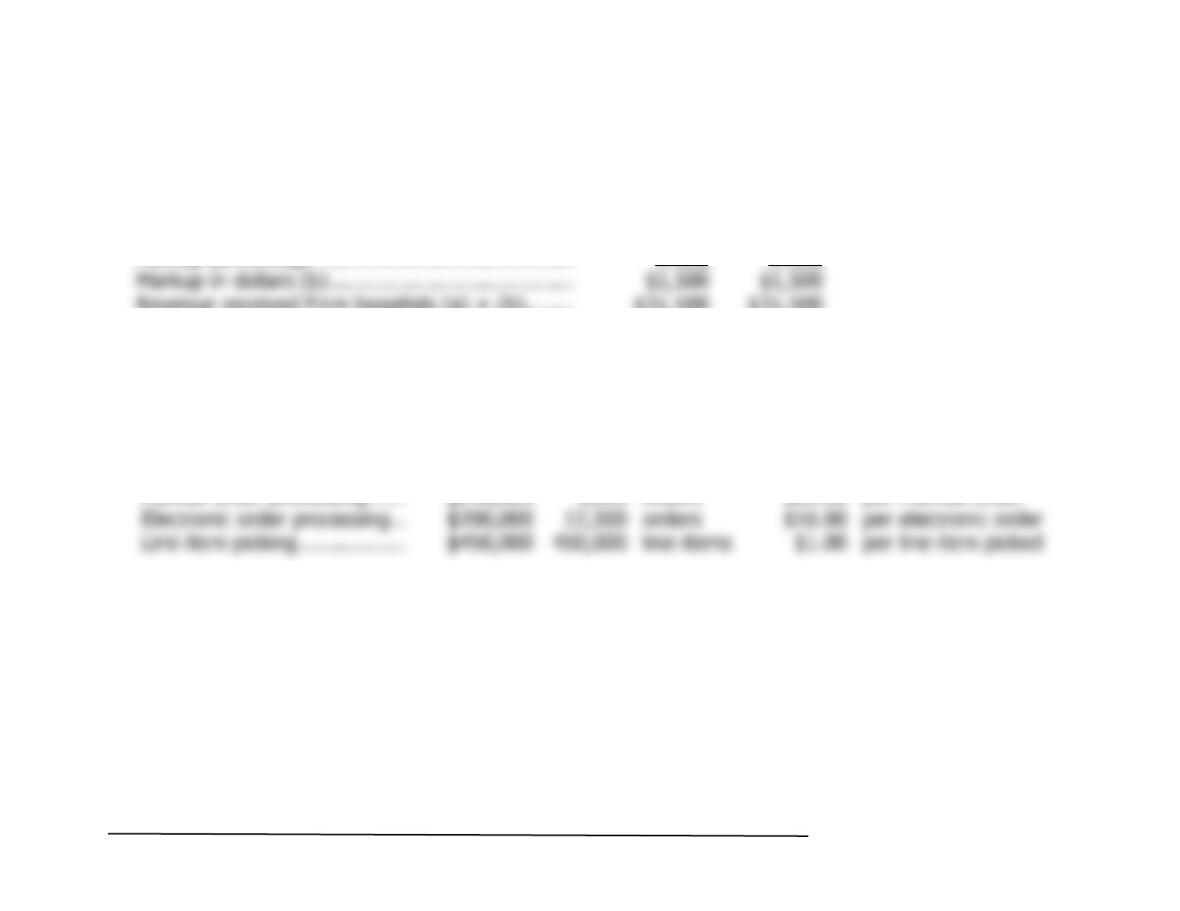
Selling …………….
per sales call
2
sales calls
© The McGraw-Hill Companies, Inc., 2021. All rights reserved.
26 Managerial Accounting, 17th Edition
Exercise 7-10 (30 minutes)
1. Total revenue received:
University
Memorial
Cost of goods sold to the hospital (a) ……………
$30,000
$30,000
Markup percentage …………………………………..
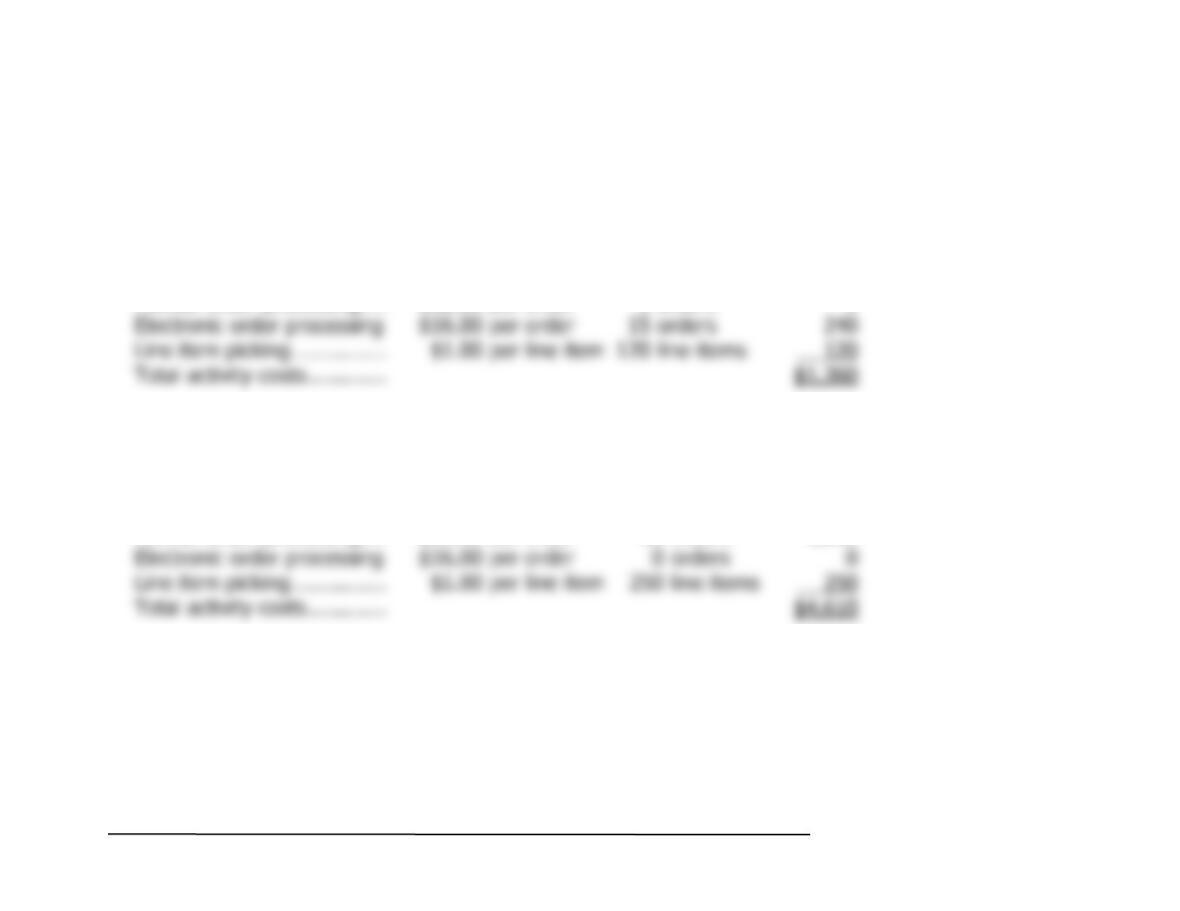
Revenue received from hospitals (a) + (b) ……..
$31,500
$31,500
2. Activity Rates:
Activity Cost Pool
(a)
Estimated
Overhead
Cost
(b)
Expected
Activity
(a) ÷ (b)
Activity
rate
Customer deliveries ………….
$500,000
5,000
deliveries
$100.00
per delivery
Electronic order processing ..
orders
per electronic order
Line item picking ……………..
line items
per line item picked
© The McGraw-Hill Companies, Inc., 2021. All rights reserved.
Solutions Manual, Chapter 7 27
Exercise 7-10 (continued)
3. Activity costs are assigned to the two hospitals as follows:
University:
Activity Cost Pool
(a)
Activity Rate
(b)
Activity
(a) × (b)
ABC Cost
Customer deliveries ………..
$100.00
per delivery
10
deliveries
$1,000
Manual order processing ….
$62.00
per order
0
orders
0
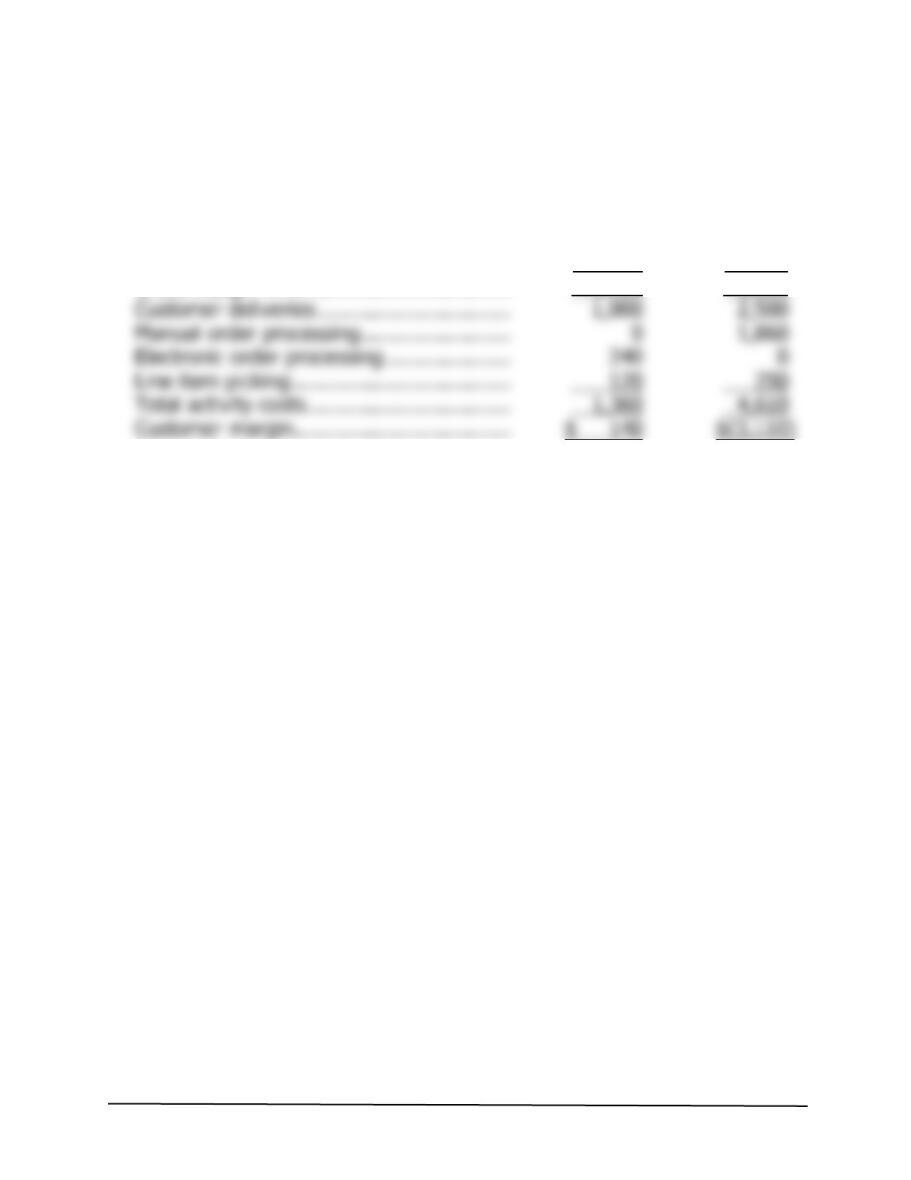
Electronic order processing
$16.00
per order
orders
Line item picking ……………
per line item
line items
Total activity costs ………….
Memorial:
Activity Cost Pool
(a)
Activity Rate
(b)
Activity
(a) × (b)
ABC Cost
Customer deliveries ………..
$100.00
per delivery
25
deliveries
$2,500
Manual order processing ….
$62.00
per order
30
orders
1,860
Electronic order processing
$16.00
per order
0
orders
Line item picking ……………
$1.00
per line item
line items
Total activity costs ………….
© The McGraw-Hill Companies, Inc., 2021. All rights reserved.
28 Managerial Accounting, 17th Edition
Exercise 7-10 (continued)
4. Customer margins for the two hospitals:
University
Memorial
Sales …………………………………………….
$31,500
$31,500
Cost of goods sold …………………………...
30,000
30,000
Gross margin ………………………………….
Customer deliveries ………………………….
Manual order processing ……………………
Electronic order processing ………………..
Line item picking ……………………………..
Total activity costs …………………………...
Customer margin ……………………………..
5. Hospitals that require frequent deliveries, place a high volume of manual
orders, and order many line items are likely to be unprofitable.
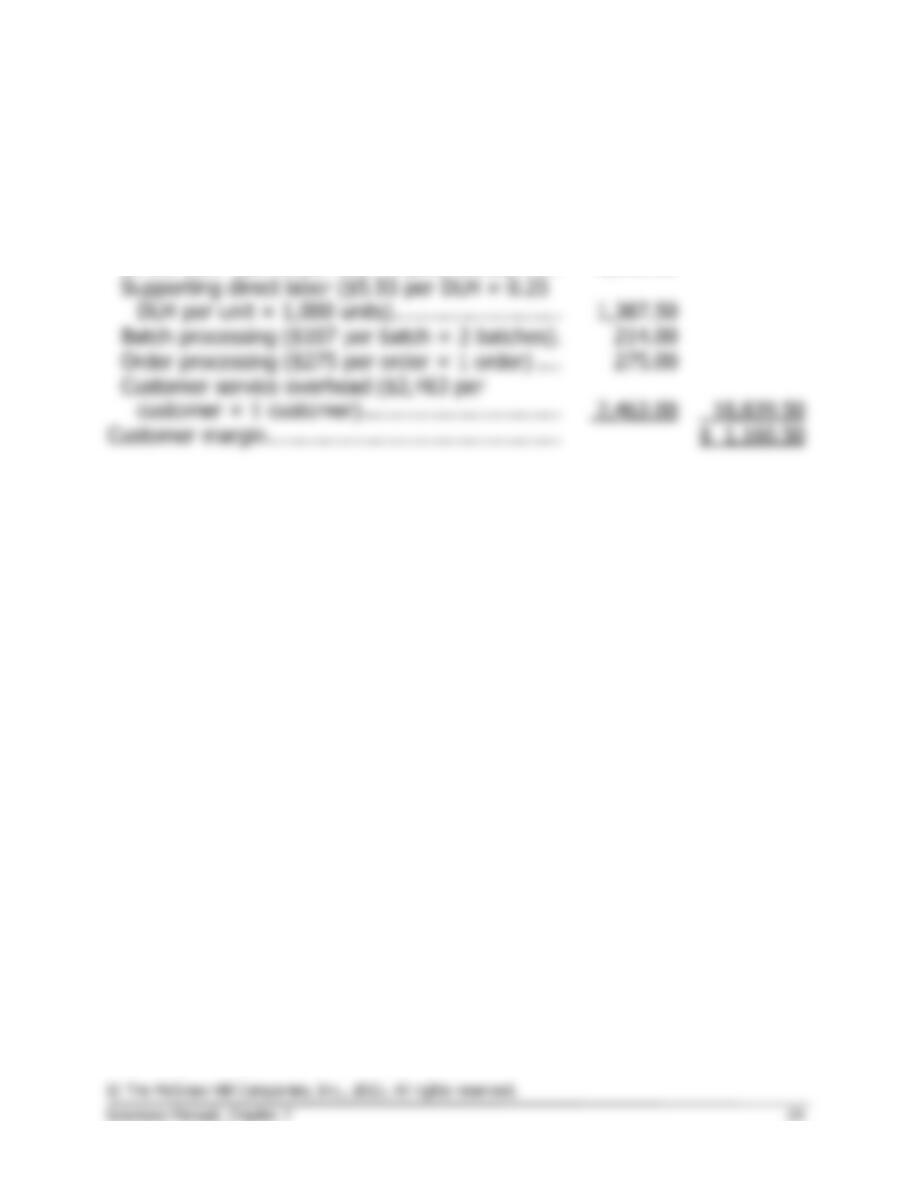
Exercise 7-11 (15 minutes)
Customer Margin—ABC Analysis
Sales (1,000 seats × $20 per unit) ………………..
$20,000.00
Costs:
Direct materials ($8.50 per unit × 1,000 units) ..
$8,500.00
Direct labor ($6.00 per unit × 1,000 units) ……..
6,000.00
1,387.50
Batch processing ($107 per batch × 2 batches) .
Order processing ($275 per order × 1 order) ….
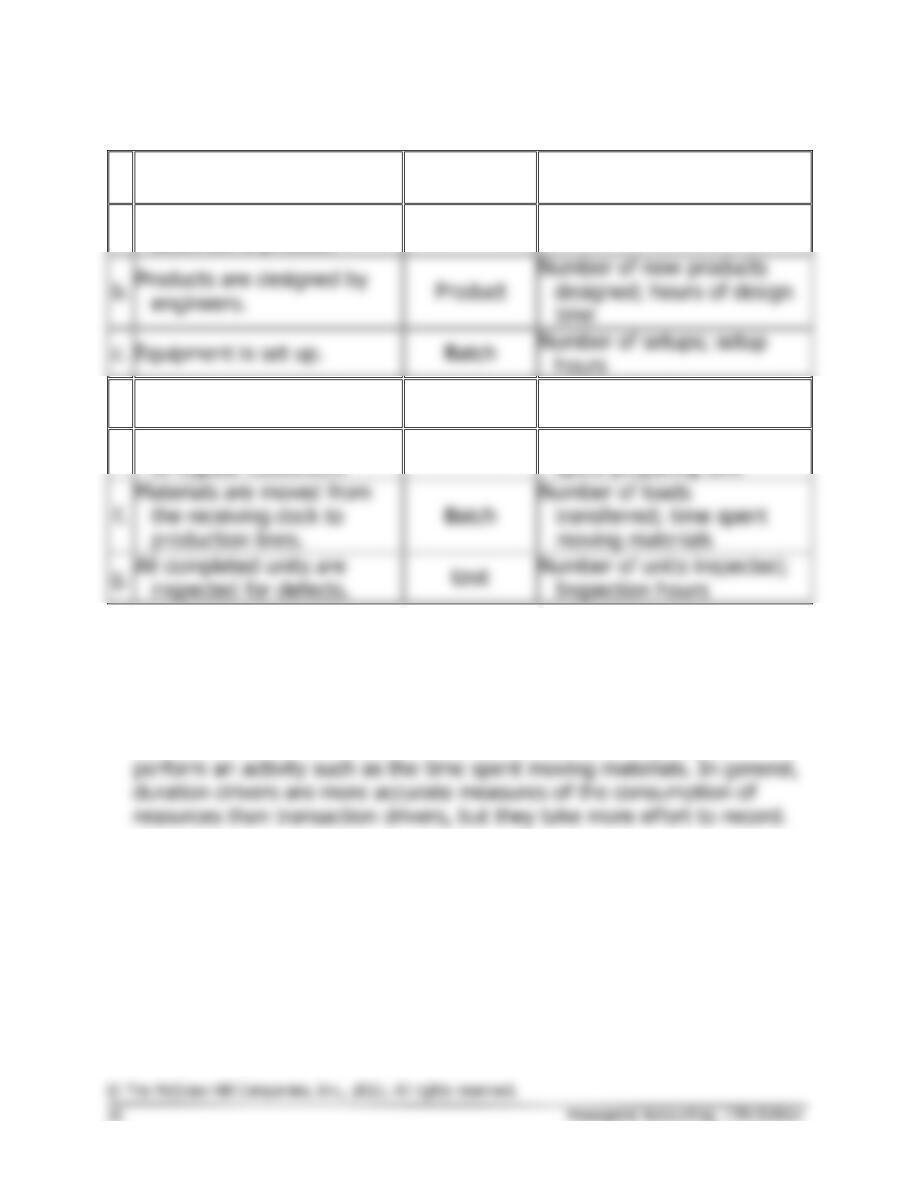
Exercise 7-12 (10 minutes)
Activity
Activity
Classification
Examples of Activity
Measures
a.
Direct labor workers
assemble a product.
Unit
Direct labor-hours
d.
Machines are used to
shape and cut materials.
Unit
Number of units processed;
machine-hours
e.
Monthly bills are sent out
g.
All completed units are
Number of units inspected;
Customer
Number of bills sent; time
Notes:
In all cases except for direct labor in part (a), two activity measures are
listed. The first is a “transaction driver” and the second is a “duration
driver.” Transaction drivers are simple counts of the number of times an
activity occurs such as the number of times materials are moved.
Duration drivers are measures of the amount of time required to
Exercise 7-13 (30 minutes)
1. Activity rates are computed as follows:
Activity Cost Pool
(a)
Estimated
Overhead
Cost
(b)
Expected
Activity
(a) ÷ (b)
Activity
Rate
Machine setups ……
$72,000
400
setups
$180
per setup
Special processing ..
MHs
per MH
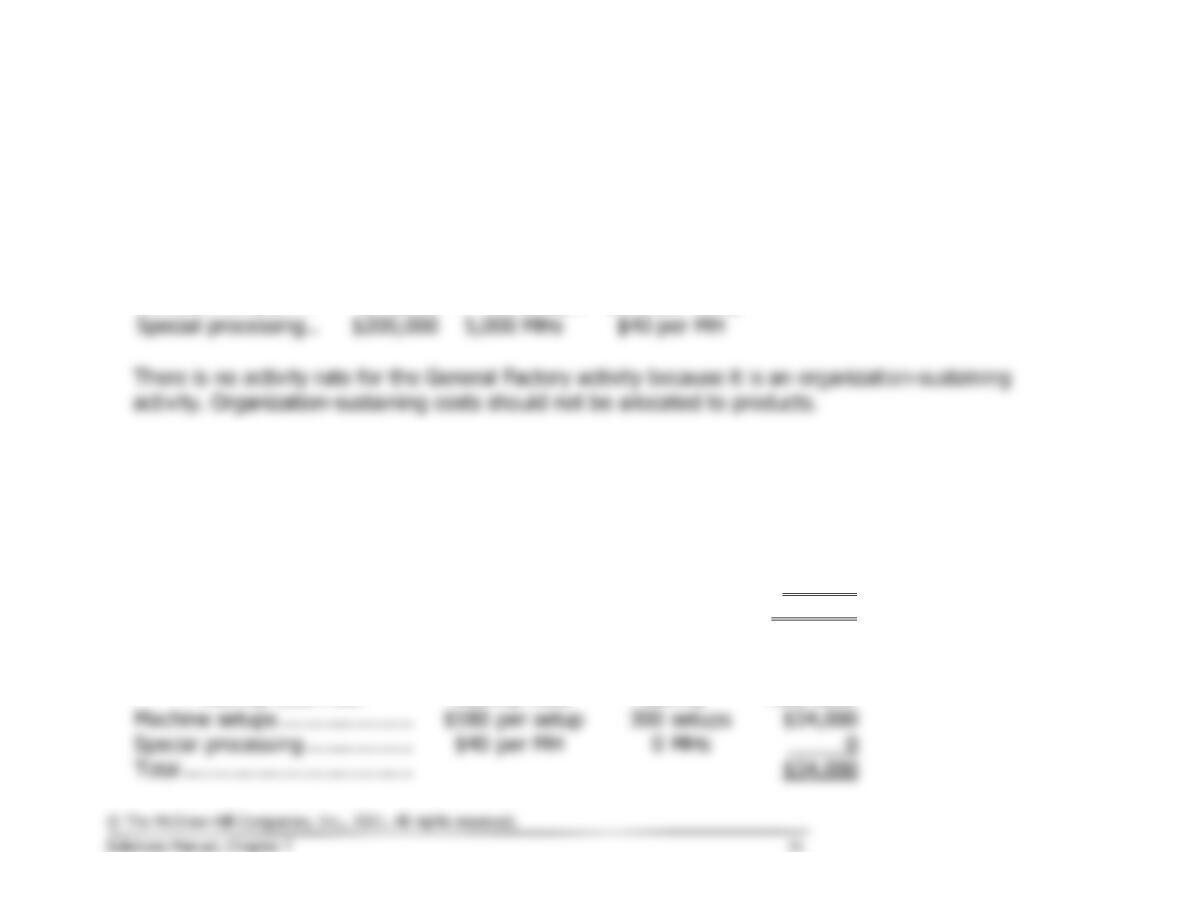
2. Overhead is assigned to the two products as follows:
Hubs:
Activity Cost Pool
(a)
Activity Rate
(b)
Activity
(a) × (b)
ABC Cost
Machine setups …………………
$180
per setup
100
setups
$ 18,000
Special processing ……………..
$40
per MH
5,000
MHs
200,000
Total ……………………………….
$218,000
Sprockets:
Activity Cost Pool
Activity Rate
Activity
ABC Cost
Machine setups …………………
$180
per setup
300
setups
$54,000
Special processing ……………..
$40
per MH
MHs
(a)
(b)
(a) × (b)
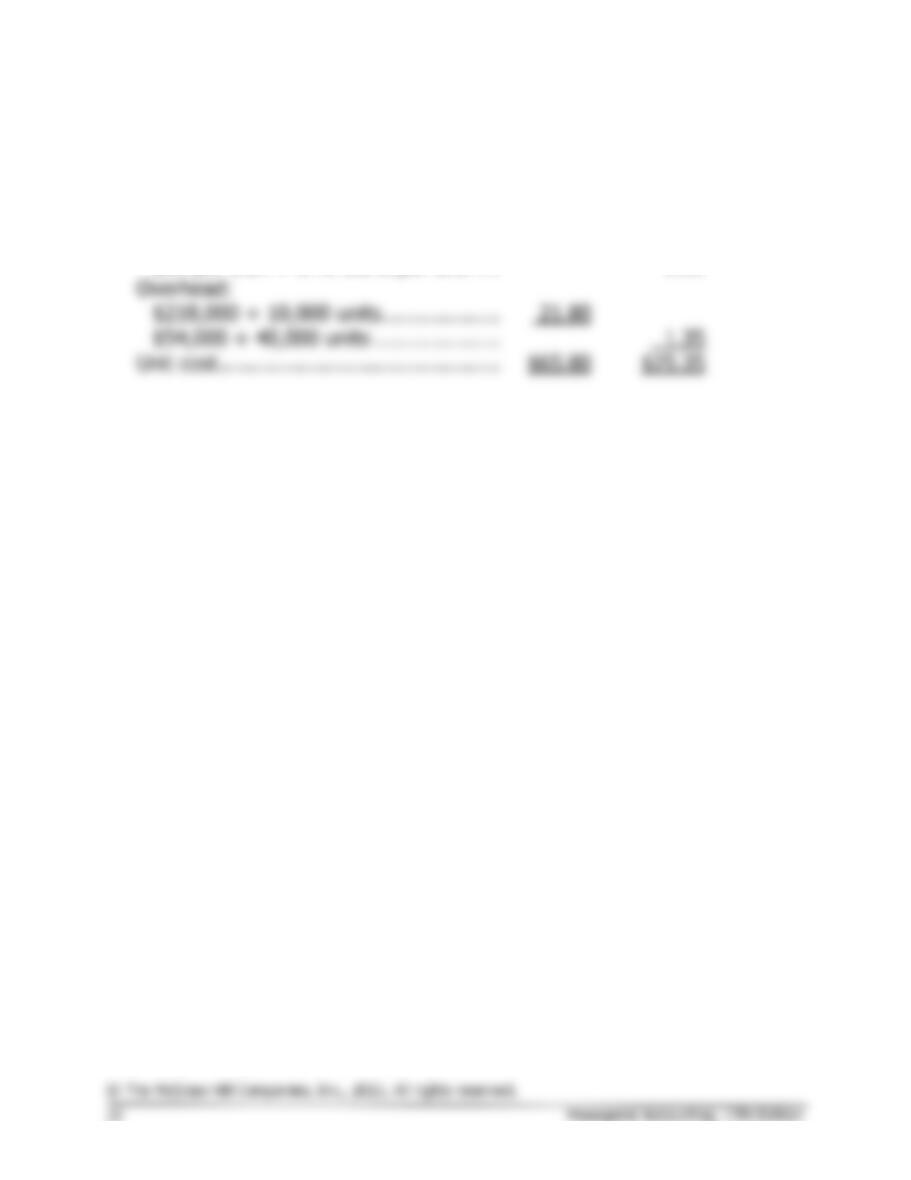
Exercise 7-13 (continued)
Hubs
Sprockets
Direct materials……………………………..
$32.00
$18.00
Direct labor:
$15 per DLH × 0.80 DLHs per unit ….
12.00
$15 per DLH × 0.40 DLHs per unit ….
Overhead:
$218,000 ÷ 10,000 units……………….
$54,000 ÷ 40,000 units ………………..
Exercise 7-14 (30 minutes)
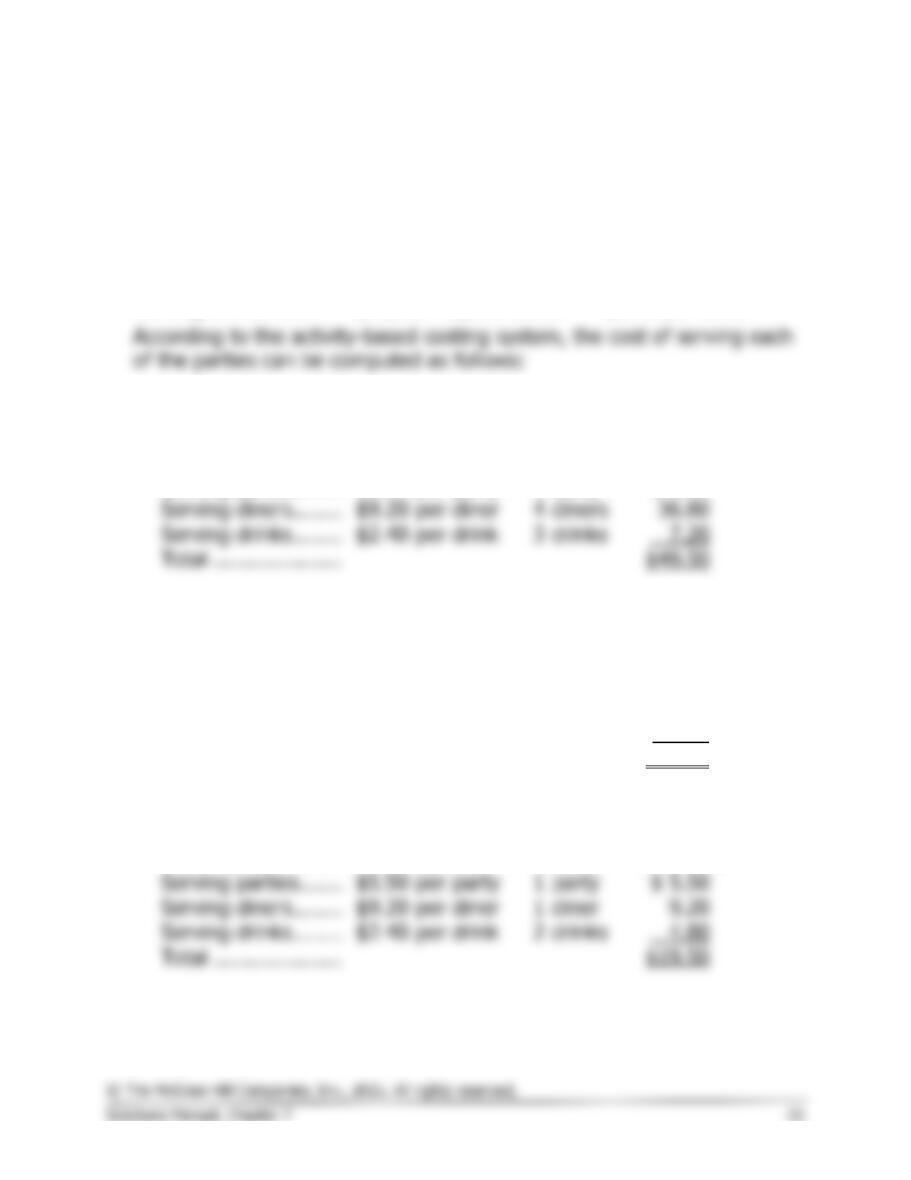
1. The first step is to determine the activity rates:
Activity Cost Pools
(a)
Total Cost
(b)
Total Activity
(a) ÷ (b)
Activity Rate
Serving parties …….
$33,000
6,000
parties
$5.50
per party
Serving diners ……..
$138,000
15,000
diners
$9.20
per diner
Serving drinks ……..
$24,000
10,000
drinks
$2.40
per drink
a. Party of 4 persons who order a total of 3 drinks:
Activity Cost Pool
(a)
Activity Rate
(b)
Activity
(a) × (b)
ABC Cost
Serving parties …….
$5.50
per party
1
party
$ 5.50
Serving diners ……..
$9.20
per diner
4
diners
36.80
Serving drinks ……..
$2.40
per drink
3
drinks
Total …………………
$49.50
b. Party of 2 persons who order no drinks:
Activity Cost Pool
(a)
Activity Rate
(b)
Activity
(a) × (b)
ABC Cost
Serving parties …….
$5.50
per party
1
party
$ 5.50
Serving diners ……..
$9.20
per diner
2
diners
18.40
Serving drinks ……..
$2.40
per drink
0
drinks
0
Total …………………
$23.90
c. Party of 1 person who orders 2 drinks:
Activity Cost Pool
(a)
Activity Rate
(b)
Activity
(a) × (b)
ABC Cost
Serving parties …….
$5.50
per party
1
party
Serving diners ……..
$9.20
per diner
1
diner
Serving drinks ……..
$2.40
per drink
2
drinks
Total …………………
$19.50
Exercise 7-14 (continued)
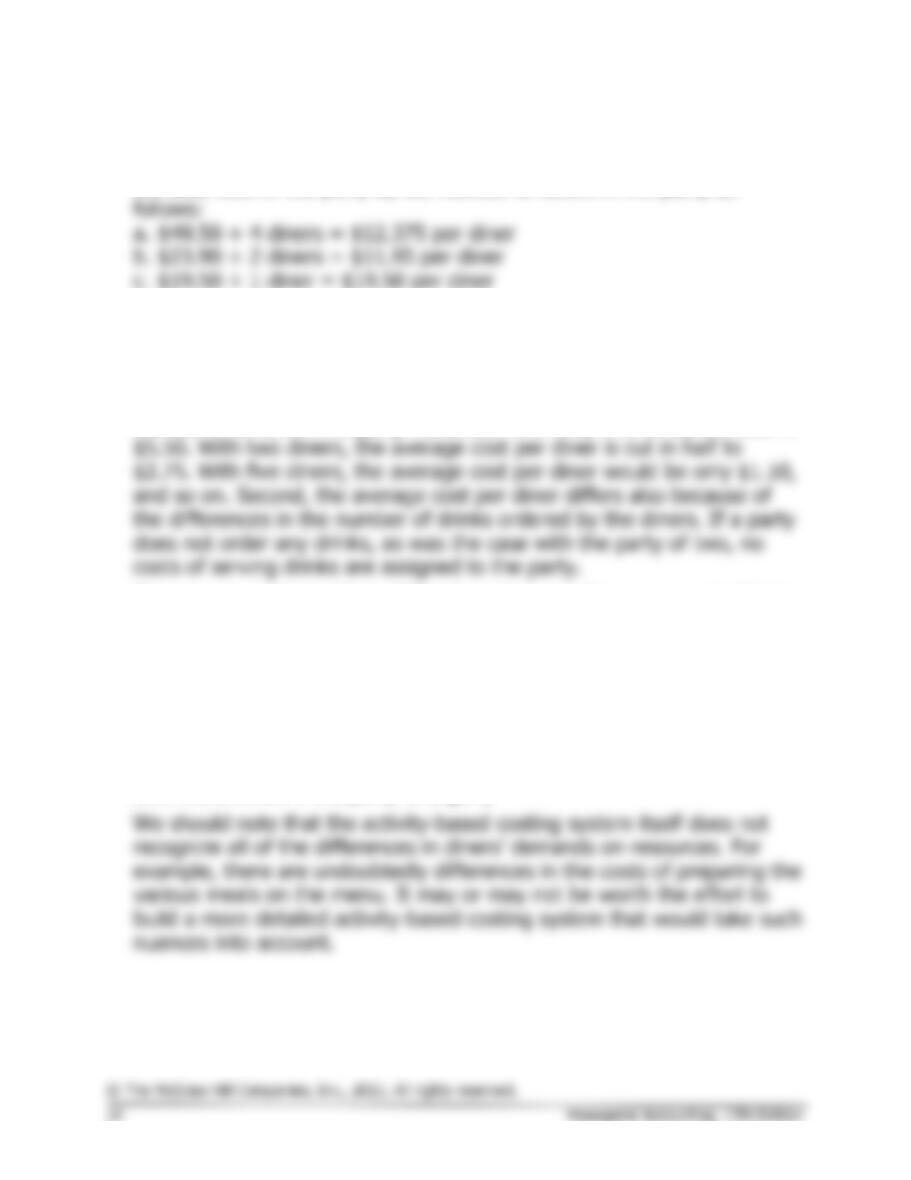
2. The average cost per diner for each party can be computed by dividing
3. The average cost per diner differs from party to party under the activity-
based costing system for two reasons. First, the cost of serving a party
($5.50) does not depend on the number of diners in the party.
Therefore, the average cost per diner of this activity decreases as the
number of diners in the party increases. With only one diner, the cost is
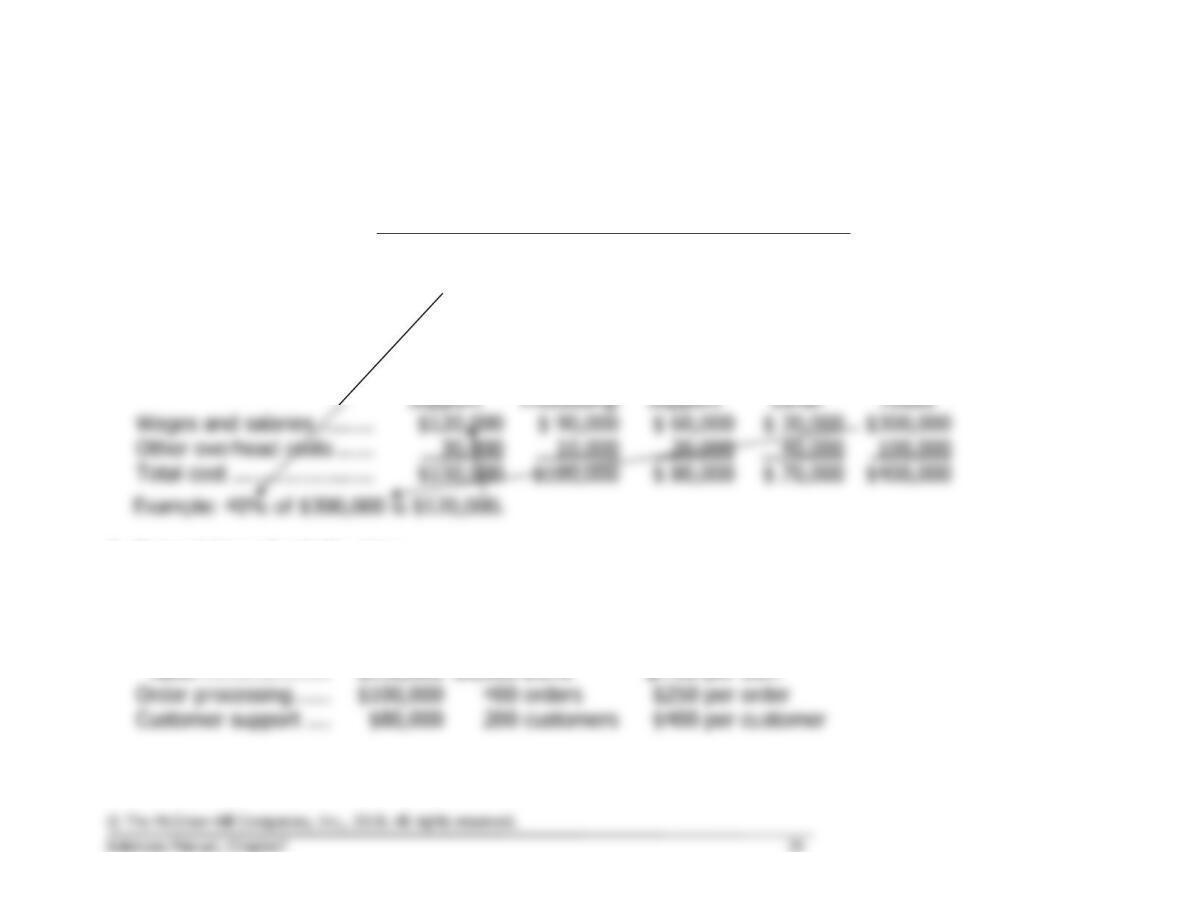
The average cost per diner differs from the overall average cost of $16
per diner for several reasons. First, the average cost of $16 per diner
includes organization-sustaining costs that are excluded from the
computations in the activity-based costing system. Second, the $16 per
diner figure does not recognize differences in the diners’ demands on
resources. It does not recognize that some diners order more drinks
than others nor does it recognize the economies of scale in serving
larger parties. (The batch-level costs of serving a party can be spread
over more diners if the party is larger.)
Exercise 7-15 (30 minutes)
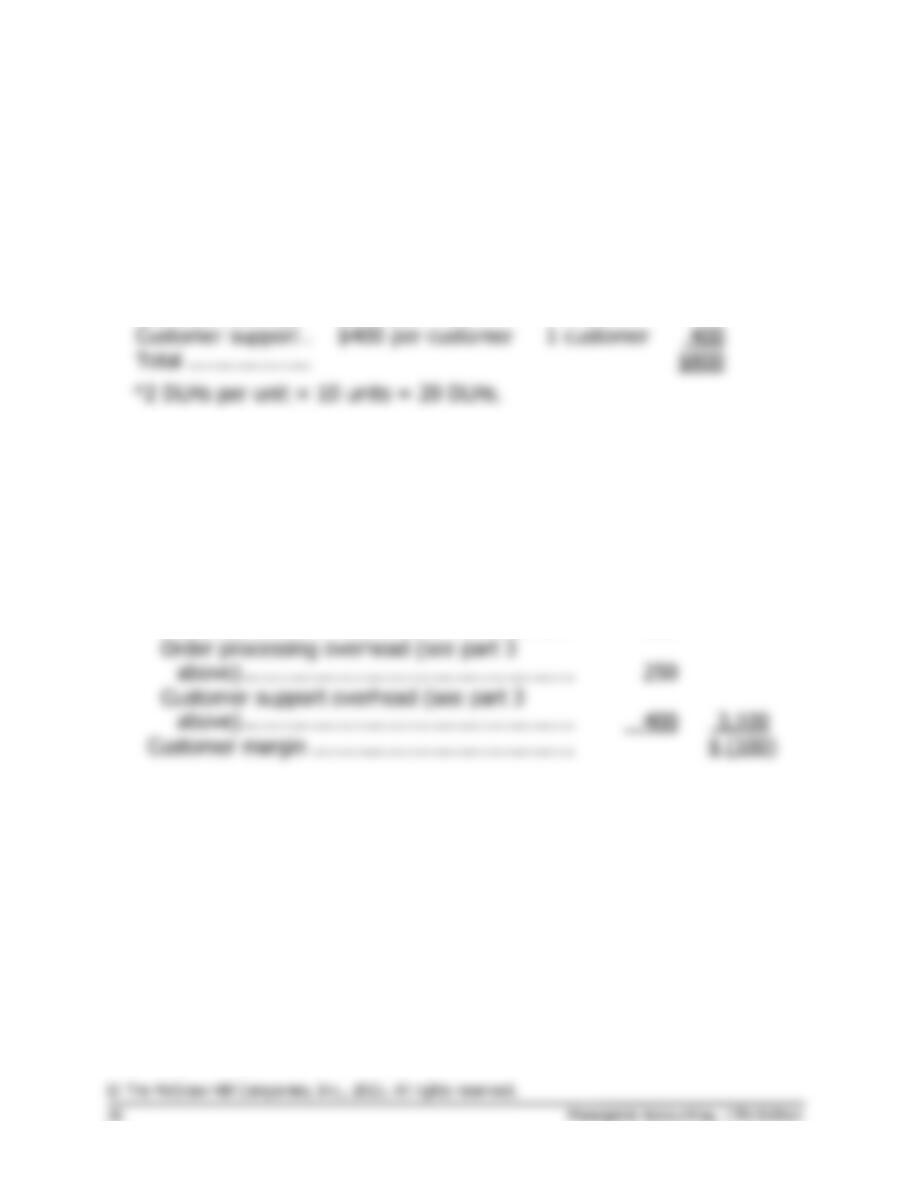
1. First-stage allocations of overhead costs to the activity cost pools:
Distribution of Resource Consumption
Across Activity Cost Pools
Supporting
Direct Labor
Order
Processing
Customer
Support
Other
Totals
Wages and salaries ………
40%
30%
20%
10%
100%
Other overhead costs ……
30%
10%
20%
40%
100%
Other
Totals
Wages and salaries ………
Other overhead costs ……
Direct Labor
Order
Customer
2. Computation of activity rates:
Activity Cost Pools
(a)
Total Cost
(b)
Total Activity
(a) ÷ (b)
Activity Rate
Supporting direct
Order processing ……
Customer support ….
Exercise 7-15 (continued)
3. Computation of the overhead costs for the Shenzhen Enterprises order:
Activity Cost Pool
(a)
Activity Rate
(b)
Activity
(a) × (b)
ABC Cost
Supporting direct
labor ………………
$7.50
per DLH
20
DLHs*
$150
Order processing …
$250
per order
1
order
250
Customer support .
$400
per customer
1
customer
400
Total ………………..
$800
4. The customer margin for Shenzhen Enterprises is computed as follows:
Customer Margin—ABC Analysis
Sales (10 units × $300 per unit) ………………..
$3,000
Costs:
Direct materials ($180 per unit × 10 units) …
$1,800
Direct labor ($50 per unit × 10 units) ………..
500
Support direct labor overhead (see part 3
above) ……………………………………………..
150
$ (100)
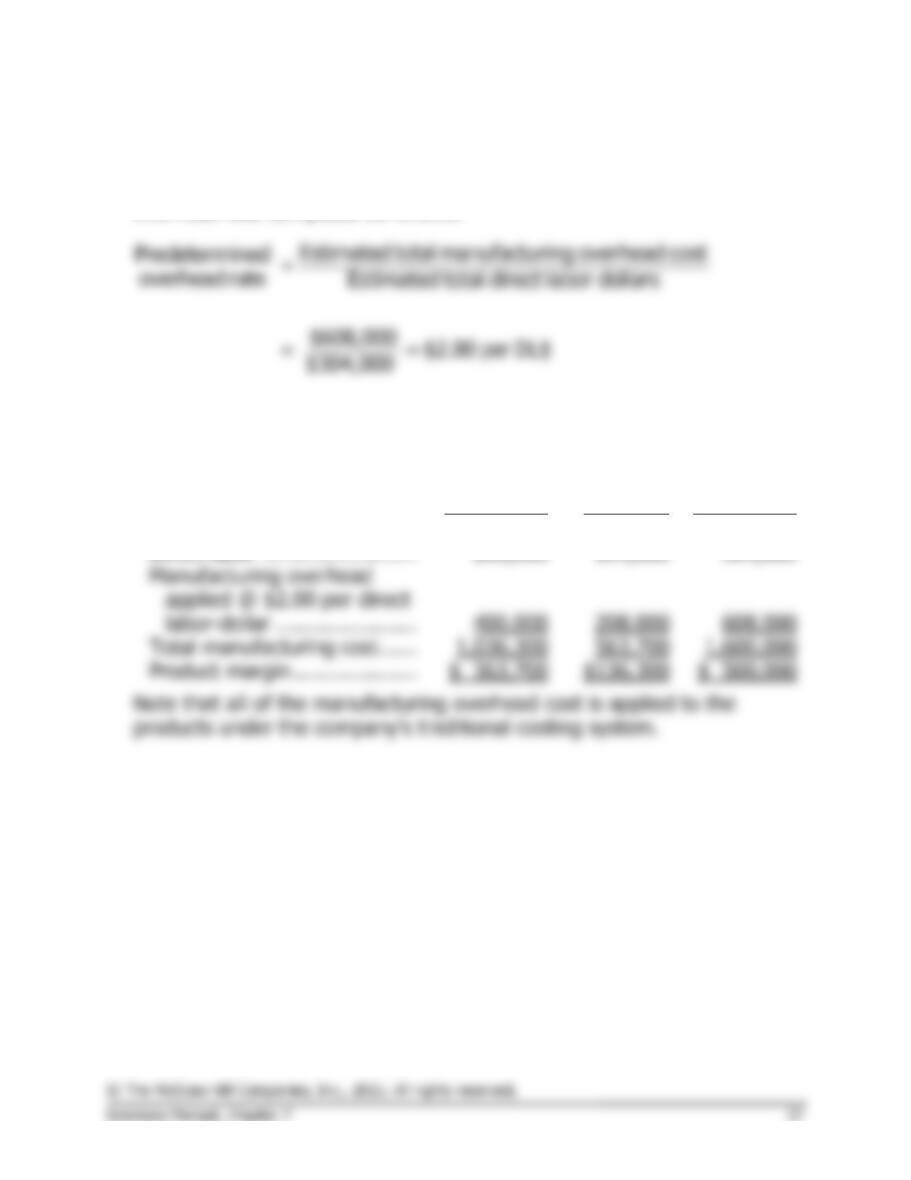
Problem 7-16 (45 minutes)
1. Under the traditional direct labor-dollar based costing system,
manufacturing overhead is applied to products using the predetermined
The product margins using the traditional approach would be computed
as follows:
B300
T500
Total
Sales ……………………………..
$1,400,000
$700,000
$2,100,000
Direct materials ……………….
436,300
251,700
688,000
Total manufacturing cost ……
563,700
Product margin ………………..
$136,300
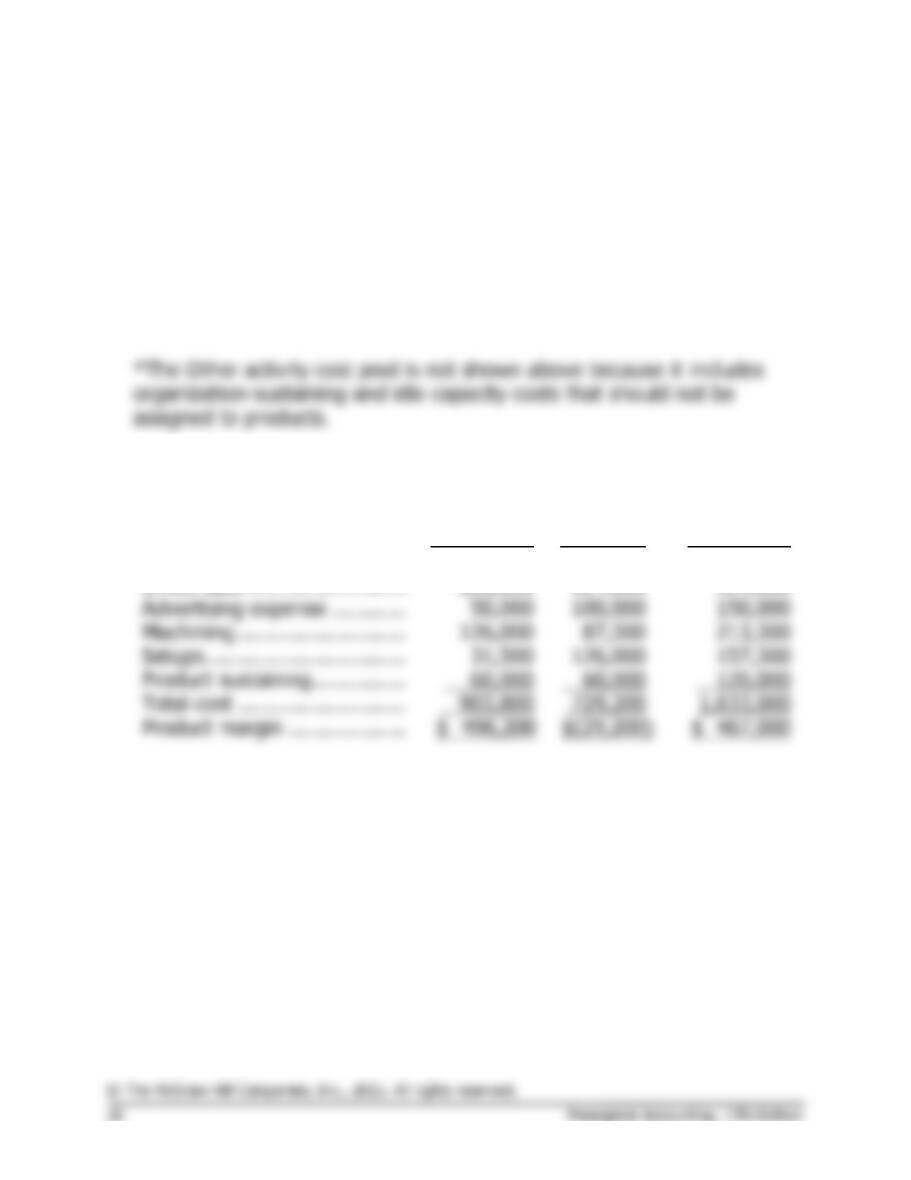
Problem 7-16 (continued)
2. The first step is to determine the activity rates:
Activity Cost Pools
(a)
Total
Cost
(b)
Total Activity
(a) ÷ (b)
Activity Rate
Machining …………..
$213,500
152,500
MH
$1.40
per MH
Setups ……………….
$157,500
375
setup hrs
$420
per setup hr
Product sustaining ..
$120,000
2
products
$60,000
per product
Under the activity-based costing system, the product margins would be
computed as follows:
B300
T500
Total
Sales …………………………….
$1,400,000
$700,000
$2,100,000
Direct materials ……………….
436,300
251,700
688,000
Direct labor …………………….
104,000
304,000
Advertising expense …………
Machining ………………………
213,500
Setups …………………………..
126,000
Product sustaining ……………
60,000
Total cost ………………………
Product margin ……………….
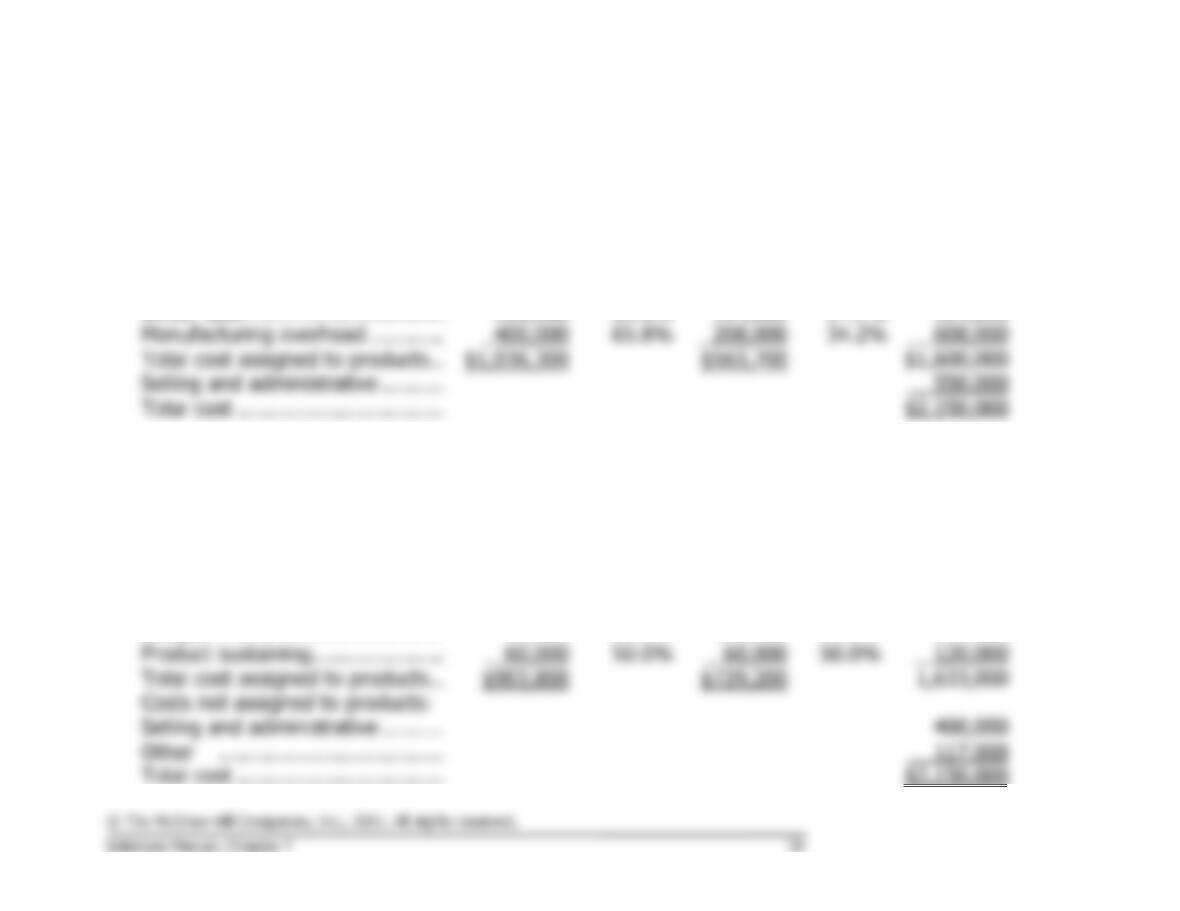
Problem 7-16 (continued)
3. The quantitative comparison is as follows:
B300
T500
Total
Traditional Cost System
(a)
Amount
(a) ÷ (c)
%
(b)
Amount
(b) ÷ (c)
%
(c)
Amount
Direct materials …………………….
$436,300
63.4%
$251,700
36.6%
$ 688,000
Direct labor ………………………….
200,000
65.8%
104,000
34.2%
Manufacturing overhead …………
65.8%
Total cost assigned to products ..
$1,036,300
$1,600,000
Selling and administrative ……….
Total cost …………………………...
$2,150,000
Activity-Based Costing System
Direct costs:
Direct materials …………………….
$436,300
63.4%
$251,700
36.6%
$ 688,000
Direct labor ………………………….
200,000
65.8%
104,000
34.2%
304,000
Advertising expense ………………
50,000
33.3%
100,000
66.7%
150,000
Indirect costs:
Machining …………………………...
126,000
59.0%
87,500
41.0%
213,500
Setups ………………………………..
31,500
20.0%
126,000
80.0%
157,500
Product sustaining …………………
50.0%
50.0%
120,000
Total cost assigned to products ..
Costs not assigned to products:
Selling and administrative ……….
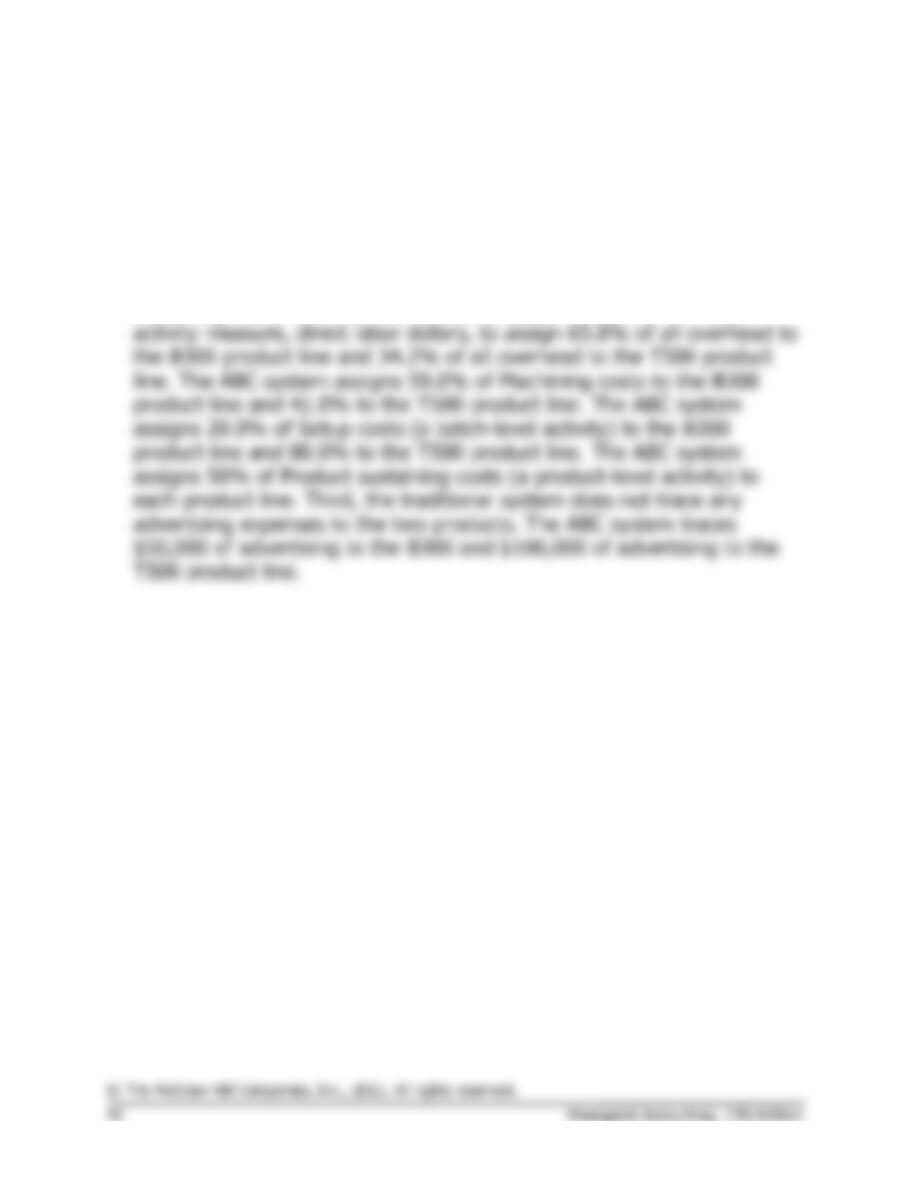
Problem 7-16 (continued)
The traditional and activity-based cost assignments differ for three
reasons. First, the traditional system assigns all $608,000 of
manufacturing overhead to products. The ABC system assigns only
$491,000 (= $213,500 + $157,500 + $120,000) of manufacturing
overhead to products. The ABC system does not assign the $117,000 of
Other activity costs to products because they represent organization-
sustaining costs. Second, the traditional system uses one unit-level