7-41
SOLUTION
7-42
7-43
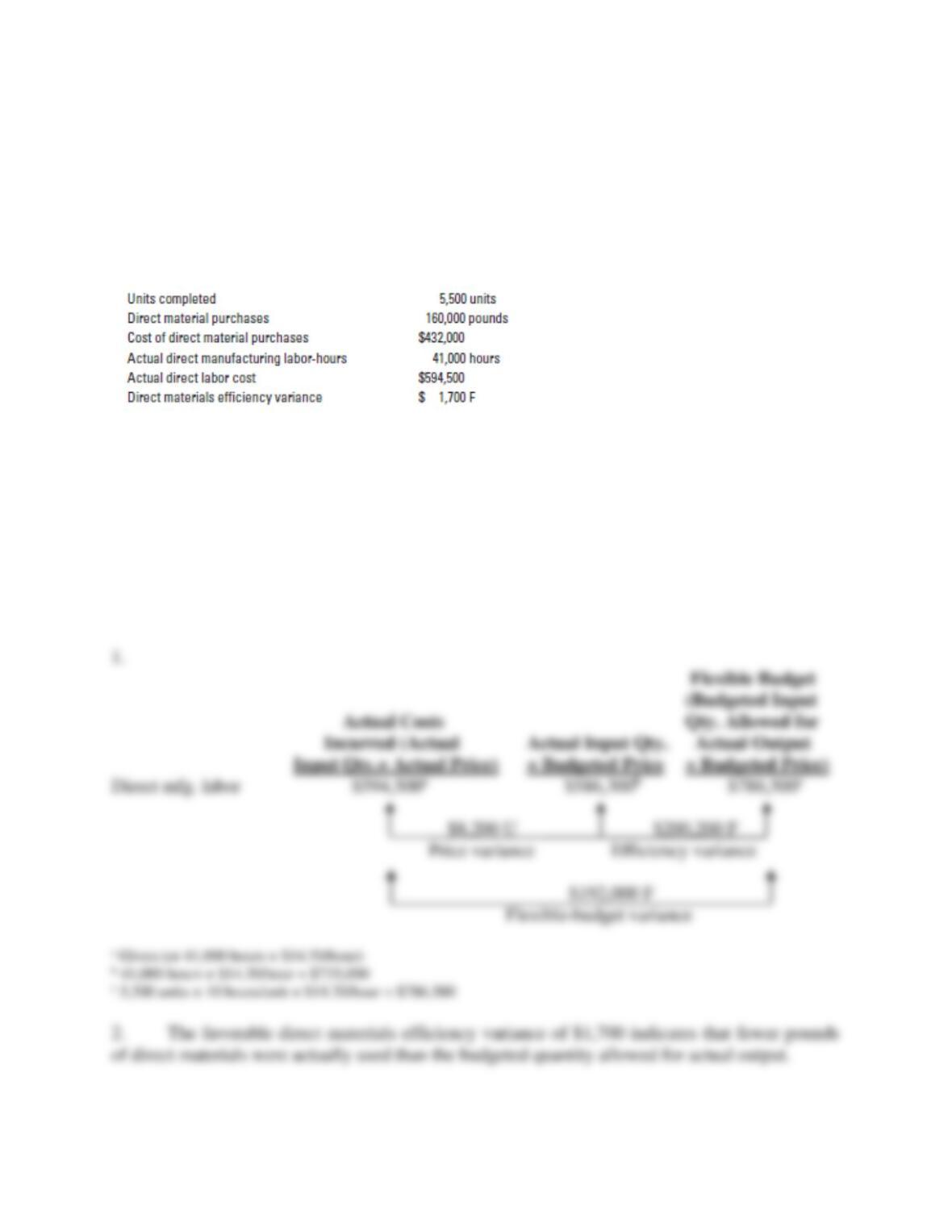
7-34 (30 min.) Direct manufacturing labor and direct materials variances, missing data.
(CMA, heavily adapted) Young Bay Surfboards manufactures fiberglass surfboards. The
standard cost of direct materials and direct manufacturing labor is $223 per board. This includes
40 pounds of direct materials, at the budgeted price of $2 per pound, and 10 hours of direct
manufacturing labor, at the budgeted rate of $14.30 per hour. Following are additional data for
the month of July:
There were no beginning inventories.
Required:
1. Compute direct manufacturing labor variances for July.
2. Compute the actual pounds of direct materials used in production in July.
3. Calculate the actual price per pound of direct materials purchased.
4. Calculate the direct materials price variance.
SOLUTION
7-44
7-35 (35 min.) Direct materials efficiency, mix, and yield variances.
Nature’s Best Nuts produces specialty nut products for the gourmet and natural foods market. Its
most popular product is Zesty Zingers, a mixture of roasted nuts that are seasoned with a secret
spice mixture and sold in 1-pound tins. The direct materials used in Zesty Zingers are almonds,
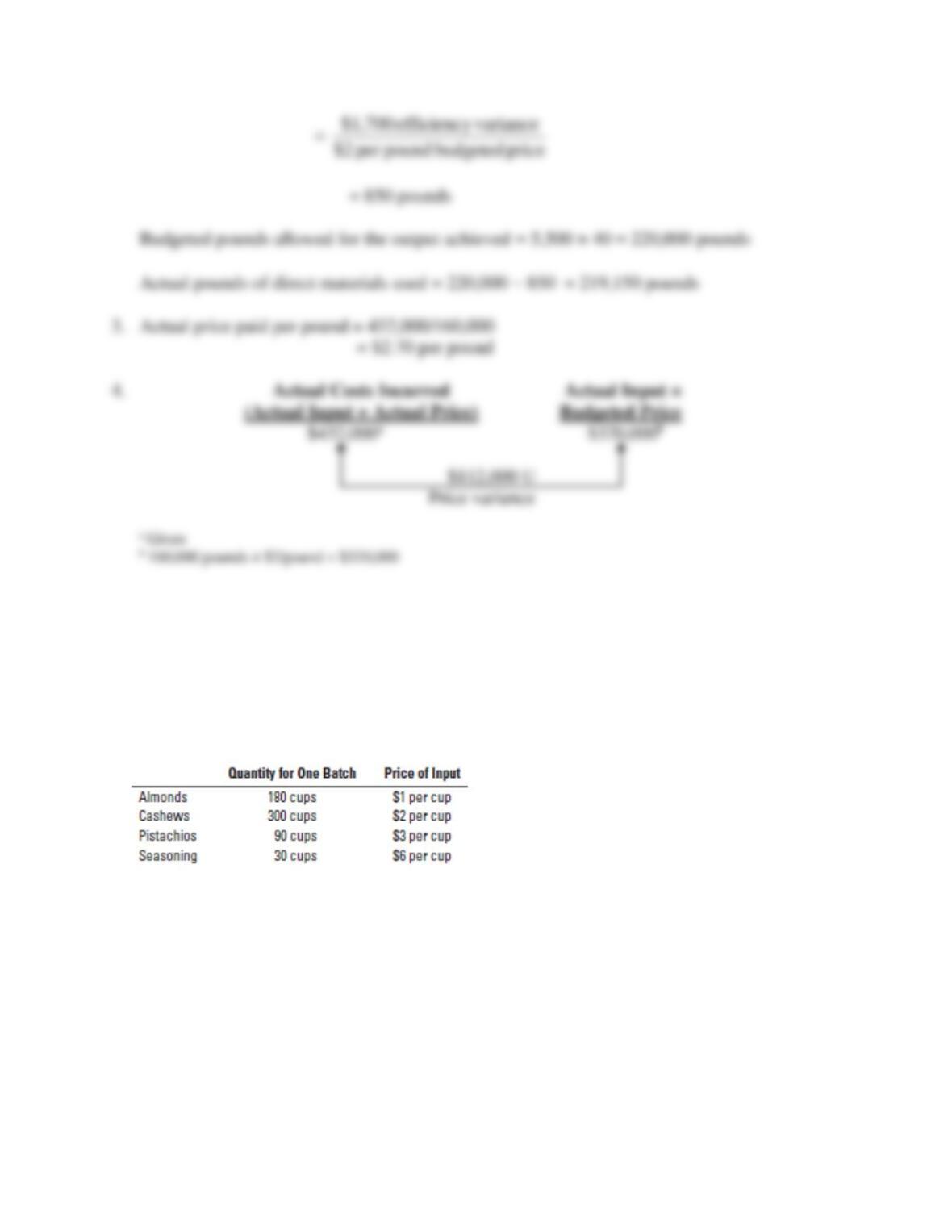
cashews, pistachios, and seasoning. For each batch of 100 tins, the budgeted quantities and
budgeted prices of direct materials are as follows:
Changing the standard mix of direct material quantities slightly does not significantly affect the
overall end product, particularly for the nuts. In addition, not all nuts added to production end up
in the finished product, as some are rejected during inspection.
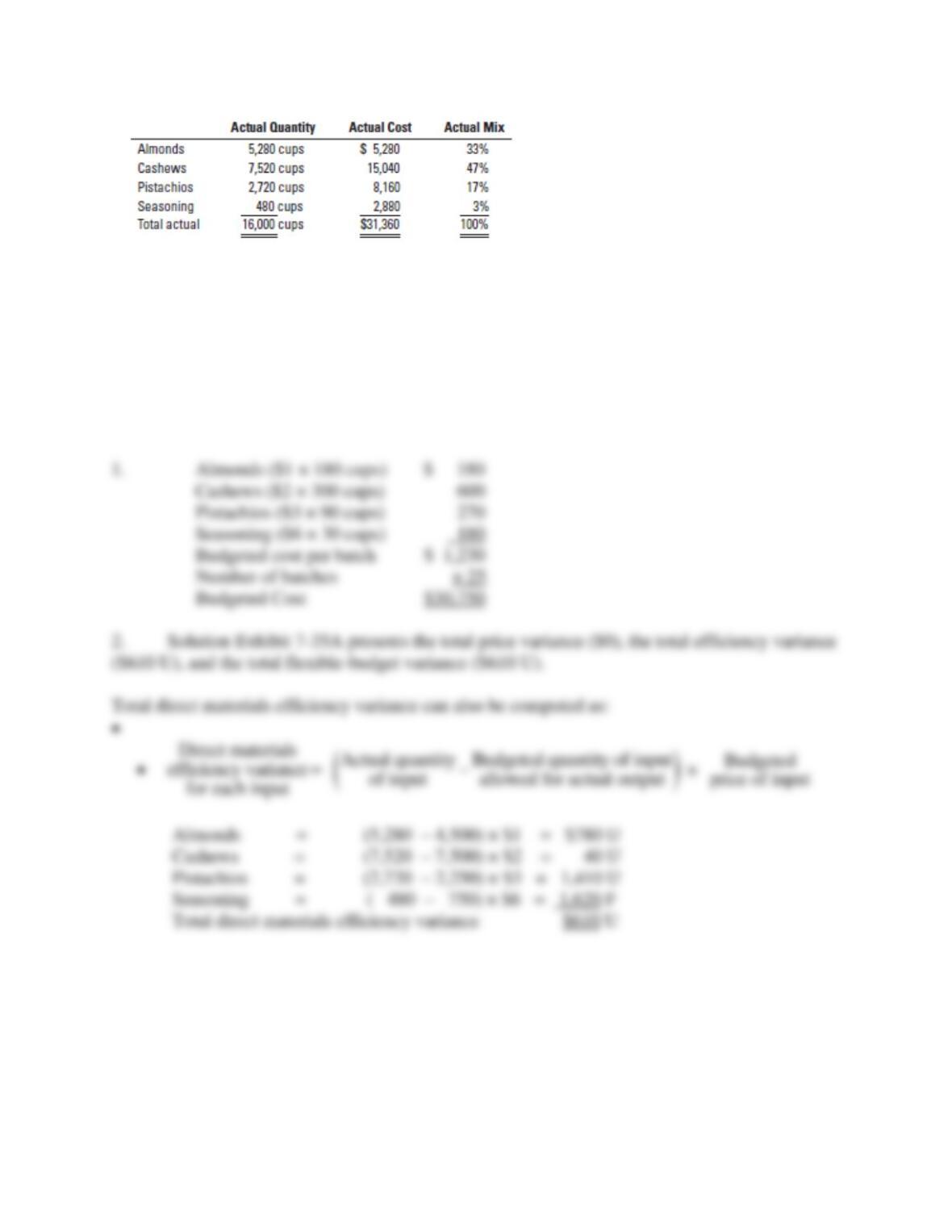
In the current period, Nature’s Best made 2,500 tins of Zesty Zingers in 25 batches with the
following actual quantity, cost, and mix of inputs:
7-45
Required:
1. What is the budgeted cost of direct materials for the 2,500 tins?
2. Calculate the total direct materials efficiency variance.
3. Why is the total direct materials price variance zero?
4. Calculate the total direct materials mix and yield variances. What are these variances telling
you about the 2,500 tins produced this period? Are the variances large enough to investigate?
SOLUTION
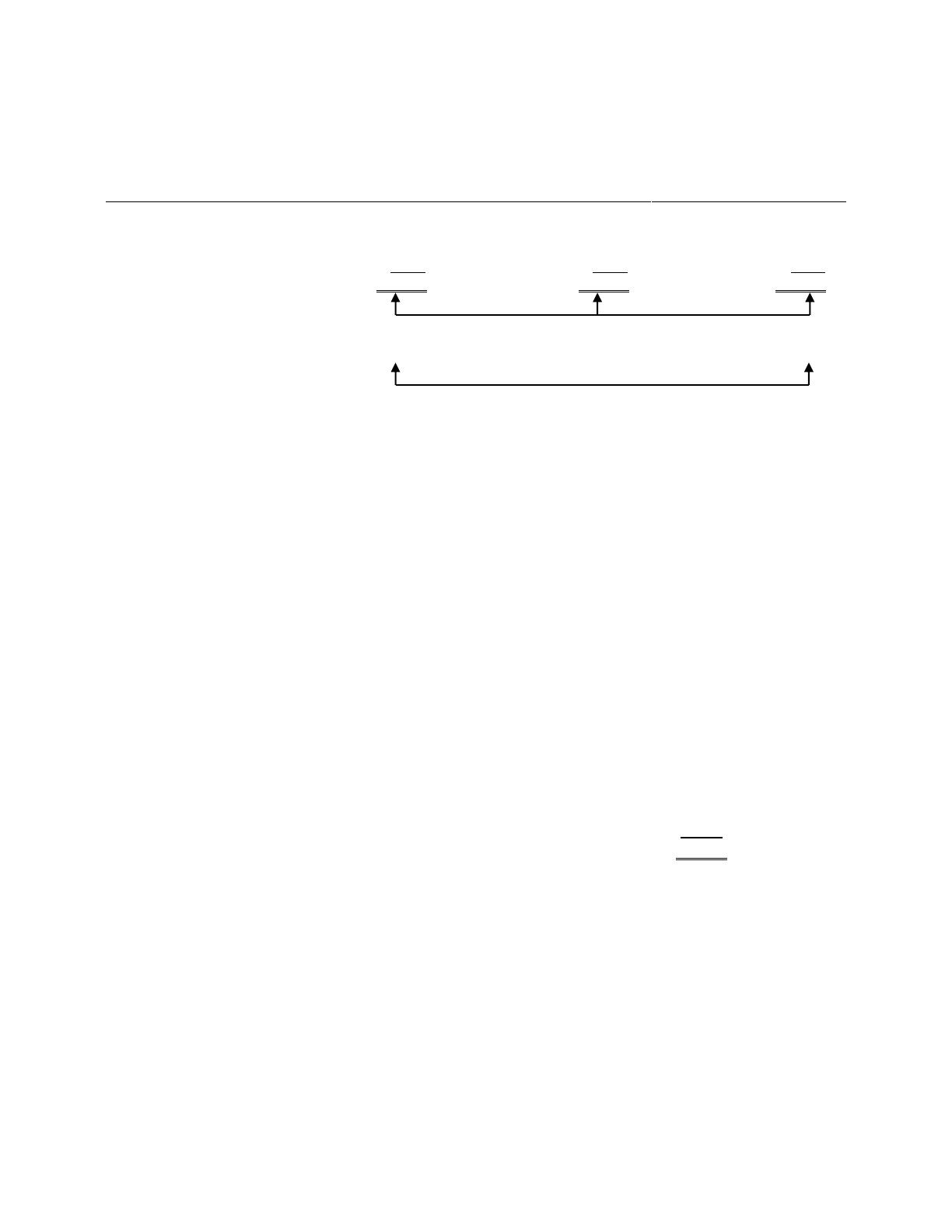
• SOLUTION EXHIBIT 7-35A
Columnar Presentation of Direct Materials Price and Efficiency Variances for Nature’s Best
Company.
7-46
Actual Costs
Incurred
(Actual Input Quantity
× Actual Price)
(1)
Actual Input Quantity
× Budgeted Price
(2)
Flexible Budget
(Budgeted Input Quantity
Allowed for Actual Output
× Budgeted Price)
(3)
Almonds
Cashews
Pistachios
Seasoning
5,280 × $1 = $ 5,280
7,520 × $2 = 15,040
2,720 × $3 = 8,160
480 × $6 = 2,880
$31,360
5,280 × $1 = $ 5,280
7,520 × $2 = 15,040
2,720 × $3 = 8,160
480 × $6 = 2,880
$31,360
4,500 × $1 = $ 4,500
7,500 × $2 = 15,000
2,250 × $3 = 6,750
750 × $6 = 4,500
$30,750
$0 $610 U
Total price variance Total efficiency variance
$610 U
Total flexible-budget variance
F = favorable effect on operating income; U = unfavorable effect on operating income
3. The total direct materials price variance equals zero because, for all four inputs, actual price
per cup equals the budgeted price per cup.
4. Solution Exhibit 7-35B presents the total direct materials yield and mix variances.
The total direct materials yield variance can also be computed as the sum of the direct
materials yield variances for each input:
Direct
materials
yield variance
for each input
=
Actual total Budgeted total quantity
quantity of all of all direct materials inputs
direct materials allowed for actual output
inputs used
−
×
Budgeted
direct materials
input mix
percentage
×
Budgeted
price of
direct materials
inputs
Almonds = (16,000 – 15,000) × 0.30a × $1 = 1,000 × 0.30 × $1 = $ 300 U
Cashews = (16,000 – 15,000) × 0.50b × $2 = 1,000 × 0.50 × $2 = 1,000 U
Pistachios = (16,000 – 15,000) × 0.15c × $3 = 1,000 × 0.15 × $3 = 450 U
Seasoning = (16,000 – 15,000) × 0.05d × $6 = 1,000 × 0.05 × $6 = 300 U
Total direct materials yield variance $2,050 U
a 180
600; b 300
600; c 90
600; d30
600
The total direct materials mix variance can also be computed as the sum of the direct materials
mix variances for each input:
Direct
materials
mix variance
for each input
=
Actual Budgeted
direct materials direct materials
input mix input mix
percentage percentage
−
×
Actual total
quantity of all
direct materials
inputs used
×
Budgeted
price of
direct materials
inputs
Almonds = (0.33 – 0.30) × 16,000 × $1 = 0.03 × 16,000 × $1 = $ 480 U
7-47
Cashews = (0.47 – 0.50) × 16,000 × $2 = –0.03 × 16,000 × $2 = 960 F
Pistachios = (0.17 – 0.15) × 16,000 × $3 = 0.02 × 16,000 × $3 = 960 U
Seasoning = (0.03 – 0.05) × 16,000 × $6 = –0.02 × 16,000 × $6 = 1,920 F
Total direct materials mix variance $ 1,440 F
• SOLUTION EXHIBIT 7-35B
Columnar Presentation of Direct Materials Yield and Mix Variances for Nature’s Best Company.
Actual Total Quantity
of All Inputs Used
× Actual Input Mix
× Budgeted Price
(1)
Actual Total Quantity
of All Inputs Used
× Budgeted Input Mix
× Budgeted Price
(2)
Flexible Budget:
Budgeted Total Quantity of
All Inputs Allowed for
Actual Output ×
Budgeted Input Mix
× Budgeted Price
(3)
Almonds 16,000 × 0.33 × $1 = $ 5,280
Cashews 16,000 × 0.47 × $2 = 15,040
Pistachios 16,000 × 0.17 × $3 = 8,160
Seasoning 16,000 × 0.03 × $6 = 2,880
$31,360
16,000 × 0.30 × $1 = $ 4,800
16,000 × 0.50 × $2 = 16,000
16,000 × 0.15 × $3 = 7.200
16,000 × 0.05 × $6 = 4,800
$32,800
15,000 × 0.30 × $1 = $ 4,500
15,000 × 0.50 × $2 = 15,000
15,000 × 0.15 × $3 = 6,750
15,000 × 0.05 × $6 = 4,500
$30,750
$1,440 F $2,050 U
Total mix variance Total yield variance
$610 U
Total efficiency variance
F = favorable effect on operating income; U = unfavorable effect on operating income.
The direct materials mix variance of $1,440 F indicates that the actual product mix uses relatively more
of less-expensive ingredients than planned. In this case, the actual mix contains slightly more almonds
and pistachios while using fewer cashews and substantially less seasoning.
The direct materials yield variance of $2,050 U occurs because the amount of total inputs needed
(16,000 cups) exceeded the budgeted amount (15,000 cups) expected to produce 2,500 tins.
The direct materials yield variance is significant enough to be investigated. The mix variance may be
within expectations but should be monitored since it is favorable largely due to the use of less
seasoning, which is considered an important element of the product’s appeal to customers.
7-48
7-36 (20–30 min.) Direct materials and manufacturing labor variances, solving
unknowns.
(CPA, adapted) On May 1, 2014, Lowell Company began the manufacture of a new paging
machine known as Dandy. The company installed a standard costing system to account for
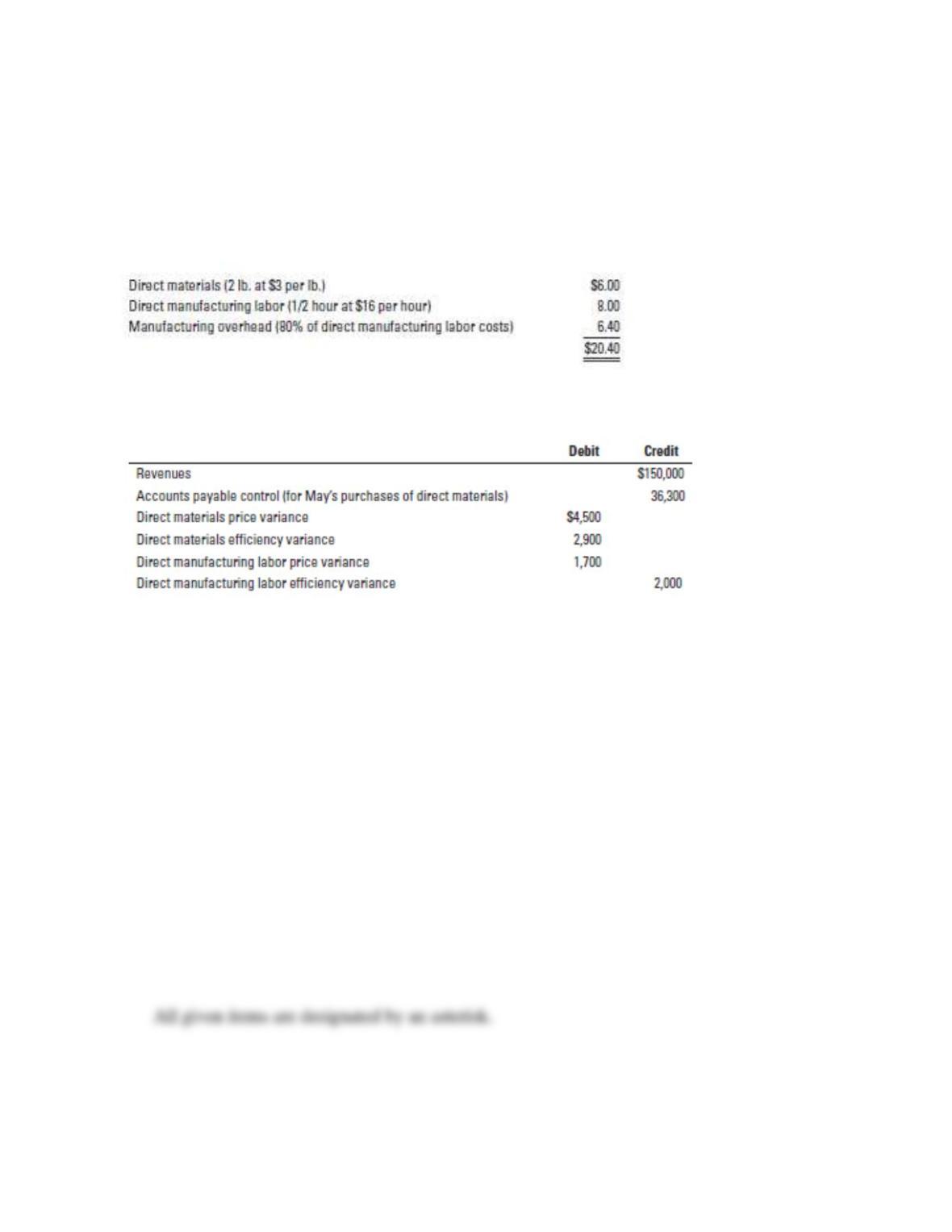
manufacturing costs. The standard costs for a unit of Dandy follow:
The following data were obtained from Lowell’s records for the month of May:
Actual production in May was 4,700 units of Dandy, and actual sales in May were 3,000 units.
The amount shown for direct materials price variance applies to materials purchased during
May.
There was no beginning inventory of materials on May 1, 2014.
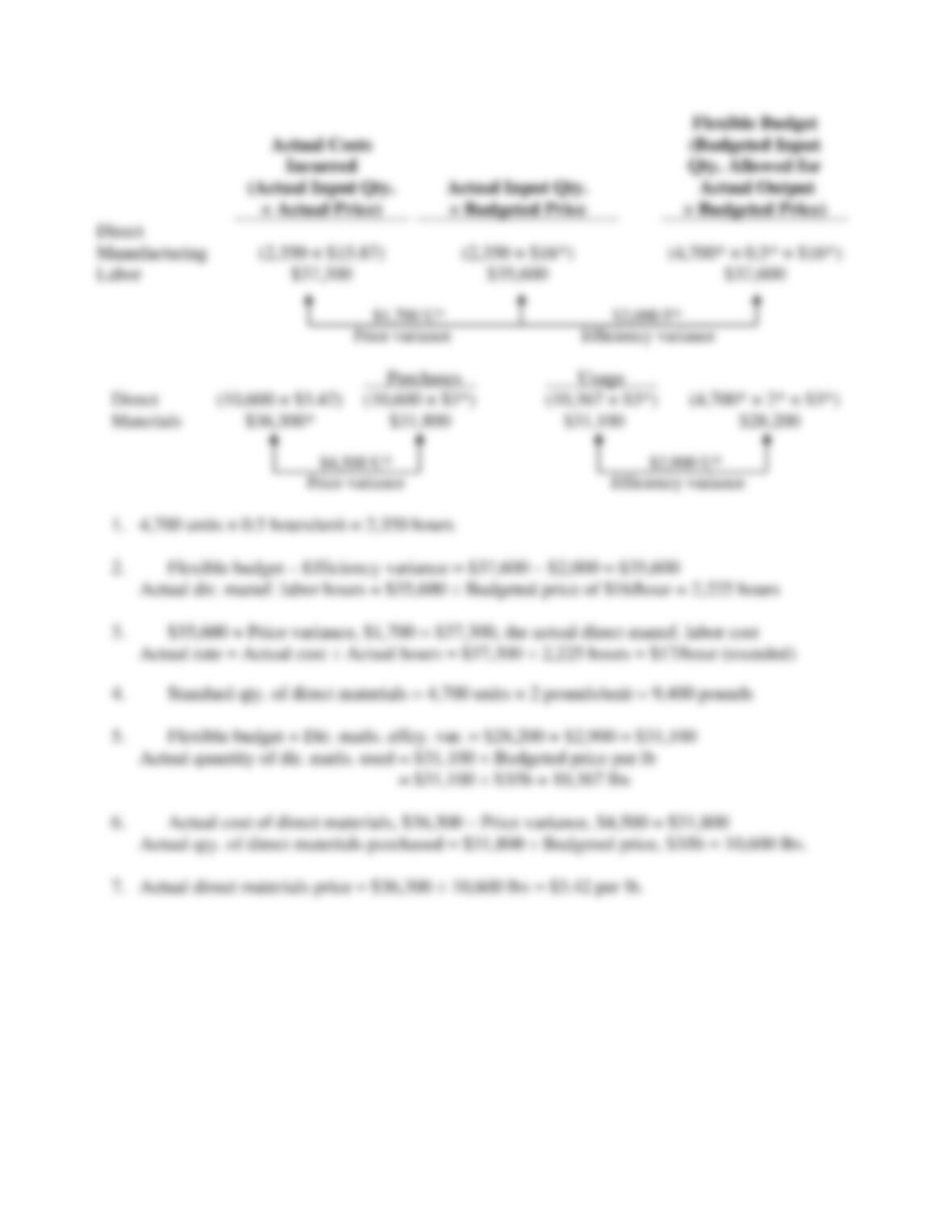
Compute each of the following items for Lowell for the month of May. Show your computations.
Required:
1. Standard direct manufacturing labor-hours allowed for actual output produced
2. Actual direct manufacturing labor-hours worked
3. Actual direct manufacturing labor wage rate
4. Standard quantity of direct materials allowed (in pounds)
5. Actual quantity of direct materials used (in pounds)
6. Actual quantity of direct materials purchased (in pounds)
7. Actual direct materials price per pound
SOLUTION
7-49
7-50
7-37 (20 min.) Direct materials and manufacturing labor variances, journal entries.
Zanella’s Smart Shawls, Inc., is a small business that Zanella developed while in college. She
began hand-knitting shawls for her dorm friends to wear while studying. As demand grew, she
hired some workers and began to manage the operation. Zanella’s shawls require wool and labor.
She experiments with the type of wool that she uses, and she has great variety in the shawls she
produces. Zanella has bimodal turnover in her labor. She has some employees who have been
with her for a very long time and others who are new and inexperienced.
Zanella uses standard costing for her shawls. She expects that a typical shawl should take 3
hours to produce, and the standard wage rate is $9.00 per hour. An average shawl uses 13 skeins
of wool. Zanella shops around for good deals and expects to pay $3.40 per skein.
Zanella uses a just–in-time inventory system, as she has clients tell her what type and color of
wool they would like her to use.
For the month of April, Zanella’s workers produced 200 shawls using 580 hours and 3,500
skeins of wool. Zanella bought wool for $9,000 (and used the entire quantity) and incurred labor
costs of $5,520.
Required:
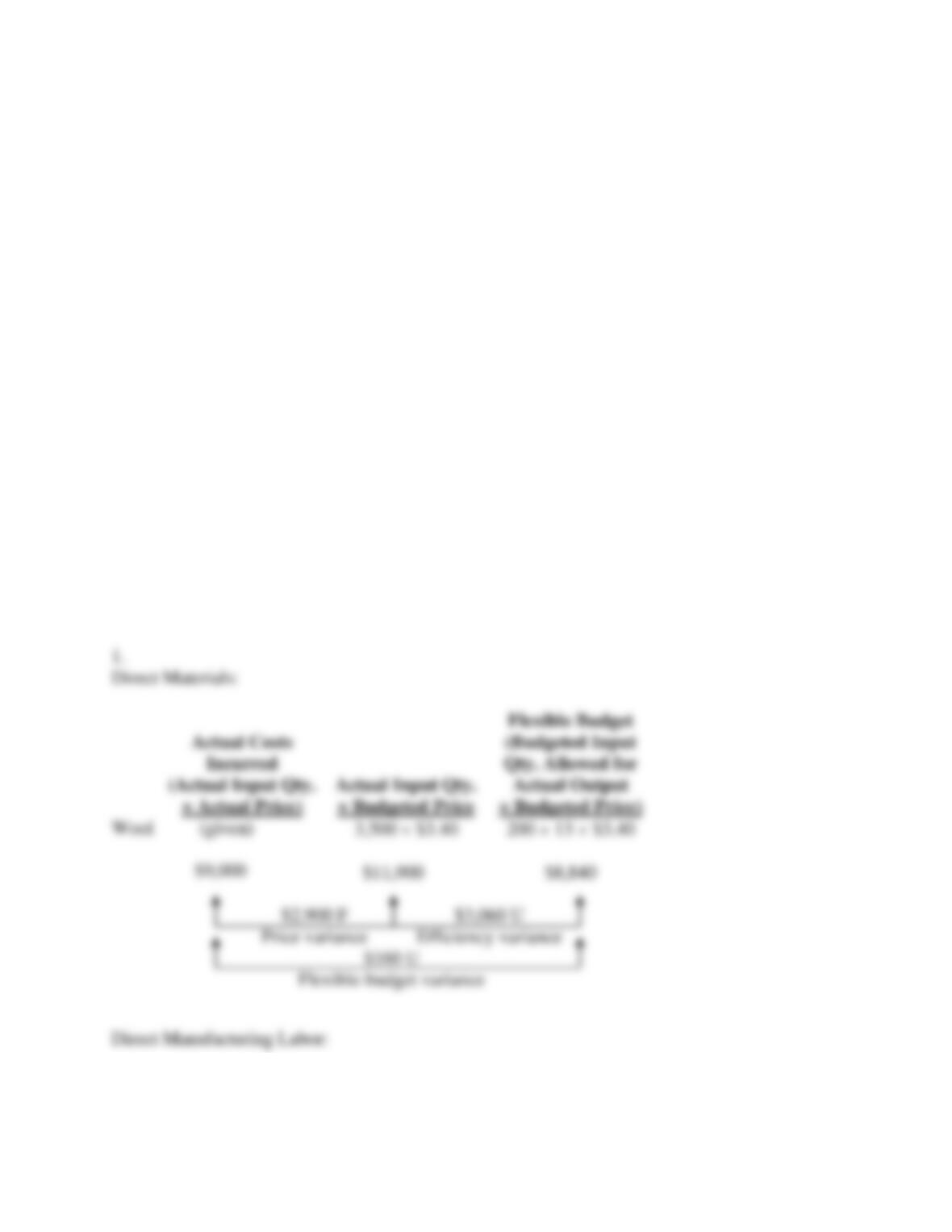
1. Calculate the price and efficiency variances for the wool and the price and efficiency
variances for direct manufacturing labor.
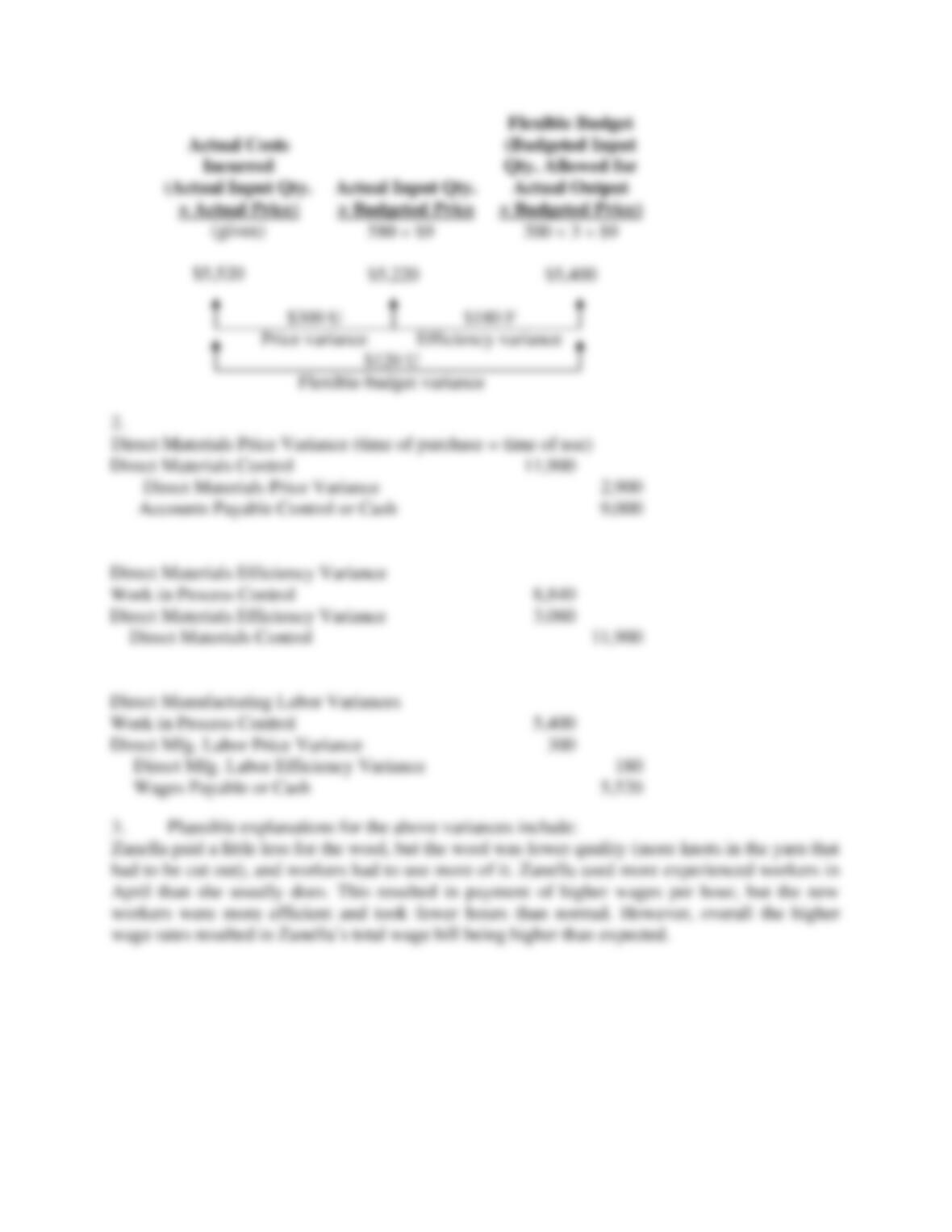
2. Record the journal entries for the variances incurred.
3. Discuss logical explanations for the combination of variances that Zanella experienced.
SOLUTION
7-51
7-52
7-38 (30 min.) Use of materials and manufacturing labor variances for benchmarking.
You are a new junior accountant at In Focus Corporation, maker of lenses for eyeglasses. Your
company sells generic-quality lenses for a moderate price. Your boss, the controller, has given
you the latest month’s report for the lens trade association. This report includes information
related to operations for your firm and three of your competitors within the trade association. The
report also includes information related to the industry benchmark for each line item in the
report. You do not know which firm is which, except that you know you are Firm A.
Required:
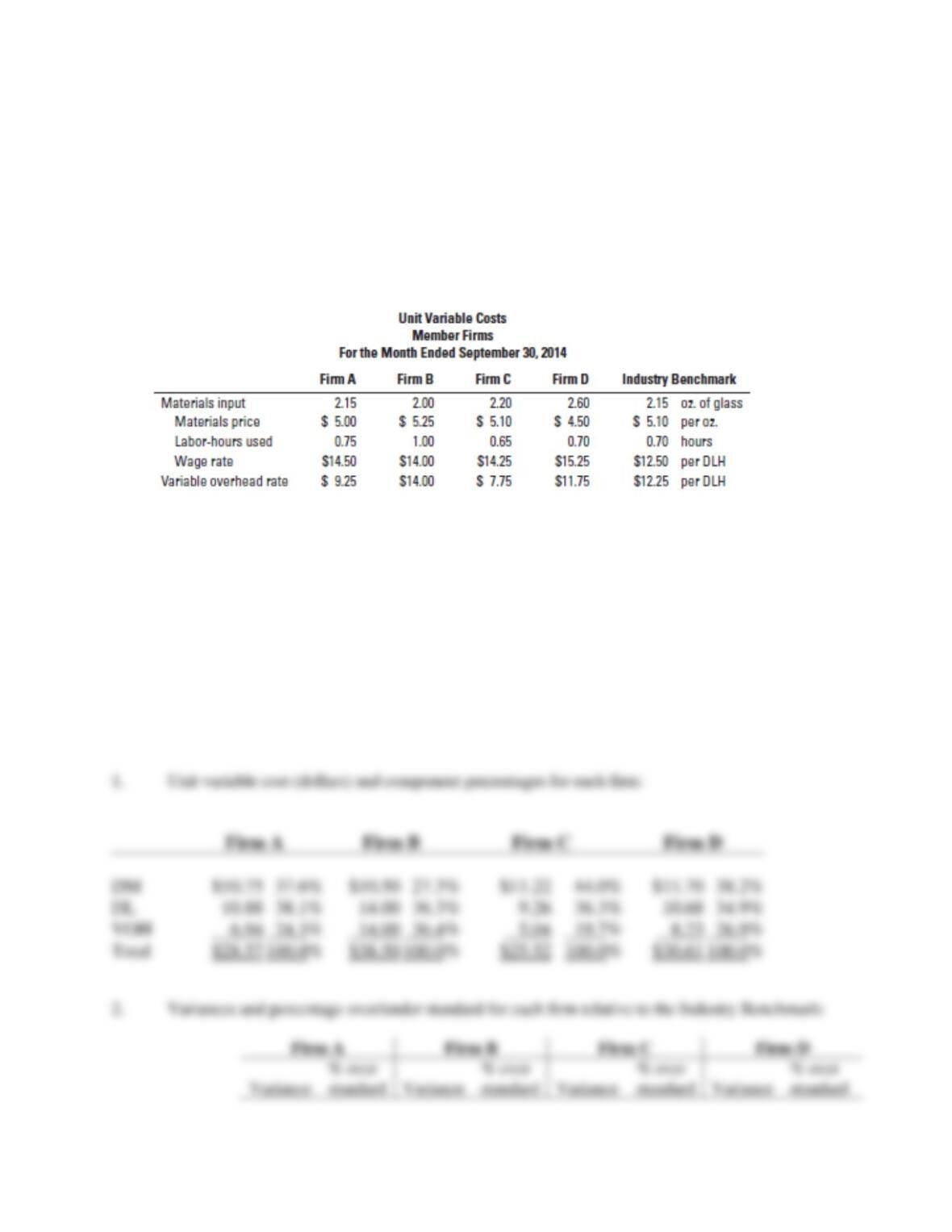
1. Calculate the total variable cost per unit for each firm in the trade association. Compute the
percent of total for the material, labor, and variable overhead components.
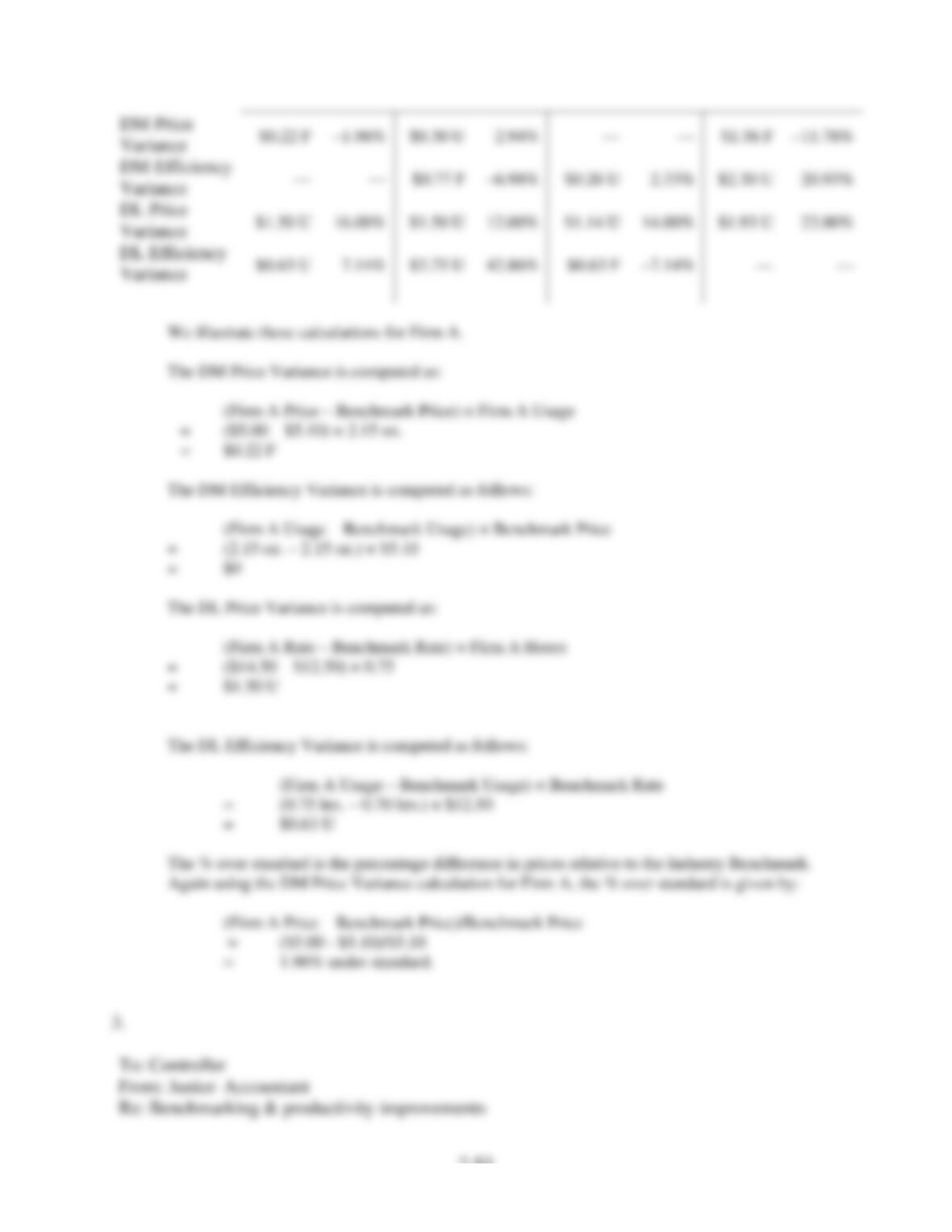
2. Using the trade association’s industry benchmark, calculate direct materials and direct
manufacturing labor price and efficiency variances for the four firms. Calculate the percent
over standard for each firm and each variance.
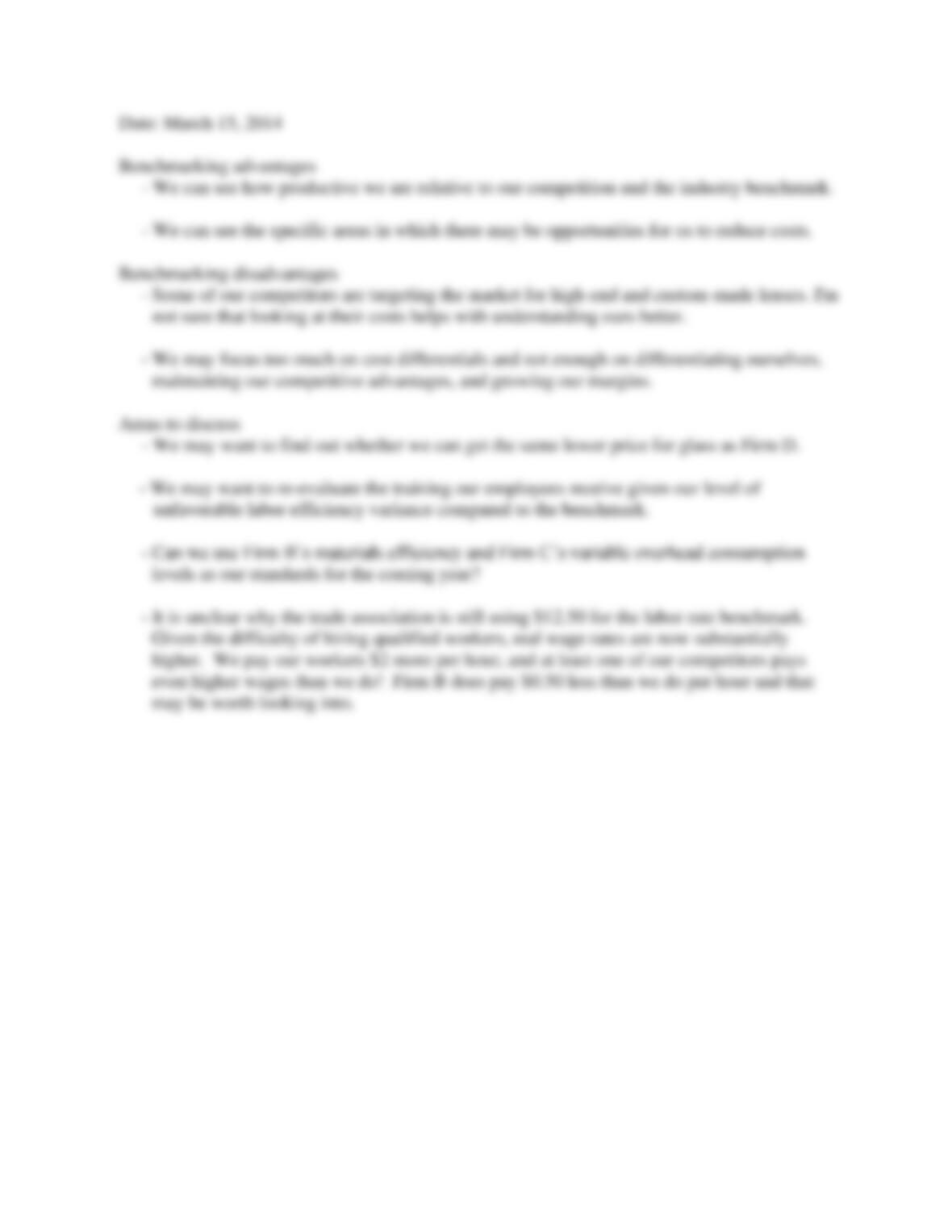
3. Write a brief memo to your boss outlining the advantages and disadvantages of belonging to
this trade association for benchmarking purposes. Include a few ideas to improve
productivity that you want your boss to take to the department heads’ meeting.
SOLUTION
7-53
7-54