
Chapter 07 – Accounting for the Business–type Activities of State and Local Governments
7-1
CHAPTER 7: ACCOUNTING FOR THE BUSINESS-TYPE
ACTIVITIES OF STATE AND LOCAL GOVERNMENTS
OUTLINE
Number
Topic
Type/Task
Status
(re: 18/e)
Questions:
7-1
Proprietary funds
Explain
Same
7-2
Internal service and enterprise funds
Describe
Revised
7-3
Budgets and proprietary funds
Remember
New
7-4
Proprietary funds vs. for-profit reporting
Compare
Same
7-5
Restricted assets of enterprise funds
Describe
Revised
7-6
Components of net position
Describe, explain
Same
7-7
Dual track accounting in proprietary funds
Explain
Same
7-8
Reporting internal balances
Describe
Same
7-9
Dissolving an internal service fund
Explain
7-11
7-10
Regulatory accounting
Describe, explain
7-9
7-11
Segment information
Define
7-10
Cases:
7-12
Internal service fund reporting
Assess
Revised
7-13
Proprietary fund statement of cash flows
Analyze
New
7-14
City and County of Denver proprietary funds
Evaluate
Revised
7-15
Enterprise fund golf course management
Evaluate
Same
Exercises/Problems:
7-16
Examine the CAFR
Examine
Revised
7-17
Various
Multiple Choice
Items 1, 4,
and 6 are
new. Item 8
revised. All
others same.
7-18
Characteristics of proprietary funds
Remember
Same
7-19
Information Technology Internal Service Fund
JEs, FS, assess
Same
7-20
Human Resource Internal Service Fund
JEs
New
7-21
Internal Service fund statement of cash flows
FS
Same
7-22
Tribute Aquatic Center Enterprise Fund
JEs, FS
Same
7-23
Net position classifications
FS
New
7-24
Central Station Enterprise Fund
JEs, FS, assess
Revised
7-25
Enterprise Fund journal entries and FS
JEs, FS
Revised
7-26
Net position classifications
FS
Same
7-27
Enterprise fund statement of cash flows
FS
Same
7-28
Appendix – Solid Waste Enterprise Fund
FS
Revised
Chapter 07 – Accounting for the Business–type Activities of State and Local Governments
7-2
CHAPTER 7: ACCOUNTING FOR THE BUSINESS-TYPE ACTIVITIES
OF STATE AND LOCAL GOVERNMENTS
Answers to Questions
7-1. Proprietary funds are funds that are supported by user charges, and therefore require
reporting that illustrates whether user charges are covering costs. They are often
described as being operated more like a business than most governmental funds, and the
reporting is similar to that of for-profit organizations.
There are two basic types of proprietary funds: internal service funds and enterprise
funds. Internal service funds are generally used for activities where centralization of a
service or function is likely to result in efficiency and/or cost effectiveness. The
customers of internal service funds would generally be within the government itself.
Examples of internal service fund activities include information systems or purchasing.
An enterprise fund carries on activities that provide goods or services to the general
General Problem Information: Proprietary funds
Learning Objective: 7-1
Topic: Proprietary funds
Bloom’s Taxonomy: Remember
Accreditation Skills tag: AACSB: Communication, AICPA: FN Reporting
Level of Difficulty: Easy
7-2. Internal service funds and enterprise funds are presented in three proprietary fund
financial statements—a statement of net position; a statement of revenues, expenses and
changes in fund net position; and a statement of cash flows. Enterprise funds considered
to be major funds are presented in separate columns of the proprietary fund financial
statements, with nonmajor enterprise funds aggregated in an Other Enterprise Funds
Chapter 07 – Accounting for the Business–type Activities of State and Local Governments
7-3
Ch. 7, Answers, Question 7-2 (Cont’d)
Internal service funds and enterprise funds are both proprietary funds and are presented
as such in the funds financial statements. However, since the transactions of internal
service funds primarily involve sales of goods or services to the General Fund and other
funds that compose the governmental activities of a government, while enterprise funds
transact business with parties external to the government, internal service funds are
reported in a different manner than enterprise funds.
7-3. Proprietary funds are not required by GASB standards to record budgets in their
accounting systems, nor are they required to present a budgetary comparison statement or
schedule. Some governments do, however, require all funds to prepare and operate under
legally adopted budgets. In such cases, GASB standards permit but do not require the
General Problem Information: Budgets and proprietary funds
Learning Objective: 7-3
Learning Objective: 7-5
Topic: Financial Reporting Requirements
Bloom’s Taxonomy: Remember
Accreditation Skills tag: AACSB: Communication, AICPA: FN Reporting
Level of Difficulty: Easy
7-4. A proprietary fund prepares a statement of net position; a statement of revenues,
expenses, and changes in fund net position; and a statement of cash flows. The statement
of net position can be compared to a for-profit organization’s balance sheet. The format
for the statement of net position differs from a balance sheet, largely because there is no
Chapter 07 – Accounting for the Business–type Activities of State and Local Governments
7-4
Ch. 7, Answers, Question 7-4 (Cont’d)
The statement of revenues, expenses, and changes in fund net position can be compared
to a for-profit organization’s income statement. One difference is that a for–profit
organization does not net items like bad debts from the related revenue as a proprietary
fund does. Also, revenues and expenses of proprietary funds are required to be identified
as operating and non-operating. Finally, the statement may include items such as
interfund transfers and capital contributions, which are unique to government accounting.
General Problem Information: Proprietary funds vs. for-profit reporting
Learning Objective: 7-1
Learning Objective: 7-3
Learning Objective: 7-5
Topic: Financial Reporting Requirements
Bloom’s Taxonomy: Understand
Accreditation Skills tag: AACSB: Communication, AICPA: FN Reporting
Level of Difficulty: Easy
7-5. Restricted assets are assets that have been segregated, pursuant to an agreement with an
external party or by law or regulation, for a specified purpose and therefore are not
available for the discretionary use of management. Items typically reported in the
Restricted Assets section of the statement of fund net position include assets set aside for
retirement of revenue bonds in conformity with bond covenants, grant funds whose use is
Chapter 07 – Accounting for the Business–type Activities of State and Local Governments
7-6. GASB Codification Section 2200.117-125 provides the following three components for
the classification of net position: net investment in capital assets, restricted, and
unrestricted. Net investment in capital assets is calculated as the total of gross capital
assets, net of accumulated depreciation, less any outstanding debt related to the
acquisition or construction of capital assets. If debt has been incurred for construction or
acquisition of a capital asset, but the proceeds of the debt have not been spent by year-
end, that debt is excluded in calculating net investment in capital assets. Restricted net
position represents those net resources with restrictions on use imposed by law or
external parties, while unrestricted net position represents the residual amount of net
position after separately identifying net investment in capital assets and restrictions.
General Problem Information: Components of net position
Learning Objective: 7-1
7-7. The “dual–track” accounting approach is useful for recording transactions reported under
both the modified accrual (governmental funds) basis and the accrual (government-wide)
basis of accounting. Because proprietary funds and governmental activities both use
accrual accounting, the “dual–track” approach is not needed to capture different bases of
General Problem Information: Internal service funds
Learning Objective: 7-1
Topic: Internal Service Funds
Bloom’s Taxonomy: Understand
Accreditation Skills tag: AACSB: Knowledge Application, AICPA: FN Reporting
Level of Difficulty: Hard
7-6
7-8. GASB standards require that activity between governmental activities and business-type
activities should be reported as internal balances at the government-wide level. Although
the internal balances do not meet the definition of elements of financial statements, they
are reported for purposes of fairly presenting each reporting unit. Using the “dual track”
method as demonstrated in this textbook, amounts reported in the funds as interfund
receivables and payables are initially recorded as internal balances at the government-
General Problem Information: Reporting internal balances
Learning Objective: 7-1
Topic: Internal Service Funds
Bloom’s Taxonomy: Understand
Accreditation Skills tag: AACSB: Communication, AICPA: FN Reporting
Level of Difficulty: Medium
7-9. An internal service fund may be dissolved in any one of the following three ways, or in
combinations thereof: (1) Transfer the fund’s assets to another fund that will continue the
operation as a subsidiary activity (i.e., a supply fund becoming a department of the
General Fund); (2) Distribute the fund’s assets to another fund or to another government;
or (3) Convert all of its noncash assets to cash and distribute the cash to another fund or
other funds. Dissolution of an internal service fund, as for a private enterprise, would
Chapter 07 – Accounting for the Business–type Activities of State and Local Governments
7-7
7-10. Regulatory accounting principles (RAP) are accounting principles established by any one
of a number of state and/or federal entities. An example of a federal entity that establishes
regulatory accounting principles is the Federal Energy Regulatory Commission (FERC).
The purpose of RAP is to help ensure that reports submitted to regulatory agencies are in
a format that helps regulators determine that entities subject to regulators’ oversight are
complying with laws and regulations. A number of enterprise funds may be subject to
certain RAP requirements, given that enterprise funds frequently provide utility type
services, which tend to be subject to state and federal regulation.
7-11. A segment is an identifiable activity either within an enterprise fund or other standalone
entity. Segment information consists of providing key operating and balance sheet
information for each segment for which reporting is required. Information about the
General Problem Information: Segment information
Learning Objective: 7-6
Topic: Appendix: Required Segment Information
Bloom’s Taxonomy: Remember
Accreditation Skills tag: AACSB: Knowledge Application, AICPA: FN Reporting
Level of Difficulty: Easy
Chapter 07 – Accounting for the Business–type Activities of State and Local Governments
7-8
Solutions to Cases
7-12. a. The financial statements suggest the Building Maintenance Fund is not being
1. There is no recognition of equipment and/or buildings on the balance sheet (of
which there should be at least equipment, given the nature of the operation). As a
consequence, depreciation also is not being charged and reported on the statement
of revenues, expenditures and changes in fund balance.
3. The headers for the financial statements suggest that modified accrual
accounting is being used rather than accrual accounting, explaining the lack of
capital assets on the balance sheet. The preferred titles for the financial statements
under accrual accounting would be statement of net position and statement of
revenues, expenses, and changes in fund net position.
4. Assuming that the fund primarily serves governmental funds, the Internal
5. Proprietary funds use contra-revenue accounts, rather than a bad debt
expense/expenditure.
7. Reported activity should be classified as operating or nonoperating.
8. The fund equity section of the balance sheet and operating statement also
suggests that the Building Maintenance Fund is using modified accrual rather than
9. Internal service fund financial statements typically include a statement of cash
flows.
Chapter 07 – Accounting for the Business–type Activities of State and Local Governments
7-9
Ch. 7, Solutions, Case 7-12 (Cont’d)
b. As manager of a city department, you should want to know the full cost of the
Building Maintenance Fund’s operations. Such information would aid in
determining the appropriateness and fairness of the fund’s charges to departments.
Although the financial statements indicate that revenues (which in the given
statement improperly include transfers) exceed expenditures only slightly, the
statements fail to disclose the relationship between operating revenues and
It is also possible that some managers of city departments that use the services of
the Building Maintenance Fund may have little interest in the financial statements
if the employees of that fund are doing a good job of keeping the city’s buildings
well maintained, and the charges of that fund do not strain their maintenance
budgets. If, however, managers perceive the service to be poor or the charges to be
excessive, the lack of full accrual financial information to objectively evaluate the
Building Maintenance Fund manager’s performance could become a problem.
General Problem Information: Internal Service Fund Reporting
Learning Objective: 7-2
Chapter 07 – Accounting for the Business–type Activities of State and Local Governments
7-13. Some of the errors noted in the City of Cypress statement of cash flows include:
• The proprietary fund statement of cash flows should be prepared using the direct
method whereby cash flows are listed by source, rather than reconciling net income to
cash flows.
• Several of the cash flow items are in the incorrect category:
– Operating grants paid to other governments should be classified as a noncapital
financing cash flow rather than an operating cash flow.
– The purchase of property, plant, and equipment should be classified as a capital
and related financing cash flow rather than an investing cash flow.
– The proceeds from the sale of equipment should be classified as a capital and
related financing cash flow rather than an investing cash flow.
General Problem Information: Proprietary fund statement of cash flows
Learning Objective: 7-2
Learning Objective: 7-5
Topic: Financial Reporting Requirements
Bloom’s Taxonomy: Analyze
7–11
7-14. a. Yes, the City and County of Denver uses two internal service funds. They are:
b. The City and County of Denver has two major enterprise funds. They are:
Wastewater Management – accounts for the city’s storm and sewer operations.
Denver Airport System – accounts for the operation of the city’s airport system which
includes Denver International Airport.
The City and County of Denver has two non-major enterprise funds. They are:
c. A negative unrestricted net position balance indicates that most of the golf course’s
equity is tied up in capital assets. Net investment in capital assets is calculated by
subtracting accumulated depreciation and debt used to acquire capital assets from the
capital asset total. While the reason for a negative net position should be examined, it
makes sense that a golf course’s major assets are land and course facilities, and that
d. At $270,394 (in thousands) interest expense (under nonoperating revenues and
expenses) is the airport’s largest expense.
e. For both funds, the largest reconciling item is depreciation expense. This is not
surprising given their significant investment in capital assets.
f. Yes, the enterprise funds use leases. Table 34 in part 6 of Note G reveals that the
Chapter 07 – Accounting for the Business–type Activities of State and Local Governments
7–12
Ch. 7, Solutions, Case 7-14 (Cont’d)
g. The Worker’s Compensation Fund is an example of a risk-related insurance activity
accounted for in an internal service fund. The most significant reconciling item for this
fund on the statement of cash flows is the claims paid. The fund had a decrease in its
net position for the year, which could signal that charges are not in line with costs.
Charges for services were $10,000 while claims payments were only $9,380; however,
General Problem Information: City and County of Denver proprietary funds
Learning Objective: 7-1
Topic: Proprietary Funds
Bloom’s Taxonomy: Analyze
Accreditation Skills tag: Knowledge Application, AICPA: FN Reporting
Level of Difficulty: Medium
7-15. a. By definition, a General Fund is used to account and report all financial resources
not accounted for and reported in another fund (GASB Codification Sec.
1300.104), whereas business-type activities must be reported in an enterprise fund
if GASB Codification Sec. 1300.109 criteria are met. In this case, there is no
evidence that the golf course is financed with debt that is secured solely by a
pledge of the golf course revenues or that laws require fees to cover costs and
capital charges. Hence, the golf course could be accounted for in either fund,
subject to administrative approval.
Chapter 07 – Accounting for the Business–type Activities of State and Local Governments
7–13
Ch. 7, Solutions, Case 7-15 (Cont’d)
b. This exercise is intended to have students consider the options provided. Their
questions might include:
(1) Status Quo. Do the citizens support subsidies for the golf course? Is the
decline in revenue a short- or long-term problem? Can rates be raised or are
there other revenue sources that could make the fund self-supporting? How
(2) Concession Agreements or Management Contracts. Would the
management company or outside vendor maintain the facility at an acceptable
level? How is the contract to be negotiated; are costs just competitive in the
short-term and then increase (low-balling)? What happens if the services are
(4) Selling the Golf Course. Do potential buyers exist? Would they upgrade the
facility to an extent not affordable to the county? What benefit is derived from
selling the golf course other than the one-time cash infusion and possible
operating cost savings?
General Problem Information: Enterprise fund golf course management
Learning Objective: 7-1
Topic: Proprietary Funds
Bloom’s Taxonomy: Analyze
Accreditation Skills tag: AACSB: Knowledge Application; AICPA: Critical Thinking,
FN Reporting
Level of Difficulty: Hard
Solutions to Exercises and Problems
7-16. Since each student has a different annual report, no two answers to this exercise will be
exactly alike. Use this opportunity to discuss the value of government-wide financial
Chapter 07 – Accounting for the Business–type Activities of State and Local Governments
Ch. 7, Solutions, 7-16 (Cont’d)
General Problem Information: Examine the CAFR
Topic: Proprietary Funds
Bloom’s Taxonomy: Analyze
Accreditation Skills tag: AACSB: Communication, AICPA: FN Reporting
Level of Difficulty: Medium
2. b. 7. a. 12. c.
4. b. 9. a.
5. a. 10. d.
General Problem Information: Various
Learning Objective: 7-1
Learning Objective: 7-2
Topic: Various
Bloom’s Taxonomy: Remember
Accreditation Skills tag: AACSB: Communication, AICPA: FN Reporting
Level of Difficulty: Medium
2. N. 7. EF.
4. ISF. 9. N.
5. B. 10. B.
General Problem Information: Characteristics of proprietary funds
Learning Objective: 7-1
Topic: Various

7–15
7-19.
WASHINGTON CITY
INFORMATION TECHNOLOGY FUND
GENERAL JOURNAL
(NOT REQUIRED)
Debits Credits
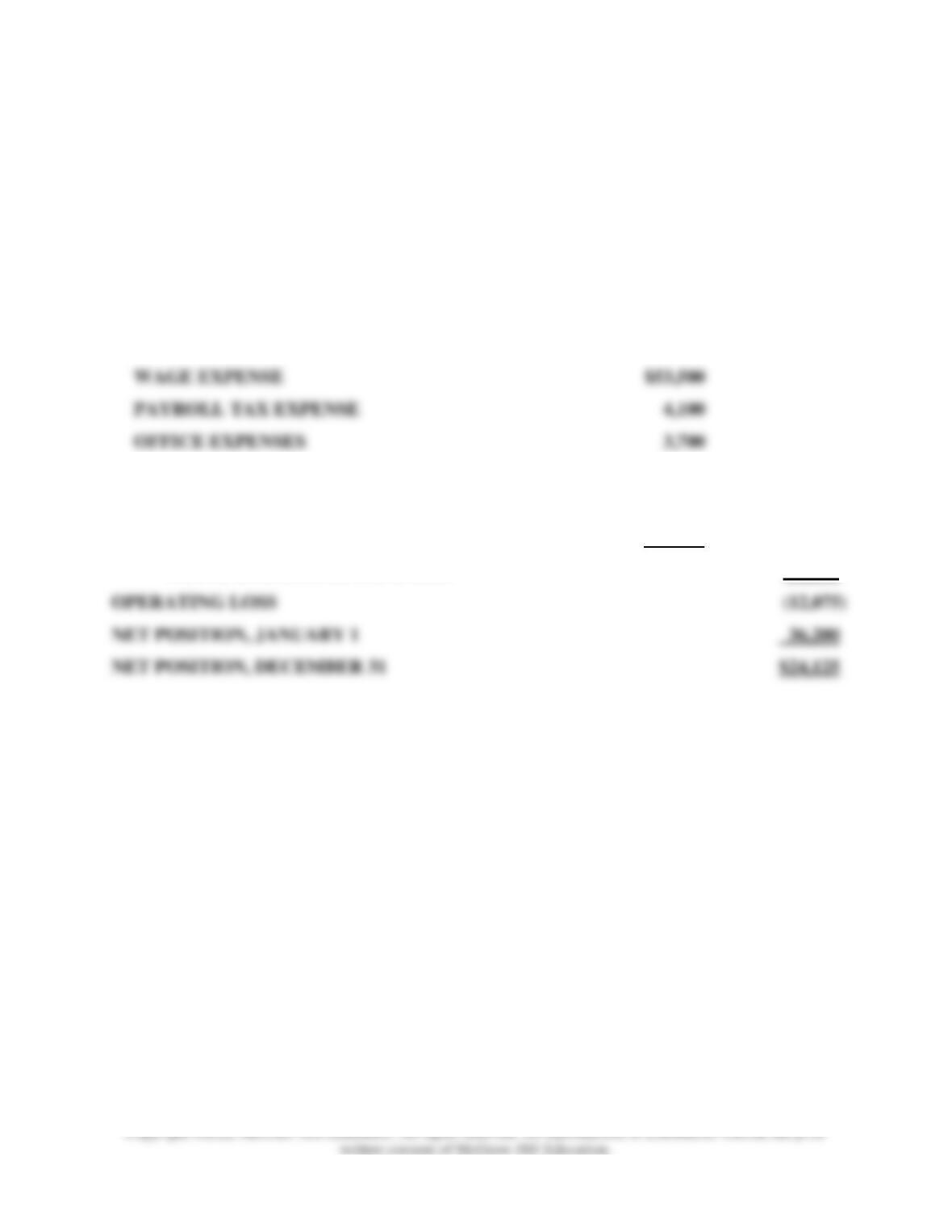
1. WAGE EXPENSE 53,500
PAYROLL TAX EXPENSE 4,100
CASH 34,775
DUE TO FEDERAL GOVERNMENT 22,825
3. MATERIALS AND SUPPLIES INVENTORY 8,400
ACCOUNTS PAYABLE 8,400
4. UTILITIES EXPENSE 14,525
DUE TO OTHER FUNDS 14,525
6. DUE TO OTHER FUNDS 14,500
CASH 14,500
7. ACCOUNTS PAYABLE 8,000
CASH 8,000
(2,550 + 8,400 – 2,950)

Chapter 07 – Accounting for the Business–type Activities of State and Local Governments
7–16
Ch. 7, Solutions, Exercise 7-19 (Cont’d)
Debits Credits
9. DUE FROM OTHER FUNDS 78,100
BILLINGS TO DEPARTMENTS 78,100
10. CASH 77,050
11. DEPRECIATION EXPENSE 6,100
ALLOWANCE FOR DEPRECIATION 6,100
12. Closing Entries:
BILLINGS TO DEPARTMENTS 78,100
EXCESS OF COST OVER NET BILLINGS TO
DEPARTMENTS 12,075
WAGE EXPENSE 53,500
NET POSITION—UNRESTRICTED 12,075
EXCESS OF COST OVER NET BILLINGS TO
DEPARTMENTS 12,075

Chapter 07 – Accounting for the Business–type Activities of State and Local Governments
7–17
Ch. 7, Solutions, Exercise 7-19 (Cont’d)
WASHINGTON CITY
T- ACCOUNTS FOR INFORMATION TECHNOLOGY FUND
(NOT REQUIRED)
CASH DUE FROM OTHER FUNDS
Beg. Bal. 14,500 (1) 34,775 Beg. Bal. 4,250 (10) 77,050
(10) 77,050 (2) 3,700 (9) 78,100
MATERIALS AND SUPPLIES INVENTORY MACHINERY AND EQUIPMENT
Beg. Bal. 350 (8) 8,250 Beg. Bal. 53,600
(3) 8,400
ALLOW FOR DEP⎯MACH & EQUIP
Beg. Bal. 30,100
(11) 6,100
ACCOUNTS PAYABLE DUE TO FEDERAL GOVERNMENT
DUE TO OTHER FUNDS NET POSITION—UNRESTRICTED
(6) 14,500 Beg. Bal. 1,200 Beg. Bal. 12,700
(4) 14,525 Closing 12,075 Closing 6,100
UTILITIES EXPENSE __COST OF MATERIALS AND SUPPLIES USED__
(4) 14,525 Closing 14,525 (8) 8,250 Closing 8,250
DEPRECIATION EXPENSE OFFICE EXPENSES
EXCESS OF NET BILLINGS TO DEPTS OVER COST
Closing 12,075 Closing 12,075
Chapter 07 – Accounting for the Business–type Activities of State and Local Governments
7–18
Ch. 7, Solutions, Exercise 7-19 (Cont’d)
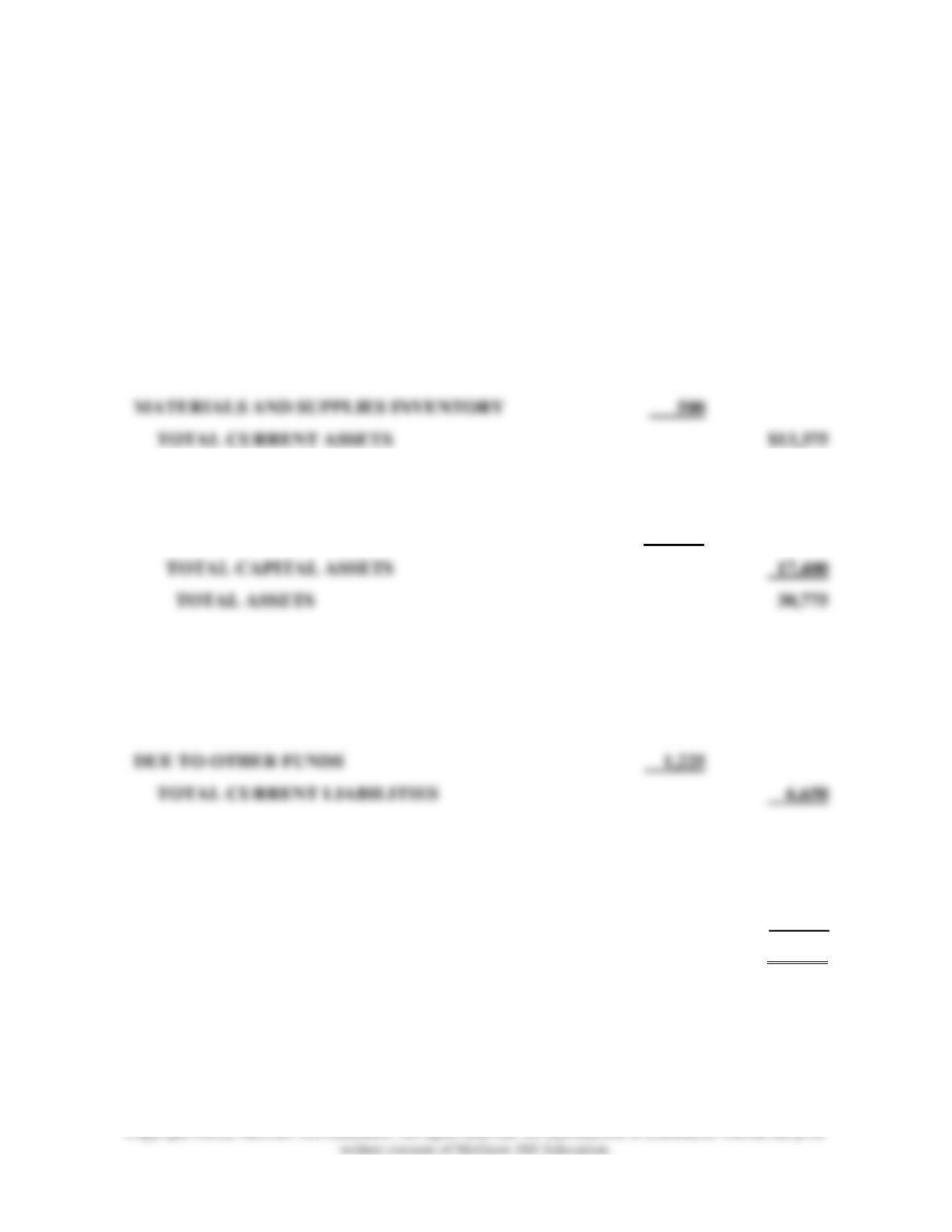
a. WASHINGTON CITY
INFORMATION TECHNOLOGY FUND
STATEMENT OF REVENUES, EXPENSES, AND
CHANGES IN FUND NET POSITION
FOR YEAR ENDED DECEMBER 31
BILLINGS TO DEPARTMENTS $78,100
OPERATING EXPENSES:
UTILITIES EXPENSE 14,525
COST OF MATERIALS AND SUPPLIES USED 8,250
DEPRECIATION EXPENSE 6,100
TOTAL OPERATING EXPENSES 90,175
Chapter 07 – Accounting for the Business–type Activities of State and Local Governments
7–19
Ch. 7, Solutions, Exercise 7-19 (Cont’d)
b. WASHINGTON CITY
INFORMATION TECHNOLOGY FUND
STATEMENT OF NET POSITION
AS OF DECEMBER 31
ASSETS:
CURRENT ASSETS:
CASH $ 7,575
DUE FROM OTHER FUNDS 5,300
CAPITAL ASSETS:
MACHINERY AND EQUIPMENT 53,600
LESS: ALLOWANCE FOR DEPRECIATION 36,200
LIABILITIES:
ACCOUNTS PAYABLE 2,950
DUE TO FEDERAL GOVERNMENT 2,475
NET POSITION:
NET POSITION—NET INVESTMENT IN CAPITAL ASSETS 17,400
NET POSITION—UNRESTRICTED 6,725
TOTAL NET POSITION $24,125

Chapter 07 – Accounting for the Business–type Activities of State and Local Governments
Ch. 7, Solutions, Exercise 7-19 (Cont’d)
c. WASHINGTON CITY
INFORMATION TECHNOLOGY FUND
STATEMENT OF CASH FLOWS
FOR THE YEAR ENDED DECEMBER 31
CASH FLOWS FROM OPERATING ACTIVITIES:
CASH RECEIVED FROM CUSTOMERS $77,050
CASH PAID TO:
EMPLOYEES $(34,775)
FEDERAL GOVERNMENT (23,000)
NET CASH PROVIDED BY OPERATIONS $ (6,925)
NET DECREASE IN CASH AND
CASH EQUIVALENTS (6,925)
RECONCILIATION OF OPERATING INCOME TO NET CASH
PROVIDED BY OPERATIONS
OPERATING INCOME/(LOSS) $ (12,075)
ADJUSTMENTS:
DEPRECIATION EXPENSE⎯MACHINERY & EQUIPMENT 6,100
INCREASE IN INVENTORY (150)