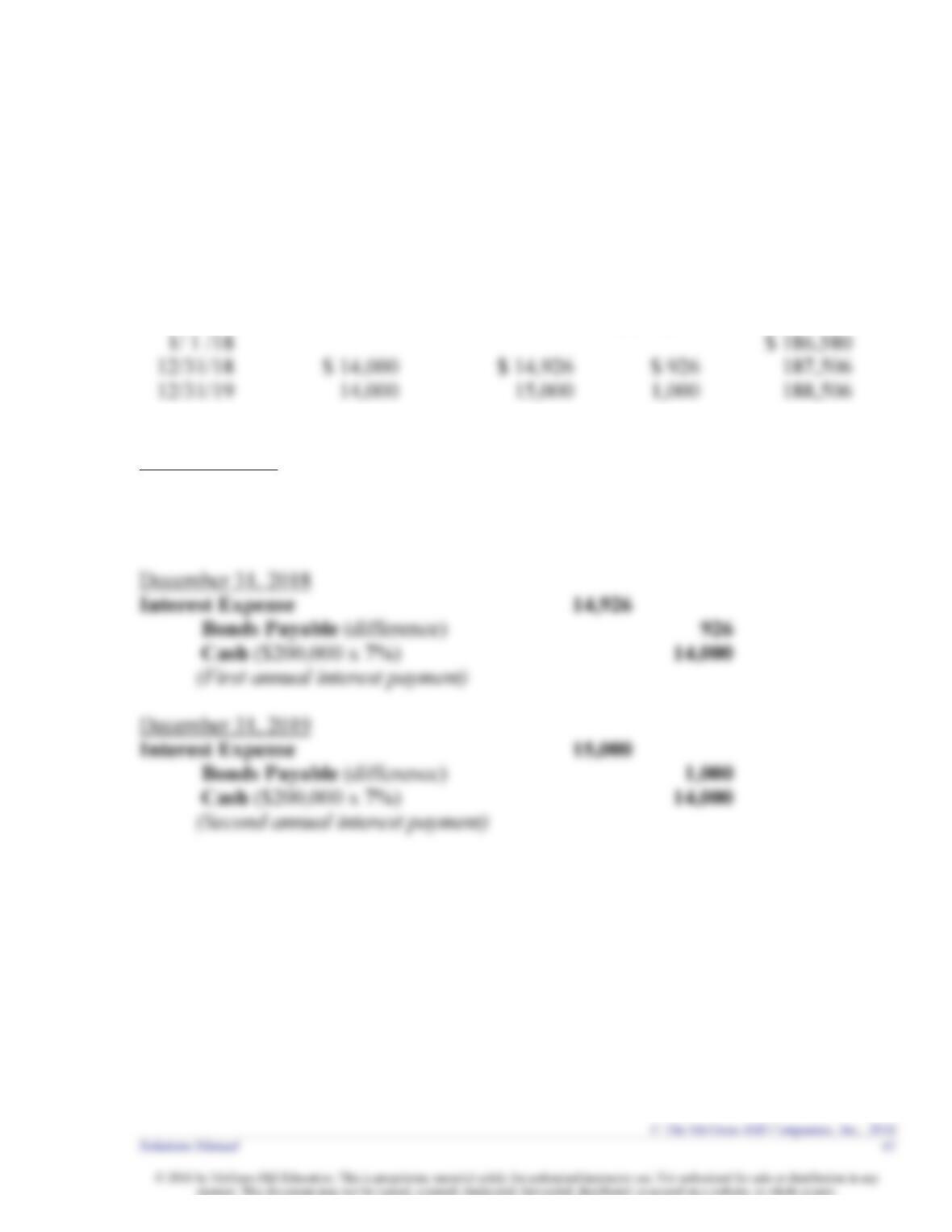
Exercise 9-14
Requirement 1
(1)
Date
(2)
Cash
Paid
(3)
Interest
Expense
(4)
Increase in
Carrying
Value
(5)
Carrying
Value
Face Amount
x Stated Rate
Carrying Value
x Market Rate
(3) – (2)
Prior Carrying
Value + (4)
Requirement 2
January 1, 2018
Cash
186,580
Bonds Payable
186,580
(To record the bond issue)
December 31, 2018
Interest Expense
(First annual interest payment)
December 31, 2019
(Second annual interest payment)
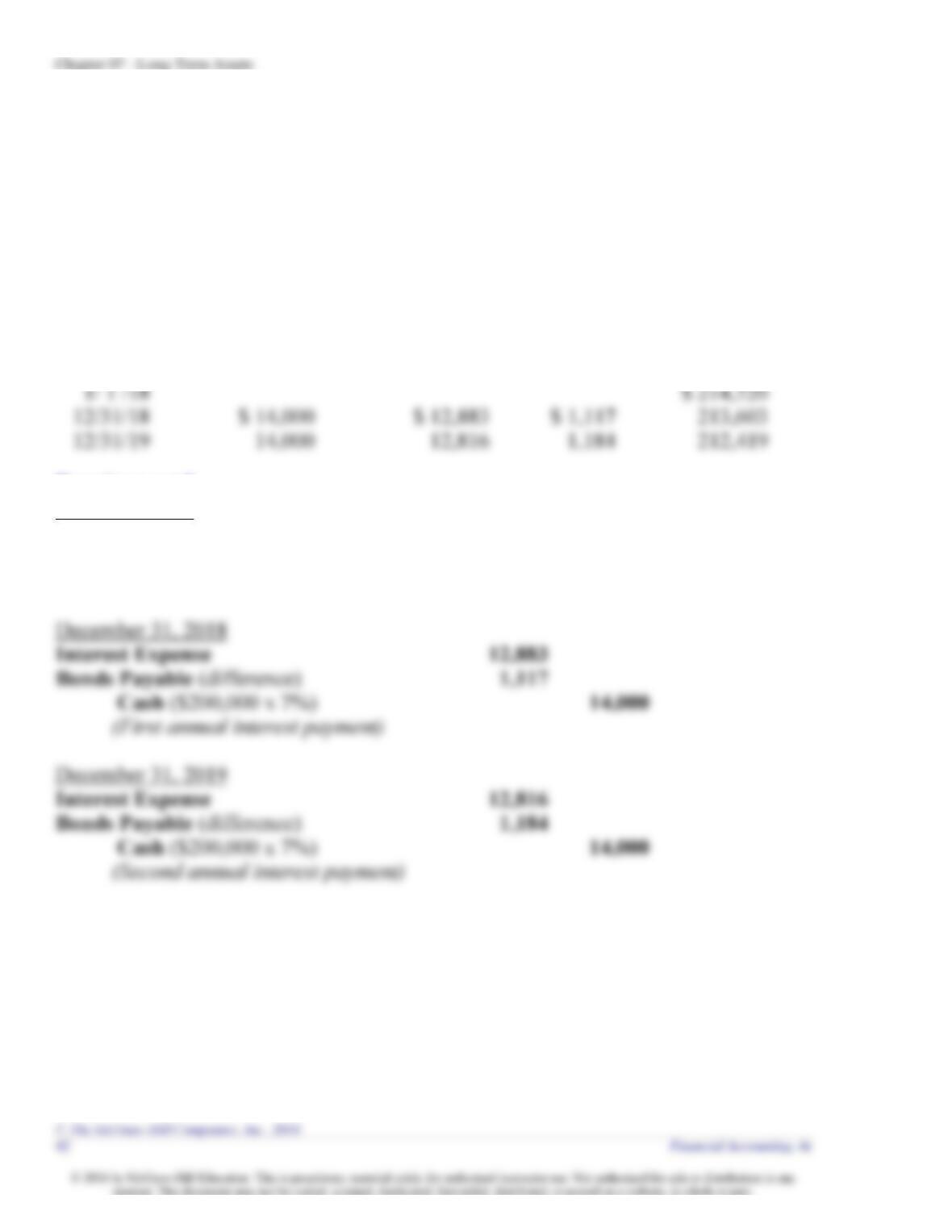
Exercise 9-15
Requirement 1
(1)
Date
(2)
Cash
Paid
(3)
Interest
Expense
(4)
Decrease in
Carrying
Value
(5)
Carrying
Value
Face Amount
x Stated Rate
Carrying Value
x Market Rate
(2) – (3)
Prior Carrying
Value – (4)
Requirement 2
January 1, 2018
Cash
214,720
Bonds Payable
214,720
(To record the bond issue)
December 31, 2018
Interest Expense
(First annual interest payment)
(Second annual interest payment)
Exercise 9-16
Requirement 1
(1)
Date
(2)
Cash
Paid
(3)
Interest
Expense
(4)
Increase in
Carrying
Value
(5)
Carrying
Value
Face Amount
x Stated Rate
Carrying Value
x Market Rate
(3) – (2)
Prior Carrying
Value + (4)
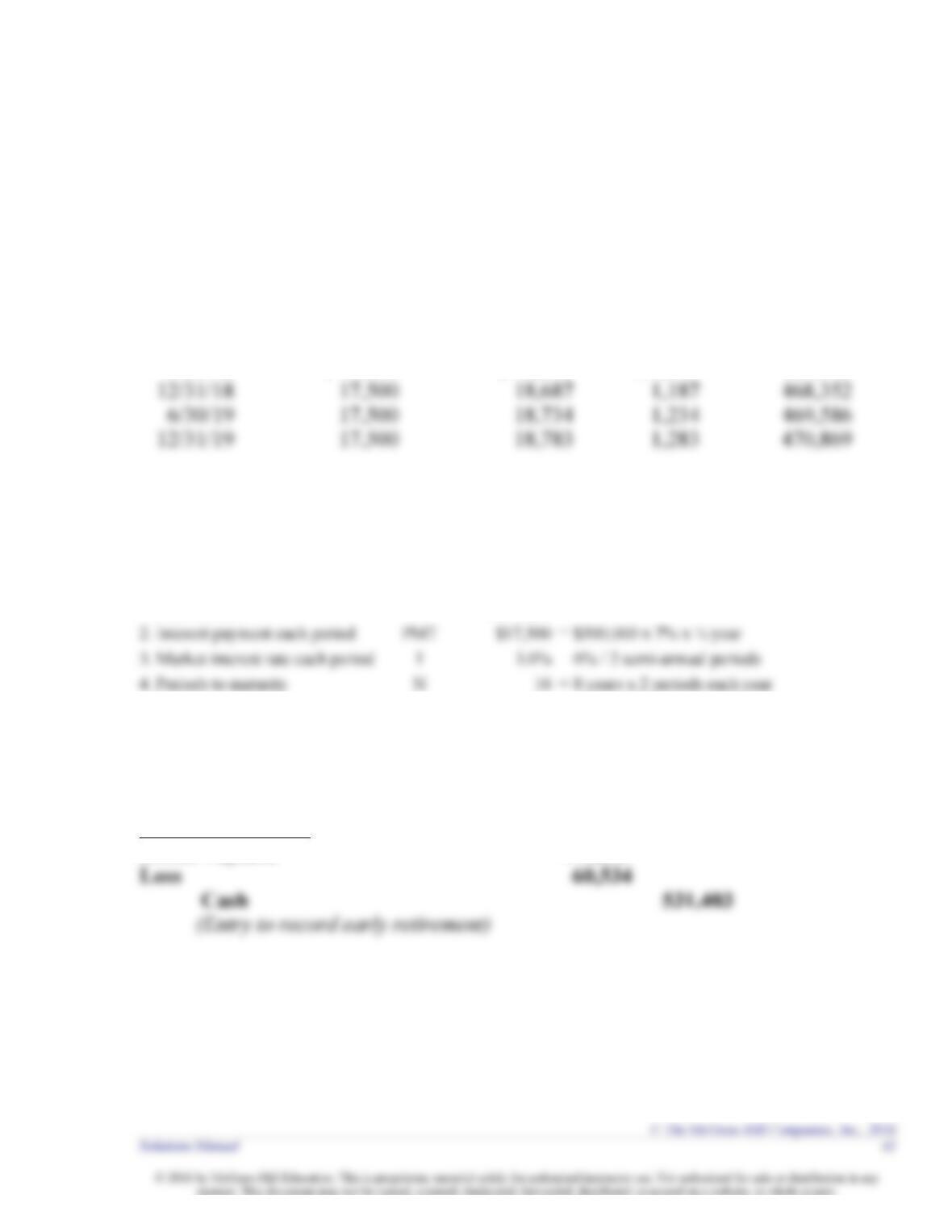
1/ 1 /18
$ 466,024
6/30/18
$ 17,500
$ 18,641
$ 1,141
467,165
468,352
6/30/19
469,586
Requirement 2
If the market rate drops to 6%, it will cost $531,403 to retire the bonds.
Calculator Input
Bond
characteristics
Key
Amount
1. Face amount
FV
$500,000
2. Interest payment each period
3. Market interest rate each period
4. Periods to maturity
N
Calculator Output
Issue price
PV
$531,403
December 31, 2019
Bonds Payable
470,869
Exercise 9-17
Requirement 1
(1)
Date
(2)
Cash
Paid
(3)
Interest
Expense
(4)
Decrease in
Carrying
Value
(5)
Carrying
Value
Face Amount
x Stated Rate
Carrying Value
x Market Rate
(2) – (3)
Prior Carrying
Value – (4)
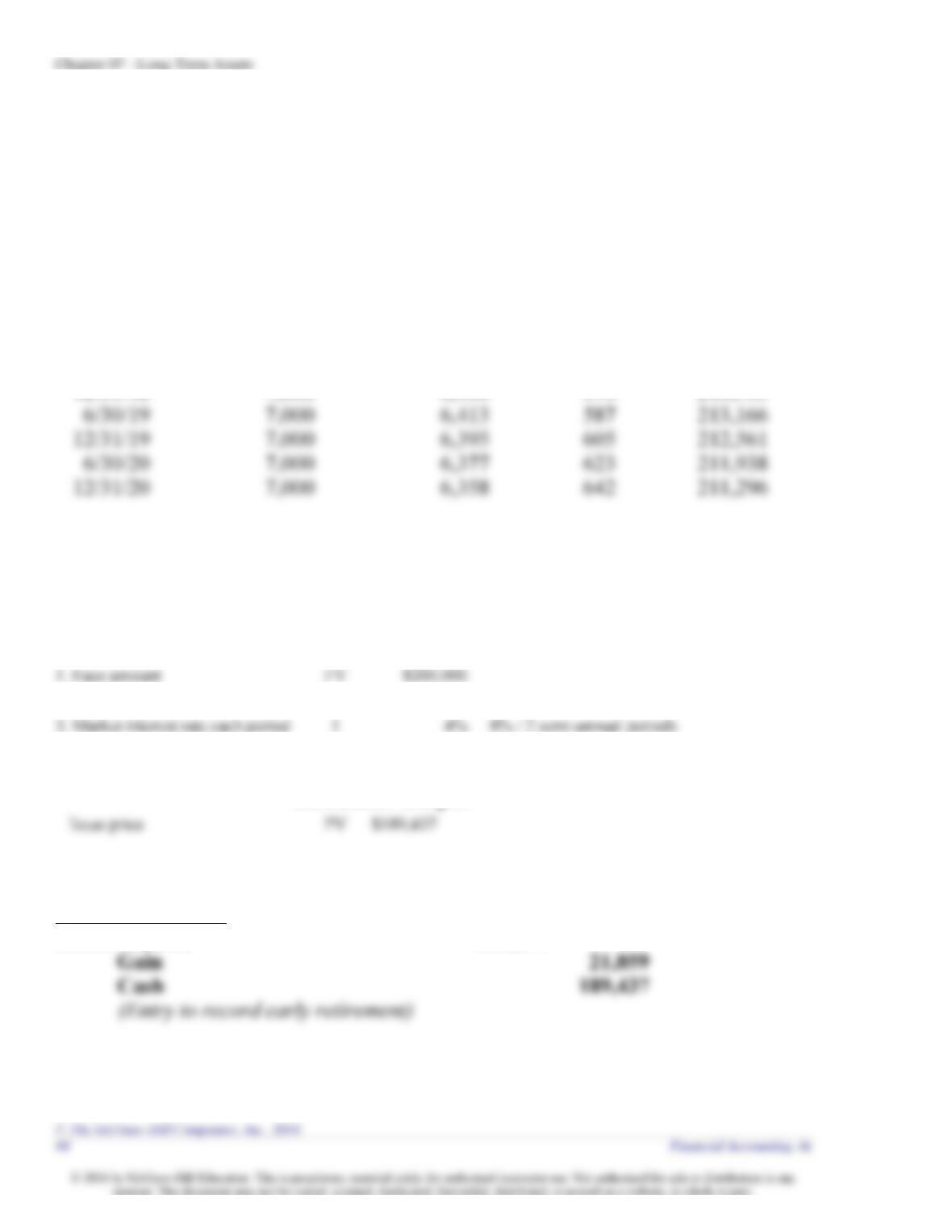
1/ 1 /18
$ 214,877
6/30/18
$ 7,000
$ 6,446
$ 554
214,323
12/31/18
7,000
6,430
570
213,753
6/30/19
7,000
6,413
587
213,166
6/30/20
7,000
6,377
623
211,938
12/31/20
7,000
6,358
642
211,296
Requirement 2
If the market rate increases to 8%, it will cost $189,437 to retire the bonds.
Calculator Input
Bond
Characteristics
Key
Amount
1. Face amount
2. Interest payment each period
PMT
$7,000
= $200,000 x 7% x ½ year
3. Market interest rate each period
= 8% / 2 semi-annual periods
4. Periods to maturity
N
14
= 7 years x 2 periods each year
Calculator Output
Issue price
$189,437
December 31, 2018
Bonds Payable
211,296
189,437
Exercise 9-18
Requirement 1
($ in thousands)
Total
Liabilities
÷
Stockholders’
Equity
=
Debt to Equity
Ratio
E-Travel
$3,984,378
÷
$2,672,544
=
1.49
Pricecheck
$1,092,579
÷
$1,813,336
=
0.60
Requirement 2
($ in thousands)
Net Income +
Interest + Taxes
÷
Interest
=
Times Interest
Earned Ratio
E-Travel
$608,270
÷
$66,428
=
9.2
Chapter 07 – Long-Term Assets
Chapter 10
Stockholders’ Equity
Exercise 10-1
Terms
__g___ 1. Limited liability company
__d___ 3. Articles of Incorporation
__h___ 4. Organization chart
__a___ 5. S Corporation
__b___ 6. Publicly held corporation
__f___ 8. Double taxation
Definitions
a. Allows for legal treatment as a corporation, but tax treatment as a partnership.
Exercise 10-2
Authorized stock is the number of shares the company is authorized to sell, stated in
the company’s articles of incorporation.
Exercise 10-3
Requirement 1
January 1, 2018
Cash (500 shares x $20)
10,000
April 1, 2018
Cash (200 shares x $24)
Requirement 2
January 1, 2018
Cash (500 shares x $20)
10,000
Common Stock (500 shares x $1.00)
500
April 1, 2018
Cash (200 shares x $24)
4,800
Common Stock (200 shares x $1.00)
200
Exercise 10-4
Requirement 1
Preferred dividends in arrears for 2017
$12,000
Preferred dividends for 2018 (2,000 shares x 6% x $100 par value)
Remaining dividends to common stockholders
Requirement 2
Preferred dividends in arrears for 2017
$ 0
Preferred dividends for 2018 (2,000 shares x6% x $100 par value)
Remaining dividends to common stockholders
Exercise 10-5
February 1
Debit
Credit
Cash (4,000 x $12)
48,000
Common Stock (4,000 x $12)
48,000
(Issue common stock no-par value))
May 15
Cash (1,000 x $11)
11,000
Preferred Stock (1,000 x $10)
10,000
1,000
(Issue preferred stock above par)
October 1
Dividends (5,000 shares x $1.00)
5,000
5,000
(Declare cash dividends)
October 15
No Entry
October 31
Dividends Payable (5,000 shares x $1.00)
5,000
5,000
Exercise 10-6
January 2, 2018
Debit
Credit
Cash (100,000 x $15)
1,500,000
Common Stock (100,000 x $1)
100,000
Additional Paid-in Capital (difference)
February 6, 2018
Cash (200 x $120)
24,000
Preferred Stock (200 x $100)
Additional Paid-in Capital (difference)
September 10, 2018
Treasury Stock (10,000 shares x $18)
180,000
180,000
December 15, 2018
Cash (5,000 shares x $20)
100,000
Treasury Stock (5,000 shares x $18)
Additional Paid-in Capital (5,000 x $2)
Exercise 10-7
Finishing Touches
Balance Sheet
(Stockholders’ Equity Section)
December 31, 2018
Stockholders’ equity:
Preferred stock, $100 par value
$ 20,000
Common stock, $1.00 par value
100,000
Additional paid-in capital
Retained earnings
Treasury stock, 5,000 shares
Exercise 10-8
Chapter 07 – Long-Term Assets
March 15
Debit
Credit
Dividends (250,000,000 shares x $0.10)
25,000,000
March 30 – No Entry
April 13
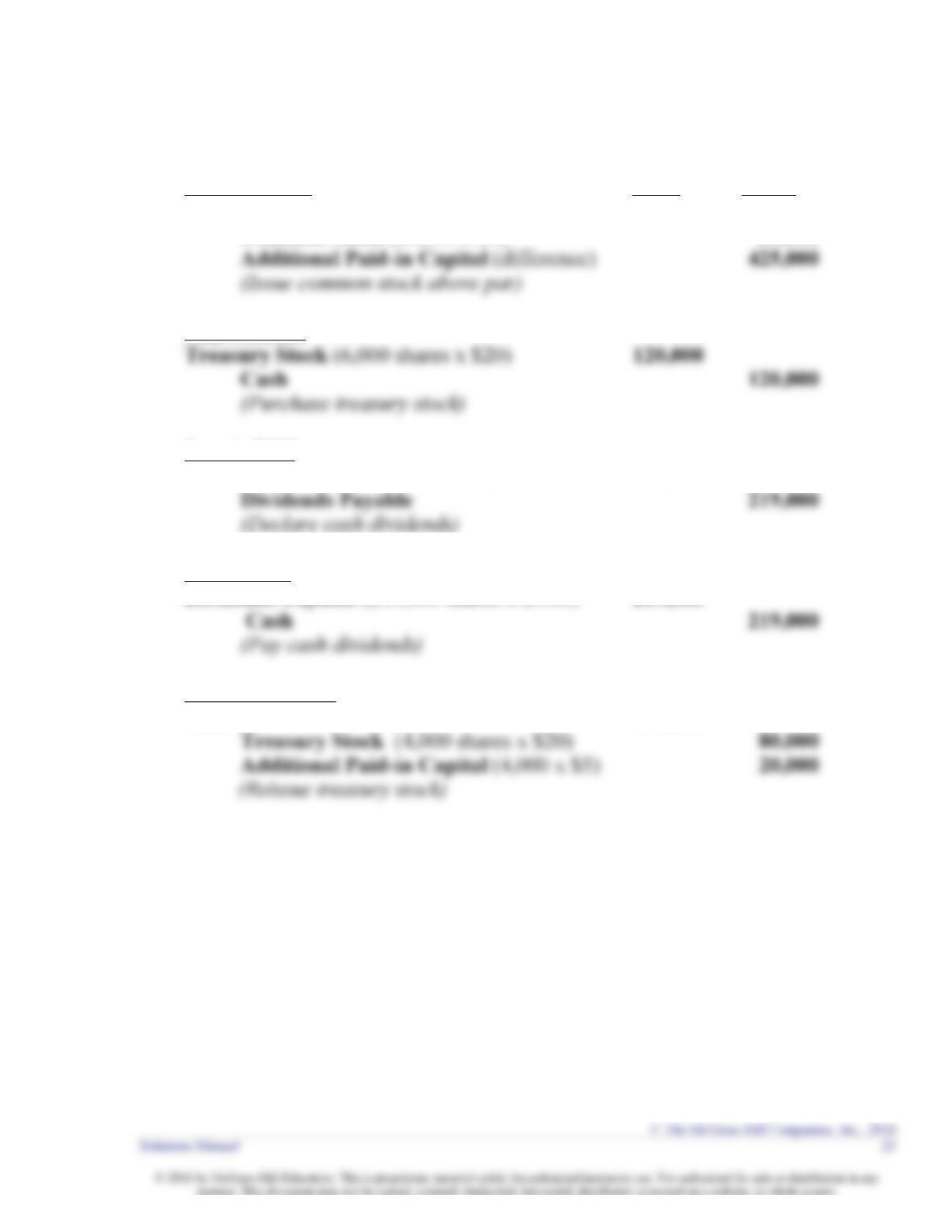
Exercise 10-9
March 1, 2018
Debit
Credit
Cash (25,000 x $18)
450,000
Common Stock (25,000 x $1)
25,000
Additional Paid-in Capital (difference)
May 10, 2018
Treasury Stock (6,000 shares x $20)
120,000
June 1, 2018
Dividends (219,000 shares x $1.00)
219,000
July 1, 2018
Dividends Payable (219,000 shares x $1.00)
219,000
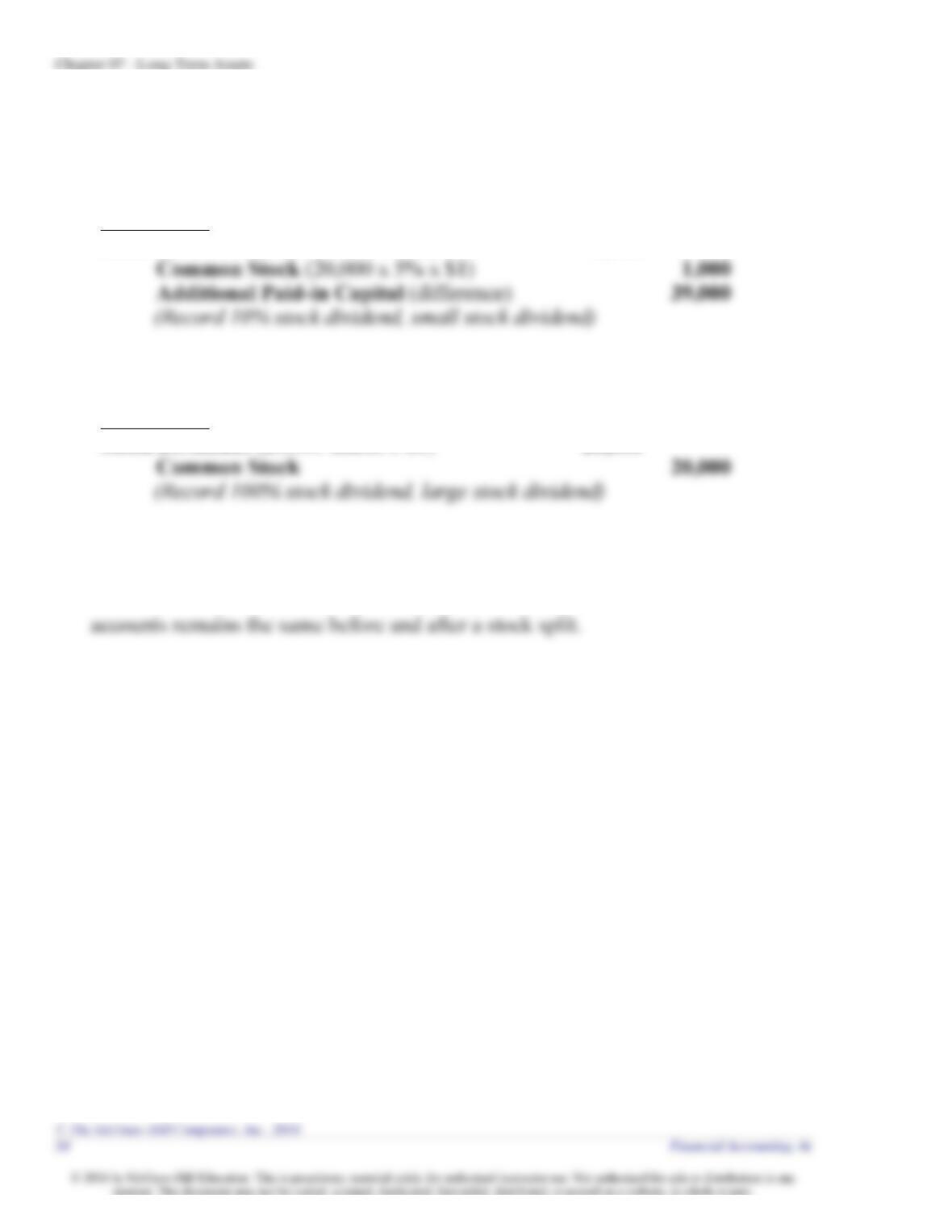
October 21, 2018
Cash (4,000 shares x $25)
100,000
Treasury Stock (4,000 shares x $20)
80,000
Exercise 10-10 (LO 10-6)
Requirement 1
September 1
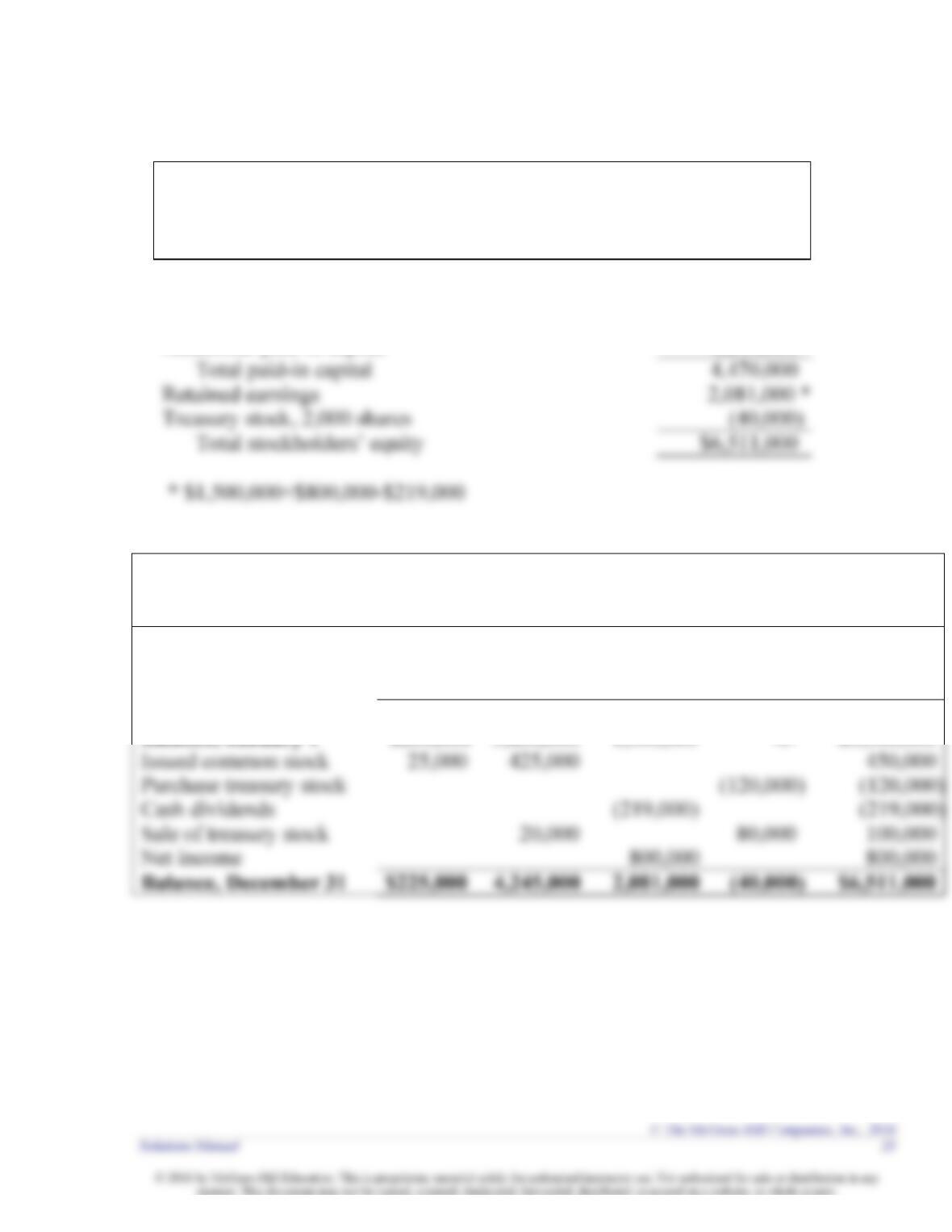
Stock Dividends (20,000 x 5% x $40)
40,000
Requirement 2
September 1
Stock Dividends (20,000 shares x $1)
20,000
Requirement 3
• No entry is recorded for a 2-for-1 stock split, because the balance in all of the
Exercise 10-11
Power Drive Corporation
Balance Sheet
(Stockholders’ Equity Section)
December 31, 2018
Stockholders’ equity:
Common stock, $1.00 par value
$ 225,000
Additional paid-in capital
4,245,000
Retained earnings
Treasury stock, 2,000 shares
Exercise 10-12
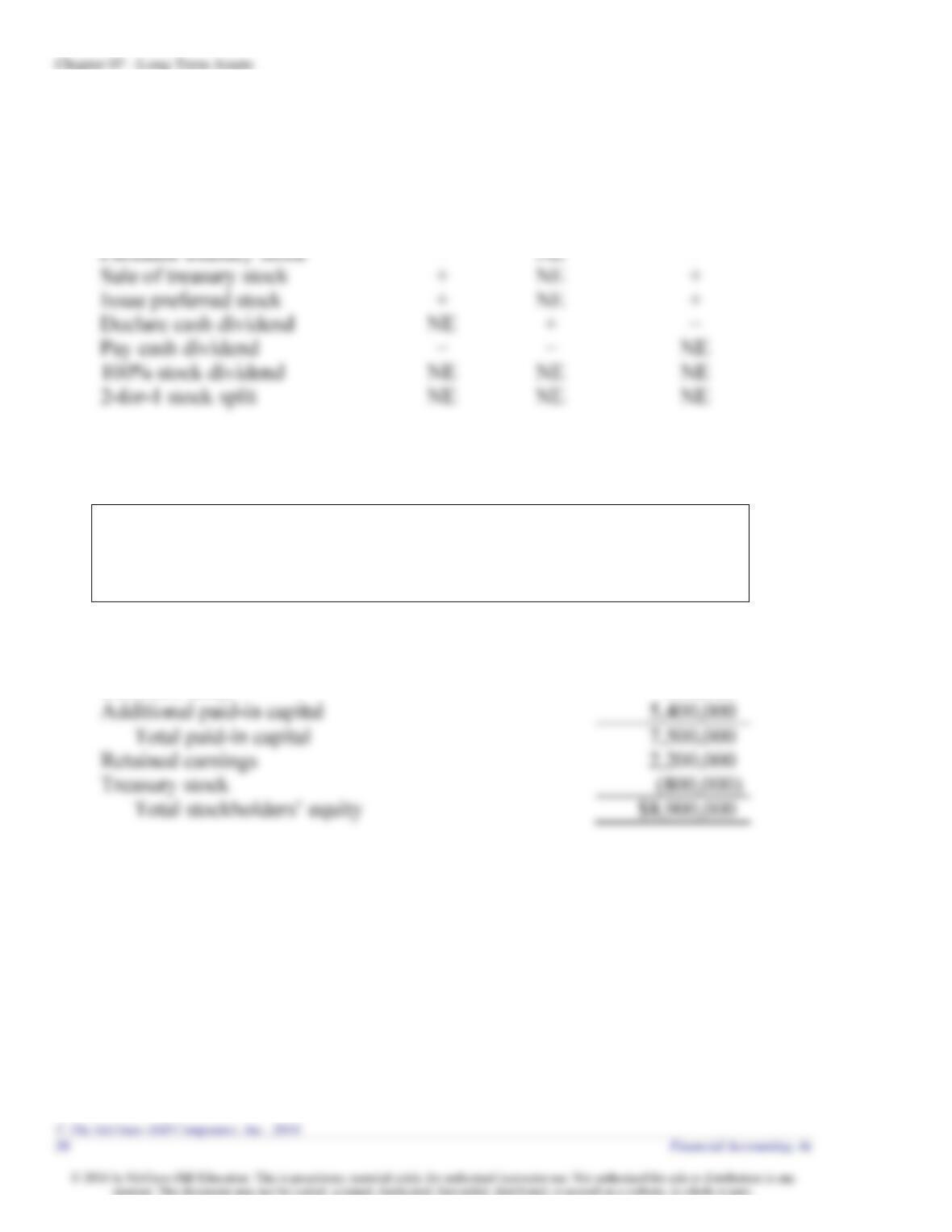
Power Drive Corporation
Statement of Stockholders’ Equity
For the Year Ended December 31, 2018
Common
Stock
Additional
Paid-in
Capital
Retained
Earnings
Treasury
Stock
Total
Stockholders’
Equity
Issued common stock
Purchase treasury stock
Sale of treasury stock
Exercise 10-13
Transaction
Total
Assets
Total
Liabilities
Total
Stockholders’
Equity
Issue common stock
+
NE
+
Purchase treasury stock
NE
Sale of treasury stock
NE
Declare cash dividend
Pay cash dividend
100% stock dividend
NE
2-for-1 stock split
NE
Exercise 10-14
United Apparel
Balance Sheet
(Stockholders’ Equity Section)
December 31, 2018
Stockholders’ equity:
Preferred stock
$ 1,500,000
Common stock
600,000
Retained earnings
Treasury stock
Exercise 10-15
Requirement 1
($ in millions)
Net Income
÷
Average
Stockholders’ Equity
=
Return on
Equity
÷
=
Requirement 2
($ in millions)
Dividends
Per Share
÷
Stock Price
=
Dividend
Yield
÷
=
Requirement 3
($ in millions)
Net Income
÷
Shares Outstanding
=
Earnings per Share
÷
=
Requirement 4
($ in millions)
Stock Price
÷
Earnings Per Share
=
Price-Earnings
Ratio
÷
=
Exercise 10-16
Requirement 1
Chapter 07 – Long-Term Assets
($ in millions)
Net Income
(less preferred
stock dividends)
÷
Average
Shares
Outstanding
=
Earnings per
Share
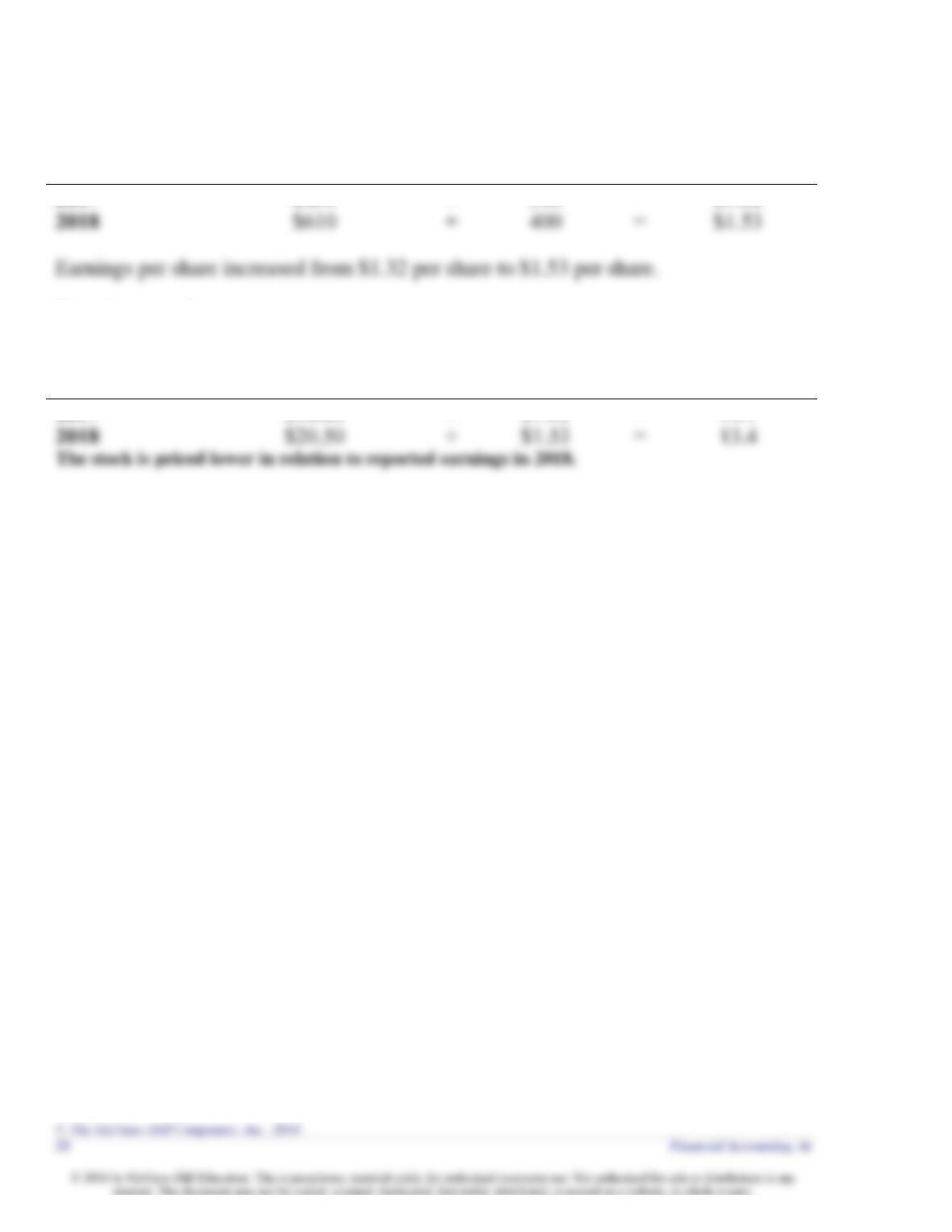
2017
$450
÷
340
=
$1.32
2018
$610
400
=
$1.53
Requirement 2
($ in millions)
Stock Price
÷
Earnings Per
Share
=
Price-Earnings
Ratio
2017
$18.60
÷
$1.32
=
14.1
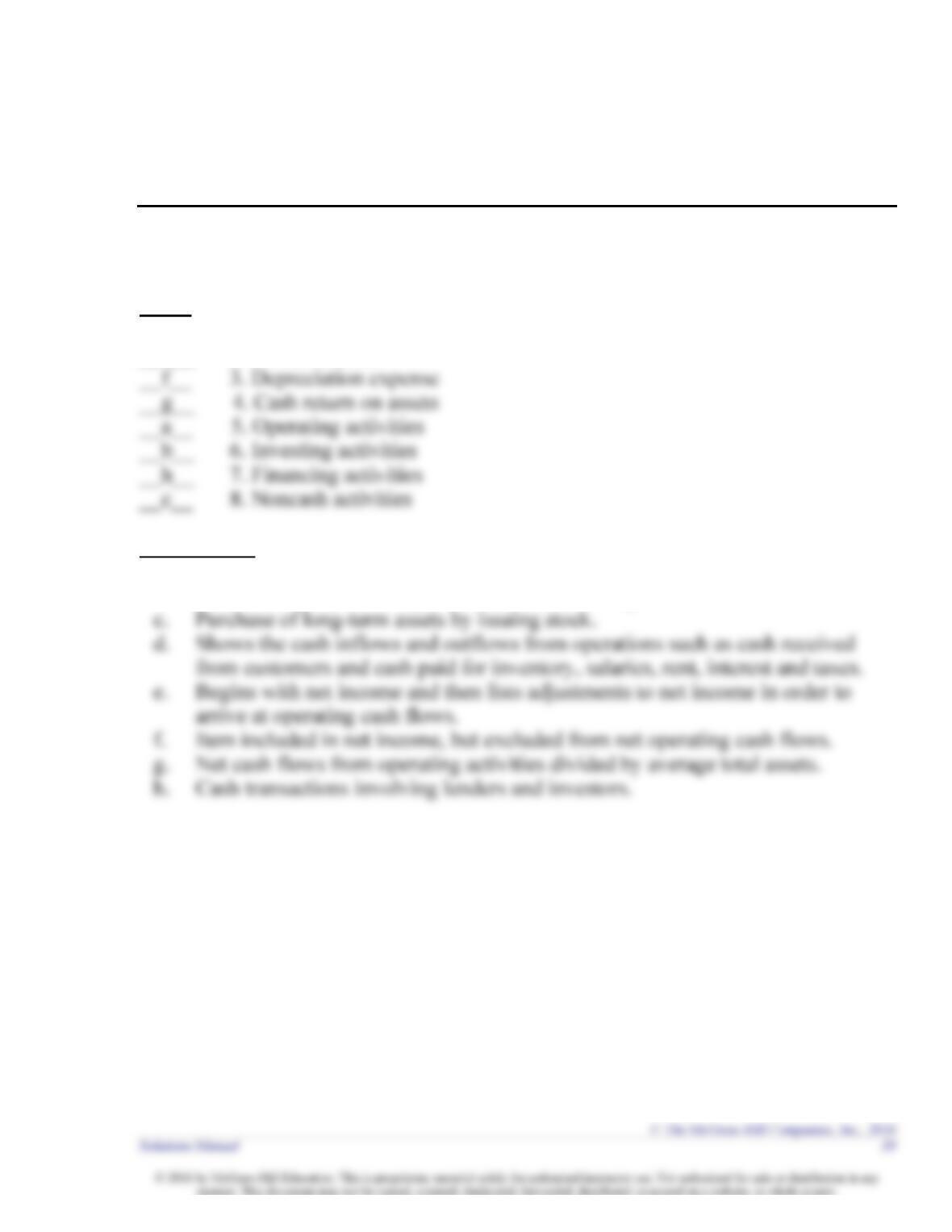
2018
$20.50
$1.53
=
13.4
Chapter 11
Statement of Cash Flows
Exercise 11-1
Items
__e__ 1. Indirect method
__d__ 2. Direct method
__f__ 3. Depreciation expense
__g__ 4. Cash return on assets
__a__ 5. Operating activities
__b__ 6. Investing activities
__h__ 7. Financing activities
__c__ 8. Noncash activities
Descriptions
a. Cash transactions involving net income.
b Cash transactions for the purchase and sale of long-term assets.
Exercise 11-2
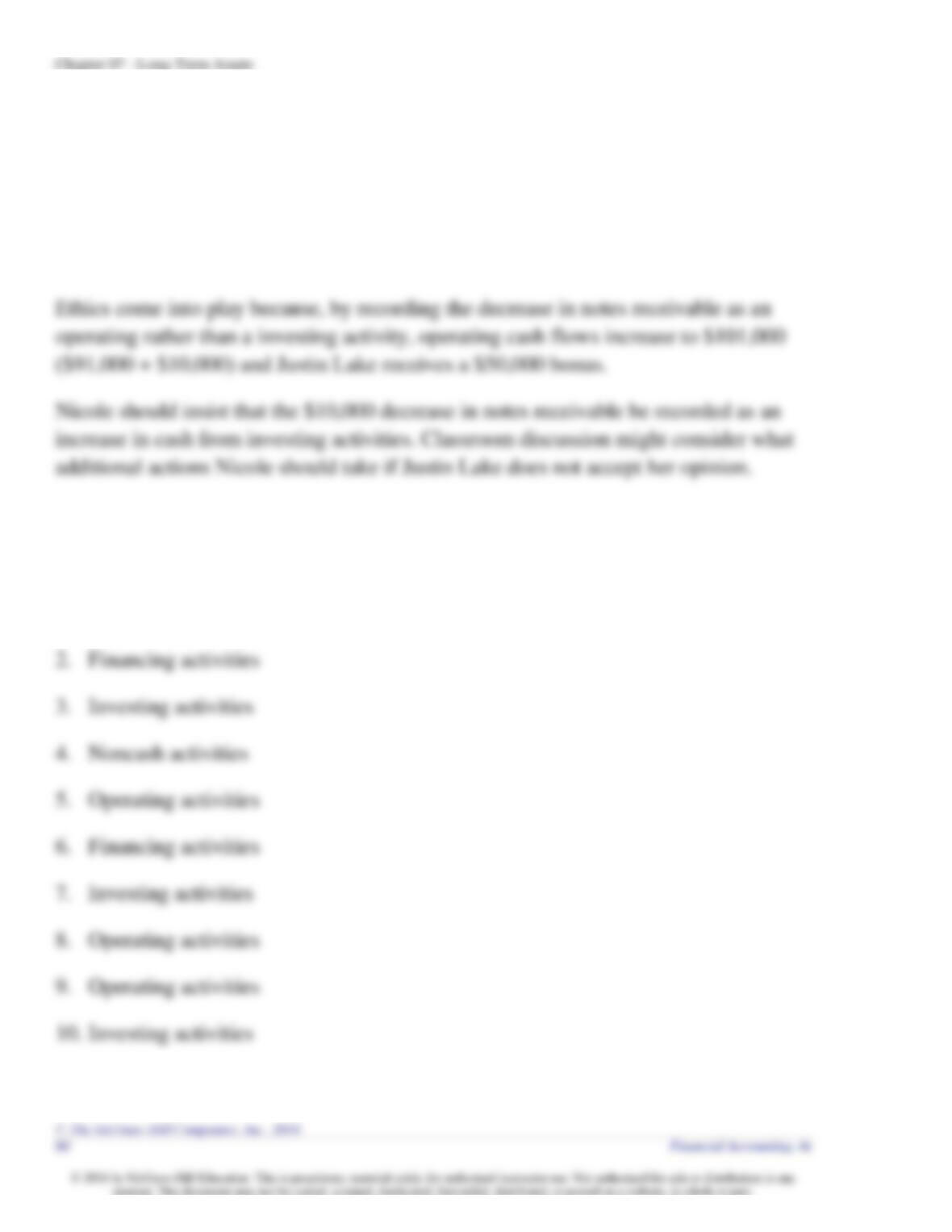
The $10,000 decrease in notes receivable should be properly recorded as an increase
in cash from investing activities. While most changes in current assets and current
liabilities are included in operating activities, loaning money to a supplier is clearly an
investing activity.
Exercise 11-3
1. Operating activities
2. Financing activities
3. Investing activities
4. Noncash activities
5. Operating activities
6. Financing activities
7. Investing activities
8. Operating activities
9. Operating activities
10. Investing activities