Case 7-4 Harrison Industries
It’s no fun accepting a position for your dream job and then red flags are raised that make you
wonder about the culture of the company. Those are the thoughts of Donna Mason on January
18, 2016, as she prepares for a meeting with her accounting supervisor, Cheryl Miles. Mason
graduated summa cum laude from State University six months ago. She is working as a staff
heard about a shutdown of any division, and she found it strange because the company’s
operating income in all divisions had set record levels in fiscal year 2015. Moreover, the
severance amounts are five times the annual payroll of the division.
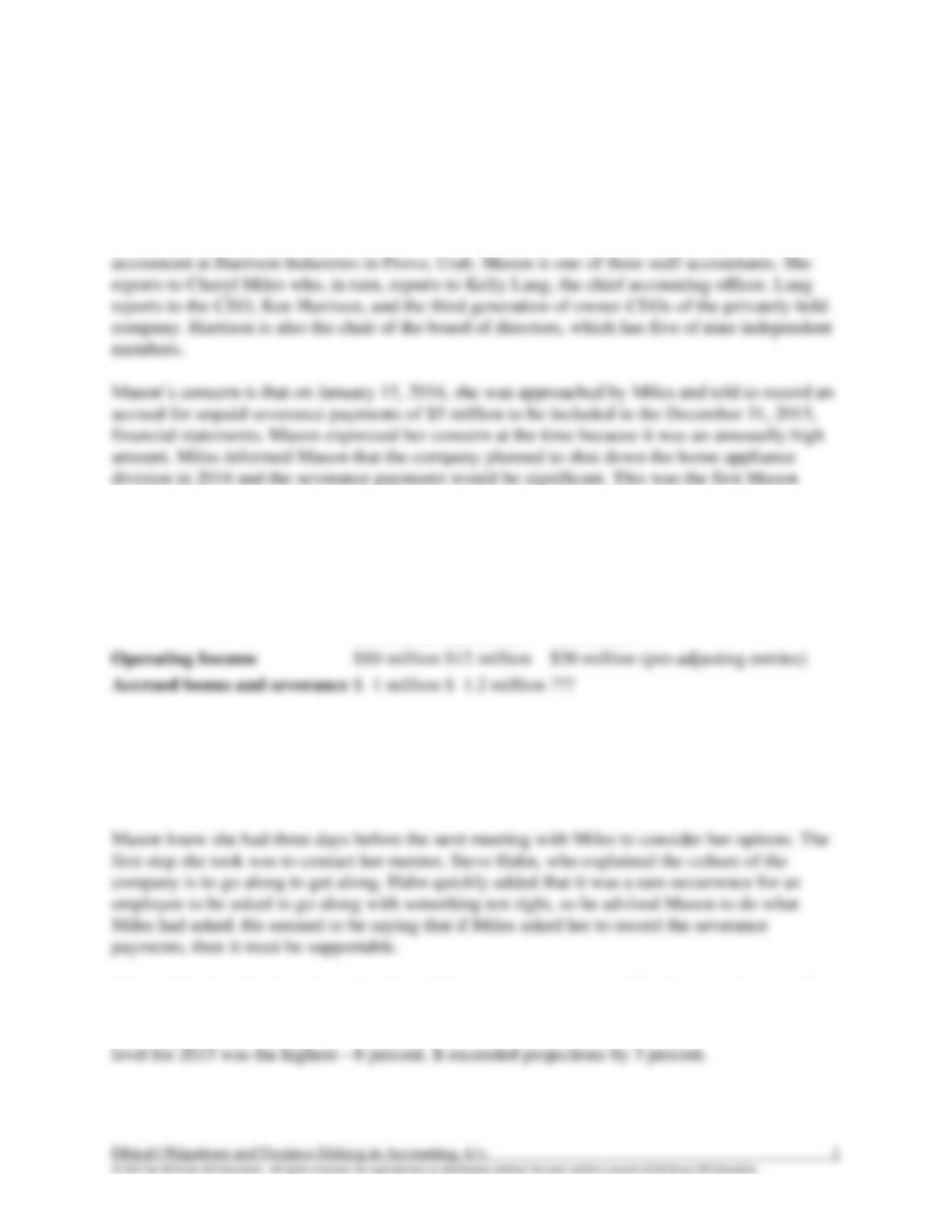
The numbers below show the operating income levels and accruals for 2013 through 2015:
12/31/2013
12/31/2014
12/31/2015
Operating Income
Accrued bonus and severance
Mason took a firm stance at first and told Miles she needed some documentation to record the
accrued severance liability. Miles instructed Mason to record the entry, that it wasn’t her job to
question orders. Miles made it clear in no uncertain terms that questioning directions from one’s
supervisor was a basis for termination. This occurred on January 15, 2016.
Mason did a lot of independent checking of the company’s computer files between January 15
and January 18, 2016, and found no evidence of a planned shutdown of the division. In fact, the
division’s income had risen on average by 5 percent a year for three straight years. The income
Ethical Obligations and Decision Making in Accounting, 4/e 2
1. What are the real and anticipated arguments that could be made by those at
Harrison Industries who may try to convince Donna to go along with the accounting
for future severance payments? Include in your discussion the possible motivation
for the accounting treatment.
It appears that Cheryl Miles is demanding Donna Mason record an accrued expense for unpaid
severance payments from the planned shutdown of the home appliance division in 2016 to
manage earnings. On the surface it seems as though the motivation for the action is to manage
earnings by shifting some of it into later periods when they may be needed more to meet or
exceed analysts’ earnings projections and the company’s own estimates. The numbers bear this
management.
2. What is at stake for the key parties? What are Donna’s ethical obligations to them?
Donna’s job is at stake. Miles threatened that she might be fired if she refuses to go along. In all
likelihood Miles did not react very well when Donna asked for supporting documentation to
record the accrued severance amount. It could be that Donna is under a great deal of pressure
from Kelly Lang (CAO) and Ken Harrison (CEO and chair of the board).
Ethical Obligations and Decision Making in Accounting, 4/e 3
3. What is Donna’s most powerful and persuasive response to the reasons and
rationalizations she needs to address? To whom should the argument be made?
One issue for Donna is to what extent she should consider the advice of her mentor, Steve Hahn,
to accept what Miles is asking because going along to get along is part of the culture of the
company. Donna should ask herself whether she wants to work for Harrison, a company that
seemingly expects an employee to be loyal to the company’s interests even if they conflict with
her personal values. A disconnect exists between what Donna thinks the ethical standards of the
4. What is Donna’s most effective approach to giving voice to her values? Explain.
Donna’s most effective approach is to focus on the unintended consequences. It is more likely
that top management did not carefully consider these possibilities while it’s less likely it
considered that the asked-for accrual is not justified by accounting rules.