Problem 7-17 (45 minutes)
1. Under the traditional direct labor-hour based costing system,
manufacturing overhead is applied to products using the predetermined
overhead rate computed as follows:
Estimated total manufacturing overhead cost
Predetermined =
overhead rate Estimated total direct labor –hours
$1,980,000
= = $16.50 per DLH
120,000 DLHs*
*20,000 units of Xtreme @ 2.00 DLH per unit + 80,000 units of the
Pathfinder @ 1.0 DLH per unit = 40,000 DLHs + 80,000 DLHs =
120,000 DLHs.
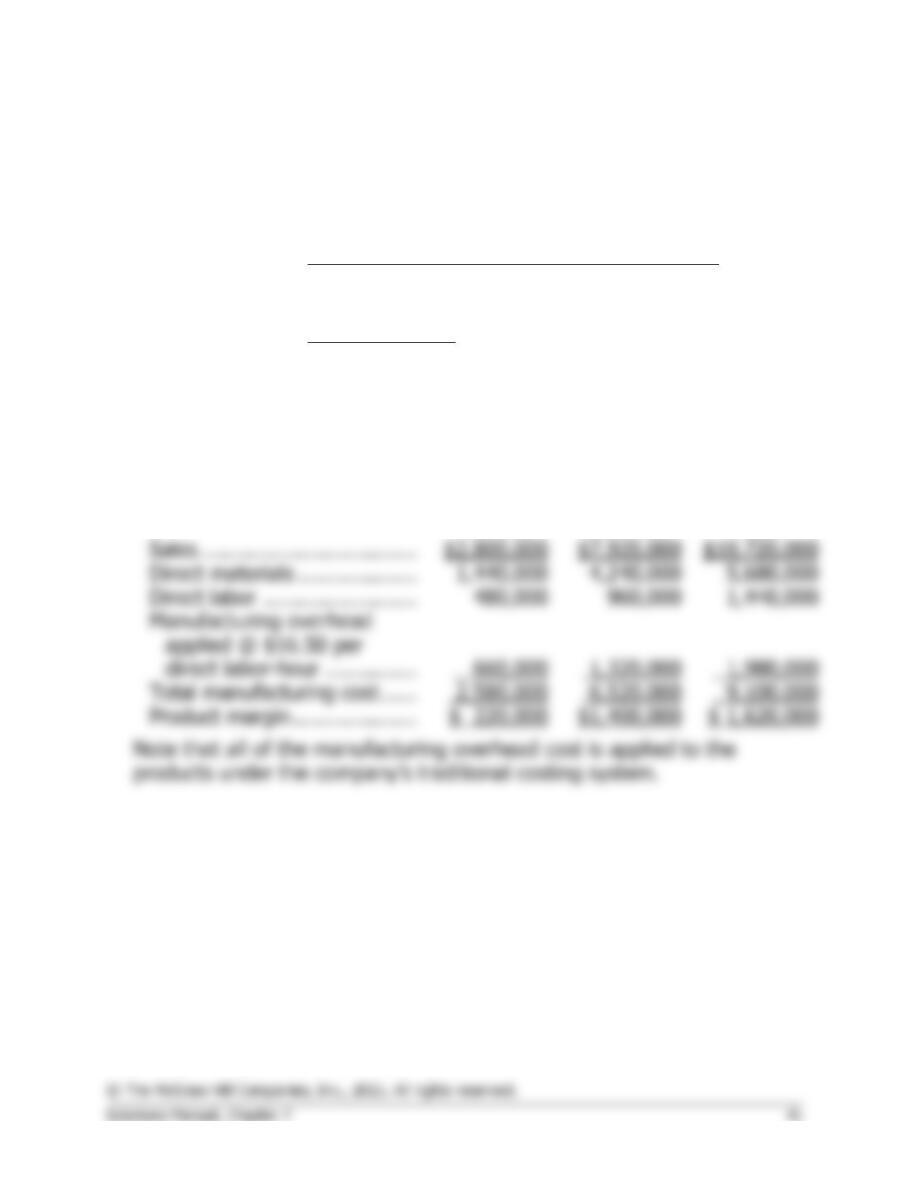
Consequently, the product margins using the traditional approach would
be computed as follows:
Xtreme
Pathfinder
Total
Problem 7-17 (continued)
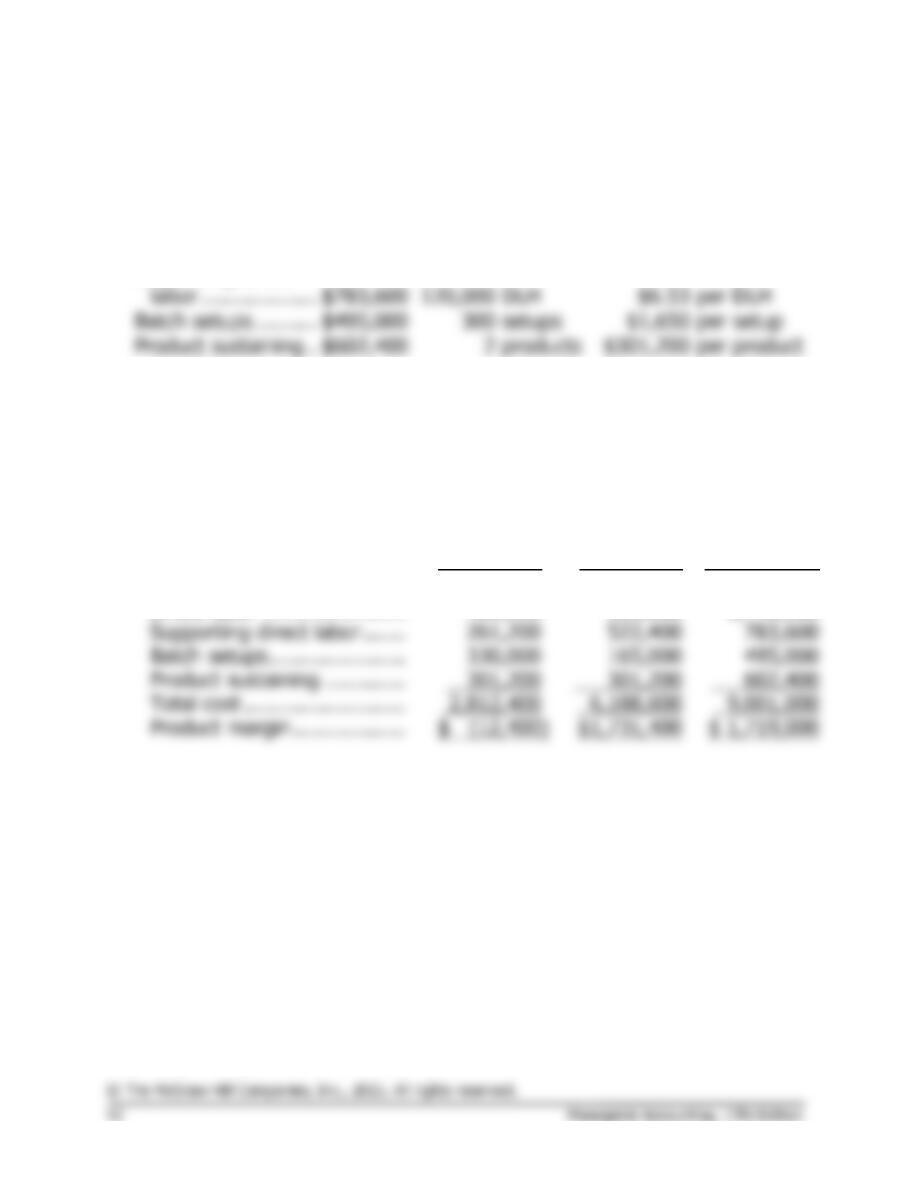
2. The first step is to determine the activity rates:
Activity Cost Pools
(a)
Total
Cost
(b)
Total Activity
(a) ÷ (b)
Activity Rate
Supporting direct
*The Other activity cost pool is not shown above because it includes
organization-sustaining and idle capacity costs that should not be
assigned to products.
Under the activity-based costing system, the product margins would be
computed as follows:
Xtreme
Pathfinder
Total
Sales …………………………...
$2,800,000
$7,920,000
$10,720,000
Direct materials ……………..
1,440,000
4,240,000
5,680,000
Supporting direct labor …….
Batch setups ………………….
Total cost ……………………..
Product margin ………………
$ (12,400)
$1,731,400
Problem 7-17 (continued)
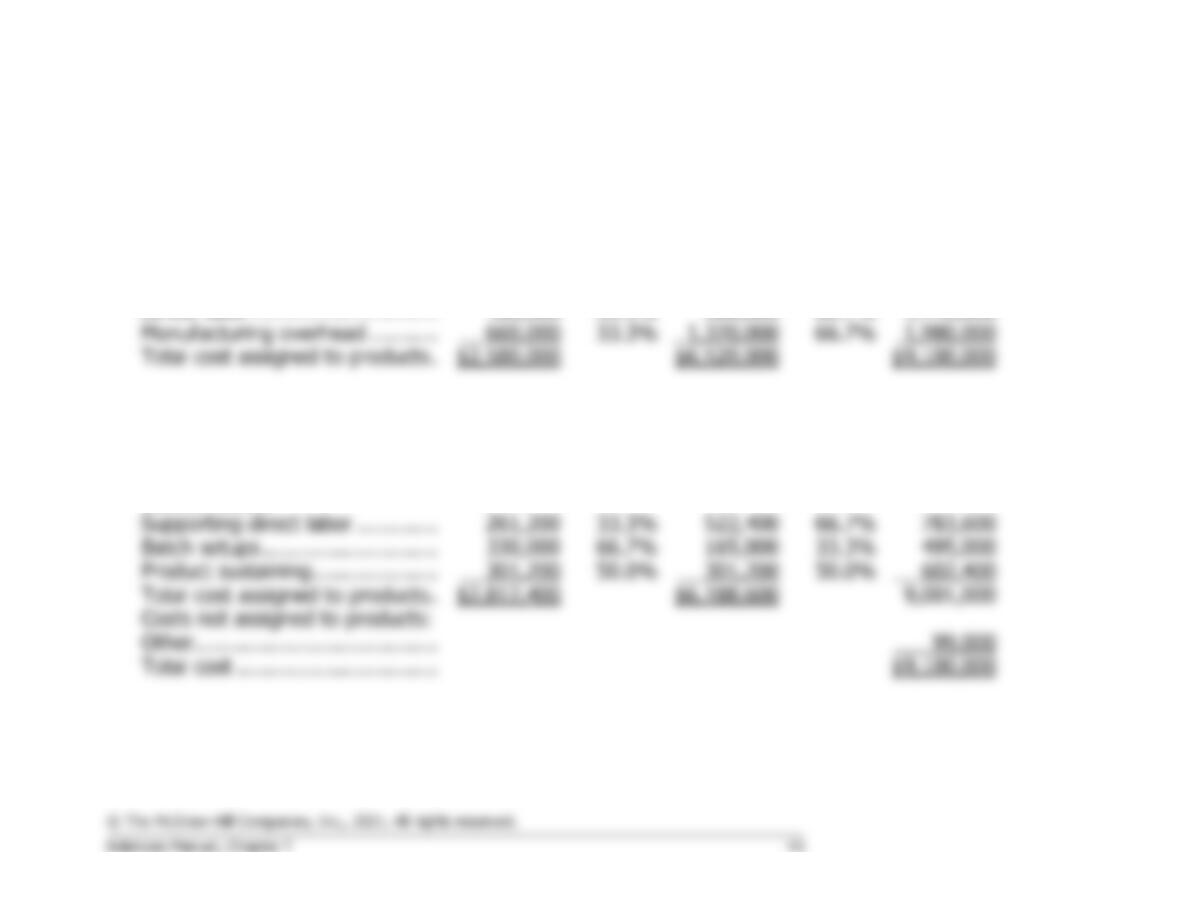
3. The quantitative comparison is as follows:
Xtreme
Pathfinder
Total
Traditional Cost System
(a)
Amount
(a) ÷ (c)
%
(b)
Amount
(b) ÷ (c)
%
(c)
Amount
Direct materials ……………………
$1,440,000
25.4%
$4,240,000
74.6%
$5,680,000
Direct labor …………………………
480,000
33.3%
960,000
66.7%
1,440,000
Manufacturing overhead ………..
33.3%
66.7%
Total cost assigned to products .
$2,580,000
$6,520,000
$9,100,000
Activity-Based Costing System
Direct costs:
Direct materials ……………………
$1,440,000
25.4%
$4,240,000
74.6%
$5,680,000
Direct labor …………………………
480,000
33.3%
960,000
66.7%
1,440,000
Indirect costs:
Supporting direct labor ………….
261,200
33.3%
522,400
66.7%
783,600
Batch setups ……………………….
330,000
66.7%
165,000
33.3%
495,000
Product sustaining ………………..
50.0%
50.0%
Total cost assigned to products .
$2,812,400
$6,188,600
9,001,000
Costs not assigned to products:
99,000
Problem 7-17 (continued)
The traditional and activity-based cost assignments differ for two
reasons. First, the traditional system assigns all $1,980,000 of
manufacturing overhead to products. The ABC system assigns only
$1,881,000 (= $783,600 + $495,000 + $602,400) of manufacturing
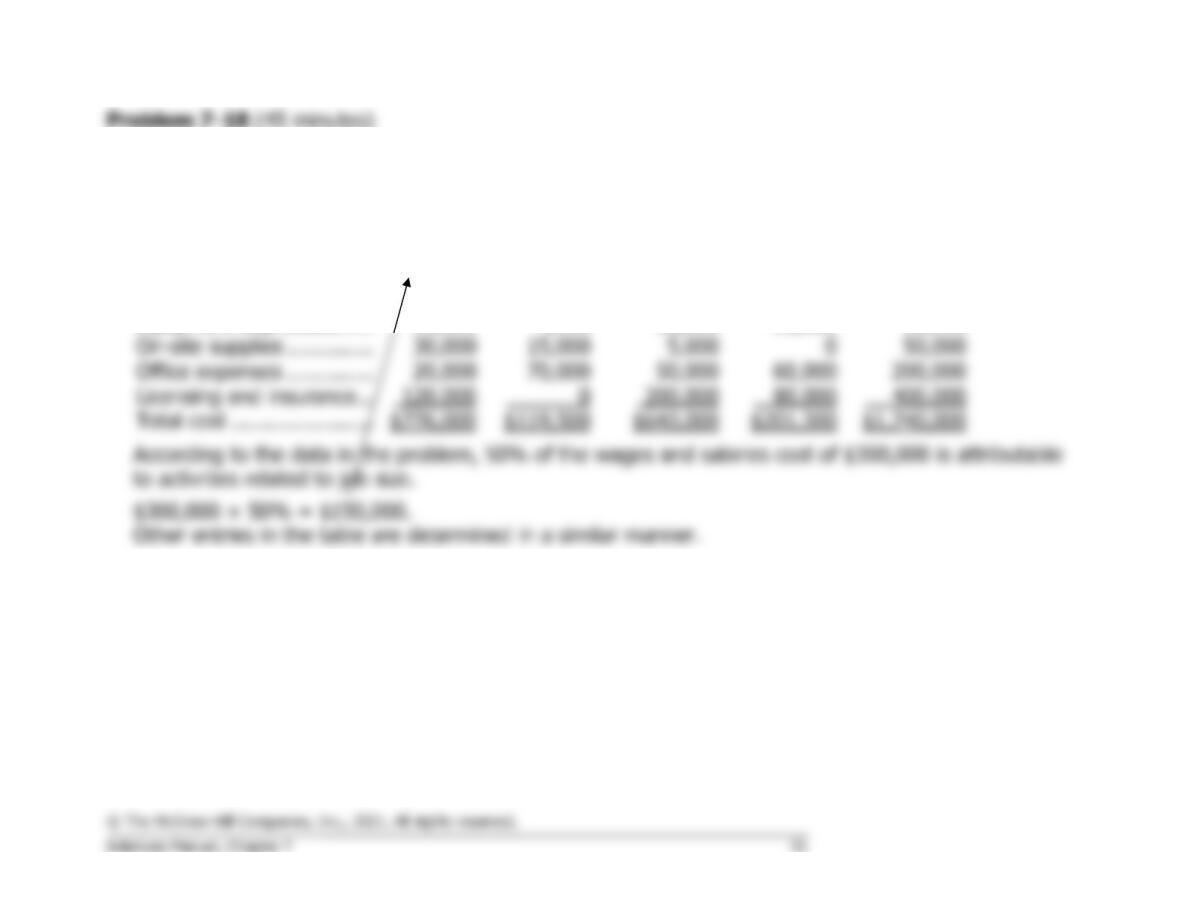
1. The results of the first-stage allocation appear below:
Job Size
Estimating
and Job
Setup
Working on
Nonroutine
Jobs
Other
Totals
Wages and salaries ………
$150,000
$ 30,000
$ 90,000
$ 30,000
$ 300,000
Disposal fees ………………
420,000
0
280,000
0
700,000
Equipment depreciation …
Office expenses …………..
Licensing and insurance…
Total cost …………………..
$776,000
$643,000
2.
Activity Cost Pool
(a)
Total Cost
(b)
Total Activity
(a) ÷ (b)
Activity Rate
Job size ……………..
$776,000
800
thousand square feet
$970
per thousand square feet
Estimating and job
setup ………………
$119,500
500
jobs
$239
per job
Working on
nonroutine jobs …
$643,000
100
nonroutine jobs
$6,430
per nonroutine job
Problem 7-18 (continued)
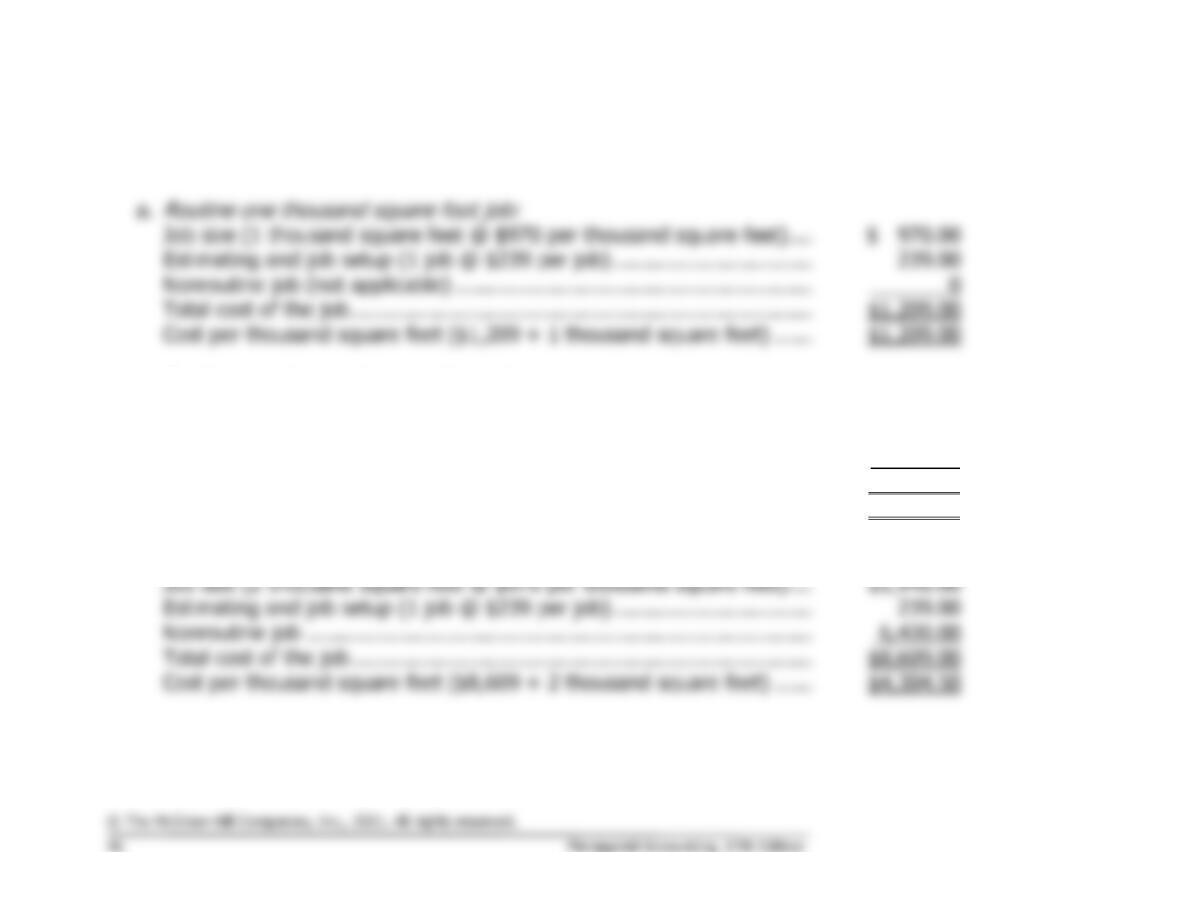
3. The costs of each of the jobs can be computed as follows using the activity rates computed above:
Routine one thousand square foot job:
Job size (1 thousand square feet @ $970 per thousand square feet) ….
Estimating and job setup (1 job @ $239 per job) …………………………..
239.00
Nonroutine job (not applicable) …………………………………………………
0
Total cost of the job ………………………………………………………………..
$1,209.00
Cost per thousand square feet ($1,209 ÷ 1 thousand square feet) ……
$1,209.00
b.
Routine two thousand square foot job:
Job size (2 thousand square feet @ $970 per thousand square feet) ….
$1,940.00
Estimating and job setup (1 job @ $239 per job) …………………………..
239.00
Nonroutine job (not applicable) …………………………………………………
0
Total cost of the job ………………………………………………………………..
$2,179.00
Cost per thousand square feet ($2,179 ÷ 2 thousand square feet) ……
$1,089.50
c.
Nonroutine two thousand square foot job:
Job size (2 thousand square feet @ $970 per thousand square feet) ….
$1,940.00
Estimating and job setup (1 job @ $239 per job) …………………………..
239.00
Nonroutine job …………………………..………………………………………….
Total cost of the job ………………………………………………………………..
$8,609.00
Cost per thousand square feet ($8,609 ÷ 2 thousand square feet) ……
$4,304.50
Problem 7-18 (continued)
4. The objectivity of the interview data can be questioned because the on-
site work supervisors were undoubtedly trying to prove their case about
the cost of nonroutine jobs. Nevertheless, the activity-based costing
data certainly suggest that dramatic differences exist in the costs of
jobs. While some of the costs may be difficult to adjust in response to
changes in activity, it does appear that the standard bid of $2,500 per
thousand square feet (= 1,000 square feet × $2.50 per square foot)
Problem 7-19 (20 minutes)
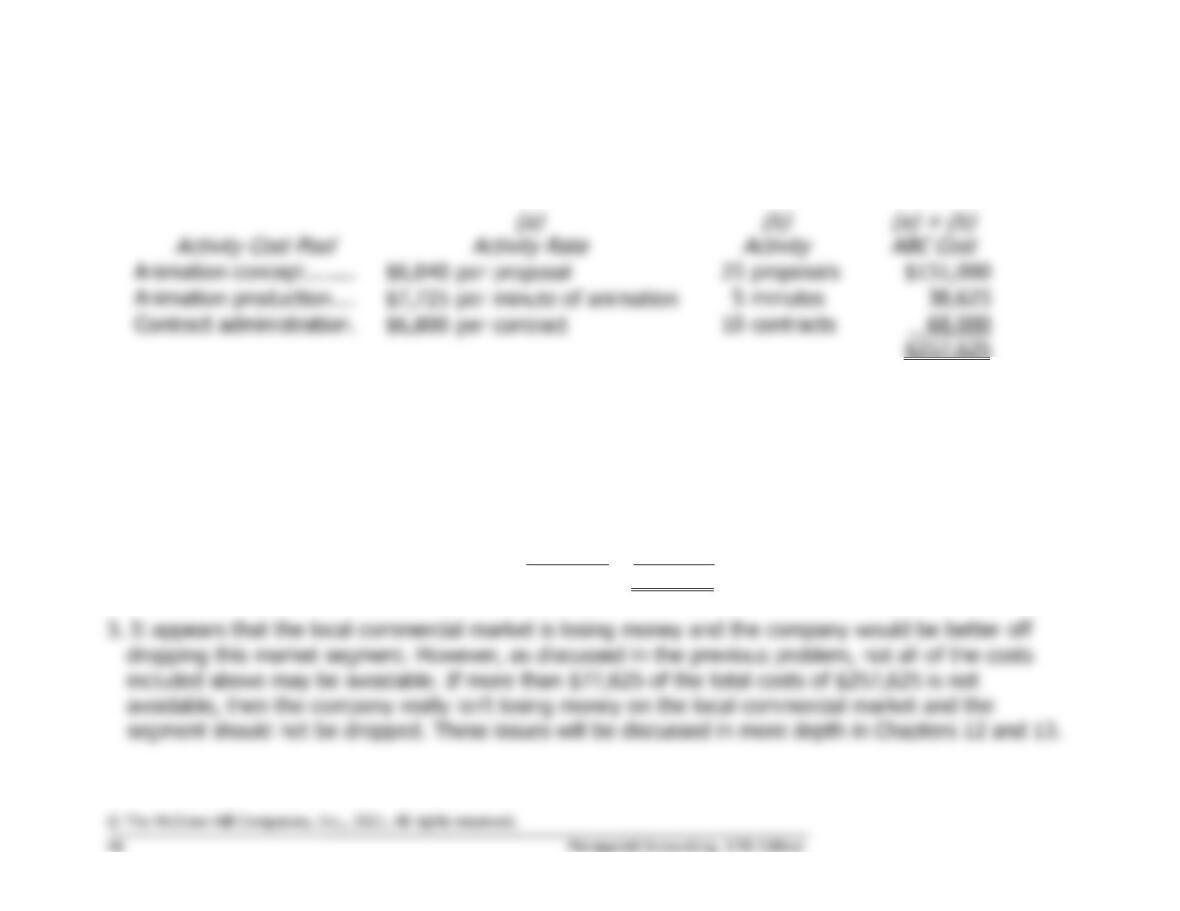
1. The cost of serving the local commercial market according to the ABC model can be determined as
follows:
Animation concept ……..
proposals
Animation production ….
minutes
Contract administration .
contracts
2. The margin earned serving the local commercial market is negative, as shown below:
Profitability Analysis
Sales ……………………………………………
$180,000
Costs:
Animation concept …………………………
$151,000
Animation production ……………………..
38,625
Contract administration …………………..
68,000
257,625
Margin ………………………………………….
$(77,625)
Problem 7-20 (45 minutes)
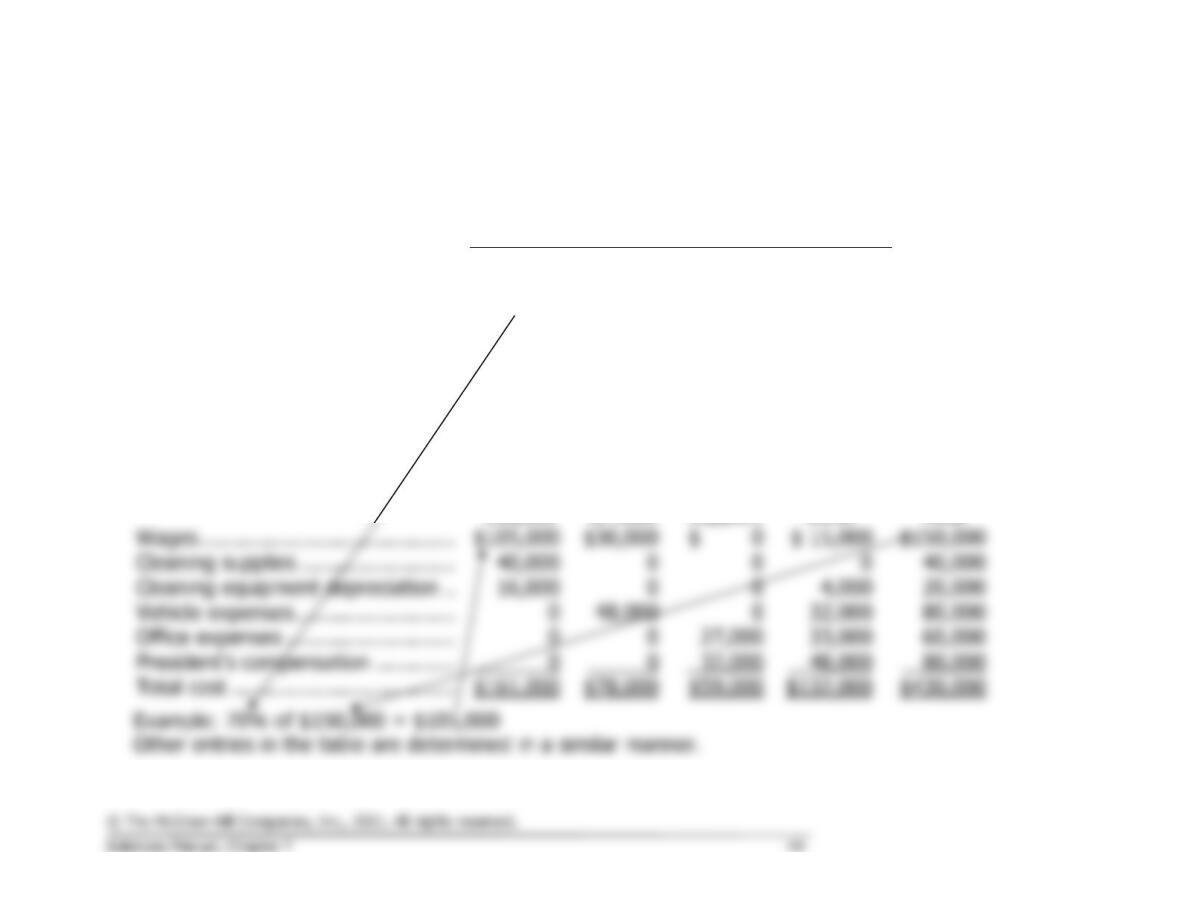
1. The first-stage allocation of costs to activity cost pools appears below:
Distribution of Resource Consumption
Across Activity Cost Pools
Cleaning
Carpets
Travel
to Jobs
Job
Support
Other
Total
Wages ………………………………….
70%
20%
0%
10%
100%
Cleaning supplies ……………………
100%
0%
0%
0%
100%
Cleaning equipment depreciation .
80%
0%
0%
20%
100%
Vehicle expenses ……………………
0%
60%
0%
40%
100%
Office expenses ……………………..
0%
0%
45%
55%
100%
President’s compensation …………
0%
0%
40%
60%
100%
Other
$161,000
Cleaning
Travel
Job
Problem 7-20 (continued)
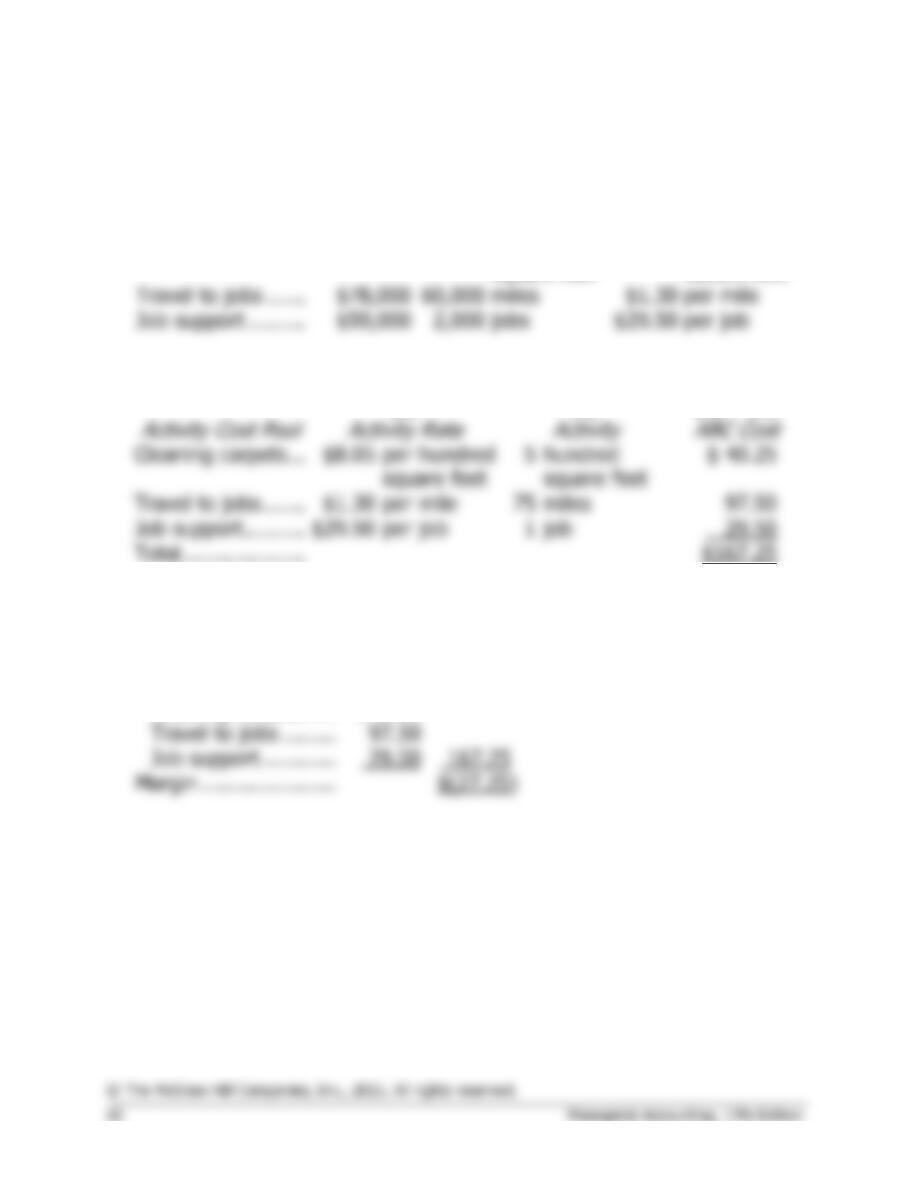
2. The activity rates are computed as follows:
Activity Cost Pool
(a)
Total Cost
(b)
Total Activity
(a) ÷ (b)
Activity Rate
Cleaning carpets ..
$161,000
20,000
hundred
Travel to jobs ……
miles
per mile
Job support ………
2,000
jobs
per job
$8.05
per hundred
3. The cost for the Flying N Ranch job is computed as follows:
Activity Cost Pool
5
$1.30
(a)
(b)
(a) × (b)
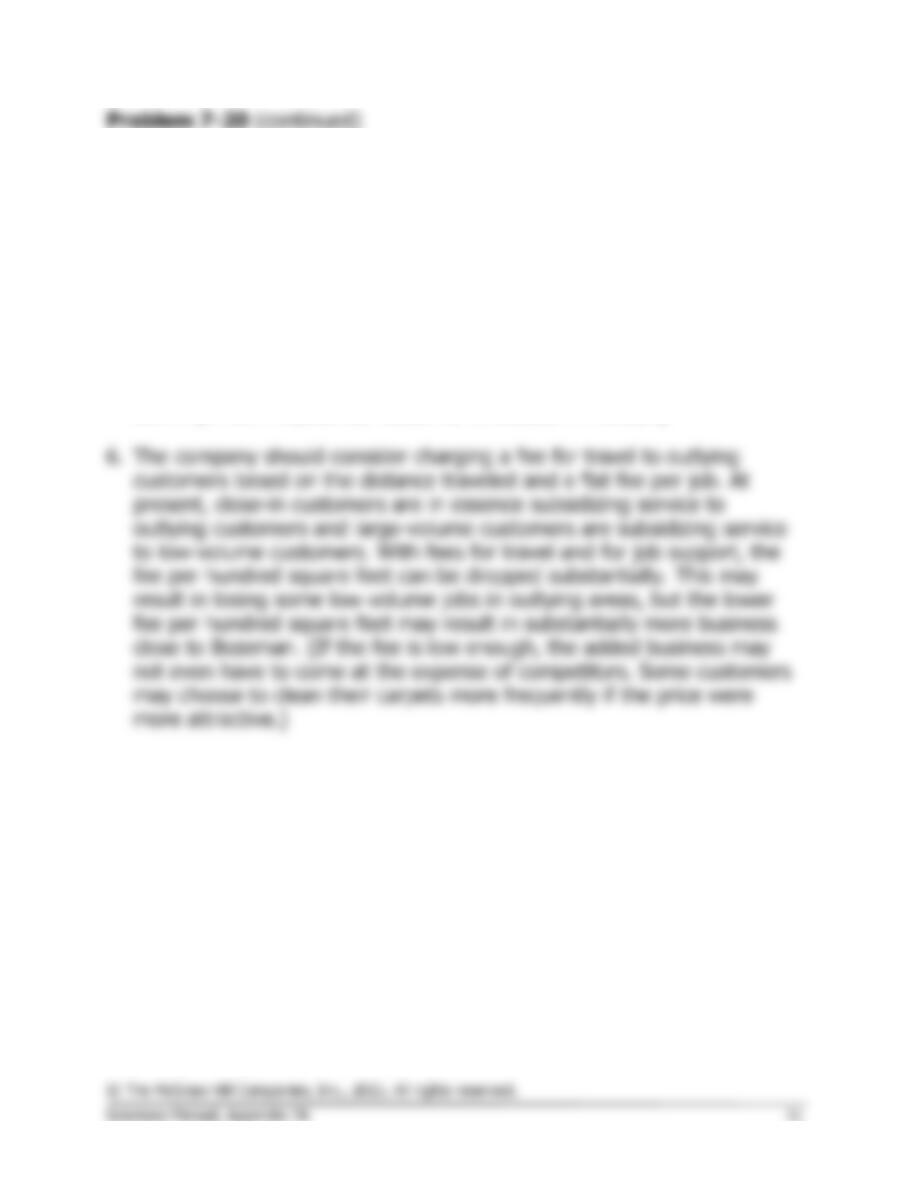
4. The margin earned on the job can be easily computed by using the
costs calculated in part (3) above.
Sales ……………………
$140.00
Costs:
Cleaning carpets …..
$40.25
Travel to jobs ………
Job support …………
Margin ………………….
5. Gallatin Carpet Cleaning appears to be losing money on the Flying N
Ranch job. However, caution is advised. Some of the costs may not be
avoidable and hence would have been incurred even if the Flying N
Ranch job had not been accepted. An action analysis (discussed in
Appendix 7A) is a more appropriate starting point for analysis than the
simple report in part (4) above.
Nevertheless, there is a point at which travel costs eat up all of the
profit from a job. With the company’s current policy of charging a flat
fee for carpet cleaning irrespective of how far away the client is from
the office, there clearly is some point at which jobs should be turned
down. (What if a potential customer is located in Florida?)
Appendix 7A
ABC Action Analysis
Exercise 7A-1 (30 minutes)
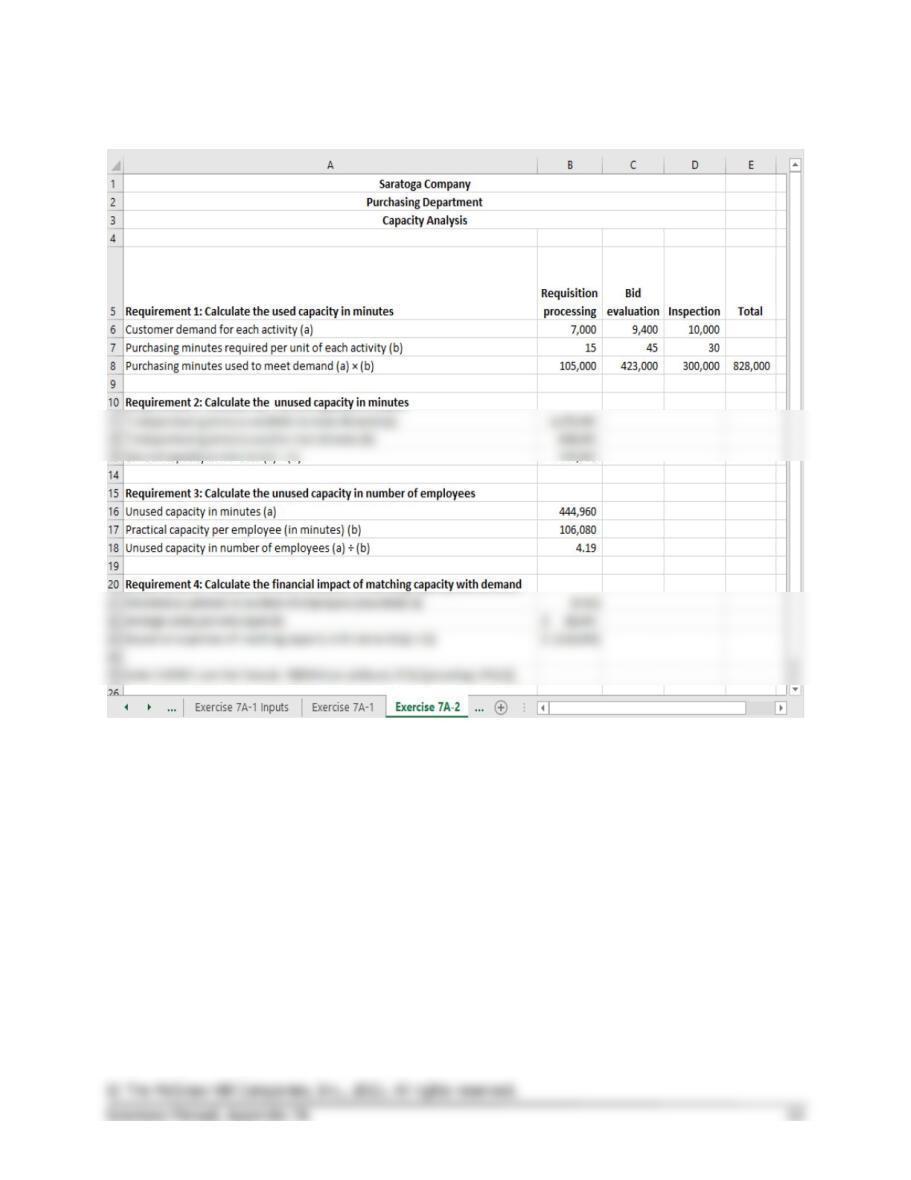
Exercise 7A-2 (30 minutes)
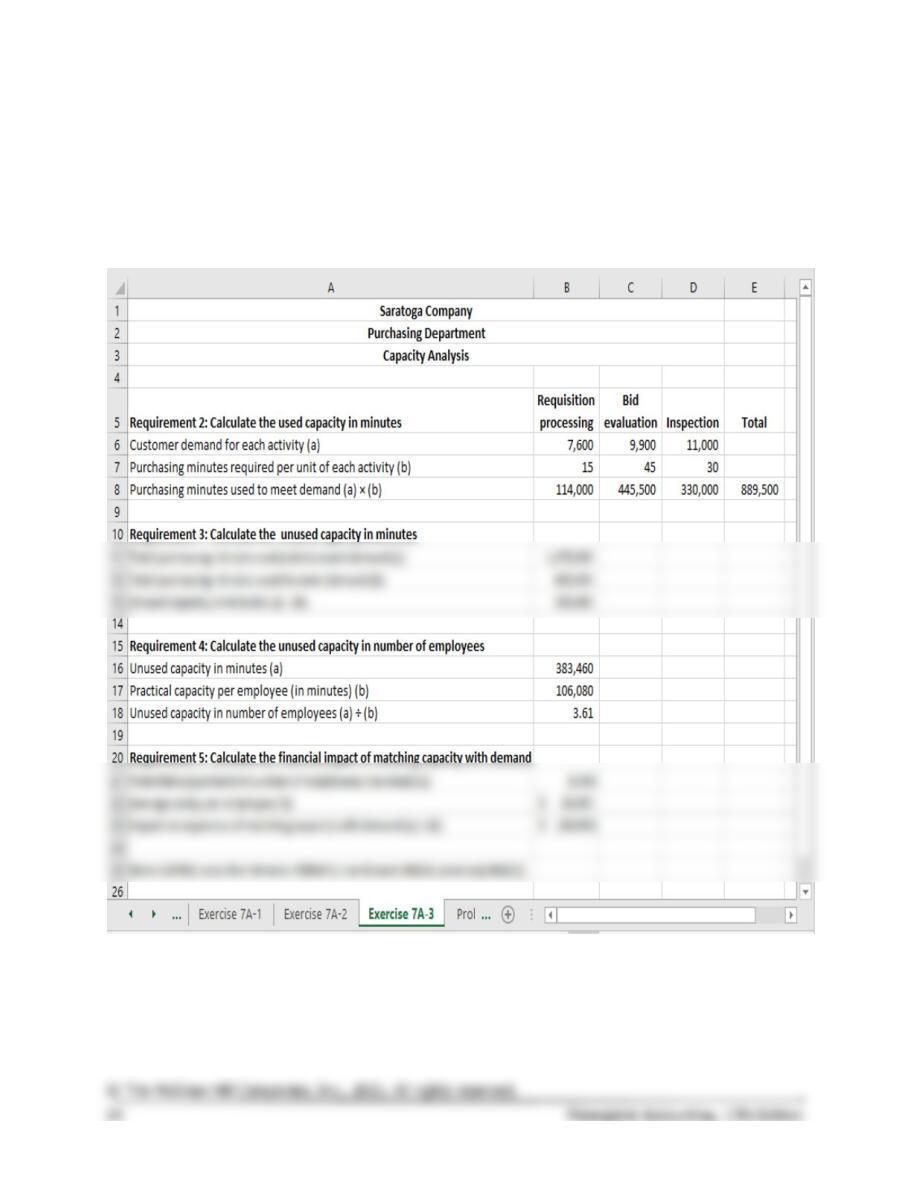
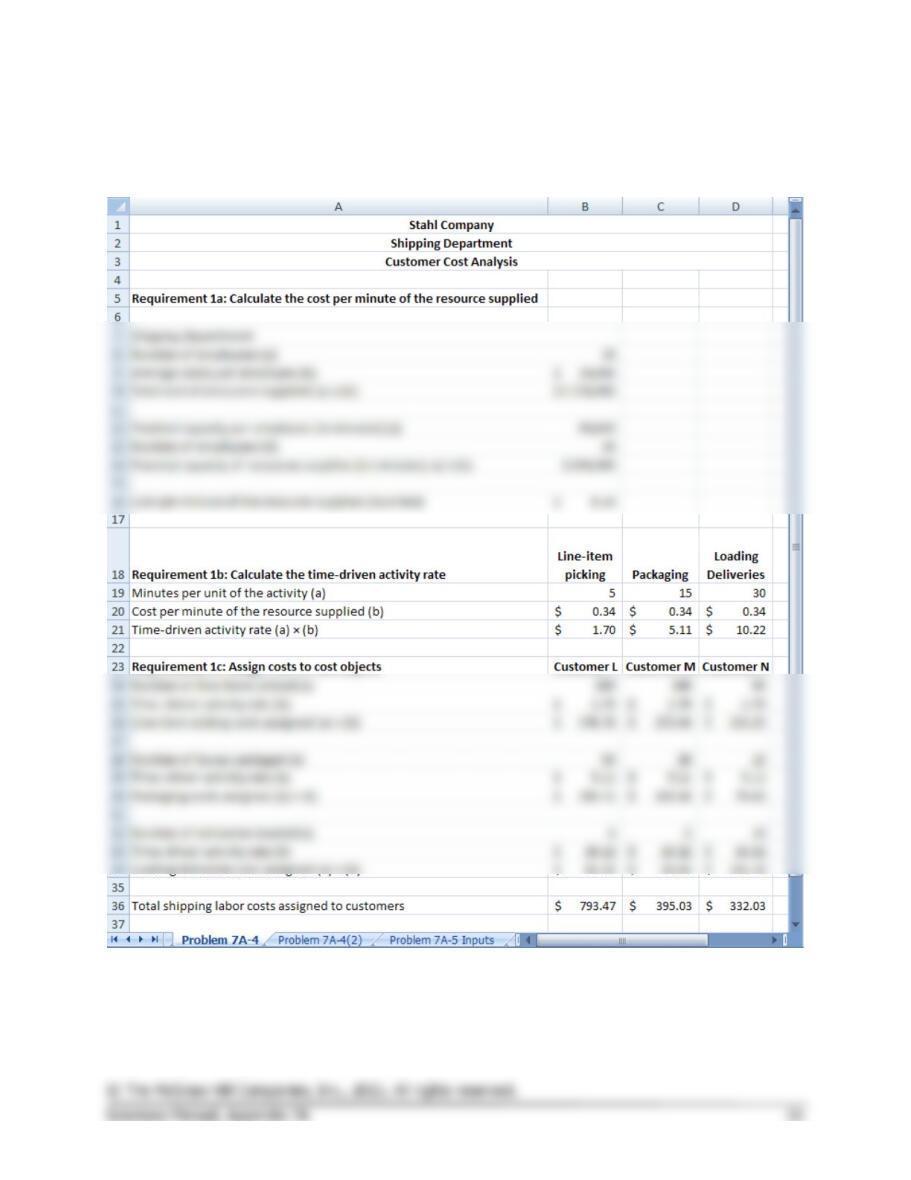
Exercise 7A-3 (30 minutes)
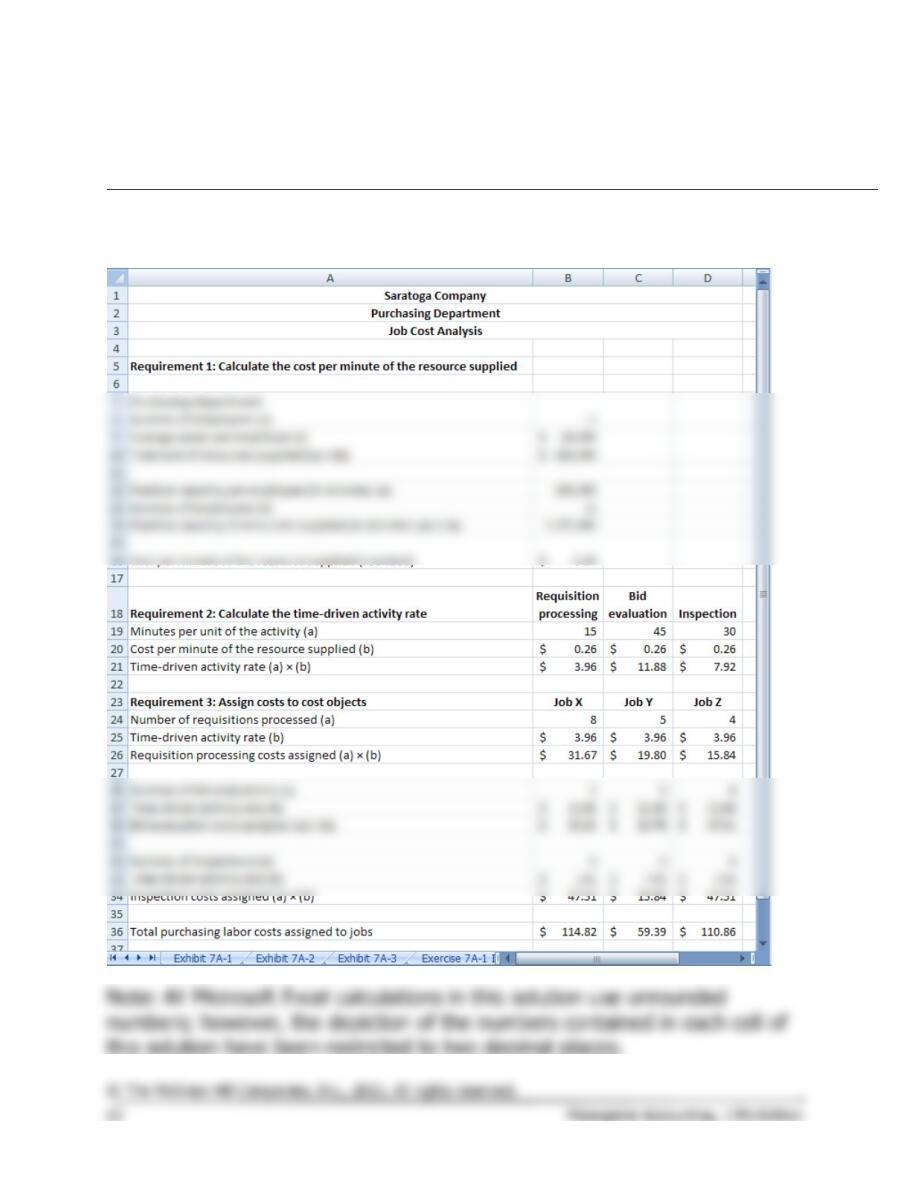
1. There will be no change to the labor costs assigned to the three jobs.
Only the total used and unused capacity will change.
Requirements 2 through 5:
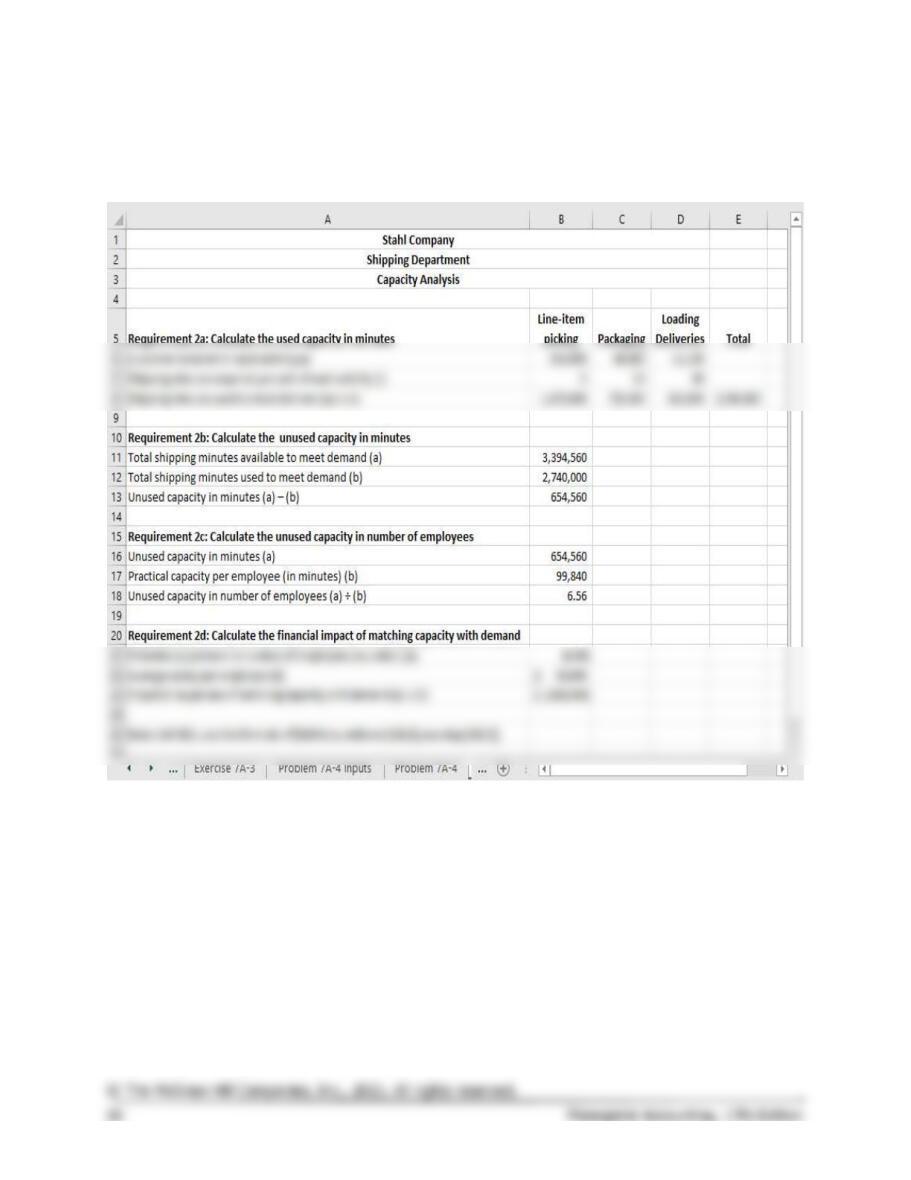
Problem 7A-4 (45 minutes)
Requirements 1a through 1c:
Note: All Microsoft Excel calculations in this solution use unrounded
numbers; however, the depiction of the numbers contained in each cell of
this solution have been restricted to two decimal places.
Problem 7A-4 (continued)
Requirements 2a through 2d:
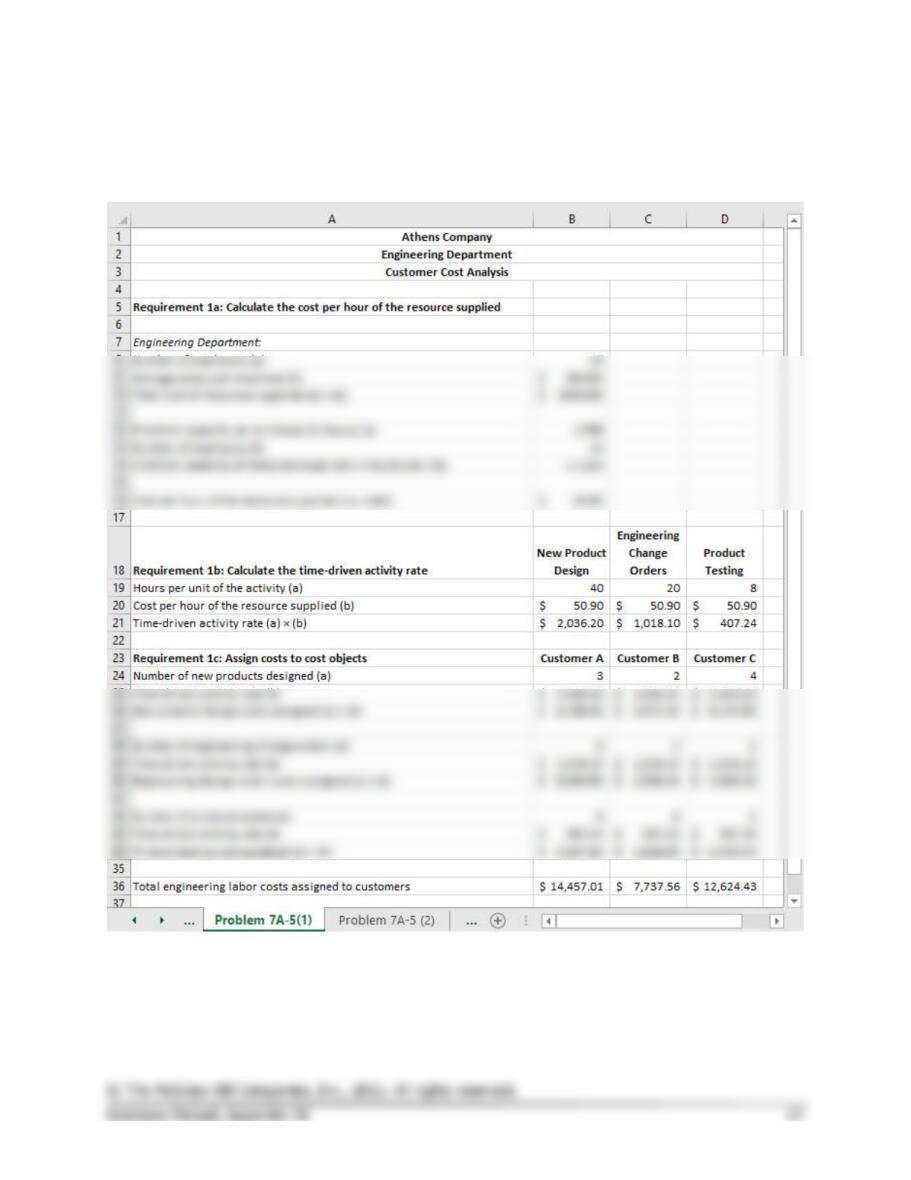
Problem 7A-5 (60 minutes)
Requirements 1a through 1c:
Note: All Microsoft Excel calculations in this solution use unrounded
numbers; however, the depiction of the numbers contained in each cell of
this solution have been restricted to two decimal places.
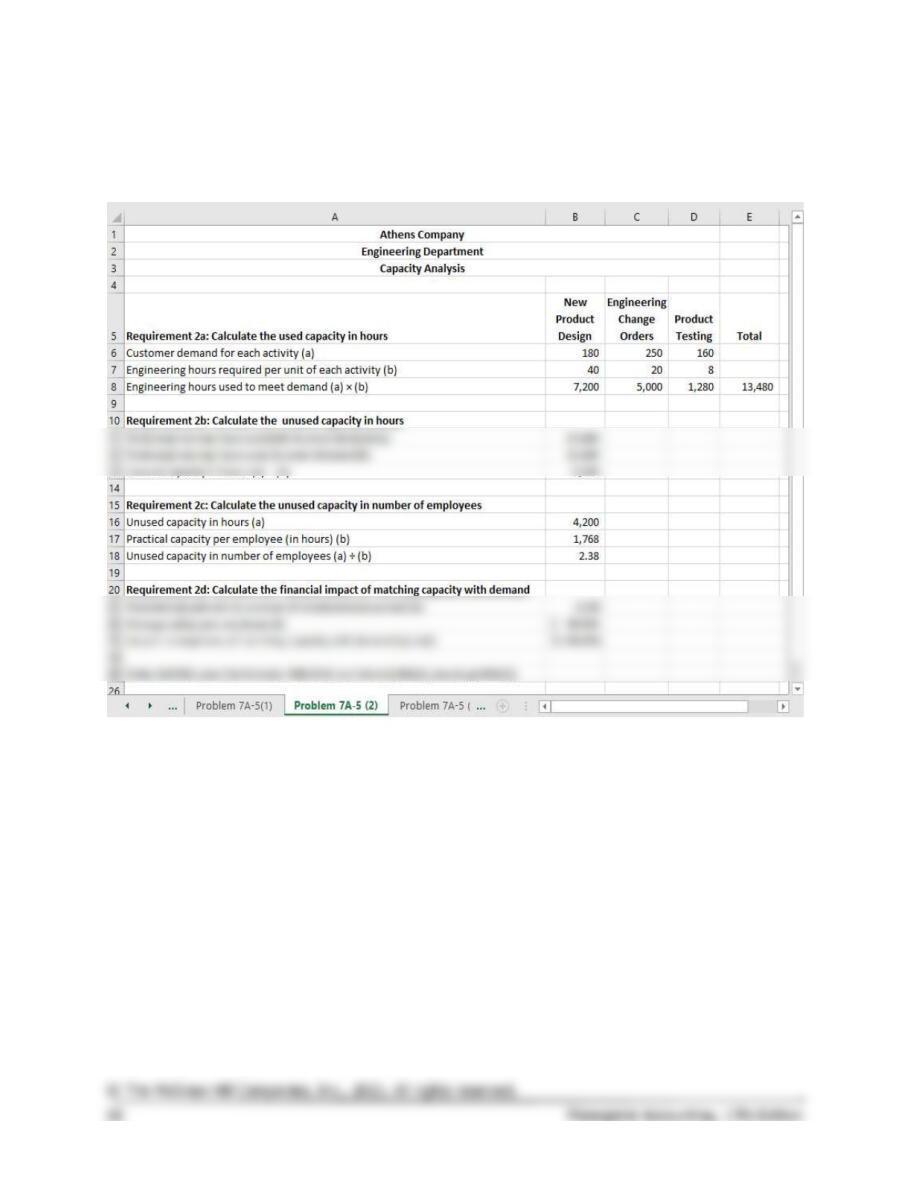
Problem 7A-5 (continued)
Requirements 2a through 2d:
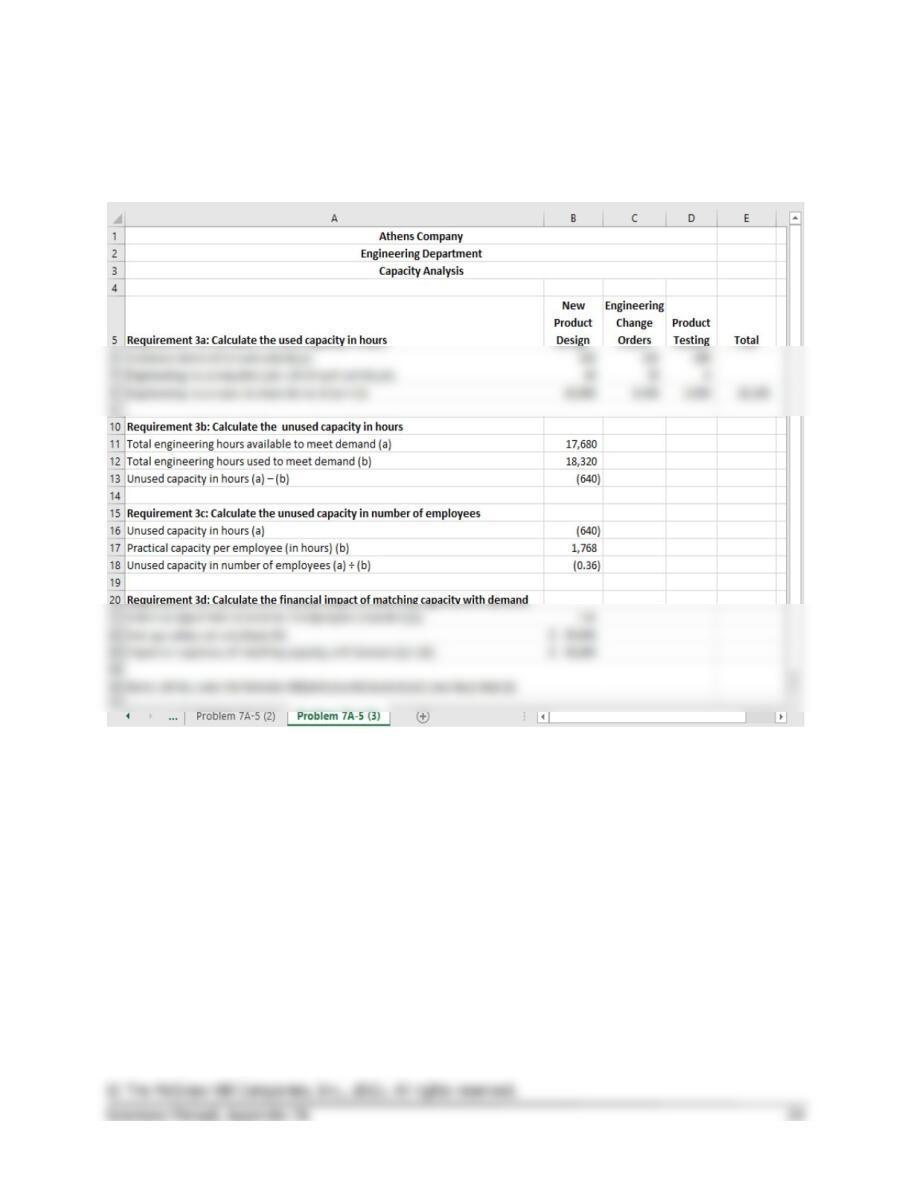
Problem 7A-5 (continued)
Requirements 3a through 3d: